Posted tagged ‘Obama’

Russia ready to consider Iraqi request for airstrikes

October 8, 2015

Russia ready to consider Iraqi request for airstrikes – Upper House speaker

Published time: 6 Oct, 2015 12:25

Edited time: 6 Oct, 2015 14:10

Source: Russia ready to consider Iraqi request for airstrikes – Upper House speaker — RT Russian politics

The crew of a Russian Su-30 fighter prepare to take off at Hmeimim aerodrome in Syria. © Dmitriy Vinogradov
Russia would consider an Air Force operation against ISIS in Iraq if that country’s authorities make such a request, Federation Council speaker Valentina Matviyenko told reporters, adding that Russia’s only interest was in defeating ISIS.

In case of an official address from Iraq to the Russian Federation, the leaders of our country would study the political and military expediency of our Air Force’s participation in an air operation. Presently we have not received such an address,” Matviyenko told reporters on Tuesday during an official visit to Jordan. She also asked the press “to stop reading tea leaves” before actual events take place.

I want to emphasize that Russia has no other political objectives and no interests other than the defeat of ISIS [formerly ISIS/ISIL] and that differs us from other nations that participate in another coalition,” Interfax news agency quoted Matviyenko as saying at a meeting with the head of the Jordanian Senate, President Abdur-Ra’uf Rawabdeh. She also said that Russian authorities understood the necessity of political reforms in Syria, but the final decision on the nature of these reforms and future head of the Syrian state must be made by Syrian people without any external pressure or direct interference of foreign nations.

READ MORE: Federal Security Service calls for broader international anti-ISIS coalition

During the meeting with her Jordanian colleague, Matviyenko stated that Russia was calling upon all states that see the Islamic State as a threat to join the information center in Baghdad used by Russian, Iraqi, Syrian and Iranian security specialists and military. She added that Russia was ready for other forms of cooperation with all nations that share the common goal of fighting international terrorism.

Last week, Russia started to carry out surgical airstrikes on terrorist positions in Syria after a request for such military aid was made by President Bashar Assad. The head of Russia’s presidential administration, Sergey Ivanov, emphasized that Moscow would not be involved in any ground operation – aid would only be in the form of airstrikes.

READ MORE: 39% of Russians approve Putin policies on Syria

In comments on the Upper House’s license on use of Russian military forces abroad, Valentina Matviyenko said that fighting against the Islamic State was in Russia’s national interests because terrorists posed a threat to Europe, Russia and the whole world. She also expressed confidence that the operation would be supported by an absolute majority of the world’s nations.

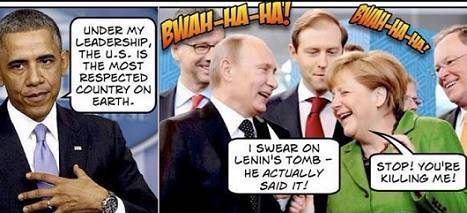
Cartoons of the day

October 7, 2015

H/t Freedom is just another word

Not on our side

ha

Russia Declares ‘Holy War’ on Islamic State

October 7, 2015

Russia Declares ‘Holy War’ on Islamic State While Obama sides with Christian-murdering “freedom fighters.”

October 7, 2015

Raymond Ibrahim

Source: Russia Declares ‘Holy War’ on Islamic State | Frontpage Mag

Raymond Ibrahim is a Shillman Fellow at the David Horowitz Freedom Center.

The Orthodox Christian Church, which holds an important place in an insurgent Russia, has described its government’s fight against the Islamic State and other jihadi opposition groups in Syria as a “holy war.”

According to Vsevolod Chaplin, head of the Church’s Public Affairs Department,

The fight with terrorism is a holy battle and today our country is perhaps the most active force in the world fighting it.  The Russian Federation has made a responsible decision on the use of armed forces to defend the People of Syria from the sorrows caused by the arbitrariness of terrorists. Christians are suffering in the region with the kidnapping of clerics and the destruction of churches. Muslims are suffering no less.

This is not some new “gimmick” to justify intervention in Syria.  For years, Russia’s Orthodox leaders have been voicing their concern for persecuted Christians.  Back in February 2012, Putin met with representatives of the Russian Orthodox Church.  They described to him the horrific treatment Christians are experiencing around the world, especially the Muslim world:

The head of External Church Relations, Metropolitan Illarion, said that every five minutes one Christian was dying for his or her faith in some part of the world, specifying that he was talking about such countries as Iraq, Egypt, Pakistan and India. The cleric asked Putin to make the protection of Christians one of the foreign policy directions in future.

“This is how it will be, have no doubt,” Putin answered.

Compare and contrast this with U.S. President Obama, who denies the connection between Islamic teachings and violence; whose policies habitually empower Christian-persecuting Islamists; who prevents Christian representatives from testifying against their tormentors; and who even throws escaped Christian refugees back to the lions, while accepting tens of thousands of Muslim migrants.

The Russian Patriarch Kirill even once wrote an impassioned letter to Obama, imploring the American president to stop empowering Christian persecuting jihadis.  That the patriarch said “I am deeply convinced that the countries which belong to the Christian civilization bear a special responsibility for the fate of Christians in the Middle East” must have only ensured that the letter ended in the trash bin of the White House.

Of course, Russian’s concern for Christian minorities will be cynically dismissed in America by the major talking heads on both sides.  While such dismissals once resonated with Americans, they are becoming less and less persuasive to those paying attention, as explained in “Putin’s Crusade—Is Russia the Last Defender of the Christian Faith?”

For those of us who grew up in America being told that the godless communist atheists in Russia were our enemies, the idea that America might give up on God and Christianity while Russia embraces religion might once have been difficult to accept.  But by 2015, the everyday signs in America show a growing contempt for Christianity, under the first president whose very claims of being a Christian are questionable.  The exact opposite trend is happening for Russia and its leaders—a return to Christian roots.

Indeed, growing numbers of Americans who have no special love for Russia or Orthodoxy—from billionaire tycoon Donald Trump to evangelical Christians—are being won over by Putin’s frank talk.

How can they not?  After one of his speeches praising the West’s Christian heritage—a thing few American politicians dare do—Putin concluded with something which must surely resonate with millions of traditional Americans: “We must protect Russia from that which has destroyed American society”—a reference to the anti-Christian liberalism and licentiousness that has run amok in the West.

Even the Rev. Franklin Graham’s response to Russia’s military intervention in Syria seems uncharacteristically positive, coming as it is from the head of the Billy Graham Evangelistic Association:  “What Russia is doing may save the lives of Christians in the Middle East….  You understand that the Syrian government … have protected Christians, they have protected minorities from the Islamists.”

Should U.S supported jihadis (“rebels”) succeed in toppling the government of Syria, Graham correctly predicts that there will be “a bloodbath of Christians”:

There would be tens of thousands of Christians murdered and slaughtered and on top of that, you would have hundreds of thousands of more refugees pouring into Europe. So Russia right now, I see their presence as helping to save the lives of Christians.

It is, of course, an established fact that the “good rebels”—the moderates—are persecuting Christians no less than the Islamic State.

When asked why the Obama administration is ignoring the persecution of Christians, Graham, echoing Putin, said Obama was more invested in promoting the homosexual agenda than he is in protecting Christian minorities:

I’m not here to bash the gays and lesbians and they certainly have rights and I understand all of that, but this administration has been more focused on that agenda than anything else. As a result, the Middle East is burning and you have more refugees moving today since World War II. It could have been prevented.

Indeed, at day’s end, it is not Russian claims of waging a holy war to save Christians from the sword of jihad that deserves to be cynically dismissed, but rather every claim the Obama administration makes to justify its support for the opposition in Syria (most of which is not even Syrian).

There are no “moderate rebels,” only committed jihadis eager to install Islamic law, which is the antithesis of everything the West used to hold precious.  If the “evil dictator” Assad kills people in the context of war, the “rebels” torture, maim, enslave, rape, behead, and crucify people solely because they are Christian.

How does that make them preferable to Assad?

And, based on established precedent—look to Iraq and Libya, the other countries U.S. leadership helped “liberate”—the outcome of ousting the secular strongman of Syria will be more atrocities, more Christian persecution, more bombed churches and destroyed antiquities, and more terrorism, including in the West, despite John Kerry’s absurd assurances of a “pluralistic” Syria once Assad is gone.

Thus, and once again, the U.S. finds itself on the side of Islamic terrorists, who always reserve their best for America.  The Saudis—the head of the Jihadi Snake which U.S. presidents are wont to kiss and bow to—are already screaming bloody murder and calling for an increased jihad in Syria in response to Russia’s audacious call to holy war.

Will Obama and the MSM comply, including through an increased propaganda campaign?  Top Islamic clerics like Yusuf Qaradawi—who once slipped on live television by calling on America to wage “jihad for Allah” against Assad—seem to think so.  Already the U.S. “welcomes” the new cruel joke that Saudi Arabia—one of the absolute worst human rights violators—will head a U.N. human rights panel.

At day’s end and all Realpolitik aside, there is no denying reality: what the United States and its Western allies have wrought in the Middle East—culminating with the rise of a bloodthirsty caliphate and the worst atrocities of the 21st century—is as unholy as Russia’s resolve to fight it is holy.

Bravo Codevilla — and a note on Russian-Turkish Fighter Contact

October 7, 2015

Bravo Codevilla — and a note on Russian-Turkish Fighter Contact

By David P. Goldman

October 6, 2015 in Chatham House Rules

Source: Bravo Codevilla — and a note on Russian-Turkish Fighter Contact | Asia Times

Angelo Codevilla’s terse and magisterial reading of Putin’s war aims is simply the best thing I have read on a subject which elicits the sort of heavy breathing that belongs in pulp scenario novels (e.g., Commentary Magazine’s post this week entitled “It’s Not a New Cold War– It’s Something Worse“). The US ambled about in a fantasy world after the misnamed Arab Spring, searching for “moderate Sunnis” who might represent a viable alternative to the Assad regime in Syria. Like most sleepwalkers, Washington is grouchy about the rude wake-up, but there is no risk of war, hot or cold.

Something additional, though, needs to be said about Russia and Turkey, which the estimable M.K. Bhadrakumar (India’s past ambassador to Turkey) neglected to say in his note today (“Russia Outflanks Turkey in Syria“). NATO has protested Russia’s violation of Turkish air space, and the usual commentators have been wheeled out to warn that air-space infractions followed by fighter interception can lead to nasty accidents. But that is beside the point. In order to suppress the emergence of a Kurdish zone in northern Syria linked to the de facto Kurdish state in northern Iraq, Turkey has been supporting whatever Islamists it find, including ISIS, to harry the Kurds. It has been using fighter cover to favor its Islamist allies in its war on the Kurds.

Turkish journalist Kadri Gursel last week explained the game in AI-Monitor:

Using some imagination, one could foresee the adverse impacts Russia’s move will have on Ankara’s policies on the ground. Ankara is now likely to be forced to end the de facto situation — virtually a no-fly zone — it has enforced casually in border areas since 2012. In June 2012, after a Turkish reconnaissance plane was shot down by an air defense system in Syria, Ankara announced new rules of engagement, including the interception of Syrian aircraft flying close to Turkish airspace. There has been no indication so far that these rules of engagement have changed. Since the summer of 2012, Turkish media have occasionally reported incidents of Turkish fighter jets taking off from their bases to chase off Syrian planes and helicopters flying “too close” to the border.

Ankara-backed Islamist groups fighting Assad’s regime have emerged as the main beneficiary of these rules of engagement, which have effectively served as a Turkish air cover for their military and logistical operations in border regions.

NATO let the Turks go rogue in their campaign against the Kurds, who will outnumber ethnic Turks among Turkey’s under-25 population in less than twenty years. The Obama administration has given the Turks a pass even when Turkish actions blatantly violate Washington’s declared policy. Evidently Putin has decided to punch Erdogan in the nose, just as he punchd Obama in the nose by blasting some American-sponsored Sunni fighters. Someone has to take the fall in the region, and that someone would be Turkey.

Russia has ‘substantial’ number of troops inside Syria, says Nato secretary-general

October 6, 2015

Russia has ‘substantial’ number of troops inside Syria, says Nato secretary-general

Lizzie Dearden

Tuesday 6 October 2015 10:25 BST 188 comments

Source: Russia has ‘substantial’ number of troops inside Syria, says Nato secretary-general | Middle East | News | The Independent

Here we go again !

Did we not here this before and proved by false pictures  in the Ukraine ?

Vladimir Putin has previously said there will be ‘no Russian boots on the ground’ in Syria AFP/Getty Images.

Russia has built up a “substantial” military presence including ground troops in Syria, according to the Nato secretary-general.

Jens Stoltenberg told journalists that Vladimir Putin’s forces have not mainly been targeting Isis, but other opposition groups.

“I will not go into any specific numbers but I can confirm that we have seen the substantial build-up of Russian forces in Syria – air force, air defences but also ground troops in connection with the air base they have,” he continued.

20-Russia-Pilot-AP.jpg
A Russian pilot climbs from an SU-25M jet fighter at Hmeimim airbase in Syria

“And we also see increased naval presence of Russian ships and naval capabilities outside Syria or in the eastern part of the Mediterranean.

“So there has been a substantial military build-up by Russia with many different kinds of capabilities and forces, over the last weeks.”

Mr Putin previously said that he had no plans to deploy ground troops in Syria.

“Russia will not take part in any field operations on the territory of Syria or in other states; at least, we do not plan it for now,” the Russian President told CBS last week.

Mr Stoltenberg said the US has made contact with Moscow to establish ways to ensure Russian planes and jets from the international coalition fighting Isis do not clash during their missions over Syria.

But relations with Turkey seemed less cordial after Russia’s Air Force reportedly violated its airspace on Saturday and Sunday.

Mr Stoltenberg said the reported incidents were “very serious“, adding: “It doesn’t look like an accident, and we’ve seen two of them over the weekend.”

Russia’s defence ministry said the first incursion was unintentional and lasted only “a few seconds” as a fighter jet approached a Syrian air base just over the nearby border in bad weather.

There were reports of air strikes in the Isis-held city of Palmyra today, targeting the jihadist group’s vehicles and weapons, as the Kremlin’s campaign continued today.

Iran troops to join Syria war, Russia bombs group trained by CIA

October 6, 2015

Iran troops to join Syria war, Russia bombs group trained by CIA

BEIRUT/MOSCOW |

By Laila Bassam and Andrew Osborn

Source: Iran troops to join Syria war, Russia bombs group trained by CIA | Reuters

Hundreds of Iranian troops have arrived in Syria to join a major ground offensive in support of President Bashar al-Assad’s government, Lebanese sources said on Thursday, a sign the civil war is turning still more regional and global in scope.

Russian warplanes, in a second day of strikes, bombed a camp run by rebels trained by the U.S. Central Intelligence Agency, the group’s commander said, putting Moscow and Washington on opposing sides in a Middle East conflict for the first time since the Cold War.

Senior U.S. and Russian officials spoke for just over an hour by secure video conference on Thursday, focussing on ways to keep air crews safe, the Pentagon said, as the two militaries carry out parallel campaigns with competing objectives.

“We made crystal clear that, at a minimum, the priority here should be the safe operation of the air crews over Syria,” Pentagon spokesman Peter Cook said.

Two Lebanese sources told Reuters hundreds of Iranian troops had reached Syria in the past 10 days with weapons to mount a major ground offensive. They would also be backed by Assad’s Lebanese Hezbollah allies and by Shi’ite militia fighters from Iraq, while Russia would provide air support.

“The vanguard of Iranian ground forces began arriving in Syria -soldiers and officers specifically to participate in this battle. They are not advisers … we mean hundreds with equipment and weapons. They will be followed by more,” one of the sources said.

So far, direct Iranian military support for Assad has come mostly in the form of military advisers. Iran has also mobilised Shi’ite militia fighters, including Iraqis and some Afghans, to fight alongside Syrian government forces.

Moscow said it had hit Islamic State positions, but the areas it struck near the cities of Hama and Homs are mostly held by a rival insurgent alliance, which unlike Islamic State is supported by U.S. allies including Arab states and Turkey.

Hassan Haj Ali, head of the Liwa Suqour al-Jabal rebel group that is part of the Free Syrian Army, told Reuters one of the targets was his group’s base in Idlib province, struck by about 20 missiles in two separate raids. His fighters had been trained by the CIA in Qatar and Saudi Arabia, part of a programme Washington says is aimed at supporting groups that oppose both Islamic State and Assad.

“Russia is challenging everyone and saying there is no alternative to Bashar,” Haj Ali said. He said the Russian jets had been identified by members of his group who once served as Syrian air force pilots.

The group is one of at least three foreign-backed FSA rebel factions to say they had been hit by the Russians in the last two days.

At the United Nations, Russian Foreign Minister Sergei Lavrov told a news conference Moscow was targeting Islamic State. He did not specifically deny that Russian planes had attacked Free Syrian Army facilities but said Russia did not view it as a terrorist group and viewed it as part of a political solution in Syria


NATO Warns Russia to Stay Out of Turkish Air Space

October 6, 2015

NATO has warned Russia to keep its aircraft, currently in Syria, out of Turkey’s air space.

By: Hana Levi Julian

Published: October 6th, 2015

Source: The Jewish Press » » NATO Warns Russia to Stay Out of Turkish Air Space

American F-16 fighter jets

F-16 fighter jets in flight. (Illustration photo)
Photo Credit: US Government

Russia was warned Tuesday to keep out of Turkish air space by the North Atlantic Treaty Organization (NATO) over its violations of Turkish Air Space.

“Russian combat aircraft have violated Turkish airspace,” NATO secretary-general Jens Stoltenberg said in a statement on the NATO website following the organization’s meeting Monday (Oct 5). “This is unacceptable.”

In a follow-up news conference, Stoltenberg went on to say, “It doesn’t look like an accident (as Moscow had claimed earlier), and we also have seen two of them, two violations of Turkish airspace. Intelligence that we have received provides me with reason to say it doesn’t look like an accident.”

The first incursion was reported on Saturday, and the second allegedly occurred on Sunday, officials said.

“I’m also concerned that Russia is not targeting ISIL (the group’s acronym for ISIS, or Da’esh), but instead attacking the Syrian opposition and civilians,” Stoltenberg continued.

“I discussed the situation in Syria with [Russia’s] Foreign Minister [Sergei] Lavrov in New York last week. I urge Russia to play a constructive and cooperative role in the fight against ISIL, and to strive for a negotiated political solution to the conflict in Syria.”

Turkey has been an active member of NATO since 1952.

Israeli Minister Yuval Steinitz told Galei Tzahal Radio last week that Israel does not want to see Russian troops on the Golan Heights and is concerned about the positioning of Iranian ground troops in the neighboring country, and the opening of a direct ground front with Iran.

Steinitz added, the world powers must “ensure the Iranian army stays in Iran. We should not see Iranian army divisions in Syria.”

Steinitz said Israel has no official position on the fate of Assad as it’s an internal Arab civil war, but added that “the war against Sunni terror [ISIS] can’t come together with support for Iranian Shiite terror.”

“Allies expressed their deep concern with regard to the Russian military build-up in Syria,” NATO said in its statement, “and especially the attacks by the Russian Air Force on Hama, Homs, and Idlib which led to civilian casualties and did not target Da’esh.

“Russian military actions have reached a more dangerous level with the recent violations of Turkish airspace on 3 October and 4 October by Russian Air Force SU-30 and SU-24 aircraft in the Hatay region. The aircraft in question entered Turkish airspace despite Turkish authorities’ clear, timely and repeated warnings,” the statement went on.

“Allies strongly protest these violations of Turkish sovereign airspace, and condemn these incursions into and violations of NATO airspace. Allies also note the extreme danger of such irresponsible behaviour. They call on the Russian Federation to cease and desist, and immediately explain these violations.”

Russia is also moving in equipment in preparation for a rather more extended role in the region than its originally-stated claim, according to eyewitness reports in Syria.

Recently Moscow moved electronic jamming equipment into the country, including a truck-mounted system and a number of aircraft-mountable pods, according to local sources.

Several pieces of artillery were also moved into the country at Latakia port, including four highly accurate BM-30 multiple-launch rapid-fire rocket systems.

Instead of remaining at the port, however, the weapons were moved and currently are reported to be in position west of Idlib, towards Homs.

According to the report, the U.S. believes Russia is “stepping up its ground activity” to attack Syrian opposition forces rather than ISIS.

Officials are reportedly questioning whether Russian forces are planning to jam the electronics of coalition aircraft as they fly over Syria.

Russia, meanwhile, contends it is indeed targeting ISIS. But it is clear that its forces are also clearly bolstering the flagging defenses of Syrian President Bashar al-Assad.

U.S. President Barack Obama meanwhile authorized additional supplies on Monday for the Kurdish and other Muslim opposition forces in Syria, according to CNN.

“President Obama was clear that we intend to continue our efforts to degrade and ultimately destroy ISIL in Syria and to keep supporting the moderate Syrian opposition,” said a senior administration official who spoke with CNN.

Although both the Russians and the Americans claim to be targeting Da’esh forces, neither deny they are also supporting Syrian fighters – with Russia backing the government and the U.S. backing “moderate” Muslim opposition fighters.

There are problems on both sides.

The government forces have tortured and murdered hundreds of thousands of their own citizens, and used chemical weapons against their own people as well.

The “moderate” rebel forces, meanwhile, have also been caught selling their American-made weapons to radical Islamist forces – including the Al Qaeda-linked Jabhat al-Nusra group – in order to secure safe passage and in some cases, simply in order to remain alive. There is simply no way to know into whose hands those American weapons will fall next.

What is very likely, however, is that whichever “moderate” forces exist in Syria will not be in control of the country when the war ends. Up to half of the country’s total population have fled Syria to other lands simply to survive

Iraq Welcomes Russian Airstrikes Against ISIL

October 6, 2015

Top Diplomat: Iraq Welcomes Russian Airstrikes Against Islamic State

BY:
October 5, 2015 4:50 pm

Source: Iraq Welcomes Russian Airstrikes Against ISIL


Unsatisfied by the Obama administration’s campaign against the Islamic State in the region, the Iraqi government welcomes Russian airstrikes against the terrorist group inside Iraq, according to a top diplomat.

The Air Force Times reported:

The Iraqis feel that the U.S.-led campaign against the Islamic State has become too focused on Syria and has not made enough progress on the ground in Iraq, a senior Iraqi diplomat, who asked to speak on condition of anonymity, told Air Force Times on Monday. The official accused the coalition fores of moving too slowly, thereby missing opportunities to roll back the Islamic State in Iraqi cities. Since more than 2,000 Russians are among the Islamic State’s ranks and Russia has experience fighting Islamic militants in Chechnya, it makes sense to include Russia in anti-Islamic State efforts, he said.

While Iraq is open to the possibility of Russian airstrikes, the diplomat said that the Iraqi government would not welcome Russian troops on the ground fighting the Islamic State (IS, also known as ISIL or ISIS). Iraq has not formally asked Russia to conduct airstrikes in the country.

Ignoring warnings from the Obama administration, Russia has been increasing its military activity in Syria in recent weeks in order to allegedly combat IS and bolster the Bashar al-Assad regime. Moscow has sent troops and military aid to Syria and last week conducted its first airstrikes there.

Russian warplanes dropped bombs near the city of Homs in western Syria Wednesday, an area that is not controlled by Islamic State militants. Defense Secretary Ash Carter has expressed skepticism that the Russian strikes were targeting IS.

Iraq agreed last month to share intelligence with Russia and Syria in the effort against IS, but the top diplomat insisted Monday that the agreement will not put U.S. or other coalition forces at risk. He also called on the U.S. to provide Iraq with more M1A1 Abrams tanks so that Iraqi forces can reclaim the Anbar province from IS.

U.S. intelligence agencies concluded in July that the Obama administration bomb campaign against IS in the Middle East has yielded no perceivable degradation in the terrorist group’s forces.

Russian Air Force destroys 20 ISIS tanks near Palmyra

October 6, 2015

Russian Air Force destroys 20 ISIS tanks near Palmyra – Defense Ministry (VIDEOS)

Published time: 5 Oct, 2015 21:23

Edited time: 6 Oct, 2015 11:51

Source: Russian Air Force destroys 20 ISIS tanks near Palmyra – Defense Ministry (VIDEOS) — RT News

Russian pilots prepared to board the SU-30 attack plane to take off from the Hmeimim aerodrome in Syria. © Dmitriy Vinogradov
Russia’s Sukhoi jets flew 15 sorties over Syria on Monday striking 10 Islamic State targets in various regions, according to Russia’s Defense Ministry. 20 tanks and 3 rocket launchers in Homs province near embattled Palmyra were destroyed,

“During the day, Sukhoi-34, Sukhoi-24M and Sukhoi-25 warplanes flew a total of 15 sorties from the Khmeimim airbase. Air strikes were delivered at ten targets of the Islamic State [IS, formerly ISIS/ISIL] group in Syria,” Igor Konashenkov, Russia’s Defense Ministry spokesman said in a statement on Monday.

A pair of Su-25Ms (NATO reporting name: Frogfoot) together with an Su-24 (NATO reporting name: Fencer) carried out strikes on two IS targets in the eastern part of Homs province near the city of Tadmur, he said.

“About 20 units of medium T-55 tanks, which were earlier seized by the militants from the Syrian army, have been destroyed [in the strikes],” as well as three multiple rocket launchers, he noted.

A video released by the ministry also showed a strike against an IS ammunition depot in Homs. The ministry explained: “Bright flashes confirm detonation of munitions caused by direct hits of air bombs. Thick smoke provides evidence of fire in the depot.”

The city Tadmur is located in an oasis in the middle of the Syrian Desert and stands about half a kilometer northeast of the ruins of the ancient city of Palmyra. The UNESCO protected cultural site was captured by IS in May. They have been gradually destroying archeological artifacts and structures since seizing the ancient city. On Sunday they blew up the Arch of Triumph, a centerpiece of the ancient ruins.

READ MORE: ISIS terrorists blow up iconic 2,000yo Arch of Triumph in Palmyra  

US Central Command reported on Monday that the US-led coalition had conducted airstrikes near Palmyra with “inconclusive results.

Russian Su-34 bombers destroyed IS headquarters and a command post in the Aleppo province, Konashenkov said on Monday, adding that there had been “direct hits” on structures housing field commanders in Dayr Hafir and al-Bab.

Some 30 IS military vehicles including tanks were destroyed in the forested area near the city of Idlib in northwest Syria, according to the ministry.

We have irrefutable intelligence, including [intercepted] communications between the militants in the area, [proving] the destruction and damage of the terrorists’ armored vehicles,” Konashenkov said.

Russia launched its anti-IS operation in Syria on September 30 after a request from President Bashar Assad. Russian President Vladimir Putin has also expressed concern about the number of Russian extremists in the country.

On Saturday, three days into the operation, Russia’s Defense Ministry said that, based on Russian intelligence, the militants were fleeing the area which had been under their control. It also stated that the strikes have significantly reduced the terrorists’ combat capabilities.

With Russia’s Dep. Army Chief due in Israel, Moscow posts 64 S-300 ship-to-air missiles off Syria, N. Israel

October 5, 2015

With Russia’s Dep. Army Chief due in Israel, Moscow posts 64 S-300 ship-to-air missiles off Syria, N. Israel

DEBKAfile Exclusive Report October 5, 2015, 2:18 PM (IDT)

Source: With Russia’s Dep. Army Chief due in Israel, Moscow posts 64 S-300 ship-to-air missiles off Syria, N. Israel

The Russian missile cruiser Moskva in action. In addition to 64 S-300 anti-aircraft missiles, the warship has 16 SS-N-12 missiles aboard specially designed to destroy US aircraft carriers.


Russia’s deputy chief of staff, Gen. Nikolay Bogdanovsky, accompanied by a large military delegation, arrives in Israel for a two-day visit on Tuesday, Oct. 6, to discuss increased coordination between the two militaries. However, Moscow seems to be sending Jerusalem an altogether different message: Friday, Oct. 2, the Russian Defense Ministry announced the surprise deployment of Navy cruiser, the Moskva, armed with 64 advanced anti-aircraft missiles S-300 ship-to-air missiles opposite the Syrian coastal town of Latakia.
debkafile’s military sources point out that Russia, without saying so publicly, has thus created an effective no-fly zone over most of Syria, most of northern Israel, including the Golan, as well as southern Turkey, for US aircraft based there for air strikes in Syria; Cyprus, the site of British air force bases; and Jordan.

Since 2012, The Obama administration has been discussing the possibility of establishing no-fly zones in northern and southern Syria on a number of occasions, but has shelved the plan whenever a decision was imminent. Now, with one move, Moscow has imposed a no-fly zone over Syria.

The presence of the wide-ranging S-300s means that the Turkish, British, Israeli and Jordanian air forces will need to coordinate their aerial operations in Syrian or Lebanese airspace with Russia, or face the risk of their planes being shot down.

In the view of debkafile’s military sources, the only aircraft capable of evading those advanced missiles are stealth planes. Neither the Israeli, British, Jordanian or Turkish air forces, nor the US squadron in Turkey consisting of F-16 fighters, have such aircraft at their disposal.

The S-300 has a range of 150 kilometers and can shoot down any type of missile, including cruise missiles, as well as planes.

If US President Obama truly wanted to deal effectively with Moscow’s military moves in Syria, besides saying that Russia is bound to fail, he would have ordered the deployment of US stealth fighters to Turkey and Israel. However,may have been held back from this step by fear of antagonizing Iran, which has so far delayed sealing the nuclear agreement with the world powers by putting it to vote in parliament.

The presence of Moskva off the shores of Syria and close to northern Israel creates a new situation that will very likely be discussed in the talks that start Tuesday in Tel Aviv between Russia’s deputy chief of staff and his Israeli counterpart, IDF Gen. Yair Golan.

Although Russian President Vladimir Putin promised Israeli Prime Minister Binyamin Netanyahu during their summit in Moscow on September 21 not to allow S-300 missiles reach the hands of the Syrian military, he made no promises about positioning them on a Russian warship in the Mediterranean facing Syria and northern Israel.          .

Our military sources point out that Russian air strikes have not been confined to any single area so far, but the injection of S-300s into the war arena widens the Russian air force’s options.

In an interview with CNN on October 4, Prime Minister Netanyahu described how the Russian operation in Syria had affected relations with Moscow. “We don’t want to go back to the days when, you know, Russia and Israel were in an adversarial position,” he said. “I think we’ve changed the relationship. And it’s, on the whole, good.” He added that Israel’s close relations with the US were in a completely different and special category.

When asked whether he thought Russia’s intervention would cause instability in the region, he seemed to avoid giving a detailed response, only saying, “I don’t know. I think time will tell”.

However, on the topic of the transfer of advanced weaponry to Hizballah, the prime minister was very clear. ”If anybody wants to use Syrian territory to transfer nuclear weapons to Hezbollah, we’ll take action,” he said.

It marked the first time for an Israeli prime minister to speak publicly on the possibility that the terrorist organization could acquire atomic weapons.