Posted tagged ‘Obama and Israel’

Time for Israel to Walk Away From US Aid

July 29, 2016

Time for Israel to Walk Away From US Aid, Front Page MagazineCaroline Glick, July 29, 2016

(Try again next year if Trump wins? — DM)

flags

Originally published by the Jerusalem Post

On Monday, acting head of the National Security Council Yaakov Nagel will sit down with his US counterpart, Susan Rice, and try to conclude negotiations about a new, multi-year defense assistance package.

We must all hope that he fails.

No clear Israeli interest will be advanced by concluding the aid deal presently on the table. 

Indeed, the deal now being discussed will cause Israel massive, long-term economic and strategic damage. This is true for a number of reasons.

First, there is the issue of the deal’s impact on Israel’s military industries, which are the backbone of Israel’s strategic independence.

Under the current defense package, which is set to expire next year, a quarter of the US aid Israel receives is converted to shekels and spent domestically.

Reportedly, the deal now under negotiation will bar Israel from using any of the funds domestically.

The implications for our military industries are dire. Not only will thousands of Israelis lose their jobs. Israel’s capacity to develop its own weapons systems will be dangerously diminished.

Then there is the problem of joint projects.

Today, Israel receives additional US funds to develop joint projects, including the Iron Dome and David’s Sling short range missile and rocket defense programs. These programs were undertaken in response to threats that weren’t foreseen when the current deal was negotiated a decade ago.

According to reports, the deal now being negotiated denies Israel and the US the ability to fund jointly new projects or to provide supplemental funding for existing projects. All funding for all projects will be covered by the lump sum that is currently being negotiated.

Not only does this preclude new projects, it prevents Congress from exercising oversight over administration funding of existing joint projects with Israel. President Barack Obama has consistently tried to slash funding of missile defense programs, only to be overridden by Congress. Under the deal now on the table, Congress will be denied the power to override a hostile administration.

Given the obvious problems with the aid program currently being proposed by the Obama administration, there’s little wonder that until now, Prime Minister Benjamin Netanyahu has publicly stated that if necessary, Israel is ready to wait for the next administration. Some argue that Netanyahu’s apparent newfound interest in concluding negotiations on Obama’s terms owes to his fear that this is the best offer Israel is likely to get. Both Hillary Clinton and Donald Trump for various reasons, it is argued, will be less likely to offer significant increases in US military assistance.

Assuming this is accurate, the question becomes whether Israel has an interest in the assistance at all.

And so we come to the F-35.

For Israel, to a significant degree, the aid package on offer is about the F-35, the US’s fifth generation fighter, otherwise known as the Joint Strike Fighter.

Last month Defense Minister Avigdor Liberman and IAF Chief of Staff Brig.-Gen Tal Kelman flew to Texas to ceremonially “take possession” of Israel’s first two F-35s. Both aircraft are set to be delivered to Israel in December.

To date, the IAF has purchased 33 F-35s – all with US aid money. The IAF wants to purchase a total of 75 F-35s, which are supposed to replace the F-16s and the F-15s that the IAF currently fields.

As Liberman made clear during his visit, whether Israel purchases them or not is entirely dependent on the aid deal.

We should not take them. We should walk away.

And we should walk away even if we receive nothing in exchange for the planes we reject.

The F-35 is a disaster of epic proportions, for the US first and foremost. If Israel agrees to base its next generation fighters on the F-35, it will be a disaster for us as well. Although it is late in the game, we need to cut our losses.

To date, the F-35 has cost the US $400 billion.

That is twice what it was supposed to cost. The project is already four years behind schedule and still in development. It won’t be operational until May 2018 – at the earliest.

The F-35 is a jet that was developed by a committee and tasked with doing everything. So it isn’t surprising that it doesn’t work. In February, J. Michael Gilmore, the director of the Pentagon’s Operational Test and Evaluation office, submitted a scathing report to Congress on the F-35 program.

It is worth going through just a few of his findings.

The F-35’s calling card is its stealth capacity.

According to the engineers at Lockheed Martin, the JSF is supposed to be all-but-invisible to radar systems. Its stealth system is supposed to be far superior to the stealth capabilities of its third generation predecessors.

But at present, its stealth systems do not work, and it is unclear whether they will ever work as planned.

First there is the problem with the JSF’s cooling systems. The JSF is too hot. To prevent its single engine from melting down in flight, pilots are forced to open its weapons bays at high speeds and altitudes every 10 minutes. When the weapons bays are open, the stealth systems do not work.

Then there is the software. The F-35 is considered one big flying computer. It uses over 20 million lines of computer code. These codes are supposed to make it the most maneuverable and stealthy aircraft in history. The problem is that the codes are defective. The software programs that enable the plane to fly, maneuver, and engage in combat are all defective. So are the software programs that control the plane’s stealth capabilities.

And fixing them is not a simple process.

The fixed software systems can’t simply be attached to existing hardware – or to existing planes. The planes themselves have to be rebuilt to adjust to the new software. So the models that have already been produced, including the two F-35s that are set for delivery in December, will all have to be rebuilt before they will be combat ready.

And as a panel of US defense and aviation experts that convened in late February following the publication of Gilmore’s report noted, that too will take time and cost hundreds of millions of dollars.

Another major problem is that the F-35’s nerve center is dysfunctional and there is no clear path to fixing it. The F-35 is controlled by the Autonomic Logistics Information System. The ALIS is a central computer system, located in the US.

All F-35s all over the world will be required to log into the ALIS system to upload computer files after each flight and to check flight readiness. The ALIS is supposed to identify broken parts and help speed up repairs and handle mission data uploads.

ALIS has the capacity to prevent F-35s from taking off. ALIS can lock out pilots and ground crews if it sees danger. If this happens, maintenance technicians have to convince the computer that they either dealt with the issues the computer identified or that it was a false alarm.

Dan Grazier, a member of that panel, whose deliberations were reported by This Week, warned that this power renders the entire F-35 fleet vulnerable to hackers. If someone were able to convince the computer that something was wrong across the fleet, they might be able to keep all the F-35s grounded. Although the damage wouldn’t be permanent, it could continue long enough to cause the US or an ally to lose a battle or fail a mission.

For Israel, this vulnerability is prohibitive even if ALIS is ever made to work. The significance of ALIS control over all F-35s worldwide is that the US – and anyone able to hack the US system – will control the IAF. It will operate at the pleasure of the US government, and those able to hack US computers. They will be able to ground IAF planes whenever they wish.

This critical problem was acknowledged obliquely by Lt.-Col. Yotam, the commander of Israel’s first F-35 or Adir squadron, in an interview with Israel Defense in April.

Lt.-Col. Yotam said, “The maintenance concept of the Adir is based on international management and logistics in terms of spare parts and maintenance echelons.”

Israeli experts note that although in theory Israel will be able to crack the ALIS code and override it, it will take years to develop such a capacity. In the meantime, the IAF will become a contract employee of the US government whose operation is subject to US approval on a flight by flight basis.

The US Air Force, Marines and Navy are all trying to figure out how to deal with the deficiencies of the F-35. There is a vague hope that the US will develop a different fifth generation fighter.

More F-18s and A-10s will likely be ordered. Deputy Defense Secretary Robert Work told Fighting Global that he foresees using the current batch of F-15s into the 2040s. In other words, the US Air Force will deploy 70-year-old planes alongside the defective F-35s.

This, of course, is a disaster for the US. And if Israel goes ahead with the F-35 project it will be an even bigger disaster for us.

Back when the Pentagon convinced the Shamir government to scrap the Lavi project and purchase the F-16, the argument that won the day was economic. The Lavi was simply too expensive.

Today, both economics and strategic arguments indicate that the opposite is the case, even if walking away involves ending US military aid.

If Israel cuts its losses and begins to develop a fifth generation jet fighter that meets its own specific needs, rather than one designed by a committee to meet other countries’ needs poorly, it will end up both far safer and far more prosperous than if it goes ahead with the F-35 project. It will produce a better plane, better suited for Israeli defense needs, and simultaneously stimulate the growth of Israeli military industries, providing jobs for thousands of Israelis.

If Israel walks away from the military assistance package currently under discussion, it will be in a position to sign joint development deals with the US and other governments on a project by project basis and so ensure that we develop the weapons systems we need, not the ones the US thinks we should have, as we need them. Just as India is investing billions of dollars in joint projects with Israel, so will the US in the future.

It is far from clear that the US can afford its $400b. white elephant. It is abundantly clear that Israel cannot afford it.

Whether or not a Trump or Clinton administration will be more forthcoming is really beside the point. The point is that the US aid deal is really a deal for Lockheed Martin, not for Israel. And we need to say no.


Hezbollah’s Massive Arms Build-up in Lebanese Civilian Areas

July 19, 2016

Hezbollah’s Massive Arms Build-up in Lebanese Civilian Areas, Front Page MagazineJoseph Klein, July 19, 2016

hn

Every calendar quarter the United Nations Security Council holds an extensive debate on the Israeli-Palestinian “situation.” The Israeli and Palestinian UN representatives make speeches following the Secretary General’s report on the current status, which are normally predictable restatements of their respective positions. This time, however, Israel’s ambassador Danny Danon, addressing the Security Council at its July 12th meeting, presented new graphic evidence of Hezbollah’s alarming arsenal of rockets and missiles located in civilian areas of southern Lebanon.

Ten years ago, when Security Council Resolution 1701 was adopted, ending the war that had broken out between Israel and Hezbollah, the terrorist group was estimated to have had about 7000 rockets. The resolution called for Hezbollah and other armed groups not officially a part of the Lebanese government’s armed forces to relinquish their weapons. Instead, precisely the opposite has happened. Hezbollah never stopped its arms build-up, which has been funded and supplied principally from the world’s leading state sponsor of terror, Iran.

Hezbollah now has approximately 120,000 rockets and missiles aimed at Israeli civilian population centers.  By way of comparison, Ambassador Danon said that “more missiles are hidden underground in 10,000 square kilometers [of Lebanon] than the above-ground 4 million square kilometers” of the European North Atlantic Treaty Organization countries.

Referring to aerial satellite imagery, based on the latest Israeli intelligence, Ambassador Danon demonstrated to the members of the Security Council the location of rocket launchers and arms depots that Hezbollah had placed in civilian areas. “The village of Shaqra has been turned into a Hezbollah stronghold with one out of three buildings used for terror activities, including rocket launchers and arms depots,” Ambassador Danon said.  “Hezbollah has placed these positions next to schools and other public institutions putting innocent civilians in great danger.”

Hezbollah, aided and abetted by Iran, was “committing double war crimes,” the Israeli ambassador charged. “They are attacking civilians, and using Lebanese civilians as human shields,” he said. “We demand the removal of Hezbollah terrorists from southern Lebanon.”

Not surprisingly, Ambassador Danon’s presentation of irrefutable evidence of Hezbollah’s clear and present danger to Israeli and Lebanese civilians, and his demand for Security Council action, fell on deaf ears. In her own statement that followed Ambassador Danon’s remarks, U.S. Ambassador to the UN Samantha Power said not a word about what was just presented regarding Hezbollah. Instead, she stuck to her canned talking points that continue to draw a moral equivalence between acts of Palestinian terrorism and Israeli self-defense. “In recent months, there’s been a steady stream of violence on both sides of the conflict,” she said. Then Ambassador Power proceeded to criticize the building of Israeli settlements, as if again to draw a moral equivalence between housing construction and terrorism. She assailed what she called Israel’s “systematic process of land seizures, settlement expansions, and legalizations of outposts that is fundamentally undermining the prospects for a two-state solution.” All that Ambassador Power said about Lebanon was to decry the political stalemate in electing a new president and to state that “the United States is helping the Lebanese armed forces build the capabilities necessary to counter violent extremism and protect the Lebanese people.”  If the Obama administration were truly interested in countering “violent extremism” in Lebanon and protecting the Lebanese people, it would start by doing everything possible to eliminate the violent extremist threat posed by Hezbollah’s massive rearmament. That, in turn, would require the Obama administration to reverse its appeasement course towards Iran and tighten, not loosen, the financial screws on the regime.

There is no doubt where the bulk of Hezbollah’s funding and arms is coming from. Even Secretary of State John Kerry acknowledged last January Iran’s leading role in arming Hezbollah.

The terrorist organization’s chief Hasan Nasrallah boasted last month about Iran’s bankrolling its operations:

“We are open about the fact that Hezbollah’s budget, its income, its expenses, everything it eats and drinks, its weapons and rockets, are from the Islamic Republic of Iran,” Nasrallah was quoted by Hezbollah’s official Al Ahed newspaper as saying.  “As long as Iran has money we will have money. Hezbollah gets its money and arms from Iran, as long as Iran has money, so does Hezbollah. We extend gratitude to the Leader Imam, [His Eminence] Sayyed Khamenei, and to the leadership of the Islamic Republic and its government, president, scholars and people for their generous support which has never stopped.”

To add insult to injury, Nasrallah made his remarks while honoring the “martyrdom” of a top Hezbollah terrorist killed in Syria whom has been linked to the 1983 attack on the U.S. Marines barracks in Lebanon. That attack took the lives of 241 Americans. Now, Hezbollah is stronger than ever, with Iran’s “generous support.”

Iran continues to fund global terrorism, with its treasury being replenished thanks to the Obama administration’s largesse.

Obama’s Favorite Islamic Terror Group Praises Murderer of 13-Year-Old Girl

June 30, 2016

Obama’s Favorite Islamic Terror Group Praises Murderer of 13-Year-Old Girl, Front Page Magazine, Daniel Greenfield, June 30, 2016

(Please see also, Terrorist kills 13-year-old in her bedroom in Kiryat Arba. — DM)

hillel-yafa-ariel-300x225

Obama insisted that PA terror boss Abbas had “renounced violence”. This was news to Abbas who had said on television that he was just like Hamas.

“I have to commend President Abbas. He has been somebody who has consistently renounced violence, has consistently sought a diplomatic and peaceful solution that allows for two states, side by side, in peace and security; a state that allows for the dignity and sovereignty of the Palestinian people and a state that allows for Israelis to feel secure and at peace with their neighbors,” Obama said.

Around the time that Obama visited him, Abbas gave an interview to Putin’s RT in which he claimed that he was just like Hamas.

“As far as I am concerned, there is no difference between our policies and those of Hamas. So why are they labeled as terrorists? In my opinion, [the EU] can remove Hamas [from the list], why not?”

The Palestinian Authority terrorist organization promotes and funds terrorism against Americans and Israelis. This includes the latest terror attack in which a Muslim terrorist stabbed a 13-year-old girl to death in her bedroom. The core Fatah organization quickly declared the Muslim man who was shot after murdering the young girl a martyr as Palestinian Media Watch reported.

Fatah’s official Facebook page immediately posted his picture, declaring him a Martyr – “Shahid,” the highest honor achievable in Islam according to the Palestinian Authority.

WAFA, the official PA news agency, likewise honored the terrorist, referring to him as a Martyr – “Shahid.”

According to Palestinian Authority law, the family of today’s murderer will immediately start receiving a monthly PA stipend that the PA pays to the families of all the “Martyrs.”

All of this is funded by the US and overseen by Abbas, the president who won’t run for election, who renounced violence.

State Department Funds Televised Call for Boycotting Israel; The New York Times Is Amused

June 7, 2016

State Department Funds Televised Call for Boycotting Israel; The New York Times Is Amused, Algemeiner, Ira Stoll, June 6, 2016

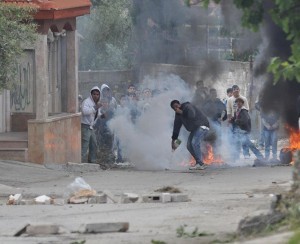
Palestinian-riots-300x244Palestinian rioters. Photo: Wikipedia.

The State Department is using American taxpayer dollars to finance Palestinian Arabs celebrating violent attacks on Israelis and advocating a boycott of Israel and the division of its capital city.

Where’s the outrage?

Not in the New York Times, which treats the topic as subject for a light-toned feature article about what it describes as a Palestinian “reality television show.”

The show features contestants who “run” for the job of Palestinian president. TheTimes article reports that “the three finalists all had similar platforms: Boycott Israel. Designate East Jerusalem as the capital of Palestine.”

Later, the Times reports, almost in passing, that the television program “broadcast on the Maan satellite network to large audiences in Gaza, the West Bank and elsewhere in the Arab world — was funded mostly by a State Department grant.”

The dollar amount of the grant is unreported by the Times. Also unreported by the Times is what the members of Congress who hold the spending power under the Constitution think about the idea of having taxpayer money used to broadcast, across the Middle East, calls to boycott Israel.

An NBC news article on the program quoted one of the contestants celebrating the role of women in the “revolution and resistance — they were throwing stones.” The NBC article also included a contestant’s call for a “’right of return,’ or the right for Arabs driven from their communities in 1948 when the State of Israel was established to go back.” Never mind that some of those Arabs left of their own free will or at the urging of neighboring Arab states, or that their “return” would, as a practical matter, be a way of destroying the Jewish state.

The Algemeiner did what the New York Times did not do, which is contact a major American Jewish organization for its view on the wisdom of spending taxpayer dollars to spread this message.

The president of the Zionist Organization of America, Morton Klein, told The Algemeiner that he found the State Department funding for the television program “astonishing,” and “shocking.” He said that if the State Department were found to be funding an Israeli television program advocating extremist views, there would be an uproar. In this case, however, “not a peep — the only peep is from Ira Stoll.”

“Where is the media and Congress screaming about this?” Mr. Klein asked.

It’s a good question, and one in which the Times shows a disappointing lack of interest in answering, or even in asking.

Israel’s PM seeks role in Russian-US duo in Syria

June 6, 2016

Israel’s PM seeks role in Russian-US duo in Syria, DEBKAfile, June 6, 2016

PutinBibi2-480 (1)

During his 48-hour trip to Moscow (Monday and Tuesday June 6-7), Prime Minister Binyamin Netanyahu will try and talk President Vladimir Putin into cutting Israel into the military teamwork evolving between Washington and Moscow for combating the Islamic State in Syria. As a quid pro quo, he will offer to elevate Moscow to senior broker in the Israeli-Palestinian dispute, with Moscow or Geneva selected as the venue for direct Israeli-Palestinian talks, if they occur – and with US participation. Netanyahu is also keen on a role for Egypt’s Presidents Abdek-Fattah al-Sisi.

DEBKAfile sources in Jerusalem and Moscow report exclusively that the floating of this deal was the reason why Russia’s Foreign Minister Sergey Lavrov abstained from attending the Mid East conference staged last weekend by France’s President Francois Hollande in Paris. The UK and German foreign ministers followed the Russian lead and stayed away.

And Friday, June 3, on the day of the Paris meeting, Russian Deputy Foreign Minister Mikihail Bogdanov, who is in charge of Kremlin Middle East policy, offered a formula for resolving the problem of Israeli settlements on the West Bank.  That formula was very similar to the land swaps plan proposed by Defense Minister Avigdor Lieberman a few years ago.

It consisted essentially of the transfer to the Palestinian state of parts of Israel with dense Arab populations, in return for Palestinian recognition of Israeli sovereignty over the Israeli communities of Judea and Samaria.

In comments to Tass news service, Bogdanov said that Moscow is willing to host an Israeli-Palestinian peace conference, and also offered to mediate between the rival Palestinian factions, including Abu Mazen’s Fatah and the radical Hamas which rules the aza Strip.

While some Israeli politicians see the French initiative as offering President Barack Obama a handle for settling accounts with PM Netanyahu before he leaves the White House at the end of the year, Moscow and Jerusalem are concocting a parallel strategy – not merely to block the Franco-American move, but also to lift Washington’s drive for an Israeli-Palestinian accord from Paris to Moscow.

DEBKAfile sources say that this maneuver is based on the early stages of military and political coordination between Washington and Moscow in the Syrian arena, including the fight against ISIS.

No such coordination exists between Washington and Paris.

Netanyahu envisages the tightening military cooperation between Russia and Israel for Syria, along with Israel’s active participation in the airstrikes against ISIS, as becoming integral to American-Russian understandings, and extending also to the Israeli-Palestinian issue.

Moscow and Jerusalem both estimate that an offer of US-Russian-Arab guarantees to the Palestinians, underwritten by Egypt and Saudi Arabia, can move the negotiations forward.

That Kissinger Promise and Obama’s Fulfillment

May 30, 2016

That Kissinger Promise and Obama’s Fulfillment, The Jewish PressVic Rosenthal, May 30, 2016

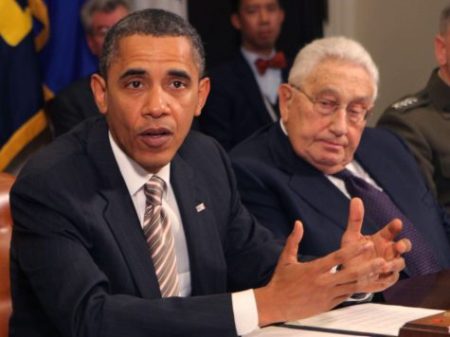
Obama-Kissinger-e1464550543436Pres. Obama seated with Henry Kissinger

{Originally posted to the author’s website, Abu Yehuda}

Old realpolitiker Henry Kissinger was in the news recently when he sat down with Donald Trump, to give him the benefit of his experience. It brought to mind Kissinger’s numerous attempts to get Israel out of the territories it conquered in 1967, before, during and – especially – after the Yom Kippur War.

Kissinger went to Iraq in December of 1975 to try to wean the regime away from the Soviet Union and improve relations with the US. In a discussion with Sa’dun Hammadi, the Iraqi Foreign Minister, Kissinger suggested that American support for Israel was a result of Jewish political and financial power, promised that the US would work to force Israel back to pre-1967 boundaries, and indicated that while the US would not support the elimination of Israel, he believed that its existence was only temporary. Here is an excerpt (the whole thing is worth reading):

I think, when we look at history, that when Israel was created in 1948, I don’t think anyone understood it. It originated in American domestic politics. It was far away and little understood. So it was not an American design to get a bastion of imperialism in the area. It was much less complicated. And I would say that until 1973, the Jewish community had enormous influence. It is only in the last two years, as a result of the policy we are pursuing, that it has changed.

We don’t need Israel for influence in the Arab world. On the contrary, Israel does us more harm than good in the Arab world. You yourself said your objection to us is Israel. Except maybe that we are capitalists. We can’t negotiate about the existence of Israel, but we can reduce its size to historical proportions. I don’t agree that Israel is a permanent threat. How can a nation of three million be a permanent threat? They have a technical advantage now. But it is inconceivable that peoples with wealth and skill and the tradition of the Arabs won’t develop the capacity that is needed. So I think in ten to fifteen years, Israel will be like Lebanon—struggling for existence, with no influence in the Arab world.  [my emphasis] …

Kissinger also promised that aid to Israel, which he presented as a result of Jewish political influence, would be significantly reduced. He indicated that legal changes in the US – he must have been referring to the creation of the Federal Electoral Commission in 1974 to regulate campaign contributions – would attenuate Jewish power and therefore American support for Israel. Naturally, he didn’t foresee the Israel-Egypt peace agreement, which permanently established a high level of military aid to both countries.

He further promised that the US would support a PLO-run Palestinian state if the PLO would accept UNSC resolution 242 and recognize Israel. This of course is what (supposedly) happened in the Oslo accords.

Kissinger insisted that “No one is in favor of Israel’s destruction—I won’t mislead you—nor am I.” But his hint that a smaller Israel might not survive is clear. Surely he understood that a pre-1967-sized Israel (within what Eban called “Auschwitz lines”) would have no chance of surviving, simply because of the strategic geography of the area.

Kissinger was wrong about the Arabs developing the capability to challenge Israel, but their place has been taken by soon-to-be-nuclear Iran and its proxies, who are significantly more dangerous than the Arab states ever were.

US policy, however, has kept more or less the same shape, except that the hypocrisy of insisting that the US supports the existence of Israel but in a pre-1967 size is even more glaring. The substitution of the PLO for the Arab states as the desired recipient of the land to be taken from Israel has barely made a ripple either in America or among the Arabs, suggesting that the policy is more about Israel giving up land than about the Arabs getting it.

The original motivation for Kissinger’s promises was supposedly the desire of the US to replace the Soviet Union as the patron of the Arab states. After the collapse of the USSR and the end of the Cold War in 1991, however, there was no change in policy. Although the Oslo Accords were initiated by left-wing Israelis, the US eagerly embraced them, and the so-called ‘peace process’ became a permanent stick to beat Israel with.

President Obama is especially adept at emphasizing support for Israel’s existence while at the same time demanding that Israel make concessions that would make her continued existence impossible. Apparently agreeing with Kissinger about Jewish power, Obama has worked to reduce the pro-Israel influence of American Jews in numerous ways, such as by providing access to the White House for groups like J Street and the Israel Policy Forum, while marginalizing traditional Zionist organizations like ZOA.

Kissinger’s almost anti-Semitic claim that US support for Israel is bought with Jewish money was probably untrue in 1975 and is even less so today, when a large proportion of American Jews, including wealthy ones, have chosen their liberal or progressive politics over Zionism. The coming struggle over the introduction of a pro-Palestinian plank into the Democratic platform is an indication that the party and with it, many of its Jewish supporters, is moving toward Obama’s position.

The Obama Administration’s program to extricate itself from the Middle East by empowering Iran as the new regional power has given a new impetus to the policy of shrinking Israel. Iran sees Israel as a major obstacle to its hegemony, for both geopolitical and religious/ideological reasons, and is committed to eliminating the Jewish state. Obama found it necessary to restrain Israel from bombing Iran’s nuclear facilities at least once (in 2012), and seems to be prepared to sacrifice Israel in order to achieve his goal of establishing Iranian regional dominance.

Some would go even further and say that Obama’s primary ideological goal is to eliminate Israel and the Iranian gambit is a means to this end, but that is highly speculative! Or maybe it’s a matter of two birds with one stone.

Henry Kissinger didn’t do us any favors, but I think the anti-Israel thread in American policy would have been strong enough without him, running from Truman’s Secretary of State George C. Marshall all the way to Obama’s stable of anti-Zionists like Rob Malley and Ben Rhodes.

Today Israel is long gone from the Sinai, more recently from Gaza, and probably only thanks to the disintegration of Syria, still holding the Golan Heights. I would like to believe that PM Netanyahu was correct when he said that Israel will never leave the Golan. Regarding Judea, Samaria and Jerusalem, I expect that we are about to begin a very difficult time, as the Obama Administration is likely to mount a campaign in its last days to fulfill Kissinger’s promise to the Arabs at long last.

The day after Abbas

May 27, 2016

The day after Abbas, Israel Hayom, David M. Weinberg, May 27, 2016

The day Mahmoud Abbas departs his post as president of the Palestinian Authority, or is deposed from his dictatorial perch, could be a watershed moment. It could and should force a reassessment of conventional thinking about the feasible contours of accommodating Palestinian independence.

That moment may be coming soon. Abbas is old, sick and tired. He has little to show for his persistent efforts to isolate Israel diplomatically and force Israel into hasty withdrawals. His regime is viewed as utterly corrupt by 95.5% of Palestinians (according to a recent Palestinian poll). The tens of billions of dollars in international aid he has swallowed have failed to build any real institutional basis for a good or democratic Palestinian government.

Abbas’ thuggish underlings are jockeying aggressively around him for pole position in the battle to succeed him as West Bank despot. Hamas, too, smells blood.

On the diplomatic front, Abbas’ departure will leave nothing behind but scorched earth. He has fled from real negotiation and compromise with Israel, espoused maximalist positions, stoked hatred toward Israelis and Jews, venerated terrorists and pushed the criminalization of Israel internationally. He basically convinced most Israelis that there is no reasonable peace deal to be had with the Palestinians.

And yet, the Obama administration and much of the global community nonsensically still considers Abbas and his gang to be viable partners for a two-state peace arrangement. What will it take for them to move beyond this rotten reliance on Fatah leadership and the creaky two-state construct?

Nevertheless, most Israelis, including Prime Minister Benjamin Netanyahu, still seek to move toward some clarity of borders, stability, and improved quality of life for Israelis and Palestinians alike.

They seek to do so without embarking on insane Israeli withdrawals that would likely lead to the establishment of a second “Hamastan” in the West Bank, or worse, an Islamic State-type regime.

So it’s time for Israel to re-articulate its thinking about the possibilities of an Israeli-Palestinian modus vivendi. Netanyahu should capitalize on his newly broadened government, and the coming transitions in Palestinian and American politics, to reset the diplomatic table. He can outline the acceptable contours of a conflict amelioration process in which Israel can pragmatically participate.

Doing so is especially urgent since the Obama administration is, in extremis, not-so-subtly readying to move the global goal posts farther away from Israel. This, of course, will only make the likelihood of Palestinian compromise with Israel even more remote.

Here are some guidelines and red lines that the Israeli government may want to adopt:

• Regional solutions: Unconventional alternatives to the struggling two-state paradigm must be on the table, including: a Palestinian-Jordanian federation; shared sovereignty with Israel in the West Bank; a three- or four-way land swap involving Egypt and Jordan; and, possibly, a combination of all these approaches.

The major Western powers must be willing to drive serious exploration of such alternatives. Arab states too can take responsibility for solving the Israeli-Palestinian conflict and consider investment of tangible resources in “regional” solutions.

• Baseline: Israel’s position at the outset of talks should be that 100% of the West Bank belongs to Israel, by historical right, and that this right is richly buttressed by political experience, legitimate settlement and security necessity. Only then can Israel hope to obtain a sensible compromise.

Talks should not begin from a 68-year-old armistice line forced upon Israel by Arab aggression; nor “from the point that talks last left off” eight years ago under a previous, defeatist Israeli government; nor from the defensive security fence line forced upon Israel by Palestinian terrorism; nor from any borders high-handedly dictated in advance by U.S. President Barack Obama or the international community.

• Security: The radical Islamic winter buffeting this region, and its inroads into the Palestinian national movement, means that the security envelope encompassing Israeli and Palestinian areas must be militarily controlled by the IDF, fully and indefinitely. This includes the Jordan Valley and the mountain ridges on both sides of Judea and Samaria.

• The Temple Mount: One way in which to wring Palestinian recognition of the Jewish people’s ancient ties to this holy land is to insist on Jewish prayer on the Temple Mount. This can be modestly facilitated either through a time-sharing arrangement (similar to that in place at the Tomb of the Patriarchs in Hebron), or through a small synagogue tucked away on the fringes of the vast Temple Mount plaza (which won’t overshadow the two large Muslim structures on the Mount).

Palestinian denial of Jewish religious, historical and national rights in Israel is the essence of the conflict. It is time to tackle this head-on, cautiously but candidly, at the core — in Jerusalem.

In conclusion, Netanyahu should leverage this turning point to reframe the parameters of how Israel can live astride the very problematic Palestinian national movement.

Sisi and Mideast Peace

May 21, 2016

Sisi and Mideast Peace, American ThinkerC. Hart, May 21, 2016

Egyptian President Abdel Fatah al-Sisi’s speech on Tuesday, May 18, set ripples through Israel’s political establishment. Speaking in the southern city of Assiut, Sisi signaled to the Arab world, the Palestinians, and Israel that it is time for an historic breakthrough in peace negotiations.

Responding immediately to Sisi’s comments, Israeli Prime Minister Benjamin Netanyahu stated that he is open to working with Egypt and Arab states towards advancing the peace process, not only with the Palestinians but with the peoples of the Middle East region.

Netanyahu’s comments come on the heels of a visit to Israel by French Foreign Minister Jean-Mark Ayrault. The two men met but disagreed on how to advance peace.

France insists on hosting an international parley to force Israel and the Palestinians to come to the peace table. Israel is against the French initiative.

Netanyahu would like to go beyond the Israeli-Palestinian conflict and work directly with moderate Arab states on a comprehensive peace deal. Sisi could be instrumental in building an Arab coalition for peace which would dismiss or weaken the divisive French initiative, releasing Israel from conceding to European demands.

Former Israeli ambassador to Egypt, Zvi Mazel, is currently working as a Research Fellow at the Jerusalem Center for Public Affairs (JCPA). He is a Middle East expert who has represented Israel’s Ministry of Foreign Affairs as former Ambassador to Sweden and Romania, as well. This writer asked Mazel if Sisi’s comments were spontaneous or were released at this time for political reasons because he wants to strengthen Egypt’s position in the region by helping Israel.

“I don’t think there is a big design… I think that Sisi understands what is going on in the Middle East and he is identifying according to his view — a kind of possibility of advancing the peace process.”

Egypt, Saudi Arabia, the Gulf countries, and Israel have common enemies: Iran and Islamic State. Already there have been discreet diplomatic and business ties between Israel and these nations

According to Mazel, Sisi is also emerging as a strong respected leader among Egyptians despite the Western media’s portrayal of him as a dictator similar to former Egyptian President Hosni Mubarak.

“Sisi sees himself as a president quite stable among his people. I know that this is not the way they think in the Western media — New York Times and company. They see him as a kind of military dictator; absolutely not! He’s a good man. He’s not Mubarak. He’s Sisi.”

Mazel explains that Egypt is on the way to economic sustainable development. This is what Sisi has been focused on over the past two years and he is seeing success. Unemployment has gone down, despite the fact that almost 90 million people live in Egypt and the country is poor.

“He has started something quite positive, and Sisi thinks that the time has come for Egypt to be in the international arena.”

What that means, according to Mazel, is that Egypt’s current role is still minor. Sisi is asking Israelis and Palestinians to go forward, yet he, himself, does not have a plan. But, in the future, Egypt could emerge as a larger player in the region.

Mazel is pragmatic about the short-term. “It’s a positive step for Egypt, but it is not going to change the world.”

Current peace advances that are being prepared for release are not a positive development for Israel: (a) the French Initiative; (b) a document showing the obstacles to Israeli-Palestinian peace efforts soon to be reported by the Quartet; (c) the 2002 Arab Peace Initiative that, despite being outdated, is still considered a serious option by the Arab world.

In the coming days, the Arab League plans to meet and discuss the Israeli-Palestinian conflict. Mazel thinks that Sisi’s statement was good timing for that meeting, but otherwise, was not connected to a bigger scheme.

However, on Wednesday, May 18, American Secretary of State John Kerry arrived in Egypt one day after Sisi gave his emotional speech. Some analysts believe that the U.S. is behind Sisi’s bold words, in an effort to circumvent the French from becoming a new power broker in the Middle East.

The question is whether Sisi’s encouragement will lead to Israel courting the Arab nations and the Arab nations courting Israel, while by-passing the Palestinians. Mazel thinks that kind of change is slow in coming, because the Arabs continue to entrench themselves in old positions that favor Palestinian demands.

Refusing to sit down and negotiate with Israel, the Palestinians have insisted on preconditions which the Arab League has accepted. They demand that Israel agree on the right of return for so-called Palestinian “refugees” to Israeli land; that Israel withdraw to the 1967 borders; and, that Israel stop building in West Bank settlements (Judea and Samaria). Palestinian President Mahmoud Abbas also expects Israel to release hundreds of Palestinian prisoners, who have blood on their hands, serving time in Israeli jails because of terrorist attacks against the Israeli population.

So far, these unresolved issues have kept Abbas away from face-to-face negotiations with Netanyahu. However, his real diplomatic scheme is to get the international community to affirm the Palestinian position and force Israel to concede to Palestinian demands. Right now, Abbas sees the best venue to accomplish his goal as a French-sponsored future peace conference, followed by a stinging UN anti-Israel resolution.

Meanwhile, the future pressure on Israel will be to immediately stop settlement construction in order to get the peace process going. Mazel declares, “Absolutely not… we have to go on! Half a million people live there. And, they are the shield of Israel. We continue to build until there is peace.”

Mazel has a real problem with the demands of the Arab League, as well. “The Arab Peace Initiative is more or less the same as the Palestinian attitude. The ‘right of return’ is still there. It should be taken completely out. Most importantly, the Palestinians and the Arabs should recognize a Jewish State in Israel.”

Mazel is also not sure that Netanyahu’s insistence on widening his government, to provide greater stability, is a wise idea. Reportedly, Yisrael Beytenu Chairman Avigdor Liberman will soon become Israel’s new Defense Minister as Netanyahu brings several more ministers into his coalition. Mazel thinks this will not provide a wider diplomatic envelope; nor, will it help change European or Arab attitudes towards Israel; nor will it end the Boycott-Divestment-Sanctions (BDS) movement against Israel.

Then there is U.S. President Barack Obama’s failed Middle East policy, which includes his lackluster support of American allies in the region. Mazel says this policy cannot continue.

“It cannot be like that, because America is the most important power in the world… And, whoever will win the presidency, whether it will be Mrs. Clinton or Trump, both of them are in a certain way connected to the Middle East.”

Mazel believes that with 22 countries and more than 300 million people living in the region, the next U.S. president will be more engaged in leading the nations into greater stability.

In the meantime, currently 80% of the Egyptian people support Egyptian President Sisi. His nation has already made peace with Israel (along with Jordan). Helping Israel to extend an olive branch to other Arab countries will encourage Egypt to take up an important leadership role in a region that continues to be embroiled in major upheaval and violence.


Perception as deterrence – Israel’s new Defense Minister

May 20, 2016

Perception as deterrence – Israel’s new Defense Minister, American ThinkerRon Jager, May 20, 2016

The recent news that Avigdor Liberman, a former Israeli Foreign Minister and head of the Yisrael Beiteinu party, a small right-wing party, will replace Moshe “Bogie” Ya’alon as the new Israeli defense minister  and has been portrayed by the Israeli media and their elitist opinion makers with dismay and stupefaction.  In Tel-Aviv, a city known for its progressive and leftist inclination, many muttered that the municipality should start opening up the air raid shelters as Lieberman’s appointment hit the airwaves. Lieberman, a politician feared and despised by the Israeli left, is being demonized and delitigitimized even before his appointed has gone into effect. Yet the potential appointment of Avigdor Lieberman as Defense Minister has thrown the whole Palestinian leadership and Israeli Arab politicians into a frenzy, making the reaction by Israel’s leftist elite seem mild. Claiming that Israel is adopting characteristics of a fascist regime and calling for the boycott of Israel; stating that “the Israeli government is sending a message to the world that Israel prefers extremism, dedication to the occupation and settlements over peace,” and encouraging blatant racism, are only a fraction of the derogatory and slanderous accusations against a veteran politician who has been democratically elected.

The potential appointment of Avigdor Lieberman to the position of Defense Minister may very well herald a new and more effective deterrence against the Palestinians’ desire to get up in the morning and murder a Jew. The Palestinian Arab perception of Lieberman as a person who believes in the sanctification of power, ruthlessness, violence, and ignorance with murderous potential can very well be exactly what will cause the Palestinians to adopt a more realistic assessment of what a negotiated settlement will look like.

This is their dilemma, and this is their choice. Either continue and deny reality, taking their chances with a Defense Minister who is perceived as having no problems with employing a strict crackdown wherever Palestinian terror erupts, who has no qualms about enforcing strict rules of engagement, making it crystal clear that Israel’s strategy is based on the adage of our Sages, “If someone rises to kill you, kill him first,” or begin to negotiate seriously and honestly to achieve a sustainable peace agreement with Israel. The perception of Avigdor Lieberman by the Palestinian Arabs could very well facilitate this change.

As Israel’s strategic deterrence and capabilities have been proven to be highly effective in recent years with land, sea, and air strategic capabilities becoming literally impenetrable, the main task facing Israel’s Defense Minister will be primarily in the Palestinian theatre. The Middle East, being a region highly susceptible to a cultural disposition to base one’s reaction on who how one perceives one’s enemy, may very well bring the Palestinian Arab leadership to fold their cards and start the arduous and unavoidable process of negotiating with Israel.

For the majority of the past eight years, President Obama and State Department “experts” have been treating the Israeli-Palestinian conflict as the central generator of political upheaval ravaging the Middle East. They do not realize just how marginal the conflict with the Palestinian Arabs has become or understand that as far as the Sunni Arab nations of the Middle East, the future Palestinian State, should it be established, will be just another failed Arab nation in perpetual conflict with its own people and with her neighbors.

As far as the Palestinian Authority (PA) that resides in Ramallah is concerned, the lack of legitimacy in the eyes of their own people is only exceeded by the widespread and institutionalized corruption by its leaders, sustained by international funding from the United States and the European Union. Having rejected over the years any possibility of a negotiated settlement, the PA leadership have proven without a doubt that they have no intention of reaching any agreement.. The only goal of the Palestinian Arab leadership has been to gain territories and use them for the next attack aimed at minimizing and weakening Israel. Apart from that, there is nothing: No democracy, no economy, no law and no future for the Palestinian Arabs other than being in a perpetual cycle of meaningless and unsuccessful conflict with Israel. Israel will continue to move ahead and forge alliances with Sunni Arab neighbors and the Palestinian Arabs will wallow in their misery as they continue to deny reality and believe in their own made-up propaganda narrative.

The unprecedented political changes having taken place in the Middle East in recent years mainly due to Obama’s irresponsible and failed strategic policy decisions have resulted in new emerging alliances between Israel and her neighbors. Despite the challenges that Iran continues to pose to Israel and the potential of her leaders who might use the conflict with Israel as a means of rallying political support in her war with the Sunni Arab nations, the threat of renewed conventional conflict between Israel and her Arab neighbors has been downgraded, while more realistic scenarios envision a greater focus on economic cooperation and regional stability. Although it is far too early to predict the success of the new political alliances and strategic order that will eventually emerge from the changes in the Arab world, the inherent asymmetry of the conflict between Israel and the Palestinian Arabs will maintain this conflict on low burner for the foreseeable future with sporadic eruptions of terror and limited missile attacks similar to what that the Israeli population has had to endure in recent years.


Renegade Jew Backlash

May 19, 2016

Renegade Jew Backlash, Front Page Magazine, David Horowitz, May 19, 2016

wc_1

Reprinted from Breitbart.

According to the Internet Webster synonyms for renegade are “defector” and “deserter.” I applied the term to Kristol because of his efforts to launch a third party campaign to block the nominee of his party, split the conservative vote, and ensure the election of a Democrat whose party had provided a path to nuclear weapons to the Jews’ mortal enemy (and America’s as well).

***************************

I have been accused of being a provocateur all my life – when I was a leftist in the 60s proclaiming (God help me) that Vietnam was the fulfillment of the American dream; when I left the left declaring that, “the beginning of political morality is anti-Communism;” when I said that identity politics “owed more to Mussolini than to Marx;” when I opposed reparations for slavery 137 years after the fact because it was “bad for blacks and racist too;” and when I organized “Islamo-fascism Awareness Weeks on a hundred college campuses across the country. Now I have provoked a firestorm on the Internet through a Breitbart article that called Bill Kristol a “renegade Jew.”

According to the Internet Webster synonyms for renegade are “defector” and “deserter.” I applied the term to Kristol because of his efforts to launch a third party campaign to block the nominee of his party, split the conservative vote, and ensure the election of a Democrat whose party had provided a path to nuclear weapons to the Jews’ mortal enemy (and America’s as well). I picked the emotional term “renegade” because I wanted to shock Kristol and his co-conspirators into realizing the gravity of their actions.

However, I had no idea that this would provoke the reaction it did. A veritable tsunami of attacks were directed at Breitbart and myself from Kristol’s supporters on the “neo-conservative” right and from die-hard enemies of the Republican nominee in all political quarters. Even the Anti-Defamation League, which had once attacked me over my anti-reparations campaign) chimed in, calling the title of my piece “inappropriate and offensive.” This was actually pretty mild considering others were denouncing it as “disgraceful” and “an anti-Semitic slur.”

How by the way is the characterization “anti-Semitic slur” even possible? Are Jews immune to defecting from causes? When I publicly repudiated the radical cause, thirty years ago, the first attack on me appeared in the Village Voice under the title, “The Intellectual Life and the Renegade Horowitz.” It was written by Paul Berman, who years later became a somewhat chastened radical himself. Berman’s attack stung me – as I hoped my charge would sting Kristol and cause him to reconsider his course. But the epithet didn’t bother anybody but me. My current critics would stigmatize me not only as a defector from the conservative cause but as a double agent who never really left the left. After my Breitbart article appeared, Commentary editor (and Kristol relative) John Podhoretz sent me a one-line email: “Once a Stalinist always a Stalinist,” while Commentary writer Jonathan Tobin in a piece titled “Breitbart ‘Renegade Jew’ Disgrace,” suggest: “You can take the boy out of the Bolsheviks but you can’t take the Bolshevik out of the boy.”

Like many of the attacks on Trump, these squalid responses with their flimsy intellectual content call to mind a famous remark of Lionel Trilling’s, made more than 60 years ago. Conservatives, he wrote, did not “express themselves in ideas but only in action or in irritable mental gestures that seek to resemble ideas.” It is not that Kristol or his defender Tobin haven’t had worthy and defensible ideas. They have. But this makes it even sadder to see the flimsy arguments they trot out to discredit Trump and to defend Kristol’s indefensible campaign. Criticisms of Trump’s personal attacks on his Republican rivals are reasonable. But not when they fail to take into account the 60,000 political ads that were aired by those same rivals whose purpose was to destroy him. (The ads were not, should anybody have missed them, about policies and issues.)

I have no quarrel with people who have doubts about what Trump would do if elected. It is the task of the candidate to allay those doubts. For reasonable critics Trump’s announcement of his prospective Supreme Court nominees should be important steps along the way. My quarrel is not with Trump skeptics, but with the effort to nullify the vote of the Republican electorate – a politically active and informed, and conservative segment of that electorate. Kristol’s third party effort exudes an elitist contempt for the will of the people, which is particularly unbecoming in a crowd that prides itself on being “constitutional conservatives.”

Finally, I am disturbed by the failure of the nullifiers to consider the perils of the choices our country now faces. For the life of me I cannot understand how my friends in the conservative movement cannot have qualms about derailing the candidacy of the Republican Party’s pro-Israel, pro-military, pro-American nominee, and electing the candidate of a party that has built its foreign policy around making Islamist Iran the number one power in the Middle East, providing its jihadists with a path to nuclear weapons, putting $150 billion into their terrorist war chest and turning a blind eye to their circumvention of international restrictions so that they can build ballistic missiles capable of destroying the Jewish state and causing incalculable damage to the United States.