Posted tagged ‘Obama Administration’

Egypt’s fight, America’s apathy

February 3, 2015

Egypt’s fight, America’s apathy, Israel Hayom, Dr. Reuven Berko, February 3, 2015

[M]any Arab states long ago branded the movement and its “offspring” as illegal. In the Arab states, unlike in the West, Arabic is fully understood. This fact raises the suspicion that the U.S., which is losing interest in our region, has come to terms with radical Islam’s ascension to power in the Middle East, and is sacrificing its allies in the region.

*********************

The Muslim Brotherhood in Egypt refuses to accept the verdict of the electorate and is trying, through brutal terrorism, to delegitimize President Abdel-Fattah el-Sissi. Ever since the el-Sissi government’s democratic election, Egypt has been plagued by a wave of terror perpetrated by the Brotherhood against the country’s army and security forces in Egypt proper and the Sinai Peninsula, which has damaged the economy and infrastructure.

In his most recent speech at Al-Azhar ‎University, on Jan. 1, el-Sissi tried conveying to the “sane” senior religious leaders a brave message about the need to fight terror, calling for introspection and for them to implement a “religious revolution” against terror. His call has gone unanswered.

Indeed, Egypt is fighting these days against Ansar Beit al-Maqdis, the terrorist group that has renamed itself the “Sinai Province” and has sworn allegiance to Islamic State. Over the past several months, Sinai Province terrorists have inflicted considerable damage and casualties on the Egyptian army, in a series of car bombings and shooting attacks. Last Thursday night, the group carried out four separate attacks on security forces in northern Sinai, killing at least 30 soldiers and police officers.

Egyptian sources pointed a finger at Hamas and its armed wing, the Izzedine al-Qassam Brigades, accusing the Gaza-based terrorist group of aiding Sinai Province in its violent campaign. Evidence of this aid can be found in intercepted messages between the groups. Consequently, Egypt over the weekend banned Hamas’ military wing, listing it as a terrorist organization. In light of the dozens of slain soldiers, el-Sissi called on his security forces in Sinai to avenge the blood of their fallen comrades, and said: “We are fighting a well-funded global terrorist organization. … I am not tying your hands to prevent you from taking retribution from the terrorists.” During the heartfelt speech, el-Sissi announced the establishment of a new headquarters, commanded by a general, charged with waging war on terror and retaking Sinai.

As per its custom, Al-Jazeera distorted his message. One of the network’s “analysts” argued that el-Sissi’s words constituted a call for vengeance and civil war, and that he has turned the Egyptian army into a jury and hangman.

In contrast, in an interview with the network, the editor-in-chief of the weekly Egyptian newspaper Al-Mashhad protested the consistent incitement by Al-Jazeera against Egypt. Al-Jazeera, meanwhile, continues to incite, provide Hamas with material aid, and exalt the Izzedine al-Qassam Brigades as a role model via its documentaries and programs. Within this framework, Izzedine al-Qassam Brigades member Abdel Karim Al-Hanini, in his own series broadcast on Al-Jazeera, boasts of murdering Israeli civilians and soldiers, while instructing his audience, Palestinians and Muslim Brotherhood followers in Egypt alike, on how to build bombs.

Despite the events in Egypt, the Muslim Brotherhood has yet to be outlawed in Europe and the United States. Many leaders still believe it is a legitimate political movement, despite knowing that it engages in terrorism across the globe and the “new Middle East,” and regardless of the fact that many Arab states long ago branded the movement and its “offspring” as illegal. In the Arab states, unlike in the West, Arabic is fully understood. This fact raises the suspicion that the U.S., which is losing interest in our region, has come to terms with radical Islam’s ascension to power in the Middle East, and is sacrificing its allies in the region. Its abstention from reining in Qatar, which incites and funds terrorism, testifies to the indifference of the United States to the damage this causes to Israel and to Egypt’s fight against fundamentalism, and will lead to the fall of other moderate Arab states.

It appears the Americans, who have soldiers based in the manipulative Qatar, along with the Europeans and partnered by Islamist Turkey and NATO, are implementing a policy of “after me, the deluge,” and have accepted the partition of the fading Middle East between the subversive Sunnis and the encroaching Iranians, who are establishing outposts and bridgeheads in Iraq, Syria and Lebanon, as well as in Bahrain and Yemen. Both camps, the Sunni and Shiite, are now moving toward an arms race and inevitable apocalyptic clash, simultaneous to the completion of Iran’s nuclear program, in lieu of sanctions or a deal ensuring it is scaled back.

In the meantime, the European Union is working with Arab League foreign ministers and, bizarrely, Turkey and Qatar, two countries that support these terrorist movements, to create a front against Islamist terror. The criminals have been appointed the guards, indeed.

What Are the Metaphysics of Islamic Denial?

February 2, 2015

What Are the Metaphysics of Islamic Denial?

February 2nd, 2015 – 12:45 am

By Victor Davis Hanson

via What Are the Metaphysics of Islamic Denial? | Works and Days.


obama_weakness_big_1-27-14-1

After six years, it is no surprise that the Obama administration does not see the Taliban as “terrorists” or that it will not associate “violent extremism” with radical Islam or just Islam.

After all, when Maj. Hasan murdered U.S. soldiers it was nothing more than “workplace violence,” as if he were a disgruntled post office employee of the 1970s. Our two top intelligence chiefs assured us that the Muslim Brotherhood was “largely secular” and that jihad “was a legitimate tenet of Islam.” Add in “workplace violence” and the old “overseas contingency operations.” Do we remember that Ms. Napolitano’s Department of Homeland Security warned us about right-wing returning veterans as the most likely to terrorize us? When someone blows up people at the Boston Marathon, beheads a woman in Oklahoma, or puts a hatchet in a NYPD officer’s head, he is not a terrorist or proselytizer fueled by Islamic hatred of non-Muslims as much as mentally confused. (I suppose in a way that a Hitler or Stalin was not.)

The problem is not that the administration is just too fond of euphemisms. At times it can be quite candid. The Republican House has been characterized as “terrorists” in their efforts to stop more federal borrowing. The Tea Party was slurred as “tea-baggers” — a derogative sexual term.  Mr. Netanyahu is variously a “coward” or “chickensh-t” — pejoratives not floated for even the vicious Mahmoud Ahmadinejad.

So why the elaborate façade about the Islamic roots of global terrorism and spreading instability in the Middle East? There are a few possible explanations.

I. Strategy

The Obama administration knows full well that the Taliban, ISIS, al Qaeda, Boko Haram and the rest of the pack draw their zeal from the Koran. But to say such might turn off two or three useful constituencies — the hard Left at home that hates any judgmentalism, “moderate” Muslims in the Middle East who are essential to nullifying the “radicals” in their midst, and the global community that is always suspicious when America goes to war against a particular group or ideology. The Obama administration with a wink-and-nod, then, accepts radical Islam as the problem, but for strategic reasons, and in the manner occasionally of the Bush administration, prefers euphemisms. Nonetheless, the administration goes on Predatoring thousands of suspected Islamic terrorists even as it won’t say what its targeted victims all have in common. Given that Americans know that the enemy is radical Islam, why turn off potential allies by reiterating that fact?

II. Appeasement

The Obama administration is terrified of radical Islamic terrorism, in the manner that Europeans are — and were scared stiff in the 1930s of Nazi Germany. They know full well that caricaturing Islam is dangerous in a way joking about other religions is not. They are afraid of more televised beheadings, more torturing, and more Benghazis. If they can blame a pathetic U.S. resident for making a video for the deaths in Benghazi, then perhaps the appreciative Islamist culprits will leave it at one harvest at Benghazi (especially before the 2012 elections). If the Taliban sense that Obama will not dare to call them terrorists, then maybe they will negotiate in good faith and enter a stable “coalition” government when we depart entirely from Afghanistan. Bowing to a Saudi royal might assuage his anger at the U.S. Carefully avoiding reference any longer to Syrian regime change might win back Assad to our side. When we don’t condemn “Islamic terrorism,” then perhaps even ISIS mutters, “Hmmm, these Americans are not that bad after all; shoot rather than behead the next hostage.”

Note that essential characteristic of appeasement, the narcissism of the appeaser: An FDR lecturing Churchill that he alone had the skills to win over “Uncle Joe” Stalin, a Jimmy Carter’s unique understanding of Iranian theocracy that as thanks would release the hostages, and the locus classicus of Neville Chamberlain alone with the fluency and sensitivity to make Herr Hitler see what is in his real interest. So, too, only the Peace Prize winner Obama can suavely appease radical Islam and convince them why leaving America alone suits their interest as well. The more we accommodate radical Islamists through euphemism and circumlocution, the more likely they might just go away.

III. Postmodern Therapy

The Obama administration has a fuzzy therapeutic view of human nature in general, as does much of America by now. There is no “welfare” anymore, just “pubic assistance” or better “health and human services.” Beau Bergdahl is confused and complex, hardly a “traitor,” a slur that leaves no room for nuance. The purpose of language is not disinterested and accurate description; rather, language is employed for the political, whether you know it or not.

So the unwillingness to use the world “Islam” in connection with global terrorism simply reflects the leftwing, relativist view that nothing is ever absolute. There is not good versus evil, failure or success, but only gradations that are conditioned by the preexisting prejudices of elites who make up these categories largely to protect their own privilege. Generalization is always reactionary stereotyping. “Islam” or “Muslim” hardly can characterize 400 million people from Indonesia to Dubai. (To be fair, I think the Left’s postmodern relativism is itself mostly political and ad hoc; after all, it often enjoys blanket categorization and has no problem with disparagement like “Republicans,” “tea-baggers,” “conservatives,” “males,” or “whites” as inclusive terms that serve well enough to stereotype millions — or for that matter “gays” and “women” in the hagiographic sense.) “Islam” and “Muslim” are meaninglessly vague, and are used as pejoratives rather than descriptive terms; like most of our race/class/gender vocabulary these rubrics cannot be used as inclusive terms when the aim is not laudatory.

IV. Multicultural Understanding

Finally, perhaps the Obama administration does not see us in a war at all or at least a righteous conflict against cold-blooded religious fanatics from the Islamic world. While it disproves of the methodology of terrorism, it is ambiguous about the origins of such anti-Western rage. Thus Obama chose to skip the march after the Paris killings in a way he would not miss going overseas to lobby for a Chicago Olympics. Collate the apology tour, the initial Al Arabiya interview, and the Cairo speech, and perhaps add in the relevant passages from Dreams from My Father and keen voluntary attendance at Rev. Wright’s sermons. What arises is a consistent Obama worldview that the present U.S.-inspired global order is not fair, but rather fuelled by neo-colonialism, past imperialism, racism, and capitalist exploitation, Western but especially American in nature. In such a moral landscape, obviously some liberationists, revolutionaries, reformers and dissidents will go too far, in the manner that Castro killed or jailed a bit too many or Arafat himself was on occasion a little bit too much the killer.

But as Andrew Young once said of Khomeini that he “will be somewhat of a saint when we get over the panic,” so, too, the Obama administration more or less understands why young men in the Middle East take up arms against the U.S. Note the leftwing hatred of American Sniper, or Michael Moore’s (the object of hero-worship at the Democratic Convention of 2004) rationale for September 11 (“If someone did this [9/11] to get back at Bush, then they did so by killing thousands of people who DID NOT VOTE for him! Boston, New York, D.C., and the planes’ destination of California — these were places that voted AGAINST Bush!”). In the world of Michael Moore’s leftism, the problem was not that Islamists had killed Americans, but rather that they blew up the wrong Americans who were against what the other bad red-state Americans — quite deserving of death — had done.

The point is not that the administration simply sympathizes with radical Islamists or thinks in lockstep with a Michael Moore or Bill Ayers, only that it is intellectually, politically, and culturally unable to damn entirely the Islamist cause by dubbing it “terrorism” or Islamism, given the complexity of past Western culpability for the present mess of the Middle East.

Why do they hate us? For Obama, it is not because of Islamic self-induced pathologies that are the logical result of entrenched tribalism, gender apartheid, religious fundamentalism and intolerance, statism, anti-Semitism, and autocracy, which can only lead to stagnation, poverty, and repression that in turn present as envy, jealousy and hatred of the West.

No, the West is responsible for the lack of parity, and thus the anger of the Middle East is somewhat legitimate and understandable. Just as Obama has apologized for Western culpability of Middle East pathologies, so, too, he does not necessarily see Islamic terrorists as primordial enemies driven on by religious zealotry, as much as variants of more legitimate groups such as the Muslim Brotherhood, Hamas, and the Palestinian Authority.

Summary

These four exegeses are not entirely constant, but transmogrify to meet the administration’s current political realities (e.g., the euphemisms may cease for a while should there be another 9/11).  They also overlap and are not mutually exclusive. Nevertheless, which of them most often drives the Obama’s administration peculiar institution of Islamic denial?

I doubt Strategy is the prime mover, although many naïve people in the administration may mistakenly believe that it is. Appeasement is closer to the mark, but perhaps in this case better applies to individuals such as journalists and cartoonists than the U.S. government that protects its own and is all-powerful. Moreover, appeasement is a tactic. It can be conditioned by ideology or individual temperament, but is not a consistent ideology (Chamberlain was a conservative appeaser). Most liberals embrace Postmodern Therapy’s view of human existence, but not all of them to the degree to deny Islamic culpability for global terrorism. I am left with explanation IV, Multicultural Understanding. The Obama administration is preconditioned to consider anti-Americanism not as a logical tic of anti-capitalist, anti-democratic systems or just the whining abroad of the jealous and envious of an exceptional United States, but rather as something often legitimate that has its origins in our inequality, unfairness, and exploitation.

In such a mental landscape, it is almost impossible for those in the administration with any confidence to say that Islamists or even radical Islamists hate us for what we are and will do everything in their power to destroy us, and that the larger neutral Middle East is watching the struggle to see which side proves the stronger horse and thus is worthy of alliance with, or at least worthy of not offending.

How Iran Is Making It Impossible for the US to Beat ISIS

February 1, 2015

How Iran Is Making It Impossible for the US to Beat ISIS, Daily Beast, Michael Weiss, Michael Pregent, February 1, 2015
1422791113178.cachedAhmed Saad/Reuters

Washington needs to quit pretending it can work with Iran to defeat the Islamic State. Tehran’s real objective is to defeat Washington.

It was August 2007, and General David Petraeus, the top commander of U.S. forces in Iraq, was angry.  In his weekly report to then-Defense Secretary Robert Gates, Petraeus wrote:  “I am considering telling the President that I believe Iran is, in fact, waging war on the U.S. in Iraq, with all of the U.S. public and governmental responses that could come from that revelation. … I do believe that Iran has gone beyond merely striving for influence in Iraq and could be creating proxies to actively fight us, thinking that they can keep us distracted while they try to build WMD and set up [the Mahdi Army] to act like Lebanese Hezbollah in Iraq.”

There was no question there and then on the ground in Iraq that Iran was a very dangerous enemy. There should not be any question about that now, either. And the failure of the Obama administration to come to grips with that reality is making the task of defeating the so-called Islamic State more difficult—indeed, more likely to be impossible—every day.

There are lessons to be learned from the experience of the last decade, and of the last fortnight, but what is far from clear is whether Washington, or the American public, is likely to accept them because they imply much greater American re-engagement in the theater of battle. As a result, what we’ve seen is behavior like the proverbial ostrich burying its head in the desert sand, pretending this disaster just isn’t happening. But at a minimum we should be clear about the basic facts. In Iraq and Syria, as we square off against ISIS, the enemy of our enemy is not our friend, he is our enemy, too.

In 2007, there were 180,000 American troops in Iraq. Under Petraeus’s oversight, U.S. Joint Special Operations Command (JSOC), the elite forces responsible for hunting terrorists around the world, was divided into two task forces. Task Force 16 went after al Qaeda in Iraq, the group that eventually would spawn ISIS, while Task Force 17 was dedicated to “countering Iranian influence,” chiefly by killing or capturing members of Iraq’s Shia militias—though in some cases, it even arrested operatives of Iran’s Revolutionary Guards Corps-Quds Force (IRGC-QF) who were arming and supervising those militias’ guerrilla warfare against coalition troops.

At one point, in the summer of 2007, Petraeus concluded that the Mahdi Army, headed by the Shiite demagogue Muqtada al-Sadr, posed a greater “hindrance to long-term security in Iraq” than al Qaeda did. As recounted in The Endgame, Michael Gordon and Bernard E. Trainor’s magisterial history of the Second Iraq War, two-thirds of all American casualties in Iraq in July 2007 were incurred by Shiite militias.  Weapons known as explosively formed penetrators, or EFPs, were especially effective against the U.S. forces. They were Iranian designed and constructed roadside bombs that, when detonated, became molten copper projectiles able to cut through the armor on tanks and other vehicles, maiming or killing the soldiers inside.

So it came as a surprise to many veterans of the war when Secretary of State John Kerry, asked in December what he made of the news that Iran was conducting airstrikes against ISIS in Iraq, suggested “the net effect is positive.” Similarly, Chairman of the U.S. Joint Chiefs of Staff Gen. Martin Dempsey—formerly the commander of the 1st Armored Division in Baghdad—told reporters last month, “As long as the Iraqi government remains committed to inclusivity of all the various groups inside the country, then I think Iranian influence will be positive.”

Whatever the Iraqi government says it is committed to, “inclusiveness” is not what’s happening on the ground.

Iran’s influence in Iraq since ISIS sacked Mosul last June has resulted in a wave of sectarian bloodletting and dispossession against the country’s Sunni minority population, usually at the hands of Iranian-backed Shia militia groups, but sometimes with the active collusion of the Iraq’s internal security forces. Indeed, just as news was breaking last week that ISIS’s five-month siege on the Syrian-Turkish border town Kobane finally had been broken, Reutersreported that in Iraq’s Diyala province at least 72 “unarmed Iraqis” —all Sunnis—were “taken from their homes by men in uniform; heads down and linked together, then led in small groups to a field, made to kneel, and selected to be shot one by one.”

Stories such as these out of Iraq have been frequent albeit under-publicized and reluctantly acknowledged (if at all) by Washington both before and after Operation Inherent Resolve got underway against ISIS.

For instance, 255 Sunni prisoners were executed by Shia militias and their confederates in the government’s internal security forces between June 9 and mid-July, according to Human Rights Watch. Eight of the victims were boys below the age of 18.  “Sunnis are a minority in Baghdad, but they’re the majority in our morgue,” a doctor working at Iraq’s Health Ministry, told HRW at the end of July. Three forensic pathologists found that most of the victims in Baghdad were shot clean through the head, their bodies often left casually where they were killed. “The numbers have only increased since Mosul,” one doctor said.

On August 22, 2014, the Musab Bin Omair mosque in Diyala—the same province where last week’s alleged executions occurred—was raided by officers of the security forces and militants of Asaib Ahl al-Haq (the League of the Righteous), which slaughtered 34 people, according to HRW.  Marie Harf, the U.S. State Department spokeswoman, said at the time: “This senseless attack underscores the urgent need for Iraqi leaders from across the political spectrum to take the necessary steps that will help unify the country against all violent extremist groups.”

Since then, however,  U.S. warplanes have provided indirect air support to Asaib Ahl al-Haq and Kataib Hezbollah, a U.S.-designated terrorist entity, both of which were at the vanguard of the troops that ended ISIS’s months-long siege of Amerli, a Shia Turkomen town of about 15,000, in November 2014.  These militias have also been seen and photographed or videoed operating U.S. Abrams tanks and armored vehicles intended for Iraq’s regular army, which means that there are now two terrorist organization, Sunni ISIS and Kataib Hezbollah, armed with heavy-duty American weapons of war.

The Hezbollah-ization of Iraq’s military and security forces has been overseen by the IRGC-QF, another U.S.-designated terrorist entity, which is headed by Maj. Gen. Qassem Suleimani, a man personally sanctioned by the Treasury Department for his role in propping up Bashar al Assad’s mass murderous regime in Syria.

Suleimani is the same Iranian operative Petraeus  once called “evil” because of his well-documented role orchestrating attacks on U.S. servicemen. The most notorious episode happened in Karbala in 2007—in a raid that was carried out by Asaib Ahl al-Haq and resulted in the death of five G.I.s  One of the founders of this militia and a main perpetrator of the attack, Qais al Khazali, was captured by coalition forces and subsequently released in a prisoner swap for a British hostage in 2009. Today, al Khazali moves freely around Iraq, dressed in battle fatigues, commanding Asaib militants.

Another one of Suleimani’s major proxies, the Badr Corps, is headed by Hadi al-Amiri, who happens to be Iraq’s current minister of transport, in which capacity he’s been accused by the U.S. government of helping to fly Iranian weapons and personnel into Syria. Not only was one of al-Amiri’s Badr henchmen, the group’s intelligence chief Abu Mustafa al-Sheibani, the man chiefly responsible for importing explosively formed projectiles into Iraq from Iran’s Mehran province during the occupation, but another of his subordinates, Mohammed Ghabban, is currently Iraq’s Interior Minister. This gives the Badr Corps purview over all of Iraq’s internal security forces, including its federal police—that is to say, the men in uniform who have allegedly acquiesced or connived in the Shia militias’ anti-Sunni pogroms.

Indeed, Iraq’s Interior Ministry gained notorious reputation in the last decade for being a clearinghouse for sectarian bloodletting. During the civil war in the mid-2000s, its agents, nominally aligned with U.S. troops, moonlighted as anti-Sunni death squads that functioned with the impunity of officialdom. The ministry also ran a series of torture-prisons in Baghdad, such as Site 4, where, according to a 2006 U.S. State Department cable, 1,400 detainees were held in “in squalid, cramped conditions,” with 41 of them bearing signs of physical abuse. Ministry interrogators, the cable noted, “had used threats and acts of anal rape to induce confessions and had forced juveniles to fellate them during interrogations.”

Needless to add, Badr has hardly mended its ways with the passage of time and the exit of U.S. troops from Iraq. Today, the militia has been accused of “kidnapping and summarily executing people…[and] expelling Sunnis from their homes, then looting and burning them, in some cases razing entire villages,” in thewords of Human Rights Watch’s Iraq research Erin Evers, who added for good measure that the current White House strategy in Iraq is “basically paving the way for these guys to take over the country even more than they already have.”

As if taunting the Obama administration’s, Suleimani has takento popping up, Zelig-like, in photographs all over Iraq, usually from a front-line position from which ISIS has just been expelled.  It is hard to overestimate the propaganda value such images now carry.

Consider this week’s blockbuster disclosure that the CIA and Israel’s Mossad collaborated in the 2008 assassination of one of Suleimani’s other high-value proxies, Hezbollah security chief Imad Mughniyeh. In close collaboration with Iran, Mughniyeh coordinated suicide attacks ranging from the 1983 U.S. Marine barracks bombings in Beirut to the blowing up of the AMIA Jewish center in Buenos Aires in 1994.  Mughniyeh also was linked to the kidnapping of several Europeans and Americans in Lebanon in the 1980s, including CIA Station Chief William Buckley, believed to have died in 1985 after months of torture by Iranian and Iranian-trained interrogators.

So it is not surprising that Langley wanted Mughniyeh dead. What is suprising is that according to the Washington Post the CIA and Mossad had “a chance to kill” the Iranian master-spy Suleimani as he strolled through Damascus with Mughniyeh in 2008, but passed it up because of potential collateral damage. No doubt U.S. satellite surveillance is currently tracking Suleimani’s plain-sight movements in Iraq and Syria, too.

Last month, an Israeli attack in the Syrian sector of the Golan Heights killed Mughniyeh’s son, Jihad, who was said to have been an “intimate” protégé of Suleimani.

While segments of the U.S. intelligence establishment and punditocracy believe Iran to be a credible or necessary force for counterterrorism, the fighters associated with Suleimani’s paramilitaries profess a different agenda entirely.

In October, ISIS was driven from Jurf al-Sakher, a town about 30 miles southwest of Baghdad. The operation was said to have been planned personally by Suleimani. It featured Quds Force agents and Lebanese Hezbollah militants embedded with some 7,000 troops form the Iraqi Security Forces.

Ahmed al Zamili, the head of the 650-strong Al Qara’a Regiment, one of the militias party to that fight, told the Wall Street Journal that he actually welcomed the invasion of Iraq by ISIS because this dire event would only hasten the return of the Hidden Imam, a religious prophecy which in Shia Islam precedes the founding of a worldwide Islamic state.  Al Zamili made it clear that his notion of counterinsurgency was holy war. Meanwhile, 70,000 Sunnis were driven from Jurf al-Sakher, which means “rocky bank” and has now been renamed Jurf al-Nasr (“victory bank”). The provincial council told them they would not be allowed to return for eight or ten months.

“Iran has used Iraq as a petri dish to grown new Shia jihadist groups and spread their ideology,” says Phillip Smyth, an expert on Shia militias. By Smyth’s count, there are more than 50 “highly ideological, anti-American, and rabidly sectarian” Shia militias operating in Iraq today, and recruiting more to their ranks, all with the acquiescence of the central government.

Some of Iraq’s Shia politicians have acknowledged the dismal reality that has attended Baghdad’s outsourcing of its security to “Khomeinists” — and the potential it carries for the kind of all-out sectarian bloodletting that nearly tore the country apart in the mid-2000s.

One unnamed  Shia politician told the Guardian newspaper last August that groups of Shia extremists “equal in their radicalization to the Sunni Qaeda” are being created. “By arming the community and creating all these regiments of militias, I am scared that my sect and community will burn,” he said.

More recently, Iraq’s Vice President for Reconciliation, Ayad Allawi, a secular Shia who once served as the interim prime minister, told the same broadsheet that pro-government forces have been ethnically cleansing Sunnis from Baghdad. This is a starker admission of the atrocities being committed by America’s silent partner than currently is on offer by the State Department or Pentagon, and many Sunnis now suspect Washington of full collaboration with Tehran, whatever the protestations to the contrary.

When Michael Pregent, one of the authors of this essay, briefed a team of U.S. military advisors headed to Iraq recently, he warned them that they are now operating in an environment in which Iranian and Shia-militia targeting choices take priority over the recommendations of U.S. advisors and intelligence officers.

The consequence of this tacit collaboration with the Quds Force and its assets is obvious: the United States will be portrayed by ISIS propagandists as a helpmeet in the indiscriminate murder and dispossession of Sunnis.

Kerry and Dempsey would do well to pay closer attention to Iran’s air war, too. According to one Kurdish Iraqi pilot interviewed by the Guardian, Suleimani’s command center in Iraq, the Rasheed Air Base south of Baghdad, is where “the Iranians make barrel bombs” and then use Antonov planes and Huey helicoptetrs to drop them in Sunni areas — thus replicating one of the nastiest tactics of Assad’s air force in Syria.

The Anbar Awakening critical to stabilizing Iraq in the middle of the last decade was made possible by the presence of U.S. ground forces who represented to the influential Sunni tribes an impartial bulwark against the draconian rule of al Qaeda in Iraq.

Many in the Obama administration express the hope that another such awakening can be fomented, given the current political and military dynamics in Iraq. But how? ISIS has cleverly exploited the sensitivities and fears of Iraq’s Sunni tribes, offering those it hasn’t rounded up and murdered the chance to “repent” and reconcile with the so-called “Calihpate.”

ISIS: Inside the Army of Terror, a new book by the co-author of this piece, documents the tragic situation of those Sunni tribesmen who have risen up against ISIS only to be slaughtered mercilessly, sometimes with the help of their fellow tribesmen, whom ISIS had already won over. The rest of the constituents of this bellwether Sunni demographic are thus given a choice between cutting a pragmatic deal with ISIS or embracing Shia death squads as their saviors and liberators. Most have, predictably, opted for the former.

“The American approach is to leave Iraq to the Iraqis,” Sami al-Askari, a former Iraqi MP and senior advisor to former Prime Minister Nouri al-Maliki, told Reuters last November. “The Iranians don’t say leave Iraq to the Iraqis. They say leave Iraq to us.”

For the White House, that ought to define the problem, not the solution.

Open Jihad Declared in Egypt Following State Dept. Meeting with Muslim Brotherhood-Aligned Leaders

January 30, 2015

Open Jihad Declared in Egypt Following State Dept. Meeting with Muslim Brotherhood-Aligned Leaders, Washington Free Beacon, January 30, 2015

(Please see also Calls To Kill President Al-Sisi And Egyptian Journalists On Muslim Brotherhood TV Channels. — DM)

Mideast Egypt US El-Sissi

The Muslim Brotherhood called for “a long, uncompromising jihad” in Egypt just one day after a delegation of the Islamist group’s key leaders and allies met with the State Department, according to an official statement released this week.

Just days after a delegation that included two top Brotherhood leaders was hosted at the State Department, the organization released an official statement calling on its supporters to “prepare” for jihad, according to an independent translation of the statement first posted on Tuesday.

The statement also was issued just two days before a major terror attack Thursday in Egypt’s lawless Sinai region that killed at least 25.

“It is incumbent upon everyone to be aware that we are in the process of a new phase, where we summon what is latent in our strength, where we recall the meanings of jihad and prepare ourselves, our wives, our sons, our daughters, and whoever marched on our path to a long, uncompromising jihad, and during this stage we ask for martyrdom,” it states.

Preparation for jihad is a key theme of the Brotherhood’s latest call for jihad.

An image posted with the statement shows two crossing swords and the word “prepare!” between them. Below the swords it reads, “the voice of truth, strength, and freedom.” According to the statement, “that is the motto of the Dawa of the Muslim Brotherhood.”

The statement also invokes the well-known Muslim cleric Imam al-Bana, who founded the Brotherhood and has called for the death of Jews.

Imam al-Bana prepared the jihad brigades that he sent to Palestine to kill the Zionist usurpers and the second [Supreme] Guide Hassan al-Hudaybi reconstructed the ‘secret apparatus’ to bleed the British occupiers,” the statement says.

The Brotherhood’s renewed call for jihad comes at a time when current Egyptian President Abdel Fattah al-Sisi is cracking down on the group and imprisoning many of its supporters, who notoriously engaged in violence following the ouster of Brotherhood-ally Mohamed Morsi.

Egypt experts said the timing of this declaration is an embarrassment for the State Department.

“The fact that the Brotherhood issued its call to jihad two days after its meeting at the State Department will be grist for endless anti-American conspiracy theories about a supposed partnership between Washington and the Brotherhood,” said Eric Trager, a fellow at the Washington Institute for Near East Policy (WINEP). “The State Department should have foreseen what an embarrassment this would be.”

One member of that U.S. delegation, a Brotherhood-aligned judge in Egypt, posed for a picture while at Foggy Bottom in which he held up the Islamic group’s notorious four-finger Rabia symbol, according to his Facebook page.

“Now in the U.S. State Department. Your steadfastness impresses everyone,” reads an Arabic caption posted along with the photo.

Other members of that group included Gamal Heshmat, a leading member of the Brotherhood, and Abdel Mawgoud al-Dardery, a Brotherhood member who served as a parliamentarian from Luxor.

When asked on Tuesday evening to comment on the meeting, a State Department official told the Washington Free Beacon, “We meet with representatives from across the political spectrum in Egypt.”

The official declined to elaborate on who may have been hosted or on any details about the timing and substance of any talks.

The meeting was described by a member of the delegation, Maha Azzam as “fruitful,” according to one person who attended a public event in Washington earlier this week hosted by the group.

The call for jihad, while surprising in light of the Brotherhood’s attempts to appear moderate, is part and parcel of organization’s longstanding beliefs, Trager said.

“Muslim Brothers have been committing violent acts for a very long time,” Trager explained. “Under Morsi, Muslim Brothers tortured protesters outside the presidential palace. After Morsi’s ouster, they have frequently attacked security forces and state property. “

“But until now, the official line from the Brotherhood was to support this implicitly by justifying its causes, without justifying the acts themselves,” he added. “ So the Brotherhood’s open call to jihad doesn’t necessarily mean a tactical shift, but a rhetorical one.”

Terrorism expert and national security reporter Patrick Poole said he was struck by the clarity of the Brotherhood’s call.

“It invokes the Muslim Brotherhood’s terrorist past, specifically mentioning the ‘special apparatus’ that waged terror in the 1940s and 1950s until the Nasser government cracked down on the group, as well as the troops sent by founder Hassan al-Banna to fight against Israel in 1948,” he said.

“It concludes saying that the Brotherhood has entered a new stage, warns of a long jihad ahead, and to prepare for martyrdom,” Poole said. “Not sure how much more clear they could be.”

Poole wondered if the call for jihad would convince Brotherhood apologists that the group still backs violence.

“What remains to be seen is how this announcement will be received inside the Beltway, where the vast majority of the ‘experts’ have repeatedly said that the Brotherhood had abandoned its terrorist past, which it is now clearly reviving, and had renounced violence,” Poole said. “Will this development be met with contrition, or silence? And what says the State Department who met with these guys this week?”

The State Department did not respond to a request for comment before press time.

Exclusive: Obama Cuts Funds for the Syrian Rebels He Claims to Support

January 27, 2015

Exclusive: Obama Cuts Funds for the Syrian Rebels He Claims to Support, Daily Beast, January 27, 2015

1422366030311.cachedFadi al-Halabi/AFP/Getty

LOST CAUSE?

Even the favored secular militias groomed to fight ISIS have seen their funding cut in half.

GAZIANTEP, Turkey — In the past several months many of the Syrian rebel groups previously favored by the CIA have had their money and supplies cut off or substantially reduced, even as President Obama touted the strategic importance of American support for the rebels in his State of the Union address.

The once-favored fighters are operating under a pall of confusion. In some cases, they were not even informed that money would stop flowing. In others, aid was reduced due to poor battlefield performance, compounding already miserable morale on the ground.

From afar, the U.S.-approved and partially American-armed Syrian “opposition” seems to be a single large, if rather amorphous, organization. But in fact it’s a collection of “brigades” of varying sizes and potentially shifting loyalties which have grown up around local leaders, or, if you will, local warlords. And while Washington talks about the Syrian “opposition” in general terms, the critical question for the fighters in the field and those supporting them is, “opposition to whom?” To Syrian President Assad? To the so-called Islamic State, widely known as ISIS or ISIL? To the al Qaeda affiliate, Jabhat al Nusra?

That lack of clarity is crippling the whole effort, not least because of profound suspicions among rebel groups that Washington is ready to cut some sort of deal with Assad in the short or medium term if, indeed, it has not done so already. For Washington, the concern is that the forces it supports are ineffectual, or corrupt, or will defect to ISIS or Nusra—or all of the above.

Republican lawmakers in D.C. are at their boiling point over the Obama administration’s anti-ISIS strategy, whether it is a failure to establish a no-fly zone in Syria, or unreliability with the issue of aid, or the Pentagon’s promised train and equip plan for the Syrian rebels.

“This strategy makes Pickett’s Charge appear well thought out,” said Sen. Lindsey Graham of South Carolina, referring to the poorly-planned and futile Confederate assault at Gettysburg. “We’re about to train people for certain death.”

In late October, al Qaeda’s Jabhat al Nusra routed American-backed militias in the northwest Syrian province of Idlib.

As a direct result, four of the 16 U.S.-approved brigades operating in the northern part of the country had their funding cut off and have been dropped from the list of “ratified” militias, say a State Department official and opposition sources. Since December, the remaining 12 brigades in the region have seen shortfalls or cuts in promised American assistance.

Syrian rebel sources who spoke on condition of anonymity say the 7thDivision, which is affiliated with the Syria Revolutionaries Front and aligned to the Free Syrian Army, has not received salaries from the CIA in months, although the State Department has maintained food shipments to the unit.

The secular Harakat al-Hazm, the most favored of the U.S.-backed brigades and one of the very few to be supplied with TOW anti-tank missiles, has seen a severe cutback in the monthly subsidy for its nearly 4,000 fighters. It is now receiving roughly 50 percent of the salaries it was receiving before. Weapon shipments arrived recently but commanders are nervous about whether future ones will come through. And the Farouq Brigade, a militia formed originally by moderate Islamist fighters based in the city of Homs, is getting no money for salaries at the moment.

CIA officials tell rebel commanders that unspecified “other funders” have ordered the cuts, or that Langley just doesn’t have the resources any longer. “What are the fighters meant to do?” complains one rebel commander. “They have families to feed.” Another says, “The idea that they don’t have the money is insulting. I don’t believe this—it is a political decision.”

Syrian rebel groups and their Washington, D.C. allies argue that CIA funding cuts —explained and unexplained—create relative advantages for extremist groups like al Nusra and ISIS, even as the president heralds the rebels as America’s on-the-ground-partners in the campaign to defeat the self-proclaimed Islamic State.

“It’s not just that the administration is failing to deliver on committed resources, it’s that they aren’t even communicating with formerly affiliated battalions regarding the cutoff,” says Evan Barrett, a political advisor to the Coalition for a Democratic Syria, a Syrian-American opposition umbrella group. “This puts our former allies in an incredibly vulnerable position, and ensures that groups like al Nusra will be able to take advantage of their sudden vulnerability in the field.”

The Obama administration says publicly that its support of moderate rebel brigades is not waning: the State Department continues to dispense non-lethal aid, the Pentagon supplies weapons, and the CIA pays salaries to brigades affiliated with the umbrella organization known as the Free Syrian Army. A CIA spokesman declined to comment for this story.

Privately, U.S. officials concede there have been funding changes. But American intelligence sources insist this is not a reflection of any shift in CIA strategy. They talk about “individual case-by-case shut offs” that are the consequences of brigades collapsing or failing to perform. And these sources dispute suggestions there’s an overall decrease in CIA subsidies, saying they are not giving up on the Syrian rebels—even though the Syrian rebels in the north of the country in the vicinity of the Turkish border increasingly believe this to be true. (Those in the south, near the Jordanian border and Damascus, may fare better.)

A State Department official told The Daily Beast that “the CIA has more money now than before and the State Department pie has not shrunk,” but confirms there has been some cutting off and cutting down. The official cited the “poor performance” of rebel brigades in Idlib last October as a primary reason.

When they were up against al Nusra, this official said, “they didn’t fight hard enough.” Several moderate brigades failed to come to the assistance of the Syria Revolutionaries Front, in particular, because they disapproved of its leader, who has been widely accused of corruption. The ease with which al Nusra was able to pull off its offensive angered U.S. officials—as did American-supplied equipment falling into jihadist hands.

That anger was compounded when the members of some U.S.-backed rebel groups actually defected to al Nusra during the offensive. One senior U.S. official admitted that some brigades have been “getting too close for our liking to al Nusra or other extremists.”

On Christmas Day armed groups formed an alliance for the defense of besieged rebel-held areas in Aleppo, where Assad had launched a major offensive to encircle them. Al-Jabha al-Shamiyya (Shamiyya Front), as the operational alliance is called, includes not only hardline Salafist factions from the groups known as the Islamic Front but more moderate brigades like the Muslim-Brotherhood-linked Mujahideen Army and Harakat Nour al-Din al-Zenki, which also has received TOW anti-tank missiles from Washington in the past.

Although al Nusra was not invited to join formally, it coordinates with the Shamiyya Front via the so-called Aleppo Operations Room, a joint headquarters for armed factions. It’s an arrangement that Washington does not like at all.

Aleppo-based rebels say they have no choice but to work with al Nusra and the Islamic-Front-aligned factions that are among the strongest armed groups in the war-torn city. Without them Assad’s forces would overwhelm the rebels.

“What do the Americans expect us to do?” asks a commander in the operations room. “Al Nusra is popular here. It is a perilous time for us—Assad is pushing hard.”

Syrian rebel sources who spoke on condition of anonymity say the 7th Division, which is affiliated with the Syria Revolutionaries Front and aligned to the Free Syrian Army, has not received salaries from the CIA in months, although the State Department has maintained food shipments to the unit.

The secular Harakat al-Hazm, the most favored of the U.S.-backed brigades and one of the very few to be supplied with TOW anti-tank missiles, has seen a severe cutback in the monthly subsidy for its nearly 4,000 fighters. It is now receiving roughly 50 percent of the salaries it was receiving before. Weapon shipments arrived recently but commanders are nervous about whether future ones will come through. And the Farouq Brigade, a militia formed originally by moderate Islamist fighters based in the city of Homs, is getting no money for salaries at the moment.

CIA officials tell rebel commanders that unspecified “other funders” have ordered the cuts, or that Langley just doesn’t have the resources any longer. “What are the fighters meant to do?” complains one rebel commander. “They have families to feed.” Another says, “The idea that they don’t have the money is insulting. I don’t believe this—it is a political decision.

For the Syrian rebels, uncertainties over funding changes by the CIA add doubt to already high skepticism over American policy toward the war in Syria. That skyrocketed when the Obama administration failed to enforce in 2013 its “red line” against Assad’s alleged use of chemical weapons, and the skepticism has merely grown since.

On the ground, the combatants say they suffer from the Obama administration’s inconsistency and argue that all too often they are being left out to dry, like some Syrian version of the Bay of Pigs, but much, much bloodier.

In the coffee shops of the Turkish border town Gaziantep last week, Syrians gathered on the safer side of the frontier listened incredulously as State Department spokesperson Jen Psaki insisted, “We maintain our belief that al Assad has lost all legitimacy and must go.” It was the first such inflexible anti-Assad statement for weeks from a senior U.S. official.

But that wasn’t what they’d heard from President Obama in his State of the Union address a few days before. Gone was the rhetoric of 2013 when he said he had “no doubt that the Assad regime will soon discover that the forces of change cannot be reversed, and that human dignity cannot be denied.” Instead, last Tuesday Obama spoke about the administration’s so-called train-and-equip plan to build a force that will target ISIS, and he made vague noises about helping Syria’s moderate opposition.

Those moderates are precisely the men and women on the ground who feel that bit by bit they are being abandoned.

Already, nearly four months after Secretary of State John Kerry announced the plan to train and equip Free Syrian Army units, Kurdish Peshmerga, and Iraqi Shia militiamen as anti-ISIS forces, the project appears to be facing major hurdles.

U.S. Senators emerged grim-faced last week from a classified briefing on the train-and-equip mission, with some of them predicting disaster from a Pentagon program that will train too few fighters and too slowly to make a difference.

At its best, Republican senators argue, it’s not going to work. At its worst, it will lead to the mass slaughter of the trained rebels.

“This strategy makes Pickett’s Charge appear well thought out,” said Sen. Lindsey Graham of South Carolina, referring to the brave but futile Confederate assault at Gettysburg. “We’re about to train people for certain death.”

The number of recruits required for a “strategic change in momentum is years away,” said Graham. “The concept of training an army that will be subject to slaughter by two enemies, not one, is militarily unsound,” and “if the first recruits you train get wiped out, it’s going to make it hard to recruit.”

Sen. Jeanne Shaheen, a Democrat who emerged from the same classified briefing, was tight-lipped: “I think we have a lot to do, and a lot of questions to answer.”

In Syria, few rebel fighters want to join a force focused only on ISIS. They argue that Assad is responsible for considerably more deaths among them and their extended families than ISIS, which is able to draw defectors from their ranks because it pays much higher salaries to its fighters and because it is able to exploit distrust of American intentions towards the Syrian revolution.

U.S. officials now acknowledge difficulties recruiting from insurgent ranks, conceding it is a serious challenge finding enough recruits willing to put off fighting the Assad regime.

So American officials recruiting for the train and equip mission are now hoping to fish in the pool of rebel fighters from eastern Syria who disbanded, quit the war and fled to Turkey when ISIS established control of the cities of Raqqa and Deir ez-Zor. The U.S. officials say the anti-ISIS force in Syria will have to be smaller than envisaged initially, but they are hoping early victories on the ground will convince more people to enlist.

Mossad denies opposing harsher sanctions on Iran

January 22, 2015

Mossad denies opposing harsher sanctions on Iran, Ynet News, Itamar Eichner, January 22, 2015

Head of Israeli spy agency releases statement denying it was working with the Obama administration against Netanyahu on Iran issue.

In an unusual step, the Israeli spy agency Mossad released an official statement on Thursday afternoon in which it denied that it opposes imposing additional sanctions on Iran, as reported in a Bloomberg report earlier in the day.

The Mossad statement said, “Mossad chief Tamir Pardo met with a delegation of American senators on January 19, 2015. The meeting was held at the request of the senators and with the approval of the prime minister. Contrary to the report, the head of the Mossad did not say that he opposed additional sanctions on Iran. The Mossad chief emphasized in the meeting the remarkable efficacy of the sanctions imposed on Iran over the last few years in bringing Iran to the negotiating table.

“The Mossad chief stated that when negotiating with Iran, the ‘carrots and sticks’ approach needs to be taken and at present, there aren’t enough ‘sticks.’ The Mossad chief noted that without strong pressure, it would not be possible to bring to meaningful compromises from the Iranian side.

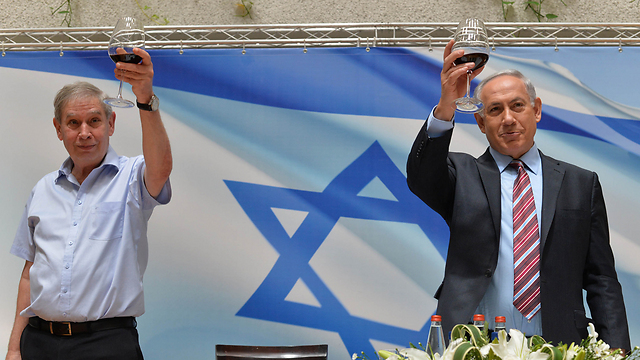
56024560100388640360noPardo and Netanyahu: On the same page (Photo: GPO)

“As for the use of the term ‘grenade’, the Mossad chief did not use that with regards to imposing sanctions, which, as mentioned, he considers to be the ‘sticks’ that would aid in achieving a good agreement. He used this term to describe the possibility of creating a temporary crisis in the talks, at the end of which the negotiations will be renewed under better terms. The Mossad chief specifically stated that the agreement currently being formulated with Iran is bad and might lead to a regional arms race.”

The Bloomberg report was published after US House Speaker John Boehner invited Prime Minister Benjamin Netanyahu to speak in front of Congress about the Iranian nuclear threat. Netanyahu has been urging the American administration to harden its sanctions policy. The Obama administration, Bloomberg reported, has been using the internal divide between the Mossad and Netanyahu to torpedo the bi-partisan proposal, penned by Senators Mark Kirk and Robert Menendez.

Meanwhile, Republican Senator Bob Corker, chairman of the Senate Foreign Relations Committee, has teamed up with Lindsay Graham and John McCain to propose a bill requiring the White House bring any deal with Iran to a vote in Congress.

The Obama administration opposes both measures and has warned the Senate to stay away from the delicate negotiations between Iran and world powers.

According to the report, Mossad officials have briefed the White House, as well as Republican legislators, on their opposition to the Kirk-Menendez bill, which would implement new sanctions on Iran if the negotiations fail to yield results by June 30 or the Islamic Republic fails to live up to its commitments.

Netanyahu, on the other hand, has expressed his support for the legislation, in particular, and sanctions on Iran, in general.

Evidence to Israeli interference in the Iran-US talks comes from comments made by Secretary of State John Kerry, who said an unnamed Israeli intelligence official had said the new sanctions bill would be “like throwing a grenade into the process.” When Menendez heard about the Mossad briefing, he demanded clarifications from Israel’s Ambassador to the US Ron Dermer.

The West Bank Army of the “State of Palestine,” Thanks to the United States

January 21, 2015

The West Bank Army of the “State of Palestine,” Thanks to the United States, The Gatestone InstituteShoshana Bryen, January 21, 2015

(????????????? — DM)

The U.S. Consulate’s determination to provide the trappings of Palestinian statehood to the Palestinian Authority outside the negotiating process should come under scrutiny.

What plan do we have if the Palestinian army attacks the IDF in the future — instead of its presumed enemy, Hamas?

It is revealing that the U.S. appears determined to provide the Palestinian Authority with an army while it is still at war with our ally, Israel.

Last week, officials from the U.S. Consulate in East Jerusalem attended a Palestinian protest over Israel’s removal of olive trees illegally planted in the West Bank. Coordinated with the Palestinian Authority [PA] but not Israel, the Consulate personnel ended up clashing with Israelis living nearby. It was, perhaps, the quietest international almost-incident you never heard of.

This week, with the focus off Paris, the Middle East Quartet (the U.S., EU, Russia & the UN) plans to meet. The U.S. Consulate’s determination to provide the trappings of Palestinian statehood to the PA outside the negotiating process should come under scrutiny.

The olive tree incident prompted an article in the Israeli press about the Consulate, including the use of Palestinian security, rather than IDF combat veterans as required by a 2011 agreement. Some IDF guards were fired, according to the article. Others resigned, blaming the appointment of a new consulate security officer, who they said, established a Palestinian armed militia. “He is training them with weapons, combat and tactical exercises. There is a lack of responsibility here – who ensures that such weapons, once given over to Palestinian guards, won’t make their way to terror groups?”

The change in personnel from IDF veterans to a Palestinian Security Force [PSF] is part of a long series of steps to transform the Palestinian body politic into a state. If the U.S. Consulate becomes the U.S. Embassy to Palestine — a function it already observes — it is understandable that the PA would not want “occupying Israeli soldiers” to guard the symbol of America from Palestinian citizens in “its capital, Jerusalem.” The Consulate, with its mission to the PA, would agree.

Palestinian security forces have been in existence since 1994 and have steadily changed mandates. They have gone from a “police force” under the Oslo formulation of “dismantling the terrorist infrastructure” so Israel could have confidence in security after withdrawing from territory, to a protection force for Mahmoud Abbas so he would continue negotiations under U.S. auspices — but now to an army for the nascent state.

The Clinton Administration signed on to the police phase, but asked how Arafat could be expected to defeat “terrorists” without weapons. Unmentioned were a) Arafat was the prime funder and organizer of the terrorist organizations in question, and b) the PLO had already proven perfectly capable of killing its enemies.

The first funds for equipment and training came in 1994 from international donors including the U.S. Arafat, having a reasonable sized arsenal of his own, wanted arms, but settled for nonlethal items.

In 1996, Western trained Palestinian “police” attacked IDF personnel with weapons, killing 15 soldiers and border guards, after the opening of an exit from an ancient Hasmonean tunnel in Jerusalem, near the Western Wall in the Old City.

Despite these attacks, according to Jeffrey Boutwell, Director
 of the Pugwash Conferences on Science and World Affairs, the 1997 Hebron Protocol “provided for a Palestinian police force of some 30,000 personnel, equipped with 15,000 automatic rifles and pistols, 240 heavy machine guns, 45 armored vehicles, lightly armed shore patrol vessels, and associated communications and transportation equipment.” An Israeli-Palestinian Joint Security Coordination and Cooperation Committee [JSC] was formed to oversee “arrangements for entry of the Palestinian Police and the introduction of police arms, ammunition, and equipment.”

Between the onset of Western arms deliveries and a thriving black market, the PA “police” had all the lethal equipment they could handle.

Training stopped during the 2001-2004 so-called “second intifada” with the (unsurprising) revelation that the PA “police” found their Western assets invaluable in attacking Israelis. In 2005, however, history began again and the U.S. decided that the Palestinians should have a new security service. LTG William Ward USA (Deputy Commanding General, U.S. Army Europe, and Chief of Staff, U.S. Seventh Army) was the point man. In the words of then-Secretary of State Condoleezza Rice, his mission was:

  • “To make sure the parties understand each other and we understand what the parties are doing, so we can raise it at the appropriate level” if action is required.
  • “To provide a focal point for training, equipping, helping the Palestinians to build their security forces and also for monitoring, and if necessary, to help the parties on security matters.”

The missions were incompatible and inappropriate. The first involved “translating for the parties” with an eye toward U.S. intervention, a political job that should not have been done by a military officer. Further, having part of the mission directed toward a Palestinian force gave the General a stake in the success of the Palestinians over the concerns of Israel.

And so it happened. The Ward mission, the sole conduit for U.S. aid to the new Palestinian Security Force, resulted only in better-trained terrorists.

LTG Keith Dayton (Director of Strategy, Plans and Policy, Office of the Deputy Chief of Staff, G-3, U.S. Army), well respected and liked by Israel and the IDF, succeeded LTG Ward. His job, however, was complicated by the deterioration relations Hamas-Fatah in Gaza. According to acontemporaneous Ha’aretz story, Dayton was to arm and train “the Presidential Guard of PA Chairman Mahmoud Abbas to prepare it for a potential violent confrontation with Hamas forces in Gaza. Palestinian sources say the training of 400 Force 17 troops… started [in November 2006] in Jericho under the guidance of an American military instructor.” Force 17 had been Arafat’s Praetorian Guard, attacking recalcitrant Palestinians as well as Israelis. Abbas had inherited it.

Throwing American support to one Palestinian faction over another was a political decision to side with what our government assumed was “better” or more “moderate” Palestinians, hoping it would use our help to put down Hamas rather than using it to kill ever more Israelis.

What it did was legitimize the creeping movement of the Palestinians toward a full-fledged army.

This new mission needed IDF participation — which Israel approved in part because of its relations with LTG Dayton, and because it allowed Israel to operate in West Bank territory with a relatively free hand to arrest both Hamas operatives and Fatah bad guys. It also made Abbas beholden to Israel for his personal security and that of his kleptocracy. That part worked, and even now, PA figures have admitted publicly that without IDF cooperation, the PA would fall.

Dayton’s successors, LTG Michael Moeller, USAF and ADM Paul Bushong, USN, have quietly continued and upgraded both training and weapons.

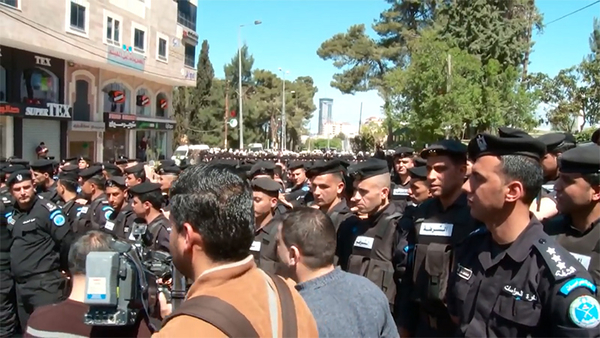
893Hundreds of troops from the Palestinian Security Force line a street in Ramallah, in order to block anti-American protestors, during President Obama’s 2013 visit to the city.

The question always was twofold: What constitutes “appropriate” weapons for the PSF, and how does the U.S. justify training security forces the ultimate loyalty of whom will be a government that we cannot foresee and may become something — or already is something — we don’t like? The corollary is: What plan do we have if the Palestinian Army attacks IDF forces in the future — instead of its presumed enemy, Hamas?

To raise the questions is to understand that there are no sound answers from either the Consulate or the State Department. In their absence, concern over the choice of security guards by the U.S. Consulate in Jerusalem is appropriate, but insufficient. It is revealing that the U.S. appears determined to provide the PA with an army while it is still at war with our ally, Israel.

No Room for Parody

January 18, 2015

No Room for Parody, American ThinkerClarice Feldman, January 18, 2015

I was sound asleep when the phone rang and so I cannot be absolutely sure the conversation was not a dream, but it seemed real enough.

“Hello,” the caller began. “My name is Mr. Mensch, I am president of the Parodists of the World, professional comedy writers, and we want to engage you in a suit against the administration for tortious interference with our livelihood.”

“What exactly are you alleging, I mean specifics?” I responded.

He then launched into a litany of grievances against the administration which the Parodists claimed had made it impossible for them to continue making a living.

“First, our country sent no one to the important anti-terrorism demonstration in Paris, and then there’s Valerie Jarrett calling the march against the slaughter of innocents in Paris a ‘Parade’, as if this were some sort of celebration.‘ Certainly We Would Have Loved To Participate In The Parade,” But We “Got The Substance Right”’.” She said and then proceeded to claim that Holder couldn’t attend because he was in a very important terrorism conference at the time, forgetting that we knew everyone else at the conference made it to the march except Holder. So at the time of the march he was meeting with himself, it seems.”

“Well, that was silly, “I agreed.  “And?” I waited for the next item.

“Then our secretary of state, John Kerry, whose entire life has been fashioned around his self-imagined superior diplomatic skills and international affairs expertise, shows up speaking execrable high school level French, accompanied by  an aging ex-druggie who sings to the grieving French ‘You’ve Got a Friend’”

“I have to agree that was preposterous and really embarrassing. One wag suggested the French ought to respond by having Carly Simon sing, ‘You’re so Vain’ to the President and his Secretary of State. ‘Send in the Clowns’ comes to mind.”

“It’s all of a piece you know. It’s cutting substantially into our employment prospects. Let me read this to you,” Mensch said:

“ ‘A scandal has erupted in the American Consulate in Jerusalem, as three Israeli security guards have quit following a plan to hire 35 armed Palestinian guards from East Jerusalem. The Palestinians have been undergoing weapons training in Jericho in recent days. The decision to hire and arm the Palestinian security personnel was made by the consulate’s chief security officer, Dan Cronin. The plan is to employ them mostly as escorts to American diplomats’ convoys in the West Bank. Their operating base will be at the consulate in the city’s west, as well as six other facilities around the city belonging to the consulate, of which five are in western Jerusalem.

The plan is a breach of a 2011 agreement between the consulate and the Israeli government, which determined that only former IDF combat soldiers hired by the consulate would be allowed to carry weapons. That year, Israel gave the consulate approval to keep about 100 guns for its security guards, but only if they’re American diplomats or Israelis who served in the army. While the consulate employs scores of guards from East Jerusalem, they have not been armed up until now.’”

“Sounds like a bad joke to me,” I replied. “With the world’s attention focused on Moslem extremists. New jihadi groups showing up all through Europe, and Palestinians continuing to attack our ally Israel  and we train and arm Palestinian guards to protect us in Jerusalem in violation of  our agreement with Israel?”

“Even the liberal foreign policy pundit Leslie Gelb is concerned that the administration is absolutely clueless,” sputtered Mensch.

“And he keeps releasing men from Gitmo who then return to fight against us. He released Mullah Abdul Rauf and immediately on his return he’s recruiting for the Taliban in Afghanistan.”

By this time Mensch was on a roll.

“The White House spokesman, Josh Earnest is tripping over his own tongue trying not to say the magic words ’Moslem extremist’. Listen to this circumlocution of his: ‘We want to describe exactly what happened. These are individuals who carried out an act of terrorism. And they later tried to justify that act of terrorism by invoking the religion of Islam and their own deviant view of it.’”

“Then there’s the nonsensical negotiations with Iran,” I interjected.

Mensch sputtered, “Thursday Obama announced he would not tighten sanctions on Iran which is violating the sanctions already in place because if we tighten the reins it will only drive them to war. Think about that! If we impose stricter sanctions on them, they’ll go to war, and if we don’t, they’ll go to war with nuclear weapons.”

“That’s nothing to joke about,” I said.

“Precisely! Obama‘s leaving us nothing to parody. We can’t make a living in comedy. He and his administration are themselves the joke. We might as well just send in news clippings to our editors as try to dream up anything wackier than what they’re doing. And, look, it’s not just foreign affairs. Take the Keystone Pipeline — I mean it should be clear to everyone that we are hurting Iran and Russia financially each time we and others increase the supply of gas and oil on the world market and we need jobs badly, so why is he still sitting on this? George Will captured this bit of nuttiness,” he added and I heard the rustle of newspaper as he read this to me.

Actually, there no longer is any reason to think he has ever reasoned about this. He said he would not make up his mind until the Nebraska Supreme Court ruled. It ruled to permit construction, so he promptly vowed to veto authorization of construction.

The more Obama has talked about Keystone, the less economic understanding he has demonstrated. On Nov. 14, he said Keystone is merely about “providing the ability of Canada to pump their oil, send it through our land, down to the gulf, where it will be sold everywhere else. That doesn’t have an impact on U.S. gas prices.” By Dec. 19, someone with remarkable patience had explained to him that there is a world market price for oil, so he said, correctly, that Keystone would have a “nominal” impact on oil prices but then went on to disparage job creation by Keystone. He said it would create “a couple thousand” jobs (the State Department study says approximately 42,100 “direct, indirect, and induced”) and said, unintelligibly, “Those are temporary jobs until the construction actually happens.” Well.

“I understand your distress,” I sympathized, “but to make your case you have to prove that Obama intended to harm your business, and as Will notes it’s just that he isn’t that smart.”

“C’mon,” the parodist, countered, “Almost every professor in America supported and voted for him. Are you calling them all stupid?”


Free Fire Zone- A Strategy to defeat Global Jihad

January 15, 2015

Free Fire Zone- A Strategy to defeat Global Jihad, Blackfive, January 15, 2015

(I look forward to learning the substance of their proposal. — DM)

The Islamists are attacking all over the world. They are enslaving and killing innocents and the best the free world can come up with is more hashtags. I am glad to see some organizations standing up for freedom of speech and liberty, but it is maddening to watch the United States of America unwilling to even name the enemy facing us all. It is Islamist Extremists and they are proud to let us know.

President Obama has no strategy and is anything has shown a complete unwillingness and inability to deal with the reality we face. The Center for Security Policy has taken the ball and in the absence of leadership from the Commander in Chief, written a comprehensive strategy for dealing with and defeating the Global Jihad. We will release the document tomorrow Friday, January 16 at 12 Noon at the National Press Club in DC.


Exclusive: ISIS Gaining Ground in Syria, Despite U.S. Strikes

January 15, 2015

Exclusive: ISIS Gaining Ground in Syria, Despite U.S. Strikes, The Daily Beast, January 15, 2015

1421322880562.cachedHosam Katan/Reuters

American jets are pounding Syria. But ISIS is taking key terrain—and putting more and more people under its black banners.

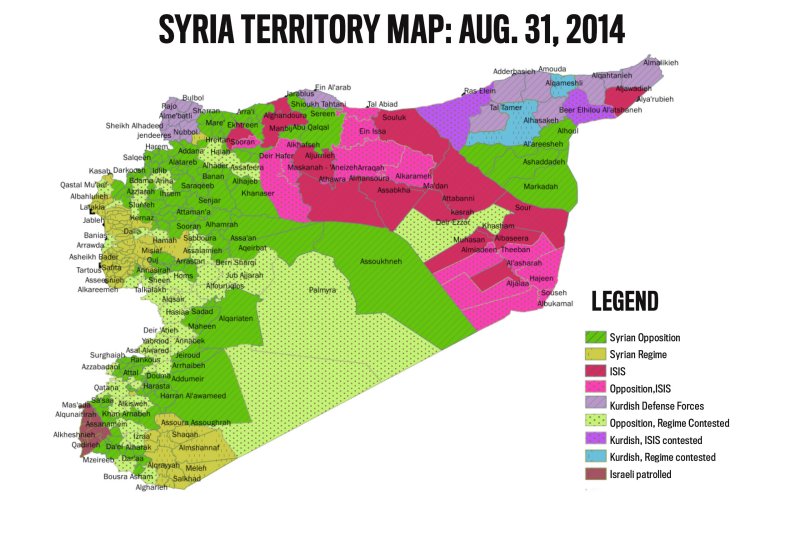
ISIS continues to gain substantial ground in Syria, despite nearly 800 airstrikes in the American-led campaign to break its grip there.At least one-third of the country’s territory is now under ISIS influence, with recent gains in rural areas that can serve as a conduit to major cities that the so-called Islamic State hopes to eventually claim as part of its caliphate. Meanwhile, the Islamic extremist group does not appear to have suffered any major ground losses since the strikes began. The result is a net ground gain for ISIS, according to information compiled by two groups with on-the-ground sources.In Syria, ISIS “has not any lost any key terrain,” Jennifer Cafarella, a fellow at the Washington, D.C.-based Institute for the Study of War who studies the Syrian conflict, explained to The Daily Beast.Even U.S. military officials privately conceded to The Daily Beast that ISIS has gained ground in some areas, even as the Pentagon claims its seized territory elsewhere, largely around the northern city of Kobani. That’s been the focus of the U.S.-led campaign, and ISIS has not been able to take the town, despite its best efforts.Other than that, they are short on specifics.

1421269431538.cachedClick to Enlarge (Coalition For a Democratic Syria)

“Yes, they have gained some ground. But we have stopped their momentum,” one Pentagon official told The Daily Beast.

A map developed by the Coalition for a Democratic Syria (CDS), a Syrian-American opposition umbrella group, shows that ISIS has nearly doubled the amount of territory it controls since airstrikes began last year.

“Assessing the map, ISIS has almost doubled its territorial control in Syria. But more importantly, the number of people who now live under ISIS control has also increased substantially,” CDS political adviser Mouaz Moustafa said.

With the fall of that much territory into ISIS hands, Syrians who once lived in ungoverned or rebel held areas are now under ISIS’s grip. Of course, in an irregular war like this one, control of people is far more important than control of territory. In that regard, too, things appear to be going in the wrong direction.

In the first two months following American airstrikes, about a million Syrians who had previously lived in areas controlled by moderates now lived in areas controlled by extremist groups al Nusra or ISIS, according to CDS, citing conversations with European diplomats who support the Syrian opposition.

The area of ISIS’s expansion includes large segments of the Homs Desert, which begins far south of the contested northern city of Aleppo. It stretches below the presumed capital of ISIS in Syria, Raqqa, and all the way to the Iraqi border. It is largely rural and not an area that ISIS has had to fight for. Rather the group took control of uncontested parts of the countryside while skirting key regime strongholds in the area, Cafarella said.

But that does not mean that land is not valuable to ISIS. That newly acquired terrain allows ISIS troops to target and threaten more valuable areas, Cafarella said.

Since the U.S. campaign began in August, “there are little buds of ISIS control in eastern Homs, al Qalamoun [which borders northern Lebanon], and southern Damascus that do appear to be growing because of that freedom of operation that can connect those western cells to key ISIS terrains in Raqqa and Deir ez Zour” in northern and eastern Syria.

Moustafa, the CDS political adviser, blamed ISIS territorial gains on a lack of “strategic coordination between coalition strikes and moderate forces inside Syria, meaning that the Free Syrian Army and aligned groups cannot use the strikes to retake territory.” Further, Moustafa told The Daily Beast, coalition strikes have given other extremist groups sympathy for ISIS.

One frustration of the Syrian opposition groups is that the bombing campaign has been focused at the heart of ISIS controlled territory, rather than at the front lines, where ISIS territorial gains could be pushed back.

“The coalition strikes seem similar to drone campaigns in Yemen or Pakistan, targeting only leadership. The front-line strength of ISIS has undoubtedly increased even as some of these targeted strikes take out mid-level individual leaders,” Moustafa said.

As of Sunday, the U.S. and its coalition partners had conducted 790 airstrikes in Syria, according to Pentagon statistics. In all, the U.S. has spent $1.2 billion on its campaign against ISIS in Iraq and Syria.

In its public comments, the U.S. military has said repeatedly the effort against ISIS is on the right track. However it often does this by conflating its war in Iraq and Syria. Ask a question about what is happening in Syria, and U.S. officials will stress that ISIS has not gained ground in Iraq. Ask if the U.S. effort is working in Syria, and the military often points to the fact that ISIS has failed to take control of Kobani.

During a Jan. 6 press briefing, for example, when a reporter asked “where ISIS’s relative strength is right now,” Navy Rear Adm. John Kirby replied by talking exclusively about the U.S. effort in Iraq, naming cities were the military believed ISIS’s momentum has been “halted.”

When the reporter pressed for an answer on what was happening in Syria, Kirby struggled, saying, “I couldn’t give you a—a specific point at which, you know, we believe, well geez, we’ve halted their momentum. It—it’s come slowly, in various stages. But I think it’s safe to say that over the last three to four weeks, we—we’ve been confident that that momentum has largely been blunted.”

On Friday, Kirby proclaimed that ISIS had lost 700 square kilometers since the campaign began—over half the size of New York City or about four times the size of the District of Columbia. But the Pentagon spokesman could not say what percentage that area marked of total ISIS-controlled land. Nor could he say if that loss was in Iraq, Syria, or combined in both nations. As Kirby asserted: “I’m frankly not sure how relevant that is. I mean, it’s—they have less ground now than they did before. They’re trying to defend what ground that they have. They’re not going on the offense much, and they’re really trying to preserve their own oxygen.”

1421269455425.cachedClick to Enlarge (Coalition For a Democratic Syria)

The American military has not been able to take full advantage of the difficulties ISIS is facing. A worldwide drop in oil prices threatens the recently declared state’s ability to raise revenue, while declining standards in public services, distribution of aid, and provision of electricity threaten to undercut the group’s support across the territories it controls. ISIS has also not been able to follow through on its military quest to challenge the Iraqi government all the way to Baghdad.

The U.S. military stressed it is waging an “Iraq first” war, that is focused on eliminating ISIS from that country first. There, the U.S. can turn to Iraqi troops on the ground to assess its efforts. But there is no equivalent resource on the ground in Syria. Perhaps because of that, the U.S. military has offered a far more detailed assessment of the air campaign in Iraq than the one in Syria.

The Combined Joint Task Force in charge of the American air campaign refused to answer a Daily Beast query about ISIS gains in Syria, even as it striking targets there. U.S. Central Command replied, “As a matter of policy we do not discuss intelligence issues.”

Information on the maps:

The maps provided by the Coalition for a Democratic Syria show the areas controlled by moderate Syrian rebels, the Syrian regime, ISIS, Syrian al Qaeda affiliate al Nusra, as well as territories contested by these groups. The maps were developed by a field team from the Coalition for a Democratic Syria (CDS), an umbrella group of Syrian American organizations. The maps were sourced through on-the-ground networks including civilian councils, humanitarian organizations, armed actors, and media monitoring of independent Syrian channels.