Posted tagged ‘North Korean missiles’

Hmm: China’s National Oil Firm Cuts Off North Korea

June 28, 2017

Hmm: China’s National Oil Firm Cuts Off North Korea, Hot Air, Ed Morrissey, June 28, 2017

Beijing had already cut off coal imports from North Korea, depriving Kim of income that could have been used to pay for the fuel. It looks like a squeeze, one that may be picking up in intensity, and one that sends a direct message to North Korea’s military leaders, who will understand only too well what a fuel embargo will do to their readiness posture. It won’t take much more for the situation to reach critical mass on the Korean peninsula.

***********************

Has North Korea run out of credit with China, or has Beijing finally run out of patience with Pyongyang? China’s state-run petroleum operation has cut off fuel sales to rogue nation, Reuters reports, ostensibly due to a lack of payment. However, it’s no secret that the Trump administration has put a lot of pressure on Beijing to get tougher with the Kim regime, and a fuel cutoff will hit Kim Jong-un where he’s most vulnerable:

China National Petroleum Corp has suspended sales of fuel to North Korea over concerns the state-owned oil company won’t get paid, as pressure mounts on Pyongyang to rein in its nuclear and missile programmes, three sources told Reuters.

It’s unclear how long the suspension will last. A prolonged cut would threaten critical supplies of fuel and force North Korea to find alternatives to its main supplier of diesel and gasoline, as scrutiny of China’s close commercial ties with its increasingly isolated neighbour intensifies.

North Korea needs the fuel not just for its farmers and shipping, but also for its military. That presents a particularly difficult problem for Pyongyang’s leaders, who already operate in a crisis-shortage environment. Kim can’t afford to cut back on military supplies, not with all of the saber rattling taking place at the moment, which means he’ll have to starve the rest of the country of fuel resources, which will hamper food production and distribution even further. It will ratchet up internal tension, and it might get worse if military needs can’t be satisfied.

CNPC won’t sell the fuel on credit, Reuters’ Chen Aizhu notes, which means that Pyongyang is having trouble coming up with hard currency. Aizhu’s source says the issue came up over “the last month or two,” and that timing is intriguing. Four months ago, Kim ordered a bizarre assassination of his older brother Kim Jong-nam, using VX nerve agent in the airport of Malaysia’s capital of Kuala Lumpur.  The target and especially the weapon made it clear who ordered the hit, and Malaysia — one of the few nations willing to do business with North Korea — cut off diplomatic and economic ties to Pyongyang, which set off a round of hostage-taking by the Kim regime. Malaysia had been a key partner in avoiding international sanctions and a vital link to hard currency for Pyongyang until the assassination. If North Korea has had trouble paying for diesel and gasoline over the last couple of months, it might signal that Pyongyang has no more options for avoiding sanctions and that its economic back is against the wall, so to speak.

Aizhu’s sources say that this was a “commercial decision,” but nothing’s that simple in China. Beijing had already cut off coal imports from North Korea, depriving Kim of income that could have been used to pay for the fuel. It looks like a squeeze, one that may be picking up in intensity, and one that sends a direct message to North Korea’s military leaders, who will understand only too well what a fuel embargo will do to their readiness posture. It won’t take much more for the situation to reach critical mass on the Korean peninsula.

Spotlight: China, U.S. reach consensus at high-level security dialogue

June 24, 2017

Spotlight: China, U.S. reach consensus at high-level security dialogue, XinhuaNet, June 24, 2017

(The words sound friendly, but what do we get at what cost? — DM)

Chinese State Councilor Yang Jiechi (1st R) co-chairs a diplomatic and security dialogue with U.S. Secretary of State Rex Tillerson (1st L) and Secretary of Defense James Mattis (2nd L) as Fang Fenghui (2nd R), a member of China’s Central Military Commission (CMC) and chief of the CMC Joint Staff Department, also participates in the dialogue in Washington D.C., the United States, on June 21, 2017. China and the United States began their first diplomatic and security dialogue on Wednesday at the U.S. State Department in Washington D.C. (Xinhua/Yin bogu)

At the dialogue, China the United States agreed to work closely on the Korean Peninsula’s nuclear issue.

Both countries reaffirmed their commitment to achieving the goal of “complete, verifiable and irreversible” denuclearization on the Peninsula.

*********************

WASHINGTON, June 23 (Xinhua) — China and the United States reached an important consensus on the development of bilateral relations and security issues at a high-level dialogue held Wednesday in the U.S. capital of Washington D.C.

The First Round of China-U.S. Diplomatic and Security Dialogue, which was described by both sides as “constructive” and “fruitful,” represents a major step in implementing the consensus reached by Chinese President Xi Jinping and his U.S. counterpart Donald Trump during their meeting in Florida in April.

Looking ahead, the two sides pledged to expand mutually-beneficial cooperation and manage differences on the basis of mutual respect, all in a bid to promote the steady development of China-U.S. relations in the long term.

FREQUENT DIALOGUES

Following Wednesday’s dialogue, U.S. Secretary of State Rex Tillerson said such talks “provide an opportunity to consider how we’re going to engage and how we’re going to live with one another over the next 40 years.

“The action items we have agreed upon today have set a foundation for additional areas of cooperation and we look forward to our next interaction at this level and between our two presidents,” said the top U.S. diplomat.

Emphasizing the importance of high-level exchanges, China and the United States expressed their willingness to achieve a positive outcome for the Hamburg meeting between the two Presidents in July and Trump’s state visit to China later this year.

Meeting with Chinese State Councilor Yang Jiechi at the White House on Thursday, Trump said he looked forward to meeting with Xi in Hamburg and visiting China. He also hoped that these high-level interactions will further promote the development of U.S.-China relations.

PRODUCTIVE MILITARY RELATIONSHIP

Fang Fenghui, a member of China’s Central Military Commission (CMC) and chief of the CMC Joint Staff Department, participated in the dialogue co-chaired by Yang, Tillerson and U.S. Secretary of Defense James Mattis.

At the dialogue, China and the United States recognized that their military-to-military relationship is an important component in the bilateral ties. The two sides agreed that the relationship between the militaries of the two powers should be “constructive, pragmatic, and effective,” according to a statement released Friday.

China and the United States are committed to implementing the annual military exchange program and enhancing high-level engagements, starting with the visits between the two defense ministers and the visit of the Chairman of the U.S. Joint Chiefs of Staff to China as soon as possible.

The two sides also “reaffirm the importance of building mutual understanding, and of reducing the risk of miscalculation between our two militaries,” said the statement.

MAINTAINING COORDINATION ON KOREAN PENINSULAR ISSUE

At the dialogue, China the United States agreed to work closely on the Korean Peninsula’s nuclear issue.

Both countries reaffirmed their commitment to achieving the goal of “complete, verifiable and irreversible” denuclearization on the Peninsula.

“The two sides are ready to continue their efforts to this end, including by fully and strictly implementing relevant United Nations Security Council resolutions, and by promoting relevant dialogue and negotiation,” said the statement.

The two countries also reaffirmed their commitment to maintaining peace and stability on the Peninsula, according to the statement.

Iran gets North Korean expertise in building up, testing and hiding its ballistic missiles

June 21, 2017

Iran gets North Korean expertise in building up, testing and hiding its ballistic missiles, Washington Times

(The North Korea – Iran nuclear/missile axis has been active for years. Why not? Iran has lots of money courtesy of Obama’s Iran Scam and North Korea has technology that Iran wants. Iran is also likely pleased that the threat of North Korean nuke-laden missiles may be diverting attention from the dangers posed by Iran. — DM)

Iranian dissidents have documented work at 42 missile centers operated by the Islamic Revolutionary Guard Corps, the regime’s dominant security force. A dozen of those sites had never been disclosed before. (Associated Press/File)

Iran has increased production and testing of ballistic missiles since the 2015 nuclear deal with the U.S. while playing permanent host to scientists from North Korea, which has the know-how to build and launch atomic weapons, a leading Iranian opposition group said Tuesday.

The National Council of Resistance of Iran issued a white paper that the dissidents say identifies and documents work at 42 missile centers operated by the Islamic Revolutionary Guard Corps, the regime’s dominant security force.

A dozen sites had never been disclosed before, said the council, which operates a spy network that has exposed Iran’s hidden nuclear program.

Tehran views expertise from North Korea as being so critical that it has established residences in Tehran for Pyongyang’s scientists and technicians, according to the white paper. North Koreans have shown Iran how to dig tunnels and build “missile cities” deep inside mountains to prevent destruction by airstrikes, among other projects.

“On the basis of specific intelligence, the IRGC’s missile sites have been created based on North Korean models and blueprints,” the white paper said. “North Korean experts have helped the Iranian regime to build them. Underground facilities and tunnels to produce, store, and maintain missiles have also been modeled after North Korean sites and were created with the collaboration of the North Korean experts.”

Iranians also are traveling to North Korea, which uses occasional missile test-firings to rattle its neighbors South Korea and Japan, two strong U.S. allies.

“In the context of these trainings and relations, delegations of the IRGC’s aerospace constantly travel to North Korea and exchange knowledge, information and achievements with North Korean specialists,” the report said. “North Korea’s experts constantly travel to Iran while the IRGC’s missile experts visit North Korea.”

President Trump has been harshly critical of the 2015 deal struck by the Obama administration and five international allies to lift economic sanctions and other financial penalties in exchange for curbs on Iran’s nuclear weapons programs, but has said he will stick with the accord for now while closely monitoring Tehran’s adherence to the deal.

Iran’s leaders say they have yet to see all the benefits promised with the lifting of sanctions.

But even supporters of the Obama deal say there has been little sign that Iran’s Islamic Republic has moderated its behavior on other fronts, including the series of ballistic missile tests in recent months that some argue violate U.N. sanctions. U.S. officials also say Iran continues to back terror groups and foment instability in regional hot spots such as Syria and Yemen.

At a press conference Tuesday, Alireza Jafarzadeh, the council’s deputy director in Washington, displayed satellite photos that he said clearly show trademark North Korean mountain entrances to “cities” that hold hundreds of missiles.

He said the regime reorganized the IRGC Aerospace Force to focus almost exclusively on missile production and testing rather than aircraft.

“It’s not by accident,” Mr. Jafarzadeh said. “It’s part of their overall strategy.”

He said a huge missile arsenal allows the ruling Shiite mullahs to intimidate Sunni Muslim neighbors such as rival Saudi Arabia. In addition, missiles provide a delivery system for the nuclear weapons that the regime plans to build once the 2015 nuclear deal, known as the Joint Comprehensive Plan of Action, expires in less than 10 years.

“We’re racing against the clock,” he said.

The National Council of Resistance of Iran held a press conference in Washington in April to present evidence that Tehran’s harsh Islamic regime is cheating on the nuclear deal by continuing secret work on atomic bomb components. The Trump administration recently certified that the Islamic republic is living up to its obligations in the deal, which restricts Tehran’s production of only nuclear material, not missiles.

The council’s report pays close attention to the Semnan missile center, a complex of storage facilities and launching pads for medium-range ballistic missiles in north-central Iran. It is here, the white paper says, that Iran melds missile work with nuclear research conducted by the Organization of Defensive Innovation and Research, known by the Persian acronym SPND.

The council first disclosed SPND’s existence in 2011. In 2014, the Obama administration imposed sanctions on SPND for conducting illicit work not allowed at by the pending nuclear deal.

“The Semnan center for missile projects has been much more active after the JCPOA,” a council official said. “The speed and scope of activities and research in Semnan has increased significantly in this period and the exchanges and traffic between SPND.”

Iran has flouted U.N. resolutions repeatedly by test-firing ballistic missiles. In February, the nonprofit Foundation for Defense of Democracies put the number at 14 since the nuclear deal was signed in July 2015. Since then, Iran has conducted at least two more tests.

On Sunday, Iran for the first time since 2001 fired an operational missile outside its boundaries, targeting an Islamic State-controlled town in eastern Syria. Tehran said the ground-to-ground missile strike was retaliation for the Islamic State’s June 7 terrorist attack on the Iranian parliament. In 2001, the regime fired missiles on resistance targets in Iraq.

Iran owns one of the world’s largest inventories of ballistic missiles. GlobalSecurity.org lists more than a dozen different short- and medium-range Iranian missiles, some of which closely resemble North Korea’s Nodong arsenal.

Tehran this year announced the launch of the Emad, which has a range of 1,000 miles. It said the test marked a first for an Iranian precision-guided ballistic missile.

More than ever, the resistance council said, Iran’s religious leaders see missiles as instrumental to their survival strategy.

“The Iranian regime has remained in power in Iran by relying on two pillars: internal repression and external export of Islamic fundamentalism and terrorism,” the council said. “Its illicit nuclear weapons program and its continued expansion of ballistic missiles serve its policy of export of Islamic fundamentalism and terrorism.”

Humor | North Korea Executes, Trains New Rocket Scientists

June 18, 2017

North Korea Executes, Trains New Rocket Scientists, Duffel Blog, June 18, 2017

PYONGYANG — North Korean plans to train a new crop of rocket scientists soon after it executes its current cadre following its next failed ballistic missile launch, sources confirmed today.

Dear Leader Kim Jong Un, who according to sources, was born of a dragonfly and a double rainbow, has demanded that his scientists and researchers sacrifice their utmost to create the capability to annihilate the rest of the world.

In keeping with this order, Pyongyang recruiters have conducted wide-ranging searches of the nation for the least nutrient-deprived minds, in order to form a new scientific cohort that can master the basics of nuclear physics and rocket propulsion.

“Only the hardest working coal miners and rice farmers will be chosen for our elite government work teams,” said spokesman Il Suk Yeo.

“Once they are identified, they are taken away to a secret government laboratory where they are fed a substantial meal of white rice. Then they are given an aptitude test with questions on anything from the Dear Leader’s non-existent bowel movements to the purity of the North Korean race.”

Once the all-encompassing battery of tests is concluded, the graduates are given a new uniform, complete with three pounds of awards and medals, before moving onto rocket science training, which includes watching the film “The Right Stuff” before their final test has them launching a two-liter soda bottle into the Sea of Japan.

The remainder are dragged out and shot as a matter of national security, sources said.

“The selectees have two weeks to read all of the books that Dear Leader himself wrote about ballistic missile trajectory, propulsion, and payload delivery before the next anticipated launch,” Yeo said. “And if that launch is not a Japanese crushing success, then the current scientists will be sacrificed for Dear Leader and our prospects here will become fully vetted, nuclear physicists.”


North Korea Nuclear EMP Attack: An Existential Threat

June 2, 2017

North Korea Nuclear EMP Attack: An Existential Threat, 38 North, June 2, 2017

(38 North is not a “click bait” site and tends to be fairly conservative in its analyses. Its conclusion that the threat of an EMP attack is real and that the consequences would be horrific should be credited. Although not mentioned, Iran is also a possible present or future source of an EMP attack. “Hardening the grid,” apparently our current focus, would help, but not very much.

Perhaps America should “test” the effects of EMP attacks by “experimenting” on North Korea and Iran simultaneously. In North Korea, the privileged few who are close to the Kim regime would be affected to a far greater extent than the peasants elsewhere. — DM)

In 2004, two Russian generals, both EMP experts, warned the EMP Commission that the design for Russia’s super-EMP warhead, capable of generating high intensity EMP fields of 200,000 volts per meter, was “accidentally” transferred to North Korea, and that due to “brain drain,” Russian scientists were in North Korea, helping with their missile and nuclear weapon programs. South Korean military intelligence told their press that Russian scientists are in North Korea helping develop an EMP nuclear weapon. In 2013, a Chinese military commentator stated North Korea has super-EMP nuclear weapons.[2]

***********************

Analysts like Jack Liu and Jeffrey Lewis are to be commended for their interest in educating the public about North Korea’s missile and nuclear programs and endeavoring to provide their readers with “informed analysis.” However, in a series of recent articles, both analysts have written off the possibility of a nuclear electromagnetic pulse (EMP) attack from North Korea as “unlikely” and “science fiction” because they believe the 10 to 20 kiloton nuclear weapons currently possessed by North Korea are incapable of making an effective EMP attack. This dismisses the consensus view of EMP experts who have advanced degrees in physics and electrical engineering along with several decades of experience in the field—with access to classified data throughout that time—and who have conducted EMP tests on a wide variety of electronic systems, beginning in 1963.

By way of background, the Commission to Assess the Threat to the United States from Electromagnetic Pulse Attack was established by Congress in 2001 to advise the Congress, the President, the Department of Defense and other departments and agencies of the US Government on the nuclear EMP threat to military systems and civilian critical infrastructures. The EMP Commission was re-established in 2015 with its charter broadened to include natural EMP from solar storms, all manmade EMP threats, cyber-attack, sabotage and Combined-Arms Cyber Warfare. The EMP Commission charter gives it access to all relevant classified and unclassified data and the power to levy analysis upon the Department of Defense.

In the interest of better informing 38 North readers about the EMP threat, we offer this commentary to correct errors of fact, analysis, and myths about EMP.

Primitive and “Super-EMP” Nuclear Weapons are Both EMP Threats

The EMP Commission finds that even primitive, low-yield nuclear weapons are such a significant EMP threat that rogue states, like North Korea, or terrorists may well prefer using a nuclear weapon for EMP attack instead of destroying a city.[1] In its 2004 report, the Commission cautioned: “Certain types of relatively low-yield nuclear weapons can be employed to generate potentially catastrophic EMP effects over wide geographic areas, and designs for variants of such weapons may have been illicitly trafficked for a quarter-century.”

In 2004, two Russian generals, both EMP experts, warned the EMP Commission that the design for Russia’s super-EMP warhead, capable of generating high intensity EMP fields of 200,000 volts per meter, was “accidentally” transferred to North Korea, and that due to “brain drain,” Russian scientists were in North Korea, helping with their missile and nuclear weapon programs. South Korean military intelligence told their press that Russian scientists are in North Korea helping develop an EMP nuclear weapon. In 2013, a Chinese military commentator stated North Korea has super-EMP nuclear weapons.[2]

Super-EMP weapons are low-yield and designed to produce not a big kinetic explosion, but rather a high level of gamma rays, which generate the high-frequency E1 EMP that is most damaging to the broadest range of electronics. North Korean nuclear tests—including the first in 2006, which was predicted to the EMP Commission two years in advance by the two Russian EMP experts—mostly have yields consistent with the size of a super-EMP weapon. The Russian generals’ accurate prediction of when the North would perform its first nuclear test, and the yield being consistent with a super-EMP weapon, indicates their warning about a North Korean super-EMP weapon should be taken very seriously.

EMP Threat from Satellites

While most analysts are fixated on when in the future North Korea will develop highly reliable intercontinental ballistic missiles, guidance systems, and reentry vehicles capable of striking a US city, the present threat from EMP is largely ignored. An EMP attack does not require an accurate guidance system because the area of effect, having a radius of hundreds or thousands of kilometers, is so large. No reentry vehicle is needed because the warhead is detonated at high-altitude, above the atmosphere. Missile reliability matters little because only one missile has to work to make an EMP attack.

For instance, North Korea could make an EMP attack against the United States by launching a short-range missile off a freighter or submarine or by lofting a warhead to 30 kilometers burst height by balloon. While such lower-altitude EMP attacks would not cover the whole US mainland, as would an attack at higher-altitude (300 kilometers), even a balloon-lofted warhead detonated at 30 kilometers altitude could blackout the Eastern Grid that supports most of the population and generates 75 percent of US electricity.

Moreover, an EMP attack could be made by a North Korean satellite. The design of an EMP or even a super-EMP weapon could be relatively small and lightweight, resembling the US W-79 Enhanced Radiation Warhead nuclear artillery shell of the 1980s, designed in the 1950s. Such a device could fit inside North Korea’s Kwangmyongsong-3 (KMS-3) and Kwangmyongsong-4 (KMS-4) satellites that presently orbit the Earth. The south polar trajectory of KMS-3 and KMS-4 evades US Ballistic Missile Early Warning Radars and National Missile Defenses, resembling a Russian secret weapon developed during the Cold War, called the Fractional Orbital Bombardment System (FOBS) that would have used a nuclear-armed satellite to make a surprise EMP attack on the United States.[3]

Kim Jong Un has threatened to reduce the United States to “ashes” with “nuclear thunderbolts” and threatened to retaliate for US diplomatic and military pressure by “ordering officials and scientists to complete preparations for a satellite launch as soon as possible” amid “the enemies’ harsh sanctions and moves to stifle” the North.[4]

Addressing Misinformation

Recent assessments by Jeffrey Lewis and Jack Liu regarding North Korea’s EMP capabilities have some fundamental flaws.[5]

For starters, in his article, Jeffrey Lewis claimed that “just one string of street lights failed in Honolulu” during the 1962 Starfish Prime high-altitude nuclear test, and that this is proof of EMP’s harmlessness.[6] In fact, the EMP knocked out 36 strings of street lights, caused a telecommunications microwave relay station to fail, burned out HF (high frequency) radio links (used for long-distance communications), set off burglar alarms, and caused other damage. The Hawaiian Islands also did not experience a catastrophic protracted blackout because they were on the far edge of the EMP field contour, where effects are weakest; are surrounded by an ocean, which mitigates EMP effects; and were still in an age dominated by vacuum tube electronics. In addition, the slow pulse (E3) component of the EMP waveform only couples effectively to very long electric power transmission lines present on large continents, but were in short supply in Hawaii.

Starfish Prime was not the only test of this kind. Russia, in 1961-62, also conducted a series of high-altitude nuclear bursts to test EMP effects over Kazakhstan, an industrialized area nearly as large as Western Europe.[7] That test damaged the Kazakh electric grid.[8] Moreover, modern electronics, in part because they are designed to operate at much lower voltages, are much more vulnerable to EMP than the electronics of 1962 exposed to Starfish Prime and the Kazakh nuclear tests. A similar EMP event over the US today would be an existential threat.[9]

In his article, Lewis also suggested that vehicle transportation would continue after an EMP event based on the fact that only 6 of 55 vehicles were shut down by a single simulated EMP test on vehicles.[10] However, the EMP test protocol limited testing vehicles only to upset, not to damage, because the EMP Commission could not afford to repair damaged cars. Even with this limitation, one vehicle was still damaged, indicating that at least 2 percent of vehicles were severely affected by EMP damage. Over 50 years of EMP testing indicates that full field damage to vehicles would probably be much higher than 2 percent. Modern vehicles are even more susceptible to EMP attack because of their much larger complement of electronics than present in the vehicles tested by the Commission more than a decade ago. Furthermore, vehicles cannot run without fuel and gas stations cannot operate without electricity. Gas pumps could also be damaged in an EMP attack.

In an article by Jack Liu, he asserts in a footnote that because EMP from atmospheric nuclear tests in Nevada did not blackout Las Vegas, therefore EMP is no threat. However, the nuclear tests he describes were all endo-atmospheric tests that do not generate appreciable EMP fields beyond a range of about 5 miles. The high-altitude EMP (HEMP) threat of interest requires exo-atmospheric detonation, at 30 kilometers altitude or above, and produces EMP out to ranges of hundreds to thousands of miles.

Liu also miscalculates that “a 20-kiloton bomb detonated at optimum height would have a maximum EMP damage distance of 20 kilometers” in part, because he assumes “15,000 volts/meter or higher” in the E1 EMP component is necessary for damage. This figure is an extreme overestimation of system damage field thresholds. Damage and upset to electronic systems will happen from E1 EMP field strengths far below Liu’s “15,000 volts/meter or higher.” A one meter wire connected to a semiconductor device, such as a mouse cord or interconnection cable, would place hundreds to thousands of volts on microelectronic devices out to ranges of hundreds of miles for low-yield devices. Based on our experience with many EMP tests, semiconductor junctions operate at a few volts, and will experience breakdown at a few volts over their operating point, allowing their power supply to destroy exposed junctions.

Furthermore, Liu ignores system upset as a vulnerability. Digital electronics can be upset by extraneous pulses of a few volts. For unmanned control systems present within the electric power grid, long-haul communication repeater stations, and gas pipelines, an electronic upset is tantamount to permanent damage. Temporary upset of electronics can also have catastrophic consequences for military operations. No electronics should be considered invulnerable to EMP unless hardened or tested to certify survivability. Some highly-critical unprotected electronics have been upset or damaged in simulated EMP tests, not at “15,000 volts/meter or higher,” but at threat levels far below 1,000 volts/meter.

Therefore, even for a low-yield 10-20 kiloton weapon, the EMP field should be considered dangerous for unprotected US systems. The EMP Commission 2004 Report warned against the US military’s increasing use of commercial-off-the-shelf-technology that is not protected against EMP: “Our increasing dependence on advanced electronics systems results in the potential for an increased EMP vulnerability of our technologically advanced forces, and if unaddressed makes EMP employment by an adversary an attractive asymmetric option.”[11] The North Korean missile test on April 29, which apparently detonated at an altitude of 72 kilometers, the optimum height-of-burst for EMP attack by a 10 KT warhead, would create a potentially damaging EMP field spanning an estimated 930 kilometer radius [kilometers radius = 110 (kilometers burst height to the 0.5 Power)], not Liu’s miscalculated 20 kilometer radius.

US Vulnerabilities to EMP

When assessing the potential vulnerability of US military forces and civilian critical infrastructures to EMP, it is necessary to be mindful of the complex interdependencies of these highly-networked systems, because EMP upset and damage of a very small fraction of the total system can cause total system failure.[12]

Real world failures of electric grids from various causes indicate that the Congressional EMP Commission, US Department of Defense, US Federal Energy Regulatory Commission (FERC), US Department of Homeland Security, and US Defense Threat Reduction Agency are right that a nuclear EMP attack would have catastrophic consequences. Significant and highly-disruptive blackouts have been caused by single-point failures cascading into system-wide failures, originating from damage comprising far less than 1 percent of the total system.[13]

In contrast to blackouts caused by single-point or small-scale failures, a nuclear EMP attack would inflict massive widespread damage to the electric grid, causing millions of failure points. With few exceptions, the US national electric grid is unhardened and untested against nuclear EMP attack. In the event of a nuclear EMP attack on the United States, a widespread protracted blackout is inevitable. This common sense assessment is also supported by the nation’s best computer modeling.[14]

Thus, even if North Korea only has primitive, low-yield nuclear weapons, and if other states or terrorists acquire one or a few such weapons as well as the capability to detonate them at an altitude of 30 kilometers or higher over the United States. As, the EMP Commission warned over a decade ago in its 2004 Report, “the damage level could be sufficient to be catastrophic to the Nation, and our current vulnerability invites attack.”

[1] John S. Foster, Jr., Earl Gjelde, William R. Graham, Robert J. Hermann, Henry M. Kluepfel, Richard L. Lawson, Gordon K. Soper, Lowell L. Wood, Jr., and Joan B. Woodard, Report of the Commission to Assess the Threat to the United States from Electromagnetic Pulse (EMP) Attack, Volume. 1: Executive Report (Washington DC: EMP Commission, 2004), 2.

[2] Peter V. Pry, Statement Before the United States Senate Subcommittee on Terrorism, Technology, and Homeland Security Hearing on Terrorism and the EMP Threat to Homeland Security: “Foreign Views of Electromagnetic Pulse (EMP) Attack,” March 8, 2005, https://www.gpo.gov/fdsys/pkg/CHRG-109shrg21324/pdf/CHRG-109shrg21324.pdf.; Min-sek Kim and Jee-ho Yoo, “Military Source Warns of North’s EMP Bomb” JoonAng Daily, September 2, 2009; Daguang Li, “North Korean Electromagnetic Attack Threatens South Korea’s Information Warfare Capabilities” Tzu Chin, June 1, 2012, 44-45.

[3] Miroslav Gyűrösi, “The Soviet Fractional Orbital Bombardment System Program,” Air Power Australia, January 27, 2014, http://www.ausairpower.net/APA-Sov-FOBS-Program.html.

[4] Alex Lockie, “North Korea threatens ‘nuclear thunderbolts’ as US And China finally work together,” Business Insider, April 14, 2017, http://www.businessinsider.com/north-korea-us-china-nuclear-thunderbolt-cooperation-war-2017-4; “US General: North Korea ‘will’ develop nuclear capabilities to hit America,” Fox News, September 20, 2016, www.foxnews.com/world/2016/09/20/north-korea-says-successfully-ground-tests-new-rocket-engine.html.

[5] Jeffrey Lewis, “Would A North Korean Space Nuke Really Lay Waste to the U.S.?” New Scientist, www.newscientist.com/article/2129618; Lewis quoted in Cheyenne MacDonald, “A North Korean ‘Space Nuke’ Wouldn’t Lay Waste To America” Daily Mail, May 3, 2017, http://www.dailymail.co.uk/sciencetech/article-4471120/A-North-Korean-space-nuke-WOULDN-T-lay-waste-America.html.; Lewis interviewed by National Public Radio, “The North Korean Electromagnetic Pulse Threat, Or Lack Thereof,” NPR, April 27, 2017, www.npr.org/2017/04/27/525833275.; “NPR hosts laugh hysterically while America remains in the cross hairs of a North Korean nuclear warhead EMP apocalypse,” Natural News, May 1, 2017, www.naturalnews.com/2017-05-01-npr-laughs-hysterically-north-korean-emp-nuclear-attack.html.

[6] Lewis, “Would A North Korean Space Nuke Really Lay Waste to the U.S.?”

[7] High-altitude EMP (HEMP), the phenomenon under discussion, results from the detonation of a nuclear weapon at high-altitude, 30 kilometers or higher. All nuclear weapons, even a primitive Hiroshima-type A-bomb, can produce levels of HEMP damaging to modern electronics over large geographic regions.

[8] According to Electric Infrastructure Security Council, Report: USSR Nuclear EMP Upper Atmosphere Kazakhstan Test 184, (www.eiscouncil.org/APP_Data/upload/a4ce4b06-1a77-44d-83eb-842bb2a56fc6.pdf), citing research by Oak Ridge National Laboratory, a comparable EMP event over the U.S. today “would likely damage about 365 large transformers in the U.S. power grid, leaving about 40 percent of the U.S. population without electrical power for 4 to 10 years.”

[9] Foster, et al., Report of the Commission to Assess the Threat to the United States from Electromagnetic Pulse (EMP) Attack, Volume. 1: Executive Report, 4-8.

[10] Lewis, “Would A North Korean Space Nuke Really Lay Waste to the U.S.?”

[11] Ibid., 47.

[12] John S. Foster, Jr., Earl Gjelde, William R. Graham, Robert J. Hermann, Henry M. Kluepfel, Richard L. Lawson, Gordon K. Soper, Lowell L. Wood, Jr., and Joan B. Woodard, Report of the Commission to Assess the Threat to the United States from Electromagnetic Pulse (EMP) Attack: Critical National Infrastructures (Washington, D.C.: EMP Commission, April 2008), http://www.empcommission.org/ docs/A2473-EMP_Commission-7MB.pdf.

[13]For example, the Great Northeast Blackout of 2003—that put 50 million people in the dark for a day, contributed to at least 11 deaths, and cost an estimated $6 billion—originated from a single failure point when a powerline contacted a tree branch, damaging less than 0.0000001 (0.00001%) of the total system. The New York City Blackout of 1977, which resulted in the arrest of 4,500 looters and injury of 550 police officers, was caused by a lightning strike on a substation that tripped two circuit breakers. India’s nationwide blackout of 2012—the largest blackout in history, effecting 670 million people, 9% of the world population—was caused by overload of a single high-voltage powerline.

[14]Modeling by the US FERC reportedly assesses that a terrorist attack that destroys just 9 of 2,000 EHV transformers–merely 0.0045 (0.45%) of all EHV transformers in the US national electric grid–would be catastrophic damage, causing a protracted nationwide blackout. Modeling by the Congressional EMP Commission assesses that a terrorist nuclear EMP attack, using a primitive 10-kiloton nuclear weapon, could destroy dozens of EHV transformers, thousands of SCADAS and electronic systems, causing catastrophic collapse and protracted blackout of the US Eastern Grid, putting at risk the lives of millions. For the best unclassified modeling assessment of likely damage to the US national electric grid from nuclear EMP attack see: US Federal Energy Regulatory Commission (FERC) Interagency Report, coordinated with the Department of Defense and Oak Ridge National Laboratory: Electromagnetic Pulse: Effects on the U.S. Power Grid, Executive Summary (2010); FERC Interagency Report by Edward Savage, James Gilbert and William Radasky, The Early-Time (E1) High-Altitude Electromagnetic Pulse (HEMP) and Its Impact on the U.S. Power Grid (Meta-R-320) Metatech Corporation (January 2010); FERC Interagency Report by James Gilbert, John Kappenman, William Radasky, and Edward Savage, The Late-Time (E3) High-Altitude Electromagnetic Pulse (HEMP) and Its Impact on the U.S. Power Grid (Meta-R-321) Metatech Corporation (January 2010).

Analysts Sound New Alarms on North Korea Missile Threat

May 31, 2017

Analysts Sound New Alarms on North Korea Missile Threat, Gatestone InstitutePeter Huessy, May 31, 2017

(What about the Iran – North Korea nexus? — DM)

The news media and independent experts have pointed out that North Korea’s ICBMs could reach Alaska, Hawaii or even the Pacific Northwest. But these missiles are said to have a range of 10,000 kilometers, which means they would hit Missouri, or 40 percent of the continental United States, said Klingner. “After they did the successful launch last year, now the estimate is probably 13,000 kilometers, which is all the way down to Miami, the entire continental U.S.”

***********************************

The North Koreans now have the range capability to strike the United States with a ballistic missile. “It is a matter of physics and math.” — USAF General John Hyten, Commander of United States Strategic Command, May 9, 2017.

“A major headache for the United States is that much of the financial and technological support for North Korea’s weapons programs comes from China.” — Joseph Bosco, Senior Fellow at the ICAS Institute for Korea-American studies.

North Korea just conducted its seventh missile test launch so far this year. No one should expect this activity to cease, and no one should be surprised by North Korea’s progressively more advanced weapons capabilities, analysts said at a recent Mitchell Institute forum on Capitol Hill, hosted by the author.

“During Kim Jung Un’s five years in power he has done twice, perhaps three times, as many launches of missiles as his father did in 18 years,” said Bruce Klingner, a senior research fellow at the Heritage Foundation.

The North Korean dictator is not showing any signs of slowing down, and he is determined to push forward the country’s program to enhance the medium and long-range missiles and nuclear warheads that now threaten the United States and its allies.

Klingner estimates that North Korea has 16 to 20 nuclear weapons. “And then, of course, the question or the debate is how far along they are,” he said. “I think it is pretty clear they’ve weaponized and miniaturized the warhead, that right now the Nodong medium-range ballistic missile is already nuclear capable.” This means U.S. allies Japan and South Korea are under a nuclear threat today, he stressed. “It is not theoretical, it is not several years in the future as some analysts or experts will tell you.”

The threats posed by North Korea are wide ranging, Klingner noted. “They’ve got, we estimate, 5,000 tons of chemical warfare agents.” And it has a sophisticated army of cyber warriors. “They are, perhaps, in the top five or top three countries in the world for cyber attack capabilities.”

Missile attacks are, it seems, what worries U.S. policy makers the most. A rising concern are submarine-launched ballistic missiles because of the immediate risk they create for South Korea. “The North Korean subs can come out on the east or west coast and threaten South Korea,” Klingner said.

North Korea successfully tested a Musudan intermediate-range ballistic missile last year, and they “flew it to an unusually high trajectory,” he said. “Had they lowered the trajectory and fired it for effect, the estimates are it could have ranged Guam. So that’s a new threat to a key node for the U.S. defense of the Pacific.”

Keeping U.S. officials up at night is the possibility of an ICBM launch. North Korea has developed several systems. One of its most advanced systems is a space launch vehicle, Klingner said. “But it’s the same technologies you would need to fire off an ICBM warhead.”

As USAF General John Hyten, Commander of United States Strategic Command, said on May 9th at a Strategic Deterrent Coalition nuclear symposium, that the North Koreans now have the range capability to strike the United States with a ballistic missile. “It is a matter of physics and math” he explained.

The news media and independent experts have pointed out that North Korea’s ICBMs could reach Alaska, Hawaii or even the Pacific Northwest. But these missiles are said to have a range of 10,000 kilometers, which means they would hit Missouri, or 40 percent of the continental United States, said Klingner. “After they did the successful launch last year, now the estimate is probably 13,000 kilometers, which is all the way down to Miami, the entire continental U.S.”

Another cause for alarm is the number of rocket engine tests, he said. “They took the first stage of a solid fuel ICBM, to see if it works.” Rocket scientists, just by looking at the photos, were able to say that they’re using two engines, which are better than the ones U.S. experts thought they were using. By the size and shape and color of the exhaust plume, analysts concluded, the North Koreans are “using a much-improved propellant than we thought.”

At the same forum, Joseph Bosco, a Senior Fellow at the ICAS Institute for Korea-American studies, noted “A major headache for the United States is that much of the financial and technological support for North Korea’s weapons programs comes from China”.

“Back in the late 1980s and early 1990s,” Bosco further explained, “North Korea began its program to develop nuclear weapons. China provided the necessary startup technology through the A.Q. Khan network in Pakistan….Today China accounts for 90% of North Korean trade with the outside world. Let’s face it, China keeps the Kim regime afloat, alive and well, and capable of continuing to invest in advancing it’s nuclear and missile programs.” Bosco said. “There is significant evidence that it directly facilitates the ongoing nuclear and missile programs through China’s banking system and the use of Chinese ports and airports for the trans-shipment of prohibited North Korean parts and technologies.”

Bosco further said that Defense Secretary Leon Panetta had told the Senate Intelligence Committee in 2012 that China was irrefutably providing advanced technology for North Korea’s ballistic missile program.

“It has been clear for 60 years that the sole cause of tension and instability between the Koreas has been Pyongyang’s own bizarre and dangerous behavior. Despite substantial aid and concessions from an accommodating South Korean government, China alone has the power to change that.”

Klingner said it remains to be seen how the Trump administration deals with these foreign policy predicaments. “When I’ve talked to folks in the administration they have described the policy as a heavy emphasis on sanctions and pressure and targeted financial measures.” The administration also apparently wants to augment ballistic missile defense and has indicated a “willingness to have our diplomats talk with their diplomats,” Klingner said. “The door has always been open, but it is North Korea that repeatedly closes the door.”

As Bosco emphasized, it is China that has to come clean.

It is also evidently China that has created a neighboring Frankenstein monster that keeps escaping from its nuclear laboratory. Reining-in North Korea is possible, but without strong Chinese economic and military pressure, which the Chinese seem loath to give, the North Korean nuclear challenge may be insurmountable.

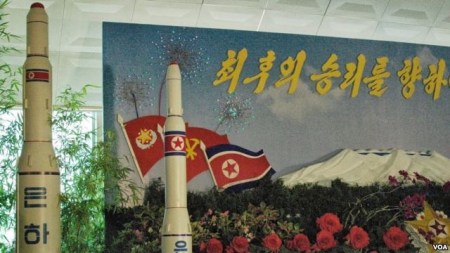
A model of the North Korean Unha-9 long-range rocket on display at a floral exhibition in Pyongyang. (Image source: Steve Herman/VOA News/Wikimedia Commons)

Dr. Peter Huessy is President of GeoStrategic Analysis, a defense consulting firm he founded in 1981, and was the senior defense consultant at the National Defense University Foundation for more than 20 years.

Missile defense damns Obama ‘flexibility’

May 31, 2017

Missile defense damns Obama ‘flexibility’, American Thinker, Daniel John Sobieski, May 31, 2017

Tuesday’s missile defense test, in which a ground-based interceptor successfully intercepted an ICBM over the Pacific, was both a warning to North Korea and another indication that America is back.  The test was in the works before Trump took office, but it comes on an administration welcoming improvements in missile defense versus the prior Obama administration that used back channels to give it away to Putin and the Russians.

As the Washington Examiner reported:

The U.S. Missile Defense Agency successfully shot down a dummy warhead in space over the Pacific Ocean Tuesday during a test of a missile defense system that would protect the country from intercontinental ballistic missiles like the ones being developed by North Korea.

“During the test, an ICBM-class target was launched from the Reagan Test Site on Kwajalein Atoll in the Republic of the Marshall Islands,” said a statement from the agency. “A ground-based interceptor was launched from Vandenberg Air Force Base, California, and its exo-atmospheric kill vehicle intercepted and destroyed the target in a direct collision.”

The irony of the interceptor being launched from a facility with Ronald Reagan’s name on it should escape no one.  President Reagan dreamed of a multi-layered missile defense most derided as “Star Wars.”  He dreamed of preventing or deterring a nuclear attack, not merely avenging one.  Perhaps he might have also had in mind the danger posed from rogue regimes such as North Korea and Iran.

We see Reagan’s legacy in the Aegis missile cruisers and destroyers that can be deployed in troubled waters around the globe.  We see it in the THAAD theater missile defense recently deployed to South Korea.  All of this President Barack Hussein Obama opposed.

Missile defense systems are systems President Obama has long opposed as “Cold War” weapons.  When President Obama took office in January 2009, sitting on his desk were President George W. Bush’s plans for the deployment of ground-based missile interceptors, such as are deployed at Fort Greely, Alaska, in Poland, as well as missile defense radars in the Czech Republic.

As Investor’s Business Daily noted over a year ago, President Obama had other plans.  His betrayal of our allies was ironically exquisite:

Yet within hours of Medvedev’s election as president in 2008, the Russian announced that Moscow would deploy SS-26 missiles in his country’s enclave of Kaliningrad situated between our NATO allies Poland and Lithuania.

He wanted the U.S. to abandon plans to deploy missile interceptors in Poland and warning radars in the Czech Republic designed to counter a future threat from Iran.

What did President Obama do? He caved in and notified the Poles in a midnight phone call on Sept. 17, 2009 – the 70th anniversary of the Soviet Union’s invasion of Poland – that we were pulling the plug on that system due to Russian objections.

Putin then watched in 2012 as Obama promised Medvedev at the Nuclear Security Summit in Seoul, South Korea, that after his re-election he would have more “flexibility” to weaken missile defense, which would help him fulfill his dream of U.S. disarmament.

Putin know full well Obama’s weakness in responding to any foreign threat to U.S. interests and security.  President Obama was our Neville Chamberlain, promising “peace in our time” as he invited war with weakness, apologies, and appeasement.  It was he who colluded with the Russians to threaten American national security in the “back channel” conversation with Medvedev that fell victim to an open mic.

Thanks largely to President George W. Bush and his push to fulfill President Ronald Reagan’s dream, the continental United States and overseas allies are protected against missile attack by 30 deployed long-range ground-based interceptors (GBI), 32 Navy ships armed with over 100 SM-3 IA interceptors and two dozen advanced SM-3 IB interceptors, dozens of Terminal High-Altitude Area Defense (THAAD) interceptors, and eight X-band missile defense radars deployed abroad.

It was Obama who proved to be Russia’s and Putin’s lapdog.  Trump may have the chance to fire a second shot heard around the world, securing America’s freedom and very existence.  When that pudgy little man-child gets his latest toy, just shoot that North Korean ICBM test down.


Japan vows ‘specific action’ with US to deter N. Korea

May 29, 2017

Japan vows ‘specific action’ with US to deter N. Korea, The HillKyle Balluck, May 29, 2017

(Please don’t tell us until after it’s done. — DM)

© Getty

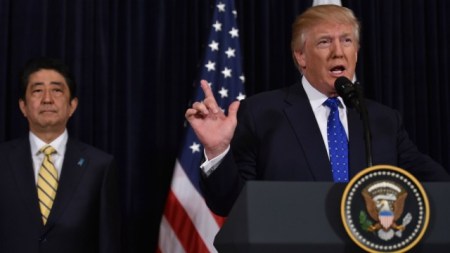
Japanese Prime Minister Shinzo Abe is vowing “specific action” with the U.S. to deter North Korea in the wake of Pyongyang’s latest missile test.

“As we agreed at the recent G7, the issue of North Korea is a top priority for the international community,” Abe told reporters on Monday, according to Reuters. “Working with the United States, we will take specific action to deter North Korea.”

The news service added that Japan protested the test.

U.S. Pacific Command said it detected the launch of a short-range ballistic missile from a site near Wonsan Airfield on Sunday. It tracked the missile for approximately six minutes until it landed in the Sea of Japan.

“We are working with our Interagency partners on a more detailed assessment. We continue to monitor North Korea’s actions closely,” U.S. Pacific Command said in a statement, adding that it “stands behind our ironclad commitment to the security of our allies in the Republic of Korea and Japan.”

A National Security Council spokesman said President Trump was briefed on the latest North Korean test.

Pyongyang said last week that it was ready to deploy a new medium-range missile as part of an “answer” to Trump’s policies. The North also fired a missile hours before Trump delivered a major speech in Saudi Arabia earlier this month.

Waiting for North Korea’s Next Nuclear Test

May 28, 2017

Waiting for North Korea’s Next Nuclear Test, PJMedia, Claudia Rosett, May 27, 2017

(To the extent that history is a good predictor of the future, more sanctions — even if enforced briefly — won’t work. Regime change, maybe. But how can we find a suitable replacement for Kim Chi-un Kim Jong-un? Has the recent high-level defector been asked? It would be stupid to let the Norks know whether he has been and, even worse, what, if anything, he said because anyone he suggested would be killed. No matter how much the leakers and media would like to know, secrecy is absolutely necessary. –DM)

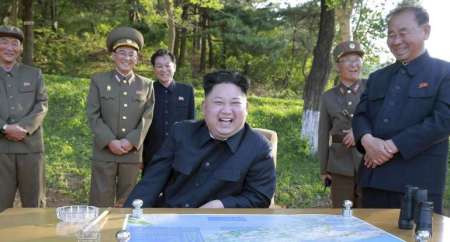
In this undated photo distributed by the North Korean government Monday, May 22, 2017, North Korean leader Kim Jong Un watches the test launch of a solid-fuel “Pukguksong-2” at an undisclosed location in North Korea. (Korean Central News Agency/Korea News Service via AP)

The threats from North Korea keep rising — not only its nuclear program, but such matters as its cyber warfare projects, plus the example Pyongyang continues to set of how a malign and predatory tyranny can survive by arming itself with the world’s most destructive weapons and threatening liberally to use them. We should have no doubt that Iran and others are taking notes.

What’s certain is this: None of this will be resolved by America writing off regime change as the real goal in Pyongyang while waiting to respond with another stack of UN sanctions, however neatly pre-negotiated, to North Korea’s next nuclear test.

******************************

Just last month, Secretary of State Rex Tillerson told the United Nations Security Council that the era of letting North Korea call the shots was over. Commenting on a record in which North Korea has carried out five nuclear tests since 2006, two of them just last year, Tillerson said: “For too long the international community has been reactive in addressing North Korea.” He added, “Those days must come to an end. Failing to act now on the most pressing security issue in the world may bring catastrophic consequences.”

Yet here we are, with Reuters reporting, based on a news conference held Friday in Beijing by senior State Department official Susan Thornton, that the U.S. is “looking at discussing with China a new Security Council resolution on pre-negotiated measures to reduce delays in any response to further nuclear tests or other provocations from the North.”

In other words, the U.S. is waiting to react to North Korea’s next nuclear test, which North Korean officials have already threatened to carry out, and for which preparations have been visibly underway.

With the variation that the diplomatic response (providing China agrees) would be “pre-negotiated,” this sounds disturbingly similar to the ritual that President Obama’s administration dolled up under the fatuous label of “strategic patience.” The result, on Obama’s watch, was that North Korea carried out four of its five nuclear tests to date, and accelerated its missile program to include over the past three years — as The Wall Street Journal reported recently — the launches of “more major missiles than in the three previous decades combined.”

The Obama ritual went like this: North Korea would carry out a forbidden nuclear test (in 2009, 2013, and two in 2016). The U.S. would turn to the UN Security Council, which after a period of closed-door wrangling would respond by approving yet another sanctions resolution, which would then be advertised by the U.S. as tough… tougher… toughest. Whatever.

Recall America’s former ambassador to the UN, Samantha Power, declaring after the passage of UN Security Council Resolution 2270 in March 2016 (in response to North Korea’s fourth nuclear test) that “this resolution is so comprehensive, there are many provisions that leave no gap, no window.” That resolution was followed last September by North Korea’s fifth nuclear test, to which the UN responded by adding to the gapless, windowless sanctions resolution #2270 the even more gapless and windowless resolution #2321.

One might reasonably ask: Why reserve all those ever tougher sanctions for North Korea’s next nuclear test, or the one after that? If gapless, windowless sanctions have yet more holes that need plugging, why not do it all now?

If I might hazard a guess, the obstacle is not solely that veto-wielding permanent Security Council members China and Russia have no serious interest in trying to throttle North Korea’s Kim regime. Even when they vote for those ever tougher UN sanctions, they have been, to put it generously, highly casual about enforcing them. On the evidence, China — despite its public expressions of disapproval and disappointment over each North Korean nuclear test — has nonetheless, for decades now, allowed North Korea to proceed. It is past time to ask quite seriously whether Beijing (never mind its public posturing) reached a quiet decision quite some years ago that China can live comfortably enough with a nuclear-armed North Korea that dedicates itself to bedeviling such leading democracies as South Korea, America and Japan.

Nor is the problem solely that sanctions, to whatever degree they are attempted, have virtually no chance of forcing North Korea into a good-faith deal to give up its long-established, deeply entrenched nuclear program. In previous talks and deals (1994, 2005, 2007, as well as President Obama’s attempted 2012 so-called Leap Day missile-freeze deal), Pyongyang racked up an unbroken record of lying, cheating, pocketing the gains and carrying on with its threats and WMD projects.

In the prime case in which sanctions did seem to get serious traction — when U.S. sanctions persuaded Macau in 2005 to freeze North Korea-linked accounts in Banco Delta Asia — North Korea went ahead in 2006 with its first nuclear test, then came to the bargaining table for a deal in 2007, and took to the cleaners the eager diplomats of President Bush’s “soft power” second term.  The antics of that era included State Department special envoy Chris Hill demanding the help of the U.S. Treasury and Federal Reserve to transfer back to North Korea, via the banking system (at North Korea’s behest), some $25 million in tainted funds that had been frozen at Banco Delta Asia in Macau; a U.S. handout of millions to pay Pyongyang for the Potemkin spectacle in 2008 of blowing up a dispensable cooling tower at North Korea’s Yongbyon nuclear complex; and the removal of North Korea from the U.S. government’s blacklist of terror-sponsoring states (a concession which to this day the State Department has yet to remedy). The 2007 deal fell apart as Bush was leaving office, and in May of 2009 North Korea welcomed Obama’s presidency by conducting its second nuclear test.

Today, with North Korea working at speed toward an ability to target the United States, the U.S. fallback is to try to pressure China, under threat of sanctions that would hurt China itself, to defang North Korea. That approach allows for plenty of employment in Washington, in the debates, design and attempts to apply such sanctions. But somewhere out there lies the question of how to sustain any such approach, on the ground (and the seas) in Asia, and where it might actually lead. Sanctions tend to erode over time, as their targets adapt. If North Korea is richly capable of the duplicities that have repeatedly foiled nuclear negotiators, China has vastly more reach and resources available for its own gambits. Even if the ever-tougher-sanctions approach leads to a deal, who or what then guarantees (the deep flaws of Obama’s Iran nuclear deal  come to mind) that once the strictures are loosened, North Korea, or China, would abide by that deal? (Forget the UN, which has to date failed abysmally to stop North Korea’s nuclear program, and which relies on individual member states to police their own enforcement of sanctions.)

The further fallback is the threat of U.S.-led military force, which is what the Trump administration is now turning to in a number of ways, including the deployment of a third aircraft carrier group as part of the “armada” Trump is sending to the Western Pacific. Part of the idea here is also to put China on notice that the U.S. is serious.

The problem here is that to be effective, military threats need to be credible. After eight years of Obama’s “patience,” following North Korea’s successes with its nuclear extortion racket going back to the early 1990s, the consistent signal from three U.S. presidents — Obama, Bush and Clinton — has been that the U.S. for all its vast firepower would rather be snookered at the bargaining table, or simply do nothing, than actually risk a military strike that could turn into a hot war with North Korea.

It doesn’t help that on May 19 Defense Secretary Jim Mattis told Pentagon reporters that any military solution to North Korea would be “tragic on an unbelievable scale,” so “our effort is to work with the U.N., work with China, work with Japan, work with South Korea to try to find a way out of this situation.” Nor does it help that on May 23, 64 Democratic lawmakers sent a public letter to Trump, asking for details of his plans for a negotiated solution of “the nuclear issue on the Korean peninsula,” and warning Trump against including in any such plans an “ill-advised military component.” If — after the agonies of the 1950-1953 Korean War, and in view of North Korea’s current military threat to Seoul and increasingly dangerous arsenal — the U.S. is not prepared to go to war again to stop North Korea, then the prudent course would be at least to keep quiet about it. Otherwise, the result is to neuter any U.S. threat of force, further emboldening North Korea.

Which brings us to the core problem, the grand dilemma looming behind all the machinations described above. There is really only one way out of this situation, only one real solution, and that is an end to the Kim regime in North Korea. On humanitarian grounds alone, the fall or overthrow of the Kim regime would be fully justified, and is long, long overdue. In view of North Korea’s rising threats to others, its growing arsenal, its record of peddling munitions to the likes of Syria and Iran, and its unbroken record of abusing any and all deals, there is no other answer. The Kim regime has to go.

But getting rid of the Kim regime is in itself risky. However it might happen, whether Kim’s regime might be destroyed by military force, throttled by sanctions, overthrown from within, or somehow shoved from power through some combination of these factors, no one knows exactly what might follow, or how things might then play out.

And so, with variations that have repeatedly failed to end the threat, one U.S. administration after another has defaulted to a “status quo” in which the effort is not to get rid of the Kim regime, but to manage it — as if it were some sort of highly unpleasant chronic medical condition.

Thus did  Tillerson tell the UN Security Council meeting last month, at its special meeting on North Korea, that “our goal is not regime change, nor do we desire to threaten the North Korean people or destabilize the Asia Pacific region.”

Newsflash: The Asia Pacific region is already being destabilized, by nuclear-arming North Korea itself, as well as China — with its own military buildup, its island-building territorial grabs offshore, and its threats to freedom of navigation. What we are witnessing is not a durable status quo, but a trajectory, in which a U.S. impulse for peace in our time keeps steering us toward cataclysm ahead. What Obama achieved with his “strategic patience” was to postpone the day of reckoning long enough to hand off a threat grown vastly worse to his successor.

How this gets resolved in any way favorable, or even remotely safe, for America and its democratic allies is a hideous conundrum. But the situation right now is very far from safe. The threats from North Korea keep rising — not only its nuclear program, but such matters as its cyber warfare projects, plus the example Pyongyang continues to set of how a malign and predatory tyranny can survive by arming itself with the world’s most destructive weapons and threatening liberally to use them. We should have no doubt that Iran and others are taking notes.

What’s certain is this: None of this will be resolved by America writing off regime change as the real goal in Pyongyang while waiting to respond with another stack of UN sanctions, however neatly pre-negotiated, to North Korea’s next nuclear test.

North Korea’s Latest Missile Test: Advancing towards an Intercontinental Ballistic Missile (ICBM) While Avoiding US Military Action

May 14, 2017

North Korea’s Latest Missile Test: Advancing towards an Intercontinental Ballistic Missile (ICBM) While Avoiding US Military Action, 38 North, May 14, 2017

(We interrupt the crucial and continuing coverage of the multiple threats President Trump poses to everything good to mention a trivial matter. — DM)

What would change the strategic balance is an ICBM capable of reaching the US mainland. This is not that missile but it might be a testbed, demonstrating technologies and systems to be used in future ICBMs like the KN-08 and KN-14. A full three-stage KN-08 would be very unlikely to work the first time it was tested, and the failure would be both expensive and very provocative. This missile would allow North Korea to conduct at least some of the testing necessary to develop an operational ICBM, without actually launching ICBMs, particularly if it includes the same rocket engines.

*********************************

North Korea’s latest successful missile test represents a level of performance never before seen from a North Korean missile. The missile would have flown a distant of some 45oo kilometers if launched on a maximum trajectory. It appears to have not only demonstrated an intermediate-range ballistic missile (IRBM) that might enable them to reliably strike the US base at Guam, but more importantly, may represent a substantial advance to developing an intercontinental ballistic missile (ICBM). Given speculation over the past months about the possibility of military action by the Trump administration to prevent Pyongyang from acquiring such a weapons, the possible testing of ICBM subsystems in this low-key manner may be a North Korean hedge against the possibility of such action.

We are still awaiting more details on this test, and if the North Koreans follow their usual practice we can expect photographs soon. But unless Pyongyang is hiding something completely new, there’s only one real candidate for this missile. During last month’s parade, one genuinely new missile was revealed – one that looks very much like a small, two-stage version of their three-stage KN-08 ICBM prototype, on displayed on a mobile launcher previously used for the “Musudan” intermediate-range ballistic missile. We don’t have a name for this missile yet; the “KN-17” designation has been used for both this system and for a Scud-derived short-range ballistic missile with a maneuvering reentry vehicle displayed in the same parade. But whatever the name, it would be expected to have about the same performance as the missile just launched.

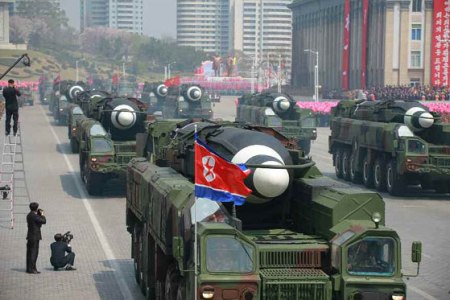
New North Korean IRBMs are displayed during an April 15 parade in Pyongyang celebrating the late Kim Il Sung’s birthday (Photo: Rodong Sinmun)

While the April 15 parade may be the first time this missile was seen, and yesterday’s test may be its first successful flight, there have been earlier indications that such a missile was under development. In January this year, intelligence sources reported that North Korea had deployed two prototype ICBMs at a test site, just under 15 meters long. All of North Korea’s ICBM prototypes and mock-ups are well over that size, which left us puzzled. But this new missile comes in at just under 15 meters, and while its performance doesn’t quite reach ICBM standards it clearly shares a common heritage with the KN-08 ICBM. Quite likely this was the missile that was reported in January.

It may have been tested on other occasions. Two failed missile tests from Kusong in October were presumed to be Musudans, but there was no solid evidence to confirm that – and the Musudan had recently been tested successfully, so it would be somewhat surprising for it to fail twice in a row. It wouldn’t be at all surprising for a new missile to fail twice, and if the missile were launched from a Musudan TEL, it might well be mistaken for a Musudan. Another failed test, on April 16, was initially ascribed to a new maneuvering reentry vehicle system, but may have been this missile instead – both were initially displayed in the parade the previous day, and a successful test of either one would neatly highlight the propaganda event.

While this missile appears to share a common heritage with the KN-08 ICBM, it isn’t simply a KN-08 with the third stage removed. The first two stages also appear to be reduced in scale. Unfortunately, we have little detail about the missile’s design. We do not, for example, know if it uses the same twin-engine propulsion system as the first stage of the KN-08. But the more important question is, what is the new missile for?

One possibility is that it is meant to replace the Musudan IRBM which. represents an attempt to stretch a Cold War vintage Russian missile to reach the US base at Guam, some 3500 km from North Korean launch sites. But the Musudan has proven unreliable in testing, with only one success in at least six attempts, and its performance is marginal for reaching Guam. The Musudan may have been the best North Korea could manage ten years ago, but that level of performance really calls for a two-stage missile. Now, it appears that they have one. But existing North Korean missiles are already capable of reaching targets anywhere in South Korea or Japan, and extending that reach to perhaps 4500 kilometers won’t greatly change the strategic balance – aside from Guam, there aren’t really any interesting targets in that range..

What would change the strategic balance is an ICBM capable of reaching the US mainland. This is not that missile but it might be a testbed, demonstrating technologies and systems to be used in future ICBMs like the KN-08 and KN-14. A full three-stage KN-08 would be very unlikely to work the first time it was tested, and the failure would be both expensive and very provocative. This missile would allow North Korea to conduct at least some of the testing necessary to develop an operational ICBM, without actually launching ICBMs, particularly if it includes the same rocket engines.

If North Korea has already conducted a successful test using the engines and other components of the first two stages of the KN-08, it may be closer to an operational ICBM than had been previously estimated. US cities will be at risk tomorrow, or any time this year since some tests have to be done with the full-scale system. With only one test of this reduced-scale system Pyongyang is probably some time from even beginning that process. But given this test and the possible North Korean path forward, a closer look will be needed to see how much progress has been made, and what technologies the North may have demonstrated, as will a reassessment of their ICBM program in that new light.