Posted tagged ‘Missile strike in Syria’

Radical Iran-led Axis Confronted with U.S. Deterrence for First Time

April 11, 2017

Radical Iran-led Axis Confronted with U.S. Deterrence for First Time, Investigative Project on Terrorism, Yaakov Lappin, April 11, 2017
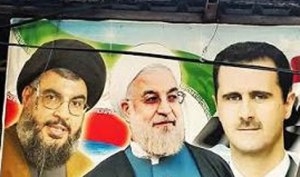
Until recently, the United States focused its attention exclusively on Sunni jihadist threats – ISIS and al-Qaida-affiliated groups. While these terrorists certainly need to be attacked, turning a blind eye to the activities of the more powerful radical Shi’ite coalition did nothing to stop the region’s destabilization. In this context, Assad’s numerous crimes against humanity went unanswered.

This helped embolden Assad to use chemical weapons. It also gave the Iranians confidence to magnify their meddling in Syria, Lebanon, Iraq, Yemen, Bahrain, and to target many other states. The end result is Iran’s enhanced ability to export its Khomeiniest Islamic fundamentalist doctrine.

Just as Iranian-backed Shi’ite militias have poured into Syria, the same has happened in Iraq, where 100,000 fighters supported by Tehran fight alongside the Iraqi government forces against ISIS. The IRGC’s network extends to Yemen’s Houthi Ansar Allah forces, who receive Iranian assistance. Ansar Allah, a heavily armed Shi’ite military force, fires ballistic missiles at Saudi Arabia on a regular basis.

The IRGC and Hizballah have been linked to a recent large-scale terrorist plot in Bahrain.

If the message addressed in the cruise missile strike is followed up with a strategy of deterrence, addressed to Ayatollah Khamenei as much as it was addressed to Assad, the U.S. could begin projecting to the world that it recognizes the threat posed by Shi’ite jihadists as much as it takes seriously the threat from their fundamentalist Sunni equivalents.

**********************

The conflict in Syria has long ceased being a civil war, becoming instead a clash between coalitions and blocs that divide the entire Middle East.

The Iranian-led axis is the most dangerous and highly armed bloc fighting in Syria. Bashar al-Assad’s regime is not an independent actor, but rather, a component of this wider axis. In many respects, Assad is a junior member of the Iranian coalition set up to fight for him.

Russia joined the Iranian axis in 2015, acting for its own reasons as the pro-Assad coalition’s air force, helping to preserve the Syrian regime.

This coalition enabled the Assad regime to conduct mass murder and ethnic cleansing of Sunnis from Syria, while also using unconventional weapons against civilians in an effort to terrorize rebel organizations into submission.

Feeling confident by its growing control of Syria, Iran also uses its regional coalition to arm, finance, and deploy Shi’ite jihadist agents all over the Middle East, and to attack those who stand in the way of Iranian domination.

The Iranian-led axis has been able to spread violence, terrorism, and Islamic militancy without facing repercussions.

Until recently, the United States focused its attention exclusively on Sunni jihadist threats – ISIS and al-Qaida-affiliated groups. While these terrorists certainly need to be attacked, turning a blind eye to the activities of the more powerful radical Shi’ite coalition did nothing to stop the region’s destabilization. In this context, Assad’s numerous crimes against humanity went unanswered.

This helped embolden Assad to use chemical weapons. It also gave the Iranians confidence to magnify their meddling in Syria, Lebanon, Iraq, Yemen, Bahrain, and to target many other states. The end result is Iran’s enhanced ability to export its Khomeiniest Islamic fundamentalist doctrine.

That sent a troubling message to America’s regional allies, who, in the face of these threats, formed a de facto coalition of pragmatic Sunni states – a coalition that includes Israel.

On April 6, the U.S. sent a signal that something may have changed. A cruise missile attack on an Assad regime air base, in response to a savage chemical weapons massacre in Idlib, Syria, was, first and foremost, a moral response to an intolerable act of evil.

But the strike also carries a wider prospective message about Washington’s new willingness to enforce red lines against Assad and his Shi’ite allies.

Potentially, it is an indication that the U.S. is willing to use its military prowess beyond the objective of targeting ISIS, and that it recognizes that Sunni jihadists are not the only global security threat that warrants the use of military force.

Statements by senior Trump administration officials indicate that a shift has occurred. “What you have in Syria is a very destructive cycle of violence perpetuated by ISIS, obviously, but also by this regime and their Iranian and Russian sponsors,” National Security Adviser H. R. McMaster told Fox News Sunday.

Russia must choose between its alignment with Assad, Iran, and Hizballah, and working with the United States, Secretary of State Rex Tillerson said Tuesday. The firm comment was made hours before he touched down in Moscow for talks.

According to U.S. officials, the April 6 missile attack destroyed 20 percent of Assad’s fighter jets. It represents the first time that Washington has taken military action against a member of the Iranian-led coalition.

The strike could evolve into a ‘dialogue of deterrence’ that the U.S. initiates against dangerous actors. These radical actors all have ‘return addresses,’ and are likely to prove responsive to cost-benefit considerations, despite their extreme ideology. They may think twice before considering further development and usage of unconventional weapons.

Washington is now able to exercise muscular diplomacy – the only kind that is effective in the Middle East – and inform all members of the Iran’s pro-Assad coalition that the deployment of unconventional weapons will not be tolerated. It can also begin to rally and strengthen the pro-American coalition of states in the Middle East, who seek to keep a lid on both ISIS and Iran.

With American officials indicating that they are “ready to do more” in Syria if necessary, signs suggest that the strike represents the start of a policy of deterrence, and leaving open future options for drawing additional red lines.

In theory, should Washington decide that Iran’s transfer of weapons and extremist Shi’ite military forces to other lands has reached unacceptable levels, or that Iran’s missile development program has gone far enough, it could call on Tehran to cease these activities. This call would carry substantially more weight following last week’s missile attack on the Syrian airbase.

The U.S. is in a better position to inform Assad and his allies that there is a limit to how far they can go in pursuing their murderous ambitions.

While the objective of creating a renewed American deterrent posture is vital, it should not be confused with plans for wider military intervention in the seemingly endless Syrian conflict.

There is little reason to believe that conventional weapons use against Syrian civilians is going to stop any time soon, or that the enormous tragedy suffered by the Syrian people is about to end.

And there is certainly no indication that the U.S. is planning to initiate large-scale military involvement in this failed state.

Hence, the missile strike should be seen for what it is: an attempt to boost American deterrence, which can then be leveraged to restrain radical actors that have, until now, been operating completely unchecked.

That is a message that will likely be heard loud and clear not only in Damascus, but also in Tehran, which has not given up its long-term ambition of building nuclear weapons.

North Korea, which helped build Syria’s plutonium nuclear plant (destroyed in 2007 in a reported Israeli air strike), and which maintains close links with Iran’s nuclear and missile programs, can be expected to take note as well.

If a policy of strategic deterrence follows the strike, it could have an impact on a coalition that is not just keeping Assad’s regime alive, but spreading its radical influence in many other areas.

In Syria, the Iranian Republican Guards Corps (IRGC) oversees ground operations across many battlefields to prop up Bashar al-Assad. Iran has gathered and armed tens of thousands of Shi’ite militia members from across the region into Syria, and manages a local force composed of 100,000 members. They fight alongside the Syrian Arab Army against Sunni rebel organizations, thereby increasing and entrenching Iranian influence.

The IRGC and its elite Quds Force are also helping to fill Hizballah’s weapons depots in Lebanon, with a vast array of surface-to-surface projectiles that are all pointed at Israel, often using Syria as an arms trafficking transit zone. Syria acts as a bridge that grants Iran access to Lebanon, and allows it to threaten both Israel and Jordan.

Jordan, an important U.S. ally, is deeply concerned by Iran’s actions in Syria, as evidenced by recent comments made by King Abdullah, who told the Washington Post that “there is an attempt to forge a geographic link between Iran, Iraq, Syria and Hezbollah/Lebanon.” IRGC forces are stationed within a mere 45 miles from Jordan’s border, he warned, adding that any hostile forces approaching the Hashemite Kingdom “are not going to be tolerated.”

Hizballah, a Lebanese-based Iranian Shi’ite proxy, evolved into a powerful army by sending 7,000 to 9,000 of its own highly trained members into Syria’s ground war. It helped rescue the Assad regime from collapse, and took part in battles stretching from Aleppo to the Qalamoun Mountains northeast of Damascus.

Last year, the Arab League and the Sunni countries of the Gulf Cooperation Council all declared Hizballah to be a terrorist entity.

Just as Iranian-backed Shi’ite militias have poured into Syria, the same has happened in Iraq, where 100,000 fighters supported by Tehran fight alongside the Iraqi government forces against ISIS. The IRGC’s network extends to Yemen’s Houthi Ansar Allah forces, who receive Iranian assistance. Ansar Allah, a heavily armed Shi’ite military force, fires ballistic missiles at Saudi Arabia on a regular basis.

The IRGC and Hizballah have been linked to a recent large-scale terrorist plot in Bahrain.

If the message addressed in the cruise missile strike is followed up with a strategy of deterrence, addressed to Ayatollah Khamenei as much as it was addressed to Assad, the U.S. could begin projecting to the world that it recognizes the threat posed by Shi’ite jihadists as much as it takes seriously the threat from their fundamentalist Sunni equivalents.

Washington’s campaign to pressure Russia to distance itself from its Middle Eastern allies could play an important part of this message.
Russia ‘furious’ with Assad over gas attack

April 11, 2017

Russia ‘furious’ with Assad over gas attack, Al Monitor,

(From the for “whatever it’s worth” department.– DM)

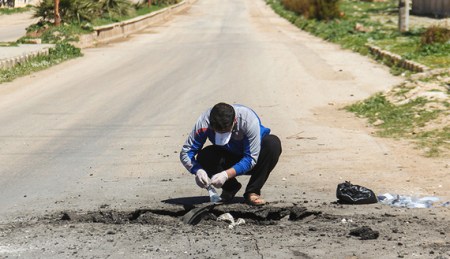
A Syrian man collects samples from the site of a suspected toxic gas attack in Khan Sheikhun, in Syria’s northwestern Idlib province, on April 5, 2017. (Photo credit should read OMAR HAJ KADOUR/AFP/Getty Images)

WASHINGTON — Privately, Russian officials are furious with Syrian President Bashar al-Assad for a suspected April 4 chemical weapons attack in Idlib province that killed over 80 people, Russia analysts said. They see it as threatening to sabotage the potential for US-Russia rapprochement ahead of US Secretary of State Rex Tillerson’s first visit to Moscow this week.

But Russia is also confused by what it perceives as contradictory statements from various top Trump Cabinet officials on whether US policy is shifting to demand Assad’s ouster, to what degree does the United States think Russia is culpable for Assad’s behavior, and more broadly, who from the administration speaks for Donald Trump, they said.

“Assad committed suicide here,” Michael Kofman, a Russia military expert with the Kennan Institute, told Al-Monitor in an interview April 10. Russia “will never forgive him for this.”

The suspected April 4 nerve gas attack on rebel-held Khan Sheikhoun that killed over 80 people, many of them children, “is a complete disaster” for Russia, Kofman said. “It destroyed the legacy of the 2013 deal [to remove Syria’s chemical weapons] that both countries [the United States and Russia] certified. So it made liars of both of us.”

He noted, “It provided all the ammunition to sabotage rapprochement between the United States and Russia. Look at the atmospherics. It caused public embarrassment. [Russian President Vladimir] Putin has to swallow US cruise missile strikes. Notice he has not defended Assad. It looks bad for Russia.”

Kofman added, “It demonstrates … in terms of Putin being a power broker … that the Russian role is very aspirational. It prevented him from doing this.”

“The Russians weren’t happy about what happened,” Nikolas Gvosdev, a Russia expert and professor at the US Naval War College, told Al-Monitor, referring to the April 4 chemical weapons attack. “They don’t like unpredictability … when things happen that throw what they are planning off course.”

“The Russians don’t like to be surprised,” Gvosdev added. “They don’t like … [to be made to] look like they can’t enforce agreements or don’t have as much influence over Assad as they were suggesting.”

Trump discussed Syria during a phone call with British Prime Minister Theresa May on April 10, and according to the British readout, the two leaders said they saw an opportunity to press Russia to break its alliance with Assad.

May and Trump “agreed that a window of opportunity now exists in which to persuade Russia that its alliance with Assad is no longer in its strategic interest,” a Downing Street spokesman said in a press release.

While US officials have said the US cruise missile strikes on the Shayrat air base on April 6 were to punish and deter Syria’s use of chemical weapons, there has been some confusion caused by statements from different Trump Cabinet officials on whether US policy is creeping toward regime change. US officials, including US Ambassador to the United Nations Nikki Haley and national security adviser H.R. McMaster, have also suggested Russia was either complicit or incompetent for Assad’s chemical weapons attack. They have expressed anger that Russia has, in their opinion, tried to publicly sow disinformation about it.

“You know the interesting thing, Chuck, is when this chemical weapons murder happened to so many people, Russia’s reaction was not ‘oh how horrible’ or ‘how could they do this to innocent children’ or ‘how awful is that,’” Haley told Chuck Todd of NBC’s “Meet the Press” on April 9. “Their initial reaction was Assad didn’t do it, the Syrian government didn’t do it.”

“Why were they that defensive that quick?” Haley continued. “The first priority for them was to cover for Assad. So what we knew from intelligence, that the Syrian regime had done this again, as they had done so many times before. We had evidence they had done it. It’s obviously classified, so I’m not the one that would release the information, but it was enough that the president knew.”

Even while pressuring Russia because of its diplomatic and military support to Assad, McMaster reiterated that the United States is still looking for a political resolution to end Syria’s civil war.

“What we really need to do, and what everyone who’s involved in this conflict needs to do, is to do everything they can to resolve this civil war,” McMaster told Fox News Sunday’s Chris Wallace April 9.

“What’s required is some kind of a political solution to that very complex problem, and … it’s very difficult to understand how a political solution could result from the continuation [of] the Assad regime,” McMaster said. “Now we’re not saying that we are the ones who are going to affect that change. What we are saying is, other countries have to ask themselves some hard questions. Russia should ask themselves, what are we doing here? Why are we supporting this murderous regime that is committing mass murder of its own population and using the most heinous weapons available?”

Tillerson, who is scheduled to meet with his Russian counterpart, Foreign Minister Sergey Lavrov, in Moscow April 12, expressed disappointment at Russia’s public criticism of the US airstrikes, but he said he did not conclude Russia was complicit in the Syrian regime’s suspected chemical weapons attack.

“I’m not seeing any hard evidence that connects the Russians directly to the planning or execution of this particular chemical weapons attack, and indeed, that’s why we’ve been trying to be very clear that the Russians were never targeted in this strike,” Tillerson told George Stephanopoulos of ABC’s “This Week” on April 9.

“Why Russia has not been able to achieve that [removal of Syria’s residual chemical weapons] is unclear to me,” Tillerson said. “I don’t draw conclusions of complicity at all; but clearly, they’ve been incompetent, and perhaps they’ve just simply been outmaneuvered by the Syrians.

But Tillerson said he still holds out hope for productive talks with the Russians when he travels there this week, and he hopes Russia can press Assad to never use chemical weapons again.

“I’m hopeful that we can have constructive talks with the Russian government, with Foreign Minister Lavrov, and have Russia be supportive of a process that will lead to a stable Syria,” Tillerson said. “Clearly, they … have the greatest influence on Bashar al-Assad and certainly his decisions to use chemical weapons. They should have the greatest influence on him to cause him to no longer use those. I hope that Russia is thinking carefully about its continued alliance with Bashar al-Assad, because every time one of these horrific attacks occurs, it draws Russia closer in to some level of responsibility.”

The changing US calculus on Assad and Russia is making it harder to see what Russia and the United States would be negotiating when Tillerson meets Lavrov April 12, Gvosdev said.

“The ask and the give are harder to ascertain,” Gvosdev said. “Two weeks ago, it was how do we move this [Syria] political process along.”

But now Tillerson is likely to tell the Russians that domestic politics in the United States is playing a bigger role in this, and “I can offer you less upfront,” Gvosdev speculated. “At a time when the Russian establishment very much … wants certain things upfront.”

“We are no longer talking about sanctions relief, [but how to] prevent new sanctions from being imposed,” Gvosdev said.

Assad’s actions have upended what was an important foreign policy priority for Putin — exploring the potential for cooperation with the United States on Syria and a possible rapprochement — and have seemingly taken sanctions relief off the table for discussion for now, and Russia will not forgive him, Kofman said.

“They are furious; it is very clear,” Kofman said, noting that there has been “no actual statement from Putin in support of Assad.”

“That is why I am saying he has signed his own political death warrant,” Kofman said of Assad. “They [the Russians] will never forgive him. They will wait. The time will come when Syria is stabilized, and they can actually have a change of power at the top. And then come for him.”


Official: U.S. Concludes Russia Had Advanced Knowledge of Syrian Chemical Weapons Attack

April 11, 2017

Official: U.S. Concludes Russia Had Advanced Knowledge of Syrian Chemical Weapons Attack, Washington Free Beacon, April 10, 2017

(Russia took all of the Syrian chemical stuff away, just as Saint Barack told us. Saint Bashar wouldn’t use chemical weapons on Syrians even if he had some, and Saint Vlad wouldn’t condone it for a minute if he did. It just a strange coincidence and it must have been a false flag attack, probably by wicked Christians, Jews or Hindus. Evil Trump must have glommed onto it to appear strong and good. Right? — DM.) 

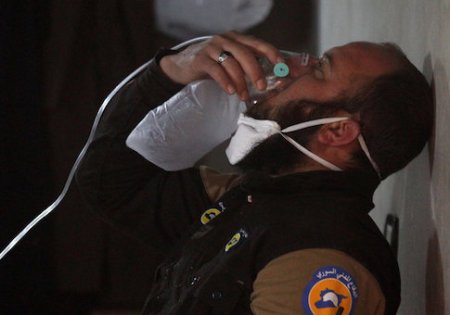
A civil defence member breathes through an oxygen mask, after what rescue workers described as a suspected gas attack in the town of Khan Sheikhoun in rebel-held Idlib, Syria April 4, 2017. REUTERS/Ammar Abdullah

The United States has concluded Russia knew in advance that the Syrian regime would employ chemical weapons in a large-scale attack last week, according to the Associated Press.

Syrian President Bashar al-Assad’s regime reportedly ordered the chemical bombings that hit a rebel-held town in the Idlib Province on April 4. At least 80 people were killed, and video footage of women and children fighting to draw breath because of lethal chemical gas spread around the world.

BREAKING: Senior U.S. official says U.S. has concluded that Russia knew in advance of Syria’s chemical weapons attack last week.

According to a senior official, a Russian-operated drone flew over a Syrian hospital while victims sought treatment, and later a Russian-made fighter jet bombed the hospital. The official said the drone’s presence revealed that Russia knew the attack was coming:

Hours after the drone left, a Russian-made fighter jet bombed the hospital in what American officials believe was an attempt to cover up the usage of chemical weapons.

Until Monday, U.S. officials had said they weren’t sure if the drone was operated by Russia or Syria. The senior official said it still wasn’t clear who was flying the jet that bombed the hospital.

The official said the presence of the drone couldn’t have been a coincidence, and that Russia must have known the chemical weapons attack was coming and that victims were seeking treatment.

President Donald Trump responded to the chemical attack on Thursday, when he ordered the firing of 59 Tomahawk cruise missiles at the Al Shayrat airfield in western Syria, where the chemical attack originated.

The Trump administration has stepped up its rhetoric against Russia in the wake of the Syria attack.

Secretary of State Rex Tillerson spoke Monday at a World War II memorial in Italy to issue a warning against countries that “commit crimes against the innocents.”

“We rededicate ourselves to holding to account any and all who commit crimes against the innocents anywhere in the world,” he said.

United Nations Ambassador Nikki Haley said on Sunday that the administration would not let Russia “cover for this regime anymore.”

“This is something to let Russia know, ‘You know what? We’re not going to have you cover for this regime anymore. And we’re not going to allow things like this to happen to innocent people,'” Haley said on “Meet The Press.”

U.S. Options in Syria Don’t Include Ground Troops

April 10, 2017

U.S. Options in Syria Don’t Include Ground Troops, PJ Media, David P. Goldman, April 10, 2017

FILE – In this file image provided on Friday, April 7, 2017 by the U.S. Navy, the guided-missile destroyer USS Porter (DDG 78) launches a tomahawk land attack missile in the Mediterranean Sea. The U.S. missile attack has caused heavy damage to one of Syria’s biggest and most strategic air bases, used to launch warplanes to strike opposition-held areas in central, northern and southern Syria. (Mass Communication Specialist 3rd Class Ford Williams/U.S. Navy via AP, File)

The war has already displaced half of Syria’s 22 million people, and Iran plans to replace Sunnis with Shi’ite immigrants in order to change the demographic balance. The Sunni side of the conflict has become globalized with fighters from the Russian Caucasus, China’s Xinjiang Province, as well as Southeast Asia.

The U.S. State Department last year estimated that 40,000 foreign fighters from 100 countries were in Syria; Russia cited a figure of 30,000. Whatever the number is today, it would not be difficult to add a zero to it.

Russia and China must be frightened of America’s prowess, especially in military technology. A Reagan-style effort to established unquestioned U.S. supremacy in military technology is the Big Stick we require. Tomahawk missiles are not a Big Stick. They speak loudly. Trump was magnificently right to send the signal to Moscow and Beijing, especially (as Secretary Tillerson said) in the light of Russia’s duplicity or incompetence in the matter of Syrian poison gas. Now we need to get to work.

***************************

Writing in the Washington Post, neo-conservatives Reuel Gerecht and Ray Takeyh propose to send U.S. ground troops to fight Iran and its proxies in Iran and Syria:

It is way past time for Washington to stoke the volcano under Tehran and to challenge the regime on the limes of its Shiite empire. This will be costly and will entail the use of more American troops in both Syria and Iraq. But if we don’t do this, we will not see an end to the sectarian warfare that nurtures jihadists. We will be counting down the clock on the nuclear accord, waiting for advanced centrifuges to come on line. As with the Soviet Union vs. Ronald Reagan, to confront American resolution, the mullahs will have to pour money into their foreign ventures or suffer humiliating retreat.

They’re nuts.

It isn’t Iran that we would be fighting: It’s an international mercenary army that already includes thousands of fighters recruited from the three million Hazara Afghans now seeking refuge in Iran, from the persecuted Pakistani Shi’ites who comprise a fifth of that country’s huge population, and elsewhere. As I reported recently in Asia Times:

The IRGC’s foreign legions include volunteers from Afghanistan and Pakistan, where Shi’ites are an oppressed minority often subject to violent repression by the Sunni majority. IRGC-controlled forces include the Fatemiyoun Militia recruited mainly from Shi’ite Hazara refugees from Afghanistan, with reported manpower of perhaps 12,000 to 14,000 fighters, of whom 3,000 to 4,000 are now in Syria. Iranians also command the Zeinabiyoun militia composed of Pakistani Shi’ites, with perhaps 1,500 fighters in Syria.

The manpower pool from which these fighters are drawn is virtually bottomless. The war has already displaced half of Syria’s 22 million people, and Iran plans to replace Sunnis with Shi’ite immigrants in order to change the demographic balance. The Sunni side of the conflict has become globalized with fighters from the Russian Caucasus, China’s Xinjiang Province, as well as Southeast Asia.

The U.S. State Department last year estimated that 40,000 foreign fighters from 100 countries were in Syria; Russia cited a figure of 30,000. Whatever the number is today, it would not be difficult to add a zero to it.

Russia and China, as I explained in the cited Asia Times essay, blame the U.S. for opening the Pandora’s Box of Sunni radicalism by destroying the Iraqi State and supporting majority (that is, Shi’ite) rule in Iraq. Sadly, they are broadly correct to believe so. Thanks to the advice of Gerecht and his co-thinkers at the Weekly Standard and Commentary, the Bush administration pushed Iraq’s and Syria’s Sunnis into the hands of non-state actors like al-Qaeda and ISIS.

A seventh of Russia’s population is Muslim, and 90% of them are Sunnis. China has a restive Muslim population among the Uyghurs in its far West, and all of them are Sunnis. Moscow and Beijing therefore support Shi’ite terrorists as a counterweight to Sunni jihadists. A Eurasian Muslim civil war is unfolding as a result. Daniel Pipes of the Middle East Forum thinks America should let Sunnis and Shi’ites exhaust each other. If it were just Syria, that would make sense, but the Syrian conflict is the nodal point for a much larger and more dangerous conflagration. If the 300 million Muslims of Southeast Asia were to become involved, the consequences would be horrific.

Gerecht and Tayekh want the U.S. to back the anti-regime forces whom Obama left twisting in the wind during the 2009 demonstrations against Iran’s rigged elections. That is the right thing to do. The Trump administration should create a special task force for regime change in Iran and recruit PJ Media’s Michael Ledeen to run it. Iran is vulnerable to subversion. With 40% youth unemployment and extreme levels of social pathology (the rate of venereal disease infection is twenty times that of the U.S.), Iranians are miserable under the theocratic regime.

But I don’t know if that will work: Iran gets all its money from oil, and the mullahs have the oil, the money, and all the guns. If we can’t overthrow the Iranian regime, we will have two choices.

The first is to bomb Iran — destroy nuclear facilities and Iran Revolutionary Guard Corps bases. That risks war with Russia and China. It is an option, but a dangerous one, and not anyone’s first choice. We could have done this before Iran became a Russian-Chinese ally.

The second is to cut a deal with Russia and China: We muzzle the Sunni jihadists whom we (or our allies like Saudi Arabia) supported, and Russia and China cut Iran off at the knees. I sketched out such a deal in August 2016. It won’t happen easily, or any time soon, because Russia and China are not sufficiently afraid of us to want to come to the table. Russia would demand other concessions (e.g., recognition of its acquisition of territory by force in Ukraine). As the use of poison gas despite past Russian assurances makes clear, one can’t trust the Russians unless, of course, they really are scared of us.

So it all comes down to Grand Strategy: Russia and China must be frightened of America’s prowess, especially in military technology. A Reagan-style effort to established unquestioned U.S. supremacy in military technology is the Big Stick we require. Tomahawk missiles are not a Big Stick. They speak loudly. Trump was magnificently right to send the signal to Moscow and Beijing, especially (as Secretary Tillerson said) in the light of Russia’s duplicity or incompetence in the matter of Syrian poison gas. Now we need to get to work.

—————

Update: Christina Lin, a former senior U.S. Defense Department analyst and fellow at SAIS (and frequent Asia Times contributor), told The Diplomat in an interview today:

As a recent Israeli intelligence report documented, there are thousands of Chinese Uyghurs fighting in the ranks of al-Qaeda affiliates and ISIS in Syria, namely in the Turkistan Islamic Party (TIP) based in Idlib — an al-Qaeda stronghold. The August 30, 2016 bombing of the Chinese embassy in  Krgyzstan, planned by TIP in Syria and financed by Al Nusra, signals increasing threats to Chinese citizens and interests overseas if Syria becomes a terrorist safe haven.

Because of “inter-mingling” with Ahrar al Sham and other so called “moderate” jihadists, TIP and Nusra enjoy U.S. and its allies’ protection even though they are designated as terrorist organizations. The have procured advanced Western weapons such as U.S.-supplied anti-tank TOW missiles, Grad missiles, and likely anti-aircraft MANPADS, and drones that they used to record their recent suicide campaigns against the Syrian army. These Western weapons enhance their war fighting capabilities to launch future attacks on China and Chinese interests, so Beijing will likely step up its military support to the Syrian army. Chinese military advisers are already on the ground in Syria, according to media reports.

Humor | Syria Issues Travel Ban On U.S. Missiles

April 10, 2017

Syria Issues Travel Ban On U.S. Missiles, Duffel Blog, April 10, 2017

DAMASCUS, SYRIA — Syrian President Bashar Al-Assad ordered the immediate closure of all Syrian airports and airfields to U.S. missiles today, fulfilling a threat he issued after U.S. missile strikes on the country.

In a ceremony at the presidential palace attended by most of the Syrian government, Assad signed the ban to rapturous applause, only briefly punctuated when several generals prematurely stopped clapping and were summarily executed.

“We don’t want these missiles here,” Assad told the cheering crowd. “We don’t need these missiles here. We are perfectly capable of destroying our own infrastructure without these foreign missiles coming over here to do a job that Syrians are perfectly capable of doing themselves.”

To illustrate his point, he ordered his Shabiha militia to immediately massacre all remaining Syrian soldiers at the Shayrat air base.

Assad added that he planned to extend the missile ban to the United Kingdom, France, Israel, and most of Western Europe.

“We only want to admit missiles into our country that will help our people, like those launched from Russia, Iran, and hopefully China,” Assad told reporters.

Assad’s decision was immediately condemned by a number of human rights groups.

“This impacts the most vulnerable group in America today: the Navy’s surface fleet,” said Neill O’Connor, a spokesman for Amnesty International. “All these poor sailors want to do is feel like they’re actually part of a war and tell their sweethearts how much danger they’re in before going back to the galley for mid-rats.”

The Syrian Civil Liberties Union vowed to oppose what it called a “racist ban,” and lawyers for the group were traveling to military bases, airports, surface-to-air missile sites, and bunkers on Monday. Interestingly, the Assad regime did not attempt to thwart their travel in any way, and in some instances, bussed them to military facilities for their scheduled protests.


Former Obama Admin Ambassador: ‘We Always Knew’ Syria Still Had Chemical Weapons

April 10, 2017

Former Obama Admin Ambassador: ‘We Always Knew’ Syria Still Had Chemical Weapons, Washington Free Beacon, April 10, 2017

(Sorry about the formatting, but it’s the best I could do with the article. — DM)

AP

A former ambassador who served during Barack Obama’s presidency admitted Sunday that the administration “always knew” Syria still had a stockpile of chemical weapons, despite public assurances to the contrary.

Dan Shapiro, a former U.S. ambassador to Israel and senior official on Obama’s National Security Council, took to Twitter to defend the previous administration’s efforts to dismantle the Syrian chemical weapon program.

“I strongly disagree with those who say Assad’s [chemical weapons] attack on Idlib [Province] proves that the 2013 [chemical weapons] deal struck by Russia & the US was worthless,” he wrote.

Shapiro argued that the deal, brokered by the U.S. and Russia to eliminate Syrian President Bashar al-Assad’s chemical weapons stockpile, successfully managed to remove and destroy all 1,300 tons of the regime’s declared arsenal. He then added that the Obama administration was aware the Syrian government likely hid away part of its chemical weapons program.

“We always knew Syria likely squirreled away some residual undeclared stocks and/or production capability, now proven by Idlib strike,” he admitted.

11. By mid-2014, all 1,300 tons had been removed, supervised by the OPCW, and carefully destroyed on ships at sea.

12. We always knew Syria likely squirreled away some residual undeclared stocks and/or production capability, now proven by Idlib strike.

Shapiro’s comments came the same day another former Obama administration official told the New York Times the same thing.

“We always knew we had not gotten everything, that the Syrians had not been fully forthcoming in their declaration,” former Deputy Secretary of State Tony Blinken told the paper.

Both claims appear to contradict previous statements made by the Obama administration. In 2014, then-Secretary of State John Kerry said the U.S. had removed Assad’s entire stockpile.

“We struck a deal where we got 100 percent of the chemical weapons out,” Kerry said on NBC’s “Meet the Press.”

As late as January, Obama’s former national security adviser, Susan Rice, likewise told NPR that “we were able to get the Syrian government to voluntarily and verifiably give up its chemical weapons stockpile.” The Washington Post fact-checker gave that statement Four Pinocchios in light of the recent chemical attack, meaning the Post deemed the comments completely false.

Shapiro noted in his Twitter remarks that he supports President Trump’s decision to order military strikes against a Syrian government airbase following Tuesday’s chemical weapons attack carried out by the Assad regime on civilians in northern Syria.

1. There’s some serious revisionist history afoot regarding the 2013 CW deal. I offer this perspective from serving in Israel at the time.

2. I’ll start by clarifying that I support the strikes against Syria last week, as I made clear at the time. pic.twitter.com/ylcwFDRpr7

Trump Sends a Message to China Through Syria

April 10, 2017

Trump Sends a Message to China Through Syria, Front Page Magazine, Daniel Greenfield, April 10, 2017

On Thursday evening, President Trump met with China’s President Xi and bombed Syria. The decision came as Trump traveled on Air Force One to meet with Xi at Mar-a-Lago. An hour into their dinner, 59 Tomahawk cruise missiles launched and pounded an airbase in Syria. The message wasn’t just for Assad and Putin. It was for Xi and his North Korean client state. The era of a weak America was over.

Xi had come to America expecting an easy photo op visit. President Trump would urge action on North Korea and Xi would smile coldly and shoot him down. Talk of fairer trade would be similarly dismissed.

And then Xi would go home and laugh that the bold new American leader was another paper tiger.

Except that President Trump had a different plan. Instead of Xi showing how tough he could be, Trump gave him a front row seat to a display of American power. The message was both obvious and subtle.

And President Xi, along with Russia’s Vladimir Putin, North Korea’s Kim Jong-un and Iran’s Supreme Leader Khamenei, aren’t laughing.

The obvious part was as blatant as a 1,000 pound explosive warhead slamming into concrete and steel, and as obvious as upstaging Xi’s efforts to stonewall Trump while warning that North Korea could be next if the Chinese leader continues to be obstinate.

Trump had warned throughout the campaign that he would not be laying his military plans on the table. “You’re telling the enemy everything you want to do!” he had mocked Clinton.

His address to the nation came an hour after the missiles had struck. The element of surprise had held.

And Xi came away with a very different message. The Obama era was over. The new guy was bold, dangerous and unpredictable. Like many of Trump’s American opponents, Xi understood now that the jovial man sitting next to him could and would violate the rules of the game without prior warning.

China would have to be careful. There was a cowboy in the White House again.

And that was the subtle part. Trump does not care very much about Assad. What he truly cares about is American power. Left-wing critics quickly pounced on Trump’s past opposition to strikes on Syria and his criticisms of Obama for not enforcing his own “red line”.

There is no contradiction.

Trump didn’t believe that strikes on Syria were a good idea. But once we had committed to a red line, then we had to follow through if we were going to be taken seriously.

And so Trump enforced Obama’s red line. Not because of Obama or Syria. But because of America.

“When he didn’t cross that line after making the threat, I think that set us back a long ways, not only in Syria, but in many other parts of the world because it was a blank threat,” President Trump said.

President Trump intends to get things done. And he knows it won’t happen with “blank” threats.

Asked about whether the strikes represented a message to Xi and North Korea, Secretary of State Tillerson replied, “It does demonstrate that President Trump is willing to act when governments and actors cross the line and cross the line on violating commitments they have made.”

“President Trump has made that statement to the world tonight,” he added.

The message is more subtle than a 1,000 pound warhead. But not by that much.

President Trump’s move bewildered leftist critics who had to shift from accusing him of having a secret relationship with Russia to accusing him of ruining our relationship with Russia. It also enraged some supporters who maintained a dogmatic non-interventionist position. But Trump doesn’t make decisions based on ideology. He measures policies against real world objectives, not abstract philosophies.

What he has always wanted to do is solve real problems.

The problem he was solving on Thursday wasn’t Assad. President Trump recognizes that Syria is an unsolvable problem and that little good can come of extended engagement with it. There are no good guys in Syria. Only Sunni and Shiite Jihadis and their victims. Syria is and will always be a dead end.

The problem is that Obama thoroughly wrecked American prestige and power over eight years. And that makes it painfully difficult to get anything done when no one in the world will take us seriously.

President Trump sees North Korea’s nuclear weapons as a major threat. But he also sees the crisis as a way to leverage our military might to achieve better trade deals with both partners and rivals. He is not wedded to a globalist or anti-globalist ideology. Instead he sees every problem as an opportunity.

He is not committed to any international coalition, globalist or anti-globalist, except where it temporarily serves American purposes. That is what being a true nationalist actually means.

That is what makes him so unpredictable and so dangerous.

President Trump made a point in Syria. He timed that point for maximum effect. The point isn’t that Assad is a bad man. Though he is. It’s not that he isn’t a Russian puppet, though only the lunatic left could have believed that. The point is that he is determined that America will be taken seriously.

Cruise missile diplomacy isn’t new. Bill Clinton fired over 500 cruise missiles into Iraq. Not to mention Sudan. Bush fired cruise missiles into Somalia. Obama signed off on firing cruise missiles into Yemen and Syria at terrorist targets. The difference is that Trump isn’t just saving face with cruise missile diplomacy.

President Trump’s real objective isn’t the Middle East. It’s Asia. He doesn’t see Russia as our leading geopolitical foe, but China. Syria was the opening shot in a staring contest with the People’s Republic. The moves in this chess game will sometimes be obvious and sometimes subtle. And Trump is usually at his most subtle when he’s being obvious. That’s what his enemies usually miss.

President Trump’s first step in Syria was to reestablish physical and moral authority on the international stage while the President of China had to sit there and watch. He humiliated Democrats and their media operation at the peak of their Russia frenzy. And he sent the message that America is back.

It’s not a bad return on a $60 million investment. We’ve spent much more in the field with less to show for it.

The Obama era in international affairs ended with whimper and a hollow Nobel Peace Prize as a trophy. The Trump era in international affairs began with 59 cruise missiles and a big bang.

After Syrian Gassing, Trump Must Expose the Iran Deal

April 10, 2017

After Syrian Gassing, Trump Must Expose the Iran Deal, PJ Media, Roger L Simon, April 9, 2017

Among the more disturbing questions emerging from the renewed use of gas by Bashar Assad is whether Barack Obama and his loyal minions (Kerry, Rhodes, Rice, etc.) actually knew the Syrian leader still had chemical weapons, even though they trumpeted the opposite to the American public on numerous occasions. Either they lied or were so extraordinarily credulous they believed — apparently without verification — the Syrians had truly rid themselves of those WMDs, in which case Obama — not Trump — was Vladimir Putin’s personal “useful idiot.”

(It may even be time to take a second look at the contention of some that Saddam transferred his chemical weapons to Syria way back when, which would be a surprise vindication of Bush 43.)

Whatever the case, it’s “heavy water” under the bridge at this point, but should alert us even more to the absolute necessity of revealing everything known about the also Obama-instigated Iran Deal, all its myriad hidden codicils and clauses that remain mysterious to the citizens of this country in whose name they were allegedly signed. That agreement too could be the product of useful idiocy, a sucker punch from the mullahs.  The devil, in this case, is very much in the details, few of which we know, except that the Iranians refused to give a baseline development level for their nuclear weapons program in this first place. In a sense, that made everything else moot.

Nevertheless, Iran has been the beneficiary of this deal to the tune of billions of dollars, some evidently in cash, much of which has been and is being spent in Syria, if not directly on chemical weapons, on a war that no less than the former chief rabbi of Israel, himself a Holocaust survivor, has called another Holocaust.  Iran is also using the money to finance Hezbollah in that war, simultaneously arming those terrorist thugs with tons of modern weapons, including long range missiles, even while the mullahs use Hezbollah’s guerrillas as cannon fodder to spare Iran’s own quasi-terrorist Revolutionary Guard. The Islamic Republic’s obvious goal is to control both Syria and Iraq by proxies.  A victorious Assad would be Iran’s boy as much as Russia’s, possibly more.

The Trump administration should expose this deal in its entirety to public view now.  If that means Iran pulls out of the agreement — as they have warned — so be it.  The transparency is worth whatever minimal insurance against a nuclear-armed Iran might be inherent in these evanescent documents.  After seeing just how much insurance against chemical weapons was inherent in Obama’s deal with Putin over the crossing of our then-president’s “red line,” one could be skeptical that there is any at all.  Indeed, what little we know of the Iran Deal leads one to believe that it would be simple for the mullahs to be as busy as ever on their nuclear program.  That they are allied with North Korea makes this all the more likely.

Further to be investigated is Obama’s peculiar desire to make a deal with these same mullahs from the very beginning of his administration or even before. Indeed, Obama representatives have been accused of meeting with both Hamas and Iran during his first presidential campaign. These meetings are better documented than Trump’s supposed collusion with Putin, which seems so unlikely now.

In a continuation of that behavior, Obama later famously ignored the pleas for support by the Iranian pro-democracy demonstrators during the Green Revolution of 2009.  “Obama, you are either with us or are you with them!”  they chanted.  Obama was evidently with them. He didn’t want to disrupt his rapport with Ahmadinejad in order to make his dreamed-of deal. (You can see it all on YouTube here.  As we used to say in the sixties, “Which side are you on?”)

Obama and Kerry then welcomed the election of Hassan Rouhani, whom their cheering section in the willfully ignorant mainstream media ludicrously called a “moderate” when he was, if anything, worse than Ahmadinejad and has since been responsible for many more murders of political prisoners than his predecessor.  They made their deal with Rouhani, who is obviously now cooperating in the maintenance of peace…. Well, not exactly.

What’s behind all this? As I said at the outset, this is disturbing — liberalism and progressivism turned upside down, at least according to their own self-described principles. Everything is situational. That Democrats like Schumer and Pelosi were so positive about Trump’s actions in Syria is a sure sign that not so deep down they were more than a little uncomfortable when Obama did nothing after a similar gassing.  Like a lot of people I would imagine, they had to bury their feelings and opinions in the name of party loyalty, what the French called mauvaise foi.  They should have felt the same way yet more intensely after Obama’s execrable non-reaction to the Green Revolution.  Maybe they did, but we’ll never know until someone leaks it out in a memoir. We didn’t need to send in the Marines.  All Obama would have had to have done was to say a few words of encouragement echoed by the international community and the revolution might have happened.  It was close enough.

Thank God there’s a new sheriff in town. Maybe there will be some hope for the citizens of Iran, eventually, some support for regime change after eight years of kowtowing to the mullahs.  But for now lets at least clear up the terms of the mysterious deal, its provenance and its usefulness, if any.  No time like the present.

Russia, Iran, Hizballah set up joint command in Syria

April 9, 2017

Russia, Iran, Hizballah set up joint command in Syria, DEBKAfile, April 9, 2017

(Trump, also known as “Putin’s Puppy,” has been nasty to Iran by declining to wag his tail whenever Khamenei whistles. Obama did, so Trump should too. Tsk tsk. The DEBKAfile article linked in the last paragraph is also available here. It deals with the transfer of substantial U.S. military air assets from Iraq to Syria.– DM)

The joint command center also said the presence of U.S troops in northern Syria where Washington has hundreds of special forces helping the Syrian Democratic Forces (SDF) to oust Islamic State was “illegal” and that Washington had a long-term plan to occupy the area.

**************************

A new joint command center made up of the forces of Russia, Iran and the pro-Iranian Shiite militias supporting Syrian President Bashar Assad accused America Sunday of waging aggression on Syria and crossing red lines. The center issued this warning: “From now on we will respond with force to any aggressor or any breach of red lines from whoever it is [against the Assad regime] and America knows our ability to respond well,” said the statement. It was issued in response to the US missile attack Friday on a Syrian air base from which chemical weapons were launched against civilians.

The joint command center also said the presence of U.S troops in northern Syria where Washington has hundreds of special forces helping the Syrian Democratic Forces (SDF) to oust Islamic State was “illegal” and that Washington had a long-term plan to occupy the area. Read DEBKAfile article.

U.S. airstrikes in Syria a smackdown for Iran’s mullahs

April 9, 2017

U.S. airstrikes in Syria a smackdown for Iran’s mullahs, American ThinkerReza Shafiee, April 9, 2017

(According to Iranian President Rouhani, “today all terrorists in Syria are celebrating the U.S. attack.” Rouhani evidently does not view Assad’s enforcers, Khamenei’s Revolutionary Guard or Iranian proxies such as Hezbollah as “terrorists.” The Syrian in this video must, according to Rouhani, be a terrorist. — DM)

Iranian president Hassan Rouhani strongly defended Assad regime’s recent sarin attack on his own people. He blasted President Trump for his decision for airstrikes. Rouhani said in a televised speech referring to the U.S. president: “This man who is now in office in America claimed that he wanted to fight terrorism, but “today all terrorists in Syria are celebrating the U.S. attack.” He also said: “Why have you attacked the Syrian army which is at war with terrorists? Under what law or authority did you launch your missiles at this independent country?”

To put more teeth to what U.S. means in terms of ending Iran’s influence in Syria, an even more effective step forward would be to expel the IRGC and all its proxies from Syria. It would certainly help with the broader war in the region against Islamic fundamentalism in all its shapes and forms. To get rid of terrorism, get rid of the Iran’s proxies.

***************************

The deadly chemical attack on innocent Syrian men, women and children in Idlib, which killed at least 100 and injured 400 was little more than Syrian dictator Bashar al-Assad crossing the “red line” again. It wasn’t his first chemical attack, he launched a similar attack in summer of 2013, which left at least 1400 dead, according the opposition sources. At that time, the world stared in disbelief as Assad commit atrocities in Syria without paying a price.  

This time, things were different. On April 7 the U.S. launched an airstrike on an airfield believed to have been used by his forces to drop chemical bombs on Idlib. It was a clear sign of shift in the U.S. attitude toward his regime. Other nations announced support, too, making the attitude shift more than just unilateralism.

President Donald Trump said after the U.S. airstrike: “Tonight, I call on all civilized nations to join us in seeking to end the slaughter and bloodshed in Syria and also to end terrorism of all kinds and all types.”

The airfield bombed is significant, because it is also used by members of Islamic Revolutionary Guard Corps (IRGC) and the Quds Force, according to a report from Asharq Al-Awsat Arabic language website. The field has been used for a long time by IRGC to operate not only in Syria but also in Iraq.

Since the start of the bloody six-year-old Syrian war, Bashar al-Assad and his allied goons, the Islamic Revolutionary Guard Corps (IRGC), including Quds Force commander Qasem Soleimani, thought that they could get away with anything.

They relied on the notion that the international community is too divided to take any firm action against the massacre of innocent Syrian people. So they thumbed their noses at every element of international law. Soleimani was caught on camera many times in Iraq and later in Aleppo walking around unencumbered as if he was a tourist there and not the international thug he was, blacklisted by UN resolutions banning him from traveling.

The reaction of the world’s leaders to the attack was a stark contrast to previous years in the Syrian conflict, too. Instead of knee-jerk opposition to Trump, there as almost a consensus about the fact that Assad must face the consequences of his actions; something long overdue.

In a joint statement, German Chancellor Angela Merkel and French President Francois Hollande laid the blame for the U.S. airstrikes on Assad’s Al-Shayrat airfield solely on Assad.

They said: “President Assad alone bears responsibility for this development.”  and “His repeated use of chemical weapons and his crimes against his own population had to be sanctioned.”

The Syrian opposition welcomed the airstrikes with joy and almost disbelief that after so many years of inaction, despite repeated calls on the U.S. to act against Assad regime, the moment finally arrived with the Tomahawk missiles.

Nikki Haley, the U.S. ambassador to the United Nations, told the UN Security Council: “The United States took a very measured step last night. We are prepared to do more, but we hope it will not be necessary.”

One of the few big exceptions to this moment of moral clarity was in the predictably repellant reaction from Iran.

Iranian president Hassan Rouhani strongly defended Assad regime’s recent sarin attack on his own people. He blasted President Trump for his decision for airstrikes. Rouhani said in a televised speech referring to the U.S. president: “This man who is now in office in America claimed that he wanted to fight terrorism, but today all terrorists in Syria are celebrating the U.S. attack.” He also said: “Why have you attacked the Syrian army which is at war with terrorists? Under what law or authority did you launch your missiles at this independent country?”

The United States Senate was quick to reciprocate President Trump’s action on behalf of the Syrian people by introducing a new bill to ensure further extend measures safeguarding human rights for innocent Syrian citizens.  The bill, titled the Syrian War Crimes Accountability Act was introduced on April 6 to instruct the Secretary of State to report on war crimes, crimes against humanity, and genocide in Syria, as well as to authorize assistance for investigations and other credible transitional justice efforts, including a potential hybrid tribunal, in a bid to hold Assad and his regime accountable for their heinous acts.

A durable solution to Syrian crisis is something hardly disputable by anyone. The U.S. administration through its UN Ambassador Nikki Haley reiterated again on an interview with CNN on Sunday that a long term solution for Syria with Assad in the picture is not possible to imagine. She also pointed to Assad’s main sponsor, the mullahs in Iran, as a major obstacle to peace in the war-torn country and the need to end the Iranian regime’s “influence” in Syria.

The mullahs’ “influence” is something which should not be taken lightly. The Syrian people’s peaceful uprising against the Assad’s dictatorship in 2011 could have taking a different turn had it not been for the IRGC and Quds Force stepping up in full support of the regime in Damascus.

The Assad regime was on the edge in 2013 and outside the capital it had no control over the rest of the country. With the aid of mullahs who spent billions in Syria while their own people at home were hungry, and the inaction of Obama administration by turning a blind eye to Assad’s crossing its established “red line,” the Syrian dictator survived.

Now it seems that a new plan is unfolding in Washington to stop the genocide in Syria with the U.S. administration’s firm respond to Assad’s use of chemical weapons against his people. The attack may not have a major military significance but it has firm political tone to it. The action no doubt has resonated as far east as Tehran.

To put more teeth to what U.S. means in terms of ending Iran’s influence in Syria, an even more effective step forward would be to expel the IRGC and all its proxies from Syria. It would certainly help with the broader war in the region against Islamic fundamentalism in all its shapes and forms. To get rid of terrorism, get rid of the Iran’s proxies.