Posted tagged ‘Middle East’

Huckabee is Right: Holocaust Lessons Needed in Iran Deal

August 1, 2015

Huckabee is Right: Iran Nuclear Deal Brings us Closer to Catastrophe of Holocaust Proportions

by Anne Bayefsky31 Jul 2015

via Huckabee is Right: Holocaust Lessons Needed in Iran Deal.

When former Arkansas Governor Mike Huckabee raised the specter of the Holocaust in his evaluation of President Obama’s Iran deal, he touched a raw nerve because Huckabee got it right: The Holocaust taught us that evil is not satiated after it consumes Jews. A deal that is catastrophic for Israel is also catastrophic for the United States.

The Governor reminded us that imagining the deal means losing some purportedly tolerable number of American servicemen to Iranian terror, somewhere “over there,” is morally and empirically wrong.

Critics, however—starting with the President—jumped on the Governor’s remarks – misread and misrepresented. What the Governor actually said to Breitbart News on July 25, 2015 was as follows: “This president’s foreign policy is the most feckless in American history. It is so naive that he would trust the Iranians. By doing so, he will take the Israelis and march them to the door of the oven.”

In response to the critics, Huckabee refused to be cowed. He subsequently told reporters and tweeted: “The last time the world did not take seriously threats against the Jewish people, just before World War II, this ended up in the murder of six million Jews… For decades, Iranian leaders have pledged to ‘destroy,’ ‘annihilate,’ and ‘wipe Israel off the map’ with a ‘big Holocaust.’” “What’s ‘unacceptable’ is a mushroom cloud over Israel,” he added. “If we don’t take seriously the threats of Iran, then God help us all.”

President Obama, anxious to court American Jews to support the deal – and New York Senator Chuck Schumer in particular – responded with alacrity from a trip abroad in Ethiopia: “The particular comments of Mr. Huckabee are, I think, part of just a general pattern that we’ve seen that is — would be considered ridiculous if it weren’t so sad.”

Huckabee shot back via Twitter: “What’s ‘ridiculous and sad’ is that @POTUS does not take Iran’s repeated threats seriously.”

The accuracy of Huckabee’s reply was corroborated by Secretary Kerry within a day, when Kerry testified at the House Foreign Affairs Committee this week. Over and over, Kerry was asked by Congressmen about the dangers of Iran in the here and now.

Congressman

Rep. Mo Brooks (R-AL)

80%

: Three months ago Iranian Brigadier General Mohammad Reza Naqdi stated that erasing Israel off the map is non-negotiable. Do you believe his comments accurately reflect Iranian government goals?Secretary Kerry: I think it accurately reflects some people’s rhetoric and some people’s attitude…

Congressman

Rep. Steven Chabot (R-OH)

80%

: If this is such a good deal, why is Israel so opposed to it?Secretary Kerry: First of all, I understand when you say Israel, there are people in Israel who support it…There are concerns about the region they live in, about the nature of the rhetoric that’s used…

Congressman

Rep. Ted Poe (R-TX)

74%

: Is it the policy of the ayatollah…that Iran wants to destroy the United States? …Do you think it’s their policy to destroy us?Secretary Kerry: I think they have a policy of opposition to us and a great enmity. But I have no specific knowledge of a plan by Iran to actually destroy us.

In other words, the Prime Minister of a democratic state, a close ally, and three-quarters of Jewish Israelis from all political stripes who are opposed to the deal were dismissed, along with the insufficiently specific “rhetoric.”

The militarization of Iran’s nuclear program, Kerry suggested in the same hearing, was all in the past. “We know what they were doing, we’ve already drawn our conclusion about 2003. We know they were engaged in trying to make a weapon.” So this deal literally gives Iran a do-over.

Downplaying the evil intent of Iran isn’t just fuzzy thinking. This posture has formed the essence of the President’s foreign policy from the moment he took office and is critical to appreciating the catastrophic nature of the deal.

As early as March 2009, President Obama produced a video in which he directly addressed the “leaders of the Islamic Republic of Iran” seeking “engagement grounded in mutual respect.” When his vision finally culminated last week in the overthrow of the entire hard-won UN sanctions regime, Ambassador Samantha Power boasted that negotiators “demonstrated” “mutual respect.”

Governor Huckabee is telling us: stop whatever you’re doing, and let that sink in. Mutual respect for a regime overtly committed to genocide against the Jewish state.

After the President ridiculed the Governor for his own political purposes, there were other politically tinged responses.

The Anti-Defamation League – whose new National Director Jonathan Greenblatt is a former Special Assistant to President Obama – immediately fell in line behind the President. Naturally, Greenblatt labeled Huckabee’s comments “completely out of line.”

Marvin Hier, Dean of the Simon Wiesenthal Center, told CNN, “…the only way we’re going to win this is with bipartisan support…[W]hat [Huckabee] said…is hardly the way to achieve that bipartisan support.” Huckabee’s political rival Jeb Bush told MSNBC: “This is not the way we’re going to win elections…” The Israeli Ambassador to the U.S., Ron Dermer, called Huckabee’s words inappropriate while explaining to USA Today that “he had met with dozens of congressional Democrats because ‘I think ultimately they may decide whether this deal goes through or doesn’t go through.’”

Critics of Huckabee worried that Democrats would defend their president if his honor was at stake, regardless of the demerits of the deal. Seeking precisely such an outcome, the President had twisted Huckabee’s words into a personal assault devoid of substance. From Ethiopia, the President said: “we just don’t fling out ad hominem attacks like that.” Instead of addressing Iran’s illegal, evil intentions and deeds, or Iran’s lack of mutual respect for diversity of any kind, the President made the critique of the deal all about himself.

The liberal news outlet Jewish Telegraphic Agency (JTA) ran a piece about Huckabee’s comments that counseled those considering making a Holocaust analogy: “never again.” That’s exactly the intimidation President Obama hoped to achieve.

It is also exactly the opposite of the lesson that ought to be drawn from the Holocaust.

In 1939, when Hitler spoke of “the end of the Jews” of Europe, precious few took seriously his genocidal intent. Just days ago, Iranian leader Ayatollah Ali Khamenei told a chanting crowd: “You heard ‘Death to Israel,’ ‘Death to the US’… So we ask Almighty God to accept these prayers by the people of Iran.”

Last year, Khamenei said “this barbaric… regime of Israel… has no cure but to be annihilated.”

It is time that the Obama administration stopped calling these statements “rhetoric” and stopped pretending that the subject at hand is Mr. President.

The subject at hand is an enemy that is the leading state sponsor of terror; today openly advocates genocide; funds the killers of Israelis; tortures Americans in its prisons; and stays in power only through brutality and mass disenfranchisement. An enemy that was caught red-handed trying to acquire nuclear weapons and has spent years continuously violating nuclear non-proliferation laws.

The subject is a deal that puts billions into the hands of this deadly foe. A deal that promises Iran an end to an arms embargo when the previously entrenched Security Council regime had no time limit and was not about to expire. A deal that grants Iran a right to enrich that was denied under the now defunct legally binding resolutions.

The President’s deal, with this enemy, takes Israel to the brink of a catastrophe of Holocaust proportions. What else should we call nuclear war?

 Anne Bayefsky is the director of the Touro College Institute on Human Rights and the Holocaust.

Hizballah presses elite Radwan Force for conquering Galilee into saving stalled Zabadani battle

August 1, 2015

Hizballah presses elite Radwan Force for conquering Galilee into saving stalled Zabadani battle, DEBKAfile, August 1,2015

New_ninja_uniforms_of_Hezbollahs_elite_forcesNew “ninja” uniforms for Hizballah’s Radwan Force

Hizballah’s elite Radwan Force was originally designed to push in from Lebanon and conquer the Israeli Galilee. DEBKAfile’s exclusive military sources report that on Thursday, July 30 Hassan Nasralla saw he had no option but to press this high-value contingent into service, to extricate the combined Hizballah-Syrian armies from their month-long failure to recapture the key town of Zabadani – or even breach the defenses set up by the Al-Qaeda affiliated rebel Nusra Front.

This standoff with heavy casualties over the key town, which commands the main Damascus-Beirut highway, has become a symbolic make-or-break duel between the Iran-backed Shiite Hizballah and Al Qaeda’s Sunni Nusra Front. Nasrallah loses it at the cost of his organization’s credibility as a formidable fighting force.

Defeat would make western Damascus and eastern Lebanon more vulnerable to attack. And for Iran’s Lebanese proxy, it would leave an embarrassing question hanging in the air: If Hizballah under Iranian command combined with Syrian troops and backed by heavy artillery fire and air strikes can’t win a relatively small battle against no more than 1,200 rebel fighters across a nine-km square battleground, how much are its leaders’ boasts worth when they claim unbeatable prowess for winning major battles, including a war on Israel?

To save face in this landmark showdown, Hizballah decided to press into battle its most prestigious unit, named for Al-Hajj Radwan, the nom de guerre of Hizballah’s renowned military chief Imad Mughniye, whom Israel took out in February 2008.

Eight months ago, the Radwan Force lost its senior commanders. An Israeli air strike on Jan. 18 targeted a group of high Iranian and Hizballah officers on a visit to Quneitra on the Syrian Golan. They were surveying the terrain before relocating this elite unit to confront IDF positions on the Israeli Golan border. Iranian Gen. Ali Reza al-Tabatabai and the Hizballah district commander Jihad Mughniye (son of Imad) lost their lives in the Israeli raid and the plan was provisionally set aside.

If the Radwan Force manages to haul Hizballah out of its impasse in Zabadani, it may next be assigned to take up battle positions on the Golan.

But for now, its mission in the battle for Zabadani has three dimensions:

1.  To disarm the enemy by commando raids, a tactic to be borrowed from the rebels defending the town. On the night of July 24, the rebels preemptively struck Hizballah and Syrian army positions around the town and captured some of them. The decision to deploy Radwan appears to have come in response to that painful setback.

2.  To pull off a quick battlefield success at Zabadani, in view of intelligence reports that the Nusra Front and the Islamic State of Iraq and the Levant in northern Syria were preparing together to open a second front in Lebanon, in order to relieve the rebel force pinned down in Zabadani.

The two groups plan to cross into Lebanon and start attacking pro-Hizballah Shiite populations in the Beqaa Valley and the North. They propose to cut through the Bequaa Valley and head up to the important northern Lebanese city of Tripoli on the Mediterranean coast.

3.  Syrian President Bashar Asad is under extreme pressure for a battlefield success after admitting in a public speech last week to the loss of strategic territory to rebel forces and shrinking military manpower. He has earmarked a Zabadani victory – both as a turning-point for his flagging fortunes and for holding back the constant draining of his army by desertions and defections.

Our military sources reveal that, after Assad leaned hard on the Lebanese government and army to round up Syrian troops who went AWOL, Lebanese security forces went into action. They are picking up Syrian army deserters and putting them on buses driving in armored convoys into Syria. It doesn’t take much imagination to conjure up the fate of these unwilling returnees.

Lawmakers Confirm French Diplomat Supports Congress Rejecting Iran Deal

August 1, 2015

Lawmakers Confirm French Diplomat Supports Congress Rejecting Iran Deal

Jacques Audibert reported to have said congressional rejection would be ‘helpful’

BY:
July 31, 2015 4:05 pm

via Lawmakers Confirm French Diplomat Supports Congress Rejecting Iran Deal | Washington Free Beacon.

Two more lawmakers stepped forward on Friday to confirm recent comments by senior French national security official Jacques Audibert, who reportedly told a delegation of lawmakers in a recent meeting that a congressional rejection of the recent Iranian nuclear deal could be “helpful.”

Audibert, a senior diplomatic adviser to President Francois Hollande, is said to have told Reps. Loretta Sanchez (D., Calif.) and Mike Turner (R., Ohio) in a recent meeting that congressional disapproval of the deal could be beneficial and help world powers secure more favorable terms.

The comments, which were first reported Thursday by Bloomberg, are directly at odds with recent remarks by Secretary of State John Kerry, who has argued that a rejection of the deal would destroy international sanctions on Tehran and push it to pursue nuclear weapons more aggressively.

Reps. Paul Cook (R., Calif.) and Tom Marino (R., Pa.) released a joint statement on Friday confirming Audibert’s comments as described by Sanchez.

“We participated in the meeting and can confirm that Congresswoman Sanchez’s account of the meeting is accurate. We disagree with recent claims that seek to refute her account,” the lawmakers said in a statement provided to the Free Beacon.

The French Embassy continues to deny the report and worked furiously on in conjunction with White House officials Thursday to downplay Audibert’s comments, sources said.

“I was in the July 17 meeting of Codel Turner with French Diplomatic Advisor Jacques Audibert, and the July 30 Bloomberg article on the meeting is completely inaccurate,” U.S. Ambassador to France and Monaco Jane Hartley said in a statement released by the embassy. “Mr. Audibert expressed France’s strong support for the JCPOA, never said there would be a better deal if Congress rejected it, and emphasized that it was a robust and hard-won accord.”

The initial report of Audibert’s comments prompted a quick pushback by the French Embassy, which was pressed to do so at the behest of White House officials, who were reportedly panicked over the report, according to sources apprised of the situation.

Audibert “basically said, if Congress votes this down, there will be some saber-rattling and some chaos for a year or two, but in the end nothing will change and Iran will come back to the table to negotiate again and that would be to our advantage,” Sanchez told Bloomberg. “He thought if the Congress voted it down, that we could get a better deal.”

The comments  “directly disputed Kerry’s claim that a congressional rejection of the Iran deal would result in the worst of all worlds, the collapse of sanctions and Iran racing to the bomb without restrictions,” according to Bloomberg.

The French Embassy’s Twitter account issued a statement by Audibert, who also distanced himself from the report.

“During the meeting with the members of the US Congress on the 17th of July, I never said or suggested that a no vote from the Congress on the JCPOA might be helpful or lead to a better deal,” Audibert said in the statement. “I insisted repeatedly on the fact that the deal itself was the best possible.”

Eric Schultz, White House press secretary, also took to Twitter to push back against the report.

However, Audibert walked back his initial rejection of the report on Friday in an interview with French-language press.

When asked by European officials what would happen if Congress were to reject the deal, Audibert “told them that in my opinion, no European company would take the risk of going to do business in Iran, since it risks being subjected to US sanctions, as was recently the case of a large French bank. It’s obvious,” French press reported.

Audibert’s apparent support for a congressional no vote on the deal is said to have swayed some lawmakers to oppose the agreement.

While Kerry and senior Obama administration officials claim that congressional refusal to lift sanctions on Iran would collapse sanctions and push international entities to do business in Iran, Audibert disagrees.

Sanchez told Bloomberg that she asked the French official “specifically what the Europeans would do, and his comment was that the way the U.S. sanctions are set in, he didn’t see an entity or a country going against them, that the risk was too high.”

Column One: Obama strikes again

July 31, 2015

Column One: Obama strikes again, Jerusalem Post, Caroline Glick, July 30, 2015

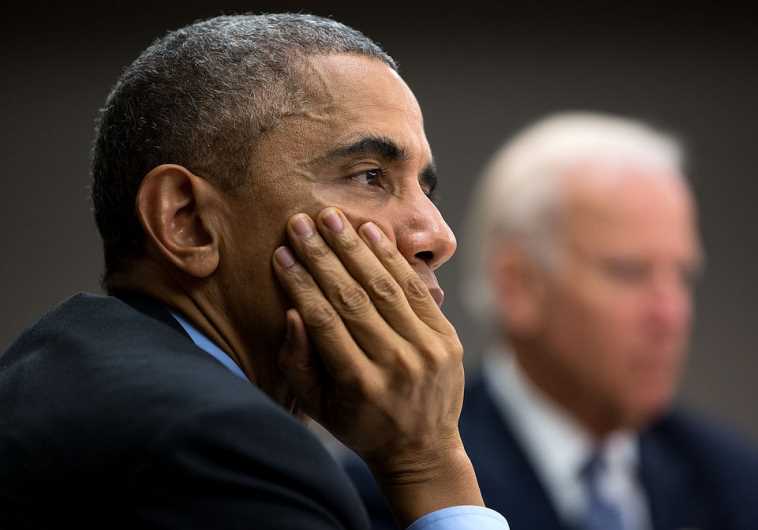
ShowImage (5)US President Barack Obama (L) and Vice President Joe Biden. (photo credit:OFFICIAL WHITE HOUSE PHOTO BY PETE SOUZA)

Most of the antiquities that ISIS plunders in Iraq and Syria make their way to the world market through Turkey. So, too, most of the oil that ISIS produces in Syria and Iraq is smuggled out through Turkey. According to the US Treasury, ISIS has made $1 million-$4m. a day from oil revenue.

Instead of maintaining its current practice of balancing its support for Turkey with its support for the Kurds, under the agreement, the West ditches its support for the Kurds and transfers its support to Turkey exclusively.

************************

While Israel and much of oficial Washington remain focused on the deal President Barack Obama just cut with the ayatollahs that gives them $150 billion and a guaranteed nuclear arsenal within a decade, Obama has already moved on – to Syria.

Obama’s first hope was to reach a deal with his Iranian friends that would leave the Assad regime in place. But the Iranians blew him off.

They know they don’t need a deal with Obama to secure their interests. Obama will continue to help them to maintain their power base in Syria though Hezbollah and the remains of the Assad regime without a deal.

Iran’s cold shoulder didn’t stop Obama. He moved on to his Sunni friend Turkish President Recep Erdogan.

Like the Iranians, since the war broke out, Erdogan has played a central role in transforming what started out as a local uprising into a regional conflict between Sunni and Shiite jihadists.

With Obama’s full support, by late 2012 Erdogan had built an opposition dominated by his totalitarian allies in the Muslim Brotherhood.

By mid-2013, Erdogan’s Muslim Brotherhood- led coalition was eclipsed by al-Qaida spinoffs. They also enjoyed Turkish support.

And when last summer ISIS supplanted al-Qaida as the dominant Sunni jihadist force in Syria, it did so with Erdogan’s full backing. For the past 18 months, Turkey has been ISIS’s logistical, political and economic base.

According to Brett McGurk, the State Department’s point man on ISIS, about 25,000 foreign fighters have joined ISIS in Syria and Iraq. All of them transited through Turkey.

Most of the antiquities that ISIS plunders in Iraq and Syria make their way to the world market through Turkey. So, too, most of the oil that ISIS produces in Syria and Iraq is smuggled out through Turkey. According to the US Treasury, ISIS has made $1 million-$4m. a day from oil revenue.

In May, US commandos in Syria assassinated Abu Sayyaf, ISIS’s chief money manager, and arrested his wife and seized numerous computers and flash drives from his home. According to a report in The Guardian published last week, the drives provided hard evidence of official Turkish economic collusion with ISIS.

Due to Turkish support, ISIS has become a self-financing terrorist group. With its revenue stream it is able to maintain a welfare state regime, attracting recruits from abroad and securing the loyalty of local Sunni militias and former Ba’athist forces.

Some Western officials believed that after finding hard evidence of Turkish regime support for ISIS, NATO would finally change its relationship with Turkey. To a degree they were correct.

Last week, Obama cut a deal with Erdogan that changes the West’s relationship with Erdogan.

Instead of maintaining its current practice of balancing its support for Turkey with its support for the Kurds, under the agreement, the West ditches its support for the Kurds and transfers its support to Turkey exclusively.

The Kurdish peshmerga militias operating today in Iraq and Syria are the only military outfits making sustained progress in the war against ISIS. Since last October, the Kurds in Syria have liberated ISIS-controlled and -threatened areas along the Turkish border.

The YPG, the peshmerga militia in Syria, won its first major victory in January, when after a protracted, bloody battle, with US air support, it freed the Kurdish border town of Kobani from ISIS’s assault.

In June, the YPG scored a strategic victory against ISIS by taking control of Tal Abyad. Tal Abyad controls the road connecting ISIS’s capital of Raqqa with Turkey. By capturing Tal Abyad, the Kurds cut Raqqa’s supply lines.

Last month, Time magazine reported that the Turks reacted with hysteria to Tal Abyad’s capture.

Not only did the operation endanger Raqqa, it gave the Kurds territorial contiguity in Syria.

The YPG’s victories enhanced the Kurds’ standing among Western nations. Indeed, some British and American officials were quoted openly discussing the possibility of removing the PKK, the YPG’s Iraqi counterpart, from their official lists of terrorist organizations.

The YPG’s victories similarly enhanced the Kurds’ standing inside Turkey itself. In the June elections to the Turkish parliament, the Kurdish HDP party won 12 percent of the vote nationally, and so blocked Erdogan’s AKP party from winning a parliamentary majority.

Without that majority Erdogan’s plan of reforming the constitution to transform Turkey into a presidential republic and secure his dictatorship for the long run has been jeopardized.

As far as Erdogan was concerned, by the middle of July the Kurdish threat to his power had reached unacceptable levels.

Then two weeks ago the deck was miraculously reshuffled.

On July 20, young Kurdish activists convened in Suduc, a Kurdish town on the Turkish side of the border, 6 kilometers from Kobani. A suicide bomber walked up to them, and detonated, massacring 32 people.

Turkish officials claim that the bomber was a Turkish Kurd, and a member of ISIS. But the Kurds didn’t buy that line. Last week, HDP lawmakers accused the regime of complicity with the bomber. And two days after the attack, militants from the PKK killed two Turkish policemen in a neighboring village, claiming that they collaborated with ISIS.

At that point, Erdogan sprang into action.

After refusing for months to work with NATO forces in their anti-ISIS operations, Erdogan announced he was entering the fray. He would begin targeting “terrorists” and allow the US air force to use two Turkish air bases for its anti-ISIS operations. In exchange, the US agreed to set up a “safe zone” in Syria along the Turkish border.

Turkish officials were quick to explain that in targeting “terrorists,” the Turks would not distinguish between Kurdish terrorists and ISIS terrorists just because the former are fighting ISIS. Both, they insisted, are legitimate targets.

Erdogan closed his deal in a telephone call with Obama. And he immediately went into action.

Turkish forces began bombing terrorist targets and rounding up terrorist suspects. Although a few of the Turkish bombing runs have been directly against ISIS, the vast majority have targeted Kurdish forces in Iraq and Syria.

Moreover, for every suspected ISIS terrorist arrested by Turkish security forces, at least eight Kurds have been taken into custody.

Then, too, Erdogan has called on AKP lawmakers to begin criminalizing their counterparts from the HDP. Kurdish lawmakers, he urged them, must be stripped of their parliamentary immunity to enable their arrests.

As Erdogan apparently sees things, by going to war against the Kurds, he will be able to reestablish the AKP’s parliamentary majority. Within a few weeks, if the AKP fails to form a governing coalition – and it will – then new elections will be held. The nationalists, who abandoned the AKP in June, will return to the party to reward Erdogan for fighting the Kurds.

As for that “safe area” in northern Syria, as the Kurds see it, Erdogan will use it to destroy Kurdish autonomy. He will flood the zone with Syrian Arab refugees who fled to Turkey, to dilute the Kurdish majority. And he will secure coalition support for the Sunni Arab militias – including those still affiliated with al-Qaida – which will be permitted by NATO to operate openly in the safe area.

Already the Kurds are reporting that the US has stopped providing air support for their forces fighting ISIS in the border town of Jarablus. Those forces were bombed this week by Turkish F-16s.

For their part, despite Erdogan’s pledge to fight ISIS, his forces seem remarkable uninterested in rolling back ISIS achievements. The Turks have no plan for removing ISIS from its strongholds in Raqqa or Haskiyah.

The Obama administration is presenting the deal with Turkey as yet another great achievement.

In an interview with Charlie Rose on Tuesday, McGurk explained that the deal was a long time in the making. It began with a phone conversation between Obama and Erdogan last October and it ended with their phone call last week.

In October, Obama convinced Erdogan not to oppose US air support for the Kurds in Kobani and to enable the US to resupply YPG fighters in Kobani through Turkey. In the second, Obama agreed not to oppose Erdogan’s offensive against the Kurds.

Two years ago, in August 2013, the world held its breath awaiting US action in Syria. That month, after prolonged equivocation amidst mountains of evidence, the Obama administration was forced to acknowledge that Iran’s Syrian puppet Bashar Assad had crossed Obama’s self-declared redline and used chemical weapons against regime opponents, including civilians.

US forces assembled for battle. Everything looked ready to go, until just hours before US jets were scheduled to begin bombing regime targets, Obama canceled the operation. In so doing, he lost all deterrent power against Iran. He also lost all strategic credibility among America’s regional allies.

To save face, Obama agreed to a Russian proposal to have international monitors remove Syria’s chemical weapons from the country.

Last summer, the administration proudly announced that the mission had been completed.

UN chemical weapons monitors had removed Syria’s chemical weapons arsenal from the country, they proclaimed. It didn’t matter to either Obama or Secretary of State John Kerry that by that point Assad had resumed chemical assaults with chlorine-based bombs. Chlorine bombs weren’t chemical weapons, the Americans idiotically proclaimed.

Then last week, the lie fell apart. The Wall Street Journal reported that according to US intelligence agencies, Assad not surrendered his chemical arsenal.

Rather, he hid much of his chemical weaponry from the UN inspectors. He had even managed to retain the capacity to make chemical weapons – like chlorine-based bombs – after agreeing to part with his chemical arsenal.

Assad was able to cheat, because just as the administration’s nuclear deal with the Iranians gives Iran control over which nuclear sites will be open to UN inspectors, and which will be off limits, so the chemical deal gave Assad control over what the inspectors would and would not be allowed to see. So, they saw only what he showed them.

Obama has gone full circle in concluding his deal with Erdogan. Since entering office, Obama has sought to cut deals with both the Sunni jihadists of the Muslim Brotherhood ilk and the Shi’ite jihadists of the Iranian ilk.

His chemical deal with Assad and his nuclear deal with the ayatollahs accomplished the latter goal, and did so at the expense of America’s Sunni Arab allies and Israel.

His deal last week with Erdogan accomplishes the former goal, to the benefit of ISIS, and on the backs of America’s Kurdish allies.

So that takes care of the Middle East. With 17 months left to go till Obama leave office, the time has apparently come for the British to begin to worry.

ObameDeal Exposed: It’s not ‘Secret’ from Congress but not in Writing

July 31, 2015

State Dept. claims Congress is “looped in,” but IAEA head refuse to testify at Senate hearings.

By: Tzvi Ben-Gedalyahu

Published: July 31st, 2015

via The Jewish Press » » ObameDeal Exposed: It’s not ‘Secret’ from Congress but not in Writing.

Matt Lee of the Associated Press at the State Department press briefing.

Matt Lee of the Associated Press at the State Department press briefing.
Photo Credit: StateDept.Gov

The State Dept. was caught in yesterday’s press briefing claiming there were not “secret deals” with Iran but admitted that it has no written copy of arrangements it is defending.

Associated Press journalist Matt Lee questioned spokesman Mark Toner at Thursday’s press briefing about many Congressmen’s concerns over IAEA access to Iran’s nuclear sites under the nuclear agreement.

Republican Sen. Bob Corker has said that IAEA director Dr. Yukiya Amano did not accept an invitation to testify at Senate Foreign Relations Committee hearings on the deal.

Toner declined to say whether Dr. Amano should testify but added:

There’s [sic] no secret deals, and we heard that expression thrown out constantly over the last couple of days. That couldn’t be farther from the truth. The IAEA, which is the one that verifies – will verify this deal, does create arrangements with countries under what’s called the Additional Protocol.

And Under Secretary Sherman has already had a secure briefing with the House leadership talking about this arrangement, and we’ve continued to provide or we will continue to provide those briefings in a classified setting, as needed….

So the perception that this has somehow been – that Congress hasn’t been looped in on this, and what we know about these arrangements is, frankly, incorrect. But they’ve had to take place in a classified setting.

Fine and dandy, but the reasonable assumption is that someone knows about the arrangements.

Lee told the spokesman:

But the notion – you said the notion that Congress hasn’t been looped in, but you haven’t been looped in because you guys haven’t read it.

Toner admitted:

We haven’t received a written copy of it, but we have been briefed on the contents.

And Lee retorted:

So someone with a photographic memory has looked at it and copied everything down in their brain and then repeated it up on the Hill?

Toner fidgeted and explained that “nuclear experts with much bigger degrees than I can ever attain have looked at this and their comfort level with it is good.”

But that does not answer the question, “If there is no secret deal, why isn’t a written version available?

Know Comment: American-Iranian fairy tales

July 31, 2015

Know Comment: American-Iranian fairy tales, Jerusalem PostDavid M. Weinberg, July 30, 2015

ShowImage (4)iran. (photo credit:REUTERS)

An updated list of the fictions peddled by the Obama administration in support of its pact with Iran.

Here is an updated scorecard of the misrepresentations advanced by the Obama administration in defense of its concordat with Iran. The list grows every day.

1. Iran will be motivated to keep the agreement.

False. Iran already may be plotting its escape from the agreement. Dr. Emily Landau of the Institute for National Security Studies points out that Iran has twice bolted – in 2004 and again in 2005 – when it felt that the agreements it concluded with the EU-3 were no longer serving its interests.

Lo and behold, the Joint Comprehensive Plan of Action has an explicit defection clause, which allows Tehran to exit the deal without any deliberations or warning if it feels that any of the P5+1 countries is reintroducing any form or degree of sanction against Iran.

So, Iran will pocket hundreds of billions of dollars in (almost-immediate and unconditional) sanctions relief, then sign hundreds of billions of dollars in investment and business partnership deals with the major French and German companies that are now in on the gold rush to Iran. Then it can accuse Congress or the next US president of being nasty and use that as the pretext for its “nuclear snapback.”

2. In case of Iranian violations, America can “snapback” sanctions.

The opposite is true. The agreement intentionally embeds the US in a web of time-consuming and complex multilateral processes that place significant and perhaps insuperable obstacles to both a snapback of economic sanctions and resort to an American military strike. Prof. Jeffrey Herf of the University of Maryland has detailed how the deal places sky-high barriers in the way of American enforcement in the event of Iranian violations.

Claudia Rosett of the Foundation for Defense of Democracies has shown that the nitty-gritty of the so-called sanction snapback provisions actually provide disincentives for the US and its partners to confront Iran in the event that Iran does cheat (which it has a long record of doing, and has done even during the recent nuclear talks). Moreover, Iran is supposed to get Western help and technology for defense against nuclear sabotage. So the US is essentially deterring itself from ever acting against Iran, no matter what. Which apparently is exactly what President Obama was after.

3. The deal will moderate or contain Iran’s aggressive ambitions in the Middle East.

Not at all. The nuclear deal seems to be just the first act in a longer drama of American retreat, retrenchment and accommodation as Obama hands the keys to the Persian Gulf and beyond to his new Shia friends.

Obama says that he “hopes” that “we can continue to have conversations with Iran that incentivize them to behave differently in the region, to be less aggressive, less hostile, more cooperative, to operate the way we expect nations in the international community to behave.” But, he adds, “We’re not counting on it. So this deal is not contingent on Iran changing its behavior.”

What a damning self-indictment. Is it believable that “conversations” are going to change or contain Iran? What is really needed, instead, says Prof. Walter Russell Mead of the New America Foundation, is a tough regional strategy to counter Iran’s rush for hegemony; an aggressive, anti- IRGC, anti-Assad, anti-Hezbollah policy.

But the White House never intended to contain Iran, says Dr. Michael Doran of the Hudson Institute. It has consistently displayed an aversion to countering Iran. America’s allies in the Middle East (and this list of allies supposedly still includes Israel) “have time and again begged the president to help them curtail Iranian influence in Iraq, Syria, Lebanon and Yemen, and time and again Obama has refused.”

Maj.-Gen. (res.) Yaakov Amidror of the Begin-Sadat Center for Strategic Studies expands on this in an-depth study published on Thursday.

Under cover of this accord, Iran is likely to greatly strengthen its grip on the Middle East, he writes. It will solidify its control of Yemen, including developing the capacity to block the Bab el-Mandeb strait in the Red Sea and thus threaten global trade and the Suez Canal, Egypt’s lifeline. It will take complete control of Lebanon.

With the help of other countries (perhaps even including the US) it will “save” the region by fighting ISIS, to become the true ruler of Iraq and of what would remain of Alawite Syria. Hezbollah will be given thousands of precise missiles, while enjoying Iranian backing and silent American approval.

Amidror: “There is little chance that America will follow through on its promise that after signing the agreement it will be more determined in its efforts to contain Iran. This claim is unrealistic and illogical, since once a rival state becomes a partner to an agreement, one does not increase efforts taken against it in other realms. It is the nature of agreements that cover a certain area of relations that they prevent pressure being applied in other areas, rather than increasing pressure. No one in the West will now be interested in jeopardizing either the agreement or trade relations with Iran. It is therefore likely that, despite the messages of reassurance coming from Washington, Iran will become much stronger over the next 15 years, internally, regionally, economically and militarily, with no opposition from the US.”

4. There was no better deal, and the alternative to this deal is war.

Both assertions are absolutely fallacious. More coercive diplomacy could have delivered a better deal. However, Obama refused to put maximum pressure on Iran. He was not willing to impose additional sanctions on Iran (as Prime Minister Netanyahu suggested and Congress wanted), or to threaten the use of military force. When you are in talks with a genocidal, terrorism-sponsoring regime and claim that you have no viable military option, you are not negotiating.

You are begging.

Prof. Fred Kagan of the American Enterprise Institute points out that there is a historical precedent for tougher diplomacy that works. The US Senate refused to ratify SALT II, ending the SALT process, but war between the US and the Soviet Union did not ensue. Both Jimmy Carter and Ronald Reagan instead increased the pressure on the Soviet Union dramatically. The lesson is that walking away from bad deals does not inevitably lead either to war or to the end of negotiations.

Netanyahu: Under nuke deal, Iran has months to hide illicit activity

July 30, 2015

Netanyahu: Under nuke deal, Iran has months to hide illicit activity

Prime minister dismisses claim of 24 days for international inspectors to access suspect sites, confirms Jerusalem not apprised of annexes to deal

By Raphael Ahren July 30, 2015, 5:21 pm

via Netanyahu: Under nuke deal, Iran has months to hide illicit activity | The Times of Israel.

In this Tuesday, July 14, 2015 file photo, Prime Minister Benjamin Netanyahu speaks during a news conference at his Jerusalem office. (AP/Oren Ben Hakoon, File)

In this Tuesday, July 14, 2015 file photo, Prime Minister Benjamin Netanyahu speaks during a news conference at his Jerusalem office. (AP/Oren Ben Hakoon, File)

The nuclear deal between the West and Iran gives Tehran up to three months to hide illicit nuclear activity in hitherto undeclared locations, and not 24 days as claimed by the accord’s backers, Prime Minister Benjamin Netanyahu said Thursday.

If Iran honors the agreement, it will be able to build numerous nuclear weapons with the blessing of the international community, he lamented during a briefing for Israeli diplomatic correspondents in his Jerusalem office.

“The inspections regime is full of holes,” Netanyahu said. “This deal is terrible. It’s preferable to have no deal than this deal.”

Under the Comprehensive Joint Plan of Action that the world powers signed with Iran earlier this month, Iran has 24 days before it needs to grant international inspectors access to hitherto undeclared sites they suspect host nuclear activity.

But, Netanyahu said, if no agreement has been reached after that time elapses, the deal says that the complaint is to go to another committee trying to bridge the dispute, which will deal with the issue for another 30 days. If Iran still refuses to let inspectors into the site and the United Nations Security Council is involved, it will take another 30 days before any action is taken, the prime minister said.

“It could take a total of three months,” Netanyahu said.

During an in-depth briefing, interrupted by a phone call during which Netanyahu discussed the Iran deal and other regional issues with Russian President Vladimir Putin, the prime minister vociferously attacked the deal, saying it endangers Israel’s existence.

“In another 10 to 15 years, Iran will become a nuclear threshold country with the potential to build nuclear weapons — with permission and authorization,” he said.

If US Congress rejects the deal, “it will avert the greatest danger of Iran becoming a legitimate nuclear threshold power in 10 years,” Netanyahu added.

The opposition to the deal is growing steadily, he said. “With every passing day there are more and more opponents to this deal. The more a person learns about the agreement, the more he opposes it,” Netanyahu said.

He said that Sunni Arab states in the region shared his concerns about the pact.

“Most Sunni Arab states don’t just criticize the deal, they fully reject it. They are outraged by the agreement,” he said. “There are very concrete threats on our existence. We’re not the only ones who understand that. Others understand it too.”

The comments seemed to contradict US Defense Secretary Ash Carter, who earlier this month said Saudi Arabia had offered some support for the accord. In the UN Security Council, Jordan, another Sunni Arab state, voted for the deal.

The prime minister pointed to a critical article by Leon Wieseltier, a frequent critic of Netanyahu’s policies, as proof that Jews and Americans were united in opposition to the deal.

“It shows that you don’t have to be right wing Jew to criticize this agreement. You also don’t have to be a Jew at all to reject this agreement.”

Recent polling has shown Americans, as well as American Jews, split on whether to support the deal. Religious Jews are most likely to oppose the agreement, according to most surveys.

Netanyahu also said that Israel is not privy to all the content of the secret supplements of the agreement signed by Iran and the world powers. “We didn’t receive all the parts of the deal,” he said, refusing to elaborate.

On Wednesday, national security adviser Yossi Cohen told Knesset lawmakers that Israel was being kept in the dark on the annexes.

“Contrary to promises, Israel has not yet received all the written supplements to the agreement signed between Iran and the world powers,” Cohen, a former deputy head of the Mossad, told members of the Knesset Foreign Affairs and Defense Committee.

The nuclear deal is currently being weighed by Congress, which will likely vote on whether to support it in September.

Netanyahu has indicated he will lobby against the deal in the US, even at the cost of ruffling feathers with the White House.

During the talk with Putin, the Russian president said the agreement “provided reliable guarantees” that Iran’s nuclear program is exclusively peaceful, according to the Kremlin.

Putin said that the agreement would help secure nuclear non-proliferation and “have a positive impact on security and stability in the Middle East.”

Iran orders from China 150 J-10 fighter jets that incorporate Israeli technology

July 30, 2015

Iran orders from China 150 J-10 fighter jets that incorporate Israeli technology, DEBKAfile, July 30, 2015

J-10Chinese Chengdu J-10 for Iranian air force

The scale of Iran’s multibillion acquisitions from China and Russia – 550 warplanes in all so far – indicates that Tehran’s top spending priority upon receipt of the funds released by the removal of sanctions, is to be a spanking new air force.

**********************

Iran is about to conclude a transaction with China for the purchase of the Chengdu J-10 multirole jet fighter, known in the West as the Vigorous Dragon, according to an exclusive report from DEBKAfile’s military and intelligence sources. Beijing has agreed to sell Tehran 150 of these sophisticated jets.

While the Chinese J-10 is comparable to the US F-16, our sources report that it is virtually a replica of the Lavi, the super-fighter developed by Israel’s aerospace industry in the second half of the 80s. Israel sold China the technology, after Washington insisted on Its discontinuing the Lavi’s production. The US also objected to the sale of the Lavi’s avionics, claiming that it contained some American components.

The Chinese plane comes in two versions – the multirole single-seat J-10A and the two-seat J-10B, which serves for training, ground assaults and electronic warfare.

Iran has additionally weighing the purchase in Moscow of 250 highly-advanced Sukhoi-Su-30MK1 twinjet multirole air superiority fighters, known in the West as Flanker-H.

On Wednesday, July 29, an Indian Air Force Su-30MK1 took part for the first time in a British air maneuver, Rainbow, where it dueled with the European Typhoon fighter.

The sophisticated Flanker has been found to have a major shortcoming. To carry eight tons of ordnance, it must use both of its AL-31FP engines, and the transition from one to two – and the reverse – often causes engine failure.

The Indian Air Force has reported three such malfunctions in a month, as well another shortcoming: The time needed for making the aircraft serviceable is too long. As a result, only half of the Indian fleet can be airborne at one time.

In a confrontation, the Iranian Air Force may find that, because of these drawbacks, the Chinese Su-30MK1 is outmatched by its American and European counterparts in the service of the Israeli, Saudi and UAE air forces.

On July 22, DEBKAfile revealed that Moscow and Tehran had concluded a giant transaction for the acquisition of a fleet of 100 IL78 MK1 (Midas) in-flight refueling planes for extending the range of its warplanes up to 7,300 km and able to refuel 6-8 planes at once.

DEBKAfile: The scale of Iran’s multibillion acquisitions from China and Russia – 550 warplanes in all so far – indicates that Tehran’s top spending priority upon receipt of the funds released by the removal of sanctions, is to be a spanking new air force.

Iran: Nuke Deal Permits Cheating on Arms, Missiles

July 27, 2015

Iran: Nuke Deal Permits Cheating on Arms, Missiles

Deal puts ‘Zionist regime in irrecoverable danger’

BY:
July 27, 2015 3:16 pm

via Iran: Nuke Deal Permits Cheating on Arms, Missiles | Washington Free Beacon.


Iran’s foreign minister and lead negotiator in nuclear talks said that under the terms of the recently inked accord, the Islamic Republic is permitted to violate current embargoes on the shipment of arms and construction of missiles, according to recent comments made before Iran’s parliament.

Zarif, who spoke to the country’s parliament about the terms of the nuclear deal, also bragged that the finalization of the accord “puts the Zionist Regime in an irrecoverable danger,” according to an independent translation of his Persian language remarks provided to the Washington Free Beacon.

Zarif insisted that “violating the arms and missiles embargo” placed on Iran by the United Nations “does not violate the nuclear agreement.”

U.S. officials and analysts have become increasingly concerned about portions of the deal that will unilaterally lift current restrictions on Iran’s importation and exportation of weapons, as well as its missile construction programs.

While these restrictions still apply, they would be completely lifted in five to eight years under the agreement.

Zarif also took aim at Israel in his remarks, claiming that the deal has isolated Israel as it never has been before.

“Benjamin Netanyahu is ready to kill himself if it helps to stop this nuclear agreement because this agreement puts the Zionist regime in an irrecoverable danger,” Zarif was reported as saying. “The abominable Zionist Regime has never been so isolated among its allies.”

The recent approval of the deal by the United Nations Security Council has solidified Iran’s right to enrich and operate a nuclear program, Zarif went on to say.

“Our biggest accomplishment is that the U.N. Security Council has endorsed our enrichment, this has never happened in the last 70 years,” Zarif said.

“Permit me not to mention the names, but many countries close to the U.S. have agreed to relinquish their enrichment rights, they all envy us today,” he added.

Turkish journalist: “Turkey prefers ISIS to the Kurds”

July 27, 2015

Turkish journalist: “Turkey prefers ISIS to the Kurds”

In an exclusive interview with JerusalemOnline, Turkish journalist Uzay Bulut described how the Turkish state systematically persecutes the Kurds while at the same time assisting ISIS and other jihadist terror groups.

Jul 27, 2015, 02:03PM | Rachel Avraham

via Israel News – Turkish journalist: “Turkey prefers ISIS to the Kurds” – JerusalemOnline.

Photo Credit: Faridan Abbas

In an exclusive interview with JerusalemOnline, Turkish journalist Uzay Bulut, who writes for the Gatestone Institute, proclaimed that Turkey prefers the ISIS terror organization to the Kurds: “In a television interview on 28 December, 2012, Recep Tayyip Erdogan said that the government was in negotiations with Abdullah Ocalan, the jailed leader of the PKK, in order to resolve the Kurdish issue.  But at the same time, there are also several reports and witness accounts that Turkey has aided the rise of ISIS, enabling the flow of funds and fighters to support it.”

According to Bulut, the establishment of Turkey as a state was based upon the denial of the Kurds identity: “After the state was founded in 1923, the name of the Kurdish land, Kurdistan, the Kurdish language and everything else related to the Kurdish existence was denied. According to the founding ideology of the state, there were no Kurds or Kurdish language. So Kurdistan within Turkey’s borders became a sub-colony without even borders or a name. Kurds have been exposed to numerous massacres and extrajudicial murders for more than 90 years. As a result of these repressive and assimilationist policies, many Kurds have been assimilated into Turkishness but many others have resisted and still demand their national rights.”

Bulut noted that it has been more than 90 years since the establishment of the Turkish Republic but the Kurds within the country are still struggling for political recognition and the Turkish government wants to stop the spread of this desire for national rights at all costs. “The establishment of the Kurdistan Regional Government of Iraq was a huge step in the liberation of Kurdistan,” Bulut noted. “Now Syrian Kurdistan is on the rise; Kurdish male and female defenders there are struggling for their freedom. So Turkey wants to stop this new development. And ISIS is the name of their new plan that they apply to stop the liberation of Kurdistan and to exterminate the Kurds – as much as possible.”

In order to highlight this, Bulut stressed that on July 20th, there was a bomb attack in the Kurdish town of Suruc that killed 32 people during a meeting to discuss reconstruction efforts in Kobane and Turkish fighter jets recently bombed Qandil where the PKK was operating. She also noted that scores of Kurds have been arrested within Turkey this week: “These developments do not signal a positive change in Turkish state policy towards the Kurds.”

In an another instance, Kurds were persecuted by the Turkish state for taking a stand against ISIS: “Esra Yakar, a 5th-year Kurdish student at the Medical School of Dicle University in Diyarbakir, went to the Kurdish province of Kobani a few months ago as a volunteer doctor to help treat Kurds wounded in the fighting with ISIS terrorists. In December 2014, she suffered heavy wounds to her head and right eye during an attack by ISIS. Her referral to a hospital for advanced examination and treatment in Turkey was delayed. In the meantime, she lost her right eye. And while still under medical treatment, she was arrested and jailed in the Sincan prison in Ankara for being a terrorist.”

However, Bulut noted that ISIS terrorists face no such obstacles for receiving medical treatment in Turkey: “Emrah Cakan, a Turkish-born ISIS commander wounded in Syria, got medical treatment at the university hospital in Turkey’s Denizli province in March. As it is evident from this instance and many others, aiding ISIS terrorists while attacking or not helping Kurds has paved the way for the crimes committed by ISIS and other jihadist armies there.”

While the Kurds are being systematically oppressed within Turkey, Bulut noted that Turkey has not only economic relations with jihadist groups but also political relations with them as well: “For Islamic armies to advance and invade places today, they do need fighters as well as logistics and military support. People who believe in Islamic jihad become the fighters – or murderers and rapists – of ISIS and other Islamist armies. But the logistics and military support is mostly provided by the regional states – including Turkey.”

This support is used in order to oppress the Kurds: “ISIS mostly operates in all parts of Kurdistan, threatening the security of all Kurds in the region and even slaughtering or kidnapping and selling them as they did to the Yazidi Kurds in the Shengal region in August 2014. And this seems to be the only concrete outcome of the so-called resolution process in Turkey. No Kurdish rights have been recognized officially and Kurdish massacres are still happening.”

“Subjugating Kurds has been one of the primary policies of Turkey since 1920s,” Bulut emphasized. “A democratic state would choose to grant political and cultural rights to indigenous Kurds but Turkish supremacism, Kurdish-hatred and anti-Kurdish bigotry is so intense in Turkey that Turkey does not seem to aim to achieve real and sustainable peace with the Kurds. And because of that, the Turkish state seems to prefer even a genocidal group like ISIS to the Kurds.”