Posted tagged ‘Media and Trump’

Virgil: The Beltway Assures Us the Deep State Doesn’t Exist

March 13, 2017

Virgil: The Beltway Assures Us the Deep State Doesn’t Exist, BreitbartVirgil, March 13, 2017

(Please see also, The Trouble with Barry.  — DM)

BNN Edit

In parts one and two of our guided tour of the Deep State, we looked at two anchors of the Federal Triangle in downtown DC, the Department of Commerce and the Environmental Protection Agency.  And while Virgil looks forward to continuing his tour of the Triangle and other nodes of the Deep State, sometimes breaking news breaks in, and so we should pause to consider the latest.

On March 10, from his podium at the James S. Brady Press Briefing Room at the White House, President Trump’s press secretary, Sean Spicer, was asked about the Deep State.  The question:

Does the White House believe in a “Deep State” that is actively working to undermine the president?

And here’s Spicer’s answer:

I think that there’s no question when you have eight years of one party in office, there are people who stay in government—and continue to espouse the agenda of the previous administration.  So I don’t think it should come as any surprise there are people that burrowed into government during eight years of the last administration and may have believed in that agenda and want to continue to seek it.  I don’t think that should come as a surprise.

In other words, Spicer’s answer to the answer to the question was “Yes.”  So now there can be no doubt that the concept of the Deep State will be discussed for a long time to come.  And yet if Virgil might be permitted to quibble with Spicer, he would say that the Deep State is a lot deeper than just the past eight years—we’ll come back to that point.

But first, let’s hear from other voices on the issue of whether or not there’s a Deep State.  As we can see, it’s gaining a critical mass of recognition, at least on the right.  And that’s good, because, as they say, forewarned is forearmed.

On March 5, former House speaker Newt Gingrich made himself clear—as he always does:

There is an active Deep State opposition to a populist disruptive reformer.  Many [in the government] believe it is their duty to break the law and lie.  For Trump to succeed, there will have to be profound overhaul of the bureaucracy.

A few days later, Rep. Mike Kelly (R-PA) didn’t use the actual words “Deep State,” but his point was the same when he described the situation in Powertown: “The same people were there, and they don’t think the new owners or the new managers should be running the ship.”  And then Kelly added this point about former president Barack Obama:

He’s only there for one purpose and one purpose only, and that is to run a shadow government that is totally going to upset the new agenda.

So is the 44th president setting up a permanent campaign against the 45th president?  Obama denies any such intention; he says that he and his family are remaining in Washington so that his youngest daughter, Sasha, can finish high school.  Of course, that explanation doesn’t quite tell us why former White House consigliere Valerie Jarrett has moved into the Obamas’ 8200-square-foot home in the swanky Kalorama neighborhood, just a couple miles north of the White House.

In fact, the real goal of the relocation, according to The Daily Mail, is to “oust Trump from the presidency either by forcing his resignation or through his impeachment.”

Meanwhile, others in Congress, too, are eyeing closely the shadowy armada arrayed against the new administration.  In the words of Rep. Thomas Massie (R-KY), “I think it’s really the Deep State vs. the president, the duly elected president.”

And on March 9, Fox News’ Sean Hannity, was even more direct:

Deep State Obama holdovers embedded like barnacles in the federal bureaucracy are hell-bent on destroying President Trump.  It’s time for the Trump administration to purge these saboteurs.

Interestingly, by coincidence, or perhaps not, the very next day President Trump’s Justice Department ordered the firing of 46 US Attorneys, all Obama holdovers.  

Still, some in the Main Stream Media, even now, choose to deny that there is any such thing as a Deep State.  One such is David Ignatius, veteran columnist for The Washington Post, who wrote on March 7 that what we’re seeing is simply the collision of President Trump and the properly established legal system:

Some [Trump] supporters claim he’s facing a secret coup from an intelligence and foreign policy establishment that constitutes a despotic “deep state.” But really, Trump is confronting the orderly process we call the “rule of law.”

Virgil thinks that it’s rich, indeed, for Ignatius to insist that there’s nothing going on except the proper rule of law.  Why?  Because it was Ignatius’ own reporting, back on January 12, that demonstrated the extra-legal power of the Deep State.  That was the report that revealed that on December 29, Michael Flynn, named as Trump’s national security adviser in the new administration, had been intercepted talking on the phone to the Russian ambassador to the US, Sergey Kislyak.  And from that first report, events tumbled, and as we all know, Flynn resigned from his White House post on February 13.

And yet a few days after that Ignatius story ran on January 12, Virgil wondered aloud how he got the information about a private phone call: “Now how did Ignatius know that?”  That is, how did Ignatius learn about the Flynn-Kislyak conversation?  Continuing, Virgil wrote back then, “The Postman won’t say, other than that he got his information from a ‘senior US government official.’”  Virgil then pointed out that even if was legal to record the call—yes, it’s smart to surveil Russians—it’s not legal to leak such information to the media, especially if it involves an American citizen.  “Such disclosures aren’t legal,” Virgil added with a sigh, “but once again, nobody in Washington, DC, seems to care.”

So we can see: In the Flynn case, the power of the Deep State wasn’t at all about the “rule of law.”  It was about just the opposite.

Others, too, take the Ignatius line—even if their denials are weirdly weak and self-contradicting.  Here, for example is a March 9 headline in Politico, the bible of the Beltway: “The Deep State Is a Figment of Steve Bannon’s Imagination.” The author, Loren DeJonge Schulman, starts out by firing both barrels at Bannon and anyone else who might have suspicions about the Deep State:

Here’s a handy rule for assessing the credibility of what you’re reading about national security in the Trump era: If somebody uses the term “Deep State,” you can be pretty sure they have no idea what they’re talking about.

Got that?  Nothing to see here: So if you hear Spicer, Gingrich, Kelly, Massie, Hannity—or, of course, ol’ Virgil—nattering on about the Deep State, well, have a dunce cap handy.

So who’s the author of this don’t-worry-about-a-thing piece?  We can see from her bio that Loren DeJonge Schulman, who now works at a Democratic-aligned think-tank in DC, has an extensive background in the politics of the Democratic Party and the Deep State, both.

So maybe it’s not so surprising that Schulman wouldn’t want anyone nosing around too much in Deep State matters.   After all, nobody likes being snooped on, right?   In fact, Virgil is reminded of the 1999 Brad Pitt movie, Fight Club, featuring these oft-repeated lines:

Welcome to Fight Club.  The first rule of Fight Club is: you do not talk about Fight Club.  The second rule of Fight Club is: you DO NOT talk about Fight Club!

That was Hollywood’s way of expressing the most basic wisdom of any secret enterprise: Keep it secret!

So Virgil was surprised to see how Schulman chose to end her denial piece.  After nearly 2000 words of mercilessly mocking the idea that there was any such thing as a Deep State, Schulman closed by . . . outing herself as a Deep Stater:

So the next time you hear someone using the term Deep State, send them a copy of this article.  Ask them to stop using it.  Tell them the term betrays their ignorance, and obscures and misleads far more than it illuminates.  And if that doesn’t work, well, we Deep Staters will take matters into our own hands. [emphasis added]

One supposes that Schulman would say that her final words were just her way of being funny: What an arch sense of humor she has!  And no doubt she got some yuks from her pals in Cleveland Park, Crystal City, and Chevy Chase.  Meanwhile, other Americans, curious about how they are being governed, might wonder what’s so funny about being threatened by a well-connected Beltway apparatchik.

Yes, an attempt at humor, however ominous, is one possible explanation for Schulman’s close.  Another possibility is that she is, in fact, proud to be a Deep Stater, and that her pride shines right through her feigned irony.  That is, she is eager to signal to her friends and colleagues in the Deep State that she is truly one of them, even as she laughs it off.

Was her Politico piece a successful stratagem?  Did Schulman succeed in playing her double game?  That is, proving that she is one of the cool kids, even as she convinced readers that only dopes and paranoids worry about the Deep State?  Virgil reports, you decide.  

Robert Spencer: What if the media had covered World War II the way it covers jihad?

March 10, 2017

Robert Spencer: What if the media had covered World War II the way it covers jihad? Jihad Watch via YouTube, March 9, 2017


Trump’s wiretapping tweets, the media and reality

March 7, 2017

Trump’s wiretapping tweets, the media and reality, Rebel Media via YouTube, March 6, 2017

(A very good summary of the information now available. — DM)


Russian Roulette

March 6, 2017

Russian Roulette, PJ MediaRoger Kimball, March 6, 2017

(Rex Features via AP Images)

It may be about time to add a new chapter to Charles Mackay’s Extraordinary Popular Delusions and the Madness of Crowds. Mackey dilated on scams like the South Sea Bubble and wild speculations like Tulipmania in 17th century Holland, when a single tulip bulb could sell for more than a mansion.

There was the distinct aroma of fraudulence, abetted by naïveté, about most of the enterprises Mackay described. And so it is with the new chapter I am proposing. It might be called “Russian Roulette.” I am thinking not of the messy game with a revolver, but rather the insinuation sweepstakes currently being deployed against Donald Trump by the Democrats and their pets in the media.

Since the game is still in process, we cannot quite finish the chapter. But we know how it starts. It starts with groundless accusations that Donald Trump and/or his surrogates somehow “colluded,” had illicit ties with, the Russians. Maybe he helped them “hack the election.” Maybe he is Putin’s puppet. We don’t quite know. But this calls for a “special prosecutor” (even though such a thing doesn’t exist), a criminal investigation, the impeachment or at least the delegitimization of Donald Trump and all his works.

Last week, Holman Jenkins had an excellent, sobering-up piece on the Left’s “Putin Fantasies.” He quickly dispatches all the usual suspects: Paul Manafort, Roger Cohen, Carter Page, et al. He quotes “veteran foreign correspondent Susan B. Glasser,” who treats readers of the New York Times to this breathless animadversion:

Mr. Trump’s rhetoric and actions as president bear more than a passing resemblance to those of Mr. Putin during his first years consolidating power. The similarities are striking enough that they should not be easily dismissed.

Oh, yes: “The similarities are indeed striking,” Jenkins observes. “Mr. Putin and Mr. Trump both have arms and legs. When it comes to distinguishing noise from signal, however, two men could not be less alike”:

Russia was a country in chaos. Its president was a drunk seeking a successor to protect his daughter and friends from corruption investigations. Mr. Putin, a former KGB agent and head of the secret police, ran one of the few, after a fashion, functioning institutions in Russia, albeit arm in arm with organized crime.

Mr. Trump’s rise couldn’t be more different. He’s a reality TV star and brand manager. To an unusual degree, he’s a president who lacks even a party. Meanwhile, the courts, the bureaucracy, the media, the political parties all continue to function as they always have.

“Striking similarities” underwritten by categorical differences.

No, when it comes to this new game of Russian Roulette, Ted Cruz got it right: it is a “nothingburger.”

Well, not quite nothing. So far, there is no evidence of malfeasance, of anything improper or illegal. But there is plenty of anchorless animus directed at Trump by the Democrats and their media pets. So far, it amounts to what William Jacobson at Legal Insurrection has called “The fact-free Intelligence Community-Media trial of Trump by innuendo.”

Here’s how it works.  You start with a lurid — but totally unsubstantiated — allegation. To wit: Senator Chris Coons (D., natch) to Dem. pet Andrea Mitchell March 3:

There are transcripts that provide very helpful, very critical insight into whether or not Russian intelligence and Senior Russian leaders, including Vladimir Putin, um, were cooperating, were colluding, with the Trump campaign at the highest levels to influence our election.

Yikes! Transcripts and evidence of collusion at the highest levels to influence our election. Andrea Mitchell sure liked that:

Actually, it’s holy smoke and mirrors.

On March 3 it was “transcripts,” Russians “colluding” with the Trump campaign “at the highest levels to influence our election.” But by March 5 it was “I have no hard evidence of collusion.

No “hard” evidence, of course, means no evidence of any kind.

I adduce the example of Chris Coons, but remarks by Nancy Pelosi, Chuck Schumer, et al. — not to mention the yapping of any of the pack of chihuahuas that is the Democratic pocket press — would do just as well.

Take a damaging allegation: the infamous “dossier” against Trump, for example. It doesn’t make any difference that it is totally unsubstantiated. Just run with it.

All Democratic outlets — CNN, MSNBC, Washington Post, New York Times — echo it. Is it untrue? Doesn’t matter. It might still have the desired effect of undermining public confidence in Trump even if it is eventually exploded.

But what if you are Donald Trump? Well, that’s different. Let’s say you make allegations that the Obama administration conducted surveillance against you in the final months and weeks of the election.

Not so fast! Where’s your proof?

Actually, there’s plenty of proof. Andy McCarthy noted a few days ago:

[T]he Obama Justice Department and the FBI sought FISA warrants against Trump insiders, and potentially against Donald Trump himself, during the last months and weeks of the presidential campaign.

Even the New York Times admitted as much, if inadvertently, in a story about various investigations in Trump’s alleged “Russia ties”:

The investigators have accelerated their efforts in recent weeks buthave found no conclusive evidence of wrongdoing, the officials said. One official said intelligence reports based on some of the wiretapped communications had been provided to the White House.

Just to parse that a bit: by “no conclusive evidence” the Times means the same thing that Senator Coons meant by “no hard evidence,” i.e., no evidence at all.

And although Nancy Pelosi responded to Trump’s allegation that Trump Tower had been secretly wiretapped by saying “We don’t do that,” it turns out, as the Times acknowledges, that they do.

Holman Jenkins noted in passing that Donald Trump is “a reality TV star and brand manager.” That’s right. He’s cut from a different bolt of cloth than the Democratic (and most of the Republican) confraternity. That’s one reason they so despise him.

Another, and deeper, reason is this: If Donald Trump is successful in draining the swamp of Washington, D.C., if he can effectively take on the unions, secure our Southern border, cut wasteful regulation, neuter the EPA, substantially dismantle the administrative state, and achieve 3-4% growth, all of those swamp creatures will be out of a habitat.

In other words, Trump represents an existential threat to their way of life. Hence their angry and hysterical war against him. Mostly, it is true, their attacks are self-refuting. But make no mistake. The Left is out to cripple Trump.

As I said in this space Saturday, he needs to fight back, and hard. The Left has declared war on Donald Trump. I am glad to see that he has woken up to that fact and is responding in kind.

Former Bush AG Mukasey: Trump ‘Right’ That There Was Surveillance

March 6, 2017

Former Bush AG Mukasey: Trump ‘Right’ That There Was Surveillance, ABC News via YouTube, March 5, 2017

https://www.youtube.com/watch?v=NfA2ROMzhJU

H/t Conservative Tree House for the link to the video and for this insight:

Here’s what’s going on, that almost everyone seems to be missing.

President Trump cannot publicly disclose anything relating to his first hand knowledge of national security issues, specifically intelligence gathering, without opening himself up to accusations of the mishandling of classified information…. which naturally his opposition would use to: #1) drive a media narrative, #2) demand an investigation of him as a leaker of classified intel, and #3) ultimately lead to pearl-clutching calls for impeachment etc. [Emphasis added.]

President Trump cannot publicly discuss anything related to his knowledge of classified information or intelligence.  His opposition (Dems and Media) know this, and therefore use his inability to discuss these matters as a tool to shape their chosen narratives.

The Alinsky accuser can run to the microphones, but the accused has a constitutional gag order.  See how that works?

Absent of the President’s ability to discuss or defend himself, he enters into the media matrix at a disadvantage.  The media can claim anything, and President Trump cannot provide evidence to refute their claims without compromising his position.   The media knows this. The media use this dynamic to their advantage.

The President cannot publicly discuss anything provided to him from the intelligence community.  However, President Trump CAN publicly discuss, or draw attention to, media reports which contain stories about leaks as derived from classified intelligence leaks.

Please read the entire article.

Presidential Payback For Media Hubris

March 2, 2017

Presidential Payback For Media Hubris, Hoover Institution, Victor Davis Hanson, March 1, 2017

Trump is the media’s Nemesis—payback for its own hubris.

****************************

Donald Trump conducted a press conference recently as if he were a loud circus ringmaster whipping the media circus animals into shape. The establishment thought the performance was a window into an unhinged mind; half the country thought it was a long overdue media comeuppance.

The media suffer the lowest approval numbers in nearly a half-century. In a recent Emerson College poll, 49 percent of American voters termed the Trump administration “truthful”; yet only 39 percent believed the same about the news media.

Every president needs media audit. The role of journalists in a free society is to act as disinterested censors of government power—neither going on witch-hunts against political opponents nor deifying ideological fellow-travelers.

Sadly, the contemporary mainstream media—the major networks (ABC, CBS, NBC, CNN), the traditional blue-chip newspapers (Washington Post, New York Times), and the public affiliates (NPR, PBS)—have lost credibility. They are no more reliable critics of President Trump’s excesses than they were believable cheerleaders for Barack Obama’s policies.

Trump may have a habit of exaggeration and gratuitous feuding that could cause problems with his presidency. But we would never quite know that from the media. In just his first month in office, reporters have already peddled dozens of fake news stories designed to discredit the President—to such a degree that little they now write or say can be taken at face value.

No, Trump did not have any plans to invade Mexico, as Buzzfeed and the Associated Press alleged.

No, Trump’s father did not run for Mayor of New York by peddling racist television ads, as reported by Sidney Blumenthal.

No, there were not mass resignations at the State Department in protest of its new leaders, as was reported by the Washington Post.

No, Trump’s attorney did not cut a deal with the Russians in Prague. Nor did Trump indulge in sexual escapades in Moscow. Buzzfeed again peddled those fake news stories.

No, a supposedly racist Trump did not remove the bust of Martin Luther King Jr. from the White House, as a Time Magazine reporter claimed.

No, election results in three states were not altered by hackers or computer criminals to give Trump the election, as implied by New York Magazine.

No, Michael Flynn did not tweet that he was a scapegoat. That was a media fantasy endorsed by Nancy Pelosi.

In fact, Daniel Payne of the Federalist has compiled a lengthy list of sensational stories about Trump’s supposed buffooneries, mistakes, and crudities that all proved either outright lies or were gross exaggerations and distortions.

We would like to believe writers for the New York Times or Washington Post when they warn us about the new president’s overreach. But how can we do so when they have lost all credibility—either by colluding with the Obama presidency and the Hillary Clinton campaign, or by creating false narratives to ensure that Trump fails?

Ezra Klein at Vox just wrote a warning about the autocratic tendencies of Donald Trump. Should we believe him? Perhaps not. Klein was the originator of Journolist, a “left-leaning” private online chat room of journalists that was designed to coordinate media narratives that would enhance Democratic politicians and in particular Barack Obama. Such past collusion begs the question of whether Klein is really disinterested now in the fashion that he certainly was not during the Obama administration.

Recently, New York Times White House correspondent Glenn Thrush coauthored a report

about initial chaos among the Trump White House staff, replete with unidentified sources. Should we believe Thrush’s largely negative story?

Perhaps. But then again, Thrush not so long ago turned up in the Wikileaks troves as sending a story to Hillary Clinton aide John Podesta for prepublication audit. Thrush was his own honest critic, admitting to Podesta: “Because I have become a hack I will send u the whole section that pertains to u. Please don’t share or tell anyone I did this Tell me if I f**ked up anything.”

Dana Milbank of the Washington Post has become a fierce critic of President Trump. Are his writs accurate? Milbank also appeared in Wikileaks, asking the Democratic National Committee to provide him with free opposition research for a negative column he was writing about candidate Trump. Are Milbank’s latest attacks his own—or once again coordinated with Democratic researchers?

The Washington Post censor Glenn Kessler posted the yarn about Trump’s father’s racist campaign for New York mayor—until he finally fact-checked his own fake news and deleted his tweet.

Sometimes the line between journalism and politicians is no line at all. Recently, former Obama deputy National Security advisor Ben Rhodes (brother of CBS news president David Rhodes) took to Twitter to blast the Trump administration’s opposition to the Iran Deal, brokered in large part by Rhodes himself. “Everything Trump says here,” Rhodes stormed, “is false.”

Should we believe Rhodes’s charges that Trump is now lying about the details of the Iran Deal?

Who knows, given that Rhodes himself not long ago bragged to the New York Times of his role in massaging reporters to reverberate an administration narrative: “We created an echo chamber They were saying things that validated what we had given them to say.” Rhodes also had no respect for the very journalists that he had manipulated: “The average reporter we talk to is 27 years old, and their only reporting experience consists of being around political campaigns. That’s a sea change. They literally know nothing.”

Is Rhodes now being disinterested or once again creating an “echo chamber”?

His boss, former UN Ambassador and National Security Advisor in the Obama administration, Susan Rice (married to Ian Cameron, a former producer at ABC news), likewise went on Twitter to blast the Trump administration’s decision to include presidential advisor Steven Bannon in meetings of the National Security Council: “This is stone cold crazy,” Rice asserted, “After a week of crazy.”

Is Rice (who has no military experience) correct that the former naval officer Bannon has no business participating in such high strategy meetings?

In September 2012, Rice went on television on five separate occasions to insist falsely to the nation that the attacks on the Benghazi consulate were the work of spontaneous rioters and not a preplanned hit by an al Qaeda franchise. Her own quite crazy stories proved a convenient administration reelection narrative of Al Qaeda on the run, but there were already sufficient sources available to Rice to contradict her false news talking points.

There are various explanations for the loss of media credibility.

First, the world of New York and Washington DC journalism is incestuous. Reporters share a number of social connections, marriages, and kin relationships with liberal politicians, making independence nearly culturally impossible.

More importantly, the election in 2008 of Barack Obama marked a watershed, when a traditionally liberal media abandoned prior pretenses of objectivity and actively promoted the candidacy and presidency of their preferred candidate. The media practically pronounced him god, the smartest man ever to enter the presidency, and capable of creating electric sensations down the legs of reporters. The supposedly hard-hitting press corps asked Obama questions such as, “During these first 100 days, what has …enchanted you the most from serving in this office? Humbled you the most…?”

Obama, as the first African-American president—along with his progressive politics that were to the left of traditional Democratic policies—enraptured reporters who felt disinterested coverage might endanger what otherwise was a rare and perhaps not-to-be-repeated moment.

We are now in a media arena where there are no rules. The New York Times is no longer any more credible than talk radio; CNN—whose reporters have compared Trump to Hitler and gleefully joked about his plane crashing—should be no more believed than a blogger’s website. Buzzfeed has become like the National Inquirer.

Trump now communicates, often raucously and unfiltered, directly with the American people, to ensure his message is not distorted and massaged by reporters who have a history of doing just that. Unfortunately, it is up to the American people now to audit their own president’s assertions. The problem is not just that the media is often not reliable, but that it is predictably unreliable. It has ceased to exist as an auditor of government. Ironically the media that sacrificed its reputation to glorify Obama and demonize Trump has empowered the new President in a way never quite seen before. At least for now, Trump can say or do almost anything he wishes without media scrutiny—given that reporters have far less credibility than does Trump.

Trump is the media’s Nemesis—payback for its own hubris.

News, Fake News, Very Fake News: A Primer

February 27, 2017

News, Fake News, Very Fake News: A Primer, PJ MediaRoger Kimball, February 27, 2017

spiceynewsconfWhite House Press secretary Sean Spicer takes questions from the media during the daily briefing in the Brady Press Briefing Room of the White House in Washington, Tuesday, Feb. 14, 2017. (AP Photo/Pablo Martinez Monsivais)

The motor of fake news is not inaccuracy. It’s malice.

I had an insight into this important truth a couple weeks back when I was at a swank New York club for an evening event. The establishment in question is overwhelmingly conventional, i.e., leftish in that smug “We’re-all-beautiful-people-who-are-you?” sort of way that publications like The New Yorker and the New York Times, along with such media outlets as CNN and MSNBC, exude like the cloying aroma of paperwhites.

I ran into an acquaintance, a female journalist I hadn’t seen in years. I knew that her politics were echt conventional in the above sense, but I had also found her an amusing and lively person. We were chatting with a couple of other people about this and that when someone she knew from the Times joined in. I then overheard him explain to her that she had to be careful about what she posted on Facebook, Twitter, etc., because anything too explicitly anti-Trump could be used against her when that glorious day came and “they” — the conventional fraternity of groupthink scribblers — finally took down that horrible, despicable man.

“We’ve got dozens of people working on it all the time,” he explained, adding that it was only a matter of time before they got the goods on Trump and destroyed him.

There in a nutshell, I thought, is the existential imperative that has been so gloriously productive of fake news and its exacerbated allotrope, first delineated by Donald Trump in his famous media-bashing presser on February 16, “very fake news.”

News is the reporting of facts. Someone says “this happened on such-and-such a day in such-and-such a way,” and independent, publicly available sources confirm that, yes, what was alleged happened at just that time and in just that fashion.

Fake news insinuates a skein of innuendo and a boatload of shared presumption floating on an ocean of fantastic desire into the mix. Repetition, like Rumor in the Iliad, whips this unstable congeries into an intoxicating frenzy:

Trump’s transition is in chaos, pass it on.”

Trump is a puppet of Putin, pass it on.”

Trump is Steve Bannon’s puppet, pass it on.”

Trump, like Steve Bannon, is a white supremacist/racist/homophobic/woman-hating xenophobe, really pass that one along.”

Every one of these fantasies is not only untrue, but ostentatiously, extravagantly untrue. Liberals of sound mind understand this.

Thus the British journalist Piers Morgan, than whom a more reliably left-liberal figure is hard to imagine, noted to Tucker Carlson that the Left’s hatred of Donald Trump has blinded them to reality. Godwin’s law, which states that the longer an online exchange proceeds, the more likely it is that Adolf Hitler will be dragged into the conversation, has been exacerbated in the case of Trump. It is true that every Republican since at least Ronald Reagan has been compared to Hitler, but in the case of Trump the comparisons have taken on an especially surreal tone. This, too, is something that Piers Morgan, in another interview with Tucker Carlson, noted with a sense of exasperated amazement.

In fact, Donald Trump’s first 30-odd days have been extraordinarily successful. That’s the news.

As Charlotte Allen noted in a column for USA Today, to date Trump has been even more successful than was Reagan in beginning to fulfill his campaign promises. All of his cabinet nominees have been confirmed (Trump withdrew his nominee for Labor secretary, Andrew Puzder, after it became clear that the two differed on immigration). He has moved quickly to get the ball rolling on tax cuts, repealing Obamacare, strengthening the military, enforcing the country’s immigration laws, and cutting the jungle of business-sapping regulation down to size. He has, as Allen observes, “already taken steps … to fulfill at least a dozen of his campaign promises.”

But listen to the New York Times or any of the other conventional (see above) “news” sources, and you would think Trump is a malevolent and incompetent monster who, despite his supreme incompetence, is somehow tipping the country into moral Armageddon.

Harken, for example, to Andrew Sullivan, who in a column for New York called “The Madness of King Donald,” tells his readers:

This man is off his rocker. He’s deranged; he’s bizarrely living in an alternative universe; he’s delusional.

Sullivan’s evidence?

There is no anchor any more. At the core of the administration of the most powerful country on earth, there is, instead, madness.

Hmm. The dogs are barking, but the caravan keeps moving along, Andrew.

So there’s news (well, there was news) and then there is fake news. Here’s one bit of news: the stock market has risen by nearly 3000 points since Trump’s election.

Here’s another bit of news: while Trump’s personal popularity remains low for a new president, the mood of the country as a whole has exploded with optimism, whereas towards the end of Barack Obama’s reign, 70% of those polled said that the country was moving in the wrong direction.

But what about “Very Fake News”? One could investigate the Left’s truly bizarre Russian fantasy to get a glimpse of the phantasmagoric nature of very fake news. Memo to CNN: Donald Trump was correct when he said the whole Russian gambit was “a ruse.” One of my favorite lines from the English essayist William Hazlitt is: “Those who lack delicacy hold us in their power.” It is ironical, to say the least, to find the very same people who decried Republicans for “red scare” tactics and the like now turn around and pretend that a man who is actively rebuilding America’s military, encouraging native energy production, and taking steps to unleash economic growth is somehow playing into Vladimir Putin’s hands.

That whole Russia narrative is deserving of the epithets served up by Andrew Sullivan: “deranged,” “delusional,” and smack dab in the middle of an alternate universe.

But Very Fake News is really more an attitude, an exfoliation of a moral atmosphere, than a putatively factual account. An exquisite specimen of the genre was vouchsafed us by the New York Times back in July, when the anti-George W. Bush historian Bruce Bartlett revealed that the Republican Party had become … the “party of hate.”

How did that terrible thing happen? Apparently, by a process akin to alchemical transformation.

Bartlett knows that the Democratic Party was the party of slavery in the 19th century, the party of segregation and Jim Crow in the early 20th century, and the party of identity politics, i.e., neo-segregation, now. He also knows, though he doesn’t come right out and say, that the Civil Rights Act was orchestrated overwhelmingly by Republicans over concerted Democratic opposition.

But then afterwards, somehow, Republicans became Democrats, or at least they became Southerners, i.e. the epitome of all that is racist, intolerant, homophobic, etc.

Note the logic: the GOP ushered in the Civil Rights and and the Voting Rights Act, but — pay attention now:

… in the process, Republicans absorbed the traditions of racism, bigotry, populism and rule by plutocrats called “Bourbons” that defined the politics of the South after the Civil War. They also inherited an obsession with self-defense, allegiance to evangelical Christianity, chauvinism, xenophobia and other cultural characteristics long cultivated in the South.

What do you think of that?

You should, I submit, think badly of it, on logical, moral, and historical grounds. Whence this alleged “process” of “absorption”? Is there any justification, any, for the deployment of those negative epithets racism, bigotry, populism? (And how did that last one sneak in?)

Bartlett’s dog’s breakfast of accusation is nothing more than a bagful of insults, utterly without content. He continues the disreputable campaign in the next paragraph:

The Southern states have long followed what are now doctrinaire Republican policies: minuscule taxes, no unions, aggressive pro-business policies, privatized public services and strong police forces that kept minorities in their place. Yet the South is and always has been our poorest region and shows no sign of converging with the Northeast, which has long followed progressive policies opposite those in the South and been the wealthiest region as well.

Personally, I am in favor of “minuscule taxes,” but, alas, the Republicans don’t favor them, at least not the ones writing the laws. Unions? There’s a place for unions in the private sector. But public sector unions, as even FDR understood, are a prescription for corruption. Privatized public services?  Why not? What’s better: FedEx or the U.S. Postal Service? Then there’s “pro-business policies.” I like them, the more  “aggressive” the better. Successful businesses make money, ergo they employ people and add to the country’s material well-being. It is true that Democrats favor the opposite strategy, but is that something to brag about?

As for the police, “strong police forces,” as Heather Mac Donald has shown (and Donald Trump has echoed) are valuable not only because they keep crime low but because they protect minorities, especially those in inner cities.

As for the relative prosperity of North and South, Bartlett is stuck in the 1850s. For more than a decade now, the South has outpaced the North in economic growth if not, thank God, in “progressive,” i.e., leftwing, anti-prosperity attitudes.

Bartlett’s scurrilous essay is one of those productions that, merely contemptible in itself, is nonetheless worth noting as a symptom. It exemplifies, even as it contributes to, that surreal atmosphere of groundless accusation and intimidation that has made the conventional (again, see above) reception of Donald Trump such a carnival of malignancy and groundless apocalyptic self-dramatization.

Steve Bannon was right to brand the media the “opposition party.”

To an extent marvelous to behold, it has become a factory for the production of fake and very fake news: not just the dissemination of lies, half-truths, and unsubstantiated fantasies, but also the perpetuation of that echo-chamber in which political paranoia feeds upon the bitter lees of its impotent irrelevance. As I say, that old adage about the barking dogs and the moving caravan is deeply pertinent to our situation. If Donald Trump is at all successful in his efforts to help the country, we will look back on the behavior of the media and its enablers circa 2017 with a mixture of horror and contempt.

Good Riddance

February 27, 2017

Good Riddance, Front Page MagazineRobert Spencer, February 27, 2017

hijabmodel

The establishment media has found a new heroine: Rumana Ahmed, a hijab-wearing Muslim woman who worked at the National Security Council during the Obama administration and for eight days into the Trump administration, at which point she quit. 

Ahmed explained: “I had to leave because it was an insult walking into this country’s most historic building every day under an administration that is working against and vilifying everything I stand for as an American and as a Muslim.” That’s enough to send the media into self-righteous ululations of anti-Trump fury, but as always, there is more to this story than what the media is telling you, and a good deal about Rumana Ahmed that they would prefer you did not know.

In her piece in The Atlantic explaining why she left the Trump NSC (and it is important to note that she wasn’t fired by her supposedly “Islamophobic” new bosses; she quit), Ahmed sounds themes of post-9/11 Muslim victimhood that have become familiar tropes among Leftists: after recounting her idyllic life “living the American dream,” she says: “After 9/11, everything would change. On top of my shock, horror, and heartbreak, I had to deal with the fear some kids suddenly felt towards me. I was glared at, cursed at, and spat at in public and in school. People called me a ‘terrorist’ and told me, ‘go back to your country.’”

Not surprisingly, Ahmed made no mention of the fact that this Muslim victimhood narrative has been sullied, if not vitiated entirely, by the high number of “anti-Muslim hate crimes” that turn out to have been faked by Muslims. The Hamas-linked Council on American-Islamic Relations (CAIR) and other Muslims have on many occasions not hesitated to stoop even to fabricating “hate crimes,” including attacks on mosques and even murders: a New Jersey Muslim was found guilty of murder that he tried to portray as an “Islamophobic” attack, and in 2014 in California, a Muslim was found guilty of killing his wife, after first blaming her murder on “Islamophobia.”

Ahmed blamed yet another murder on “Islamophobia”: “A harsher world began to reemerge in 2015,” she wrote in The Atlantic. “In February, three young American Muslim students were killed in their Chapel Hill home by an Islamophobe. Both the media and administration were slow to address the attack, as if the dead had to be vetted before they could be mourned. It was emotionally devastating.”

In reality, there is no evidence that the Chapel Hill murders were committed by an “Islamophobe.” U.S. Attorney Ripley Rand declared the day after the murders: “The events of yesterday are not part of a targeting campaign against Muslims in North Carolina.” Rand said that there was “no information this is part of an organized event against Muslims.” Nor has any emerged since then, although that fact has not stopped Islamic advocacy groups from routinely treating these murders as evidence of a wave of anti-Muslim hatred in the U.S. Ruhana Ahmed in The Atlantic abets this cynical and disingenuous agenda.

In the same vein, Ahmed claims: “When Trump first called for a Muslim ban, reports of hate crimes against Muslims spiked.” In reality, as MRC Newsbusters noted in late November, “A number of these incidents have been debunked already, though the scant details on the majority of stories would be near impossible to disprove (or prove!).”

Ahmed is not only dishonest; she’s connected. Before she went to work for the Obama administration, she was an officer of George Mason University’s Muslim Students Association (MSA). According to Discover the Networks, the “was established mainly by members of the Muslim Brotherhood (MB) in January 1963 at the University of Illinois, Urbana-Champaign. Nyack College theologian Larry A. Poston writes that ‘many of the founding members of this agency [MSA] were members of, or had connections to,’ the Muslim Brotherhood or Jamaat-i-Islami.” The MSA is “a radical political force and a key lobbying organization for the Wahhabi sect of Islam, telling students that America is an imperialist power and Israel an oppressor nation. MSA speakers routinely spew anti-Semitic libels and justify the genocide against the Jews which is promoted by Islamic terrorist organizations like Hamas and Hezbollah and by the government of Iran.”

What’s more, “a 1991 Muslim Brotherhood internal document — titled ‘An Explanatory Memorandum on the General Strategic Goal for the Group in North America’ — which named MSA as one of the Brotherhood’s 29 likeminded ‘organizations of our friends’ that shared the common goal of destroying America and turning it into a Muslim nation. These ‘friends’ were identified by the Brotherhood as groups that could help teach Muslims ‘that their work in America is a kind of grand Jihad in eliminating and destroying the Western civilization from within and “sabotaging” its miserable house by their hands … so that … God’s religion [Islam] is made victorious over all other religions.’”

It is hard to imagine how someone who had served as an officer in an organization dedicated to “eliminating and destroying the Western civilization from within” would so quickly be appointed to the National Security Council, but that was Barack Obama’s America. The Trump administration is indeed setting a strikingly different tone, one that Rumana Ahmed finds unacceptable. Her dissatisfaction and departure from the NSC are good reason for every patriotic American to applaud.

REALLY Fake News | Basic Reporting Errors Lead Media To Falsely Report Trump Pay-To-Play Allegations

February 26, 2017

Basic Reporting Errors Lead Media To Falsely Report Trump Pay-To-Play Allegations, Daily Caller, Peter Hasson, February 26, 2017

trumpparties

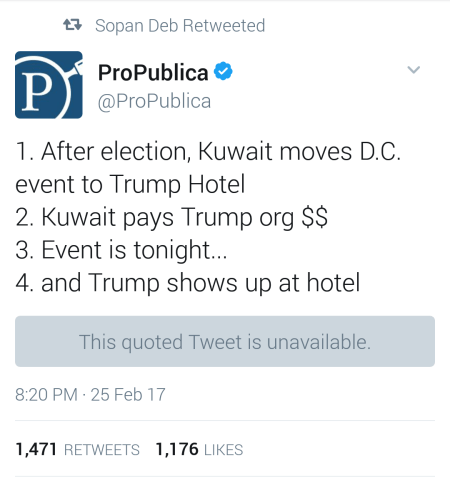
Basic reporting errors by Reuters and NPR resulted in journalists falsely reporting that President Trump attended a foreign diplomat’s party at Trump’s D.C. hotel in what was portrayed as a possible pay-to-play scenario.

NPR and Reuters both reported that Kuwait’s ambassador to the U.S., Salem al-Sabah, was throwing a gala in honor of his country’s independence day at the Trump International Hotel. Reuters definitively placed the event as happening on Saturday, while NPR’s coverage implied the same.

According to Reuters, the event was expected to cost between $40,000 and $60,000. When Trump was spotted at the hotel on Saturday, a number of prominent journalists on Twitter spread the allegation that Trump was appearing at al-Sabah’s party after the ambassador gave Trump tens of thousands of dollars in business.

There’s just one problem — the party took place on Wednesday, not Saturday, hotel staff confirmed to The Daily Caller. But by the time the facts came to light, the media had already widely circulated the false story.

An editor at left-wing website Think Progress, Judd Legum, led the charge in cranking up the rhetoric surrounding Trump’s apparent cameo at his hotel during al-Sabah’s party. “The message is clear to foreign governments,” Legum declared. “Hold your lavish events at my hotel and I might stop by.” Other journalists spread Legum’s claims across Twitter, furthering the false narrative. (Legum has since deleted the tweets, although not before other Twitter users captured screenshots.)

Independent journalism nonprofit ProPublica, which is funded by left-wing financier George Soros’s Open Society Foundations, relied on Legum’s tweets and uncritically spread the false narrative, implying that Trump’s appearance at his hotel Saturday night was related to the money received for the Kuwaiti party. Sopan Deb, a reporter at The New York Times, retweeted ProPublica’s false tweet to his followers.


partytweet

ProPublica later issued a tweet acknowledging the error, although the correction received a fraction of the retweets the original tweet did.

MTV senior political correspondent Ana Marie Cox, who also writes an interview column for the New York Times, sarcastically called “Trump swinging by the Trump hotel during the Kuwaiti gov event” a “big coincidence.” By press time, Cox had neither deleted nor corrected her tweet.

partytweet1

Trump swinging by the Trump hotel during the Kuwaiti gov event is a big coincidence I’m sure Spicy will explain. https://twitter.com/anamariecox/timelines/835674727846928384 

The Washington Post’s White House bureau chief, Phillip Rucker, also spread the false allegations, although he later deleted it and admitted the party took place on Wednesday.

By press time, neither Reuters nor NPR had corrected their stories to indicate that the Kuwaiti event took place on Wednesday.


Off Topic | Wayne Barrett, Donald Trump, and the Death of the American Press

February 23, 2017

Wayne Barrett, Donald Trump, and the Death of the American Press, Tablet MagazineLee Smith, February 23, 2017

(Please see also, Off Topic:  A Purblind Press, Unable To Admit Error, Boycotts the President. — DM)

How did we get from ‘Village Voice’ reporters digging up everything there is to know about a flashy New York real estate salesman to not knowing anything about the President of the United States and his ties to Russia?

So when does the other shoe drop? Who’s going to break the story proving beyond a shadow of a doubt that the president of the United States is so deeply connected to Russian President Vladimir Putin that the White House has become a Muscovite colony in all but name?

Time to use some common sense—it’s not going to happen, there is no story. The narrative that Donald Trump is effectively Putin’s prison wife is an information operation orchestrated by Democratic hands, many of whom served in the Obama administration, sectors of the intelligence community, and much of the American press. The purpose of the campaign is to delegitimize Trump’s presidency by continuing to hit on themes drawn from the narrative that Russia “hacked” the election and stole it away from Clinton.

The narrative is contorted because it’s not journalism. It’s a story that could only make sense in a profoundly corrupted public sphere, one in which, for instance, Graydon Carter is celebrated for speaking truth to power with an editor’s letter critical of Trump in a magazine that has no other ontological ground in the universe except to celebrate power.

Oh, sure, there are regular hints that there’s still more to come on Trump and his staff’s ties to Russia—the big one is about to hit. But the steady sound of drip-drip-drip is the telltale sign of a political campaign, where items are leaked bit by bit to paralyze the target. Journalists, on the other hand, have to get their story out there as quickly, and as fully, as possible because they’re always worried the competition is going to beat them to it.

No, if Trump really was in bed with the Russians, the story would already be out there, and I’m pretty sure it would have had a Wayne Barrett byline.

When I worked at the Village Voice in the mid-1990s, my office was right around the corner from Barrett’s and his bullpen of interns, a team that kept the heat on local politicians like Rudy Giuliani, Ed Koch, and others. Barrett was the first journalist who wrote at length about Trump, starting in the mid-1970s. His biography, Trump: The Deals and the Downfall, was published in 1992, and reissued in 2016 as Trump: The Greatest Show on Earth: The Deals, the Downfall, the Reinvention.

When Trump won the nomination and the pace of Trump stories picked up, Barrett became something of an official archivist, with reporters visiting his Brooklyn house to go through his files in the basement. Anyone who wanted to know what Trump’s deal with Russia was, for instance, would want to talk to Barrett because either he or his team of interns, 40 years’ worth, would have it. After all, New York City is the world capital for information on Russians, even better than Israel—because even though the city got a smaller number of post-Cold War immigrants, New York got a higher percentage of mobsters.

Let’s compare the institution of Wayne Barrett, a subset of the institution of journalism, to the so-called Russia dossier, the document placing Trump in a shady underworld governed by Putin and other Russian thugs. The former includes not only Barrett’s body of work over nearly half a century, but that of the hundreds of journalists he trained, and many thousands of sources whose information is, therefore, able to be cross-checked.

The latter, a congeries of preadolescent pornographic fantasy and spy tales, was authored by a British intelligence officer who has gone to ground since the dossier was made public. The dossier started as work made for hire, first paid for by Republican opponents of Trump and then the Clinton camp, and is sourced to Russian “contacts” who are clearly using the document as an opportunity to proliferate an information operation for perhaps various and as yet unknown purposes. The former is journalism. The latter, part oppo research and part intelligence dump, is garbage. Clearly, it is also the new standard in the field, which is why journalists on both sides of the political spectrum are boasting about their willingness to let their bylines be used as bulletin boards for spy services and call it a “scoop.”

Barrett had Trump on a whole variety of issues, but check the records yourself—up until the day of his death, the day before Trump’s inauguration, there’s nothing on Trump and Putin. Does this mean Trump is totally clean? Who knows? But the journalists now clamoring like maniacs about Trump’s ties sure aren’t going to find it. They’re thin-skinned hacks outraged that Trump dared violate the inherent dignity of that most important of American political institutions, the presidential press conference. And as we all know, this is the apex of real journalism, where esteemed members of the press sit side by side with other masters of the craft to see who gets their question televised.

Does Trump really believe the media are “an enemy of the people”? Please. Let’s remember how he rode his wave to fame on the back of the New York Post’s Page Six (and Graydon Carter’s Spy magazine). He still speaks regularly to the head of CNN (aka “Fake News”), Jeff Zucker, who put him on The Apprentice and Celebrity Apprentice at NBC, where Trump sat atop the Nielsens for 13 years. Trump uses his Twitter feed to boost his replacement Arnold Schwarzenegger’s ratings because the president still has a credit as executive producer. No, Trump, doesn’t hate the media. Like Howard Stern, he sees himself as the king of all media. What he’s doing here is playing gladiator in front of an audience that wants to see the lions slain.

Maybe Trump deserves the heat with the fake Russia stories. He backed the Obama birth certificate story, and what goes around comes around. But the American public sure doesn’t deserve a press like this.

Trump adviser Steve Bannon calls the media the opposition party, but that’s misleading. Everyone knows that the press typically tilts left, and no one is surprised, for instance, that The New York Times has not endorsed a Republican candidate since 1956. But that’s not what we’re seeing now—rather, the media has become an instrument in a campaign of political warfare. What was once an American political institution and a central part of the public sphere became something more like state-owned media used to advance the ruling party’s agenda and bully the opposition into silence. Russia’s RT network, the emir of Qatar’s Al Jazeera network—indeed, all of the Arab press—and media typically furnished by Third World regimes became the American press’ new paradigm; not journalism, but information operation.

How did this happen? It’s not about a few journalists, many of whom still do honor to the profession, or a few papers or networks. It’s a structural issue. Much of it is because of the wounds the media inflicted on itself, but it was also partly due to something like a natural catastrophe that no one could have predicted, or controlled.

***

I was at the Voice when the meteor hit. Like many papers back then, dailies and weeklies, the Voice made its money on classified advertising. The New York Times, for instance, had three important classifieds sections—employment, automotive, and housing—but if New Yorkers really wanted to find a great apartment, they’d line up at the newsstand on 42nd Street to get a copy of the Voice hot off the press.

And then the internet came along, and it was all there in one place—for free. The press panicked. The Voice’s publisher at the time, David Schneiderman, announced to the staff that the paper was going free. It made no sense, he argued, to keep charging $1 for what consumers could get on the internet for nothing.

Here’s how the staff heard it: Who would want to pay $1 a week to read Nat Hentoff on civil liberties, Robert Christgau on music, Michael Musto on New York nightlife—or Wayne Barrett on the follies of real-estate mogul Donald Trump? That is, who would want to pay $1 a week to feel themselves a part of what the Village Voice had made them feel part of for decades? But at the time, devaluing content was in fashion—which meant, as few saw back then, the profession was digging its own grave.

The American press’ new paradigm: not journalism, but information operation.

In midtown, Tina Brown had taken The New Yorker, a notoriously sleepy rag that entry-level assistants stacked in a corner of their studio apartments to spend a rainy Saturday with a 10,000-word Ved Mehta article, and turned it into a hot book that everyone from Bill and Hillary Clinton to Harvey and Bob Weinstein was talking about. “Buzz” was Tina’s catchword, and she made her writers stars. But something else was happening on the business side that wasn’t good for the content providers.

Before Brown, The New Yorker made its money by selling the magazine to readers who wanted to feel like a part of the world only The New Yorker made available, a cozy world reflected by the modest, but very profitable, number of subscriptions, which hovered around 340,000. Advertising was an afterthought. It may have been the only magazine in history at which the business side held ads because there wasn’t space for them, or because, well, Mr. Shawn might not like them.

Condé Nast owner Si Newhouse, who bought The New Yorker in 1985, and publisher Steve Florio turned the business model on its head when Brown came on in 1992. Forget about making readers pay for content; instead, bill advertisers for access to your readers—charge them for eyeballs. They slashed the subscription price dramatically and readership swelled by many hundreds of thousands. This enabled the sales team to bump up ad rates to levels on par with other Condé Nast glossies, essentially fashion catalogs, that enjoyed much larger readerships, like Vogue, GQ, and Glamour.

The paradox was that The New Yorker lost money because each of the new subscriptions was costly. Paper, printing, and postage are expensive, and even the new ad rates couldn’t cover the costs now that circulation had grown to something like 800,000—not monthly like Vogue, but weekly.

Instead of paying for the cost of high-level reporting and editing, subscribers now cost The New Yorker money. In Brown’s last year at the magazine, The New Yorker lost $10 million—a giant black hole that her successor would endeavor mightily to fill while retaining the magazine’s new subscribers, who had little knowledge of or attachment to the magazine’s prior mix of literary reporting and sophisticated whimsy. If the subscribers didn’t feel interested and flattered, the magazine was sunk.

With a new media model that devalued content, no one had a very clear picture of the problems ahead. The future was further obscured by what seemed to be an astonishing reflorescence of the press, with tiny internet startups throwing lavish parties in Manhattan bistros and paying writers Condé Nast-level fees. The internet was the messiah, everything was great—until the IT bubble burst and media giants like TimeWarner stopped throwing money at a platform they didn’t understand. So now who was going to pay?

For the next decade, the media couldn’t decide which slogan of the moment carried more weight—“content is king” or “information wants to be free.” Sure, you can give away “information,” but someone has to find some way to cover expenses, and yet no one had figured out how to make internet advertising work. Maybe you really could charge for content. Of course you could—The New Yorker had done it for decades.

Even if you bring your own glass to a lemonade stand, there is no 8-year-old entrepreneur who is not going to charge you for his product. Why didn’t media grandees get it? When they saw their ad-based business model collapse, why didn’t they do the logical thing and raise the price on consumers? Sure, they’d lose some readers and have to cut some staff and departments, but they’d have established a fundamental defense of the product, the industry, and the institution itself—news is worth paying for.

As the old Chinese saying has it, the first generation builds the business, the second generation expands it, and the third spends it all on Italian shoes, houses in the Hamptons, and divorces. For the most part, the people inheriting these media properties didn’t know what they were doing. It took The New York Times more than a decade to settle on billing consumers for its product—after giving it away, charging for it, giving it away again, then billing for “premium content,” etc. By then, it was too late. Entire papers went under, and even at places that survived, the costliest enterprises, like foreign bureaus and investigative teams, were cut. An entire generation’s worth of expertise, experience, and journalistic ethics evaporated into thin air.

In January, Bannon told the Times that the press doesn’t “understand this country. They still do not understand why Donald Trump is the president of the United States.” But the Times had already acknowledged its blunder in a letter to its readers after the election. However, neither Bannon nor the Times seemed to grasp the logistical reasons for the failure—it wasn’t because the paper of record slants left, or because it was too caught up in its own narrative. It’s in large part because it had long ago cut the regional bureaus in the South, the Midwest, etc., that would’ve forced reporters to speak to Americans outside the urban bubble and thereby explain to readers what the world looks like once you wander off the F train.

By the time two planes brought down the World Trade Center towers in September of 2001, everyone in the industry knew the media was in big trouble. The Iraq War partially hid and then later amplified that fact. The media spent millions it didn’t have for coverage it gave away free of a war that the press first supported and then turned against. If journalists prided themselves on their courageous about-faces, to much of their audience it further discredited a press whose main brief is not to advocate for or against, but to report facts.

This is the media environment that Barack Obama walked into—where Post columnist David Ignatius was no more important a media figure than Zach Galifianakis, on whose precious and often funny internet show Between Two Ferns the president marketed the Affordable Care Act. I suspect the Obama White House was a little sad that the press we’d all grown up with was basically dead. As Ben Rhodes, former national security adviser for strategic communications, told The New York Times Magazine, “I’d prefer a sober, reasoned public debate, after which members of Congress reflect and take a vote. But that’s impossible.”

He was right. What was once known as the prestige media became indistinguishable from the other stuff that Facebook gives away. Was it The New York Times or BuzzFeed that published that video about cats terrorized by cucumbers? Or was it Fake News because, in fact, cats aren’t scared of vegetables? It doesn’t matter where it came from, because there is no longer any hierarchy in the press. The media, as Thomas Friedman might say, is flat.

Obama didn’t kill journalism, but he took advantage of it in its weakness, because he knew the press would do anything to feel relevant again. All those 27-year-olds at the Times, the Washington Post and others hired as bloggers—“who literally know nothing,” as Rhodes told the Times Magazine—when the foreign and national bureaus were closed, they didn’t know it wasn’t OK to be a journalist and a political operative at the same time. They thought it made them more valuable, even patriotic, to put themselves in the service of a historic presidency. And they’d replaced for pennies on the dollar all the adults who could have taught them otherwise.

That’s the raw material out of which the Obama administration built its echo chamber, the purpose of which was to drown out the few remaining vestiges of journalism in order to sell the president’s policies. And there really were real journalists still putting in the hours, still doing the work, but the echo chamber, a relentless, frenzied chorus of incoherent and nearly illiterate prose, shouted them down.

Yes, it would have been nice if the American public had a chance to discuss a policy of vital importance to our national security, like the Iran nuclear deal, but the press congratulated itself for silencing those who dissented from Obama’s signature foreign-policy initiative. These weren’t simply critics or opponents of the White House, they weren’t just wrong; no, they were warmongers, beholden to donors and moneyed interests and lobbies, they were dual loyalists.

But it was all OK for the press to humiliate and threaten Obama’s opponents in accordance with the talking points provided by Obama administration officials—they were helping the president prevent another senseless war. That’s for history to decide. What everyone saw at the time was that the press had put itself in the service of executive power. This was no longer simply tilting left, rather, it was turning an American political institution against the American public.

Now with Trump in the White House, commentators on the right are critical of those angry with the press for calling out Trump on the same stuff that Obama got away with. Let’s be above it, they argue. Just because Obama did it doesn’t make it OK for Trump to do it. Fine, obviously, call out Trump—but this isn’t about playing gotcha. It’s about a self-aggrandizing press corps gaslighting the electorate. The public is astonished and appalled that the media has now returned after an eight-year absence to arrogate to itself the role of conscience of the nation.

It’s not working out very well.

Consider the Washington Post, whose new motto is “Democracy Dies in Darkness,” which presumably was OK’d by owner Jeff Bezos, the man who closed virtually every independent bookstore in America. Here’s a recent story about riots in Sweden:

Just two days after President Trump provoked widespread consternation by seeming to imply, incorrectly, that immigrants had perpetrated a recent spate of violence in Sweden, riots broke out in a predominantly immigrant neighborhood in the northern suburbs of the country’s capital, Stockholm.

You’ve probably never seen the phrase “seeming to imply” in the lede of a story in a major American newspaper before—a news story. So did Trump imply, or seem to imply? How are readers supposed to parse “incorrectly” if the story is about the reality of riots in a place where Trump “seemingly” “implied” there was violence? So what’s the point—that Trump is a racist? Or that Trump can see the future?

The press at present is incapable of reconstituting itself because it lacks the muscle memory to do so. Look at the poor New Yorker. During the eight years of the Obama administration, it was best known not for reported stories, but for providing a rostrum for a man to address the class that revered him as a Caesar. Now that the magazine is cut off from the power that made it relevant, is it any wonder that when it surveys the post-Obama landscape it looks like Rome is burning—or is that the Reichstag in flames?

The Russia story is evidence that top reporters are are still feeding from the same trough—political operatives, intelligence agencies, etc.—because they don’t know how to do anything else, and their editors don’t dare let the competition get out ahead. Why would the Post, for instance, let the Times carve out a bigger market share of the anti-Trump resistance? And what’s the alternative? Report the story honestly? Don’t publish questionably sourced innuendo as news?

And still, you ask, how could the Russia story be nonsense? All the major media outlets are on it. Better to cover yourself—maybe it’s true, because the press can’t really be this inept and corrupt, so there’s got to be something to it.

I say this not only out of respect for a late colleague, but in the hope that journalism may once again merit the trust of the American public. Wayne Barrett had this file for 40 years, and if neither he nor the reporters he trained got this story, it’s not a story.