Newsmax Prime | Raymond Ibrahim and Nonie Darwish discuss the latest US airstrike in Libya, Newsmax TV via You Tube, February 19, 2016
Libya slams US airstrike on Sabratha as flagrant violation of sovereignty
Published time: 20 Feb, 2016 18:03 Edited time: 20 Feb, 2016 21:07
Source: Libya slams US airstrike on Sabratha as flagrant violation of sovereignty — RT News

Libya’s interim government issued a statement saying that it “strongly condemns the airstrikes carried out by the US Air Force at certain positions in the town of Sabratha on Friday morning, February 19, 2016, without any coordination or consultation with the interim Libyan government.”
“Any interference, similar to the one that has taken place, will be considered an open and flagrant violation of the sovereignty of the Libyan state and international law,” the statement said.

The interim government said that it values the foreign assistance it receives in the war on terror, but added that “any military or political interference into Libyan affairs should be performed in a legal way through parliament and the newly formed government.”
In the statement, the government also said it “places the responsibility for the worsening of the domestic economic and social situation, as well as the security situation that contributed to the spread of these organizations (Islamic State) in our country, on the international community.”
The Friday airstrike carried out by the US in western Libya reportedly killed more than 40 people and was hailed as a major success by the Pentagon.
However, two Serbian hostages – embassy communications chief Sladjana Stankovic and her driver Jovica Stepic – also died in the bombardment, which came just as ransom negotiations had gotten underway with the kidnappers.
Serbian Prime Minister Aleksandar Vucic said that Belgrade “demanded explanations from the US about whether they knew that foreigners were present at the site. They said they didn’t.”
Stankovic and Stepic were abducted in the northwestern coastal city of Sabratha on November 8, 2015, when their car was hijacked by gunmen after becoming separated from a convoy carrying Serbia’s ambassador to Libya.
READ MORE: 2 Serbian embassy staff kidnapped by ISIS killed in US bombing in Libya
The circumstances of the two Serbs’ alleged deaths are reminiscent of those of Italian Giovanni Lo Porto and American Warren Weinstein, who were killed by an alleged US drone strike on a Taliban compound in January, 2015.
The US has failed to address the real problems that Libya faces and creates even more problems by carrying out aerial bombardments and “other types of operations” inside Libya, Abayomi Azikiwe, an editor of the Pan-African News Wire, told RT, commenting on the incident.
Libya disaster: Have Western leaders learned anything? Investigative Project on Terrorism via Fox News, Pete Hoekstra, February 19, 2016
(Please see also, Exclusive: Obama Refuses to Hit ISIS’s Libyan Capital. — DM)
That the U.S. has launched airstrikes against ISIS in Libya should demonstrate once and for all the total disaster of the NATO-led adventure to overthrow Muammar al-Qaddafi in 2011.
Libya devolved into a failed state when NATO assisted Qaddafi’s radical jihadist opponents in killing him and then promptly abandoned the country. Left in the wake were two rival governments competing for power, which created space for Islamists to turn Libya into a cesspool of extremism.
Former Secretary of State Hillary Clinton continues to call the debacle American “smart power at its best.” Other presidential candidates still argue that it was the right thing to do.
How will the West ever learn anything if it can’t identify its most obvious failures?
Libya has no central functioning government that can provide security for its citizens. ISIS fights to expand its caliphate along the Mediterranean to points as close as 200 miles from Europe’s vulnerable southern border. It controls Qaddafi’s hometown of Sirte. It has imposed Shariah law in the areas under its control. It exploits Libya as a base to export weapons, jihadists and ideology to Europe, other African countries and the Middle East.
Benghazi and Derna, which have long been hotbeds of radicalism, provided more fighters per capita to Afghanistan and Iraq than nearly any other area in the world. The difference between then and now is that Qaddafi kept the lid on the garbage can long before 2002-2003, when he became a reliable U.S. ally against radical Islam. He changed his behavior, gave up his nuclear weapons program, paid reparations to the victims of his atrocities and provided invaluable intelligence that disrupted numerous Islamist terror plots.
It represented a massive foreign policy success, and the U.S. thanked him by facilitating his murder.
Similarly, the West embraced former Egyptian President Hosni Mubarak in his struggles against Islamist forces, and then it threw him under the bus. Both Qaddafi and Mubarak did everything asked of them, but they ended up dead or in jail.
Any leader would really need to ask why he should trust NATO or the West. Is there any question why Syrian dictator Bashar al-Assad does not negotiate an end to his country’s civil war and clings to Iran and Russia to keep him in power?
Iran cheated on its nuclear program for years. As a result, the U.S. gifted it with more than $100 billion – including $1.7 billion in U.S. taxpayer dollars – and it hasn’t changed its behavior in the slightest. In addition to its military ambitions, Iran will most assuredly spend the money on supporting Assad and its terrorist proxies throughout the Middle East, Africa and, yes, Europe.
I’m amazed by some of the statements now coming from the coalition. The French defense minister is concerned about ISIS fighters blending in with refugees crossing the Mediterranean. Talk about restating the obvious. The British want troops to identify friendly militias in order to avoid targeting them in future airstrikes. Has something changed where we have improved the vetting of “moderate” militia groups?
NATO failed miserably in Libya and in Syria the first time around. What’s different now?
The only official who seems to make any sense is U.S. Secretary of Defense Ash Carter, who said recently, “The Libyans don’t welcome outsiders intruding on their territory.” He was referring to ISIS, but he might as well have been talking about the West. Libyans have not forgotten that NATO all but vanished once Qaddafi was killed.
Western foreign policy is in disarray. The scariest part is that supposed leaders don’t even know it, and therefore they can’t admit to previous mistakes. Allies that brought stability to the region are gone. Former and current antagonists benefited from Western incompetence.
Who would have predicted six years ago that those rulers battling Islamist terror would be deposed and that those committing it would become the West’s new friends?
NATO snatched defeat from the jaws of victory in Libya. Refugees flood Europe. Terrorist attacks continue to spread geographically and in lethality. The Syrian civil war rages on. Iran lavishes its newfound wealth on its nuclear program and campaign of global terror.
Is it any wonder that citizens in Western countries are frustrated and angry with those in positions of authority?
Exclusive: Obama Refuses to Hit ISIS’s Libyan Capital, Daily Beast, Nancy A. Youssef, February 18, 2016
(Please see also, ISIS Leader Moves to Libya. — DM)

Despite the growing threat from the self-proclaimed Islamic State in Libya, the Obama administration has turned down a U.S. military plan for an assault on ISIS’s regional hub there, three defense officials told The Daily Beast.
In recent weeks, the U.S. military—led by its Africa and Special Operations Commands—have pushed for more airstrikes and the deployment of elite troops, particularly in the city of Sirte. The hometown of former Libyan leader Muammar Gaddafi, the city is now under ISIS control and serving as a regional epicenter for the terror group.
The airstrikes would target ISIS resources while a small band of Special Operations Forces would train Libyans to eventually be members of a national army, the officials said.
Weeks ago, defense officials told The New York Times that they were crafting military plans for such strikes, but needed more time to develop intelligence so that they could launch a sustained air campaign on ISIS in Sirte.
But those plans have since been put on the back burner.
“There is little to no appetite for that in this administration,” one defense official explained.
Instead, the U.S. will continue to do occasional strikes that target high-value leaders, like the November drone strike that killed Abu Nabil al-Anbari, the then-leader of ISIS in Libya.
“There’s nothing close to happening in terms of a major military operation. It will continue to be strikes like the kind we saw in November against Abu Nabil,” a second defense official explained to The Daily Beast.
The division over what action the U.S. and the international community should take in Libya speaks to the uncertainty about when and where ISIS should be countered.
For Europe, Libya is uncomfortably close and already a jumping off point for migrants willing to take on the rough Mediterranean waters in search of asylum. ISIS pronouncements have previously pointed out that Rome is nearby.
For the United States, there are major concerns about allowing another ISIS hub to emerge in the region. The Libyan city of Sirte is under ISIS control and some believe the terror group seeks to turn Sirte into a center of operations, like Raqqa in Syria and Mosul in Iraq.
Leaders across Europe have hinted that more should be done in Libya but have fallen short on specifics. In an interview with Der Spiegel last month, the German envoy to Libya said: “We simply cannot give up on Libya.”
According to U.S. military figures, there are roughly 5,000 ISIS fighters in Libya, a spike from 1,000 just a few months ago. Defense officials believe that ISIS supporters are moving toward Libya, having found it increasingly difficult to travel to Iraq and Syria.
Perhaps because of that, Sirte, and areas around it, are increasingly falling victim to ISIS’s barbaric practices. And some are urging the international community not to wait until Sirte falls further under ISIS control, and filled with fighters mixed in with civilians.
According to this report, residents there cannot leave the city freely as ISIS fighters—many of them from Egypt, Chad, Niger, and Tunisia—inspect cars for signs of residents trying to escape. As in Raqqa and Mosul, residents do not have access to cellphone or Internet networks and live under an ISIS judicial system that issues death sentences to those who do not practice the terror group’s brand of Islam.
Moreover, in nearby cities like Ras Lanouf, ISIS is destroying oil installations, cutting off a key potential source of revenue for any newly cobbled unified Libyan government. ISIS has set its sights across the country, from Misrata in the west to Derna in the east.
Some fear the terror group is hunkering down in places like Sirte in preparation for a potential U.S. offensive.
The administration had said that it would not intervene until Libya, which now is governed by two rival governments on opposite sides of the country, had created a single entity to govern the state.
At a press conference Tuesday, during this year’s summit of the Association of Southeast Asian Nations, President Obama referred to United Nations efforts to help build a government in Libya, suggesting any military effort could create even more political fractures. On Sunday, a member of Libya’s Presidential Council announced that a list of 13 ministers and five ministers of state had been sent to Libya’s eastern parliament for approval.
But while the president said the U.S. would go after ISIS “anywhere it appeared,” he stopped short of saying the U.S. would expand its effort in Libya unilaterally.
“We will continue to take actions where we’ve got a clear operation and a clear target in mind. And we are working with our other coalition partners to make sure that as we see opportunities to prevent ISIS from digging in, in Libya, we take them. At the same time, we’re working diligently with the United Nations to try to get a government in place in Libya,” the president said. “And that’s been a problem.”
Some military officials believe Obama feels that France and Italy, which both have hinted at intervention, should take the lead on any military effort. Both countries were key to the NATO-led campaign in 2011 that led to Gaddafi’s fall. Still others believe the United States wants to limit its war against the Islamic State to Iraq and Syria.
Since Gaddafi’s death in October 2011, the state has become especially susceptible to outside extremists. With no tradition of an independently strong state military, militias have served as security forces and now are unwilling to disarm.
With no stable government or security forces, parts of Libya have become vulnerable to groups like ISIS looking for territory to set up a self-described caliphate.
As many as 435,000 of the country’s 6 million people are internally displaced, according a recent UN report. An estimated 1.9 million require some kind of humanitarian aid. And as of August, 250,000 migrants had entered, turning Libya into a key hub for those seeking to enter Europe.
Tuesday marked the five-year anniversary of Libya’s Arab Spring. It’s now considered a bittersweet day, rather than the beginning of a democratic movement the protests launched that day once promised.
‘Operation Sophia’: WikiLeaks releases classified data on EU military op against refugee flows
Published time: 17 Feb, 2016 12:07 Edited time: 17 Feb, 2016 13:17

The leaked report, dated January 29, 2016, is written by the operation’s commander, Rear Admiral Enrico Credendino of the Italian Navy, for the European Union Military Committee and the Political and Security Committee of the EU.
The document gives refugee flow statistics and details of performed and planned operation phases of the joint EU forces operating in the Mediterranean.
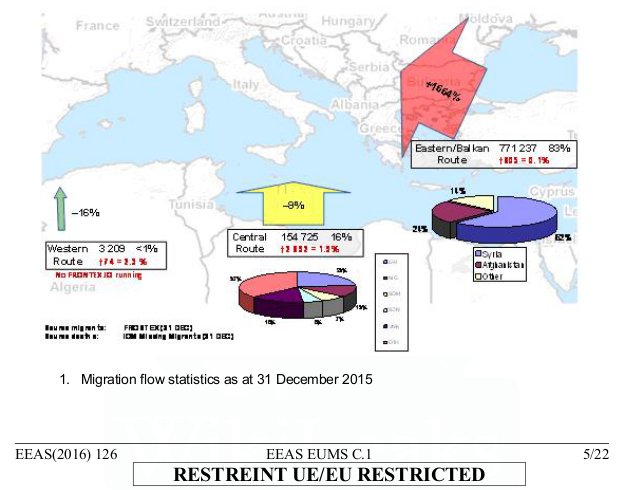
RELEASE: Operation Sophia – classified report on EU military ops against #refugee flows https://wikileaks.org/eu-military-refugees/ …
The report also places pressure on the responsible EU bodies to help speed up the process of forming a “reliable” government in Libya, which is expected to invite EU forces to operate within its territorial waters, and later give permission to extend EU military operations onshore.
“Through the capability and capacity building of the Libyan Navy and Coastguard we will be able to give the Libyan authorities something in exchange for their cooperation in tackling the irregular migration issue. This collaboration could represent one of the elements of the EU comprehensive approach to help secure their invitation to operate inside their territory during Phase 2 activities,” the document states.
Admiral Credendino writes that the task force is ready to proceed to phase 2B despite political and legal challenges:
“…We are ready to move to phase 2B (Territorial Waters) where we can make a more significant impact on the smuggler and traffickers business model.”
“However, in order to move into the following phases we need to have a government of national accord with which to engage.”
“A suitable legal finish is absolutely fundamental to the transition to phase 2B (Territorial Waters) as without this, we cannot be effective.”
“Central to this and to the whole transition to phase 2B, is an agreement with the Libyan authorities. Ultimately they have the casting vote on the legal finish which will in turn drive the transition to phase 2B and the appetite for Member States to provide assets. As a European Union, we must therefore apply diplomatic pressure appropriately to deliver the correct outcome,” the document states.
The leak comes less than five months after it was reported that Operation Sophia would consist of 22 member states and 1,300 personnel which would board and seize suspect vessels in the Mediterranean.
However, the document notes that when the operation progresses into phases 2B and 3, “the smugglers will again most likely adapt quickly to the changing situation. The primary concern for smugglers will likely remain to avoid being apprehended so they can continue their illegal activities.”
The operation’s objective is primarily to disrupt smuggling routes by human traffickers, rather than to stop migration flows, according to the European Union Institute for Security Studies, which wrote in a document that the operation began on July 27, 2015.
The Institute noted, however, that there is a “real uncertainty on whether the operation will ever be able – for either legal or political reasons – to get to the core of its mandate, i.e. neutralising the smuggling networks through deterrence or open coercion, both off the Libyan coast and onshore.”
It went on to note that regardless of the operation’s support for EU member states, only “a very few” are likely to “have the skills and experience for such missions, let alone the will.”
It also stressed that the operation cannot be a “solution” to the refugee crisis, and that “no one in Brussels is contending that it could.”
The document’s release comes as Europe continues to face the worst refugee crisis since World War II, with the numbers of new arrivals expected to grow this year.
ISIS Leader Moves to Libya, Investigative Project on Terrorism, Pete Hoekstra, February 16, 2016
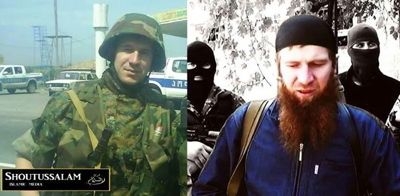 Shishani as a Georgian special forces soldier and as an ISIS leader.
The barbaric and elusive Chechen commander who recruited British executioner “Jihadi John” has moved to Sirte, Libya to assume control of ISIS operations in the terrorist organization’s metastasizing Mediterranean caliphate.
The Investigative Project on Terrorism first learned about the movement of Abu Omar al-Shishani – among the world’s most-wanted terrorists – through its exclusive Middle East sources. Other news organizations later confirmed the account.
Al-Shishani is a former American-trained officer in the Georgian special forces. He developed a reputation for his ferocity and effectiveness while fighting against the Russians during the 2008 invasion of Georgia and later for ISIS against dictator Bashar al-Assad in Syria.
He established his presence not long after arriving in former dictator Muammar Gaddafi’s hometown Sirte by ordering one execution and chopping the limbs off another individual.
Western intelligence officials believe that up to 6,500 ISIS fighters – twice the number previously thought – have relocated to Libya as a result of coalition airstrikes on ISIS in the Middle East and new difficulties entering Syria.
Libya’s emergence as an ideal location in which to foster its new caliphate arose after NATO assisted radical jihadists in killing Gaddafi in 2011 and abruptly abandoned the country. Left in its wake were two rival governments competing for power, which created space for Islamists to turn Libya into a cesspool of extremism.
ISIS’s new caliphate along the Mediterranean coastline reaches as close as 200 miles from the vulnerable southern border of Europe. It exploits Libya as a base to export weapons, jihadists and ideology to Europe, Africa and the Middle East.
Benghazi and Derna have long been nests of radicalism. They provided more fighters per capita to Afghanistan and Iraq than nearly any other geographic area in the world. The difference between then and now is that Gaddafi kept the lid on the garbage can.
With al-Shishani hanging his hat in Sirte, Libya has become a safe haven for one of the most murderous leaders in the world today. The situation demonstrates the total failure of a Western foreign policy that “leads from behind.”
Report: Islamic State, Al-Qaida, Muslim Brotherhood Discuss ‘Mega-Merger’ in Libya, Breitbart, Aaron Klein and Ali Waked, January 25, 2016
(Here’s a video of an interview with Islamic reformist Dr. Zuhdi Jasser about the current situation in Libya. H/t Counter Jihad Report.
— DM)

TEL AVIV – The Libyan branches of the Islamic State, Al-Qaida, and the Muslim Brotherhood are in discussions to complete a “mega merger,” the London-based A Sharq al Awsat newspaper reported.
Leaked documents have revealed that Libya’s biggest Islamist organizations are considering an alliance and the establishment of a joint council of sages, the Arabic language daily reported.
The prospective move comes in the wake of reports of an imminent international effort to form a unity government that would bring Libya’s numerous parties and militias together.
The paper said the Muslim Brotherhood is considering a united Islamic front even though the movement is officially in favor of forming a unity government. However, sources within the movement told the paper that their support for the international endeavor is merely tactical, and they’re waiting for it to collapse.
Negotiations between the three Islamic groups began because of reports of a rapprochement between the internationally recognized government based in Tobruk and the unrecognized government in the capital Tripoli, the paper said.
The groups wish to send a message to the forces coalescing around a unity government that they are not opposed by IS alone, but “all the Islamist opposition elements speak in one voice and should be treated as such,” a source said.
According to the documents, Muslim Brotherhood leaders said that Egyptian President Abdel Fatah al-Sisi’s regime “isn’t supported by the Americans because of his close relations with Russia. They can’t wait to see him leave the scene.”
The parties agreed to form a joint Shura (advisory) council and territories that are currently under Islamic control will be divided between them, echoing a similar agreement that is already underway in Benghazi.
Al-Qaida’s representative was quoted as saying that the move would inspire Islamists in Algeria and Egypt to follow suit.
This follows Breitbart Jerusalem’s own exclusive reporting on mediation efforts between the Muslim Brotherhood-aligned Hamas in Gaza and Salafists aligned with the Islamic State.
Breitbart Jerusalem previously reported that Shadi al-Menai, one of the leaders of Wilayat Sinai, the Islamic State branch in Sinai, visited Gaza in a bid to mediate between Hamas and local Salafi groups after clashes erupted, resulting in the arrests of dozens of jihadists by Hamas forces.
Earlier this month, a leading Salafi source revealed that Menai mediated a deal whereby Hamas would give the Gaza Salafi opposition groups more leeway in exchange for Wilayat Sinai’s help in bypassing the Egyptian army’s restrictions on smuggling rocket parts into Gaza
This is not the first report of Hamas-IS cooperation in arms smuggling.
A Middle East think tank charged last month that there is information Hamas has been paying off the Islamic State’s Sinai branch to smuggle weapons into Gaza. “Over the past two years, IS Sinai helped Hamas move weapons from Iran and Libya through the peninsula, taking a generous cut from each shipment,” stated a report by the Washington Institute for Near East Policy.
Despite the rapprochement between Hamas and IS-Sinai, tensions between the ruling faction and Salafi opposition groups in Gaza are rampant.
The Army of Islam, a Salafi group that aspires to become IS’s sole representative in Palestine, recently released an acerbic video in which it blames Hamas for straying from Sharia law and cooperating with anti-Islamic players, including Shi’ite Iran.
US-Russian marines set up bridgehead in E. Libya for campaign against ISIS, DEBKAfile, January 23, 2016

President Barack Obama resolved earlier this month, much to the surprise of Washington insiders, to open a third anti-terror front in Libya to eradicate the Islamic Front’s tightening grip on the country.
This top-secret decision was first revealed by DEBKA Weekly 692 on Jan. 1.
While collaborating with Russia in the Syrian arena, and with the Iranians and the Iraqi army and Sunnis in Iraq, Obama took his close aides by surprise by another decision – to lead the Libya campaign again in conjunction with Russia, as well as with concerned Western Europe allies.
The first step in this campaign took place this weekend: A group of US, Russian, French and Italian Special Forces quietly landed at a point south of Tobruk near the Libyan-Egyptian frontier. Standing by after preparing the ground were some 1,000 British SAS troops.
The landing area is located some 144 kilometers from Darnah, the main bastion of extremist Libyan Islamic groups linked to Al Qaeda or ISIS, of which the ultra-violent Ansar al Sharia is the most powerful.
The joint US-Russian war offensive building up in Libya, the first such collaboration in many decades, may be seen as an extension of their expanding military partnership in Syria, DEBKAfile’s military sources report.
Preparations for the campaign were assigned to two special operational commands set up at the Pentagon and at the US Central Command, CENTCOM, in Tampa, Florida.
According to the scenario sketched in advance by DEBKA Weekly, large-scale US air, naval and ground units are to spearhead the new coalition’s combined assault on the main Libyan redoubts of ISIS, Al Qaeda, Ansar al-Sharia and other radical Islamist organizations. Cruise missiles strikes will blast them from US, British, French and Italian warships on the Mediterranean.
At the peak of the assault, large-scale US, British and French marines will land on shore for an operation first billed as the largest allied war landing since the 1952 Korean War. The attachment of Russian forces was negotiated later.
According to this scenario, one group will be dropped ashore from the Gulf of Sidra (see attached map) to seize the town of Sirte, a city of 50,000, where ISIS has located its central military command center in Libya.
This group will then split up into two task forces.
One will head south to take over Tripoli and its oil fields 370 kilometers away and reinstate Libya’s central government, which had been exiled to Tobruk, at its seat in the capital.
On its way to Tripoli, the force will take control of three renegade towns: Misrata, Zliten and Khoms.
The second task force will head north to capture the eastern Libyan capital of Benghazi, seizing Ras Lanuf, 200 kilometers east of Sirte, en route. A second marine force will meanwhile land in eastern Libya to capture the radical Islamist stronghold of Darnah, a port city with 150,000 inhabitants.
The Obama administration will therefore be going into Libya for the second time in four years – only this time up front and on the ground – for three objectives:
1. Control of Libya’s oil and gas fields.
2. Stripping ISIS of its jumping-off base for terrorizing Europe, especially Italy, from across the Mediterranean.
3. Saving Tunisia, Algeria and Morocco from the noose ISIS and Al Qaeda are pulling around them from their back yard.
The scenario was first published in DEBKA Weekly 692 (for subscribers) on Jan. 1, 2016
January 22, 2016 at 5:00 am
Source: Libya’s Chaos: Threat to the West
In 2011 when Libya’s former ruler, Muammar Gaddafi, was murdered by the mob of militiamen, many people believed it was the beginning of a new, free, democratic country. Libya, however, did not become free or democratic. Instead, it became fractured, violent, tribal and divided. Rather than starting a new life, Libya was sliding slowly toward some sort of hell.
Over the years, as violence became a daily casual occurrence, Libya almost became synonymous in the news with disorder, and on its way to becoming yet another failed stated, like Somalia.
In spite of that, hope emerged anew with the attempt of the United Nations to negotiate a national agreement through UNMSIL (United Nations Support Mission in Libya).
In its Resolution 2144 (March 14, 2014), article 6, the UN Security Council tasked the UNMSIL to support Libyan government efforts to:
Subsequently, on December 17, 2015, under the leadership of UNMSIL, the different protagonists of the Libyan crisis reached a historic agreement in the Moroccan city of Skhirat.
The agreement did not mean the end of the turmoil in Libya: there are still a lot of splinter groups that are not a part of the accord. They have both the means and the will to stand in the way of peace. There is also the lethal Islamic State (ISIS), present throughout the country with proxy organizations, ready to step in, and for which agreements mean nothing.
Martin Kobler, the Special Representative of the Secretary General of the UN and head of UNMSIL, made it clear that:
“Urgent solutions must be found to bolster the Libyan-led fight against terrorism and in particular the threat of Daesh [ISIS]. The dire humanitarian situation in Benghazi and other areas needs to be addressed as a matter of highest priority, including through the establishment of a dedicated reconstruction fund for Benghazi. The concerns of the Eastern and Southern constituencies should be brought to the forefront. This work must start immediately. The signing of the Libyan Political Agreement is the first step on the path of building a democratic Libyan state based on the principles of human rights and the rule of law.”
No sooner was the agreement concluded than, unsurprisingly, the answer “No” came both from the uninvited marginal groups, as well as ISIS.
When a truck bomb was detonated, leaving 65 people dead, on January 7, 2016 outside a police training center in the western city of Zliten, the message was clear: there will be no peace. No group took credit for the attack.
Libya is divided by tribalism. Many of the armed groups that represent the various tribes of the country could not care less about national unity: they would only lose wealth and power to the increased dominance of the federal government. As a result, they would become insignificant and die out. As long as Libya is in chaos, it benefits them to bear arms.
Other Libyans seem to favor the “Caliphate solution.” Hard-core Islamists want a strict and radical Islam to prevail in the Muslim world through the re-Islamization of society. They believe that by countering the influence of the West, Islam can once again become the most important influence on the international scene and regain its long-lost, Golden Age prominence. They aim to make clear that any UN-brokered accord is a Western-imposed subterfuge to halt the inexorable advance of glorious Islam.
From the time of the Ottoman Empire until the overthrow of Gaddafi, Libya was ruled by heavily-centralized governments that delegated minimal power to the regions. This tight rule insured peace and stability to both the people and to the state. Tribes existed, but had only an honorific role and a cultural existence, no more than that. They were used, at times, as auxiliaries to strengthen the power of the state and, in return, were given economic grants.
When Gaddafi toppled King Idris Senussi in 1969, he consolidated the state and made it all-prominent. He subdued the population through generous cash handouts and a wide array of economic concessions. The population did not have to work; if some did, they held senior positions that did not require great effort. This way, Gaddafi guaranteed to himself total control of the state and the legitimacy of “the Revolution” to get rid of recalcitrant or groups or individuals — as he expeditiously did.
In the aftermath of the “Arab Spring” of 2011 and the ensuing uprising of the Cyrenaica region against the rule of Gaddafi, NATO sided with the revolutionaries of Benghazi to topple him. However, NATO conducted its war operations from the skies, and never fielded any ground forces. In a March 2015 article in Foreign Policy, Ethan Chorin wrote:
“The current situation in Libya is the product of a series of significant mistakes, erroneous assumptions, and myths that date back to NATO intervention in 2011. The United States and its NATO allies made a fundamental mistake in not imposing a robust reconstruction plan on Libya and stabilizing the country before radicalism was able to flourish. Even U.S. President Barack Obama understands that this was a mistake: In an interview last year with the New York Times, he cited lack of a plan for “the day after Qaddafi is gone” as potentially one of his biggest foreign-policy regrets. (The Libyans, of course, share much of the blame too.)”
As Gaddafi’s forces withdrew from various regions, religious and tribal groups moved in and helped themselves to the huge arsenals left behind. With that came the temptation to rule and have access to a share of oil reserves. At the fall of Ghaddafi in October 2011, there were over 300 armed groups, all dreaming of leadership and control.
In May 2014, Libyan General Khalifa Haftar, with support from the U.S., Egypt, UAE and Saudi Arabia, led an army from the east to rid the country of the powerful Islamist groups. His secular-oriented movement, dubbed “Operation Dignity,” in spite of a few limited successes, soon faltered miserably.
In reaction to the establishment of Haftar’s movement, the Islamists, supported by Turkey and Qatar, put together their own front, Fajr Libya (“Libya Dawn”), on July 13, 2014. The declared aim of Fajr Libya was to correct the direction of the revolution and set up a stable government; the undeclared objective was to turn Libya into an Islamist country. Fajr Libya was made up of several Islamist militias, all dreaming of power, wealth and religious consecration:
The Fajr Libya front was, in addition, allied to a large group of heavily armed brigades, each controlling one tribe or region and reflecting the disintegration of Libya into small emirates reminiscent of the taifas in Arab Spain.[1]
During the era of the Barbary pirates, which lasted from the 16th to the 19th century, North Africa developed a taste for piracy, under the religious justification of Jihad al-Bahr (“jihad at sea”) that protected the Dar al-Islam (“domain of Islam”) from the Dar al-Kufr (“domain of infidels”). This religious justification became especially prominent after the fall of Grenada in 1492, and the ensuing efforts to reconquer al-Andalus (Spain) from the Christians. The Barbary pirates’ raids meant easy gains of goods and slaves.
Today, the tribal piracy instinct again seems strong, for various reasons. Among them are:
Many of the Libyan groups and warlords therefore see a national reconciliation as a threat to their power and lucrative business. Many believe that with the Zliten terrorist attack of January 7, the warlords were sending a message to Libyan politicians that their political agreement would not go farther than Skhirat, the Moroccan city where it was signed.
ISIS badly needs Libya for its operations in North Africa: to spread its paramilitary brigades, to organize its terrorist networks and, most importantly, to prepare its political pawns, after the chaos, to take power.
Its taking control of North Africa, the soft underbelly of Europe, would amount to getting ready to recapture, by terror and force, al-Andalus from the Catholic Christians of Spain.
In his Foreign Policy article, Chorin notes that,
“Over the last four years, Libya has become a key node in the expansion of Islamic radicalism across North Africa, West Africa, across the Sahel, and into Europe. Arms and fighters have crossed Libya’s porous borders, feeding radical organizations from al Qaeda in the Islamic Maghreb to Boko Haram and reinforcing radical trends in the heart of the Middle East. If events in Libya continue on their current path, they will likely haunt the United States and its Western allies for a decade or more.”
If Libya is not stabilized in the near future, the whole world will regret it.
Stabilizing Libya would undoubtedly help to fight religious radicalism in West Africa; cut the lifeline of the lethal Boko Haram, active in the whole of West Africa; and impede al-Qaeda, which is threatening the Sahel countries of Burkina Faso, Mali and Niger.
To insure peace and stability for Libya, the UN’s Skhirat Agreement recommended strengthening UNMSIL to be a peace-keeping force. This peace-keeping force must be of, at least, 10,000 elite soldiers with heavy equipment and NATO air support to undertake the pacification of the country, with obviously the help of government forces sympathetic to the Skhirat accord.
This peace-keeping force could be made of the following countries: Spain, Italy, Morocco, Egypt, Jordan, Turkey, Pakistan and Senegal. The problem with any UN peacekeeping force, as seen, for example, with UNIFIL in South Lebanon, is that when the first shot is fired, they run. There also seems to be a tendency among peacekeepers, especially in Africa, to trade food for sex with children.
The Skhirat Agreement recommended the following actions be implemented as soon as possible. This is what the participants agreed to, but all they seem to do is underscore the sanctimonious grandiosity of the UN:
1 – Disarm militias:
Disarm all paramilitary groups by persuasion, incentive or sheer force and make, by law, bearing arms strictly illegal;
Comment: Who should do that?
2 – Train a national army and a police force:
Offer the militias the possibility to integrate the army and police force and be under the rule of law.
Comment: Why would the militias prefer that to having their own familiar honey-pot?
3 – Undertake a cultural study:
There is an urgent necessity to understand the social and cultural make-up of the Libyan society. The Amazigh and Tuareg people must be granted unconditionally their cultural rights.
Comment: Is anyone expecting the warrior tribesmen willingly to go along with that?
4 – Adopt a federal system of government:
Probably the best government system that could befit the numerous needs and the varied wishes and hopes of the Libyan population in political, cultural and religious terms is undeniably the federal system, with which tribal groupings, cultural minorities and religious lodges can, eventually, all identify.
Comment: ISIS and the other groups would probably fight this to the death.
5 – Help the country set up an open and competitive economy:
International economic institutions will need to help Libya restructure its economy, especially now that the price of oil has fallen steeply. Libya is and has always being an oil-producing country where most of the natives never worked.
Comment: This is the problem of so many oil-producing countries in which whoever is in charge does not want to share the spoils.
The problem always seems to be: Who should be doing the hard and dangerous work — the boots on the ground to mop up.
Libya is on the verge of implosion. The Skhirat Agreement, with its good intentions, is not enough. If the armed groups are left on the loose, Libya will effectively be the newest failed state. At present, Libya is a lethal danger to Europe, Africa and the Middle East.
 The Skhirat Agreement (left), with its good intentions, is not enough to save Libya from Islamist militias such as Fajr Libya (right). The Skhirat Agreement (left), with its good intentions, is not enough to save Libya from Islamist militias such as Fajr Libya (right). |
Dr. Mohamed Chtatou, an author, is a Professor at the University of Mohammed V in Rabat. He is currently a political analyst with Moroccan, Saudi and British media on politics and culture in the Middle East and Islam.
[1] First Taifa period (1009–1106), second Taifa period (1140–1203) and third Taifa period (1232–1287).
Benghazi Commission: Obama Admin Gun-Running Scheme Armed Islamic State, Breitbart, Edwin Mora, November 30, 2015
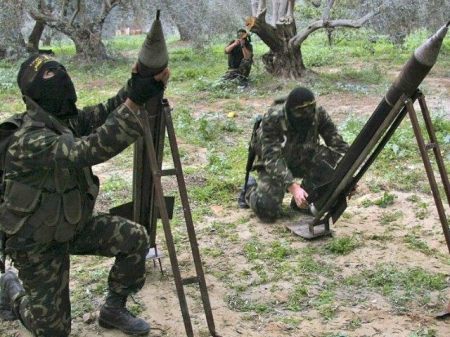
To avoid having the funds tracked back to the Obama administration, the arms flow to Libya was financed thru the United Arab Emirates, while Qatar served as the logistical and shipping hub, she noted.
****************************
The Obama administration pursued a policy in Libya back in 2011 that ultimately allowed guns to walk into the hands of jihadists linked to the Islamic State (ISIS/ISIL) and al-Qaeda (AQ) in Syria, according to a former CIA officer who co-authored a report on behalf of the Citizen’s Commission on Benghazi (CCB), detailing the gun running scheme.
In Congress, the then-bipartisan group known as the “Gang of Eight,” at a minimum, knew of the operation to aid and abet America’s jihadist enemies by providing them with material support. So says Clare Lopez, a former CIA officer and the primary author of CCB’s interim report, titled How America Switched Sides in the War on Terror, speaking with Breitbart News.
The ripple effects of the illegal policy to arm America’s enemies continue to be felt as the U.S. military is currently leading a war against ISIS and AQ terrorists in Iraq and Syria, according to Lopez.
In late October, Defense Secretary Ash Carter said that the U.S. would begin “direct action on the ground” against ISIS terrorists in Iraq and Syria who may have reaped the benefits from the gun-running scheme that started in Libya.
“The Obama administration effectively switched sides in what used to be called the Global War on Terror [GWOT] when it decided to overthrow the sovereign government of our Libyan ally, Muammar Qaddafi, who’d been helping in the fight against al-Qaeda, by actually teaming up with and facilitating gun-running to Libyan al-Qaeda and Muslim Brotherhood [MB] elements there in 2011,” explained Lopez. “This U.S. gun-running policy in 2011 during the Libyan revolution was directed by [then] Secretary of State Hillary Clinton and [the late Libya Ambassador] Christopher Stevens, who was her official envoy to the Libyan AQ rebels.”
To avoid having the funds tracked back to the Obama administration, the arms flow to Libya was financed thru the United Arab Emirates, while Qatar served as the logistical and shipping hub, she noted.
“In 2012, the gun-running into Libya turned around and began to flow outward, from Benghazi to the AQ-and-MB-dominated rebels in Syria,” Lopez added. “This time, it was the CIA Base of Operations that was in charge of collecting up and shipping out [surface-to-air missiles] SAMs from Libya on Libyan ships to Turkey for overland delivery to a variety of jihadist militias, some of whose members later coalesced into groups like Jabhat al-Nusra and ISIS [also known as IS].”
Jabhat al-Nusra is al-Qaeda’s Syrian affiliate.
“The downstream consequences of Obama White House decisions in the Syrian conflict are still playing out, but certainly the U.S. – and particularly CIA – support of identifiable jihadist groups associated with the Muslim Brotherhood, Jabhat al-Nusra, Ahrar al-Sham, the Islamic State and other [jihadists] has only exacerbated what was already a devastating situation,” declared Lopez.
Some of the other weapons that eventually ended up in Syria included thousands of MAN-Portable-Air-Defense-System (MANPADS) missile units, such as shoulder-launched SAMs, from late dictator Muammar Qaddafi’s extensive arms stockpiles that pose a threat to low-flying aircraft, especially helicopters.
“It’s been reported that President Obama signed an Executive Order on Syria in early 2012 [just as he had done for Libya in early 2011], that legally covered the CIA and other U.S. agencies that otherwise would have been in violation of aiding and abetting the enemy in time of war and providing material support to terrorism,” notes Lopez. “Still, such blatant disregard for U.S. national security can only be described as deeply corrosive of core American principles.”
Libya Amb. Stevens was killed by jihadists in Benghazi on September 11, 2012, along with three other Americans.
Echoing a Benghazi resident who provided a first-hand account of the incident, retired U.S. Air Force Lt. Col. Dennis Haney, a CCB member, suggested to Breitbart News that Hillary Clinton’s State Department armed some of the al-Qaeda linked jihadists who may have killed the four Americans in Benghazi.
“The reason the U.S. government was operating in Libya is absolutely critical to this debacle because it reflects where America went off the tracks and literally switched sides in the GWOT,” points out Lopez. “This is about who we are as a country, as a people — where we are going with this Republic of ours.”
“There can be no greater treason than aiding and abetting the jihadist enemy in time of war – or providing material – weapons, funding, intel, NATO bombing – support to terrorism,” she continued. “The reason Benghazi is not the burning issue it ought to be is because so many at top levels of U.S. government were implicated in wrong-doing: White House, Pentagon, Intel Community-CIA, Gang of Eight, at a minimum, in Congress, the Department of State, etc.”
The State Department and the CIA did not respond to Breitbart News’ requests for comment.
Clinton was asked about the gun running operation when testifying before the House Select Committee on Benghazi in October.
The Democratic presidential frontrunner claimed she was not aware of any U.S. government efforts to arm jihadists in Libya and Syria.
Clinton did admit to being open to the idea of using private security experts to arm the Qaddafi opposition, which included al-Qaeda elements, but added that it was “not considered seriously.”
Members of the 2011 “Gang of Eight” mentioned in this report included: then-House Speaker Rep. John Boehner (R-OH), House Minority Leader Rep. Nancy Pelosi (D-CA), then-Rep. Mike Rogers (R-AL), (R-MI), Rep. Dutch Ruppersberger (D-MD), then-Sen. Majority Leader Sen. Harry Reid (D-NV), then-Sen. Minority Leader Sen. Mitch McConnell (R-KY), Sen. Dianne Feinstein (D-CA), and Sen. Saxby Chambliss (R-GA).




 anneinpt
 artaxes
 danmillerinpanama
 davidking1530
 Peter Hofman
 Joseph Wouk
 Peter
Peter Louisiana Steve
 WarSclerotic
Recent Comments