Posted tagged ‘Lebanon’

The Iran-Hamas-Hezbollah Connection

November 8, 2017

The Iran-Hamas-Hezbollah Connection, Gatestone InstituteKhaled Abu Toameh, November 8, 2017

Hamas has already stated repeatedly that it has absolutely no intention of laying down its weapons as promised for the “reconciliation” agreement with the Palestinian Authority.

****************************

Now that the Iranians have sole control over Lebanon, their eyes are set on the Gaza Strip.

Hamas, for its part, is thirsting for Iranian resources. Hamas knows that it will have to pay a price.

Iran and Hezbollah are working with Hamas to establish a “joint front” against Israel.

The Lebanese Prime Minister, Saad Hariri, has had enough. Last week, Iran finalized its takeover of Lebanon when Hariri resigned, and reportedly fled to Saudi Arabia.

Hariri, denouncing Hezbollah and its Iranian backers, said he feared for his life. Hariri has good reason to be afraid of Hezbollah, the powerful Shia terror group and Iranian proxy that effectively controls Lebanon.

Indications show that Iran and Hezbollah are also planning to extend their control to the Gaza Strip. Iran already provides Hamas with financial and military aid. It is precisely the support of Iran that has enabled Hamas to hold in power in the Gaza Strip for the past 10 years. It is also thanks to Iran that Hamas and Palestinian Islamic Jihad, another major terror group in the Gaza Strip, are in possession of thousands of missiles and rockets. It is Iranian money that allows Hamas and Palestinian Islamic Jihad to continue digging terror tunnels under the border with Israel.

Relations between Iran and Hamas have grown stronger in the past few weeks. Last month, a senior Hamas delegation visited Tehran to attend the funeral of the father of the senior Iranian security official, Qasem Soleimani. A few weeks earlier, another senior Hamas delegation visited Tehran to brief Iranian leaders on the latest developments surrounding the “reconciliation” agreement reached between Hamas and Mahmoud Abbas’s Palestinian Authority (PA).

It was the first time senior Hamas officials visited Iran since relations between the two sides became strained in 2011. That year, Iran suspended its ties with Hamas over the latter’s refusal to support Syria’s dictator, Bashar Assad, against his opponents in its civil war. The sudden rapprochement between Hamas and Iran has raised concerns among Abbas and his Palestinian Authority officials regarding Hamas’s sincerity in implementing the “reconciliation” agreement. President Abbas and his officials wonder why Hamas rushed into arms of Iran immediately after reaching the “reconciliation” accord under the auspices of the Egyptian authorities.

Iran and Hezbollah are no fans of Abbas and the Palestinian Authority. Abbas is terrified that Hamas is trying to bring Iran and its Hezbollah proxy into the Gaza Strip.

Abbas and his PA are eager to return to the Gaza Strip, but the presence of Iran there creates a serious problem. Like Hariri, Abbas would have good reason to fear for his life if Hamas brings the Iranians and Hezbollah into the Gaza Strip.

Abbas’s fear is also not unjustified. Earlier this week, a senior Hamas official, Musa Abu Marzouk, disclosed that his movement and Hezbollah were working towards strengthening their relations. “Relations between Hamas and Hezbollah were never cut off,” Abu Marzouk stated.

“We have ongoing contacts and understandings. But we preferred to keep them away from the spotlight. Hamas and Hezbollah are in one line in the fight against Israel, and we coordinate our positions regarding the Palestinian cause. Hamas will continue to cooperate with resistance groups that support the Palestinian resistance.”

The alliance between Hamas and Hezbollah is a direct result of the renewed relations between Iran and Hamas. With the help of Hezbollah, Iran has managed to take control of large parts of Syria. With the help of Hezbollah, Iran already controls Lebanon. Now that the Iranians have sole control over Lebanon, their eyes are set on the Gaza Strip. They know that the only way to access the Gaza Strip is through the Hamas door. Iran wants to see Hezbollah inside the Gaza Strip. Hamas, for its part, is thirsting for Iranian resources. Hamas knows that it will have to pay a price: allowing Iran and Hezbollah to set foot in the Gaza Strip. Judging from the remarks of Abu Marzouk, Hamas appears to be happy to pay the price.

Hariri, Abbas and many Sunni Arab countries, such as Saudi Arabia, felt betrayed by the Obama Administration’s policy of détente towards Iran — a policy that emboldened the Iranians and gave them a green light to meddle in the internal affairs of Arab countries to try to establish, as they seem to have done, a “Shiite Crescent” from Persia through Yemen and now Lebanon, clear to the Mediterranean Sea.

The Sunni Arabs are apparently particularly worried about the nuclear deal signed between the Obama Administration and Iran. They feel that the Obama Administration’s attempt to appease the Iranians has emboldened the country that is the world’s leading sponsor of terrorism. Iran has since taken advantage of the nuclear deal to threaten and try to terrorize America, its friends and its Arab allies.

Abbas has multiple reasons to be worried about the Hamas-Hezbollah alliance. Here is another one: a recent meeting in Beirut between Hamas leader Saleh Arouri and Hezbollah chief Hassan Nasrallah was yet another sign of Hamas’s effort to pave the way for Iran and Hezbollah to infiltrate the Gaza Strip and meddle in the internal affairs of the Palestinians.

A recent meeting in Beirut between Hamas leader Saleh Arouri (left) and Hezbollah chief Hassan Nasrallah (right) was another sign of Hamas’s effort to pave the way for Iran and Hezbollah to infiltrate the Gaza Strip. (Image source: Hezbollah via Al Manar)

Hamas has already stated repeatedly that it has absolutely no intention of laying down its weapons as promised for the “reconciliation” agreement with the Palestinian Authority. Hamas is prepared to cede to PA President Mahmoud Abbas limited civilian control of the Gaza Strip, but has been clear that it will never dismantle its security apparatus or military wing. Hamas wants to bring the Iranians and Hezbollah into the Gaza Strip to counterbalance pressure from Abbas and Egypt and other countries to disarm and hand control over to Abbas. If Abbas ever returns to the Gaza Strip, he will find himself sitting not only with Hamas, but also with Iran and Hezbollah, who consider him a traitor and puppet in the hands of Israel and the US.

Alarmed by the rapprochement between Hamas and Hezbollah and Iran, Saudi Arabia earlier this week summoned Abbas for urgent talks in Riyadh. The Saudis have been following with concern the visits by Hamas leaders to Iran and Hezbollah, and are worried that Abbas may face the same fate as Hariri.

Abbas may well wish to steer clear of the Gaza Strip: Iran and Hezbollah are working with Hamas to establish a “joint front” against Israel. Hamas’s decision to tilt towards Iran and Hezbollah discloses the truth: it is not headed towards moderation and pragmatism, but the very opposite. This does not bode well for the current Trump Administration’s efforts to achieve peace in the Middle East.

Without stopping Iran and Hezbollah from spreading their influence and control to the Gaza Strip and Arab countries, the prospects of peace seem rather dim. In fact, the prospects of war seem pretty close, as Iran, Hezbollah, Hamas and Palestinian Islamic Jihad meet in the middle to discuss their plans for war against Israel. Failing to stop Iran and Hezbollah would mean that Abbas may soon find themselves hiding with Hariri in Saudi Arabia.

Khaled Abu Toameh, an award-winning journalist, is based in Jerusalem.
Saudi minister says he has ‘confirmed information’ on plot to kill Hariri

November 5, 2017

Saudi minister says he has ‘confirmed information’ on plot to kill Hariri, Al Arabiya, November 5, 2017

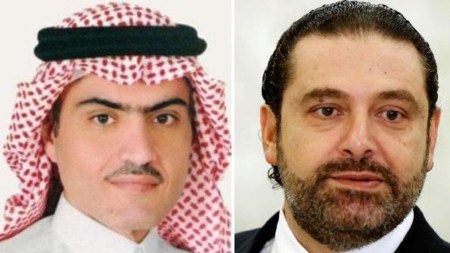
Saudi Arabia’s Gulf Affairs Minister Thamer al-Sabhan (L) was speaking about Lebanon’s Hariri. (Supplied/Reuters)

Saudi Arabia’s Gulf Affairs Minister Thamer al-Sabhan said the personal security detail of Lebanese Prime Minister Saad al-Hariri, who resigned on Saturday, had “confirmed information” of a plot to kill him.

Speaking in an interview on Future, an Arabic television channel owned by Hariri, he said Hariri was in Riyadh, adding there were “security threats to the prime minister and the kingdom is keen on his safety.”

He added that Hariri resigned from Riyadh for security reasons.

“Saudi Arabia is different than the terrorist state Iran. We respect Lebanese parties despite their different opinions,” Sabhan added.

Speaking to the Lebanese television channel LBC, Sabhan said Hariri is completely free to return to Lebanon, adding, however: “We do not want explosions and destruction to happen again in the Hariri family.”

Sabhan also said that Saudi Arabia supported all of Hariri’s stances in the past, including the agreement related to choosing a Lebanese president, adding that the Saudi kingdom did not incite Hariri to resign.

“We cannot but be sad over Lebanon’s situation due to Hezbollah. We call for peace but those who try to (harm) the kingdom will find what they do not wish for,” he added.

“Hezbollah is a militia that tried to transfer Syrian battles to Lebanon and to harm Lebanon and Arab countries,” Sabhan also said, asking: “What’s the difference between Hezbollah and ISIS?”

Hezbollah denounces US sanctions bill targeting its cash flow

October 27, 2017

Hezbollah denounces US sanctions bill targeting its cash flow, Israel Hayom, October 27, 2017

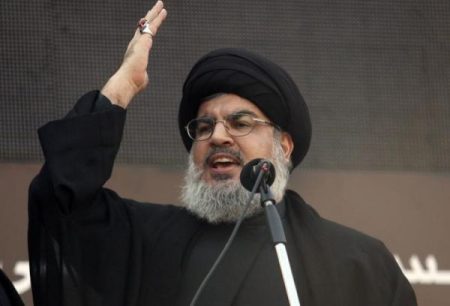
Hezbollah leader Hassan Nasrallah | Photo: Reuters

Washington considers Hezbollah a terrorist organization and has previously imposed sanctions on the group and its top commanders. The expected new sanctions come at a time when the Trump administration is increasing pressure on Iran, Hezbollah’s main backer that has been supplying the group with weapons and money for more than three decades.

****************************************

Hezbollah on Thursday denounced new U.S. measures designed to thwart the militant group’s cash flow, calling a bill targeting its finances an “aggression” against Lebanon.

In a statement, the Iranian-backed Shiite terrorist group said the new measures are a “blatant intervention in Lebanese internal affairs, a violation of Lebanese sovereignty and an unacceptable targeting of the Lebanese people.”

The statement was issued following a weekly meeting of Hezbollah’s parliamentary bloc. It came a day after the U.S. House approved legislation to block the flow of illicit money to the group and to sanction it, with lawmakers calling it Iran’s leading terrorist proxy.

The bill targeting Hezbollah’s finances, sponsored by Reps. Ed Royce and Eliot Engel, directs the Trump administration to sanction people and businesses engaged in fundraising and recruitment activities for the group.

Hezbollah is a member of Lebanon’s coalition government, and the House measure touched off alarms in Beirut, where officials feared major damage to the country’s banking sector if the bill is signed into law.

Joseph Torbey, head of the Association of Banks in Lebanon, told reporters earlier this week that U.S. officials reassured a Lebanese banking delegation who visited Washington recently that the sanctions will not target Lebanese banks as long as they abide by American regulations.

Washington considers Hezbollah a terrorist organization and has previously imposed sanctions on the group and its top commanders. The expected new sanctions come at a time when the Trump administration is increasing pressure on Iran, Hezbollah’s main backer that has been supplying the group with weapons and money for more than three decades.

A Hezbollah official earlier this month said that U.S. sanctions will not affect the operational activities of the group, calling it part of ongoing efforts to “demonize” Hezbollah.

In its statement Thursday, Hezbollah said the new measures “camouflaged” in legislation aims at subjugating Lebanon and warned against subservience or fear of such policies.

Hamas Rejoins Iran’s Terrorist Axis

October 26, 2017

Hamas Rejoins Iran’s Terrorist Axis, Investigative Project on Terrorism, Yaakov Lappin, October 26, 2017

(Please see also, The Iran-Hamas Plan to Destroy Israel. — DM)

One immediate result of the Iranian-Hamas reconciliation is the new Hamas outpost being built in Lebanon.

Lebanon is under the firm control of Iran’s proxy, Hizballah. It is now seeing the arrival of Hamas members who have set up a new command center. From there, Hamas could set up terrorist cells in the West Bank.

Hamas’ new presence in Lebanon could also be used to create a rocket-firing base, or cross-border terror cells operating from Lebanon, with Hizballah’s and Iran’s approval.

******************************

Hamas is deepening its ties with Iran and its radical Shi’ite axis. Iranian cash is once again expected to fund Gaza’s war preparations and arms build-up program.

Before the 2011 outbreak of the war in Syria, Sunni Hamas and Shi’ite Iran were united by their goal to destroy Israel. Iran helped arm and fund Hamas’ terrorist-guerilla army in Gaza.

But the two fell out after finding themselves on opposite sides of the sectarian fence in the bloody Syria war. Iran, largely through its Lebanese proxy Hizballah, has committed troops and weapons to prop up dictator Bashar Al-Assad.

Now, out of cash and isolated, Hamas is in search of backing from a major regional power, and it is returning to Iran’s orbit.

The Iranians have been indicating that past fall-outs are history, and that Hamas will get all of the help it needs to prepare for future war against Israel. Israel’s intelligence community is closely monitoring these developments.

The Islamic Republic will grant Hamas “all assistance that it requests,” a senior Iranian official told the Lebanon-based Al Mayadin TV network, according to Israel’s Ynet website.

“Relations with Iran are excellent and Iran is the largest supporter of the [Hamas armed wing] Izz Al-Din Kassam Brigades with money and arms,” Hamas’ chief in Gaza, Yehya al-Sinwar said.

“The relationship today is developing and returning to what it was in the old days,” Sinwar told Reuters.

“This will be reflected in the resistance [against Israel] and in the agenda to achieve the liberation,” he said. “Liberation” is a reference to Hamas’ ideological long-term commitment to destroy Israel and replace it with a Palestinian-Islamist state.

One immediate result of the Iranian-Hamas reconciliation is the new Hamas outpost being built in Lebanon.

Lebanon is under the firm control of Iran’s proxy, Hizballah. It is now seeing the arrival of Hamas members who have set up a new command center. From there, Hamas could set up terrorist cells in the West Bank.

Hamas’ new presence in Lebanon could also be used to create a rocket-firing base, or cross-border terror cells operating from Lebanon, with Hizballah’s and Iran’s approval.

One of the Hamas members seen in Beirut recently is its No. 2 man, Saleh Al-Arouri. He has been responsible for remotely setting up terrorist cells in the West Bank. Until recently, Al-Arouri operated out of Hamas’ headquarters in Turkey.

Al-Arouri has been appointed Hamas deputy leader. He took part in a senior Hamas delegation to Iran earlier this month.

Those ties with Iran are one reason why Israel’s cabinet rejected recognition of a fledgling Hamas-Fatah unity government. Israel will not recognize the new Palestinian government until Hamas agrees to give up its weapons, recognize Israel, and cut links with Tehran.

“Our presence in Iran is the practical denial of the third precondition — cutting ties with Iran,” Arouri said. “Undoubtedly, the Palestinian resistance forces will never give up… their arms,” he was quoted by Reuters as saying.

Iran’s Supreme Leader, Ayatollah Khamenei, praised Hamas’ stance. Khamenei’s representative congratulated Hamas “for declaring that you will not set your weapons aside,” according to the semi-official Fars news agency.

Renewed Iranian support probably will take the form of suitcases of cash entering Gaza via smuggling tunnels.

Some tunnels linking Gaza to the Sinai Peninsula remain, though many others have been demolished by Egypt.

Iranian know-how in producing rockets, RPGs, mortars, and drones will also, once again, be used to train Hamas engineers, who are in charge of Hamas’ domestic weapons industry.

Iranian guerilla combat doctrines, which already have influenced Hamas greatly, could also reappear in Gaza, in updated forms.

Iran might also try to smuggle materials to make weapons into Gaza via small fishing boats.

Hamas has been open and frank about its intentions in renewing Iranian sponsorship. A senior Hamas official said it was about securing “Iranian financial and logistical support,” according to the Agence France-Presse.

Hamas’ new relationship with Iran will displease Sunni Arab countries who, like Israel, view the Iranians and their regional destructive behavior as a top threat.

But this is a risk Hamas’ leadership is prepared to take in its quest to replenish cash supplies for its military and terrorist operations.

Hamas’s isolation – the force that drove it into Iran’s arms – is also what caused it to enter a reconciliation agreement with its arch Palestinian rival, Fatah.

Seeking to avoid a collapse of its regime in Gaza due to dwindling cash and energy resources, and under pressure from Palestinian Authority President Mahmoud Abbas, who had been reducing Gaza’s electricity flow, Hamas decided to feign compromise with Fatah.

This is a short-term tactical move designed to serve the longer-term radical vision. Both Hamas and Iran would like to eventually use the Palestinian reconciliation to depose Fatah from power in the West Bank.

Hamas can be expected to use the coming years to build up its political power in the West Bank, Fatah’s home turf, and then try to take it over through elections. Hamas’s end goal is to create two armed fronts against Israel – from Gaza and the West Bank – with Iran creating the third and most potent third front from Lebanon, in the form of Hizballah.

Hamas and Iran still have their differences, but Hamas’s new leadership, and its distress stemming from isolation, have led it firmly back into Iran’s orbit. So long as Egypt remains under a government that is hostile to Islamists and jihadists, Hamas will continue to see Iran as its state backer, despite the Shi’ite-Sunni divide.

Meanwhile, a senior Hamas member with a history of funneling tens of millions of dollars from Iran to the organization’s military wing has recently been unveiled as a new top-level overseas liaison, according to Israel’s Kan television news service.

Maher Salah, a senior Hamas financier, recently appeared at a Turkish rally for the deceased Egyptian former Muslim Brotherhood leader Mohammed Mahdi Akef, in which he eulogized Akef as one who “loved jihad fighters and the jihad for Allah.”

The U.S. Treasury Department sanctioned Salah, together with Al-Arouri, in 2015.

“The fate of your country is to pass from the world,” Salah said, addressing Israeli Prime Minister Benjamin Netanyahu. “The fate of your kingdom is to be eliminated. I promise him that his country will not live to celebrate 100 years.”

Salah could use his ties in Iran to restart large-scale terrorist financing efforts.

The Gaza Strip is the quietest it has been in 30 years, and Hamas today remains deterred by Israel’s military might.

But its recent actions and statements show that Hamas is exploiting the ceasefire to gear up for long-term and destructive conflict with Israel. It is returning to Iran’s fold to help it in this effort.

Yaakov Lappin is a military and strategic affairs correspondent. He also conducts research and analysis for defense think tanks, and is the Israel correspondent for IHS Jane’s Defense Weekly. His book, The Virtual Caliphate, explores the online jihadist presence.

Iran buildup in S. Syria – riposte for IDF drill

September 12, 2017

Iran buildup in S. Syria – riposte for IDF drill, DEBKAfile, September 12, 2017


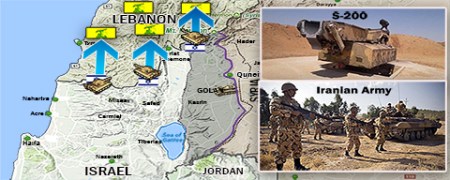
An Iranian military buildup indeed appears to be taking place on Syria’s borders with Jordan and Israel, in response to Israel’s mock thrust into Lebanon. But they are moving in on areas outside the de-escalation zones which are manned by Russian officers. Their tactic therefore is to entrench themselves in other parts of the southeastern Syria so that Russian, Iranian, Syrian and Hizballah forces form a continuous, impermeable line along Syria’s borders with Israel and Jordan.

*****************************

Lebanese sources claimed that on Monday, Syria had fired S-200 missiles against two Israeli F-15 fighter bombers flying over the southern Lebanese port town of Sidon – but missed their targets. The Syrian missiles, they claimed, had been fired from “an air defense base in southern Syria.”

This report was not confirmed by any other source. But it was accompanied by a photo on various Syrian social media, which claimed to depict the firing of these missiles and also presented a Lebanese military spokesman as saying that the Syrian missiles were fired at precisely 11.30 a.m. when the Israeli planes were over Sidon.

The Lebanese and Syrian media accounts are clearly coordinated.

If this episode actually happened, it would be a game changer, in that for the first time, Syria would have launched missiles from one of its bases against a purported Israel warplanes flying over Lebanon.

Even if the two allies were just sending a message to Jerusalem by drumming up an incident, it gains substance from its timing, i.e. five days after an Israeli air strike on Syria’s chemical and missile weapons development facility, the Scientific Studies and Research Center near Masyaf, 38 km west of the central town of Hama.

Syrian military sources are moreover reporting an onrush of Iranian officers, troops and military advisers to southern Syria. According to one official, “Many Iranians are deployed as advisers and police in southern Syria, especially in the de-escalation zones.” Another Syrian official put it more plainly. “We have seen a big increase in the number of Iranian soldiers this month.”

|DEBKAfile’s military sources confirm that these reports are partially correct. An Iranian military buildup indeed appears to be taking place on Syria’s borders with Jordan and Israel, in response to Israel’s mock thrust into Lebanon. But they are moving in on areas outside the de-escalation zones which are manned by Russian officers. Their tactic therefore is to entrench themselves in other parts of the southeastern Syria so that Russian, Iranian, Syrian and Hizballah forces form a continuous, impermeable line along Syria’s borders with Israel and Jordan.

On Sunday, Sept. 11, units of the Syrian army’s 5th Corps moved in on large sections of the Jordanian border, including parts close to Israel.

Neither the IDF nor the Jordanian army interfered with any of these potentially menacing steps. They are seen by DEBKAfile’s military sources as a combined Syrian-Iranian-Hizballah comeback for the IDF exercise, to demonstrate that, while Israel shows itself capable of invading Lebanon, the three allies have meanwhile become firmly ensconced on its northern border.

The next day, Hizballah’s leader Hassan Nasrallah boasted: “We have won the war in Syria. Our martyrs, wounded, captives and people are changing equations and writing the region’s history, not just Lebanon’s.”

IDF simulates war-to-win strategy vs Hizballah

September 5, 2017

IDF simulates war-to-win strategy vs Hizballah, DEBKAfile, September 5, 2017

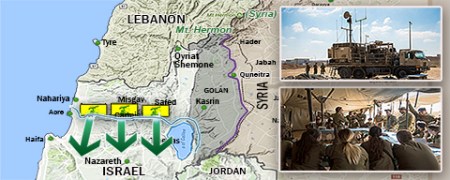
The IDF Tuesday, Sept. 5, embarked on its biggest military exercise against Hizballah in 19 years, with a radically revised mission in the face of a greatly empowered enemy (tanks and drones as well as 100,000 rocket and missiles) which is now embedded in Syria, not just in Lebanon.

Tens of thousands of ground, air, sea and intelligence units, including reservists – the IDF’s entire northern array – will simulate a Hizballah thrust across the border to occupy two Israeli locales in Galilee and the Golan. They will conduct simultaneous defensive and offensive operations deep behind enemy lines. The game plan is not to aim for a ceasefire and respite for the enemy to prepare for the next round, as the 2006 Lebanon war ended. This time, Israel strategists have set themselves the goal of defeating Hizballah convincingly enough to smash its morale and infrastructure and end its belief that it can destroy Israel the next time round

The exercise’s three military objectives are clearly laid out:

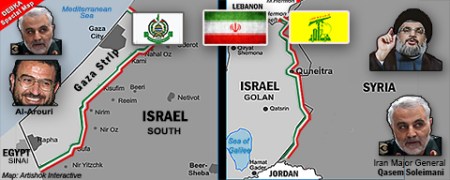
1.  Two sectors are defined for repelling a deep Hizballah thrust into northern Israel; (see map)

(a)  Hizballah is expected to go for the Metulla-Misgav sector on the Lebanese border, as well as the “Fatma Road” linking the Galilee hills north of Kiryat Shemona along the Israeli-Lebanese border.

(b)  Zarit-Shetula in western Galilee north of Nahariya, which is close enough to the Lebanese border for Hizballah troops to reach by land and through tunnels.

Israeli forces will practice driving the enemy out of occupied towns and villages, often using the element of surprise.

2. Another major IDF force will storm across the border into Lebanon for an effort to rapidly and decisively defeat Hizballah on its home ground. The defensive operation apart, the IDF is resolved to inflict on the enemy intolerable losses of life, infrastructure and territory.

This fighting-to-win strategy draws heavily on the negative lessons of the 2006 war, DEBKAfile’s military sources report. Then, the IDF’s overreliance on air might for winning the war proved counterproductive. By the time ground troops were deployed to cross the border and challenge Hizballah, they were too few and too late.

3.  This time, the air force is practicing a different role in the conflict, in coordination with Israel’s heavily upgraded, multi-tier air defenses. They will not only be geared for contending with Hizballah’s vast 100,000 rockets and missiles, but also, for the first time, with a formidable fleet of assorted UAVs, which are designed to serve the enemy in multiple tasks: intelligence-gathering, delivering rockets and guided  drones packed with explosives.

Also for the first time, the IDF will prepare to order the evacuation of civilians, up to 75,000, from towns and village within close range of Hizballah fire. Their evacuation may take place by roads that are under enemy attack.

Iran/Hizballah noose tightens around Israel

September 1, 2017

Iran/Hizballah noose tightens around Israel, DEBKAfile, September 1, 2017

Seen from the strategic-military angle, Israel can be said to have regressed 11 years to 2006, when two foes were poised menacingly on its northern and southern borders. Israel was then compelled to fight a war against Hizballah in Lebanon. This time, the conflict could potentially flare up simultaneously on three fronts – Lebanon, Gaza and Syria.

********************************

Nikki Haley, the US Ambassador to the UN, challenged the international community to hold Iran to account on Thursday, Aug. 31, after the Islamic Republic showed its “true colors” by restoring its ties with the Palestinian extremist Hamas. In her statement, she described as “stunning” the Hamas leader’s boast that Tehran is again the biggest provider of money and arms. The breach between them followed the terrorist group’s refusal to side with Bashar Assad in the Syrian civil war.

“Iran must decide whether it wants to be a member of the community of nations that can be expected to take its international obligations seriously, or whether it wants to be the leader of a jihadist terrorist movement. It cannot be both,” Haley said in her statement.

Islamic Iran has long made that decision, as the ambassador knows very well from the intelligence reports she sees. But her brave words were meant as a wakeup call for the rapid advances made by Iran and Hizballah during August to impose their will on the Middle East, often with great stealth.

Haley will have learned about the Aug. 2 meeting in Beirut between Hamas’s military chief Salah al-Arouri and Iranian officials, following which Hizballah’s Hassan Nasrallah confirmed that the Palestinian rulers of the Gaza Strip were worthy of restored military and financial aid.

That deal was clinched at the highest level in Tehran, after Arouri and a delegation from Gaza were received by top Iranian officials, including Revolutionary Guards General Qassem Soleimani. He is not only commander of Iran’s Middle East warfronts, but also head of Al Qods, which runs Iran’s intelligence, subversion and terror networks.

These events and their ramifications were itemized in the latest issue of DEBKA Weekly, out Friday, Sept. 1.

It was Soleimani who assigned Hamas and its military arm with its next tasks. Since both parties are dedicated to violent tactics (terror) to achieve their ends, one of which is the destruction of the State of Israel, all that remains to be seen is the precise form the Iranian-backed Hamas-Hizballah partnership will take – and where. Those practicalities were aired at the secret sessions between Hamas and Al Qods in Tehran

Present at some of those sessions were also Soleimani’s secret agents and heads of the terrorist networks he runs across the Middle East and in the Gulf emirates.

The inauguration ceremony for Hassan Rouhani’s second term as Iran’s president on Aug. 5 provided a convenient cover for these get-togethers.

Nikki Haley’s warning to the international community was prompted by these dangerous events. Although her words were powerful, telling and timely, it is hard to see any sign of their being followed up by other parts of the Trump administration.

With the southern front against Israel in the bag, Iran and Hizballah this week put together its northern front, just two or three kilometers from Israel’s Golan border with Syria. This could not have happened without the Trump administration submitting to Russia’s demand to revise their de-escalation zone project for the Syrian Golan, so that Iranian and Hizballah forces are no longer required to distance themselves 40-50km from the zone, but only 8km.

Iran and Hizballah in Syria have in consequence been quietly shortening their distance from the Israeli border. But this week, they made a major leap forward, when the Russian monitors brought a group of Iranian and Hizballah officers all the way to Quneitra. There, they were given a base under Russian protection within sight of the Israeli Golan.

Tehran and its pawn therefore used the month of August to climb into position for drawing a noose around Israel and tightening it at will.

Prime Minister Binyamin Netanyahu this week boasted that his tenure was marked by relative calm. Israel, he said, had successfully avoided getting embroiled in any major war.

That is correct. However, his policy of preserving the calm and maintaining a purely defensive stance has carried a price. That price was totted up on Sept. 1. By then, Iran and Iran had been able to move unopposed into position on Israel’s borders with Syria and Lebanon in the north and had crept up to the Gaza border in the south.

Seen from the strategic-military angle, Israel can be said to have regressed 11 years to 2006, when two foes were poised menacingly on its northern and southern borders. Israel was then compelled to fight a war against Hizballah in Lebanon. This time, the conflict could potentially flare up simultaneously on three fronts – Lebanon, Gaza and Syria.

Brigitte Gabriel and Dave Rubin: Terrorism, The Muslim Brotherhood, and Linda Sarsour

July 9, 2017

Brigitte Gabriel and Dave Rubin: Terrorism, The Muslim Brotherhood, and Linda Sarsour via YouTube, May 19, 2017

(The transition of Lebanon from a vibrant homogeneous society into an Islamist state where Muslims, formerly friends of Christians and Jews, became violent enemies — about five minutes into the video — bodes ill for much of Europe. Although this video was posted on YouTube on May 19th, some of the content suggests that the interview occurred significantly earlier.  — DM


Congress blames State Department after draft sanctions bill leaked to pro-Hezbollah media

May 2, 2017

Congress blames State Department after draft sanctions bill leaked to pro-Hezbollah media, Al-Monitor

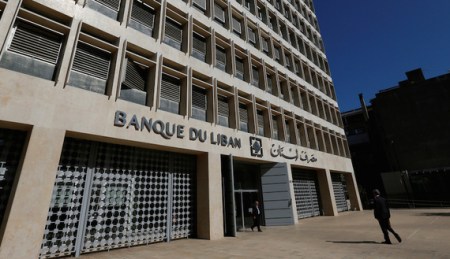
People walk outside Lebanon’s Central Bank in Beirut November 6, 2014. REUTERS/Jamal Saidi/File Photo – RTSEJDF

Congress is blaming the State Department and the US Embassy in Lebanon after draft sanctions legislation was leaked to the Lebanese media, setting off a political and diplomatic firestorm.

House Foreign Affairs Committee Chairman Ed Royce, R-Calif., began devising a new bill targeting Hezbollah last year amid concerns that the Barack Obama administration was slow-walking implementation of a previous effort that was signed into law in December 2015. Royce shared an early draft with State Department experts for their input, sources on and off Capitol Hill told Al-Monitor, but got burned when a media outlet close to Hezbollah got wind of it. 

The State Department has not officially acknowledged or denied being involved. Royce declined to comment.

As a result of the leak, numerous newspaper articles in Lebanon over the past month have picked apart — and possibly distorted — an unfinalized draft that only a handful of people in Washington have heard about and fewer still have seen. Even House Foreign Affairs ranking member Eliot Engel, D-N.Y., a natural ally on sanctions legislation, has yet to see the proposed draft, according to a Democratic aide. Sen. Marco Rubio, R-Fla., is working on a similar effort in the Senate.

Lebanese officials say destabilizing sanctions would be ill-advised while tiny Lebanon is struggling to absorb more than a million refugees from Syria.

“We are surprised by all the leaks about new sanctions,” Lebanese member of parliament Yassine Jaber, a former economy minister who met with administration officials during the congressional recess two weeks ago, told Al-Monitor in an email. “We don’t see a need for further legislation, we feel that all these leaks about further legislation to come, only hurts Lebanon, its economy and banking sector, at a moment of very high weakness and vulnerability.”

According to Lebanese media accounts, the 20-page draft bill has also caused a panic in Lebanon because of its potential political impact. While the 2015 bill unnerved a banking sector that is one of the pillars of the country’s economy, the new draft has government leaders fretful that Congress is now coming after them.

The Royce draft, Lebanese President Michel Aoun said last week during a meeting with the Washington-based American Task Force for Lebanon, “would harm Lebanon and its people greatly.” Critics are worried that the draft bill paves the way for sanctioning Lebanese allies and political parties that are close to Hezbollah, including Aoun, the Christian Free Patriotic Movement headed by his son-in-law and Foreign Minister Gebran Bassil, and the Shiite Amal Movement of parliament Speaker Nabih Berri.

In response, the Lebanese government is planning to send a delegation to Washington later this month of government officials, lawmakers and other dignitaries, possibly including Central Bank Governor Riad Salameh. The government hopes to have representatives of the private banking sector tag along to play up any potential threat to the financial sector, a Lebanese source told Al-Monitor, but the main concern appears to be with the bill’s political ramifications.

“This is more about the political groups of the speaker, etc., being nervous rather than the issues of the banks,” the source said. “Politicians — and the government, actually — are trying to get the private banks involved in their effort. I can tell you the private banks do not like that: They do not want to come with politicians here.”

The Association of Banks in Lebanon spent $200,000 in the first three months of this year to discreetly lobby Congress about the bill and other matters, according to lobbying records. The banks would prefer to wait until President Donald Trump fills in top spots at the Treasury Department before organizing their annual visit to Washington, the source said.

Hezbollah claims to get all its funding from Iran. US experts, however, have long suspected that much more comes from Lebanese expatriates, illegal activities and other sources, fueling Congress’ desire to crack down on as many funding streams as possible.

The Lebanese source, who has seen a draft of the bill, said it does not designate Hezbollah’s allies as terror groups. Rather, it would require the Trump administration to publicly report on their financial links to the Shiite militia, including estimates of the net worth of some top Lebanese officials.

“Obviously they don’t want their net worth to be mentioned,” the source said. “I totally see how Nabih Berri could be panicking even if his own party knows how much money he has.”


EXCLUSIVE – Arab Intelligence Source: Jihadists Are Wearing Down Hezbollah on Syria-Lebanon Border

April 29, 2017

EXCLUSIVE – Arab Intelligence Source: Jihadists Are Wearing Down Hezbollah on Syria-Lebanon Border, BreitbartAaron Klein and Ali Waked, April 29, 2017

ANWAR AMRO/AFP/Getty

Fighters of the Al Nusra Front, Al Qaida’s affiliate in Syria, or as the group now calls itself, Jabhat Fatah al-Sham, have recently been posing a serious challenge to Hezbollah in the border area between Lebanon and Syria, a senior Arab intelligence official told Breitbart Jerusalem.

“Dozens of Hezbollah fighters have been wounded in engagements over the last few weeks between the two sides,” the official stated. “The jihadists decided to switch their offensive from Syria to Lebanon. “

“In the area of Arsal and in other regions, they’ve continued to surprise Hezbollah and force the group to send many soldiers to the area.”

The challenge presented by the jihadists has forced Hezbollah to reconsider the positions of their troops in Syria and at home in Lebanon, according to the intelligence source. “According to intelligence reports, Hezbollah is taking the most recent engagements very seriously,” said the intelligence source.

“The slow stream of jihadists into Lebanon represents a disruption of the relative stability within the country’s borders, especially just before the beginning of the fasting month of Ramadan next month,” said the source.

“Hezbollah understands that Al Nusra and the jihadists are trying to turn the month of Ramadan into a bloody month for the Shi’ite organization and the communities supporting it, and so, we are witnessing the reduction in age of volunteers and fighters being recruited by the organization and they’re continuing to go down and even now we can see that 16-year-olds are among the fighters.”

The intelligence source also said that, as far as Hezbollah is concerned, “The threat from Al-Nusra isn’t nearing its strongholds in Lebanon. The increased troop presence on the border comes at a direct cost to troop numbers in Syria.

“In any case, Hezbollah already conducted a new assessment of the deployment of its forces in Syria due to the American airstrike, but now the fear is double.”

According to the source, “Hezbollah’s fundraisers and recruiters are investing far more effort than in the past.  If Ramadan passes without any special attacks, it should be a month of fundraising that will help the organization deal with the need to expand its recruitment of volunteers.”

The source added that “the main deliberation within Hezbollah concerns the need to prepare for a direct attack on the organization from Israel or even the U.S. The organization understands that Hezbollah is in the cross hairs of the American government as a source of disruption of U.S. interests in the area.”

“Hezbollah is fundraising, recruiting volunteers and fighting for public opinion. The organization is preparing for a very difficult summer.”