Posted tagged ‘Kurds’

Germany’s Sharia Refugee Shelters – “Bulk of Migrants Cannot Be Integrated”

October 1, 2015

Germany’s Sharia Refugee Shelters – “Bulk of Migrants Cannot Be Integrated” Gatestone InstituteSoeren Kern, October 1, 2015

  • Christians, Kurds and Yazidis in the shelters are being attacked by Muslims with increasing frequency and ferocity.
  • “I fled from the Iranian secret service because I thought that in Germany I could finally live my faith without persecution. But in the refugee shelter, I cannot admit that I am a Christian, or I would face threats… They treat me like an animal. They threaten to kill me.” — An Iranian Christian in a German refugee shelter.
  • “We have to dispense with the illusion that all of those who are coming here are human rights activists. … We are getting reports of threats of aggression, including threats of beheading, by Sunnis against Shiites, but Yazidis and Christians are the most impacted. Those Christian converts who do not hide their faith stand a 100% probability of being attacked and mobbed.” — Max Klingberg, director of the Frankfurt-based International Society for Human Rights.
  • “We are observing that Salafists are appearing at the shelters disguised as volunteers and helpers, deliberately seeking contact with refugees to invite them to their mosques to recruit them to their cause.” — Hans-Georg Maaßen, head of German intelligence.
  • Police are urgently calling for migrants of different faiths to be housed in separate facilities. Some politicians counter that such segregation would go against Germany’s multicultural values.
  • “The bulk of the migrants who are arriving here cannot be integrated.” — Heinz Buschkowsky, former mayor of Berlin’s Neukölln district.

Muslim asylum seekers are enforcing Islamic Sharia law in German refugee shelters, according to police, who warn that Christians, Kurds and Yazidis in the shelters are being attacked by Muslims with increasing frequency and ferocity.

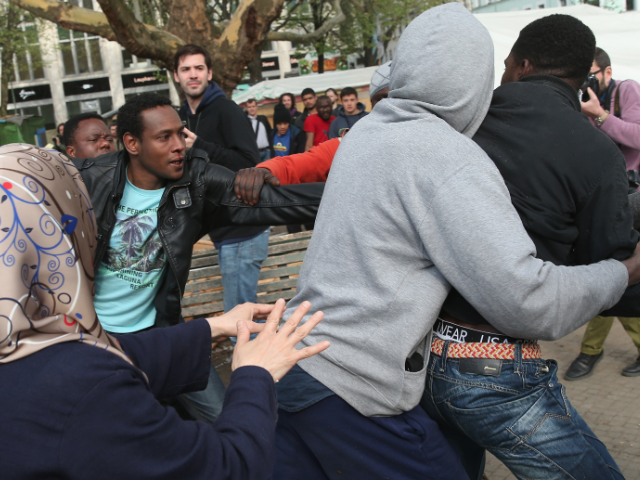
Muslim migrants from different sects, clans, ethnicities and nationalities are also attacking each other. Violent brawls — sometimes involving hundreds of migrants — are now a daily occurrence.

Police say the shelters, where thousands of migrants are housed together in cramped spaces for months at a time, are seething cauldrons ready to explode. The police are urgently calling for migrants of different faiths to be housed in separate facilities.

Some politicians counter that such segregation would go against Germany’s multicultural values, while others say that separating hundreds of thousands of migrants by religion and nationality would be a logistical impossibility.

As the consequences of unrestrained migration become apparent, the tide of public opinion is turning against the government’s open-door policy. Observers say that German Chancellor Angela Merkel, the so-called most powerful woman in the world, may have met her Waterloo.

A report published by the newspaper Die Welt on September 27 sheds light on the targeting of Christians by Muslims in German refugee shelters. The paper interviewed an Iranian convert to Christianity who said:

“In Iran, the Revolutionary Guards arrested my brother in a house church. I fled from the Iranian secret service because I thought that in Germany I could finally live my faith without persecution. But in the refugee shelter, I cannot admit that I am a Christian, or I would face threats.

“Muslims wake me before the crack of dawn during Ramadan and say that I should eat before sunrise. When I decline, they call me a kuffar, an unbeliever. They spit at me. They treat me like an animal. They threaten to kill me.”

At a refugee shelter in Hemer, a town in North Rhine-Westphalia, 10 Algerian asylum seekers attacked a Christian couple from Eritrea with glass bottles. The Muslims said they were angry that the man was wearing a cross. They ripped the cross from his neck and stole his money and cellphone.

Die Welt also interviewed an Iraqi Christian family from Mosul who were living at a refugee shelter in the Bavarian town of Freising. The father said that threats by Islamists were a daily fact of life. “They shouted at my wife and hit my child,” he said. “They say: ‘We will kill you and drink your blood.'” Life in the shelter, he said, was as if in a prison.

According to the director of the Munich-based Central Committee for Oriental Christians, Simon Jacob, these incidents are only “the tip of the iceberg.” “The actual number of attacks is very high,” he said. “We have to expect further conflict, which the migrants bring to Germany from their homelands. Between Christians and Muslims. Between Shiites and Sunnis. Between Kurds and extremists. Between Yazidis and extremists.”

Max Klingberg, the director of the Frankfurt-based International Society for Human Rights (Internationale Gesellschaft für Menschenrechte, IGFM), says that much of the aggression is being perpetrated by Afghans and Pakistanis, who are “even more Islamic than some Syrians and Iraqis.” He warns that conflict in the refugee shelters will only become worse:

“We have to dispense with the illusion that all of those who are coming here are human rights activists. Among those who are arriving here now, a substantial number are at least as religiously intense as the Muslim Brotherhood.

“We are getting reports of threats of aggression, including threats of beheading, by Sunnis against Shiites, but Yazidis and Christians are the most impacted. Those Christian converts who do not hide their faith stand a 100% probability of being attacked and mobbed.”

In a September 29 interview with the newspaper Passauer Neue Presse, the head of the German police union (Deutschen Polizeigewerkschaft, DPolG), Rainer Wendt, warned that “brutal criminal structures” have taken over the refugee shelters and that police are overwhelmed and unable to guarantee safety and security. He called for Christians and Muslims to be separated before someone gets killed:

“We have been witnessing this violence for weeks and months. Groups based on ethnicity, religion or clan structures go after each other with knives and homemade weapons. When these groups fight each other at night, all those German citizens who welcomed the migrants with open arms at the Munich train station are fast asleep, but the police remain awake and are left standing in the middle…

“We can only estimate the true extent of violence because women and children are often afraid to file a complaint. Since it is also about sexual abuse and rape…

“Sunnis are fighting Shiites, there are Salafists from competing groups. They are trying to impose their rules in the shelters. Christians are being massively oppressed and the Sharia is being enforced. Women are forced to cover up. Men are forced to pray. Islamists want to introduce their values and order at the shelters.

Wendt gave the interview days after 300 Albanian migrants clashed with 70 Pakistani migrants at a refugee shelter in Calden, a town in the state of Hesse, on September 27. More than a dozen people, including three police officers, were injured in the melee, which erupted after two migrants got into a fight while waiting in line at the canteen. It took 50 police officers several hours to restore order at the shelter, which is home to 1,500 migrants from 20 different countries.

More than 60 migrants, including ten children, were injured after Pakistanis and Syrians clashed at the same shelter on September 13. The fight broke out just after midnight, when someone sprayed mace into a tent filled with sleeping migrants. Police did not inform the public about the fight for more than a week, apparently to prevent fueling anti-immigrant sentiments.

Violent brawls are becoming commonplace at German refugee shelters across the country.

1275In the past two months alone, dozens of violent brawls and riots between different groups of migrants have erupted in Germany’s refugee shelters.

On September 30, migrants went on a rampage at a refugee center in Braunschweig, a city in Lower Saxony. On September 29, Syrian migrants clashed at a refugee shelter in Gerolzhofen, a small town in Bavaria. Also on September 29, migrants from Algeria and Mali clashed at a refugee center in Engelskirchen, a town in North Rhine-Westphalia.

On September 28, more than 150 Syrians and Pakistanis clashed at a refugee shelter on Nöthnitzer Straße in Dresden. The migrants attacked each other with wooden planks and metal bars. Two dozen police officers were needed to restore order. More than 30 Syrians and Pakistanis clashed at the same shelter on August 10.

Also on September 28, between 100 and 150 migrants of different nationalities clashed at a refugee shelter in Donaueschingen, a town in the Black Forest. The trouble started over a dispute about who should be able to use the shower facilities first. On September 22, more than 400 migrants marched through town to protest conditions at the same facility. On September 15, a male migrant was attacked by another migrant for using a female bathroom at the shelter.

On September 24, around 100 Syrians and Afghans clashed at a refugee shelter in Leipzig, the largest city in Saxony. The fight broke out after a 17-year-old Afghan pulled a knife on an 11-year-old Syrian girl at the shelter, which houses 1,800 migrants. On September 23, migrants clashed at a refugee shelter for unaccompanied minors in Nuremberg.

On September 3, Syrian migrants attacked security guards at a refugee shelter in the Moabit district of Berlin. Also on September 3, Iraqi migrants attacked security guards at a refugee shelter in Heidelberg. A total of 21 squad cars were dispatched to restore order. On September 2, Algerian and Tunisian migrants clashed at the same shelter. A dozen police cars were deployed to restore order.

On September 3, migrants clashed at a refugee shelter in Hövelhof, a town in North Rhine-Westphalia. On September 2, migrants clashed at a refugee facility in Wolgast, a town in Mecklenburg-Vorpommern. Also on September 2, migrants clashed at a refugee center inGütersloh, a town in North Rhine-Westphalia.

On September 1, migrants clashed at a refugee shelter in Delitzsch, a town in Saxony. A 27-year-old Tunisian migrant was killed after being stabbed by a 27-year-old migrant from Morocco. Also on September 1, a 15-year-old Somali migrant stabbed a 15-year-old Egyptian migrant with a scissors at a refugee center in the Groß Borstel district of Hamburg.

On September 1, Somali, Syrian and Albanian migrants clashed at a refugee center inTegernsee, a small town in Bavaria. Also on September 1, migrants clashed at a refugee shelter in Heidelberg.

On August 31, Libyan and Tunisian migrants clashed at a refugee shelter in Hoyerswerda, a town in Saxony. Also on August 31, migrants clashed with each other and with security guards at a refugee shelter in Heidelberg. On August 30, a 25-year-old Sudanese migrant was arrested for going on a rampage at a refugee shelter in Jesteburg, a small town in Lower Saxony.

On August 29, a 17-year-old Algerian migrant was arrested for robbing the cellphones of other migrants at a refugee center in Elzach, a town in Baden-Württemberg. On August 25, 60 migrants went on a rampage at a refugee shelter in Karlsruhe.

On August 24, a migrant from Montenegro was stabbed by a migrant from Algeria at a refugee shelter in Seevetal, a town in Lower Saxony.

On August 22, Afghan migrants clashed at a refugee shelter in Rotenburg, a town in Hesse. Also on August 22, at least 20 migrants went on a rampage at a refugee center in Grafing, a town near Munich.

On August 21, migrants clashed at a refugee facility in Schwetzingen, also in Baden-Württemberg. Also on August 21, migrants clashed at a refugee center in the Marienthal district of Hamburg.

On August 16, 50 migrants attacked each other with broken tree branches, umbrellas and trash cans at a refugee center in Friedland, a town in Lower Saxony. The facility, which has a capacity of 700, is home to 2,400 migrants.

On August 19, at least 20 Syrian migrants staying at an overcrowded refugee shelter in the eastern German town of Suhl tried to lynch an Afghan migrant after he tore pages from a Koran and threw them in a toilet. More than 100 police officers intervened; they were attacked with stones and concrete blocks. Seventeen people were injured in the melee, including 11 refugees and six police officers. The Afghan is now under police protection. The president of the German state of Thuringia, Bodo Ramelow, said that to avoid similar violence in the future, Muslims of different nationalities must be separated.

On August 10, 40 migrants clashed at a refugee shelter on Bremer Straße in Dresden.

On August 1, 50 Syrians and Afghans clashed at the same shelter. More than 80 police officers were needed to restore order.

According to Jörg Radek, the vice chairman of Germany’s police union, (Gewerkschaft der Polizei, GdP), police have reached the “absolute breaking point,” and Christian and Muslim migrants should be housed separately. In a September 28 interview with the newspaper Die Welt, Radek said:

“Our officers are increasingly being called to respond to confrontations in refugee shelters. When there are 4,000 people in a shelter which only has space for 750, this leads to aggression where even something as insignificant as a walk to the restroom can lead to fisticuffs.

“We must do everything we can to prevent further outbreaks of violence. I think it makes perfect sense to separate migrants according to their religion.”

Not everyone agrees. In an interview with N24 television, the former mayor of the Neukölln district of Berlin, Heinz Buschkowsky, warned that if migrants are separated by religion and nationality, Germany risks the permanent establishment of parallel societies throughout the country.

Buschkowsky said the first lesson migrants must learn when they arrive in Western countries is tolerance, and if they refuse to accept people of other faiths, their asylum applications should be rejected. He expressed pessimism about the possibility of integrating the current wave of migrants into German society: “The bulk of the migrants who are arriving here cannot be integrated.”

Meanwhile, the head of German intelligence, Hans-Georg Maaßen, was warned that radical Muslims in Germany are canvassing the refugee shelters looking for new recruits. He said:

“Many of the asylum seekers have a Sunni religious background. In Germany there is a Salafist scene that sees this as a breeding ground. We are observing that Salafists are appearing at the shelters disguised as volunteers and helpers, deliberately seeking contact with refugees to invite them to their mosques to recruit them to their cause.”

The editor of the newspaper Neue Westfälische, Ansgar Mönter, reports that Salafists in Bielefeld, a city in North Rhine-Westphalia, have already infiltrated refugee centers in the area by bringing toys, fruits and vegetables for the migrants.

Mönter says “naïve” politicians are contributing to the radicalization of refugees by are asking Muslim umbrella groups in the country to reach out to the migrants.

Mönter points out that the main Muslim groups in Germany all adhere to fundamentalist interpretations of Islam and are anti-Western in outlook. Some groups have ties to the Muslim Brotherhood while others want to implement Sharia law in Germany. According to Mönter, politicians should not be encouraging these groups to establish contact with the new migrants.

Finally, A Plan To Defeat the Islamic State

September 28, 2015

Finally, A Plan To Defeat the Islamic State, Town HallJim Hanson, September 28, 2015

(Obama would need the approvals of Putin, Xi, Rouhani, Assad, Erdogan and “our” other “peace partners” as well as his trained seals at the Department of Defense. Then, and only then, could General Bowie Bergdahl lead his march to victory. Or something. —  DM)

Black flag

What if there was an actual strategy to defeat ISIS and stop their reign of terror? The state of affairs and the very existence of IS as a governing entity is intolerable so we developed a strategy called Cut Down the Black Flag – A Plan to Defeat the Islamic State, the second book in the Secure Freedom Strategy series.

President Obama has failed to articulate or implement anything resembling a strategy during his time in office. This fact is even more painful when considering the rise of the Islamic State (IS) occurred on his watch and was largely due to his shortsighted and foolish decision to cut and run from Iraq. He lost the peace after our troops won the war.

Unlike the President, we’re not interested in token gestures doomed to failure as IS kills, rapes, and tortures on ground won for freedom just a few short years ago. We will not stand on the sidelines as an Inter-Continental Caliphate calls for “Death to all Infidels.” We have a plan to win and cut down their blood-soaked, Black Flag of Jihad.

It will not be easy but it is an essential part of the war for the free world. If we do not make a full faith effort to destroy IS, we will have done a disservice to all who gave their lives and limbs to free Iraq from tyranny. We will also be leaving millions to suffer the chaos and killing fields created when the inevitable vacuum of our withdrawal was filled by IS and Iran.

This book details a strategy focused on victory, aimed for stability in the region with the possibility of actual peace. It recognizes this action must be part of a greater “long war” against the whole of the Global Jihad Movement (GJM). They are the collection of groups who, while not officially associated, share a belief in Islamic Supremacy and are working actively to achieve it.

The Violent Jihadists like the Islamic State, Al Qaeda and others are easily identifiable as our enemies. The Civilization Jihadists of the Muslim Brotherhood and the groups it has spawned such as Council on American-Islamic Relations (CAIR) and the Islamic Society of North America (ISNA) are less overt but perhaps even more dangerous. Our overall strategy to defeat the Global Jihad Movement with a whole of government and culture approach is detailed in the Secure Freedom Strategy.

Our plan to defeat the Islamic State is a complete departure from the dismal failures of the current Commander in Chief leading from behind. The military might and will to win of the United States are vital to any chance of success. This does not mean we propose rolling tanks in a thunder run from Baghdad to Damascus. But we must take the handcuffs off the forces we already have deployed by allowing them to participate in combat missions with the forces they have trained to provide command and control and direct fire support. We must remove the cumbersome and overly risk-averse process for airstrikes that leave most of our aircraft returning to base with all munitions unused.

We must also work with the Sunni tribes who helped us defeat the precursor to IS; and, arm the Kurds who are our best friend and truest ally in the region. Both of these groups were left to the mercy of a central Iraqi government when U.S. forces withdrew and Iranian influence became dominant. We must look to a future where they govern by self-determination rather than remain forced into artificial borders established nearly 100 years ago; and, that have been largely erased over the recent war-torn years.

Our strategy is ambitious, but it does not require large deployments of U.S. troops or the expectation we will be the sole guarantor of security going forward. We aim to cut off the head of the jihadist snake by empowering the indigenous people who have suffered the most from its actions and then let them govern themselves. This strategy vigorously executed can do what the current half-hearted efforts never will: Defeat the Islamic State.


https://www.youtube.com/watch?t=194&v=TCO36yZ7UDc

Germany segregating Christians as migrant violence escalates

September 28, 2015

Germany segregating Christians as migrant violence escalates, Breitbart, Liam Deacon, September 28, 2015

Screen-Shot-2015-09-28-at-12.58.45-640x480Sean Gallup/Getty

(Video at link.– DM)

Christian migrants in German asylum centres are living under persistent threat, with many fearing for their lives as the hardline Sunni majority within the migrant population attempts to enforce Sharia law in their new host nation. The situation is so bad that Christians claim they live like “prisoners” in Germany, and some have even returned to Middle East.

In the German state of Thuringia, Prime Minister Bodo Ramelow, one of the multiculturalists driving and celebrating the migrant crisis, has been forced to initiate a policy of separating and segregating different cultures as soon as they arrive in Europe.

“In Iran, the Revolutionary Guards have arrested my brother in a house church. I fled the Iranian intelligence, because I thought in Germany I can finally live freely according to my religion,” says Said, a Christian who fled persecution in his native country.

“But I can not openly admit that I am a Christian in my home for asylum seekers. I will be threatened,” he told Germany language paper Die Welt.

This year Germany prepares to absorb a million people in just twelve months – one per cent of its entire population – from numerous, diverse and alien cultures.

“We must rid ourselves of the illusion that all those who arrive here are human rights activists,” says Max Klingberg of the International Society for Human Rights (ISHR), who has worked with refugees for 15 years. “Among the new arrivals is not a small amount of religious intensity, it is at least at the level of the Muslim Brotherhood,” he said.

Said is living in an asylum centre in southern Brandenburg, near the border with Saxony. “They wake me before dawn during Ramadan and say I should eat before the sun comes up. If I refuse, they say I’m a kuffar, an unbeliever. They spit at me… They treat me like an animal. And threaten to kill me.”

“… They are also all Muslims,” he adds.

Gottfried Martens, a pastor of the Evangelical Lutheran Church Trinity in Berlin-Steglitz, has around 600 Afghanis and Iranians in his church, most of whom he baptised himself. “Almost all have big problems in their homes,” says Martens. “Devout Muslims teach their view, that here [in Germany] there is the Sharia, and then there is our law.”

He told Die Welt that the Christian refugees are often stopped from using kitchens to prepare food in asylum centres, and are constantly bullied for not praying five times a day to Mecca. Martens continues:

“And [the Christians] ask the question: What happens when the devout Muslim refugees leave the refugee center, must we continue hiding ourselves as Christians in the future in this country?”

Said’s fear is not unfounded. On the 14th of September German police in the town of Hemer revealed in a statement that an Eritrean Christian and his wife – who was eight months pregnant – had been hospitalised after being brutally attacked with a glass bottle by Algerian Muslims. The man had been wearing a wooden crucifix, which had “insulted” the Algerians.

In September, Syrian refugees rioted in the town of Suhl when an Afghan man tore a few pages out of the Koran. Last week during Ramadan, in Baden-Württemberg Ellwangen, there was a mass brawl between Christians, Yazidis and Muslims, and just this weekend migrant violence erupted as hundreds fought in the city of Kassel, leaving 14 injured.

A young Syrian from Erstaufnahmelager in Giessen, who has reported threats against him, said he is concerned that among the refugees are followers of the Islamic State (IS): “They shout Quranic verses. These are words that IS shouts before they cut off people’s heads. I cannot stay here. I am a Christian,” he said

Die Welt even reports a case of a Christian family from Iraq who was housed in a refugee camp in Bavarian Freising. The family lived like “prisoners” in Germany, they said, so returned to Mosul in Iraq. The father told a TV crew how Syrian Islamists had attacked them in Germany: “You have my wife yelled at and beaten. My child they say… We will kill you and drink your blood.”

Simon Jacob of the Central Council of the Eastern Christians said that stories like this no longer surprise him: “I know a lot of reports of Christian refugees who are under attack. But that’s just the tip of the iceberg.”

“The number of unreported cases is high. We must expect further conflicts that bring the refugees from their homeland to Germany. Between Christians and Muslims. Between Shiites and Sunnis. Between Kurds and extremists. Between Yazidis and extremists,” he said.

Genocide, Islam and weaponized empathy

September 5, 2015

Genocide, Islam and weaponized empathy, The Declination, The study of a civilization in decline

(A powerful narrative. — DM)

But back to the central point, why, then, if America sheltered my family, must the West turn back the refugees of Syria, of Somalia, of Libya?

Because they bring the source of infection with them. Armenians had managed, through some strength I sometimes find difficult to fully grasp, to hang on to their European culture and Christian religion through millenia of conflict with Islam. They had stubbornly resisted assimilation into Islam and its ideals. These refugees, for all that my heart yearns to give them sanctuary and a place to escape to, nonetheless carry Islam with them.

Leftists, take your Weaponized Empathy elsewhere. We understand that the world is full of terrible things, of children dying, of women enslaved. But we have to find our resolve and protect our own.

************************

As some of my readers know, I am part Armenian by ancestry. It used to be a thing that didn’t enter into my daily thought process, for I am also partially of English descent and am fully American, in culture, language and appearance. Armenians can generally tell that I am of Armenian ancestry, but few others can. But as militant Islam made its presence felt, increasingly in recent years, that identity has resurfaced because of the connection my own family has to the affair.

Then I saw this photo of a drowned Syrian boy:

2464-300x180

Leftists would have you believe that us on the Right have no empathy. We wish to deny the endless migrations away from crisis areas in the Islamic world and that, they would tell us, is incompatible with human rights, dignity, empathy and so on.

My grandfather told me stories of Armenia (Armenians, then, lived throughout Anatolia), which he remembered only dimly. For he had been only a few years old when my family escaped, just ahead of the genocide in the dying Ottoman Empire. Mostly, he remembered it through the stories told in the Armenian exile community.

Entire villages were erased, all the inhabitants slaughtered, the buildings burnt to the ground, the movable wealth stolen and melted down. Nothing of them remained. In the days before the genocide, two dialects of the Armenian language existed, colloquially referred to as the Western, or Anatolian, dialect and the Eastern dialect. The Western dialect has mostly gone extinct, spoken only by a few elders in the diaspora. My grandfather could speak it, but my mother knew only a few words. Only the Eastern dialect survives. Half of Armenia ceased to exist.

These were hardy Christians who had survived on the edge of the Byzantine and Islamic worlds for centuries. They had fought alongside Greeks and Crusaders. They were among the earliest — perhaps the very first — nations to convert to Christianity. They spoke an ancient language, a variant of the Indo-European language set that appears distantly related to Greek, and unrelated to any other.

Islam nearly erased them.

Now that Christians in the Middle-East are approaching extinction, the new target is the insufficiently Muslim. The Yazidis with their syncretic half-Muslim religion, or the Kurds who elevate their own nationalism over their religion (a rarity in the Muslim world).

I feel for them. I really do. In fact, I cannot tell you how much it pains me to see these things. On my grandfather’s knee, I heard the stories of Armenian survivors. In particular, one woman stands out. She was a child when the Turks came for her family, but she was comely and pretty. Her parents and brothers were killed and she was sold as a slave for a wealthy Turk’s harem. Her story of survival and escape was terrifying to me as a child, and it instilled a sense of resolve where Islam was concerned that has not abated to this day.

Can you imagine this? Seeing your family slaughtered, and only surviving to be used as a sex slave by those who did the deed? Blacks in America lecture me about my White privilege, saying that their ancestors were slaves. Mine were slaves much more recently than theirs. Mine were slaughtered wholesale.

But back to the central point, why, then, if America sheltered my family, must the West turn back the refugees of Syria, of Somalia, of Libya?

Because they bring the source of infection with them. Armenians had managed, through some strength I sometimes find difficult to fully grasp, to hang on to their European culture and Christian religion through millenia of conflict with Islam. They had stubbornly resisted assimilation into Islam and its ideals. These refugees, for all that my heart yearns to give them sanctuary and a place to escape to, nonetheless carry Islam with them.

There are good Muslims in the world, and I want to make this clear. My own family lived only because an Ottoman official warned my great-grandfather that genocide was coming. This man, whose name I cannot remember — something that genuinely pains me, for my grandfather died when I was young and his stories are almost dream-like to me, now — paid for the ticket to America for my family, for English language lessons, and everything else needed to escape before it was too late.

I hope that I will meet this good and righteous man in the life to come. I hope God saw fit to accept him into His kingdom.

But Islam nonetheless is a contagion, even if some maintain a stubborn moral immunity to the infection. Where Islam goes, this violence will follow. You will never save all the little boys, you will never stop the slaughter. All you will do is bring it to your own shores.

And if there is something I know for certain, it is that my ancestors did not escape Islam only to see their descendants fight it again, once more in their own homes.

There were tears in my grandfather’s eyes, at times, as he recounted the things he knew. And I know what his reaction would be to this boy’s death. He would feel empathy and sadness, far more acutely than the moral busybodies of Progressive Leftism. But then he would turn off the TV and tell me the truth: that we could not help them without also dooming ourselves to the same.

So, Leftists, take your Weaponized Empathy elsewhere. We understand that the world is full of terrible things, of children dying, of women enslaved. But we have to find our resolve and protect our own.

For if we do not, it could be my son laying on that distant beach, and that I will not allow.

America: A Tool for Turkish Domestic Policy

August 21, 2015

America: A Tool for Turkish Domestic Policy

How the US is helping the ruling Islamist government solidify power.

August 21, 2015

Robert Ellis

via America: A Tool for Turkish Domestic Policy | Frontpage Mag.

Turkey’s President Recep Tayyip Erdogan has finally agreed to allow the US to use the NATO airbase at Incirlik in southern Turkey for sorties against ISIL in Syria. This will cut flying time for American bombers from 3 hours from the Gulf to 15 minutes, but the two allies seem to be talking at cross purposes.

According to US President Barack Obama, the agreement they are working on is carefully bound around closing off the Turkish border to foreign fighters entering Syria, but Turkey regards it as carte blanche for a showdown with Kurds on both sides of the border. A senior US military official, speaking to The Wall Street Journal, has been more forthright: “It’s clear that ISIL was a hook. Turkey wanted to move against the PKK [Kurdistan Workers’ Party], but it needed a hook.”

Three years ago, Turkey failed to secure the UN Security Council’s support for the creation of a safe zone for refugees and a no-fly zone along the Syrian border and has since lobbied for U.S. backing, but after the bomb attack in the Kurdish border town of Suruc on July 20 a solution has been found.

There is apparent agreement between the US and Turkey to create what both parties call “an ISIL-free zone” across the border in northern Syria, which will drive a wedge about 68 miles long and 40 miles deep between the Kurdish autonomous cantons of Kobane and Jazira to the east and Afrin to the west of the projected zone.

The US State Department insists that this will not be a “safe zone,” but Turkish Prime Minister Ahmet Davutoglu continues to push for a no-fly zone in this “safe area.” Furthermore, Turkey claims it has reached an understanding with the US that the Kurdish PYD (Democratic Union Party) and its military wing, the YPG (People’s Defense Units), will not cross to the west of the Euphrates.

The idea is that joint anti-ISIL operations will clear this zone ready for occupation by “moderate” Syrian opposition forces, but here there is also a difference of opinion on the definition of “moderate.” The first test of a joint “train and equip” program did not end well, as most of a team of 54 fighters sent to Syria in July were killed, wounded or captured by the al-Nusra Front.

The most effective force in the region is Jaish al-Fatah (Army of Conquest), which includes the al-Nusra Front and Ahrar al-Sham, a Salafist group. Backed by Turkey, Qatar and the Saudis, this coalition is unlikely to gain US support. Besides, al-Nusra has decided to withdraw from the region in criticism of the Turkey-US plan, which it said was aimed to prevent the creation of a Kurdish state in northern Syria rather than fight Syrian President Bashar al-Assad.

A Reliable Ally

The Suruc bombing was blamed on ISIL, but whoever arranged it, it allowed Turkey’s interim AKP (Justice and Development Party) government to make common cause with the US and brand itself as a reliable ally in the war on terror. Prime Minister Davutoglu declared: “Turkey and AK Party governments have never had any direct or indirect connection with any terrorist organization and never tolerated any terrorist group,” but facts state otherwise.

A report last November from the UN Security Council’s Analytical Support and Sanctions Monitoring Team notes that the primary routes for the arms smuggled to ISIL and the al-Nusra Front run through Turkey. A US State Department briefing at the beginning of June also stated that nearly all of more than 22,000 foreign fighters who have poured into Syria to join extremist organizations, mainly ISIL, have come through Turkey.

There are numerous reports in the Western and also Turkish press implicating Turkey and in particular Turkey’s National Intelligence Organization (MIT) in the organized supply of weapons and fighters to jihadist groups in Syria. In one instance, in January last year Syria-bound trucks belonging to MIT were stopped by the local gendarmerie, but the public prosecutors and the gendarmerie commander involved have themselves been arrested and prosecuted for “attempting to topple or incapacitate the government” and “exposing information regarding the security and political activities of the state.”

The violent response of the PKK to the Suruc bombing has also provided justification for the Turkish government to launch attacks on PKK targets in northern Iraq and southeastern Turkey under the guise of a “synchronized war on terror.” It is indicative that there have been three strikes on ISIL positions in Syria but 300 against the PKK.

In a tape of a national security meeting leaked on YouTube in March last year, the Turkish Foreign Ministry’s undersecretary observed: “Our national security has become the tool of vulgar, cheap domestic policy.” This is apparently what has happened, and in return for access to Incirlik airbase the US is now serving Turkish domestic interests.

President Erdogan’s AKP government lost its overall majority in the June election because the Kurdish-based HDP (Peoples’ Democratic Party) overcame the 10 percent electoral threshold and gained 80 out of the Turkish parliament’s 550 seats.

Attempts to form a coalition government have predictably collapsed and now Erdogan can call for a new election, probably in November. His hope is that the AKP will once again gain an overall majority sufficient to push through a new constitution, which will give him full executive power.

To do this Erdogan will have to discredit the HDP in the eyes of the electorate, which he is well on the way to doing with his claim that the Kurdish party is an extension of the PKK. In return, the HDP has warned: “It is a plan to set the country on fire in order for the government to secure a single-party government in a snap election, while creating an impression it is conducting a comprehensive fight against terrorism.”

Column One: Obama strikes again

July 31, 2015

Column One: Obama strikes again, Jerusalem Post, Caroline Glick, July 30, 2015

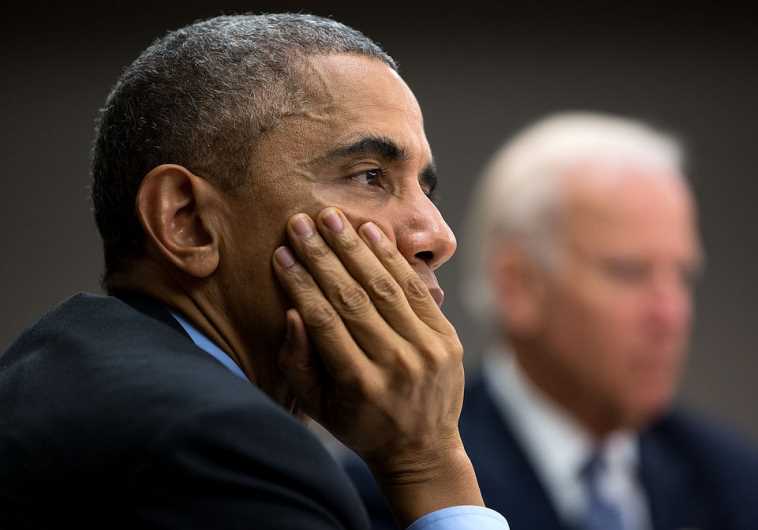
ShowImage (5)US President Barack Obama (L) and Vice President Joe Biden. (photo credit:OFFICIAL WHITE HOUSE PHOTO BY PETE SOUZA)

Most of the antiquities that ISIS plunders in Iraq and Syria make their way to the world market through Turkey. So, too, most of the oil that ISIS produces in Syria and Iraq is smuggled out through Turkey. According to the US Treasury, ISIS has made $1 million-$4m. a day from oil revenue.

Instead of maintaining its current practice of balancing its support for Turkey with its support for the Kurds, under the agreement, the West ditches its support for the Kurds and transfers its support to Turkey exclusively.

************************

While Israel and much of oficial Washington remain focused on the deal President Barack Obama just cut with the ayatollahs that gives them $150 billion and a guaranteed nuclear arsenal within a decade, Obama has already moved on – to Syria.

Obama’s first hope was to reach a deal with his Iranian friends that would leave the Assad regime in place. But the Iranians blew him off.

They know they don’t need a deal with Obama to secure their interests. Obama will continue to help them to maintain their power base in Syria though Hezbollah and the remains of the Assad regime without a deal.

Iran’s cold shoulder didn’t stop Obama. He moved on to his Sunni friend Turkish President Recep Erdogan.

Like the Iranians, since the war broke out, Erdogan has played a central role in transforming what started out as a local uprising into a regional conflict between Sunni and Shiite jihadists.

With Obama’s full support, by late 2012 Erdogan had built an opposition dominated by his totalitarian allies in the Muslim Brotherhood.

By mid-2013, Erdogan’s Muslim Brotherhood- led coalition was eclipsed by al-Qaida spinoffs. They also enjoyed Turkish support.

And when last summer ISIS supplanted al-Qaida as the dominant Sunni jihadist force in Syria, it did so with Erdogan’s full backing. For the past 18 months, Turkey has been ISIS’s logistical, political and economic base.

According to Brett McGurk, the State Department’s point man on ISIS, about 25,000 foreign fighters have joined ISIS in Syria and Iraq. All of them transited through Turkey.

Most of the antiquities that ISIS plunders in Iraq and Syria make their way to the world market through Turkey. So, too, most of the oil that ISIS produces in Syria and Iraq is smuggled out through Turkey. According to the US Treasury, ISIS has made $1 million-$4m. a day from oil revenue.

In May, US commandos in Syria assassinated Abu Sayyaf, ISIS’s chief money manager, and arrested his wife and seized numerous computers and flash drives from his home. According to a report in The Guardian published last week, the drives provided hard evidence of official Turkish economic collusion with ISIS.

Due to Turkish support, ISIS has become a self-financing terrorist group. With its revenue stream it is able to maintain a welfare state regime, attracting recruits from abroad and securing the loyalty of local Sunni militias and former Ba’athist forces.

Some Western officials believed that after finding hard evidence of Turkish regime support for ISIS, NATO would finally change its relationship with Turkey. To a degree they were correct.

Last week, Obama cut a deal with Erdogan that changes the West’s relationship with Erdogan.

Instead of maintaining its current practice of balancing its support for Turkey with its support for the Kurds, under the agreement, the West ditches its support for the Kurds and transfers its support to Turkey exclusively.

The Kurdish peshmerga militias operating today in Iraq and Syria are the only military outfits making sustained progress in the war against ISIS. Since last October, the Kurds in Syria have liberated ISIS-controlled and -threatened areas along the Turkish border.

The YPG, the peshmerga militia in Syria, won its first major victory in January, when after a protracted, bloody battle, with US air support, it freed the Kurdish border town of Kobani from ISIS’s assault.

In June, the YPG scored a strategic victory against ISIS by taking control of Tal Abyad. Tal Abyad controls the road connecting ISIS’s capital of Raqqa with Turkey. By capturing Tal Abyad, the Kurds cut Raqqa’s supply lines.

Last month, Time magazine reported that the Turks reacted with hysteria to Tal Abyad’s capture.

Not only did the operation endanger Raqqa, it gave the Kurds territorial contiguity in Syria.

The YPG’s victories enhanced the Kurds’ standing among Western nations. Indeed, some British and American officials were quoted openly discussing the possibility of removing the PKK, the YPG’s Iraqi counterpart, from their official lists of terrorist organizations.

The YPG’s victories similarly enhanced the Kurds’ standing inside Turkey itself. In the June elections to the Turkish parliament, the Kurdish HDP party won 12 percent of the vote nationally, and so blocked Erdogan’s AKP party from winning a parliamentary majority.

Without that majority Erdogan’s plan of reforming the constitution to transform Turkey into a presidential republic and secure his dictatorship for the long run has been jeopardized.

As far as Erdogan was concerned, by the middle of July the Kurdish threat to his power had reached unacceptable levels.

Then two weeks ago the deck was miraculously reshuffled.

On July 20, young Kurdish activists convened in Suduc, a Kurdish town on the Turkish side of the border, 6 kilometers from Kobani. A suicide bomber walked up to them, and detonated, massacring 32 people.

Turkish officials claim that the bomber was a Turkish Kurd, and a member of ISIS. But the Kurds didn’t buy that line. Last week, HDP lawmakers accused the regime of complicity with the bomber. And two days after the attack, militants from the PKK killed two Turkish policemen in a neighboring village, claiming that they collaborated with ISIS.

At that point, Erdogan sprang into action.

After refusing for months to work with NATO forces in their anti-ISIS operations, Erdogan announced he was entering the fray. He would begin targeting “terrorists” and allow the US air force to use two Turkish air bases for its anti-ISIS operations. In exchange, the US agreed to set up a “safe zone” in Syria along the Turkish border.

Turkish officials were quick to explain that in targeting “terrorists,” the Turks would not distinguish between Kurdish terrorists and ISIS terrorists just because the former are fighting ISIS. Both, they insisted, are legitimate targets.

Erdogan closed his deal in a telephone call with Obama. And he immediately went into action.

Turkish forces began bombing terrorist targets and rounding up terrorist suspects. Although a few of the Turkish bombing runs have been directly against ISIS, the vast majority have targeted Kurdish forces in Iraq and Syria.

Moreover, for every suspected ISIS terrorist arrested by Turkish security forces, at least eight Kurds have been taken into custody.

Then, too, Erdogan has called on AKP lawmakers to begin criminalizing their counterparts from the HDP. Kurdish lawmakers, he urged them, must be stripped of their parliamentary immunity to enable their arrests.

As Erdogan apparently sees things, by going to war against the Kurds, he will be able to reestablish the AKP’s parliamentary majority. Within a few weeks, if the AKP fails to form a governing coalition – and it will – then new elections will be held. The nationalists, who abandoned the AKP in June, will return to the party to reward Erdogan for fighting the Kurds.

As for that “safe area” in northern Syria, as the Kurds see it, Erdogan will use it to destroy Kurdish autonomy. He will flood the zone with Syrian Arab refugees who fled to Turkey, to dilute the Kurdish majority. And he will secure coalition support for the Sunni Arab militias – including those still affiliated with al-Qaida – which will be permitted by NATO to operate openly in the safe area.

Already the Kurds are reporting that the US has stopped providing air support for their forces fighting ISIS in the border town of Jarablus. Those forces were bombed this week by Turkish F-16s.

For their part, despite Erdogan’s pledge to fight ISIS, his forces seem remarkable uninterested in rolling back ISIS achievements. The Turks have no plan for removing ISIS from its strongholds in Raqqa or Haskiyah.

The Obama administration is presenting the deal with Turkey as yet another great achievement.

In an interview with Charlie Rose on Tuesday, McGurk explained that the deal was a long time in the making. It began with a phone conversation between Obama and Erdogan last October and it ended with their phone call last week.

In October, Obama convinced Erdogan not to oppose US air support for the Kurds in Kobani and to enable the US to resupply YPG fighters in Kobani through Turkey. In the second, Obama agreed not to oppose Erdogan’s offensive against the Kurds.

Two years ago, in August 2013, the world held its breath awaiting US action in Syria. That month, after prolonged equivocation amidst mountains of evidence, the Obama administration was forced to acknowledge that Iran’s Syrian puppet Bashar Assad had crossed Obama’s self-declared redline and used chemical weapons against regime opponents, including civilians.

US forces assembled for battle. Everything looked ready to go, until just hours before US jets were scheduled to begin bombing regime targets, Obama canceled the operation. In so doing, he lost all deterrent power against Iran. He also lost all strategic credibility among America’s regional allies.

To save face, Obama agreed to a Russian proposal to have international monitors remove Syria’s chemical weapons from the country.

Last summer, the administration proudly announced that the mission had been completed.

UN chemical weapons monitors had removed Syria’s chemical weapons arsenal from the country, they proclaimed. It didn’t matter to either Obama or Secretary of State John Kerry that by that point Assad had resumed chemical assaults with chlorine-based bombs. Chlorine bombs weren’t chemical weapons, the Americans idiotically proclaimed.

Then last week, the lie fell apart. The Wall Street Journal reported that according to US intelligence agencies, Assad not surrendered his chemical arsenal.

Rather, he hid much of his chemical weaponry from the UN inspectors. He had even managed to retain the capacity to make chemical weapons – like chlorine-based bombs – after agreeing to part with his chemical arsenal.

Assad was able to cheat, because just as the administration’s nuclear deal with the Iranians gives Iran control over which nuclear sites will be open to UN inspectors, and which will be off limits, so the chemical deal gave Assad control over what the inspectors would and would not be allowed to see. So, they saw only what he showed them.

Obama has gone full circle in concluding his deal with Erdogan. Since entering office, Obama has sought to cut deals with both the Sunni jihadists of the Muslim Brotherhood ilk and the Shi’ite jihadists of the Iranian ilk.

His chemical deal with Assad and his nuclear deal with the ayatollahs accomplished the latter goal, and did so at the expense of America’s Sunni Arab allies and Israel.

His deal last week with Erdogan accomplishes the former goal, to the benefit of ISIS, and on the backs of America’s Kurdish allies.

So that takes care of the Middle East. With 17 months left to go till Obama leave office, the time has apparently come for the British to begin to worry.

Turkish journalist: “Turkey prefers ISIS to the Kurds”

July 27, 2015

Turkish journalist: “Turkey prefers ISIS to the Kurds”

In an exclusive interview with JerusalemOnline, Turkish journalist Uzay Bulut described how the Turkish state systematically persecutes the Kurds while at the same time assisting ISIS and other jihadist terror groups.

Jul 27, 2015, 02:03PM | Rachel Avraham

via Israel News – Turkish journalist: “Turkey prefers ISIS to the Kurds” – JerusalemOnline.

Photo Credit: Faridan Abbas

In an exclusive interview with JerusalemOnline, Turkish journalist Uzay Bulut, who writes for the Gatestone Institute, proclaimed that Turkey prefers the ISIS terror organization to the Kurds: “In a television interview on 28 December, 2012, Recep Tayyip Erdogan said that the government was in negotiations with Abdullah Ocalan, the jailed leader of the PKK, in order to resolve the Kurdish issue.  But at the same time, there are also several reports and witness accounts that Turkey has aided the rise of ISIS, enabling the flow of funds and fighters to support it.”

According to Bulut, the establishment of Turkey as a state was based upon the denial of the Kurds identity: “After the state was founded in 1923, the name of the Kurdish land, Kurdistan, the Kurdish language and everything else related to the Kurdish existence was denied. According to the founding ideology of the state, there were no Kurds or Kurdish language. So Kurdistan within Turkey’s borders became a sub-colony without even borders or a name. Kurds have been exposed to numerous massacres and extrajudicial murders for more than 90 years. As a result of these repressive and assimilationist policies, many Kurds have been assimilated into Turkishness but many others have resisted and still demand their national rights.”

Bulut noted that it has been more than 90 years since the establishment of the Turkish Republic but the Kurds within the country are still struggling for political recognition and the Turkish government wants to stop the spread of this desire for national rights at all costs. “The establishment of the Kurdistan Regional Government of Iraq was a huge step in the liberation of Kurdistan,” Bulut noted. “Now Syrian Kurdistan is on the rise; Kurdish male and female defenders there are struggling for their freedom. So Turkey wants to stop this new development. And ISIS is the name of their new plan that they apply to stop the liberation of Kurdistan and to exterminate the Kurds – as much as possible.”

In order to highlight this, Bulut stressed that on July 20th, there was a bomb attack in the Kurdish town of Suruc that killed 32 people during a meeting to discuss reconstruction efforts in Kobane and Turkish fighter jets recently bombed Qandil where the PKK was operating. She also noted that scores of Kurds have been arrested within Turkey this week: “These developments do not signal a positive change in Turkish state policy towards the Kurds.”

In an another instance, Kurds were persecuted by the Turkish state for taking a stand against ISIS: “Esra Yakar, a 5th-year Kurdish student at the Medical School of Dicle University in Diyarbakir, went to the Kurdish province of Kobani a few months ago as a volunteer doctor to help treat Kurds wounded in the fighting with ISIS terrorists. In December 2014, she suffered heavy wounds to her head and right eye during an attack by ISIS. Her referral to a hospital for advanced examination and treatment in Turkey was delayed. In the meantime, she lost her right eye. And while still under medical treatment, she was arrested and jailed in the Sincan prison in Ankara for being a terrorist.”

However, Bulut noted that ISIS terrorists face no such obstacles for receiving medical treatment in Turkey: “Emrah Cakan, a Turkish-born ISIS commander wounded in Syria, got medical treatment at the university hospital in Turkey’s Denizli province in March. As it is evident from this instance and many others, aiding ISIS terrorists while attacking or not helping Kurds has paved the way for the crimes committed by ISIS and other jihadist armies there.”

While the Kurds are being systematically oppressed within Turkey, Bulut noted that Turkey has not only economic relations with jihadist groups but also political relations with them as well: “For Islamic armies to advance and invade places today, they do need fighters as well as logistics and military support. People who believe in Islamic jihad become the fighters – or murderers and rapists – of ISIS and other Islamist armies. But the logistics and military support is mostly provided by the regional states – including Turkey.”

This support is used in order to oppress the Kurds: “ISIS mostly operates in all parts of Kurdistan, threatening the security of all Kurds in the region and even slaughtering or kidnapping and selling them as they did to the Yazidi Kurds in the Shengal region in August 2014. And this seems to be the only concrete outcome of the so-called resolution process in Turkey. No Kurdish rights have been recognized officially and Kurdish massacres are still happening.”

“Subjugating Kurds has been one of the primary policies of Turkey since 1920s,” Bulut emphasized. “A democratic state would choose to grant political and cultural rights to indigenous Kurds but Turkish supremacism, Kurdish-hatred and anti-Kurdish bigotry is so intense in Turkey that Turkey does not seem to aim to achieve real and sustainable peace with the Kurds. And because of that, the Turkish state seems to prefer even a genocidal group like ISIS to the Kurds.”


To gratify Tehran and Moscow, new US-Turkish anti-ISIS war campaign in Syria skirts Assad’s forces

July 26, 2015

To gratify Tehran and Moscow, new US-Turkish anti-ISIS war campaign in Syria skirts Assad’s forces, DEBKAfile, July 25, 2015

Tanks_face_IS_at_Syria_25.7.15

Not exactly by chance, the security zone bisects Kurdish territory and holds back Kurdish forces in their assaults on ISIS.

DEBKAfile’s military sources report that a glance at the map betrays an all-out US-Turkish effort not put up backs in Tehran by interfering with Syrian, Hizballah and pro-Iranian militia operations in critical northern Syrian war zones such as Aleppo or give the Syrian rebels a helping hand in the Idlib province.

*********************

After the second successive night of Turkish cross-border bombing attacks on the Islamic State in northern Syria, Ankara and Washington agreed Saturday, July 25, to name the “security zone” covered by a “partial no fly zone” they had declared in northern Syria the “Islamic State free zone.” Click HERE for full-size map!

This name represents a significant US-Turkish concession to Iran of immunity for its allies, Syrian President Bashar Assad and Hizballah, in order to gain Tehran’s cooperation in the campaign Turkey launched against ISIS Friday. Integral to the deal is also a promise to abstain from using the campaign to grant anti-Assad rebel groups any advantages.

This immunity did not extend to the Kurdish Workers Movement (PKK), which were targeted in the course of Turkish air and ground action in and over the new “security zone.” Those warplanes also flew missions Friday night over the PKK bases and logistical facilities in the Qandil Mountains of northern Iraq. The PKK responded Saturday with an announcement that their armistice with Ankara was over. Turkey may consequently expect a recurrence of Kurdish terrorist violence in its cities,DEBKAfile notes.

High-placed sources in Ankara disclosed details of the US-Turkish deal with Iran. US warplanes will have the use of Turkish air bases, and not just the big Incirlik facility, for staging air strikes against ISIS, so long as Syrian targets are avoided. Washington agreed to Ankara using its air and ground operations against ISIS in Syria to drive into the new “security zone” and push toward the east to continue those attacks – eve if they run up against Kurdish forces which are also fighting ISIS.

The security zone’s area covered by a no-fly zone is 90 km wide and 40km deep, running between Mere, a small town 25  km north o Aleppo in the west, to the northwestern town of Jarabulus, which is situated on the west bank of the Euphrates.

Not exactly by chance, the security zone bisects Kurdish territory and holds back Kurdish forces in their assaults on ISIS.

DEBKAfile’s military sources report that a glance at the map betrays an all-out US-Turkish effort not put up backs in Tehran by interfering with Syrian, Hizballah and pro-Iranian militia operations in critical northern Syrian war zones such as Aleppo or give the Syrian rebels a helping hand in the Idlib province.

The combined US-Turkish action moreover greatly supports the Assad-Hizballah war against ISIS gains in Syria and enhances Iranian and Russian influence in Damascus.

US Secretary of Defense Ashton Carter, in Irbil Friday, July 24, assured leaders of the semiautonomous Kurdish Republic of Iraq. “We are trying to build a force through the territory of Iraq, and someday in Syria, that can do what the peshmerga have achieved.”

At the same time, in Syria, the Kurds and their national aspirations look like losing out dramatically in the fallout from the complex US-Turkish partnership for beating ISIS back.

Turkey Uses ISIS as Excuse to Attack Kurds

July 26, 2015

Turkey Uses ISIS as Excuse to Attack Kurds, Gatestone Institute, Uzay Bulut, July 26, 2015

(Please see also, Will Anyone Help the Kurds? — DM)

  • It appears as if the Turkish government is using ISIS as a pretext to attack the PKK (Kurdistan Workers’ Party).
  • Turkey just announced that its air base at Incirlik will soon be open to coalition forces, presumably to fight ISIS. But the moment Turkey started bombing, it targeted Kurdish positions in Iraq, in addition to targeting ISIS positions in Syria.
  • In Turkey, millions of indigenous Kurds are continually terrorized and murdered, but ISIS terrorists can freely travel and use official border crossings to go to Syria and return to Turkey; they are even treated at Turkish hospitals.
  • If this is how the states that rule over Kurds treat them, why is there even any question as to whether the Kurds should have their own self-government?

Turkey’s government seems to be waging a new war against the Kurds, now struggling to get an internationally recognized political status in Syrian Kurdistan.

On July 24, Turkish media sources reported that Turkish jet fighters bombed Kurdish PKK (Kurdistan Workers’ Party) bases in Qandil, in Iraqi Kurdistan, as well as the Islamic State (ISIS) in Syria.

Turkey is evidently unsettled by the rapprochement the PKK seems to be establishing with the U.S. and Europe. Possibly alarmed by the PKK’s victories against ISIS, as well as its strengthening international standing, Ankara, in addition to targeting ISIS positions in Syria, has been bombing the PKK positions in the Qandil mountains of Iraqi Kurdistan, where the PKK headquarters are located.

There is no ISIS in Qandil.

As expected, many Turkish media outlets were more enthusiastic about the Turkish air force’s bombing the Kurdish militia than about bombing ISIS. “The camps of the PKK,” they excitedly reported, “have been covered with fire.”

It appears as if Turkey’s ruling Justice and Development Party (AKP) is using ISIS as a pretext to attack the PKK. Ankara just announced that its air base at Incirlik will soon be open to coalition forces, presumably to fight ISIS, but the moment Turkey started bombing, it targeted Kurdish positions. Those attacks not only open a new era of death and destruction, but also bring an end to all possibilities of resolving Turkey’s Kurdish issue non-violently.

Prime Minister Ahmet Davutoglu announced that

“a second wave operation against Daesh [ISIS] in Syria was started. Just after that, a very comprehensive operation was carried out against the camps of the terrorist organization PKK in northern Iraq. I am glad that the targets were hit with great success. We have given instructions to start a third wave operation in Syria and a second wave operation in Iraq.”

The “great success” of the Turkish military has brought much damage and injury to even Kurdish civilians — including children. The Kurdish newspaper Rudaw reported that two Kurdish villagers in Duhok’s Berwari region were carried to hospital in the aftermath of a Turkish artillery bombardment in the Amediye region. One of the victims was 12 years old. The second victim lost a leg in an airstrike. Four members of the PKK were killed and several others were injured.

Shortly after military operations against the PKK started, access to the websites of pro-Kurdish newspapers and news agencies was denied “by decree of court.” These websites — including Fırat News Agency (ANF), Dicle News Agency (DIHA), Hawar News Agency (ANHA), Ozgur Gundem newspaper, Yuksekova News, Rudaw and BasNews — are still blocked in Turkey.

ISIS, meanwhile, has not so far made any statement regarding Turkey’s so-called bombings of ISIS in any of its media outlets.

Had Turkish military attacked the PKK alone, and not in addition to attacking ISIS, it would probably have received widespread international condemnation. So to add “legitimacy” to its attacks against the Kurdish PKK — whose affiliate Democratic Union Party (PYD) in Syria and its armed wing, the Kurdish People’s Defense Units (YPG) have been resisting ISIS and other Islamist terrorist groups since 2013 — Turkey declared that it will also attack ISIS. This would give it cover for its attacks against Kurdish fighters.

In 2014, Turkey’s President Recep Tayyip Erdogan described the plan he wanted to carry out in Syria and Iraq: “The problem in Syria should be taken into account. Iraq too should be considered similarly. Moreover, there needs to be a solution that will also deal with the Syrian wing [PYD] of the separatist terrorist organization [PKK].”

The AKP government, dissatisfied with the results of last month’s parliamentary elections, also seems to want to hold new elections, to push the mainly Kurdish HDP Party below the required 10% threshold, and thus force them out of parliament. Perhaps the government thinks that bombing the PKK will generate Turkish nationalist enthusiasm that will work in the AKP’s favor to help it regain a majority in early elections.

Apparently, Turkey does not need Kurdish deputies in its parliament. Apparently, the state prefers to slaughter or arrest the Kurds — as it has done for decades. Why hold talks and reach a democratic resolution when you have the power to murder people wholesale?[1]

Sadly, Turkey has preferred not to form a “Turkish-Kurdish alliance” to destroy ISIS. First, Turkey has opened its borders to ISIS, enabling the growth of the terrorist group. And now, at the first opportunity, it is bombing the Kurds again. According to this strategy, “peace” will be possible only when Kurds submit to Turkish supremacism and abandon their goal of being an equal nation.

In the meantime, Mevlut Cavusoglu, Turkish minister of foreign affairs, said that the Incirlik air base in Turkey has not yet been opened for use by the U.S. and other coalition forces, but that it will be opened in the upcoming period.

Kurdish forces, therefore, are the only forces that are truly resisting the Islamic State.

They have been repressed by Baghdad and murdered by Turkey and Iran.

If this is how the states that rule over Kurds treat them, why is there even any question as to whether the Kurds should have their own self-government?

As a result of the ISIS attacks in the region, the Kurdish PKK — as well as its Syrian Kurdish affiliate, Democratic Union Party (PYD) and its armed wing, Kurdish People’s Defense Units (YPG) — have emerged as the America’s most effective battlefield partners against ISIS. Ever since ISIS became a major force in Syria, the U.S. has apparently relied heavily on YPG to stop ISIS from advancing. According to Henri Barkey, a former State Department specialist on Turkey, “The U.S. has become the YPG’s air force and the YPG has become the U.S.’s ground force in Syria.”

* * *

Attacks on the Kurds were already under way last week. On July 20, a bomb attack in the Kurdish town of Suruc (Pirsus) in Turkey killed 32 people during a meeting of young humanitarian activists, who were discussing the reconstruction of the neighboring Kurdish town of Kobane.

1171The scene of the suicide bombing in Suruc, Turkey. An ISIS suicide bomber murdered 32 people and wounded more than 100 others in a July 20 attack on Kurdish humanitarian activists. (Image source: VOA video screenshot)

The blast took place while the activists were making a statement to the press in the garden of a cultural center. At least 100 others, mostly university students, were wounded. (Graphic video of the explosion)

The suicide bomber was identified through DNA testing, according to reports in the Turkish news media. Seyh Abdurrahman Alagoz was reportedly a 20-year-old Turkish university student, recently returned from Syria, and believed to have had ties to ISIS.

Alagoz targeted a meeting 300 secular activists, members of the Federation of Socialist Youth Associations (SGDF), who gathered at a cultural center in the province of Urfa, opposite the Kurdish town of Kobane in Syrian Kurdistan. As part of an effort to rebuild Kobane, they were preparing to provide aid, give toys to the children there and build a hospital, school, nursery, children’s park, library and a memorial forest for those who had lost their lives in Kobane.

“Work on the building of hospitals and schools needs to be done,” Oguz Yuzgec, the co-president of the federation, said before the explosion. “One of the things we will do is to build a children’s park in Kobane. We will name it after Emre Aslan, who died fighting in Kobane. We are collecting toys. We will participate in the construction of the nursery that the canton of Kobane is planning to build. We have the responsibility of helping the nursery function. We need everybody who knows how to draw and can teach children.”

Mazlum Demirtas, a survivor of the attack, said: “The main one responsible for this incident is the state of Turkey, the AKP fascism, the AKP dictatorship. … It attacked us with its gunmen and gangs. Since yesterday, parents have been collecting the dismembered body parts of their children. They are trying to identify the dismembered bodies. This is called fascism, inhumanity and barbarity.”

Pinar Gayip, another survivor of the attack, said in a telephone interview on the pro-government Haberturk TV that, “Instead of helping the wounded, the murderer-police of the murderer-AKP threw tear gas at the vehicles with which we carried the wounded.” She was taken off the air.

All across Turkish Kurdistan, there were protests condemning the massacre and the government’s alleged involvement in it. Police in Istanbul used plastic bullets and water cannonsagainst people who gathered to remember those murdered in Suruc.

The Turkish authorities briefly blocked access to Twitter last Wednesday to prevent the people from viewing photos of the bombing in Suruc. Officials admitted that Turkey had asked Twitter to remove 107 URLs (web addresses) with images related to the bombing; before the ban, Twitter had already removed 50.

Selahattin Demirtas, the co-chair of the pro-Kurdish Peoples’ Party (HDP), said that state surveillance activities were intensive in Suruc, and that the intelligence service was recording the identity of everyone traveling to and from Suruc.

As Demirtas’s own convoy had recently not been permitted to enter Suruc, he emphasized the extent of state surveillance in the town, and said that nobody could argue that someone could have managed to infiltrate the crowd and carry out the suicide attack without state support.

“Today, we have witnessed in Suruc yet again what an army of barbarity and rape, an army that has lost human dignity, can do,” Demirtas said. “Those who have been silent in the face of ISIS, who have not dared even raise their voice to it, as well as the officials in Ankara who threaten even the HDP every day but caress the head of ISIS, are the accomplices of this barbarity.”

In the meantime, Mehmet Gormez, the head of the Turkish Presidency of Religious Affairs (Diyanet), announced on its Twitter account that the perpetrators of the Suruc attack do not have religion.

However, three days before the massacre in Suruc, about 100 Islamists — alleged to be ISIS sympathizers — had performed mass Islamic Eid prayers in Istanbul. They demanded Islamic sharia law instead of democracy. ISIS sympathizers had performed the same Eid prayers at the same place the year before, as well.

Over the border in Syrian Kurdistan, shortly after the blast in Suruc, a suicide bomber detonated a car bomb at a checkpoint in Kobane. Two Kurdish fighters were killed in the explosion, according to Rami Abdel Rahman, director of the Syrian Observatory for Human Rights.

Last month, a deadly blast hit the Kurdish province of Diyarbakir in Turkey, during an election rally of the pro-Kurdish HDP that was attended by tens of thousands of people. Just before the HDP co-chair Selahattin Demirtas was going to speak, two bombs exploded at different places. Four people were killed, and more than 100 people are estimated to have been wounded. One of the wounded, Lisa Calan, 28, a Kurdish art director from Diyarbakir, lost both legs in the explosion.

As the wounded were being carried to hospitals, police used tear gas against people trying to run from the area in panic

The bomber was reported to be a member of ISIS.

* * *

In Turkey, millions of indigenous Kurds are continually terrorized and murdered, while ISIS terrorists can freely travel and use official border crossings to go to Syria and return to Turkey; they are even treated at Turkish hospitals. Emrah Cakan, for instance, a Turkish-born ISIS commander wounded in Syria, got medical treatment at the university hospital in Turkey’s Denizli province in March.

The Denizli governor’s office issued a written statement on 5 March:

“The treatment of Emrah C. at the Denizli hospital was started upon his own application. The procedural acts concerning his injury were conducted by our border city during his entry to our country and they still continue. And his treatment procedures continue as a part of his right to benefit from health services just like all our other citizens have.”

The “compassion” and hospitality that many Turkish institutions have for ISIS members is not even hidden. The silence of the West is mystifying and disappointing.

The U.S. government cooperates with oppressive regimes — including the terrorist regime of Iran, under which Kurds are forced to live — to the detriment of the Kurds, to the detriment other persecuted peoples, and to the detriment of the future of the West.

Many Middle Eastern regimes are ruled by Islamist, often genocidal governments — so there is not much to expect from them in terms of human rights and liberties.

The Kurds need real support, real arms and real recognition. Otherwise, there does not seem to be much difference between the dictatorial, genocidal Middle Eastern regimes and the West, which used to represent democracy and freedom.
_____________________________

[1] The so-called “peace process” was reportedly started in 2012 and through it, Kurds and the Turkish government were to resolve the Kurdish issue through negotiations.)

US Defense Secy to visit Iraqi Kurdistan after Baghdad

July 24, 2015

US Defense Secy to visit Iraqi Kurdistan after Baghdad, DEBKAfile, July 24, 2015

US Defense Secretary Ashton Carter plans to visit Irbil, capital of the semi-autonomous Kurdish Republic of Iraq, before he leaves Iraq. He will hold talks with the KRG president Massoud Barazani and other Kurish leaders. DEBKAfile: The main purpose of his talks in Irbil is to determine whether the US will provide the peshmerga with heavy weapons, including warplanes and combat helicopters, for grappling with Islamic State’s assaults on their doors. Obama has until now turned down Kurdish requests for this hardware, mainly because of Iranian and Iraqi objections. The Kurds maintain that their army is the only effective force fighting in the field capable of routing ISIS.