Posted tagged ‘Jerusalem – status’

Newsflash: Jerusalem Not on Fire!

December 10, 2017

Newsflash: Jerusalem Not on Fire!, Gatestone InstituteBassam Tawil, December 10, 2017

(Please see also, Palestinian protests won’t swell into mass resistance so long as Arab rulers and Iran see no gain. — DM)

“More journalists than protesters…” — Björn Stritzel, German journalist.

Protests against Israel and the US are not uncommon on the streets of Ramallah, Hebron and Bethlehem. But for the “war correspondents,” there is nothing more exciting than standing behind burning tires and stone throwers and reporting from the heart of the “clashes.” Such scenes make the journalists look as if they are in the middle of a battlefield and are risking their lives to bring the story home to their viewers. They might even receive an award for their “courageous” reporting from danger zones!

Jerusalem is tense, and has long been so, because the Palestinians have not yet managed to come to terms with Israel’s right to exist. That is the real story. The Palestinians rage and rage for only one reason: because Israel exists. Put that in a story and publish it.

The Palestinians declared a three-day-long “rage” spree over US President Donald Trump’s announcement recognizing Jerusalem as Israel’s capital. Thus far, however, it seems that the real anger is showing up in the international media, not on the Palestinian street.

Question: How many foreign journalists does it take to cover the Palestinian reaction to Trump’s announcement? Answer: As many as the Israel-Palestinian-conflict-obsessed-West can manage to send.

The massive presence of the international media in Jerusalem and the West Bank has taken even the Palestinians by surprise. Since Trump’s announcement on December 6, dozens of additional journalists and camera crews have converged on Israel to cover “the big story.”

The American Colony Hotel in Jerusalem, once a favorite haunt of international reporters, is once again packed with journalists from around the world.

Some of these reporters, including those working for American networks, have been flown in from their working posts in London, Paris, Cairo and New York to cover what many of them are already calling the “New Palestinian Intifada.” But is it really a new intifada, or is it simply wishful thinking on the part of the swarm of Palestinian and foreign reporters?

In the past few days, we have seen wild exaggeration in the media as to what is really happening in and around the Old City of Jerusalem. What is evident, however, is that the number of journalists and photographers covering the protests in the city has thus far exceeded the number of Palestinian protesters.

Let us start with Friday, December 8, the final day of the announced Palestinian “rage.” The Palestinian Authority, Hamas and other Palestinian groups told us to expect mass rallies and protests after Friday prayers at the Al-Aqsa mosque compound. So did the reporters.

By early morning, at least six television production trucks were stationed in the small parking lot outside the Damascus Gate, the main entrance to the Old City of Jerusalem. The trucks belonged to various television stations were presumably brought there to film live broadcasts of the anticipated mass protests. Another 70-80 journalists and photographers were waiting, some impatiently, for the Muslim worshippers to finish their prayers and start their protests against President Trump’s announcement.

What we got in the end was a small and peaceful protest of some 40 Palestinians, who chanted slogans against Israel, the US and Arab leaders — including Palestinian Authority (PA) President Mahmoud Abbas, who was dubbed a “traitor” and “Israeli spy.”

Björn Stritzel, an honest and brave German journalist, tweeted from the scene: “More journalists than protesters after Friday prayers.”

The media frenzy was echoed by several other reporters. “Three days of ‘rage’ have passed since Trump’s Jerusalem declaration and Armageddon hasn’t arrived,” remarked journalist Oren Kessler. “One is loath to make predictions of continued calm in the region, but thus far the doomsday prophecies have not materialized.”

French journalist Piotr Smolar, who also waited for the “big” protest, wrote: “Dozens and dozens of journalists at Damascus gate, where nothing has happened until now.”

Joe Dyke, a reporter with Agence France Press (AFP), tweeted this photo showing more journalists than protesters at Damascus Gate. He wrote: “Small Palestinian protest at Damascus Gate in Jerusalem broken up by the Israeli police. They seemed to object to a picture of Trump as a toilet.”

Dyke later reported that he had “just walked through Jerusalem’s Old City and the situation is very calm. More police on streets but no issues as yet. Tourists milling about.”

The following day, Saturday December 9, we witnessed a repetition of the same scenario in Jerusalem. The city was relatively quiet, but the presence of journalists and photographers loomed large. At noon, a small group of Palestinians (25-30) staged a protest on the main business thoroughfare of east Jerusalem, Salah Eddin Street, while chanting slogans against Israel and the US.

Here is how the journalist Seth Frantzman of The Jerusalem Post, who was at the scene, described the situation: “There are more people with cameras here than anyone clashing (with police) at the moment.”

Frantzman later had this to say about the “clash”: “There are as many media and onlookers taking photos here as there are youth and police waiting for the clashes.”

There are nearly 300,000 Arabs living in Jerusalem, and the truth is that the vast majority did not take part in any of the small protests, which were staged deliberately as a show for the dozens of journalists who converged on the city. In fact, there were more protesters on the streets of Berlin, Cairo, Valencia (Spain) and Istanbul than in Jerusalem itself. With the exception of the two incidents at Damascus Gate and Salah Eddin Street, the remaining 28 Arab neighborhoods of Jerusalem were mostly quiet, with nothing dramatic happening.

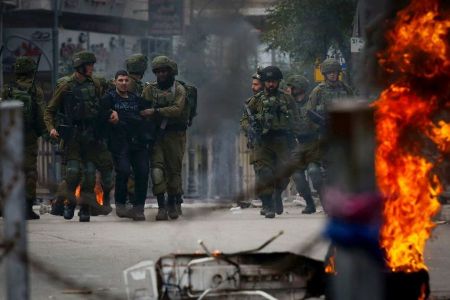
The bored journalists were forced to don their helmets and bullet-proof vests and head to the West Bank, in the hope of capturing scenes of the “New Intifada.” What they found in the West Bank, however, was not unusual: minor “clashes” between stone throwers and Israeli soldiers occur almost every day.

Protests against Israel and the US are not uncommon on the streets of Ramallah, Hebron and Bethlehem. But for the “war correspondents,” there is nothing more exciting than standing behind burning tires and stone throwers and reporting from the heart of the “clashes.” Such scenes make the journalists look as if they are in the middle of a battlefield and are risking their lives to bring the story home to their viewers. They might even receive an award for their “courageous” reporting from danger zones!

That is what happens when you are afraid to go to Yemen, Libya, Syria or Iraq to cover the real bloodshed.

Let us be frank. The large number of journalists dispatched to Israel expected — even hoped — that Trump’s announcement would trigger a new Palestinian intifada.

This way, the media could blame Trump for “igniting violence,” instigating instability and “derailing” the peace process. It is all about media-based Trump-hatred. Of course, it is also about media-based Israel-hatred, searching for any excuse to blame the Jews for the “suffering” of the Palestinians. The journalists, however, will not let those pesky facts get in their way; they continue to report as if Jerusalem is engulfed in flames. The reality on the ground, though, is far from that.
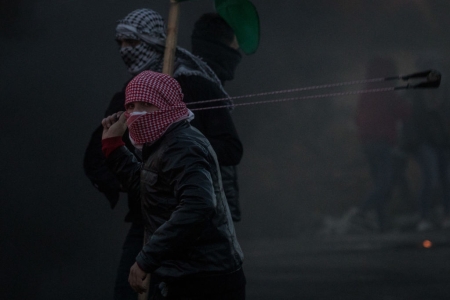
A Palestinian man uses a slingshot to hurl stones at Israeli border police near Ramallah, on December 9, 2017. (Photo by Chris McGrath/Getty Images)

  • “More journalists than protesters…” — Björn Stritzel, German journalist.
  • Protests against Israel and the US are not uncommon on the streets of Ramallah, Hebron and Bethlehem. But for the “war correspondents,” there is nothing more exciting than standing behind burning tires and stone throwers and reporting from the heart of the “clashes.” Such scenes make the journalists look as if they are in the middle of a battlefield and are risking their lives to bring the story home to their viewers. They might even receive an award for their “courageous” reporting from danger zones!
  • Jerusalem is tense, and has long been so, because the Palestinians have not yet managed to come to terms with Israel’s right to exist. That is the real story. The Palestinians rage and rage for only one reason: because Israel exists. Put that in a story and publish it.

The Palestinians declared a three-day-long “rage” spree over US President Donald Trump’s announcement recognizing Jerusalem as Israel’s capital. Thus far, however, it seems that the real anger is showing up in the international media, not on the Palestinian street.

Question: How many foreign journalists does it take to cover the Palestinian reaction to Trump’s announcement? Answer: As many as the Israel-Palestinian-conflict-obsessed-West can manage to send.

The massive presence of the international media in Jerusalem and the West Bank has taken even the Palestinians by surprise. Since Trump’s announcement on December 6, dozens of additional journalists and camera crews have converged on Israel to cover “the big story.”

The American Colony Hotel in Jerusalem, once a favorite haunt of international reporters, is once again packed with journalists from around the world.

Some of these reporters, including those working for American networks, have been flown in from their working posts in London, Paris, Cairo and New York to cover what many of them are already calling the “New Palestinian Intifada.” But is it really a new intifada, or is it simply wishful thinking on the part of the swarm of Palestinian and foreign reporters?

In the past few days, we have seen wild exaggeration in the media as to what is really happening in and around the Old City of Jerusalem. What is evident, however, is that the number of journalists and photographers covering the protests in the city has thus far exceeded the number of Palestinian protesters.

Let us start with Friday, December 8, the final day of the announced Palestinian “rage.” The Palestinian Authority, Hamas and other Palestinian groups told us to expect mass rallies and protests after Friday prayers at the Al-Aqsa mosque compound. So did the reporters.

By early morning, at least six television production trucks were stationed in the small parking lot outside the Damascus Gate, the main entrance to the Old City of Jerusalem. The trucks belonged to various television stations were presumably brought there to film live broadcasts of the anticipated mass protests. Another 70-80 journalists and photographers were waiting, some impatiently, for the Muslim worshippers to finish their prayers and start their protests against President Trump’s announcement.

What we got in the end was a small and peaceful protest of some 40 Palestinians, who chanted slogans against Israel, the US and Arab leaders — including Palestinian Authority (PA) President Mahmoud Abbas, who was dubbed a “traitor” and “Israeli spy.”

Björn Stritzel, an honest and brave German journalist, tweeted from the scene: “More journalists than protesters after Friday prayers.”

The media frenzy was echoed by several other reporters. “Three days of ‘rage’ have passed since Trump’s Jerusalem declaration and Armageddon hasn’t arrived,” remarked journalist Oren Kessler. “One is loath to make predictions of continued calm in the region, but thus far the doomsday prophecies have not materialized.”

French journalist Piotr Smolar, who also waited for the “big” protest, wrote: “Dozens and dozens of journalists at Damascus gate, where nothing has happened until now.”

Joe Dyke, a reporter with Agence France Press (AFP), tweeted this photo showing more journalists than protesters at Damascus Gate. He wrote: “Small Palestinian protest at Damascus Gate in Jerusalem broken up by the Israeli police. They seemed to object to a picture of Trump as a toilet.”

Dyke later reported that he had “just walked through Jerusalem’s Old City and the situation is very calm. More police on streets but no issues as yet. Tourists milling about.”

The following day, Saturday December 9, we witnessed a repetition of the same scenario in Jerusalem. The city was relatively quiet, but the presence of journalists and photographers loomed large. At noon, a small group of Palestinians (25-30) staged a protest on the main business thoroughfare of east Jerusalem, Salah Eddin Street, while chanting slogans against Israel and the US.

Here is how the journalist Seth Frantzman of The Jerusalem Post, who was at the scene, described the situation: “There are more people with cameras here than anyone clashing (with police) at the moment.”

Frantzman later had this to say about the “clash”: “There are as many media and onlookers taking photos here as there are youth and police waiting for the clashes.”

There are nearly 300,000 Arabs living in Jerusalem, and the truth is that the vast majority did not take part in any of the small protests, which were staged deliberately as a show for the dozens of journalists who converged on the city. In fact, there were more protesters on the streets of Berlin, Cairo, Valencia (Spain) and Istanbul than in Jerusalem itself. With the exception of the two incidents at Damascus Gate and Salah Eddin Street, the remaining 28 Arab neighborhoods of Jerusalem were mostly quiet, with nothing dramatic happening.

The bored journalists were forced to don their helmets and bullet-proof vests and head to the West Bank, in the hope of capturing scenes of the “New Intifada.” What they found in the West Bank, however, was not unusual: minor “clashes” between stone throwers and Israeli soldiers occur almost every day.

Protests against Israel and the US are not uncommon on the streets of Ramallah, Hebron and Bethlehem. But for the “war correspondents,” there is nothing more exciting than standing behind burning tires and stone throwers and reporting from the heart of the “clashes.” Such scenes make the journalists look as if they are in the middle of a battlefield and are risking their lives to bring the story home to their viewers. They might even receive an award for their “courageous” reporting from danger zones!

That is what happens when you are afraid to go to Yemen, Libya, Syria or Iraq to cover the real bloodshed.

Let us be frank. The large number of journalists dispatched to Israel expected — even hoped — that Trump’s announcement would trigger a new Palestinian intifada.

This way, the media could blame Trump for “igniting violence,” instigating instability and “derailing” the peace process. It is all about media-based Trump-hatred. Of course, it is also about media-based Israel-hatred, searching for any excuse to blame the Jews for the “suffering” of the Palestinians. The journalists, however, will not let those pesky facts get in their way; they continue to report as if Jerusalem is engulfed in flames. The reality on the ground, though, is far from that.
Palestinian protests won’t swell into mass resistance so long as Arab rulers and Iran see no gain

December 9, 2017

Palestinian protests won’t swell into mass resistance so long as Arab rulers and Iran see no gain, DEBKAfile, December 9, 2017

All the same, it would be premature to completely rule out a major escalation being sparked by some unforeseen event. For instance, a cell of Tanzim, the armed wing of Abbas’ Fatah party, may decide to join Hamas, the Iranian-backed Jihad Islami and the extremist Popular Front – all of them with a long record of terrorism – for a spectacular terrorist attack on an Israeli or American target.  For the time being, there is no sign of this building up. The ordinary Palestinian man in the street has a job to go to on Sunday and appears to have settled on a moderate demonstration of protest for Trump’s Jerusalem strategy.

***************************************

The Palestinian Hamas finds itself shouting alone for a massive armed uprising, raising only muted echoes in the Arab world and the Palestinian street in protest at the US president’s Jerusalem decision. Most adult Palestinians, when asked, admit they see no point in sending their sons in harm’s way. Yet Israel’s mainstream media astonishingly report with great bombast every Hamas threat as though a world power is threatening World War III.

The Hamas rulers of the Gaza Strip have it in their power to unleash a barrage of rockets against their Israeli neighbors that would be damaging and lethal enough to trigger a major confrontation with Israel’s Defense Forces. They have done this before, but not so far now. In the exchange of blows Friday night, Dec. 8, Hamas clearly pulled its punches, showing that its rhetoric was just that. Smaller factions were allowed to fire off a few short-range rockets of low accuracy in the direction of Beersheba, Ashkelon, Ashdod and Israeli locations next door to the Gaza Strip. Most exploded on open ground or fell short while still in Gazan air space; one exploded harmlessly on a Sderot street and one was intercepted by an Iron Dome battery. Two Hamas activists were killed in Israeli retaliatory air strikes against three Hamas military facilities in the Gaza Strip.

Hamas leaders understand that their leeway for extreme action is narrower than ever before. They are a lone voice, are woefully short of funds, have no real backers in the Arab world and their popularity in the wider Palestinian community is waning.

By the time the anti-US, anti-Israel Palestinian protests reached their third day, Saturday, the following picture was taking shape:

The Palestinian Authority chairman Mahmoud Abbas (Abu Mazen) decided against taking up Hamas’ call to arms when together they could have ignited a major conflagration. After all, President Donald Trump’s recognition of Jerusalem as Israel’s capital left in ruins the diplomatic campaign he led for years as his signature for unilateral recognition of Palestinian statehood.

In the phone conversation he held with Hamas leader Ismail Haniyeh on Wednesday, shortly after Trump announced his decision on Jerusalem, Abu Mazen briefly considered joining the Hamas call for an extreme response. He pulled back when he realized that Haniyeh’s plan was to use the Jerusalem crisis as his pretext for hanging onto rule in the Gaza Strip. This would have wrecked the “reconciliation” deal in which Egypt invested long months as broker, in the hope of unifying the two Palestinian factions and bringing the Gaza Strip under Palestinian Authority rule. When Abu Mazen saw Haniyeh’s game, he backed away. The anti-Trump rallies in West Bank towns Thursday and Friday were consequently modest, compared with so many convulsions in the past.

Iran too pulled back from putting in its oar for inflaming Palestinian ire, because it has bigger fish to fry – even through Hizballah’s leader Hassan Nasrallah pushed hard for Tehran to instruct Hamas and the Islamic Jihad in the Gaza Strip to escalate the anti-Trump protest. Tehran’s attention is fixed on the turning-point in the Yemen civil war at Saudi Arabia’s back door, generated by the Revolutionary Guards success, in conjunction with Hizballah, to assassinate former president Ali Abdullah Saleh, after he switched sides from the Houthi insurgents to the Saudi-led coalition fighting them. The Houthis were then directed to wipe out the opposition by executing hundreds of officers and commanders loyal to Saleh.

The Palestinians are also small beer in the calculations of most members of the Arab League. Arab foreign ministers convened in Cairo Saturday, Dec. 9, for an “emergency session on Jerusalem.”  But it was summoned by the Palestinian Authority and one other Arab leader, Jordan’s King Abdullah, who has fallen out with most of his colleagues, badly enough for Riyadh and Abu Dhabi, for instance, to cut of financial assistance to Amman.

Abu Mazen found Saudi Arabia and other senior Arab League members otherwise engaged. Crown Prince Muhammed Bin Salman was busy replacing Adel Al-Jubeir as foreign minister with his brother, Prince Khaled bin Salman, and Egyptian President Abdel-Fatteh El-Sisi showed no interest in the session. Abbas quickly saw which way the wind was blowing in the Palestinians Arab hinterland.

In New York too, the emergency UN Secretary Council session on Jerusalem, after hearing the PA’s complaint against President Trump, ended with a joint expression of “disappointment” by the ambassadors of France, Germany, Italy, Sweden and the UK. “We disagree with the US decision to recognize Jerusalem as the capital of Israel,” they said. “The status of Jerusalem must be determined through negotiations between Israelis and Palestinians leading to a final status agreement.” After that, the “disappointed” powers returned home.

All the same, it would be premature to completely rule out a major escalation being sparked by some unforeseen event. For instance, a cell of Tanzim, the armed wing of Abbas’ Fatah party, may decide to join Hamas, the Iranian-backed Jihad Islami and the extremist Popular Front – all of them with a long record of terrorism – for a spectacular terrorist attack on an Israeli or American target.  For the time being, there is no sign of this building up. The ordinary Palestinian man in the street has a job to go to on Sunday and appears to have settled on a moderate demonstration of protest for Trump’s Jerusalem strategy.

Defiant Haley chides fuming Security Council members: ‘Change is hard’

December 9, 2017

Defiant Haley chides fuming Security Council members: ‘Change is hard’, Times of Israel, December 8, 2017

US Ambassador to the United Nations Nikki Haley delivers a speech during a United Nations Security Council meeting on December 8, 2017 in New York City (Stephanie Keith/Getty Images/AFP)

In a Wednesday address from the White House, Trump defied worldwide warnings and insisted that after repeated failures to achieve peace a new approach was long overdue, describing his decision to recognize Jerusalem as the seat of Israel’s government as merely based on reality.

The move was hailed by Israel’s Prime Minister Benjamin Netanyahu and by leaders across much of the Israeli political spectrum. Trump stressed that he was not specifying the boundaries of Israeli sovereignty in the city, and called for no change in the status quo at the city’s holy sites.

************************************

At an emergency meeting of the UN Security Council on Friday, the US Ambassador to the United Nations Nikki Haley said President Donald Trump knew his decision to recognize Jerusalem as Israel’s capital would raise “questions and concerns,” but that he took it to advance peace between Israel and the Palestinians.

“I understand the concerns that members have in calling this session,” Haley said. “Change is hard.”

Washington’s move left it isolated as one after another fellow UN Security Council members — Russia, France, the UK, China, Egypt, Jordan and a host of others — condemned the announcement.

The debate unfolded at a largely symbolic emergency meeting of the council — no vote on a resolution was planned, as the US has veto power — two days after Trump reversed two decades of US policy on the holy city.

The meeting was convened by eight of the 14 non-US members of the council. It seemed a vivid show of the discord triggered by Trump’s announcement, which included plans to move the US embassy in Israel from Tel Aviv to Jerusalem.

Asked what he expected to come from the UN meeting, one diplomat said: “Nothing.” Another said the session would show US “isolation” on the issue.

US Ambassador to the United Nations Nikki Haley speaks with Israeli Ambassador to the United Nations Danny Danon before a United Nations Security Council on December 8, 2017 in New York City. (Stephanie Keith/Getty Images/AFP)

Haley said Washington was more committed to peace “than we’ve ever been before — and we believe we might be closer to that goal than ever before.”

Haley said anyone who used Washington’s actions as a pretext for violence was “only showing” they were not partners for peace.

She noted that past Israeli-Palestinian agreements have been signed on the White House lawn, and that if there is a new agreement, there is “a good likelihood” it will be signed there as well, “because the United States has credibility of both sides.”

At the meeting, the UN coordinator for the Middle East peace process warned Security Council members of a risk of “violent escalation.”

Nickolay Mladenov warned that if the Israeli-Palestinian conflict isn’t resolved, “it risks being engulfed in the vortex of religious radicalism throughout the Middle East.”

A Palestinian protestor uses a sling shot to throw stones towards Israeli security forces during clashes after the Friday prayers in the city center of the West Bank town of Hebron on December 8, 2017. (AFP/Hazem Bader)

Mladenov spoke of “a serious risk” of “a chain of unilateral actions” that would push the goal of peace further away. He pointed to the latest clashesbetween Palestinian protesters and Israeli forces and some calls for a new intifada, or uprising.

Mladenov also reiterated Secretary-General Antonio Guterres’s words that the Israeli-Palestinian conflict must be resolved through direct negotiations and that “there is no Plan B to the two-state solution.”

Palestinian envoy Riyad Mansour spoke of the “global consensus” against Washington’s recognition and said Trump’s decision to recognize Jerusalem as Israel’s capital and ultimately move the US embassy there should be reconsidered and rescinded.

Palestinian envoy to the UN Riyad Mansour at the UN Security Council, December 8, 2017 (United Nations)

“There can be no just and lasting solution to the Palestine question without a just solution” to Jerusalem, he said, calling the city “the heart of Palestine.”

Israel’s ambassador to the UN Danny Danon told the council the Trump declaration was “a positive step.”

He called on council members to “send a clear message there is never an excuse for violence. Violence must never be used as a threat.”

Israel’s Ambassador to the UN Danny Danon holds up an ancient coin from Jerusalem during his address to the UN Security Council debate on Jerusalem, December 8, 2017 (UN Photo/Eskinder DebebeIsrael)

Danon said the recognition of Jerusalem “should serve as a reality check for the Palestinians and for the nations of the world” that “recognizing Jerusalem as Israel’s capital is a critical and necessary step for peace.”

Danon held up an ancient coin from Jerusalem during his speech, and said that King David made Jerusalem his capital 3,000 years ago.

The British ambassador to the UN, Matthew Rycroft, said flat out that Britain disagreed with Trump’s move.

“These decisions are unhelpful for the prospects for peace in the region,” Rycroft said.

He urged Trump to now come up with detailed proposals for an Israel-Palestinian peace accord, a goal which has eluded the US and the international community for decades.

In a Wednesday address from the White House, Trump defied worldwide warnings and insisted that after repeated failures to achieve peace a new approach was long overdue, describing his decision to recognize Jerusalem as the seat of Israel’s government as merely based on reality.

The move was hailed by Israel’s Prime Minister Benjamin Netanyahu and by leaders across much of the Israeli political spectrum. Trump stressed that he was not specifying the boundaries of Israeli sovereignty in the city, and called for no change in the status quo at the city’s holy sites.

U.S. Still Won’t List Jerusalem as Israel’s Capital on Official Docs, Passports, Maps

December 9, 2017

U.S. Still Won’t List Jerusalem as Israel’s Capital on Official Docs, Passports, Maps, Washington Free Beacon , December 8, 2017

(Does this mean that everything is on-hold until the Palestinian Authority and Israel agree on who owns what in Jerusalem? How can the Amerian Embassy be built in Jerusalem until the matter is resolved? — DM)

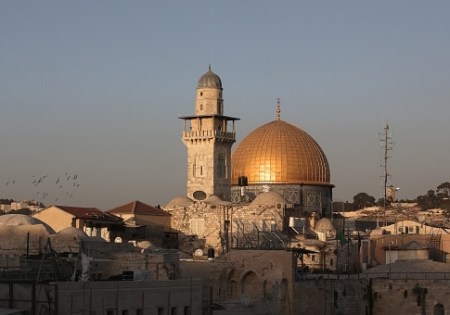
The Old City in Jerusalem / Getty Images

“The specific boundaries of Israeli sovereignty in Jerusalem are subject to final status negotiations,” the official said. “The United States is not taking a position on boundaries or borders.”

***************************

The United States still will not formally recognize Jerusalem as being located in Israel on official documents, maps, and passports, despite President Donald Trump’s announcement earlier this week that America is formally recognizing the holy city as Israel’s capital, according to State Department officials who spoke to the Washington Free Beacon about the matter.

Despite Trump’s declaration, which was formally codified on Wednesday into U.S. policy, the State Department is taking a more nuanced position on the matter, drawing some ire in Congress among pro-Israel lawmakers who accuse the State Department of undermining Trump’s efforts.

State Department officials this week had difficulty stating as fact that Jerusalem is located within Israel, instead trying to parse the issue as still subject to diplomatic negotiations.

State Department officials who spoke to the Free Beacon about the situation said that while it supports Trump’s declaration that Jerusalem is the capital of Israel, it is not yet at the point where it will list Jerusalem as part of Israel on passports, maps, and official documents. This means that official documents, such as passports, will not, at this point, list “Jerusalem, Israel” as a place that exists.

The State Department’s careful parsing of the issue has already drawn outrage on Capitol Hill, where some lawmakers are describing this as part of an effort to undermine the Trump White House’s clear-cut declaration on the matter.

“The president is the commander-in-chief and America’s sole organ when it comes to conducting foreign policy,” Rep. Ron DeSantis (R., Fla.), a member of the House Foreign Affairs Committee, told the Free Beacon.  “Article II of the Constitution does not vest this authority in bureaucrats in the State Department.”

“The State Department must permit Americans born in Jerusalem to list ‘Jerusalem, Israel’ on their passports and must follow the logical implications of this historic recognition in other policy areas,” DeSantis said. ” President Trump’s decision to recognize Jerusalem as Israel’s capital was the right thing to do and enjoys broad support from the American people; an entrenched bureaucracy has no right to stymie this decision.”

A State Department official who spoke to the Free Beacon about the matter made clear that the United States now “recognizes Jerusalem as the capital of Israel and its seat of government.”

However, “the specific boundaries of Israeli sovereignty in Jerusalem are subject to final status negotiations,” the official said, explaining that the holy city’s exact location and placement in Israel proper is still up for debate.

“While we are affirming the current and historic reality of Jerusalem’s role as Israel’s capital and seat of government, any ultimate determination of sovereignty over Jerusalem will flow from the results of negotiations between the parties,” the State Department official explained.

With regards to U.S. passports for Americans born in Jerusalem, there will be no formal change in American policy on the matter.

The issue of listing “Jerusalem, Israel” as a person’s birthplace has been a hot button issue over the years, with a case even being adjudicated by the U.S. Supreme Court.

Americans born in Jerusalem still will not be able to list Israel as the birth nation on their passports.

“There is no change in policy at this time,” according to the State Department official. “We will provide any new guidance as and when appropriate.”

With regards to official maps and documentation, the State Department is still engaged in a process to figure out how exactly to classify Jerusalem.

“The president is taking a specific step in affirming that the United States believes that Jerusalem has and will continue to serve as Israel’s capital—and the U.S. is not backing off efforts towards encouraging the parties to resolve their differences over final status issues in a comprehensive peace agreement,” according to the State Department official.

However, the president’s declaration is limited in nature and is being reviewed by the State Department as it moves forward.

“The specific boundaries of Israeli sovereignty in Jerusalem are subject to final status negotiations,” the official said. “The United States is not taking a position on boundaries or borders.”

When asked if official documents will bear the words, “Jerusalem, Israel,” the State Department could not provide a concrete answer.

“This is quite a complex issue that we continue to study and work through,” the official said.

One senior official at a large, national pro-Israel organization cautioned against viewing the State Department’s stance as an effort to subvert Trump’s declaration on Jerusalem.

“It’s too early to panic,” the official, speaking on background, told the Free Beacon. “The administration was focused on getting the broad policy correct and meeting the president’s demand that we finally acknowledge the simple reality Jerusalem is Israel’s capital.”

“Now they’re going to take a month to figure out the consequences,” explained the official, who has been briefed on the situation. “Implementing pro-Israel fact-based policy is a new thing for some of our diplomats, and many others have forgotten how that works in recent years, so people are willing to give them some time. If at the end of the process nothing has changed, there will be broad criticism – to say nothing of pro-Israel voters around the county who will be bitterly let down.”

President Trump’s Jerusalem Move Deals a Blow to Terror

December 8, 2017

President Trump’s Jerusalem Move Deals a Blow to Terror, FrontPage Magazine, Daniel Greenfield, December 8, 2017

It’s not about a “piece of land here or there”, as the PA’s top Sharia judge clarifies, it’s a religious war. And Israel is not just a religious war between Muslims and Jews, but a shifting frontier in the larger war between Islam and the rest of the world. It’s another territory to be conquered on the way to Europe. And Europe is another territory to be conquered on the way to America. 

There can be no peace in a religious war. Nor is there anything to negotiate.

“It isn’t possible to compromise on or negotiate over Jerusalem,” Habash had said. “In politics there can be compromises here and there… In politics there can be negotiation. However, in matters of religion, faith, values, ethics, and history, there can be no compromises.”

*********************************

Hamas has announced that President Trump’s recognition of Jerusalem as the capital of Israel has opened the “gates of hell.” Its Muslim Brotherhood parent has declared America an “enemy state.”

The Arab League boss warned that the Jerusalem move “will fuel extremism and result in violence.” The Jordanian Foreign Minister claimed that it would “trigger anger” and “fuel tension.”

“Moderate” Muslim leaders excel at threatening violence on behalf of the “extremists”.

The Organization of Islamic Cooperation (OIC) warned that recognizing Jerusalem will trigger an Islamic summit and be considered a “blatant attack on the Arab and Islamic nations.”

The last time the OIC was this mad, someone drew Mohammed. And wasn’t stoned to death for it.

According to the Saudi ambassador, it will “heighten tensions”. The Deputy Prime Minister of Islamist Turkey called it a “major catastrophe”. And the leader of the largest Muslim country in Europe, France’s Emmanuel Macron “expressed concern” that America will “unilaterally recognize Jerusalem.”

PLO leaders and minions meanwhile made it quite clear that now the dead peace process is truly dead.

The Palestinian Authority’s boss warned that recognizing Jerusalem will “destroy the peace process”. The PLO’s envoy in D.C. threatened that it would be the “final lethal blow” and “the kiss of death to the two-state solution”. A top PA advisor claimed it “will end any chance of a peace process.”

A day later, the peace process is still as alive and as dead as it ever was.

Since the chance of a peace process is about the same as being hit by lightning while scoring a Royal Flush, that “chance” doesn’t amount to anything. The peace process has been deader than Dracula for ages. And even a PLO terrorist should know that you can’t threaten to kill a dead hostage.

The only kiss of death here came from Arafat.

Peace wasn’t killed though. It was never alive. Because a permanent peace is Islamically impossible.

“The world will pay the price,” warned Mahmoud Habash, the Palestinian Authority’s Supreme Sharia judge.

Habash isn’t just the bigwig of Islamic law, he’s also the Islamic adviser to the leader of the Palestinian Authority. And Abbas, the terror organization’s leader, was there when Habash made his remarks.

Previously Habash had declared that the Kotel, the Western Wall of the fallen Temple, the holiest site in Judaism, “can never be for non-Muslims. It cannot be under the sovereignty of non-Muslims.”

While the official warnings from the Palestinian Authority, the Arab League and assorted other Islamic organizations have claimed that recognizing Jerusalem threatens the non-existent peace process, Habash had in the past had made it quite clear that the issue wasn’t land, it was Jihad.

“The struggle over this land is not merely a struggle over a piece of land here or there. Not at all. The struggle has the symbolism of holiness, or blessing. It is a struggle between those whom Allah has chosen for Ribat and those who are trying to mutilate the land of Ribat,” Habash had declared.

Ribat means that Israel is a frontier outpost between the territories of Islam and the free world. The Muslim terrorists who call themselves “Palestinians” have, according to the Abbas adviser, been chosen for “Ribat” to stand guard on the Islamic frontier and expand the territories of Islam.

The sense of Ribat is that the Jihadists may not yet be able to win a definitive victory, but must maintain their vigilance for the ultimate goal, which a Hadith defines as performing Ribat “against my enemy and your enemy until he abandons his religion for your religion.”

That is what’s at stake here.

It’s not about a “piece of land here or there”, as the PA’s top Sharia judge clarifies, it’s a religious war. And Israel is not just a religious war between Muslims and Jews, but a shifting frontier in the larger war between Islam and the rest of the world. It’s another territory to be conquered on the way to Europe. And Europe is another territory to be conquered on the way to America.

There can be no peace in a religious war. Nor is there anything to negotiate.

“It isn’t possible to compromise on or negotiate over Jerusalem,” Habash had said. “In politics there can be compromises here and there… In politics there can be negotiation. However, in matters of religion, faith, values, ethics, and history, there can be no compromises.”

There’s an extremely thin line in Islamic theocracy between politics and religion. But what Habash is really saying is that there might be room to negotiate how many times a week the garbage truck comes to pick up the trash, but not who gives him the orders. Islamic supremacism is non-negotiable.

The Supreme Sharia judge warned Trump that moving the embassy is “a declaration of war on all Muslims.” Why all Muslims? Because the “Palestinians” are a myth. Islamic conquests are collective.

And it’s not as if any of the Muslim leaders disagree.

Why is Jerusalem their business? It’s not empathy for the “Palestinians”. Kuwait ethnically cleansed huge numbers of them. They aren’t treated all that much better in other Arab Muslim countries.

It’s not about them. The Muslim settlers in Israel are just there as “Ribat”. They’re the frontier guard of the Islamic conquest. Much like the Sharia patrols in the No-Go Zones of Europe or the Jihadists in Kashmir, the Rohingya in Burma and all the other Islamic Volksdeutsche variants of occupying colonists.

Sunni may fight Shiite. Muslim countries, tribes and clans may war with each other. But the land they’re fighting over belongs to all of them collectively.

It can never belong to non-Muslims. That is the essence of Islam where conquest is religion.

That’s true of Jerusalem. And of the entire world.

That is what is truly at stake in the war over Jerusalem. When countries refuse to move their embassies to Jerusalem, they are submitting to Sharia law and Islamic supremacism. The issue at stake is the same one as drawing Mohammed. It’s not about a “piece of land”. It’s about the supremacy of Islam.

Refusing to move the embassy doesn’t prevent violence. Islamic terrorism continues to claim lives in Jerusalem. And Islamic violence has been a constant before Israel liberated Jerusalem or before there was even a free Israel. The Arab League, the Jordanians, the Saudis and the rest of the gang aren’t promising an end to the violence. Instead they warn that if we don’t obey, it will grow worse.

That’s not diplomacy. It’s a hostage crisis.

President Trump made the right decision by refusing to let our foreign policy be held hostage. We don’t win by giving in to terrorists.

We win by resisting them.  Or else we’ll have to live our lives as hostages of Islamic terror.

Jerusalem is a metaphor. Every free country has its own Jerusalem. In America, it’s the First Amendment. Our Jerusalem is not just a piece of land, it’s a value. And the Islamic Jihad seeks to intimidate us into giving it up until, as the Hadith states, we abandon our religion for Islam.

Moving the embassy to Jerusalem will do much more for America than it will for Israel.

The Israelis already know where their capital is. We need to remember where we left our freedom. Islamic terrorists win when they terrorize us into being too afraid to do the right thing.

President Trump sent a message to the terrorists that America will not be terrorized.

Previous administrations allowed the terrorists to decide where we put our embassy. But Trump has made it clear that we won’t let Islamic terrorists decide where we put our embassies, what cartoons we will draw or how we live our lives. That is what real freedom means.

Israel to build 14,000 new housing units in Jerusalem

December 8, 2017

Israel to build 14,000 new housing units in Jerusalem, Israel National News, Ido Ben Porat, December 8, 2017

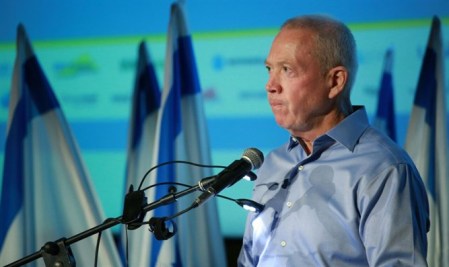
Yoav GalantMiriam Tzahi

Construction and Housing Minister Yoav Galant (Kulanu) is promoting a plan to build 14,000 housing units in Jerusalem, Hahadashot (formerly Channel 2 News) reported on Thursday.

The move follows President Donald Trump’s announcement on Wednesday that the United States recognizes Jerusalem as the capital of Israel.

According to the report, the government would promote the construction of 5,000 housing units in Atarot, in addition to a new neighborhood in the area which is being promoted by the Jerusalem municipality.

Another 1,000 housing units are expected in Pisgat Ze’ev and are waiting for approval, 3,000 units will be built in Katamon and 5,000 units will be built in Reches Lavan.

“Following President Trump’s historic declaration, I intend to promote and strengthen the construction in Jerusalem,” said Minister Galant.

Other ministers in the Cabinet expressed support for Galant and told Hahadashot, “There are no more excuses. There are no more reasons why we should not build in the city, when the president of the United States views it as the undisputed capital of the State of Israel.”

Obtaining Peace by Pressuring the PLO, Not Israel

December 7, 2017

Obtaining Peace by Pressuring the PLO, Not Israel, The Point (FrontPage Magazine, Daniel Greenfield, December 7, 217

Let’s peel back the blatant double standard behind the media’s Jerusalem outrage. And the claims that this will somehow destroy any possibility for peace.

Whenever the problem of peace is discussed, the prescription is always pressuring Israel, not the PLO.

Jerusalem was one of the pressure points. 

Trump’s move applied pressure to the PLO’s Palestinian Authority in exactly the way that the left had wanted pressure to be applied to Israel. He did to the PLO, what Obama had been doing to Israel by covertly backing the PA’s statehood moves.

The double standard is that pressuring Israel in this way is deemed a very good thing because the Jews are somehow the obstacles to peace. While pressuring the PLO is a terrible thing because that will destroy the cause of peace.

Why is pressuring Israel a good thing and pressuring Islamic terrorists a bad thing?

That’s the bias that needs addressing.

It’s the PLO that has rejected every peace proposal. Despite the attacks on Prime Minister Netanyahu, it was Arafat and Abbas who made the decision to walk away from peace negotiations.

If anyone needs to be pressured to come to the table, it’s the PLO. And that is what President Trump did.

U.S.-Based Israel Bashers’ Fury and Disapproval Over Trump’s Jerusalem Recognition

December 7, 2017

U.S.-Based Israel Bashers’ Fury and Disapproval Over Trump’s Jerusalem Recognition, Investigative Project on Terrorism, Ariel Behar, December 7, 2017

“This may surprise you, but the embassy move does not challenge Palestinian/Arab/Muslim claims to the city,” wrote Jonathan Schanzer, vice president of research at the Foundation for Defense of Democracies. “What is happening right now is reflective of the Palestinian-Israeli conflict historically: Palestine advocates fighting against Israel rather than for the Palestinian cause.”

**********************************************

Anti-Zionist groups were quick to pounce Wednesday following President Trump’s proclamation acknowledging Jerusalem as Israel’s capital.

In a statement, Jewish Voice for Peace (JVP), a virulently anti-Israel organization, “unequivocally condemn[ed] President Trump’s announcement that he will begin the process of moving the U.S. embassy to Jerusalem as part of recognizing Jerusalem as Israel’s capital, a move that would make the U.S. the only country in the world to do so.”

In contrast, Russia recognized West Jerusalem as Israel’s capital in April, and after Trump’s speech Wednesday, the Czech Republic also said it would recognize West Jerusalem as Israel’s capital.

But for those who reject Israel’s very existence, Wednesday was a difficult day.

#Jerusalem is not the capital of Israel no matter how many times Trump says it,” wrote political activist Linda Sarsour, who has argued Zionists can’t be feminists and that “nothing is creepier than Zionism. “He doesn’t speak for me.”

Good thing she cleared that up.

Trump’s proclamation “effectively hands Israel a blank political check for its illegal annexation of Jerusalem and legitimizes Israel’s ongoing displacement and disenfranchisement of the city’s Palestinian residents,” said the U.S. Campaign for Palestinian Rights (USCPR), an organization leading the push for an economic boycott of Israel.

This statement, along with Sarsour’s, ignores the reality that Jerusalem has been Israel’s capital since 1949. It is home to its parliament, the Knesset, as well as the prime minister’s residence. The statements also deliberately ignore Trump’s specific caveat that the United States is “not taking a position of any final status issues, including the specific boundaries of the Israeli sovereignty in Jerusalem, or the resolution of contested borders. Those questions are up to the parties involved.”

The relocation of the American embassy affects peace talks only if the Palestinians choose to make that so.

Still, American Muslims for Palestine’s (AMP) national policy director Osama Abuirshaid joined a protest outside the White House to express outrage and say that Trump should be held responsible for any resulting violence. “Now our demand is very clear that this administration should inject some common sense, should inject some logic and withdraw this announcement,” he said.

At a news conference Tuesday, Council on American Islamic Relations (CAIR) Executive Director Nihad Awad argued that the decision to move the embassy was due to the disproportionate influence of the “pro-Israel lobby” in Congress.

Recognizing Jerusalem as Israel’s capital and committing to move the U.S. embassy there is “a reckless move that has put the interest of a foreign power and its domestic lobby above the interests of the United States,” he said. Awad, who publicly expressed support for Hamas in 1994 and was linked to a Muslim Brotherhood-run Hamas-support network, all but called Congress corrupt for the original, bipartisan legislation that makes the move possible.

“It is really the interest of those politicians who voted, and they voted. And they voted against the interest of their own country because of the money, the pressure and the favors that they get from the pro-Israel lobby,” Awad said.

He repeated that message Wednesday standing with Abuirshaid outside the White House.

The Senate voted 90-0 in June to reaffirm “the Jerusalem Embassy Act of 1995 (Public Law 104–45) as United States law, and calls upon the President and all United States officials to abide by its provisions.”

As many people have commented this week, no peace proposal has ever contemplated Israel relinquishing Jerusalem as its capital. While some argue the U.S. embassy move should wait for a peace agreement, that strategy has shown no results and ignores the realities of the Israeli government.

“This may surprise you, but the embassy move does not challenge Palestinian/Arab/Muslim claims to the city,” wrote Jonathan Schanzer, vice president of research at the Foundation for Defense of Democracies. “What is happening right now is reflective of the Palestinian-Israeli conflict historically: Palestine advocates fighting against Israel rather than for the Palestinian cause.”

As President Trump said in his speech, “Peace is never beyond the grasp of those willing to reach.”

Abbas lacks important Arab support against Trump’s recognition of Jerusalem

December 7, 2017

Abbas lacks important Arab support against Trump’s recognition of Jerusalem, DEBKAfile, December 7, 2017

Israeli soldiers clash with Palestinians during a protest in the West Bank city of Hebron, following US President Donald Trump’s announcement that he recognized Jerusalem as the capital of Israel, on December 7, 2017. Photo by Wisam Hashlamoun/Flash90

It is no secret in Ramallah or Nablus that King Abdullah of Jordan has fallen out of favor with the majority of Arab rulers, especially the Saudi crown prince and strongman, the UAE emir and the Egyptian president.  DEBKAfile’s Middle East sources reveal that Riyadh has gone so far as to cut off financial assistance to Amman.

*************************************

The Palestinian leader Mahmoud Abbas only found Jordan’s King Abdullah and Turkey’s President Tayyip Erdogan to back him up Thursday, Dec. 7, in the first 24 hours after US President Donald Trump’s announced recognition of Jerusalem as Israel’s capital. The Arab street’s first response was also minor in scale and pitch – less than 100 protesters at most of the rallies. Prepared for an outbreak of “the third Palestinian intifada (uprising)”, foreign correspondents arrived on the scene kitted up in helmets and vests, only to find a fairly low-key event to cover rather than a violent backlash. The Palestinian sources reported 140 injured so far, most of them from inhaling gas and three from rubber bullets.

The Palestinians were called out by their leaders to stage massive protest marches in East Jerusalem, Hebron, Ramallah, Nablus, Jenin and Tulkarm, as well as at the Gaza border fence.  Stones were hurled at Israeli troops and tires set on fire for the cameras, but nothing more lethal at Damascus Gate in Jerusalem, for instance, than bottles of water. Only in Hebron did real clashes occur between security forces and protesters. They were broken up with tear gas, stun grenades and rubber bullets.

Extra Israeli security and military forces have been mobilized for the weekly Muslim Friday prayers at the mosques and Saturday. Will Palestinian protesters then turn out in force, as they have so many times before?

It must be said that, while most Arab and Muslim rulers have gone through the motions of condemning Trump’s pro-Israeli act, few are actively opposing it, which the Palestinian street has not been slow to notice. Their zeal for a violent confrontation with Israeli security forces is therefore less than expected – especially after their leader Abu Mazen had to fall back on the Jordanian king and Turkish president for support, instead of finding a rousing condemnation from the entire Arab leadership.

It is no secret in Ramallah or Nablus that King Abdullah of Jordan has fallen out of favor with the majority of Arab rulers, especially the Saudi crown prince and strongman, the UAE emir and the Egyptian president.  DEBKAfile’s Middle East sources reveal that Riyadh has gone so far as to cut off financial assistance to Amman.

Jordan has always been good friends with Turkey and so Abdullah flew to Ankara Wednesday to find a backer ahead of the Trump announcement. However, the ordinary Palestinian has a low opinion of President Erdogan and his efforts to set up an anti-American, Anti-Israel Islamic Front never found much response in Palestinian towns.

And so Abu Mazen’s panicky visit to Amman to talk with Abdullah is not expected to change the mood on the Palestinian street. At the same time, the situation is inflammable enough to catch fire in a trice. A large-scale Palestinian terrorist attack against Israel is always on the cards, and the potential for Israeli security forces facing a raging mob  to inflict a large number of casualties cannot be ruled out for triggering a major outbreak.

Donald Trump’s Jerusalem declaration amid dire warnings of mayhem and violence

December 7, 2017

Donald Trump’s Jerusalem declaration amid dire warnings of mayhem and violence | Anne’s Opinions, 7th December 2017


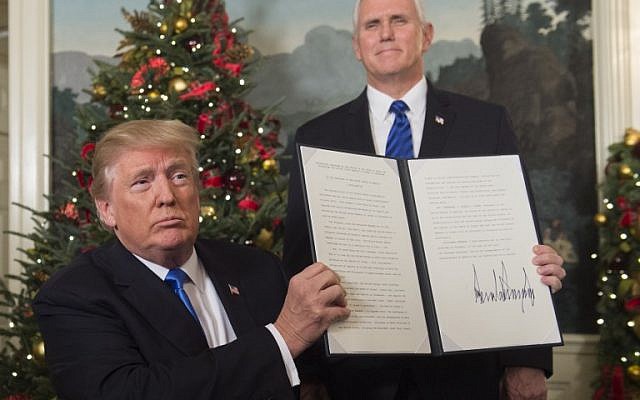
US President Donald Trump holds up a signed memorandum after he delivered a statement on Jerusalem from the Diplomatic Reception Room of the White House in Washington, DC on December 6, 2017 as US Vice President Mike Pence looks on. (Saul Loeb/AFP)

After days of speculation and rumour-mongering, Donald Trump delivered the speech of a lifetime – at least in the lifetime of the Jewish People.

I never thought he would have it in him, but I give Trump full credit. The speech was excellent. He hit all the right notes without committing any great diplomatic faux pas. He declared America’s recognition of Jerusalem as the capital of Israel – “recognizing reality” as he accurately called it. He simply reaffirmed the blindingly obvious – that Jerusalem has always been the capital of Israel and that it’s about time America recognized that fact

He walked a diplomatic tightrope by not going into the details of exactly where the US Embassy will be located or how long it will take to get it ready. In this way he satisfied the Israelis, and if the Palestinians were so inclined, they could be satisfied too, since the issue of the Embassy was left open-ended.

He also didn’t mention the dreaded two-state solution – which by now should be recognized by all as a non-starter. He simply reaffirmed the United States’ commitment to peace and to settling the Arab-Israeli conflict, calling on all sides for restraint.

In fact the speech was startling for the lack of any great new insights. It was the very fact that every point was obvious, and has always been evident for anyone who cared to look, that was so unusual – because when it comes to Middle East Peace-processing, wishful thinking is the name of the game. This speech was almost an “Emperor has no clothes” moment, except that here Donald Trump was playing the part of the naive child who states the reality for all the world to see.

I will post below the video of Trump’s speech and the full text, but before that I just want to make a couple of points:

The Arabs, the Palestinians in particular, are threatening “days of rage” in response to Trump’s declaration. But did they ever declare “days of peace” when countless UN resolutions were passed in their favour? How about that miserable UN Security Council Resolution 2334, which declared all of Judea and Samaria as Palestinian territory, and calling all the settlements illegal, which was passed with the aid, abetting and active assistance of the United States under President Barack Obama? Did we get peace talks and normalization, or offers of land-swaps? We did not. We simply got more of the same old violence: stabbings, car-rammings, shootings and more. So please, give us Israelis one reason why we should take any more notice of these latest threats of days of rage than any other days of rage that are routinely declared on the slightest of pretexts.

The Palestinians assert that America is no longer an honest broker in the peace talks. My question is “what peace talks?”. And was America an honest broker when those UN resolutions were going your way?

Similarly with other countries who have strongly objected to Trump’s declaration. Britain’s Theresa May is going to express her concern to Trump, saying (wrongly) that Jerusalem is intended to be a shared capital between Israel and the Palestinians.

The UN, the EU and even the Pope criticized Trump for his move. All expressed their “concern for peace”. But where were they when Israel’s streets were exploding? When “lone-wolf” stabbers ran rampant. When car-rammings took place on a nearly daily basis? And all this while Jerusalem was NOT recognized as Israel’s capital, and while “peace talks” were ostensibly taking place!

So why should Israel, or Donald Trump for that matter, take the slightest notice of their ignorant opinion? Why do they think their dire warnings will resonate when they never paid more than lip service to the violence committed daily against Israeli civilians.

Where was their pressure on the Palestinians to come to the negotiating table? Where was their pressure on the Palestinians to stop the violence, stop the incitement?

Only the Trump Administration has had the courage to shake up the playing board and restate the facts as they are, rather than as anyone would wish them to be. In perfect timing, maybe not coincidentally, the Taylor Force act was just passed in Congress, targeting moneys passed from the Palestinian Authority to terrorists in payment for their terrorist acts.

None of this though is to derogate from the fact that Trump did not deny any Palestinian claims to Jerusalem, nor did he rule out the possibility of a Palestinian state. All they need to do for that is come to the table.

**********************

And now to the main event. Watch the video of Trump’s speech:

https://youtu.be/OAKxZeFc8Jk

And here is the full text:

THE PRESIDENT: Thank you. When I came into office, I promised to look at the world’s challenges with open eyes and very fresh thinking. We cannot solve our problems by making the same failed assumptions and repeating the same failed strategies of the past. Old challenges demand new approaches.

My announcement today marks the beginning of a new approach to conflict between Israel and the Palestinians.

In 1995, Congress adopted the Jerusalem Embassy Act, urging the federal government to relocate the American embassy to Jerusalem and to recognize that that city — and so importantly — is Israel’s capital. This act passed Congress by an overwhelming bipartisan majority and was reaffirmed by a unanimous vote of the Senate only six months ago.

Yet, for over 20 years, every previous American president has exercised the law’s waiver, refusing to move the US embassy to Jerusalem or to recognize Jerusalem as Israel’s capital city.

Presidents issued these waivers under the belief that delaying the recognition of Jerusalem would advance the cause of peace. Some say they lacked courage, but they made their best judgments based on facts as they understood them at the time. Nevertheless, the record is in. After more than two decades of waivers, we are no closer to a lasting peace agreement between Israel and the Palestinians. It would be folly to assume that repeating the exact same formula would now produce a different or better result.

Therefore, I have determined that it is time to officially recognize Jerusalem as the capital of Israel.

While previous presidents have made this a major campaign promise, they failed to deliver. Today, I am delivering.

I’ve judged this course of action to be in the best interests of the United States of America and the pursuit of peace between Israel and the Palestinians. This is a long-overdue step to advance the peace process and to work towards a lasting agreement.

Israel is a sovereign nation with the right like every other sovereign nation to determine its own capital. Acknowledging this as a fact is a necessary condition for achieving peace.

It was 70 years ago that the United States, under President Truman, recognized the State of Israel. Ever since then, Israel has made its capital in the city of Jerusalem — the capital the Jewish people established in ancient times. Today, Jerusalem is the seat of the modern Israeli government. It is the home of the Israeli parliament, the Knesset, as well as the Israeli Supreme Court. It is the location of the official residence of the Prime Minister and the President. It is the headquarters of many government ministries.

For decades, visiting American presidents, secretaries of state, and military leaders have met their Israeli counterparts in Jerusalem, as I did on my trip to Israel earlier this year.

Jerusalem is not just the heart of three great religions, but it is now also the heart of one of the most successful democracies in the world. Over the past seven decades, the Israeli people have built a country where Jews, Muslims, and Christians, and people of all faiths are free to live and worship according to their conscience and according to their beliefs.

Jerusalem is today, and must remain, a place where Jews pray at the Western Wall, where Christians walk the Stations of the Cross, and where Muslims worship at Al-Aqsa Mosque.

However, through all of these years, presidents representing the United States have declined to officially recognize Jerusalem as Israel’s capital. In fact, we have declined to acknowledge any Israeli capital at all.

But today, we finally acknowledge the obvious: that Jerusalem is Israel’s capital. This is nothing more, or less, than a recognition of reality. It is also the right thing to do. It’s something that has to be done.

That is why, consistent with the Jerusalem Embassy Act, I am also directing the State Department to begin preparation to move the American embassy from Tel Aviv to Jerusalem. This will immediately begin the process of hiring architects, engineers, and planners, so that a new embassy, when completed, will be a magnificent tribute to peace.

In making these announcements, I also want to make one point very clear: This decision is not intended, in any way, to reflect a departure from our strong commitment to facilitate a lasting peace agreement. We want an agreement that is a great deal for the Israelis and a great deal for the Palestinians. We are not taking a position on any final status issues, including the specific boundaries of the Israeli sovereignty in Jerusalem, or the resolution of contested borders. Those questions are up to the parties involved.

The United States remains deeply committed to helping facilitate a peace agreement that is acceptable to both sides. I intend to do everything in my power to help forge such an agreement. Without question, Jerusalem is one of the most sensitive issues in those talks. The United States would support a two-state solution if agreed to by both sides.

In the meantime, I call on all parties to maintain the status quo at Jerusalem’s holy sites, including the Temple Mount, also known as Haram al-Sharif.

Above all, our greatest hope is for peace, the universal yearning in every human soul. With today’s action, I reaffirm my administration’s longstanding commitment to a future of peace and security for the region.

There will, of course, be disagreement and dissent regarding this announcement. But we are confident that ultimately, as we work through these disagreements, we will arrive at a peace and a place far greater in understanding and cooperation.

This sacred city should call forth the best in humanity, lifting our sights to what it is possible; not pulling us back and down to the old fights that have become so totally predictable. Peace is never beyond the grasp of those willing to reach.

So today, we call for calm, for moderation, and for the voices of tolerance to prevail over the purveyors of hate. Our children should inherit our love, not our conflicts.

I repeat the message I delivered at the historic and extraordinary summit in Saudi Arabia earlier this year: The Middle East is a region rich with culture, spirit, and history. Its people are brilliant, proud, and diverse, vibrant and strong. But the incredible future awaiting this region is held at bay by bloodshed, ignorance, and terror.

Vice President Pence will travel to the region in the coming days to reaffirm our commitment to work with partners throughout the Middle East to defeat radicalism that threatens the hopes and dreams of future generations.

t is time for the many who desire peace to expel the extremists from their midst. It is time for all civilized nations, and people, to respond to disagreement with reasoned debate –- not violence.

And it is time for young and moderate voices all across the Middle East to claim for themselves a bright and beautiful future.

So today, let us rededicate ourselves to a path of mutual understanding and respect. Let us rethink old assumptions and open our hearts and minds to possible and possibilities. And finally, I ask the leaders of the region — political and religious; Israeli and Palestinian; Jewish and Christian and Muslim — to join us in the noble quest for lasting peace.

Thank you. God bless you. God bless Israel. God bless the Palestinians. And God bless the United States. Thank you very much. Thank you.

(The proclamation is signed.)

************************

Israel expressed its gratitude to America by lighting up Jerusalem in red, white and blue:

And here is Israeli Prime Minister Binyamin Netanyahu giving due thanks to Donald Trump for recognizing our capital, Jerusalem: