Posted tagged ‘Israel’

[UPDATED] Syria moves all its fighter jets to Russian base

April 19, 2017

Syria moves all its fighter jets to Russian base, DEBKAfile, April 19, 2017

The Pentagon disclosure came ironically just hours after a senior Israeli military officer confidently informed military correspondents in Tel Aviv that the mechanism introduced for Russian-Israeli air force coordination in Syria had been successfully adopted by other nations operating in Syria, such as Turkey and the United States. He reported that the arrangement included reciprocal visits once every two months by heads of the operations divisions of the two armies.

These visits will probably go the same way now as the entire arrangement.

**********************************

Syria has moved all its fighter aircraft to the Russian Hmeimim air base in Latakia three weeks after 59 US Tomahawk cruise missiles knocked out one-fifth of its air force at the Shayrat base, in retaliation for a chemical attack on civilians in Idlib. This was reported Wednesday night, April 19, by the Pentagon. The Russian high command in Syria has its seat at that base.

DEBKAfile’s military sources report that the Syrian air force will operate henceforth under Russian protection and behind the advanced Russian S-300 and S-400 air defense shield without fear of US reprisals.

President Vladimir Putin’s response to the Trump administration’s call to distance Moscow from the Assad regime is therefore a flat rejection. He is instead fortifying Russian support for that regime.

The upsurge of Russian-US military tension places at risk the operational coordination accords prevailing between the air forces of Russia, the US and Israel in Syrian skies.

Syrian operational staff officers working in Hmeimim will now have access to the advanced Russian surveillance instruments tracking the movements of all foreign aircraft moving through Syrian air space. Syrian intelligence officers will also be close to Russian SIGINT facilities which the Russian spy agency GRU has installed there. In other words, by a single move, the Russians have substantially upgraded the Syrian air force’s operational and intelligence capabilities.

How does this affect the Syrian and Iranian air freight traffic ferrying military supplies from Iran? Where will they deliver their cargoes? Will they too be allowed to land at the Russian base in Latakia? If they are, the Israeli air force will be prevented from cutting down the flow of Iranian weapons for Hizballah. The new move more or less buries the Russian-Israeli agreements covering Syrian skies.

The Pentagon disclosure came ironically just hours after a senior Israeli military officer confidently informed military correspondents in Tel Aviv that the mechanism introduced for Russian-Israeli air force coordination in Syria had been successfully adopted by other nations operating in Syria, such as Turkey and the United States. He reported that the arrangement included reciprocal visits once every two months by heads of the operations divisions of the two armies.

These visits will probably go the same way now as the entire arrangement.

Why Is the US Still Funding Palestinian Terrorism?

April 19, 2017

Why Is the US Still Funding Palestinian Terrorism? Gatestone Institute, Shoshana Bryen, April 19, 2017

(Please see also, Towards the pending Abbas visit to Washington D.C. — DM)

Jamil Tamimi, 57, knew that if he committed an act of terror, he would be lionized by the Palestinian Authority (PA) and — perhaps more importantly — that, if he were killed or sent to prison, his family would be taken care of financially.

“The PLO Commission was new only in name. The PLO body would have the ‎same responsibilities and pay the exact same amounts of salaries to prisoners… PA Chairman Mahmoud Abbas retained overall supervision of ‎the PLO Commission.” — Palestinian Media Watch.

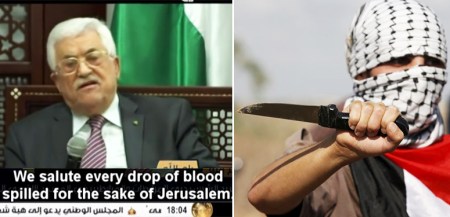
In 2016 Bashar Masalha, who murdered U.S. Army veteran Taylor Force and wounded several others, was hailed on official PA media outlets as a “martyr.” A few months later, Abbas said on PA TV, “We welcome every drop of blood spilled in Jerusalem…. With the help of Allah, every martyr will be in heaven, and every wounded will get his reward.”

The U.S. government should let the PLO and PA know that we are onto their game. Disincentivizing terrorism by closing the PLO office in Washington would be a good first step.

British exchange student Hannah Bladon was stabbed to death on a Jerusalem light rail train last Friday. Her murderer was identified as an East Jerusalem resident who had previously been convicted of molesting his daughter and had tried to commit suicide. Failing at that, he apparently opted for terrorism, on the assumption that the police would kill him. They didn’t. “This,” the Shin Bet said in a statement, “is another case, out of many, where a Palestinian who is suffering from personal, mental or moral issues chooses to carry out a terror attack in order to find a way out of their problems.”

“Suicide by cop” is not unheard of, but the real incentives need to be spelled out.

Jamil Tamimi, 57, knew that if he committed an act of terror, he would be lionized by the Palestinian Authority (PA) and — perhaps more importantly — that, if he were killed or sent to prison, his family would be taken care of financially.

To take the PA leader, Mahmoud Abbas, at his word, the PA itself does not pay salaries or pensions to terrorists in Israeli jails or to their families; the money — instead! — comes from the Palestine Liberation Organization (PLO). That sleight-of-hand would make this a perfect time for the United States, an ally of the UK and properly appalled by terrorism, to take a step it has been avoiding for more than 25 years: to close the PLO office in Washington — preferably before the planned visit by Abbas in May.

The PLO was once understood to be a terrorist organization and a terror umbrella. It hijacked airplanes and threw an elderly disabled man in a wheelchair overboard from a cruise ship. Black September, an arm of the PLO, murdered 11 Israeli Olympic athletes in Munich. The PLO has committed acts of horrific terror in Israel — including massacring bus drivers and their families on holiday. Twenty-five adults and 13 children were killed and 71 others wounded. The PLO has also committed acts of war against the United States by killing American diplomats in Sudan.

In the 1970s and 80s, the U.S. generally knew what it was looking at.

During the Reagan-to-Bush “41”-transition, however, the U.S. dropped its ban on officially talking to then-PLO Chairman Yasser Arafat. (Full disclosure: Colin Powell, then national security advisor, gave this author a “heads up”: “Everyone has something to say,” he said. “The U.S. government already knows what Arafat has to say,” I said, and it is unacceptable.” He was not interested.)

Talking was not the same as opening an office; that move was still prohibited by the Anti-Terrorism Act of 1987. However, in the post-Oslo Accords euphoria, Senate legislation permitted the PLO an official mission in Washington “to implement the accords,” and it allowed President Clinton to waive the law barring U.S. funds to international organizations that gave money to the PLO. The House passed similar legislation. Rep. Howard L. Berman (D-CA) said at the time:

“This legislation provides a limited, temporary and conditional waiver of restrictions in United States law that would seriously impede the ability of Israel and the PLO to proceed with negotiating and implementing their landmark peace agreement.”

It was “conditional” on the PLO meeting its Oslo Accords obligations, including refraining from terrorism and renouncing international moves that would impede bilateral agreement on final status issues. While the legislation was, as Berman said, “temporary,” it came with the usual waiver provision, ultimately allowing Presidents to do as they wished.

Presidents, therefore, beginning with President Clinton, did exactly that, even as the Palestinian Authority supplanted the PLO as the “peace partner” and ignored the Oslo Accords at will.

In 2003, the height of the so-called “second intifada,” the Palestinian terror war against Israel, Colin Powell, by then Secretary of State, waffled through a statement suggesting that the Palestinians kindly refrain from not killing so many Jews. “We need to see a more concerted effort against the capacity for terrorist activity on the Palestinian side… It’s not enough just to have a cease-fire.” He then noted “progress in reducing attacks against Israelis” — but without mentioning that the IDF and Shin Bet had reduced them; not the PA. Nevertheless, President Bush exercised the waiver.

A 2011, a Palestinian bid for recognition as a full member of the UN failed, but the waiver remained. Over U.S. objections, “Palestine” joined the International Criminal Court in 2015. President Barack Obama waived the sanctions every six months — right through two Hamas wars against Israel.

Largely through the work of Palestinian Media Watch (PMW), the question of payments to terrorists and their families has come to the fore. Worried about foreign aid payments from the U.S. and the EU, in 2014 the Palestinian Authority claimed it stopped paying salaries and that future money would come from a new PLO Commission of Prisoner Affairs. However, PMW reported from Palestinian sources:

The PLO Commission was new only in name. The PLO body would have the ‎same responsibilities and pay the exact same amounts of salaries to prisoners; the ‎former PA Minister of Prisoners’ Affairs, Issa Karake, became the Director of the new ‎PLO Commission and PA Chairman Mahmoud Abbas retained overall supervision of ‎the PLO Commission.

Tower Magazine reported that in 2015, a year after the PA “officially” transferred authority over Palestinian prisoners to the PLO, it also transferred an extra 444 million shekels (more than $116 million) to the PLO — nearly the same amount that the PA had allocated in the previous years to its now-defunct Ministry of Prisoners’ Affairs.

Citing PMW, Tower wrote that the transfer to the PLO was meant to evade pressure from Western governments that demanded an end to terrorist salaries — specifically the United States and the UK, which froze payments to the PA in 2016 over the problem.

In the end, perhaps, it does not matter whose bank account transfers the money to whose bank account:

In 2016 Bashar Masalha, who murdered U.S. Army veteran Taylor Force and wounded several others, was hailed on official PA media outlets as a “martyr.” A few months later, Abbas said on PA TV, “We welcome every drop of blood spilled in Jerusalem. This is pure blood, clean blood, blood on its way to Allah. With the help of Allah, every martyr will be in heaven, and every wounded will get his reward.”


Abbas has not said much about Jamil Tamimi, last Friday’s murderer, and it is time to stop encouraging, threatening or demanding that he do so. Rather, the U.S. government should let the PLO and PA know that we are onto their game. Disincentivizing terrorism by closing the PLO office in Washington would be a good first step.

Towards the pending Abbas visit to Washington D.C.

April 19, 2017

Towards the pending Abbas visit to Washington D.C., Israel National News, David Bedein, April 17, 2017

(Please see also, UNRWA Won’t Be Changing School Textbooks and Curriculum. — DM)

With President Donald Trump set to greet Mahmoud Abbas, head of the Palestinian Authority, at the White House on May 3rd, the time has come to examine how the US allowed the PLO to  trample upon ten US government PLO policy guidelines, and to examine what the current US administration can do to see to it that the PLO does not trample on Trump.

The US recognized the PLO during  the final month of the Reagan administration December 1988, on the condition that the PLO would recognize UN resolution 242, which required the PLO to  recognize the right of every nation to secure boundaries  – especially Israel . The PLO immediately ignored this requirements for US recognition.

It is not too late for the US to ask the PLO, under the aegis of the Palestinian Authority, to recognize UN resolution 242, which it has yet to do.

The US acted as  a witness and guarantor of the PLO/Israel Oslo Accords, signed on the White House lawn on September 13, 1993. Known as the DOP, “The Declaration of Principles”, it spelled out mutual recognition of Israel and the PLO, and the formal denunciation of violence and terror. The DOP was premised on its ratification by the Israeli Knesset and by the central committee of the PLO. The Israeli Knesset ratified the DOP on Sept, 26, 1993, by a vote of 61 to 50, with nine abstentions. The PLO central committee was set to meet in Tunis to ratify the DOP on October 6, 1993. However, the one Israeli correspondent dispatched to Tunis to witness the PLO ratification, Pinhas Inbari, on the staff of the left wing newspaper Al HaMishmar, reported from Tunis that the PLO chairman announced that he could not get a quorum of the PLO to attend, so the PLO Central Committee did not convene to ratify the DOP.

It is not too late for the US, as witness and guarantor of the Oslo Accord, to insist the PLO, through the aegis of the PA, ratify the DOP.  Otherwise, the agreement between Israel and the PLO does not hold water.

US law allowed the PLO, all of whose components were designated by the US law as FTOs, Foreign Terrorist Organizations, to open an embassy in D.C. and allowed the PLO to dispatch representatives to the USA, but only if PLO would cancel the PLO Covenant, the document which defined the purpose of the PLO:  To replace and destroy the State of Israel. The PNC, the PLO National Council, met in special session on April 24, 1996, with the stated purpose that this session would renounce and cancel the PLO Covenant. The PLO, at that session, filmed by the Institute for Peace Education Ltd, only announced the formation of a committee to consider changes in the PLO Covenant.

A video and protocol of the session was sent to the US embassy in Tel Aviv, and to the US Congress. Prof. Yehoshua Porat, expert on the PLO and a candidate of  the left wing Meretz party for the Knesset, reviewed the video and protocols of the PNC session, and affirmed that the PLO had not cancelled the PLO Covenant.  The US embassy in Tel Aviv, however, ignored what had actually transpired at the PNC, and instead reported to the White House and to the US Congress that the PLO had fulfilled the requirements of US law with the cancellation of the PLO Covenant, allowing the US to roll out a red carpet to welcome PLO chairman Yassir Arafat as a dignitary in Washington one week later. The PLO was allowed to open an official embassy , which has functioned ever since, conditional on the US President signing a waiver every six months which extends the non- terror status of the PLO.

It is not too late for the US to insist the head of the PLO and the Palestinian Authority call the PNC into a special session to cancel the PLO covenant, as required by US law, before Abbas enters the White House on May 3rd, 2017.  Otherwise, the entry of Abbas to the US represents a challenge to US law.

As an integral part of the US Aid package to the Palestinian Authority, the US funds PA schools which instituted a war education curriculum, despite US objections. That PA curriculum does not prepare Palestinian Arab children to live in state alongside Israel. That curriculum indoctrinates all Palestinian Arab children to conduct a Jihad to liberate Palestine, all of what they considere Palestine, with no attempt to train the next generation for peace with Israel.

It is not too late for the US to demand an overhaul of PA education to prepare the next generation for peace.

US law forbids any agency that receives funds from the US from placing members of a designate FTO  – a foreign terrorist organization — on the payroll of  a US government funded entity. Yet the US funded UNRWA schools, which openly employ members and even leaders of HAMAS, putting them on the payroll. UNRWA, which now receives $400 million of its 1.2 billion dollar budget from the US, has ignored US directives to remove Hamas from the UNRWA  payroll.  And when UNRWA has removed some Hamas leaders from the UNRWA payroll, they simple return as senior employees  of UNRWA.

It is not too late for the US, as the leading donor of UNRWA, to insist that UNRWA fire members and leaders of Hamas who receive salaries from UNWRA – especially Hamas teachers, who dominate the Gaza UNRWA teachers union. Elections are imminent.

It is not too late for the US to reverse its decision to force Hamas into the PA electoral process.

The US helped to create the  PSF, the Palestinian Security Force of the Palestinian Authority. However, the US embassy and US State department have ignored all inquiries challenging the PSF inclusion of Palestinian terror organizations which have never demonstrated any peaceful intentions, to say the least.

It is not too late for the US to ask the PSF to remove  Palestinian terror groups from its ranks.

The US enacted the  Koby Mandell act which requires the US to pursue and prosecute thoe who maim or kill US citizens abroad. Until the inauguration of President Trump, the US would not enforce the act concerning American citizens attacked  in Israel by terrorists. The new Trump administration has begun to file indictments of terrorists who murdered US citizens in Israel.

It is not too late, Trump has demonstrated, for the US government to enforce the Koby Mandell act.

The US established an office in the US State Department to monitor anti Semitism in 2008. However, that office has  refused to examine PA anti-Semitism. While there are rumors that Trump will not renew funding for the US office that tracks anti-Semitism, it is not too late for the US to examine the tentacles of official Palestinian Authority ant-Semitism which can be tracked world- wide.

The US created a special commission to form a Palestinian Authority constitution. However, the Papal Nuncio, Archbishop Pietro Sambi , the late Vatican official who examined the draft of the proposed PA constitution, and reported to the US, wrote  that the current PA constitution, which would form the basis of PA law in a Palestinian Arab state, does not allow for any  juridical status of  any religion other than Islam. Futhermore,  the Papal Nuncio  warned that the proposed US-funded PA constitution was  based on the strict Sharia law used in Saudi Arabia, and not on a more tolerant Sharia law that Archbishop Sambi had witnessed in  his earlier postings in Indonesia and Bangladesh.

It is not too late for the US government to reconsider the nature of jurisprudence that would exist in any kind of future Palestinian Arab entity.

UNRWA Won’t Be Changing School Textbooks and Curriculum

April 18, 2017

UNRWA Won’t Be Changing School Textbooks and Curriculum, The Jewish Press, April 18, 2017

(The UN Rockets Warehousing Agency will continue to teach young Palestinians to hate Jews. — DM) 

Photo Credit: The Center for Near East Policy Research

The announcement came after threats by Hamas and the Palestinian Authority who said the planned changes were “unacceptable”.

**************************

Following all the exposure of incitement and anti-Semitism in the UNRWA schools, there was pressure on UNWRA to clean up the books and the curriculum they’re teaching from all the anti-Semitism.

Khaled Abu Toameh reports that it won’t be happening, “UNRWA says it has no intention to change textbooks and will continue to teach according to Palestinian Authority curriculum.”

UNRWA says it has no intention to change textbooks and will continue to teach according to Palestinian Authority curriculum.

INTO THE FRAY: Middle East meltdown

April 14, 2017

INTO THE FRAY: Middle East meltdown, Israel National News, Dr. Martin Sherman, April 14, 2017

But of course the most troubling of questions regarding the regional integration question is this: If the allegedly moderate regimes really desire Israel’s help in confronting formidable common threats (the menace of Jihadi cohorts and the specter of nuclear Iran), why would they predicate that help on precisely the same concessions from Israel that they demanded prior to those threats arising?  And were Israel to refuse those concessions would these “moderates” deny themselves the aid Israel could provide them—for the sake of the Palestinian-Arabs, for whom they have shown consistent disdain and contempt over decades?

Furthermore, if the “moderate” states see Israel’s strength as a determining factor in making it an attractive ally in combatting the common threat of radical Islamism, why would they insist on concessions that weaken it, and expose it to greater perils as a precondition to accepting its aid? Why would they press for concessions that are likely to fall—as they did in Gaza—to the very Jihadi elements that both they, and Israel, see as a common enemy?

****************************

Worst Chemical Attack in Years; US blames Assad  – New York  Times, April 4, 2017.

Death toll climbs in clashes at Palestinian camp in Lebanon – Reuters, April 9, 2017.

Deadly blasts hit Coptic churches in Tanta, Alexandria – Al Jazeera, April 10, 2017.

Five Sudanese soldiers killed in Yemen conflict – Reuters, April 12, 2017.

These four recent headlines, spanning barely a week, bear chilling testimony to the grim and grisly realities of the Arab world.

Barbaric business as usual   

After all, had the several score killed in the April 4th chemical attack in Northern Syria been beheaded, or lynched, or burnt alive or slaughtered by any one of the other gruesome methods by which hundreds of thousands of civilians have lost their lives in the Syrian Civil War over the last five years, it is more than likely that their deaths would have gone largely unnoticed and unreported.Indeed, it would have been nothing more than brutal, barbaric business as usual for the region.

Across virtually the entire Arab world , from the Atlantic Ocean in the West to the Persian Gulf in the East; from the Sahara desert in the South to the upper reaches  of the Euphrates in the North, naked violence engulfs entire countries – Syria, Iraq, Yemen, Libya.  Others – like Lebanon and Egypt—are perennially on the cusp of its eruption; and in others (like Bahrain and Saudi Arabia), it lurks, simmering just below the surface, constrained only by the iron grip of police-state tyranny.

With painfully few—and dubious—exceptions (such as Iraq, teetering on the brink of failed state status and Tunisia, once the poster-child of the “Arab Spring”, now   increasingly threatened by Jihadi Salafi insurgents—see here and here), the Arab regimes are a noxious brew of theocratic tyrannies, military dictatorships and/or nepotistic monarchies. The violent exchanges that rage throughout the region occur between a wide range of protagonists and across a myriad of schisms: Sunni vs Shia, radicals vs. monarchs, rebel insurgents vs incumbent rulers, Islamist extremists vs traditional regimes.

Death, depravity and despotism

It is against this doleful and daunting backdrop that the fatal follies of the past and of the emerging prescriptions for the future course of what has been perversely dubbed “the peace process”, must be assessed.

For as growing numbers of erstwhile advocates of the two-state paradigm are becoming increasingly skeptical—indeed, even despairing—of its viability within any foreseeable future, rather than admit the enormity of their error, they are now turning to a new false deity, no less ppreposterous or perilous than the tarnished chimera of two-statism.

This is the new cult of “regionalism”, which attempts to invert the twisted logic of two- statism—but leaves it just as twisted.

At the core, regionalism is the idea that, rather than strive for an agreement with the Palestinians as a necessary precursor to its acceptance by the states of the region, Israel can, and should, establish a pan-regional alliance with allegedly “moderate” states, driven by a recognition of common threats (the menace of Jihadi cohorts and the specter of nuclear Iran)—thereby paving its way to a resolution of the Palestinian issue.

Central to this new cult is the bizarre belief that Israel’s “integration” into region—which, as we have seen, is little more than a cesspool of death, depravity and despotism –is a goal both necessary and worthy—and one that the nation ought to strive to achieve.

Risible regionalism

Significantly, there are several glaring logical inconsistencies, non sequiturs and factual inaccuracies that plague the regional-integration doctrine.

First of all, as commonly presented, it almost inevitably entails circular reasoning – i.e. Israel should pursue relations with the moderate Arab states as a means of arriving at a resolution of the Palestinian problem; but the only way to arrive at such relations with the Arab world is to reach an agreement with the Palestinians.  So, resolving the Palestinian issue becomes both the objective of the regional-integration and the means to achieve it!

Thus, for instance in an article, Regional integration only way for Israel to achieve security, Atlantic Council senior fellow H.A. Hellyer writes: “…the only realistic way for Israelis to thrive in the long term is for them to be integrated into the wider region, beginning with a comprehensive and just peace settlement…”

This statement is not only of dubious veracity—since Israel seems to be thriving rather well without (thankfully) being “integrated into the wider region—but seems to collide with a later contention by Hellyer, who writes elsewhere: “A sustainable peace for Israelis is predicated on their eventual integration into the wider region.”

So there you have it: “Integration into the wider region” must be preceded by “peace”; but “peace” must be predicated on (i.e. preceded by) “integration into the region”.  Thus, resolving the Palestinian issue (a.k.a. “peace”) is presented both as the cause and effect of integration –having to precede it on the one hand, while being predicated on it, on the other.

Confusing, isn’t it??

Puzzling Pardo

But perhaps one of the most puzzling and perturbing endorsements of the regional-integration paradigm came in a speech delivered by Tamir Pardo the former Head of Israel’s Secret Intelligence Service, Mossad.

In it, Pardo identified the emergence of “a rare confluence of interests between Israel and the moderate Arab states.”

Pointing to the drawbacks of relations that are entirely covert, he remarked: “Secret relations that take place “under the radar” are by their nature transitory.” Accordingly, he advocated Israel’s overt integration into the region: “The key to regional integration is to build economic and social bridges between countries, facilitating trade and tourism…. The deeper, the more open and above board relations are, the better suited they will be to survive the inevitable shocks and disruptions that take place from time to time…. Israel’s regional integration is a key to its very survival.”

But he warned “None of this will happen without a resolution of the Palestinian problem.”

There are several disturbing defects—both conceptual and empirical–in this portrayal by Pardo, which seem to indicate that his undoubted ability in covert operations is not matched by a commensurate acumen for political analysis.

So, while Pardo may well be correct in his doubts as to the durability of secret relations, his faith in more overt one seems wildly at odds with Israel’s experience in past decades, causing one to puzzle over what could possibly be the basis  for his unfounded contention, and his reasons for making it.

Puzzling (cont) 

Indeed, the examples of Iran and Turkey clearly indicate that robust overt “economic and social bridges” as well as “trade and tourism” are of little value if the regime should change. After all, the relations with pre-revolutionary Iran and pre-Islamist Turkey could hardly have been closer or more cordial.

Yet, with the ascent to power of Khomeini in Iran and Erdogan in Turkey these ties proved, indeed, “transitory”.  Of course, the metamorphosis was particularly dramatic and rapid in Iran, where Israel was transformed from being a trusted ally to a hated enemy almost immediately. In Turkey, the process was more gradual and less drastic, but there can be little comparison between the tight strategic ties of yesteryear and the hostile attitude that prevails today.

This volatility in relations between nations is one of the most profound flaws in the regional-integration proposal—especially when it is predicated on a resolution of the Palestinian issue. For while it is true that countries like Jordan, under the Hashemite dynasty,  Egypt under Sisi, and the incumbent regimes in the Gulf may face common threats, it would be more than a stretch to characterize this as sharing long-term mutual interests with Israel.

Indeed, a yawning gulf separates between the seminal values that define the differing societies – with regard to individual liberties, gender equality, social diversity, religious pluralism—which clearly portends ample room for renewed adversarial relations once the common threat has been eliminated.

Palmerston…on perpetual allies

Israel would do well to heed the words of British Prime Minister, Lord Palmerston (1784-1865) on the fickleness of nations and their international ties “We have no eternal allies, and we have no perpetual enemies. Our interests are eternal and perpetual, and those interests it is our duty to follow”.This caveat is particularly pertinent in the case of the regional-integration paradigm. For in essence the deal to be struck is as follows: Israel is called upon to make perilous permanent concessions (to resolve the Palestinian issue) in exchange for a temporary alliance, based on the (ephemeral) word of rulers, who head not only some of the most decadent and despotic regimes on the planet, but also some of the most threatened.

Accordingly, there is little guarantee that the Arab entity that makes commitments toward Israel will be the entity called upon to honor them when need be. After all, what would be the value of any understanding on integration entered into in 2010 with say Syria, or Iraq or Libya…
Moreover, Israel was unable to prevent an Islamist takeover of Gaza.  It is, therefore, highly unlikely that it could prevent an Islamist takeover by a resurgent Muslim Brotherhood in Egypt, or an Islamist coup in Jordan.

Thus, given the fact that the concessions Israel is called upon to make to resolve the Palestinian issue, are largely irrevocable, while the pledges given it are largely retractable, any regime change in Cairo and even more so in Amman would have potentially disastrous ramifications.

With an Islamist state abutting the envisaged Palestinian state from the East, dispatching irredentist insurgents to destabilize any purportedly peaceable Palestinian regime in the territory evacuated by Israel; with a regime in Cairo no longer interested in, or capable of, countering the Jihadi warlords in Sinai, pressing against Israel’s 200 km frontier and the land route to Eilat, Israel is likely to rue any credence it placed in regional integration.

The most troubling of questions 

But of course the most troubling of questions regarding the regional integration question is this: If the allegedly moderate regimes really desire Israel’s help in confronting formidable common threats (the menace of Jihadi cohorts and the specter of nuclear Iran), why would they predicate that help on precisely the same concessions from Israel that they demanded prior to those threats arising?  And were Israel to refuse those concessions would these “moderates” deny themselves the aid Israel could provide them—for the sake of the Palestinian-Arabs, for whom they have shown consistent disdain and contempt over decades?

Furthermore, if the “moderate” states see Israel’s strength as a determining factor in making it an attractive ally in combatting the common threat of radical Islamism, why would they insist on concessions that weaken it, and expose it to greater perils as a precondition to accepting its aid? Why would they press for concessions that are likely to fall—as they did in Gaza—to the very Jihadi elements that both they, and Israel, see as a common enemy?

Indeed one might ask: Why should Israel have to make any concessions so that the Arab states would deign to accept its aid in their battle against a grave common menace?

As Lewis Carroll’s Alice in Wonderland once sighed “It would be so nice if something made sense for a change.”   It sure would! Regional integration: What Isaiah would say?

Of course one can only puzzle over what merit proponents of regional integration see in its implementation. Do they really want Israel to be absorbed into the morass of cruelty, corruption and cronyism that is the Middle East?  What values that pervade their Arab neighbors, would they urge it to adopt in order to “integrate”?Misogynistic gender bias? Homophobic persecution of gays? Intolerance of social diversity? Repression of minority religious faiths?  Suppression political dissidence? For were Israel to resist adopting these and other regional values, how on earth could it integrate into the region?

So, with the Mid-East on the cusp of melt-down, one can only imagine what Isaiah (5:20) would say of the proponents of regional integration:  Woe unto them that call evil good, and good evil; that put darkness for light, and light for darkness; that put bitter for sweet, and sweet for bitter.  

Martin Sherman is the founder and executive director of the Israel Institute for Strategic Studies.

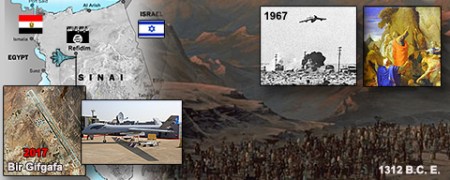
Rephidim, Amalek then: Bir Gafgafa, ISIS now

April 10, 2017

Rephidim, Amalek then: Bir Gafgafa, ISIS now, DEBKAfile, April 10, 2017

Bir Gafgafa’s mission is to provide the Egyptian forces fighting in Sinai with a shield, as well as securing the Suez, one of the world’s most important waterways, against ISIS attack.

It will also serve as a hub for coordinating air operations over Sinai and the Libyan border. It is vitally important to prevent the jihadist networks based in ungoverned Libya and the lawless heartland of the Sinai Peninsula from reaching Egypt’s main cities.

**********************************

They camped at Rephidim, but there was no water for the people to drink. The people quarreled with Moses, and said, “Give us water to drink.” Moses said to them, “Why do you quarrel with me? Why do you test the Lord?” The Lord said to Moses, take in your hand the staff with which you struck the Nile, and go. Strike the rock, and water will come out of it.” Moses did so, in the sight of the elders of Israel. He called the place Massah and Meribah, because the Israelites quarreled and tested the Lord. Then Amalek came and fought with Israel at Rephidim.  Whenever Moses held up his hand, Israel prevailed; and whenever he lowered his hand, Amalek prevailed. And Joshua defeated Amalek and his people with the sword. (Exodus 17)

About 3,200 years later, Moses would not have recognized Rephidim. In 1967 it was called Bir Gafgafa and was the site of the Egyptian Air Force’s biggest air facility in Sinai, known as “Egyptian Air Force Base 244.”

From there, Egyptian ruler Gemal Abdul Nasser declared that year: “If Rabin wants war, let’s go!”

And so when the Israeli Air Force preemptively wiped out Nasser’s air force on the ground at the outset of the Six-Day war, Bir Gafgafa was hit first. Rephidim was next transformed into Baha 3, the main Israeli Air Force operations base in Sinai during the War of Attribution and the Yom Kippur war. It was supported 8 kilometers away by a radar and electronic warfare station.

But then, Rephidim aka Bir Gafgafa stepped back into history in its next reincarnation as the very first base from which Israeli withdrew in late 1979 after Israeli Prime Minister Menachem Begin and Egyptian President Anwar Sadat signed the Camp David peace accords, Israel’s first peace pact with an Arab nation.

Another 37 years went by and in 2017 Rephidim now serves another Egyptian President, Abdul-Fatteh El-Sisi, for his life-and-death struggle with the Islamic State’s Sinai affiliate.

The Egyptian Air Force is in the course of transforming the small air field there into the largest air base in Egypt, this time with Israel’s concurrence. The base is being tailored to serve a wide variety of warplanes, attack helicopters and UAVs, with long runways, hangars and storage depots for bombs, missiles and fuel.

The Egyptian have built an enormous hangar 70×57 meters for housing long-range Wing Loong UAVs purchased from China, which are 9 meters long with a 14-meter wing spread. The Wing Loongs are also being deployed at the Uthman Air base in the Western Desert just 68km from the Libyan border.

The huge base will also have a large civilian passenger terminal at its northeastern end to serve the large army contingents deployed in Sinai. Today the 2nd and 3rdArmies are waging war against terror in Sinai supported by Border Guard units which are undertaking special training in anti-terror warfare.

Rephidim is today hemmed in by packs of the new Amalek, the Ansar Beit al-Maqdis which has pledged loyalty to the Islamic State and its leader Abu Bakr al-Baghdadi El-Sisi and is battling Egypt under his direction. The base is accessible only by air or convoys escorted by armored vehicles.

But El-Sisi has big plans for defeating them, DEBKAfile’s military sources report. Bir Gafgafa’s mission is to provide the Egyptian forces fighting in Sinai with a shield, as well as securing the Suez, one of the world’s most important waterways, against ISIS attack.

It will also serve as a hub for coordinating air operations over Sinai and the Libyan border. It is vitally important to prevent the jihadist networks based in ungoverned Libya and the lawless heartland of the Sinai Peninsula from reaching Egypt’s main cities.

The importance of this mission was demonstrated this week. On April 9, President El-Sisi reported that three gangs of terrorists had infiltrated the country from Libya and sent two suicide bombers to blow up two Coptic churches celebrating Palm Sunday, taking the lives of 45 people and injuring 150.

The jihadist menace points more than one way. The next day, Israel closed the Taba crossing into Egyptian Sinai to Israeli holidaymakers bound for the beach resorts, after its security services had received intelligence of an imminent ISIS death-cum-abduction attack afoot for the 10,000 Israeli trippers.

PA defies US, will raise payments to Martyrs’ families

April 9, 2017

PA defies US,  will raise payments to Martyrs’ families, Palestinian Media Watch, Itamar Marcus, April 9, 2017

In defiance of the US, which is demanding that the Palestinian Authority completely stop financial rewards to families of terrorist “Martyrs” (Shahids), the PA is now raising the payments to the “Martyrs'” families. These PA payments include lifetime monthly allowances to families of suicide bombers, and other murderers who were killed during or after committing their crimes.

Muhammad Sbeihat, the Secretary-General of the National Association of the Martyrs’ Families of Palestine, which is the PLO organization dealing with the PA’s payments to “Martyrs'” families, explained last week:

“In the upcoming period the allowances of the Martyrs’ families will be linked to the cost of living index, which will cause an improvement in these allowances, if only slightly.”

[Al-Quds, April 4, 2017]

The fact that the PA is raising the amount of the allowances to Martyrs’ families, even slightly, at this time is in direct defiance of the United States. Palestinian Media Watch exposed in 2011  that the Palestinian Authority pays salaries to imprisoned terrorists and allowances to families of terrorist Martyrs, and in 2016 exposed that the PA was lying when they claimed to have stopped payments to prisoners.

After years of international condemnation of the PA, the United States Congress recently proposed The Taylor Force Act to cut off financial all aid to the Palestinian Authority because of these payments to terrorists and their families. When Taylor Force, an American citizen, was murdered last year in Tel Aviv, American legislators were incensed to learn that the family members of the dead terrorist would be rewarded with lifetime payments, thus benefiting either directly or indirectly from American financial aid.

Similar legislation was proposed in the Israeli parliament last month, to deduct the equivalent amount that the PA pays to terrorists and their families from the tax revenues that Israel collects on the PA’s behalf.

The following are the payment amounts, mostly based on PA law signed by former PA Prime Minister Salam Fayyad in 2011:

1- Immediate (one-time) payment: 6,000 shekels2- Monthly (life-time) payments: 1,400 shekels/monthly, plus additions 2A: Addition for spouse: 400 shekels 2B: Addition for each child: 200 shekels 2C: Addition for residents of Jerusalem: 300 shekels >2D: Addition for residents of Israel: 300 shekels

2- Monthly (life-time) payments: 1,400 shekels/monthly, plus additions 2A: Addition for spouse: 400 shekels 2B: Addition for each child: 200 shekels 2C: Addition for residents of Jerusalem: 300 shekels >2D: Addition for residents of Israel: 300 shekels

3- Monthly payments to families abroad: $350

3B: Addition for each child: $50

Total expenditure per year (2016 budget): 660,315,772 shekels ($180,839,067)

[Official PA 2016 budget]

In 2016, more than 32,500 Martyrs’ families received payments.

Raising the allowances at this time is a sign of the PA’s direct defiance of the US and other Western countries that fund the PA, many of whom have condemned the PA’s financial reward payments to terrorists and their families.

Note: Payments to Martyrs families go to families of all Palestinian terrorists killed during the act of terror including suicide bombers, or in any combat with Israel, as well as families of those killed during riots, or disturbances, including non-combatants.

In addition, at the ceremony where Sbeihat spoke, laptops were distributed to children of Martyrs including the daughter of a terrorist who murdered 9.

The following is an excerpt from the article in the Palestinian daily, Al Quds:

“The National Association of the Martyrs’ Families of Palestine distributed laptops to the Martyrs’ (Shahids) sons and daughters in the [Tulkarem] district who successfully completed high school studies last year, and are currently in their first year of university studies.

This was during a ceremony that was held under the auspices of Tulkarem District Governor Issam Abu Bakr, who provided considerable financial aid to fund the computers…

The Secretary-General of the [National] Association [of the Martyrs’ Families of Palestine Muhammad Sbeihat] mentioned the issue of stopping the allowances (mukhassasat) of many of the civilian Martyrs’ families (i.e., a few dozen families stopped receiving payments in February 2017, Ma’an [independent Palestinian news agency]) , and of some of the Martyrs’ wives who married the Martyrs’ brothers. He emphasized that the issue has been raised to [PA] President Mahmoud Abbas, and that the Association and the [PLO] Families of the Martyrs and Wounded Institution are investing intensive efforts to deal with the issue as quickly as possible. He emphasized that Abbas and [PA] Prime Minister Dr. Rami Hamdallah are following the issue with the relevant parties, and expressed optimism about its resolution in a few days.

He emphasized that in the upcoming period the allowances of the Martyrs’ families will be linked to the cost of living index, which will cause an improvement in these allowances, if only slightly. He emphasized that the Association will continue its efforts and demands to improve the allowances of the Martyrs’ families, and deal with the issue of the allowances of the families of the Martyrs of the Israeli aggression against the Gaza Strip in 2014 (i.e., 2014 Gaza War)…

At the end of the ceremony, the computers were distributed to Ahmed Ali Ja’ar (PMW was unable to find additional information -Ed.), Badour Ibrahim Al-Ajami (PMW was unable to find additional information -Ed.), Bisan Fawaz Badran (i.e., daughter of terrorist Fawaz Badran) [and additional children of Martyrs].”

[Al-Quds, April 4, 2017]

Fawaz Badran – 27-year-old terrorist and top official in the Hamas Izz A-Din Al-Qassam Brigades (Hamas’ military wing), according to Israeli sources responsible for the planning of two terrorist attacks in Netanya in which 9 people were murdered, and dozens injured. On July 13, 2001, Badran was killed in a car explosion. Hamas blamed Israel for the car bombing, but Israel denied responsibility. PMW has been unable to confirm which attacks he was responsible for.

President Trump and King Abdullah II Hold a Joint Press Conference

April 5, 2017

President Trump and King Abdullah II Hold a Joint Press Conference, White House via YouTube, April 5, 2017

Sisi as key to Arab anti-ISIS pact with Israel

April 3, 2017

Sisi as key to Arab anti-ISIS pact with Israel, DEBKAfile, April 3, 2017

(Please see also, Restore the U.S.-Egyptian Strategic Alliance, Designate the Muslim Brothers as Terrorists. — DM)

Our Washington sources report that President Trump aims to complete his plan for bringing together Egypt, Saudi Arabia, Jordan and Israel on a new footing by September.

*********************************

US President Donald Trump’s first face to face with Egyptian President Abdel-Fatteh El-Sisi at the White House Monday, April 3, focuses on four main topics, DEBKAfile reports: The fight against Islamist State terror rampant in Egyptian Sinai and neighboring Libya; topping up US military assistance to Cairo, aid for easing Egypt’s dire economic straits and, finally, the effort to bolster normal relations between the Arab world (including the Palestinians) and Israel.

From the moment he assumed the Egyptian presidency in June 2014, El-Sisi has waged a never-ending war on Islamist terror against Ansar Beit-al Maqdis, which later pledged alliance to the Islamic State’s leader Abu Bakr Al-Baghdadi. The Egyptian army has so far been worsted.  The Egyptian president is not deaf to the criticism of the Second and Third Armies’ failure to overcome a few thousand armed men, even though they can at a moment’s notice raise several thousand more fighters from the Bedouin tribes of Sinai. US intelligence has rated the Egyptian forces as slow-moving and unwieldy; but for limited forays, its contingents preferring to sit safely in their barracks rather than risk going out and pursuing the enemy across the Peninsula.

Shortly before President El-Sisi’s trip to Washington, the Egyptian air force conducted intense bombardments of ISIS concentrations around the northern town of El Arish, killing at least 14 terrorists, nabbing 22 and seizing large caches of roadside bombs. But they too long delayed bearding the Islamists in their main stronghold atop Mount Jabal Hala in central Sinai. ISIS is therefore free to move around the territory and strike at will, the while expanding its operations into Egypt proper.

The weekend air strikes came after months in which ISIS overran sections of El Arish, Sinai’s biggest town (pop: 100,000). Their grip is such that Egyptian forces no longer dared venture into those lawless neighborhoods, especially at night. Earlier this year, terrible persecution including executions forced the few thousand indigenous Christians, most of them Copts, to flee their homes in El Arish. Egyptian forces proved unequal to safeguarding the US-led international observer force (MFO) monitoring the 1972 Egyptian-Israel peace treaty at a nearby station.

American military aid to Egypt stands today at $1.3bn a year. Even though the US president means to slash foreign aid programs, he may make an exception in this case and expand military assistance -, possibly in the coin of advanced military hardware, given the country’s unending frontline battle against Islamist terror.

Its presence in El Arish, 130km from the Egyptian-Israeli border, plants the peril on the doorsteps of Egypt’s neighbors as well: Northern Sinai borders on Israel, its northwestern district shares a border with the Gaza Strip, abutting in the east on Jordan and in the southwest on Libya. The cities of western Sinai sit on the banks of the Suez Canal.

The Islamic State’s Sinai affiliate is closely allied with Salafi organizations in the Gaza Strip and works hand in glove with its Palestinian Hamas rulers, especially in the lucrative arms-smuggling business.

Al-Baghdadi last year posted a group of Iraqi officers in his service to the Sinai contingent. They travelled through southern Jordan to reach the peninsula. The Islamist cells in Libya have moreover made ISIS-held turf in Sinai their safe highway for traveling undetected to their other strongholds across the Middle East.

To stamp out this sprawling, multi-branched menace, the Trump administration needs to bring Egypt, Jordan and Israel into a coalition for a sustained, common campaign.

The Obama administration, which boycotted President El-Sisi for persecuting Egypt’s Muslim Brotherhood, tried unsuccessfully to build Turkey, Egypt and Israel into a counterterrorism pact. The Trump administration, for which the Brotherhood is anathema, has a better chance. But first, relations between the Arab world and Israel need to be placed on a regular footing. Some groundwork already exists in the informal bilateral military ties Egypt and Jordan maintain with Israel. DEBKAfile’s military sources have revealed in past reports the limited give-and-take relations for fighting terror Saudi Arabia and Abu Dhabi maintain with Israel.

The US President’s advisers recognize that before a broad, effective front against ISIS and Al Qaeda can be put together from these partial, often covert ties, progress is necessary towards normalizing relations between the Arab governments and the Jewish state, including the Israeli-Palestinian track.

Trump will certainly want to hear what role his Egyptian guest is willing to take for bringing this process forward. He will ask his next Middle East visitor, Jordan’s Abdullah II, the same question, when he arrives in Washington Tuesday. As for the Palestinian leader Mahmoud Abbas, he was promised an invitation to the White House this month, but not yet been given a date. He is clearly being left to wait until the senior players in the region have had their say. Our Washington sources report that President Trump aims to complete his plan for bringing together Egypt, Saudi Arabia, Jordan and Israel on a new footing by September.

Think-tank offers Trump policy recommendations on Israel

March 29, 2017

Think-tank offers Trump policy recommendations on Israel, Israel National News, Mordechai Sones, March 29, 2017

Aerial view of Capitol HillUS gov’t / public domain)

Heritage recently released a report authored by James Phillips, Heritage’s Senior Research Fellow for Middle Eastern Affairs, and a latest volume of Mandate, outlining specific policy recommendations for the Trump Administration. Four topics treated are Iran, the defeat of Islamist terrorist groups, the Israeli–Palestinian conflict, and President Trump’s promise to move the U.S. embassy to Jerusalem.

**************************

Weeks after President Ronald Reagan’s first election victory, the U.S. was engulfed in problems and the new President was confronting challenges unparalleled in nearly a half-century. At that time, the prominent conservative Heritage Foundation produced a detailed road map designed to help the fledgling administration steer the nation into a sound future, guided by conservative principles, called Mandate for Leadership. By the end of President Reagan’s first year in office, nearly two-thirds of Mandate’s more than 2,000 specific recommendations had been or were being transformed into policy.

Since then, Heritage has produced the Mandate series for incoming administrations, marshaling the talents of scores of experts.

Heritage recently released a report authored by James Phillips, Heritage’s Senior Research Fellow for Middle Eastern Affairs, and a latest volume of Mandate, outlining specific policy recommendations for the Trump Administration. Four topics treated are Iran, the defeat of Islamist terrorist groups, the Israeli–Palestinian conflict, and President Trump’s promise to move the U.S. embassy to Jerusalem.

Regarding Iran, the report finds Iran to be “the chief long-term regional threat to the U.S. and Israel. While the Obama Administration turned a blind eye to many of Iran’s malign activities to avoid jeopardizing its flawed nuclear agreement with Tehran, the Trump Administration is committed to confronting and pushing back against Iran.”

Findings regarding Iran state that “Cooperation on missile defense should be an especially important agenda item. Iran’s medium-range missiles already can reach Israel with a 1,000-pound payload. On February 4, Mojtaba Zonour, a member of Iran’s National Security and Foreign Policy Commission, helpfully reminded the world that ‘only seven minutes are needed for an Iranian missile to hit Tel Aviv’ and that 36 U.S. military bases in the Middle East are within range of Iranian missiles. Israel is now deploying the Arrow-3 interceptor, developed jointly with the United States, and the two leaders should agree to support cooperation in further enhancing missile defenses.”

Heritage recommends: “President Trump should discuss plans to hold Iran accountable for its hostile regional policies and roll back its influence, outlining the Administration’s strategy for ratcheting up sanctions on Iran and particularly on the IRGC, which controls Iran’s ballistic missile program and efforts to export terrorism. President Trump and Prime Minister Netanyahu should also coordinate on interdicting the flow of Iranian arms to Hezbollah, Hamas, and other terrorist groups.”

On the Islamic State (ISIS) and the war in Syria, Heritage concludes, “Both the U.S. and Israel seek the rapid destruction of ISIS in Syria, but Israel is concerned that President Trump’s intention to cooperate with Russia in Syria could strengthen the influence of Iran and Hezbollah there.” Explaining Israel’s needs, Heritage councils the Trump Administration that “Netanyahu will want to gain an understanding of U.S. plans for Syria, efforts to split Russia from Iran, and the implications for Israeli security. At a minimum, Jerusalem wants to prevent Iran and Hezbollah from establishing a military presence near the Israeli–Syrian border.”

Recommendations: “Israel has legitimate concerns about the increasing role that Iran and Hezbollah are playing in Syria. Trump needs to ensure that U.S. policies in regard to Syria will not inadvertently harm Israel’s security.

“Islamist terrorist groups pose a significant threat to the U.S. and Israel. Both countries can benefit from better coordination. Trump and Netanyahu should coordinate policies on fighting ISIS in Syria and explore ways to reduce the ISIS threat to Jordan and Egypt. Jordan needs intelligence and counterterrorism help in uncovering terrorist plots and economic support to lighten the burden of more than 600,000 Syrian refugees. Egypt has sustained heavy losses fighting ISIS in the Sinai Peninsula, and the group claimed responsibility on February 9 for a cross-border rocket attack on the Israeli city of Eilat. Cairo needs quiet help in defeating the ISIS insurgency, which has received extensive aid from Hamas and other Islamist extremist groups in Gaza.”

The Israel-Palestinian conflict is summed up thus: “In contrast to the Obama Administration—which allowed the passage of U.N. Security Council Resolution 2234 condemning Israel and added insult to injury with a blistering anti-Israel speech from Secretary of State John Kerry—the Trump Administration will be much more supportive of Israel at the U.N. and elsewhere. Trump should publicly underscore that the U.S. will veto any one-sided U.N. Security Council resolutions and assert that only direct bilateral negotiations, not the U.N., can produce a peace agreement.

“President Trump should also stress that Palestinian terrorist attacks, not Israeli settlements, are the chief obstacles to peace. Although the Administration has not taken an official position on settlements, it did release a statement saying that new settlements “may not be helpful” in achieving a peace agreement. A senior Administration official later told The Jerusalem Post that new settlements could undermine Trump’s plans to engineer a final status agreement.

“Trump has described an Israeli–Palestinian peace agreement as ‘the ultimate deal,’ but the situation is not ripe for such a deal. The Palestinian Authority is unwilling to make the necessary concessions and too weak to enforce any agreement in the face of Hamas’s implacable opposition to Israel.”

Recommendations include: “The Administration should focus on managing rather than resolving the conflict, which is impossible for the immediate future. Trump should consult with Netanyahu about how to restore calm, undermine Hamas and other Islamist extremist groups, and create a more stable environment for future step-by-step negotiations.” However, Phillips adds, “Refraining from establishing new settlements would be helpful in this context.”

Regarding the embassy move, Heritage says, “President Trump’s commitment to move the U.S. embassy from Tel Aviv to Jerusalem would correct a historic anomaly: The United States has never recognized any part of Jerusalem as Israel’s capital. However, moving the embassy could ignite protests, riots, and anti-American backlashes among Palestinians, Arabs, and Muslims.”

Therefore, Heritage recommends to “Ensure that certain standards are met before moving the U.S. embassy to Jerusalem. To mitigate the risks of the move, Trump should consult with Netanyahu on the timing; pick a site in West Jerusalem, which has been controlled by Israel since 1948; and explain that the move does not change other aspects of U.S. policy. The U.S. should make it clear that the borders and final status of Jerusalem should be determined through negotiations; that the embassy move would not preclude a Palestinian state; that the U.S. consulate-general in Jerusalem would continue to function as the U.S. representative to the Palestinian Authority; and that no changes would be made in the status of Muslim holy sites, which would continue to be administered by Jordan.”

In conclusion, the Heritage report says that “Israel is America’s foremost ally in the Middle East. Both countries are democracies, value free-market economies, and uphold human rights at a time when many other countries in the Middle East reject those values.” It says recent developments represent “a promising opportunity to reassert American leadership in the Middle East and strengthen U.S.–Israel strategic cooperation on foreign policy, defense, and counterterrorism issues.”