Posted tagged ‘Israel’

‘Israel no longer weak state seeking peace at any price’

July 13, 2016

‘Israel no longer weak state seeking peace at any price’ Foreign policy expert suggests Netanyahu’s Africa trip, strengthening ties with Egypt show Israel dump old model of foreign policy.

Arutz Sheva Staff, 13/07/16 20:10

Source: ‘Israel no longer weak state seeking peace at any price’ – Defense/Security – News –

Dr. Efraim Arera    Eliran Baruch

Israel is on the brink of a new modus operandi in foreign policy, one which will include more assertive Israeli behavior, as well as closer ties with regional powers like Egypt and Turkey.

That is the conclusion drawn by Dr. Efraim Arera, a leading Israeli scholar of Islam and the Middle East, who suggests Prime Minister Binyamin Netanyahu’s recent trip to Africa – conspiciously coinciding with a rare visit to Israel by Egypt’s Foreign Minister – hint at a broad shift in Israeli policy.

“The foreign policy of Israel is a new policy,” Dr. Arera told Arutz Sheva. “No more weak state seeking peace at any price, but a strong state that can deliver help to its neighbors.”

While many Israelis saw the recent reconciliation deal signed with Turkey as a major concession on Israel’s part, Dr. Arera notes it included unprecedented acceptance of Israeli interests in the region, not least of which is Turkey’s recognition of Israel’s right to maintain its military blockade of Hamas.

“The first example is Turkey. We have signed an agreement with them despite the fact that [Turkish President Tayyip] Erdogan is close to the positions of the Muslim Brotherhood. In this agreement they recognize our right to the gas [deposits] in the Mediterranean Sea, and also the security blockade on Gaza, and these are good points for Israel because they deserve Turkish interest.”

Dr. Arera then turned to Egypt, following reports of cooperation between the former rivals in the fight against the ISIS terror group, and the recent visit by Egyptian Foreign Minister, Sameh Shoukry. While there is little affection for Israel in Egypt, the country’s leadership is increasingly recognizing the benefits of cooperation with the Jewish state.

“Egypt has many problems; the first being a security problem. El-Sisi has enemies. The first is the Muslim Brotherhood, and the second is ISIS in Sinai. Israel can deliver intelligence to the regime of El-Sisi – and it does – and its very important help for El-Sisi.”

“The second point is an economic one. There are many economic problems in Egypt. Half the population is below the poverty line. Links with Israel could help on this topic.”

“The third one is the problem of water. You have the building, by Ethiopia, of a dam on the Nile. The strength of Israel in the meetings with African leaders in the last period could help Egypt to solve these very serious problems it has. So I think that the visit of Shukri in Israel was a very important one and its a success of Israeli diplomacy.”

Egypt is not alone in the Arab wold, Dr. Arera says, in its evolving view of Israel, from mortal enemy to de facto partner in the war on radical Islamic terror.

“The Arab world is divided on this [visit by Shoukry to Israel]. The countries who support the Muslim Brothers see it as a bad deal, and as a treason of Egyptian leader. But many countries in the Arab world and outside of the Arab world, are conscious that this is part of a stability factor, and they support it even if they don’t say it clearly.”

“Is something new beginning in the Middle East? I’m not so sure. You have very deep hatred towards Israel and towards the Jewish people. But these countries see now how Israel could deal with these problems and can help them in their fight against extremist Islam. And maybe on the basis of [mutual] interest our position could be strengthened and Israel will be more accepted in the Middle East.”

With Publication Of High School Finals Results, Palestinian Authority Press Notes Deaths Of Students Who Carried Out Stabbing Attacks, Stresses: ‘Dying As A Martyr Is The Path Of Excellence And Superiority’

July 13, 2016

With Publication Of High School Finals Results, Palestinian Authority Press Notes Deaths Of Students Who Carried Out Stabbing Attacks, Stresses: ‘Dying As A Martyr Is The Path Of Excellence And Superiority’, MEMRI, July 13, 2016

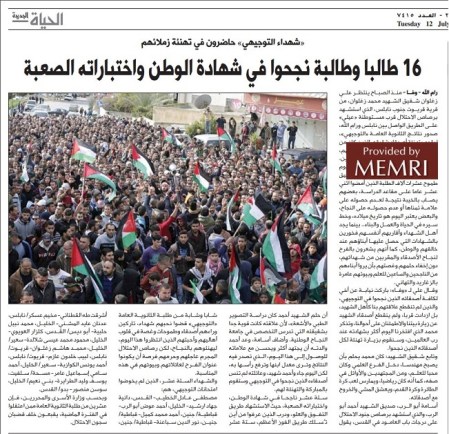
The July 11, 2016 release of high school seniors’ final exam results by the Palestinian Authority (PA) Ministry of Education is being widely covered in the Palestinian media. As part of this coverage, on July 12, PA dailies published articles on high school seniors who had been killed during the school year carrying out, or attempting to carry out, stabbing attacks against Israelis, and who thus would never graduate. The articles praised the teenagers’ martyrdom, playing with the Arabic wordshahada, which means both “diploma” and “martyrdom.” The lead article in the PA official daily Al-Hayat Al-Jadida listed 16 Palestinian students whom, it stated, had not been able to take their final exams, but had “passed the difficult [test] of dying as martyrs for the sake of the homeland” with flying colors. It added, “Dying as a martyr is the path of excellence and superiority.”

The list included 16-year-old Ahmad Abu Al-Rab, who participated in the February 3 shooting and stabbing attack at Damascus Gate in the Old City of Jerusalem in which a female Israeli Border Guard was killed, and Labib ‘Aazem and Muhammad Zaghlawan, both 17, who carried out the March 2 stabbing attack at Har Bracha, wounding two Israeli soldiers.

PA Dailies: ’16 [Students] Successfully Passed The Difficult Test Of Dying As Martyrs For The Sake Of The Homeland’

Articles in the PA dailies praised the dead students, calling them a source of pride for their families and for the entire Palestinian people. They quoted their relatives’ and friends’ expressions of praise for them and yearning for them, and referred to the teen attackers as martyred by “the bullets of the occupation” while omitting mention of the attacks they had carried out.

Thus, for instance, a front-page article in Al-Hayat Al-Jadida, which also appeared on page 12, stated: “The places of 16 students was not missing from yesterday’s announcement of the general high school [exam] results. This is despite the fact that the occupation’s bullets ended their lives and prevented them from taking their final exams, as they became martyrs in Paradise. Sixteen [students] passed the difficult [test] of dying as martyrs for the homeland, since dying as a martyr is the path of excellence and supremacy.

“Sixteen boys and girls, seniors in high-school, died as martyrs, leaving behind friends, ambitions, and sorrow in the hearts of their families and loved ones, who had waited for this day to congratulate them. But the bullets of the criminal occupation were swifter, and denied them the opportunity to be a source of joy for their families…”[1]

29059The full article in Al-Hayat Al-Jadida

The PA daily Al-Ayyam also quoted friends and relatives of some of the attackers, and, like Al-Hayat Al-Jadida, provided a selective narrative omitting mention of the attacks that they carried out or the victims of those attacks. The article opened by stating: “‘Ali Zaghlawan, the brother of the martyr Muhammad Zaghlawan [who carried out the March 2, 2016 Har Bracha attack], from the village of Qariout near Nablus, who was martyred by the bullets of the occupation near the settlement of Eli on the Nablus-Ramallah road, has been waiting since morning for the publication of the high school final [exam] results, in order to congratulate his brother’s friends [on their scores]. Muhammad’s name should have been among them [i.e. those who received results], especially as he was known for his [scholastic] excellence and diligence…”

The article also quoted the friend of dead student Ahmad Abu Al-Rab, who had participated in the Damascus Gate attack, describing him as having been “martyred by the bullets of the occupation soldiers on the steps of Damascus Gate in Jerusalem.”[2]

Palestinian Honor Students Dedicate Their Success To Palestinian Martyrs

One notable article on the finals results, published by the Palestinian news agency WAFA, focused on honor students who said that they dedicated  their success to the martyrs of the Palestinian people. Muhammad Abu Nahla, an honors student majoring in industry, dedicated his success to the martyr ‘Adnan Al-Mashni, killed while attempting to carry out a stabbing attack. Abu Nahla said: “I dedicate my success to the Palestinian leadership and its head President Mahmoud ‘Abbas; to the educational and pedagogical family; to my family and our people; and especially to my friend, the 17-year-old martyr ‘Adnan ‘Aaid Hamed Al-Mashni Al-Halaiqa,  from the town of Al-Shayoukh, who was martyred at Beit ‘Einun Junction east of Hebron on January 12, 2016… How I wish that he could have celebrated his success today – but the bullets of the occupation stole him, denying us and his parents of this joy. But we are all proud of the martyr’s death he attained.”[3]

PLO Executive Committee member Ahmed Al-Majdalani also mentioned the martyred students, saying: “In these moments, we feel the absence of 16 students, the martyrs who should have taken the high school finals but who were prevented from taking them by the violent and aggressive occupation forces, who denied joy to their families…”[4]


Endnotes:

[1] Al-Hayat Al-Jadida (PA), July 12, 2016.

[2] Al-Ayyam (PA), July 12, 2016.

[3] Wafa.ps, July 11, 2016.

[4] Al-Hayat Al-Jadida (PA), July 12, 2016.

Brexit Disrupts Nonchalant European Union Meddling

July 13, 2016

Brexit Disrupts Nonchalant European Union Meddling, Gatestone InstituteMalcolm Lowe, July 13, 2016

♦ In respect of the Palestinian problem, the European political elites have only the means to destabilize the status quo without installing an alternative. But Israel’s leaders can take heart. Any declarations made at French President François Hollande’s conference will be unenforceable, because the EU on its own lacks the means and because its energies must now focus on stopping its own disintegration.

♦ The underlying reasons for Brexit and for EU disintegration in general have still not been widely understood. Brexit was not merely a vote of no confidence in the EU but also in the UK establishment. Similar gaps between establishment and electorate now exist in several other major European states. In some cases, however, governments are united with their electorates in detesting the EU dictatorship in Brussels.

The June 23 vote by the United Kingdom electorate to leave the European Union should be seen in the context of two other recent European events. Three days earlier, on June 20, the EU’s Foreign Ministers Council decided to solve the Palestinian problem by Christmas with its endorsement of French President François Hollande’s “peace initiative.” Three days after the vote, on June 26, the second election in Spain within a few months failed once again to produce a viable majority for any government. Worse still, the steadily rising popularity of nationalist parties in France, Germany, Austria and the Netherlands suggests that political paralysis in other EU countries is on the way.

In short, the ambitions of the ruling political cliques of Europe to solve the problems of the world are being undermined by their own neglected electorates, which are increasingly furious at the failure of those cliques to solve the problems of Europe itself. Four years ago, we wrote about Europe’s Imminent Revolution. Two years ago, about the attempt and failure of those cliques to turn the EU into a make-believe copy of the United States. Today, that revolution is creeping ahead month by month.

Before threatening Israel’s security and local supremacy, the EU foreign ministers could have recalled the results of their previous nonchalant meddling in the area. We were all rightly horrified by the threat of Muammar Gaddafi to hunt down his enemies “street by street, house by house,” as he began by shooting hundreds in his capital, in February 2011. Hollande’s predecessor, Nicolas Sarkozy, rallied European leaders — first and foremost the UK’s David Cameron — to do something about it. President Obama turned up to give a speech, something that he is good at. More importantly, Obama supplied warplanes from the NATO base in Naples. The idea was to enable victory for the Libyan rebel forces by paralyzing Gaddafi’s own air force and bombing his land forces.

Victory was achieved. But the rebels were united only in their hatred of Gaddafi. So Libya has descended into a chaos that could have been prevented only by a massive long-term presence of European land forces, which Europe — after repeated cuts in army strength — does not have. Now it is the local franchise of the Islamic State, among others, that is hunting down enemies house by house.

Europe was incapable of achieving anything in Libya without the United States, and incapable of replacing a detestable regime with a superior alternative. The lesson could have been learned from Iraq. Here, a massive American military presence accompanied a constitutional revolution and the beginnings of parliamentary rule. But the whole costly achievement collapsed when Obama decided to remove even the residual military presence needed to perpetuate it.

In respect of the Palestinian problem, too, the European political elites have only the means to destabilize the status quo without installing an alternative. But Israel’s leaders can take heart. At Hollande’s conference in December, the UK will be half in and half out, if present at all. Neither Obama nor his by then elected successor will turn up to make a speech. Any declarations made at Hollande’s conference will be unenforceable because the EU on its own lacks the means and because its energies must now focus on stopping its own disintegration.

Of the authors of the Libyan adventure, David Cameron resigned after the vote for Brexit. Obama will shortly leave after what may charitably be called a mixed record in foreign affairs. Sarkozy’s aspiration to be reelected and succeed the unpopular Hollande, whose approval rate is now just 12%, has been challenge by a recent French court decision.

Sarkozy was trying to sue Mediapart, a French investigative agency, for publishing a letter of 2007 from Gaddafi’s intelligence chief about an “agreement in principle to support the campaign for the candidate for the presidential elections, Nicolas Sarkozy, for a sum equivalent to Euro 50 million.” (The maximum individual contribution permitted in French law is 1500 euros.) The judges investigating the corruption case against Sarkozy have ruled that the letter is genuine. The suspicion, then, is that Sarkozy’s campaign to eliminate Gaddafi was at least partly motivated by the need to eliminate the supplier of a bribe.

The underlying reasons for Brexit and for EU disintegration in general have still not been widely understood. Brexit was not merely a vote of no confidence in the EU but also in the UK establishment. Out of 650 members in the House of Commons, only around 150 — nearly all Conservatives — are estimated to have voted for Brexit. Against Brexit was also a clear majority of leading figures in commerce, academia and the churches. Similar gaps between establishment and electorate now exist in several other major European states. In some cases, however, governments are united with their electorates in detesting the EU dictatorship in Brussels.

That glaring discrepancy between the UK establishment and the electorate explains the establishment’s quick acceptance of Brexit, for fear of becoming totally discredited. A contributory reason was the broad consensus on both sides of the debate that the operative style of EU institutions is deeply flawed and often detrimental to UK interests. The concessions obtained by Cameron from the EU before the vote were widely regarded as derisory. Moreover, the President of the European Parliament, Martin Schulz, had loudly proclaimed that he could obtain a vote to cancel those concessions. The real issue, therefore, was whether a Remain vote could help to reform the EU, in cooperation with other member states, or whether the EU was fundamentally unreformable. The UK electorate decided for the latter view and the establishment is committed to implementing it.

1693The glaring discrepancy between the UK establishment and the electorate explains the establishment’s quick acceptance of Brexit, for fear of becoming totally discredited. Pictured above: Theresa May launches her campaign for leader of the UK Conservative party on July 11, 2016, saying “Brexit means Brexit.”

The two earlier articles mentioned above first spotted the phenomenon of European disintegration and then explained it. Today, the intervening events have made the explanation all the simpler. Basically, the European political elites were correctly convinced, long ago, that considerable European integration was desirable, but their very successes in this area made them grossly overestimate what could and should be done further.

Up to a decade ago, it seemed that a similar pattern was becoming established in one EU country after another: the parliament was dominated by a large center-right party and a large center-left party that alternated in power from one election to another. The parallel to the United States seemed obvious, but the parallel was illusory, as we shall show.

Emboldened, the political parties concerned made the fatal mistake of trying to combine for the purpose of elections to the EU Parliament. Thus emerged a pan-European center-right pseudo-party, the “European People’s Party” (EPP), whose origins go back to a get-together of Christian Democrat parties in 1976. And a pan-European center-left pseudo-party, the “Party of European Socialists” (PES), founded in 1992 as an alliance between old-style Social Democrat parties and the former so-called Eurocommunist parties. The latter first emerged during the decline and discreditation of the Soviet Union in the 1970s and 1980s, then changed their names after its disappearance in December 1991. Thus, the core of Italy’s current Democratic Party derives from the Italian Communist Party (PCI), the major opposition party of post-war Italy.

Curiously but inevitably, the more those parties tried to unite, the more they lost support in their own countries of origin. Thus the Dutch Christian Democrats (CDA) are today a minor party of the right and the Panhellenic Socialist Movement (PASOK) barely crosses the threshold of 5% needed for entry into the Greek Parliament. (Incongruously, the last PASOK Prime Minister of Greece, George Papandreou, continues to be President of the Socialist International.) The reason for this development, however, is not far to seek.

Nationalism, it was forgotten, is an essential component of center-right sentiment. So a center-right party that prefers an international interest at the expense of the national interest of its own country loses credibility among its own core supporters; it becomes vulnerable to the rise of far-right upstart parties. Examples of this process in the EU are now so evident as not to need enumeration.

The attraction of socialism, it was forgotten, is that its core supporters expect increases in government social spending at the expense of financial stability. This becomes more difficult, the more a country is constrained by participation in a shared international framework. It becomes impossible to maintain once a country joins a common currency, since the usual remedy for socialist overspending is devaluation of the national currency. This is why PASOK has been eclipsed in Greece by the far-left SYRIZA, why the Spanish franchise of the PES (the PSOE) has lost severely to the upstart Podemos, and why support for its Dutch franchise (the PvdA) is now down to about the same as for each of two other left-wing parties.

It is also why in Britain, where the electoral system obstructs the rise of new parties, Jeremy Corbyn was voted leader by the Labour Party membership to the horror of the party establishment. Corbyn himself was a pronounced Euroskeptic until recently and only half-heartedly spoke in public for Remain, creating suspicions that he secretly voted for Leave.

A far-right party, like the Freedom Party (OFP) of Austria, has an easy sales pitch. Not so the far-left ones: after they come to power, it quickly and painfully becomes evident that they have no more ability than their derided Social Democrat predecessors to defy the constraints imposed by membership in the Eurozone.

Thus SYRIZA came to power in Greece and won a referendum to end austerity. The result was that all Greeks found that their bank accounts were virtually frozen: they were allowed to withdraw only sixty Euros a day. SYRIZA then split. The larger faction won the resulting general election and accepted the harsh conditions that the referendum had rejected. The paradoxical result in Greece is that the current government is a coalition of an upstart far-left party, SYRIZA, and an upstart nationalist party (the Independent Hellenes) that lies to the right of New Democracy (the Greek franchise of the EPP).

In other EU countries, however, the typical development has been the opposite: the erstwhile competing franchises of the EPP and the PES are in coalition against the motley upstart breakaway parties, since neither of the two gets an absolute majority in parliament any more. That is, their former raison d’être as competing alternatives has been abandoned in the need to survive in power at all. The paralysis in Spain comes from the fact that the two local franchises there are descended from the two sides in the murderous Civil War of 1936-1939. Joint government is still hardly imaginable especially for the losing socialists, who continued to suffer persecution long after the war.

Likewise, in the elections to the EU Parliament in May 2014, the EPP and the PES won only 221 and 191 seats respectively out of 751, each far short of a majority. So they clubbed together to make the top candidate of the EPP, Jean-Claude Juncker, President of the EU Commission and to retain the top candidate of the PES, Martin Schulz, as President of the Parliament. The incredible response of Juncker to Brexit has been to demand even tighter integration: he wants to force into the Eurozone the eight EU member states (other than the UK) that still have independent currencies. He also reiterated his proposal, originally made last March, to unite the armed forces of all states (with the UK gone) into a European army. For this he has the support of Schulz’s home party, the German SPD. That is, they want more and more of what the European electorates want less and less.

Especially in Eastern Europe, there are now also governments that resent the relentless centralizing urges of the EU establishment. In Hungary, for example, the government has rejected the demand of the EU Commission to absorb a quota of the immigrants currently streaming into Europe; it has scheduled a referendum on the matter for October 2. On the same day, Austria will hold a revote for the presidency, which the Freedom Party may narrowly win after narrowly losing the first time around.

These governments are among the new friends of Israel described in a recent Reuters article, titled “Diplomatic ties help Israel defang international criticism.” As it notes:

“Whereas a few years ago Israel mostly had to rely on Germany, Britain and the Czech Republic to defend its interests in the EU, now it can count Italy, Greece, Cyprus, Austria, Hungary and a handful of others among potential allies.”

These allies have no desire to penalize Israel on behalf of increasingly tedious Palestinians. On the contrary:

“Like Turkey, which last week agreed to restore diplomatic ties with Israel after a six-year hiatus, they see a future of expanding business, trade and energy ties.”

By “energy ties” is meant Israel’s recently discovered vast fields of natural gas, the phenomenon that we earlier dubbed “Israel as a Gulf State.” That is: just as governments care little for the human rights record of, say, Qatar in their eagerness to acquire its natural gas, so also the self-righteous moaning of the Palestinian Authority does not deter those governments from going for what Israel has to offer. As the Reuters article quotes a European ambassador: “There’s just no appetite to go toe-to-toe with Israel and deliver a really harsh indictment. No one sees the upside to it.”

Israel’s government is not, of course, gloating over the discontent spreading in the EU. But it surely appreciates some of the side effects.

Republican draft platform calls for undivided Jerusalem

July 13, 2016

Republican draft platform calls for undivided Jerusalem

Source: Republican draft platform calls for undivided Jerusalem – Behind The News

The Republican Party is in the process of changing its platform on Israel to include language that is more in favor of Israel, Israeli media reported Monday.

In advance of the party’s nominating convention, the GOP platform committee held its first meeting Monday in Cleveland, where it discussed reinstating a reference to Jerusalem as Israel’s “undivided” capital and removing a reference to “Palestine.”

This new draft marks a significant change from the platform from four years ago, which did not include the word “undivided” in reference to Jerusalem, but did include mention of “Palestine.”

The 2012 platform read, “We support Israel’s right to exist as a Jewish state with secure, defensible borders; and we envision two democratic states – Israel with Jerusalem as its capital and Palestine – living in peace and security.”

On Monday, CNN reported, the subcommittee reviewing the platform specifically rejected language affirming the party’s commitment to what is known as the two-state solution.

The draft platform could change several times before the start of the Republican National Convention on July 18.

The amendments to the platform are in line with presumptive Republican presidential nominee Donald Trump.

Last month a senior official in the Trump campaign said that if elected president, Trump would back Israel annexing portions of Judea and Samaria.

In an interview with Israeli daily Haaretz, Trump’s co-adviser on Israeli affairs, David Friedman, addressed issues of the Israeli-Palestinian conflict and how the presumptive republican nominee would handle them if elected in November.

“I think there are parts of the West Bank that will stay part of Israel in any peace deal. I am sure he [Trump] wouldn’t have any problem with that at all,” he said.

“Regarding the entire West Bank I think that’s a legal issue. I don’t think he will have a problem with that but he would expect Israel to continue seeking peace. He has no doubt that Israel wants peace,” Friedman continued.

Asked if Trump would support annexing parts of Judea and Samaria, Friedman said that “I would expect that he would. I haven’t had this discussion with him but I expect he would.”

Regarding the Jewish communities in Judea and Samaria, Friedman said that Trump recognizes Israel has a “commitment to its citizens in Judea and Samaria” and says that there is no reason not to continue building.

Achieving peace does not need to focus on land, Friedman said

“There are always creative ways to allow people to live in peace. It is not always about the land. We don’t accept the idea it is only about land. Nobody really knows how many Palestinians actually live there.”

An independent Palestinian state, said Friedman, will not happen without Israel’s consent.

“This is an issue that Israel has to deal with on its own because it will have to deal with the consequences,” Friedman said.

“The Israelis have to make the decision on whether or not to give up land to create a Palestinian state. If the Israelis don’t want to do it, so he doesn’t think they should do it. It is their choice. … He [Trump] does not think it is an American imperative for it to be an independent Palestinian state,” he continued.

Trump’s viewpoint is that Israel shouldn’t have “to wait for another generation for the Palestinians to hold more realistic expectations and show less hostile motivation,” Friedman explained. “Trump’s position is that we have to deal with reality and not hopes and wishes.”

‘Hamas constantly trying to destabilize Jerusalem’

July 12, 2016

‘Hamas constantly trying to destabilize Jerusalem’ In report to Knesset Committee, Shin Bet head Nadav Argaman surveys number from recent terror wave as well as state of Fatah, Hamas.

Shai Landesman, 12/07/16 16:41

Source: ‘Hamas constantly trying to destabilize Jerusalem’ – Defense/Security – News –

Shin Bet head Nadav Argaman appeared at a meeting of the Knesset Foreign Affairs and Defense Committee headed by MK Avi Dichter (Likud) today (Tuesday), and delivered a report about the wave of Palestinian terror that started last October.

Here are the main findings Argaman presented in the report:

Since the beginning of the current escalation on the 10th of October, 2015, over 300 significant terror attacks have been carried out or attempted (this excludes stone or Molotov cocktail throwing). Of these 180 were stabbing attacks, 90 were shooting attacks, and 30 involved running over with cars, (all rounded figures). Though October 2015 saw a dramatic increase in the scale of these attacks, this can be seen as a continuation of a more slow increase of attacks in Judea and Samaria starting in 2012.

The majority of the attacks were “lone wolf” attacks, with only a few perpetrated by the established terror organizations.

Security forces and the Shin Bet have thwarted some 240 attacks since October, and in the first five months of 2016 alone they’ve prevented 11 suicide attack attempts, 10 kidnapping attempts, and over 60 shooting attempts, most planned by Hamas, who are constantly acting to destabilize Judea and Samaria.

There is a decrease in attacks over the past few months versus October of 2015, when some 600 attacks were perpetrated, of which 81 were significant. In June of this year 103 were perpetrated, of which 9 were significant.

The decrease is attributed to the large number of thwarted attacks, improvements in intelligence, and deterrence focused in the immediate surroundings of the terrorists. All of these measures have produced a widespread feeling among the Palestinian population of Judea and Samaria that there is little to be gained by continuing to escalate hostilities, a feeling reflected in opinion polls conducted by Palestinian institutions.

Though the actual number of attacks is decreasing, the situation remains highly volatile, with the threat still very real (as evidenced by the number of thwarted attacks). Thus any significant event may cause a renewed breakout of hostilities.

It is also important to note that there is a general feeling in PA and Fatah circles that the Mahmoud Abbas-era is nearing its end (as he has announced his intentions to retire several times). There is therefore much jostling for position among Fatah leaders, as is usual in transition periods, and many of them are using belligerent language to bolster their status as strong leaders.

The report also dealt with the Gaza Strip; the quiet reigning there is deceptive, it said. The economic situation is worsening, ISIS is gaining power, and Hamas are rebuilding their strength.

Approximately 80 terror attacks were perpetrated from the Gaza Strip since operation Protective Edge, making this the most quiet period in a decade. Fringe Salafist groups are behind most of the attacks. The quiet is mainly due to Hamas’ feeling of lack of readiness for war, and the stability of Israeli policy in dealing with the Gaza Strip.

Hamas is in strategic crisis due to diplomatic isolation as a result of its feuds with the Sunni states led by Egypt, difficulties in its relationship with the Iranian led Shi’ite camp, and internal divisions between the military wing in Gaza and the political leadership outside. In practice this has led to greater control by the military wing.

Hamas is rebuilding its arsenal and operational capabilities in preparation for the next round of fighting, from which it plans to extract strategic gains such as the removal of the IDF blockade of the Gaza coast.

As to public opinion in Gaza, the Shin Bet has found that there is rising resentment toward Hamas for its inability to improve the economic situation. Yet it is unlikely that any overthrow will be attempted, due to widespread fear of Hamas reprisals, economic dependency, and general distaste for the alternative, namely ISIS.

2015: Black Lives Matter visits “Palestine,” links jihad against Israel to race war in US

July 12, 2016

2015: Black Lives Matter visits “Palestine,” links jihad against Israel to race war in US

July 8, 2016 10:42 am By Robert Spencer

Source: 2015: Black Lives Matter visits “Palestine,” links jihad against Israel to race war in US

“Ahmad Abuznaid, the legal and policy director of the Dream Defenders, as well as the co-organizer of the delegation, explained that the trip was all about making connections, and seeing beyond single-issue causes….In the spirit of Malcolm X, Angela Davis, Stokely Carmichael and many others, we thought the connections between the African American leadership of the movement in the US and those on the ground in Palestine needed to be reestablished and fortified….Activist Cherrell Brown said there are numerous parallels between the violence perpetrated by the State of Israel against Palestinians and the police violence from the U.S. government which has taken so many African American lives.” So expect the same tactics to be employed in both wars by those who wish to kill and destroy.

BLM Palestine

“Ferguson Anti-Police Brutality Protesters Take Historic Trip To Palestine,” by Moreh B.D.K., Reagan Ali and M.A. Hussein, Counter Current News, January 13, 2015:

Recently, a number of representatives from the Dream Defenders, Black Lives Matter and various Ferguson anti-police brutality protesters made history through a solidarity trip to Palestine.

The purpose of last week’s trip was to connect with activists living under Israeli occupation.

The 10-day trip to the occupied Palestinian Territories, specifically in the West Bank, was organized to show a link between oppression emanating from the Israeli State as well as that which victims of police brutality are experiencing in America.

Ahmad Abuznaid, the legal and policy director of the Dream Defenders, as well as the co-organizer of the delegation, explained that the trip was all about making connections, and seeing beyond single-issue causes.

“The goals were primarily to allow for the group members to experience and see first hand the occupation, ethnic cleansing and brutality Israel has levied against Palestinians, but also to build real relationships with those on the ground leading the fight for liberation,” Abuznaid said.

“In the spirit of Malcolm X, Angela Davis, Stokely Carmichael and many others, we thought the connections between the African American leadership of the movement in the US and those on the ground in Palestine needed to be reestablished and fortified.”

Furthermore, he said that the American activists hoped to collaborate and teach organizing and protest strategies that have worked well in the United States, to their Palestinian brothers and sisters.

“As a Palestinian who has learned a great deal about struggle, movement, militancy and liberation from African Americans in the US, I dreamt of the day where I could bring that power back to my people in Palestine. This trip is a part of that process.”

The co-founder of the Black Lives Matter movement, Patrisse Cullors commented that the first thing that came to mind when she saw the divisions between Israelis and Palestinians was apartheid.

“This is an apartheid state. We can’t deny that and if we do deny it we are apart of the Zionist violence. There are two different systems here in occupied Palestine. Two completely different systems. Folks are unable to go to parts of their own country. Folks are barred from their own country.”

Activist Cherrell Brown said there are numerous parallels between the violence perpetrated by the State of Israel against Palestinians and the police violence from the U.S. government which has taken so many African American lives.

“So many parallels exist between how the US polices, incarcerates, and perpetuates violence on the black community and how the Zionist state that exists in Israel perpetuates the same on Palestinians.

“This is not to say there aren’t vast differences and nuances that need to always be named, but our oppressors are literally collaborating together, learning from one another – and as oppressed people we have to do the same,” she concluded.

A complete list of the delegates who made this trip include five Dream Defenders (Phillip Agnew, Ciara Taylor, Steven Pargett, Sherika Shaw, Ahmad Abuznaid); Tef Poe and Tara Thompson from Ferguson/Hands Up United; journalist Marc Lamont Hill, Cherrell Brown and Carmen Perez of Justice League NYC; Charlene Carruthers from the Black Youth Project; as well as poet and artist Aja Monet; Patrisse Cullors of Black Lives Matter; and USC doctoral student Maytha Alhassen.

The Arabs’ Historic Mistakes in Their Interactions with Israel ( a must read )

July 11, 2016

The Arabs’ Historic Mistakes in Their Interactions with Israel

by Fred Maroun

July 10, 2016 at 5:00 am

Source: The Arabs’ Historic Mistakes in Their Interactions with Israel

A top notch peace !

  • We Arabs managed our relationship with Israel atrociously, but the worst of all is the ongoing situation of the Palestinians. Our worst mistake was in not accepting the United Nations partition plan of 1947.
  • Perhaps one should not launch wars if one is not prepared for the results of possibly losing them.
  • The Jews are not keeping the Arabs in camps, we are.
  • Jordan integrated some refugees, but not all. We could have proven that we Arabs are a great and noble people, but instead we showed the world, as we continue to do, that our hatred towards each other and towards Jews is far greater than any concept of purported Arab solidarity.

This is part one of a two-part series. The second part will examine what we Arabs can do differently today.

In the current state of the relationship between the Arab world and Israel, we see a patchwork of hostility, tense peace, limited cooperation, calm, and violence. We Arabs managed our relationship with Israel atrociously, but the worst of all is the ongoing situation of the Palestinians.

The Original Mistake

Our first mistake lasted centuries, and occurred well before Israel’s declaration of independence in May 1948. It consisted of not recognizing Jews as equals.

As documented by a leading American scholar of Jewish history in the Muslim world, Mark R. Cohen, during that era, “Jews shared with other non-Muslims the status of dhimmis [non-Muslims who have to pay protection money and follow separate debasing laws to be tolerated in Muslim-controlled areas] … New houses of worship were not to be built and old ones could not be repaired. They were to act humbly in the presence of Muslims. In their liturgical practice they had to honor the preeminence of Islam. They were further required to differentiate themselves from Muslims by their clothing and by eschewing symbols of honor. Other restrictions excluded them from positions of authority in Muslim government”.

On March 1, 1944, while the Nazis were massacring six million Jews, and well before Israel declared independence, Haj Amin al-Husseini, then Grand Mufti of Jerusalem, declared on Radio Berlin, “Arabs, rise as one man and fight for your sacred rights. Kill the Jews wherever you find them. This pleases God, history, and religion. This saves your honor. God is with you.”

If we had not made this mistake, we might have benefited in two ways.

Jews would likely have remained in the Muslim Middle East in greater numbers, and they would have advanced the Middle Eastern civilization rather than the civilizations of the places to which they fled, most notably Europe and later the United States.

Secondly, if Jews felt secure and accepted in the Middle East among Arabs, they may not have felt the need to create an independent state, which would have saved us from our subsequent mistakes.

The Worst Mistake

Our second and worst mistake was in not accepting the United Nations partition plan of 1947. UN resolution 181 provided the legal basis for a Jewish state and an Arab state sharing what used to be British-controlled Mandatory Palestine.

As reported by the BBC, that resolution provided for:

“A Jewish State covering 56.47% of Mandatory Palestine (excluding Jerusalem) with a population of 498,000 Jews and 325,000 Arabs; An Arab State covering 43.53% of Mandatory Palestine (excluding Jerusalem), with 807,000 Arab inhabitants and 10,000 Jewish inhabitants; An international trusteeship regime in Jerusalem, where the population was 100,000 Jews and 105,000 Arabs.”

Although the land allocated to the Jewish state was slightly larger than the land allocated to the Arab state, much of the Jewish part was total desert, the Negev and Arava, with the fertile land allocated to the Arabs. The plan was also to the Arabs’ advantage for two other reasons:

  • The Jewish state had only a bare majority of Jews, which would have given the Arabs almost as much influence as the Jews in running the Jewish state, but the Arab state was almost purely Arab, providing no political advantage to Jews within it.
  • Each proposed state consisted of three more-or-less disconnected pieces, resulting in strong geographic interdependence between the two states. If the two states were on friendly terms, they would likely have worked in many ways as a single federation. In that federation, Arabs would have had a strong majority.

Instead of accepting that gift of a plan when we still could, we Arabs decided that we could not accept a Jewish state, period. In May 1948, Azzam Pasha, the General Secretary of the Arab League, announced, regarding the proposed new Jewish part of the partition: that, “This will be a war of extermination, a momentous massacre, which will be spoken of like the Mongolian massacres and the Crusades.” We initiated a war intended to eradicate the new state in its infancy, but we lost, and the result of our mistake was a much stronger Jewish state:

  • The Jewish majority of the Jewish state grew dramatically due to the exchange of populations that occurred, with many Arabs fleeing the war in Israel and many Jews fleeing a hostile Arab world to join the new state.
  • The Jews acquired additional land during the war we launched, resulting in armistice lines (today called the green lines or pre-1967 lines), which gave Israel a portion of the land previously allocated to the Arab state. The Jewish state also acquired much better contiguity, while the Arab portions became divided into two parts (Gaza and the West Bank) separated by almost 50 kilometers.

Perhaps one should not launch wars if one is not prepared for the results of possibly losing them.

In May 1948, Azzam Pasha (right), the General Secretary of the Arab League, announced, regarding the proposed new Jewish part of the partition: that, “This will be a war of extermination, a momentous massacre, which will be spoken of like the Mongolian massacres and the Crusades.”

More Wars and More Mistakes

After the War of Independence (the name that the Jews give to the war of 1947/1948), Israel was for all practical purposes confined to the land within the green lines. Israel had no authority or claim over Gaza and the West Bank. We Arabs had two options if we had chosen to make peace with Israel at that time:

  • We could have incorporated Gaza into Egypt, and the West Bank into Jordan, providing the Palestinians with citizenship in one of two relatively strong Arab countries, both numerically and geographically stronger than Israel.
  • We could have created a new state in Gaza and the West Bank.

Instead, we chose to continue the hostilities with Israel. In the spring of 1967, we formed a coalition to attack Israel. On May 20, 1967, Syrian Defense Minister Hafez Assad stated, “The time has come to enter into a battle of annihilation.” On May 27, 1967, Egypt’s President Abdul Nasser declared, “Our basic objective will be the destruction of Israel”. In June, it took Israel only six days to defeat us and humiliate us in front of the world. In that war, we lost much more land, including Gaza and the West Bank.

After the war of 1967 (which Jews call the Six-Day War), Israel offered us land for peace, thereby offering us a chance to recover from the mistake of the Six-Day War. We responded with the Khartoum Resolutions, stating, “No peace with Israel, no recognition of Israel, and no negotiations with Israel”.

Not having learned from 1967, we formed yet another coalition in October 1973 and tried again to destroy Israel. We achieved some gains, but then the tide turned and we lost again. After this third humiliating defeat, our coalition against Israel broke up, and Egypt and Jordan even decided to make peace with Israel.

The rest of us remained stubbornly opposed to Israel’s very existence, even Syria which, like Egypt and Jordan, had lost land to Israel during the Six-Day War. Today Israel still holds that territory, and there is no real prospect for that land ever going back to Syria; Israel’s Prime Minister recently declared that, “Israel will never leave the Golan Heights”.

The Tragedy of the Palestinians

The most reprehensible and the most tragic of our mistakes is the way that we Arabs have treated Palestinians since Israel’s declaration of independence.

The Jews of Israel welcomed Jewish refugees from Arab and other Muslim lands into the Israeli fold, regardless of the cost or the difficulty in integrating people with very different backgrounds. Israel eagerly integrated refugees from far-away lands, including Ethiopia, India, Morocco, Brazil, Iran, Ukraine, and Russia. By doing so, they demonstrated the powerful bond that binds Jews to each other. At the same time, we had the opportunity similarly to show the bond that binds Arabs together, but instead of welcoming Arab refugees from the 1947/48 war, we confined them to camps with severe restrictions on their daily lives.

In Lebanon, as reported by Amnesty International, “Palestinians continue to suffer discrimination and marginalization in the labor market which contribute to high levels of unemployment, low wages and poor working conditions. While the Lebanese authorities recently lifted a ban on 50 of the 70 jobs restricted to them, Palestinians continue to face obstacles in actually finding employment in them. The lack of adequate employment prospects leads a high drop-out rate for Palestinian schoolchildren who also have limited access to public secondary education. The resultant poverty is exacerbated by restrictions placed on their access to social services”.

Yet, Lebanon and Syria could not integrate refugees that previously lived a few kilometers away from the country’s borders and who shared with the country’s people almost identical cultures, languages, and religions. Jordan integrated some refugees but not all. We could have proven that we Arabs are a great and noble people, but instead we showed the world, as we continue to do, that our hatred towards each other and towards Jews is far greater than any concept of purported Arab solidarity. Shamefully to us, seven decades after the Palestinian refugees fled Israel, their descendants are still considered refugees.

The worst part of the way we have treated Palestinian refugees is that even within the West Bank and Gaza, there remains to this day a distinction between Palestinian refugees and native Palestinians. In those lands, according to the year 2010 numbers provided by Palestinian Refugee ResearchNet at McGill University, 37% of Palestinians within the West Bank and Gaza live in camps! Gaza has eight Palestinian refugee camps, and the West bank has nineteen. The Jews are not keeping the Arabs in camps, we are. Palestinian President Mahmood Abbas claims a state on those lands, but we can hardly expect him to be taken seriously when he leaves the Palestinian refugees under his authority in camps and cannot even integrate them with other Palestinians. The ridiculousness of the situation is rivaled only by its callousness.

Where We Are Now

Because of our own mistakes, our relationship with Israel today is a failure. The only strength in our economies is oil, a perishable resource and, with fracking, diminishing in value. We have not done nearly enough to prepare for the future when we will need inventiveness and productivity. According to Foreign Policy Magazine, “Although Arab governments have long recognized the need to shift away from an excessive dependence on hydrocarbons, they have had little success in doing so. … Even the United Arab Emirates’ economy, one of the most diversified in the Gulf, is highly dependent on oil exports”.

Business Insider rated Israel in 2015 as the world’s third most innovative country. Countries from all over the world take advantage of Israel’s creativity, including countries as remote and as advanced as Japan. Yet we snub Israel, an innovation powerhouse that happens to be at our borders.

We also fail to take advantage of Israel’s military genius to help us fight new and devastating enemies such as ISIS.

Worst of all, one of our own people, the Palestinians, are dispersed — divided, disillusioned, and utterly incapable of reviving the national project that we kidnapped from under their feet in 1948 and that we have since disfigured beyond recognition.

To say that we must change our approach towards Israel is an understatement. There are fundamental changes that we ourselves must make, and we must find the courage and moral fortitude to make them.

The Jews are not keeping the Arabs in camps, we are.

Fred Maroun, a left-leaning Arab based in Canada, has authored op-eds for New Canadian Media, among other outlets. From 1961-1984, he lived in Lebanon.

ISIS Comes to Gaza

July 11, 2016

ISIS Comes to Gaza

by Khaled Abu Toameh

July 11, 2016 at 5:00 am

Source: ISIS Comes to Gaza

  • Recent reports leave no doubt as to cooperation between Hamas and ISIS groups in Sinai. These reports, the Egyptians and Palestinian Authority argue, provide further evidence that the Gaza Strip remains a major base for various jihadi terror groups that pose a real threat.
  • The report said that terrorists wanted by the Egyptian authorities were admitted to the Gaza Strip hospital in return for weapons given to Hamas by the Islamic State in the Sinai.
  • Mahmoud Abbas and the leaders of the Palestinian Authority (PA) can continue to talk all they want about a Palestinian state that would be established in the West Bank, Gaza Strip and east Jerusalem. But when ISIS-inspired groups are active in Gaza and there are no signs that the Hamas regime is weakening, it is rather difficult to imagine a Palestinian state.
  • The jihadi groups clearly seek to create an Islamic emirate combining the Gaza Strip and Sinai. Abbas might thank Israel for its presence in the West Bank — a presence that allows him and his government to be something other than infidel cannon fodder for the jihadis.

Hamas denies it up and down. Nonetheless, there are growing signs that the Islamist movement, which is based in the Gaza Strip, is continuing to cooperate with other jihadi terror groups that are affiliated with Islamic State (ISIS), especially those that have been operating in the Egyptian peninsula of Sinai in recent years.

This cooperation, according to Palestinian Authority security sources, is the main reason behind the ongoing tensions between the Egyptian authorities and Hamas. These tensions have prompted the Egyptians to keep the Rafah border crossing mostly closed since 2013, trapping tens of thousands of Palestinians inside the Gaza Strip.

In 2015, the Egyptians opened the Rafah terminal for a total of twenty-one days to allow humanitarian cases and those holding foreign nationalities to leave or enter the Gaza Strip.

This year so far, Rafah has been open for a total of twenty-eight days. Sources in the Gaza Strip say there are about 30,000 humanitarian cases that need to leave immediately. They include dozens of university students who haven’t been able to go back to their universities abroad and some 4,000 patients in need of urgent medical treatment.

Surprisingly, last week the Egyptians opened the Rafah terminal for five days in a row, allowing more than 4,500 Palestinians to leave and enter the Gaza Strip. The unusual gesture came on the eve of the Muslim feast of Eid al-Fitr. However, the terminal was closed again at the beginning of the feast on July 6.

The renewed closure of the Rafah terminal coincided with reports that efforts to end the tensions between Hamas and Egypt hit a snag. According to the reports, the Egyptian authorities decided to cancel a planned visit to Cairo by senior Hamas officials. The decision to cancel the visit, the reports said, came in the wake of the dissatisfaction of the Egyptians with the way Hamas has been handling security along the border between the Gaza Strip and Egypt. The closure of the border crossing came as a blow to Hamas’s efforts to patch up its differences with Egypt and pave the way for easing severe travel restrictions imposed by Cairo on the Palestinians in the Gaza Strip.

In recent weeks, Hamas announced that it had deployed hundreds of its border guards along the shared border with Egypt in order to prevent infiltration both ways, especially of jihadi terrorists who have been targeting Egyptian security personnel and civilians in Sinai. However, the Egyptian authorities remain extremely skeptical about Hamas’s measures.

Egyptian security officials are convinced that Hamas is not serious about preventing jihadi terrorists from crossing the border in either direction. Moreover, the Egyptians suspect that Hamas maintains close relations with some of the ISIS-affiliated groups in Sinai, and is providing them with weapons and medical treatment.

Egyptian President Abdel Fattah el-Sisi has refused to conduct high-level contacts with Hamas since he came to power in 2013. His regime views Hamas as a threat to Egypt’s national security. The few meetings that did take place between the two sides were restricted to security issues; that was why Sisi entrusted his General Intelligence officials to conduct the discussions with the leaders of the Islamist movement who visited Cairo in the past months.

Apparently, the Egyptian skepticism towards Hamas is not unjustified.

In recent weeks, reports have surfaced that leave no doubt as to cooperation between Hamas and ISIS groups in Sinai. These reports, the Egyptians and Palestinian Authority argue, provide further evidence that the Gaza Strip remains a major base for various jihadi terror groups that pose a real threat not only to Egypt’s national security, but also to Israel and the Palestinian Authority in the West Bank, as well as neighboring countries such as Jordan and Lebanon.

Reports have also emerged that some of the jihadi terrorists in Sinai have been receiving medical treatment in hospitals in the Gaza Strip, with the approval of Hamas. The terrorists, who are wanted by the Egyptian authorities, are believed to have entered the Gaza Strip through smuggling tunnels along the border with Egypt.

According to one report, one of the terrorist leaders from Sinai, Abu Sweilem, was documented lying in bed at the Abu Yusef al-Najjar Hospital in the city of Rafah, in the southern Gaza Strip. The report said that Abu Sweilem was hospitalized under the heavy guard of members of Hamas’s armed wing, Ezaddin al-Qassam. It said that he, and other terrorists wanted by the Egyptian authorities, were admitted to the Gaza Strip hospital in return for weapons given to Hamas by the Islamic State in Sinai, which is known as Wilayat Sina’.

Another report by the same source claimed that Mohamed Abu Shawish, a senior member of Ezaddin al-Qassam in the Gaza Strip, has been helping train and organize the jihadi terrorists in Sinai. Hamas claimed that the man had fled the Gaza Strip to join ISIS and was wanted by its armed wing for defection. The report, however, noted that Abu Shawish was moving freely between the Gaza Strip and Sinai and was even using Hamas vehicles to commute between the two areas. It added that Abu Shawish has even set up a vast network of relations along the Palestinian side of the border with Egypt to facilitate the smuggling of weapons and terrorists in both directions.

The report goes on to reveal that the top Hamas operative is in touch with Eyad al-Khaldi, the owner of a clothing factory in the Gaza Strip, who has been supplying him with military uniforms and other equipment for the terrorists in Sinai. The report cites this as evidence of the growing activities of the Sinai-based jihadi terrorists inside the Gaza Strip, which is taking place with the blessing of top Hamas officials.

Hamas has in the past indeed cracked down on ISIS-affiliated groups and individuals in the Gaza Strip. But this happens only when they seem to pose some kind of a threat or challenge to Hamas’s rule over the Gaza Strip.

This crackdown, however, has clearly not stopped Hamas members, especially those belonging to Ezaddin al-Qassam, from collaborating with other groups that are linked to ISIS and that are engaged in terror attacks against the Egyptians in Sinai. Isolated and desperate for cash in the Gaza Strip, Hamas seems prepared to cooperate with anyone in order to retain its control and survive.

Some Palestinians in the Gaza Strip argue that the double standard Hamas employs in dealing with the jihadi terrorists is the result of a split between its political and military wing. While the top political leaders of Hamas appear to be keen to distance themselves from the jihadi terrorists, the commanders of Ezaddin al-Qassam are acting independently and working with anyone who hands them weapons.

These Palestinians also point out that an increasing number of Ezaddin al-Qassam members have in recent years fled the Gaza Strip to join ISIS in Sinai, Syria and Iraq — a development that continues to worry the political leadership of Hamas. Those who have not been able to flee the Gaza Strip are joining other jihadi groups that are operating inside the Gaza Strip.

Reports indicate that an increasing number of Hamas gunmen have in recent years fled the Gaza Strip to join ISIS in Sinai, Syria and Iraq. Pictured above: An August 2014 image of terrorists from the Islamic State in Sinai (then known as Ansar Bayt al-Maqdis), preparing to behead four Egyptians they accused of spying for Israel.
Last month, further evidence of this trend was provided by the death of Khaled al-Tarabin, a former Hamas operative killed while fighting alongside ISIS in Syria. He is the seventh Hamas-affiliated Palestinian to be killed while fighting alongside ISIS in Iraq and Syria in recent months, according to sources in the Gaza Strip.

Regardless of the level of cooperation between Hamas and jihadi terrorists in Sinai, the Palestinians living in the Gaza Strip will pay the price. Reports about this cooperation simply entrench in the minds of the Egyptians the need to close the borders, humanitarian needs be damned.

As for the Palestinian Authority, all it can do for now is watch the Gaza Strip — which it is hoping will become part of a future Palestinian state — descend into hell.

Mahmoud Abbas and the leaders of the Palestinian Authority can continue to talk all they want about a Palestinian state that would be established in the West Bank, Gaza Strip and east Jerusalem. But when ISIS-inspired groups are active in the Gaza Strip and there are no signs that the Hamas regime is weakening, it is rather difficult to imagine a Palestinian state. Abbas has not been able to set foot in the Gaza Strip since 2007. Even his private residence in Gaza City is off-limits to him. But Hamas is just the beginning of the story for Abbas. The jihadi groups clearly seek to create an Islamic emirate combining the Gaza Strip and Sinai. The Palestinian Authority president might thank Israel for its presence in the West Bank — a presence that allows him and his government to be something other than infidel cannon fodder for the jihadis.

Khaled Abu Toameh is an award-winning journalist based in Jerusalem.

The Case for Kurdish Statehood

July 11, 2016

The Case for Kurdish Statehood, Investigative Project on Terrorism, Noah Beck, July 11, 2016

1691

Why has the West been so supportive of Palestinian nationalism, yet so reluctant to support the Kurds, the largest nation in the world without a state?

The Kurds have been instrumental in fighting the Islamic State (ISIS); have generously accepted millions of refugees fleeing ISIS to the Kurdistan Regional Government (KRG); and embrace Western values such as gender equality, religious freedom, and human rights. They are also an ancient people with an ethnic and linguistic identity stretching back millennia and have faced decades of brutal oppression as a minority. Yet they cannot seem to get sufficient support from the West for their political aspirations.

The Palestinians, by contrast, claimed a distinct national identity relatively recently, are less than one-third fewer in number (in 2013, the global Palestinian population was estimated by the Palestinian Authority to reach 11.6 million), control land that is less than 1/15th the size of the KRG territory, and have not developed their civil society or economy with nearly as much success as the Kurds. Yet the United Nations, the European Union, the Arab League, and other international bodies have all but ignored Kurdish statehood dreams while regularly prioritizing Palestinian ambitions over countless other global crises.

Indeed, in 2014 the UK and Sweden joined much of the rest of the world in recognizing a Palestinian state. There has been no similar global support for a Kurdish homeland. Moreover, Kurdish statehood has been hobbled by U.S. reluctance to see the Iraqi state dismantled and by regional powers like Turkey, which worries that a Kurdish state will stir up separatist feelings among Turkish Kurds.

With an estimated worldwide population of about 35 million (including about 28 million in the KRG or adjacent areas), the Kurds are the fourth-largest ethnic group in the Middle East (after the Arabs, Persians, and Turks), and have faced decades of persecution as a minority in Turkey, Iran, and Iraq.

The 1988 “Anfal” attacks, which included the use of chemical weapons, destroyed about 2,000 villages and killed at least 50,000 Kurds, according to human rights groups (Kurds put the number at nearly 200,000). Several international bodies have recognized those atrocities as a genocide.

The Kurds in Turkey have also suffered oppression dating back to Ottoman times, when the Turkish army killed tens of thousands of Kurds in the Dersim and Zilan massacres. By the mid-1990s, more than 3,000 villages had been destroyed and 378,335 Kurdish villagers had been displaced and left homeless, according to Human Rights Watch.

The drive for Kurdish rights and separatism in Iran extends back to 1918, and – during its most violent chapter – cost the lives of over 30,000 Kurds, starting with the 1979 rebellion and the consequent KDPI insurgency.

A 2007 study notes that 300,000 Kurdish lives were lost just in the 1980s and 1990s. The same study states that 51,000 Jews and Arabs were killed in the Arab-Israeli conflict from 1950 until 2007 (and, because that total includes wars with Israel’s Arab neighbors, Palestinians are a small fraction of the Arab death toll).

Perhaps because of the Kurds’ own painful history, the KRG is exceptionally tolerant towards religious minorities and refugees. The KRG has embraced its tiny community of Jews, and in 2014, the Kurds rescued about 5,000 Yazidis trapped on Mount Sinjar after fleeing attempted genocide by ISIS. Last November, the Kurds recaptured the Sinjar area from ISIS, liberating hundreds more Yazidis from vicious oppression.

The KRG absorbed 1.8 million refugees as of December, representing a population increase of about 30 percent. The KRG reportedly needs $1.4 to 2.4 billion to stabilize the internally displaced people in its territory.

“Most of the refugees [in the KRG] are Arab Sunnis and Shia, Iranians, Christians, and others,” Nahro Zagros, Soran University vice president and adviser to the KRG’s Ministry of Higher Education, told the  IPT. “Yet there is no public backlash from the Kurds. And of course, we have been helping the Yazidi, who are fellow Kurds.”

The Kurdish commitment to gender equality is yet another reason that Kurdish statehood merits Western support. There is no gender discrimination in the Kurdish army: their women fight (and get beheaded) alongside the men. Last December, Kurdistan hosted the International Conference on Women and Human Rights.

The Kurds are also the only credible ground force fighting ISIS, as has been clear since the ISIS threat first emerged in 2014. ISIS “would have totally controlled the Baji oil field and all of Kirkuk had the [Kurdish] Peshmerga not defended it,” said Jay Garner, a retired Army three-star general and former Army assistant vice chief of staff who served during “Operation Provide Comfort” in northern Iraq. “Losing Kirkuk would have changed the entire war [against ISIS], because there are billions of dollars [per] week in oil flowing through there. The Iraqi army abandoned their equipment [while the Kurds defended Kirkuk, which has historically been theirs].”

Masrour Barzani, who heads the KRG’s intelligence services, says that Kurdish independence would empower the Kurds to purchase the type of weapons they need without the delays that currently hobble their military effort against ISIS. Under the present arrangement, Kurdish weapons procurement must go through Iraq’s Shia-led central government, which is also under heavy Iranian influence.

Besides bolstering the fight against ISIS, there are other geopolitical reasons for the West to support Kurdish statehood: promoting a stable partition of Syria, containing Iran, balancing extremist forces in the Middle East, and giving the West another reliable ally in a volatile region.

Now that Syria is no longer a viable state, it could partition into more sustainable governing blocs along traditional ethnic/sectarian lines with Sunni Arabs in the heartland, Alawites in the northwest, Druze in the south, and Kurds in the northeast. KRG leader Masrour Barzani recently argued that political divisions within Iraq have become so deep that the country must transform into “either confederation or full separation.”

Southeast Turkey and northwest Iran also have sizeable Kurdish areas that are contiguous with the KRG, but those states are far from disintegrating, and would aggressively resist any attempts to connect their Kurdish areas to the future Kurdish state. However, the Kurdish areas of former Syria should be joined to Iraqi Kurdistan as a way to strengthen the fledgling Kurdish state and thereby weaken ISIS.

In a recent article, Ernie Audino, the only U.S. Army general to have previously served a year as a combat adviser embedded inside a Kurdish Peshmerga brigade in Iraq, notes that Iran currently controls the Iraqi government and Iran-backed fighters will eventually try to control Kurdistan. He also makes the point that Western support for the Kurdish opposition groups active in Iran would force the Iranian regime to concentrate more on domestic concerns, effectively weakening Iran’s ability to pursue terrorism, expansionism, and other destabilizing activities abroad.

Because the Kurds are religiously diverse moderates who prioritize their ethno-linguistic identity over religion, a Kurdish state would help to balance out the radical Mideast forces in both the Shiite and Sunni camps. The Kurds are already very pro-American, thanks to their Western-leaning values, the U.S.-backed-no-fly zone, and the 2003 toppling of Saddam Husssein that made the KRG possible.

A Kurdish state would also have excellent relations with Israel, another moderate, non-Arab, pro-Western democracy in the region. Israeli Prime Minister Benjamin Netanyahu endorsed Kurdish independence in 2014, and Syrian Kurds – after recently declaring their autonomy – expressed an interest in developing relations with Israel.

By contrast, the Palestinian Authority slanders Israel at every opportunity: Abbas recently claimed in front of the EU parliament that Israel’s rabbis are trying to poison Palestinian drinking water. The Authority raises Palestinian children to hate and kill Jews with endless anti-Israel incitement coming from schools, media, and mosques. Palestinians have also shown little economic progress in the territories that they do control, particularly in Gaza, where Palestinians destroyed the greenhouses that donors bought for them in 2006 and instead, have focused their resources on attacking Israel with tunnels and rockets.

By almost any measure, a Kurdish state deserves far more support from the West. After absorbing millions of Syrian refugees while fighting ISIS on shrinking oil revenue, the KRG is battling a deepening financial crisis. Aggravating the situation, Iraq’s central government has refused – since April 2015 – to send the KRG its share of Iraqi oil revenue. The economic crisis has cost the KRG an estimated $10 billion since 2014.

U.S. Rep. Ed Royce, R-Calif., chairman of the House Foreign Affairs Committee, introduced House Resolution 1654 “to authorize the direct provision of defense articles, defense services, and related training to” the KRG. Fifteen months later, the bill is still stuck in Congress.

Helping the Kurds should be an even bigger priority for the European Union, which absorbs countless new refugees every day that ISIS is not defeated. If the EU were to fund the KRG’s refugee relief efforts and support their military operations against ISIS, far fewer refugees would end up on their shores.


The covert dimension of Israeli-Egyptian ties

July 10, 2016

The covert dimension of Israeli-Egyptian ties, DEBKAfile, July 10, 2016

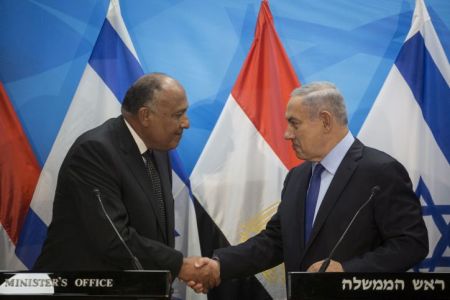
Prime Minister Benjamin Netanyahu meets with Egypt's Foreign Minister Sameh Shoukry at the Prime Minister's office in Jerusalem, on July 10, 2016, during a visit to Israel for the first time in nearly a decade. Foreign Minister Shoukry came to meet Netanyahu to support the peace process between Israel and the Palestinians. Photo by Hadas Parush/Flash90 *** Local Caption *** ????? ???? ?? ???? ???? ????? ????? ????? ???? ????? ??????? ??? ?????? ?????? ??????

Prime Minister Benjamin Netanyahu meets with Egypt’s Foreign Minister Sameh Shoukry at the Prime Minister’s office in Jerusalem, on July 10, 2016, during a visit to Israel for the first time in nearly a decade. Foreign Minister Shoukry came to meet Netanyahu to support the peace process between Israel and the Palestinians. Photo by Hadas Parush/Flash90

The Egyptian Foreign Minister Sameh Shoukry’s visit to Israel Sunday, July 10 and the two conversations he held with Prime Minister Binyamin Netanyahu that day underscored the intensified ties between the two governments and their leaders, President Abdel-Fatteh El-Sisi and the prime minister. The Palestinian issue rated a mention in passing, mostly as useful camouflage to disguise the real business under discussion. This, DEBKAfile’s intelligence sources reveal, revolved around a fresh update on the Syrian war and most of all on the sudden reversal of Syria’s Bashar Assad’s fortunes from wanted war criminal, whose head the US and its president Barack Obama demanded, to the master of a regime and army which is suddenly in the highest demand – even by Obama – as the only reliable military force capable of pursuing the war on jihadi terror, especially ISIS.

This astonishing reversal came to the fore in the last week of June. While putting the final touches on his reconciliation pact with Israel after six years of discord, Turkish President Tayyip Erdogan sent his intelligence chiefs on a clandestine mission to meet Assad’s aides and test the ground for burying the hatchet with him too.

This move was not taken into account by Netanyahu. Erdogan acted on the quiet, while in the midst of yet another maneuver, this one advanced talks for mending relations with the Egyptian president with the help of Algerian mediators who are flitting between Ankara and Cairo, DEBKAfile’s sources report.

While taking briefings from his foreign minister on the talks in Jerusalem, El-Sisi tried to assess whether Erdogan’s feelers to Assad would ripen into a deal between them   If so, the Turkish leader was perfectly capable of jumping aboard the Iranian-Syrian-Hizballah lineup on the Shiite side of the Middle East map and ditching the moves led by Saudi Arabia, Egypt and the UAE for a counter-alignment of Sunni nations.

The answer to this question will determine whether Iran’s position in Syria is strengthened or weakened.

Egypt and Israel share a strong common interest in this answer.

mistral_class_helicopter_carrier_Egypt_26.8.15

Meanwhile the balance of military strength in the region underwent a radical change with the delivery to the Egyptian Navy of its first helicopter carrier, an advanced Mistral-class vessel made in France and paid for by Saudi Arabia to the tune of half a billion dollars.

The second carrier is due later this year.

These acquisitions substantially upgrade Egypt’s military capabilities as the only power operating in the region in possession of helicopter carriers except Russia.

The highly versatile French amphibious assault ship, equipped with state-of the-art radar navigation and missile defense systems, can carry 16 helicopters plus a battalion of 40 Leclerc tanks and 450 soldiers. This makes the Egyptian navy the primary sea and air arm for defending the shores of the Sinai Peninsula, Suez Canal, the Gulf of Suez, the Red Sea and the approaches to the Gulf of Aqaba – not just against Islamist terrorists but also Iranian expansion.

Since the Saudi, Egyptian and Emirate governments are in close military and intelligence sync for combating the two threats, the Egyptian foreign minister had plenty of urgent business to discuss with Netanyahu.


