Posted tagged ‘Israel’

Lieberman: “A fighter does not need to the battlefield with a lawyer”

August 29, 2016

Israeli Defense Minister Avigdor Lieberman: “A fighter does not need to go to the battlefield with a lawyer”

Aug 29, 2016, 3:46PM

Source: Lieberman: “A fighter does not need to the battlefield with a lawyer” – Israel Politics News | JerusalemOnline

photo Credit: Reuters/Channel 2 News

Lieberman strongly criticized how the media has responded to the trial of Elor Azaria, the Hebron soldier who shot the terrorist, and the Israeli fighter who shot a Palestinian earlier today.

A fighter does not need to go to the battlefield with a lawyer,” Israel’s Defense Minister Avigdor Lieberman stated this morning in reference to the trial of Elor Azaria, who is being investigated for shooting a terrorist, and the Israeli fighter who shot a Palestinian in Ofra earlier today, which was reported on JerusalemOnline.

“I would like to take this opportunity and to appeal to the Israeli media in three parts,” he stated. “First of all, the Israeli media needs to remember that Israel is a democratic country who only convicts people in court. It isn’t the media but the courts that decide. This includes Azaria and the other soldier.”

“The second thing that people need to remember is that we are fighting against terrorists every day,” Lieberman added. “They cannot go out on a mission with a lawyer glued to them. To reach a situation where every soldier asks for a lawyer before going out on a mission is impossible. I expect for the Israeli media to strengthen Israel’s deterrence and not to deter the soldiers in their struggle against the terrorists.”

Earlier today, one of Azaria’s commanders concurred with Lieberman regarding Azaria: “All of the time we updated that a knife is only the beginning and the day will come when there will be something greater, such a shooting incident or an explosive device. When the commanders came to the scene of the incident, it is the first thing that they think about. When I saw this big body and heard a citizen shout ‘fear of explosive device,’ this creates a frightening picture. I think that it is impossible to state at the scene that there is no fear and that there is a chance that something else is there.”

“As long as the incident is not finished, it is impossible to state that there was no danger to human life,” he added. “When terrorists are alive in the area, the danger exists. The terrorist was shot and moved a little. He was still a danger and I didn’t for nothing position a soldier beside him to differentiate him from the first terrorist that was shot in the head. I instructed soldiers to make sure that the terrorist doesn’t move and that they need to follow the rules of engagement. I positioned him further away for I feared an explosive device. The soldier was instructed to shoot if the terrorist implemented sudden movements or moved his hands towards his body. This shifting of responsibility is not responsible.”

Sinai attacks decline as Egypt’s fight against IS yields results

August 29, 2016

Sinai attacks decline as Egypt’s fight against IS yields results Through targeted bombings on Islamic State’s Jabal Hilal stronghold, Egyptian military deals strong blow to terror group’s capabilities

By Avi Issacharoff

August 29, 2016, 2:51 pm

Source: Sinai attacks decline as Egypt’s fight against IS yields results | The Times of Israel

Smoke rises after a house was blown up in a military operation in Egypt’s Sinai peninsula on November 20, 2014. (Abed Rahim Khatib/Flash90)

There has been a steady and significant decline in terror attacks carried out by the Islamic State in the Sinai Peninsula in recent months, according to both Egyptian and Israeli sources.

Get The Times of Israel’s Daily Edition by email
and never miss our top stories
  Free Sign up!

Though the Islamic State’s armed activities continue apace in the northeast triangle framed by the Israel, Gaza and Egypt borders, there have been fewer terror attacks on the Egyptian army, with a smaller number of casualties than last year, and the attacks have been less ambitious than those IS carried out in 2014 and 2015, as a result of the group’s weakened force and diminished weapons supply.

The Egyptian military’s operations in the central Sinai Peninsula and a series of airstrikes in the Jabal Hilal region — a terrorist-controlled area — have dealt a powerful blow to IS’s military capabilities, the sources said.

For the past few years, Jabal Hilal has been the stronghold of the extremist group in the peninsula, mostly due to its topography.

The region’s extensive cave system — it is considered the “Tora Bora of the Sinai,” an allusion to the rugged region of Afghanistan that Taliban and al-Qaeda fighters made into a bastion against the United States — has made it the preferred destination for IS, the current iteration of the Ansar Bayt al-Maqdis group.

Three months ago, toward the end of May, the Egyptian military spokesperson, Col. Muhammad Samir announced the killings of “88 armed members of the jihadist group in central and northern Sinai.”

May’s large-scale aerial campaign not only took out nearly 100 IS operatives, it also injured hundreds more, dozens of them seriously. In addition to the human casualties, the bombings destroyed the group’s weapons storage facilities and ammunition caches, which had been kept hidden for years.

Essentially, the “logistic front” of the Islamic State in Sinai was destroyed, the sources said.

Around the same time, Egyptian President Abdel-Fattah el-Sissi also discussed the actions against IS, which focused on Jabal Hilal, an area that is seen as particularly problematic. According to Sissi, there had been a significant victory in the fight against terror. However, he clarified, the state of emergency for Egypt would continue.

An image taken from a video clip released by the Sinai affiliate of the Islamic State group on August 1, 2016. (MEMRI)

An image taken from a video clip released by the Sinai affiliate of the Islamic State group on August 1, 2016. (MEMRI)

Earlier this month, the Egyptian military announced another achievement, the execution of Abu Duaa al-Ansari, the presumed commander of the Islamic State in Sinai, formerly known as Ansar Bayt al-Maqdis.

According to the military’s statement, the series of bombings south of el-Arish — the provincial capital of the Sinai — in which al-Ansari was killed came as the result of precise intelligence. During the bombings, a number of weapons storehouses were destroyed and some 45 operatives were killed.

Illustrative: Egyptian security forces in the Sinai, in July 2013. (Mohamed El-Sherbeny/AFP)

Illustrative: Egyptian security forces in the Sinai, in July 2013. (Mohamed El-Sherbeny/AFP)

Throughout 2015, dozens of Egyptian soldiers were killed by IS, with the worst attack taking place during the month of Ramadan in simultaneous assaults on a number of Egyptian military outposts near the town of Sheikh Zuweid that left over 50 dead.

Since the July 1, 2015 attack, however, the Egyptian military’s intelligence has improved. In addition, security collaboration and cooperation with Israel has continued.

Recently, Egypt has made a number of significant gestures in the diplomatic realm, including a rare meet-up between its foreign minister and Prime Minister Benjamin Netanyahu, that testify to the closeness of the two sides.

White House Echo Chamber Architect to Keynote Pro-Iran Lobby Conference

August 25, 2016

White House Echo Chamber Architect to Keynote Pro-Iran Lobby Conference, Washington Free Beacon, August 25, 2016

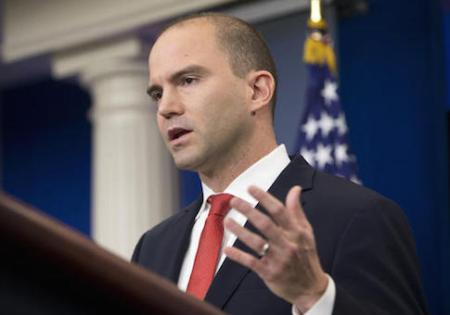
FILE - In this Feb. 16, 2016 file photo Deputy National Security Adviser For Strategic Communications Ben Rhodes speaks in the Brady Press Briefing Room of the White House in Washington. The White House is working to contain the damage caused by a magazine profile of one of President Barack Obama's top aides. In a blog post published late Sunday, May 8, 2016, Rhodes said the public relations campaign he created to sell the Iran nuclear deal was intended only "to push out facts." Rhodes says outside groups that participated "believed in the merits of the deal." (AP Photo/Pablo Martinez Monsivais, File)

Ben Rhodes (AP Photo/Pablo Martinez Monsivais, File)

The Sept. 25 event also is being co-sponsored by the Rockefeller Brothers Fund, a philanthropic group that has been criticized for funding anti-Israel activities and organizations that support boycotts of the Jewish state. The fund bankrolls some of the leading backers of the global BDS movement against Israel, which has raised concerns among some that the administration is breaking its promises to oppose this movement.

The NIAC event is being viewed as another sign that the White House is seeking to boost these organizations in return for their efforts to push the nuclear deal and support the pro-Iran “echo chamber.”

***********************

The senior White House official who bragged about creating a pro-Iran “echo chamber” to mislead Americans about last summer’s nuclear agreement is scheduled to keynote a conference sponsored by an organization that has long been accused of acting as a pro-Tehran lobbying front.

Ben Rhodes, a top national security adviser to President Obama, is slated to be the keynote speaker at an upcoming gathering hosted by the National Iranian American Council, or NIAC, which played a key role in bolstering the nuclear agreement and has long operated under suspicion that it acts as Tehran’s lobbying shop.

NIAC

Rhodes has been engulfed in a growing scandal following the revelation that he enlisted a roster of journalists and experts to spin the public in favor of the deal.

Outside organizations such as NIAC and the Ploughshares Fund, which is co-sponsoring the upcoming conference, were cited as key parts of the White House’s effort to mislead the public about the deal.

The Sept. 25 event also is being co-sponsored by the Rockefeller Brothers Fund, a philanthropic group that has been criticized for funding anti-Israel activities and organizations that support boycotts of the Jewish state. The fund bankrolls some of the leading backers of the global BDS movement against Israel, which has raised concerns among some that the administration is breaking its promises to oppose this movement.

The NIAC event is being viewed as another sign that the White House is seeking to boost these organizations in return for their efforts to push the nuclear deal and support the pro-Iran “echo chamber.”

“Pro-Iran lobbies like NIAC were helpful to Ben Rhodes when he created his echo chamber to sell the Iran nuclear deal and the Iran money-for-hostages deal,” said one senior foreign policy consultant who has worked with Congress on the Iran deal. “It’s only fair that Rhodes would return the favor by keynoting NIAC’s conference. It’s not clear what he’ll talk about more: Iran developing its nuclear program, Iran expanding across the region, or Iran seizing more American hostages including those with close links to NIAC itself.”

The NIAC conference also will be attended by Rep. Jared Huffman (D., Calif.), an Iran deal backer, according to an invitation for the event circulated by NIAC.

NIAC makes note of Rhodes’ efforts to deepen diplomacy with the Islamic Republic in its invitation.

The event’s top billed sponsors include Ploughshares and the Rockefeller Brothers Fund.

Ploughshares, a longtime funder of pro-Iran organizations and media outlets, has found itself on defense in recent months following disclosure of its role in Rhodes’ “echo chamber.”

Ploughshares funded writers and organizations in order to create a network of Iran deal “validators” who could influence public opinion at the White House’s behest.

Most recently, the Washington Free Beacon disclosed that a Washington Post contributor who touted the administration’s $400 million payment to Iran had been funded by Ploughshares. Neither the Post nor the writer disclosed this fact.

Ploughshares also moved money to National Public Radio to influence its coverage of the Iran deal.

Palestinians: The “Mountain of Fire” Erupts Against Abbas

August 25, 2016

Palestinians: The “Mountain of Fire” Erupts Against Abbas, Gatestone InstituteKhaled Abu Toameh, August 25, 2016

♦ The Palestinian Authority is now paying the price for harboring, funding and inciting gang members and militiamen who until recently were hailed by many Palestinians as “heroes” and “resistance fighters.”

♦ Hamas’s dream of extending its control to the West Bank now seems more realistic than ever — unless Mahmoud Abbas wakes up and realizes that he made a big mistake by authorizing local and municipal elections.

♦ The blood pouring out in Nablus and other Palestinian towns is proof that Abbas is on his way to losing control over the West Bank, just as he lost Gaza to Hamas in 2007. In an emergency meeting held on August 25 in Nablus, several Palestinian factions and figures reached agreement that it would be impossible to hold the vote under the current circumstances.

Hours after his security officers lynched a detainee, Palestinian Authority President Mahmoud Abbas urged Palestinian businessmen living abroad to support the Palestinian economy by investing in the Palestinian territories. The Palestinian Authority (PA), he asserted, was “working to provide security and safety to encourage investment.”

According to Abbas, “The Palestinian territories are living in a state of security stability, which we are working to provide for residents and investors alike by enforcing the rule of law and enhancing transparency and accountability.”

It must be nice to create your own reality, especially if your true reality is that of the 81-year-old Abbas.

In his speech before the businessmen, Abbas neglected any reference to the latest wave of “security chaos” in PA-controlled areas in the West Bank, specifically Nablus, the largest Palestinian city.

Five Palestinians, including two PA police officers, were killed in the worst scenes of internecine violence to hit the West Bank in recent years. Abbas was either playing the businessmen for fools or hoping that they share his deaf and blind state.

The violence in Nablus did not come as a surprise to those who have been monitoring the situation in the West Bank in recent months.

In fact, scenes of lawlessness and “security chaos” have become part of the norm in many Palestinian cities, villages and refugee camps — a sign that the PA may be losing control to armed gangs and militias. Palestinians refer to the situation as falatan amni, or “security chaos.” An article published in Gatestone in June referred to the growing instances of anarchy and lawlessness in PA-controlled areas in the West Bank, first and foremost Nablus.

Palestinians refer to Nablus as the “Mountain of Fire” — a reference to the countless armed attacks carried out against Israelis by residents of the city since 1967. Current events in Nablus, however, have shown how easily fire burns the arsonist. The Palestinian Authority is now paying the price for harboring, funding and inciting gang members and militiamen who until recently were hailed by many Palestinians as “heroes” and “resistance fighters.” Unsurprisingly, most of these “outlaws” and “criminals” (as the PA describes them) are affiliated in one way or another with Mahmoud Abbas’s Fatah faction.

Nablus, the so-called Mountain of Fire, is now threatening to turn into a volcano that is set to erupt in the face of Abbas and his PA government.

The situation in Nablus the past few days raises serious questions about the ability of the PA to perform basic security measures and rein in armed gangs and militiamen. Moreover, the unprecedented violence has further shattered Palestinian confidence in the PA and its leaders ahead of the local and municipal elections, scheduled to take place on October 8.

Hamas’s dream of extending its control to the West Bank now seems more realistic than ever. Under the current circumstances, Abbas would be offering the West Bank to Hamas on a silver platter — unless he wakes up and realizes that he made a big mistake by authorizing the local and municipal elections.

And the businessmen who met with Abbas? One might guess that they are sophisticated enough to avoid a doomed investment. Nablus will no doubt do the trick: they are likely to go running from the mayhem of the PA-controlled territories.

Things lately began to unravel when on August 18, in the Old City of Nablus, two Palestinian Authority security officers, Shibli bani Shamsiyeh and Mahmoud Taraira, were killed in an armed clash with gunmen.

Hours later, PA policemen shot dead two Palestinian gunmen who were allegedly involved in the killing of the officers. The two were identified as Khaled Al-Aghbar and Ali Halawah. The families of the two men accused the PA of carrying out an “extrajudicial” killing, and claimed their sons were captured alive and only afterwards shot dead. The families called for an independent commission of inquiry into the circumstances surrounding the killing of their sons. Palestinian human rights organizations have also joined the call for an inquiry into the killings.
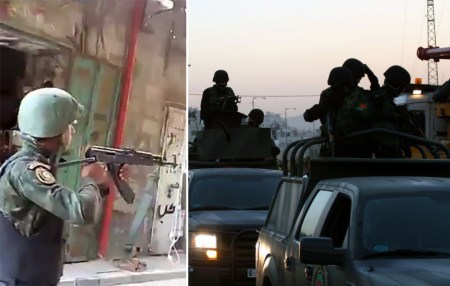
1809On August 18, two Palestinian Authority policemen were killed in an armed clash with gunmen in Nablus (left). In April of this year, a fierce gun battle erupted between Palestinian Authority policemen and members of the Jaradat clan in the refugee camp of Jenin (right). The clash started during an attempt to arrest a clan member.

In June, two other PA security officers, Anan Al-Tabouk and Uday Al-Saifi, were also killed in a shootout with gunmen in Nablus. The PA claimed that “outlaws” were behind the killings and vowed to punish the culprits.

Tensions in Nablus reached their peak on August 23, when scores of PA policemen lynched Ahmed Halawah, a former policeman suspected of leading a notorious gang belonging to Abbas’s Fatah faction. Halawah was beaten to death by PA policemen shortly after he was arrested and taken to the PA-run Jneid Prison in Nablus.

The PA leadership, which has since admitted that Halawah was lynched by its policemen, says it has ordered an inquiry into the case. Its leaders have described the lynching as an “unacceptable mistake.”

The lynching of the detainee sparked widespread protests throughout the West Bank, with many Palestinians calling for an immediate inquiry into the circumstances surrounding the case and demanding that those responsible be brought to trial.

The Palestinian Bar Association issued a statement strongly condemning the lynching of Halawah as a “crime and a human rights violation.” The Association called for holding those responsible, adding, “The regrettable and painful events, including the crime of killing Ahmed Halawah, do not serve the interest of the citizen or homeland and deepens divisions in our society.” It also called on the PA and its security forces to abide by the law and honor the human rights of the Palestinians and their public freedoms.

Alarmed by the widespread condemnations of the lynching of Halawah, some Palestinian Authority officials began issuing direct and veiled threats against Palestinian critics.

Palestinian lawyer Wael Al-Hazam, who called on Abbas to “withdraw” his security forces from Nablus, was visited by unidentified gunmen who sprayed his house with 14 bullets. The attorney and his family members were not hurt in the shooting attack, which was clearly designed to send a warning message to anyone who dared to raise his or her voice against human rights abuses by the PA security forces. And in this instance, the message arrived.

Shortly after the attack on his house, the lawyer issued a statement in which he said, “14 bullets are enough to silence me. I’m a man of the law and I cannot face bullets. My pen and voice are the only weapon I have. I do not possess armed militias to defend myself.” The attack on his house came shortly after PA security officers threatened the lawyer, warning him against appearing on a TV show to discuss the latest wave of violence in his city.

The turmoil in Nablus has prompted many Palestinians to call on Abbas to make a decision to postpone the upcoming municipal election in their city. In an emergency meeting held on August 25 in Nablus, several Palestinian factions and figures reached agreement that it would be impossible to hold the vote under the current circumstances.

Sarhan Dweikat, a senior member of Abbas’s Fatah, said that an election delay was needed, to

“protect the social fabric and preserve our national project, which is facing an existential threat in light of the security chaos and anarchy in Nablus. … Conditions in Nablus do not provide a positive climate for holding elections.”

It is hard to see how Abbas, delusional as he appears to be, would heed the calls to postpone the local and municipal elections. His pathetic attempt to persuade Palestinian businessmen to invest their money in PA-controlled areas at a time when the flames are engulfing his backyard is yet another sign of the man’s refusal — or inability — to see the reality on the ground.

This is the same president who claims that he is seeking to lead his people toward statehood and a better future. Incredibly, Abbas can probably continue to fool world leaders into believing that he and the Palestinian Authority are prepared for statehood. Yet the blood pouring out in Nablus and other Palestinian cities and villages is proof positive that Abbas is on his way to losing control over the West Bank, just as he lost the Gaza Strip to Hamas in 2007. If until now it seemed that Hamas posed the biggest threat to Abbas’s rule over the West Bank, it is now obvious that that is not so. The real threat, as brought home in blood in the West Bank, is coming from Abbas’s homegrown loyalists-turned-rebels.

State capitulates to hunger striking terrorist’s demands

August 25, 2016

State capitulates to hunger striking terrorist’s demands Bilal Kayed, who is hospitalized at Barzilai Hospital after hunger strike, reaches agreement with the Israeli authorities on his release.

Arutz Sheva, 25/08/16 00:15

Source: State capitulates to hunger striking terrorist’s demands – Defense/Security – News –

Terrorist Bilal Kayed, who was in administrative detention and is hospitalized at the Barzilai Hospital after hunger striking, has reached an agreement with Israeli authorities according to which he will be released from administrative detention and will stop his 70-day hunger strike.

Kayed’s lawyers reached an agreement with the state that his administrative detention will not be renewed after six months unless new information emerges which supports his staying in jail.

The agreement will be brought before the High Court on Thursday as part of the petition presented by the terrorist against his administrative detention.

Kayed, 35, a resident of Asira a-Samilia, a village north of Shechem, was arrested during the intifada in 2002 when he was a member of the armed unit of the Democratic front. He was charged with a number of security crimes including attacks and attempted attacks and was sentenced to 14.5 years of jail.

In June the terrorist completed his prison time but was transferred to administrative detention for a half a year and consequently he started a hunger strike.

Anti-Israel Double Standards Enable Assad’s Brutality

August 23, 2016

Anti-Israel Double Standards Enable Assad’s Brutality, Investigative Project on Terrorism,  Noah Beck,August 23, 2016

1789

Syria’s civil war claimed 470,000 lives since it started in March 2011, the Syrian Centre for Policy Research announced in February. That’s an average of about 262 deaths per day and 7,860 per month. The carnage has continued unabated, so, applying the same death rate nearly 200 days after the February estimate, the death toll is over 520,000.

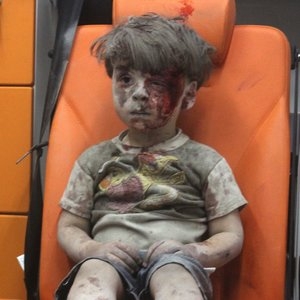
Such numbers are staggering, even by Middle East standards. However, the violence has become so routine that it only occasionally captures global attention, usually when a particularly poignant moment of human suffering is documented. The most recent example is Omran Daqneesh, a 5-year old Syrian boy who was filmed shell-shocked, bloody, and covered in dust after the airstrike bombing of his Aleppo apartment block.

The tragic image of Omran caused outrage around the world, as did the image of Aylan Kurdi, the drowned Syrian boy whose body washed up last September on a beach in Turkey. Yet Omran’s plight demonstrates that, nearly a year after the last child victim of Syrian horrors captured global sympathy, nothing has changed.

If anything, the violence in this multi-party proxy war seems to be getting worse. Since Aylan Kurdi’s drowning, Russia began blitz-bombing Syria in support of the Assad regime. The Syrian Observatory for Human Rights (SOHR) estimates that nine months of Russian airstrikes have killed 3,089 civilians – a toll that is greater, by some estimates, than the number of civilians killed by ISIS. By contrast, Syrian civilian deaths caused by U.S. airstrikes are probably in the hundreds (over roughly twice as much time, since U.S. airstrikes began in the summer of 2015).

But Syrian airstrikes are responsible for the bulk of civilian deaths in Syria. The Assad regime killed 109,347 civilians between March 2011 and July 2014 (88 percent of the total casualties at the time), according to estimates by the Syrian Network for Human Rights. That works out to about 91 civilian deaths per day. More recently, the SOHR documented 9,307 civilian deaths from 35,775 regime airstrikes over a 20-month period running from November 2014 through June 2016. Thus, roughly one innocent Syrian was killed every hour, during the 20 months that the SOHR documented civilian casualties caused by Russian and Syrian airstrikes.

Compare those figures to the number of innocent Palestinians killed by Israel from 2011 to 2014. According to Human Rights Watch (HRW), which has been accused of anti-Israel bias, 37 Palestinians were killed in 2011, 103 in 2012, 15 in 2013 and 1,500in 2014 – the year when Hamas fired rockets at Israel from highly populated Gazan areas. That’s a four-year total of 1,655. During roughly the same four-year period, the number of Syrian civilian deaths was about 76 times greater than the HRW total of Palestinian civilian casualties.

Yet the European Union singles out Israel for conflict-related consumer labels without any similar attempt to warn European consumers about goods or services whose consumption in any way helps the economies of countries responsible for the Syrian bloodshed, including Syria, Russia, and Iran. Human rights lawyer Arsen Ostrovsky has highlighted how none of those countries is targeted by those advocating a boycott of Israel out of a purported concern for human rights. Even more absurd, most of the results produced by a Google search for “academic boycott of Syria” or “academic boycott of Iran” concern academic boycotts of Israel. That asymmetry precisely captures the problem.

In addition to supporting the Assad regime in Syria and contributing to the violence there, Iran executes people for everything from drug offenses to being gay.

Indeed, the global outcry over Syrian suffering is embarrassingly weak when compared to reactions to Israel’s far less bloody conflict with the Palestinians. Imagine if Omran Daqneesh had been a Palestinian boy hurt by an Israeli airstrike on Gaza. College campus protests, the media, NGOs, and world bodies around the planet would be positively on fire. Israeli embassies would be attacked, French synagogues would be firebombed (eight were attacked in just one week during Israel’s 2014 war with Gaza), Jews around the world would be attacked, and condemnations would pour in from the EU, the United Nations, and the Obama administration. UN resolutions and emergency sessions would condemn the incident. International investigations would be demanded. Global blame would deluge Israel, regardless of whether Hamas, a terrorist organization, actually started the fighting or used human shields to maximize civilian deaths. Israel would be obsessively demonized despite any risky and unprecedented measures the Israeli military might have taken to minimize civilian casualties.

Moreover, when an occasional Syrian victim captures global attention, the protests are generally for some vague demand for “peace” in Syria, rather than blaming and demanding the punishment of Syria, Iran, and Russia, even though those regimes are clearly responsible for the slaughter. The starkly different reactions to Israel and Syria are even more shocking when it comes to the United Nations.

From its 2006 inception through August 2015, 62 United Nations Human Rights Council resolutions condemned Israel, compared to just 17 for Syria, five for Iran, and zero for Russia, according to the watchdog group UN Watch. The lopsided focus on Israel is equally appalling at the UN General Assembly, as UN Watch has highlighted. In each of the last four years, as the Syrian bloodbath claimed hundreds of thousands of lives, there were at least five times as many resolutions condemning Israel as those rebuking the rest of the world:

2012: 22 against Israel, 4 for the rest of the world

2013: 22 against Israel, 4 for the rest of the world

2014: 20 against Israel, 3 for the rest of the world

2015: 20 against Israel, 3 for the rest of the world

A corollary of the anti-Israel bias ensures that no Israeli victim will ever enjoy the kind of global sympathy expressed for Omran Daqneesh or Aylan Kurdi. When a Palestinian man enters the bedroom of a 13-year old girl and stabs her to death in her sleep,Obama says nothing even though she was a U.S. citizen and the world hardly notices. By contrast, imagine if the Israeli father of Hallel Yaffa Ariel had decided to take revenge by entering a nearby Palestinian home to stab a 13-year old Palestinian girl to death in her sleep. The global anger would be deafening.

Why do Israeli lives matter so much less? And why do student activists, the UN, the EU, the media, and the rest of the world focus so much more on alleged Palestinian civilian deaths than on Syrian civilian deaths? Doing so is woefully unjust to Syrians. It is also deeply unfair to Israel, which has endured terrorist attacks on its people throughout its existence as a state. It is the one country that, according to Col. Richard Kemp, former commander of British forces in Afghanistan, has done more to protect civilians during war than any other in the history of war.

The global obsession with condemning Israel not only defames a beleaguered democracy doing its best, it also enables the truly evil actors like the Assad regime and Hamas, by giving them a pass on some of the world’s worst crimes.

Robert Spencer on Black Lives Matter and the Leftist/Islamic Alliance

August 23, 2016

Robert Spencer on Black Lives Matter and the Leftist/Islamic Alliance, Jihad Watch via YouTube, August 23, 2016


Hamas, Palestinian Authority Target Journalists Ahead of Election

August 23, 2016

Hamas, Palestinian Authority Target Journalists Ahead of Election

by Khaled Abu Toameh

August 23, 2016 at 5:00 am

Source: Hamas, Palestinian Authority Target Journalists Ahead of Election

  • Both of the journalists who were arrested made the mistake of reporting on the suffering of Palestinians living under Hamas rule. These are not the kind of stories that Hamas wishes to see ahead of the local and municipal elections. Rather, Hamas wants to see printed lies of prosperity.
  • It is a puzzle why foreign journalists choose not to report about the campaign of intimidation facing their Palestinian colleagues.
  • One might wonder if the human rights groups neglect these abuses because of their continued obsession with destroying Israel.

Palestinian journalists are at the top of the Palestinian Authority (PA) and Hamas hit-list in the crackdown occurring alongside preparations for the Palestinian local and municipal elections, scheduled for October 8.

The crackdown is part of an ongoing campaign by the two rival parties to silence critics in the West Bank and Gaza Strip. Neither Hamas nor the PA tolerates a free and independent media — especially on the eve of a crucial election that could have far-reaching political implications in the Palestinian arena.

A Hamas victory in the upcoming elections would be catastrophic for President Mahmoud Abbas and his Palestinian Authority. Such an electoral outcome would be tantamount to a vote of no-confidence in their policies and performance.

Hamas, for its part, is investing a huge amount of resources in the election campaign, in hopes that the results would further boost its standing among Palestinians. Hamas fears that a defeat would undermine its power in the Gaza Strip and pave the way for its collapse.

As the election campaign heats up, it is clear that Hamas and the PA agree on one thing: intensifying their repressive measures against Palestinian journalists.

This media crackdown is essentially ignored by international human rights organizations. Why? One reason is that when Israel is not involved, assaults on freedom of the media and expression do not interest them.

Some Western journalists and human rights advocates also treat these cases as “internal Palestinian issues” that are of no relevance to international public opinion. A story about a Palestinian journalist who is arrested by Israel is news. A Palestinian journalist incarcerated or threatened by the Palestinian Authority or Hamas is not.

Take, for example, the case of Ahmed Said, a journalist from the Gaza Strip. Last week, he was arrested by Hamas security forces, who also confiscated his personal computer. Said has a radio show on the Sawt Al Sha’ab (Voice of the People) radio station, where Palestinians call in to voice their grievances and talk openly about the problems they are facing under Hamas rule in the Gaza Strip.

Before he was arrested, Said had phoned the spokesman of the Hamas police force, Ayman Al Batnihi, to discuss the recent rise in cases of homicide in the Gaza Strip. According to the journalist, the furious spokesman threatened him: “You are causing us a lot of problems and inciting people. I know how to deal with people. You need to be hanged.”

Said is no stranger to this sort of encounter. Last year, he was summoned for investigation for “incitement” against the Gaza City Municipality. The move came after Said used his talk show to talk about the case of street vendor Mohamed Abu Assi, who tried to commit suicide by ingesting poison after Gaza City Municipality inspectors banned him from selling corn at the beach.

Earlier, Hamas arrested another Palestinian journalist, this time for no clear reasons. Mahmoud Abu Awwad, who works for the Palestinian daily Al-Quds, was arrested from his home in the Shati refugee camp on July 25. He too had his personal computer and cellular phone seized.

Ahmed Said (left) and Mahmoud Abu Awwad (right) are two journalists living in the Gaza Strip who were recently arrested by Hamas security forces. Both journalists made the mistake of reporting on the suffering of Palestinians living under Hamas rule.

Abu Awwad’s family have since been banned from seeing him in prison. Their son, they were told by Hamas, is being held for “security reasons.” Abu Awwad, who has been working for Al-Quds for the past three years, had been reporting mostly about the hardships facing Palestinians in the Gaza Strip. In addition, he was also reporting for the Saudi London-based pan-Arab daily, Asharq Al Awsat.

“Hamas is trying to spread lies to distort the image of my son and justify his arrest,” Abu Awwad’s father told Al-Quds. “He was arrested because he was critical of the situation in the Gaza Strip and the Hamas government.”

Said and Abu Awwad have something in common. Both journalists made the mistake of reporting on the suffering of Palestinians living under Hamas rule. These are not the kind of stories that Hamas wishes to see ahead of the local and municipal elections. Rather, Hamas wants to see printed lies of prosperity.

In the context of its election campaign, Hamas has released a video featuring new houses and neighborhoods, as well as green and clean parks and smiling children. Entitled, “Thank You Hamas,” the video seeks to persuade Palestinian voters that life under Hamas is the best thing that could ever happen to them. And that is why they need to help Hamas extend its control from the Gaza Strip to the West Bank through the local and municipal elections. Journalists such as Said and Abu Awwad are spoiling the effect with their inconvenient truths.

Hamas, however, is the proverbial pot calling the kettle black. In the face of its own massive journalistic repression, Hamas dares to criticize the Palestinian Authority for taking similar measures in the West Bank.

Like Hamas, the PA leadership has always been intolerant towards Palestinian (and sometimes non-Palestinian) journalists who dare not toe the party line. Hardly a week passes without hearing about another Palestinian journalist who has been arrested or summoned for investigation by the Palestinian Authority.

In recent weeks, the crackdown on journalists in the West Bank seems to have increased in light of the upcoming elections. The PA too wants to remove from the scene any journalist who might harm its loyalists’ chances of winning the local and municipal vote. In this regard, journalists are easy prey.

One of the recent victims is Mohamed Abu Khabisah, who reports on economic issues for the Turkish news agency, Anadolu. Palestinian security officers who raided his home shortly after midnight in Al Bireh, near Ramallah, seized his personal computer and documents before taking him into custody. His wife, Hana, said she too was briefly questioned about her husband’s source of income and the nature of his work. Palestinian sources say he was apparently arrested for reporting about financial corruption in the Palestinian Authority’s official news agency, Wafa.

Abu Khabisah was the sixth journalist to be arrested by the PA since the decision to hold local and municipal elections was taken two months ago. The other four are Yehya Saleh, Raghid Tabisah Ibrahim Al Abed, Mohamed Abu Jheisheh and Ziad Abu Arrah. In another recent incident, Palestinian security officers raided the home of journalist Musab Kafisheh and seized his personal computer, but did not take him into custody.

It is anxiety that is driving Hamas and the Palestinian Authority in their crackdown on Palestinian journalists. The “security reasons” they tout as an excuse for their repression is a foil for their sense of instability: the less politically secure they feel, the more they strip Palestinian journalists of their ability to report how things really stand in the Gaza Strip and the West Bank.

So far, so good, from the point of view of Hamas and the PA. Palestinian reporters have been duly deterred. But they are far from the only ones affected.

Foreign journalists rely almost entirely on Palestinian “fixers” and producers for information about what is happening under the Palestinian Authority and Hamas. Now, local Palestinians will think ten times before they provide their foreign employers with information. Still, it is a puzzle as to why foreign journalists choose not to report about the campaign of intimidation facing their Palestinian colleagues.

One might wonder if the human rights groups neglect these abuses because of their continued obsession with destroying Israel.

Israel strikes Syria

August 23, 2016

Israel strikes Syria After mortar fire landed in the Golan Heights, the Israeli Air Force struck back.

Source: Israel strikes Syria – Defense/Security – News –

Israel Air Force (Illustration)

Israel Air Force

The Israeli Air Force struck a military target in Syria in response to mortar fire which landed in the Golan Heights in the north.

IAF jets scrambled into the air when a mortar strayed over from Syria and exploded in the Golan Heights. The fighter jets targeted a Syrian army missile launcher in retaliation, near Quneitra, Syria.

According to Syrian media, an unmanned aircraft struck a Ba’ath party position at the outskirts of Quneitra.

No one was injured. The mortar landed in open terrain.

No Red Alert rocket sirens sounded when the mortar breached Israeli territory.

Israel maintains a policy that spillover fighting, even of rebels, is the responsibility of the country who allowed it into Israel.

WATCH: Dozens of illegal guns seized in West Bank crackdown

August 23, 2016

Dozens of illegal guns seized in West Bank crackdown IDF, police, Shin Bet conduct raids in Bethlehem, Hebron as part of ongoing campaign against illicit weapons

By Judah Ari Gross

August 23, 2016, 1:53 pm

Source: WATCH: Dozens of illegal guns seized in West Bank crackdown | The Times of Israel


In the largest operation of the year, Israeli security forces seized dozens of weapons, confiscated equipment and made arrests in Hebron and Bethlehem early Tuesday morning as part of an ongoing effort to crack down on illegal guns in the West Bank, an IDF official said.

In total, seven illegal gun workshops were raided and 22 pieces of gunsmithing machinery — drill presses and metal lathes — were seized, along with “approximately 50 weapons,” including handguns, shotguns, hunting rifles and Carlo-style submachine guns, a cheap and simple automatic weapon loosely based off the design of the Carl Gustav submachine gun, the official said.

 Security forces also recovered ammunition and dozens of gun pieces — grips, barrels, stocks, etc. — that would have been used to create more weapons, the official added.

Two of the alleged manufacturers were arrested in the raids. The suspects do not appear to be connected to any terrorist groups, but were more likely driven by financial motives, the army source said.

“It seems to be a combination of market demand and the ability to manufacture,” he said.

The IDF, along with the police and Shin Bet security service, seizes machinery believed to have been used to create illegal weapons in Bethlehem and Hebron on August 23, 2016, as part of a large crackdown effort on illicit guns in the West Bank. (IDF Spokesperson's Unit)

The IDF, along with the police and Shin Bet security service, seizes machinery believed to have been used to create illegal weapons in Bethlehem and Hebron on August 23, 2016, as part of a large crackdown effort on illicit guns in the West Bank. (IDF Spokesperson’s Unit)

Though the tools necessary to create Carlo-style submachine guns are “dual purpose” and can be found in almost any machine shop in the world, the factories raided early Tuesday morning appeared to be “specifically designed for the manufacturing of weapons,” the IDF official said.

More arrests are expected to come, as Shin Bet and Israel Police investigators will now begin interrogating the two suspects in order to locate the manufacturing and distribution network, the official said.

Dozens of illegal weapons seized by Israeli security forces in Bethlehem and Hebron on August 23, 2016, as part of a large crackdown effort on illicit guns in the West Bank. (IDF Spokesperson's Unit)

Dozens of illegal weapons seized by Israeli security forces in Bethlehem and Hebron on August 23, 2016, as part of a large crackdown effort on illicit guns in the West Bank. (IDF Spokesperson’s Unit)

The joint operation was conducted between 1 a.m. and 5:30 a.m. by five battalions from the Israel Defense Forces — the elite Duvdevan unit, the Nahal Brigade’s 50th Battalion, soldiers from an artillery battery and two reservist battalions — along with representatives from the Israel Police and Shin Bet security service, according to spokespeople for the organizations.

IDF soldiers break into a workshop  believed to have been used to create illegal weapons in Bethlehem and Hebron on August 23, 2016, as part of a large crackdown effort on illicit guns in the West Bank. (IDF Spokesperson's Unit)

IDF soldiers break into a workshop believed to have been used to create illegal weapons in Bethlehem and Hebron on August 23, 2016, as part of a large crackdown effort on illicit guns in the West Bank. (IDF Spokesperson’s Unit)

The raids in Bethlehem and Hebron were the culmination of months of gathering “signal intelligence, human intelligence and visual intelligence,” an IDF official said.

There was no immediate indication that any of the guns sold by the two alleged manufacturers were specifically sold for use in terror attacks. These types of guns can be used for any number of reasons, including terrorist attacks, self-defense and criminal activity, the IDF official said.

However, a weapon purchased for self-defense can still end up being used in a terror attack, the official added.

“Someone who has one of these weapons at home [for self-defense] might hide it in a closet. And when his son gets carried away by incitement, he goes and takes this weapon to carry out attacks,” the officer said.

IDF soldiers, along with the police and Shin Bet security service, seize dozens of illegal weapons in Bethlehem and Hebron on August 23, 2016, as part of a large crackdown effort on illicit guns in the West Bank. (IDF Spokesperson's Unit)

IDF soldiers, along with the police and Shin Bet security service, seize dozens of illegal weapons in Bethlehem and Hebron on August 23, 2016, as part of a large crackdown effort on illicit guns in the West Bank. (IDF Spokesperson’s Unit)

This year over 30 shooting attacks have been carried out with illegally produced weapons. In response, the IDF and other security agencies have been cracking down on illegally produced weapons in recent months, arresting more than 140 people suspected of being involved in the creation or distribution of illicit arms, police said.

Over 300 illegal guns and nearly 50 pieces of manufacturing equipment have also been confiscated in raids across the West Bank in recent months, according to police.

The ongoing crackdown has already had an effect on the market, driving up the price of guns Col. Roman Gofman told the Associated Press last month. For example, a crude Carlo-style submachine gun cost around $500 a few months ago, whereas now it can cost upward of $2,500, he said.