Posted tagged ‘Israel’

The IDF’s New Social Contract

January 6, 2017

The IDF’s New Social Contract, Front Page MagazineCaroline Glick, January 6, 2016

flickr_-_israel_defense_forces_-_karakal_winter_training_1

Azaria is the first victim of a General Staff that has decided to cease serving as the people’s army and serve instead as B’Tselem’s army. The call now spreading through the Knesset for Azaria to receive a presidential pardon, while certainly reasonable and desirable, will likely fail to bring about his freedom. For a pardon request to reach President Reuven Rivlin’s desk, it first needs to be stamped by Eisenkot.

A pardon for Azaria would go some way toward repairing the damage the General Staff has done to its relationship with the public. But from Eisenkot’s behavior this week, it is apparent that he feels no need and has no interest in repairing that damage.

******************************

Sgt. Elor Azaria, who was convicted of manslaughter Wednesday for shooting a terrorist in Hebron last March, is a symptom of what may be the most dangerous threat to Israeli society today.

Azaria, a combat medic from the Kfir Brigade, arrived at the scene of an attack where two terrorists had just stabbed his comrades. One of the terrorists was killed, the other was wounded and lying on the ground, his knife less than a meter away from him.

A cameraman from the foreign-funded, Israeli- registered anti-Israel pressure group B’Tselem filmed Azaria removing his helmet and shooting the wounded terrorist. According to the military judges, the film was the centerpiece of the case against him.

The day of the incident, the General Staff reacted to the B’Tselem film with utter hysteria. Led by Chief of General Staff Lt.-Gen. Gadi Eisenkot and then-defense minister Moshe Ya’alon, Israel’s generals competed to see who could condemn Azaria most harshly.

For the public, though, the issue wasn’t so cut and dry. Certainly Azaria didn’t act like a model soldier. It was clear, for instance, that he acted without proper authority and that his action was not permitted under the rules of engagement then in effect in Hebron.

But unlike the IDF’s senior leadership, the public believed that the fact that it was B’Tselem that produced the film meant that it had to be viewed with a grain of salt.

The name “B’Tselem” was seared into the public’s consciousness as an organization hostile to Israel and dedicated to causing it harm with the publication of the UN’s Goldstone Commission Report in 2009. Among the Israeli-registered groups that provided materials to the biased UN commission charged with finding Israel guilty of war crimes during the course of Operation Cast Lead against Hamas in late 2008 and early 2009, B’Tselem made the greatest contribution.

The Goldstone Report cited B’Tselem as the source for its slanderous “findings” 56 times.

After the UN published the Goldstone Report, Michael Posner, the US assistant secretary of state for human rights, visited Israel and met with Jessica Montell, B’Tselem’s executive director at the time.

The US Embassy’s official report of their meeting was published by WikiLeaks.

During their meeting, Montell told Posner that her group’s goal in providing the Goldstone Commission with materials was to force the government to pay a heavy price for its decision to fight Hamas, by criminalizing Israel in the court of world opinion.

As B’Tselem saw it, Israel needed to come to the point where it would consider whether it could “afford another operation like this.”

Montell explained that from B’Tselem’s perspective the root of the problem with Israel is the Israeli public. The public is the source of Israel’s bad behavior, according to B’Tselem, because it “had zero tolerance for IDF killed.” As far as the public is concerned, she said, harm to Palestinian civilians is preferable to harm to IDF soldiers.

Since, in B’Tselem’s view, the public’s commitment to the lives of its soldiers meant that it would not constitute a “moral check on war,” and check the bellicosity of IDF commanders, it fell to B’Tselem to make the IDF brass and the government care more about world opinion than they care about what the public thinks.

The public’s condemnation of B’Tselem after its role in compiling the Goldstone Commission’s libelous accusations against the IDF was made public made no impression whatsoever on the group.

Following Operation Protective Edge in 2014, B’Tselem’s materials were cited 67 times by the report of the biased UN commission put together to slander Israel.

In 2007, B’Tselem launched its “Camera Program.”

The camera initiative involved providing video cameras to B’Tselem employees and volunteers in Judea and Samaria in order to document the actions of Israeli security forces and civilians in the areas.

In many cases, the videos B’Tselem produced distorted reality for the purpose of criminalizing both groups.

For instance, in 2011, B’Tselem gave a film to Ynet’s Elior Cohen that purported to show Israeli police brutally arresting a young Palestinian boy and preventing his mother from coming to the police station with him.

But as CAMERA showed at the time, B’Tselem’s portrayal of events was fanciful at best. In all likelihood, the event was staged by the B’Tselem photographer.

At the outset of the film the boy is unseen as he throws rocks at a police van. The boy is first seen as he runs toward the B’Tselem camerawoman. For her part, the camerawoman screams at the police and identifies herself as from B’Tselem.

The police are shown asking the boy’s mother repeatedly to join them in the car. As she stands poised to enter the vehicle, a Palestinian man is shown telling her in Arabic not to go.

In July 2016, B’Tselem released a film taken in Hebron during an attempted stabbing attack by a female Palestinian terrorist against Israel police at a security checkpoint outside the Cave of the Patriarchs.

The police reported that the terrorist tried to stab a policewoman who was checking her in an inspection room. Another policewoman shot and killed her.

B’Tselem claimed that its film proved that the female terrorist was shot for no reason. But the fact is that it does no such thing. As NGO Monitor noted, the B’Tselem film neither contradicts nor proves the police’s version of events.

Over the years, the public’s growing awareness of B’Tselem’s unwavering hostility went hand in hand with its growing distress over what was perceived as the IDF’s willingness to sacrifice the safety of troops to prevent it from receiving bad press.

For instance, in 2012, a film went viral on social media that showed a platoon of combat engineers fleeing from a mob of Palestinians attacking with rocks, Molotov cocktails and slingshots.

When questioned by reporters, the soldiers said that they had repeatedly asked their battalion commander for permission to use force to disperse the crowd and they were repeatedly denied permission.

Retreat was their only option.

In 2015, another film went viral showing a group of Palestinian women hitting and screaming at a soldier trying to arrest one of them for throwing rocks at his platoon. He did nothing as he absorbed the blows. And no harm came to the women who assaulted him.

Along with the films, came stories that soldiers on leave told their friends and family about the IDF’s rules of engagement. The tales were always the same. The rules of engagement are so restrictive that all initiative is placed in the hands of the enemy. Not only can terrorists attack at will. They can flee afterward and expect that no harm will come to them, because what is most important, the soldiers explain, is to ensure that IDF maintains its reputation as the most moral army in the world.

This was the context in which Azaria killed the wounded terrorist.

Although the headlines relate to Azaria, and his family members have become familiar faces on the news, the fact is the reason the Azaria affair was the biggest story of the year is that it really has very little to do with him.

There are three forces driving the story.

First of course, there is B’Tselem.

B’Tselem’s produced the film to advance its goal of obliging Israel’s national leadership, including the IDF brass, to care more about “world opinion” than about the opinion of Israeli citizens.

Second then, is the pubic that cares more about the lives of IDF soldiers than about what the world thinks of it.

Finally, there is the IDF General Staff that is being forced to pick which side it stands with.

Since Israel was established nearly 70 years ago, the relationship between the IDF and the public has been based on an often unstated social contract.

From the public’s side, Israel’s citizens agree to serve in the IDF and risk their lives in its service.

Moreover, they agree to allow their children to serve in the military and to be placed in harm’s way.

From the IDF’s side, the commanders agree to view the lives of their soldiers as sacrosanct, and certainly as more precious than the lives of the enemy and the enemies’ society.

The third side is the General Staff. In the years leading up to the Azaria affair the generals were already showing disturbing signs of forgetting their contract with the public.

The films of fleeing soldiers and the rules of engagement weren’t the only signs of our military leadership’s estrangement.

There were also the promotions given to radical lawyers to serve in key positions in the Military Advocate-General’s unit, and the red carpet treatment given to radical leftist groups like B’Tselem that were dedicated to criminalizing soldiers and commanders.

Since the shooting in Hebron, the General Staff’s treatment of the public has become even more disdainful.

Ya’alon and Eisenkot and his generals have repeatedly offended the public with comparisons of “IDF values” with alleged processes of barbarization, Nazification and ISIS-ization of the public by the likes of Azaria and his supporters.

If there was a specific moment where the military brass abandoned its compact with society once and for all, it came on Tuesday, the day before the military court convicted Azaria of manslaughter. In a speech that day, Eisenkot insisted that IDF soldiers are not “our children.” They are grownups and they are required to obey the orders they receive.

By making this statement the day before the verdict in a case that pitted society against the General Staff, which sided with B’Tselem, Eisenkot told us that the General Staff no longer feels itself obligated by a sacred compact with the people of Israel.

Azaria is the first victim of a General Staff that has decided to cease serving as the people’s army and serve instead as B’Tselem’s army. The call now spreading through the Knesset for Azaria to receive a presidential pardon, while certainly reasonable and desirable, will likely fail to bring about his freedom. For a pardon request to reach President Reuven Rivlin’s desk, it first needs to be stamped by Eisenkot.

A pardon for Azaria would go some way toward repairing the damage the General Staff has done to its relationship with the public. But from Eisenkot’s behavior this week, it is apparent that he feels no need and has no interest in repairing that damage.

As a result, it is likely that Azaria will spend years behind bars for killing the enemy.

Moreover, if nothing forces Eisenkot and his generals to their senses, Azaria will neither be the last nor the greatest victim of their betrayal of the public’s trust.
The Man Who Most Deserves to be DNC Chairman

January 5, 2017

The Man Who Most Deserves to be DNC Chairman, Front Page MagazineJohn Perazzo, January 5, 2017

keithellison

In a recent interview with the Fox Business Network, legal scholar Alan Dershowitz announced that because of U.S. Rep. Keith Ellison’s past ties to Nation of Islam leader Louis Farrakhan, he (Dershowitz) is prepared to “resign [his] membership to the Democratic Party after 50 years of being a loyal Democrat” if Ellison is named as the next DNC chairman.

It’s actually hard to figure out exactly what’s got Mr. Dershowitz in such a snit. It’s not as if Ellison represents some type of sudden, radical departure from what has become the mainstream Democratic position regarding race and religion. In fact, when it comes to racialism and anti-Semitism, Ellison is a mere piker compared to Barack Obama, for whom Dershowitz voted twice. That would be the same Barack Obama who spent 20 years worshiping in the church of a racist Jew-hater named Jeremiah Wright; the same Barack Obama whose longtime close friend and mentor, Professor Rashid Khalidi, was a devoted ally of the late Jew-killer extraordinaire, Yasser Arafat; the same Barack Obama whose policies toward Israel were described by a Likud Party chairman as “catastrophic”; the same Barack Obama who, according to Israeli Ambassador Michael Oren, has plunged “Israel’s ties with the United States” into “a crisis of historic proportions”; and the same Barack Obama who, in an act of historic treachery just a few days ago, permitted the passage of a U.N. Security Council resolution demanding an end to Israeli settlement-building in the West Bank.

By any metric one chooses, Keith Ellison’s resumé makes him an absolutely perfect choice to continue this proud Democratic tradition of endlessly stoking the fires of racial and religious antagonism.

While attending law school in 1989-90, for instance, Ellison, who had converted to Islam in 1982, wrote several student-newspaper columns where he: (a) stated that the U.S. Constitution is “the best evidence of a white racist conspiracy to subjugate other peoples”; (b) advocated slavery reparations as well as the creation of a geographically self-contained “homeland” for black people in the Southeastern United States; (c) praised the Jew-hating Nation Of Islam (NOI) organization for “all of its laudable work”; and (d) defended the incendiary NOI spokesman Khalid Abdul Muhammad—a black supremacist who once praised a black gunman for killing six white commuters (and wounding fourteen others) in a racially motivated atrocity aboard a New York City train—as a hero who possessed the courage to “just kill every goddamn cracker that he saw.”

In February 1990, Ellison participated in sponsoring Kwame Ture (a.k.a. Stokely Carmichael) to speak at his law school on the topic of Zionism’s ties to “imperialism” and “white supremacy.” The speech was replete with anti-Jewish slander—hardly a surprise, given that Ture, who in the ’60s had called for “killing the honkies,” was now in the habit of proclaiming that “the only good Zionist is a dead Zionist.”

Ellison supported, and was affiliated with, the Nation of Islam and Louis Farrakhan for at least a decade, from the late 1980s through the late ’90s. Notwithstanding Farrakhan’s long, well-documented history of venom-laced denunciations of “white devils” and Jewish “bloodsuckers,” Ellison described him as “a role model for black youth” who was “not an anti-Semite”; as “a sincere, tireless, and uncompromising advocate of the black community and other oppressed people around the world”; and as “a central voice for our [black people’s] collective aspirations.”

When Farrakhan supporter Joanne Jackson—the then-executive director of the Minneapolis Initiative Against Racism—asserted in 1997 that “Jews are among the most racist white people I know,” Ellison declared that he and his NOI comrades “stand by the truth contained in [Jackson’s] remarks.”

In February 2000 Ellison gave a speech at a fundraising event sponsored by the Minnesota chapter of the National Lawyers Guild, on whose steering committee he previously had served. Also in attendance was the former Weather Underground terrorist Bernardine Dohrn, a longtime Obama friend and political ally who had once devoted her life to the goal of fomenting violent revolution across the United States. Incidentally, that 2000 fundraiser was held on behalf of onetime Symbionese Liberation Army terrorist Kathleen Soliah, after her apprehension for the attempted murder of some Los Angeles police officers. Ellison called for Soliah’s release, and also spoke favorably of such high-profile killers and leftist icons as Mumia Abu Jamal, Assata Shakur, and Geronimo Pratt.

But alas, America would still have to wait another six-plus years before Ellison would finally grace the U.S. Congress with his presence. Following his electoral triumph in 2006, Ellison’s victory party featured a number of his supporters shouting “Allahu Akbar!”—the traditional battle cry of Islamic jihadists.

Between 2006 and 2016, Ellison spoke at a minimum of twelve fundraising events sponsored by the Council on American-Islamic Relations (CAIR), an organization whose co-founders had close ties to the Islamic Association for Palestine, which functioned as a public-relations and recruitment arm for Hamas—the infamous horde of missile-launchers and suicide bombers committed to the mass murder of Jews. At one of those dozen CAIR fundraisers, Ellison urged his listeners to support Sami al-Arian, the former University of South Florida professor who already had confessed to aiding and abetting the terrorist group Palestinian Islamic Jihad, which, like Hamas. has always had a fondness for the smell of dead Jews.

Ellison has also spoken at numerous conventions held by organizations like the Islamic Society of North America, the Muslim American Society, and the Islamic Circle of North America, the Muslim Public Affairs Council, and the the North American Imams Federation—all of which are closely affiliated with the Muslim Brotherhood. The Brotherhood, you may recall, advocates the use of violent jihad for the creation of a worldwide Islamic caliphate ruled by strict Sharia Law, and is the parent organization of both Hamas and Al-Qaeda.

But apart from that, the Brotherhood is quite moderate.

In 2007 Ellison denounced what he called the baseless “persecution” of several officials of the Holy Land Foundation (HLF) who were being tried on charges that they had funneled millions of dollars to Hamas. The trial ended with a hung jury on most counts, but the following year the HLF defendants were retried and convicted on all charges.

In a July 2007 speech, Congressman Ellison likened the Bush Administration’s military response to the 9/11 attacks, to the manner in which the Nazis had exploited the 1933 burning of the Reichstag in Berlin: “It’s almost like the Reichstag fire, kind of reminds me of that. After the Reichstag was burned, they blamed the Communists for it, and it put the leader [Hitler] of that country in a position where he could basically have authority to do whatever he wanted.”

During “Operation Cast Lead” (OCL)—a December 2008/January 2009 military operation in which Israel sought to quell the aggression of Hamas and other terrorists in Gaza—Ellison made it quite clear that his hatred for America was equaled by his contempt for Israeli Jews. Stating that he was “torn” on the issue, he refused to support a nonbinding House resolution “recognizing Israel’s right to defend itself against attacks from Gaza” and “reaffirming the United States’ strong support for Israel.” In September 2009, Ellison called for an end to all U.S. aid to Israel.

In 2009 as well, Ellison met with Mohammed al-Hanooti—a leading U.S.-based fundraiser for Hamas—at a campaign event for Virginia House of Delegates candidate Esam Omeish, who had previously exhorted Palestinians to follow “the jihad way” in their struggle against Israel.

While Ellison is fond of pro-jihadists like al-Hanooti, he’s not too keen on Muslims who seek to persuade other members of their faith to reject jihad and Islamic supremacism. In the fall of 2009, for instance, Ellison disparaged Zuhdi Jasser, a Muslim activist who has consistently warned about the threat that political Islam poses to the West, as an Islamic “Uncle Tom.”

During his 2010 congressional re-election bid, Ellison accepted campaign contributions from such notables as Jamal Barzinji and Hisham Al-Tali—both of whom had previously served as vice presidents of the Saudi-dominated, pro-jihad International Institute of Islamic Thought, and both of whom had been identified by the FBI as U.S. leaders of the Muslim Brotherhood.

In September 2012 Ellison condemned a portion of the Republican Party Platform which stated that “there must be no use of foreign law by U.S. courts in interpreting our Constitution and laws.” Characterizing this as a manifestation of anti-Sharia intolerance, the congressman said: “It’s an expression of bigotry.… They’re demonstrating hatred toward Muslims.… [T]hey’re the party that is basically a bigoted party and they have now officially declared themselves against a whole segment of the American population …”
During Operation Protective Edge—a 2014 Israeli military incursion that was launched in response to a dramatic escalation in rocket fire against Israel by Hamas-affiliated terrorists in Gaza—Ellison pennedWashington Post op-ed arguing that any ceasefire should be predicated on Israel ending its blockade of Gaza. Curiously, he made no mention of the fact that the blockade, which explicitly permitted the import of humanitarian supplies and other basic necessities, had been implemented out of necessity in 2007, due to Hamas’s relentless importation and deployment of deadly weaponry from its allies abroad.

Also in 2014, Ellison was one of only eight Members of Congress to vote against a House Resolution to increase the amount of U.S. financial aid that was earmarked to help Israel maintain and develop its Iron Dome missile-defense system—a system that had successfully intercepted 735 Hamas rockets aimed at Israeli population centers during Operation Protective Edge.

To be fair, we should note that Ellison is no less concerned about Israel’s national security than he is about America’s. Indeed, when President Obama announced in September 2015 that he planned to admit 10,000 Syrian refugees to the U.S. during the ensuing year, Ellison said: “Ten thousand is not enough. Aren’t we the people who say, ‘give me your tired, your poor, your huddled masses’? We must do more for families who are not safe in their own homeland.” He said this in spite of the fact that the Islamic State‘s bloodthirsty savages had openly vowed to secrete their own terrorist operatives into the refugee masses, as well as the fact that high-ranking government officials like FBI Director James Comey, Homeland Security Secretary Jeh Johnson, CIA Director John Brennan, and FBI Deputy Assistant Director Michael Steinbach had all said that it would be impossible to reliably screen out terrorists posing as refugees.

In 2015 as well, Ellison voiced his unequivocal support for the passage of the Iran Nuclear Deal, which allowed the Islamist regime in Tehran to enrich uranium, build advanced centrifuges, purchase ballistic missiles, fund terrorism, and have a near-zero breakout time to a nuclear bomb approximately a decade down the road. “This deal is a triumph of diplomacy over war and proves negotiation is an excellent method of peacemaking,” said Ellison.

Last year, Bernie Sanders used his influence to secure, for Ellison, a major role in formulating the Democratic Party’s platform for the presidential election campaign. As terrorism expert Steven Emerson reports: “Ellison and other delegates supporting Sanders wanted the Democratic Party platform to delete a description of Jerusalem as Israel’s ‘undivided capital’ and wanted to gut language opposing the boycott, divestment and sanctions movement targeting the Jewish state.”

At the Democratic National Convention last July, Ellison was a featured speaker in a session held by the U.S. Campaign to End the Israeli Occupation—part of an alliance of anti-Israel organizations that promote the Boycott, Divestment, & Sanctions (BDS) campaign. Ellison himself supports BDS, a Hamas-inspired initiative that aims to use various forms of public protest, economic pressure, and court rulings to advance the Hamas agenda of permanently destroying Israel as a Jewish nation-state.

But lest you think that Ellison’s only qualifications for the post of DNC chairman are his Jew-hatred, his admiration for Islamist radicals, and his utter contempt for his own country, don’t neglect to credit him also for the high regard in which he held the late totalitarian dictator and mass murderer Fidel Castro. After Castro died this past November, Ellison sang his praises as a “revolutionary leader” who had nobly “confronted a system of government that excluded everybody except the military and the money-rich”; who had “[stood] up for peace and freedom in Africa”; who had “[taken] on the South Africa apartheid military forces and defeated them”; who had “deployed doctors anywhere … people were sick”; and who had “made medical education very available [and] made medicine available.”

So, here’s to Keith Ellison—in hopes that he will get the DNC chairmanship that a man of his caliber so richly deserves.

Why the Anti-Israeli Sentiment?

January 5, 2017

Why the Anti-Israeli Sentiment? Town HallVictor Davis Hanson, January  5, 2017

israelflag

Secretary of State John Kerry, echoing other policymakers in the Obama administration, blasted Israel last week in a 70-minute rant about its supposedly self-destructive policies.

Why does the world — including now the U.S. — single out liberal and lawful Israel but refrain from chastising truly illiberal countries?

Kerry has never sermonized for so long about his plan to solve the Syrian crisis that has led to some 500,000 deaths or the vast migrant crisis that has nearly wrecked the European Union.

No one in this administration has shown as much anger about the many thousands who have been killed and jailed in the Castro brothers’ Cuba, much less about the current Stone Age conditions in Venezuela or the nightmarish government of President Rodrigo Duterte in the Philippines, an ally nation.

President Obama did not champion the cause of the oppressed during the Green Revolution of 2009 in Iran. Did Kerry and Obama become so outraged after Russia occupied South Ossetia, Crimea and eastern Ukraine?

Ambassador to the United Nations Samantha Power was never so impassioned over the borders of Chinese-occupied Tibet, or over Turkish-occupied Northern Cyprus.

In terms of harkening back to the Palestinian “refugee” crisis that started in the late 1940s, no one talks today in similar fashion about the Jews who survived the Holocaust and walked home, only to find that their houses in Eastern Europe were gone or occupied by others. Much less do we recall the 11 million German civilians who were ethnically cleansed from Eastern Europe in 1945 by the Soviets and their imposed Communist governments. Certainly, there are not still “refugee” camps outside Dresden for those persons displaced from East Prussia 70 years ago.

More recently, few nations at the U.N. faulted the Kuwaiti government for the expulsion of 200,000 Palestinians after the liberation of Kuwait by coalition forces in 1991.

Yet on nearly every issue — from “settlements” to human rights to the status of women — U.N. members that routinely violate human rights target a liberal Israel.

When President Obama entered office, among his first acts were to give an interview with the Saudi-owned news outlet Al Arabiya championing his outreach to the mostly non-democratic Islamic world and to blast democratic Israel on “settlements.”

Partly, the reason for such inordinate criticism of Israel is sheer cowardice. If Israel had 100 million people and was geographically large, the world would not so readily play the bully.

Instead, the United Nations and Europe would likely leave it alone — just as they give a pass to human rights offenders such as Pakistan and Indonesia. If Israel were as big as Iran, and Iran as small as Israel, then the Obama administration would have not reached out to Iran, and would have left Israel alone.

Israel’s supposed Western friends sort out Israel’s enemies by their relative natural resources, geography and population — and conclude that supporting Israel is a bad deal in cost/benefit terms.

Partly, the criticism of Israel is explained by oil — an issue that is changing daily as both the U.S. and Israel cease to be oil importers.

Still, about 40 percent of the world’s oil is sold by Persian Gulf nations. Influential nations in Europe and China continue to count on oil imports from the Middle East — and make political adjustments accordingly.

Partly, anti-Israel rhetoric is due to herd politics.

The Palestinians — illiberal and reactionary on cherished Western issues like gender equality, homosexuality, religious tolerance and diversity — have grafted their cause to the popular campus agendas of race/class/gender victimization.

Western nations in general do not worry much about assorted non-Western crimes such as genocides, mass cleansings or politically induced famines. Instead, they prefer sermons to other Westerners as a sort of virtue-signaling, without any worries over offending politically correct groups.

Partly, the piling on Israel is due to American leverage over Israel as a recipient of U.S. aid. As a benefactor, the Obama administration expects that Israel must match U.S. generosity with obeisance. Yet the U.S. rarely gives similar “how dare you” lectures to less liberal recipients of American aid, such as the Palestinians for their lack of free elections.

Partly, the cause of global hostility toward Israel is jealousy. If Israel were mired in Venezuela-like chaos, few nations would care. Instead, the image of a proud, successful, Westernized nation as an atoll in a sea of self-inflicted misery is grating to many. And the astounding success of Israel bothers so many failed states that the entire world takes notice.

But partly, the source of anti-Israelism is ancient anti-Semitism.

If Israelis were Egyptians administering Gaza or Jordanians running the West Bank (as during the 1960s), no one would care. The world’s problem is that Israelis are Jews. Thus, Israel earns negative scrutiny that is never extended commensurately to others.

Obama and his diplomatic team should have known all this. Perhaps they do, but they simply do not care.

John Kerry, Those “Illegal” Settlements, That “Two-State Solution” (Part II)

January 4, 2017

John Kerry, Those “Illegal” Settlements, That “Two-State Solution” (Part II), Jihad Watch

(Part I of the series is available here. — DM)

kerry-netanyahu

After the Six-Day War, while the Israelis waited for the Arabs to make that phone call about peace negotiations that never came, the Arabs had other ideas. First, they announced at a meeting in the Sudanese capital of the Arab League “the three No’s of Khartoum”: No peace with Israel, no recognition of Israel, and no negotiations with Israel. Who and what – before a single “settlement” was started — was then the “obstacle to peace”? Second, the Arabs and their willing collaborators began to speak about, and thus to reify, out of the local Arabs in Israel, Gaza, the West Bank, and in the refugee camps, a “Palestinian people.” This fiction, which Secretary Kerry uncritically accepts (to be fair, so do millions of others), was designed for propaganda purposes, and has proven to be a stunningly effective weapon against Israel. No Arab leaders or diplomats or intellectuals mentioned the “Palestinian people” until 1967, when the need for such became apparent. As Zuheir Mohsen, leader of the Palestinian Arab terror group As Saiqa, famously told a journalist in 1977:

The Palestinian people does not exist. The creation of a Palestinian state is only a means for continuing our struggle against the state of Israel for our Arab unity. In reality today there is no difference between Jordanians, Palestinians, Syrians and Lebanese. Only for political and tactical reasons do we speak today about the existence of a Palestinian people, since Arab national interests demand that we posit the existence of a distinct “Palestinian people” to oppose Zionism. Yes, the existence of a separate Palestinian identity exists only for tactical reasons, Jordan, which is a sovereign state with defined borders, cannot raise claims to Haifa and Jaffa, while as a Palestinian, I can undoubtedly demand Haifa, Jaffa, Beer-Sheva and Jerusalem. However, the moment we reclaim our right to all of Palestine, we will not wait even a minute to unite Palestine and Jordan.

Yet Kerry insists that U. N. Resolution 181 — the “Partition Plan” — was meant to “realize the national aspirations of both Jews and Palestinians.” In 1947, there were no “Palestinians” with “national aspirations.” The invading Arab states never mentioned these “Palestinians” and had no intention of giving up whatever territory they managed to win to a nonexistent “Palestinian” people. And in 1947, the “national aspirations” of the Jews were betrayed when they were left by the Partition Plan with only about half of what had been promised under the Palestine Mandate, or – if we include eastern Palestine — only 23% of the territory promised before eastern Palestine had been transformed into the Emirate of Transjordan. To the extent that the local Arabs had any “national aspirations,” they were to destroy the Jewish state. In any case, Resolution 181 became a dead letter when the Arabs unanimously rejected it and then invaded Israel. Kerry wants to resuscitate it.

Kerry then moves on to Resolution 242, and what he, and Resolution 2334, call “occupied Palestinian territory.” But the word “occupied” has both a colloquial and a legal meaning, and this confusion between the two meanings has been well exploited by the Arabs. Israel is an “occupier” in the colloquial sense: through force of arms, it has “occupied” certain territories. But Israel is not only a “military occupier” of the West Bank, in the way that it was an “occupier” of the Sinai. Israel’s legal (historic, moral) claim to the West Bank, under the Mandate for Palestine, remains.

The constant use of the phrase “occupied territory,” or still worse, “occupied Palestinian territory” by John Kerry and so many others suggests that Israel has no claim to the “West Bank” or Gaza other than the temporary one of being a military occupant. One thinks in this regard of such examples as “Occupied Berlin,” “Occupied Vienna,” “Occupied Paris,” “Occupied Japan.” In all of these examples, the word “occupied” signals that the territory in question is under the control of a victorious power or powers, that control having been won through military conquest, and the claim to that territory is understood to be only temporary, based solely on that military occupation. But Israel’s claim to the “West Bank” is not based on the fact of military occupation. Rather, the West Bank is properly thought of as an unallocated part of the Palestine Mandate, and the provisions of the League of Nations’ Mandate still apply. Had Israel managed to capture all of the West Bank in the 1948-49 war, it could have exercised its rights under the Mandate, and incorporated all of that territory into the Jewish state. The fact that the Jews did not end up in possession of Gaza and the “West Bank” at the close of hostilities in 1949 war did not change the legal status of those territories. Israel’s claim based on the Mandate itself was not extinguished. Of course, had the Arabs accepted the Partition Plan, as Israel had done, then Israel would have been obligated to stand by its own acceptance, but the Arab refusal to do so freed Israel from any such obligation. The Six-Day War allowed Israel, by coming into possession of the West Bank by force of arms, to finally exercise its right, based on the Mandate, to establish settlements in that territory.

The claim under the Mandate was reinforced, rather than weakened, by Resolution 242’s insistence that territorial adjustments be made to guarantee Israel’s security (“secure borders”). And when Israel voluntarily gave up the Sinai to Egypt, and later handed Gaza over to “Palestinian” Arab rule – for reasons of realpolitik– that had no bearing on Israel’s continued claim to the “West Bank.”

So what has John Kerry carefully not said in his ill-tempered attack on Israel that has apparently so heartened Hamas? He has failed to mention the most important foundational document for Israel, the Mandate for Palestine, which enshrines Israel’s legal, moral, and historic rights to establish Jewish settlements everywhere in Palestine, from the Jordan to the sea, including all of the West Bank. Not only are those settlements not illegal, but they were, and still are, to be “encouraged” under the express terms of the Mandate. He has failed to mention, too, that Israel gave up fully 95% of what it won in the Six-Day War, and failed to mention the endless Israeli efforts to engage the “Palestinians” in real peace talks, not Rose Garden photo ops; those Israeli efforts have always been rebuffed. When at Camp David in 2000 Ehud Barak made the astounding offer to Yassir Arafat of fully 95% of the West Bank, Arafat refused.

This puts quite a different spin on Israeli behavior from that which Kerry presents. For him, it is Israel that keeps trying to deny the “Palestinians” everything, whereas it is those same “Palestinians” under Abbas as under Arafat, who have turned down Israeli offers, and most important, continue to refuse even to recognize Israel as a Jewish state. The list of Arab refusals starts with the Partition Plan of 1947, then the refusal to make the armistice lines of 1949 into permanent borders as offered by Israel, then the further refusal, for 12 years after the Six-Day War, by all the Arab states to recognize, or to negotiate, or to make peace with Israel (the Three No’s of Khartoum) until Sadat made his separate peace.

And even Kerry’s whipping-boy, Prime Minister Netanyahu, whose government he describes as “the most right-wing” in Israel’s history, in November 2009 put in place a 10-month freeze on settlements, hoping thereby to get the Palestinians back to the negotiating table. It didn’t work. And Kerry, of course, doesn’t mention Netanyahu’s attempt. Far from clinging adamantly to territories it won, Israel has been remarkably generous in giving up territories. The minute Anwar Sadat decided he would break ranks with the other Arabs and negotiate for Egypt alone, he found the Israelis willing, in exchange for a peace treaty, to hand back the entire Sinai. How often, in human history, has a nation victorious in war handed back all the territory it won to an aggressor?

Israel went even further with its concessions in Gaza, removing all of the Jewish settlements, handing Gaza back to the local “Palestinians,” without receiving anything in return but rockets and bombs. Yet Secretary Kerry dares to present Israel as the obstacle to peace, with the “Palestinian” campaigns of terror, and celebrations of terrorists, mentioned only in passing, while the Israeli “settlements” – specifically authorized by the Mandate – are treated, at great length, as “illegal.” He finds the Israelis bizarre in their belief, one that they have come to most reluctantly, that IDF control of the West Bank is a better way to preserve peace than a peace treaty signed with the likes of Mahmoud Abbas. Kerry is outraged that Israelis dare to insist they have a legal right to establish such settlements in the West Bank. Don’t bring up the Palestine Mandate; he doesn’t want to hear about it. And he certainly doesn’t want people beginning to agree with Israelis that the Mandate remains relevant. He doesn’t care what the main author of Resolution 242, Lord Caradon, meant by the phrases “withdrawal from territories” and “secure and recognized borders.” Please don’t trouble Secretary Kerry, either, with the report prepared by the American Joint Chiefs of Staff for President Johnson, about the minimum territorial adjustments that in their view Israel would need for “secure and defensible borders.” For Kerry, it’s more than enough to keep repeating the phrases “two-state solution” and “just and lasting peace,” which for him clearly means almost complete withdrawal to the 1967 lines with “minor adjustments.” For Lord Caradon, however, the most important thing about Resolution 242 was that Israel not be compelled to return to the 1967 lines that invited Arab aggression, and the adjustments need not everywhere be categorized as “minor.” As he forcefully put it:

We could have said: well, you go back to the 1967 line. But I know the 1967 line, and it’s a rotten line. You couldn’t have a worse line for a permanent international boundary. It’s where the troops happened to be on a certain night in 1948. It’s got no relation to the needs of the situation.

Kerry doesn’t want to hear about “secure and defensible borders.” He wants the Israelis to “take risks for peace” (as if Israel was not already taking unbelievable risks for peace), to uproot settlements needed for Israel’s defense, and to put their trust in a peace treaty, while all the evidence suggests that the “Palestinians,” including nobody-here-but-us-accountants Mahmoud Abbas, have no intention of recognizing Israel as a Jewish state until Israel returns to the 1967 lines, including East Jerusalem, and likely not even then. As for the other Arabs, it’s true that right now a shared fear of Iran has made it possible for Egypt, Saudi Arabia, and Jordan to collaborate with Israel behind the scenes, but fear of Iran may not prove to be a unifying force forever. As for most Arabs and Muslims, the spectacle of a dimidiated Israel would not sate but whet jihadist appetites.

Among the many things John Kerry would prefer not to be reminded of is that in 1920, 77% of the formerly Ottoman territories that were originally intended to be included in the Palestine Mandate — that is, the land east of the Jordan — was closed to Jewish immigration. Eastern Palestine instead became, thanks to the British, the Arab Emirate of Transjordan. For Kerry, that’s not worth mentioning, but it was a huge event for the Zionists at the time. In fact, those Zionists who did not accept the loss of eastern Palestine continued to include it in their maximalist demands. Their leader, Ze’ev Jabotinsky, even wrote a celebrated poem: “Shtei Gadot L’Yarden – Zu Shelanu Zu Gam Ken” (“Two sides has the river Jordan/This side is ours, and that side too”) expressing the refusal to give up the claim to eastern Palestine. So Israel had by 1948 already been considerably reduced, the British having given away 77% of what had been intended for the Palestine Mandate. To remind people of this is not to endorse Jabotinsky’s demand, but at least to offer a historical perspective that might make some more understanding of Israel’s position.. Would it have been too much to expect John Kerry to mention how, and why, and on what land, the country of Jordan was created?

The Arabs, then, already had in 1948 a “Palestinian” state, consisting of all of eastern Palestine, the country we now call “Jordan,” where 80% of the population identifies itself as “Palestinian.” When the Arabs became convinced, after the Six-Day War, that they could not destroy Israel outright, they sought to undermine Israel in other ways – diplomatic isolation, boycotts, terror attacks – hoping to reduce its size through salami tactics, and to establish a second Arab state, this one in western Palestine, a state whose main purpose would be not to live in satisfied coexistence with Israel (‘two states, side-by-side” etc.) as Kerry naively foresees, but to serve, rather, as a springboard for yet another attempt at destroying, whether through the Fast Jihad of Hamas or the Slow Jihad of Fatah, the one Jewish state, whose mere existence, whatever its size, is such an affront to all Muslims and Arabs. John Kerry, innocent of Islam, gives no sign of realizing how deep is the Muslim Arab opposition to Israel.

So the Arabs refused this and the Arabs refused that. And the Israelis accepted this, and the Israelis gave back that. And the Mandate for Palestine says this, and U.N. Resolution 242 says that. It’s all so complicated and mind-numbing, no wonder John Kerry wants to hear only about a very few things. He blocks out the rest, and he reduces everything to the simple-minded phrases repeated endlessly: the “two-state solution,” the “just and lasting peace.” He doesn’t need to know what has actually happened between Arab and Jew in Palestine in the last 100 years, what principles were invoked or ignored, what rights created or destroyed, what promises kept or broken, what offers accepted or rejected. For Kerry, all he knows and all he needs to know is that the settlements are “illegal,” and positively noxious because they are what prevent that “two-state solution” that “everybody” knows can be arrived at just as soon as Israel stops building new settlements and dismantles all but a few of the old ones.

For the Palestinians, of course, as Kerry may not know, all the cities in Israel are “occupied” territory (“Occupied Haifa,” “Occupied Jaffa,” “Occupied Jerusalem”), and all the towns are “settlements” and all the settlements, of course, are on “Occupied Arab Land.” The Jews, as Infidels, have no rights on lands once possessed by Muslims. There is no historic connection of Jews to Jerusalem, which is also “occupied Palestinian territory.” And even if the Palestine Mandate existed, we are not required to pay any attention to it. Any history that is not on the side of the Muslims can safely be forgotten.

U.N. Resolution 2334 pretends to be about furthering “peace,” but its effect will be to embolden the “Palestinian” side, now less willing than ever to negotiate, since it believes it has now isolated Israel diplomatically. With little to lose, the Israeli government could take a different tack, a hypertrophied hasbara that would speak over the talking heads of the Security Council to a public that, especially in Europe, has been getting its own taste of Muslim convivencia and may, as a consequence, be more sympathetic to Israel’s plight than votes at the U.N. might suggest. Let Israel explain what the Palestine Mandate was intended to achieve, why the settlements are not “illegal,” what made the Partition Plan (Resolution 181) null and void, why those armistice lines were never made into permanent borders, how and why the “Palestinian people” were invented, and then, in terms anyone looking at a map can understand, what territory in the “West Bank” the tiny nation of Israel, as a military matter, must keep, as “settlements,” if it is to have those “secure and defensible borders” it both needs and deserves.

John Kerry assures us that he cares deeply about, even “loves,” the plucky little state of Israel that, he insists, stole his heart away decades ago. But he is convinced that Israel doesn’t understand its real situation, and its blinkered (“extreme right-wing”) leaders can’t seem to grasp that a “Palestinian” state living “side-by-side with a Jewish state” would only improve Israel’s well-being. Here is John Kerry, the American Secretary of State, fierce in Foggy Bottom, languid in Louisburg Square, who knows better than the Israelis what they need, and understands perfectly this most intractable of foreign policy problems. It’s an old and cruel idea: that Israel doesn’t understand its real interests, and must be saved in spite of itself. And John Forbes Kerry has arrived on the scene to help straighten out the little country he loves so much. All he asks of Israelis is that they come to their senses, and do what he, and Barack Obama, and the Security Council, demand.

Fortunately, for Israel, and for the Western world, too, the clock is running out on Obama and on Kerry. This means Israel still has a chance to decide for itself what it needs, at a minimum, in order to survive. Given the history of the Jews during the last 3000 years, that doesn’t seem like much to ask.

Obama Administration Set for One Last Strike at Israel

January 4, 2017

Obama Administration Set for One Last Strike at Israel, Front Page MagazineP. David Hornik, January 4, 2016

kerryandobama

The Times of Israel cites an Israeli news broadcast saying Netanyahu believes the Middle East Quartet—which includes the U.S., UN, Russia, and the EU—“will coordinate positions at the Paris summit, and then return to the Security Council in the very last days of Obama’s presidency to cement these new parameters on Mideast peacemaking.”

*************************************

A week and a half ago President Obama gave the order for the U.S. to abstain on UN Security Council Resolution 2334, thereby—effectively—voting in favor and allowing the resolution to pass.

As I noted, the resolution goes beyond “moral equivalency” by obfuscating Palestinian terror and incitement while branding Jewish life beyond the 1949 Armistice Lines a “flagrant violation under international law” and a “major obstacle…to peace.”

But the administration wasn’t through with Israel. A few days later, with the Middle East aflame from Yemen to Iraq to Syria to Libya to Sudan and Iranian expansionism on the march, Secretary of State Kerry delivered a 75-minute harangue against what he called Israel’s “pernicious policy of settlement construction that is making peace impossible.”

Critics have noted that—in the real world—Israeli construction in settlements under the recent Netanyahu governments has been so modest that it has not affected the Israeli-Palestinian population balance in the West Bank; and that if any and all Israeli presence beyond the 1949 Armistice Lines is “illegal,” then the idea of a “peace process” to settle claims over disputed land appears to be invalidated, since Israel is then nothing but a rapacious thief and the Palestinians its victims seeking redress.

As international-law scholar Eugene Kontorovich notes in the Washington Post:

The…condemnation of any Jewish presence whatsoever in eastern Jerusalem and the West Bank is a unique rule invented for Israel. There has never been a prolonged belligerent occupation—from the U.S. occupation of West Berlin to Turkey’s ongoing occupation of Cyprus to Russia’s of Crimea—where the occupying power has blocked its citizens from living in the territory under its control. Moreover, neither the United Nations nor any other international body has ever suggested they must do so. What is being demanded of Israel in its historical homeland has never been demanded of any other state, and never will be. 

The Obama administration’s stepped-up diplomatic and verbal assault on Israel in the last weeks of its tenure has not gone unnoticed, sparking bitter criticism even from Democratic lawmakers and mainstream American Jewish organizations that are far from any right-wing agenda.

But the extent to which the administration listens to such protests, or can be budged from its wholesale endorsement of Palestinian claims regarding the West Bank and Jerusalem, can be gauged from the fact that the Obama-Kerry team has still more in store for Israel.

It’s set to take place in Paris on January 15, under the aegis of the Hollande government, and it’s expected that some 70 countries will be attending.

The ostensible subject: “Middle East peace.” The translation: more invalidation of any and all Israeli claims to land captured from Jordan (not the Palestinians) in a defensive war in 1967, and more support for what—under present circumstances—would almost certainly be a Palestinian terror state in that territory.

American Jewish leaders have demanded that France call off this “ill-conceived, poorly timed and damaging” event, also pointing to “the impending transition to a new US administration, just five days later.”

But according to The Times of Israel, that—the Obama administration’s exploitation of its last days in office to do more harm to Israel—is exactly what Prime Minister Netanyahu is concerned about.

The Times of Israel cites an Israeli news broadcast saying Netanyahu believes the Middle East Quartet—which includes the U.S., UN, Russia, and the EU—“will coordinate positions at the Paris summit, and then return to the Security Council in the very last days of Obama’s presidency to cement these new parameters on Mideast peacemaking.”

“Cement these new parameters” would, of course, mean another Security Council resolution that is ruinous to Israel’s stance in favor of a negotiated settlement, tars it as a rogue state and international outlaw, and gives another major boost to the ongoing international effort to delegitimize and ultimately dismantle the Jewish state.

The Obama administration that came into office calling for “daylight” between the U.S. and Israel and slamming “natural growth” in Israeli communities, will be leaving office having learned nothing about the real sources of Middle Eastern violence and instability, Palestinian intransigence and outright rejection of Israel in any contours, and Israel’s unique nature in its region as a stable, faithfully pro-U.S. democracy seeking a genuine peace that would not merely imperil it.

Instead the administration appears bent on compounding ignorance and incorrigibility by cementing a lasting legacy of shame.

It’s all on Azaria’s shoulders

January 4, 2017

It’s all on Azaria’s shoulders, Israel Hayom, Dror Eydar, January 4, 2017

(Please see also, The Azaria trial and the rift over orders to shoot. — DM)

In July 1988, a terrorist attacked Yossi Hadassi, a soldier who had enlisted just three months earlier. Hadassi grappled with the terrorist and managed to kill him. He was awarded a citation of merit from the commander of the Engineering Corps.

Then the media hunt began, backed by the self-righteous Left, which accused the soldier of murder. On May 30, 1989, Yossi Hadassi committed suicide.

That week, the poet Naomi Shemer published a message in Yedioth Ahronoth: “The soldier Yossi Hadassi killed his attacker, and a year later killed himself. It wasn’t only Yossi Hadassi who committed suicide; an entire nation is committing suicide. An entire country is defending itself as its investigators, police, and poets drive it mad and convince it that it is a predatory wolf, Goliath, a monster. The intifada is the prelude and the excuse for the destruction of Israel. We are all Yossi Hadassi.”

Hadassi’s fate touched me. Naomi Shemer’s courage touched me, too. She published her message after a decade in which her work had been viciously attacked because she was “right-wing.”

I was reminded of that piece when the Azaria affair broke. We’ve thrown all the problems in Israeli society, the disagreement rooted in debate between Left and Right and the 100-year-old conflict between us and our neighbors, on to the bowed back of the young soldier. The mechanism of national suicide camouflaged as morality, too.

No, I’m not arguing that Azaria acted rightly. I don’t know how I would have acted in his situation. But even if I don’t think he’s a hero, it’s clear that he’s no murderer, and that what I’ve written. He certainly should not have been put on trial; the matter should have ended with a disciplinary hearing in his unit. And he certainly should not have to carry the weight of Israel’s foreign relations and the IDF’s ethical code and the discussions that have used him as a beast of burden. Sgt. Elor Azaria killed a terrorist. The craziness around his case has to do with the accursed insanity and politicization of the public discourse.

Like Hadassi, Azaria comes from a humble family on which the uncompromising interest and self-righteousness of some of us came crashing down out of the clear blue sky and threatened to crush. No mercy was shown to Hadassi, may he rest in peace, or to Azaria, may he live a long life. But unlike the 1980s, this time there is social media, which was able to help and support him. That’s some comfort. Back then, I couldn’t help Yossi Hadassi, but today I can express my own opinion wholeheartedly: We are all Elor Azaria.

The Azaria trial and the rift over orders to shoot

January 4, 2017

The Azaria trial and the rift over orders to shoot, DEBKAfile, January 4, 2017

(What is the standard for Israeli military tribunals? Proof “beyond a reasonable doubt” or something less? — DM)

elorverdict480

DEBKAfile’s military analysts note that the controversy reflects long efforts to introduce politics – or a brand of political correctness – into IDF decision-making. Soldiers are under orders to shoot terrorists in the heat of an attack – that is not in question, but since the Azaria affair, the army under Gen. Eisenkott, is working on refinements, such as when it is permissible and when it is not.

*****************************

All three judges of an Israeli military court Wednesday, Jan. 4, unanimously found Sgt. Elor Azaria guilty of manslaughter for the fatal shooting of an injured terrorist in Hebron in March 2016, after an attack on soldiers. The conviction was announced after a three-hour reading of the verdict by the lead judge, Col. Maya Heller. The court threw out the entire case for the defense in favor of the testimony given by the commanders at the scene of the incident and the prosecution. The cause of the terrorist’s death was judged to be the bullet Sgt. Azaria fired to his head, although the court ruled that there was no danger of the terrorist continuing his attack. Nor was the suspicion of the accused that he concealed explosives confirmed after the fact.

According to the verdict, Azaria was motivated purely by revenge for the terrorist’s attempt to stab his friend. Col. Heller rejected arguments that the court was influenced by social, political or military controversy surrounding the case and stressed that it was guided solely by the facts of the case. The convicted soldier’s lawyer said he would appeal the verdict. Sentence is to be announced at a later date.

Outside the court, hundreds of protesters demonstrated against the Hebron soldier’s trial.

Seven months ago, Sgt. Elior Azaria was put on trial before a three-judge panel of the Jaffa Military Court. He was charged with manslaughter for shooting dead in March last year a Palestinian terrorist, who had attacked soldiers with a knife and was already shot and injured.

Release of the videotape which showed the terrorist lying prone on the ground but still alive when Azaria came on the scene went viral and made the case a cause célèbre.

The trial turned on the question of whether the terrorist was immobilized or still posed a threat. The popular controversy on this question led to Moshe Yaalon’s resignation as defense minister, after he argued that Azaria, then 19, was out of line and should stand trial for murder.

He was supported by the incumbent chief of staff, Lt. Gen. Gady Eisenkott.

Azaria’s family mounted a popular campaign to justify his actions, claiming that he acted in the conviction that he was saving lives. His conduct was backed by many uniformed men through the social media, and a number of former generals volunteered to testify in his defense.

DEBKAfile’s military analysts note that the controversy reflects long efforts to introduce politics – or a brand of political correctness – into IDF decision-making. Soldiers are under orders to shoot terrorists in the heat of an attack – that is not in question, but since the Azaria affair, the army under Gen. Eisenkott, is working on refinements, such as when it is permissible and when it is not.

Both Yaalon and Eisenkott went overboard in their attempt to improperly influence the course of the military trial sub judice by public statements disparaging the accused soldier.

Last week, in pursuance of this campaign, the former defense minister appeared before 1,000 18-year olds about to join the army for three years of compulsory service. First, he rehashed the events leading up to Azaria’s action and his own resignation.

On March 24, he said, two terrorists came up to the Gilbert checkpoint at Tel Romeida in Hebron and started stabbing a soldier and officer who were manning it. But then, Yaalon burst out:  “If we don’t preserve our human values, the IDF will be no better than Daesh!” the implication being that Azaria was no better than an Islamist State killer.

This was a move to prejudge the trial and sway the three military judges, just in case they were persuaded that Azaria was not trigger-happy but had shot the prone terrorist in the belief that as a soldier it was his duty to protect the immediate environment from further menace.

The chief of staff had his say on Tuesday, Jan. 3, the day before the court was to hand down its verdict. He declared that he had a duty to “preserve IDF values.”

Our military analysts have searched in vain the IDF military codebook for a definition of “IDF values” among the often contradictory orders of when to open fire. They wonder how a young conscript serving at a checkpoint -and knowing he is the target at any moment for a sudden knifing, shooting, bombing or vehicular attack – can be expected to decide on the spot which “military values” to apply.

In his basic training, he is taught that his duty as a soldier is to fight the enemy and protect civilians. Confusion at the vital moment of an attack could cost precious lives.

However, Yaalon and Eisenkott have made it crystal clear that, regardless of the verdict handed down by a court after a long trial and exhaustive questioning of a flock of witnesses – both for the defense and the prosecution – they are determined to perpetuate the divisive, politically-tainted controversy in the country and its armed forces.

Israel erased in UN schools

January 4, 2017

Israel erased in UN schools

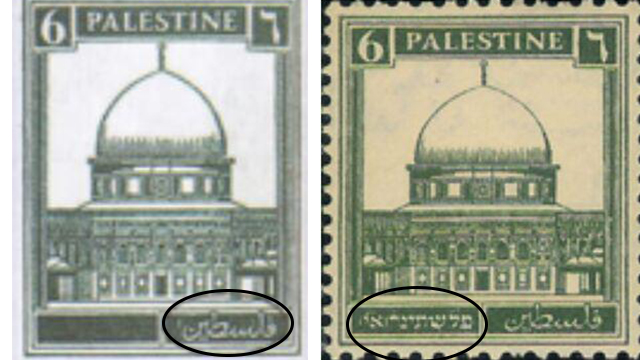
UN-run schools in the West Bank and Gaza use textbooks which negate the existence of Israel; teach Western Wall, Cave of the Patriarchs are exclusively Muslim holy sites which the Jews strive to occupy; stamps from the British Mandate period are doctored to remove the Hebrew.

Elior Levy, Eitan Goldstein

Published: 03.01.17 , 19:03

Source: Ynetnews News – Israel erased in UN schools

An Israeli investigation into school books used by United Nations-run schools in the West Bank were found to consistently delegitimize and demonize the State of Israel.

These textbooks—written by the Palestinian Ministry of Education—are used in schools run by the United Nations Relief and Works Agency (UNRWA) in both Gaza and the West Bank.

However, the most shocking discovery is that the UN schools don’t teach Palestinian children to recognize Israel as a country—not within the 1947 borders, nor any borders at all.

Picture of the countries of the Middle East in one of the textbooks. "Palestine" is superimposed on the whole of Israel

Picture of the countries of the Middle East in one of the textbooks. “Palestine” is superimposed on the whole of Israel

The research was presented by Dr. Arnon Gross who translated the books, and Dr. Ronni Shaked from the Harry Truman Research Institute at the Hebrew University in Jerusalem.

In one of the history books, Zionism is defines as a colonialist movement that was founded by European Jews in order to gather Jews from all over the world and to put them in Palestine along with in other neighboring Arab countries. The textbooks argue that the Zionists do this via methods such as immigration and forcing the Arab population off their land.

No mention is made of the religious or historical connection of Jews to the Land of Israel or to Jerusalem in these textbooks used by UNRWA. The schools also make no mention of Jewish holy sites anywhere in their materials—no Western Wall, no Cave of the Patriarchs, and no Rachel’s Tomb.

Instead, the textbooks teach that these are all Muslim holy sites which the Jews are trying illegitimately to take control of.

Also, children at UNRWA schools are taught that the Arab massacres of Jews in 1929 (specifically in Safed, Hebron, and Jerusalem) was called the “al Buraq revolt,” and was carried out to keep the Jews from conquering and occupying these holy cities.

Over 130 Jews were murdered by their Arab neighbors during these massacres.

British stamp from the Mandate Era. On the right, all three languages included on the original stamp. On the left, the doctored stamp used in Palestinian textbooks, completely erasing the Hebrew

British stamp from the Mandate Era. On the right, all three languages included on the original stamp. On the left, the doctored stamp used in Palestinian textbooks, completely erasing the Hebrew

The textbooks used by the UN to teach Palestinian children even negate the existence of Hebrew. One of the books has a picture of a stamp used during the British Mandate Period upon which is written Hebrew, English, and Arabic. However, the textbooks written by the Palestinians erase the Hebrew, leaving only the English and the Arabic.

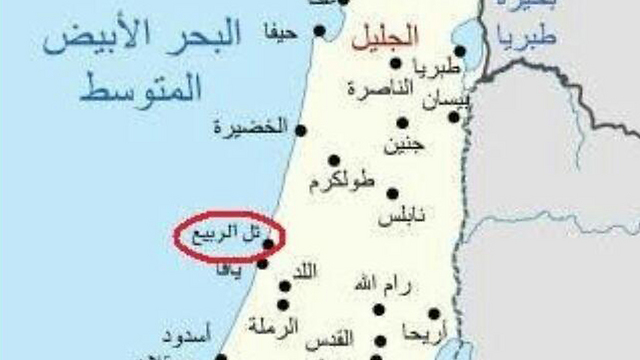
Additionally, there is no reference to the presence of Jews in Israel, with Jewish cities and towns established after 1948 erased from the maps given to Palestinian children. Tel Aviv, originally named after the Hebrew title of Theodor Herzl’s book Altneuland, is re-named “Tel al-Rabia.” The word al-rabia means the season of spring in Arabic.

Tel al-Rabia, circled, appears in place of Tel Aviv on a "Map of Palestine" used in UN schools. No Jewish towns built after 1948 are included

Tel al-Rabia, circled, appears in place of Tel Aviv on a “Map of Palestine” used in UN schools. No Jewish towns built after 1948 are included

Incitement in Palestinian textbooks is well known and documented. Palestinian President Mahmoud Abbas has spoken about the issue several times, and has agreed to be a part of a joint Israeli-US–Palestinian committee to design new textbooks. However, this committee has yet to meet.

The research was conducted by the Center for Near East Policy Research, and was published less than two weeks after the UN Security Council resolution declaring construction and settlements in the West Bank and eastern Jerusalem illegal.

UN schools were previously used as Hamas weapons storehouses during Operation Protective Edge.


The Significance, Ramifications, And Messages Of Hizbullah’s Show Of Military Force In Al-Qusayr, Syria

January 4, 2017

The Significance, Ramifications, And Messages Of Hizbullah’s Show Of Military Force In Al-Qusayr, Syria, MRMRI, Yael Yehoshua*, January 3, 2016

On November 13, 2016, Hizbullah marked its annual Martyr Day by holding its first military parade in a Syrian town, Al-Qusayr, which Hizbullah took over in 2013 following a long and bloody battle with rebel forces, and which has since become the main symbol of the organization’s involvement in the Syria war alongside the Assad regime. The parade featured hundreds of fighters in military uniforms, tanks, U.S.-made M113 armored personnel carriers, cannon, machine guns, and an armored regiment. Also marching was the Al-Radwan division, comprising some 10,000 fighters from Hizbullah’s “intervention forces” and “special forces” fighting in Syria, which constitute the spearhead of the organization in the country.[1]

By holding this parade at this time and at this location, Hizbullah was informing its rivals, locally and in the region – that is, political players in Lebanon, the Syrian rebels and their Arab supporters, and the West and Israel – that it is now a powerful cross-border military force that can control areas outside Lebanon’s borders. The parade did indeed cause a tremendous stir among Hizbullah supporters, as well as among the organization’s opponents.

This paper will review the significance and ramifications of the parade in Al-Qusayr and the messages that it sent.

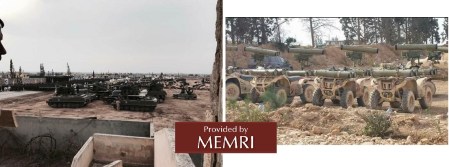
1295aPhotos from the parade. Arabipress.org, November 13, 2016; Addiyar.com, November 14, 2016
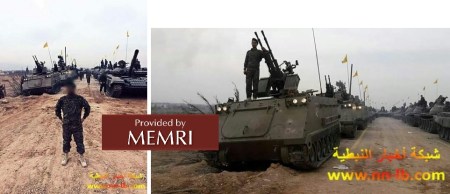
1295bPhotos from the parade. Nn-lb.com, November 13, 2016

Hizbullah Underlines Its Presence On Syrian Soil

Hizbullah’s holding the parade on Syrian soil, particularly in Al-Qusayr, is a symbolic yet highly significant act showing the organization’s control of part of Syrian territory. Al-Qusayr is the jewel in the crown of Hizbullah’s  military involvement in Syria and is seared into the memories of the Syrian rebels as an arena in which they were defeated by Hizbullah in 2013 after a bitter battle that lasted weeks and involved many losses on both sides. Moreover, Al-Qusayr is also Hizbullah’s gateway into Syria. After capturing it from the rebels, Hizbullah emptied it of its residents and turned it into a center for its headquarters and into a staging area for its fighters arriving from Lebanon, from which they leave for other battle fronts in Syria.

Also, holding the parade on Syrian soil as opposed to Lebanese soil is a blatant attempt by Hizbullah to highlight its presence in Syria and signal that this presence has become a known, established and certain fact. It may also reflect Hizbullah’s view of Al-Qusayr and its surroundings as its own military territory, and not as Syrian territory – with no consideration whatsoever for Syria’s sovereignty or for Lebanon’s position on this. [2] Hizbullah deputy secretary general Na’im Qassem hinted at this when he said, several days after the parade: “We are in Syria, and we do not need to give any explanation or justification for this. We stand alongside the Syrian army and the Syrian state.”[3]

Qassem’s statements were backed up by statements by Lebanese Army Gen. (ret.) Amin Hatit, who is close to Hizbullah: “Hizbullah’s presence in Syria is something basic… As far as we are concerned, there is no difference between Al-Qusayr and South [Lebanon].”[4]

By holding it on its Martyr Day, Hizbullah also intended the parade to convey a message to the Shi’ite public in Lebanon, which supports Hizbullah and is the source of its political power and its fighters, that despite its losses Hizbullah has remained strong. For Lebanese Shi’ites, many of whom have been killed and wounded in the past four years of Hizbullah’s fighting in Syria, and particularly in the ongoing battle for Aleppo, the parade was meant to boost morale and signal that the losses had not been in vain but had only further strengthened the organization and made it possible for it to become a regional power.

Hizbullah’s Transition From A Resistance Force To A Quasi-Regular Army

Hizbullah’s demonstration of its military strength by parading hundreds of its soldiers with tanks, cannon, machine guns, and so on also reflected its wish to send the message that it was now a well-trained and well-armed force, with new units, resembling an experienced regular army, and was no longer a resistance militia waging guerilla warfare against Israel.

This upgrade of its military and deterrence capabilities is the result of its military experience in Syria fighting the anti-regime rebels. In this context, Lebanese daily newspapers quoted Na’im Qassem making statements about Hizbullah’s military capability. The Lebanese Al-Mudun daily quoted Qassem as saying: “Hizbullah has added expertise, fighting capability, and military capabilities. This force is becoming more powerful and more developed, into something greater than resistance and less than a regular army.”[5] The Al-Safir daily quoted him as saying: “Now we have a trained army and the resistance is no longer based on methods of guerilla warfare. We are better armed and better trained, and we have advanced professional knowledge.”[6] It should be noted that an official Hizbullah communique denied that Qassem had called Hizbullah an army.[7]

It appears that Hizbullah’s show of strength at this time was because of achievements in the field by both it and its camp, the resistance axis. These achievements included the strengthening of Hizbullah, the Syrian army, and the militias that have been operating alongside the Syrian army since the beginning of Russia’s military involvement in Syria over a year ago along with the upsurge in the political status of Syrian President Bashar Al-Assad in the Arab world and in the West, and the bolstering of Iran’s regional and international status because of its increased military presence in Iraq and Syria and in the wake of the nuclear agreement and the election of the Hizbullah ally Michel Aoun to the Lebanese presidency.


Hizbullah As A Cross-Border Regional Force

Alongside the messages it sent locally, the parade was aimed at letting the region know that Hizbullah is a cross-border military force that is not bound by any particular territory and does not recognize the Syria-Lebanon border, or other borders between Middle East states, set by the Sykes-Picot agreement.

Hizbullah and its sponsor, Iran, which itself is striving to spread its Islamic Revolution and “Rule of the Jurisprudent” doctrine, do not consider geographic borders to be significant, and are deepening their penetration of many countries in the region. This approach is expressed by the military involvement of Iran and its agents in Syria, Iraq, and Yemen, and by Hizbullah’s complete military control of part of Syrian soil, including the Al-Qusayr region.

The military parade sent a message not only to the rebels in Syria, but also to their sponsors in the Arab and Muslim world – Saudi Arabia, Qatar, and Turkey – underlining that the resistance axis in Syria has the upper hand, and that Hizbullah will not hesitate to show its power anywhere it needs to in order to subjugate its opponents. On this matter, Lebanese Army Gen. (ret.) Amin Hatit said: “Had Hizbullah wanted to send a message to Lebanon, it would have held the demonstration there, not in Syria, and what it did in Al-Qusayr is a message to the region.”[8]

In an interview with the Iranian website Tasnim, which is close to Iran’s Islamic Revolutionary Guard Corps (IRGC), Qassem said: “If we want to look [at this] realistically, we see that Hizbullah has become a regional power. The way in which Hizbullah is confronting both the Zionist enemy and the takfiriyyoun [i.e. the Salafi-jihadi organizations]… shows that the organization is a regional power, and the changes in the region are proof of that.”[9]

Also, Nasser Qandil, editor of the pro-Syria Lebanese daily Al-Bina and an Assad associate, wrote in a November 16, 2016 article titled “Hizbullah – The New Middle East Army” that the organization is a cross-border force and that the borders between countries mean nothing to it. He stated that Hizbullah has become the “Middle East Army” because of its military capabilities and because it is a military force that crosses borders, and that it has achieved this by virtue of the popular organizations in the region that assist it, which comprise approximately a million fighters spread across the Middle East. These forces share its wars and its positions, and see Hizbullah secretary-general Hassan Nasrallah as a leader “with special status and as a source of authority for the wars in the Middle East.” He added that in actuality Hizbullah “has torn up Sykes-Picot” by transforming the areas of Syria that border Lebanon’s east and northeast into a “direct and vital continuation of the resistance.”

In this context, Qandil added that as Israel’s military strength and Saudi Arabia’s economic and political strength were waning, and as Al-Qaeda was failing, and as the U.S. was more preoccupied with domestic affairs and Russia was concerned about neutralizing other regional forces such as Turkey, “Hizbullah and the network of its allies is developing, becoming like a soft-[power] state that lives in the bosom of several countries. [Hizbullah] is not a rival [to the states on whose soil it exists], but complements them, living and developing at their consent as a deterrent force and as added strategic value. Thus, this force is becoming the most important fact emerging with the beginning of the 21st century… and no force in existence can threaten the growth of this new army of the Middle East that is deployed from Lebanon to Afghanistan, and from Aleppo to Bab Al-Mandeb.”[10]


Hizbullah As An Independent Force Operating Outside Lebanese Laws And Institutions

The Al-Qusayr military parade has great significance also vis-à-vis Lebanon. Hizbullah’s control in the Al-Qusayr region erases the Lebanon-Syria border and creates a single large, contiguous swath of territory from Syria to the northern Beqa’a, one of its strongholds in Lebanon, without the Lebanese government’s agreement and under harsh criticism from various political elements in that country.[11]

By holding the parade, Hizbullah has again proven, to Lebanon and to the entire world, that it is not subject to Lebanon’s laws and institutions, but that it operates according to its own interests and the interests of Iran and the resistance axis. As far as it is concerned, its presence in Syria depends solely on it, not on any decision by the Lebanese state. On this, Qassem said: “We stand alongside the Syrian army and the Syrian state, and without our intervention in Syria, the terrorists would enter every place in Lebanon. The issue of our involvement in Syria is no longer under discussion by Lebanese circles.”[12]

This message was discordant to Hizbullah’s opponents within Lebanon, who expressed harsh criticism of the Al-Qusayr parade. Ashraf Rifi, justice minister in Lebanon’s interim government, a bitter enemy of Hizbullah, said that this parade sends a message threatening Lebanon’s sovereignty. He tweeted: “Hizbullah has blatantly shown its military strength in occupied Syria… What will ‘the strong president’ [Michel Aoun] say about the armed militia that has become an army that is participating in the occupation of Syria, and dividing and killing its people?” He added that “Lebanon is in danger” and called on all the forces opposing the Iranian sponsorship of Lebanon to act together “to save Lebanon that Hizbullah has exploited with shari’a backing and has turned into a platform in service of Iran’s plans.”[13]

Other criticism came from Ali Al-Husseini, in his column in the Lebanese daily Al-Mustaqbal, associated with the March 14 Forces: “It is odd that this parade was held at the same time as preparations were being carried out by the Lebanese army for [Lebanon’s November 22] Independence Day… The message to Lebanon is that Hizbullah is an independent force that is not subjugate to the laws of the Lebanese state and does not want [Lebanon] to be independent… Hizbullah has established itself as an occupier and has declared Al-Qusayr and other regions [in Syria] to be under its control and its aegis from now on, and declared that negotiation on them in the future will be only with [Hizbullah] and according to its conditions.”[14]


Hizbullah As A Deterrent Force In Lebanon’s Internal Politics

Hizbullah’s parade, which also came several weeks after its ally Michel Aoun was elected Lebanon’s president,[15] and at the height of consultations for the establishment of a new government headed by Sa’ad Al-Hariri, head of the Al-Mustaqbal stream, was also a way of flexing its muscles at various forces in Lebanon’s political arena, particularly at President Aoun and his party which are still considered Hizbullah allies. This show of strength was aimed at reiterating that the organization had military power and that it would not agree to any changes to the political balance of power that were not in its favor, and would also not allow its weapons to be touched.

While Aoun’s election was considered a victory for Hizbullah and for the March 8 Forces that it heads, there is, according to reports in the Lebanese media, great apprehension in Hizbullah and in the March 8 Forces that Aoun will end his sweeping support for the resistance, and will moderate his stance, compromise, and lean more towards the center than he has in the past, and will show neutrality towards both the March 14 Forces and the March 8 Forces.

The cooperation between Aoun (who represents the majority of Christians in the country after forming an alliance with the Christian Lebanese Forces party led by Samir Geagea) and Al-Hariri (who represents the majority of Sunnis) – cooperation which led to Aoun’s election and to the appointment of Al-Hariri to establish the next government – is also of concern to the Shi’ite Hizbullah. Its main fear stems from the possibility of shifts in the political power balance in the country, because Aoun’s alliance with Hizbullah foe Geagea has created a powerful, cohesive Christian group that has shared out the government portfolios among its members, at the expense of the other Christian parties who belong to the March 8 Forces – and Aoun is likely to prioritize this powerful Christian group over his alliance with Hizbullah and his support for the resistance.

These apprehensions also increased following visits by Saudi and Qatari emissaries to Aoun, following which the latter promised that Saudi Arabia will be the first stop on his visits to Arab countries, and in light of his statement, as part of his wish to establish Lebanon as an independent actor, that Lebanon under his leadership would “adopt an independent policy and will not be subjugated to anyone.”[16]


Hizbullah As An Anti-Israel Deterrent Force From Both Lebanese And Syrian Territory

Hizbullah also used the parade to convey a message about its position on a war against Israel. In light of its military involvement in Syria fighting the rebels alongside the Assad regime, Hizbullah was accused by elements in and out of Lebanon of abandoning the path of resistance against Israel, and of having become an accessory to the Iranian plan to eliminate the Sunni presence in Syria. In response, with the parade, Hizbullah sought to clarify that establishing its might in Syria was part of the plan of the resistance that serves its war against Israel and intensifies its anti-Israel deterrence. On this topic, Na’im Qassem said that upgrading Hizbullah’s capabilities and transforming it into a real military force “is sufficient to deter the Israeli enemy.”[17]

That the parade was an attempt by Hizbullah to demonstrate its strength to Israel was also expressed by the fact that the main element marching in it was from the Al Radwan division, revealed here for the first time. According to a Lebanese source,[18] this division was thought up by the late Hizbullah chief of staff ‘Imad Mughniyeh, who was assassinated in 2008, and comprises some 10,000 fighters trained at Hizbullah bases specifically built for this purpose in Al-Qusayr. The division was initially established to invade Israel’s Galilee during the next conflict there, but is right now fighting the rebels in Syria and gaining combat experience, and Hizbullah considers it its spearhead in Syria. Having fighters from this division marching in the parade is a message to Israel that the Al-Radwan division, which it considers a deterring force against Israel, is complete and ready for action against it at a moment’s notice.

‘Abdallah Kamah wrote on the Lebanese website Alhadathnews.net: “At a time when the warriors of the Al-Radwan [division] are fighting and gaining combat experience in Syria, they see the Galilee as their strategic goal. In order to achieve this goal, we must prepare for a war [with Israel], which ‘Imad Mughniyeh had said ‘would be different from those that came before it.’ This difference opens the door to adopt new [combat] methods, because this campaign will not be the same as in the past, when it was conducted according to a scenario where the enemy invades and the resistance ambushes and charges, or fires rockets from groves and using mobile, manually-operated, ground-based launchers. Moreover, the next war, as Hizbullah showed yesterday, will be more offensive than defensive, and will include armored vehicles entering the occupied Upper Galilee.”[19] It should be mentioned in this context that in a February 2011 speech marking the third anniversary of Mughniyeh’s assassination, Hizbullah Secretary-General Hassan Nasrallah threatened Israel, and warned that in the next conflict he would order his men to take over the Galilee.[20]

Moreover, by holding the parade on Syrian soil, Hizbullah challenged Israel’s opposition to the establishment of Hizbullah forces in Syria, specifically in the Golan Heights. Increasing its presence in the Syrian Golan is part of the organization’s plan to expand the arena of conflict with Israel from southern Lebanon to the Golan Heights, and transform them into a single front that transcends political borders. Back in January 2016, Nasrallah stated that Hizbullah will no longer recognize either the rules of combat with Israel or the separation between the South Lebanon and Golan Heights fronts.[21] In May 2016, Ibrahim Al-Amin, head of the board of directors of the Lebanese daily Al-Akhbar, which is close to Hizbullah, stated that the organization had established a resistance infrastructure in the Syrian Golan Heights with the help of local residents.[22]

In an article published a few days after the parade, the political editor of the Lebanese daily Al-Safir implied that that one of the reasons Hizbullah is establishing itself in Syria is to open an additional front against Israel in the Golan Heights: “The weapons displayed by Hizbullah [at the parade] are weapons that [regular] armies have, and this is a clear message to Israel that the arena for every future campaign will absolutely not be limited to certain Lebanese borders and to a local population that either does or does not support [the resistance], but will rather be an arena that is more energetic, deeper, and broader – strategically, geographically, and militarily.”[23]

*Yael Yehoshua is Vice President for Research and Director of MEMRI Israel


[1] For more on the military parade, see MEMRI Special Dispatch No. 6677, Special Dispatch No. 6677, Hizbullah Military Parade In Syrian Town Of Al-Qusayr: Tanks, Cannon, And Machine Guns, November 14, 2016. It should be noted that the Lebanese army denied claims that the M113 APCs and other military equipment in the parade belonged to it. Al-Nahar (Lebanon), November 15, 2016.

[2] Al-Mudun (Lebanon), November 16, 2016.

[3] Al-Safir (Lebanon), November 16, 2016.

[4] Al-Nahar (Lebanon), November 14, 2016.

[5] Al-Mudun (Lebanon), November 16, 2016.

[6] Al-Safir (Lebanon), November 16, 2016.

[7] Alahednews.com, November 16, 2016.

[8] Al-Nahar (Lebanon), November 14, 2016.

[9] Tasnim (Iran), November 22, 2016.

[10] Al-Bina (Lebanon), November 16, 2016.

[11] For more on Lebanese criticism of Hizbullah’s involvement in the fighting in Syria, see MEMRI Inquiry & Analysis No. 980, Lebanon Openly Enters Fighting In Syria, June 13, 2013; Special Dispatch No. 6383, Lebanese Writer: Hizbullah Is No Longer A Resistance Organization, But An Occupier And Target For Resistance, April 12, 2016; Inquiry & Analysis No. 1147, Lebanese Elements Furious Over Hizbullah’s Activity In Golan, Shebaa Farms, Critical Of Nasrallah’s Statements About Uniting Lebanese, Syrian Resistance Fronts, March 11, 2016.

[12] Al-Safir (Lebanon), November 16, 2016.

[13] Twitter.com/Ashraf_Rifi, November 14, 2016.

[14] Al-Mustaqbal (Lebanon), November 15, 2016.

[15] See MEMRI Inquiry & Analysis No. 1276, Al-Hariri’s Choice Of Hizbullah Ally Aoun For Lebanese Presidency Is Another March 14 Forces Concession To Pro-Iran Axis, October 28, 2016.

[16] Al-Safir (Lebanon), November 12, 2016; Al-Akhbar (Lebanon), November 26, 2016.

[17] Al-Mudun (Lebanon), November 16, 2016.

[18] For example, Alhadathnews.net, November 15, 2016.

[19] Alhadathnews.net, November 15, 2016.

[20] Al-Akhbar (Lebanon), February 17, 2011. See MEMRI Special Dispatch No. 6051, The Emergence Of ‘Galilee Force’ – Palestinian Forces Fighting Alongside Syrian Regime, May 20, 2015.

[21] For Lebanese criticism of Nasrallah’s statement, see MEMRI Special Dispatch No. 5994, Lebanese Elements Furious Over Hizbullah’s Activity In Golan, Shebaa Farms; Slam Nasrallah’s Statements About Uniting Lebanese, Syrian Resistance Fronts, March 10, 2015; For more on Hizbullah and Iranian IRGC activity in the Syrian Golan on the Israeli border, see MEMRI Inquiry & Analysis No. 1138, Following Killing Of Hizbullah Operative Jihad Mughniyah, New Information Comes To Light Regarding Hizbullah, Iranian Activity In Syrian Golan On Israeli Border, January 28, 2015; MEMRI Daily Brief No. 1146, From The Mediterranean to the Golan, Iran Builds Active Front And Direct Military Presence On Israel’s Border To Deter Israel And Further Ideology Of Eliminating The Zionist Regime, February 16, 2015.

[22] For more on Hizbullah’s activity in the Golan, see MEMRI Special Dispatch No. 6039, Board Chairman Of Pro-Hizbullah Lebanese Daily: Hizbullah Has Established Resistance Infrastructure In Syrian Golan In Cooperation With Locals, April 30, 2015.

[23] Al-Safir (Lebanon), November 16, 2016.

How should Israel respond to Obama’s betrayal and Resolution 2334?

January 3, 2017

How should Israel respond to Obama’s betrayal and Resolution 2334? | Anne’s Opinions, 3rd January 2017

Party like it's 1949 By AF Branco at Legal Insurrection

Party like it’s 1949 By AF Branco at Legal Insurrection

The implications, immediate and far-reaching, have been discussed almost ad nauseum in the political world, in the media, even on this little blog. But the question remains: what ought Israel do in light of the resolution’s adoption, and how should we respond (if at all) to Obama’s betrayal?

Isi Leibler, in his column at the Jerusalem Post, asks this very question. In answer he recommends Jewish unity, bi-partisan Jewish support of President-elect Trump, and a plea to Israeli politicians to stop antagonising the nations with their loose-lipped talk and shoot-from-the-hip political suggestions:

We are more powerful today than ever before and in the course of our history we have successfully overcome far greater threats to our existence than the United Nations. Now is a time for us to display unity and strength.

In this context, if the proclaimed decision to move the U.S Embassy to Jerusalem is implemented it will send the world a powerful message. To his credit, Trump used all his weight as an incoming president in efforts to ward off the UN resolution, albeit unsuccessfully.

In light of these developments most of the mainstream Jewish leadership who were in denial for over eight years should share a deep sense of guilt and shame.

They remained silent as Obama treated Israel diplomatically as a rogue state whilst he groveled to the Ayatollah. They continued voting for him and we now see how he repaid them. The only consistent critic was indefatigable Morton Klein, head of the Zionist Organization of America who has now been more than vindicated.

Individual American Jews are free to express their personal political opinions in any manner they deem fit, but mainstream Jewish organizations are obliged to avoid activity which reflects political bias.

But now is the time for us to look forward and unite. This U.N. resolution was not just about settlements. It was to undermine the security of the state and pave the way for anti-Semitic boycotts and sanctions by those seeking Israel’s demise.

The resolution employing Obama’s malevolent views made no distinction between isolated outposts and settlements in outlying regions and Jewish suburbs of Jerusalem including the Western Wall.

Looking down onto the thousands of people crowding the Kotel plaza, Sukkot 2016

Looking down onto the thousands of people crowding the Kotel plaza, Sukkot 2016

Any Jew who endorses the view that Judaism’s most sacred site – formerly occupied by the Jordanians who denied Jews access to worship – is occupied territory is reminiscent of medieval “mosers” (informers), who were ostracized from the religious and social life of the community. Those in J Street, The New Israel Fund and other far left Jewish groups who consider Jewish districts of Jerusalem and Judaism’s holiest site to be “occupied territories” should be regarded as renegades and treated as such.

The immediate challenge is to encourage the incoming Trump administration to salvage what it can from Obama’s betrayal of Israel.

Most important to note is that the moderate Sunni countries of Egypt, Saudi Arabia and the Gulf states will be desperate to ally themselves with Trump and are hardly likely to do more than express formal protests if and when the US treats Israel as a genuine ally.

But for this to be effective, Israel must tread cautiously and not provoke the incoming administration by seeking to impose arrangements without prior consultation.

Naftali Bennett and other right-wing elements should be silenced and Prime Minister Netanyahu must be enabled to determine the attitude of the new administration. They should also realize that whilst there is close to a consensus for ultimately annexing the settlement blocs and creating defensible borders, most Israelis do not seek to incorporate Judea and Samaria in their entirety because this would effectively lead to the demise of a Jewish state and its substitution by a binational state which would be swallowed up by the Arab world.

The recent statements and settlement policies certainly provided Obama with additional ammunition to justify his perfidious initiative. But it is almost certain that he would have acted no differently had the government not been engaged in any public discussion because his prime intent, since the day of his inauguration, has consistently been to impose such a settlement on Israel.

The reality is that all political parties – other than the Joint Arab list and Meretz – are no less opposed to this resolution than the government. This is surely a time for all political parties to set aside parochial squabbles and act in the national interest by displaying strength and unity.

Jewish unity is always an excellent idea, particularly in times of trouble. Whether American Jews or Israel’s politicians will pay any heed to Leibler’s suggestions is another matter altogether.

In contrast to Leibler’s plea for caution on the subject of settlements, Evelyn Gordon urges “Build baby, Build” – settlements of course:

There’s really only one suitable Zionist response to last week’s UN Security Council resolution on the settlements: massive settlement construction. That’s the appropriate response for more than one reason, but I’ll focus here on the most obvious one: The resolution proves conclusively that Israel gets no credit for showing restraint on this issue, so there’s no earthly reason why it should continue suffering the costs of restraint.

As I’ve written repeatedly in the past, data from Israel’s Central Bureau of Statistics shows that there has been less settlement construction under Prime Minister Benjamin Netanyahu than under any of his predecessors. Nor is this a matter of partisan dispute: The left-wing daily Haaretz, a virulent opponent of both Netanyahu and the settlements, used the same data to reach the same conclusion last year.

For Netanyahu, this restraint has come at a real price. First, it caused him political damage, because it infuriated his voter base. The result, as I’ve noted before, is that by last month, he was facing an open revolt in his own party over the issue.

Second, it caused Israel strategic damage, because it kept the country from strengthening its hold over areas that most Israeli governments have considered essential for security under any future agreement. To take just one example, all Israeli premiers have deemed the E1 corridor, which links Jerusalem with the Ma’aleh Adumim settlement bloc, critical for Israel’s security – even Yitzhak Rabin, the patron saint of the peace process. Moreover, E1 in no way prevents the possibility of a contiguous Palestinian state, and has actually been assigned to Israel by every serious international peace plan ever proposed. Yet for years, Israel has refrained from building there out of deference to international public opinion, even as illegal Palestinian construction has mushroomed in this formerly empty area. The result is that it now has no “facts on the ground” to act as a counterweight to Palestinian claims. And since Palestinian claims always enjoy the international community’s automatic support, facts on the ground, in the form of large numbers of Israelis whom it’s simply too difficult to evacuate, are Israel’s best guarantee of retaining areas it deems essential to its security.

Rise in house prices in Israel because of a housing shortage

Rise in house prices in Israel because of a housing shortage

Third, settlement restraint has caused major financial damage by exacerbating Israel’s massive housing crisis. As of last year, the price of an average apartment had soared to 146 average monthly salaries, more than double the ratio in most other countries, and up from just 43 in 2008; rents have risen correspondingly. In short, housing in Israel has simply become unaffordable for most people, and that’s a major threat to Israel’s future:…

The settlement blocs are all within commuting distance of the center of the country, which is where the jobs are, and thus where people want to live; inside the Green Line, in contrast, there are few empty areas left in the country’s narrow waist. And in Jerusalem, the housing shortage is the main reason why the capital loses some 18,000 Jews every year.

Commuting distances from Kedumim in the Shomron (Samaria) to other Israeli cities

Commuting distances from Kedumim in the Shomron (Samaria) to other Israeli cities

Netanyahu was willing to absorb all this damage in the belief that international leaders, regardless of what they said publicly, would know the truth about the brakes he has put on settlement construction and support him when it mattered. But to most of the world, the facts have never mattered where Israel is concerned, and it turns out the same is true of the post-truth Obama Administration.

So if Israel is going to be accused of “accelerated settlement activity” and slapped with potentially serious consequences no matter how much restraint it shows, there’s no justification whatsoever for it to incur the very real costs of this restraint. Hence there’s only one sensible response to this resolution: Build, baby, build.

And once again, in case anyone had the slightest doubt about the invalidity of the “Israeli occupation” myth, law blogger Elliott Hamilton lays to rest the myth of the “illegal Israeli occupation” in a scholarly article in The Daily Wire.

From the perspective of someone who does not understand international law or the history of the Arab-Israeli conflict, this resolution tells the story that Israelis have trampled over Palestinian lands illegally and decided to build houses on them in a fit of colonial aggression. Unfortunately for them, that is nonsensical and false.

I recommend you read the entire article which has detailed quotes from the laws of treaties from the International Committee of the Red Cross.

His concluding paragraph chimes with the Quora comment by Gail Ellis which I quoted in my earlier piece on “what’s wrong with Resolution 2334“. Hamilton writes:

Since there has never been a sovereign state of “Palestine” prior to 1948 or 1967 and since there is still no legitimate state of “Palestine” today, there cannot legally be an “occupation of Palestinian lands” by Israel according to the Hague Convention of 1907. Since there was no legitimate Palestinian state and Israel already has legal claim to Judea, Samaria, and Eastern Jerusalem, Israel has the right to build Jewish communities in disputed territory in Area C until a final peace agreement is signed with the Palestinian Authority, if that is still possible at this point…

We must keep hammering this point home until the world gets it.