Posted tagged ‘Israel’

Some deal: Iran will soon be able to kill 90 percent of our population

August 13, 2015

Some deal: Iran will soon be able to kill 90 percent of our population, Newsday, Lawrence J. Hass, August 13, 2015

Iran has tested how to conduct an EMP attack, such as by attaching a nuclear weapon to an orbiting satellite or launching a nuclear-armed missile into the atmosphere from a ship.

Iranian military leaders have endorsed an EMP attack against America, according to secret Iranian military documents that Pentagon officials have translated, and the Pentagon’s North American Aerospace Defense Command is moving back into Cheyenne Mountain in Colorado because it can resist an EMP attack.

Those who, in light of this deal and Iran’s missile and EMP work, nevertheless dismiss the “Death to America” threats from Iran as just political rhetoric might heed the words of former Israeli Foreign Minister Abba Eban: “It is our experience that political leaders do not always mean the opposite of what they say.”
********************

Just four days after U.S.-led global powers and Iran completed their nuclear deal, Ayatollah Ali Khamenei, Iran’s supreme leader, reaffirmed the “Death to America” mantra that has pervaded his regime since its establishment in 1979, stating, “The entire country is under the umbrella of this great movement.” Iran has killed hundreds of Americans in the Middle East, both directly and through its terrorist proxies. It has threatened U.S. regional interests by funding anti-Israeli terrorists, propping up Syria’s terror-backing Bashar al-Assad and de-stabilizing U.S.-backed governments.

Moving forward, this deal will enable Tehran to threaten U.S. security more directly in at least two ways: First, Iran could deploy a nuclear warhead on one of its ballistic missiles and fire it at the United States. Iran is building increasingly sophisticated ballistic missiles, with its Shahab-3 able to reach Israel, and the Sejjil that it’s developing capable of reaching Italy and Poland.

Tehran also announced plans to build missile silos in what experts consider a precursor to deploying longer range missiles.

Second, Iran could detonate a nuclear device over the United States in an electromagnetic pulse attack that destroys our electric grid, putting the nation in the dark for months and eventually leaving 90 percent of Americans dead from disease or starvation.

Iran has tested how to conduct an EMP attack, such as by attaching a nuclear weapon to an orbiting satellite or launching a nuclear-armed missile into the atmosphere from a ship.

Iranian military leaders have endorsed an EMP attack against America, according to secret Iranian military documents that Pentagon officials have translated, and the Pentagon’s North American Aerospace Defense Command is moving back into Cheyenne Mountain in Colorado because it can resist an EMP attack.

That Iran can develop nuclear weapons under the deal, making these two scenarios plausible, is clear; the only question is when.

For starters, the deal is time-limited and, as restrictions end in 10-15 years, Iran can pursue two paths to a bomb – enriching uranium to weapons-grade levels or building plutonium-producing reactors, or both.
But Tehran need not wait that long because international inspectors will be hard-pressed to confirm that Iran is abiding by the deal’s restrictions on how much uranium it’s enriching, how many centrifuges it’s operating, and what it may be doing at secret sites that the world has not yet discovered.

That’s because rather than “anywhere, anytime” inspections, Iran will have 24 days to comply with requests from the International Atomic Energy Agency to visit a suspected undeclared site, during which Iran can move, hide, or destroy evidence of its nuclear progress.

If Iran refuses to allow a site visit after 24 days, global leaders likely would begin further negotiations with Iran that would give the latter weeks more to clean up a site.

But Tehran need not wait that long because international inspectors will be hard-pressed to confirm that Iran is abiding by the deal’s restrictions on how much uranium it’s enriching, how many centrifuges it’s operating, and what it may be doing at secret sites that the world has not yet discovered.

That’s because rather than “anywhere, anytime” inspections, Iran will have 24 days to comply with requests from the International Atomic Energy Agency to visit a suspected undeclared site, during which Iran can move, hide, or destroy evidence of its nuclear progress.

If Iran refuses to allow a site visit after 24 days, global leaders likely would begin further negotiations with Iran that would give the latter weeks more to clean up a site.

Nor, under this deal, must Tehran reveal the military-related dimensions of its nuclear work to date, leaving the world dangerously ignorant of how close it already is to developing and deploying a nuclear weapon and also leaving inspectors without a baseline against which to judge Iranian compliance in the future.

Moreover, the $100 billion to $150 billion in sanctions relief will give Iran a huge windfall to develop a more robust infrastructure for nuclear weapons production – either quickly by evading the weak inspections regime or more patiently by waiting about a decade until the world frees Iran of all restrictions.

Those who, in light of this deal and Iran’s missile and EMP work, nevertheless dismiss the “Death to America” threats from Iran as just political rhetoric might heed the words of former Israeli Foreign Minister Abba Eban: “It is our experience that political leaders do not always mean the opposite of what they say.”

Our World: The anti-peace administration

August 12, 2015

Our World: The anti-peace administration, The Jerusalem PostCaroline B. Glick, August 11, 2015

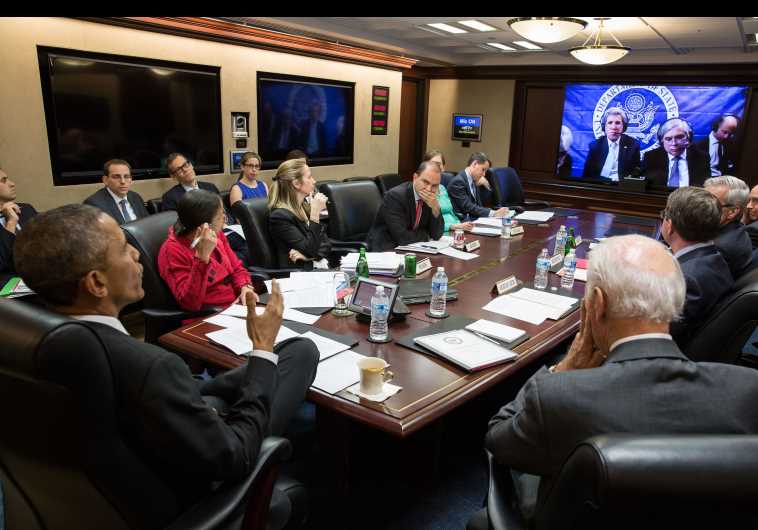
ShowImage (9)President Barack Obama, Vice President Joe Biden, and White House aides receive an update from Secretary of State John Kerry and Secretary of Energy Ernest Moniz via teleconference in Lausanne. (photo credit:WHITE HOUSE)

The US has striven to achieve peaceable relations between the states of the Middle East for nearly 70 years. Yet today, US government is disparaging the burgeoning strategic ties between the Sunni Arab states and Israel.

In a briefing to a delegation of visiting Israeli diplomatic correspondents in Washington last week, a senior Obama administration official sneered that the only noticeable shift in Israel-Arab relations in recent years is that the current Egyptian government has been coordinating security issues “more closely” with Jerusalem than the previous one did.

“But we have yet to see that change materialize in the Gulf.”

If this is how the US views the state of Israel’s relations with the Arabs, then Israel should consider canceling its intelligence cooperation with the US. Because apparently, the Americans haven’t a clue what is happening in the Middle East.

First of all, to characterize the transformation of Israeli-Egyptian relations as a mere question of “more closely” coordinating on security issues is to vastly trivialize what has happened over the past two years.

Before then Egyptian defense minister Abdel Fattah el-Sisi overthrew the US-backed Muslim Brotherhood regime headed by Muhammad Morsi in July 2013, there was a growing sense that Morsi intended to vacate Egypt’s signature to the peace deal with Israel at the first opportunity. Just a month after Morsi ascended to power in January 2013, the Muslim Brotherhood began threatening to review Egypt’s continued commitment to the peace treaty.

The main reason Morsi did not cancel the peace deal with Israel was that Egypt was bankrupt. He needed US and international monetary support to enable his government to pay for imported grain to feed Egypt’s destitute population of 90 million.

During his year in power, Morsi used Hamas as the Brotherhood’s shock troops. He embraced Iran, inviting president Mahmoud Ahmadinejad to visit Cairo in February 2013.

If Morsi were still in power today, with its $150 billion in sanctions relief Iran would have been in a position to support Egypt’s economy. So it is possible that if Morsi were still president, he would have felt he had the financial security to walk away from the peace treaty.

In happy contrast, under Sisi, Israeli-Egyptian ties are closer than they have ever been. Just last week Egyptian diplomats told Al Ahram that Israel’s support was critical for building administration support for Sisi.

Over Ramadan, Egyptian television broadcast a pro-Jewish mini-series.

Israel is closely working with the Egyptians on defeating the growing threat of Islamic State, Hamas and other Islamic terrorist groups waging a bloody insurgency against the regime in Sinai.

Last summer, it was due to the close coordination between Sisi and Israel that the US failed to force Israel to accept Hamas’s cease-fire terms, as those were represented by the Islamist regimes of Qatar and Turkey.

In part due to Israel’s critical support for Sisi’s government, and in part owing to their opposition to Iran’s rise as a regional hegemon armed with nuclear weapons, Saudi Arabia, the UAE and Jordan have all joined Egypt in viewing Israel as a strategic partner and protector.

Last year Saudi Arabia together with the UAE and Jordan supported Israel and Egypt in opposing Hamas and its American, Turkish and Qatari defenders. Had it not been for this massive Arab support, it is very likely that Israel would have been forced to accept the US’s demands and grant Hamas control over Gaza’s international borders.

In June, as negotiations between the US and the other five powers and Iran were moving toward an agreement, the Council on Foreign Relations in New York hosted a meeting between then incoming Foreign Ministry director general Dore Gold and retired Saudi General Anwar Eshki, a former advisor to the Saudi ambassador to the US. The two revealed that over the previous 18 months, they had conducted five secret meetings to discuss Iran.

Although President Barack Obama harangued Israel in his speech at American University last Wednesday, claiming that the Israeli government is the only government that has publicly opposed his nuclear deal with the Iranians, Monday US congressmen now shuttling between Egypt and Israel told Israeli reporters that Egypt opposes the nuclear deal.

As for the Gulf states, according to the US media, last week they told visiting US Secretary of State John Kerry that they support the nuclear deal.

Kerry addressed his counterparts in the Gulf Cooperation Council.

But the fact is that the only foreign minister who expressed such support was Qatari Foreign Minister Khaled al-Attiyah. To be sure, Attiyah was charged to speak for all of his counterparts because Qatar holds the GCC’s rotating chairmanship. But given that Qatar has staked out a pro-Iranian foreign policy in stark contrast to its neighbors and GCC partners, Attiyah’s statement is impossible to take seriously without the corroboration of his colleagues.

As for Qatar’s statement of support, Qatar has worked for years to cultivate good relations with Iran. It might have been expected therefore that Attiyah’s endorsement of the deal would have been enthusiastic. But it was lukewarm at best.

In Attiyah’s words, Kerry promised that the deal would place Iran’s nuclear sites under continuous inspections. “Consequently,” he explained, “the GCC countries have welcomed on this basis what has been displayed and what has been talked about by His Excellency Mr. Kerry.”

The problem of course is that Kerry wasn’t telling the truth. And the Arabs knew he was lying. The deal does not submit Iran’s nuclear sites to a rigorous inspection regime. And the GCC, including Qatar, opposes it.

In his briefing with Israeli reporters, the high-level US official rejected the importance of the détente between Israel and its Arab neighbors because he claimed the Arabs have not changed their position regarding their view of a final peace deal between Israel and the Palestinians.

But this is also nonsense. To be sure, the official position of the Saudis and the UAE is still the so-called Arab peace initiative from 2002 which stipulates that the Arabs will only normalize relations with Israel after it has ceded Jerusalem, Judea, Samaria and the Golan and allowed millions of foreign-born Arabs to freely immigrate to the shrunken Jewish state. In other words, their official position is that they will only have normal relations with Israel after Israel destroys itself.

But their official position is no longer their actual position. Their actual position is to view Israel as a strategic ally.

The senior official told the Israeli reporters that in order to show that “their primary security concern is Iran,” then as far as the Arabs are concerned, “resolving some of the other issues in the region, including the Palestinian issue should be in their interest. We would like to see them more invested in moving the process forward.”

In the real world, there is no peace process. And the Palestinian factions are fighting over who gets to have better relations with Iran. Monday we learned that PA leader Mahmoud Abbas wishes to visit Iran in the coming months in the hopes of getting the money that until recently was enjoyed by his Hamas rivals.

Hamas for its part is desperate to show Tehran that it remains a loyal client. So today, no Palestinian faction shares the joint Israeli-Saudi-Egyptian interest in preventing Iran from becoming a nuclear armed regional hegemon.

The administration showed its hand in that briefing with the Israeli reporters last week. For all their talk about Middle East peace, Obama and his advisors are not at all interested in achieving it or of noticing when it has been achieved.

Captured Hamas Operative Details Group’s Terrorist Plans

August 11, 2015

Captured Hamas Operative Details Group’s Terrorist Plans, Investigative Project on Terrorism, August 11, 2015

A Hamas operative provided a treasure trove of intelligence during Israeli interrogation concerning the terrorist group’s rebuilding efforts and future terrorist plans, Israel’s intelligence agency Shin Bet disclosed on Tuesday.

The terrorist, Ibrahim Adal Shahada Sha’ar, 21, described about Hamas’ tunnel reconstruction efforts, planned terrorist attacks against Israel, military strategy, and coordination with Iran, the Jerusalem Post reported.

He admitted working on rebuilding underground tunnels and described how some would be used in future attacks against Israel. Sha’ar disclosed the location of digging sites, tunnel entrances and underground routes, and reportedly said that a road built along the border with Israel is intended partly for terrorist attacks involving vehicles charging into Israeli territory.

He admitted that he stored several 50 kg explosive charges in his home and said that fighters kept explosives and other material in their own homes since Hamas commanders worried that the organization’s weapons depots would be targeted by Israel.

Israeli authorities arrested Sha’ar last month at the Erez Crossing after he attempted to enter Israel for “personal or humanitarian reasons.” Officers were aware of Sha’ar’s terrorist background and immediately detained him.

During last summer’s war between Israel and Hamas, Sha’ar participated in specific battlefield operations, including field logistics, transferring terrorists and weapons, and even admitted to setting up an anti-tank improvised explosion device (IED).

Sha’ar provided details of Iranian-Hamas military cooperation, including how Iran transfers funds and supplies weapons and electronics to the terrorist group. Those supplies include devices intended to jam radio frequencies to bring down Israeli drones deployed over Gaza. Furthermore, Sha’ar described how Iran trained Hamas terrorists to use hang gliders for attacks against Israel – a tactic revealed by previous Israeli interrogations of captured terrorists.

Critics of the recent Iran nuclear agreement argue that newly released funds to the Islamic Republic will bolster their regional hegemonic ambitions and global terrorist activities, including transferring more money and weaponry to its terrorist proxies.

According to Israeli intelligence, the Sha’ar detailed plans using tunnels to conduct cross-border attacks against Israeli targets, akin to Hamas’ attempts during last summer’s war. The Hamas operative confirmed that the terrorist group is diverting civilian reconstruction material for the purposes of rebuilding its terrorist infrastructure and underground tunnel network.

Sha’ar was indicted July 31 in the Beersheba District Court for being a member and engaging in activities with a banned organization, attempted murder, and forbidden military training.

Obama vs. the Jews

August 11, 2015

Obama vs. the Jews, Front Page Magazine, Daniel Greenfield, August 11, 2015

21obama

Even in the extremely unlikely circumstance that enough Democrats would come together to veto the deal, Obama had already told the agreement’s leading Democratic opponent in the House, “If Congress overrides my veto, you do not get a U.S. foreign policy that reflects that vote. What you get is you pass this law and I, as president, will do everything possible to go in the other direction.”

****************

It was his birthday and Obama was grouchy.

“It’s my birthday and I’m going to be blunt,” Obama told the Jewish leaders meeting with him. When they complained that, “Words have consequences, and when they come from official sources, they can be even more dangerous,” he was unapologetic. 

“If you guys would back down, I would back down from some of the things I’m doing,” he warned.

By that he meant that if they stopped objecting to the Iran deal, he would stop accusing critics of his nuclear sellout to Iran of being money-grubbing warmongers.

Obama complained, “It’s been a really busy day. You’d think they’d be nicer to me on my birthday.”

His busy day had consisted of a meeting with the ineffectual UN Secretary General, lunch with Biden and a photo op in the East Room. But he also had reservations at Rose’s Luxury, an expensive Capitol Hill restaurant where ordinary people wait for hours to get in.

Rose’s doesn’t take reservations, but Obama was an exception.

Shortly after his meeting with Jewish leaders, he and his close Iranian-born adviser Valerie Jarrett skipped the line at Rose’s and got the party started. On the next day, Obama blasted Republican opponents as treasonous allies of those who chant “Death to America,” even though he was the one who had actually made common cause with Iran’s regime.

The day after that, Senator Schumer called Obama to tell him he would oppose the deal and asked him to let him announce it on Friday. The White House instead leaked it to the Huffington Post.  The first response to Schumer’s announcement came from MoveOn, which blew the dog whistle loudly enough to be heard in the next state over, “Our country doesn’t need another Joe Lieberman in the Senate.”

The only obvious thing that both politicians had in common was that they were Jewish.

Obama had lost the argument on the facts. The majority of Americans opposed the deal by 52 to 28 percent. Even among Democrats, support stood at only 52 percent.

His game plan for winning the debate was to get as ugly and dirty as possible.

Despite having just gotten back into Iraq, after contemplating an attack on Syria and coming off an illegal assault on Libya, any Democrat opposing him risked being accused of wanting another Iraq War. Or as White House press secretary Josh Earnest coyly put it, “This difference of opinion that emerged overnight is one that has existed between Senator Schumer and President Obama for over a decade.”

Obama allies emphasized that Schumer had voted for the Iraq War. Obama was once again rerunning his old campaign against Biden and Hillary, even though one was his VP and the other his successor.

Barack Obama had already rolled out the “lonely little guy in the White House” playbook complaining about lobbies and money. He had been irked at his representatives not getting full access to the AIPAC activists who were visiting members of Congress and was reading from Bush I’s old script. But now he began to sound more like Pat Buchanan ranting about Israel’s “amen corner” beating the drums for war.

Having forgotten the time he sent his campaign consultants to defeat Netanyahu in the Israeli election, he complained that Netanyahu was inappropriately interfering. During his speech, he rediscovered a love for the Constitution which he claimed obligated him to sideline Israel. Sadly he lacked the same love for the Constitution’s Treaty Clause which requires two-thirds of the Senate to ratify a treaty.

The complaints about lobbies and money sounded strange coming from a guy who had his own SuperPAC with tens of millions of dollars to spend. Behind him was a network of organizations with hundreds of millions of dollars in cash on hand and billionaire donors to donate on demand.

The Rockefeller Brothers Fund had invested a fortune into the project. Some of the money went into the Ploughshares Fund, which did its own promotion for the deal, and funneled cash to Global Zero, which released a video promoting the deal featuring Jack Black and Morgan Freeman.  His position was backed by George Soros’ J Street, an astroturfed anti-Israel group that was bringing serious money to the party.

Once Schumer came out on the deal, he was targeted by Credo Mobile and MoveOn, among other powerful left-wing groups, determined that nothing would be allowed to interfere with Iran’s nukes.

There was no shortage of lobbies and money in Obama’s corner. The citizen activists opposed to the deal might have the support of the American people, but they were outmatched by the massive wealth and infrastructure of the Democracy Alliance and Obama’s mainstream media allies.

The teachers, mothers, engineers and small businessmen could travel to Washington D.C. and complain to their Congressman. Obama could go on the Daily Show and complain about them to Jon Stewart.

There was no comparing their respective power.

And all that was without mentioning the Iran Lobby which boasted close relationships with Joe Biden and John Kerry.

Obama continued to escalate tensions with the Jewish community, even though he faced no real risk that enough Democrats would come together to override his veto. Even Schumer’s rejection had bent over backward to praise and flatter him. The American people might disapprove of the deal, but they had also disapproved of ObamaCare and his illegal war in Libya. And he had just rolled over them.

The administration wasn’t in this fight because it worried that it might lose. Between the GOP establishment and Obama, the game had already been rigged. Everyone, including Schumer, would play their parts, get their applause and the agreement would move forward. Hundreds of AIPAC members lobbying a few members of Congress wouldn’t stop that. Neither would a few ads.

Even in the extremely unlikely circumstance that enough Democrats would come together to veto the deal, Obama had already told the agreement’s leading Democratic opponent in the House, “If Congress overrides my veto, you do not get a U.S. foreign policy that reflects that vote. What you get is you pass this law and I, as president, will do everything possible to go in the other direction.”

Obama would implement the deal no matter what Congress did. Iran would get its nukes.

But for Obama, scowling and impatiently tapping his fingers while waiting to go for his birthday dinner, musing that he could have already been there if it wasn’t for these old white men whining to him, looking forward to his round of golf and a trip to Camp David, it had become petulantly personal.

For the left, the political is often indistinguishable from the personal, and for Obama it has always been that way. Obama’s view of government is Louis XIV’s “I am the State”. All opposition is personal. All dissent is treason. Enemies have to be punished on the principle of the thing.

It didn’t matter that the Jewish leaders had zero chance of actually stopping his agreement with Iran. Most of them didn’t even want to be there. What mattered was that they had opposed him and they had to be punished for it.

Obama had compared Americans uneasy about Iran’s “Death to America” slogan to schoolyard bullies who wanted to “smack around” the “little guy” who dared to “mouth off.” But he was the one playing the bully, going out of his way to sow tension, using rhetoric condemned even by Jewish supporters of the deal, not because he needed it to win, but because he was angry and resentful.

Millions of Jews around the world saw the specter of an atomic cloud rising into the sky, but Obama had a birthday meal at Rose’s Luxury to go to, a round of golf to play and his feelings were being hurt and his birthday was being ruined by these annoying Jews who wouldn’t take “No” for an answer.

Obama isn’t even stirring up anti-Semitism to defend the Iran deal. He’s lashing out, accusing critics of being traitors and warmongers, because they ruined his birthday party.

State Department Interferes in Favor of PLO Terrorists

August 11, 2015

State Department Interferes in Favor of PLO Terrorists, Israel National News, Tova Dvorin, August 11, 2015

US President Barack Obama is reportedly seeking to lower that fine – following a series of conflicts between officials from the State Department and the Justice Department over the issue, an official involved in the case told the New York Times Tuesday. 

*********************

Washington asks a judge presiding over terror victims’ compensation case to reduce money paid to Israelis injured during Second Intifada.

The Obama administration has asked a judge Monday to “carefully consider” the size of the bond demanded from the Palestinian Authority (PA) for its role orchestrating years of terror attacks against Israelis and Jews – directly interfering in a US court case.

In February, the Palestine Liberation Organization (PLO) – the terror group behind the PA – was found liable to pay $218.5 million to victims of terror, a figure that was set to be tripled to $655.5 million according to the anti-terrorism laws under which the case was brought.

Legal rights group Shurat Hadin (Israel Law Center) helped represent the 11 families who charge the PA and PLO of inciting, supporting, planning and executing the seven terror attacks which killed American citizens between 2000 and 2004.

In May, the PA admitted it cannot pay such a hefty fine, however – as it is struggling under billions of debt despite an ongoing stream of aid from Israel and other countries – and called the case “political extortion.”

Now, US President Barack Obama is reportedly seeking to lower that fine – following a series of conflicts between officials from the State Department and the Justice Department over the issue, an official involved in the case told the New York Times Tuesday.

In a document entitled “Statement of Interest of the United States of America,” the Obama administration expressed concerns over the payments hurting the PA’s basic government services.

Forcing the PLO to pay “a significant portion of its revenues would likely severely compromise the P.A.’s ability to operate as a governmental authority,” deputy Secretary of State Antony J. Blinken wrote. “A P.A. insolvency and collapse would harm current and future U.S.-led efforts to achieve a two-state solution to the Israeli-Palestinian conflict.”

Blinken stressed in the document, however, that the State Department allegedly values the rights of terror victims to seek “just compensation” and was not taking a position on the case itself, only on the high bond.

“The United States strongly supports the rights of victims of terrorism to vindicate their interests in federal court and to receive just compensation for their injuries,” Blinken claimed.

Justice Department officials have maintained throughout the proceedings that any State Department interference in the case would interfere with the victims’ rights for compensation and justice.


Israeli Scientists Reach Breakthrough in HIV Research

August 11, 2015

Israeli scientists at Ben Gurion University of the Negev have reached a breakthrough in HIV and leukemia research.

By: Hana Levi Julian

Published: August 11th, 2015

via The Jewish Press » » Israeli Scientists Reach Breakthrough in HIV Research.

Soroka Medical Center in Be'er Sheva.
Soroka Medical Center in Be’er Sheva.
Photo Credit: Miriam Alster / Flash 90

Israeli scientists have made a breakthrough in researching the HIV virus, Ben Gurion University of the Negev has announced.

Dr. Ran Taube of the Department of Microbiology, Immunology and Genetics says that his team has found similarities between HIV and leukemia.

The study aims to wipe out AIDS, which is caused by the HIV virus, and also to slow down the development of leukemia as well. The study is aiming specifically at the rare mixed -lineage leukemia (MLL) that occurs mostly in children and hinders the development of cells in the blood.

Taube and his team worked in collaboration with Dr. Uri Rubio, of Soroka Medical Center in Be’er Sheva.

The researchers said the discovery will lead to a “revolutionary diagnosis and the key to the clinical solution that will prevent infection with HIV and will destroy the deadly virus.”

MSNBC: Obama ‘stunning’ in vilifying of deal opponents

August 10, 2015

MSNBC: Obama ‘stunning’ in vilifying of deal opponents, Washington Free Beacon via You Tube, August 10, 2015


Israel is working at speed to convert Boeing 767 into a long-flight refueling tanker

August 10, 2015

Israel is working at speed to convert Boeing 767 into a long-flight refueling tanker, DEBKAfile, August 10, 2015

kc46aAmerica Boeing KC-46A refueling tanker

In an interview published by the German newspaper Der Spiegel on Aug. 8, Defense Minister Moshe Ya’alon said: “Ultimately it is very clear, one way or another, Iran’s military nuclear program must be stopped. We will act in any way, including taking military action, and are not willing to tolerate a nuclear-armed Iran. We prefer that this be done by means of sanctions, but in the end, Israel should be able to defend itself.”

*****************

US defense and air industry sources report that the Israeli Air Force may give up on the US Boeing’s KC-46A Pegasus as its future refueling tanker for long-range flights because of delays in its delivery. Israel had first planned to take the Pegasus to replace its converted Boeing 707 when delivery was first to the US Air Force was scheduled for August 2017. But this week, the company put the date back by another eight months and the price increased by half a billion dollars.

American sources point out that if Israel wants to retain the option of attacking Iran’s nuclear facilities when Barack Obama exits the White House in January 2017, it can’t wait for the brand-new US Pegasus tanker, which doubles as a military transport plane, to come off the Boeing production line and be delivered to its air force. The Boeing 707 in current service, after a multibillion investment in its conversion to a long-flight refueling tanker, no longer meets the fluctuating conditions in the Middle East. Work is therefore going ahead on the conversion of the Boeing 767 as its replacement.

On July 22, DEBKAfile’s military sources revealed a mammoth transaction for Iran to purchase Russian UL78 MK1 (Midas) tankers with a range of 7,300km. (The distance from Iran to Israel is 1,200km). Each tanker is capable of spontaneously feeding 6-8 fighter craft.

This purchase represented Tehran’s aspiration – not just to draw level with Israel but to outdo its air force in range and fueling capability. This transaction no doubt spurred the decision by Israel’s defense chiefs to go ahead on its own project, instead of waiting for the American KC-46A to become available.
Israel Aerospace Industries [IAI] is therefore working at top speed on the Boeing 767, a long-range, wide-body, twin-engine jet airliner with a range of 7,000 to 11,000 km. The converted aircraft will be designated 767-200ER MRTT.

In an interview published by the German newspaper Der Spiegel on Aug. 8, Defense Minister Moshe Ya’alon said: “Ultimately it is very clear, one way or another, Iran’s military nuclear program must be stopped. We will act in any way, including taking military action, and are not willing to tolerate a nuclear-armed Iran. We prefer that this be done by means of sanctions, but in the end, Israel should be able to defend itself.”

Britain: The “Struggle of Our Generation”

August 10, 2015

Britain: The “Struggle of Our Generation”, The Gatestone InstituteSamuel Westrop, August 10, 2015

  • “We’ve got to show that if you say ‘yes I condemn terror — but the Kuffar are inferior’, or ‘violence in London isn’t justified, but suicide bombs in Israel are a different matter’ — then you too are part of the problem. Unwittingly or not, and in a lot of cases it’s not unwittingly, you are providing succour to those who want to commit, or get others to commit to, violence.” — Prime Minister David Cameron.
  • In a series of religious rulings published on its website, the Islamic Network charity advocated the murder of apostates; encouraged Muslims to hate non-Muslims; stated that when non-Muslims die, “the whole of humanity are relieved;” and described Western civilisation as “evil.”
  • The Charity Commission’s solution, however, was to give the charity’s trustees booklets titled, “How to manage risks in your charity,” and warn them not to do it again.

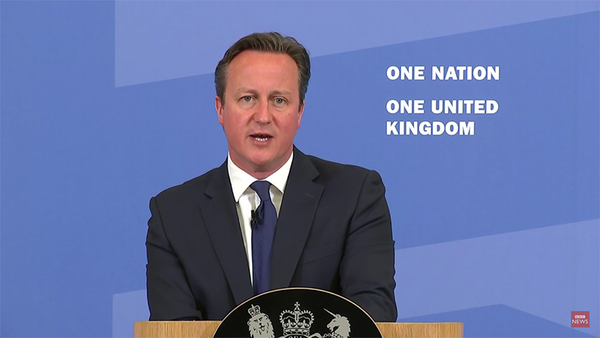
On July 20, Prime Minister David Cameron outlined his government’s plans to counteract Islamic extremism, which he described as the “struggle of our generation.”

In a speech before Ninestiles School, in the city of Birmingham, Cameron articulated a view of the Islamist threat that, just a couple of years ago, few else in British politics would have dared to support.

In a report for BBC Radio 4, the journalist John Ware described Cameron’s speech, and the government’s proposed counter-extremism measures, as “something no British government has ever done in my lifetime: the launch of a formal strategy to recognize, challenge and root out ideology.”

Cameron’s speech was wide-ranging. It addressed the causes, methods and consequences of Islamist extremism.

1199(Image source: BBC video screenshot)

We must recognize, Cameron reasoned, that Islamist terror is the product of Islamist ideology. It is definitely not, he argued, “because of historic injustices and recent wars, or because of poverty and hardship. This argument, what I call the grievance justification, must be challenged. … others might say: it’s because terrorists are driven to their actions by poverty. But that ignores the fact that many of these terrorists have had the full advantages of prosperous families or a Western university education.”

“Extreme doctrine” is to blame — a doctrine that is “hostile to basic liberal values … Ideas which actively promote discrimination, sectarianism and segregation. … which privilege one identity to the detriment of the rights and freedoms of others.” This is a doctrine “based on conspiracy: that Jews exercise malevolent power; or that Western powers, in concert with Israel, are deliberately humiliating Muslims, because they aim to destroy Islam.”

People are drawn to such extremist ideas, Cameron argued, because:

“[Y]ou don’t have to believe in barbaric violence to be drawn to the ideology. No-one becomes a terrorist from a standing start. It starts with a process of radicalisation. When you look in detail at the backgrounds of those convicted of terrorist offences, it is clear that many of them were first influenced by what some would call non-violent extremists.

“It may begin with hearing about the so-called Jewish conspiracy and then develop into hostility to the West and fundamental liberal values, before finally becoming a cultish attachment to death. Put another way, the extremist world view is the gateway, and violence is the ultimate destination.”

To counteract the extremist threat, Cameron concludes, the government will “tackle both parts of the creed — the non-violent and violent. This means confronting groups and organisations that may not advocate violence — but which do promote other parts of the extremist narrative.”

Further, no longer will extremist groups be able to burnish their moderate credentials by pointing to ISIS as the Islamic bogeyman:

“We’ve got to show that if you say ‘yes I condemn terror — but the Kuffar are inferior’, or ‘violence in London isn’t justified, but suicide bombs in Israel are a different matter’ – then you too are part of the problem. Unwittingly or not, and in a lot of cases it’s not unwittingly, you are providing succour to those who want to commit, or get others to commit to, violence.

For example, I find it remarkable that some groups say ‘We don’t support ISIL’ as if that alone proves their anti-extremist credentials. And let’s be clear Al-Qaeda don’t support ISIL. So we can’t let the bar sink to that level. Condemning a mass-murdering, child-raping organisation cannot be enough to prove you’re challenging the extremists.”

Rather radically for a Western leader, Cameron also asserted that, “simply denying any connection between the religion of Islam and the extremists doesn’t work… it is an exercise in futility to deny that. And more than that, it can be dangerous. To deny it has anything to do with Islam means you disempower the critical reforming voices; the voices that are challenging the fusing of religion and politics…”

Cameron’s speech was groundbreaking. No previous Prime Minister in past decades would have dared to make such statements. This is not to say, however, that it is without fault.

Cameron is not just talk. An “Extremism Analysis Unit” has been set up within the Home Office, which will serve to tackle Islamist extremism, including “non-violent” groups. According to the journalist John Ware, the new body is currently preparing lists of extremist preachers and groups.

More importantly, a variety of new legislation is being brought before Parliament. However, some of the proposed laws, critics argue, are draconian. “Banning Orders” will outlaw designated “extremist groups.” “Extremism Disruption Orders,” meanwhile, will restrict designated “extremists” from appearing on television, or publishing without the authorities’ approval. And “Closure Orders” will allow the government to close any institution deemed guilty of promoting extremism.

Cameron has correctly and radically diagnosed the problem of Islamic extremism. His solutions, however, do not appear promising.

A more useful next step would be for the government to tackle its own relationships with extremist groups. Britain’s registered charities offer a particularly vivid example of Islamist extremism going unchallenged.

In 2014, I wrote about the Islamic Network, a group that describes itself as “a da’wah[proselytizing] organisation which aims to promote awareness and understanding of the religion of Islam.”

In a series of religious rulings published on its website, the Islamic Network charity advocated themurder of apostates; encouraged Muslims to hate non-Muslims; stated that when non-Muslims die, “the whole of humanity are relieved;” and described Western civilisation as “evil.” Further, the Islamic Network directed a great deal of hatred towards the Jews. Its website claimed: “The Jews strive their utmost to corrupt the beliefs, morals and manners of the Muslims. The Jews scheme and crave after possessing the Muslim lands, as well as the lands of others.”

In spite of these views, the Islamic Network is a registered charity, which means it is entitled to subsidy from the taxpayer.

As a result of revealing the material published on the Islamic Network’s website, as well as several complaints submitted to the Charity Commission, the government opened an inquiry into the charity. After a year of deliberation, the Charity Commission published its report, which concluded that the Islamic Network had indeed published extremist material.

The Charity Commission’s solution, however, was to give the charity’s trustees booklets titled, “How to manage risks in your charity,” and warn them not to do it again.

Britain may finally have a government that understands the problem of Islamist extremism, but if government bodies fail to challenge extremist charities such as the Islamic Network, then what use is this enlightenment?

The Islamic Network is but one of many dozens of examples. Why is the British organizationInterpal, for example, still allowed to be a registered charity? Interpal is a designated terrorist organization under United States law. Its trustees regularly meet with senior leaders of the terror group Hamas. In 2013, for instance, Interpal trustee Essam Yusuf took part in a ceremony with the Hamas leader Ismail Haniyeh, at which they expressed praise for Hamas’ military wing, the Al Qassam Brigades, and glorified “martyrdom.”

Or what of Islamic Relief, one of Britain’s largest charities? Established by the Muslim Brotherhood, Islamic Relief’s directors have included Ahmed Al-Rawi, a Muslim Brotherhood leader who, in 2004, supported jihad against British and American troops in Iraq; and Essam El-Haddad, who is accused by an Egyptian court of divulging Egyptian state secrets to Hamas, Hezbollah and Iran, and using Islamic Relief to finance global terrorism.

Despite Islamic Relief’s links to Islamist extremism, the charity continues to receive millions of pounds from the British government.

David Cameron’s speech on July 20 should be applauded. If another political party had won the recent general election, no such speech would have been made. But before the Prime Minister turns his hand to censorship, perhaps the government should address extremist groups closer to home.

Palestinians, Iran to work together for Israel’s nuclear disarmament, official says

August 10, 2015

Palestinians, Iran to work together for Israel’s nuclear disarmament, official says

via Palestinians, Iran to work together for Israel’s nuclear disarmament, official says – Middle East – Jerusalem Post.

The Palestinian Authority and Iran have agreed to work together toward holding an international conference to seek the nuclear disarmament of Israel, a senior PLO official who visited Tehran in the past few days said.

Ahmed Majdalani, member of the PLO Executive Committee, held talks in Tehran with Iranian Foreign Minister Mohamed Zarif. He also delivered a letter from PA President Mahmoud Abbas to Iranian leader Hassan Rouhani.

Majdalani said on Monday that his visit to Iran resulted in agreement on reviving the idea of an international conference to rid the region of Israel’s nuclear arsenal and weapons of mass destruction. Voicing support for the nuclear agreement between Iran and the world powers, Majdalani said that the accord would create a positive atmosphere for ensuring security and stability in the Middle East.

The PLO official said that his visit to Iran was aimed at refuting Prime Minister Benjamin Netanyahu’s claim that Iran’s nuclear program poses a threat to Israel and peace. He claimed that Netanyahu was using the Iranian issue to avoid fulfilling Israel’s obligations toward the peace process.

The Palestinians are now hoping that the Palestinian issue would return to the center stage as the essence of the Middle East conflict.

Majdalani said his talks in Iran also focused on Israeli “assaults” against Palestinians. He accused the Israeli government of failing to work toward achieving peace with the Palestinians and expressed hope that Tehran would support Palestinian diplomatic moves in the international arena.

The rapprochement between the PA and Iran is also likely to pave the way for the restoration of the Palestinians’ ties with Syria. Relations between Syria and the Palestinians have been tense since the beginning of the civil war there.

Majdalani said that the PA’s position toward the Syrian crisis is based on the need to find a peaceful, rather than military, solution. He said that the Palestinians were very keen to see an end to the crisis because they have paid a heavy price due to the continuation of the civil war. Tens of thousands of Palestinians have been displaced since the beginning of the crisis in Syria in 2011.