Posted tagged ‘Israel’

Curfews and Internet restrictions can’t be avoided for reining in Palestinian street terror

October 10, 2015

Curfews and Internet restrictions can’t be avoided for reining in Palestinian street terror, DEBKAfile, October 10, 2015

Nablus_Gate10.10.15Holding the line at Nablus Gate, Jerusalem

After nearly a month of rampant Palestinian violence and murder, Israel’s leaders and its forces of law and order were Saturday, Oct. 10, fast approaching an unavoidable decision to impose a curfew on the Old City of Jerusalem – both to bring the stabbing attacks at every corner under control, and to isolate this source of contagion from the disorders spreading in the West Bank and across Israeli Arab coummunities.

Once a curfew is in place, the security authorities – whose forces are stretched to the limit by the multiple outbreaks proliferating across the country – will be able to deal quietly and systematically with the disorders.

A major hindrance until now has the refusal of the heads of government, especially Prime Minister Binyamin Netanyahu and Defense Minister Moshe Ya’alon, to realistically appreciate the dynamic of the wave of terror, and their insistence on playing down its eruption in one place after another as random and uncontrolled.

They keep on harping on the incitement and lies spread by Mahmoud Abbas and radical Israeli Muslim leaders, although the street has since taken over.

Friday night, Ya’alon commented in a television interview that terrorists had committed “only” four fatal stabbings out of a population of four million.

This challenge was taken up with a vengeance. That night, Israeli Arabs staged riotous disturbances from northern Israel to the south, attacking security forces and blocking highway traffic on Routes 6, 444 and 65, with rocks and burning tires.

The following morning, the focus of violence switched back to Jerusalem and the Palestinians: A 16-year old Palestinian stabbed and badly injured two elderly religious Jews wrapped in prayer shawls.

He was shot dead when he brandished the knife against approaching police officers. A second Palestinian was killed after stabbing three police officers at Damascus Gate.

This sequence of events indicates that, while there is no single controlling hand behind them, they are nonetheless orchestrated in a way that keeps every Israeli constantly looking over his or her shoulder for fear of being taken off guard by the next attack – whether on an Israeli highway or town like Afula or Petach Tikva, or in Judea and Samaria. But Jerusalem remains the constant focal point because it is a powerful unifier.

Official Israeli spokesmen have tried relaying messages to Abbas and putting out reports that he has responded favorably to appeals. Saturday, Netanyahu asked US Secretary of State John Kerry to intercede with the Palestinian leader for help to quieten things down. However, none of the three, any more than Jordan’s Abdullah, holds the levers for controlling current events.

That is because they are being orchestrated to a large extent through messages of incitement and false inflammatory information which bounce back and forth between the cell phones and social media networks of young Palestinian and Israeli Arabs hungry for trouble.

In the latest example, the networks were flooded all day with calls to torpedo the international soccer match between Israel and Cyprus taking place Saturday night at the Teddy stadium in Jerusalem – even to setting the arena on fire.

This move had two objects: to dilute police strength in the Old City in order to reinforce security at the stadium and to terrify the public into staying away from the game.

Israel’s security authorities are finding they can no longer avoid stepped up measures, such as a curfew on the Old City of Jerusalem and blocking selected Palestinian cell phone networks and Internet connections and IPs of known inciters. This method was used by Turkish President Erdogan to stem the rising tide of opposition against him in 2014.

These measures are far from pleasant and will be frowned on by many people including Israelis. But they may possibly calm the turbulence and save Israeli and Palestinian lives.

Time is running out. Wednesday, Oct. 14, members of the Middle East Quartet are due to arrive in Israel. The Netanyahu government can’t afford to be found at a loss in the face of a major threat to its authority in Jerusalem. The ineffectual measures applied till now no longer serve.

What’s Behind Carter’s Claim That Russia Will Suffer Casualties in Syria?

October 10, 2015

What’s Behind Carter’s Claim That Russia Will Suffer Casualties in Syria?

18:26 10.10.2015

(updated 18:27 10.10.2015)

Source: What’s Behind Carter’s Claim That Russia Will Suffer Casualties in Syria?

When US Defense Secretary Ash Carter said that he expects Russia will soon suffer casualties, his phrase sparked the question whether the Pentagon has a Soviet-Afghanistan redux in mind for Syria, Germany-based political scientist and analyst Phil Butler remarks.

The real life “war on ISIL” conducted by the US is completely different from what Washington’s tame media sources are telling the public: in fact it is a part of a US strategy of widespread regime change across much of the world, Germany-based American political scientist and analyst Phil Butler notes.

“Without expanding our story too far, the Arab Spring we heard so much about is not finished yet. As Barack Obama and other Western leaders have made abundantly clear, Bashar Assad’s government must be overthrown by whatever means. ISIL, or even al-Qaeda, they’re only bit players in an overall strategy to shift world affairs,” Butler pointed out in his article for New Eastern Outlook.

The US’ large-scale project in the Middle East is supported by its partners and NATO allies, such as Australia, Saudi Arabia, Qatar, Jordan, Bahrain, the UAE, Morocco, Canada, Turkey and the United Kingdom. Also allied with the coalition are the Kurdish administration in Northern Iraq, the so-called “Syrian opposition,” and, rather surprisingly, America’s bitter enemy al-Qaeda, along with numerous jihadist extremist groups like al-Nusra, the political scientist underscored.And here comes Russia…

“Russia is now flying support for a massive Syrian Army push to regain territory and control. The short story being, ISIL has suffered more losses in the last few days than throughout the US/Coalition campaign supposedly designed to eradicate these terrorists,” Butler emphasized.

It goes without saying that Russia has largely upset the US and Co.’s applecart in the region.

Butler quoted US investigative reporter Jeffrey Silverman, who told him that Washington has invested too much in this Middle Eastern project to allow Russia “to just fly in and sort out the terrorists once and for all.”

“We can expect that the US, its proxies, including Turkey, Jordan and Israel, will provide all necessary covert material support to try to save their joint project,” Silverman emphasized.

The question remains open how far Washington will go to halt the Russo-Syrian advance in the war zone.Commenting on the issue, Butler called attention to US Defense Secretary Ash Carter’s recent remarks over Russia’s involvement in Syria.

“This will have consequences for Russia itself. And I also expect that in the coming days, the Russians will begin to suffer casualties in Syria,” Carter said.

Furthermore, less than a week ago Barack Obama declared that Syria would become a “quagmire” for Russia, the US analyst highlighted.

Carter and Obama’s words were not just casual comments, according to Butler. The political scientist referred to the fact that about three decades ago the Reagan administration provided the Afghani Mujaheddin, the would-be Taliban fighters, with Stingers to inflict serious damage on the USSR’s Air Force in Afghanistan. So, is this the option Carter and Obama are hinting at?

“At this juncture, if Obama gives a green light to jihadists shooting down Russian planes, America will be exposed in the game. With millions of lives at stake in the region, and hundreds of millions more affected by the refugee crisis, sanctions, and America polarizing the world, the string pullers of Washington have few options,” the analyst pointed out.

“If I were Ash Carter, I’d make damn sure Russian pilots had an American wing man or two. Even a lucky hit on an SU-34 sends a signal — Afghanistan Redux — America is guilty of chaos again,” Phil Butler stressed.

‘Russia’s Success in Syria Pushes Europe From US Stance Into Kremlin Line’

October 10, 2015

Russia’s Success in Syria Pushes Europe From US Stance Into Kremlin Line’

15:57 06.10.2015 (updated 16:02 06.10.2015)

Source: ‘Russia’s Success in Syria Pushes Europe From US Stance Into Kremlin Line’

A DC think tank has proposed another narrative regarding Russia’s involvement in Syria; having failed to sell the idea of Moscow’s anti-ISIL campaign being a ruse for bombing ‘friendly’ militants, it now claims that “Putin aims to drive a wedge between the US and Europe”, coaxing the latter to embrace closer ties with the Kremlin.

Two research fellows from the Hudson Institute, a conservative DC-based think tank, have laid out their vision of what Russia is up to in the skies above Syria.

The real reason for Russia’s presence, they claim, is not to assist in the fight against the Islamic State, but rather to “drive a wedge between Europeans and Americans”.In their article, which was published on the institute’s website and in Foreign Policy, the authors insist that Europe certainly can’t manage on its own and should be shepherded, if not by the US, then by Russia.

“Should Russia’s narrative on Syria carry the day, the consequences will test the reliability of US leadership,” they say.

The authors reiterate that the true purpose of the US-led coalition in Syria is to oust its legitimate president rather than to merely fight a terrorist group, and lament that the fight against the Islamic State has now taken precedence.

“European governments that have spent political capital supporting Washington’s position from the start of the Syrian crisis, now pressured to prioritize the fight against the Islamic State instead of ousting Assad, are left to ponder if Putin has been right all along.”

“Is he a more reliable ally than Washington? In any case, Russia’s move is less of an enigma to European policymakers than it is to the White House. “If I [were] Russia and Iran, I would act exactly the same way,” they quote a senior European diplomat as telling Foreign Policy.

“Even more worrisome for the future of European liberal polities, Putin’s moves in Syria will only embolden the voices that turn to Moscow as an alternative to Washington and Brussels.”

The authors then get down to the real business of worrying that if President Putin hasn’t been wrong all along, then perhaps the anti-Russian sanctions should be called into question: “more dangerously, this goes beyond Syria. Russian involvement in Syria is inextricably linked to the ongoing conflict in Ukraine.”

“Should the Ukrainian situation remain calm, European leaders will have a hard time explaining why they must maintain sanctions on the very country they’re counting on to solve the Syrian problem.”

“Sanctions don’t come cheap for European economies. The European Commission projects that Ukraine-related sanctions cost European economies 0.3 GDP points in 2014 and 2015 — a non-negligible cut, when eurozone GDP is only expected to grow by 1.5 percent in 2015. In short, the sanctions regime is expensive, divisive, and European leaders are beginning to make noise about their desire to rebuild trade relations with Russia. Their business communities demand it, and Europe’s attention span for the conflict in Ukraine is waning.”

With these ‘grim’ prognostications, the authors conclude that “after his recent move, Vladimir Putin seems like a more coherent, reliable player than Washington,” warning that the “cost of American restraint may damage European and transatlantic unity for many years to come.”

What could a “harsh” Iranian reaction to Riyadh constitute?

October 10, 2015

What could a “harsh” Iranian reaction to Riyadh constitute? Al-MonitorAli Omidi, October 9, 2015

[A]s history has shown, a country’s desire to start a military campaign is not always logical. Iran might decide that no matter what, it must launch a military campaign against Riyadh in order to punish Saudi Arabia.

**********************

TEHRAN, Iran — Hundreds of Iranian pilgrims were killed in the Sept. 24 stampede in Mina, near Mecca. The incident was followed by Saudi negligence in reporting the situation on time, and failure to collaborate with Iranian authorities. This prompted Iran’s Supreme Leader Ayatollah Ali Khamenei to call on Saudi Arabia to apologize to the “Muslim world” and Iran. Ayatollah Khamenei also accused Riyadh of not fulfilling its obligations in returning the bodies of the Iranian pilgrims, and behaving “maliciously.” He further warned, “The slightest disrespect to tens of thousands of Iranian pilgrims in Mecca and Medina as well as the Saudi government’s refusal to fulfill its duties with regard to the transfer of the pure corpses [of those killed during the hajj] will elicit a harsh and tough reaction from Iran.”

Meanwhile, upon the Oct. 3 return of the bodies of 104 Iranian pilgrims, President Hassan Rouhani issued an additional warning. He said, “So far, our language has been one of brotherhood. When necessary, we have used the language of diplomacy; however, if needed, the language of authority will be used as well.”

Indeed, on the very same day, Maj. Gen. Mohammad Ali Jafari, the commander of the Islamic Revolutionary Guard Corps (IRGC), said, “The IRGC has prepared all its possible potentials in order to fulfill the will of the great leader of the Islamic Revolution and make the Saudi dynasty answer for the crimes it committed in Mina and restore the rights of the victims. We are ready and are awaiting orders.” Jafari added, “The Muslim World is tired of the Saudis’ betrayals and ignorance, which reminds us of Abu Lahab, including the massacre of the people of Yemen, displacement of the poor people of Syria, repression of the people of Bahrain, ethnic massacres in Iraq, creation of ethnic tension and support of terrorism. The Saudis shall melt in the anger of the Muslims.”

Lastly, former IRGC Cmdr. Mohsen Rezaei, who is also adviser to Ayatollah Khamenei, warned Riyadh, “Don’t play with fire, because the fire will burn you … don’t follow the example of Saddam [Hussein], who in the middle of the Iraq-Iran War had no way out.”

In response, Saudi Arabia has accused Iran of playing politics with the stampede. “I think the Iranians should think of more productive activities than to play politics with a tragedy that has befallen those people who were performing their most sacred religious duty,” Saudi Foreign Minister Adel al-Jubeir told the UN General Assembly. Mindful of the increasingly hostile rhetoric, the question arises of what the “harsh and tough reaction” that Iran has warned of could potentially constitute.

In general, harsh reaction translates into military action. Iran has just finished its negotiations with the six world powers over its nuclear program, and thus considers itself to be in a stronger position. Separately, Iran also assesses that Saudi Arabia is in a desperate situation in Yemen. Therefore, in the case of a possible military confrontation with Saudi Arabia, there are several scenarios that Tehran could consider:

    • A ground campaign. For this kind of campaign to be possible, Iran would need to cross both Iraq and Kuwait. Neither of these countries will allow Iran to enter their territory in order to attack Saudi Arabia. Therefore, this option is not on the table. In addition, such a military campaign requires a large and well-equipped army as well as logistical, financial and economic abilities enjoyed by a superpower. Iran is only considered a mid-level power in the region. There is also the historical example of the US reaction to Iraq’s 1991 invasion of Kuwait for Iran to consider.


    • A naval campaign. This would mean that Iran has to travel a distance of 200 miles to reach the eastern coast of Saudi Arabia. Such a campaign is impossible considering the Iranian armed forces’ lack of strategic depth vis-a-vis Saudi Arabia, as the latter has the advantage of controlling the sea from land.


    • Supporting allies in proxy wars. This would mean that Iran will, more determinedly than ever, support Syrian President Bashar al-Assad in his fight against opposition forces. Tehran would also support Hezbollah against pro-Saudi elements of the Lebanese government, as well as in Israel, and the Houthis in Yemen. Of course, while supporting Hezbollah and Assad is possible and easy, it is more difficult to give military support to the Houthis since Yemen is under naval blockade. Moreover, UN Resolution 2216 forbids provision of military support to the Houthis. Iran can, however, achieve this goal via smugglers and private contractors.


    • Restricting Saudi access to the Strait of Hormuz. Considering Iran’s familiarity with the Strait of Hormuz and the military advantages that it enjoys in this regard, this option is possible. The problem, however, is that this scenario can lead to a battle of tankers, as it did toward the end of the 1980-88 Iran-Iraq War. Indeed, Saudi ships could be prompted to raise a third party flag. In addition, this scenario will give an excuse to world powers to increase their military presence in the Persian Gulf, which runs counter to Iran’s objectives.


    • Destroying the bridge that connects Saudi Arabia to Bahrain. The King Fahd Causeway, which is 25 kilometer (15.5 miles) long, was used for the first time in December 1986. If the bridge is destroyed by high-explosives missiles from the air, the Saudi military support for Bahrain is likely to decrease, which will in turn weaken the Bahraini regime. If such an attack is carried out, and Iran at the same time manages to provide opposition groups in Bahrain with logistic and military support, the Bahraini regime is likely to collapse. However, considering that the United States maintains a military presence in Bahrain, it is not possible for Iran to conduct a direct military campaign against Bahrain.


    • Supporting the Shiite population of Qatif, in Saudi Arabia’s Eastern Province, with the condition that in case of receiving military and logistic support, the Shiites of Saudi Arabia will rebel with the aim of toppling the Saudi government. Considering that Saudi Arabia has built a very long wall on its border with Iraq, and also considering the distance between the Shiite-inhabited region of Saudi Arabia and Iran, this is hardly a probable option. In addition, there are doubts about whether Saudi Shiites will in fact rebel against their government if provided with such support.


  • Firing missiles at Saudi Arabia. As Iran is equipped with multiple types of missiles, it can hit a variety of targets inside Saudi Arabia. Since Saudi Arabia does not have the necessary infrastructure for an effective air defense, such as an Iron Dome, an Iranian missile attack will be effective. The problem, however, is that in such a scenario, Saudi Arabia and its allies will destroy Iran’s oil infrastructure in retaliation.

Considering the options above, and existing limitations, any “harsh” response on the part of Iran will likely be limited to options three through six above. Of course, in case of any kind of confrontation between Iran and Saudi Arabia, all the Arab states of the Persian Gulf — minus Oman — and more than likely the United States and Israel, will offer their complete support to Saudi Arabia. Nevertheless, as history has shown, a country’s desire to start a military campaign is not always logical. Iran might decide that no matter what, it must launch a military campaign against Riyadh in order to punish Saudi Arabia. It is therefore more beneficial, for both Iran and Saudi Arabia, to solve their problems via diplomatic means. However, the current exchange of harsh words between Saudi and Iranian officials shows that the situation will either get critical, or the current cold war will continue.


A Few Thoughts on Syria From a Famous Russian Journalist (Vladimir Mamontov)

October 10, 2015

A Few Thoughts on Syria From a Famous Russian Journalist (Vladimir Mamontov)

Source: A Few Thoughts on Syria From a Famous Russian Journalist (Vladimir Mamontov)

Vladimir Mamontov is one of the best known journalists in Russia.  Formerly Editor-in-chief of Izvestia, Russia’s largest daily newspaper, he is currently the CEO of a large radio station and a popular blogger.  

The ideas in this short post, which originally appeared on Facebook, accurately reflect what a wide majority of Russians are saying about Syria, their response to Western reactions conveyed in the media.

Translated by Vladimir Gavryushin.

No sooner had the dust settled after the first strikes against terrorists in Syria, it became clear that:

1. The Syrian army will provide Russia with the identities of killed ISIS fighters, to the extent that this is possible.  These notices will contain the names of people who joined ISIS out of zealotry, greed or stupidity. At least 4000 ISIS troops come from countries of the former Soviet Union.

2. Our opponents will go above and beyond their usual efforts to “prove” that we are bombing the wrong people and that we are “bombing civilians or moderate opposition”. What do we have to say to that? – With all due respect ladies and gentlemen, piss off!

3. Assessing the validity of the oxymoron “military positions of the moderate opposition” will now be the responsibility of the Russian armed forces, who will gladly take over the task from the chattering classes.

4. Projecting power with our armed forces beyond our borders is from now on going to be a daily reality for Russian foreign policy, joining that other pillar of Russian power, our nuclear deterrent. This is not very pretty, but that’s the world we live in today.

5. People can argue about the legality of Russia’s action in Crimea, but in Syria we are acting in the strictest possible compliance with international law. This returns Russia to the moral high ground. Claims about “Assad’s tyranny” have become meaningless because he is fighting (with the support of our Air Force and Iran which is in a new phase of cooperation and raprochement with the West) against those who decapitate Christians and other ordinary civilians.

6. Boneheaded John McCain, who seemingly didn’t get enough war during his Vietnam captivity era, is now bawling that the US has lost the initiative. You had the place to yourself for three years!  What the hell were you doing all this time, playing footsie?

7. Amidst all the developments in Syria, Poroshenko (who at the UN was hanging on to Obama for dear life, while Obama spitefully reproached him with: “Well, Petro, when are you going to invite me to your Crimean resort?”) is now in a serious jam. I doubt the recent increase in the sales of his chocolate company will be enough to compensate the bitterness of the rest of his life.  As Alexander Lukashenko (the president of Belarus) pointed out in his speech to the UN, “God sees it all”.

8. Russia is waging a pre-emptive war in Syria.  It’s about time!

9. Guys, be careful, and fly with the angels!

Jordan slams Palestinian deaths, urges international intervention

October 9, 2015

Jordan slams Palestinian deaths, urges international intervention Amman accuses Israel of human rights violations, warns of repercussions for further violence;PA seeks UN protection

By Times of Israel staff October 9, 2015, 11:19 pm

Source: Jordan slams Palestinian deaths, urges international intervention | The Times of Israel

King Abdullah II of Jordan addresses the UN General Assembly in New York on September 28, 2015 (screen capture: YouTube)

King Abdullah II of Jordan addresses the UN General Assembly in New York on September 28, 2015 (screen capture: YouTube)

Jordan on Friday issued a strong condemnation over the deaths of Palestinians at the hands of Israeli security forces in the ongoing violence, branding it a violation of human rights and urging international intervention.

Minister of State for Media Affairs and Communications Mohammad Momani expressed outrage at the killing and wounding of many Palestinians at the hands of what he called “ongoing Israeli aggression against the Palestinian people,” the Jordanian news agency Petra reported.

Momani said that the killing of Palestinian citizens was one in a series of Israeli crimes against the Palestinian people. He attributed the violence to “the occupying power in the West Bank and Gaza,” Israel Radio reported.

The minister, who also serves as government spokesman, called on the international community to take immediate steps to force Israel to put an end to its aggression. He also warned of the repercussions of continued Israeli aggression against the Palestinians, Petra said.

Jordan has issued several vehement condemnations of Israel in recent weeks, with King Abdullah telling the UN General Assembly last month that his country “rejects threats to the holy places and the Arab character of this holy city [of Jerusalem].”

Palestinian Prime Minister Rami Hamdallah also demanded international intervention on Friday, Israel Radio said, calling on the United Nations to provide protection for the Palestinians. Speaking to a local news website, Hamdallah maintained that the Palestinians had the right to defend themselves, both on their land and at their holy places.

At least seven Palestinians were killed Friday by Israeli security forces, including six people who were shot along the border fence that separates Israel from Gaza. Another Palestinian was shot dead by police in the West Bank after he stabbed and wounded an officer in Kiryat Arba, adjacent to Hebron.

Israel is braced for Russian aerial intrusions over its Golan border

October 9, 2015

Israel is braced for Russian aerial intrusions over its Golan border, DEBKAfile, October 9, 2015

Su-25_Frogfoot_ground-attack_planes_B-Syria_10.15_1Russian Su-25 Frogfoot fighter-bombers in Syria

Uncertainty still hangs over Moscow’s precise intentions regarding its air force flights over the Golan close to Israel’s border – even after two days of discussions on coordination ended in Tel Aviv Thursday, Oct. 8 between the Russian Deputy Chief of Staff Gen. Nikolay Bogdanovsky and his Israeli counterpart Maj. Gen. Yair Golan. A coordination mechanism between the two air forces was left as unfinished business for further discussion, DEBKAfile’s military sources report. So it is still not clear to Israel what is supposed to happen if Russian fighters and bombers enter the Syrian-Israeli border district and slip over into Israeli air space.

The bilateral talks left Israel with the impression that this was a distinct possibility.

Israeli and Western aviation and intelligence experts don’t see how Israel can prevent Russia providing air cover for Syrian and Hizballah forces when the war moves close to the Israeli and Jordanian borders of southern Syria.

Last week, Russian SU-30 and Su-24 warplanes twice violated Turkish air space in the southern province of Hatay (called Alexandretta on Syrian maps). Although after the Russian defense ministry apologized for the first intrusion as accidental and lasting just a few seconds, our military sources are certain that the Russians were in fact deliberately testing Turkish air defenses.

This scenario may well repeat itself over the Golan in the very near future.

Gen. Bogdanovsky made no secret of Moscow’s intention to use its air power against rebel targets in battles taking place near the Israeli border. According to our exclusive military sources, Israel braced for this eventually Wednesday night, Oct. 7. Syrian, Hizballah and pro-Iranian Shiite forces then launched a ground offensive with Russian air cover against Syrian rebel forces in the Hama region. This was their first ground operation since the start of the Russian military buildup in late August. Intelligence was received that a second Syrian-Hizballah offensive, covered by Russian fighters and bombers, was scheduled to start at the same time in the Quneitra area, directly opposite the Israeli Golan.

For some reason, it was not launched when expected, but it is unlikely to be deferred for long. After firing Kalibr-NK-SS-27 Sizzler cruise missiles last week to soften rebel resistance to the Syrian government offensive in the Hama area, the Russians may well aim them at the Quneitra arena too in support of another Syrian operation.

What’s Obama’s Next Move on Israel?

October 9, 2015

What’s Obama’s Next Move on Israel? Commentary Magazine, October 9, 2015

(On the other hand, Obama may concentrate on global smarming and bypassing Congress on gun control. — DM)

new-obama

The reasoning behind America’s supine reaction to Russian intervention in Syria is no mystery. It is a clear reflection of President Obama’s longstanding desire to withdraw from the Middle East, as well as his commitment to détente with Iran. Since the Iranians are hoping the Russian forces can do what Hezbollah and Iranian volunteers failed to accomplish in the last few years — destroy Bashar Assad’s opposition — it is hardly surprising that the U.S. would decide to shrug at this nightmarish reversal of fortune for American interests. But that doesn’t mean the president likes being upstaged by Russian President Vladimir Putin. The question for the White House now is how to seize back the initiative on the world stage in a manner better suited to President Obama’s sensibilities. The recent surge of Palestinian terror attacks on Israelis may provide the answer. Though the administration has its hands full with foreign crises right now, it may be that Obama’s answer to Russian adventurism will be a return to the dead in the water peace process between Israel and the Palestinians. Instead of stronger efforts to make good on his promise to destroy ISIS, he may prefer another go at hammering Israeli Prime Minister Netanyahu.

As late as only a couple of weeks ago, the conflict between Israel and the Palestinians didn’t seem to be on the White House’s front burner. To judge by his recent speech at the United Nations General Assembly, President Obama was done with the Israel-Palestinian peace process. For the first time since he became president, Obama didn’t mention the topic once in his annual UN address. With Russia waging war in Syria, the U.S. is unable to do much about ISIS and the region in chaos. The notion that the carnage and suffering that had spread across the Middle East has anything to with Israel or the Palestinians is ludicrous. So it was little surprise that the president preferred to use his address to boast of the dubious virtues of his nuclear deal with Iran than to spout his standard lines about Israel needing to take risks for the sake of a peace process that wasn’t going anywhere.

Indeed, the scheduled meeting with Prime Minister Netanyahu next month was seen as an opportunity to repair the alliance that was damaged by the debate over Iran rather than another chance for Obama to renew his longstanding feud with the Israeli leader. Though Palestinian Authority leader Mahmoud Abbas’s farcical declaration at the UN that the Oslo Accords no longer bound him fell flat, the outbreak of a wave of Palestinian terror directed at Israelis has put that issue back in the news. The administration’s studious neutrality about the recent violence in spite of the incitement from the Palestinian Authority that has stoked the bloodshed has helped to further isolate Israel. The intractable nature of the conflict and the Palestinians’ obvious lack of interest in peace would deter a wiser man than Obama. But the need to do something to assert American influence, or at least get some attention, could prompt the president to use what may be the start of a third intifada to unleash Secretary of State John Kerry and begin a new round of pointless negotiations.

Why would the administration expend what is left of its diminishing political capital for another round of Netanyahu-bashing that would almost certainly do nothing to advance the cause of peace?

The first thing to remember about this president is never to underestimate either the strength of his obsessions or his willingness to hold onto grudges.

President Obama is a man who has learned nothing in his seven years in office. He arrived at the White House determined to foster engagement with Iran and create more daylight between the U.S. and Israel, and convinced that Netanyahu’s Likud was not to his taste. Nothing that has happened in the intervening years has altered his opinion about any of this.

Part of it is rooted in a genuine belief that the only way to solve the Israel-Palestinian conflict is to put sufficient pressure on the Israelis to make concessions. That fits in nicely with his equally sincere conviction that the United States must concentrate its efforts on reaching out to the Muslim and Arab worlds rather than reinforcing the alliance with Israel, which he and advisors like Susan Rice see as an impediment to U.S. interests.

The failure of every previous attempt to foster peace has not influenced the president’s opinion. No matter how many times the Palestinian leadership says no to Israeli offers of peace or incites their people to religious-based violence — as Abbas is currently doing — Obama still thinks that the key to success will be more Israel-bashing.

However, just as important as his faith in pressure on Israel is his animus for Netanyahu. The president’s defining characteristic in office is his arrogant belief in his own superior intellect and Netanyahu’s stubborn refusal to bow to Obama’s demands irritates him in a way that can only be described as disproportionate. As State Department veteran and former Obama staffer Dennis Ross describes in his new book that was excerpted yesterday in Politico, Obama and Susan Rice were so offended by possible Israeli opposition to the Iran deal that they kept Netanyahu in the dark about the talks with Tehran and then spread canards about his dissent being rooted in racism.

It would make political sense for Obama and the Democratic Party for the president to forget about his feud with Netanyahu,  but that isn’t likely to happen. That’s especially true since the prime minister used his own UN speech to reiterate his criticisms of the Iran deal, something that was likely to drive Obama straight up the White House walls even though that’s a fight he’s already won.

Lastly, a new peace process push would let Obama preen on the international stage in a way that he likes. The president disdains and even mocks Putin’s muscular approach to international affairs, even though Russia’s advances come at America’s expense. But he really thinks that moves like appeasing Iran or putting Israel in its place enhance his prestige. That this is dangerous nonsense that only undermines American credibility seems never to occur to him.

The ultimate outcome of any new push for peace with the Palestinians is a foreordained conclusion. Neither Abbas nor his Hamas rivals are willing to recognize the legitimacy of a Jewish state, no matter where its borders might be drawn. Moreover, the violence that Abbas has incited in order to compete with Hamas may not be so easily kept in check. American neutrality about Abbas’ double game in which he stokes hatred with one hand and seeks to restrain it with the other may serve to only make the situation even more dangerous. Instead of allowing the president to claim that the U.S. is a force for peace, more pressure on Israel will just add to the toll of suffering in Iraq and Syria, that Obama’s misguided policies have created.


Column One: Abbas must be stopped

October 9, 2015

Column One: Abbas must be stopped, Jerusalem Post, Caroline Glick, October 8, 2015
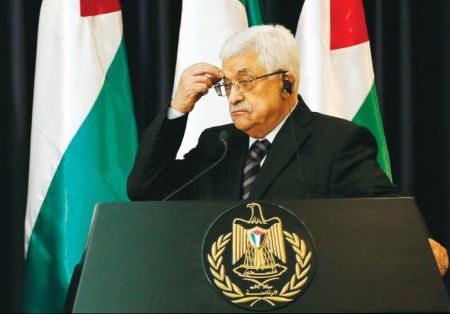
ShowImage (12)PA President Mahmoud Abbas.. (photo credit:AMMAR AWAD / REUTERS)

All the Palestinian terrorist attacks that have been carried out in recent weeks share one common feature. All the terrorists believe that by attacking Jews they are protecting the Temple Mount from destruction.

And why shouldn’t they believe this obscenity? Everywhere they go, every time they turn on their televisions, read the paper, go to school or the mosque they are told that the Jews are destroying al-Aksa Mosque. Al-Aksa, they are told, is in danger. They must take up arms to defend it from the Jews, whatever the cost.

One man stands at the center of this blood libel. The man who propagates this murderous lie and orchestrates the death and mayhem that is its bloody harvest is none other than the West’s favorite Palestinian moderate: PLO chief and Palestinian Authority Chairman Mahmoud Abbas.

On September 16 Abbas gave a speech. It was broadcast on PA television and posted on his Facebook page. In it, he incited the Palestinians to kill Jews. In his words, “Al-Aksa Mosque is ours.

They [the Jews] have no right to desecrate it with their filthy feet. We won’t allow them to do so and we will do everything in our power to defend Jerusalem.”

Abbas added, “We bless every drop of blood spilled for Jerusalem. This is clean and pure blood, blood that was spilled for God. It is Allah’s will that every martyr will go to heaven and every wounded [terrorist] will receive God’s reward.”

Two weeks later, Abbas opened his address before the UN General Assembly with the same lies, threats, and incitement.

Almost exactly a year ago, Abbas spewed the same bile in a speech, with the same murderous consequences. In a speech before Fatah’s executive committee last October, Abbas said, “We must prevent them [the Jews] from entering the holy site in every possible way. This is our holy site, this is our al-Aksa and our church [the Church of the Holy Sepulchre]. They have no right to enter them. They have no right to desecrate them. We must prevent them from entering. We must block them with our bodies to defend our holy sites.”

In subsequent weeks, Abbas’s words were rebroadcast 19 times on Palestinian television.

During that period, Arab terrorists massacred rabbis in prayer at a Jerusalem synagogue, attempted to assassinate human rights activist Yehudah Glick, and murdered Jews standing at light rail stops in the capital.

Eleven Israelis were butchered in that terrorist onslaught.

Then as now, Abbas and his lieutenants not only incited attacks, they incentivized would be perpetrators to kill Jews.

Every year, the same PA that claims perpetual poverty pays more than $100 million to terrorists imprisoned in Israeli jails. Their salaries range between four to seven times the average PA salary, depending on the lethality of the attacks they carried out.

Popular awareness of the financial benefits of terrorist activities has played a critical role in motivating Palestinians to attack Jews. This is made clear by the actions in recent weeks of several of the supposedly “lone wolf” attackers in the hours before they struck. Several of them – like their predecessors in last year’s onslaught – announced their intention to become martyrs to protect al-Aksa from the Jews on their Facebook pages immediately before they carried out their attacks.

Money may be the greatest incentive Abbas and his PA provide for potential terrorists. But it isn’t the only one. There is also the social status they confer on terrorists and their families. Every would-be terrorist knows that if he succeeds in killing Jews, he will be glorified by the Palestinian media and his family will be embraced by the PA establishment – first and foremost by Abbas himself, who has made a habit of meeting with terrorists and their families.

Presently, Israel’s security brass is embroiled in a bitter dispute with our elected leaders regarding the nature of the current terrorist offensive. The dispute bubbled to the surface Wednesday night when the generals used military reporters to criticize Prime Minister Benjamin Netanyahu for blaming Abbas for the violence.

The generals insist that Abbas is a good guy.

He’s trying to calm the situation, they argue, and Israel needs to support him.

From the looks of things, the IDF seems to have the upper hand in this fight. This is the only way to read Netanyahu’s announcement Wednesday night that he is barring government ministers and members of Knesset from visiting the Temple Mount until further notice. Netanyahu’s move is nothing less than a signal that he accepts Abbas’s premise that there is something wrong with Jews exercising their right to visit Judaism’s holiest site.

The generals’ rationale for defending Abbas is fairly straightforward. Throughout the current Palestinian terror onslaught they have continued to cooperate with Abbas-controlled Palestinian security forces in Judea and Samaria.

These forces cooperate with the IDF in seeking out and arresting terrorists from Hamas and other groups that are not subordinate to Abbas. The fact that Abbas has ordered his men to work with the IDF has convinced the generals that he is a positive actor. So as they see it, he must be protected.

In their view, Israel must limit its counterterrorism operations to tactical operations against trigger pullers and their immediate commanders and ignore the overarching cause of the violence.

In behaving in this manner, our security brass is being willfully blind to the fact that Abbas is playing a double game. On the one hand, he orders his forces to be nice to IDF officers in Central Command when they fight terrorist cells from Hamas and other groups not loyal to Abbas, and so wins their appreciation.

But on the other hand, Abbas works with those same terrorist forces, incites them to attack, and rewards them for doing so.

Perhaps the most outrageous aspect of the IDF’s insistence that Abbas is critical to its counterterrorism efforts is that the IDF’s own data demonstrate that Abbas has played an insignificant role in quelling terrorist attacks against Israel.

As Jerusalem Post columnist Evelyn Gordon showed in an article in Commentary this week, according to official data, from 2002 when Palestinian terrorist activities in the areas were at their peak until 2007, when Israel began transferring security control over some Palestinian cities to Abbas’s forces, levels of terrorism went down 97 percent. Even after Israel began permitting Abbas to deploy his security forces to Nablus and Jenin, the IDF has continued to operate at will in these areas, often on a nightly basis.

As Gordon noted, the only place Abbas has exercised sole security control was in Gaza. From September 2005, when Israel removed its military forces from Gaza until Hamas expelled Fatah forces from the areas in June 2007, Abbas’s forces had full control over Gaza. During this time, his forces did nothing to prevent Hamas – and Fatah forces – from attacking Israel with thousands of mortars and rockets. His forces did nothing to prevent the massive transfer of advanced weaponry to Gaza from Egypt and Iran.

True, since his forces were routed in Gaza, Abbas has ordered them to work with the IDF in Judea and Samaria to prevent Hamas from overthrowing him. But at the same time, he continuously seeks to form a unity government with Hamas.

He funds Hamas. He glorifies its terrorists. And he refuses to condemn their attacks against Israel.

Moreover, while ordering his men to help the IDF to protect him from Hamas, he leads the diplomatic war against Israel internationally. The goals of that war are to harm Israel’s economy and deny Israel the right to self-defense.

Our political leadership’s reluctance to stand up to the army is understandable. It is nearly impossible to order the IDF to take action it opposes.

At some point though, the government is going to rein in our insubordinate generals. Fortunately, the government doesn’t need the IDF to deal with Abbas and destroy his capacity to foment and direct attacks against Israel.

Our elected officials have the authority to go after the twin foundations Abbas’s terrorist offensive on their own. Those foundations are the incitement and the financial incentives he uses to motivate Palestinians to attack Jews.

On the financial end, the Knesset should pass two laws to dry up the wells of terrorism financing.

First, the Knesset should pass a law stipulating that all property belonging to terrorists, and all property used by terrorists to plan and carry out attacks, will be seized by the government and transferred to the victims of their attacks.

Moreover, all compensation paid to terrorists and their relatives pursuant to their attacks will be seized by the government and transferred to their victims.

The second law would relate to Israel’s practice – anchored in the Oslo Accords that Abbas revoked last month at the UN – of transferring tax revenues to the PA. The Knesset should pass a law prohibiting those transfers unless the Defense Minister certifies that the PA has ceased all terrorism- related activities including incitement, organization, financing, directing and glorifying terrorist attacks and terrorists.

Until he so certifies, all revenues collected should be used to pay PA debts to Israeli institutions and to compensate victims of Palestinian terrorism.

As for the incitement, the government needs to go to the source of the problem – Abbas’s blood libel regarding Jewish rights to the Temple Mount.

As things stand, Abbas is exacting a price in human lives for his obscene anti-Jewish propaganda about our “filthy feet defiling” the most sacred site in Judaism. By barring elected officials from visiting the Temple Mount, not only is the government failing to exact a price for Abbas’ obscene propaganda. It is rewarding him and so inviting Abbas to expand his rhetorical offensive.

To remedy the situation an opposite approach is required. Rather than bar elected officials from visiting the Temple Mount, Netanyahu should encourage them to do so. Just as he sent a letter to Jordan’s King Abdullah telling him that Israel is preserving the status quo on the Temple Mount, so he should write a similar letter to our lawmakers.

In his letter, Netanyahu should say that in keeping with the status quo, which protects the rights of members of all religions to freely enter the Temple Mount, so he commits the government to protect the rights of all believers of all religions to ascend the Mount.

The Palestinian terrorist onslaught now raging against us is not spontaneous. Abbas has incited it and is directing it. To stop this assault, Israel must finally take action against Abbas and his machinery of war. Anything less can bring us nothing more than a temporary respite in the carnage that Abbas will be free to end whenever he wishes.

Russia Missile Attacks Embarrass Obama, Warn Israel

October 9, 2015

Russia Missile Attacks Embarrass Obama, Warn Israel, American ThinkerJonathan Keiler, October 9, 2015

Beyond heaping yet another humiliation on Obama and signaling American admirals to keep their distance, the missile attack probably also sent a very pointed message to Israel. Israel currently deploys four advanced German-made and Israeli equipped Dolphin submarines, with two more on the way.

******************************

Russia’s October 7 cruise missile bombardment of anti-Assad Syrian rebels from ships stationed nearly 1000 miles away was probably the most expensively ineffectual display of military firepower since Bill Clinton launched a similar strike against al Qaeda in 1998. Clinton’s feckless and spendthrift action was supposedly in retaliation for the embassy bombings in Tanzania and Kenya and succeeded by most accounts in wiping out a few empty tents with several tons of explosives and several million dollars’ worth of advanced ordnance.

It is unlikely that Vladimir Putin’s strike did much damage to Syrian rebels either. But unlike Clinton (and the current Democrat in the White House) Putin doesn’t use force to shirk greater national responsibilities, he uses it to pursue clear strategic objectives. In this case, the Russian decision to launch brand-new Kalibr-NK missiles from the Caspian Sea fleet was clearly intended as yet another poke in the eye to President Obama, and a demonstration of Russian firepower, from diminutive but still dangerous Russian warships.

The 26 missiles were launched by three patrol boats and a frigate (a warship smaller than a destroyer.)  Russian spokesmen claimed all landed within nine feet of their targets, a degree of accuracy probably not needed against dispersed irregular infantry, but necessary to hit opposing warships, like those flying American flags. The Syrian rebels served as live practice targets for the Russian missile crews, who got to shoot off the new and previously unproven (in combat) missile.

Beyond heaping yet another humiliation on Obama and signaling American admirals to keep their distance, the missile attack probably also sent a very pointed message to Israel. Israel currently deploys four advanced German-made and Israeli equipped Dolphin submarines, with two more on the way. Most analysts presume that these advanced boats are intended to penetrate the Persian Gulf in the event of war with Iran, and from their launch cruise missiles in support of Israeli air action.

However, several years ago, in this article I proposed that the Israeli purpose was probably otherwise. Israeli is widely presumed to have equipped the subs with Israeli Popeye turbo cruise missiles with a range similar to that of the Russian Kalibr-NK. With such a weapon, Israeli subs need not make the long and dangerous journey to the Persian Gulf, but could launch from off the coast of Syria, the missiles following a flight plan very similar to those the Russian weapons took (but in reverse) where they could strike targets across northern Iran.

If I could conceive of such a plan, so could Russian intelligence services, which have probably backed this idea with hard, but secret intelligence. The Russian attack is a clear signal to Israel, demonstrating that cruise missiles which can go from the eastern Mediterranean to Iran can go the other way too. It is unlikely that it was a message lost on the Israelis, and more evidence that Russia’s movement in to the Syrian arena is proving disastrous for America and her allies.