Posted tagged ‘Islamophobia’

Islamic Hate for the Christian Cross

June 22, 2015

Islamic Hate for the Christian Cross, Front Page Magazine, June 22, 2015 (Originally published by PJ Media.)

(Apparently Obama, who appears to favor Islam over all other religions, hopes that when The Islamic Republic of Iran gets or gets to keep the bomb and enjoys lots of sanctions relief its behavior toward non-Muslims will improve. — DM
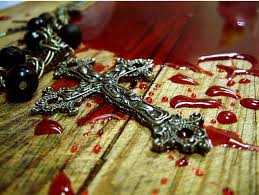
pc

Islamic hostility to the cross is an unwavering fact of life—one that crosses continents and centuries; one that is very much indicative of Islam’s innate hostility to Christianity.

********************

Last May in Italy, a Muslim boy of African origin beat a 12-year-old girl during school because she was wearing a crucifix around her neck. The African schoolboy, who had only started to attend the school approximately three weeks earlier, began to bully the Christian girl—“insulting her and picking on her in other ways all because she was wearing the crucifix”—before he finally “punched the girl violently in the back.”

What is it about the Christian cross that makes some Muslims react this way?

The fact is, Islamic hostility to the cross is an unwavering fact of life—one that crosses continents and centuries; one that is very much indicative of Islam’s innate hostility to Christianity.

Doctrine and History

Because the Christian cross is the quintessential symbol of Christianity—for all denominations, including most forms of otherwise iconoclastic Protestantism—it has been a despised symbol in Islam.

According to the Conditions of Omar—a Medieval text which lays out the many humiliating stipulations conquered Christians must embrace to preserve their lives and which Islamic history attributes to the second “righteous caliph,” Omar al-Khattab—Christians are “Not to display a cross [on churches]… and “Not to produce a cross or [Christian] book in the markets of the Muslims.”

The reason for this animosity is that the cross symbolizes the fundamental disagreement between Christians and Muslims. According to Dr. Sidney Griffith, author of The Church in the Shadow of the Mosque, “The cross and the icons publicly declared those very points of Christian faith which the Koran, in the Muslim view, explicitly denied: that Christ was the Son of God and that he died on the cross.” Thus “the Christian practice of venerating the cross and the icons of Christ and the saints often aroused the disdain of Muslims,” so that there was an ongoing “campaign to erase the public symbols of Christianity, especially the previously ubiquitous sign of the cross.”

Islam’s hostility to the cross, like all of Islam’s hostilities, begins with the Muslim prophet Muhammad. He reportedly “had such a repugnance to the form of the cross that he broke everything brought into his house with its figure upon it.” He once ordered someone wearing a cross to “take off that piece of idolatry” and claimed that at the end times Jesus himself would make it a point to “break the cross”—an assertion the Islamic State regularly makes.

Islamic history following Muhammad is riddled with anecdotes of Muslims cursing and breaking crosses. Prior to the Battle of Yarmuk in 636, which pitted the earliest invading Muslim armies against the Byzantine Empire, Khalid bin al-Walid, the savage “Sword of Allah,” told the Christians that if they wanted peace they must “break the cross” and embrace Islam, or pay jizya and live in subjugation—just as his Islamic State successors are doing today in direct emulation. The Byzantines opted for war.

In Egypt, Saladin (d. 1193)—regularly touted in the West for his “magnanimity”—ordered “the removal of every cross from atop the dome of every church in the provinces of Egypt,” in the words of The History of the Patriarchate of the Egyptian Church.

Europe: Growing Violence against the Cross

Centuries later, not much has changed concerning Islam’s position towards the cross, though much has changed in Western perceptions. In other words, an African boy punching a Christian girl in Italy for her crucifix is part of a long continuum of Islamic hostility for the cross. Perhaps he learned this hatred in mosque—the same European mosques where Islamic State representatives call Muslims to jihad?

After all, earlier this year in Italy, another crucifix was destroyed in close proximity to a populated mosque.  The municipality’s Councilor, Giuseppe Berlin, did not mince words concerning the identity of the culprit(s):

Before we put a show of unity with Muslims, let’s have them begin by respecting our civilization and our culture. We shouldn’t minimize the importance of certain signals; we must wake up now or our children will suffer the consequences of this dangerous and uncontrolled Islamic invasion.

Nor is Italy the only European nation experiencing this phenomenon. In neighboring France, a “young Muslim” committed major acts of vandalism at two churches.  Along with twisting a massive bronze cross, he overturned and broke two altars, the candelabras and lecterns, destroyed statues, tore down a tabernacle, smashed in a sacristy door and even broke some stained-glass windows.  (Click for images.)

And in Germany, a Turkish man who checked himself into a hospital for treatment went into a sudden frenzy because there were “too many crosses on the wall.”  He called the nurse a “bitch” and “fascist” and became physically aggressive.

Of course, other times Europeans willingly capitulate to Islamic hostility for the cross. Real Madrid, a professional football (soccer) team in Spain reportedly stripped the traditional Christian cross from its club crest as part of a deal with the National Bank of Abu Dhabi—“so as not to offend Muslim sensibilities in the United Arab Emirates.” And in the United Kingdom, offensive crucifixes are being removed from prisons in order not to offend Muslim inmates (who are further provided with food baths for Islamic rituals).

Muslim World: Christians Killed for the Cross

If this is how some Muslims react to the Christian cross in Europe—where Muslims are aware of their outnumbered, minority status—how do other Muslims react to the cross in the Islamic world, where vastly outnumbered and ostracized Christian “infidels” are easy prey?

The answer is murderous—literally, Christians are being murdered by Muslims provoked at the sight of the cross:

Last year in Egypt, a young Coptic Christian woman named Mary was mauled to death—simply because her cross identified her as a Christian to Muslim Brotherhood rioters.   According to an eyewitness who discussed the episode, Mary Sameh George was parking her car by the church to deliver medicine to an elderly woman:

Once they [Brotherhood rioters] saw that she was a Christian [because of the cross hanging on her rearview mirror], they jumped on top of the car, to the point that the vehicle was no longer visible. The roof of the car collapsed in.  When they realized that she was starting to die, they pulled her out of the car and started pounding on her and pulling her hair—to the point that portions of her hair and scalp came off.  They kept beating her, kicking her, stabbing her with any object or weapon they could find….  Throughout [her ordeal] she tried to protect her face, giving her back to the attackers, till one of them came and stabbed her right in the back, near the heart, finishing her off.  Then another came and grabbed her by the hair, shaking her head, and with the other hand slit her throat.  Another pulled her pants off, to the point that she was totally naked.

In response, the Coptic Christian Church issued the following statement: “Oh how lucky you are, Mary, you who are beloved of Christ.  They tore your body because of the Cross.  Yet they offered you the greatest service and gave you a name of honor as one who attained the crown of martyrdom.” The statement also quoted Christ’s warning to believers: “Yes, the time is coming that whoever kills you will think that he offers God service” (John 16:2).

In October 2011, seventeen-year-old Ayman Nabil Labib, a Coptic student, was strangled and beaten to death by his Muslim teacher and some fellow students—simply for refusing to obey the teacher’s orders to remove his cross. Student eyewitnesses present during the assault said that while Ayman was in the classroom he was told to cover up his tattooed wrist cross, which many Copts wear. Not only did he refuse, but he defiantly produced the pectoral cross he wore under his shirt, which prompted the enraged Muslim teacher and students to beat the Christian youth to death.

Before that, an off-duty Muslim police officer on a train from Asyut to Cairo shouted “Allahu Akbar!” and opened fire on six Christians, killing a seventy-one-year-old man and critically wounding the rest. Before opening fire he had checked for passengers with the traditional Coptic cross tattooed on their wrists. (Days ago, another Coptic woman was “shot dead by an Egyptian police officer. Although officially an “accident,” the Muslim officer is notorious for hating Christians.)

In Pakistan, when a Muslim man saw Julie Aftab, a Christian woman, wearing a cross around her neck,

The man became abusive, shouting at her that she was living in the gutter and would go to hell for shunning Islam. He left and returned half an hour later, clutching a bottle of battery acid which he savagely chucked over her head. As she ran screaming for the door a second man grabbed her by the hair and forced more of the liquid down her throat, searing her esophagus. Teeth fell from her mouth as she desperately called for help, stumbling down the street. A woman heard her cries and took her to her home, pouring water over her head and taking her to hospital. At first the doctors refused to treat her, because she was a Christian. ‘They all turned against me . . . even the people who took me to the hospital. They told the doctor they were going to set the hospital on fire if they treated me’. . . . 67 percent of her esophagus was burned and she was missing an eye and both eyelids. What remained of her teeth could be seen through a gaping hole where her cheek had been. The doctors predicted she would die any day. Despite the odds she pulled through.

All this because she was wearing a cross.

Even in Muslim nations deemed “moderate,” violence provoked by the cross is not uncommon. In 2012, a 12-year-old boy in Turkey who converted to Christianity and decided to profess his new faith by wearing a silver cross necklace in class was spit on and beat regularly by Muslim classmates and teachers.

In the Maldives, October 2010, authorities had to rescue Geethamma George, a Christian teacher from India, after Muslim “parents threatened to tie and drag her off of the island” for “preaching Christianity.” Her crime was simply to draw a compass in class as part of a geography lesson. The compass was mistaken for the Christian cross.

Christians ‘Killed’ Again for the Cross

If some Muslims kill the wearers of the cross, so do they disturb the slumber of those already dead for having the cross on their tombstones. A few of the many examples follow:

  • Libya, March 2012: A video of a Muslim mob attacking a commonwealth cemetery near Benghazi appeared on the internet. As the Muslims kicked down and destroyed headstones with crosses on them, the man videotaping them urged them to “Break the cross of the dogs!” while he and others cried “Allahu Akbar!” Towards the end of the video, the mob congregated around the huge Cross of Sacrifice, the cemetery’s cenotaph monument, and started to hammer at it, to more cries of “Allahu Akbar.”Other Christian cemeteries in post-“Arab Spring” Libya have suffered similarly.
  • France, April 2015: Christian crosses and gravestones in a cemetery weredamaged and desecrated by a Muslim. After being apprehended, he was described as follows: “The man repeats Muslim prayers over and over, he drools and cannot be communicated with: his condition has been declared incompatible with preliminary detention.” He was hospitalized as “mentally unbalanced.” (See his handiwork.)
  • Malaysia, February 2014: AChristian cemetery was attacked and desecrated in the middle of the night by unknown persons in the Muslim majority nation.  Several crosses were destroyed, including by the use of “a heavy tool to do the damage.”
  • Germany, June 2014: After Muslims were granted their own section at a cemetery in Seligenstadt, and after being allowed to conduct distinctly Islamic ceremonies, these same Muslims begandemanding that Christian symbols and crosses in the cemetery be removed or covered up during Islamic funerals.

—–

One can go on and on with more recent examples of Islam’s hostility to the cross. Last April in “moderate” Malaysia, a Muslim mob rioted against a small Protestant church due to the visible cross atop the building of worship. It was quickly removed.

And in Pakistan, a nation where the mere accusation of offending Islam get Christians burned alive—a Muslim shopkeeper is allowed to sell shoes which depict the Christian cross on their sole: “In Pakistani culture, showing the sole of one’s shoe or foot is offensive because placing anything on the ground is considered to be an insult to the object. Therefore, something on the sole of a shoe is going to be constantly insulted as the person walks.”

From an African School Boy in Italy to ‘ISIS’

In light of the above, it should come as no surprise that the Islamic State—“ISIS”—also exhibits violence to the Christian cross.   In its communiques to the West, hostile reference to the cross is often made: “We will conquer your Rome, break your crosses, and enslave your women, by the permission of Allah…. [We will cast] fear into the hearts of the cross worshippers….”

After carving the heads of Coptic Christians off in Libya, the lead executioner waved his dagger at the camera and said, “Oh people, recently you have seen us on the hills of as-Sham and Dabiq’s plain [Syrian regions], chopping off the heads that have been carrying the cross for a long time.  And today, we are on the south of Rome, on the land of Islam, Libya, sending another message.”  He concluded by declaring: “We will fight you [Christians/Westerners] until Christ descends, breaks the cross and kills the pig” (all eschatological actions ascribed to the Muslim “Christ,” Isa).

Moreover, the Islamic State has committed countless atrocities against and because of the cross: it made and disseminated a video showing its members smashing crosses in and atop churches in territories under its sway; it beheaded and stabbed a man with his own crucifix after it exposed him as a Christian; and it published pictures of its members destroying Christian crosses and tombstones in cemeteries under its jurisdiction — and quoted Islamic scriptures justifying its actions.

Careful readers will note the similar parallels here: destroying crosses in churches and cemeteries and even killing Christian “infidels” for wearing them, as documented above, is not limited to “ISIS” but is happening all around the Muslim world, and even in Europe.

In short, Islam’s age-old hatred for the Christian cross—and what it represents—is not a product of the Islamic State, but of Islam.

The Myth of Muslim Radicalization

June 18, 2015

The Myth of Muslim Radicalization, Front Page Magazine, Daniel Greenfield, June 18, 2015

Usaama RahimUsaama Rahim

Mainstreaming extremism is . . . Obama’s policy. It’s the logic behind nearly every Western diplomatic move in the Middle East from the Israel-PLO peace process to the Brotherhood’s Arab Spring. And these disasters only created more Islamic terrorism.

****************

After some of its quarter of a million Muslims headed to join ISIS, Quebec decided the answer was a $2 million anti-radicalization center headed by a specialist in cultural sensitivity. But if you’re about to be beheaded by a masked ISIS Jihadist, a specialist in cultural sensitivity isn’t going to help you much.

Western governments nevertheless keep rolling out their culturally sensitive approaches to fighting ISIS.

The key element in Obama’s strategy for fighting ISIS isn’t the F-15E Strike Eagle, it’s a Twitter account run by a Muslim Brotherhood sympathizer which claims to “Counter Violent Extremism” by presenting moderate Islamists like Al Qaeda as positive role models for the Islamic State’s social media supporters.

So far 75% of planes flown on combat missions against ISIS return without engaging the enemy, but the culturally sensitive State Department Twitter account has racked up over 5,000 tweets and zero kills.

Cultural sensitivity hasn’t exactly set Iraq on fire in fighting ISIS and deradicalization programs here start from the false premise that there is a wide gap between a moderate and extremist Islam.  Smiling news anchors daily recite new stories about a teenager from Kentucky, Boston or Manchester getting “radicalized” and joining ISIS to the bafflement of his parents, mosque and community.

And who is to blame for all this mysterious radicalization? It’s not the parents. It certainly can’t be the moderate local mosque with its stock of Jihadist CDs and DVDs being dispensed from under the table.

The attorney for the family of Usaama Rahim, the Muslim terrorist who plotted to behead Pamela Geller, claims that his radicalization came as a “complete shock” to them.

It must have come as a truly great shock to his brother Imam Ibrahim Rahim who claimed that his brother was shot in the back and that the Garland cartoon attack had been staged by the government.

It must have come as an even bigger shock to Imam Abdullah Faaruuq, the Imam linked to Usaama Rahim and his fellow terrorist conspirators, as well as the Tsarnaev brothers, who had urged Muslims to “grab onto the gun and the sword.”

The culturally insensitive truth about Islamic ‘radicalization’ is that it is incremental.

There is no peaceful Islam. Instead of two sharply divided groups, peaceful Islam and extremist Islam, there is a spectrum of acceptable terrorism.

Muslim institutions have different places on that spectrum depending on their allegiances and tactics, but the process of radicalization is rarely a sharp break from the past for any except converts to Islam.

The latest tragic victim of radicalization is Munther Omar Saleh; a Muslim man living in New York City who allegedly plotted to use a Tsarnaev-style pressure cooker bomb in a major landmark such as the Statue of Liberty or the Empire State Building. Saleh claimed to be following orders from ISIS.

Media coverage of the Saleh arrest drags out the old clichés about how unexpected this sudden radicalization was, but what appears to be his father’s social media account shows support for Hamas.

Likewise one of Usaama Rahim’s fellow mosque attendees said that Rahim and another conspirator had initially followed the “teachings of the Muslim Brotherhood” but that he had been forced to cut ties with them when they moved past the Brotherhood and became “extreme”.

Despite the media’s insistence on describing the Muslim Brotherhood as a moderate organization, it has multiple terrorist arms, including Hamas, and its views on non-Muslims run the gamut from the violent to the genocidal.

A year after Obama’s Cairo speech and his outreach to the Muslim Brotherhood, its Supreme Guide announced that the United States will soon be destroyed, urged violent terrorist attacks against the United States and “raising a jihadi generation that pursues death just as the enemies pursue life.”

Despite this, Obama continued backing the Muslim Brotherhood’s rise to power across the region.

There are distinctions between the Muslim Brotherhood and Al Qaeda, but the latter is a splinter group of the former. Al Qaeda’s current leader came out of the Muslim Brotherhood. A move from one to the other is a minor transition between two groups that have far more in common than their differences.

And since the Brotherhood controls much of the Islamic infrastructure in the United States, the idea that Munther Omar Saleh or Usaama Rahim became radicalized because they went from a Jihadist group that takes the long view in the struggle against the infidel, putting political structures into place to make a violent struggle tactically feasible, to a Jihadist group that focuses more on short term violence, is silly.

Radicalization isn’t transformational; it’s incremental.

It’s the Pakistani kid down the block deciding that instead of joining the Muslim Students Association and then CAIR to build Islamist political structures in America, he should just cut to the chase and kill a few cops to begin taking over America now.

Radicalization is the moderate Imam who stops putting on an act for PBS and the local politicians and moves to Yemen where he openly recruits terrorists to attack America instead of doing it covertly at his mosque in Virginia.

Radicalization is the teenage Muslim girl who forgets about marrying her Egyptian third cousin and bringing him and his fifty relatives to America and goes to join ISIS as a Caliphate brood mare instead.

It’s not pacifism giving way to violence. Instead it’s an impatient shift from tactical actions meant to eventually make Islam supreme in America over many generations to immediate bloody gratification. ISIS is promising the apocalypse now. No more waiting. No more lying. You can have it tomorrow.

Radicalization does not go from zero to sixty. It speeds up from sixty to seventy-five.

It builds on elements that are already there in the mosque and the household. The term “extremism” implicitly admits that what we are talking about is not a complete transformation, but the logical extension of existing Islamic beliefs.

Omar Saleh seemed cheerful enough about Hamas dropping Kassam rockets on Israeli towns and cities. Would he have supported his son setting off a bomb in the Statue of Liberty? Who knows, but his son was already starting from a family position that Muslim terrorism against non-Muslims was acceptable.

Everything else is the fine print.

When Usaama Rahim followed the way of the Muslim Brotherhood, he was with a moderate group whose spiritual guide, the genocidal Qaradawi was the godfather of cartoon outrage and had endorsed the murderous Iranian fatwa against Salman Rushdie.

The slope that leads from Qaradawi’s cartoon rage to trying to behead Pamela Geller isn’t a slippery one; it’s a vertical waterfall. And this is what radicalization really looks like. It doesn’t mean moderates turning extreme. It means extremists becoming more extreme. And there’s always room for extremists to become more extreme which turns old extremists into moderates while mainstreaming their beliefs.

In the UK, Baroness Warsi, Cameron’s biggest mistake, blamed Muslim radicalization on the government’s refusal to engage with… radicals. Or as she put it, “It is incredibly odd and incredibly worrying that over time more and more individuals, more and more organisations are considered by the government to be beyond the pale and therefore not to be engaged with.”

The reason why the government is refusing to “engage” with these organizations is that they support terrorism in one form or another. Warsi is proposing that the UK fight radicalization by mainstreaming it.

Mainstreaming extremism is also Obama’s policy. It’s the logic behind nearly every Western diplomatic move in the Middle East from the Israel-PLO peace process to the Brotherhood’s Arab Spring. And these disasters only created more Islamic terrorism.

The Muslim teenagers headed to join ISIS did not come out of a vacuum. They came from mosques and families that normalized some degree of Islamic Supremacism and viewed some Muslim terrorists as heroes and role models. It’s time for Western governments to admit that the ISIS Jihadist is more the product of his parents and his teachers than of social media Jihadis on YouTube and Twitter.

Radicalization doesn’t begin with a sheikh on social media. It begins at home. It begins in the mosque. It just ends with ISIS.

The Postcolonial Rot Spreads Beyond Middle East Studies

June 15, 2015

The Postcolonial Rot Spreads Beyond Middle East Studies, Front Page Magazine, June 15, 2015

middle-east-scholarships

Middle East Studies programs, Kramer writes, “came under a take-no-prisoners assault, which rejected the idea of objective standards, disguised the vice of politicization as the virtue of commitment, and replaced proficiency with ideology.” The ideology, of course, comprised the old Marxist narrative of Western colonial and imperial crimes, a Third Worldism that idealizes the dark-skinned, innocent “other” victimized by Western depredations, and the juvenile romance of revolutionary violence.

*****************

In theory, Middle East Studies programs are a good idea. One of the biggest impediments to countering modern jihadism has been the lack of historical knowledge about the region and Islam. But even the attention and urgency that followed the terrorist attacks on 9/11 have not led to such knowledge. The result has been policies pursued both by Republicans and Democrats that are doomed to fail, as the current chaos in the region attests.

Rather than enlightening citizens and policy-makers, Middle Eastern Studies programs have darkened our understanding. As Martin Kramer documented in his important 2002 study Ivory Towers on Sand, most programs have become purveyors not of knowledge but of ideology. Under the influence of literary critic Edward Said’s historically challenged book Orientalism––“a work,” historian Robert Irwin has written, “of malignant charlatanry, in which it is hard to distinguish honest mistakes from willful misrepresentations”­­––Middle East Studies programs, Kramer writes, “came under a take-no-prisoners assault, which rejected the idea of objective standards, disguised the vice of politicization as the virtue of commitment, and replaced proficiency with ideology.” The ideology, of course, comprised the old Marxist narrative of Western colonial and imperial crimes, a Third Worldism that idealizes the dark-skinned, innocent “other” victimized by Western depredations, and the juvenile romance of revolutionary violence.

Yet Said’s baleful influence has not been limited to Middle East Studies programs, one of which has been created at my campus of the California State University, replete with the problems Kramer catalogues. It has insidiously corrupted much of the humanities and social sciences, operating under the innocuous rubric of “postcolonial” studies, which to the unwary suggests a historical rather than an ideological category. Through General Education courses that serve students across the university, and in departments like English that train primary and secondary school teachers, Saidian postcolonial ideology has been shaping the attitudes and presumed knowledge of Islam and the Middle East far beyond the reach of Middle East Studies programs.

Said’s dubious argument in Orientalism is that the work of Western scholars on the Middle East embodied “a Western style for dominating, restructuring, and having authority over the Orient,” thus creating the intellectual infrastructure for justifying colonialism and imperialism. As such, every European scholar perforce was “a racist, an imperialist, and totally ethnocentric.” For social science and humanities departments committed totally to the multiculturalist melodrama of white racism and oppression of the dark-skinned “other,” Said’s work seemingly provides scholarly bona fides to ideas that are in fact expressive of illiberal grievance politics.

English departments have been particularly vulnerable to Said’s work, for he overlaid his bad history with watered down Foucauldian ideas about the relationship of power to discourse. Thus English professors seduced by the poststructuralist theory ascendant in 1978 when Orientalism was published found in that book a seemingly sophisticated theoretical paradigm that shared both poststructuralism’s disdain for objectivity and truth, and its “hermeneutics of suspicion,” the notion that the apparent meaning of a discourse is a mask for the sinister machinations of power at the expense of the excluded “other.”

More important, postcolonialism is a politically activist theory, bound up as it is in the politics of the Middle East, especially the Arab-Israeli conflict. Now English professors could avoid the legitimate charge that poststructuralism, despite its patina of leftist ideology, was in fact an evasion of politics, a “symbolic politics,” as historian Russell Jacoby put it, “a replacement for, and a diversion from, the gritty politics of the community and the street.” On the contrary, the purveyors of postcolonialism were on the barricades, struggling to liberate Palestinians and other Muslims oppressed by a neo-imperialist America and its puppet Israel. Rather than pampered elitists guaranteed jobs for life, now the professors could fancy themselves freedom fighters and champions of the ex-colonial brown peoples still exploited and oppressed by the capitalist, racist West.

Finally, the dogma of multicultural “diversity” now firmly enshrined in American universities likewise has found Saidian postcolonialism a useful tool for interpreting and teaching literature, one that exposes the Western literary canon’s hidden racism and oppression. Moreover, in a university like Fresno State, half of whose students are minorities, a postcolonial perspective can establish a rapport with minority students who are encouraged to interpret their own experiences through the same lens of unjust exclusion and hurtful distortions of their culture and identity. At the same time white students are schooled in their privilege and guilt, minorities can be comforted by a narrative that privileges them as victims of historical oppression, one masked by the unearned prestige of the classics written by “dead white males.” Now minority students learn that Shakespeare’s Caliban is the true hero the Tempest with whom they should identify, the displaced victim of rapacious colonialists and slavers like Prospero who unjustly define the indigenous peoples as savages and cannibals in order to justify the brutal appropriation of their lands and labor.

Over the thirty years I have taught in the California State University, I have seen this transformation of the English department. Reading lists dominated by contemporary ethnic writers are increasingly displacing the classics of English literature, and even when traditional works are on the list, the books are often taught from the postcolonial perspective. New hires more and more comprise those Ph.D.’s whose specialties lie in ethnic or “world” literature, replacing the Shakespeare scholars and others trained to teach the traditional English and American literary canon. The traditional content of a liberal education––“the best which has been thought and said in the world,” as Matthew Arnold wrote––is disappearing, replaced by multicultural melodramas of Western crime and guilt.

More important for the culture at large, many of these students will go on to earn teaching credentials and staff public schools. They will carry the postcolonial ideology into their own classrooms, influencing yet another generation and reinforcing a received wisdom that will shape their students’ understanding of the important threats to our national security and interests emanating from the Middle East, especially jihadism. And it will encourage ordinary citizens to assent to the demonization of our most valuable regional ally, Israel, currently battling the Boycott, Divest, and Sanction movement that can more easily gain traction among those who from grade school to university have been exposed to the postcolonial ideology.

The damage done to our foreign policy by Middle East Studies is obvious. The influence of the godfather of such programs, Edward Said, on the social sciences and humanities departments like English is more insidious and subtle. But it is no less dangerous.

Islam’s ‘Baby Jihad’

June 12, 2015

Islam’s ‘Baby Jihad,’ Front Page Magazine, June 12, 2015

Islamic aspirations to dominate the world are set to happen—if not through might of arms, then apparently through sheer numbers.

In 1900, the Muslim population of the world was less than 200 million.  Conversely, the Christian population of the world was almost 560 million—almost three times the number of Muslims.

Times have changed.  According to the findings of a Pew Research Center in America:

The number of Muslims will increase at more than double the rate of the world’s population, which is expected to rise by 35 per cent in the next four decades.

There will be more Muslims than Christians in the world in less than sixty years, new research revealed.

The [Islamic] religion’s share of the world’s population will equal the Christian share – at roughly 32 per cent each – in 2070, analysis by the Pew Research Center showed.

[…]

By 2050 Muslims will make up around ten per cent of Europe’s population.

For a better idea of what is in store for Europe, simply look to the UK’s “Londonistan”—the apt name for London and other regions with a notable Muslim presence: Already with a 10 percent Muslim population, Londonistan is a reflection of Europe 35 years from now when it too is projected to be ten percent Muslim (and by which time the UK will likely have an even much larger Muslim population).

The same sorts of anti-infidel violence and sexual abuse that is a daily fixture in Muslim majority nations is already a normal feature of Londonistan with its mere 10 percent Muslim minority.

Put differently, if “ISIS” and other Islamic groups regularly behead “infidel” men and sexually enslave “infidel” women in the Middle East—so are “average” Muslims doing so in the UK:

Recall how in 2013, two Muslim men shouting “Allahu Akbar” beheaded a British soldier with a cleaver—in a busy intersection and in broad daylight no less.  They even boasted in front of passersby and asked to be videotaped.

Or recall how Muslims were recently busted for running a sex ring in Rotherham, England: 1,400 British children as young as 11 were plied with drugs before being passed around and sexually abused in cabs and kabob shops.

It was at least the fifth sex abuse ring led by Muslims to be uncovered in England—Muslims who only make 10 percent.

During the trial of an earlier Muslim-run sex ring “Several of the men on trial in Liverpool apparently told their victims that it was all right for them to be passed around for sex with dozens of men ‘because it’s what we do in our country.’”

In fact, that is exactly what some Muslim men do to infidel girls in their country.  Seemingly not a day goes by without Christian girls in Egypt, Pakistan, Nigeria, Iraq, Syria, and any number of other Muslim majority nations being abducted, enslaved, raped, and/forced to convert (See Crucified Again, pgs. 186-199 for a sampling, plus the doctrinal justification.)

When a Muslim man savagely raped a nine-year-old Christian girl in Pakistan, he told her “not to worry because he had done the same service to other young Christian girls.”  Commenting on this case, local human rights activists said,  “It is shameful. Such incidents occur frequently. Christian girls are considered goods to be damaged at leisure. Abusing them is a right. According to the community’s mentality it is not even a crime. Muslims regard them as spoils of war.”

Indeed, there is no end of patterns of abuse against Christian minorities in the Muslim world that are now occurring in the West.  While many are now aware that “ISIS” destroys churches and Christian cemeteries, few realize that Muslims—not “ISIS”—just average Muslims—are doing the same thing in the West.

Days ago in Canada, which has a miniscule Muslim population, a Muslim man vandalized and desecrated a church on several different occasions.  Among other things, he covered the Christ statue in front of the church with black paint and broke its fingers and tore up Christian books inside the church.

Weeks earlier in France, 215 Christian gravestones and crosses in the cemetery of Saint-Roch de Castres (Tarn) were damaged and desecrated by a Muslim man later described as follows:  “The man repeats Muslim prayers over and over, he drools and cannot be communicated with: his condition has been declared incompatible with preliminary detention.”

And last March in Germany, a potential jihadi attack on the cathedral and synagogue in Bremen was averted following action by police.

In short, along with all the other forms of jihad to be wary of—the sword jihad, the tongue jihad (deceit/propaganda), the money jihad (financial support to jihadis)—the West should also be aware of the baby jihad.

If the same sorts of crimes being committed against Christian minorities in Muslim majority nations are already being committed in Europe and North America—despite the fact that Muslims are currently minorities—how then when, as projected, Islam becomes the most adhered to religion in the world?

Death by Lashing: Saudi Arabia

June 11, 2015

Death by Lashing: Saudi Arabia, The Gatestone InstituteSalim Mansur, June 11, 2015

  • Nothing could uplift the universal image of Saudi Arabia and King Salman more than if today he issued a pardon. World leaders, including U.S. President Barack Obama, who has so far been silent on the issue, should immediately speak out — as should the media and human rights groups.
  • There was no insult of Islam, of the prophet, or of the Quran, in what Badawi wrote; and, truth be told, God, Islam and the prophet are all beyond insults, and beyond the reach of profanity that occasionally spills forth from the bigoted or tortured minds of individuals.
  • The treatment of Raif Badawi stands out, not merely for its cruelty, but how it has come to symbolize the grotesquely repulsive nature of the Saudi kingdom and what it represents behind the mask of religious austerity.

Tomorrow, Friday, the virtual death sentence by 1000 lashes, delivered “very harshly” according to the flogging order, fifty at a time, might continue for Raif Badawi, a 31-year-old Saudi blogger and father of three, for allegedly “insulting Islam.”

The flogging sentence, plus ten years in prison, was upheld last week by Saudi Arabia’s supreme court, and can now only be overturned by a pardon from King Salman.

Although Badawi, who is ill and frail, would most certainly perish, in Saudi justice there is little concern for sentences to be proportionate to the crimes for which the accused are found guilty, or for adequate legal representation. Badawi’s lawyer, Walid Abu al-Khair, was also jailed, effectively for the crime of representing him.

Badawi was accused of insulting Islam in his blog posts. In a country where thinking is forbidden, Badawi had expressed forbidden thoughts by questioning the nature of his society and going public with them.

Badawi, for instance, had written, “Muslims in Saudi Arabia not only disrespect the beliefs of others, but also charge them with infidelity — to the extent that they consider anyone who is not Muslim an infidel. They also, within their own narrow definitions, consider non-Hanbali [the Saudi school of Islam] Muslims as apostates. How can we be such people and build… normal relations with six billion humans, four and a half billion of whom do not believe in Islam?”

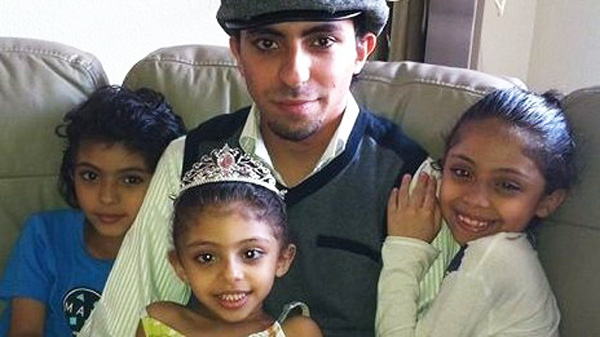
1106Raif Badawi and his children, before his 2012 arrest.

There was naivety in putting such thoughts in writing, as Badawi did, and drawing the attention of Saudi thought police. In another post, Badawi suggested, “Secularism respects everyone and does not offend anyone… Secularism is the practical solution to lift countries (including ours) out of the third world and into the first world.”

It appears Badawi wrote in the first blush of what seemed to have been a breath of fresh air, characterized as the “Arab Spring,” that wafted across the politically bleak landscape of the Arab world in early 2011. There had come news of a Tunisian vendor who had put lit himself on fire protesting police brutality, and had died as a result; his death sparked a movement against Arab despots.

The anguish of the Tunisian vendor, Mohammed Bouazizi, was genuine. His tragic death brought people into the streets, and the Tunisian strongman, Zine el-Abidine Ben Ali, eventually fled into exile in January 2011. The Tunisian protest stirred Egyptians to rise against their strongman, President Hosni Mubarak, and succeed in toppling him in February 2011.

The “Arab Spring,” for those brief few weeks in early 2011, held forth the promise of change for better across the Arab world. And young men like Raif Badawi could be forgiven for imagining that they, too, in Saudi Arabia, could no longer be denied freedom, democracy, and secularism — the accepted norms in the West.

But the hard realities of the Arab world turned the promise of the “Arab Spring” into the nightmare of religious terror and counter-terror. Saudi Arabia is the incubator and citadel of Islamic fascism, otherwise known as Wahhabism. And here in the land of the two holy cities of Islam — Mecca and Medina — religion and politics are inseparable, and anyone who trespasses either does so at the risk of losing his head — literally — in the public beheadings that are the hallmark of the Saudi kingdom.

Raif Badawi was arrested, and has been held in prison in Jeddah since June 2012. The arrest of Badawi and Souad al-Shammari came after they together set up the web site called Saudi Liberal Network. It was promptly closed by the authorities when Badawi posted criticism of the Saudi religious police.

The initial sentence for Badawi by the Criminal Court in Jeddah for mischief and subverting public order was for 600 lashes and seven years in prison. He appealed, and the court returned the verdict by raising the sentence to 1000 lashes and 10 years in prison. The Saudi supreme court has upheld this sentence.

In the interim Badawi was given 50 lashes in a Jeddah public square in January of this year, while further lashings were suspended on medical grounds. Badawi’s wife, Ensaf Haidar, fears the lashings will resume — according to court order the 1000 lashes are to be completed in 20 sessions in front of a mosque — and could be fatal for her husband.

* * *

There is very little the outside world can do to change the nature of the Saudi regime, or for that matter the regime in Iran, which is indistinguishable from the Saudi regime in terms of tyranny and the cruelty to which, in both countries, dissidents are subjected.

After Raif Badawi was arrested, Ensaf Haidar and her children found refuge in Quebec, Canada. Across Quebec there has been heartfelt popular support expressed for Raif Badawi, and condemnation of his punishment. Quebec has officially protested Badawi’s sentence, while demanding his release from Saudi Arabia so that he might join his family where they have settled.

In response to a Quebec National Assembly resolution, passed unanimously in February, condemning Badawi’s lashings in Jeddah in January 2015, the Saudi ambassador to Canada wrote a letter to the Quebec politicians. The same letter was also sent to the Canadian government in Ottawa.

The letter, signed by the Saudi ambassador, Naif Bin Bandir Alsudairy, was obtained by the Canadian Broadcasting Corporation (CBC). It states, “The Kingdom does not accept at all any attack on it in the name of human rights especially when its constitution is based on Islamic law, which guarantees the rights of humans and preserves his blood, money, honour and dignity.”

The stand taken by the Quebec government apparently rattled the Saudi kingdom sufficiently to have its ambassador write a letter addressed to members of a provincial legislature.

* * *

It is one of the anomalies of our age that when, by a fluke of nature, large deposits of fossil fuels are discovered in a country, as in Saudi Arabia, it is accorded attention and respect by other countries in excess of anything it has done, or achieved, or by the record of its conduct in human affairs.

Apart from the oil reserves of the kingdom, the House of Saud is indistinguishable from the House of Kim ruling North Korea, and it is as deserving of the same contempt.

Oil has not only made the difference for Saudi Arabia, it has also made the West complicit in the evil that Saudi Arabia does at home and perpetrates abroad: spreading its pre-modern and perverted culture as Islam or, more appropriately, Wahhabism; and funding terror as jihadism.

The treatment of Raif Badawi stands out, not merely for its cruelty, but how it has come to symbolize the grotesquely repulsive nature of the Saudi kingdom and what it represents behind the mask of religious austerity.

Saudi Arabia is possessed with the opposite of the “Midas touch”: wherever its money buys influence, there, the natural goodness in society is stained and corroded by its touch.

The tragedy surrounding Raif Badawi is both the savage treatment meted out to a young man by the Saudi regime for simply expressing his thoughts, and of how innocence, when it goes against the culture of Saudi intolerance, is mocked, abused, and strangled.

Raif Badawi is also the face of why “official” Islam — the one portrayed by Saudi Arabia and the other OIC member states, and to which the West routinely defers – is so terribly retarded. Freedom of thought is anathema to “official” Islam and its defenders, as it once was in the former Soviet Union; it is the defining characteristic of a closed, totalitarian society.

Raif Badawi is a young man, and the thoughts he expressed were the unsullied thoughts of the young that are at once universal in expectations and desires, as they are innocent and unburdened by the hardness of life’s experiences.

There was no insult of Islam, of the prophet, or of the Quran, in what Badawi wrote; and truth be told, God, Islam, and the prophet are all beyond insults, and beyond the reach of profanity that occasionally spills forth from the bigoted or tortured minds of individuals.

“Official” Islam is an insult to Muslims and non-Muslims alike — for “official” Islam is politics devoid of any redeeming quality found in faith, which nourishes the spiritual yearning of people and uplifts them in a broken world. Through betrayal and hypocrisy, “official” Islam insults God, Islam, and the prophet, every minute of each day, and has become a torment to Muslims.

It is “official” Islam, and Wahhabism in its most perverted expression among Sunni Muslims, that has turned God — Allah in Arabic — repeatedly invoked in the Quran as the “Most Beneficent, the Most Merciful,” into a vengeful and capricious deity.

The Quran states that on the Day of Reckoning the prophet will speak forth, “O my Lord! Lo! mine own folk make this Qur’an of no account” (25:30). In another verse, the Quran instructs the prophet to tell the wandering Arabs of the desert that they have merely submitted, but they have no belief “for the faith hath not yet entered into your hearts” (49:14). And then there is the verse stating categorically, “There is no compulsion in religion” (2:256).[1]

When religion is reduced to politics then it is the logic of politics, hence power and coercion, that takes precedence. In Albert Camus’s striking formulation, “Politics is not religion, or if it is, then it is nothing but the Inquisition.”[2] In Saudi Arabia, religion is a daily dose of inquisition, and the executioner with his sword is both the reality and the symbol of the vengeful deity that bears little resemblance to the merciful and compassionate God of the Quran.

Raif Badawi’s innocence betrayed him. Age and experience would have taught him the hard reality of his culture, veiled by the mask of “official” Islam. This hard reality of Arab culture has been best understood by Arab poets through the years of Arab and Muslim history. Here is one example of a poet’s disgust with the hard reality of his country’s culture and politics. These are lines from a poem of Nizar Qabbani (1923-98), a much-loved Syrian-Arab poet:

When a helmet becomes God in heaven
and can do what it wishes
with a citizen – crush, mash
kill and resurrect
whatever it wills,
then the state is a whorehouse,
history is a rag,
and thought is lower than boots.

When a breath of air
comes by decree
of the sultan,
when every grain of wheat we eat,
every drop of water we drink
comes only by decree
of the sultan,
when an entire nation turns into
a herd of cattle fed in the sultan’s
shed, embryos will suffocate
in the womb, women will miscarry
and the sun will drop
a black noose over our square.[3]

The Sultan’s power is vainglorious, whimsical, easily insulted, and secured by perpetrating fear, and the realm he rules by decree is by necessity a slaughterhouse.

If Raif Badawi survives the thousand lashes in the slaughterhouse that is the Kingdom of Saudi Arabia, it will be a testimony of how an individual’s courage, born of innocence, might well defy the Sultan’s decree.

Nothing could uplift the universal image of Saudi Arabia or King Salman more than if today he issued a pardon.

World leaders, including U.S. President Barack Obama, who has so far been silent on the issue, should immediately speak out — as should the media and human rights groups.

________________________

[1] Verses quoted from the Quran are from The Meaning of the Glorious Koran, translated by Mohammed Marmaduke Pickthall (New York: Alfred A. Knopf and Everyman’s Library, 1930, 1992).

[2] A. Camus, The Rebel (New York: Vintage Books, Random House, 1956), p. 302.

[3] Nizar Qabbani, “From The Actors” in Salma Khadra Jayyusi (editor), Modern Arabic Poetry: An Anthology (New York: Columbia University Press, 1987), pp. 378-379.

As ISIS Brutalizes Women, a Pathetic Feminist Silence

June 9, 2015

As ISIS Brutalizes Women, a Pathetic Feminist SilenceThe New York Post via Middle East Forum, Phyllis Chester, June 7, 2015

1354

While the most recent Women’s Studies annual conference did focus on foreign policy, they were only interested in Palestine, a country which has never existed, and support for which is often synonymous with an anti-Israel position. Privately, feminists favor non-intervention, non-violence and the need for multilateral action, and they blame America for practically everything wrong in the world.

Feminists strongly criticize Christianity and Judaism, but they’re strangely reluctant to oppose Islam — as if doing so would be “racist.” They fail to understand that a religion is a belief or an ideology, not a skin color.

**************************

Oh, how the feminist movement has lost its way. And the deafening silence over ISIS’s latest brutal crimes makes that all too clear.

Fifty years ago, American women launched a liberation campaign for freedom and equality. We achieved a revolution in the Western world and created a vision for girls and women everywhere.

Second-wave feminism was an ideologically diverse movement that pioneered society’s understanding of how women were disadvantaged economically, reproductively, politically, physically, psychologically and sexually.

Feminists had one standard of universal human rights — we were not cultural relativists — and we called misogyny by its rightful name no matter where we found it.

As late as 1997, the feminist majority at least took a stand against the Afghan Taliban and the burqa. In 2001, 18,000 people, led by feminist celebrities, cheered ecstatically when Oprah Winfrey removed a woman’s burqa at a feminist event — but she did so safely in Madison Square Garden, not in Kabul or Kandahar.

Six weeks ago, Human Rights Watch documented a “system of organized rape and sexual assault, sexual slavery, and forced marriage by ISIS forces.” Their victims were mainly Yazidi women and girls as young as 12, whom they bought, sold, gang-raped, beat, tortured and murdered when they tried to escape.

In May, Kurdish media reported, Yazidi girls who escaped or were released said they were kept half-naked together with other girls as young as 9, one of whom was pregnant when she was released. The girls were “smelled,” chosen and examined to make sure they were virgins. ISIS fighters whipped or burned the girls’ thighs if they refused to perform “extreme” pornography-influenced sex acts. In one instance, they cut off the legs of a girl who tried to escape.

These atrocities are war crimes and crimes against humanity — and yet American feminists did not demand President Obama rescue the remaining female hostages nor did they demand military intervention or support on behalf of the millions of terrified Iraqi and Syrian civilian refugees.

An astounding public silence has prevailed.

1355The National Organization for Women (NOW) apparently doesn’t think ISIS is a problem.

The upcoming annual conference of the National Organization for Women (NOW) does not list ISIS or Boko Haram on its agenda. While the most recent Women’s Studies annual conference did focus on foreign policy, they were only interested in Palestine, a country which has never existed, and support for which is often synonymous with an anti-Israel position. Privately, feminists favor non-intervention, non-violence and the need for multilateral action, and they blame America for practically everything wrong in the world.

What is going on?

Feminists are, typically, leftists who view “Amerika” and white Christian men as their most dangerous enemies, while remaining silent about Islamist barbarians such as ISIS.

Feminists strongly criticize Christianity and Judaism, but they’re strangely reluctant to oppose Islam — as if doing so would be “racist.” They fail to understand that a religion is a belief or an ideology, not a skin color.

The new pseudo-feminists are more concerned with racism than with sexism, and disproportionately focused on Western imperialism, colonialism and capitalism than on Islam’s long and ongoing history of imperialism, colonialism, anti-black racism, slavery, forced conversion and gender and religious apartheid.

And why? They are terrified of being seen as “politically incorrect” and then demonized and shunned for it.

The Middle East and Western Africa are burning; Iran is raping female civilians and torturing political prisoners; the Pakistani Taliban are shooting young girls in the head for trying to get an education and disfiguring them with acid if their veils are askew — and yet, NOW passed no resolution opposing this.

Twenty-first century feminists need to oppose misogynistic, totalitarian movements. They need to reassess the global threats to liberty, and rekindle our original passion for universal justice and freedom.

Spain in the Eye of the Storm of Jihad

June 6, 2015

Spain in the Eye of the Storm of Jihad, The Gatestone InstituteSoeren Kern, June 6, 2015

(Right of return? — DM)

  • The Islamists are especially interested in converts who have not yet taken on Muslim names and whose official IDs still have their Christian names, so they can purchase weapons without drawing the attention of police.
  • At least 50,000 Muslim converts are currently living in Spain. Police say that converts are especially susceptible to radicalization because they are facing increasing pressure from Islamists who are calling on them to carry out attacks to “demonstrate their commitment” to their new faith.
  • Spain has also become a key entry point for human trafficking mafias being used by jihadist veterans seeking to return to Europe after fighting in the Middle East.
  • “Turkey is the Seven-Eleven of false passports.” — Spanish agent working on a human trafficking case.

Spanish security forces have arrested a total of 568 jihadists over the past ten years in 124 separate operations against Islamic terrorism, Spanish Interior Minister Jorge Fernández Díaz revealed at an African security conference in Niger on May 14.

Fernández Díaz said that “constant police and judicial actions” have helped Spanish authorities prevent another large-scale terrorist attack similar to the March 2004 Madrid train bombings, in which nearly 200 people were killed and more than 2,000 were injured.

At the same time, Fernández Díaz has warned that it is “very probable” that Islamic terrorists will strike Spain at some point in the future; he has estimated the probability of an attack to be 70%.

At a two-day terrorism conference held in Madrid on April 23 and 24, Fernández Díaz said that at least 115 Spanish jihadists — including at least 15 women — are now known to have joined the Islamic State. He added that 14 jihadists had returned to Spain; nine of those are in prison and five remain free.

In January, Fernández Díaz said the number of Spanish jihadists abroad was 70, which implies a jump of more than 40 new jihadists in the first four months of 2015 alone. In August 2014, the first time that Fernández Díaz provided an official estimate, he said there were 51 Spanish jihadists fighting abroad.

Meanwhile, “dozens” of jihadists and other Islamic radicals are entering Spain from neighboring France, where they are said to be “asphyxiating” due to a government crackdown following theCharlie Hebdo attacks in Paris in January. (On April 29, French President François Hollande announced that a force of 7,000 troops would be deployed to patrol French streets on a permanent basis.)

According to an anonymous Spanish intelligence operative interviewed by El Confidencial, a media outlet based in Madrid, French jihadists are moving to Spain because they feel they have “greater room for movement” on the Iberian Peninsula. They include individuals “suspected” of being Islamic radicals, but for whom there is insufficient proof for either government to arrest them.

The report says that most of the jihadists from France are moving to Catalonia and Spain’s Mediterranean coast, where they are attempting to “blend in” with Muslim communities there. Also known as the Spanish Levant, the region roughly corresponds with what was once known as Xarq al-Ándalus, territories that were occupied by Muslim invaders for nearly five centuries.

Al-Andalus is the Arabic name given to those parts of Spain, Portugal and France occupied by Muslim conquerors (also known as the Moors) from 711 to 1492. Many Muslims believe that territories Muslims lost during the Christian Reconquista of Spain still belong to the realm of Islam. They claim that Islamic law gives them the right to return there and re-establish Muslim rule.

In July 2014, jihadists with the Islamic State produced a video in which they vowed to liberate al-Andalus from non-Muslims and make it part of their new Islamic Caliphate. The video showed a jihadist speaking in Spanish with a heavy North African accent, warning:

“I say to the entire world as a warning: We are living under the Islamic flag, the Islamic caliphate. We will die for it until we liberate those occupied lands, from Jakarta to Andalusia. And I declare: Spain is the land of our forefathers and we are going to take it back with the power of Allah.”

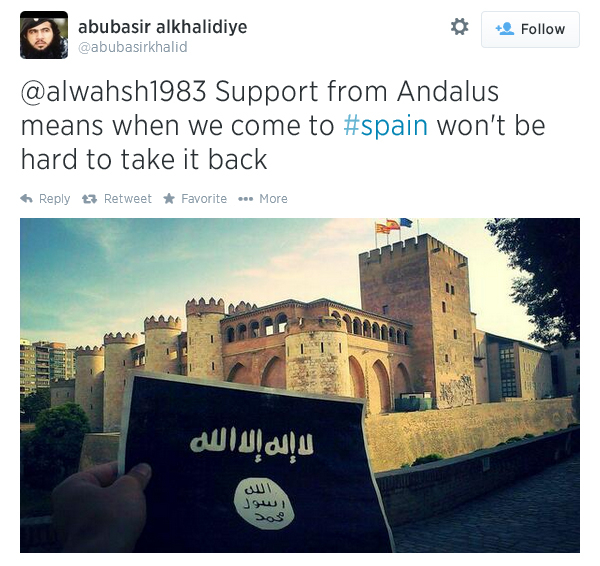
639A tweeted photo of an Islamic State supporter holding the Islamic State’s black flag of jihad in front of Aljafería Palace in Zaragoza, Spain

Counter-terrorism authorities are now warning that the Islamic State is actively looking for Spanish converts to Islam who possess gun licenses and who can legally purchase rifles and shotguns. The Islamists are especially interested in converts who have not yet taken on Muslim names and whose official IDs still have their Christian names, so that they can purchase weapons without drawing the attention of police.

At least 50,000 Muslim converts are currently living in Spain. Police say that converts are especially susceptible to radicalization because they are facing increasing pressure from Islamists who are calling on them to carry out attacks to “demonstrate their commitment” to their new faith. “Converts are the perfect breeding ground for Islamism,” according to a Spanish intelligence operative.

These concerns have been confirmed in a new report published by the Spanish Institute of Strategic Studies, an organ of the Ministry of Defense, which warned that so-called lone wolves pose the biggest threat to Spain and other European countries.

“They are activists who secretly swear allegiance to [Islamic State leader] Abu Bakr al-Baghdadi and act independently without making contact with anyone, so locating them becomes a living hell,” the report said. It added:

“Terrorists no longer need to communicate directly with the leadership of the organization to which they belong, or use the telephone or emails to know exactly what to do, when and under what circumstances. There is no longer any need for prior contact to establish the type of signals to be used, the conditions and dimensions of an attack or any restrictions.

“These tactics end the dream of the intelligence services to control everything through the systematic interception of communications and the use of satellite imagery. If there is no communication, it is not possible to intercept anything.”

Spain has also become a key entry point for human trafficking mafias being used by jihadist veterans seeking to return to Europe after fighting in the Middle East. A report prepared by Spanish border police identifies three main routes of entry — Africa, South America and Europe — and warns that human trafficking is “more lucrative than cocaine trafficking.”

According to the report:

“The proliferation of organizations trafficking in human beings and taking advantage of counterfeit documentation is resulting in the introduction of thousands of people into European countries. The problem is compounded when one considers that European jihadist veterans who have fought in Syria and Iraq on behalf of the Islamic State are using the same networks to facilitate their return. Many have arrest warrants in different countries (Spain, France, UK, etc.) and Islamic State members may cross our borders to carry out terror attacks in Europe.”

In November 2014, police in Madrid arrested 18 individuals — eight Lebanese, four Spaniards, three Syrians, one Ecuadorian, one Moroccan and one Ukrainian — accused of running smuggling operation to bring people from Syria into Spain. Police estimate that the cell, which had branches in Lebanon and Turkey, generated earnings of between €50,000 ($55,000) and €100,000 ($110,000) each month. According to one of the agents working on the case, “Turkey is the Seven-Eleven of false passports.”

Meanwhile, at least 60 jihadists in Catalonia are said to be waiting for a signal from the Islamic State to attack, according to the Madrid-based El País newspaper. The warning was given during a closed-door meeting of anti-terrorism police held in late April in Viladecans, a town near Barcelona.

The unofficial meeting was convened after a counter-terrorism operation in Catalonia was compromised, when some jihadists were allegedly tipped-off that they were about to be arrested. Although the exact circumstances of the imbroglio remain unclear, it appears to have been the result of poor inter-agency coordination between counter-terrorism police in Madrid and Catalan police known as the Mossos d’Esquadra. The two groups were apparently investigating the same Islamist cell without consulting each other.

The meeting in Viladecans, attended by 130 agents from different police forces — Mossos, Civil Guards, national and local police — from across the country, got together to discuss their mutual concerns about “the lack of training of law enforcement to combat jihadist terrorism.”

Much of the daylong meeting was used to share information about how to detect “radicalization processes” and how to distinguish ordinary Muslims from Salafists and jihadists. A counter-terrorism specialist said that one of the key problems faced by police is that “jihadists have infiltrated society, they drink alcohol, eat pork and dress like a Westerner and are undetectable.”

One of the organizers of the event, Alex Pérez of a local branch of the International Police Association, said:

“We go out on the street every day but we do not have the tools needed to combat threats against the public. Some of us are digging into our own pockets to train ourselves, protect ourselves and provide an adequate service to society.”

Another police officer summed it up this way: “We are screwed and will be much worse off in the future because there are radicals increasingly inclined to attack.”

How Islam in America Became a Privileged Religion

June 3, 2015

How Islam in America Became a Privileged Religion, Front Page Magazine, Daniel Greenfield, June 3, 2015

(Much the same nonsense infects foreign policy and propels the notion that the Islamic State is not Islamic. — DM)

islam

What is Islam? The obvious dictionary definition answer is that it’s a religion, but legally speaking it actually enjoys all of the advantages of race, religion and culture with none of the disadvantages.

Islam is a religion when mandating that employers accommodate the hijab, but when it comes time to bring it into the schools, places that are legally hostile to religion, American students are taught about Islam, visit mosques and even wear burkas and recite Islamic prayers to learn about another culture. Criticism of Islam is denounced as racist even though the one thing that Islam clearly isn’t is a race.

Islamist organizations have figured out how lock in every advantage of race, religion and culture, while expeditiously shifting from one to the other to avoid any of the disadvantages.

The biggest form of Muslim privilege has been to racialize Islam. The racialization of Islam has locked in all the advantages of racial status for a group that has no common race, only a common ideology.

Islam is the only religion that cannot be criticized. No other religion has a term in wide use that treats criticism of it as bigotry. Islamophobia is a unique term because it equates dislike of a religion with racism. Its usage makes it impossible to criticize that religion without being accused of bigotry.

By equating religion with race, Islam is treated not as a particular set of beliefs expressed in behaviors both good and bad, but as an innate trait that like race cannot be criticized without attacking the existence of an entire people. The idea that Islamic violence stems from its beliefs is denounced as racist.

Muslims are treated as a racial collective rather than a group that shares a set of views about the world.

That has made it impossible for the left to deal with ex-Muslims like Ayaan Hirsi Ali or non-Muslims from Muslim families like Salman Rushdie. If Islam is more like skin color than an ideology, then ex-Muslims, like ex-Blacks, cannot and should not exist. Under such conditions, atheism is not a debate, but a hate crime. Challenging Islam does not question a creed; it attacks the existence of an entire people.

Muslim atheists, unlike all other atheists, are treated as race traitors both by Muslims and leftists. The left has accepted the Brotherhood’s premise that the only authentic Middle Easterner is a Muslim (not a Christian or a Jew) and that the only authentic Muslim is a Salafist (even if they don’t know the word).

The racialization of Islam has turned blasphemy prosecutions into an act of tolerance while making a cartoon of a religious figure racist even when it is drawn by ex-Muslims like Bosch Fawstin. The New York Times will run photos of Chris Ofili’s “The Holy Virgin Mary” covered in dung and pornography, but refuses to run Mohammed cartoons because it deems one anti-religious and the other racist.

The equating of Islam with Arabs and Pakistanis has made it nearly impossible for the media to discuss violence against Christians in those parts of the world. The racialization of Islam has made Arab Christians, like Bangladeshi atheists, a contradiction in terms. The ethnic cleansing of the Yazidi could only be covered by giving them a clearly defined separate identity. Middle Eastern Christians are increasingly moving to avoid being categorized as Arabs because it is the only way to break through this wall of ignorance.

While racialization is the biggest Muslim privilege, race provides no protection for many Islamic religious practices. Muslims then seek religious discrimination laws to protect these practices even if it’s often a matter of debate whether their lawsuits protect their religious practices or impose them on others.

Islam is a theocracy. When it leaves the territories conquered by Islam, it seeks to replicate that theocracy through violence and by adapting the legal codes of the host society to suit its purposes.

Islamic blasphemy laws are duplicated using hate crime laws. Employers are obligated to make religious concessions to Muslim employees because of laws protecting religious practices, but many of these practices, such as refusing to carry out jobs involving pork, liquor or Seeing Eye dogs, are really ways of theocratically forcing behaviors that Islam forbids out of public life much as Saudi Arabia or Iran do.

Accusations of bigotry are used to outlaw ideas that Islam finds blasphemous and religious protection laws are used to banish behaviors that it disapproves of. By switching from race to religion and back again, Islamists construct a virtual theocracy by exploiting laws designed to protect different types of groups.

Religions in America traded theocracy for religious freedom. They gave up being able to impose their practices on others in exchange for being able to freely practice their own religions. Islam rejects religious freedom. It exploits it to remove the freedom of belief and practice of others. When it cannot do so through religious protection laws, it does so through claims of bigotry.

Religions were not meant to be immunized from blasphemy because that is theocracy. Instead religions are protected from restrictions, rather than from criticism. Islam insists on being protected from both. It makes no concessions to the freedom of others while demanding maximum religious accommodation.

While race and religion are used to create negative spaces in which Islam cannot be challenged, the creed is promoted positively as a culture. Presenting Islam as a culture allows it easier entry into schools and cultural institutions. Islamic missionary activity uses the Western longing for oriental exotica that its political activists loudly decry to inject it into secular spaces that would ordinarily be hostile to organized religion.

Leftists prefer to see Islam as a culture rather than a religion. Their worldview is not open to Islam’s clumsy photocopy of the deity that they have already rejected in their own watered down versions of Christianity and Judaism. But they are constantly seeking an aimless and undefined spirituality in non-Western cultures that they imagine are free of the materialism and hypocrisy of Western culture.

Viewing Islam as a culture allows the left to project its own ideology on a blank slate. That is why liberals remain passionately convinced that Islam is a religion of social justice. Their Islam is a mirror that reflects back their own views and ideas at them. They pretend to respect Islam as a culture without bothering to do any more than learn a few words and names so that they can seem like world travelers.

By morphing into a culture, Islam sheds its content and becomes a style, a form of dress, a drape of cloth, a style of beard, a curvature of script and a whiff of spices. It avoids uncomfortable questions about what the Koran actually says and instead sells the religion as a meaningful lifestyle. This approach has always had a great deal of appeal for African-Americans who were cut off from their own heritage through Islamic slavery, but it also enjoys success with white upper class college students.

The parents of those students often learn too late that Islam is not just another interchangeable monotheistic religion, that its mosques are not places where earnest grad students lecture elderly congregants about social justice and that its laws are not reducible to the importance of being nice to others.

Like a magician using misdirection, these transformations from religion to race, from race to culture and from culture to religion, distract Americans from asking what Islam really believes. By combining race, religion and culture, it replicates the building blocks of its theocracy within our legal and social spaces.

Separately each of these has its advantages and disadvantages. By combining them, Islam gains the advantages of all three, and by moving from one to the other, it escapes all of the disadvantages. The task of its critics is to deracialize Islam, to reduce it to an ideology and to ask what it really believes.

Islam is a privileged religion. And there’s a word for that. Theocracy.

Egypt Says NY Times Promoting Muslim Brotherhood Agitprop

June 3, 2015

Egypt Says NY Times Promoting Muslim Brotherhood Agitprop, The Clarion ProjectRyan Mauro, June 3, 2015

(Obama has spread and relied upon much the same meme as the NY Times and Washington Post. — DM)

New-York-Times-Building-IP_1The New York Times building in New York City

If the New York Times values objective reporting, then it must mention the Brotherhood’s calls to violence in its coverage as well as the many other instances of violence that the group has been involved in.

*********************

The Egyptian ambassador to the U.S. has written a public letter toThe New York Times protesting “its unquestioning adoption of Moslem Brotherhood’s propaganda” and false characterization of the Islamist group as non-violent.

Ambassador Mohamed Tawfik’s letter was written around the same time that the Egyptian embassy released three videos of calls to violence made on Muslim Brotherhood television networks based in Turkey.

The networks’ coverage promoted explicit calls for killing Egyptian police officers and attacking foreign companies and embassies. A threat was also made to carry out regional attacks against the interests of countries who support the Egyptian government.

Egypt is infuriated at the Times as well as the Washington Post for repeatedly asserting that the Brotherhood is non-violent. In response to the Times suggestion that the Egyptian government’s prosecution of the Brotherhood is pushing it towards terrorism, the Egyptian ambassador writes:

This statement demonstrates, at best, a complete misunderstanding of the roots of radicalism. At worst, it amounts to a justification for violent extremism. Today, terrorists in Egypt are part of a network of extremists who are bound by a singular distorted ideology, and by a shared goal of taking our region back hundreds of years. They are inspired by the radical teachings of the former Moslem Brotherhood leader Sayyid Kutb [Qutb]. Terrorists in Egypt share the same evil goals as terrorists in Iraq, Syria and Libya.

Indeed, Ambassador Tawfik is correct that the New York Times separates Islamists from terrorists and extremists. The Times editorial condemns “relentless and sweeping crackdown on Islamists, under the baseless contention that they are inherently dangerous.”

The New York Times described sentencing to death of former President Morsi and 100 other Brotherhood members as “deplorable.” It describes the Brotherhood as having renounced violence in the 1970s.

However, Morsi and the defendants were sentenced for his involvement in prison breaks in 2011 that freed 20,000 inmates, including Morsi himself. The Egyptian government says the attacks were well-orchestrated and involved participation by the Muslim Brotherhood, Hamas and Hezbollah.

Tawfik chastises the Times for failing to mention that the prison break was a violent operation that resulted in the deaths of prison guards and inmates and freed members of Hamas and Hezbollah.

The Egyptian ambassador also excoriated the Washington Post in February for “toeing the Muslim Brotherhood line” and advised it to be more balance in order to “save whatever is left of your credibility in the Arab world.”

Egyptian President El-Sisi came into power after the popularly-supported military intervention in July 2013 overthrew the Muslim Brotherhood government. The move had the support of a broad spectrum of Egyptian society with public endorsements from secular-democratic activists, the Grand Sheikh of Al-Azhar University and the leader of the Coptic Orthodox Church.

The overthrow came after Morsi (whose election itself was marred bycharges of voter fraud) seized far-sweeping powers for himself, essentially negating any semblance of a democratic government.

El-Sisi is often characterized as an anti-democratic strongman; a depiction that his government is now challenging.

He argues that these strongman tactics are necessary because a democratic transition cannot be completed without stability, economic development and a confrontation with Islamism (also known as Political Islam). He asks the West to understand that there is a “civilizational gap between us and you” and it will take time to modernize.

A study commissioned by the Egyptian government criticized its heavy-handedness but concluded that banning Islamist parties is required for the country’s stability and democratic development. It recommended a program to separate politics and religion.

The Egyptian government sees the Islamic State (ISIS) as a natural outgrowth of the Muslim Brotherhood. Its website warns that the Muslim Brotherhood has a network of fronts in America that are disguised as civil society organizations.

El-Sisi called for a reformation in Islamic interpretation in January 2014 and made a dramatic call on the Islamic religious establishment to address problematic teachings this January that received widespread media coverage. He has explicitly said that Egypt should be “a civil state, not an Islamic one” and defined the ideology of the enemy as Political Islam in an interview on FOX News Channel.

El-Sisi is also confronting Islamist terrorism internationally, in addition to its fight against Islamic State in the Sinai Peninsula. His government is an enemy of Hamas and is as minimally anti-Israel as can be expected of an Arab leader.

Egypt has conducted airstrikes on ISIS in Libya and is materially supporting the Libyan government in its civil war against Islamist forces. Egypt and Libya are complaining about a lack of American backing. A new Egyptian-backed offensive is said to be in the works.

El-Sisi is assembling an Arab rapid-reaction force of 40-50,000 troops that can quickly be deployed to fight Islamic State and other terrorists. Egypt is also taking part in the Arab military intervention against the Iranian-backed Houthi rebels in Yemen.

El-Sisi also made a historic visit to a Coptic Christian church during mass on Christmas Eve. He challenged the Egyptian honor culture when he apologized to a woman who was raped in Tahrir Square.

Major American media outlets have fallen for the falsehood that the Muslim Brotherhood is non-violent. It is true that the Egyptian government is often criticized for its human rights record, but coverage of those accusations should not automatically exempt the Brotherhood and other Islamists from blame.

If the New York Times values objective reporting, then it must mention the Brotherhood’s calls to violence in its coverage as well as the many other instances of violence that the group has been involved in.

The “Speech-Denialists”

June 2, 2015

The “Speech-Denialists,” The Gatestone InstituteDaniel Mael, June 2, 2015

  • In denying the average college student the opportunity to hear, think, question and learn, these minority organizations violated the basic principles of a liberal arts education and what higher learning should presumably be about: challenging assumptions and talking openly about issues that might cause discomfort.
  • Both micro-sensitivity and political correctness require at best, obfuscating information, and at worst, silencing it.

On college campuses, teachers, students and sometimes even administrators seem to have become ever more eager to block any idea with which they disagree.

Often it appears as if their first impulse is to demonize the individual or organization presenting the offending idea, rather than to address the substance of the argument and open a discussion in the “free marketplace of ideas.”

On the campus of Lake Superior State University, wall postings “deemed offensive, sexist, vulgar, discriminatory or suggestive will not be approved.” The campus code of conduct states that if students fail to comply, they may be disciplined — a rule that was named “Speech Code of the Month” for May by the Foundation for Individual Rights in Education (FIRE).

1092Lake Superior State University’s campus code of conduct states that wall postings “deemed offensive, sexist, vulgar, discriminatory or suggestive will not be approved.” (Image source: Bobak Ha’Eri/Wikimedia Commons)

Increasingly, individuals and groups, perhaps unknowingly betraying the spirit of classic liberalism, seek to shame or ridicule dissenting opinion into silence. Both in politics and on college campuses, it seems as if aggressive shaming has replaced the art of persuasion as the favored means of argumentation. Substantive, non-politically correct discussion is now at a premium.

In her recently published book The Silencing, life-long liberal and Fox News contributor Kirsten Powers documents the escalating efforts of people claiming to be liberal to silence dissent on issues they regard as contentious. The tactic follows what Powers calls the “authoritarian impulse to silence.”

On issues ranging from campus “speech codes” to feminism, these self-described liberals are unwilling to entertain the notion that a well-intentioned individual from the other side of the aisle might have a different remedy for the problems of the day.

When feminist scholar Christina Hoff Sommers of the American Enterprise Institute gave a lecture on the campus of Oberlin University on the topic of campus sexual assault and due process, protesters labeled her a “rape denialist” and claimed that they felt “unsafe.” Perhaps we should begin calling such protesters “due-process denialists.”

When the subject is religion, these “liberals” maintain a disingenuous double standard. “While the illiberal left seems to hold a special animosity to Christianity,” Powers notes, in a remark that could also apply to Israel, “it is strangely protective of Islam, despite the fact that orthodox Muslims oppose same-sex marriage.” Not only are Muslim attitudes toward gay marriage overlooked or roadsided completely, but if anyone dares to discuss the issue of minorities in the Muslim-majority world, they are labeled “racist,” “Islamophobic,” or other slurs at arm’s reach.

Meanwhile, critics are unrelenting in their animosity toward observant Christians’ views of homosexuality. “If you think about it, we are at the water’s edge of the argument that mainstream Christian teaching is hate speech,” Senator Marco Rubio recently told CBN News. “Because today we’ve reached the point in our society where if you do not support same-sex marriage you are labeled a homophobe and a hater.”

Last year, at Brandeis University, when I sought to bring a human rights display highlighting the oppression of LGBTQ individuals in Yemen, Saudi Arabia and Iran, the initiative was blocked in a flood of administrative bureaucracy. The member of the administration with whom I met was clearly not thrilled by the idea.

Meetings with a gay rights group and the Muslim Students Association (MSA), however, were just as telling. Hoping to solicit partnerships in the initiative, I explained to leaders and members of both organizations that the project was not about Islam, but about how, on a routine basis, certain governments murder people who identify as LGBTQ. Members of the gay rights organization expressed concern about “Islamophobia,” while members of the Muslim Students Association expressed concern about “homophobia.” The initiative was rejected. Both groups evidently prioritized the emotional and intellectual comfort of the campus community over drawing attention to the plight of innocent LGBTQ individuals in the Muslim world.

In denying the average college student the opportunity to hear, think, question and learn, these minority organizations violated the basic principles of a liberal arts education and what higher learning should presumably be about: challenging assumptions and talking openly about issues that might cause discomfort. It is still puzzling why the LGBTQ club and the MSA are not at the forefront of defending other members of their respective groups, regardless of where they may live.

Both micro-sensitivity and political correctness require at best, obfuscating information, and at worst, silencing it. It is incumbent upon those who recognize the dangers of the ever-expanding “speech-denialists” in the “political correctness” movement to put up a fight — figuratively, of course.