Posted tagged ‘Islamists vs Islam’

The West’s Most Important Ally: Islam’s Dissidents

June 12, 2016

The West’s Most Important Ally: Islam’s Dissidents, Gatestone InstituteGiulio Meotti, June 12, 2016

♦ Today a new Iron Curtain has been erected by Islam against the rest of the world, and the new heroes are the dissidents, the apostates, the rebels, the non-believers and the heretics.

♦ This rapidly growing army of Muslim dissidents is the best liberation movement for millions of Muslims who aspire to practice their faith peacefully without submitting to the dictates of fundamentalists and fanatics.

♦ They are alone against all. Against Islamism which uses Kalashnikovs and against an intellectual terrorism which submits them to media intimidation. Seen as “traitors” by their communities, they are accused by the élites in the West of “stigmatizing.”

♦ We should support them — all of them. Some of the bravest defenders of freedom come from the Islamic regimes. Europe should give financial, moral and political support to these friends of Western civilization, while our disgraced intelligentsia is engaged in slandering them.

Islam, warned the best-selling Algerian novelist, Boualem Sansal, is going to split European society. In an interview with German media, this brave Arab writer painted a vision of Europe subjugated by radical Islam. According to Sansal, the terror attacks in Paris and Brussels are directed at the Western way of life: “You can not even defeat the weak Arab states, so they have brought in fifth columns to bring the West to destroy itself. If they succeed society will fall.”

Mr. Sansal, who has been threatened with death, belongs to a rapidly growing army of Muslim dissidents. They are the best liberation movement for millions of Muslims who aspire to practice their faith peacefully without submitting to the dictates of fundamentalists and fanatics. These Muslim dissidents pursue freedom of conscience, interreligious coexistence, pluralism in the public sphere, criticism of Islam, and respect for the rule of common law. For the Islamic world, their message could be devastating. That is why the Islamists are hunting them down.

It is always individuals, such as Lech Walesa, who make all the difference. The Soviet Union was defeated by only three beings: Ronald Reagan, Pope John Paul II — and the dissidents. When Professor Robert Havemann died in East Germany, few people noticed it. This intrepid critic of the regime was confined under house arrest in Grünheide, guarded by the Stasi. But the old professor never allowed himself to be intimidated. He continued to fight for his ideas.

A hero of Czechoslovak anti-Communism, Jan Patočka, died under grueling police interrogation. Patočka paid the highest price of silencing. His brilliant lectures were reduced to a clandestine seminar. Although unable to publish, he continued to work in a tiny underground apartment.

Hunted by the KGB, Alexander Solzhenitsyn set down the chapters of his Gulag Archipelago and hid them with different trusted friends, so no one possessed the entire manuscript. In 1973 only three copies existed. When the Soviet political police managed to extort the typist, Elizaveta Voronyanskya, to one of the hideouts, thinking the masterpiece was lost forever she hanged herself.

Today a new Iron Curtain has been erected by Islam against the rest of the world, and the new heroes are the dissidents, the apostates, the heretics, the rebels, and the non-believers. It is no coincidence that the first victim of a fatwa was Salman Rushdie, an Indian-British writer from a Muslim family.

Pascal Bruckner called them “the free thinkers of the Muslim world.” We should support them — all of them. Because if the enemies of freedom come from free societies, those who kneel before Allah’s enforcers, some of the bravest defenders of freedom come from the Islamic regimes. Europe should give financial, moral and political support to these friends of Western civilization, while our disgraced intelligentsia is engaged in slandering them.

One, an Algerian author, Kamel Daoud, who called Saudi Arabia “an Isis that had made it,” recently sparked an “Islamophobia” row for having directed his own anger at the naïve people, who he says ignore the cultural gulf separating the Arab-Muslim world from Europe.

Another, an Iranian exile, now in the Netherlands, the jurist Afshin Ellian, works at Utrecht University, where after the murder of Theo Van Gogh, he is protected by bodyguards. After the massacre at Charlie Hebdo, while Europe’s media were busy in blaming the “stupid” cartoonists, Ellian promoted an appeal: “Don’t let terrorists determine the limits of free speech.”

Another brave dissident and author, Ayaan Hirsi Ali, had to flee from the Netherlands to the U.S., where she rapidly became one of most prominent public intellectuals.
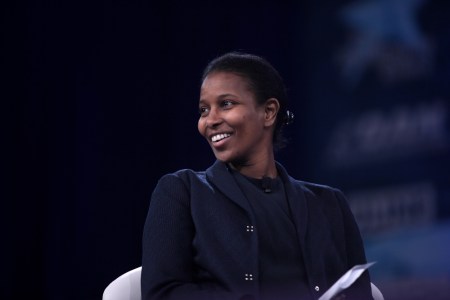
1644Ayaan Hirsi Ali, a brave Muslim dissident and author, had to flee from the Netherlands to the U.S., where she rapidly became one of most prominent public intellectuals. (Image source: Gage Skidmore)

The Moroccan mayor of Rotterdam, Ahmed Aboutaleb, is also guarded by police. He recently told fellow Muslims who protested against freedoms they found while living in the West to “pack your bags and f… off.” A heroic Christian defender of these freedoms in the Netherlands, Geert Wilders, is now on trial accused of “discrimination.” “I am in jail,” he has said, referring to his safehouses, “and they are walking around free.”

Many of these dissidents are women. Shukria Barakzai, an Afghan politician and journalist, declared war on Islamic fundamentalists after the Taliban’s religious police beat her for daring to walk without a male escort. A suicide bomber blew himself up near her car, killing three. Kadra Yusuf, a Somali journalist, infiltrated Oslo’s mosques to denounce the imams, especially regarding female genital mutilation, not even required in the Koran or the Hadith (reports about Mohammad). In Pakistan, Sherry Rehman called for “a reform of Pakistani blasphemy’s laws.” She risks her life every day. She is branded by Islamists “fit to be killed” for being a woman, a Muslim and a secular activist. The Syrian-American author and psychiatrist, Wafa Sultan, was also branded an “infidel” deserving of death.

Le Figaro recently published a long report about Muslim French personalities threatened with “execution”. “Placed under permanent police protection, regarded as traitors by Muslim fundamentalists, they live in a hell. In the eyes of Islamists, their freedom is an act of betrayal of the ummah [community].” They are writers and journalists of Arab-Muslim culture who denounce the Islamist threat and the inherent violence of the Koran. They stand alone against Islamism which uses the physical terrorism of Kalashnikovs, and against the intellectual terrorism which submits them to media intimidation. Seen as “traitors” by their communities, they are accused by the élites in the West of “stigmatizing.”

The French journalist Zineb El Rhazoui has more bodyguards than many ministers in the government of Manuel Valls, and for security, has to change houses in Paris often in recent months. For this young scholar, born in Casablanca and who works at the French weekly, Charlie Hebdo, walking down the street in Paris has become unthinkable. A fatwa put out after January 7, 2015 reads: “Kill Zineb El Rhazoui to avenge the Prophet.”

Threats against another dissident, Nadia Remadna, do not come from Raqqa, Syria, but her own city: Sevran, in Seine-Saint-Denis. They reflect the growing influence of Islamists in the lost territories of the French Republic. What “crime” was she found guilty of? She created the “Brigade of Mothers” to combat the Islamist influence on young Muslims.

A philosophy teacher, Sofiane Zitouni, has also quit his job at a Muslim French school over “insidious Islamism.”

The French-Algerian journalist, essayist and author of several investigations into Islamist circles,Mohamed Sifaoui, is the victim of a double threat. He is a prime target for both fundamentalists and the “tolerant” grand inquisitors. Sentenced to two years in prison by the Algerian regime for “press offenses,” then harassed by Islamists, Sifaoui requested asylum in France in 1999 and has never set foot in Algeria again. Since then, Sifaoui has seen his picture and name next to the words “le mourtad,” the apostate, on Islamist websites, meaning that he is targeted for death. French police protection around him has been total since 2006, when he defended freedom of expression for the French satirical magazine, Charlie Hebdo.

About fifteen witnesses made a deposition in favor of the magazine, Charlie Hebdo. Among them were the late Muslim Tunisian essayist, Abdelwahab Meddeb, who had the courage to challenge the entire French Muslim establishment which tried to stop Charlie Hebdo. Meddeb wanted to show “this is not about anyone against Islam, but enlightened Islam against obscurantist Islam.”

Also in France, Hassen Chalghoumi, the courageous imam of Drancy, preaches while wearing a bullet-proof vest. When he goes out on the street, he is accompanied by five police officers with semiautomatic weapons. This is not outside Baghdad’s Green Zone; this is in the heart of Paris. Chalghoumi backed the ban on burkas; made an unprecedented visit at Jerusalem’s Holocaust memorial; paid tribute to the victims of Charlie Hebdo and favored a dialogue with French Jews.

Naser Khader, a Muslim liberal with Danish citizenship, who called for “a Muslim reformation,” and authored “Honour and Shame,” is threatened by Islamic groups with death.

In Italy, an Egyptian-born writer, Magdi Cristiano Allam, is protected by bodyguards for having criticized political Islam. As the deputy editor of Italy’s leading newspaper, Corriere della Sera, Mr. Allam published a book whose title alone was enough to endanger his life: “Viva Israele.

Ibn Warraq lives protected behind a pseudonym since writing a seminal book, “Why I am Not a Muslim.”

The Palestinian blogger Walid Husayin is also a rarity. Jailed for “satirizing the Koran, he recently published a book in France about his experience in the Palestinian territories, where his “atheism” nearly cost him his life.

In Tunisia there are a handful of filmmakers and intellectuals who fight for freedom of expression, especially after a secular opposition leader, Chokri Belaid, was assassinated. Also Nadia El Fani, the director of “Ni Allah ni maître” [“Neither Allah nor Master”], and Nabil Karoui, the manager of Nessma TV, are threatened with death and are being taken to court to answer charges of “blasphemy.” If Tunisia’s “Arab spring” did not turn into an Islamist winter, as elsewhere, it is largely thanks to these dissidents.

Those heroes know what happened to their predecessors in “the war on Arab intellectuals.” Writers such as Tahar Djaout were killed in 1993 by the Islamists in Algiers, as was the journalist, Farag Foda, famous for his sharp satires on Islamic fundamentalism. Prior to his murder, Foda had been accused of “blasphemy” by the great mosque of al-Azhar. A dozen Bangladeshi bloggers have also been murdered in cold blood by Islamists for the “crime” of “secularism.”

Last year, Egypt’s President Abdel Fattah al- Sisi called for reforming Islam and the way it is taught as did Sunni Islam’s leading cleric, Sheikh Ahmed al Tayeb, head of Cairo’s al-Azhar University, the center of Sunni Islam. And he said it in Mecca, no less. Egypt’s conservatives however did their best to tamp that down – at least for the moment.

There are, however, more and more dissidents successfully speaking out and leading bold, farsighted movements. In the U.S., M. Zuhdi Jasser, author of “A Battle for the Soul of Islam,” and a practising physician, founded the American Islamic Forum for Democracy. Last year, more than two dozen Muslim personalities promoted an appeal “to embrace a pluralistic interpretation of Islam, rejecting all forms of oppression and abuses committed in the name of religion.”

In Canada, Raheel and Sohail Raza founded “Muslims Facing Tomorrow,” and there is the outspoken Associate Professor of Political Science at the University of Western Ontario, Salim Mansur.

In the U.K., Maajid Nawaz heads the influential Quilliam Foundation, and Shiraz Maher, who defected from the Islamist organization, Hizb-ut-Tahrir, now serves as a Senior Fellow at the International Center for the Study of Radicalization at King’s College London.

These are just a few of today’s heroes. Some had to be left out; there were too many to list.

The proud and painful resistance of these “Allah’s rebels” is one of the most beautiful testaments of our times. These “Allah’s rebels” are also the only real hope of reform for the Islamic world — and of preserving freedom for all of us.


Dr. Jasser discusses the Muslim Reform Movement on the Terry Gilberg Show 05.28.2016

May 31, 2016

Dr. Jasser discusses the Muslim Reform Movement on the Terry Gilberg Show 05.28.2016 via YouTube

Massachusetts Islamism

April 4, 2016

Massachusetts Islamism, Gatestone InstituteSamuel Westrop, April 4, 2016

♦ The response of “non-violent” Islamists to counter-extremism programs displays a master class in deception. The greatest mistake made by the Obama administration is to treat groups such as CAIR and the Islamic Society of Boston (ISB) as genuine representatives of the Muslim community.

♦ Very few American Muslims believe that CAIR is a legitimate voice of American Islam. A 2011 Gallup poll revealed that around 88% of American Muslims said CAIR does not represent them.

♦ It is little wonder that groups such as CAIR disparage genuine moderates. They perceive moderates as a threat to their self-styled reputations as representatives of American Islam. Many in them have learned to speak the language of liberalism and democracy in their pursuit of an ultimately illiberal and anti-democratic ideal.

♦ Counter-extremism work is best achieved by marginalizing such groups — by freeing American Muslims from their self-appointed Islamist spokesmen, and by working instead with the genuine moderates.

A number of Massachusetts Muslim groups, led by Cambridge city councilor Nadeem Mazen, are currently spearheading a campaign against the Obama administration’s program, Countering Violent Extremism (CVE), which has designated Boston as one of its pilot cities.

From the government’s perspective, Boston was an obvious choice. The city has a long, unfortunate history of producing internationally-recognized terrorists, including the Tsarnaev brothers, who bombed the Boston marathon; Aafia Siddiqui, whom FBI Director Robert S. Mueller describes as “an al-Qaeda operative and facilitator;” Abdulrahman Alamoudi, the founder of the Islamic Society of Boston, and named by the federal government as an Al Qaeda fundraiser, and Ahmad Abousamra, a key official within Islamic State, whose father is vice-president of the Muslim American Society’s Boston branch.

During the past decade, in fact, twelve congregants, supporters, officials and donors of the Islamic Society of Boston alone have been imprisoned, deported, killed or are on the run in connection with terrorism offenses.

Despite these alumnae, a number of extremist Islamic organizations, such as the Council on American Islamic Relations (CAIR), have claimed that the government’s attempt to combat radicalization “targets American Muslims” and “undermines our national ideals.”

Cambridge city councilor Nadeem Mazen, who is also a director of CAIR’s Massachusetts branch, has spoken at a number of anti-CVE rallies, condemning the government’s approach as “authoritarian” because it included “violent practices like surveillance and racial profiling.”

In response, Robert Trestan, the Massachusetts director of the Anti-Defamation League (ADL), points out that the CVE program “is relatively new in this country. It’s not fair to judge it yet and be overly critical.” He added: “Nothing I’ve seen or participated in has gone anywhere near proposing or suggesting anything close to surveillance, crossing the line of people’s civil rights or profiling.”

What, then, is the basis for this opposition?

Critics of Nadeem Mazen look with concern at his opposition to policing that protects Americans from terrorist attacks. In May, Mazen voted against the Cambridge Police Department budget. He argued that the funding for SWAT teams and the police’s participation in CVE programs only served to “alienate the Muslim community.” The Cambridge SWAT team, however, played a crucial part in the arrest of Boston Marathon bomber Dzhokhar Tsarnaev just hours after he and his brother murdered three spectators and injured hundreds at the Boston marathon.

Mazen has also taken part in protests against Boston police departments. Addressing a crowd of activists from a group named Restore the Fourth, Mazen claimed that police counter-terrorism units are part of a larger conspiracy to suppress free speech: “They are working very hard…in the background….but really, there’s never any need. … Some of the research is looking at free speech activists…like me. … It is that type of government operation, it’s that that is the best and the most evident hallmark of tyranny.”

Are Mazen and CAIR, then, simply free speech campaigners?

CAIR does not exactly have a reputation for liberal activism. It was founded in 1994 by three officials of the Islamic Association of Palestine, which, the 2008 Holy Land Foundation terror financing trial would later determine, was a front for the terrorist group, Hamas. During the same trial, the prosecutors designated CAIR as an “unindicted co-conspirator.” U.S. District Court Judge Jorge Solis concluded that, “The government has produced ample evidence to establish the associations of CAIR… with the Islamic Association for Palestine, and with Hamas.”

One of CAIR’s original Islamic Association of Palestine founders, Nihad Awad, is today CAIR’s Executive Director. Awad peddles conspiracy theories that the U.S Congress is controlled by Israel, and has stated that U.S. foreign policy was propelled by Clinton administration officials of a particular “ethnic background.”

The Anti-Defamation League (ADL) notes that CAIR has long expressed anti-Semitic and pro-terror rhetoric. The ADL adds that, “[CAIR’s] public statements cast Jews and Israelis as corrupt agents who control both foreign and domestic U.S. policy and are responsible for the persecution of Muslims in the U.S.”

1414 (1)In November 2015, CAIR, which in the Holy Land Foundation terror financing trial was determined to be a front for the terrorist group Hamas, organized a “lobbying day” at the Massachusetts State House.

Not all of Massachusetts’s Muslim groups have opposed involvement in the CVE program. In February, the Islamic Society of Boston (ISB), which is partly run by the Muslim American Society, took part in the White House’s summit on Countering Violent Extremism.

The ISB’s Director, Yusufi Vali, however, would later criticize the CVE program on the grounds that by focusing on radicalization rather than violence, the authorities were unfairly targeting Muslim-Americans simply because of their faith.

Instead, Vali has urged, the government should deputize responsibility for combatting extremism to groups such as his. Boston is a pilot city for the CVE program, he claimed, because of the “strong relationship” between law enforcement and institutions such as the ISB. Only the ISB’s version of Islam, Vali proposed, can “appeal to young people” and “win in the marketplace of ideas.”

But the ideology underpinning the Islamic Society of Boston itself is cause for some concern. In 2008, the Muslim American Society (MAS), which runs the ISB’s Cultural Center, of which Vali is also a board member, was labelled by federal prosecutors “as the overt arm of the Muslim Brotherhood in America.”

Religious leaders of the Muslim American Society have included Hafiz Masood, the brother of Pakistani terrorist Hafiz Saeed, who masterminded the 2008 Mumbai Massacre in which 164 people were murdered. While he was living in the Boston area, according to a Times of India report, Masood was raising money and trying to recruit people for his brother’s terrorist group. After being deported by the government for filing a fraudulent visa application, Masood has since become a spokesperson for Jamaat-ud-Dawa, a branch of his brother’s terrorist group, Lashkar-i-Taiba.[1]

The ISB itself was founded by the Al Qaeda operative Abdulrahman Alamoudi, who was jailed in 2004 for participating in a Libyan plot to assassinate Saudi Crown Prince Abdullah. The ISB’s other trustees have included prominent Islamist operatives, including Yusuf Al Qaradawi, the spiritual leader of the global Muslim Brotherhood.

In October, an event hosted by the ISB featured a number of extremist preachers. One of them, Hussain Kamani has cited Quranic verse and commentary to warn Muslims, “do not resemble the Jews” and has advised parents to “beat” their children “if they do not [pray].” In a talk titled ‘Sex, Masturbation and Islam,’ Kamani explains that a Muslim man must only fulfil his sexual desires “with his spouse…[or] with a female slave that belongs to him.” Those who commit adultery or have sex outside of marriage, Kamani further declares, must be “stoned to death.”

If one looks to European experiences with counter-extremism programs, some of which have been in place for over a decade, Yusufi Vali and the ISB have good reasons to lobby against a focus on radicalization. In Britain, under Prime Minister David Cameron, the government has come to the realization that some of the Islamic groups entrusted with counter-extremism initiatives are, in fact, part of the problem.

In a speech delivered in Munich in 2011, Cameron stated:

“As evidence emerges about the backgrounds of those convicted of terrorist offences, it is clear that many of them were initially influenced by what some have called ‘non-violent extremists’, and they then took those radical beliefs to the next level by embracing violence. … Some organisations that seek to present themselves as a gateway to the Muslim community are showered with public money despite doing little to combat extremism. As others have observed, this is like turning to a right-wing fascist party to fight a violent white supremacist movement.”

Groups similar to the ISB and CAIR, the Conservative government reasons, represent the “non-violent extremists.” These are likely the first stop on the “conveyor belt” path to radicalization: a young is Muslim exposed to anti-Semitism, excuses for terrorism and claims of victimhood and gradually becomes open to committing violent acts.

This insight was not without foundation. The previous Labour government, under both Tony Blair and Gordon Brown, partnered with British Muslim groups such as the Muslim Council of Britain (MCB), Britain’s most prominent Muslim group — similar in ideology to CAIR and the ISB — to counteract extremist ideas in the Muslim community. In 2008, however, the Labour government severed all relations with the Muslim Council of Britain after it emerged that the group’s deputy secretary general, Daud Abdullah, had signed a declaration supporting attacks against Jewish communities and the British armed forces.

By seeking the partnership of groups such as the ISB, the Obama administration risks making the same mistakes of Britain’s last Labour government. And, in time, the U.S. government will arrive at the same realization as the British government — that non-violent extremists do not offer an alternative to violent extremism; in fact, they make the problem worse.

But all this invites the question: why do some Islamist groups oppose CVE programs while others join in? Although the ISB backed out of the Boston CVE initiative, the Islamic Council of New England (ICNE) remains a key partner. As with CAIR and the ISB, the ICNE is part of the “soft Islamist” network — groups that emerged from Muslim Brotherhood ideology and which have learned to speak the language of liberalism and democracy in their pursuit of an ultimately illiberal and anti-democratic ideal.

In 2002, the ICNE hosted a conference with the Muslim Brotherhood academic, Tariq Ramadan, and the British Salafist, Abdur Raheem Green, a former jihadist who warns Muslims of a Jewish “stench,” encourages the death penalty as a “suitable and effective” punishment for homosexuality and adultery, and has ruled that wife-beating “is allowed.”

The ICNE has announced its continued involvement in CVE programs because “rather than obsessing about the insidious erosion of our ‘civil rights’, Muslims should focus on the more immediate risk of being blind-sided by the overwhelming tsunami of Islamophobia.”

While CAIR protests against CVE, the ICNE believes it can work with counter-extremism programs to its advantage. The ISB lies somewhere in the middle. And yet all these Islamist groups are key partners, mostly founded and managed by the same network of Islamist operatives.

Has the CVE program really caused such discord?

Again, the European experience offers some answers. Daud Abdullah, the former deputy secretary general of the Muslim Council of Britain, had his group work closely with the British government’s counter-extremism program, before later hosting an event with his other group, Middle East Monitor, which denounced the scheme as a “Cold War on British Muslims.” Similarly, the Cordoba Foundation, a prominent Muslim Brotherhood think tank, procured counter-extremism grants in 2008 only to run events condemning counter-extremism programs in 2009.

Non-violent extremists learn both to exploit and criticize counter-extremism initiatives to their benefit. By working in tandem, some Islamist voices accept government funds that legitimize them as leaders of the Muslim community and portray them as responsible Muslims concerned with extremism; while other Islamist groups oppose counter-extremism efforts in an effort to style themselves as civil rights champions and gain the support of libertarians on both the Left and Right.

The response of “non-violent” Islamists to counter-extremism programs displays a master class in deception. The greatest mistake, if it is one, made by the Obama administration is to treat groups such as CAIR and ISB as genuine representatives of the Muslim community. Very few American Muslims, it seems, actually believe that CAIR is a legitimate voice of American Islam. According to a 2011 Gallup poll, around 88% of American Muslims said CAIR does not represent them.

As for the ISB, it operates under the aegis of the Muslim American Society, which claims to be a national group for American Muslims. A 2011 report produced by CAIR itself, however, demonstrates that a mere 3% of American mosques are affiliated with the Muslim American Society. 62% of mosques claimed that they were not affiliated with any organization.

It is little wonder that groups such as CAIR disparage genuine moderates. They perceive moderates as a threat to their self-styled reputations as representatives of American Islam. CAIR Massachusetts Director Nadeem Mazen has denounced counter-Islamist Muslim groups that “foist secular attitudes on Muslims” and promote ideas that “are being projected, imperialist-style on to our population.”

American Islam is diverse. No group can claim to represent either Massachusetts Muslims or American Muslims. Islamist bodies have imposed their leadership on American Muslims. As inherently political movements, they were best organized to style themselves as community leaders. When politicians in D.C ask to speak to the “Muslim community,” groups such as CAIR and the ISB step forward.

Counter-extremism work is best achieved, in fact, by the government marginalizing such groups — by freeing American Muslims from their self-appointed Islamist spokesmen, by working instead with the genuine moderates among American Muslims, and by recognizing the link between non-violent and violent extremism. European governments have finally understood this reality, but far too late. For the sake of moderate Muslims everywhere, let us hope American politicians are quicker on the uptake.

