Posted tagged ‘Islamic terrorism’

The terrorist diaspora: After the fall of the caliphate

July 14, 2017

The terrorist diaspora: After the fall of the caliphate, Long War Journal, July 13, 2017

The cult of martyrdom has grown. A disturbingly large number of people are willing to kill themselves for the Islamic State’s cause. The number of suicide bombings claimed by the so-called caliphate dwarfs all other jihadist groups, including al Qaeda. In 2016, for instance, the Islamic State claimed 1,112 “martyrdom operations” in Iraq and Syria alone. Through the first six months of 2017, the organization claimed another 527 such bombings (nearly three-fourths of them using vehicle-borne improvised explosive devices, or VBIEDs) in those two countries. These figures do not include suicide attacks in other nations where Abu Bakr al Baghdadi’s loyalists are known to operate.

To put the Islamic State’s current “martyrdom operations” in perspective, consider data published by the Washington Post in 2008. According to the Post, there were just 54 suicide attacks in all of 2001, when al Qaeda’s “martyrs” launched the most devastating terrorist airline hijackings in history. The Islamic State currently eclipses that figure every month in Iraq and Syria, averaging 93 suicide bombings per month in 2016 and 88 per month so far in 2017. Many of these operations are carried out by foreign fighters.

[I]t is reasonable to conclude that the number of people willing to die for the sake of the so-called caliphate is disturbingly high – much higher than the number of willing martyrs in 2001 or even much more recently. Even though most of these people have been deployed in war zones, it is possible that more will be used outside of Iraq and Syria if they survive the fight and are able to travel to other countries. The Islamic State has already had some success in instigating would-be recruits to die for its cause in the West after they failed to emigrate to the lands of the caliphate. It is certainly possible that more will be sent into Europe or the U.S. in the future.

***********************************

[Editor’s Note: Below is Thomas Joscelyn’s testimony before the House Homeland Security Committee’s Task Force on Denying Terrorists Entry into the United States. The hearing is titled, “The Terrorist Diaspora: After the Fall of the Caliphate.” A version with footnotes will also be posted.]

Chairman Gallagher, Ranking Member Watson Coleman, and other distinguished Committee Members, thank you for inviting me to testify today concerning foreign fighters and the threat some of them pose to the U.S. and Europe.

The fall of Mosul and the likely fall of Raqqa won’t be the end of the Islamic State. The group has already reverted to its insurgent roots in some of the areas that have been lost. It also still controls some territory. The Islamic State will continue to function as a guerrilla army, despite suffering significant losses. In May, the Office of the Director of National Intelligence (ODNI) assessed that even though it was losing significant ground, the Islamic State “will likely have enough resources and fighters to sustain insurgency operations and plan terrorists [sic] attacks in the region and internationally” going forward. Unfortunately, I think ODNI’s assessment is accurate for a number of reasons, some of which I outline below. I also discuss some hypothetical scenarios, especially with respect to returning foreign fighters or other supporters already living in Europe or the U.S.

Recent history. The Islamic State’s predecessor quickly recovered from its losses during the American-led “surge,” capitalizing on the war in Syria and a politically poisonous environment in Iraq to rebound. Indeed, Abu Bakr al Baghdadi’s organization grew into an international phenomenon by the end of 2014, just three years after the U.S. withdrawal from Iraq was completed. Baghdadi’s men did this while defying al Qaeda’s leaders and competing with rival jihadist groups. This recent history should give us pause any time we hear rhetoric that sounds too optimistic about the end of the Islamic State’s caliphate. The enterprise has had enough resources at its disposal to challenge multiple actors for more than three years. There is no question that the Islamic State’s finances, senior personnel, and other assets have been hit hard. But it is premature to say its losses amount to a deathblow.

Uncertainty regarding size of total membership. While it is no longer at the peak of its power, the Islamic State likely still has thousands of dedicated members. We don’t even really know how many members it has Iraq and Syria, let alone around the globe. Previous U.S. estimates almost certainly undercounted the group’s ranks. In September 2014, at the beginning of the US-led air campaign, the CIA reportedly estimated that the Islamic State could “muster” between 20,000 and 31,500 fighters. This figure was “more than three times the previous estimates,” CNN noted. By December 2016, the U.S. military was estimating that 50,000 Islamic State fighters had been killed. By February 2017, U.S. Special Operations command concluded that more than 60,000 jihadists had perished. Two months later, in April 2017, the Pentagon reportedly estimated that 70,000 Islamic State fighters had been killed.

Taken at face value, these figures (beginning with the September 2014 approximation) would suggest that Abu Bakr al Baghdadi’s enterprise was able to replace its entire force structure more than two times over, while fighting multiple enemies on numerous fronts. This is, of course, highly unlikely. Even with its prolific recruiting campaign, it would be impossible for any cohesive fighting organization, let alone one under the sustained pressure faced by the Islamic State, to train, equip and deploy fighters this quickly. It is far more likely that the U.S. never had a good handle on how many jihadists are in its ranks and the casualty figures are guesstimates. The purpose of citing these figures is not to re-litigate the past, but instead to sound a cautionary alarm regarding the near-future: We likely do not even know how many members the Islamic State has in Iraq and Syria today.

The Islamic State is an international organization. Since November 2014, when Abu Bakr al Baghdadi first announced the establishment of “provinces” around the globe, the Islamic State’s membership grew outside of Iraq and Syria. This further complicates any effort to estimate its overall size. Some of these “provinces” were nothing more than small terror networks, while others evolved into capable insurgency organizations in their own right. The Libyan branch of the caliphate temporarily controlled the city of Sirte. Although the jihadists were ejected from their Mediterranean abode by the end of 2016, they still have some forces inside the country. Similarly, Wilayah Khorasan (or Khorasan province), which represents the “caliphate” in Afghanistan and Pakistan, seized upwards of ten districts in Afghanistan as of early 2016, but has since lost ground. More recently, jihadists in the Philippines seized much of Marawi, hoisting the Islamic State’s black banner over the city. Wilayah Sinai controls at least some turf, and is able launch spectacular attacks on security forces. It was responsible for downing a Russian airliner in October 2015. Other “provinces” exist in East Africa, West Africa, Yemen and elsewhere.

In May, the Office of the Director of National Intelligence (ODNI) reported that the so-called caliphate “is seeking to foster interconnectedness among its global branches and networks, align their efforts to ISIS’s strategy, and withstand counter-ISIS efforts.” Gen. John Nicholson, the commander of U.S. Forces-Afghanistan, has said that Wilayah Khorasan went through an “application process” and the Islamic State mothership provided it with “advice,” “publicity,” and “some financial support.” Although it is impossible to judge the extent of the Islamic State’s cohesion, as much of the data is not available, there is at least some connectivity between the group’s leadership and its “provinces” elsewhere. This is best seen on the media side, as the organization is particularly adept at disseminating messages from around the globe in multiple languages, despite some recent hiccups in this regard.

While their fortunes may rise or fall at any given time, this global network of Islamic State “provinces” will remain a formidable problem for the foreseeable future. Not only are they capable of killing large numbers of people in the countries they operate in, this structure also makes tracking international terrorist travel more difficult. For instance, counterterrorism officials have tied plots in Europe to operatives in Libya. This indicates that some of the Islamic State’s “external plotters,” who are responsible for targeting the West, are not stationed in Iraq and Syria. The U.S.-led air campaign has disrupted the Islamic State’s “external operations” capacity by killing a number of jihadists in this wing of the organization. But others live.

The cult of martyrdom has grown. A disturbingly large number of people are willing to kill themselves for the Islamic State’s cause. The number of suicide bombings claimed by the so-called caliphate dwarfs all other jihadist groups, including al Qaeda. In 2016, for instance, the Islamic State claimed 1,112 “martyrdom operations” in Iraq and Syria alone. Through the first six months of 2017, the organization claimed another 527 such bombings (nearly three-fourths of them using vehicle-borne improvised explosive devices, or VBIEDs) in those two countries. These figures do not include suicide attacks in other nations where Abu Bakr al Baghdadi’s loyalists are known to operate.

To put the Islamic State’s current “martyrdom operations” in perspective, consider data published by the Washington Post in 2008. According to the Post, there were just 54 suicide attacks in all of 2001, when al Qaeda’s “martyrs” launched the most devastating terrorist airline hijackings in history. The Islamic State currently eclipses that figure every month in Iraq and Syria, averaging 93 suicide bombings per month in 2016 and 88 per month so far in 2017. Many of these operations are carried out by foreign fighters.

These suicide bombers have been mainly used to defend Islamic State positions, including the city of Mosul, which was one of the self-declared caliphate’s two capitals. For instance, half of the “martyrdom operations” carried out in Iraq and Syria this year (265 of the 527 claimed) took place in the Nineveh province, which is home to Mosul. The “martyrs” were dispatched with increasing frequency after the campaign to retake the city began in October 2016, with 501 claimed suicide bombings in and around Mosul between then and the end of June 2017.

Some caveats are in order. It is impossible to verify the Islamic State’s figures with any precision. The fog of war makes all reporting spotty and not every suicide bombing attempt is recorded in published accounts. Some of the claimed “martyrdom operations” likely failed to hit their targets, but were counted by the Islamic State as attacks anyway. The U.S.-led coalition and Iraqi forces have routinely taken out VBIEDs before drivers could reach their mark. Not all “martyrs” are truly willing recruits. For instance, the Islamic State’s figures include numerous children who were pressed into service by Baghdadi’s goons.

Still, even taking into account these caveats, it is reasonable to conclude that the number of people willing to die for the sake of the so-called caliphate is disturbingly high – much higher than the number of willing martyrs in 2001 or even much more recently. Even though most of these people have been deployed in war zones, it is possible that more will be used outside of Iraq and Syria if they survive the fight and are able to travel to other countries. The Islamic State has already had some success in instigating would-be recruits to die for its cause in the West after they failed to emigrate to the lands of the caliphate. It is certainly possible that more will be sent into Europe or the U.S. in the future.

Children used in suicide attacks, executions and other operations. The Islamic State has a robust program, named “Cubs of the Caliphate,” for indoctrinating children. It is one of the most disturbing aspects of the organization’s operations. Not only does the Islamic State’s propaganda frequently feature children attending classes, its videos have proudly displayed the jihadists’ use of children as executioners.

Earlier this month, for instance, the group’s Wilayah Jazirah disseminated a video entitled, “They Left Their Beds Empty.” Four children are shown beheading Islamic State captives. The same production is laced with footage of the terrorists responsible for the November 2015 Paris attacks, as well as other plots in Europe. Indeed, the children are made to reenact some of the same execution scenes that the Paris attackers carried out before being deployed. The Islamic State’s message is clear: A new generation of jihadists is being raised to replace those who have fallen, including those who have already struck inside Europe.

The “Cubs of the Caliphate” program is not confined to Iraq and Syria, but also operates in Afghanistan and elsewhere. This means that numerous children who have been indoctrinated in the Islamic State’s ways will pose a disturbing challenge for authorities going forward. As I noted above, some have already been used in “martyrdom operations” in Iraq and Syria. It is possible that others could be used in a similar fashion outside of the group’s battlefields, in Europe or the U.S. One purpose behind making children or adults commit heinous acts is to shock their conscience into thinking there is no way back, that they have crossed a threshold and there is no return. There are no easy answers for how to best deal with this problem.

Diversity of terrorist plots. There are legitimate concerns about the possibility of well-trained fighters leaving Iraq and Syria for the West now that the Islamic State is losing its grip on some of its most important locales. We saw the damage that a team of Islamic State operatives can do in November 2015, when multiple locations in Paris were assaulted. Trained operatives have had a hand in other plots as well. This concern was succinctly expressed by EUROPOL in a recent report. “The number of returnees is expected to rise, if IS [Islamic State], as seems likely, is defeated militarily or collapses. An increasing number of returnees will likely strengthen domestic jihadist movements and consequently magnify the threat they pose to the EU.” While a true military defeat will be elusive, the central point stated here has merit, even though the number of arrests of returnees across Europe has recently declined. According to EUROPOL, “[a]rrests for travelling to conflict zones for terrorist purposes…decreased: from 141 in 2015 to 77 in 2016.” And there was a similar “decrease in numbers of arrests of people returning from the conflict zones in Syria and Iraq: from 41 in 2015 to 22 in 2016.”

However, the overall number of arrests “related to jihadist terrorism” rose from 687 in 2015 to 718 in 2015, meaning that most of these terror-related arrests do not involve returnees.

Still, returnees and the logistical support networks that facilitate travel to Iraq and Syria were prominently represented in court cases tried by EUROPOL member states. “As evidenced in the past couple of years, the majority of the verdicts for jihadist terrorism concerned offences related to the conflict in Syria and Iraq,” EUROPOL reported in its statistical review for 2016. “They involved persons who had prepared to leave for or have returned from the conflict zone, as well as persons who have recruited, indoctrinated, financed or facilitated others to travel to Syria and/or Iraq to join the terrorist groups fighting there.” In addition, “[i]ndividuals and cells preparing attacks in Europe and beyond were also brought before courts.”

These data show that while the threat posed by returnees is real, it is just one part of the overall threat picture. The Islamic State has encouraged supporters in the West to lash out in their home countries instead of traveling abroad, directed plots via “remote-control” guides, and otherwise inspired individuals to act on their own. These tactics often don’t require professional terrorists to be dispatched from abroad. The Islamic State has also lowered the bar for what is considered a successful attack, amplifying concepts first espoused by others, especially al Qaeda. A crude knife or machete attack that kills few people is trumpeted as the work of an Islamic State “soldier” or “fighter.” On Bastille Day in Nice, France last year, an Islamic State supporter killed more than 80 people simply by running them over with a lorry. Other Islamic State supporters have utilized this simple technique, repeatedly advocated by Abu Bakr al Baghdadi’s propagandists, as well.

However, I would urge caution. While the amateurs or individual actors have become more lethal over time, the risk of professionally-trained jihadists carrying out a mass casualty attack remains distinct. On average, the professionals can still do more damage than their amateur counterparts – if they are not stopped beforehand. The threat to aviation demonstrates the point. In October 2015, the Islamic State’s Wilayah Sinai downed a Russian airliner, killing all 224 people on board. Although the jihadists claim to have used a crude improvised explosive device, the plot required that well-placed personnel implant it at an optimal location within the aircraft. U.S. officials are attempting to stop even more sophisticated devices, built by either the Islamic State or al Qaeda, from being placed on board flights bound for Europe or America. Other professionally-planned attacks could involve bombing commuter trains, Mumbai-style sieges, or multi-pronged assaults. Therefore, if the professionals are able to evade security measures, they could easily kill more people than the average amateur.

Counterterrorism services in Europe and the U.S. have stopped a number of professional plots through the years. Some of those foiled in the past year may have been more serious than realized at the time. However, there is a risk that as counterterrorism authorities deal with a large number of individual or amateur plots, the professional terrorists will be able to find another window of opportunity. The various threats posed by the Islamic State have placed great strains on our defenses.

The Islamic State could seek to exploit refugee flows once again. “The influx of refugees and migrants to Europe from existing and new conflict zones is expected to continue,” EUROPOL reported in its review of 2016. The Islamic State “has already exploited the flow of refugees and migrants to send individuals to Europe to commit acts of terrorism, which became evident in the 2015 Paris attacks.” The so-called caliphate and “possibly other jihadist terrorist organizations may continue to do so.” While the overwhelming majority of migrants are seeking to better their lives, some will continue to pose a terrorist threat. European nations are dealing with this, in part, by deploying more “investigators” to “migration hotspots in Greece and soon also to Italy.” These “guest officers” will rotate “at key points on the external borders of the EU to strengthen security checks on the inward flows of migrants, in order to identify suspected terrorists and criminals, establishing a second line of defense.”

This makes it imperative that U.S. authorities share intelligence with their European counterparts and receive information in return to better track potential threats. The U.S. has led efforts to disrupt the Islamic State’s “external attack” arm and probably has the best intelligence available on its activities. But European nations have vital intelligence as well, and only by combining data can officials get a better sense of the overall picture. Recent setbacks with respect to this intelligence sharing, after details of British investigations were leaked in the American press, are troubling. But we can hope that these relationships have been repaired, or will be soon.

It should be noted that would-be jihadists who are already citizens of European countries could have an easier route into the U.S. than migrants fleeing the battlefields. It is much easier for a British citizen to get on a plane headed for the U.S. than for an Islamic State operative posing as a Syrian refugee to enter the U.S. clandestinely through Europe. Given recent events in the UK, and the overall scale of the jihadist threat inside Britain, this makes intelligence sharing on potential terrorists all the more crucial. British officials have said that they are investigating 500 possible plots involving 3,000 people on the “top list” of suspects at any given time. In addition, 20,000 people have been on the counterterrorism radar for one reason or another and are still considered potentially problematic.

Exporting terror know-how. It is possible that more of the Islamic State’s terrorist inventions will be exported from abroad into Europe or the U.S. As the self-declared caliphate sought to defend its lands, it devised all sorts of new means for waging war. It modified drones with small explosives and built its own small arms, rockets, bombs and the like. Al Qaeda first started to publish ideas for backpack bombs and other IEDs in its online manuals. The Islamic State has done this as well, but we shouldn’t be surprised if some of its other inventions migrate out of the war zones. The group could do this by publishing technical details in its propaganda, or in-person, with experienced operatives carrying this knowledge with them.
A Month of Islam and Multiculturalism in Germany: June 2017

July 11, 2017

A Month of Islam and Multiculturalism in Germany: June 2017, Gatestone InstituteSoeren Kern, July 11, 2017

A 10-year-old girl from a former republic of the Soviet Union was raped by an asylum seeker from Ghana, but police and the local government allegedly suppressed information about the crime for more than two weeks.

A student sexually assaulted an 11-year-old girl and punched another boy in the face, breaking his glasses. At least six other students have been beaten bloody. The school’s leadership has refused to discipline the child, apparently because of his migrant background, and instead has lashed out at the parents for demanding a safe environment for their children.

Police in Lübeck suspect that refugees are taking over illegal drug trade in the city.

June 1. A Syrian migrant was stabbed to death in Oldenburg by another Syrian because he was eating ice cream during Ramadan. The murder, which occurred in broad daylight in a busy pedestrian shopping area, was just the latest example of Islamic law, Sharia, being enforced on German streets.

June 2. Around one million non-Europeans living in Germany are now on welfare, an increase of 124% in just one year, according to new statistics from the Federal Employment Agency (Bundesagentur für Arbeit). The top welfare beneficiaries are from: Syria (509,696); Turkey (276,399); Iraq (110,529) and Afghanistan (65,443).

June 2. Police temporarily halted the annual Rock am Ring music festival in Nürburg because of a possible jihadist threat. Authorities asked the 90,000 visitors to leave the concert grounds in a “controlled and calm” manner. The move was based on “concrete leads which do not allow us to eliminate a possible terror threat,” the police said.

June 3. Bavarian Interior Minister Joachim Herrmann called on Germany’s BfV domestic intelligence agency to begin surveilling minors suspected of being involved with Islamist groups:

“I would strongly urge for the age limit for surveillance to be lowered throughout Germany. Minors have already committed serious acts of violence. Normally, the domestic intelligence agency in Bavaria would not place children under surveillance. But if there is concrete evidence that a 12-year-old is with an Islamist group, we have to be able to monitor them, too.”

June 4. Mostafa J., a 41-year-old asylum seeker from Afghanistan, stabbed to death a five-year-old Russian at a refugee shelter in Arnschwang. The Afghan, who had been arguing with the boy’s 47-year-old mother, was shot to death by police after a standoff. It later emerged that the man had a criminal history in Germany and should have been deported but was not. In October 2009, for example, a court in Munich sentenced Mostafa J. to six years in prison for arson. In July 2011, he received a deportation order, but in 2014 he fooled a judge into believing that he had converted to Christianity and would be killed if he were deported to Afghanistan.

June 5. A study conducted by the Hanns Seidel Foundation, a think tank affiliated with Bavaria’s Christian Social Union, found that half the asylum seekers in Bavaria subscribe to classic anti-Semitic views about Jewish power. Around 60% of Afghans, 53% of Iraqis and 52% of Syrians said Jews wield too much influence.

June 7. A 27-year-old migrant from Syria stabbed and killed a Red Cross mental health counselor in Saarbrücken. The attacker and the psychologist allegedly got into an argument during a therapy session at a counselling center for traumatized refugees.

June 9. A court in Cottbus sentenced a 32-year-old Chechen migrant named Rashid D. to 13 years in prison for slitting his wife’s throat and throwing her out of the second-floor window of their apartment. The couple’s five children now live in Chechnya with their grandparents. The man was charged with manslaughter rather than murder because, according to the court, the “honor killing” was done in the heat of passion: the man thought that his wife had been unfaithful.

June 12. A 44-year-old migrant from Syria named Sultan K. was arrested at his home in Bullenhausen on charges of being a member of the Jabhat al-Nusra terrorist group. Police said that the man’s three brothers, Ahmed K. (51), Mustafa K. (41) and Abdullah K. (39), were also suspected of being members of al-Nusra. The arrest confirmed fears that jihadists posing as refugees have gained access to Germany.

June 12. Bavarian Interior Minister Joachim Herrmann called on three German states — Berlin, Bremen and North Rhine-Westphalia — to introduce random police spot checks. Local laws against “racial profiling” prohibit police in the three states from stopping and identifying individuals. Hermann called it a “blatant security gap that urgently needs to be closed.” He also said he wanted to see random checks extended in border areas, around airports, railway stations and rest-stops, as well as on highways that lead in and out of the country. At the moment, such checks are only allowed within 30 kilometers (20 miles) of German borders. Parliamentary spokesman Stephan Mayer said:

“The demand of Bavarian Interior Minister Joachim Herrmann to finally introduce so-called spot-checks in the states of Berlin, Bremen and North Rhine-Westphalia is completely and utterly justified. Given the basically open borders in Europe, random checks are a necessary instrument for preventing terrorists, criminals and illegal immigrants from entering the country.”

June 13. The newspaper, Bildposted on its website a film — “Chosen and Excluded: Jew Hatred in Europe” — that was censored by the Franco-German television outlet ARTE because it showed Islamic-animated anti-Semitism and Jew-hatred in all walks of European life. Julian Reichelt, Bild‘s online editor-in-chief, said:

“The TV documentary proves the rampant, in part socially acceptable Jew-hatred, for which there are only two words: disgusting and shameful. It is suspected that the documentary is not being shown on television because it is politically unsuitable and because the film shows an anti-Semitic worldview in wide parts of society that is disturbing. Our historical responsibility requires us to decisively counter the unspeakable truth that this film establishes.”

June 14. A 33-year-old migrant from Syria stabbed and seriously injured his ex-wife at a supermarket in Cologne. He also stabbed his 13-year-old son after the boy intervened to protect his mother.

June 15. A 21-year-old migrant from Nigeria went on a rampage after the manager of a public swimming pool in Rosenheim repeatedly told him that hygiene regulations prohibited him from swimming in his underwear. After police arrived, the Nigerian attacked an officer. He was arrested for refusing to obey a police officer.

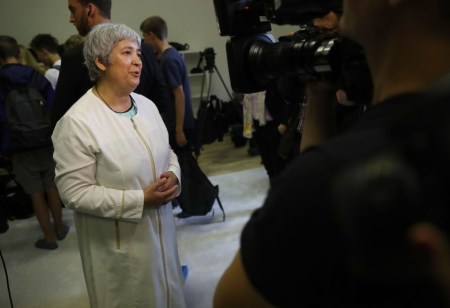
June 16. Germany’s first “liberal mosque” opened in Berlin. The Ibn Rushd-Goethe Mosque, which holds its services inside the St. Johannis Church in the Moabit district, was founded by Seyran Ates, a women’s rights activist who has been hailed by some as the “champion of modern Islam.” The mosque allows men and women to pray together and the Koran to be interpreted “historically and critically.” The mosque, which is open to everyone, including Alawite and Sufi Muslims, as well as homosexuals, has caused outrage in the Muslim world. Al-Azhar University in Cairo, Egypt, generally considered the leading authority on Sunni Islam, issued a fatwa warning against “religious innovation that is not approved by Islamic Sharia.” Turkey’s religious affairs agency, Diyanet, said that the mosque’s practices “do not align with Islam’s fundamental resources, principles of worship, methodology or experience of more than 14 centuries, and are experiments aimed at nothing more than depraving and ruining religion.” Ates, the mosque’s female imam, is now under 24-hour police protection.

Seyran Ates, a women’s rights activist who has been hailed by some as the “champion of modern Islam,” recently opened Germany’s first “liberal mosque” in Berlin, and serves as its imam. Due to the outrage this caused in the Muslim world, Ates is now under 24-hour police protection. (Photo by Sean Gallup/Getty Images)

June 17. In Cologne, a peace march organized by German Muslim groups to condemn terrorism and violence in the name of Islam had an extremely low turnout. Organizers had expected at least 10,000 participants, but actual turnout was estimated at between several hundred to about 3,500. Germany’s largest Islamic association, the Turkish-Islamic Union (DITIB) refused to take part in the march because it would “send the wrong signal to suggest that Muslims were mainly responsible for international terrorism.”

June 18. The parents of student at the Kronwerk Gymnasium, a school in Rendsburg, have been ordered to appear in court because they refused to allow their child to visit a nearby mosque as part of a geography class. The parents, who are not religious, said they did not want their child to be exposed to “religious indoctrination.” No one could be compelled to enter a sacred building against his or her own free will, they argued. The school insisted that the visit to the mosque was compulsory: “The school is designed to promote the openness of young people to cultural and religious diversity, the desire for international understanding and peace.” Each parent was fined €150 ($175), which they refused to pay. They are now being sued. The mosque in question belongs to the Milli-Görüs movement (IGMG), one of Europe’s largest Islamist organizations. According to Germany’s BfV domestic intelligence agency, the movement is extremist and virulently anti-Semitic.

June 18. Local authorities in Hereford reportedly covered up information about the rape of a ten-year-old girl at a refugee shelter in the city. The girl, who is from a former republic of the Soviet Union, was raped by an asylum seeker from Ghana, but police and the local government allegedly suppressed information about the crime for more than two weeks.

June 18. Muslims in Freiburg launched an online petition demanding that the city prohibit male supervisors from working at a female-only swimming pool in the city. The petition says that Muslim women who want a “break from everyday gazes” are unable to use the pool. The petition adds that the “presence and supervision of male staff is deeply reactionary and sexist” and calls for the “creation of a dialogue to promote mutual understanding and acceptance.” Facility managers at the Lorettobad said that it hired male supervisors because of a shortage of female personnel. The pool has been rocked by disputes between Muslims and managers who have been trying to enforce hygiene regulations at the facility: Muslim women have been angered after being told that they are not allowed to wear jeans and other street clothing while swimming, and also that they cannot consume food while in the pool. Some Muslim women have also been told that they have “too little control over their offspring” and that their children are “too wild” and are disturbing other guests. Muslims have reacted with such aggression that police repeatedly have been called to restore order at the pool.

June 19. Jakob Augstein, a German newspaper editor well known for his anti-Israel tirades, wrote an essay for Der Spiegel in which he expressed glee that so few Muslims attended an anti-terrorism rally in Cologne. He said that those Muslims who did attend were “Uncle Toms” and excessively subservient to their German “overseers.” He wrote:

“Terror is not a question of civil society, but one of politics. What is more important, however, is that the demonstration call was addressed to the Muslims in Germany. This is an impertinence. What does the average German Muslim have to do with terrorism? Nothing.

“Just because terrorists justify their crimes with Islam, there is still no special obligation for people of the Muslim faith to distance themselves from these crimes. On the contrary, the terrorists would be given an honor that is not theirs: they are taken seriously as representatives of Islam. But they are not…. Terrorism is a political and social phenomenon, not a religious one. There are more than 1.5 billion Muslims in the world. Should all of them demonstrate? If I were a Muslim, I would refuse such requests.”

June 20. Police in 14 German states raided the homes of three dozen people accused of posting hateful comments on social media. Most of the raids were said to have involved “right-wing incitement” while two of the raids involved “left-wing agitators.” The head of the Federal Criminal Police (BKA) Holger Münch said: “Our free society must not allow a climate of fear, threats or criminal violence to be found either on the street or on the internet.” Critics say the crackdown is part of an effort to suppress criticism of Chancellor Angela Merkel’s open door migration policy ahead of federal elections set for September 24, 2017.

June 20. In an essay published by Süddeutsche Zeitung, Benjamin Idriz, an imam in Bavaria, called on the German government to provide language training for imams so that they can become the “driving force behind integration and dialogue” in Germany:

“The demand for imams from around 2,700 municipalities in Germany is usually supplied by imams from abroad. Many of them are thus directly connected with foreign religious authorities and under foreign influence. Imams from abroad also hardly have sufficient language and cultural competence. They are therefore not conducive to the integration of the Muslims, nor do they meet the needs of the Muslim communities, especially among the younger generation. The demand for imams is enormous, and too much time has already been lost. We must begin before we lose the next generation.”

June 21. The parents of more than 20 fifth-graders at the Herder-Gymnasium, a school in Charlottenburg district of Berlin, initiated a boycott of the school over accusations that the school was not dealing with discipline and violence in class. The problem revolves around one male student who has been bullying his classmates since he arrived at the school last fall. The student has sexually assaulted an 11-year-old girl and punched another boy in the face, breaking his glasses. At least six other students have been beaten bloody. “Our concern is that our children be protected,” a father said. The school’s leadership has refused to discipline the child, apparently because of his migrant background, and instead has lashed out at the parents for demanding a safe environment for their children: “We deeply regret the fact that because of a single populist exception among the parents such serious damage has been done to the reputation of our school.”

June 22. Aydan Özoğuz, Germany’s commissioner for immigration, refugees and integration, admitted that “there has been a shift in perceptions” and that only a quarter to a third of the so-called refugees in Germany will enter the labor market over the next five years, and “for many others we will need up to ten.” In an interview with the Financial Times, she said that many of the first Syrian refugees to arrive in Germany were doctors and engineers, but they were succeeded by “many, many more who lacked skills.” The Times, citing statistics from the Federal Employment Agency, revealed that only 6,500 refugees of the more than two million who have been allowed into Germany during the past two years are enrolled in work training programs. “We don’t take in refugees according to their skills set,” Özoğuz said. “The only criteria should be to help people fleeing war and political persecution.”

June 22. Police in Lübeck suspect that refugees are taking over illegal drug trade in Schleswig-Holstein, the northernmost state in Germany. Since May there have been more than a dozen mass brawls involving Afghans, Iraqis, Syrians and North Africans armed with knives and batons. Some of those involved are known drug traffickers. “The middle level of drug trafficking is targeting migrants in the refugee shelters, promoting them as street vendors or couriers,” said Christian Braunwarth, spokesman for the Lübeck public prosecutor’s office. “Unfortunately, the economically weaker parts of society are vulnerable to such offers.”

June 23. A 37-year-old migrant from Syria sexually assaulted a ten-year-old girl in Tübingen. The girl was riding her bicycle when the man ambushed her from behind. Passersby who heard the girl scream rushed to her aid. Police said the man was a “prior offender” and was known to them. A “southern-looking” (südländisches Erscheinungsbildsexually assaulted a 23-year-old woman in broad daylight in Voerde. A 17-year-old German-Turk raped a 17-year-old woman in Stuttgart.

June 24. An 18-year-old Syrian asylum seeker shouting Allahu Akbar injured four people with a metal chain at the central bus station in Lünen. The initial police report described the perpetrator only as “an 18-year-old” and failed to mention that he had dedicated his attack to Allah. Dortmund police provided more details only after being pressed by a local newspaper.

June 25. A police officer in Duisburg asked a man to move his car, which was illegally parked. The man refused and began shouting at the officer. Within minutes, more than 250 people appeared at the scene and began harassing the police officer, who called for backup. More than 50 policemen and 18 police vehicles were required to resolve what began as a routine traffic procedure.

June 25. Four Iraqi men sexually assaulted three girls, aged 13, 15 and 16, at a public swimming pool in Kassel. A 35-year-old migrant from Romania sexually assaulted two girls, aged 12 and 13, at a public swimming pool in Stuttgart. The man was questioned and released.

June 26. The Berlin Labor Court ordered the city-state of Berlin to pay €6,900 ($7,900) — the equivalent of two months’ pay — to a Muslim teacher whose job application at a grammar school was rejected because she wears a headscarf. Berlin’s Neutrality Law (Neutralitätsgesetz) prohibits teachers from wearing conspicuous religious symbols at state schools, but the Federal Constitutional Court (Bundesverfassungsgericht) has ruled that a general prohibition of Muslim headscarves is unconstitutional unless there is a concrete threat to security. In February, the National Labor Court of Berlin-Brandenburg awarded a Muslim woman compensation of almost €8,600 ($9,800) after her job application was rejected because she wore a headscarf. The judges ruled that it was a violation of the Equal Treatment Act (Gleichbehandlungsgesetz).

June 27. A “southern-looking” (südländisch aussehenden) man raped a woman at a park in downtown Cologne. Two “dark-skinned” men (dunkelhäutigen Männersexually assaulted a 52-year-old woman in Hüfingen.

June 28. A 23-year-old migrant from Iraq was arrested in Immenstaad on Lake Constance on charges of being a war criminal. After the man — who arrived in Germany as a refugee at the height of the migrant crisis in late 2015 — reportedly threatened to kill a roommate at a migrant shelter in Böblingen, police found three mobile phones in his room. One of the phones contained a picture of him posing alongside the decapitated heads of six jihadists from the Islamic State. The photo was created sometime between December 2013 and September 2015 when the man was an Iraqi soldier. The Attorney General’s office in Stuttgart said the man was guilty of “mocking the slain combatants and degrading them in their death” which “should be seen as a war crime…according to the criminal code (Völkerstrafgesetzbuch and Strafgesetzbuch).”

June 29. Mohammad Hussain Rashwani, a 38-year-old migrant from Syria tried to behead 64-year-old Ilona Fugmann at a beauty salon in Herzberg. Less than a year earlier, Fugmann had offered Rashwani a job as a hair stylist at her salon and German media praised him as an exemplar of successful integration. Fugmann and her husband Michael were said to have bestowed “infinite goodness and magnanimity” toward Rashwani. In the weeks leading up to the attack, however, Mohammad reportedly had found it difficult to subordinate himself to his female boss. “I am still convinced that it is 100% correct to help other people, but we have to admit that in this case our attempts at integration have failed,” Michael concluded.

June 30. The German Parliament approved a controversial law to fine social media networks up to €50 million euros ($57 million) if they fail to remove so-called hate speech. The Network Enforcement Act (Netzwerkdurchsetzungsgesetz, NetzDG), commonly referred to as the “Facebook law,” gives social media networks 24 hours to delete or block “obviously criminal offenses” (offenkundig strafbare Inhalte) and seven days to deal with less clear-cut cases. German Justice Minister Heiko Maas said the measure to “end the internet law of the jungle.” Critics say the law will restrict free speech because social media networks, fearing high penalties, will delete posts without checking whether they are within the legal limits and should actually remain online. Others say the real purpose of the law is to silence criticism of the government’s open door migration policy, as well as multiculturalism and the rise of Islam in Germany, ahead of the federal elections on September 24, 2017.

France: Macron to ban internal combustion engine

July 10, 2017

France: Macron to ban internal combustion engine, Rebel Media via YouTube, July 10, 2017

According to the blurb beneath the video,

Sheila Gunn Reid of TheRebel.media reports on French President Emmanuel Macron’s decision to impose ruinous energy policies while failing to address the threat of radical Islam.

In sweeping speech, Trump calls out Russia for supporting ‘hostile regimes’

July 6, 2017

In sweeping speech, Trump calls out Russia for supporting ‘hostile regimes’, Washington ExaminerSarah Westwood, July 6, 2017

(Please see also, Europe’s Migrant Crisis: Views from Central Europe.– DM)

President Trump applauded Poland’s commitment to secure borders, called out Russia for its activities in Ukraine and Syria and affirmed America’s collective defense commitment to NATO in a sweeping speech Thursday that set the tone for his visit to the G-20 summit this week.

“While we will always welcome new citizens who share our values and love our people, our borders will always be closed to terrorism and extremism of any kind,” Trump said before a large crowd in Warsaw’s historic Krasinski Square.

Unlike much of western Europe, Poland has resisted accepting large numbers of Middle Eastern refugees, and its right-wing ruling party has advocated for keeping Polish borders secure. Trump’s decision to visit Poland and deliver remarks about his worldview before moving on to Germany for the summit was widely viewed as a symbolic endorsement of Poland’s actions.

“This continent no longer confronts the specter of communism,” Trump said on Thursday. “There are dire threats to our security and to our way of life.You see what’s happening out there, they are threats. We will confront them. We will win.”

Trump pointed to the “steady creep of government bureacracy” as another threat facing Poland the U.S.

“The West became great not because of paperwork and regulations but because people were allowed to chase their dreams and pursue their destinies. Americans, Poles and nations of Europe value individual freedom and sovereignty,” Trump said. “We must work together to confront forces, whether they come from inside or out, from the South or the East, that threaten over time to undermine these values and to erase the bonds of culture, faith and tradition that make us who we are.”

“If left unchecked, these forces will undermine our courage, sap our spirit and weaken our will to defend ourselves and our societies,” the president added. “We put faith and family, not government and bureaucracy, at the center of our lives.”

Citing Poland’s historic mistrust of the Soviet Union, Trump went after Russia for its present-day conduct.

“We urge Russia to cease its destabilizing activities in Ukraine and elsewhere and its support for hostile regimes including Syria and Iran,” Trump said.

The president also voiced his support for NATO’s Article 5, the collective defense commitment Trump declined to endorse explicitly during his visit to a NATO summit in May.

“My administration has demanded that all members of NATO finally meet their full and fair financial obligation,” Trump said, referring to his push for NATO allies to honor their commitments to spend at least 2 percent of their gross domestic product on defense. “As a result of this insistence, billions of dollars more have begun to pour into NATO.

“To those who would criticize our tough stance, I would point out that the U.S. has demonstrated not merely with words, but with actions, that we stand firmly behind Article 5,” Trump said. “Words are easy, but actions are what matters.

“Europe must do more,” Trump added. “Europe must demonstrate that it believes in its future by investing its money to secure its future.”

Administration officials said the speech was intended to be “very philosphical.”

“The core theme of this speech is a defense of western civilization,” an official told reporters in Warsaw ahead of the speech. “But the basic question of the speech is, are we as a civilization confident enough in our own values to defend and preserve our civilization?”

Trump will head to the G-20 summit in Hamburg on Friday, where he will meet with a number of foreign leaders, including Russian President Vladimir Putin.

Trump’s Warsaw Uprising

July 6, 2017

Trump’s Warsaw Uprising, PJ MediaRoger Kimball, July 6, 2017

President Donald Trump delivers a speech at Krasinski Square at the Royal Castle, Thursday, July 6, 2017, in Warsaw. (AP Photo/Evan Vucci)

If you want to know why Donald Trump will go down in history as a great president, listen to (or read, when it is available) his speech in Krasinski Square, Warsaw today.

Yes, there is a lot of the usual diplomatic persiflage: “Thank you, President Duda. Thank you, Poland.” But be an adult and distinguish the gem from the setting. While the anti-Trump press was busy running stories warning about “unease in Brussels” over Trump’s visit to Poland, Trump once again totally outflanked his critics.  Those who have ears, let them hear:

  1. The United States is absolutely committed to securing Poland’s access to alternative sources of energy.  Now, to whom do you think that was addressed?  What country would use access to oil and gas as political blackmail (do what we say or you can’t warm your homes, light your streets, run your factories)? Who would do such a thing?
  2. The United States is absolutely committed to its trans-Atlantic partnership. That partnership, said Trump in his aspirational mode, has never been stronger: suitably translated, that means that he wishes to assure that it will never be stronger.  It was a proffered hand.  Will the EU bureaucrats reach out and grasp it?
  3. Speaking of bureaucrats, Trump also—mirabile dictu—warned about “steady creep of government bureaucracy” that, left unchecked, saps a people’s will and makes the flourishing of individual initiative, the very marrow of freedom, impossible.  This was a direct kick against the administrative state: I like to see it. Darin the Swamp.
  4. Trump reaffirmed his absolute commitment to Article 5 of the NATO agreement — the bit that pledges members to “collective defense”: an attack on one member is an attack on all. He praised Poland for stepping up to meet its statutory financial commitment to NATO and urged other European countries to do the same. A strong NATO means a strong Europe.
  5. Trump reaffirmed his commitment to battle against “radical Islamic terrorism” and other forms of extremism and highlighted his call in Riyadh in May for Muslim countries to step up and help quash the violence of jihad.
  6. He noted other challenges faced by the West, including cyber-warfare and Russia’s “destabilizing activities” in Ukraine, Syria, and Iran.
  7. But the best part came about three-quarters of the way through.  After reminding his audience about the million people who gathered to hear John Paul II celebrate Mass in 1979, he asked: what did the people want? Answer: “We want God.” This led into the heart of Trump’s speech.  The prerequisite for the success of Western civilization is not material riches. Economic prosperity and military might on their own are not sufficient. The critical leaven is the confidence in core Western values: such things as free speech, the equality of women, respect for individual rights, the rule of law, the affirmation of faith and family.  Hence, the “fundamental question” facing Western nations today is whether the people continue to nurture the cultural self-confidence in those fundamental values. If they do, the West is unbeatable. If those values dissipate, the West is lost.  “As long as we know our history,” Trump said, “we will know how to build our future.” Trump spent a lot of time in his speech rehearsing Poland’s heroic resistance to Nazi atrocities in the Warsaw uprising and its equally heroic resistance to Soviet aggression during and after the war. Not since Ronald Reagan has an American president gone so clearly to the nub of what makes the West great and what threatens that greatness.

No Tolerance for Extremism

June 16, 2017

No Tolerance for Extremism, Gatestone InstituteDenis MacEoin, June 16, 2017

What May plans to do will take us far, but not far enough. Her weakness, set against Corbyn’s show of strength, undermines the likelihood of any serious changes to how Britain tackles the Islamic threat. Bit by bit, the political fear of appearing xenophobic or “Islamophobic” will reassert itself. Labour will make sure of that. Members of parliament with substantial numbers of Muslim constituents will answer calls to water down any legislation that can be labeled as discriminatory to Muslims. It is only when we come to terms with the fact that terrorist attacks are not being carried out by Christians, Jews, Hindus, Buddhists, Baha’is, Quakers or the members of any religion except Islam.

***********************

At the moment, the bar for taking extremists out of circulation is set ridiculously high. People known for their own extremism that reaches pre-terrorist levels should not be walking the streets when they have expressed support for Islamic State (ISIS) or tried to head to Syria or called for the destruction of Britain and other democracies or allied themselves to people already in prison. Their demand for free speech or freedom of belief must never be elevated above the rights of citizens to live safely in their own towns and cities. It is essential for parliament to lower the bar.

Is this to be the political landscape for the future, where groups of people demanding death and destruction are given the freedom of the streets whilst those wishing to hold a peaceful celebration are prevented from doing so?

To see extremist Islam as a “perversion” of Islam misses an important point. The politically correct insistence that radical versions of Islam somehow pervert an essentially peaceful and tolerant faith forces policy-makers and legislators, church leaders, rabbis, interfaith workers and the public at large to leave to one side an important reality. Flatly, Islam in its original and classic forms has everything to do with today’s radicals and the violence they commit. The Qur’an is explicit in its hatred for pagans, Jews and Christians. It calls for the fighting of holy war (jihad) to conquer the non-Muslim world, subdue it, and gradually bring it into the fold of Islam. Islam has been at war with Europe since the seventh century.

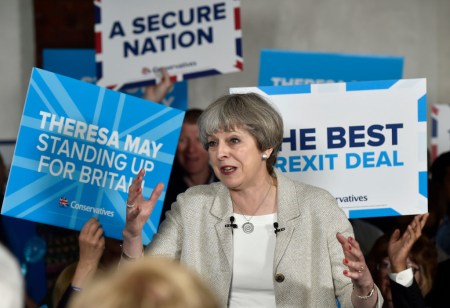
On the Sunday morning after the terrorist attacks in London the night of June 3, British Prime Minister Theresa May addressed the nation in a powerful speech. It deserves to be read in full, but several points stand out and call for a response.

We cannot and must not pretend that things can continue as they are. Things need to change and they need to change in four important ways.

First, while the recent attacks are not connected by common networks, they are connected in one important sense. They are bound together by the single evil ideology of Islamist extremism that preaches hatred, sows division and promotes sectarianism.

It is an ideology that claims our Western values of freedom, democracy and human rights are incompatible with the religion of Islam.

Lower down, she enhances that by saying:

Second, we cannot allow this ideology the safe space it needs to breed. Yet that is precisely what the internet, and the big companies that provide internet-based services provide.

No one who has watched the endless stream of radical Muslim preachers who appear on YouTube or who post extremist, anti-Western, anti-democratic, or anti-Semitic opinions on Facebook would object to May’s stricture. But given earlier attempts to rein in the providers of so many internet spaces in a demand for better scrutiny and the removal of radicalizing material from their sites, we must remain pessimistic about how far May or any other Western leader can bring effective pressure to bear. Without strong financial disincentives, these rulers of the internet will pay little heed to the concerns of the wider public and our security services.

Perhaps May’s strongest statement comes some lines later:

While we have made significant progress in recent years, there is — to be frank — far too much tolerance of extremism in our country. So we need to become far more robust in identifying it and stamping it out across the public sector and across society. That will require some difficult, and often embarrassing, conversations.

Here, she puts her finger on the most sensitive yet compelling reason for our vulnerability. The democracies have been and still are weakened by the very things that in other contexts give us strength. May speaks rightly of our “pluralistic British values”. But those values include freedom of speech, freedom of religion, open-mindedness, and tolerance — things that are not held as desirable values in any Muslim country. Such values are key to our survival as free and tolerant people unrestricted by any overarching ideology. Yet May is right. Even toleration has its limits. While allowing Muslims to live in our societies with full freedom to live their lives according to the tenets of their faith is desirable expression of our openness and love for humanity, we have been tolerant of radical Islam and even traditionalist and conservative Islam where it leads into radicalization and an extremism that erupts in physical assaults, fatalities, and, as intended, widespread public fear.

For years, we have known the identities of radical Islamic preachers and extremist organizations, but we have allowed them to bring their hatred for us onto university and college campuses, into mosques and Islamic centres, and even onto our streets, where they set up stalls to speak and hand out literature. Scroll down here or here to find long lists of radical individuals and organizations, few of which have even been banned. Few terrorist suspects have ever been deported. In a Telegraph article from 2015, one reads:

Here is an astonishing figure to mull over. In the past 10 years, the UK has deported just 12 terrorism suspects from its shores under its Deportation with Assurances (DWA) scheme. In the same period, France deported more than 100 more. The British figures come from a review of the DWA programme that is unlikely to be published until after the general election. It suggests, as we have always suspected, that the UK remains a soft touch for foreign-born jihadists.

It took eight years, 15 court cases and a £25 million bill to keep the hate preacher and terrorist fighter Abu Hamza and his huge family in the UK before he was finally deported (to the United States) in 2012, where he was sentenced to life imprisonment. In that same year, Theresa May (then Home Secretary) was frustrated because another sinister figure, Abu Qatada, could not be deported to Jordan because the European Court of Human Rights had ruled against it for fear of his being tortured there. But in 2013, once Jordan agreed not to do so, he was sent there only to be tried and set free. Last year, he used Twitter to urge Muslims to leave the UK for fear of persecution and “bloodshed” — a possible encouragement to would-be jihadis to head abroad. May spoke vehemently against the Strasbourg ruling:

It is simply isn’t acceptable, that after guarantees from the Jordanians about his treatment, after British courts have found that he is dangerous, after his removal has been approved by the highest courts in our land, we still cannot deport dangerous foreign nationals.

The right place for a terrorist is a prison cell. The right place for a foreign terrorist is a foreign prison cell far away from Britain.

We constantly undermine ourselves by our need to be principled. This is an ongoing problem in politics. Jeremy Corbyn, leader of Britain’s Labour Party, is frequently described as a man of principle, and in many ways that judgement seems fair. Certainly, he has stuck by his socialist principles even if they have led him to adopt positions not well aimed at creating security for Britain. He has supported the IRA; refused many times to condemn their terrorist attacks; has called Hamas and Hizbullah his “friends” and invited their representatives to the British parliament. If that were not enough, he has boasted of his opposition to every piece of anti-terrorist legislation parliament has tried to pass.

In a 2015 interview just shown by the tabloid newspaper The Sun, Corbyn spoke with the Bahrain-based LuaLua Television. Although The Sun is not a reliable source, the clip from the interview shows Corbyn speaking in English with an accurate Arabic translation in subtitles. The interviewer speaks in Arabic. What are alarming are Corbyn’s statements, including a criticism of the UK government laws preventing would-be fighters who have travelled to Syria and from returning to the UK:

The British government’s response has been to try to make it impossible for them to travel, to restrict their ability to travel, to take upon themselves the ability to remove passports and, strangely, to deny people the right of return – which is legally a very questionable decision.

Surely no responsible politician would want to make it easy for jihadi fighters to come and go between Syria and the UK, especially while Islamic State is encouraging jihadis who leave to go back to European countries to carry out acts of terror — which seems to be exactly what has been happening.

In 2002, Corbyn addressed a large anti-Israel rally in London attended by Hizbullah supporters, several radical preachers including Abu Hamza, and 300 members of al-Muhajiroun, a banned extremist organization. According to one left-wing newspaper:

None of these groups called (openly at least) for the destruction of the state of Israel. It was a different story though for the ultra-reactionaries of such organisations as Al Muhajiroun, who held placards reading, “Palestine is muslim”. They chanted, “Skud, Skud Israel” and “Gas, gas Tel Aviv”, along with their support for bin Laden. Two would-be suicide posers were dressed in combat fatigues with a ‘bomb’ strapped to their waists. This section accounted for no more than 200-300, but they made a noise far out of proportion to their numbers.[1]

Stories concerning Corbyn’s support for jihadis was plastered on the front pages of several newspapers one day before the general election on June 8. He may never take charge of our national security, but following the results of the election, which proved disastrous for May and her Conservative party, it is now not entirely unimaginable that he may yet form a minority government. Overconfidence in her party’s strength, a hardline stance on Brexit, and a lack of concern in her Manifesto for public sensitivities concerning the National Health Service, social care and pensions led May to lose the confidence of much of the public, especially some, such as the elderly, who were traditional Tory voters. The campaign she ran turned out to be very badly handled. The two advisers who worked on it have just resigned, and large numbers of citizens, including 60% of Conservatives, are calling on her to resign. She no longer commands the large parliamentary majority of which she was so sure when she called the election, in fact she has no majority at all without pairing with the backward-looking Democratic Unionist Party, founded by bigoted Ian Paisley in 1971 and now the largest party in Northern Ireland. Many predict that the alliance will soon founder.

Whoever remains in power in coming months, the threat of terrorism has risen to the top of the agenda as a public preoccupation. Except that almost nobody talked much about it in the days after the London Bridge attack leading up to the election. Alarmingly, large numbers of young people rushed to vote for the leader of the one party that will do the least to combat that threat. The abolition of student fees or other right-on issues mattered so much more. And yet, in a matter of months, the British people have grown frightened of a beast our political correctness and laxity helped create, a Frankenstein monster that has risen from its slab and shows no signs of lying back down again. This beast has, in a few fell swoops, changed the nature of politics in Britain as it has elsewhere.

Jeremy Corbyn is the last person to whom we should entrust our future safety, yet he is now in a position to water down or cancel any legislation that might ensure more preparedness and better control. Theresa May, whatever her political disaster, has at least promised firmness in our relations with the Muslim community, identifying the problem and calling for action.

That promise of action is exemplified in her statements that:

If we need to increase the length of custodial sentences for terrorist-related offences — even apparently less serious offences — that is what we will do. Since the emergence of the threat from Islamist-inspired terrorism, our country has made significant progress in disrupting plots and protecting the public. But it is time to say “Enough is enough”.

On June 6, addressing party supporters in Slough, and again speaking about resistance to terrorism, she went farther, saying:

I mean longer prison sentences for those convicted of terrorist offences.

I mean making it easier for the authorities to deport foreign terrorist suspects back to their own countries.

And I mean doing more to restrict the freedom and movements of terrorist suspects when we have enough evidence to know they are a threat, but not enough evidence to prosecute them in full in court.

And if our human rights laws get in the way of doing it, we will change the law so we can do it.

Clearly, not even May can ride roughshod over essential human rights values and legislation, things put in place to protect the public. Now, with Corbyn looking over shoulder, tough and measured action is in jeopardy. It is clear nonetheless that an excessive concern for the rights of dangerous individuals and hostile communities has served to take away vital protections for the lives of British citizens. This misguided generosity is linked to a growing worry that we have been too relaxed about individuals who have later gone on to commit atrocities in our midst. Salman Abedi, the suicide bomber who murdered 22 concert-goers, including several children, during an Ariane Grande concert in Manchester, had been reported to the authorities no fewer than five times, yet had been allowed to walk free enough to take forward his mission to kill and maim.

Youssef Zaghba, one of the three attackers on London Bridge and Borough Market on June 3, had been stopped in Bologna in 2016 carrying terrorist literature while trying to fly to Istanbul en route for Syria. He told officers “I am going to be a terrorist”, was arrested but later released. His name was flagged on an international terrorism database and the Italian authorities notified the British security services. Allowed to go to the UK, he helped kill seven people and injure more.

Even more alarmingly, his accomplice, Khuram Butt, a Pakistani-born British man, was well above the horizon. He had been reported to the security services and was alleged to have been an associate of Anjem Choudary, a radical preacher now serving time in jail for his support for Islamic State. Butt had defended Choudary by calling a Muslim opposed to the preacher an apostate (murtadd); and in 2016, he had appeared in a Channel 4 television documentary where he was seen with others in a park holding an ISIS flag and at two events attended by radical preachers who had been arrested for radicalizing others. One of those preachers, Mohammed Shamsuddin, has said: “Our message is deadly, we are calling for world domination, and for Sharia for the UK.”

In 2015, MI5, the UK’s domestic intelligence service, stated that it had 3,000 extremists on its watchlist. According to Business Insider:

There are 6,000 employees at GCHQ and 4,000 at MI5. But there are up to 3,000 terror suspects in the UK. At the French ratio, you would need 60,000 officers to track them all. That’s almost half of Britain’s total number of police officers, 127,000.

What this means, in effect, is that thousands of potential terrorists are left free to live with little interference from the police or MI5. Raising the number of police, as Jeremy Corbyn demands, would place a heavy strain on the economy of a country sailing into uncharted waters as it leaves the EU. The answer must be, as May suggests, a different approach to human rights legislation. At the moment, the bar for taking extremists out of circulation is set ridiculously high. People who are known for their own extremism that reaches pre-terrorist levels should not be walking the streets when they have expressed support for Islamic State or tried to head to Syria or called for the destruction of the UK and other democracies or allied themselves to people already in prison. Their demand for free speech or freedom of belief must never be elevated above the rights of citizens to live safely in their own towns and cities. It is essential for parliament to lower the bar.

That the police and security services are avoiding any real confrontation with Islamists is clear from the contents of this letter, sent on June 7 to the Daily Mail by pro-Israel activist Clive Hyman. It makes troubling treading:

On 18th June, Muslims will be holding a march in central London to celebrate Al-Quds Day. In previous years these marches have called for the destruction of Israel and death to the Jews, and the marchers have carried signs to this effect and flags supporting Hamas, Hezbollah and ISIS. Despite requests from both the Christian and Jewish communities for this march to be cancelled because of the violence it will incite amongst those participating and their followers, Mayor Khan and the Metropolitan police have refused to do so, their reason being that there has been no violence at these marches in previous years.

By comparison, an event to honour Israel organised by Christians United for Israel for 22nd June has been cancelled apparently because Mayor Khan and the Metropolitan Police cannot guarantee the safety of those who wish to attend.

Is this to be the political landscape for the future, where groups of people demanding death and destruction are given the freedom of the streets whilst those wishing to hold a peaceful celebration are prevented from doing so?

As might be expected, leftists have rejected May’s appeal for changes in human rights legislation. They argue that she will need to declare a state of emergency, something that can only be invoked when the life of the nation is under threat. This is not incorrect, since all democracies have to avoid potential dictators using changes in the law to give themselves powers they might not otherwise have. But that is not the whole story.

What May plans to do will take us far, but not far enough. Her weakness, set against Corbyn’s show of strength, undermines the likelihood of any serious changes to how Britain tackles the Islamic threat. Bit by bit, the political fear of appearing xenophobic or “Islamophobic” will reassert itself. Labour will make sure of that. Members of parliament with substantial numbers of Muslim constituents will answer calls to water down any legislation that can be labelled as discriminatory to Muslims. It is only when we come to terms with the fact that terrorist attacks are not being carried out by Christians, Jews, Hindus, Buddhists, Baha’is, Quakers or the members of any religion except Islam.

Regrettably May herself fell into a politically-correct trap in her speech, when she said in reference to Islamic radicalism, “It is an ideology that is a perversion of Islam and a perversion of the truth.” It is easy to see what she means by this — that she wants to distance radicalism and terrorism from the majority of decent Muslims in the UK, the ones like Sara Khan who work to create a British Islam based on the best Islamic values in alliance with the British values May rightly extols. However, to see extremist Islam as a “perversion” of Islam misses an important point. The politically correct insistence that radical versions of Islam somehow pervert an essentially peaceful and tolerant faith forces policy-makers and legislators, church leaders, rabbis, interfaith workers and the public at large to leave to one side an important reality. If not tackled head-on, that reality will not go away.

In a June 3 speech, British Prime Minister Theresa May regrettably fell into a politically-correct trap, when she said in reference to Islamic radicalism, “It is an ideology that is a perversion of Islam and a perversion of the truth.” (Photo by Hannah McKay/Pool/Getty Images)

Flatly, Islam in its original and classic forms has everything to do with today’s radicals and the violence they commit. The Qur’an is explicit in its hatred for pagans, Jews, and Christians. It calls for the fighting of holy war (jihad) to conquer the non-Muslim world, subdue it, and gradually bring it into the fold of Islam. Muhammad himself led his followers into battle and sent out expeditions out of Arabia before his death in 632. The astonishing Islamic conquests that followed in the Middle East, Europe, and far beyond into Central Asia and India turned a swathe of territories into Islamic fiefdoms, and most of these remain under Muslim rule today. The Ottoman Turkish conquest of Constantinople in 1453 not only destroyed the Eastern Orthodox Roman Empire (the Byzantine Empire), but is still regarded by Muslims as a turning point in the history of the world. The subsequent Ottoman conquests across eastern Europe were only halted when the King of Poland John III Sobieski (1629-1696) defeated a massive Turkish army under the command of Sultan Soleiman I outside the city of Vienna.

In 2015, after Islamist attacks in Paris, French president François Hollande declared that “We are in a war against terrorism, jihadism, which threatens the whole world.” But Islam has been at war with Europe since the seventh century. The beheadings, crucifixions, massacres and demolitions of towns and churches carried out by Islamic State today are replicas of wider atrocities carried out by the Muslim conquerors of Spain in the 8th century.[2]

Jihad wars against the Byzantines were carried out twice a year. Spain and Portugal were occupied for centuries until the Christian kingdoms of the north drove the Muslims out, in a process that itself took some centuries. The Ottomans continued to be a threat down to their defeat in the First World War. From the sixteenth to late eighteenth centuries, the Muslim slavers, known as the Barbary pirates, dominated the Mediterranean and took more than a million Christian slaves to North Africa. In the nineteenth century, jihad wars against European colonists were frequent.[3] Today, Europeans and others are fighting wars against Islamic radicals from Afghanistan to Iraq to Syria, and on the streets of our own cities.

To be at war is justification for extreme measures. Deportation and internment are unattractive, just as the measures Western countries have been forced to take against their enemies in other wars. But set next to the threat of unending terror in our cities, and given the nature of the people we will deport or intern, they are probably not as bad as the alternative. We will not execute terrorists (just as Israel has never executed the thousands of terrorists who have murdered its citizens) nor torture them or harm their families. Minor adjustments to our human rights laws and the lowering of the bar a bit on what we consider unacceptable are all we need. But that will not stop Jeremy Corbyn and his terrorist-supporting friends crying that such measures will be a “slippery slope” that will set back community relations by decades.

Dr. Denis MacEoin has recently completed a large study of concerns with Islam. He is an Arabist, Persianist, and a specialist in Shi’i Islam. He is a Distinguished Senior Fellow at Gatestone Institute.

______________________________________________

[1] See also here.

[2] See Darío Fernández-Morera, The Myth of the Andalusian Paradise, Wilmington, 2016, chapters 1 and 2.

[3] See Rudolph Peters, Islam and Colonialism: The Doctrine of Jihad in Modern History, The Hague, 1979, especially chapter 3.

Hezbollah Terrorists Caught in US Planning Attack

June 11, 2017

Hezbollah Terrorists Caught in US Planning Attack, ClarionProjectRyan Mauro, June 11, 2017

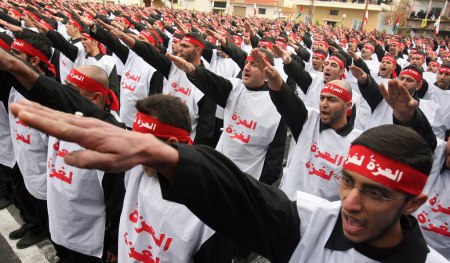
New Hezbollah recruits in Lebanon salute during a ceremony (Photo: AFP/Getty Images)

The pace of jihadist activity has been so intense lately that an incredibly important story has been barely reported on:

Two terrorists belonging to Hezbollah, a puppet of the Iranian and Syrian regimes, have been arrested for planning attacks in the U.S., with one scouting potential targets in New York including JFK International Airport.

Both are citizens who entered, exited and re-entered the U.S.

Although the Iranian and Syrian regimes regularly organize terrorist attacks through its Hezbollah proxy, the plotting of attacks on U.S. soil and on Americans overseas is very significant, but not unprecedented.

The two arrested terrorists are Ali Kourani of the Bronx, New York and Samer El-Debek of Dearborn, Michigan. Each is a well-trained militant who belongs to Hezbollah’s Islamic Jihad branch that is tasked with perpetrating terrorist attacks, preferably with some level of deniability.

Yet, under questioning, Ali Kourani explicitly told the FBI in 2016 and 2017 that he was a “sleeper” agent of Hezbollah’s Islamic Jihad carrying out “black ops” for Hezbollah and “the Iranians.”

His first round of training took place in Lebanon in 2000 when he was only 16-years old. Kourani admitted to the FBI that he was accepted by Hezbollah because his family is connected to a top official in the terrorist group. He said one of his brothers is the “face of Hezbollah” in Yater, Lebanon and boasted that his family’s name is like the “Bin Laden’s of Lebanon.” In other words, his family is famous for being terrorists.

Shockingly, in 2003 (two years after the 9/11 attacks), this member of a famous terrorist family successfully entered the U.S. and became a student. He also went by the names of “Jacob Lewis” and “Daniel.”

In 2008, he then joined Hezbollah’s Islamic Jihad branch. Shortly thereafter, he applied for naturalization and became a citizen in April 2009, all the while lying about his connections to terrorism. If his boasts are true, a simple look of his family would have tipped off the U.S. government about who Kourani was.

Kourani predictably lied throughout his process to become a U.S. citizen, including denying any plans to travel overseas when he applied to become a citizen. Only a month after becoming a citizen, he went to Guangzhou, China, on a so-called “business trip” to the location of a medical company that produces chemicals that can be used in bombs. Stolen chemicals from the company were later found in the possession of Iranian terrorists in Thailand planning bombings.

In 2011, Kourani went to Lebanon for a second round of terrorism training in RPG and various firearms. He then came back into the U.S. to use the skills he acquired.

On the orders of his Hezbollah handler, he began identifying and surveilling targets.

According to the criminal complaint, his handler directed him to “surveil and collect information regarding airports, including the layout of terminals, the locations of cameras and personnel, and other security features. In response, Kourani provided detailed information to [his handler] regarding specific security protocols, baggage-screening and collection practices and the locations of surveillance cameras, security personnel, law enforcement officers and magnetometers at JFK and an international airport in another country.”

Some historical context is important here: This is a revival of Iran’s ambitions to target New York’s JFK International Airport. Iran already tried to carry out an attack at the airport once and was preparing to do so again.

The previous plan (in 2007) was to blow up fuel tanks and pipelines going to the airport. The FBI confirms that one of the individuals involved in this plot had links to “militant groups” in Iran and Venezuela and had regularly contact with Iranian authorities.

There were various other Iranian links, including the involvement of an operative who was previously part of an Iran-sponsored bombing in Argentina in 1994.

Kourani also used Google Maps to research LaGuardia Airport in Queens, New York (specifically its terminals) in April 2011. He also looked up the U.S. Armed Forces Career Center in Queens in February 2013.

Kourani conducted surveillance on a governmental building in Manhattan with FBI offices inside; an Army National Guard office in Manhattan; an Army Armory building in Manhattan and a Secret Service office in Brooklyn.

He looked for people tied to the Israeli military. He was also tasked with making contacts who could provide firearms to Hezbollah operatives in the U.S.

In addition, Hezbollah wanted Kourani to do something in Mexico and Canada. His handler talked about possibly having him fly to one of these countries and cross into the U.S. by land using his passport. Hezbollah has ties to Latin American drug cartels, which may have something to do with the talk of a trip to Mexico.

The surveillance of targets in preparation for expected Hezbollah attacks continued until at least September 2015, as per the complaint.

Like Kourani, Samer El-Debek is a naturalized citizen who belonged to Hezbollah’s Islamic Jihad branch. He communicated via email with someone who owned a business in Iran.

El-Debek acted as an agent of the terrorist group from 2007 to September 2016, with his salary growing to over $1,000 per month plus medical expenses. He is a specialist in bomb-making and began confessing to the FBI after Hezbollah accused him of being an American spy and detained him for four months until he falsely admitted to being one.

El-Debek was first trained in 2008 and received four rounds of training total. One round included six days of religious teaching, where a sheikh taught about Islam’s rules and “martyrdom ideology.” His explosives training focused on remotely-detonated bombs.

El-Debek was specifically taught how to make IEDs like the one Hezbollah used on a bus of Israeli tourists in Bulgaria in 2012 that killed 6 people and injured 32. He told the FBI that the bomber was his aunt’s nephew.

In 2009, he was sent to Thailand to dispose of bomb ingredients from a Hezbollah safehouse that they believed to have come under surveillance. His cover was that he was traveling to Thailand for paid sex, going so far as to hire a prostitute and to have her enter the safehouse so he could try to discover any surveillance taking place.

In 2011, El-Debek flew to Colombia and entered Panama on a Hezbollah mission to identify gaps in security at the Panama Canal and the Israeli embassy. He returned to Panama in 2012 to identify weaknesses in the Panama Canal’s construction and security gaps and find out how close someone could get to a ship passing through.

He was told to conduct surveillance of the U.S. embassy but did not, fearing it would compromise his mission.

Hezbollah detained El-Debek in December 2015 until April 2016, accusing him of being a U.S. spy and demanding a confession. He eventually did so. Based on the complaint, it appears the detention caused him to open up to the FBI during voluntary questioning (assuming his story is true).

This is only a tiny portion of what Iran and Hezbollah is doing to try to attack targets in the U.S. at home and abroad. This is the experience of only two Hezbollah terrorists we caught.

If this is the scale of what we do know, then what horrors are being planned that we don’t know about?

Fred Fleitz: ‘We May Have Generations of Radical Islamists in the U.K. Unless the British Government Wakes Up’

June 5, 2017

Fred Fleitz: ‘We May Have Generations of Radical Islamists in the U.K. Unless the British Government Wakes Up’, BreitbartJohn Hayward, June 5, 2017

ODD ANDERSEN/AFP/Getty

“I think 9/11 was a wake-up call. You could just see how Republicans and Democrats in Washington were working together against the threat. Now we’re challenged by political correctness, and people who are in denial, and don’t want to the let the government take the steps it has to take to go after radical Islam,” Fleitz reflected.

“Whenever there’s a radical Islamic terrorist attack, we get these lectures about Islamophobia from our leaders, leaders in the U.K. I think that is really hobbling the ability of our government to go after this threat, and that’s unfortunate. I hope what happened in London will be a wake-up call, but I’m worried in a few weeks we’ll be lectured about Islamophobia again,” he said.

***************************

Senior Vice President for Policy and Programs Fred Fleitz of the Center for Security Policy joined SiriusXM host Joel Pollak on Monday’s Breitbart News Daily to talk about the London Bridge terror attack.

Pollak began by asking if the London Bridge attack would finally provide the wake-up call needed for those who underestimate or downplay the dangers of radical Islamic terrorism.

“A lot of people who were in denial almost say the right thing after these events. They sort of can’t help themselves,” Fleitz replied.

“But what really concerns me is that yes, it’s right we have to improve security – we need better outreach, we need better intelligence – but there’s something they’re not talking about in the U.K. that really needs to be focused on: the role that the failure to assimilate British Muslims has created the situation,” he said. “There are communities where British Muslims are deliberately not assimilating, are being taught to hate British society, and this is incubating radicalism. There’s actually a parallel system of sharia law courts in the U.K. that operate.”

“We may have generations of radical Islamists in the U.K., until the British government wakes up and stops the situation,” he warned.

Pollak pointed out that the United States has unassimilated religious communities with their own internal systems of government that live peaceably alongside their neighbors, such as the Amish and Jewish communities in upstate New York.

“It’s certainly true there are some communities in the United States that have not assimilated,” Fleitz agreed. “I’m not concerned about Amish or Jewish communities, but I will tell you that there are enclaves of Muslim communities in Michigan and Minnesota that concern me. We know that in Minnesota there’s a rising rate of measles because the community has not assimilated into the rest of the community, and is not vaccinating their children. This is wrong. This is a big problem.”

“The problem with these Muslim communities is that it is making them susceptible to this radical worldview that wants to destroy modern society, create a global caliphate, and impose sharia law on everyone on Earth,” Fleitz contended. “These other communities aren’t trying to do that. They’re peaceful religious communities.”

“Also, when we have immigrants coming to a country from another country, I think they need to learn the practices and laws of the country where they’re coming to, the country that is accepting them and serving as a refuge for them. I think when people come to their new home country, they should understand and learn about the laws of this new country. That’s not happening in the U.K.,” he said.

Pollak offered the converse observation that some of the worst terrorist murderers, such as the San Bernardino jihadis, appear to be fairly well-assimilated.

“We can have homegrown radical Islamist terrorists – and I don’t really think they’re homegrown, I think they’re inspired or directed by foreign Islamist terrorist organizations – but it’s this ideology of hate that either is being communicated to them over the Internet, or is being passed on to members of separated communities in the U.K. It’s the ideology we have to confront, and I think this problem is worse in these separate communities,” Fleitz said.

Fleitz argued that measures to hinder the ability of extremists to recruit and coordinate with the Internet should be explored, with due regard for civil liberties, but he is more concerned about “radical clerics and radical mosques who are promoting this type of hate and ideology firsthand.”

“I also want to stop these ISIS videos that we know homegrown radical Islamist terrorists are taking in, and it’s playing a role in radicalizing them,” he added.

“I think 9/11 was a wake-up call. You could just see how Republicans and Democrats in Washington were working together against the threat. Now we’re challenged by political correctness, and people who are in denial, and don’t want to the let the government take the steps it has to take to go after radical Islam,” Fleitz reflected.

“Whenever there’s a radical Islamic terrorist attack, we get these lectures about Islamophobia from our leaders, leaders in the U.K. I think that is really hobbling the ability of our government to go after this threat, and that’s unfortunate. I hope what happened in London will be a wake-up call, but I’m worried in a few weeks we’ll be lectured about Islamophobia again,” he said.

“Anyone who raises concerns about radical Islam seems to be tarred and feathered as an Islamophobe in this country. I’ll let the people who peddle this term give a better explanation, but that’s my experience,” he replied when Pollak asked for a precise definition of “Islamophobia.”

Between the Thames and the Nile

June 5, 2017

Between the Thames and the Nile, Israel Hayom, Dr. Shaul Shay, June 5, 2017

(On the rare occasions when President Obama led from the front (Egypt and Libya, for example) he led in the wrong direction. — DM)

Europe is currently paying the price for its strategic failure to understand the reality and culture of the Middle East, as it faces waves of terrorism and an influx of immigrants.

The war against terrorism must be decisive, and at times, this entails infringing on individual liberties and imposing restrictions on the media, when it caters to terror organizations. When Western nations and human rights groups exert pressure on Arab regimes that are already engaged in an existential battle against Islamic terrorist organizations, they only diminish these regimes’ ability to win and survive, and, furthermore, indirectly endanger the West.

***********************************

In the past two weeks, the United Kingdom has suffered two major terror attacks, which have killed a total of 29 people and wounded over a hundred. The first attack, on May 22, was carried out by a young terrorist of Libyan descent who detonated himself up outside the crowded Manchester Arena, while the second attack, on June 3, was a coordinated attack by three terrorists that began with a vehicle-ramming on London Bridge and continued with a stabbing spree at nearby busy Borough Market. The Islamic State group claimed responsibility for both attacks.

A few days after the Manchester attack, 29 people were killed and 27 were wounded in a shooting attack on two buses carrying Coptic Christians to the remote monastery of Saint Samuel in the al-Idwah district outside Minya in Egypt. Islamic State took responsibility for that attack too. A few hours later, the Egyptian Air Force launched airstrikes against Islamic State training camps near Derna in east Libya, from where Egypt said the terrorists had come.

Despite the geographical distance between these terrorist attacks, they have much in common. They are a reflection of the growing global Islamic terror problem, which poses challenges to the Muslim as well as the Western world.

In 2011, when the “Arab Spring” revolutions began to spread across the Arab world, the West chose to support those who acted to topple dictatorial regimes, out of an unfounded belief that they would be replaced by Western-style democracies. The result was the disintegration of nation-states created by the West a hundred years earlier, giving rise to a chaotic reality in which radical Islamic movements and terrorist organizations thrive.

Britain was one of the countries that supported the efforts to overthrow Libyan leader Moammar Gadhafi in 2011. Since then, Libya has been torn by civil war and has become a stronghold for Islamic State and al-Qaida terrorists. Furthermore, Libya has become a potential terrorist threat to its neighbors, first and foremost Egypt and Tunisia, by turning into a training base for jihadists from across the globe. Libya is also the gateway to hundreds of thousands of refugees and immigrants on their way from Africa and Asia to Europe.

Europe is currently paying the price for its strategic failure to understand the reality and culture of the Middle East, as it faces waves of terrorism and an influx of immigrants.

The war against terrorism must be decisive, and at times, this entails infringing on individual liberties and imposing restrictions on the media, when it caters to terror organizations. When Western nations and human rights groups exert pressure on Arab regimes that are already engaged in an existential battle against Islamic terrorist organizations, they only diminish these regimes’ ability to win and survive, and, furthermore, indirectly endanger the West.

The West needs to implement a three-tiered strategy involving a determined struggle against radical Islamic groups in the West; economic and security assistance to moderate Sunni regimes such as Egypt and Jordan in order to maintain their stability and assist them in fighting radical Islam at home and abroad; and a combined military, diplomatic and economic effort to rehabilitate failed countries such as Libya and Yemen, to prevent them from developing into a breeding ground for terrorist groups.

Time for a Terrorism Accord, Not a Climate Accord

June 4, 2017

Time for a Terrorism Accord, Not a Climate Accord, PJ MediaRoger L Simon, June 3, 2017

(Another pleasing idea that won’t likely be tried and, if tried, won’t work. “America First” can work and, if given a chance, should. The Supreme Court is about to consider President Trump’s “Muslim ban” executive order. Perhaps recent events in Europe and England will push enough justices to reinstate it.That will at least be a step in the right direction. Please see also, Supreme Court Expedites Trump’s Petition on Executive Order Case. — DM)

[T]he recent Paris climate accord is not only based on bad or “cooked” Climategate science, it is a deliberate conscious/unconscious deflection from the genuine “present danger” in front of us.  It is no more than obfuscation allowing moral narcissists to feel good about themselves, virtue signaling about an environmental armageddon that hasn’t happened and may never happen while, in real life, people are actually murdered on London bridges and in Cairo churches.

**************************

Yes, there’s a threat to civilization and it’s not global warming, manmade or otherwise.  And anyone who isn’t comatose should know what it is.

Islam, like cancer, needs a cure. And we all have to participate in the search for one before it’s too late.

Yes, this is about Islam, not “radical” Islam or some other off-shoot, real or imagined, because the tenets that have inspired the non-stop spate of terrorism across the world in recent years are spelled out clearly in sections of the Koran and the Hadith and other holy works of Islam. They provide justification for ISIS and a hundred other groups that may or may not replace them, now and in the future. This cannot continue — unless we really do want to destroy ourselves.

To be clear, this is not about bad people (many Muslims are fine human beings), but about a malignant ideology from the seventh century that must be expunged for the survival of all.

But the majority of Western leaders don’t want to know that.  In fact, I’d wager that most have not even bothered to educate themselves in any serious way about Islam nearly sixteen years after 9/11 and with all the constant carnage that has gone on since and has been increasing significantly, not just in London and Manchester but virtually everywhere.

These Westerners are not only willfully blind, they are suicidal.  But we cannot let them commit suicide for the rest of us.  They have to go.

Similarly, the recent Paris climate accord is not only based on bad or “cooked” Climategate science, it is a deliberate conscious/unconscious deflection from the genuine “present danger” in front of us.  It is no more than obfuscation allowing moral narcissists to feel good about themselves, virtue signaling about an environmental armageddon that hasn’t happened and may never happen while, in real life, people are actually murdered on London bridges and in Cairo churches.

What we need now is an international terrorism accord — and, unlike the climate accord, a binding one — that would commit the world, including the Muslim nations themselves, to the complete reformation of Islam that is the necessary basis for an end to this terrorism.

President Trump made a good start in Riyadh in his address to the Sunni leaders, but we must go much further.  It is correct that the Islamic world should be the ones to change their religion, but the rest of us on the planet are too affected by the results to stand by and wait.  From the horrifying (London this weekend) to the daily (the constant of indignity of being scanned at airports, concerts, museums, etc.), we are all victims of Islamic ideology.  We have a right, indeed an obligation, to participate in and demand its change. Otherwise, it will only get worse.

Since Trump had the courage to open the discussion in Saudi Arabia, he should attempt to expand the dialogue and create this global accord. Egypt’s el-Sisi would be a good partner because he already had the guts to criticize his own religion.  All should be invited, even those who would never come (like the mullahs).  All must confront the question of why Islam, unique among the world’s religions today, has so much violence committed in its name. What is it about Islam that attracts this?  What therefore has to be changed, both in behavior and ideology?

The event should be public, with Islam ultimately made to pledge itself to human rights as accepted by the West — equal rights for women and homosexuals, separation of church (mosque) and state, no discrimination based on race or religion (why no churches allowed in Saudi Arabia?), etc. — not the absurd Orwellian version of human rights promulgated the UN Human Rights Council.

This demand should be made to all quarters of the Islamic world with economic punishment applied if necessary.  The time for diplomatic politesse is long over. Islam must be forced to join modernity. Reactionary multiculturalists among us must be ignored, along with their hypocritical (and nonsensical) belief that all religions are equal.  To do otherwise would be to treat Muslim people like children.  And that is what the West has been doing for some time — with atrocious results for all.