Posted tagged ‘Islamic State’

Nuclearizing Iran, Sabotaging Arabs

August 6, 2015

Nuclearizing Iran, Sabotaging Arabs, The Gatestone InstituteBassam Tawil, August 6, 2015

(Please see also, Obama’s Strategy Of Equilibrium. — DM)

  • Obama’s solution? To let Iran have legitimate nuclear bombs in a few years, along with intercontinental ballistic missiles to deliver them to the U.S. — or perhaps from America’s soft underbelly, South America, where Iran has been acquiring uranium and establishing bases for years. Or perhaps launched from submarines off America’s coast, which would make the identity of the attacker unknowable and a response therefore impossible. Incredibly, America’s politicians do not even seem to seem to be concerned about that.
  • We have just sacrificed Sunni stability for American ideology: empty slogans fed to us by clueless, if well-meaning, American officials.
  • As we watched one stable Arab regime fall after another, we have allowed ourselves to be destroyed from within by these bungling diplomats — from America, Europe, China and Russia. Instead of keeping our eyes on the real threat, we exhausted ourselves in wasteful, unending battles against the Jews — meanwhile letting the Iranian menace slip out of sight.
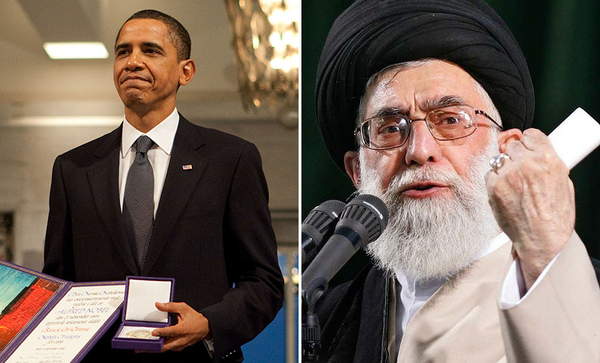
  • Obama really does deserve a Nobel Prize, but it should have been awarded by the Ayatollah Khamenei, the Supreme Leader of Iran, in gratitude for America’s surrender.

“Nation building” seems to have fallen into disrepute in the West, but it should not. It is vitally important — as the successes of Germany, Japan and South Korea attest.

Over the past few years, in our foolishness, we in the Middle East swallowed the deceptive bait of “democracy” dangled before us, even though we knew that it could not, in the misguided way it was presented, be implemented in the Middle East.

The idea was superb, but here in the Middle East, possibly in being impatient to “get credit” before the diplomats’ term of office were over, no one ever took the time to establish the institutions of democracy — equal justice under law, freedom of speech, property rights, the primacy of the individual rather than the collective, separation of religion and state — to show us in the Middle East how democracy actually operates, and to allow those institutions to take rootbefore ever holding an election.

So eager were Western leaders to take credit right away that they refused “let the rice bake.” Had the West introduced democratic elections to Japan and South Korea (where they eventually worked brilliantly) in the same way it muscled democracy into Iraq, it would never have taken root in those countries either. Had the Germans had been asked to vote right after World War II, they would most likely have reelected the Nazis — that was what they knew. It took seven years to re-educate the public to understand and accept a Konrad Adenauer.

What seems clear is that we have sacrificed Sunni stability for empty slogans — and for clueless, if well-meaning, American officials. As we watched one stable Arab regime fall after another, we allowed American ideology to destroy us from within. Instead of keeping our eyes on the real threat, we exhausted ourselves in wasteful, unending battles against the Jews — meanwhile letting the Iranian menace slip out of sight.

If we try to look at the positive side of the Iran nuclear agreement, it is just possible that Obama looked at the Sunni Arab states, fractured and at each other’s throats, and at the ruthless terrorist groups gaining ground in the expanding battle zones, and decided that we were too fractious for the U.S. to protect.

Sunni states such as Saudi Arabia, Qatar and Turkey have been worsening the situation in the Arab world by funding Sunni terrorist organizations, thereby putting it on a course of complete chaos. Despite Arab wealth and power, we have been dealing almost exclusively with the marginal issue of Palestine and the Jews, to excuse our inability to be effective in giving U.S. President Barack Obama what he really needs: regional stability.

Obama sees Iran and its terrorist organizations, which are all unified, organized and obedient, opposing the Sunni Arabs. Obama may be betting on Iran to bring order to the Middle East.

Imagine if we and our fundamentalist Sunni terrorist organizations had actually focused on stopping the Iranians in Syria, Iraq, Lebanon and Yemen. Imagine if we had abandoned, even momentarily, the dream of the Muslim Brotherhood (what the West calls “political Islam”) ruling the world. Imagine if we had stopped our stupid, useless acts of hatred, and could instead have focused on our common enemy, Iran. Our situation now would be immeasurably better. We would not be deviating from the teachings of Muhammad, because first we have to focus on the near enemy and then on the distant one. Iran is nearer and more dangerous than Europe and the United States, so Iran should have been — and still should be — the first Sunni target. We might have led Obama to adopt a different approach than allowing Iran to acquire a nuclear bomb in ten years or sooner — but we did not, because of our weakness and distraction with marginal “causes.” Thus Obama, from a desire to stabilize the Middle East, seems to be betting on the strong horse, Iran.

The truth, however, may be somewhat different. It is entirely possible that Obama, who won the Nobel Peace Prize, is employing a policy of “divide and conquer.” In the U.S., instead of trying to improve how children in the inner cities are being educated, he has been busy stoking racial and economic conflict. The Arabs are becoming increasingly suspicious that he is a historic “divide and conquer” manipulator. He may deliberately be creating fitna (civil strife) in the Arab world by whipping up conflict with Iran, so that America will one again look like the big power-broker — but at the expense of the Arabs.

We Arabs are expert conspiracy theorists, and interpret every political agenda as a hidden plot, but one only has to look at the Obama administration’s fawning support for the Muslim Brotherhood in Turkey and Egypt, and how America supported the fall of Mubarak, and it immediately becomes obvious that the U.S. is trying to manipulate the fate of the Arabs.

Anyone following America’s rejection of, and now only reluctant support for, the reformist regime of Egyptian President Abdel Fattah el-Sisi understands that the Americans prefer what they consider “backward Arabs”: those controlled by regressive Islam.

That is the reason we see Obama’s policies as backing both the Sunni Muslim Brotherhood and the theocrats in Iran. The ideologies of both the Muslim Brotherhood and Iran’s mullahs would lead to most dangerous and regressive fate of both Sunni and Shiite Muslims around the world, as well as Americans at home — and these are the Muslims most loved by the current American administration. Or maybe, as many of us say here on the street, Obama is just trying to “get even” with the West and bring it to its knees, for being white, “imperialist” and non-Muslim. Obama’s solution? To let Iran have legitimate nuclear bombs in a few years, with the intercontinental ballistic missiles to deliver them to the U.S. — or perhaps from America’s soft underbelly, South America, where Iran has been acquiring uranium and establishing bases for years. Or perhaps launched from submarines off America’s coast, which would make the identity of the attacker unknowable and a response therefore impossible. Incredibly, America’s politicians do not even seem to seem to be concerned about that.

Obama really does deserve a Nobel Prize, but it should have been awarded by the Ayatollah Khamenei, the Supreme Leader of Iran, in gratitude for America’s surrender.

1190Perhaps President Obama’s Nobel Prize should have been awarded by the Ayatollah Khamenei, the Supreme Leader of Iran, in gratitude for America’s surrender.

Obama’s Strategy Of Equilibrium

August 6, 2015

Obama’s Strategy Of Equilibrium, Middle East Media Research Institute, Yigal Carmon and Alberto M. Fernandez, August 5, 2015

(The conflict between Shiite and Sunni factions has been going on since shortly after the death of Mohamed. Obama is not likely to bring reconciliation. — DM)

This article will analyze the strategy of creating an equilibrium between Sunnis and Shiites as a means to promote peace in the Middle East. It will examine the meaning of the strategy in political terms, how realistic it is, and what its future implications might be on the region and on the United States.

“It is worth noting that the first Islamic State created in the Middle East in the last 50 years was not the one created in the Sunni world in 2014 and headed by Abu Bakr al-Baghdadi.” Rather, it was the Islamic Republic of Iran created in 1979 by Ayatollah Ruhollah Khomeini and currently ruled by his successor, Supreme Leader Ali Khamenei, who maintains – even following the Iran deal – the mantra “Death to America,” continues to sponsor terrorism worldwide, and commits horrific human rights violations.

********************

Introduction

In an interview with Thomas Friedman of The New York Times (“Obama Makes His Case on Iran Nuclear Deal,” July 14, 2015), President Obama asked that the nuclear deal with Iran be judged only by how successfully it prevents Iran from attaining a nuclear bomb, not on “whether it is changing the regime inside of Iran” or “whether we are solving every problem that can be traced back to Iran.” However, in many interviews he has given over the last few years, he has revealed a strategy and a plan that far exceed the Iran deal: a strategy which aims to create an equilibrium between Sunnis and Shiites in the Muslim world.

President Obama believes that such an equilibrium will result in a more peaceful Middle East in which tensions between regional powers are reduced to mere competition. As he told David Remnick in an interview with The New Yorker, “…if we were able to get Iran to operate in a responsible fashion…you could see an equilibrium developing between Sunni, or predominantly Sunni, Gulf states and Iran in which there’s competition, perhaps suspicion, but not an active or proxy warfare” (“Going the Distance,” January 27, 2014).

In discussing the Iran deal, the President recalled President Nixon negotiating with China and President Reagan negotiating with the Soviet Union in order to explain the scope of his strategy for the Middle East and the Muslim world. President Obama seeks, as did Presidents Reagan and Nixon with China and the Soviet Union, to impact the region as a whole. The Iran deal, even if major, is just one of several vehicles that would help achieve this goal.

This article will analyze the strategy of creating an equilibrium between Sunnis and Shiites as a means to promote peace in the Middle East. It will examine the meaning of the strategy in political terms, how realistic it is, and what its future implications might be on the region and on the United States.

The Meaning Of The Equilibrium Strategy In Political Terms

Examining the strategy of equilibrium requires the recollection of some basic information. Within Islam’s approximately 1.6 billion believers, the absolute majority – about 90% – is Sunni, while Shiites constitute only about 10%.  Even in the Middle East, Sunnis are a large majority.

What does the word “equilibrium” mean in political terms? In view of the above stated data, the word “equilibrium” in actual political terms means empowering the minority and thereby weakening the majority in order to progress toward the stated goal. However, the overwhelming discrepancy in numbers makes it impossible to reach an equilibrium between the two camps. Therefore, it would be unrealistic to believe that the majority would accept a policy that empowers its adversary and weakens its own historically superior status.

Implications For The Region

Considering the above, the implications of the equilibrium strategy for the region might not be enhancing peace as the President well intends; rather, it might intensify strife and violence in the region. The empowered minority might be persuaded to increase its expansionist activity, as can be already seen: Iran has extended its influence from Lebanon to Yemen. Iranian analyst Mohammad Sadeq al-Hosseini stated in an interview on September 24, 2014, “We in the axis of resistance are the new sultans of the Mediterranean and the Gulf. We in Tehran, Damascus, [Hizbullah’s] southern suburb of Beirut, Baghdad, and Sanaa will shape the map of the region. We are the new sultans of the Red Sea as well” (MEMRITV Clip No. 4530). Similarly, in a statement dedicated to the historically indivisible connection between Iraq and Iran, advisor to President Rouhani Ali Younesi stressed that, “Since its inception, Iran has [always] had a global [dimension]; it was born an empire” (MEMRI Report No. 5991).

In view of this reality, this strategy might create, against the President’s expectations, more bitterness and willingness on the part of the majority to fight for their status. This has already been realized; for example, when Saudi Arabia intervened in Yemen after facing the Houthi/Shiite revolution, which it perceived as a grave danger to its survival, and created a fighting coalition within a month to counter it. Similarly, Saudi Arabia has previously demonstrated that it regards Bahrain as an area where any Iranian attempt to stir up unrest will be answered by Saudi military intervention. According to reports, Saudi Arabia has been supporting the Sunni population in Iraq, and in Lebanon, a standstill has resulted because Saudi Arabia has shown that it will not give up – even in a place where Iranian proxy Hizbollah is the main power. Hence, the strategy of equilibrium has a greater chance of resulting in the eruption of regional war than in promoting regional peace.

Implications For The United States

Moreover, this strategy might have adverse implications for the United States and its interests in the Sunni Muslim world: those countries that feel betrayed by the strategy might, as a result, take action against the United States – hopefully only politically (such as changing international alliances) or economically. These countries might be careful about their public pronouncements and might even voice rhetorical support to U.S. policy, as the GCC states did on August 3, but the resentment is there.

Realpolitik Versus Moral Considerations

The analysis presented here is based on principles of realpolitik: in politics, one does not align with the minority against the majority. However, sometimes other considerations take precedence. Morality is such an example: the Allies could not refrain from fighting Nazi Germany because it was a majority power – ultimately, they recognized the moral obligation to combat the Third Reich. However, with regard to the Middle East, the two adversaries are on equal standing: the Islamic Republic of Iran is no different than the Wahhabi Kingdom of Saudi Arabia. President Obama and Secretary Kerry would be wrong to think that Mohammad Javad Zarif, the sophisticated partygoer in New York City, represents the real Iran. Zarif, his negotiating team, and President Rouhani himself, all live under the shadow and at the mercy of the Supreme Leader, the ayatollahs, and the IRGC.

“It is worth noting that the first Islamic State created in the Middle East in the last 50 years was not the one created in the Sunni world in 2014 and headed by Abu Bakr al-Baghdadi.” Rather, it was the Islamic Republic of Iran created in 1979 by Ayatollah Ruhollah Khomeini and currently ruled by his successor, Supreme Leader Ali Khamenei, who maintains – even following the Iran deal – the mantra “Death to America,” continues to sponsor terrorism worldwide, and commits horrific human rights violations.

Analysis: Arabs see US-trained anti-Islamist force as only fit to ‘play paintball’

August 6, 2015

Analysis: Arabs see US-trained anti-Islamist force as only fit to ‘play paintball’, Jerusalem PostAriel Ben Solomon, August 6, 2015

ShowImage (7)AN ISIS member rides on a rocket launcher in Raqqa in Syria two months ago. (photo credit:REUTERS)

The deal with Iran and the cooperation with Iranian forces against Islamic State, include “Shi’ite militias that are no less criminal.”

*********************

The Arab world perceives the dramatic failure of the small US-trained Syrian rebel force as a further indication that it cannot be a reliable ally against the Iran led Shi’ite axis.

A US defense official, who spoke to Reuters on condition of anonymity, said on Tuesday that at least five Syrian rebels it has trained are believed to have been captured by the Nusra Front.

That followed an attack by the Nusra Front on Friday thought to have killed one member of the so-called “New Syrian Forces,” in what would be their first battlefield casualty.

The incidents underscore the extreme vulnerability of the New Syrian Forces, a still tiny group estimated to number less than 60, who only deployed to the battlefield in recent weeks.

The Pentagon is far behind on its goals to train around 5,000 fighters a year.

Kirk Sowell, principal of Uticensis Risk Services, a Middle East-focused political risk firm, who closely follows Arab media summed it up this way on Twitter: “Pentagon: Arab media are laughing at you.”

Sowell posted a broadcast by pro-opposition Orient News, which expressed astonishment as to why the US would send in a force of only 50 to 60 fighters to help destroy Islamic State.

Aymenn Jawad al-Tamimi, a fellow at the Middle East Forum who closely follows Islamist opposition groups in Syria and Iraq, told The Jerusalem Post that “for many Sunni Arabs and Syrian Sunni Arab rebels in particular, this train-and-equip program has had no credibility from the outset.”

This is because the notion of fighting Islamic State while ignoring regime forces does not make sense for them, said Tamimi.

“US policymakers’ sense of reality on the ground is seriously in question with the apparent failure to anticipate a clash with the Nusra Front, which has a notable presence in the Azaz district into which the force of 50-60 men was inserted,” he continued.

Since the US has targeted Nusra Front in air strikes it is not surprising that the group would view a US backed group as a threat, he said.

Middle East researcher Ali Bakir, who also writes for Arab publications, told the Post on Wednesday that “no one in the Arab world takes this program seriously; I mean you would need around 50 to 60 people to play paintball but definitely not to fight Islamic State.”

“There is a profound general perception in the Arab world that the Obama administration is no less responsible than Iran and Russia in the Syrian crisis,” he said.

The deal with Iran and the cooperation with Iranian forces against Islamic State, include “Shi’ite militias that are no less criminal.”

This situation is increasingly seen in the Arab world as siding with the Shi’ites at the expense of the vast majority of Muslims, he asserted.

The US administration is more concerned about not jeopardizing the Iran deal than helping the Syrian people, Bakir added.

Russia slams U.S. attempts to provide air cover to Syrian rebels

August 6, 2015

Russia slams U.S. attempts to provide air cover to Syrian rebels

Middle East

August 4, 2015

via Russia slams U.S. attempts to provide air cover to Syrian rebels – The Journal of Turkish Weekly.

Is this a declaration of war ?

Kremlin denounced Monday the U.S. attempts to provide air cover for Syrian rebels, indicating it will ultimately destabilize the country’s situation.

“We have repeatedly stressed that the assistance, especially financial or technical one, to the Syrian opposition would further destabilize the situation in the country,” Kremlin spokesman Dmitry Peskov said.

Once implemented, the plans would benefit the so-called Islamic State (IS) terrorists, weakening the counter potential of the Syrian capital Damascus, Peskov said.

“This is a fundamental disagreement between Moscow and Washington over Syria,” he added.

On Sunday, U.S. President Barack Obama reportedly authorized air defense to U.S.-backed Syrian rebels against attacks from terrorists or Syrian government forces.

More here .

The U.S. directly stated Tuesday that it would protect its nascent force of Syrian rebels from Syrian government attacks.

“What we are trying to convey is that we’ll also do defensive efforts in case or in the hypothetical that they would come under fire from Syrian forces,” State Department spokesman Mark Toner told reporters.

He ruled out that any such attack would be offensive, however, Toner said “any type of effort to protect them from Syrian forces would be defensive in nature”.

White House spokesman Josh Earnest hinted at the policy Monday, saying previous warnings that Washington issued to Damascus to not interfere with its aerial bombardment of Daesh and other Syrian extremists holds true for the U.S.-trained opposition forces.

He added that the U.S. and its coalition partners are “committed to using military force where necessary to protect the coalition-trained and equipped Syrian opposition fighters that are operating against ISIL inside of Syria right now”.

The decision by President Barack Obama could potentially further Washington’s stake in the Syrian conflict, and drag the U.S. deeper into ongoing hostilities – action the Obama administration has been reluctant to take.

http://www.turkishweekly.net/2015/08/05/news/us-explicitly-warns-damascus-not-to-attack-its-rebels/


Mark Moyar: Lurching without direction

August 5, 2015

Mark Moyar: Lurching without direction, Power Line, Mark Moyar, August 5, 2015

Because crisis management focuses on reducing symptoms rather than eliminating causes, its practitioners typically resort to half measures and token gestures. By demonstrating that the White House is “doing something,” symbolic actions often suffice to alleviate press scrutiny and public pressure for action, at least temporarily. They seldom remedy the problem that they were ostensibly addressing.

**********************

Mark Moyar is Visiting Scholar at The Foreign Policy Initiative and the author, most recently, of the important new book Strategic Failure: How President Obama’s Drone Warfare, Defense Cuts, and Military Amateurism Have Imperiled America. We invited Mark to write something for us bearing the subject of his book. He has responded with this column:

Last year, shortly before Barack Obama fired him, Secretary of Defense Chuck Hagel chided America’s President for “lurching from crisis to crisis without direction.” The treatment of foreign policy as an exercise in ad hoc crisis management has characterized Obama’s entire Presidency, as indeed it has every Democratic Presidency of the last half century. Fixated on domestic affairs and reluctant to assert American power overseas, Democrats from Lyndon Johnson to Barack Obama have viewed foreign policy challenges as nuisances to be kept off the front page of the New York Times, rather than problems to be solved through a coherent grand strategy.

Whereas a good strategy drives an active foreign policy, crisis management is inherently reactive. International problems reach the President’s attention mainly when they generate inordinate press coverage or cause a spike in unfavorable polling. Active adversaries, like North Vietnam in 1964 and Russia and ISIS in 2015, have consistently beaten a reactive United States to the punch and dodged the counterpunches.

Because crisis management focuses on reducing symptoms rather than eliminating causes, its practitioners typically resort to half measures and token gestures. By demonstrating that the White House is “doing something,” symbolic actions often suffice to alleviate press scrutiny and public pressure for action, at least temporarily. They seldom remedy the problem that they were ostensibly addressing.

In the case of Syria, Obama rejected recommendations from his cabinet to arm moderate Syrian rebels until 2013, by which time most of the moderate rebels had been killed or co-opted by extremists. He then decided to train and equip rebel forces in such small numbers and with such restrictions on their activities as to render them insignificant. When ISIS advances compelled Obama to restart American training of Iraqi forces, Obama put a ceiling on the number of U.S. trainers that limited throughput to 3,000 trainees per year, too few to make a difference in the war against ISIS or to lessen the influence of the 100,000 Iraqi Shiite militiamen whom the Iranians were training.

In Afghanistan, Obama authorized a troop surge, but began withdrawing troops much earlier than his generals advised, preventing completion of the military’s counterinsurgency campaign and discouraging Afghans from siding with the pro-American government. In Libya, Obama joined a NATO campaign against Muammar Gadhafi after international outrage about Gadhafi’s atrocities reached fever pitch, but his refusal to send American military forces to help secure the peace or protect American interests led to the collapse of central governance and the killing of the U.S. ambassador at Benghazi.

Of the recent additions to the administration’s list of token gestures and half measures, the most flagrant offender is Obama’s nuclear deal with Iran. Less well known is his response to the crisis of Russian expansionism. For more than a year, Eastern European allies and American critics—some of them within the Obama administration—have been calling for tougher American actions to discourage further Russian advances. Obama finally made his token gesture at the end of June, announcing that the United States would send American troops and heavy weaponry to several eastern European countries.

The joy that the initial announcement may have brought the eastern Europeans quickly faded when they saw the fine print, which was issued by U.S. ambassador to NATO Douglas Lute. The United States, Lute explained, was not going to deploy forces to eastern Europe on a permanent basis. “The tanks are empty, the … vehicles are empty, and will be parked, stored and maintained in training areas across the six Eastern most allies for training purposes,” Lute said. “Then the soldiers, on exercise after exercise, will be flown in.” One doubts that the Latvians will feel secure, or the Russians will feel deterred, by empty American vehicles and occasional visits from jet-setting American soldiers.

Many of Obama’s token gestures and half measures are clearly intended to keep simmering crises from boiling over until Obama leaves office. Administration spokesmen have repeatedly said that defeating ISIS will be a “multiyear” effort. The diluted U.S. military presence in Afghanistan is scheduled to last until the end of Obama’s term. Most of the fallout from Obama’s bad Iran deal will not hit ground until someone else occupies the White House. Obama and his proxies will no doubt craft stories explaining how his successor’s errors undid all of his foreign policy masterstrokes.

The President’s tokenism also serves one of the few national security objectives that Obama has pursued with any consistency, the diminution of American military power. The White House ramped up drone strikes in Pakistan and Yemen as a means of diverting the American people’s attention and showing that the United States could still do damage to terrorists without large military forces. While boasting about the number of people killed by drones, Obama quietly forced through drastic reductions in the armed services and withdrew American forces from critical regions. The drone strikes, in actuality, succeeded mainly in killing low-level fighters and antagonizing the Pakistani and Yemeni governments to the point that the United States eventually had to discontinue most strikes.

If one believes that Obama’s foreign policy should be driven by mitigation of immediate crises, particularly those that might detract from perceived domestic achievements such as Obamacare and environmental regulation, then there may be cause for optimism about the next year and a half. If, on the other hand, one believes that Obama’s foreign policy should be driven by protection of America’s enduring national security interests, then there is cause only for worry. Obama’s remaining months in office will give America’s enemies time and space to accumulate strength. The continuance of passivity and tokenism may even invite audacious provocations from enemies seeking to steal more sheep before a more vigilant shepherd comes along.

Obama gives ISIS ally veto power over US air strikes on ISIS

August 3, 2015

Obama gives ISIS ally veto power over US air strikes on ISIS, Front Page Magazine, Daniel Greenfield, August 3, 2015

turkey-2erdoganwhitehouse

The war against the JayVee team that has captured large chunks of Syria, Iraq and Libya is going really well. Secretary of State John Kerry and White House Minister of Information Mohammed Saeed al-Sahaf assure us that the un-Islamic terrorist group whose name must not be mentioned will shortly be crushed.

Meanwhile Obama keeps trying to negotiate with the Taliban, the other group of misogynistic mass-murdering Islamists he had vowed to defeat back in his first term.

The administration is celebrating a coup in finally getting Turkey to get on board and allow the US to use an air force base for air strikes on ISIS. But as Commander Dyer points out, there’s a slight problem.

1.  The Obama administration refuses to define a territorial or operational objective.

2.  U.S. forces aren’t sure whom they’ll be allowed to shoot at.

Well it’s not like we need to know what we’re fighting for or how we’re going to fight. The important thing is that Obama got a crazy Islamist dictator who built himself a billion dollar palace while terrorizing his people to agree to let the US use an air force base.

As long as he gets to decide who we bomb.

The US Air Force could use the Incirlik air force base in Turkey but had to allow Turkish oversight of the targets it would strike in Syria and Iraq from Incirlik.

That is a slight tiny problem because the Turkish regime loves terrorists almost as much as Iran and has a history of secret ties to ISIS.

According to the Guardian on 25 July, a U.S.-led raid on an ISIS compound in May 2015 unearthed a treasure trove of documentation on this connection.  Turkish middlemen have been funding ISIS for months, to the tune of millions of dollars, by buying oil from the guerrillas – implicitly with the knowledge and support of the Turkish government.

The Jerusalem Post reported one Islamic State member said Turkey, a member of NATO, provided funds for the terrorist group.

“Turkey paved the way for us. Had Turkey not shown such understanding for us, the Islamic State would not be in its current place. It [Turkey] showed us affection. Large [numbers] of our mujahedeen received medical treatment in Turkey,” said the man, who was not identified.

The topic of Turkey’s involvement with ISIS remains controversial and has led to a conflict between Turkish law enforcement, which tried to expose government weapons shipments, and the Erdogan regime.

Even Joe Biden said it not long ago, before being forced to apologize.

So Obama has given an ally of ISIS oversight of US air strikes against ISIS. And it gets even more schizophrenic because the US is now involved with the PKK, a Kurdish Marxist liberation group, which Turkey is bombing.

So yes, the war will be won any day. Meanwhile Pakistan will be hosting peace talks with the Taliban. You know, the country which was pretending to be our ally while harboring Osama bin Laden.

Don’t worry. I’m sure the Caliph of ISIS probably isn’t living in a mansion in downtown Istanbul. Yet.

Army is breaking, let down by Washington

August 3, 2015

Army is breaking, let down by Washington, Stars and Stripes, Robert H. Scales, August 2, 2015

(Last year I also wrote a depressing article on the lamentable combat readiness of our military. It’s here at my blog and here at Warsclerotic. The situation has continued to deteriorate. How could Obama’s America help to protect freedom, particularly against an enemy whose name must not be mentioned, without a combat effective military — even if Obama wanted to do it? — DM)

image militaryU.S. paratroopers with the 173rd Airborne Brigade load a M119A2 howitzer at the 7th Army Joint Multinational Training Command’s Grafenwoehr Training Area, Germany, July 28, 2015.
GERTRUD ZACH/U.S. ARMY

Last month, Gen. Ray Odierno, outgoing Army chief of staff, and Gen. Mark Milley, his successor, testified to the difficulties faced by the Army. I’d like to make the same points by telling a story.

When I was a boy, tonsillitis was a dangerous illness. In 1952, it kept me in Tokyo General Hospital for weeks. I shared a cramped ward with dozens of soldiers horribly maimed in Korea. The hospital had only one movie theater. I remember watching a Western sandwiched between bandage- and plaster-wrapped bodies. I remember the antiseptic smells, the cloud of cigarette smoke and the whispers of young men still traumatized by the horrors of the war they had just left.

My dad came from Korea to visit me, and I recall our conversations vividly. At the time he was operations officer for the 2nd Engineer Battalion. He told me how poorly his men were prepared for war. Many had been killed or captured by the North Koreans. During the retreat from the Yalu River, some of his soldiers were in such bad physical shape that they dropped exhausted along the road to wait to be taken captive.

“We have no sergeants, son,” he told me, shaking his head, “and without them we are no longer an Army.”

In the early ’70s, I was the same age as my Korean-era dad. I had just left Vietnam only to face another broken Army. My barracks were at war. I carried a pistol to protect myself from my own soldiers. Many of the soldiers were on hard drugs. The barracks were racial battlegrounds pitting black against white. Again, the Army had broken because the sergeants were gone. By 1971, most were either dead, wounded or had voted with their feet to get away from such a devastated institution.

I visited Baghdad in 2007 as a guest of Gen. David Petraeus. Before the trip I had written a column forecasting another broken Army, but it was clear from what Petraeus showed me that the Army was holding on and fighting well in the dangerous streets of Baghdad. Such a small and overcommitted force should have broken after so many serial deployments to that hateful place. But Petraeus said that his Army was different. It held together because junior leaders were still dedicated to the fight. To this day, I don’t know how they did it.

Sadly, the Army that stayed cohesive in Iraq and Afghanistan even after losing 5,000 dead is now being broken again by an ungrateful, ahistorical and strategically tone-deaf leadership in Washington.

The Obama administration just announced a 40,000 reduction in the Army’s ranks. But the numbers don’t begin to tell the tale. Soldiers stay in the Army because they love to go into the field and train; Defense Secretary Ash Carter recently said that the Army will not have enough money for most soldiers to train above the squad level this year. Soldiers need to fight with new weapons; in the past four years, the Army has canceled 20 major programs, postponed 125 and restructured 124. The Army will not replace its Reagan-era tanks, infantry carriers, artillery and aircraft for at least a generation. Soldiers stay in the ranks because they serve in a unit ready for combat; fewer than a third of the Army’s combat brigades are combat-ready.

And this initial 40,000-soldier reduction is just a start. Most estimates from Congress anticipate that without lifting the budget sequestration that is driving this across-the-board decline, another 40,000 troops will be gone in about two years.

But it’s soldiers who tell the story. After 13 years of war, young leaders are voting with their feet again. As sergeants and young officers depart, the institution is breaking for a third time in my lifetime. The personal tragedies that attended the collapse of a soldier’s spirit in past wars are with us again. Suicide, family abuse, alcohol and drug abuse are becoming increasingly more common.

To be sure, the nation always reduces its military as wars wind down. Other services suffer reductions and shortages. But only the Army breaks. Someone please tell those of us who served why the service that does virtually all the dying and killing in war is the one least rewarded.

My grandson is a great kid. He’s about the same age I was when I was recovering at Tokyo General. Both of his parents served as Army officers, so it’s no wonder that in school he draws pictures of tanks and planes while his second-grade classmates draw pictures of flowers and animals. The other day he drew a tank just for me and labeled it proudly “Abrams Tank!”

Well, sadly, if he follows in our footsteps, one day he may be fighting in an Abrams tank. His tank will be 60 years old by then.

At the moment I’d rather he go to law school.

Robert H. Scales, a retired Army major general, is a former commandant of the U.S. Army War College.

Christians Burn While Pope Worries about “Worldly” Matters

August 2, 2015

Christians Burn While Pope Worries about “Worldly” Matters, The Gatestone InstituteRaymond Ibrahim, August 2, 2015

  • Although the Egyptian constitution stipulates equality before the law, the judiciary refuses the testimony of Christians against Muslims in courts. Islamic law maintains that the testimony of an “infidel” cannot be accepted against a Muslim.
  • Al Azhar University in Egypt continues to incite Egypt’s Muslims against Christians. Most recently, the university was exposed distributing a free booklet dedicated to discrediting Christianity. It is full of direct attacks on Christianity in general and the nation’s Coptic Christians in particular. Islam is hailed as the true and superior religion. No mention of violent Islamic conquests is made.
  • More than 200 girls, mostly Christian, remain missing in Nigeria after Boko Haram kidnapped them in 2014. Escapees testify that some were told to slit the throats of Christians and to carry out suicide attacks. Girls who cannot recite the Koran are flogged.
  • The “lawyers” of a Christian man imprisoned in Pakistan on the charge of desecrating the Koran last May are actually working against him. Faisal’s lawyers officially canceled the request for bail, previously submitted by other lawyers.
  • Christians and others in the southern Philippines say they fear that legislation meant to create an Islamic sub-state — legislation meant to appease Islamists — will only create more extremism against Christians. Critics say it would render the federal government powerless to redress human rights abuses under Islamic law. In some areas, violence has been increasing, including trademark Islamic attacks on churches and nuns.

In June, Pope Francis released his first independent encyclical. It merely served to highlight the indifference to the plight of persecuted Christians around the world.

The Pope warned about issues dealing with the environment, but he did not once mention the plight of persecuted Christians — even though he is well acquainted with it, and even though previous popes mentioned it when Christians were experiencing far less persecution than they are today.

Encyclicals are formal treatises written by popes and sent to bishops around the world. In turn, bishops are meant to disseminate the encyclical’s ideas to all the priests and churches in their jurisdiction, so that the pope’s thoughts might reach every church-attending Catholic.

If the plight of persecuted Christians had been mentioned in the encyclical, bishops and the congregations under their care would be required to acknowledge it. Perhaps a weekly prayer for the persecuted could be institutionalized, keeping the plight of those Christians in the spotlight so that Western Catholics and others would remember them, talk about them, and, perhaps most importantly, ask why they are being persecuted. Once enough people were familiar with Christian persecution, they could influence U.S. policymakers — for starters, to drop those policies that directly exacerbate the sufferings of Christian minorities in the Middle East.

Instead, Pope Francis apparently deemed it more important to issue a proclamation addressing the environment and climate change. Whatever position one holds concerning these topics, it is telling that the pope — the one man in the world best placed and most expected to speak up for millions of persecuted Christians around the world — is more interested in speaking up for a “safe” (politically correct, if scientifically questionable) subject, “the world” itself, rather than the pressing bloodbath in front of him, or a topic requiring real leadership from a Christian authority.

Meanwhile, Christians around the world and the Muslim world especially continue to be persecuted and slaughtered. In one little-reported story, the Islamic State burned an 80 year-old Christian woman to death in a village southeast of Mosul. The elderly woman was reportedly burned alive for refusing to comply with Islamic law.

In east Jerusalem, a group calling itself the “Islamic State in Palestine” distributed fliers threatening to massacre all Christians who failed to evacuate the Holy City. The leaflets, which appeared on June 27, said that the Islamic State knows where the city’s Christians live, and warned that they have until Eid al-Fitr — July 19, the end of Ramadan — to leave the city or be slaughtered. The leaflet was emblazoned with the Islamic State’s black flag.

In Egypt, after a foiled suicide attack on the ancient temples of Karnak in Luxor (a tourist destination), the Islamic State promised a “fiery summer” for Egypt’s Christian Copts. Abu Zayid al-Sudani, a leading member of the Islamic State, tweeted: “The bombing of Luxor, a burning summer awaits the tyrant of Egypt [President Sisi] and his soldiers, and the worshippers of the cross. This is just the beginning.”

The rest of June’s roundup of Muslim persecution of Christians around the world includes, but is not limited to, the following accounts, listed by theme.

Muslim Attacks on Christian Churches and Cemeteries

Turkey: On June 9, a Muslim man attacked a church in the Kadıköy district of Istanbul with a Molotov cocktail, setting the building’s door on fire. In a video of the attack, the man is seen shouting “Allahu Akbar” [“Allah is Greater!”] and “Revenge will be taken for Al-Aqsa Mosque” as he throws a firebomb at the Hagia Triada Orthodox Church. The man was eventually detained by police.

Egypt: A bomb was placed alongside the Virgin Mary Coptic Christian Church in Helwan, part of Greater Cairo, but the security services managed to dismantle it before it exploded.

France: On June 7, two Muslim men were arrested by French authorities in connection to a thwarted terror plot to attack a church near Paris last April. Authorities said they had detained Sid Ahmed Ghlam, a computer science student, who had planned an attack on churches in Villejuif, south of Paris, and is suspected in the killing of a woman nearby. Documents in Arabic mentioning al-Qaeda and the Islamic State were found during a search of Ghlam’s home. Several military weapons, handguns, ammunition, bulletproof vests and computer and telephone hardware were also found in Ghlam’s home and car.

Zanzibar: Muslims on the majority-Muslim island harassed and persecuted two churches:

1) They drove Pastor Philemon, a father of five, into hiding and took over his New Covenant Church’s worship hall by getting the landlord to rent it to them before the church’s lease ended. Once a congregation of 100, members now number 25. “The church faithful are so scattered,” said Philemon. “Some members are always knocking at my door requesting a place for worship.” The pastor is also helping care for several converts from Islam who fled their homes after persecution, and he is struggling financially to help them while also providing for his own family, which includes five children.

2) Just outside Zanzibar City, in Chukwani, Muslims made false land claims to bleed dry a church with legal costs. Said Pastor Lukanula: “The Muslims are waiting for the time when we shall fail to attend the court hearing, implying losing the case and subsequently having to pay a substantial amount of money.” Before the false claims were made, regarding ownership of the land, the leader of a local mosque told the pastor, “We do not want to see a church building here in Chukwani.” In 2007, Muslims in the area had demolished the original structure under construction.

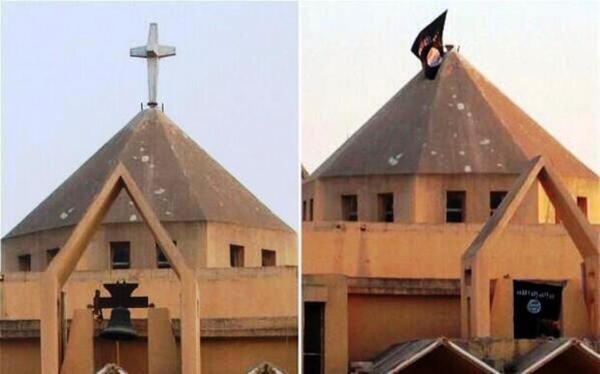
Iraq: The Islamic State posted notices around the captured city of Mosul announcing that the Syriac Orthodox Cathedral Church of St. Ephrem, seized a year ago, was to be become the “mosque of the mujahedeen,” or “jihadis.” The new name was announced on the anniversary of the date the church had been seized. The Islamic flag stating the shehada (“there is no god but Allah and Muhammad is his Messenger”) was draped over the building. “If they changed a church to a mosque it is further proof of their cleansing,” said the president of A Demand for Action, a group advocating the protection of minorities in the Middle East. “They destroy our artefacts, our churches and try to erase us in any way they can.”

1181The Syriac Orthodox Church of St. Ephrem in Mosul, Iraq, before if the captured by the Islamic State (left), and after.

Libya: Yet another Christian cemetery, in the old Christian section of post-“Arab Spring” Tripoli, was recently desecrated by Muslim militants. Described by witnesses as “Salafi” Muslims, the vandals of the grave destroyed crosses and tombstones, and dug up graves in the early morning hours of June 3. Security forces charged with protecting the region did nothing to stop or arrest the men.

Muslim Slaughter of Christians

Egypt: Two Christians were killed under questionable circumstances:

1) The only Christian in his army unit was found shot dead in a chair at the office of the military base in which he was stationed. On June 24, Bahaa Gamal Mikhail Silvanus, 23, a conscript in the Egyptian Army, was found with two bullet wounds in his chest and a gun at his feet. Relatives who later saw the body also say there were wounds on his head, as if he had been struck with a blunt object. The military’s official position is that the Copt committed suicide. Family, friends, and church leaders strongly disagree. They point out that those who commit suicide are rarely able to shoot themselves twice — or first hit themselves on the head with blunt objects. They also point out that Silvanus was a happy man with strong faith, a college degree in music, and plans to enter the monastic life. “My son was killed by someone. He didn’t kill himself,” said his father, Gamal Silvanus, who had advised his son to finish his military obligation, then work for five years to help support the family, and after that to join a monastery. A friend of Bahaa Silvanus, who wished to remain anonymous, said that Silvanus had confided to him that he was regularly pressured by other soldiers in his unit to convert to Islam or else: “He told me that the persecution of the fanatical Muslim conscripts in the battalion against him had been increased the last days, and they threatened him with death, that they would kill him if he wouldn’t convert to Islam.”[1]

2) According to MCN, “Police officer Mohammed Megalli, who killed a Coptic woman, Sarah Youssef Ghali, used to insult Copts of the district and treat them with contempt, said Nour Rashad, a cousin of the Coptic woman. Ghali was accidentally shot dead by Megalli, a police officer from Manshiet Nasser Police Station in Cairo.”

Uganda: A mother of 11, who, along with her husband, left Islam (considered by many Muslims apostasy) and converted to Christianity almost a year earlier, was poisoned to death on June 17 in a village in eastern Uganda. Namumbeiza Swabura, the mother of a 5-month-old baby, died after her sister-in-law visited and offered to prepare a meal for her. She complained of stomach pain that started immediately after eating the food. According to Morning Star News:

Swabura’s pain grew worse as she began vomiting and her nose began to bleed uncontrollably; her face turned pale, and two hours later she died in their home as Muhammad [her husband] was trying to rent a car to take her to a hospital, they said. Her sister-in-law has gone into hiding, the sources said. Swabura and her husband have received several death threats since putting their faith in Christ, according to Muhammad. During a visit by Morning Star News to the area in late May, he said, “We are fearing for our lives as the Muslims are threatening to kill us if we continue in Christianity.” Besides her infant and husband, Swabura wife leaves behind 10 other children.

Dhimmitude: Generic Contempt and Discrimination against ‘Infidels’

Ethiopia: On April 25, police raided a Christian worship service in Asella, just south of the capital, Addis Ababa. The Church of Asella had just baptized 40 new converts to Christianity, an act that prompted mass arrests. One of those imprisoned, a former Muslim, known only as “Palus Ejigu,” who converted to Christianity, said, “We were gathered for sharing and encouraging each other with the Word of God. After we finished the service, police imprisoned us. Some of our friends ran away when they saw the way we were harshly handled.” After weeks of suffering unspeakable prison conditions and abuses, Ejigu was eventually released. But five days later, four masked men forced him on his knees, put a pistol in his mouth, and ordered him to kill two pastor friends, or his children would die.

His wife’s Muslim family, in accordance with Islamic law, had already taken the children away from him.

Egypt: The inferior status of Christian minorities was again on display. The principal of a school in Sohag has been openly refusing the enrollment of Christian students, simply on the basis of their religion. When Copts and others protested — the current law of Egypt is on their side — the principal declared that, “As long as I am present in the school, no Christian pupils will be accepted.”

Popular Egyptian columnist Karima Kamal wrote that although the Egyptian constitution stipulates equality before the law, the judiciary does not apply this provision, and refuses the testimony of Christians against Muslims in courts. Anecdotal evidence supports her claim. Some weeks earlier, the following letter was published:

Yesterday I suffered an extremely harsh psychological shock. I went to court with one of my neighbors, a widow, to serve as witness in an inheritance case. Another neighbor and witness accompanying us was a young Christian. We had all been living as one family. Imagine my shock, then, at the judge who very rudely and with incomprehensible disapproval rejected the testimony of the [Christian] youth: [saying]: “It is unacceptable for a Christian to testify against a Muslim.”

In fact, Islamic law maintains that the testimony of an “infidel” cannot be accepted against a Muslim.

Al Azhar — arguably the Islamic world’s most prestigious Islamic university — continues to incite Egypt’s Muslims against Christians. Most recently, the university was exposed distributing a free booklet dedicated to discrediting Christianity. It is full of direct attacks on Christianity in general and the nation’s Coptic Christians in particular. Christianity is referred to as a “failed religion,” while Islam is hailed as the true and superior religion. Because the “seeds of weakness” are inherent in Christianity and the Bible, says the booklet, Islam was easily able to supplant it in the Middle East. No mention is made of any violent Islamic conquests.

Iran: Iran’s revolutionary court sentenced 18 Christian converts on charges that include evangelism, propaganda against the regime, and creating house churches to practice their faith. The sentences totaled almost 24 years (the lack of transparency in Iran’s tightly controlled judicial system does not allow for a breakdown of individual sentences). The defendants were also barred from organizing home church meetings and given a two-year ban from leaving Iran. The Christians, many of whom were arrested in 2013, were sentenced in accordance with Article 500 of the Islamic Penal Code, which states that “Anyone who engages in any type of propaganda against the Islamic Republic of Iran or in support of opposition groups and associations, shall be sentenced to three months to one year of imprisonment.”[2]

Nigeria: More than 200 girls remain missing after Boko Haram stormed a government school in Chibok in 2014, kidnapping scores of mostly Christian young girls. Escapees continue to testify to the brainwashing that they encountered from their captors. Some were told to slit the throats of Christians and to carry out suicide attacks. One witness said that the Chibok girls have been given special status as “teachers” told to memorize the Koran and teach others to do so. Girls who cannot recite the Koran are flogged.

Pakistan:

1) The “lawyers” of a Christian man imprisoned in Pakistan on the charge of desecrating the Koran last May[3] are actually working against him. Humayun Faisal, a mentally disabled Christian, will remain in prison because his lawyers have withdrawn their request for bail. According to the pool of Christian attorneys of the NGO “Lead,” during the hearing on June 27 before the Lahore High Court, Faisal’s lawyers officially canceled the request for bail, previously submitted by other lawyers. Said Lead:

[There are lawyers who] intervene in cases in which Christians are accused of blasphemy or other crimes and, instead of obtaining justice, do not operate in the interests of the accused, their clients, but act for others purposes.

2) Mumtaz Masih, a Christian man, was recently released from forced slavery by his Muslim employer. Masih had an arrangement with his Muslim employer, part of which was that Masih remain on his employer’s property at all times except once a month when he would receive payment and could go home to visit his family. In July 2014, the employer stopped paying Masih, banned him from home visiting, and effectively turned him into a slave. Masih’s wife sought help when her husband stopped coming. After a habeas corpus court case on May 29, a court official was directed to find Masih, who was found on his master’s property in a locked room. Although slavery is illegal in Pakistan, many poor Christians live and work in such conditions.

Sudan: On June 25, 12 Christian girls were detained for wearing “scandalous outfits” by the Public Order Police as they left the Baptist church in El Izba, Khartoum. The young women, in trousers and skirts, were transferred to a police station; two were acquitted on Friday, after the agents of the Public Order Police reconsidered their opinion. The ten others were charged with “deeds against the public morality” under Article 152 of the 1990 Criminal Code. “The young women attended a religious festivity in the church, and were wearing fancy dress. The charges are an insult to the church,” argued their lawyer. “Furthermore, the students were forced to change their clothes inside the police station, which is an affront to their dignity.”

Turkey: Authorities shut down Christian schools belonging to the Association of Churches of Jerusalem. Schools in several districts of the southeastern city of Gaziantep, where many refugees from Syria had fled, and in three other regions, were closed. Although providing much needed humanitarian relief, the Christian schools were found giving Bibles and other Christian literature to their refugee students, many of whom come from Muslim backgrounds.

Philippines: Christians and others in the southern Philippines say they fear that legislation meant to create an Islamic sub-state on Mindanao Island — legislation meant to appease Islamists — will only create more extremism against Christians. They believe that if Bangsamoro, or “Moro Country” — Moro is colloquial for “Muslim” — were ruled under Sharia, non-Muslims would become second-class citizens with drastically reduced rights. Critics of the bill say it would render the federal government powerless to redress human rights abuses under Islamic law.[4] “What President Aquino is doing is treasonous to Christian communities in Mindanao,” said Rolly Pelinggon, national convener of Mindanaoans for Mindanao (M4M).

United Kingdom: Nissar Hussain, a former Muslim from Pakistan who converted to Christianity in 1996, recently wrote a letter to his local MP recounting some of the violence, abuse, and other attacks that he, his wife and their six children have suffered at the hands of Muslims in the area of Bradford where they live.[5]

Iraq: According to Nineveh Provincial Council member Anwar Mata, “more than 120 thousand Christians [were] displaced from Mosul and Nineveh after the Islamic State invaded Mosul. He further noted that, “about 20 thousand of them have migrated [from] Iraq since last year…. The lack of interest of the federal government towards the displaced Christians pushed them to migrate outside the country … the psychological and moral damage was greater than the loss of their money and property as a result of ISIS occupation of Mosul.” Meanwhile, the theft of Christian property was conducted, not only by IS but by local politicians in Iraq. Impostors and fraudulent groups, thanks to corrupt officials, have managed to acquire illegal possession of thousands of houses belonging to Christian families in Baghdad, who fled the city after the U.S-led ousting of Saddam Hussein uncorked a virulent jihad on them. Mohammed al-Rubai, member of the city council of Baghdad, said that almost 70 percent of Christian houses in Baghdad have been expropriated illegally, and property titles were forged with the tampering of land registers carried out by dishonest bureaucrats. The NGO “Baghdad Beituna” has calculated that the thefts of Christian properties carried out with the complicity of corrupt public officials were about seven thousand. Even members of the political and military apparatus have enjoyed the “legalized” theft of Christian properties.

About this Series

While not all, or even most, Muslims are involved, persecution of Christians is expanding. “Muslim Persecution of Christians” was developed to collate some — by no means all — of the instances of persecution that surface each month.

It documents what the mainstream media often fails to report.

It posits that such persecution is not random but systematic, and takes place in all languages, ethnicities and locations.

_________________

[1] Mikhial Shenouda, senior priest of Archangel Mikhial, adds: “A person who commits suicide is a disappointed and desperate person, but Bahaa was in a very good spirits. He was smiling always. He was keeping the word of God.” Although the Egyptian military and media have said little about this incident, hundreds attended his funeral.

[2] According to a 2015 U.S. Commission on International Religious Freedom report, “Over the past year, there were numerous incidents of Iranian authorities raiding church services, threatening church members, and arresting and imprisoning worshipers and church leaders, particularly Evangelical Christian converts…. Since 2010, authorities arbitrarily arrested and detained more than 500 Christians throughout the country.” Christians make for less than one percent of Iran’s Shia Muslim majority population. “The Iranian regime’s systematic persecution of Christians, as well as Baha’is, Sunni Muslims, dissenting Shi’a Muslims, and other religious minorities, is getting worse not better,” said U.S. Senator Mark Kirk (R-Ill.) in a statement. “This is a direct consequence of President Obama’s decision to de-link demands for improvements in religious freedom and human rights in Iran from the nuclear negotiations.”

[3] On Sunday, May 24, Faisal was accused of blasphemy when some Muslims saw him burning newspapers that reportedly contained Arabic verses from the Koran. After the accusation, a Muslim mob caught the Christian, severely beat him, and even attempted to set him on fire. A few months earlier, another Muslim mob burned a Christian couple alive inside a kiln after they, too, were accused of insulting Islam. After the attack on Faisal, the Muslim mob, reportedly numbering in the thousands, rampaged through the neighborhood and set fire to Christian homes and a church.

[4] The Bangsamoro Basic Law (BBL), proposed by President Benigno Aquino III last September with the aim of ending decades of Islamist rebel violence in Mindanao, was approved by a House Ad Hoc Committee on May 20. The area, comprising five provinces with sizeable non-Muslim populations, already enjoys a measure of autonomy and the proposed BBL would give leaders sufficient independence to impose sharia (Islamic law). The BBL came about as part of a preliminary peace accord between the Aquino administration and the Moro Islamic Liberation Front (MILF) rebel group. But it has done little to reduce violence.The BPFA was signed in 2013 as a precursor to a final peace agreement. The government claimed there would be no more Muslim rebel attacks in Mindanao after it was signed, but in some areas violence –including trademark Islamic attacks on churches and nuns — has been increasing.

[5] The letter reads:

Dear Naseem Shah MP,

Can I congratulate you on behalf of myself and family on your stunning victory and we can’t express our delight as our newly elected MP for the Ward of Manningham and wish you every success for the future. On a serious note can I express our utter misery and dire situation as Christian converts from a Mirpuri/Muslim background since 1996 [Mirpur is a region in Pakistan].

We were forced out of our previous home after over several years of suffering as converts and in short my family and I endured ‘hell’ by my fellow Pakistani young men in the form of persecution which entailed assault, daily intimidation, criminal damage to property: smashing house windows and also 3 vehicles written off whilst the community looked on and even endorsed this. One of vehicles was torched outside my home. Despite witnessing another vehicle being rammed deliberately by a man who I knew, the Police did not even take a statement never mind an arrest. Finally after being threatened to be burnt out of my home these young men deliberately set the neighbours’ house (which was vacant) on fire in the hopes that our house would catch fire. When I had reported it to Police prior to this happening the Police sergeant’s response was: “Stop trying to be a crusader and move out!” In short the Police had wilfully failed us so as not to be labelled racists or seem to cause the Muslim community offence at our suffering and expense.

After being forced to move out in June 2006 we settled in St Paul’s Rd and set about rebuilding our lives, which was going well and had no issues and forged good relations with neighbours until we contributed in a Dispatches documentary called ‘Unholy War’ highlighting the plight of converts from Islam to Christianity in September 2008. Then our problems began, largely posed by the A. family who have been engaged on a campaign to drive us out our home given their bigoted attitude and thoroughly unscrupulous conduct and since last July they have embarked upon criminal damage to my vehicle to the point I have now had my vehicle windscreens smashed for the fourth occasion. The most recent incident occurred on 24 April when I had my vehicle smashed in the early hours of the morning and cannot express the financial impact also as I have to wait 3 weeks at a time for the glass to be ordered from the States as my vehicle is American. And again as in our previous experience the Pakistani community has looked on at our suffering and turned a blind eye whilst others have been openly hostile, while they enjoy freedom and liberty religious or otherwise whilst imposing their will rule and reign upon us and we are treated as second class citizens.

As a result of the latest criminal damage, and after weeks of having no car until it was repaired, I took the liberty of parking my vehicle away from outside my home for peace of mind, as given the misery over the last several years I have been diagnosed with PTSD and my wife and family also suffer stress and anxiety. When I went this morning to get my car I was mortified to discover that my car has been smashed deliberately yet again. Clearly we cannot go on living like this; … our lives have been sabotaged, we fear for our safety and suffer anxiety daily, not to mention the financial costs to all of this wanton criminal damage.

I cannot express in words the Police failure over the years which has led to our suffering and have no confidence in them whatsoever and am desperate for your help.

Kind regards,

Nissar Hussain


Dispatch from Iraq: the Stealth Iranian Takeover Becomes Clear

August 1, 2015

Dispatch from Iraq: the Stealth Iranian Takeover Becomes Clear, PJ Media via Middle East Forum, Jonathan Spyer, July 31, 2015

1484A Shi’a militia billboard in Baghdad

Close observation of the militias, their activities, and their links to Tehran is invaluable in understanding what is likely to happen in the Middle East following the conclusion of the nuclear agreement between the P5 + 1 powers and Tehran.

The genius of the Iranian method is that it is not possible to locate a precise point where the Iranian influence ends and the “government” begins. Everything is entwined. This pro-Iranian military and political activity depends at ground level on the successful employment and manipulation of religious fervor. This is what makes the Hashed fighters able to stand against the rival jihadis of ISIS.

The deal itself proves that Iran can continue to push down this road while paying only a minor price, so why change? Expect further manifestations of the Tehran formula in the Middle East in the period ahead.

****************

In late June, I traveled to Iraq with the purpose of investigating the role being played by the Iranian-supported Shia militias in that country.

Close observation of the militias, their activities, and their links to Tehran is invaluable in understanding what is likely to happen in the Middle East following the conclusion of the nuclear agreement between the P5 + 1 powers and Tehran.

An Iranian stealth takeover of Iraq is currently under way. Tehran’s actions in Iraq lay bare the nature of Iranian regional strategy. They show that Iran has no peers at present in the promotion of a very 21st century way of war, which combines the recruitment and manipulation of sectarian loyalties; the establishment and patient sponsoring of political and paramilitary front groups; and the engagement of these groups in irregular and clandestine warfare, all in tune with an Iran-led agenda.

With the conclusion of the nuclear deal, and thanks to the cash about to flow into Iranian coffers, the stage is now set for an exponential increase in the scale and effect of these activities across the region.

So what is going on in Iraq, and what may be learned from it?

Power in Baghdad today is effectively held by a gathering of Shia militias known as the Hashed al-Shaabi (Popular Mobilization). This initiative brings together tens of armed groups, including some very small and newly formed ones. However, its main components ought to be familiar to Americans who remember the Iraqi Shia insurgency against the U.S. in the middle of the last decade. They are: the Badr Organization, the Asaib Ahl al-Haq, the Kataeb Hizballah, and the Sarayat al-Salam (which is the new name for the Mahdi Army of Muqtada al-Sadr).

All of these are militias of long-standing. All of them are openly pro-Iranian in nature. All of them have their own well-documented links to the Iranian government and to the Revolutionary Guards Corps.

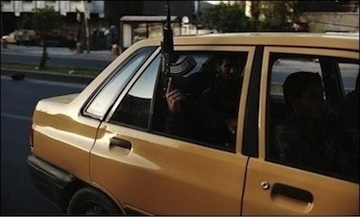
1559Shia militiamen are becoming a fixture of daily life in the Iraqi capital.

The Hashed al-Shaabi was founded on June 15, 2014, following a fatwa by venerated Iraqi Shia cleric Ali al-Sistani a day earlier. Sistani called for a limited jihad at a time when the forces of ISIS were juggernauting toward Baghdad. The militias came together, under the auspices of Quds Force kingpin Qassem Suleimani and his Iraqi right-hand man Abu Mahdi al-Muhandis.

Because of the parlous performance of the Iraqi Army, the Shia militias have become in effect the sole force standing between ISIS and the Iraqi capital.

Therein lies the source of their strength. Political power grows, as another master strategist of irregular warfare taught, from the barrel of a gun. In the case of Iraq, no instrument exists in the hands of the elected government to oppose the will of the militias. The militias, meanwhile, in their political iteration, are also part of the government.

In the course of my visit, I travelled deep into Anbar Province with fighters of the Kataeb Hizballah, reaching just eight miles from Ramadi City. I also went to Baiji, the key front to the capital’s north, accompanying fighters from the Badr Corps.

1469Asaib Ahl al-Haq fighters operating in Baiji in June

In all areas, I observed close cooperation between the militias, the army, and the federal police. The latter are essentially under the control of the militias. Mohammed Ghabban, of Badr, is the interior minister. The Interior Ministry controls the police. Badr’s leader, Hadi al-Ameri, serves as the transport minister.

In theory, the Hashd al-Shaabi committee answers to Iraqi Prime Minister Haider al Abadi. In practice, no one views the committee as playing anything other than a liaison role. The real decision-making structure for the militias’ alliance goes through Abu Mahdi al Muhandis and Hadi al-Ameri, to Qassem Suleimani, and directly on to Supreme Leader Ali Khamenei.

No one in Iraq imagines that any of these men are taking orders from Abadi, who has no armed force of his own, whose political party (Dawa) remains dominated by former Prime Minister Nouri al-Maliki and his associates, and whose government is dependent on the military protection of the Shia militias and their political support. When I interviewed al-Muhandis in Baiji, he was quite open regarding the source of the militias’ strength: “We rely on capacity and capabilities provided by the Islamic Republic of Iran.”

1482Iraqi militia leader Abu Mahdi al-Muhandis (right) with Iranian Quds Force commander Qassem Suleimani

The genius of the Iranian method is that it is not possible to locate a precise point where the Iranian influence ends and the “government” begins. Everything is entwined. This pro-Iranian military and political activity depends at ground level on the successful employment and manipulation of religious fervor. This is what makes the Hashed fighters able to stand against the rival jihadis of ISIS. Says Major General Juma’a Enad, operational commander in Salah al-Din Province: “The Hashed strong point is the spiritual side, the jihad fatwa. Like ISIS.”

So this is Tehran’s formula. The possession of a powerful state body (the IRGC’s Quds Force) whose sole raison d’etre is the creation and sponsorship of local political-military organizations to serve the Iranian interest. The existence of a population in a given country available for indoctrination and mobilization. The creation of proxy bodies and the subsequent shepherding of them to both political and military influence, with each element complementing the other. And finally, the reaping of the benefit of all this in terms of power and influence.

This formula has at the present time brought Iran domination of Lebanon and large parts of Syria, Iraq, and Yemen. Current events in Iraq form a perfect study of the application of this method, and the results it can bring. Is Iran likely to change this winning formula as a result of the sudden provision of increased monies resulting from the nuclear deal? This is certainly the hope of the authors of the agreement. It is hard to see on what it is based.

The deal itself proves that Iran can continue to push down this road while paying only a minor price, so why change? Expect further manifestations of the Tehran formula in the Middle East in the period ahead.

“This caliphate will take over the entire world and behead every last person that rebels against Allah”

August 1, 2015

“This caliphate will take over the entire world and behead every last person that rebels against Allah,”  Front Page Magazine, Daniel Greenfield, August 1, 2015

(But of course, as all good little Obamabots know, the Islamic State it not Islamic. Please see also, Despite Bombing Campaign, Islamic State No Weaker Than a Year Ago. — DM)

isis_map


The Un-Islamic JayVee team that Obama is trying to fight has a big plan. Behead all non-Muslims. Rule the world.

The undated document, titled “A Brief History of the Islamic State Caliphate (ISC), The Caliphate According to the Prophet,” seeks to unite dozens of factions of the Pakistani and Afghan Taliban into a single army of terror.  It includes a never-before-seen history of the Islamic State, details chilling future battle plans, urges al-Qaeda to join the group and says the Islamic State’s leader should be recognized as the sole ruler of the world’s 1 billion Muslims under a religious empire called a “caliphate.”

“Accept the fact that this caliphate will survive and prosper until it takes over the entire world and beheads every last person that rebels against Allah,” it proclaims. “This is the bitter truth, swallow it.”

Unlike al-Qaeda, which has targeted terror attacks on the United States and other western nations, the document said Islamic State leaders believe that’s the wrong strategic goal. “Instead of wasting energy in a direct confrontation with the U.S., we should focus on an armed uprising in the Arab world for the establishment of the caliphate,” the document said.

First the Muslim world. Then the world. It’s a straightforward strategy, one that Osama bin Laden flirted with but never truly committed to. Though he celebrated the Arab Spring, ISIS would reap its rewards.

Retired Defense Intelligence Agency Director Lt. Gen. Michael Flynn, who also reviewed the document, said it “represents the Islamic State’s campaign plan and is something, as an intelligence officer, I would not only want to capture, but fully exploit. It lays out their intent, their goals and objectives, a red flag to which we must pay attention.”

The failure to target the radical Islamic ideas behind the group has given its fighters the opportunity to spread, Flynn said. “If I were in their shoes, I would say,’We are winning, we are achieving our objectives,’” Flynn said. “They have demonstrated an incredible level of resiliency and they will not be defeated by military means alone.”

We have yet to try defeating them by military means.