(Unfortunately, Obama was “in the game” which led to the nuke “deal” with Iran. There, he was not incompetent; he got what he sought. — DM)
Obama has made a lot of foreign policy mistakes in office, but his capitulation on the Iranian nuclear talks followed by Russia’s move into Syria is impossible to explain away as anything but a stupendous strategic fiasco. Incompetence is too nice a word. Obama was never even in the game.
*********************
It is sometimes said that in negotiations with foreigners, American leaders play checkers, while their wilier opponents play chess. There is perhaps some truth to this, as American leaders sometimes chase short-term political results, a consequence of democratic governance and constantly changing leadership. By contrast, despotic Persians are credited with inventing chess, and in modern times autocratic Russians have been its master, and so it is tempting to say of President Obama’s dealings with those two countries that the analogy holds.
But that is way too charitable. As Vladimir Putin skillfully reasserts Russian power and influence in the Middle East with Islamic Persian Iran as a willing partner, a more apt analogy might be that while the Russians and Iranians move their chessmen, isolating and threatening opposing pieces, Obama is not even at the table, but rather childishly looking on, as he pushes diplomatic dirt around the Middle East sandbox.
For over 150 years, a primary objective of Western diplomatic and military strategy was to keep the Russians out of the Middle East and Southwest Asia. In the 1850s, the British and French went to war in Crimea to protect the Ottomans from Russian predation and to preserve the balance of power. Later, the so-called “Great Game” centered on similar British efforts to frustrate Russian domination of Iran and Afghanistan. A century later, the United States took up the task, offsetting Russian influence in newly socialist Arab dictatorships by backing Israel and more traditional Arab monarchies in the Middle East, while openly and successfully opposing the Soviet incursion into Afghanistan.
Today, one can’t even say there remains any Western strategy regarding Russia. Western Europe has mostly forfeited its military and political influence overseas to support decadent welfare states, even as it is being progressively and deliberately overwhelmed by millions of Islamist migrants. Under Obama, who supports and admires Europe’s demise, the United States has increasingly joined in the decline. The laughable Libyan campaign, “fought” by Europeans while the U.S. led from behind, set an example of pursuing a feckless, feel-good military campaign without regard for consequences or traditional strategic concerns. Obama’s encouragement of the so-called Arab Spring and its Islamist provocateurs almost lost Egypt and did lose Syria, with catastrophic humanitarian and geopolitical results.
Putin is taking advantage of American weakness and inaction. A half-century of successful American effort to keep the Russians out of the Middle East has been forfeit in a few months of breathtaking American diplomatic and military incompetence. Obama’s capitulation in the Iran deal effectively completed the groundwork for the Russian move, Putin having carefully monitored America’s year-long and ineffectual air campaign against ISIS. Putin now claims that Russia’s push into Syria is to redeem the campaign against ISIS with Russian troops fighting with Syria and Hezb’allah. Embarrassed by Putin at the U.N., Obama gave up any pretense of strength, effectively welcoming the Russian “intervention” against ISIS. Unexplained is why a large percentage of Russian anti-ISIS forces are heavily equipped with anti-aircraft weapons, something that even a flaccid NATO command cannot ignore, inasmuch as ISIS have an air force. Those weapons are useful only against NATO or Israeli aircraft.
So lost was Obama before his meeting with Putin at the U.N. that his stated strategy for dealing with the Russian strongman was to ask him what he was doing. From the stiff and awkward body language of the president following the meeting (a painful handshake and awkward smile) it is clear that Putin told Obama at least some of the story, whether Obama liked it or not. Most particularly, his client Bashar Assad will remain in power with Russian backing, regardless of Obama’s view on the matter. But likely Obama had known what he was in for, and just going through the motions. The day before, Secretary of State of State John Kerry responded to a question about how long the U.S. could tolerate the survival of Assad, saying, “… it doesn’t have to be on day one or month one or whatever.” Right, dude, whatever. Between Obama and Kerry, it is now fair to assume that our much muddled and irresolute Syrian policy is “whatever,” which means we just don’t care. We take our toys and go home.
If Obama was hoping, as he and his supporters implied, that the Iranian deal would produce a more moderate, cooperative Iran, Putin and the mullahs are doing all they can to demonstrate how wrong he was. If he was hoping that “international pressure” and the conflict in Ukraine would moderate Putin’s aggressive strategies, he was wrong again. And if he thinks that by quitting, he has left Putin an unwinnable game, the Russian leader aims to prove him wrong again. And since Obama is almost always wrong when it comes to foreign policy, it’s a fool’s errand to bet against Putin.
In chess, before going for the opponent’s king, typical strategy calls for supporting one’s important pieces, while threatening and isolating opposing pieces. The Russians and Iranians are now going about this with a vengeance, without the United States or the West making any noticeably effective counter-moves. Russia is backing and protecting Assad and has closely allied itself with a newly empowered (thanks largely to Obama) Iran. Meanwhile, traditional American allies in the region, Israel, Egypt, and the Arab monarchies are indeed increasingly threatened and isolated. The stage is being set for a Russo-Iranian endgame that could prove disastrous to America’s traditional allies and the West in general.
Some of Obama’s liberal supporters dismiss such analysis as over the top, and insist that Putin’s moves have more to do with domestic politics than a long-term Middle Eastern power play. They point out Putin’s problems at home, and the relative weakness of the Russian military. However, relative Russian weakness means little when moving into a power vacuum created by Obama’s flight from international responsibilities and, to a large extent, reality. And besides, this has been the basic way liberals have sought to excuse Obama whenever he is pushed around by a foreign leader (which is almost always). Putin’s got problems, so he invades Ukraine, threatens the Baltic States, and moves into Syria. The Chinese have problems, so they push naval vessels into American waters and fortify disputed Western Pacific archipelagos. Korea’s got problems, Iran’s got problems, and none of their aggressive actions has anything to do with the dilettante in the White House. It’s all about solving problems at home with international temper tantrums.
Obama has made a lot of foreign policy mistakes in office, but his capitulation on the Iranian nuclear talks followed by Russia’s move into Syria is impossible to explain away as anything but a stupendous strategic fiasco. Incompetence is too nice a word. Obama was never even in the game.
Obama’s options are to counteract the expansion or offer lectures while Russia gives him a “back kick.” Like so much of his conduct, Obama’s U.N. speech amounts to pasting a “kick me” sign on his backside.
*********************************
“History, Stephen said, is a nightmare from which I am trying to awake. . .What if that nightmare gave you a back kick?”
This passage from Ulysses captures the Obama presidency in the realm of foreign policy. History, the nightmare from which the president is trying to escape, has given him a “back kick” — in Iraq, Syria, Libya, Ukraine, and Yemen for example — and he risks becoming a laughingstock as a result.
But there’s a twist. President Obama denies he has been kicked. His nightmare thus becomes ours.
Obama’s speech to the United Nations illustrates the problem. Elliott Abrams, describing the speech as “surreal,” writes that it “is filled with nice lines that unfortunately bear no relationship to his seven years of foreign policy — and in some cases, no relationship to reality.”
Abrams supports this claim by analyzing what Obama had to say about Syria, Libya, Ukraine, and Cuba. The analysis is well worth reading.
I want to focus, though, on a portion of just one passage. Obama stated:
I stand before you today believing in my core that we, the nations of the world, cannot return to the old ways of conflict and coercion. We cannot look backwards. We live in an integrated world — one in which we all have a stake in each other’s success. . . .And if we cannot work together more effectively, we will all suffer the consequences. That is true for the United States, as well.
The disdain for history is evident and, in a sense, warranted. But it doesn’t follow from the fact that history has been unpleasant that we cannot (or should not) look back at it. History has much to teach us.
One lesson is that Obama’s claim that “we cannot return to the old ways of conflict and coercion” is rubbish. The world not only can “return” to them, it has (and never stopped).
Another lesson is that conflict and coercion don’t necessarily cause “all” to “suffer” bad “consequences.” Often conflict and coercion produce winners and losers. The losers suffer, but the winners, though often paying some price, thrive for decades and sometimes centuries.
The fact that we “live in an integrated world” doesn’t alter this reality. If Obama knew anything about history, he would understand that integration isn’t new. Europe and large portions of Asia were integrated by trade and migration more than two thousand years ago. In important ways, today’s world, with its religious wars and mass movement of peoples, bears more resemblance to the ancient one than to yesterday’s world of seemingly solid nation states (which was also integrated).
Obama wasn’t offering a history lesson, though. The speech was an exercise in self-justification — an attempt to demonstrate that although he looks like a loser, he isn’t really one because the old world of losers and winners has been extinguished. This farcical claim will only enhance Obama’s status as a laughingstock.
But the speech had a serious side, I think. It seems to me that Obama was sending this message to Putin: Russia will suffer if you don’t cooperate with the U.S. In fact, Obama mentioned the sanctions against Russia and their consequences (“capital flight, a contracting economy, a fallen ruble, and the emigration of more educated Russians”) in his speech.
The message isn’t implausible. Russia reportedly is starting to run short on foreign currency reserves, thanks in part to sanctions. Russia also runs the risk of military overreach if it continues to become more involved in Syria. Its dirty little war in Ukraine enjoys only mixed support at home and polls show little appetite by Russians for large scale military involvement in Syria. (Just as we had Vietnam, Russia had Afghanistan).
But Putin is a skillful operator. He doesn’t need lessons from Obama.
Taking on ISIS to a serious degree would require a level of military engagement that might erode Putin’s domestic support. But it’s unlikely that Putin is serious about doing ISIS in (though I’m pretty sure he would like to). He just dangles this prospect, as Iran does, to tantalize Obama.
Putin’s goals, it seems to me, are (1) to work with Iran to help Assad maintain control over a portion of Syria, (2) cement relations with Iran, and (3) diminish U.S. influence in the region. He may well be able to accomplish these objectives without a level of military involvement that might hurt him at home.
As for Russia’s finances, they appear to be a looming problem. Ironically, however, Obama has undercut the Russia sanctions by lifting those on Iran. The Iran deal will boost the Russian economy by enabling Russians to sell all manner of weapons to the mullahs.
These sales alone won’t solve Russia’s economic problems. It needs a strong rebound of oil prices, which may or may not be in the cards.
But history suggests that “capital flight, a contracting economy, a fallen ruble, and the emigration of more educated Russians” won’t be sufficient to dissuade an autocrat like Putin from expanding Russia’s influence in Eastern Europe and the Middle East.
Obama’s options are to counteract the expansion or offer lectures while Russia gives him a “back kick.” Like so much of his conduct, Obama’s U.N. speech amounts to pasting a “kick me” sign on his backside.
Yesterday, the House Homeland Security Committee released the final report of its Task Force on Combating Terrorist and Foreign Fighter Travel and its conclusions weren’t pretty. The following are a dozen hair-raising facts from the bipartisan report:
“Today, we are witnessing the largest global convergence of jihadists in history.”
If you consider how the jihad in Afghanistan against the Soviets impacted the terrorist threat to the West, then we’re in for a heap of trouble due to the jihad in Syria, Iraq and elsewhere.
About 10,000 foreign fighters joined the jihad against the Soviets over roughly a 10-year period, with only 3-4,000 fighter joining at once. Today, over 25,000 foreign fighters are currently in Syria and the civil war is only four years old. When it started in 2011, the number of foreign fighters was a mere 1,000.
“We have largely failed to stop Americans from traveling overseas to join jihadists … Several dozen also managed to make it back into America.”
This stunning conclusion will add ammunition to efforts to revoke the passports of Americans who are believed to have joined jihadists overseas. Aside from constitutional objections, one rebuttal has been if the government has the evidence to show an American has joined terrorists, then it can simply arrest them if they try to re-enter. The report shows that these American traitors have been able to evade detection and come back home to potentially carry out attacks and/or radicalize others.
“The U.S. government lacks a national strategy for combating terrorist travel and has not produced one in nearly a decade.”
This statement, unfortunately, speaks for itself.
“The unprecedented speed at which Americans are being radicalized by violent extremists is straining federal law enforcement’s ability to monitor and intercept suspects.”
Over 250 Americans have joined or tried to join the jihadist groups in Iraq and Syria, including around 30 females. They come from 19 states, with 26% coming from Minnesota, 12% from California and 12% from New York/New Jersey.
“There have now been twice as many ISIS-inspired terror plots against the West in 2015 than there were in all of 2014.”
This conclusion is unsettling—and charitable. A review by terrorism expert Patrick Poole found that the number of Islamist terrorism cases in the U.S. this year was double that of the previous two years combined. And that was as of about four months ago.
“[ISIS] is believed to have inspired or directed nearly 60 terrorist plots or attacks against Western countries, including 15 in the United States.”
“Military officials estimate airstrikes have killed over 10,000 [ISIS] extremists, but new foreign fighters replace them almost as quickly as they are killed.”
This substantiates the admission that the U.S. fight with ISIS was at a “stalemate.” Our analysis of the numbers led to thesame conclusion back in May. If you look at ISIS’ membership and territorial expansion, the U.S. is barely making a dent.
Additionally, optimistic claims of success exempt ISIS’ growth outside of Iraq and Syria. The Committee mentions reports that there are “hundreds, if not thousands” of ISIS members in Afghanistan now and the Libyan government believes it is dealing with 5,000 of its own jihadist foreign fighters now.
“Gaping security weaknesses overseas—especially in Europe—are putting the U.S. homeland in danger…”
The report raises several warnings about European security procedures, a pressing issue considering that about 1,550 fighters from France, 700 from Germany and 700 from the United Kingdom have joined the jihad in Syria and Iraq. The Committee found that counter-terrorism checks at European borders and airports are insufficient.
One-third of the international community does not issue fraud-resistant E-Passports or utilize the INTERPOL databases that contain the names of terrorists.
“In short, information about foreign fighters is crossing borders less quickly than the extremists themselves.”
The report emphasizes that intelligence-sharing remains a severe problem. There isn’t even an international comprehensive database of foreign fighter names.
“The federal government has failed to develop clear early intervention strategies—or ‘off-ramps’- to radicalization—to prevent suspects already on law enforcement’s radar from leaving to join extremists.”
Someone who is actively trying to join a group like ISIS or Al-Qaeda is probably too far gone to be rescued, unless they get a brutal wakeup call when they see the caliphate first-hand. The report states that 80% of foreign fighters download extremist propaganda and/or engage a jihadist online. It is critical that we target the ideology that precedes the violent act.
“Few initiatives exist nationwide to raise community awareness about foreign fighter recruitment and to assist communities with spotting warning signs.”
The report says that 75% of foreign fighter arrests in the U.S. happen due to the involvement of a confidential informant who is close enough to the suspect to provide the critical evidence. Presumably, this would be a Muslim in most cases. This is why Islamist propaganda that demonizes the FBI and its informants must be rebutted, such as when the Council on American-Islamic Relations (CAIR) claims that the War on Terror is “made up” by the FBI and its informants are paid to frame innocent Muslims.
“The Administration has launched programs to counter-message terrorist propaganda abroad, but little is being done here at home.”
The report isn’t exactly kind to our ideological strategy abroad, either. It says the U.S. government has not exploited the opportunity presented by “jaded jihadists”— Islamist terrorists who join the caliphate, realize it wasn’t all it was cracked up to be and flee. For example, a State Department video featuring such testimonies had only 500 views over two months.
That’s 30,000 foreign fighters. Not Syrians or Iraqis. ISIS heavily depends on foreign fighters and there are plenty of Muslims from around the world who are eager to join.
Nearly 30,000 foreign recruits have now poured into Syria, many to join the Islamic State, a doubling of volunteers in just the past 12 months and stark evidence that an international effort to tighten borders, share intelligence and enforce antiterrorism laws is not diminishing the ranks of new militant fighters.
Among those who have entered or tried to enter the conflict in Iraq or Syria are more than 250 Americans, up from about 100 a year ago, according to intelligence and law enforcement officials.
Those are sizable numbers when you consider how much trouble conventional armies have filling recruitment numbers. And ISIS often pays late, though it pays well.
And those 30,000 recruits have often had to smuggle themselves in, dodge law enforcement and make difficult trips. Not only does this shut down the “ISIS is losing” narrative. But if even a group that most Muslims take issue with (mainly because it demands that they accept it or die) can pick up that many recruits, the whole “Tiny minority of extremists” narrative looks shaky.
The worse ISIS behaves, the more Muslims flock to join it. Not only isn’t its brutality a turn off, it’s a turn on. The more horribly it kills people, the more Muslims want to be part of it.
That’s just the reality and it has to be dealt with.
All these lectures on how ISIS is un-Islamic and has nothing to do with Islam haven’t fooled any actual Muslims. All they’ve done is fooled deluded Western leaders into thinking that black is white and up is down.
President Obama’s address to the U.N. General Assembly on Monday morning was a rambling journey through a fantasy world where his foreign policy hasn’t been an unmitigated disaster.
Perhaps the most bizarre moment came when he tried to tout his Libyan adventure as a success.
There was plenty of tough-guy posturing that intimidated absolutely no one. The Russian and Iranian delegations were especially good at looking bored and unimpressed when he called upon them to do this-or-that because The World supposedly demanded it. Obama hasn’t figured out he’s the only leader at the U.N. eager to sacrifice his nation’s interests to please The World.
Obama made the weird decision to vaguely threaten Russia over its invasion of Ukraine by claiming that The World would not stand idly by and allow it… when that’s exactly what The World, and especially First Citizen of the World Barack Obama, has been doing. He essentially pleaded with Iran to stop supporting terrorist proxies and pursuing its aggressive regional ambitions, and focus on their economy instead. (Of course, in Obama’s vigorous imagination, the U.S. has been enjoying an economic boom under his stewardship, instead of an endless grinding non-recovery and limp, sporadic growth, after Obama’s spending doubled the national debt in a single presidency.)
It was bad enough that the President talked about American troops coming home from Iraq and Afghanistan as the triumphant conclusion of an effective policy, rather than the hideous blunder that allowed ISIS to create a terror state, al-Qaeda to rise from the ashes, and the Taliban to begin planning its return to power. At the same moment Obama was speaking, the Taliban was conducting a major offensive in Afghanistan, on par with the importance of ISIS taking Mosul in Iraq. Obama’s pitifully small “New Syrian Force” of U.S.-backed rebels just handed a good deal of its American equipment over to al-Qaeda, and no one really knows what became of the unit itself. Their predecessors were destroyed by al-Qaeda’s Nusra Front in Syria, with less than half a dozen survivors still on the field.
When Obama boasted of the Libyan operation as the successful removal of a tyrant, jaws must have hit the floor around the room. Libya is an unholy disaster, a wasteland of warlords fighting to keep ISIS off their turf. It’s a key gateway for the incredible migratory tide blasting out of Africa and the Middle East and now surging across Europe. And yet, Obama portrays it as [a] laudable example of tyrant removal… while modestly admitting that “our coalition could have, and should have, done more to fill a vacuum left behind.”
Of course he blamed everyone else in the “coalition” for the disaster in Libya. He’s Barack Obama. The day may come when he takes responsibility for something, but today is not that day, and tomorrow isn’t looking good either.
The scary thing about Obama is that he believes so completely in the power of his own rhetoric.
He thinks he can reshape reality with his words. When he scolds the Iranians for their “Death to America!” rhetoric by saying bloodthirsty chants don’t create jobs, he’s asking Iran to live up to the silly talking points he foisted off on the American people to cover the Iranian nuclear deal. He’s commanding Iran to act like the enlightened, responsible nation-state he gambled the future of Israel, America, and much of the Western world on.
The Iranians, on the other hand, see no reason to knock off the “Death to America!” chants, disband their theocracy, and begin spending their days arguing about stimulus bills. Belligerence has gotten them everything so far. They’ve been rewarded for it… by Barack Obama. They’ve got $150 billion in sanctions relief coming their way. They can afford to send a few guys to sit in the U.N. General Assembly with pissy expressions on their faces while Obama rambles on about how geo-political crime does not pay. They know for a fact it pays, quite handsomely. The Iranians are already using their Obama loot to reinforce terror proxies like Hamas and Hezbollah, and secure Bashar Assad in power.
Ah, yes, Bashar Assad… the dictator Obama still blathers on about removing from power, even as his own diplomatic apparatus gets used to the idea Assad is not going anywhere. The only really good part of Obama’s speech was when he spent five seconds glaring at the Syrian ambassador before launching into his denunciation of barrel bombs and chemical weapons. But you know what? That Syrian ambassador gets paid enough to take a few seconds of hairy eyeball from the ineffectual American president. The Russians are smoothly replacing American influence across the Middle East, in partnership with Iran. The new order is taking shape. Obama isn’t going to reverse that process by telling aggressive, bare-knuckle conquerors they should be ashamed of themselves.
The other dangerous thing about this delusional President is his belief in the “judgment of history.”
He’s constantly hitting on the idea that all of the world’s villains are on the wrong side of history, and will find themselves buried in the sands of time any day now. It’s a dodge, a way of Obama evading responsibility. Bashar Assad is going to remerge from the Wrong Side of History in pretty good shape. ISIS is very comfortable there, as is Iran. Qaddafi didn’t assume room temperature because History caught up with him. Vladimir Putin has a lovely view of Crimea from the wrong side of history. The history of Europe is being reshaped by the tramping of a million “refugee” feet.
In every example, Obama clings to the idea that he can change the world by talking and scoring debate points, while his adversaries seize territory and control the course of events. It’s not as though Obama has some deep-seated reluctance to use deadly force – there have been a lot of deaths by drone strike since he won that Nobel Peace Prize. What Obama lacks is commitment. His foreign policy is all about gestures and distractions. He cooks up half-baked plans that will blow up a terrorist here and there, so he can’t be accused of doing “nothing,” but he won’t do anything that could cost him political capital at home. Even Libya was half-hearted and calculated for minimum risk, which is why the place went to an even deeper Hell after Qaddafi was overthrown.
Obama talks as if he’s taken action against numerous crises, but all he ever did was talk about them. The men of action are stacking up bodies, and raising flags over conquered cities, while this President is writing speeches and trying to win applause from editorial boards. The men of action know that Obama’s promises all have expiration dates, his vows of action always have escape clauses, and no matter how he loves to boast that he heads up the most powerful military the world has ever seen, he’s done everything he can to make it weaker.
President Obama is still clinging to a romantic vision of the “Arab Spring” as a flourishing of democracy, despite all evidence to the contrary. He’s giving the same foreign policy speeches he gave in 2009 because he can’t bear to live in the world he made. He talks about filling vacuums and voids… but those voids are already filled, by hard characters with plans to make the most of the extraordinary opportunity Barack Obama afforded them.
(Obama would need the approvals of Putin, Xi, Rouhani, Assad, Erdogan and “our” other “peace partners” as well as his trained seals at the Department of Defense. Then, and only then, could General Bowie Bergdahl lead his march to victory. Or something. — DM)
What if there was an actual strategy to defeat ISIS and stop their reign of terror? The state of affairs and the very existence of IS as a governing entity is intolerable so we developed a strategy called Cut Down the Black Flag – A Plan to Defeat the Islamic State, the second book in the Secure Freedom Strategy series.
President Obama has failed to articulate or implement anything resembling a strategy during his time in office. This fact is even more painful when considering the rise of the Islamic State (IS) occurred on his watch and was largely due to his shortsighted and foolish decision to cut and run from Iraq. He lost the peace after our troops won the war.
Unlike the President, we’re not interested in token gestures doomed to failure as IS kills, rapes, and tortures on ground won for freedom just a few short years ago. We will not stand on the sidelines as an Inter-Continental Caliphate calls for “Death to all Infidels.” We have a plan to win and cut down their blood-soaked, Black Flag of Jihad.
It will not be easy but it is an essential part of the war for the free world. If we do not make a full faith effort to destroy IS, we will have done a disservice to all who gave their lives and limbs to free Iraq from tyranny. We will also be leaving millions to suffer the chaos and killing fields created when the inevitable vacuum of our withdrawal was filled by IS and Iran.
This book details a strategy focused on victory, aimed for stability in the region with the possibility of actual peace. It recognizes this action must be part of a greater “long war” against the whole of the Global Jihad Movement (GJM). They are the collection of groups who, while not officially associated, share a belief in Islamic Supremacy and are working actively to achieve it.
The Violent Jihadists like the Islamic State, Al Qaeda and others are easily identifiable as our enemies. The Civilization Jihadists of the Muslim Brotherhood and the groups it has spawned such as Council on American-Islamic Relations (CAIR) and the Islamic Society of North America (ISNA) are less overt but perhaps even more dangerous. Our overall strategy to defeat the Global Jihad Movement with a whole of government and culture approach is detailed in the Secure Freedom Strategy.
Our plan to defeat the Islamic State is a complete departure from the dismal failures of the current Commander in Chief leading from behind. The military might and will to win of the United States are vital to any chance of success. This does not mean we propose rolling tanks in a thunder run from Baghdad to Damascus. But we must take the handcuffs off the forces we already have deployed by allowing them to participate in combat missions with the forces they have trained to provide command and control and direct fire support. We must remove the cumbersome and overly risk-averse process for airstrikes that leave most of our aircraft returning to base with all munitions unused.
We must also work with the Sunni tribes who helped us defeat the precursor to IS; and, arm the Kurds who are our best friend and truest ally in the region. Both of these groups were left to the mercy of a central Iraqi government when U.S. forces withdrew and Iranian influence became dominant. We must look to a future where they govern by self-determination rather than remain forced into artificial borders established nearly 100 years ago; and, that have been largely erased over the recent war-torn years.
Our strategy is ambitious, but it does not require large deployments of U.S. troops or the expectation we will be the sole guarantor of security going forward. We aim to cut off the head of the jihadist snake by empowering the indigenous people who have suffered the most from its actions and then let them govern themselves. This strategy vigorously executed can do what the current half-hearted efforts never will: Defeat the Islamic State.
Pope Francis and Turkey’s Islamist leader, Recep Tayyip Erdogan
With the visit of Pope Francis to the United States, some attention has been paid to his views on Jihad in general and the September 11 attacks in particular.
On a visit to the September 11 memorial at Ground Zero, the pope made a statement that we find offensive and born of ignorance.
From USA Today:
In a remark some relatives of 9/11 victims may disagree with, the pope attributed “the wrongful and senseless loss of innocent lives” at Ground Zero to “the inability to find solutions which respect the common good.”
To what solutions could Pope Francis possibly be referring?
What “solutions which respect the common good” would have convinced Osama Bin Laden, Ayman al-Zawahiri, Khalid Sheikh Mohammed and Mohammed Atta that violent Jihad was wrong?
Al Qaeda and all Jihadist groups have as their goal the imposition of Shariah through violent Jihad. We can only assume that the pope is unaware of this. We must also assume that he is unaware that mainstream Islamic doctrine also calls for the imposition of Shariah worldwide.
Which Catholics and other Christians should be sacrificed to live under Shariah for the “common good?”
This was not the first time Pope Francis made statements that demonstrate an ignorance of Islamic doctrine.
In his The Joy of the Gospel, the pope stated:
Faced with disconcerting episodes of violent fundamentalism, our respect for true followers of Islam should lead us to avoid hateful generalizations, for authentic Islam and the proper reading of the Quran are opposed to every form of violence.
No one can study Islamic doctrine based on the Islamic trilogy–the Quran, the Hadith and the Sirah–and come away believing that “authentic Islam and the proper reading of the Quran are opposed to every form of violence.”
It should be noted that when it comes to commentary on Islam, Pope Francis is merely stating his opinion; this is not a statement that has the authority of the Catholic church behind it since it applies to the interpretation of another religion.
But all one has to do to see the folly in the pope’s assertion here is to review the too numerous to count examples of Islamic religious leaders and Shariah scholars admonishing their followers to violent Jihad.
We could fill volumes with examples of violent exhortations in the Quran, the Hadith and the Sirah. We could go into depth here about the principle of abrogation in the Quran. But rather than do that, we would like to point out that there are other members of the Catholic clergy and community who are more informed on Islam, Shariah and Jihad and they have put their thoughts in writing. In some cases, these good men are much closer to the tip of the spear in the clash of civilizations:
Nigerian cardinal criticizes role of sharia, says Muslim leaders must ‘rein in their mad dogs’
Nigeria of course has been wracked for several years now by horrible violence committed by Boko Haram, which has recently pledged allegiance to the Islamic State. Cardinal Onaiyekan has seen thousands of Christians in his country slaughtered at the hands of Jihadists and he knows that Boko Haram’s stated goal is the imposition of Shariah.
Rev. James V. Schall, S.J. expresses a very different view from that of Pope Francis on the issue of the Islamic State and the role of Islam in violence.
Robert Royal, editor-in-chief of The Catholic Thing, and president of the Faith & Reason Institute in Washington, D.C., also expresses a far different view of Islamic terrorism than the one expressed by Pope Francis.
Why have these three men, two American and one Nigerian, two men of the cloth and one a prominent lay Catholic, one black and two white, reached such a different conclusion than that of Pope Francis?
To those of us who have studied Islamic doctrine over the past 15 years, the clear answer is that they have studied the Quran, the Hadith, the Sirah and Shariah. Pope Francis clearly has not. Francis is not alone in that state of being; few if any world leaders in the non-Islamic world have studied Islamic doctrine.
But those who have know what it contains and it isn’t all about peace, the “opposition to every form of violence” and “solutions for the common good.”
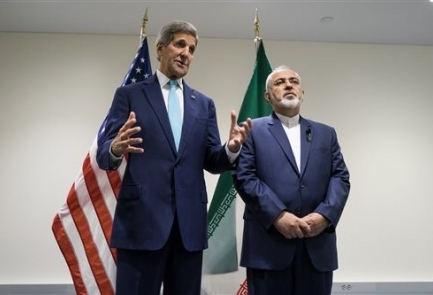
The Munich moment is upon us. U.S. Secretary of State John Kerry with Iranian Foreign Minister Mohammad Zarif at U.N. headquarters on Saturday | Photo credit: AP
Washington is reaching out to Russia, which is openly helping Syrian President Bashar Assad, who is working in conjunction with Iran, which in turn supports Hezbollah. Now Europe is prepared to talk to Assad, but what about us, for heaven’s sake?
Two years ago to the day, in September 2013, U.S. Secretary of State John Kerry compared Bashar Assad to Adolf Hitler, after the Syrian dictator once again used chemical weapons against his own people. “This is our Munich moment,” Kerry said at the time.
As far as the Americans were concerned, Assad had crossed a line. In those days (more like in those hours, actually), Washington briefly believed that a failure to respond to Assad’s actions would send a dangerous message to Iran regarding its nuclear ambitions.
“Will [Iran] remember that the Assad regime was stopped from those weapons’ current or future use, or will they remember that the world stood aside and created impunity?” Kerry asked at the time. History and retrospect have turned what may have been Kerry’s greatest speech into remarks entirely detached from reality.
The United States did not attack, Assad is still in power, and an ominous nuclear deal has been signed with Iran. It is no wonder that there is a new kind of atmosphere in the region, under American auspices. There are no more good guys and bad guys; everyone is a partner. And thanks to this new reality, Assad now has a renewed license to rule, after having received a license to kill.
Washington is reaching out to Russia, which is openly helping Assad in Syria, who is working in conjunction with Iran, which in turn supports Hezbollah. Europe (Angela Merkel), in the meantime, startled by its refugee crisis, is already prepared to talk with Assad; the same Assad who was compared to Hitler only two years ago. But what about us, for heaven’s sake?
Regretfully, Israel’s biggest fears are now materializing. Instead of being the architects and shaping a new reality in the Middle East, Washington is falling into line with the existing reality. Russia, Syria and Iran are enjoying the consequent vacuum. When the cat is away, the mice will play. Now, all of a sudden, even Hezbollah chief Hassan Nasrallah is letting himself go on television, beaming with joy. Aside from the 75 tanks Damascus is giving him, he now sees his two patrons (Damascus and Tehran) become partners with the West, without having to change one bit.
There is no diplomatic vacuum
The latest developments in Syria are not encouraging: Assad’s first target, with Russia’s help, is expected to be the Nusra Front rebel group, which not only threatens Assad but is also a bitter enemy of the Islamic State group. In other words, somewhat paradoxically, Islamic State could initially benefit from the Russian intervention in Syria.
And one final word about Iran’s rapprochement with the international community: We have been told repeatedly that this was only about the nuclear deal, but in reality we can see cooperation between the U.S. and Iran in Iraq and in the war against Islamic State. We can also see American-Iranian dialogue regarding Syria’s future, and on Saturday night we learned of a gigantic deal worth upwards of $21 billion between Iran and Russia. This time I am forced to agree with Secretary Kerry: This really does look like a Munich moment.
[T]he Jaysh al Fateh alliance, which is led by Al Nusrah and its closest jihadist allies, has captured more territory from Assad’s regime this year than the Islamic State has.
Not only has al Qaeda thwarted America’s first efforts under the overt $500 million train and equip program, which is managed by the US military, it has also taken out rebels who received unofficial support from the US intelligence community.
*****************************
US-backed rebels in the so-called “New Syrian Forces” (NSF) have turned over at least some of their equipment and ammunition to a “suspected” intermediary for Al Nusrah Front, US Central Command (CENTCOM) conceded in a statement released late yesterday. The coalition-provided supplies were given by the rebels to Al Nusrah, an official branch of al Qaeda, in exchange for “safe passage within their operating area.”
The “NSF unit contacted Coalition representatives and informed us that on Sept. 21-22 they gave six pick-up trucks and a portion of their ammunition to a suspected Al Nusrah Front intermediary, which equates to roughly 25 percent of their issued equipment,” CENTCOM spokesperson Col. Patrick Ryder said. “If accurate, the report of NSF members providing equipment to Al Nusrah Front is very concerning and a violation of Syria train and equip program guidelines.”
While Ryder left open the possibility that the report is not accurate, he did not offer any explanation for why the NSF unit would lie about giving the equipment to Al Nusrah. The admission further jeopardizes the unit’s ability to receive American arms in the future.
Rebels belonging to Division 30, a group supported by the US, suffered losses immediately upon entering the Syrian fray earlier this year.
More than 50 members of Division 30 were sent into Syria in July. But Al Nusrah quickly thwarted their plans, even though the US-backed rebels intended to fight the Islamic State, Al Nusrah’s bitter rival. A number of Division 30 fighters were captured or killed within days of embarking on their mission.
Al Nusrah released a statement at the time saying that Division 30 is part of an American scheme that is opposed to the interests of the Syrian people. Al Qaeda’s branch accused the group of trying to form “the nucleus” of a “national army” and blasted the attempt to bolster the “moderate opposition.”
Al Nusrah also attacked Division 30’s headquarters in Azaz, a city north of Aleppo. The US responded with airstrikes, killing a number of jihadists, but the damage to the limited US effort was done. US officials said earlier this month that only four or five rebels were left in the fight. Dozens of additional US-supported rebels have entered the war in recent weeks, according to US military officials.
Not only has al Qaeda thwarted America’s first efforts under the overt $500 million train and equip program, which is managed by the US military, it has also taken out rebels who received unofficial support from the US intelligence community.
Al Nusrah Front has consistently resisted the West’s meager attempts to build a reliable opposition force. Late last year, al Qaeda’s branch pushed the Syrian Revolutionaries Front (SRF), which had reportedly received some support from the West, out of its strongholds in the Idlib province. The SRF’s demise helped pave the way for Al Nusrah and its allies in the Jaysh al Fateh (“Army of Conquest”) coalition to capture much of Idlib beginning in late March.
After being vanquished, SRF head Jamaal Maarouf accused Al Nusrah’s emir, Abu Muhammad al Julani, of being a “Kharijite” (or extremist). This was an about-face in the relationship, as the SRF and Al Nusrah had previously fought side-by-side. Maarouf also publicly lamented the limited support he had received from the West.
Earlier this year, Al Nusrah also took the fight to Harakat Hazm (the Hazm Movement) outside of Aleppo. Despite receiving Western support, including US weaponry, Hazm had fought alongside the jihadists in the past and its leaders had praised Al Nusrah. Regardless, it was eventually forced to disband under Al Nusrah’s relentless pressure. Hazm’s remaining members were folded into other rebel groups.
It is suspected that American-made anti-tank TOW missiles fell into al Qaeda’s hands as a result of the battle against Hazm. The weapons were used during the jihadists’ successful assault on Idlib in March, as well as during other key confrontations with the Assad regime.
Recent events demonstrate that the US is consistently underestimating al Qaeda’s presence and capabilities in Syria, and does not have a true strategy for the multi-sided conflict. The rebels who have gone through the train and equip program are supposed to fight the Islamic State and not, according to public accounts, Al Nusrah. But it is Al Nusrah, which has been seeded with al Qaeda veterans in its upper ranks and is openly loyal to al Qaeda emir Ayman al Zawahiri, that has interfered with the US effort.
The US apparently did not anticipate Al Nusrah blocking Division 30’s first foray into northern Syria in July. The al Qaeda branch did so not to support Abu Bakr al Baghdadi’s men, but because it is opposed to any US presence in the country. The US has targeted individual al Qaeda commanders in Syria, especially those believed to pose an immediate threat to the West, but has not sought to degrade the Al Nusrah-led wing of the anti-Assad insurgency. However, the Jaysh al Fateh alliance, which is led by Al Nusrah and its closest jihadist allies, has captured more territory from Assad’s regime this year than the Islamic State has.
The withdrawal of the United States from Iraq and points elsewhere around the Middle East has created a vacuum that has been filled by forces hostile to the United States. Syria is representative. ISIS has moved into Syria from Iraq. Iran and Hezbollah have both moved into Syria to defend the Assad regime from ISIS.
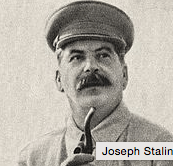
The Obama administration has taken a sort of Stalinist tack. Obama has concentrated on building socialism in one country (i.e,, the United States) rather than protecting the national interests of the United States abroad in a difficult foreign theater, especially insofar as doing so might complicate Obama’s dreams of an entente with Iran.
Last week brought a new round of Syria related stories. At the Weekly Standard, Lee Smith noted “Obama’s Syria doctrine.” Obama disclaims responsibility even for his own pathetically failed approach:
In the wake of last week’s embarrassing revelation that only four or five U.S.-trained rebels are currently engaged in fighting the Islamic State, the White House was scrambling to deflect blame. It wasn’t Obama’s fault, said White House press secretary Josh Earnest. The president never wanted to back the rebels in the first place. His hand was forced by administration figures and Republican lawmakers who wanted to aid the rebels. It’s time, said Earnest for “our critics to fess up in this regard as well. They were wrong.”
Russian, Syrian and Iranian military commanders have set up a coordination cell in Baghdad in recent days to try to begin working with Iranian-backed Shia militias fighting the Islamic State, Fox News has learned.
Western intelligence sources say the coordination cell includes low-level Russian generals. U.S. officials say it is not clear whether the Iraqi government is involved at the moment.
Describing the arrival of Russian military personnel in Baghdad, one senior U.S. official said, “They are popping up everywhere.”
And Prime Minister Netanyahu flew to Moscow with two members of the IDF General Staff to meet with Putin about Russia’s moves in Syria. “In Moscow,” the Times of Israel reported, “presence of generals sends a message of military urgency.” President Obama, however, is taking the long view. A couple of weeks ago Obama declared Russia’s Syrian adventure to be “doomed to failure.” Obama’s judgment represents a striking case of projection.

 “Today, we are witnessing the largest global convergence of jihadists in history.”
 “We have largely failed to stop Americans from traveling overseas to join jihadists … Several dozen also managed to make it back into America.”
 “The U.S. government lacks a national strategy for combating terrorist travel and has not produced one in nearly a decade.”
 “The unprecedented speed at which Americans are being radicalized by violent extremists is straining federal law enforcement’s ability to monitor and intercept suspects.”
 “There have now been twice as many ISIS-inspired terror plots against the West in 2015 than there were in all of 2014.”
 “[ISIS] is believed to have inspired or directed nearly 60 terrorist plots or attacks against Western countries, including 15 in the United States.”
 “Military officials estimate airstrikes have killed over 10,000 [ISIS] extremists, but new foreign fighters replace them almost as quickly as they are killed.”
 “Gaping security weaknesses overseas—especially in Europe—are putting the U.S. homeland in danger…”
 “In short, information about foreign fighters is crossing borders less quickly than the extremists themselves.”
 “The federal government has failed to develop clear early intervention strategies—or ‘off-ramps’- to radicalization—to prevent suspects already on law enforcement’s radar from leaving to join extremists.”
 “Few initiatives exist nationwide to raise community awareness about foreign fighter recruitment and to assist communities with spotting warning signs.”
 “The Administration has launched programs to counter-message terrorist propaganda abroad, but little is being done here at home.”






 anneinpt
 artaxes
 danmillerinpanama
 davidking1530
 Peter Hofman
 Joseph Wouk
 Peter
Peter Louisiana Steve
 WarSclerotic
Recent Comments