Posted tagged ‘Islamic State’

Syrian army advances into Raqqa in major anti-ISIS assault

February 15, 2016

Syrian army advances into Raqqa in major anti-ISIS assault

Published time: 15 Feb, 2016 08:22 Edited time: 15 Feb, 2016 12:58

Source: Syrian army advances into Raqqa in major anti-ISIS assault — RT News

© Valeriy Melnikov
Syrian army units and paramilitary forces are reportedly moving into Raqqa province, seizing strategically important areas along the Salamiyah-Raqqa road which leads directly into the Islamic State stronghold.

On Sunday, Syrian government forces and Palestinian armed militia captured the strategically important Tal Masbah hilltop, the last entrenched Islamic State (IS, previously ISIS/ISIL) position.

Read more

A multifunctional fighter-bomber Su-34 of the Russian Aerospace Forces lands at Hemeimeem air base in Syria. © Dmitriy Vinogradov

The fortified position guarded approaches to the Salamiyah-Raqqa highway, leading to the terror group’s stronghold in the city of Raqqa, Al-Masdar news outlet reported, citing a military source.

Later that day, the Syrian government army launched a massive assault on the village of Zakiyah and seized an important crossroads near the village, cutting IS’s major supply route from Raqqa to nearby Hama province.

The Syrian government army’s 555th Brigade, 4th Mechanized Division, “Desert Hawks” brigade and Golani regiment, as well as the pro-government Palestinian Liwaa Al-Quds militia (Jerusalem brigade) took part in both ground offensives.

A source in the 555th brigade told Al-Masdar that IS militants entrenched at Tal Masbah hilltop were forced to flee northeast towards the desert on the Raqqa-Hama border, where an intense battle between the terror group and government forces is taking place.

© Google  Maps

The Syrian government army is also set to retake the key Tabaqah military airbase in southwest Raqqa province, which was captured by IS in August 2014.

“This is an indication of the direction of coming operations toward Raqqa,” a military source briefed on the battle told Reuters. “In general, the Raqqa front is open … starting in the direction of the Tabqa area.”

The advance into IS-held Raqqa province would allow Damascus to regain control over a region where Syrian government forces have had no presence since 2014. It would also complicate any move by Saudi Arabia to deploy forces to the area.

Previous media reports indicate that Saudi Arabia is considering a full-scale ground invasion into war-torn Syria, where they are backing anti-government rebels battling Syrian President Bashar Assad.

Riyadh has also been threatening that Assad will be toppled if he does not leave during a period of political transition. “Bashar al-Assad will leave – have no doubt about it. He will either leave by a political process or he will be removed by force,” Saudi Arabian Foreign Minister Adel al-Jubeir told CNN.

The possible Saudi intervention as well as recent Turkish artillery shelling of Kurdish and Syrian army positions came amid a successful anti-IS offensive by government forces in Aleppo, another important region.

Saudi Arabia confirms sent aircraft to Turkey to fight against ISIL

February 14, 2016

Saudi Arabia confirms sent aircraft to Turkey to fight against ISIL

February 14, 2016, Sunday/ 10:38:20/ REUTERS WITH TODAY’S ZAMAN

Source: Saudi Arabia confirms sent aircraft to Turkey to fight against ISIL

 Saudi Arabia confirms sent aircraft to Turkey to fight against ISIL

Royal Saudi Air Force jets fly in formation in Riyadh. (File photo: Reuters)

Saudi Arabia confirmed late on Saturday it sent aircraft to NATO-member Turkey’s İncirlik air base for the fight against Islamic State in Iraq and the Levant (ISIL) militants, although Turkish sources reportedly denied arrival of any Saudi aircraft.

Brig. Gen. Ahmed al-Assiri, adviser in the office of Saudi Arabia’s minister of defense, told pan-Arab Al Arabiya television that the kingdom was committed to stepping up the fighting against ISIL and that the move was part of those efforts.

He also said that the current presence in the air base was limited to aircraft and no ground troops had been sent.

“What is present now is aircraft that are part of the Saudi Arabian forces,” Assiri said in response to a question on whether ground troops were included.

Turkey’s Hürriyet daily, however, quoted Turkish military sources as denying the arrival of Saudi jets at the İncirlik air base. According to the military sources, Saudi jets had not arrived at İncirlik yet and their arrival would take two to three weeks, Hürriyet reported.

Saudi Arabia has resumed its participation in air strikes against ISIL in recent weeks and US Defense Secretary Ash Carter on Thursday welcomed its commitment to expand its role.

Turkish Foreign Minister Mevlüt Çavuşoğlu told the Yeni Şafak newspaper on Saturday that Saudi Arabia had carried out inspections at the air base in preparation for sending aircraft.

Turkish military repeatedly shell Assad forces; Kurds confirm to RT being hit by massive attack

February 14, 2016

Turkish military repeatedly shell Assad forces; Kurds confirm to RT being hit by massive attack

Published time: 13 Feb, 2016 16:17 Edited time: 14 Feb, 2016 00:56

Source: Turkish military repeatedly shell Assad forces; Kurds confirm to RT being hit by massive attack — RT News

The Turkish army has shelled Syrian government forces in Aleppo and Latakia provinces, while also hitting Kurdish targets near the city of Azaz in northwestern Syria, including an air base recently retaken from Islamist rebels, with a massive attack.

Anatolia news agency reported that the Turkish military hit Syrian government forces on Saturday, adding that the shelling had been in response to fire inflicted on a Turkish military guard post in Turkey’s southern Hatay region.

Turkish artillery targeted Syrian forces again late on Saturday, according to a military source quoted by RIA Novosti. The attack targeted the town of Deir Jamal in the Aleppo Governorate.

The agency also cited details of an earlier attack on Syrian government army positions in northwestern Latakia.

“Turkey’s artillery opened fire on the positions of the Syrian Army in the vicinity of Aliya mountain in the northwestern part of the province of Latakia,” the source said.

Meanwhile, the Turkish shelling of Kurdish positions continued for more than three hours almost uninterruptedly, a Kurdish source told RT, adding that the Turkish forces are using mortars and missiles and firing from the Turkish border not far from the city of Azaz in the Aleppo Governorate.

The shelling targeted the Menagh military air base and the nearby village of Maranaz, where “many civilians were wounded,” local journalist Barzan Iso told RT. He added that Kurdish forces and their allies among “the Syrian democratic forces” had taken control of the air base on Thursday.

According to Iso, the Menagh base had previously been controlled by the Ahrar ash-Sham Islamist rebel group, which seized it in August of 2013. The journalist also added that Ahrar ash-Sham militants at the base had been supported by Al-Nusra terrorists and some extremist groups coming from Turkey.

Ahrar ash-Sham is a militant group that has trained teenagers to commit acts of terror in Damascus, Homs, and Latakia provinces, according to data provided to the Russian Defense Ministry by Syrian opposition forces.

The group, which has intensified its attacks on the Syrian government forces since January, was getting “serious reinforcements from Turkey,” Russian Foreign Ministry spokeswoman Maria Zakharova said during a briefing in Moscow on January 21.

A source in the Turkish government confirmed to Reuters that the Turkish military had shelled Kurdish militia targets near Azaz on Saturday.

The Turkish Armed Forces fired shells at PYD positions in the Azaz area,” the source said, referring to the Syrian Kurdish Democratic Union Party (PYD), which Ankara views as a terrorist group.

A Turkish security official told Reuters that the shelling of the Kurds had been a response to a shelling of Turkish border military outposts by the PYD and forces loyal to Damascus, as required under Turkish military rules of engagement.

Turkey’s PM Davutoglu also confirmed that the country’s forces had struck Syrian Kurdish fighters and demanded that the Kurds retreat from all of the areas that they had recently seized.

“The YPG will immediately withdraw from Azaz and the surrounding area and will not go close to it again,” he told reporters, adding that Turkey “will retaliate against every step [by the YPG],” Reuters reports.

A Kurdish official confirmed to Reuters that the shelling had targeted the Menagh air base located south of Azaz.

According to the official, the base had been captured by the Jaysh al-Thuwwar rebel group, which is an ally of PYD and a member of the Syria Democratic Forces alliance.

Syrian Kurds are actively engaged in the fight against the Islamic State (IS, formerly ISIS/ISIL) terrorist group and have been recently described as “some of the most successful” forces fighting IS jihadists in Syria by US State Department spokesman John Kirby, AFP reports.

Earlier, the US also called the PYD an “important partner” in the fight against Islamic State, adding that US support of the Kurdish fighters “will continue.”

Read more

Russian Foreign Minister Sergei Lavrov (L) speaks to German Foreign Minister Frank-Walter Steinmeier at the Munich Security Conference in Munich, Germany, February 13, 2016. © Michael Dalder

Turkey’s shelling of the Syrian Kurds comes just days after a plan to end hostilities in Syria was presented in Munich after a meeting of the so-called International Syria Support Group (ISSG), in which Russian Foreign Minister Sergey Lavrov, US Secretary of State John Kerry, and UN Special Envoy on Syria Staffan de Mistura participated.

‘We will strike PYD’ – Turkish PM

Earlier on Saturday, Turkish Prime Minister Ahmet Davutoglu threatened Syrian Kurds with military action, saying that Turkey will resort to force against the Syrian Kurdish People’s Protection Units (YPG) if it considers the step “necessary.”

As I have said, the link between the YPG and the [outlawed Kurdistan Workers’ Party] PKK is obvious. If the YPG threatens our security, then we will do what is necessary,” Davutoglu said on February 10, as quoted by the Hurriyet Daily.

“The leadership cadre and ideology of the PKK and PYD is the same,” he argued in a televised speech in the eastern city of Erzincan on Saturday, AFP reports.

Davutoglu also said that if there is a threat to Turkey, “we will strike PYD like we did Qandil,” referring to a bombing campaign waged by Turkey against the PKK in its Qandil mountain stronghold in northern Iraq, Daily Sabah reports.

Turkey regards the Syrian Kurdish Democratic Union Party (PYD) and its military wing, the YPG, as affiliates of the outlawed Kurdistan Workers’ Party (PKK), which has waged a decade-long insurgency against Turkish authorities, demanding autonomy for Turkish Kurds.

The latest developments come as Turkey continues a relentless crackdown on Kurds in its southeastern region. Ankara launched a military operation against Kurdish insurgents from the outlawed Kurdistan Workers’ Party (PKK) in July of 2015, breaking a ceasefire signed in 2013.

Turkey’s General Staff claim that Turkish forces killed more than 700 PKK rebels during the offensive in the southeastern districts of Cizre and Sur. Meanwhile, Amnesty International has reported that at least 150 civilians, including women in children, were killed in the Turkish military operation, adding that over 200,000 lives have been put at risk.

According to the Turkish Human Rights Foundation, at least 198 civilians, including 39 children, have been murdered in the area since August of 2015.


Turkish military shells PYD targets in Syria

February 13, 2016

Turkish military shells PYD targets in Syria

February 13, 2016, Saturday/ 18:01:08/ REUTERS | BEIRUT

Source: Turkish military shells PYD targets in Syria

Turkish military shells PYD targets in Syria

Turkey’s military has shelled Kurdish militia targets near the town of Azaz in northern Syria. (Photo: Today’s Zaman)

Turkey’s military has shelled Kurdish militia targets near the town of Azaz in northern Syria, a Turkish government source told Reuters on Saturday, without elaborating on the extent of the shelling or why it had been carried out.

“The Turkish Armed Forces fired shells at PYD positions in the Azaz area,” the source said, referring to the Kurdish Democratic Union Party (PYD), which Ankara regards as a terrorist organization.

The Syrian Observatory for Human Rights reported that the shelling had targeted a Syrian air base and a village captured from insurgents in recent days by the YPG militia, which is backed by the PYD.

A Kurdish official confirmed the shelling of northern Aleppo’s Menagh air base, which he said had been captured by the Kurdish-allied Jaysh al-Thuwwar group rather than the YPG. Both are part of the Syria Democratic Forces alliance.

News of the shelling came after Prime Minister Ahmet Davutoglu said on Saturday Turkey would not hesitate to act in Syria if it faced a threat from Syrian Kurdish forces.

His comments reflected Ankara’s growing frustration with United States backing for the PYD, which controls most of the Syrian side of the border with Turkey and which Ankara views as tied to militants fighting an insurgency in southeast Turkey.

Our Good Islam/Bad Islam Strategy

February 11, 2016

Our Good Islam/Bad Islam Strategy, Front Page Magazine, Daniel Greenfield, February 11, 2016
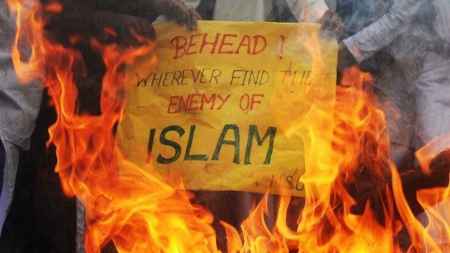
Behead them

There is no Good Islam. There is no Bad Islam. There is just Islam.

**********************

Our only hope of defeating Islamic terrorism is Islam. That’s our whole counterterrorism strategy.

But Islamic terrorism is not a separate component of Islam that can be cut off from it. Not only is it not un-Islamic, but it expresses Islamic religious imperatives. Muslim religious leaders have occasionally issued fatwas against terrorism, but terrorism for Muslim clerics, like sex for Bill Clinton, is a matter of definition. The tactics of terrorism, including suicide bombing and the murder of civilians, have been approved by fatwas from many of the same Islamic religious leaders that our establishment deems moderate. And the objective of terrorism, the subjugation of non-Muslims, has been the most fundamental Islamic imperative for the expansionistic religion since the days of Mohammed.

Our strategy, in Europe and America, under Bush and under Obama, has been to artificially subdivide a Good Islam from a Bad Islam and to declare that Bad Islam is not really Islam. Bad Islam, as Obama claims, “hijacked” a peaceful religion. Secretary of State Kerry calls Bad Islam’s followers, “apostates”. ISIS speaks for no religion. It has no religion. Which means the Islamic State must be a bunch of atheists.

Our diplomats and politicians don’t verbally acknowledge the existence of a Bad Islam. Even its name is one of those names that must not be named. There is only Good Islam. Bad Islam doesn’t even exist.

This isn’t just domestic spin, which it is, but it’s also an attempt at constructing an Islamic narrative. Our leaders don’t care what we think. They just want us to keep quiet and not offend Muslims. They do care a great deal about what Muslims think. And so, in their own clumsy way, they try to talk like Muslims.

They are attempting to participate in an Islamic debate without the requisite theological credentials. They want to tell Muslims that they should be Good Muslims not Bad Muslims, but they’re too afraid to use those words, so instead they substitute Good Muslims and Not Muslims. All Muslims are Good Muslims and Bad Muslims are Not Muslims is their Takfiri version of the No True Scotsman fallacy.

Our counterterrorism strategy has been constructed to convince Good Islam to have nothing to do with Bad Islam. And any of us who criticize Good Islam or argue that the artificial distinction between Good Islam and Bad Islam, between Saudi Arabia and ISIS, between Iran and Hezbollah, between Pakistan and the Taliban, is false are accused of provoking Good Islam to transform into Bad Islam.

Nothing so thoroughly proves that the difference between Bad Islam and Good Islam is a lie as the compulsive way that they warn that Good Muslims are capable of turning into Bad Muslims at any moment. Offend a Good Muslim, criticize his religion, fail to integrate him, accommodate his every whim and censor what he dislikes and he’ll join ISIS and then he’ll become a Bad Muslim.

After every terror attack, the media painstakingly constructs a narrative to determine why former moderates like Anwar Al-Awlaki, the Tsarnaevs or the San Bernardino killers turned bad without resorting to religious explanations. Their efforts at rationalization quickly become ridiculous; Nidal Hasan, the Fort Hood killer, contracted airborne PTSD, Anwar Al-Awlaki, the head of Al Qaeda in Yemen, became an “extremist” because he was afraid the FBI had found out about his prostitutes and the Times Square bomber turned into a terrorist because his “American Dream” was ruined.

Nobody, they conclude, becomes an Islamic terrorist because of Islam. Instead there are a thousand unrelated issues, having nothing to do with Islam, which creates the Muslim terrorist. Even the term “Radical Islamic Jihadist”, an absurd circumlocution (is there a moderate Islamic Jihadist), has become a badge of courage on one side and a dangerous, irresponsible term that provokes violence on the other.

But what is the distinction between Good Islam and Bad Islam? It isn’t fighting ISIS. Al Qaeda and the Taliban do that. It isn’t terrorism. Our Muslim allies, Saudi Arabia, Pakistan, Turkey and Qatar, are hip deep in the terror trade. It isn’t equality for non-Muslims. No Muslim country under Sharia law could have that. Equality for women? See above.

What are the metrics that distinguish Good Islam and Bad Islam? There aren’t any. We can’t discuss the existence of Bad Islam because it would reveal that Bad Islam and Good Islam are really the same thing.

Our Good Islam allies in Pakistan fight Bad Islam’s terror, when they aren’t hiding Osama bin Laden. Bad Islam in the Islamic State beheads people and takes slaves and Good Islam in Saudi Arabia does too. Qatar is our Good Islam ally helping us fight Bad Islam terrorists by arming and funding Good Islam terrorists who sometimes turn out to be Bad Islam terrorists so we can’t figure out if the Islamic terrorists the CIA is routing weapons to are Good Islam terrorists or Bad Islam terrorists.

The moderate Muslim Brotherhood wins democratic elections. The extremist Muslim Brotherhood then burns down churches. The moderate Palestinian Authority negotiates with Israel and then the extremist Palestinian Authority cheers the stabbing of a Jewish grandmother. The moderate Iranian government signs a nuclear deal and then the extremist Iranian government calls for “Death to America”.

Like the saintly Dr. Jekyll and the mean Mr. Hyde, Good Islam and Bad Islam are two halves of the same coin. When Dr. Jekyll wanted to act out his baser nature, he took a potion and turned into Mr. Hyde. But the nasty urges were always a part of him. When a moderate Muslim pulls a Keffiyah over his face and starts stabbing, bombing or beheading, he doesn’t become an extremist, he just expresses his dark side.

Good Islam borrowed all sorts of noble sentiments from Judaism and Christianity. But when non-Muslims didn’t accept Islam, then Mohammed stopped playing nice and preached murder. Bad Islam is not something ISIS invented on a website. It’s always been a part of Islam. We attempt to separate Good Islam and Bad Islam because we don’t like being beheaded. But Muslims don’t make that distinction.

Our counterterrorism strategy is based on empowering Good Islam, on building coalitions with Muslims to fight terrorism and enlisting their cooperation in the War on Terror. But we’re trying to convince Dr. Jekyll to help us fight Mr. Hyde. And Dr. Jekyll might even help us out, until he turns into Mr. Hyde.

Our moderate Afghan Muslim allies, when they’re aren’t raping young boys (one of their cultural peculiarities we are taught to ignore), sometimes unexpectedly open fire on our soldiers. The Muslim migrants who arrive here to “enrich” our societies sometimes start shooting and bombing. The head of Al Qaeda was hanging out near the West Point of Pakistan. The mastermind of 9/11 was saved by a member of the Qatari royal family. The call is coming from inside the house. Mr. Hyde is Dr. Jekyll.

When we “empower” and “build coalitions” with Good Islam, we’re also empowering and building coalitions with Bad Islam. Just ask all the Muslim terrorists running around with our weapons.

Our leaders want Good Islam to shield us from Bad Islam. If Good Islam is out front, then Muslims won’t see a clash of civilizations or a religious war, but a war between Good Islam and Bad Islam. But the Muslim understanding of Good Islam and Bad Islam is very different from our own.

Sunnis see their Jihadis as Good Islam and Shiites as Bad Islam. Shiites look at it the other way around. The Muslim Brotherhood, that our elites were so enamored with, saw secular governments as Bad Islam. To win them over, we helped them overthrow more secular governments because our leaders had adopted an understanding of Good Islam in which giving Christians civil rights was Bad Islam.

To win over Good Islam, we censor cartoons of Mohammed and criticism of the Koran, open our borders, Islamize our institutions and then wait to see if we’re on the good side of Good Islam. We adapt our societies and legal systems to Islamic norms and hope that it’s enough to let us join the Good Islam Coalition. If we go on at this rate, the experts will tell us that the only way to defeat Islamic terrorism is for us to become Muslims. Only then will we become members in good standing of Good Islam.

There is no Good Islam and no Bad Islam, as Muslim leaders occasionally trouble to tell us. The distinction that our leaders make between Good Islam and Bad Islam is not theological, but pragmatic. They dub whatever is shooting at us right now Bad Islam and assume that everything else must be Good Islam. That is the fallacy which they used to arrive at their Tiny Minority of Extremists formula.

There is no Tiny Minority of Extremists. Behind the various tiny minorities of extremists are countries and billionaires, global organizations and Islamic banks. Outsourcing our counterterrorism strategy to the countries and ideologies behind the terrorists we’re fighting isn’t a plan, it’s a death wish.

Islamic terrorism is just what we call Islam when it’s killing us.

The Jihad isn’t coming from some phantom website. It’s coming from our Muslim allies. It’s coming from Pakistan, Turkey, Qatar and Saudi Arabia. It’s coming from the Muslim Brotherhood and its front groups. It’s coming from the moderate Muslim leaders that our leaders pose with at anti-extremism conferences. And it’s coming from the mosques and homes of the Muslims living in America.

There is no Good Islam. There is no Bad Islam. There is just Islam.

ISIS: The Latest Phase of the Jihad

February 9, 2016

ISIS: The Latest Phase of the Jihad How Western acquiescence to al-Qaeda’s “grievance” narrative paved the way for the Islamic State.

February 9, 2016 Raymond Ibrahim

Source: ISIS: The Latest Phase of the Jihad | Frontpage Mag

Originally published by Hoover Institution’s Strategika.

Raymond Ibrahim is a Shillman Fellow at the David Horowitz Freedom Center.

The best way to understand the Islamic State (ISIS) is to see it as the next phase of al-Qaeda. All Sunni Islamic jihadi groups—Boko Haram, ISIS, Taliban, al-Shabaab, al-Qaeda, even Hamas—share the same motivations based on a literal and orthodox reading of Islamic history and doctrine: resurrecting a caliphate (which existed in various forms from 632 to 1924) that implements and spreads the totality of sharia, or Islamic law.

Accordingly, ISIS’s notorious atrocities—beheading, crucifixion, sexual enslavement, and destruction of non-Sunni places of worship—are being committed by other jihadi groups (e.g., Boko Haram and al-Shabaab, both of which pledged allegiance to ISIS) and even by some Muslim governments (e.g., Saudi Arabia) and individual Muslims around the world.

Conversely, although al-Qaeda (AQ) adheres to the same sharia that ISIS implements, it has long waged a propaganda war against the West. AQ portrays all terrorist attacks on the West, including 9/11, as mere payback for the West’s unjust polices against Muslims, including support for Israel and Arab dictators.[1]

To maintain this “grievance” narrative, AQ knows that the innately supremacist and violent aspects of sharia—for example ISIS’ destruction of churches and subjugation of “infidel” Christian minorities—need to be curtailed or hidden from the Western world.  Otherwise AQ’s efforts of portraying jihadis as “freedom fighters” resisting an oppressive West risk being undermined.[2]

Regardless, AQ’s strategy of turning Western opinion appears to have borne fruit in one pivotal area: canceling longtime Western support for secular Arab dictators. In the context of the “Arab Spring,” the Obama administration turned its back on America’s Egyptian ally of 30 years, Hosni Mubarak; helped ISIS-affiliated jihadis overthrow Libya’s Gaddafi (even though he was complying with Washington); and continues supporting ISIS-affiliated “moderates”[3] to overthrow Syria’s Assad. Idealists in both government and media forgot a primary reason the U.S. had formerly supported secular Arab dictators: they single-mindedly opposed the jihadis.

The result has been a new and emboldened phase of the jihad, a.k.a., ISIS. Born and entrenched in precisely those nations that U.S. leadership brought “freedom and democracy” to—Iraq, Syria, and Libya—ISIS (or al-Qaeda 2.0) is now indifferent to Western opinion. By widely broadcasting its savage triumphalism in the name of Islam, ISIS forfeits the “grievance card” but plays the “strength” card, thus inspiring millions of Muslims. According to the Pew Research Center, in 11 countries alone, at least 63 million and as many as 287 million Muslims support ISIS.[4]

Yet even ISIS works in stages. When criticized by Muslims for killing fellow Muslims and not attacking Israel—the supreme enemy—ISIS responded by saying it was following the pattern of the historic caliphate founded in 632.[5] Then, Caliph Abu Bakr beheaded and crucified tens of thousands of Muslims for apostatizing. Only after the rebel tribes were brought back into the fold of Islam were they set loose to conquer European/Christian territories during history’s early Muslim conquests (634–750). Indeed, it is believed that ISIS’ caliph Abu Bakr al-Baghdadi took this name to signify his focus, that is, terrorizing all “hypocrites” and “apostates” until they unify under the caliphate’s banner.

It still remains to be seen whether ISIS’ strategy—inspiring Muslims but losing Western opinion—will succeed. According to polls, “Islamophobia” is on the rise in the West, especially after the rise of ISIS, prompting several politicians to speak more candidly about the catalysts for terrorist violence.

The Obama administration’s weak responses feed into AQ’s narrative that Islamic terrorism at least in part reflects Islamic grievance; and it refuses to connect the actions of any jihadi organization—whether ISIS, al-Qaeda, Boko Haram, et al—to Islamic teaching.

Time will tell whether the next administration will remain willfully ignorant of the nature of its jihadi enemy—which is fatal in war according to Sun Tzu’s ancient dictum, “know your enemy”—or whether reality will trump political correctness.

Notes:

[1] See “An Analysis of Al-Qa’ida’s Worldview: Reciprocal Treatment or Religious Obligation?” Also, The Al Qaeda Reader, which separates the organization’s communiqués into two groups: “Propaganda” messages to the West portraying jihadi terrorists as mere freedom fighters, and “Theology” messages to fellow Muslims, preaching the same Islam of ISIS.

[2] See “Al-Qaeda: Defender of Christians?” for a more elaborate explanation of this theme.

[3] For the Syrian Free Army’s role: “Largest Massacre of Christians in Syria Ignored.”

An Exasperated John Kerry Throws In Towel On Syria: “What Do You Want Me To Do, Go To War With The Russians?!”

February 8, 2016

An Exasperated John Kerry Throws In Towel On Syria: “What Do You Want Me To Do, Go To War With The Russians?!”

Submitted by Tyler Durden on 02/07/2016 23:48 -0500

Source: An Exasperated John Kerry Throws In Towel On Syria: “What Do You Want Me To Do, Go To War With The Russians?!” | Zero Hedge

“Russian and Syrian forces intensified their campaign on rebel-held areas around Aleppo that are still home to around 350,000 people and aid workers have said the city – Syria’s largest before the war – could soon fall.”

Can you spot what’s wrong with that quote, from a Reuters piece out today? Here’s the problem: “could soon fall” implies that Aleppo is on the verge of succumbing to enemy forces. It’s not. It’s already in enemy hands and has been for quite some time. What Reuters should have said is this: “…could soon be liberated.”

While we’ll be the first to admit that Bashar al-Assad isn’t exactly the most benevolent leader in the history of statecraft, you can bet most Syrians wish this war had never started and if you were to ask those stranded in Aleppo what their quality of life is like now, versus what it was like in 2009, we’re fairly certain you’ll discover that residents aren’t particularly enamored with life under the mishmash of rebels that now control the city.

In any event, Russia and Iran have encircled Aleppo and once it “falls” (to quote Reuters) that’s pretty much it for the opposition. Or at least for the “moderate” opposition. And the Saudis and Turks know it.

So does John Kerry, who is desperate to restart stalled peace negotiations in Geneva. The problem for the US and its regional allies is simple: if Russia and Iran wipe out the opposition on the battlefield, there’s no need for peace talks. The Assad government will have been restored and that will be that. ISIS will still be operating in the east, but that’s a problem Moscow and Tehran will solve in short order once the country’s major urban centers are secured.

As we noted on Saturday, Riyadh and Ankara are extremely concerned that the five-year-old effort to oust Assad is about to collapse and indeed, the ground troop trial balloons have already been floated both in Saudi Arabia and in Turkey. For their part, the Russians and the Iranians have indicated their willingness to discuss a ceasefire but according to John Kerry himself, the opposition is now unwilling to come to the table.

Don’t blame me – go and blame your opposition,’” an exasperated Kerry told aid workers on the sidelines of the Syria donor conference in London this week.

America’s top diplomat also said that the country should expect another three months of bombing that would “decimate” the opposition, according to Middle East Eye who also says that Kerry left the aid workers with “the distinct impression” that the US is abandoning efforts to support rebel fighters.

In other words, Washington has come to terms with the fact that there’s only one way out of this now. It’s either go to war with Russia and Iran or admit that this particular effort to bring about regime change in the Mid-East simply isn’t salvageable.

“He said that basically, it was the opposition that didn’t want to negotiate and didn’t want a ceasefire, and they walked away,” a second aid worker told MEE.

“‘What do you want me to do? Go to war with Russia? Is that what you want?’” the aid worker said Kerry told her.

MEE also says the US has completely abandoned the idea that Assad should step down. Now, apparently, Washington just wants Assad to stop using barrel bombs so the US can “sell the story to the public.” “A third source who claims to have served as a liaison between the Syrian and American governments over the past six months said Kerry had passed the message on to Syrian President Bashar al-Assad in October that the US did not want him to be removed,” MEE says. “The source claimed that Kerry said if Assad stopped the barrel bombs, Kerry could ‘sell the story’ to the public, the source said.”

Of course Kerry won’t be able to “sell” that story to the Saudis and the Turks, or to Qatar all of whom are now weighing their oppositions as the US throws in the towel. “Kerry’s mixed messages after the collapse of the Geneva process have put more pressure on Turkey and Saudi Arabia,” MEE concludes. “Both feel extreme unease at the potential collapse of the opposition US-recognised Free Syrian Army.”

And so, as we said earlier this week, it’s do or die time for Riyadh, Ankara, and Doha. Either this proxy war morphs into a real world war in the next two weeks, or Aleppo “falls” to Assad marking a truly humiliating defeat for US foreign policy and, more importantly, for the Saudis’ goal of establishing Sunni hegemony in the Arabian Peninsula.

The only other option is for John Kerry to face the Russians in battle. As is evident from the sources quoted above, Washington clearly does not have the nerve for that.

Middle East Strategic Outlook, February

February 7, 2016

Middle East Strategic Outlook, February

by Shmuel Bar

February 7, 2016 at 6:00 am

Source: Middle East Strategic Outlook, February

  • The EU-Turkey agreement of 25 November, which provided Turkey with 3 billion euros over two years in order to stop the flow of refugees to Europe, has not achieved that goal. Speaking privately, EU officials complain that Turkey has not taken any concrete measures to reduce the flow of refugees. In our assessment, Turkey will continue to prevaricate on steps to stem the flow of refugees as pressure on the EU to give more concessions.
  • During the coming year there will certainly be further terrorist attacks that will push European public opinion further to the right.
  • We assess that Iran will continue in indirect channels with a parallel nuclear program, realized long before the 10-year target of the JCPOA.
  • The demand for unification of Kurdistan — Iraqi and Syrian — will also begin to be heard. It is highly likely that Russia will take advantage of the trend and support the Kurds, effectively turning an American ally into a Russian one.

The announcement by the IAEA that Iran has fulfilled its obligations according to the Joint Comprehensive Plan of Action (JCPOA) has triggered “Implementation Day” and the removal of the nuclear-related sanctions on Iran. The JCPOA, however, did not deal with Iran’s ballistic missile program, and the sanctions related to it are still nominally in force. These sanctions are minor and will not have any real effect on the Iranian missile program. The missile program will mature during this period and will include Ghadr missiles with ranges of 1,650-1,950 km, which may be capable of carrying nuclear warheads.

The question now is: whither the Iranian nuclear program? After the lifting of sanctions, and taking into account the impracticality of “snap-back” of sanctions, we assess that Iran will now initiate a parallel nuclear program. This will, of course, be far slower than the program that was dismantled by the JCPOA, but it will be realized long before the 10-year target of the JCPOA. One possibility for Iran to continue its nuclear program is through North Korea. The wording of the JCPOA is ambiguous on nuclear Iranian nuclear cooperation with other countries that are not a party to the agreement. North Korea could produce the whole chain of nuclear weapons and put it at Iran’s disposal in return for Iranian funding. North Korea would certainly profit economically from such collaboration and would not risk further sanctions. Such cooperation would be difficult to detect, and even if detected, may not reach the threshold of a material breach of the JCPOA.

The most immediate reward that Iran will receive is the release of frozen Iranian funds ($100-$150 billion). In addition, Iran may now market oil stored offshore in tankers (about 50 billion barrels) and is preparing to increase its production by 500 thousand bpd (from 2.8 million bpd). It is doubtful that Iran can truly increase its production as planned. Even if it does, the addition of Iranian oil is likely to drive prices down even further, counter-balancing much of the potential profit. Sanctions relief also is not a quick fix for the Iranian economy. While it removes legal impediments for investment and business in Iran, the risks that Western companies will face due to residual non-nuclear sanctions (that may be enhanced and enforced by a future American administration), lack of government protection, corruption, and the weakness of the Iranian market cannot be removed by decree. Therefore, European banks and investors may not hurry to invest in Iran at the levels needed to jump-start the Iranian economy after years of sanctions.

The Iranian regime’s goal is not only to block the path to the reformists or reformist-minded, but also to the extremists on the right to Supreme Leader Ali Khamenei. Such a balance could help the Iranian system maintain its “centrist” orientation and guarantee the continuity in the event of Khamenei’s death and the appointment of a new successor (or a triumvirate of several potential leaders). It will also facilitate the eventual takeover of the regime by the Islamic Revolutionary Guards Corps (IRGC) after the demise of Khamenei. The backing that the Guardian Council received from the Supreme Leader for the results of its vetting process, in the face of Rouhani’s condemnation of the disapproval of almost all reformists, is also indicative of the balance of power in the regime.

The Iranian seizure of two US Navy patrol boats on January 12 and the publication of drone pictures of a US Navy aircraft carrier underlined the sense of immunity that Iran has achieved. These actions should be seen in the context of Iran’s attempt to change the rules of the game in the Persian Gulf, while testing the waters of American tolerance and sending to Saudi Arabia and the Gulf States an indirect message that Iran is ready and willing to risk conflict with the US and that the US is a paper tiger that cannot be relied upon in a confrontation between the Gulf States and Iran. In our assessment, Iran will continue with shows of force such as seizing of naval vessels of Saudi Arabia and the Gulf States, stop and search operations of commercial vessels en route to the Gulf States, naval exercises — including missile tests close to Gulf sea-lanes and to the territorial waters of the Gulf States — in international waterways that implicitly interrupt and threaten shipping in the Gulf, “spooking” of Gulf aircraft and even false flag operations of mining, piracy or attacks by proxies in the Gulf and the Red Sea along the Yemeni coast. We may expect as a result possible frontier skirmishes on the shared littoral borders of Iran and Saudi Arabia, gas fields and disputed islands and in the international waters of the Gulf.

The Iranian seizure of two US Navy patrol boats on January 12 underlined the sense of immunity that Iran has achieved.

Saudi Arabia is drawing up its own map of interests and areas of influence that it is projecting as “no-go zones” for Iran — a Saudi “Monroe Doctrine” for the region. The most critical of these are: Yemen (due to the potential for threatening the Bab al-Mandeb Straits), subversion in the Gulf States (primarily Bahrain), the Strait of Hormuz and the international waters of the Gulf. To this list one must add the obvious: any Iranian-inspired or -planned attack on the Saudi homeland itself — government facilities, oil installations etc. — would be perceived as crossing a red line. While neither Saudi Arabia nor Iran is interested in direct conflict, and both would prefer to continue to work through proxies and in areas outside their respective sovereign territories, the dynamic nature of the situation can easily lend itself to misreading of such red lines and such miscalculation may lead to direct confrontation between them. While all-out direct war between Iran and Saudi Arabia remains a low probability, this assessment should be revisited again in the near future.

In Syria, American positions have undergone a strategic shift that reflects the new balance of power created by the Russian intervention. On the military side, the Russian presence imposes a heavy constraint on the American activities, and U.S. officials caution that the success of the Ramadi operation will not be followed by a concerted effort to roll back the “Islamic State” in the Syrian theater. In regards to a political solution, the US has accepted the Russian-Iranian four-point-plan that envisages Bashar al-Assad remaining in office during a transition period and being allowed to run for President in “internationally supervised elections”. In our assessment, the Syrian opposition and their Arab supporters cannot accept any blueprint that would leave any doubt regarding Bashar al-Assad relinquishing power before any process begins. These developments will only feed the sense of the Sunni Arabs that the United States has turned its back on them and is supporting Iranian-Russian hegemony in the region. On this background, the prospects that the Syrian “peace talks” in Geneva will achieve any progress towards resolution or even mitigation of the civil war are close to nil.

Last month’s visit by Chinese President Xi Jin Ping to Saudi Arabia, Egypt and Iran was the first such visit of a Chinese President in the region since 2002, and the first foreign head of state to visit Iran since the announcement of “Implementation Day” of the JCPOA. The Chinese emphasis in all the visits was on economic cooperation, development and stability, but above all — in an implicit stab at the US and Russia — emphasizing that China does not seek proxies, to fill a power vacuum or hegemony in the region. The leitmotif of the visit was the integration of the Middle Eastern partners (i.e. the Arabs in general and Iran) into China’s “Belt and Road Initiative.” In spite of the inclusion of Iran in the visit, President Xi took care not to offend the Arabs. The agreements with Saudi Arabia included nuclear cooperation in a scope far greater than that which was offered to Iran, and the joint statement reflected the Saudi position on Yemen, stating, “both sides stressed support for the legitimate regime of Yemen.”

The “Arab Policy Paper” published on the eve of the visit stresses China’s commitment to “non-intervention and opposition to interference in the affairs of other countries”. This is seen by the Arab policy communities as a sign of implicit Chinese support for their position vis-à-vis Iran’s activities in the region, though they would have welcomed more explicit statements of support. There is no expectation in the region that China is going to play the “Big Power” card in the region. Taking sides in this conflict would be out of character for China. Saudi Arabia and the other Arab states will attempt to convince China to refrain from demonstrations of rapprochement with Iran and to support the Arab positions vis-à-vis Iranian provocations in the Gulf, Syria and Yemen. While China may show a slight implicit leaning towards the Arab position on these issues, it is not likely to take a clear anti-Iranian/pro-Arab position in the near future.

The European Union-Turkey agreement of 25 November, which provided Turkey with 3 billion euros over two years in order to stop the flow of refugees to Europe, has not achieved that goal. Speaking privately, EU officials complain that Turkey has not taken any concrete measures to reduce the flow of refugees. In our assessment, Turkey will continue to prevaricate on steps to stem the flow of refugees as pressure on the EU to give more concessions. Turkey has already signaled that the sum will not suffice for the task of maintaining the refugees inside Turkey alone, and certainly not for other security measures such as blocking the border with Turkey to prevent passage to and fro of “Islamic State” foreign fighters.

Aside from the 3 billion euros, the EU commitments will also not be easily implemented; visa waivers for Turkish citizens in general will encounter massive opposition within the EU. The road to Turkish accession to the EU must also go through complex negotiations on various aspects of compatibility of Turkey to the standards of the EU. All these discussions will encounter a veto by Cyprus, pending a peace deal with Turkish-occupied Northern Cyprus. This veto may be resolved if a referendum on unification of Cyprus takes place and supports re-unification later this year. However, the real obstacle towards Turkish accession is not technical or due to the Cyprus question; it revolves around the shift in European public opinion towards absorption of immigrants from Muslim countries. During the coming year, there will certainly be further terrorist attacks that will push European public opinion further to the right. Under these circumstances, Turkish accession or even visa waiver will be very unlikely.

In our assessment, the trend towards Kurdish independence will eventually lead to an independent Iraqi Kurdistan. The events in Syrian Kurdistan will also affect the pace and direction of the independence movement in Iraq’s Kurdistan Regional Government (KRG). Unification of the parts of Syrian Kurdistan in the face of Turkish opposition and under Russian protection will give impetus to the demand to create a political fait accompli of independence in Iraqi Kurdistan. As the principle of Kurdish independence in Iraq gains more and more support and becomes a reality, the irredentist demand for unification of Kurdistan — Iraqi and Syrian — will also begin to be heard. This is the fulfillment of the Kurdish nightmare that Turkey has always feared. With the deterioration of relations between the AKP government and the Turkish Kurds inside Turkey, such a political reality of independent Kurdistan will add fire to the flames of the Kurdish rebellion in southern Turkey. It is highly likely that Russia will take advantage of the trend and support the Kurds, effectively turning an American ally into a Russian one. If this happens, the US will have lost an important potential ally in the new map of the Middle East.

The large number of players on the ground that may take a part in the campaign for Mosul will only complicate the campaign further and — if the city or part of it is retaken, will increase the chances of internal fighting between the components of the ad-hoc alliance of Iraqi government forces, Shiite militias, Sunni militias, Kurdish Peshmarga, Turks and American forces.

On this background, the Syrian “Peace Talks” in Geneva started (29 January) as “proximity talks” in which the UN representatives shuttle between the rooms of the opposing parties. The Saudi supported High Negotiations Committee (HNC) of the Syrian opposition ceded their original conditions — cessation of the attacks on civilians — though they refuse to meet with the regime representatives while the latter refuse to meet with “terrorists”. The Syrian regime representation is low-level as an indication that there is no intention to hold real negotiations. Furthermore, the Kurdish Democratic Union Party (PYD), whose military wing, the YPG, is the most effective fighting force on the ground against the “Islamic State,” were not included in the opposition delegation because of the Turkish threat to boycott the Geneva negotiations if it participates. Under these conditions, the prospects that the talks will achieve any progress towards resolution or even mitigation of the civil war are close to nil.

Dr. Shmuel Bar is a senior research fellow at Israel’s Institute for Policy and Strategy at the Interdisciplinary Center Herzliya in Israel and a veteran of Israel’s intelligence community.

Erdoğan to US: Choose either Turkey or the PYD as your partner

February 7, 2016

Erdoğan to US: Choose either Turkey or the PYD as your partner

February 07, 2016, Sunday/ 10:51:35/

Source: Erdoğan to US: Choose either Turkey or the PYD as your partner

Erdoğan to US: Choose either Turkey or the PYD as your partner

President Recep Tayyip Erdoğan. (Photo: Reuters)

In one of his strongest remarks to date, Turkish President Recep Tayyip Erdoğan has lambasted the US after a senior official’s visit last week to the northern Syrian town of Kobani, which is under the control of the Kurdish Democratic Union Party (PYD), and called on Washington to choose either Turkey or “terrorists in Kobani” as a partner.

Erdoğan directed severe criticism at the visit to the town by Brett McGurk, US President Barack Obama’s special envoy for the anti-Islamic State in Iraq and the Levant (ISIL) coalition. The visit came at a time where Geneva peace talks were taking place, and the Turkish president declared that the US should make a choice between the PYD and Turkey.

Erdoğan has called on the US and the European Union to list the major Syrian Kurdish political party and its armed wing as terrorist organizations over their affiliation with the Kurdistan Workers’ Party (PKK), which is fighting against the Turkish state and which is regarded as a terrorist group by Washington and Brussels.

“Do you accept the PKK as a terrorist organization? Then why don’t you list the PYD and [People’s Protection Units] YPG as terrorist organizations, too?” Erdoğan asked while speaking to reporters on Friday on board a plane en route to Turkey from a week-long Latin America tour

This is not the first time Erdoğan has made such a call. His and other senior Turkish leaders’ calls reflect a split between Ankara and its allies over how to treat the Syrian Kurdish party and its armed faction.

The Kurdish militia the YPG has been a reliable ally in the fight against ISIL on the ground and has benefited from the US arms supply on several occasions.

While the US and EU share Turkey’s view toward the PKK and sees it as a terrorist organization, they differ in their views regarding the PYD and YPG.

During his visit, McGurk met with senior PYD and YPG officials and pledged further support for Syrian Kurds. He also visited a cemetery and paid his respects to YPG fighters killed during a months-long battle with ISIL in Kobani.

It was the first time a top US official has visited the YPG-controlled town, reflecting the type of relationship the US and the PYD enjoy. The US airdropped weapons and munitions during the siege of Kobani.

“We discovered advanced Russian, US and European weapons in PKK cells during military operations in southeastern Turkey. Where do these weapons come from?” the Turkish president asked, revealing Turkey’s growing anxiety that some of the weapons provided by the US and EU to the YPG end up in PKK hands.

“The PKK is a terrorist organization and the YPG is too. The PYD is what the PKK is. [US Vice President] Joe Biden came with an official. A national security official [Obama’s envoy]. He visits Kobani at the time of the Geneva talks and is awarded a plaque by a so-called YPG general. How can we trust [you]?” Erdoğan said, expressing his dismay over McGurk’s visit.

McGurk was given a plaque by YPG official Polat Can, a former PKK member. It sparked a harsh reaction from Ankara as Erdoğan called on the US to choose, saying, “Am I your ally or are the ‘terrorists’ in Kobani?”

Erdoğan also repeated his criticism of Russian air strikes in Syria. The Turkish president said on Friday that Russia must be held accountable for the people it has killed in Syria, arguing that Moscow and Damascus were together responsible for 400,000 deaths there.

While speaking at a joint press conference with his Senegalese counterpart during a brief stopover in the West African country on Friday, Erdoğan also dismissed a Russian statement that Turkey was preparing for an incursion in Syria, saying he is “laughing” at the claim.

Ankara has dismissed this as propaganda intended to conceal Russia’s own “crimes.”

Erdoğan said Russia was engaged in an invasion of Syria and accused it of trying to set up a “boutique state” for its longtime ally President Bashar al-Assad.

“Russia must be held accountable for the people it has killed within Syria’s borders,” the Doğan news agency quoted him as saying. “By cooperating with the regime, the number of people they have killed has reached 400,000.”

His comments are likely to further anger Moscow. Relations between Turkey, a NATO member, and Russia hit their worst low in recent memory last November after Turkey shot down a Russian warplane Ankara said had violated Turkish airspace from Syria.

Russian-Made T-90 Tank Goes Through Baptism by Fire in Syria

February 7, 2016

Russian-Made T-90 Tank Goes Through Baptism by Fire in Syria

Middle East

17:34 07.02.2016(updated 17:43 07.02.2016)

Source: Russian-Made T-90 Tank Goes Through Baptism by Fire in Syria

For the first time, the Syrian Army used Russian-made T-90A tanks in combat. Their baptism by fire took place near the city of Aleppo.

The T-90A, one of Russia’s most advanced weapons, went through its baptism by fire in service with the Syrian armed forces. Earlier, it was reported by Turkish and Iranian media, and then the Russian Defense Minister confirmed the fact.The Turkish pro-government newspaper Yeni Safak reported, citing a military commander, that over 80 T-72 and T-90 tanks were spotted in combat north of Aleppo. The report also read that Syrian forces backed by Russian jets took control over the towns of Nubul and Zehra, north of Aleppo.

Meanwhile, Syrian T-90s in action near Aleppo were then reported by Iran’s FARS news agency on February 2. According to the agency, T-90 tanks were deployed near the town of Khan Tuman, south of Aleppo, after the Syrian Army regained control over the town in December.

Using the advantages of the T-90 tank, the Syrian Army alongside its allies surrounded the strategic towns of Khan Tuman and Al-Karassi, along the Aleppo-Damascus highway, a military source told FARS News.

However, the first news about delivering T-90 tanks to the mechanized division of the Syrian Army came on November 29, 2015. At the time, Russia neither confirmed nor denied it.On February 5, a source in the Russian Defense Ministry told RNS news agency that in late-2015, a number of T-90 machines were delivered to Syria. According to the source, previously the tanks were in service with the Russian military. Syrian troops practiced at training fields in Russia. According to RNS, the tanks were first used in combat by the Syrian Army near Aleppo. They supported a ground assault by Syrian troops.

The T-90A tank entered service with the Russian Armed Forces in 2004. The T-90A is a modernized version of the T-90 Vladimir tank developed on the basis of the T-72B, in the 1980-1990s. It was named “Vladimir” after its constructor Vladimir Potkin. The T-90A featured a new engine and turret and was equipped with a thermal-vision system. Its engine delivers 1,000 hp at 2,000 rpm. The tanks is equipped with third-generation active armor, capable of withstanding an attack by 120-mm M829A2 and DM43A1 tank rounds, designed for the Abrams M1A1 and Leopard-2 tanks respectively.
The T-90 protective system is capable of protecting the tank from the newest TOW-2A and HOT-2 anti-tank missiles.According to FARS, in four-and-a-half years of the Syrian war various militant groups received over 9,000 US-made TOW anti-tank missile systems and M-79 grenade launchers. They were very successful against the aging T-55 and T-72 tanks of the Syrian Army. Only after the newest T-90 tanks were delivered to Syria the Syrian Army began its advance against militants.

The T-90 was delivered to Syria because the tank is equipped with the Shtora active armor, military analyst Alexei Ramm told Gazeta.Ru. Unlike, for example the T-72B, the T-90 tanks of the Russian Armed Forces were initially equipped with this type of armor. The need for it was dictated by the fact that many Syrian militants are armed with TOW missiles.

A T-90A main battle tank
Host photo agency
A T-90A main battle tank

How does the system works? There are several laser radiation receivers, mounted on the tank, as well as two projectors near the gun. These receivers can detect laser radiation when the tank is being targeted and warns the crew of the threat, Ramm explained. In this situation, the crew can evade the attack. The second option is smoke-screening, and the third option is jamming the enemy target-acquiring system with the projectors.

The T-90A is equipped with a 125-mm smooth-bore gun – the 2A46M-2 – with a barrel length of 51 calibers. Its maximum accuracy range while firing high-explosive anti-tank warheads is 4,000 meters, and while firing fragmentation projectiles – up to 9,600 meters.

According to the analyst, the Syrian Army would actively engage the Russian T-90 tanks in combat. He explained that ground relief allows for using the T-90 near Aleppo, Idlib, Hama and Homs but currently main combat actions are focused on Aleppo and northern Latakia.”The principal task now is to neutralize threats to two western regions – Latakia and Tartus. If Latakia falls it would deal a serious blow to [Syrian President Bashar] Assad’s position and would complicate the Russian aerial operation,” Ramm pointed out.

What is more, now an offensive is also underway against militants in the enclave of Salma. Tanks are not enough in this mountainous area, where ground forces backed by aviation are needed.

“If Salma and Aleppo are liberated Turkey will not be able to deliver supplies to terrorists,” he said.

In December, Syria’s news agency SANA published footage from the battlefield where Russian T-90’s were also spotted.


