Posted tagged ‘Islam’

Should Islam Be Banned for Blasphemy?

February 13, 2015

Should Islam Be Banned for Blasphemy? Raymondibrahim.com via Middle East Forum, Raymond Ibrahim, February 13, 2015 (Originally published under the title, “Islam: Banned for Blasphemy?”)

Blasphemy

Islam is the only religion whose core texts actively and unequivocally defame other religions.

Modern day Muslim scholars and sheikhs agree that it is permissible to defame and mock Christianity.

It is this issue, Islam’s perceived “divine” right to defame and destroy, that the international community should be addressing—not silly cartoons and films.

*****************

Soon after Muslim gunmen killed 12 people at Charlie Hebdo offices, which published satirical caricatures of Muslim prophet Muhammad, the Organization of Islamic Cooperation (OIC)—the “collective voice of the Muslim world” and second largest inter-governmental organization after the United Nations—is again renewing calls for the United Nations to criminalize “blasphemy” against Islam, or what it more ecumenically calls, the “defamation of religions.”

Yet the OIC seems to miss one grand irony: if international laws would ban cartoons, books, and films on the basis that they defame Islam, they would also, by logical extension, have to ban the entire religion of Islam itself—the only religion whose core texts actively and unequivocally defame other religions, including by name.

To understand this, consider what “defamation” means. Typical dictionary-definitions include “to blacken another’s reputation” and “false or unjustified injury of the good reputation of another, as by slander or libel.” In Muslim usage, defamation simply means anything that insults or offends Islamic sensibilities.

However, to gain traction among the international community, the OIC cynically maintains that such laws should protect all religions from defamation, not just Islam (even as Muslim governments ban churches, destroy crucifixes, and burn Bibles). Disingenuous or not, the OIC’s wording suggests that any expression that “slanders” the religious sentiments of others should be banned.

What, then, do we do with Islam’s core religious texts—beginning with the Koran itself— which slanders, denigrates and blackens the reputation of other religions? Consider Christianity alone: Koran 5:73 declares that “Infidels are they who say God is one of three,” a reference to the Christian Trinity; Koran 5:72 says “Infidels are they who say God is the Christ, [Jesus] son of Mary”; and Koran 9:30 complains that “the Christians say the Christ is the son of God … may God’s curse be upon them!”

Considering that the word “infidel” (kafir) is one of Islam’s most derogatory terms, what if a Christian book or Western cartoon appeared declaring that “Infidels are they who say Muhammad is the prophet of God—may God’s curse be upon them“? If Muslims would consider that a great defamation against Islam—and they would, with the attendant rioting, murders, etc.—then by the same standard it must be admitted that the Koran defames Christians and Christianity.

Indeed, it is precisely because of this that some Russian districts are banning key Islamic scriptures—including Sahih Bukhari, which is seen as second in authority after the Koran itself. According to Apastovsk district RT prosecutors, Sahih Bukhari has been targeted because it promotes “exclusivity of one of the world’s religions,” namely Islam, or, in the words of Ruslan Galliev, senior assistant to the prosecutor of Tatarstan, it promotes “a militant Islam” which “arouses ethnic, religious enmity.”

Similarly, consider how the Christian Cross, venerated among millions, is depicted—is defamed—in Islam: according to canonical hadiths, when he returns, Jesus (“Prophet Isa”) will destroy all crosses; and Muhammad, who never allowed the cross in his presence, once ordered someone wearing a cross to “throw away this piece of idol from yourself.” Unsurprisingly, the cross is banned and often destroyed whenever visible in many Muslim countries.

What if Christian books or Western movies declared that the sacred things of Islam—say the Black Stone in Mecca’s Ka’ba—are “idolatry” and that Muhammad himself will return and destroy them? If Muslims would consider that defamation against Islam—and they would, with all the attendant rioting, murders, etc.—then by the same standard it must be admitted that Islamic teaching defames the Christian Cross.

Here is a particularly odious form of defamation against Christian sentiment, especially to the millions of Catholic and Orthodox Christians. According to Islam’s most authoritative Koranic exegetes, including the revered Ibn Kathir, Muhammad is in paradise married to and copulating with the Virgin Mary.

What if a Christian book or Western movie portrayed, say, Muhammad’s “favorite” wife, Aisha—the “Mother of Believers”—as being married to and having sex with a false prophet in heaven? If Muslims would consider that a great defamation against Islam—and they would, with all the attendant rioting, murders, etc.—then by the same standard it must be admitted that Islam’s most authoritative Koranic exegetes defame the Virgin Mary.

Nor is such defamation of Christianity limited to Islam’s core scriptures; modern day Muslim scholars and sheikhs agree that it is permissible to defame and mock Christianity. “Islam Web,” which is owned by the government of Qatar, even issued a fatwa that legitimizes insulting Christianity. (The Qatari website also issued a fatwa in 2006 permitting burning people alive—only to take it down after the Islamic State used the fatwa’s same arguments to legitimize burning a Jordanian captive pilot.)

The grandest irony of all is that the “defamation” that Muslims complain about—and that prompts great violence and bloodshed around the world—revolves around things like cartoons and movies, which are made by individuals who represent only themselves; on the other hand, Islam itself, through its holiest and most authoritative texts, denigrates and condemns—in a word, defames—all other religions, not to mention calls for violence against them (e.g., Koran 9:29).

It is this issue, Islam’s perceived “divine” right to defame and destroy, that the international community should be addressing—not silly cartoons and films.

Folks Do the Randomest Things

February 11, 2015

Folks Do the Randomest Things, National Review Online, Andrew C. McCarthy, February 11, 2015

(I think it may be satire, random of course. — DM)

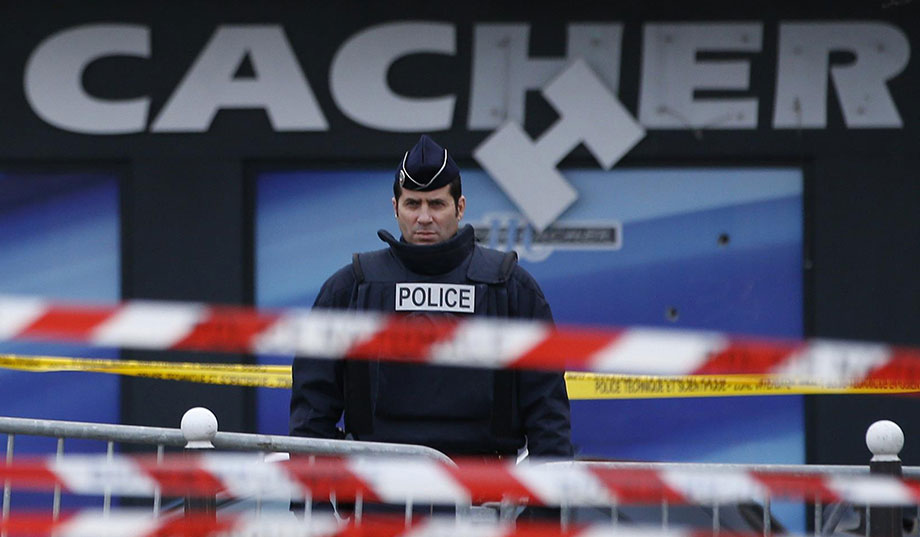
pic_giant_021115_SM_Paris-Hyper-CacherFrench police guard the Hyper Cacher market in Paris

Random? You’d almost think we were dealing with an identifiable enemy motivated by a distinct ideology that is drawn verbatim from a particular belief system’s scriptures. Nah . . .

******************

I don’t understand why folks are giving President Obama and his spokes-minions such a hard time over his insistence that Ahmedy Coulibaly, the terrorist who just happened to be Muslim committing terrorism that had nothing to do with Islam, was just “randomly” picking out folks in Paris to kill when he randomly came upon a grocery that just happened to be Jewish and, coincidentally, to have Jews in it, whom he randomly killed.

Sure, we know Coulibaly called a French TV station during the siege, said he was loyal to the Islamic State that has nothing to do with Islam, and that he picked this kosher market because he was targeting Jews. But you can’t believe everything you hear on TV — just ask Brian Williams.

Come to think of it, the Paris attack seems an awful lot like another random one in 2008. Back then, another group of Pakistani terrorists who just happened to be Muslim, and who belonged to the Lashkar-e-Taiba Islamic terrorist organization that has nothing to do with Islam, went looking for random folks to kill and just happened to stumble on the Nariman House, a Chabad Lubavitch Jewish center which, coincidentally, had Jews in it — Rabbi Gavriel Holtzberg and his wife,Rivka, then six months pregnant.

Of course, when they were randomly detaining these two folks who happened to be Jewish before randomly killing them, the terrorists who happened to be Muslim were overheard in radio transmissions discussing how “the lives of Jews were worth 50 times those of non-Jews” in this jihad that had nothing to do with Islam. But hey, totally random, right?

By the way, have you ever flipped randomly through Islamic scripture?

I just happened to land on sura 5:82 — wasn’t looking for anything in particular, you see — and found that it says: “Strongest among men in enmity to the Believers wilt thou find the Jews and pagans.”

Could something have been mistranslated? Maybe the revelation to the prophet really said “folks” but got somehow got written down as “Jews”? Doesn’t seem too likely. If you turn back a few verses, to sura 5:64, you learn Muslims believe the Jews have profoundly insulted Allah, claiming that “Allah’s hand is tied up” — which, as explained by the notes provided in the Saudi government’s English translation of the Koran, is a blasphemous taunt akin to calling Allah “close-fisted” and ungenerous.

In response, Allah instructs Muslims that it is the Jews whose hands should be tied up, and that they should be “accursed for the [blasphemy] they utter.” The verse adds:

The revelation that cometh to thee from Allah increaseth in most of [the Jews] their obstinate rebellion and blasphemy. Amongst them, We have placed enmity and hatred till the Day of Judgment. Every time they kindle the fire of war, Allah doth extinguish it. But they (ever) strive to do mischief on earth. And Allah loveth not those who do mischief.

That doesn’t seem very random.

Nor does sura 2:61, which explains that Allah has stamped the Jews with “humiliation and misery” because “they went on rejecting the signs of Allah and slaying His Messengers without just cause.” We further learn, four verses later, of Allah’s command that the Jews become “apes — despised and rejected” because they violated the sabbath.

Sura 5:41 describes the Jews as “men who will listen to any lie.”

According to sura 4:160–161, because of the “iniquity of the Jews,” Allah made it “unlawful for them” to eat certain “good and wholesome” foods. He was angered because

they hindered many from Allah’s way; . . . they took usury, though they were forbidden, and . . . they devoured men’s wealth wrongfully. We have prepared for those among them who reject Faith a grievous chastisement.

Given these, it should come as no surprise that Allah, in sura 5:51, instructs Muslims, “Do not take the Jews and the Christians for friends.” These passages probably also explain why, in sura 9:29, Allah commands Muslims to fight the Jews and the Christians until they agree to live under Allah’s law, pay a tax, and feel themselves subdued.

And let’s not forget the Hadith — authoritative collections of the recorded words and deeds of the prophet Mohammed. Like the Koran, they have scriptural standing in Islam. Also like the Koran, they often do not treat Jews as “random folks.”

Indeed, we are told that, in his dying words, the prophet cursed the Jews, along with the Christians:

When the last moment of the life of Allah’s Apostle came he started putting his ‘Khamisa’ on his face and when he felt hot and short of breath he took it off his face and said, “May Allah curse the Jews and Christians for they built the places of worship at the graves of their Prophets.” [Sahih Bukari, Book 1, volume 8, no. 427.]

In fact, in several hadith, the prophet is reported to have stated:

The last hour would not come unless the Muslims will fight against the Jews and the Muslims would kill them until the Jews would hide themselves behind a stone or a tree and a stone or a tree would say: Muslim, or the servant of Allah, there is a Jew behind me; come and kill him.

I know you’ll be stunned to hear this, but even though Islamic terrorists have nothing to do with Islam, they appear to think Islamic scripture means what it says. So if you were randomly to peruse, say, the charter of Hamas — an Islamic terrorist group that has nothing to do with Islam and that is randomly the Palestinian branch of the “largely secular” Muslim Brotherhood — look what you find in Article 7:

Hamas has been looking forward to implement Allah’s promise whatever time it might take. The prophet, prayer and peace be upon him, said: The time will not come until Muslims will fight the Jews (and kill them); until the Jews hide behind rocks and trees, which will cry: O Muslim! there is a Jew hiding behind me, come on and kill him!

Random? You’d almost think we were dealing with an identifiable enemy motivated by a distinct ideology that is drawn verbatim from a particular belief system’s scriptures. Nah . . .

4-Star Admiral Slams Obama: Muslim Brotherhood Infiltrated All Of Our National Security Agencies

February 11, 2015

4-Star Admiral Slams Obama: Muslim Brotherhood Infiltrated All Of Our National Security Agencies, You Tube, January 28, 2015

During a press conference on how to combat radical Islamic extremism, Admiral James A. “Ace” Lyons (U.S. Navy, Ret.), former Commander-in-Chief, U.S. Pacific Fleet, stated that under the leadership of Barack Obama the Muslim Brotherhood have infiltrated all of the National Security Agencies of the United States. Furthermore, Lyons said that Obama is deliberately unilaterally disarming the military and spoke to the need for the new GOP controlled congress and Military leaders to stand up to the administration and uphold their oaths.


What’s worse than no strategy?

February 11, 2015

What’s worse than no strategy? Israel Hayom, Clifford D. May, February 11, 2015

It seems like only yesterday that U.S. President Barack Obama was being criticized for having no strategy to ‎counter the jihadi threat. In fact, it was about 10 days ago. Peggy Noonan’s Feb. 1 Wall Street ‎Journal column was headlined: “America’s strategy deficit.”‎

Since then, a different perception has been taking root: Obama does indeed have a strategy — ‎a “secret strategy,” one that is alarmingly misguided. ‎

According to this theory, he believes that fighting terrorism requires accommodating the regime ‎long recognized by the U.S. government as the world’s leading sponsor of terrorism: the Islamic Republic of Iran. ‎

He may also see the Islamic republic not as a rival to the Islamic State group but as a more moderate ‎alternative — despite the fact that Iran’s Supreme Leader Ali Khamenei has repeatedly declared ‎hostility toward America the foundation of the Islamic revolution. ‎

The president appears to believe that Sunni jihadis can be countered by Shia jihadis. Last week, Islamic State demonstrated its barbarism by immolating a Jordanian pilot. That should not ‎cause us to forget that Iran’s rulers supplied militias in Iraq with improvised explosive devices used to immolate ‎American soldiers, are supporting Syrian dictator Bashar Assad who has used chemical ‎weapons to scorch the lungs of his opponents, and are continuing to illicitly develop nuclear ‎weapons capable of immolating millions.‎

Dr. Michael Doran, a senior fellow at the Hudson Institute, has not just speculated about ‎Obama’s “secret strategy.” He has painstakingly combed through the record and produced a ‎‎9,000-word report persuasively establishing that Obama, since early in his presidency, has ‎been in pursuit of a “comprehensive agreement” that would allow Iran to become what the ‎president has called “a very successful regional power.” ‎

Understand what that means: Iran would be the hegemon of the Middle East. Some states would ‎accept Tehran’s authority, striking deals and kowtowing in order to survive. Europeans would ‎accommodate Iran, based on its control of the flow of Gulf oil. Israel and Saudi Arabia, nations ‎that Iran’s rulers have threatened to wipe from the map, would be left to fend for themselves.‎

And some Sunnis would almost certainly turn to al-Qaida and Islamic State to help defend ‎them from Shia domination. Indeed, Islamic State rose in response to the extension of ‎Iranian power in Baghdad after America’s withdrawal from Iraq, coupled with ‎Obama’s decision not to support non-Islamist Syrians who had rebelled against the Assad ‎dictatorship.‎

Doran cites evidence that in the first year of Obama’s first term, there were more ‎White House meetings on Iran than any other national security concern. Detente with Iran was ‎seen as “an urgent priority,” but the president “consistently wrapped his approach to that priority ‎in exceptional layers of secrecy” because he was convinced that neither Congress nor the ‎American public would support him.‎

A year ago, Doran further reports, Benjamin Rhodes, a member of the president’s inner ‎circle, told a group of Democratic activists (unaware that he was being recorded) that a deal with ‎Iran would prove to be “probably the biggest thing President Obama will do in his second term ‎on foreign policy.” He made clear that there would be no treaty requiring the Senate’s advice and ‎consent.‎

The president believes that “the less we know about his Iran plans, the better,” Doran ‎concludes. “Yet those plans, as Rhodes stressed, are not a minor or incidental component of his ‎foreign policy. To the contrary, they are central to his administration’s strategic thinking about ‎the role of the United States in the world, and especially in the Middle East.” ‎

Those plans also explain why the president has refused to use tough sanctions, or even the threat ‎of tough sanctions, to force Supreme Leader Ali Khamenei to choose between his nuclear ‎weapons program and economic collapse. Doran writes, “For Obama, to force a confrontation ‎with Khamenei would destroy any chance of reaching an accommodation on the nuclear front ‎and put paid to his grand vision of a new Middle East order.”‎

Doran’s piece was published in the online journal Mosaic on Feb. 2. Four days later, ‎Obama released his 2015 National Security Strategy. It contained nothing about the ‎‎”secret strategy.” In fact, it contained nothing that could be called a strategy. ‎

That appraisal is widely shared. For example, David Rothkopf — who served in the Clinton ‎administration, “voted for Barack Obama twice” and now edits Foreign Policy magazine — called‎ the National Security Strategy “a brief filed by the president in defense of his record to date” and “a mishmash ‎leavened by good intentions but unintentionally spiced up by oversights, misrepresentations, and ‎a bad track record.” ‎

Last Friday, National Security Adviser Susan Rice reassured an audience at the Brookings ‎Institution that “the dangers we face … are not of the existential nature we confronted during ‎World War II or the Cold War.” But if Iran becomes nuclear-armed, other despotic regimes will ‎follow, greatly increasing the likelihood that terrorists will get their hands on nukes and, sooner ‎or later, use them.‎

Remember that American leaders of both parties similarly minimized the threat posed by al-Qaida prior to Sept. 11, 2001. Is the lesson of that day, as Rice implies, that we should ‎worry only about existential threats — confident that we can absorb lesser doses of death and ‎destruction? Or should we have learned instead to do all we can to prevent our enemies from ‎inflicting such punishment now and in the future?‎

This is a debate worth having. But it will be inhibited so long as the president insists on hiding ‎his views, leaving it to a few exceptional scholars to read between the lines. ‎

Columnist On Jordanian Daily: ISIS ‘Did Not Invent A New Islam’

February 11, 2015

Columnist On Jordanian Daily: ISIS ‘Did Not Invent A New Islam,’ MEMRI, February 11, 2015

(It would be encouraging if such statements were more often made in the “legitimate news” media of the U.S. and the “free” world. — DM)

In a February 10, 2015 article in the English-language Jordanian daily Jordan Times, titled “We Have a Problem”, attorney and columnist Zaid Nabulsi wrote that Muslims must not suffice with protesting that “Islam is innocent” of the terrorists’ actions. They must also acknowledge that the extremism of terrorist organizations like ISIS emanates directly from the teachings of Wahhabi Islam that now permeate the Sunni world, and from messages spread by the Muslim Brotherhood and by prominent clerics like Yousuf Al-Qaradawi. He added that Muslims must be brave enough not merely to condemn the ideology of the terrorists, but also to renounce Islamic texts that are incompatible with basic human values, including certain hadiths that are erroneously attributed to the Prophet Muhammad, as well as the writings of certain prominent medieval scholars, such as Ibn Taymiyyah.

The following are excerpts from his article:

“Some Wahabist Teachings, Which Have Permeated The Air We Breathe In The Muslim World, Are Simply Irreconcilable With Decent Human Values”

“Enough is enough. It is time to speak out. ‘Islam is innocent’ is an incomplete sentence. Introspection is needed, for, if we shy away from reality, the alternative will be more images like those we witnessed last Tuesday night, when brave Lt. Muath Al-Kasasbeh was burnt to death in a cage…

“Some Wahabist teachings, which have permeated the air we breathe in the Muslim world, are simply irreconcilable with decent human values, especially the ones that declare that every non-Wahabist is a disposable body whose bloodletting is unproblematic. So enough of this burial of our heads in the sand. It has become tiresome to keep hearing the unproductive cliché that Islam is innocent after each atrocity committed by devout fanatics who did nothing except execute the exact letter of their textbooks, which order them to slaughter the infidels.

“The escapism that mainstream Islam has nothing to do with those atrocities does not hold water anymore because Wahabism and Islam have become indistinguishable. To understand the crisis of Muslims today, one has to remember that Wahabism exists in several textbooks containing the alleged sayings of the Prophet Mohammad, or books of ‘Hadith,’ revered by so many. What we must confront is the undeniable fact that it is from many stories found in these books that the unprecedented cruelty of groups such as the so-called Islamic State and Jabhat Al-Nusra emanates.

“The problem today has nothing to do with the original spirit of Prophet Mohammad’s message. Nor has it anything to do with the tumultuous history of Muslims over 14 centuries, parts of which were no doubt glorious and enlightened. The catastrophe today is with the visible manifestation of Islam in the modern world, as demonstrated by the prevalent beliefs and practices of many people who call themselves Muslims.”

“[The] Negative Image Of Muslims Is Not All Just Smoke And No Fire”

“[But] this negative image of Muslims is not all just smoke and no fire. This is what those 120 Islamic scholars who sent a letter to Abu Bakr Al-Baghdadi last year could not fathom. [ISIS] did not invent a new Islam. On the contrary, its followers are strict adherents of the same textbooks quoted in that long letter (bizarrely addressed to ‘Dr Ibrahim Awwad Al-Badri,’ Baghdadi’s real name, bestowing intellectual respectability upon this mass murderer, as if one were writing a letter to the mayor of Copenhagen). In fact, the scholars’ letter was a misguided attempt to disinfect Wahabism, to cleanse it from itself, by claiming that IS simply misinterpreted texts that are otherwise compatible with human decency. In that sense, the letter squabbled over the semantics of the alleged instructions by the Prophet to spread Islam by the sword, but it did not dare renounce the authenticity of those same sayings…

“If we truly want to defend Islam, we need to perform a much more invasive surgery. Take the Muslim Brotherhood as an example of the prevalence of the Wahabist teachings among Muslims today. The Brotherhood is the virtual womb that incubated all the current jihadist groups, including Al-Qaeda itself (Al- Zawahiri hailed from the Egyptian MB offshoot that murdered president Anwar Sadat). Yet, when Abu Musab Al-Zarqawi was killed in 2006, the three most senior leaders of the MB in Jordan brazenly visited the condolence house in Zarqa and announced to the media that Zarqawi was a martyr in the eyes of God, despite Zarqawi having blown up three hotels in Amman the previous year, killing scores of Jordanians going about their lives or celebrating a peaceful wedding…

“The orgy of decapitations in Syria over the last four years was promoted by very rich Sunni clerics such as Yusuf Al-Qaradawi and Mohammad Al-Uraifi, aided by the countless satellite stations openly calling for the murder of Alawites and Shiites, and financed by billions from extremely wealthy but hateful Muslims. So, enough with the denials. It is time to raise the alarm. We have a problem!”

“If We Really Want To Defend Islam As A Religion Of Mercy… We Have To Muster The Courage To Identify The Specific Texts That Actually Defame Islam, Denounce Them And Permanently Cleanse Islamic Tradition Of Them”

“There is obviously a propensity towards eliminating ‘the other’ imbedded deep within Wahabist ideology. It is not only foolish to deny this fact, it is also dangerous, for we would be covering the cancerous tumour with a bandage. What we cannot deny is that many of the Wahabist textbooks are the same operating manuals that Islamist butchers use to justify their savagery. For example, very few people know that while [the Jordanian pilot] Muath was being set on fire in that macabre video, the voiceover was a recitation of an Ibn Taymiyah fatwa deeming the incineration of unbelievers a legitimate act of jihad. Ibn Taymiyah is not some obscure scholar on the fringe of Sunni Islam. In the Sunni world, he is universally venerated with the title ‘Sheikh of Islam,’ elevating him to an almost infallible clerical status.

“If we really want to defend Islam as a religion of mercy, if we really want to be believed when we proclaim the innocence of this religion, we need to do more than just repeat this meaningless mantra about us having nothing to do with [ISIS]. We have to muster the courage to identify the specific texts that actually defame Islam, denounce them and permanently cleanse Islamic tradition of them.”

The Only Strategy to Defeat Jihad

February 11, 2015

The Only Strategy to Defeat Jihad

By Jonathan David Carson

February 11, 2015

via Articles: The Only Strategy to Defeat Jihad.


An imam on British television taught me more in a few minutes than any of the books I have read on Islam, some of them quite instructive.  After railing at Israel and America, the imam smiled knowingly and said that if God did not want those skyscrapers to fall, he wouldn’t have let airplanes fly into them.  I almost shouted, “Then I guess God wants Palestinians to suffer, or else he wouldn’t let Israelis do all those awful things you say they do!”

I hear endless lamentations about our not having a strategy to defeat “Islamic extremism” or whatever the day’s euphemism is.  The cynic in me says that what we really need is to get rid of our strategy of helping the Muslim Brotherhood and the mullahs in Iran.  But if we have to have a strategy, here it is.

We blow some ISIS bastard to smithereens and shout, “Allahu Akbar!”  We take out Iran’s nuclear reactors and say, “If Allah wanted Iran to have a nuclear bomb, he wouldn’t have dropped those bunker-busters.”

Islam holds that there are no “secondary causes,” that is, that God never acts indirectly, by means of natural law, but always directly, willing everything that happens.  Fine, then, let secondary causes, cruise missiles, for instance, or rifle bullets, kill as many of our enemies as it takes for them to have to come to their senses.  Make them believe that Allah is killing them.  Make them believe it for so long that they stop believing the absurd promise that heaven is full of beautiful virgins waiting lustfully for their smelly carcasses.  Tell them over and over again that Allah is killing them, and doing it directly, without intermediaries, such as drone pilots or Marine snipers, and they will just want a drink.

Franklin Roosevelt said that the Doolittle Raid was launched from Shangri-La.  That’s the idea.  We won that war.

People frequently make the mistake of thinking that Islam is like Christianity, only different.  They are opposites.

Christianity thrives under adversity.  What’s killing Christianity is comfort and ease.  Christianity is for people in trouble.  Judaism too.

Islam thrives on success.  Muslims won one battle, and Mohammed said it was God’s will.  That seemed to make sense.  They won another battle, and they were convinced.  They won another battle, and Mohammed’s boast began to make sense to their enemies.  They won another battle, and their enemies were convinced.  Enemies fled and fled until they had a mighty empire.

Then they ran into men who knew to fight the long defeat, as the elves in The Lord of the Rings put it, and, lo, the defeat was not so long anymore.

We must fight whether we expect to win or not.  We are not cowards who won’t fight without a guarantee of victory from God.

I don’t want to hear any “moderate Muslim” crap.  Who are these mythical beasts?  The Saudis, who in the name of sexual morality won’t let girls escape from burning buildings improperly dressed and who then buy sex slaves from India and Pakistan?  Selling us oil makes them moderate?   They won’t even drill for it themselves.  We have to do it, just as we have to defend them from Saddam Hussein.  What makes them moderate is that we are fools.

I also don’t want to hear that most victims of Islamic extremism are Muslims.

For a while the hobbits sat in silence. At length Sam stirred. ‘Well, I call that neat as neat,’ he said. ‘If this nice friendliness would spread about in Mordor, half our trouble would be over.’

‘Quietly, Sam,’ Frodo whispered. ‘There may be others about. We have evidently had a very narrow escape, and the hunt was hotter on our tracks than we guessed. But that is the spirit of Mordor, Sam; and it has spread to every corner of it. Orcs have always behaved like that, or so all tales say, when they are on their own. But you can’t get much hope out of it. They hate us far more, altogether and all the time. If those two had seen us, they would have dropped all their quarrel until we were dead.

Colonialism has been roundly condemned as oppressive.  Maybe so.  But what the Islamic world needs is oppression.  When the West oppressed the Muslim world, we didn’t have this problem.  And the Muslims were better off.  They could gradually become sane,  as they noticed that Allah was not winning any battles for them.

The reason so many of us are complacent about the threat from Islam is that the colonial era, which ended only recently in historical terms, made us feel safe.  It made Muslims feel impotent and made us feel invincible.  We got swelled heads and saw too many movies and decided that Muslims were peaceful when they were simply afraid.  Now the Establishment reassures them of our peaceful intentions and destroys our best defense: their fear.

Not every Muslim is a terrorist, but Islam is a terrorist religion.  Mohammed was a mass murderer and child molester, and devout Muslims have been following his example ever since.  As long as there is Islam, there will be “Islamic extremists.”

The only way to get rid of Islamic extremism is to get rid of Islam, and it can be done.  Several times Islam has been near collapse, only to be rescued by infidels.  The Great Powers of the West, more fearful of each other than of Islam, rescued it in hopes of using it against their European enemies.  During the Cold War, Russians and Americans tried to turn the Islamic world against each other.  Now both live in fear of it.

Islam will collapse in reverse order.  One victory led to another and another and another.  One defeat will lead to another and another until either some Obama rescues it or it collapses.  The no secondary causes doctrine works only on the way up.

The reason we lost the wars in Iraq and Afghanistan is that we don’t know our enemies — or anybody else for that matter.  We think that we have to “win the hearts and minds” of Muslims.  That is insane.  No Iraqi or Afghan is going to fight for us.  They will fight for themselves, some of them.  Afghans will not fight for America; they might fight to protect themselves from the Taliban.

We don’t have to be liked or even respected.  Afghans have to be brave enough to fight for freedom.  We can help them be brave by killing some of their enemies.  The Muslim god is an illusion, American military might real.

Do not in your arrogance think that Afghan villagers are so much less intelligent than we are that it is impossible for them to grasp the obvious: Allah cannot protect the Taliban from determined Americans.  Afghans are like anyone else: they want to be on the winning side.  So don’t lose.

Squeamishness means death all around, even death for our enemies.  Wait until a nuclear weapon goes off in an American city, or the anti-Semites have their way and Israel is on the brink of destruction.  That is when you will see real death of Muslims, deaths of millions or tens of millions.

The issue is how many Muslims we will have to kill.  The liberals would have us kill more, far more, than is necessary.  We could kill a billion Muslims on a lazy afternoon.  We don’t do it because we are not killers, not because we can’t.  They, on the other hand, would kill a billion of us if they could.  They just can’t.

The more we wring our hands and say we are weary, the more we praise Islam without any real knowledge of it or any intention to obey its cruel rules, the more we temporize, the more we pride ourselves on our compassion and understanding, the more Muslims will die.

Obama is presenting a false American face to the Islamic world, which is getting the idea that Americans are just a bunch of European weenies, just when Europeans giving up on being weenies.  We are not “war weary”; we are weary of wars we lose.  Even if we win, we lose, as when we put in place a regime in Iraq more beholden to Iran than to us or a regime in Afghanistan no one should have to live under.

Obama is not America, as Muslims are going to find out.  The sooner, the better


Iran’s Moves in the Middle East and Why You Should Care.

February 10, 2015

Iran’s Moves in the Middle East and Why You Should Care, The Watchman via You Tube, February 10, 2015


Memo to President Obama: The Jihad That Led to the Crusades

February 10, 2015

Memo to President Obama: The Jihad That Led to the Crusades

via Memo to President Obama: The Jihad That Led to the Crusades | Pamela Geller, Atlas Shrugs.


The Jihad That Lead to the Crusades
Obama’s remarks about the evil of the Crusades, needs to be factually examined in detail. Here is such a list:
0355 After removing a Roman temple from the site (possibly the Temple of Aphrodite built by Hadrian), Constantine I has the Church of the Holy Sepulcher constructed in Jerusalem. Built around the excavated hill of the Crucifixion, legend has it that Constantine’s mother Helena discovered the True Cross here.
0613 – Persians capture Damascus and Antioch.
0614 – Persians sack Jerusalem. damaging the Church of the Holy Sepulcher in the process.
0633 – Muslims conquer Syria and Iraq.
0634 – 0644 – Umar (c. 0591 – 0644) reigns as the second caliph.
0635 – Muslims begin the conquest of Persia and Syria.
0635 – Arab Muslims capture the city of Damascus from the Byzantines.
August 20, 0636 – Battle of Yarmuk (also: Yarmuq, Hieromyax): Following the Muslim capture of Damascus and Edessa, Byzantine Emperor Heraclius organizes a large army which manages to take back control of those cities. However, Byzantine commander, Baänes is soundly defeated by Muslim forces under Khalid ibn Walid in a battle in the valley of the Yarmuk River outside Damascus. This leaves all of Syria open to Arab domination.
0637 – The Arabs occupy the Persian capital of Ctesiphon. By 0651, the entire Persian realm would come under the rule of Islam and continued its westward expansion.
0637 – Syria is conquered by Muslim forces.
0637 – Jerusalem falls to invading Muslim forces.
0638 – Caliph Umar I enters Jerusalem.
0639 – Muslims conquer Egypt and Persia.
0641 – Islam spreads into Egypt. The Catholic Archbishop invites Muslims to help free Egypt from Roman oppressors.
0641 – Under the leadership of Abd-al-Rahman, Muslims conquer southern areas of Azerbaijan, Daghestan, Georgia, and
Armenia.
0641 – Under the leadership of Amr ibn al-As, Muslims conquer the Byzantine city of Alexandria in Egypt. Amr forbids the looting of the city and proclaims freedom of worship for all. According to some accounts, he also has what was left of the Great Library burned the following year. Al-As creates the first Muslim city in Egypt, al-Fustat, and builds there the first mosque in Egypt.
0644 – Muslim leader Umar dies and is succeeded by Caliph Uthman, a member of the Umayyad family that had rejected Muhammad’s prophesies. Rallies arise to support Ali, Muhammad’s cousin and son-in-law, as caliph. Uthman launches invasions to the west into North Africa.
0649 – Muawiya I, a member of the Umayyad family, leads a raid against Cyprus, sacking the capital Salamis-Constantia after a short siege and pillaging the rest of the island.
0652 – Sicily is attacked by Muslims coming out of Tunisia (named Ifriqiya by the Muslims, a name later given to the entire continent of Africa).
0653 – Muawiya I leads a raid against Rhodes, taking the remaining pieces of the Colossus of Rhodes (one of the Seven Wonders of the ancient world) and shipping it back to Syria to be sold as scrap metal.
0654 – Muawiya I conquers Cyprus and stations a large garrison there. The island would remain in Muslim hands until 0966.
0655 – Battle of the Masts: In one of the only Muslim naval victories in the entire history of Islam, Muslim forces under the command of Uthman bin Affan defeat Byzantine forces under Emperor Constant II. The battle takes place off the coast of Lycia and is an important stage in the decline of Byzantine power.
0661 – 0680 – Mu’awiya, founder of the Umayyad dynasty, becomes the caliph and moves the capital from Mecca to Damascus.
0662 – Egypt fell to the Umayyad and Abbasid caliphates until 868 CE. A year prior, the Fertile Crescent and Persia yielded to the Umayyad and Abbasid caliphates, whose rule lasted until 1258 CE and 820 CE, respectively.
0667 – Sicily is attacked by Muslims coming out of Tunisia.
0668 – First Siege of Constantinople: This attack lasts off and on for seven years, with the Muslim forces generally spending the winters on the island of Cyzicus, a few miles south of Constantinople, and only sailing against the city during the spring and summer months. The Greeks are able to fend off repeated attacks with a weapon desperately feared by the Arabs: Greek Fire. It burned through ships, shields, and flesh and it could not be put out once it started. Muawiyah has to send emissaries to Byzantine Emperor Constans to beg him to let the survivors return home unimpeded, a request that is granted in exchange for a yearly tribute of 3,000 pieces of gold, fifty slaves, and fifty Arab horses.
0669 – The Muslim conquest reaches to Morocco in North Africa. The region would be open to the rule of the Umayyad and Abbasid caliphates until 800 CE.
0672 – Muslims under Mauwiya I capture the island of Rhodes.
0674 – Arab conquest reaches the Indus River.
August 23, 0676 – Birth of Charles Martel (Charles the Hammer) in Herstal, Wallonia, Belgium, as the illegitimate son of Pippin II. Serving as Mayor of the Palace of the kingdom of the Franks, Charles would lead a force of Christians that turn back a Muslim raiding party near Poitiers (or Tours) which, according to many historians, would effectively halt the advance of Islam against Christianity in the West.
0677 – Muslims send a large fleet against Constantinople in an effort to finally break the city, but they are defeated so badly through the Byzantine use of Greek Fire that they are forced to pay an indemnity to the Emperor.
0680 – Birth of Leo III the Isaurian, Byzantine Emperor, along the Turkish-Syrian border in the Syrian province of Commagene. Leo’s tactical skills would be responsible for turning back the second Arab Muslim siege of Constantinople in 0717, shortly after he is elected emperor.
0688 – Emperor Justinian II and Caliph al-Malik sign a peace treaty making Cyprus neutral territory. For the next 300 years, Cyprus is ruled jointly by both the Byzantines and the Arabs despite the continuing warfare between them elsewhere.
0691 – Birth of Hisham, 10th caliph of the Umayyad Dynasty. It is under Hisham that Muslim forces would make their deepest incursions into Western Europe before being stopped by Charles Martel at the Battle of Poitiers in 0732.
0698 – Muslims capture Carthage in North Africa.
0700 – Muslims from Pamntelleria raid the island of Sicily.
0711 – With the further conquest of Egypt, Spain and North Africa, Islam included all of the Persian empire and most of the old Roman world under Islamic rule. Muslims began the conquest of Sindh in Afghanistan.
April 0711 – Tariq ibn Malik, a Berber officer, crosses the strait separating Africa and Europe with a group of Muslims and enters Spain (al-Andalus, as the Muslims called it, a word is etymologically linked to “Vandals”). The first stop in the Muslim conquest of Spain is at the foot of a mountain that comes to be called Jabel Tarik, the Mountain of Tarik. Today it is known as Gibraltar. At one time the Berbers had been Christians but they recently converted in large numbers to Islam after the Arab conquest of North Africa.
July 19, 0711 – Battle of Guadalete: Tariq ibn Ziyad kills King Rodrigo (or Roderic), Visigoth ruler of Spain, at the Guadalete River in the south of the Iberian peninsula. Tariq ibn Ziyad had landed at Gibraltar with 7,000 Muslims at the invitation of heirs of the late Visigoth King Witica (Witiza) who wanted to get rid of Rodrigo (this group includes Oppas, the bishop of Toledo and primate of all Spain, who happens to be the brother of the late king Witica). Ziyad, however, refuses to turn control of the region back over to the heirs of Witica. Almost the entire Iberian peninsula would come under Islamic control by 0718 CE.
0712 – Muslim governor of Northern Africa Musa ibn Nusayr follows Tariq ibn Ziyad with an army of 18,000 as reinforcements for the conquest of Andalusia. Musa’s father had been a Catholic Yemenite studying to be a priest in Iraq when he was captured in Iraq by Khalid, the “Sword of Islam,” and forced to choose between conversion or death. This invasion of Iraq had been one of the last military orders given by Muhammed before his death.
0714 – Birth of Pippin III (Pippin the Short) in Jupille (Belgium). Son of Charles Martel and father of Charlemagne, in 0759 Pippin would capture Narbonne, the last Muslim stronghold in France, and thereby drive Islam out of France.
0715 – By this year just about all of Spain is in Muslim hands. The Muslim conquest of Spain only took around three years but the Christian reconquest would require around 460 years (it might have gone faster had the various Christian kingdoms not been at each other’ throats much of the time). Musa’s son, Abd el-Aziz, is left in charge and makes his capital the city of Seville, where he married Egilona, widow of king Rodrigo. Caliph Suleiman, a paranoid ruler, would have el-Aziz assassinated and sends Musa into exile in his native Yemen village to live out his days as a beggar.
0716 – Lisbon is captured by Muslims.
0717 – Cordova (Qurtuba) becomes the capital of Muslim holdings in Andalusia (Spain).
0717 – Leo the Isaurian, born along the Turkish-Syrian border in the Syrian province of Commagene, revolts against the usurper Theodosius III and assumes the throne of the Byzantine Empire.
August 15, 0717 – Second Siege of Constantinople: Taking advantage of the civil unrest in the Byzantine Empire, Caliph Sulieman sends 120,000 Muslims under the command of his brother, Moslemah, to launch the second siege of Constantinople. Another force of around 100,000 Muslims with 1,800 galleys soon arrives from Syria and Egypt to assist. Most of these reinforcements are quickly destroyed with Greek Fire. Eventually the Muslims outside Constantinople begin to starve and, in the winter, they also begin to freeze to death. Even the Bulgarians, usually hostile to the Byzantines, send a force to destroy Muslim reinforcements marching from Adrianopolis.
August 15, 0718 – Muslims abandon their second siege of Constantinople. Their failure here leads to the weakening of the Umayyad government, in part because of the heavy losses. It is estimated that of the 200,000 soldiers who besieged Constantinople, only around 30,000 made it home. Although the Byzantine Empire also sustains heavily casualties and loses most its territory south of the Taurus Mountains, by holding the line here they prevent a disorganized and militarily inferior Europe from having to confront a Muslim invasion along the shortest possible route. Instead, the Arabic invasion of Europe must proceed along the longer path across northern Africa and into Spain, a route which prevents quick reinforcement and ultimately proves ineffective.
0719 – Muslims attack Septimania in southern France (so named because it was the base of operations for Rome’s Seventh Legion) and become established in the region known as Languedoc, made famous several hundred years later as the center of the Cathar heresy.
July 09,0721 – A Muslim army under the command of Al-Semah and that had crossed the Pyrenees is defeated by the Franks near Toulouse. Al-Semah is killed and his remaining forces, which had previously conquered Narbonne, are forced back across the Pyrenees into Spain.
0722 – Battle of Covadonga: Pelayo, (0690-0737) Visigoth noble who had been elected the first King of Asturias (0718- 0737), defeats a Muslim army at Alcama near Covadonga. This is generally regarded as the first real Christian victory over the Muslims in the Reconquista.
0724 – Hisham becomes the 10th caliph of the Umayyad Dynasty. It is under Hisham that Muslim forces make their deepest incursions into Western Europe before being stopped by Charles Martel at the Battle of Poitiers in 0732.
0724 – Under the command of Ambissa, Emir of Andalusia, Muslim forces raid southern France and capture the cities of Carcassone and Nimes. Primary targets in these and other raids are churches and monasteries where the Muslims take away holy objects and enslave or kill all the clerics.
0725 – Muslim forces occupied Nimes, France.
0730 – Muslim forces occupy the French cities of Narbonne and
Avignon.
October 10, 0732 – Battle of Tours: With perhaps 1,500 soldiers, Charles Martel halts a Muslim force of around 40,000 to 60,000 cavalry under Abd el-Rahman Al Ghafiqi from moving farther into Europe. Many regard this battle as being decisive in that it saved Europe from Muslim control. Gibbon wrote: “A victorious line of march had been prolonged above a thousand miles from the rock of Gibraltar to the banks of the Loire; the repetition of an equal space would have carried the Saracens to the confines of Poland and the Highlands of Scotland; the Rhine is not more impassable than the Nile or Euphrates, and the Arabian fleet might have sailed without a naval combat into the mouth of the Thames. Perhaps the interpretation of the Koran would now be taught in the schools of Oxford, and her pulpits might demonstrate to a circumcised people the sanctity and truth of the revelation of Muhammed.” Others, though, argue that the battle’s importance has been exaggerated. The names of Tours, Poitiers, and Charles Martel do not appear in the Arab histories. They list the battle under the name Balat al- Shuhada, the Highway of Martyrs, and is treated as a minor engagement.
0735 – Muslim invaders capture the city of Arles.
0737 – Charles Martel sends his brother, Childebrand, to lay siege to Avignon and drive out the Muslim occupiers. Childebrand is successful and, according to records, has all the Muslims in the city killed.
0739 – Already having retaken Narbonne, Beziers, Montpellier, and Nimes during the previous couple of years, Childebrand captures Marseille, one of the largest French cities still in Muslim hands.
June 08, 0741 – Death of Leo III the Isaurian, Byzantine Emperor. Leo’s tactical skills were responsible for turning back the second Arab Muslim siege of Constantinople in 0717, shortly after he was elected emperor.
October 22, 0741.- Death of Charles Martel (Charles the Hammer) in at Quierzy (today the Aisne county in the Picardy region of France). As Mayor of the Palace of the kingdom of the Franks, Charles had led a force of Christians that turned back a Muslim raiding party near Poitiers (or Tours) which, according to many historians, effectively halted the advance of Islam against Christianity in the West.
April 04, 0742 -Birth of Charlemagne, founder of the Frankish Empire.
0743 -Death of Hisham, 10th caliph of the Umayyad Dynasty. It was under Hisham that Muslim forces made their deepest incursions into Western Europe before being stopped by Charles Martel at the Battle of Poitiers in 0732.
0750- The Arabian Nights, a compilation of stories written under the reign of the Abbasids, became representative of the lifestyle and administration of this Persian influenced government.
0750 – 08500750 – 0850 -The Four Orthodox Schools of Islamic Law were established.
0750 -The Abbasids assume control of the Islamic world (except Spain, which falls under the control of a descendant of the Umayyad family) and moved the capital to Baghdad in Iraq. The Abbasid Caliphate would last until 1258.
September 0755 -Abd al-Rahman of the Umayyad dynasty flees to Spain to escape the Abbasids and would be responsible for creating the “Golden Caliphate” in Spain.
0756 -The Emirate of Cordova is established by Umayyad refugee Abd al-Rahman I in order to revive the defeated Umayyad caliphate which had been destroyed in 0750 by the Abbasids. Cordova would become independent of the Abbasid Empire and represents the first major political division within Islam. The political and geographic isolation of the Cordova Caliphate would make it easier for Christians to decisively conquer it despite their failures elsewhere, although this would not be completed until 1492.
0759 -Arabs lose the city of Narbonne, France, their furthest and last conquest into Frankish territory. In capturing this city Pippin III (Pippin the Short) ends the Muslim incursions in France.
0768 -Pepin’s son, Carolus Magnus (Charlemagne), succeeded his father and became one of the most important European rulers of medieval history.
September 24, 0768 -Death of Pippin III (Pippin the Short) at Saint Denis. Son of Charles Martel and father of Charlemagne, in 0759 Pippin captured Narbonne, the last Muslim stronghold in France, and thereby drove Islam out of France.
0778 -Charlemagne, King of the Franks and soon-to-be Holy Roman Emperor, is invited by a group of Arab leaders in northeastern Spain to attack Abd al-Rahman I, ruler of the Emirate of Cordova. Charlemagne obliges them, but is forced to retreat after only getting as far as Saragossa. It is during his march back through the Pyrenees that his forces are set upon by Basques. Among the many who die is the war leader Roland from Breton, killed in Roncevalles, whose memory has been preserved in the “Chanson de Roland,” an important epic poem during the Middle Ages.
0785 -The Great Mosque in Cordoba, in Muslim controlled Spain, was built.
0787 – Danes invade England for the first time.
0788 -Death of Abd al-Rahman I, founder of the Umayyad Emirate of Cordova. His successor is Hisham I.
0792- Hisham I, emir of Cordova, calls for a Jihad against the infidels in Andalusia and France. Tens of thousands from as far away as Syria heed his call and cross the Pyrennes to subjugate France. Cities like Narbonne are destroyed, but the invasion is ultimately hated at Carcassone.
0796 -Death of Hisham I, emir of Cordova. His successor is his son, al-Hakam, who would keep up the jihad against the Christians but would also be forced to contend with rebellion at home.
0799 -The Basques rise in revolt and kill the local Muslim governor of Pamplona.
0800 -North Africa falls under the rule of the Aghlabi dynasty of Tunis, which would last until 0909 CE.
0800 – 12000800 – 1200 -Jews experience a “golden age” of creativity and toleration in Spain under Moorish (Muslim) rule.
0800 -Ambassadors of Caliph Harunu r-Rashid give keys to the Holy Sepulcher to the Frankish king, thus acknowledging some Frankish control over the interests of Christians in Jerusalem.
0801 -Vikings begin selling slaves to Muslims.
0806 -Hien Tsung becomes the Emperor of China. During his reign a shortage of copper leads to the introduction of paper money.
0813 -Muslims attack the Civi Vecchia near Rome.
April 04,0814 -Death of Charlemagne, founder of the Frankish Empire.
0816 -With the support of Moors, the Basques revolt against the Franks in Glascony.
0822 -Death of Al-Hakam, emir of Cordova. He is succeeded by Abd al-Rahman II.
June 0827 -Sicily is invaded by Muslims who, this time, are looking to take control of the island rather than simply taking away booty. They are initially aided by Euphemius, a Byzantine naval commander who is rebelling against the Emperor. Conquest of the island would require 75 years of hard fighting.
0831 -Muslim invaders capture the Sicilian city of Palermo and make it their capital.
0835 -Birth of Ahmad Ibn Tultun, founder of the Tulunid Dynasty in Egypt. Originally sent there as a deputy by the Abbasid Caliphate, Tultun will establish himself as an independent power in the region, extending his control as far north as Syria. It is under Tultun that the Great Mosque of Cairo is built.
0838 -Muslim raiders sack Marseille.
0841 -Muslim forces capture Bari, principle Byzantine base in southeastern Italy.
0846 -Muslim raiders sail a fleet of ships from Africa up the Tiber river and attack outlying areas around Ostia and Rome. Some manage to enter Rome and damage the churches of St. Peter and St. Paul. Not until Pope Leo IV promises a yearly tribute of 25,000 silver coins do the raiders leave. The Leonine Wall is built in order to fend off further attacks such as this.
0849 -Battle of Ostia: Aghlabid monarch Muhammad sends a fleet of ships from Sardinia to attack Rome. As the fleet prepares to land troops, the combination of a large storm and an alliance of Christian forces were able to destroy the Muslims ships.
0850 -The Acropolis of Zimbabwe was built in Rhodesia.
0850 -Perfectus, a Christian priest in Muslim Cordova, is executed after he refuses to retract numerous insults he made about the Prophet Muhammed. Numerous other priests, monks, and laity would follow as Christians became caught up in a zest for martyrdom.
0851- Abd al-Rahman II has eleven young Christians executed in the city of Cordova after they deliberately seek out martyrdom by insulting the Prophet Muhammed.
0852 -Death of Abd al-Rahman II, emir of Cordova.
0858- Muslim raiders attack Constantinople.
0859 -Muslim invaders capture the Sicilian city of Castrogiovanni (Enna), slaughtering several thousand inhabitants.
0863 -Under Cyril (0826 – 0869) and Methodius (c. 0815 – 0885) the conversion of Moravia begins. The two brothers were sent by the patriarch of Constantinople to Moravia, where the ruler, Rostilav, decreed in 863 that any preaching done had to be in the language of the people. As a result, Cyril and Methodius developed the first usable alphabet for the Slavic tongue – thus, the Cyrillic alphabet.
0866 Emperor Louis II travels from Germany to southern Italy to battle the Muslim raiders causing trouble there.
0868 -The Sattarid dynasty, whose rule would continue until 0930 CE, extended Muslim control throughout most of Persia. In Egypt, the Abbasid and Umayyad caliphates ended and the Egyptian-based Tulunid dynasty took over (lasting until 904 CE).
0869 -Arabs capture the island of Malta.
0870- After a month-long siege, the Sicilian city of Syracuse is captured by Muslim invaders.
0871 -King Alfred the Great of England created a system of government and education which allowed for the unification of smaller Anglo-Saxon states in the ninth and tenth centuries.
0874 -Iceland is colonized by Vikings from Norway.
0876 -Muslims pillage Campagna in Italy.
0879 -The Seljuk Empire unites Mesopotamia and a large portion of Persia.
0880 – Under Emperor Basil, the Byzantines recapture lands occupied by Arabs in Italy.
0884- Death of Ahmad Ibn Tultun, founder of the Tulunid Dynasty in Egypt. Originally sent there as a deputy by the Abbasid Caliphate, Tultun established himself as an independent power in the region, extending his control as far north as Syria. It is under Tultun that the Great Mosque of Cairo is built.
0884 -Muslims invading Italy burn the monastery of Monte Cassino to the ground.
0898 -Birth of Abd al-Rahman III, generally regarded as the greatest of the Umayyad caliphs in Andalusia. Under his rule, Cordova would become one of the most powerful centers of Islamic learning and power.
0900 -The Fatimids of Egypt conquered north Africa and included the territory as an extension of Egypt until 0972 CE.
0900 -Mayans emigrate to the Yucatan Peninsula.
0902 -The Muslim conquest of Sicily is completed when the last Christian stronghold, the city of Taorminia, is captured. Muslim rule of Sicily would last for 264 years.
0905-The Tulunid Dynasty in Egypt is destroyed by an Abbasid army sent to reestablish control over the region of Egypt and Syria.
0909 -Sicily came under the control of the Fatimids’ rule of North Africa and Egypt until 1071 CE. From 0878 until 0909 CE, their rule of Sicily was uncertain.
0909 -The Fatimid Dynasty assumes control of Egypt. Claiming descent from Fatima, daughter of the Prophet Muhammed, and Ali bin Abi Talib, the Fatimids would rule Egypt until being overthrown by the Auyybids and Saladin in 1171.
0911 -Muslims control all the passes in the Alps between France and Italy, cutting off passage between the two countries.
0912- Abd al-Rahman III becomes the Umayyad Caliph in Andalusia.
0916 -A combined force of Greek and German emperors and Italian city-states defeat Muslim invaders at Garigliano, putting Muslim raids in Italy to an end.
0920 -Muslim forces cross the Pyrenees, enter Gascony, and reach as far as the gates of Toulouse.
0929 -Abd al-Rahman III transforms the Emirate of Cordova into and independent caliphate no longer under even theoretical control from Baghdad.
0935 – 0969 -The rule of Egypt was under the Ikhidid dynasty.
0936 -The Althing, the oldest body of representative government in Europe, is established in Iceland by the Vikings.
0939 -Madrid is recaptured from Muslim forces.
0940 -Hugh, count of Provence, gives his protection to Moors in St. Tropez if they agree to keep the Alpine passes closed to his rival, Berenger.
c. 0950 Catholicism becomes prevalent and dominant religion throughout Europe.
0950 According to traditional historiography, Europe enters Dark Ages.
0953- Emperor Otto I sends representatives to Cordova to ask Caliph Abd al-Rahman III to call off some Muslim raiders who had set themselves up in Alpine passes and are attacking merchant caravans going in and out of Italy.
0961 -Death of Abd al-Rahman III, generally regarded as the greatest of the Umayyad caliphs in Andalusia. Under his rule, Cordova became one of the most powerful centers of Islamic learning and power. He is succeeded by Abdallah, a caliph who would kill many of his rivals (even family members) and has captured Christians decapitated if they refuse to convert to Christianity.
0961- Under the command of general Nicephorus Phokas, the Byzantines recapture Crete from Muslim rebels who had earlier fled Cordova.
0965 -Byzantine Emperor Nicephorus Phokas reconquers Cyprus from the Muslims.
0965 -Grenoble is recaptured from the Muslims.
0969 -The Fatimid dynasty (Shi’ite) takes Egypt from the Ikshidids and assumes the title of caliphate in Egypt until 1171 CE.
0969 -Byzantine Emperor Nicephorus II Phocas reconquers Antioch (modern Antakya, capital of the province Hatay) from the Arabs.
0972 -The Fatimids of Egypt conquer north Africa.
0972 -The Muslims in the Sisteron district of France surrender to Christian forces and their leader asks to be baptized.
0981- Eric the Red is exiled from Iceland and settles in a new land he called Greenland in order to attract settlers.
0981 -Ramiro III, king of Leon, is defeated by Al-Mansur Ibn Abi Aamir (Almanzor) at Rueda and is forced to begin paying tribute to the Caliph of Cordova.
0985 -Al-Mansur Ibn Abi Aamir sacks Barcelona
0994 -The monastery of Monte Cassino is destroyed a second time by Arabs.
0995 -Japanese literary and artistic golden age begins under Emperor Fujiwara Michinaga (ruled 0995 – 1028).
July 03,0997 -Under the leadership of Almanzor, Muslim forces march out of the city of Cordova and head north to capture Christian lands.
August 11, 0997 -Muslim forces under Almanzor arrive at the city of Compostela. The city had been evacuated and Almanzor burns it to the ground.
0998 -Venice conquers the Adriatic port of Zara. The Venetians would eventually lose the city to the Hungarians and, in 1202, they offer a deal to soldiers of the Fourth Crusade: capture the city again for them in exchange for passage to Egypt.
c. 1000-Chinese perfect the production and use of gunpowder.
1000 -The Seljuk (Saljuq) Turkish Empire is founded by an Oghuz Turkish bey (chieftain) named Seljuk. Originally from the steppe country around the Caspian Sea, the Seljuks are the ancestors of the Western Turks, present- day inhabitants of Turkey, Turkmenistan, Uzbekistan and Azerbaijan.
August 08, 1002 -Death of Al-Mansur Ibn Abi Aamir, ruler of Al-Andalus, on the way back from raiding the Rioja region.
1004 -Arab raiders sack the Italian city of Pisa.
1007 -Birth of Isaac I Comnenus, Byzantine emperor. Founder of the dynasty of the Comneni, Isaac’s government reforms may have helped the Byzantine Empire last longer.
1009 -The Holy Sepulcher in Jerusalem is destroyed by Muslim armies.
1009 -Caliph Al-Hakim bi-Amr Allah, founder of the Druze sect and sixth Fatimid Caliph in Egypt, orders the Holy Sepulcher and all Christian buildings in Jerusalem be destroyed. In Europe a rumor develops that a “Prince of Babylon” had ordered the destruction of the Holy Sepulcher at the instigation of the Jews. Attacks on Jewish communities in cities like Rouen, Orelans, and Mainz ensue and this rumor helps lay the basis for massacres of Jewish communities by Crusaders marching to the Holy Land.
1009 -Sulaimann, grandson of Abd al-Rahman III, returns over 200 captured fortresses to the Castilians in return for massive shipments of food for his army.
1012 -Caliph Al-Hakim bi-Amr Allah, founder of the Druze sect and sixth Fatimid Caliph in Egypt, orders the destruction of all Christian and Jewish houses of worship in his lands.
1012 -Berber forces capture Cordova and order that half the population be executed.
1013 -Jews are expelled from the Umayyad Caliphate of Cordova, then ruled by Sulaimann.
1015 -Arab Muslim forces conquer Sardinia.
1016 -The Dome of the Rock in Jerusalem is partially destroyed by earthquakes.
1020 -Merchants from Amalfi and Salerno are granted permission by the Egyptian Caliph to build a hospice in Jerusalem. Out of this would eventually grow The Order of Knights of the Hospital of St. John of Jerusalem (also known as: Knights of Malta, Knights of Rhodes, and most commonly as Knights Hospitaller).
1021 -Caliph al-Hakim proclaimed himself to be divine and founded the Druze sect.
1022 -Several Cathar heretics are discovered in Toulouse and put to death.
1023 -Muslims expel the Berber rulers from Cordova and install Abd er-Rahman V as caliph.
1025 -The power of the Byzantine Empire begins to decline.
1026 -Richard II of Normandy leads a group of several hundred armed men on a pilgrimage to the Holy Land in the belief that the Day of Judgment had arrived. Turkish control of the region hampers their goals, however.
1027 -The Frankish protectorate over Christian interests in Jerusalem is replaced by a Byzantine protectorate. Byzantine leaders begin the reconstruction of the Holy Sepulcher.
1029- Alp Arslan, “The Lion Hero,” is born. Arslan is the son of Togrul Beg, conqueror of Baghdad who made himself ruler of the Caliphate, and great-grandson of Seljuk, founder of the Seljuk Turkish empire.
1031 -The Moorish Caliphate of Córdoba falls.
1031 -The emir of Aleppo has the Krak des Chevaliers contructed.
1033 -Castile is retaken from the Arabs.
1035 -The Byzantines make a landing in Sicily, but don’t try to recapture the island from the Muslims.
1038 -The Seljuk Turks become established in Persia.
1042- The rise of the Seljuk Turks begins.
1045 – 1099 -1099 Life of Ruy Diaz de Vivar, known as El Cid (Arabic for “lord”), national hero of Spain. El Cid would become famous for his efforts to drive the Moors out of Spain. May 18, 1048 – Persian poet Umar Khayyam is born. His poem The Rubaiyat became popular in the West because of its use by Victorian Edward Fitzgerald.
1050 – 1200 -The first agricultural revolution of Medieval Europe begins in 1050 CE with a shift to the northern lands for cultivation, a period of improved climate from 700 CE to 1200 CE in western Europe, and the widespread use and perfection of new farming devices. Technological innovations include the use of the heavy plow, the three-field system of crop rotation, the use of mills for processing cloth, brewing beer, crushing pulp for paper manufacture, and the widespread use of iron and horses. With an increase in agricultural advancements, Western towns and trade grow exponentially and Western Europe returns to a money economy.
1050 -Duke Bohemond I (Bohemond Of Taranto, French Bohémond De Tarente), prince of Otranto (1089–1111) is born. One of the leaders of the First Crusade, Bohemond would be largely responsible for the capture of Antioch and he secures the title Prince of Antioch (1098 – 1101, 1103 – 04).
1050 -Byzantine emperor Constantine IX Monomachos restores the complex of the Holy Sepulcher in Jerusalem.
1054 -A famine in Egypt forces al Mustansir, 8th Fatimid caliph, to seek food and other commercial assistance from Italy and the Byzantine Empire.
July 16,-1054 Great Schism: The Western Christian Church, in an effort to further enhance its power, had tried to impose Latin rites on Greek churches in southern Italy in 1052; as a consequence, Latin churches in Constantinople were closed. In the end, this leads to the excommunication of Michael Cerularius, patriarch of Constantinople (who in turn excommunicates Pope Leo IX). Although generally regarded as a minor event at the time, today it is treated as the final event that sealed the Great Schism between Eastern and Western Christianity.
1055 -Seljuk Turks capture Baghdad.
1056 -The Almoravid (al-Murabitun) Dynasty begins its rise to power. Taking the name “those who line up in defense of the faith,” this is a group of fanatical Berber Muslims who would rule North Africa and Spain until 1147.
1061 -Roger Guiscard lands at Sicily with a large Norman force and captures the city of Masara. The Norman reconquest of Sicily would require another 30 years.
1063 -Alp Arslan succeeds his father, Togrul Beg, as ruler of the Baghdad Caliphate and the Seljuk Turks.
1064 -The Seljuk Turks conquer Christian Armenia.
September 29, 1066 -William the Conqueror invades England and claims the English throne at the Battle of Hastings. Because William is both the King of England and the Duke of Normandy, The Norman Conquest fuses French and English cultures. The language of England evolves into Middle English with an English syntax and grammar and a heavily French vocabulary.
1067 -Romanus IV Diogenes becomes the Byzantine Emperor.
1068 -Alp Arslan invades the Byzantine Empire and is repulsed by Romanus IV Diogenes over the course of three campaigns. Not until 1070, though, would the Turks be driven back across the Euphrates river.
1070 -Seljuk Turks capture Jerusalem from the Fatimids. Seljuk rule is not quite as tolerant as that of the Fatimids and Christian pilgrims begin returning to Europe with tales of persecution and oppression.
1070 -Brother Gerard, a leader of the Benedictine monks and nuns who run the hospices in Jerusalem. beings to organize The Order of Knights of the Hospital of St. John of Jerusalem (also known as: Knights of Malta, Knights of Rhodes, and most commonly as Knights Hospitaller) as a more military force for the active protection of Christian pilgrims.
1071 -Normans conquer the last Byzantine holdings in Italy.
1071 – 1085 -Seljuk Turks conquer most of Syria and Palestine.
August 19, 1071 –
Battle of Manzikert: Alp Arslan leads an army of Seljuk Turks against the Byzantine Empire near Lake Van. Numbering perhaps as many as 100,000 men, the Turks take the fortresses of Akhlat and Manzikert before Byzantine Emperor Romanus IV Diogenes can respond. Although Diogenes is able to recapture Akhlat, the siege of Manzikert fails when a Turkish relief force arrives and Andronicus Ducas, an enemy of Romanus Diogenes, refuses to obey orders to fight. Diogenes himself is captured and released, but he would be murdered after his return to Constantinople. Partly because of the defeat at Manzikert and partly due to the civil wars following the murder of Digoenes, Asia Minor would be left open to Turkish invasion. One third of Christian Lands and 51% of Christian Churches fall to Islam.
1072 -Tancred of Hauteville is born. A grandson of Robert Guiscard and nephew of Bohemund of Taranto, Tancred would become a leader of the First Crusade and eventually regent of the Principality of Antioch.
December 15, 1072 -Malik Shah I, son of Alp Arslan, succeeds his father as Seljuk Sultan.
1073 -Seljuk Turks conquer Ankara.
July 1074 -El Cid marries Jimena, niece of Alfonso IV of Castile and daughter of the Count of Oviedo.
1076 -First recorded execution in England by the ax: the Earl of Huntingdon.
1078 -Seljuk Turks capture Nicaea. It would change hands three more times, finally coming under control of the Turks again in 1086.
1079 -Battle of Cabra: El Cid led his troops to a rout of Emir Abd Allah of Granada.
1080 -Order of the Hospital of St. John is founded in Italy. This special order of knights was dedicated to guarding a pilgrim hospital, or hostel, in Jerusalem.
1080 -An Armenian state is founded in Cilicia, a district on the southeastern coast of Asia Minor (Turkey), north of Cyprus, by refugees feeling the Seljuk invasion of their Armenian homeland. A Christian kingdom located in the midst of hostile Muslim states and lacking good relations with the Byzantine Empire, “Armenia Minor” would provide important assistance to Crusaders from Europe.
1081 – 1118 -Alexius I Comnenus is Byzantine emperor.
1081 -El Cid, now a mercenary because he had been exiled by Alfonso IV of Castile, enters the service of the Moorish king of the northeast Spanish city of Zaragosa, al- Mu’tamin, and would remain there for his successor, al- Mu’tamin II.
1082 -Ibn Tumart, founder of the Amohad Dynasty, is born in the Atlas mountains.
1084 -Seljuk Turks conquer Antioch, a strategically important city.
October 25, 1085 -The Moors are expelled from Toledo, Spain, by Alfonso VI.
October 23, 1086 -Battle of Zallaca (Sagrajas): Spanish forces under Alfonso VI of Castile are defeated by the Moors and their allies, the Almorivids (Berbers from Morocco and Algeria, led by Yusef I ibn Tashufin), thus preserving Muslim rule in al-Andalus. The slaughter of Spaniards was great and Yusef refused to abide by his agreement to leave Andalusia in the hands of the Moors. His intention was actually to make Andalusia an African colony ruled by the Almorivids in Morocco.
1087 -After his crushing defeat at Zallaqa, Alfonso VI swallows his pride and recalls El Cid from exile.
September 13, 1087- Birth of John II Comnenus, Byzantine emperor.
1088 -Patzinak Turks begin forming settlements between the anube and the Balkans.
March 12, 1088 -Urban II is elected pope. An active supporter of the Gregorian reforms, Urban would become responsible for launching the First Crusade.
1089 -Byzantine forces conquer the island of Crete.
1090 -Yusuf Ibn Tashfin, King of the Almoravids, captures Granada.
1091 -The Normans recapture Sicily from the Muslims.
1091 – Cordova (Qurtuba) is captured by the Almoravids.
1092 -After the death of Seljuk Sultan (al-sultan , “the power”) Malik Shah I, the capital of the Seljuks is moved from Iconjium to Smyrna and the empire itself dissolves into several smaller states.
May 1094-El Cid captures Valencia from the Moors, carving out his own kingdom along the Mediterranean that is only nominally subservient to Alfonso VI of Castile. Valencia would be both Christian and Muslim, with adherents of both religions serving in his army.
August 1094 -The Almoravids from Morocco land near Cuarte and lay siege to Valencia with 50,000 men. El Cid, however, breaks the siege and forces the Amoravids to flee – the first Christian victory against the hard-fighting Africans.
November 18, 1095 -Pope Urban II opens the Council of Clermont where ambassadors from the Byzantine emperor Alexius I Comnenus, asking help against the Muslims, were warmly received.
Political foundations laid for the first “organized” Christian response to Jihad: the First Crusade.
These facts are taken from multiple open sources. If there is an error, let me know.

Egypt Under Al-Sisi: An Interview with Raymond Stock

February 9, 2015

Egypt Under Al-Sisi: An Interview with Raymond Stock, Middle East Forum, February 8, 2015

by Jerry Gordon
The New English Review
February 2015

The introduction to this interview has been abridged.

To discuss Egypt’s prospects under the Abdel Fattah al-Sisi government, we invited back Dr. Raymond Stock whom we had interviewed in November 2012. (See: No Blinders About Egypt Under Muslim Brotherhood ). Stock is a Shillman/Ginsburg Writing Fellow at the Middle East Forum and a former Assistant Professor of Arabic and Middle East Studies at Drew University. He spent twenty years in Egypt and was deported by the Mubarak regime in 2010. He is writing a biography of 1988 Egyptian Nobel laureate in literature Naguib Mahfouz (1911-2006) for Farrar, Straus and Giroux and is a prolific translator of his works.

……………………..

“[The Muslim Brotherhood] has deeply bonded with the highest levels of the Obama administration, which uncritically backed its creation of an elected, one-party dictatorship under Morsi.

“Unlike Morsi and the MB, who worked covertly with the terrorists in Sinai, al-Sisi wholeheartedly supports the peace with Israel.”

Egypt is now in an informal alliance with Israel, the United Arab Emirates and Bahrain to confront Iran. That alliance is compromised, however, by recent moves from Egypt’s Gulf partners to mend fences with Iran as a result of their feeling exposed by Washington’s alarming pivot toward Tehran at the expense of its traditional Sunni clients.

“Obama’s leftist, rather Edward-Saidian worldview … sees indigenous anti-Western forces such as the Islamists to be the benignly natural and legitimate consequence of American and European policies during the colonial era and the Cold War.”


********************

Jerry Gordon: Ray Stock thank you for consenting to this interview.

Raymond Stock: Thank you for inviting me back.

Jerry Gordon: Egyptian President al-Sisi started 2015 with two dramatic moves- his New Year’s speech at al-Azhar University and Christmas greetings at a Coptic church with Pope Tawadros II present. What were the messages he conveyed to Muslim clerics, Coptic Christians and the world?

Raymond Stock: At al-Azhar, President al-Sisi was saying it is not merely an extremist interpretation of Islam that is threatening the world with global jihad, but ideas that are at the core of the mainstream, orthodox understanding of the religion–and that this would require a “religious revolution” to change.

At the Coptic Cathedral, he urged Egyptians not to define themselves by their religion, be it Christian or Muslim, but by the fact that they are Egyptians–a rejection of Islamism, which defines national identity in purely religious terms.

To the world, he was saying that Islam as it is being taught and practiced by its leading religious scholars has given birth to a globally destructive ideology which is now threatening us all.

Moreover, he wants to launch a movement within Islam to save the religion from itself, that is, before it tears itself apart completely and the rest of the world destroys it in self-defense.

And he challenged the clerics to take the lead in that effort by openly re-examining their own teachings and source materials for interpreting Islam.

Gordon: Al-Sisi has cracked down on press freedoms in Egypt and brought to trial three Al Jazeera correspondents. What in your view prompted that?

Stock: Though no libertarian, it is hard to say if al-Sisi himself has had anything to do directly with the suppression of press freedom, though it is happening on his watch. Going back to Pharaonic times, Egypt’s state institutions, the oldest in the world, and its political culture, have little tradition of respecting civil liberties. Some periods have been worse than others–the worst was actually under Gamal Abdel-Nasser in the 1950s and ’60s, when many thousands of political prisoners were sent “behind the sun” to camps in the Western Desert.

Al-Sisi is still so popular, the public so widely disgusted with the unending social and political chaos since the 2011 revolution, and so alarmed by the terrorist insurgency waged by the Islamists, that probably a majority of news editors and perhaps also of reporters have decided to support him completely and to oppose his critics automatically. At this point it is hard to find any clear connection with al-Sisi himself to this consensus, enshrined in a declaration by several hundred key media figures a few months ago. However, certainly if he didn’t like it he could well speak up against it–yet he hasn’t so far.
948Pro-Sisi demonstrators celebrate the third anniversary of Mubarak’s overthrow, January 2014.

Last summer he publicly regretted the imprisonment of the three Al Jazeera journalists, saying he wished they had been deported instead. Citing his belief in an independent judiciary, he refused to intervene in the legal process. Now that they are being retried after winning on appeal, we’ll see if he pardons and deports them should they be convicted again.

Gordon: Following, al-Sisi’s ouster of President Morsi and crackdown on Muslim Brotherhood leaders, what has happened to the movement in Egypt?

Stock: Though deservedly banned as a terrorist group, its top leaders in jail and the rest driven underground or abroad, it is far from dead and remains a threat to the Egyptian state and society. Its refusal to accept the June 30 popular revolution (far larger than the one that overthrew Mubarak), parental bonds to Hamas, financial support from Qatar and wealthy Gulf donors (and possibly Iran), partnership with the Salafis and ideological affinity and outreach to groups like al-Qa’ida and Islamic Jihad have served it well in retaining its base while gaining sympathy–especially internationally.

Though all these factors–plus its horrendous behavior in power–have greatly alienated the majority of Egyptians, they are for the most part also its greatest assets for the future, if they can only survive the current storm. As they have shown in several major periods of repression in the past–the most severe being under Abdel-Nasser–they only need to endure until there is successor to al-Sisi, who may decide to restore the MB to political legitimacy as a means of fighting al-Sisi’s remaining political allies. (Anwar al-Sadat, for example, freed the MB activists from prison to combat the surviving members of Abdel-Nasser’s coterie.) Such a situation could put them in striking distance of taking power again.

Meanwhile, the MB has global headquarters in Istanbul and London, is very influential in Europe, and has enormously increased its penetration at the federal, state and local levels all over the US. As part of this, it has deeply bonded with the highest levels of the Obama administration, which uncritically backed its creation of an elected, one-party dictatorship under Morsi. Obama evidently seeks to help the MB to return to power in Egypt—as shown, for example, by the State Department’s recent hosting of a conference of MB allies at Foggy Bottom, though it may take a while. Al-Sisi probably only has a year or two to turn the economy around before he risks another uprising.

The goal of the terrorist insurgency is to discourage foreign investment and stifle the stimulus provided by major government projects such as the new second channel to the Suez Canal to aid the recovery from the last four years of chaos. This, they hope, will pave the way for new popular upheaval which they hope to manipulate if not lead.

Gordon: Has the Islamic State supplanted the Salafist and Muslim Brotherhood movements?

Stock: In a sense, yes, but the situation is actually quite complex. Ideologically, IS—like al-Qa’ida–is an extension of the Salafist movement and the MB (itself established as a Salafi organization in the Salafi library in Ismailiya, Egypt in 1928). IS, because of its uncompromising Islamist purity, harshness, brutality and its dramatic seizure of so much territory in Iraq and Syria, coupled with its incredibly savvy use of social media, has largely eclipsed all of its predecessors in recruitment of fighters to the Middle East. It also outpaced all of them in its creation of lone wolves and sleeper cells in Europe, America and elsewhere.
949Ansar Bayt al-Maqdis pledged allegiance to the Islamic State (IS) group last year.

That includes Egypt, where the MB-and-AQ aligned Ansar Bayt al-Maqdis (ABM) organization is responsible for most of the attacks in the country over the past two years. ABM, along with its allies controls much of North Sinai and has declared its allegiance to IS. The MB, as noted, still retains a very strong base, as does the Salafi al-Nour Party which has pragmatically allied itself with Al-Sisi. The appeal of IS may frustrate their ability to draw younger members–yet it is far from clear that IS will do any better in the long run. So have many of the Islamists in Libya, the eastern half of which IS now controls, and may soon run Tripoli as well. The stunning success of IS provides further inspiration to groups like Boko Haram, which has overrun much of northeastern Nigeria and has recently spread into Cameroon, as well as al-Shabaab in Somalia. IS also now has a presence in southern Afghanistan and beyond. Unless it is destroyed militarily in the very near future–which is virtually impossible so long as Obama is President–IS threatens every state with a significant Muslim population, as well as the West, which is its ultimate target.

Gordon: Al-Sisi has propounded a doctrine of stability for Egypt. What is it and has he succeeded since his election?

Stock: I would say that if al-Sisi truly has established such a doctrine for stability, it would consist of the following:

    1. Anti-Islamism—i.e. a more limited role for Shariah (which is nonetheless still enshrined in the new constitution, yet no longer to be interpreted by the clerics at al-Azhar, but by the government, whose authority and much of its outlook is secular, not religious;
    2. Electoral democracy though with somewhat limited civil liberties, to satisfy both the demand for popular sovereignty and for an end to the endless chaos–strikes and demonstrations (and skyrocketing crime) since the fall of Mubarak in 2011, and to limit the public role of the Islamists, who are at war with Egypt; and
    3. An independent foreign policy—one that still seeks to maintain the traditional alliance with the U.S. and the West, but is not afraid to go elsewhere as needed.

Obama’s backing of the Islamists and his cutting of aid for the past two years have driven al-Sisi to radically diversity Egypt’s sources of funding and investment from abroad, including for the first time military aid. For more than three decades, Egypt’s military assistance came almost exclusively from Washington, though that is now being surpassed by multi-billion dollar arms deals from Moscow and even to an extent from Beijing, funded by al-Sisi’s backers in the Gulf. That puts the Egyptian-American alliance and its principal benefits—the more than thirty-five year peace with Israel, our priority access to the Suez Canal (now being expanded with a second channel but without US investment), and vital cooperation on security issues—seriously at risk.

Gordon: Some analysts have said that in the wake of the Arab Spring the old order of regional autocracies has re-emerged in an alliance against the Muslim Brotherhood. What is your view and especially in the case of Egypt’s North African neighborhood?

Stock: That depends on the country: in North Africa, King Mohammed VI is still in power, but the Muslim Brotherhood has won more seats than the other parties in parliament, a situation echoing that in Jordan, though it is less precarious at present. Algeria, still recovering from the savage Islamist bloodbath after the Army’s annulment of elections in January 1992, was least affected of all the states in the region by the Arab Spring. (Perhaps the only major result there was the lifting of the State of Emergency that had prevailed for nearly two decades, in February 2011.) Tunisia, where the Arab Spring began in December 2010, threw out its MB-affiliate controlled government in a popular movement backed by the army—in a situation that rather echoed the one in Egypt, and late last year elected a new secularist plurality in parliament and a new secularist president, Béji Caїd Essebsi.

In Libya, the feeble central government that we helped install by foolishly removing the vicious, eccentric but cooperative Col. Mu’ammar al-Qaddafi has predictably collapsed. Yet a new secularist-dominated government was elected last June 25 and a pro-secularist remnant of the Qaddafi era, General Khalifa Haftar, for the past year has been at war with the Islamist militias that have been the real powers since 2011. Haftar also wants to destroy the Libyan iteration of the Muslim Brotherhood, root and branch, especially after it launched an armed uprising in eastern Libya following Morsi’s ouster in Egypt in 2013. As a result of this chaos, generated by our own needless—or at least, badly botched–intervention in the Arab Spring, the U.S. now has no effective presence in Libya. The security vacuum prompted Egypt and the United Arab Emirates to cooperate in launching air strikes near Tripoli last summer in support of Haftar’s forces. IS and other Islamist organizations are now infiltrating weapons and fighters into Egypt from Libya, threatening the country’s—and the region’s—stability.

In the Eastern Arab world, Egypt’s principal allies now are Saudi Arabia and the UAE, who together immediately pledged 12 billion dollars in aid after Morsi’s removal, and have given billions more since. All of it and more is desperately needed to compensate for the depletion of Egypt’s hard currency reserves, loss of foreign investment and near-destruction of the once lucrative tourist industry that have all continued since the January 25th Revolution against Hosni Mubarak. Both the Saudis and the Emiratis oppose the MB and Hamas, who—along with Egypt under Morsi—are clients of their Gulf rival, Qatar. America’s annual, mainly military package of $1.5 billion seems trifling in comparison (unless viewed cumulatively since it began in 1979). Still, it will be difficult to switch to mainly Russian or Chinese systems–much as the latter may be based on hacked American designs–after so many years of absorbing Yankee equipment and training.

Gordon: What is the emerging change in Egypt’s relations with Israel, both geo-political and economic?

Stock: Unlike Morsi and the MB, who worked covertly with the terrorists in Sinai, al-Sisi wholeheartedly supports the peace with Israel. He has greatly increased security cooperation with the Jewish state—which had been endangered in the 2011-12 transition and during the Morsi era—to levels exceeding those under Mubarak. Again, even more than Mubarak, who loathed them too, al-Sisi sees the MB, Hamas and their Islamist allies as threats to Egypt as well as Israel. Likewise, he sees Iran—with whom Morsi sought a rapprochement—as Egypt’s greatest strategic adversary in the region.

As a result, Egypt is now in an informal alliance with Israel, the United Arab Emirates and Bahrain to confront Iran. That alliance is compromised, however, by recent moves from Egypt’s Gulf partners to mend fences with Iran as a result of their feeling exposed by Washington’s alarming pivot toward Tehran at the expense of its traditional Sunni clients.

Meanwhile, though overall Israel-Egypt trade remains minimal (as it had through the decades of cold peace under Mubarak and afterward), energy-strapped Egypt may soon be importing natural gas from Israel’s newly-developed Tamar Reservoir in the Mediterranean. Given that Israel used to import natural gas from Egypt via a pipeline shared with Jordan (repeatedly sabotaged physically as well as assailed legally in Egypt since the fall of Mubarak), that is a remarkable turnaround indeed.

Gordon: What triggered Qatar’s re-opening of relations with Egypt despite the former’s support of Hamas and the Brotherhood?

Stock: The main factor was probably al-Sisi’s logical desire to stay in step with the policy of Egypt’s current primary foreign donors and investors, the Arab states in the Persian Gulf. After freezing relations with Qatar due to its support for Hamas and the MB, and perhaps also AQ and IS (the latter only early on?), and the universal irritant of Doha-based Al Jazeera, the members of the Gulf Cooperation Council (GCC), especially Saudi Arabia and the United Arab Emirates, decided last summer to repair the rift, apparently in face of the increasing U.S. tilt toward Iran. The U.S. tried to bypass al-Sisi by turning to Qatar and Turkey—both of whom Cairo had shunned for their support of Islamists and their criticism of Morsi’s ouster—as intermediaries with Hamas in the Gaza conflict last summer.

Ironically, that move may have done more to damage relations with Washington than with either Doha or Ankara, who probably could not be totally excluded in any case, given their closeness to Hamas. Yet those two regional rival countries’ desire to cut out Cairo, the historic mediator between the Palestinians, Israel and the West, did aggravate the Egyptians enormously, to be sure.

Qatar has taken some token steps to distance itself from the MB, like deporting several MB leaders who had taken refuge there. But Qatar apparently continues to finance them in their new home in London, and few believe the change is more than cosmetic. Thus the warming with Egypt and even within the GCC may not long endure.

Gordon: Why has the US Administration maintained an arm’s length relationship with al-Sisi subsequent to the ouster of Morsi?

Stock: It is no doubt due to Obama’s leftist, rather Edward-Saidian worldview, which sees indigenous anti-Western forces such as the Islamists to be the benignly natural and legitimate consequence of American and European policies during the colonial era and the Cold War—for which he has apologized repeatedly. He also has a positive, nostalgic view of Islam, given that he was born of a Muslim father and having apparently been raised as one by his step-father during his early childhood in Indonesia, and seems to project this image onto radical groups like the MB who cleverly pose as moderates. He is thus surrounded by numerous pro-Islamist advisers, as well as those who simply take a naïve view of groups like the MB, Hamas and Hizbollah–and even the Taliban (not a new position, but one now getting attention in the news).

It also means that he denies the common Islamist ideology of all those groups as well as AQ and IS, or even any connection of their beliefs to Islam. This, despite their being made up entirely of Muslims, that they base their ideology and tactics on the Qur’an, Hadith and other key Islamic texts, and that they have a very wide appeal in the global Islamic community. This is even more bizarre if you compare his statements and those of his aides about this question to those of al-Sisi—a Muslim leader of a majority Muslim country—at the seat of Sunni Islam’s highest authority, al-Azhar, on New Year’s Day. One of them, Obama, is willfully blind; the other, al-Sisi, with devastating clarity, identifies the problem as coming from within the very heart of Islam.

On a personal level, Obama does not take kindly to those who cross him. Just look at his relationship with Congress, and with Benjamin Netanyahu, while ignoring his own transgressions against those he thinks are transgressing against him. He regarded al-Sisi’s patriotic overthrow of Morsi–whom he had bolstered with more and more aid even as the MB leader became more and dictatorial–at the demand of more than twice as many Egyptians as those who voted for Morsi, as a personal affront as well as ideological heresy. He has since punished al-Sisi and the Egyptian people who rejected his chosen savior of their destiny accordingly. That may have softened a bit recently, due to the need to find Arab allies to fight IS, but that is not a serious effort: the default position is against al-Sisi and for the MB.

Gordon: Given your Egyptian sojourn does al-Sisi have both the domestic and international support to implement his agenda?

Stock: Domestic, yes—all but a quarter to a third of the country wants him to succeed. But internationally is another story. Al-Sisi’s greatest enemy is not the MB, or even IS, but the president of the United States. When the State Department invited key figures from the pro-MB alliance of groups to a major conference in Washington this week, he was signaling his desire (and only Obama sets our foreign policy) to overthrow al-Sisi—just as his invitation to the leaders from the banned MB to sit in the front row of his Cairo speech in 2009 signaled that he wanted to remove Mubarak. So U.S.-dependent international institutions and allies may not be too supportive of al-Sisi.

The only possible silver lining for Egypt is, ironically (given our historic alliance), really a great problem for our country, if one values its role of global leadership since World War II. That is, Obama has done so much to destroy America’s standing with the rest of the world that even our closest allies no longer fear to stray, and may yet not follow his wishes regarding al-Sisi. Tragically, on many issues, that may be better for us all until Obama leaves office. For the heading he has set leads directly to hell, a destination that many countries, thanks to in large part to his policies, have already seen (and Syria and Libya have already become)–good intentions (by his lights) notwithstanding.

Gordon: Dr. Stock many thanks for this highly informative interview.

Stock: You’re most welcome.

Qatar, Egypt on a collision course

February 9, 2015

Qatar, Egypt on a collision course, Israel Hayom, Dr. Reuven Berko, February 9, 2015

This anti-Egypt agenda, which seems to be shared by Turkey, is fueled by the desire to realize the dream of installing a Sunni Islamic empire, all while undermining moderate Arab regimes and giving a nod to Iran, as a way of covering all bases — just in case.

******************

Qatar and Egypt are at odds, and the attempts by the late King Abdullah of Saudi Arabia to facilitate a reconciliation between them have failed.

Qatar’s relentless efforts to overthrow Egyptian President Abdel-Fattah el-Sissi’s regime and reinstate the Muslim Brotherhood to power are evident from the programs airing on the Doha-controlled Al-Jazeera television network, and from the publication of doctored wiretaps featuring the Egyptian president and his advisers, who allegedly “stole” Egypt away from the Muslim Brotherhood and the “holy” Mohammed Morsi.

This anti-Egypt agenda, which seems to be shared by Turkey, is fueled by the desire to realize the dream of installing a Sunni Islamic empire, all while undermining moderate Arab regimes and giving a nod to Iran, as a way of covering all bases — just in case.

Egypt’s decision to outlaw the Muslim Brotherhood has resulted in increased incitement by Qatar as well as in an escalation in terrorist attacks in Egypt and Sinai. Egyptian intelligence has linked the latest series of attacks to Ansar Beit al-Maqdis, an offshoot of the Islamic State group, as well as to Hamas’ Izzedine al-Qassam Brigades. Hamas and the Izzedine al-Qassam Brigades are very much Qatar’s “babies,” and their involvement in these terrorist attacks has prompted Egypt to outlaw both.

In response, Al-Jazeera has begun portraying Izzedine al-Qassam Brigades’ operatives, who have denounced Sissi as a traitor to Islam and Arabs everywhere, as heroes fighting for the liberation of “Palestine.” The Qatari television station has also been obsessively covering the riots and unrest instigated by the Muslim Brotherhood to undermine the regime, intimidate foreign investors, and reverse the image of stability Sissi’s government is trying to convey to the world.

The airing of secret wiretaps, on which Sissi is heard mocking the wealthy Persian Gulf states, at this time seeks to pit Cairo against the Gulf states, ahead of the World Economic Forum on the Middle East, which is scheduled to convene in Sharm el-Sheikh, in Egypt, in late February, and where Egypt will lobby for aid.

Sissi’s assertion about the current situation in the Middle East is correct: Sunni Arab states are being offered as sacrifice to Iran, which is pursuing its nuclear endeavors uninterrupted. These states understand that Egypt’s stability is a prerequisite for their own national security, and therefore aiding Cairo is a favor that could only work to their advantage.

At the end of the day, in a reality where Iran poses an existential threat to other Arab countries, pointing to the emir of Qatar as a leader drowning in gold while millions of Egyptians go hungry — as heard on the wiretaps — may prove to be a double-edged sword, which may end up striking Qatar itself.