Posted tagged ‘Islam’

 Russia: Bad Turkey Planning Invasion of Syria, Good Israel Cooperating with Russians

February 4, 2016

Russia: Bad Turkey Planning Invasion of Syria, Good Israel Cooperating with Russians

Source: The Jewish Press » » Russia: Bad Turkey Planning Invasion of Syria, Good Israel Cooperating with Russians

Russian attack planes in Syria

Russian attack planes in Syria
Photo Credit: TASS

The current activity at the Turkish-Syrian border suggest that Turkey prepares to invade Syria, Russian Defense Ministry spokesman Igor Konashenkov said Thursday, according to various reports in Russia’s state-sponsored media. “We have good reasons to believe that Turkey is actively preparing for a military invasion of a sovereign state – the Syrian Arab Republic,” Konashenkov told reporters. “We’re detecting more and more signs of Turkish armed forces being engaged in covert preparations for direct military actions in Syria,”.

Meanwhile, Russia’s Federation Council Speaker Valentina Matviyenko told Israeli media that Russia is content with the level of cooperation with Israel over military operations in Syria.

Last year, during Prime Minister Benjamin Netanyahu’s visit to Moscow, an agreement was reached by the two countries on coordination between Russia’s Aerospace Force and Israel’s Air Force. Matviyenko noted, according to TASS: “We are satisfied how our mechanism has been tailored,” which we only vaguely understood, but assume she meant to say, “We are pleased with the way our agreement has been adjusted.”

As to Turkey, the Russians are not at all pleased with its plan to invade a country they’ve already invaded. As Konashenkov remarked with thick irony, “We’re perplexed by the fact that the usually talkative representatives of the Pentagon, NATO and of the groups allegedly protecting the rights of Syrian people remain silent despite our calls to react to these actions.”

A Thursday afternoon Russian Defense Ministry tweet read: “Russian MoD registers a growing number of signs of hidden preparation of the Turkish Armed Forces for active actions on territory of #SYRIA.”

The Russians are irate because Turkey will not allow a Russian inspection flight over its territory, which they take to prove that Ankara is hiding illegal military activity on the border with Syria.

Elsewhere on the Syrian front, another Russian Defense Ministry spokesman announced Thursday that since the start of February Russian planes have made 237 sorties and attacked almost 900 targets in five Syrian provinces.

John Kerry calls ISIS ‘apostates’

February 4, 2016

John Kerry calls ISIS ‘apostates’

ByPamela Geller on February 3, 2016

Source: John Kerry calls ISIS ‘apostates’ | Pamela Geller

The Obama administration continues its absurd Islamic proclamations devoid of Islamic theology.

Over the past four years, Obama and his yapping minions have insisted that the Islamic State “is not Islamic” despite their every action, every declaration being based on Islamic texts and teachings. The Islamic State prays around every murder, every rape, every conquest. Muhammad is their model. The Islamic State kills Muslims who have “betrayed” Islam — secular Muslims, Shia Muslims, apostates.

So I cannot help but be bemused and amused by John Kerry, world-renowned Islamic scholar, declaring the Islamic State faithful to be “apostates.” What school of Islamic jurisprudence is Kerry basing this on? First, it’s “ISIS has nothing to do with Islam” and now, when it can no longer be denied, it’s, “well — they’re Islamic apostates!” These are the people in charge of our security?

The former Imam of the Grand Mosque in Mecca, Adel Kalbani, said,  “ISIS have the same beliefs as we do.” The Islamic State explains their every action using the Quran, hadith and sira.

It is interesting that when the Obama administration could no longer deny the connection between the Islamic State and Islam, they have resorted to using Islamic terminology to explain them. Obama is far more the apostate than the devout Muslims serving the Islamic State: he was raised a Muslim and his father was a Muslim, making him a Muslim according to Islamic law. But now he identifies as a Christian. So here we have the apostate President’s non-Muslim Secretary of State declaring that people whose every move is guided by the Quran are apostates. It would be a great comedy if so many people weren’t getting killed.

John Kerry calls ISIS ‘apostates’ By Arutz Sheva Staff, February 2, 2016:
With unusual choice of language, US Secretary of State wades into Islamic theology, claims Islamic State not true Muslims but ‘apostates.

With an unusual choice of language, US Secretary of State John Kerry waded into Islamic theological debate on Tuesday when he branded the Islamic State terror group “apostates.”

The United States affords its citizens religious freedom and does not consider apostasy a crime, but Kerry chose the term to rubbish the jihadists’ claims of piety.

“Daesh is in fact nothing more than a mixture of killers, of kidnappers, of criminals, of thugs, of adventurers, of smugglers and thieves,” he declared using the Arabic acronym for ISIS.

“And they are also above all apostates, people who have hijacked a great religion and lie about its real meaning and lie about its purpose and deceive people in order to fight for their purposes.”

Some Muslim legal scholars consider the proper punishment for turning one’s back on the faith to be death and several majority Islamic countries execute convicted apostates.

ISIS claims to have founded a “caliphate” based on its interpretation of Islamic sharia law and itself often brands its Muslim enemies apostates.

Kerry was in Rome on Tuesday for a meeting of the 23 nations at the core of the US-led coalition fighting ISIS in Iraq and Syria and supporting local forces.

The end of a news conference by Kerry and Italy’s foreign minister Paolo Gentiloni was briefly disrupted by protesters alleging US policy had caused the jihadists’ rise.

Lavrov, Kerry confirm plans to hold meeting on Syria in Munich on February 11

February 4, 2016

Lavrov, Kerry confirm plans to hold meeting on Syria in Munich on February 11 World

February 04, 14:25

Source: TASS: World – Lavrov, Kerry confirm plans to hold meeting on Syria in Munich on February 11

The top diplomats also agreed to take steps to minimize the pause in the intra-Syrian talks
US and Russian Foreign Ministers John Kerry and Sergey Lavrov © Alexandr Sherbak/TASS
MOSCOW, February 4. /TASS/. Russian Foreign Minister Sergey Lavrov and his US counterpart John Kerry in a phone conversation on Thursday confirmed plans to hold a meeting of the International Syria Support Group (ISSG) in Munich on February 11, Russia’s Foreign Ministry has said.
“The agreement was also confirmed on holding another ministerial meeting of the International Syria Support Group in Munich on February 11,” the ministry said. The sides will consider “all the aspects of the Syrian settlement in line with the UN Security Council resolution 2254.” Lavrov and Kerry also agreed to take steps to minimize the pause in the intra-Syrian talks.
The talks in Switzerland’s Geneva were suspended on Wednesday until February 25, UN special envoy for Syria Staffan de Mistura said. “While expressing common regret over the fact that the UN-brokered intra-Syrian dialogue has been temporarily suspended, Lavrov and Kerry agreed to make necessary efforts to ensure that this pause is as short as possible,” the ministry said. Read also Moscow regrets Syria talks paused, but no one expected everything to be smooth — Kremlin Syrian internal opposition says it has legitimate right to take part in talks Russia hopes Syrian Support Group will put no obstacles to intra-Syrian talks — FM Deputy UN envoy: Syria peace talks suspended until 25 February
The Russian side has voiced concerns as some representatives of the Syrian opposition set unacceptable preconditions to establish sustained negotiations with the government of Syria. Moscow also called on the United States and its allies to remain committed to the provisions of the UN Security Council resolution 2254 adopted on December 18 that endorsed a road map for peace process in Syria. Lavrov and Kerry “stated the need for urgent steps both of the Syrian government and the opposition in order to ensure humanitarian access under the UN auspices to the areas of the country blocked both by the government forces and the armed opposition units,” the ministry said.
The Russian and US top diplomats agreed on “possible coordinated actions on delivering humanitarian aid to the certain areas of Syria by air with the use of means of military-transport aviation,” it said.

Obama at Muslim Brotherhood-linked Mosque: “Muslim Americans Keep Us Safe”

February 4, 2016

Obama at Muslim Brotherhood-linked Mosque: “Muslim Americans Keep Us Safe” And: “Islam has always been part of America.” Really?

February 4, 2016 Robert Spencer

Source: Obama at Muslim Brotherhood-linked Mosque: “Muslim Americans Keep Us Safe” | Frontpage Mag

When Barack Obama visited the Muslim Brotherhood-linked Islamic Society of Baltimore on Wednesday, he said: “The first thing I want to say is two words that Muslim Americans don’t hear often enough: Thank you.”

While Obama has been President, Muslims have murdered non-Muslims, avowedly in the cause of Islam, at Fort Hood, Boston, Chattanooga, and San Bernardino, and attempted to do so in many, many other places. Imagine if armed Baptists screaming “Jesus is Lord” had committed murder, and explained that they were doing so in order to advance Christianity, in four American cities, and had attempted to do so in many others. Imagine that those killers were supporters of a global Christian movement that had repeatedly called for attacks on U.S. civilians and declared its determination to destroy the United States.

Imagine how incongruous it would be in that case for the President of the United States to visit a church and say: “The first thing I want to say is two words that Christian Americans don’t hear often enough: Thank you.” And imagine how unlikely it would be that Barack Obama would ever have done that.

But his visit to the Islamic Society of Baltimore was the apotheosis of the Muslim victimhood myth, as he signaled yet again to the world (and worldwide jihadis) that in the U.S., Muslims are victims, victims of unwarranted concern over jihad terror, and thus that concern is likely to lessen even more, as Obama dismantles still more of our counter-terror apparatus.

“We’ve seen children bullied, we’ve seen mosques vandalized,” Obama claimed. “It’s not who we are. We’re one American family. And when any part of our family begins to feel separate or second class, it tears at the heart of our nation” – he said to his gender-segregated Muslim audience, with the womensitting in the back. In reality, Muslims are not victimized in American society: FBI hate crime statistics show that the hysteria over “Islamophobia” is unfounded, but that matters not at all to Barack Obama. At the mosque, he said: “If we’re serious about freedom of religion — and I’m talking to my fellow Christians who are the majority in this country — we have to understand that an attack on one faith is an attack on all faiths.”

Once again Obama felt free to scold and admonish Christians, but said nothing about Muslims in the U.S. needing to clean house and work for real reform that would mitigate jihad terror. And his premise was false: there is no attempt to restrict Muslims’ freedom of religion. Donald Trump hasn’t called for that; nor has Ben Carson or any serious analyst. But the Hamas-linked Council on American-Islamic Relations (CAIR) (a representative of which accompanied Obama to the mosque Wednesday) and other Islamic advocacy groups have consistently charged that counter-terror efforts and attempts to restrict the political, supremacist and authoritarian aspects of Sharia that are at variance with Constitutional principles were tantamount to restricting Muslims’ religious freedom.

Now the President of the United States has endorsed their false narrative, which will only further stigmatize initiatives to understand the jihadis’ ideology and counter it effectively. He further criticized those who dare to suggest that Islam might have something to do with Islamic terrorism by criticizing those who say that the U.S. is at war with Islam: “That kind of mind-set helps our enemies,” he intoned. “It helps our enemies recruit. It makes us all less safe.”

The U.S. certainly isn’t at war with Islam, but segments of the Islamic world are at war with the U.S., and Obama did not explain what might be done to counter the beliefs that have given rise to that idea. He is, of course, against studying the beliefs of the enemy. Yet he said proudly: “Jefferson and John Adams had their own copies of the Qur’an,” without bothering to mention that they had them in order to understand the ideology of the enemy the new nation faced in the Barbary Pirates. They held, of course, the same ideology he ignores and denies today, the one he ordered all traces of removed from counterterror training.

“Islam,” Obama declared, “has always been part of America.” Really? There were Muslims at Jamestown? In the Massachusetts Bay Colony? At Roanoke? Obama’s statement is so wildly ridiculous that it doesn’t just invite parody; it pleads for it. Remember the Muslims among the Founding Fathers, Yahya al-Adams and Iskandar Hamilton? Remember the Muslims who told James Madison about Muhammad’s Constitution of Medina so that he could lay out the foundations of a republic in the U.S. Constitution? Remember the Muslims who fought so valiantly in the Revolutionary Jihad, and the Jihad of 1812, and the Mexican Jihad, and the Civil War, aka the Jihad Between the Caliphates? Remember all the controversies about whether Muslim soldiers in the Civil War could make sex slaves out of the wives and daughters of Confederate commanders? The jihad suicide attacks that broke the Germans’ will to fight on during World War I?

Burrowing deeper into fantasy, Obama proclaimed: “Generations of Muslim Americans helped to build our nation.” He didn’t mention the real contributions Muslims have made to our nation: you know, like rearranging the New York skyline, transforming government buildings into grim, nervous fortresses, making air travel into exercise in annoyance and humiliation that it is today, and draining the American economy with two futile wars and hundreds of billions spent on security and counterterror initiatives.

In detailing the contributions that Muslims have made to the U.S., Obama said: “Muslim Americans keep up safe. They are our police. They are our fire fighters. They’re in (the Department of) Homeland Security.” And remember: none of them were screened for jihadi sympathies. To have done so would have been “Islamophobic,” and transgressed against the prevailing dogma that Islam is a Religion of Peace that non-Muslims are wrong and bigoted to be concerned about.

The most ominous thing Obama said in this speech full of treacle and humbug was this: “We’re not going to strengthen our leadership around the world by allowing politicians to insult Muslims or pit groups of Americans against each other. That’s not who we are. That’s not keeping America safe.” So what is he going to do? Destroy the First Amendment and disallow politicians to insult Muslims?

Obama decried “phony tough talk and bluster and over-the-top claims.” Yet in the final analysis, that was all he offered.

Russia content with cooperation with Israel over military operation in Syria

February 3, 2016

Russia content with cooperation with Israel over military operation in Syria

Russian Politics & Diplomacy February 03, 18:28

Source: TASS: Russian Politics & Diplomacy – Russia content with cooperation with Israel over military operation in Syria

“We are satisfied how our mechanism has been tailored,” Russia’s Federation Council Speaker Valentina Matviyenko says

© EPA/PAVEL WOLBERG

JERUSALEM, February 3. /TASS/. Russia is content with the level of cooperation with Israel over the military operation in Syria, Russia’s Federation Council Speaker Valentina Matviyenko said on Wednesday. Answering a TASS question whether the fight against terrorism was on the table of her meeting with Israel’s parliamentary speaker Yuli-Yoel Edelstein, Matviyenko said, “We discussed the issue.” Last year during a visit of Israel’s Prime Minister Benjamin Netanyahu to Moscow an agreement was reached on coordination between Russia’s Aerospace Force and Israel’s Air Force, she recalled. “We are satisfied how our mechanism has been tailored,” the speaker of the Russian upper parliamentary house said. Russia’s aviation grouping has been delivering air strikes against the Islamic State terrorist organization (outlawed in Russia) in Syria since September 30 at the request of Syria’s President Bashar Assad.

The IDF’s Misplaced Trust in the Palestinian Authority

February 3, 2016

The IDF’s Misplaced Trust in the Palestinian Authority The new major threat inside Israeli communities enters a new phase.

February 3, 2016 Caroline Glick

Source: The IDF’s Misplaced Trust in the Palestinian Authority | Frontpage Mag

Amjad Sakari made no effort to hide his feelings and intentions towards Israel. The soldier in the Palestinian security forces filled his Facebook page with paeans to Saddam Hussein. Last weekend he published two posts indicating his imminent plan to carry out a terrorist attack.

In other words, if the PA forces he served had been serious about preventing their members from carrying out terrorist attacks, they could have easily prevented Sakari from driving to an IDF checkpoint between Ramallah and Beit El Sunday morning, opening fire and wounding three soldiers – one critically. Sakari, who was killed in the course of his attack, was the third member of the US-backed PA security forces who engaged in terrorism in the past two months.

On December 3, Mazen Ariba, an officer in the PA’s US-sponsored Preventive Security Forces opened fire on Israelis at the Hizma checkpoint north of Jerusalem. Ariba wounded two Israelis – one critically – before he was shot and killed.

Ariba, was PLO Secretary General Saeb Erekat’s nephew. Erekat made a very public condolence call to Ariba’s home. Ariba was posthumously hailed as a hero.

Two weeks ago, the Shin Bet arrested Ala’a Barkawi, an officer in the PA’s US-supported intelligence services. Barkawi was a member of a three-man terror cell that carried out a shooting attack against IDF forces operating in Tulkarm earlier last month.

Sunday night Prime Minister Binyamin Netanyahu demanded that PA President Mahmoud Abbas condemn the terrorism carried out by forces operating under his command. Abbas rejected Netanyahu’s demand and instead doubled down in supporting terrorism.

According to Channel 2, in US-mediated discussions between the two leaders, Abbas demanded that Israeli hand over Sakari’s body.

The IDF’s relationship with the Palestinian security forces is becoming a source of concern. The now five month old Palestinian terror campaign is entering a new phase, with direct attacks inside Israeli communities becoming a new major threat.

While many commanders on the ground in Judea and Samaria hold few illusions about the long-term viability of their cooperation with their US-trained Palestinian counterparts, senior IDF commanders serve as their greatest advocates and apologists. Following the murders of Dafna Meir and Shlomit Krigman late last week, the IDF’s senior commanders insisted yet again that Israel must do nothing to harm the PA security forces.

Sakari’s attack didn’t dampen their enthusiasm.

In a radio interview Monday morning, Defense Minister Moshe Yaalon reported that Palestinian forces foil about twenty percent of the terror plots. In so proclaiming the day after a Palestinian security officer gunned down three IDF troops, Yaalon made clear that the IDF will change nothing in its cooperative position towards them.

For their part, almost immediately after word got out that Sakari served in the PA forces, senior IDF commanders set out to control the damage. Sakari, they told reporters, was but a marginal figure in an unimpressive unit. He did not serve in any of the seven battalions deployed to the Palestinian population centers that were trained by the US military in Jordan. His actions, they insisted, were not indicative of a wider phenomenon within the PA security forces.

Both Yaalon and his senior commanders were doubtlessly telling the truth. But that doesn’t mean that all is well with the PA security forces.

Sakari served as a driver for the PA’s General Prosecutor Ahmed Hanoun. As such, he may have been a member of an unimportant unit, although certainly he had access to some of the most senior members of the PA. But as intelligence officers, Ariba and Barkawi were members of the core of the forces.

But in the final analysis, whether or not Ariba, Barkawi and Sakari were important operatives is beside the point. The main problem with the Palestinian security forces is that by their very nature, they are inherently hostile to Israel and supportive of terrorism.

PA forces are commanded by terrorists from Fatah and other affiliated PLO terror groups. The tens of thousands of men under arms in these forces are recruited from these terrorist groups.

The Palestinian Authority which they serve itself supports terrorism. On a practical level, as Deputy Foreign Minister Tzipi Hotovely relayed in a Wall Street Journal op-ed last week, the PA spends 16 percent of its donor financed annual budget paying salaries to terrorists jailed in Israeli prisons and stipends to their families. Moreover, the PA’s heroes are all terrorists. Its media and school system daily incite Palestinians to take up arms against Israelis and murder them. Murad Adais, who murdered Dafna Meir in her home in Otniel two weeks ago told investigators that he decided to murder Jews after watching incendiary PA media broadcasts.

In trusting the security cooperation they receive from the PA, our military leaders are mistaking inputs for outputs. That is, they assume that because they receive cooperation from these forces, these forces are inherently friendly. But again, the opposite is the case.

The PA is cooperating with the IDF today for two reasons. First, at present, Abbas believes that he has more to gain from cooperating with Israel than he does from Hamas. Second, at present, Abbas controls the bulk of his forces.

Both of these variables are likely to change, and Israel can do nothing to keep them constant.

In the past, both Abbas and his predecessor Yassir Arafat assessed at various points that they were better off cooperating with Hamas against Israel than with Israel against Hamas. Their decisions in 1996, from 2000 to 2007, and intermittently ever since, have had little to do with Israel’s positions. Indeed, their shifts from Israel to Hamas have often occurred at times when Israel did the most to support them.

As for Abbas’s control over his forces, this too can change on a dime. For years, Palestinian sources have insisted that these forces feel no intrinsic loyalty to Abbas. They stay with Abbas because he pays them.

Ideologically, these men under arms are free floaters. Nothing they believe is a bar for shifting their loyalties to Hamas. More to the point, all the US financial transfers to the PA security forces won’t stop any of the US-trained Palestinian forces from moonlighting as Hamas, Fatah or Hezbollah terrorists. They’ve done it in the past and they will do it again.

The instrumental, and necessarily temporary nature of Palestinian security cooperation with the IDF tells us three things.

First, the IDF needs to ditch its current counterterror strategy which is based on the wrongheaded assumption that we can rely on the PA security forces. Central Command needs to develop contingency plans for neutralizing these forces. These contingency plans don’t need to be made public. But to the extent that aspects of the plans can be quietly implemented, they should be implemented as quickly as possible.

Second, IDF commanders need to stop praising these hostile forces. At some point in the not so distant future the IDF will be required to fight these forces. When that day comes, the IDF’s enthusiastic tributes to their great cooperation with these terror-supporting forces will come back to haunt us. How will we be able to explain why our actions are necessary to allies to whom we have praised these hostile forces? This brings us to the final thing we need to recognize about these Palestinian forces. It was a major strategic blinder for Israel to support the US’s decision to train them. By supporting the US training program, Israel has given the US an incentive to deny the hostile nature of these forces.

Even worse than guaranteeing that the US will be unwilling to accept that in training these forces its military built a terror army, is that threat these forces pose. Today seven US-trained Palestinian combat battalions are deployed close to Israel’s major urban centers. Their fighting skills far surpass anything Israel has had to deal with in campaigns to date against Palestinian terror onslaughts.

As IDF commanders have warned over the years, due to the American training these terror-supporting anti-Israel forces have received, they can overrun small Israeli communities. They can carry out mass terror onslaughts in larger ones, on both sides of the armistice lines.

Following Sakari’s attack, Monday morning the IDF encircled Ramallah, barring non-residents from entering the city. The move was first announced by Palestinian security forces. So clearly the IDF coordinated the move with them before implementing it.

It is all well and good that the Palestinians continue to cooperate with the IDF, to the extent that the do. But Sakari’s attack must serve as a wake-up call. The defense establishment needs to quit relying on and praising this cooperation.

Because it will end. And if we are not prepared, the end will be very bad for Israel, and for the IDF.

 Critical Injuries in Jerusalem Attack, 3 Terrorists Dead [video]

February 3, 2016

By: David Israel Published: February 3rd, 2016

Source: The Jewish Press » » Critical Injuries in Jerusalem Attack, 3 Terrorists Dead

ID cards of the three terrorists who carried out attack at Jerusalem's Damascus Gate.

ID cards of the three terrorists who carried out attack at Jerusalem’s Damascus Gate.
Photo Credit: social media

A young female Border Guard officer was critically injured Wednesday afternoon in a combined stabbing and shooting attack by three terrorists at the Shechem (Damascus) Gate of the Old City of Jerusalem. Another female Border Guard police officer was seriously wounded and a third person was less severely injured. Numerous others were badly traumatized from the scene.

Aftermath of attack at Damascus gate entrance to Old City of Jerusalem.

Security forces initially prevented the Magen David Adom paramedics from going near the attackers for fear of a pipe bomb the terrorists were carrying.

According to Jerusalem police, three terrorists armed with Carl Gustav M/45 sub-machine guns, knives and explosives arrived at the Damascus Gate and were immediately identified by Border Guard officers at the site. They stopped them for questioning; one terrorist handed his ID card, the other pulled out his gun and started shooting. Two female Border Guards were injured and all three of the terrorists were neutralized.

The critically injured female officer, 20, was rushed to the Trauma Center at Hadassah Mount Scopus Medical Center, as was the second female officer, 19, who was stabbed in the neck. A man, 21, was injured lightly; he was treated at the scene and then evacuated to the hospital as well.

Two pipe bombs were successfully dismantled by sappers from the security force, according to Israel Police spokesperson Micky Rosenfeld.

The three terrorists were residents of Qabatiya, in the Jenin area of Samaria, with no prior history of security offenses, according to Israeli security sources.

All three of the attackers — Ahmed Rajeh Zakarneh, Mohamed Ahmed Kmail and Ahmed Najeh Abu Al-Rub – were killed.

Anti-Trump Saudi Prince Tied to Both Rupert Murdoch And Hillary Aide

February 1, 2016

Anti-Trump Saudi Prince Tied to Both Rupert Murdoch And Hillary Aide, BreitbartLee Stranahan, February 1, 2016

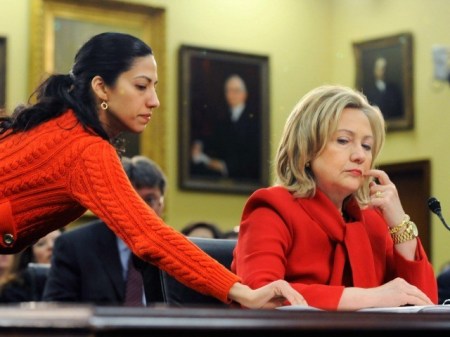
Huma-Abedin-Hillary-Clinton-AFP-640x480Jonathan Ernst/Getty Images/AFP

Fox mogul Rupert Murdoch is partnered in multiple media ventures with Saudi Arabian Prince  Bin Talal, including an Arabic religious TV network with a direct tie to Hillary Clinton’s top aide Huma Abedin.

Both Prince Alwaweed Bin Talal and Murdoch’s Fox News network have become vocal critics of GOP Presidential frontrunner Donald Trump. On December 11, 2015 Bin Tala took to Twitter to savage Trump:

.@realDonaldTrump
You are a disgrace not only to the GOP but to all America.

Withdraw from the U.S presidential race as you will never win.

European Governments Ignoring Security Warnings?

January 30, 2016

European Governments Ignoring Security Warnings? Gatestone InstituteJudith Bergman, January 30, 2016

♦ “We are importing Islamic extremism, Arab anti-Semitism, national and ethnic conflicts of other peoples, as well as a different understanding of society and law.” — From a leaked German intelligence document.

♦ The mayor of Molenbeek, Belgium ignored a list she received, one month prior to the Paris attacks, “with the names and addresses of more than 80 people suspected as Islamic militants living in her area,” according to the New York Times. “What was I supposed to do about them? It is not my job to track possible terrorists,” Mayor Schepmans said.

♦ In October 2015, Andrew Parker, director general of Britain’s Security Service, said that the “scale and tempo” of the danger to the UK is now at a level he has not seen in his 32-year career. British police are monitoring over 3,000 homegrown Islamist extremists willing to carry out attacks on the UK.

The head of the Norwegian Police Security Service (PST), Benedicte Bjørnland, was recently a participating guest at a security conference in Sweden, where she warned against further Muslim immigration.

One cannot,” she said, “assume that new arrivals will automatically adapt to the norms and rules of Norwegian society. Furthermore, new arrivals are not homogenous and can bring ethnic and religious strife with them… If parallel societies, radicalization and extremist environments emerge in the long run,” she added, “We will have challenges as a security service.”

The changes Bjørnland speaks of — parallel societies, radicalization and extremist environments — are nothing new; they have been proliferating throughout Western Europe for years. The Brussels suburb of Molenbeek, which was home to two of the perpetrators of November’s terror attacks in Paris, is known as a “terrorist den.” Yet the mayor of Molenbeek ignored a list she received, one month prior to the Paris attacks, “with the names and addresses of more than 80 people suspected as Islamic militants living in her area,” according to the New York Times. “What was I supposed to do about them? It is not my job to track possible terrorists,” Mayor Schepmans said. “That is the responsibility of the federal police.”

This statement is, in many ways, symptomatic of the European failure to deal with the security problems that Europe faces. The problem is always supposed to be somebody else’s.

Anders Thornberg, the head of the Swedish Security Service (SÄPO), literally begged Swedish society for help: “The Islamist environments have grown considerably in the past five years,” he said “and tensions are growing between various population groups. We need all of society to help fight the radicalization, there are limits to how much faster a security service can run.”

These are sentiments that are rarely, if ever, voiced by official Norway or Sweden. Apparently, the fear of offending Muslim sensitivities has thus far overridden security concerns. But even Sweden, which sees itself as a “humanitarian superpower,” and up until recently had sworn to keep its doors open to all migrants and refugees, has had to reassess its policy. At the end of November 2015, Sweden’s Deputy-Prime Minister Asa Romson, reluctantly and in tears, said that the government had been “forced to take reality into account,” given the huge number of migrants that entering the country. Sweden (and Denmark) tightened their border controls a few weeks ago.

It is questionable, however, whether the warning cries of the Scandinavian security services will have any noticeable impact on the fundamental political course of their political leaders, especially if the latest statements by Swedish Prime Minister Stefan Löfven are anything to take into account.

In an interview at the World Economic Forum in Davos on January 21, Löfven declared that it was “wrong” to mix up either sexual assaults on European women or the threat of ISIS with the mass migration into Europe: “Sexual harassment is not automatically binding to migration and immigration. We have had sexual harassment in Sweden for many, many years, unfortunately,” Löfven told CNBC, thus pretending that the imported Middle Eastern pastime of Taharrush Gamea [collective harassment] of women in Cologne on New Year’s Eve, had nothing to do with migrants.

“What it now takes is to be very clear that this is not appropriate, it is absolutely out of line and we need to take a very clear message now to show to these young girls and women they are of course entitled to walk in the city… without sexual harassment,” Löfven added. No, the girls and the women are not the ones in need of a “clear message.” The men harassing and raping them are — especially in a country now known as the rape capital of the West.

The Swedish prime minister’s refusal to “deal with reality” — including that ISIS terrorists enter Europe together with the migrants — is disturbing and should be of immense concern to Swedish citizens. It also displays the huge gap in perception of the current situation between the Swedish Security Services and the Swedish government.

The head of the Swedish Security and Intelligence Services has every reason, it turns out, to beg Swedish society to help fight the security challenges Sweden is facing. Considering current Swedish government, he is going to need all the help he can get.

The additional gap between the genuine concerns of national intelligence and security services on one hand, and governments’ fear of offending Muslim sensibilities and venturing beyond the politically correct “narratives” on the other hand, is not confined to Sweden, but evident across Western Europe.

European intelligence and security services have warned for a long time that — given the increase of mainly Muslim migration and the ensuing growth of parallel societies and extremist environments — they cannot keep up with the ever-increasing threats of jihadist terrorism, which in the past decade have grown exponentially.

In the Netherlands, the Dutch jihadist movement began a far-reaching process of becoming more professional in late 2010, and adopted propaganda methods developed by British jihadists. “The increasing momentum of Dutch jihadism poses an unprecedented threat to the democratic legal order of the Netherlands,” stated the Dutch intelligence service, AIVD, in the autumn of 2014.

In Germany, the intelligence agencies warned in the early fall of 2015 that, “We are importing Islamic extremism, Arab anti-Semitism, national and ethnic conflicts of other peoples, as well as a different understanding of society and law.” Four major German security agencies made it clear that “German security agencies… will not be in the position to solve these imported security problems and thereby the arising reactions from Germany’s population.” Still, this dire warning, which was leaked to the German press, did not cause Germany’s Chancellor, Angela Merkel, to change her open-door policy. While Germany has introduced border controls, 2000 asylum claims are still processed there every day.

In Britain, the MI5 has openly declared that it cannot stop all terrorist attacks on English soil. In October 2015, Andrew Parker, director general of the Security Service, said that the “scale and tempo” of the danger to the UK is now at a level he has not seen in his 32-year career. He warned that while the threat to the UK from ISIS is on the rise MI5 can “never” be confident in stopping all terror plots.

Little wonder. British police are monitoring over 3,000 homegrown Islamist extremists who are willing to carry out attacks on the UK, British security sources have warned. That is a 50% increase in less than a decade. Already in November 2014, Sir Bernard Hogan-Howe, the Metropolitan Police Commissioner, told an international terrorism conference that 25% of the population growth in the UK had arrived in London in the last 10 years, and posing big challenges for the police force, who could not keep up with the pace of immigration.

The difficulties in properly monitoring so many extremists and effectively preventing them from committing acts of terror has also become a tremendous challenge, compounded by the sheer volume of extremists. Dame Stella Rimington, former head of the MI5, estimated in June 2013 that it would take around 50,000 full-time MI5 spies to monitor 2,000 extremists or potential terrorists 24 hours a day, seven days a week. That would be more than 10 times the number of people employed by MI5.

The situation is not much different in many other European countries. In Germany Hans-Georg Maasen, head of Germany’s BfV domestic security agency, claimed that his office was aware of almost 8,000 Islamic radicals in Germany. He said that all of these extremists advocate violence to advance their goals, with some trying to win over migrants, and that his office receives one or two ‘fairly concrete tips’ of planned terrorist activity each week.

Most European countries – such as Germany, Britain, and France – are operating at their highest terror alert ever. The intelligence services are trying to cope with a situation beyond anything one could have imagined a decade ago.

The fight against the terrorist threat is never going to be won, however, only by pouring more financial resources and manpower into the counter-terrorism effort, although that is of course a necessary first step. As long as the political leaders — the governments — of the national security and intelligence services refuse to openly address the threat, without shrouding the issue in politically correct language – as demonstrated by Löfven — they will never be able to reduce it, let alone eliminate it.

Libya’s Chaos: Threat to the West

January 22, 2016

Libya’s Chaos: Threat to the West

by Mohamed Chtatou

January 22, 2016 at 5:00 am

Source: Libya’s Chaos: Threat to the West

  • ISIS badly needs Libya for its operations in North Africa: to spread its paramilitary brigades, to organize its terrorist networks and, most importantly, to prepare its political pawns, after the chaos, to take over power.
  • “Over the last four years, Libya has become a key node in the expansion of Islamic radicalism across North Africa… and into Europe. If events in Libya continue on their current path, they will likely haunt the United States and its Western allies for a decade or more.” — Ethan Chorin, Foreign Policy.
  • ISIS taking control of North Africa, the soft underbelly of Europe, would amount to it getting ready to recapture, by terror and force, al-Andalus from the Catholic Christians of Spain.

In 2011 when Libya’s former ruler, Muammar Gaddafi, was murdered by the mob of militiamen, many people believed it was the beginning of a new, free, democratic country. Libya, however, did not become free or democratic. Instead, it became fractured, violent, tribal and divided. Rather than starting a new life, Libya was sliding slowly toward some sort of hell.

Over the years, as violence became a daily casual occurrence, Libya almost became synonymous in the news with disorder, and on its way to becoming yet another failed stated, like Somalia.

In spite of that, hope emerged anew with the attempt of the United Nations to negotiate a national agreement through UNMSIL (United Nations Support Mission in Libya).

In its Resolution 2144 (March 14, 2014), article 6, the UN Security Council tasked the UNMSIL to support Libyan government efforts to:

  • Ensure the transition to democracy;
  • Promote the rule of law and monitor and protect human rights, in accordance with Libya’s international legal obligations;
  • Control unsecured arms and related materiel in Libya and counter their proliferation; and
  • Build governance capacity.

Subsequently, on December 17, 2015, under the leadership of UNMSIL, the different protagonists of the Libyan crisis reached a historic agreement in the Moroccan city of Skhirat.

The agreement did not mean the end of the turmoil in Libya: there are still a lot of splinter groups that are not a part of the accord. They have both the means and the will to stand in the way of peace. There is also the lethal Islamic State (ISIS), present throughout the country with proxy organizations, ready to step in, and for which agreements mean nothing.

Martin Kobler, the Special Representative of the Secretary General of the UN and head of UNMSIL, made it clear that:

“Urgent solutions must be found to bolster the Libyan-led fight against terrorism and in particular the threat of Daesh [ISIS]. The dire humanitarian situation in Benghazi and other areas needs to be addressed as a matter of highest priority, including through the establishment of a dedicated reconstruction fund for Benghazi. The concerns of the Eastern and Southern constituencies should be brought to the forefront. This work must start immediately. The signing of the Libyan Political Agreement is the first step on the path of building a democratic Libyan state based on the principles of human rights and the rule of law.”

No sooner was the agreement concluded than, unsurprisingly, the answer “No” came both from the uninvited marginal groups, as well as ISIS.

When a truck bomb was detonated, leaving 65 people dead, on January 7, 2016 outside a police training center in the western city of Zliten, the message was clear: there will be no peace. No group took credit for the attack.

Libya is divided by tribalism. Many of the armed groups that represent the various tribes of the country could not care less about national unity: they would only lose wealth and power to the increased dominance of the federal government. As a result, they would become insignificant and die out. As long as Libya is in chaos, it benefits them to bear arms.

Other Libyans seem to favor the “Caliphate solution.” Hard-core Islamists want a strict and radical Islam to prevail in the Muslim world through the re-Islamization of society. They believe that by countering the influence of the West, Islam can once again become the most important influence on the international scene and regain its long-lost, Golden Age prominence. They aim to make clear that any UN-brokered accord is a Western-imposed subterfuge to halt the inexorable advance of glorious Islam.

From the time of the Ottoman Empire until the overthrow of Gaddafi, Libya was ruled by heavily-centralized governments that delegated minimal power to the regions. This tight rule insured peace and stability to both the people and to the state. Tribes existed, but had only an honorific role and a cultural existence, no more than that. They were used, at times, as auxiliaries to strengthen the power of the state and, in return, were given economic grants.

When Gaddafi toppled King Idris Senussi in 1969, he consolidated the state and made it all-prominent. He subdued the population through generous cash handouts and a wide array of economic concessions. The population did not have to work; if some did, they held senior positions that did not require great effort. This way, Gaddafi guaranteed to himself total control of the state and the legitimacy of “the Revolution” to get rid of recalcitrant or groups or individuals — as he expeditiously did.

In the aftermath of the “Arab Spring” of 2011 and the ensuing uprising of the Cyrenaica region against the rule of Gaddafi, NATO sided with the revolutionaries of Benghazi to topple him. However, NATO conducted its war operations from the skies, and never fielded any ground forces. In a March 2015 article in Foreign Policy, Ethan Chorin wrote:

“The current situation in Libya is the product of a series of significant mistakes, erroneous assumptions, and myths that date back to NATO intervention in 2011. The United States and its NATO allies made a fundamental mistake in not imposing a robust reconstruction plan on Libya and stabilizing the country before radicalism was able to flourish. Even U.S. President Barack Obama understands that this was a mistake: In an interview last year with the New York Times, he cited lack of a plan for “the day after Qaddafi is gone” as potentially one of his biggest foreign-policy regrets. (The Libyans, of course, share much of the blame too.)”

As Gaddafi’s forces withdrew from various regions, religious and tribal groups moved in and helped themselves to the huge arsenals left behind. With that came the temptation to rule and have access to a share of oil reserves. At the fall of Ghaddafi in October 2011, there were over 300 armed groups, all dreaming of leadership and control.

In May 2014, Libyan General Khalifa Haftar, with support from the U.S., Egypt, UAE and Saudi Arabia, led an army from the east to rid the country of the powerful Islamist groups. His secular-oriented movement, dubbed “Operation Dignity,” in spite of a few limited successes, soon faltered miserably.

In reaction to the establishment of Haftar’s movement, the Islamists, supported by Turkey and Qatar, put together their own front, Fajr Libya (“Libya Dawn”), on July 13, 2014. The declared aim of Fajr Libya was to correct the direction of the revolution and set up a stable government; the undeclared objective was to turn Libya into an Islamist country. Fajr Libya was made up of several Islamist militias, all dreaming of power, wealth and religious consecration:

  • The Muslim Brotherhood
  • Libyan Shield Militia of Misrata with links with the Ikhwane (brotherhood)
  • The Tripoli Brigade, of the famous Islamist leader Belhaj, who had opposed Gaddafi openly
  • The Libya Revolutionaries Operation Room

The Fajr Libya front was, in addition, allied to a large group of heavily armed brigades, each controlling one tribe or region and reflecting the disintegration of Libya into small emirates reminiscent of the taifas in Arab Spain.[1]

During the era of the Barbary pirates, which lasted from the 16th to the 19th century, North Africa developed a taste for piracy, under the religious justification of Jihad al-Bahr (“jihad at sea”) that protected the Dar al-Islam (“domain of Islam”) from the Dar al-Kufr (“domain of infidels”). This religious justification became especially prominent after the fall of Grenada in 1492, and the ensuing efforts to reconquer al-Andalus (Spain) from the Christians. The Barbary pirates’ raids meant easy gains of goods and slaves.

Today, the tribal piracy instinct again seems strong, for various reasons. Among them are:

  • The affirmation of undemocratic tribal and patriarchal power under the cover of Islam;
  • The ability to dispose of the riches of the country directly, by selling oil and benefiting from its revenues without having to pay any taxes to a central government;
  • Undertaking contraband commerce and, most importantly, organizing, unhindered, immigration traffic to Europe.

Many of the Libyan groups and warlords therefore see a national reconciliation as a threat to their power and lucrative business. Many believe that with the Zliten terrorist attack of January 7, the warlords were sending a message to Libyan politicians that their political agreement would not go farther than Skhirat, the Moroccan city where it was signed.

ISIS badly needs Libya for its operations in North Africa: to spread its paramilitary brigades, to organize its terrorist networks and, most importantly, to prepare its political pawns, after the chaos, to take power.

Its taking control of North Africa, the soft underbelly of Europe, would amount to getting ready to recapture, by terror and force, al-Andalus from the Catholic Christians of Spain.

In his Foreign Policy article, Chorin notes that,

“Over the last four years, Libya has become a key node in the expansion of Islamic radicalism across North Africa, West Africa, across the Sahel, and into Europe. Arms and fighters have crossed Libya’s porous borders, feeding radical organizations from al Qaeda in the Islamic Maghreb to Boko Haram and reinforcing radical trends in the heart of the Middle East. If events in Libya continue on their current path, they will likely haunt the United States and its Western allies for a decade or more.”

If Libya is not stabilized in the near future, the whole world will regret it.

Stabilizing Libya would undoubtedly help to fight religious radicalism in West Africa; cut the lifeline of the lethal Boko Haram, active in the whole of West Africa; and impede al-Qaeda, which is threatening the Sahel countries of Burkina Faso, Mali and Niger.

To insure peace and stability for Libya, the UN’s Skhirat Agreement recommended strengthening UNMSIL to be a peace-keeping force. This peace-keeping force must be of, at least, 10,000 elite soldiers with heavy equipment and NATO air support to undertake the pacification of the country, with obviously the help of government forces sympathetic to the Skhirat accord.

This peace-keeping force could be made of the following countries: Spain, Italy, Morocco, Egypt, Jordan, Turkey, Pakistan and Senegal. The problem with any UN peacekeeping force, as seen, for example, with UNIFIL in South Lebanon, is that when the first shot is fired, they run. There also seems to be a tendency among peacekeepers, especially in Africa, to trade food for sex with children.

The Skhirat Agreement recommended the following actions be implemented as soon as possible. This is what the participants agreed to, but all they seem to do is underscore the sanctimonious grandiosity of the UN:

1 – Disarm militias:

Disarm all paramilitary groups by persuasion, incentive or sheer force and make, by law, bearing arms strictly illegal;

Comment: Who should do that?

2 – Train a national army and a police force:

Offer the militias the possibility to integrate the army and police force and be under the rule of law.

Comment: Why would the militias prefer that to having their own familiar honey-pot?

3 – Undertake a cultural study:

There is an urgent necessity to understand the social and cultural make-up of the Libyan society. The Amazigh and Tuareg people must be granted unconditionally their cultural rights.

Comment: Is anyone expecting the warrior tribesmen willingly to go along with that?

4 – Adopt a federal system of government:

Probably the best government system that could befit the numerous needs and the varied wishes and hopes of the Libyan population in political, cultural and religious terms is undeniably the federal system, with which tribal groupings, cultural minorities and religious lodges can, eventually, all identify.

Comment: ISIS and the other groups would probably fight this to the death.

5 – Help the country set up an open and competitive economy:

International economic institutions will need to help Libya restructure its economy, especially now that the price of oil has fallen steeply. Libya is and has always being an oil-producing country where most of the natives never worked.

Comment: This is the problem of so many oil-producing countries in which whoever is in charge does not want to share the spoils.

The problem always seems to be: Who should be doing the hard and dangerous work — the boots on the ground to mop up.

Libya is on the verge of implosion. The Skhirat Agreement, with its good intentions, is not enough. If the armed groups are left on the loose, Libya will effectively be the newest failed state. At present, Libya is a lethal danger to Europe, Africa and the Middle East.

The Skhirat Agreement (left), with its good intentions, is not enough to save Libya from Islamist militias such as Fajr Libya (right).

Dr. Mohamed Chtatou, an author, is a Professor at the University of Mohammed V in Rabat. He is currently a political analyst with Moroccan, Saudi and British media on politics and culture in the Middle East and Islam.


[1] First Taifa period (1009–1106), second Taifa period (1140–1203) and third Taifa period (1232–1287).