Posted tagged ‘Iraq’

Seymour Hersh Says Hillary Approved Sending Libya’s Sarin To Syrian Rebels

May 2, 2016

Seymour Hersh Says Hillary Approved Sending Libya’s Sarin To Syrian Rebels Tyler Durden’s picture

Submitted by Tyler Durden

on 05/01/2016 22:00 -0400

Source: Seymour Hersh Says Hillary Approved Sending Libya’s Sarin To Syrian Rebels | Zero Hedge

Authored by Eric Zuesse via Strategic-Culture.org,

The great investigative journalist Seymour Hersh, in two previous articles in the London Review of Books (“Whose Sarin?” and “The Red Line and the Rat Line”) has reported that the Obama Administration falsely blamed the government of Syria’s Bashar al-Assad for the sarin gas attack that Obama was trying to use as an excuse to invade Syria; and Hersh pointed to a report from British intelligence saying that the sarin that was used didn’t come from Assad’s stockpiles. Hersh also said that a secret agreement in 2012 was reached between the Obama Administration and the leaders of Turkey, Saudi Arabia, and Qatar, to set up a sarin gas attack and blame it on Assad so that the US could invade and overthrow Assad.

“By the terms of the agreement, funding came from Turkey, as well as Saudi Arabia and Qatar; the CIA, with the support of MI6, was responsible for getting arms from Gaddafi’s arsenals into Syria.”

Hersh didn’t say whether these ‘arms’ included the precursor chemicals for making sarin which were stockpiled in Libya, but there have been multiple independent reports that Libya’s Gaddafi possessed such stockpiles, and also that the US Consulate in Benghazi Libya was operating a “rat line” for Gaddafi’s captured weapons into Syria through Turkey. So, Hersh isn’t the only reporter who has been covering this. Indeed, the investigative journalist Christoph Lehmann headlined on 7 October 2013, “Top US and Saudi Officials responsible for Chemical Weapons in Syria” and reported, on the basis of very different sources than Hersh used, that:

“Evidence leads directly to the White House, the Chairman of the Joint Chiefs of Staff Martin Dempsey, CIA Director John Brennan, Saudi Intelligence Chief Prince Bandar, and Saudi Arabia´s Interior Ministry.”

And, as if that weren’t enough, even the definitive analysis of the evidence that was performed by two leading US analysts, the Lloyd-Postal report, concluded that:

“The US Government’s Interpretation of the Technical Intelligence It Gathered Prior to and After the August 21 Attack CANNOT POSSIBLY BE CORRECT.”

Obama has clearly been lying.

However, now, for the first time, Hersh has implicated Hillary Clinton directly in this ‘rat line’. In an interview with Alternet.org, Hersh was asked about the then-US-Secretary-of-State’s role in the Benghazi Libya US consulate’s operation to collect weapons from Libyan stockpiles and send them through Turkey into Syria for a set-up sarin-gas attack, to be blamed on Assad in order to ‘justify’ the US invading Syria, as the US had invaded Libya to eliminate Gaddafi. Hersh said:

That ambassador who was killed, he was known as a guy, from what I understand, as somebody, who would not get in the way of the CIA. As I wrote, on the day of the mission he was meeting with the CIA base chief and the shipping company. He was certainly involved, aware and witting of everything that was going on. And there’s no way somebody in that sensitive of a position is not talking to the boss, by some channel”.

This was, in fact, the Syrian part of the State Department’s Libyan operation, Obama’s operation to set up an excuse for the US doing in Syria what they had already done in Libya.

The interviewer then asked:

“In the book [Hersh’s The Killing of Osama bin Laden, just out] you quote a former intelligence official as saying that the White House rejected 35 target sets [for the planned US invasion of Syria] provided by the Joint Chiefs as being insufficiently painful to the Assad regime. (You note that the original targets included military sites only – nothing by way of civilian infrastructure.) Later the White House proposed a target list that included civilian infrastructure. What would the toll to civilians have been if the White House’s proposed strike had been carried out?”

Hersh responded by saying that the US tradition in that regard has long been to ignore civilian casualties; i.e., collateral damage of US attacks is okay or even desired (so as to terrorize the population into surrender) – not an ‘issue’, except, perhaps, for the PR people.

The interviewer asked why Obama is so obsessed to replace Assad in Syria, since “The power vacuum that would ensue would open Syria up to all kinds of jihadi groups”; and Hersh replied that not only he, but the Joint Chiefs of Staff, “nobody could figure out why”. He said, “Our policy has always been against him [Assad]. Period”. This has actually been the case not only since the Party that Assad leads, the Ba’ath Party, was the subject of a shelved CIA coup-plot in 1957 to overthrow and replace it; but, actually, the CIA’s first coup had been not just planned but was carried out in 1949 in Syria, overthrowing there a democratically elected leader, in order to enable a pipeline for the Sauds’ oil to become built through Syria into the largest oil market, Europe; and, construction of the pipeline started the following year. But, there were then a succession of Syrian coups (domestic instead of by foreign powers – 195419631966, and, finally, in 1970), concluding in the accession to power of Hafez al-Assad during the 1970 coup. And, the Sauds’ long-planned Trans-Arabia Pipeline has still not been built. The Saudi royal family, who own the world’s largest oil company, Aramco, don’t want to wait any longer. Obama is the first US President to have seriously tried to carry out their long-desired “regime change” in Syria, so as to enable not only the Sauds’ Trans-Arabian Pipeline to be built, but also to build through Syria the Qatar-Turkey Gas Pipeline that the Thani royal family (friends of the Sauds) who own Qatar want also to be built there. The US is allied with the Saud family (and with their friends, the royal families of Qatar, Kuwait, UAE, Bahrain, and Oman). Russia is allied with the leaders of Syria – as Russia had earlier been allied with Mossadegh in Iran, Arbenz in Guatemala, Allende in Chile, Hussein in Iraq, Gaddafi in Libya, and Yanukovych in Ukraine (all of whom except Syria’s Ba’ath Party, the US has successfully overthrown).

Hersh was wrong to say that “nobody could figure out why” Obama is obsessed with overthrowing Assad and his Ba’ath Party, even if nobody that he spoke with was willing to say why. They have all been hired to do a job, which didn’t change even when the Soviet Union ended and the Warsaw Pact was disbanded; and, anyone who has been at this job for as long as those people have, can pretty well figure out what the job actually is – even if Hersh can’t.

Hersh then said that Obama wanted to fill Syria with foreign jihadists to serve as the necessary ground forces for his planned aerial bombardment there, and, “if you wanted to go there and fight there in 2011-2013, ‘Go, go, go… overthrow Bashar!’ So, they actually pushed a lot of people [jihadists] to go. I don’t think they were paying for them but they certainly gave visas”.

However, it’s not actually part of America’s deal with its allies the fundamentalist-Sunni Arabic royal families and the fundamentalist Sunni Erdogan of Turkey, for the US to supply the salaries (to be “paying for them”, as Hersh put it there) to those fundamentalist Sunni jihadists – that’s instead the function of the Sauds and of their friends, the other Arab royals, and their friends, to do. (Those are the people who finance the terrorists to perpetrate attacks in the US, Europe, Russia, Afghanistan, Pakistan, India, India, Nigeria, etc. – i.e., anywhere except in their own countries.) And, Erdogan in Turkey mainly gives their jihadists just safe passage into Syria, and he takes part of the proceeds from the jihadists’ sales of stolen Syrian and Iraqi oil. But, they all work together as a team (with the jihadists sometimes killing each other in the process – that’s even part of the plan) – though each national leader has PR problems at home in order to fool his respective public into thinking that they’re against terrorists, and that only the ‘enemy’ is to blame. (Meanwhile, the aristocrats who supply the “salaries” of the jihadists, walk off with all the money.)

This way, US oil and gas companies will refine, and pipeline into Europe, the Sauds’ oil and the Thanis’ gas, and not only will Russia’s major oil-and-gas market become squeezed away by that, but Obama’s economic sanctions against Russia, plus the yet-further isolation of Russia (as well as of China and the rest of the BRICS countries) by excluding them from Obama’s three mega-trade-deals (TTIP, TPP & TISA), will place the US aristocracy firmly in control of the world, to dominate the 21st Century, as it has dominated ever since the end of WW II.

Then, came this question from Hersh:

“Why does America do what it does? Why do we not say to the Russians, Let’s work together?”

His interviewer immediately seconded that by repeating it, “So why don’t we work closer with Russia? It seems so rational”. Hersh replied simply: “I don’t know”. He didn’t venture so much as a guess – not even an educated one. But, when journalists who are as knowledgeable as he, don’t present some credible explanation, to challenge the obvious lies (which make no sense that accords with the blatantly contrary evidence those journalists know of against those lies) that come from people such as Barack Obama, aren’t they thereby – though passively – participating in the fraud, instead of contradicting and challenging it? Or, is the underlying assumption, there: The general public is going to be as deeply immersed in the background information here as I am, so that they don’t need me to bring it all together for them into a coherent (and fully documented) whole, which does make sense? Is that the underlying assumption? Because: if it is, it’s false.

Hersh’s journalism is among the best (after all: he went so far as to say, of Christopher Stephens, regarding Hillary Clinton, “there’s no way somebody in that sensitive of a position is not talking to the boss, by some channel”), but it’s certainly not good enough. However, it’s too good to be published any longer in places like the New Yorker. And the reporting by Christof Lehmann was better, and it was issued even earlier than Hersh’s; and it is good enough, because it named names, and it explained motivations, in an honest and forthright way, which is why Lehmann’s piece was published only on a Montenegrin site, and only online, not in a Western print medium, such as the New Yorker. The sites that are owned by members of the Western aristocracy don’t issue reports like that – journalism that’s good enough. They won’t inform the public when a US Secretary of State, and her boss the US President, are the persons actually behind a sarin gas attack they’re blaming on a foreign leader the US aristocrats and their allied foreign aristocrats are determined to topple and replace.

Is this really a democracy?
Iraq Parliament Collapses, Lawmakers Flee Baghdad

May 1, 2016

Iraq Parliament Collapses, Lawmakers Flee Baghdad, Voice of AmericaSharon Behn, May 1, 2016

Baghdad parliament flees

Baghdad teeters on the edge of political chaos Sunday.

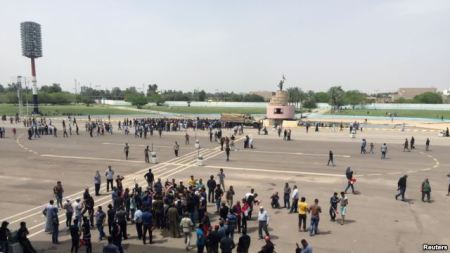
The city is in a state of emergency, protesters are occupying parts of the once-secure International Zone (IZ), lawmakers have run away and the military is on high alert.

By Sunday morning, protesters led by Shi’ite cleric Muqtada al-Sadr continued to crowd the streets in front of the country’s now-empty parliament and gather in what is known as the zone’s “Celebration Square.”

Lawmakers fled Saturday after protestors stormed into the parliament.

About 60 lawmakers, mostly from the minority Kurdish and Sunni parties, flew out of the capital for Irbil and Suleymania, in the northern autonomous Kurdish region.

“It was dangerous for all of us,” one parliament official told VOA, speaking on condition of anonymity out of fear of retaliation. Some lawmakers were beaten, he said.

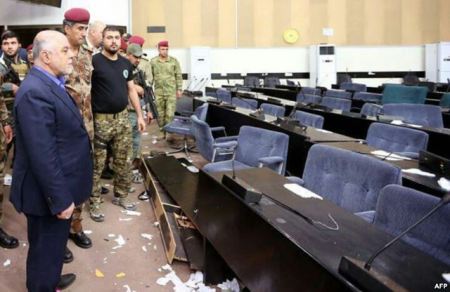
Baghdad 1A handout image released by the press office of Iraqi Prime Minister Haider al-Abadi on May 1, 2016, shows him (L) looking at the damage after protesters stormed the Iraqi parliament building in Baghdad’s fortified Green Zone area.

The official said thousands of protesters were still in the so-called International Zone Sunday, parked outside the major government buildings.

WATCH: Related video of protesters in the International Zone (Video at the link — DM)

Normally only those with special badges are allowed into the secured area, which is also home to many foreign embassies and the United Nations.

“It is dangerous,” the parliament official said. “At any time, the protesters could attack any embassy, any institution they want, or abuse anybody passing by.

“It seems al-Sadr wants to keep them inside the IZ so he can force the government to do what he wants,” the official said.

Political unrest

The parliament takeover was the culmination of weeks of political wrangling and increasing instability, and came just days after U.S. Vice President Joe Biden visited Baghdad.

White House Press Secretary Josh Earnest said the visit was a good indication of U.S. continued support for Iraqi Prime Minister Haider al-Abadi’s efforts to unify Iraq and confront the Islamic State (IS) group.

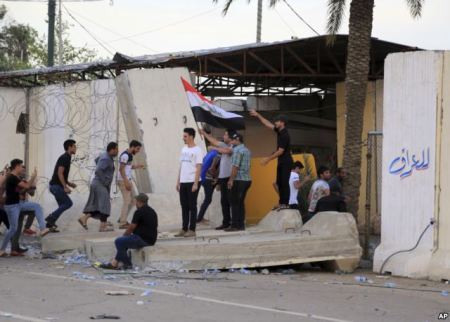
Baghdad 2Supporters of Shi’ite cleric Muqtada al-Sadr walk over the blast walls surrounding Baghdad’s highly fortified Green Zone, April 30, 2016. Dozens of protesters climbed over the blast walls and could be seen storming the parliament building.

But the visit was not enough to stave off the deepening political crisis.

Sadr has been demanding a new government of technocrats.

Abadi, who had also promised reform, had been unable to deliver any real change as political parties, unwilling to let go of their political power, blocked the majority of his list of candidates.

The prime minister on Sunday walked through the ransacked parliament building, and called on Interior Minister Mohammed Salem al-Ghabban to bring the attackers “to justice.”

Unrest growing

But even as political blocs have fought to maintain their positions and all the trappings of power, the anger in the Iraqi street has been growing for the past year over the lack of basic services, security, and the vast government corruption and political patronage.

Sadr, a firebrand cleric sometimes described as a Shi’ite nationalist, has managed to capitalize on that anger and frustration.

“Al-Sadr has the power of the people. One speech and he can deliver thousands of people to do what he wants. It is the power of the populace,” the parliament official said. “Al-Sadr is capable of running and leading the anger within each Iraqi person.”

Baghdad 3Supporters of Shiite cleric Muqtada al-Sadr raise the Iraqi flag outside parliament in Baghdad’s Green Zone, April 30, 2016.

One high-ranking Iraqi military official, also speaking to VOA on condition of anonymity, said that Sadr had many young Iraqis, including Sunnis and Christians, on his side.

The Institute for the Study of War describes Sadr’s power grab as a de facto political coup.

But the military official said Prime Minister Abadi was still in control of the Iraqi military and running the country.

Rival Shi’ite powers

Yet, the military official warned that powerful rival Shi’ite powers in Baghdad were not comfortable with Sadr’s attempted power grab. He said members of the notorious Badr Brigade militia, which is strongly allied with Iran, were beginning to converge on the capital’s center.

The possibility for intra-Shi’ite violence in Baghdad is high, and Baghdad residents said they are unsure of what will happen next.

There is also concern that IS could take advantage of the turmoil to ramp up its attacks. Iraqi security forces closed off all entrances to the city Saturday.

Resident Mahdi Makhmour, who lives outside the IZ, said the city streets were empty Sunday morning and many roads were still blocked, partly because of the start of a three-day Shi’ite religious celebration in the capital.

Protesters storm Iraqi parliament in Baghdad

April 30, 2016

Protesters storm Iraqi parliament in Baghdad, Washington PostLoveday Morris, April 30, 2016

(Here’s a short video.

— DM)

Protesters stormed Iraq’s parliament on Saturday, bursting into the capital’s fortified Green Zone, where other key buildings, including the U.S. Embassy, are located.

Live footage on Iraqi television showed swarms of protesters, who have been demanding government reform, inside the parliament building, waving flags and chanting. Lawmakers were berated and beaten with flags as they fled the building, while demonstrators smashed the windows of politicians’ cars.

Baghdad Operations Command declared a state of emergency and said all roads into the capital had been closed. A U.S. Embassy official, speaking on condition of anonymity, said that staff were not being evacuated from their compound, which is about a mile away from the parliament building.

Iraq is in the grip of a political crisis, with Prime Minister Haider al-Abadi attempting to reshuffle his cabinet and meet the demands of the demonstrators, who have been spurred on by the powerful Shiite cleric Moqtada al-Sadr. But Abadi has been hampered by chaotic parliament sessions, where lawmakers have thrown water bottles and punches at one another.

The political unrest has brought a new level of instability to a country that is facing multiple crises, including the fight against the Islamic State militant group and the struggling economy.

“This is a new era in the history of Iraq,” screamed one demonstrator in the main lobby of the parliament, in footage on Iraqi television. “They have been robbing us for the past 13 years,” said another.

Earlier in the day, not enough lawmakers had turned up in parliament to officially convene a session in which Abadi was due to present names for a cabinet reshuffle.

The session had been postponed until the afternoon, however before it was held, Sadr, a leader in the resistance to the American troop presence in Iraq following the U.S.-led invasion, held a news conference from the southern city of Najaf.

“They are against reform, they hope to behead the will of the Iraqi people,” he said of the country’s politicians. “I’m with the people, no matter what they decide. I’m standing and waiting for a major uprising of the Iraqi people.”

Shortly afterward, protesters, many of whom are Sadr loyalists, pushed through the multiple security cordons around parliament.

U.S. officials are concerned that the political crisis will have a negative impact on the country’s fight against the Islamic State, leading to a flurry of high level visits in recent weeks. “Now is not the time for government gridlock or bickering,” President Obama said of the crisis in Iraq during a visit to Saudi Arabia last week. He said that he was “concerned”.

GCC leaders reject Obama’s Middle East policy

April 23, 2016

GCC leaders reject Obama’s Middle East policy, DEBKAfile, April 23, 2016

Big Bomber


DEBKAfile’s intelligence sources and its sources in the Gulf report exclusively that US President Barack Obama failed to convince the leaders of the six Gulf Cooperation Council member states, during their April 22 summit in Riyadh, to support his Middle East policy and cooperate with Washington.

Our sources also report that Saudi Arabia, with Turkey’s help, and the US carried out separate military operations several hours before the start of the summit that showed the extent of their differences.

The US on Thursday started to use its giant B-52 bombers against ISIS in an attempt to show Gulf leaders that it is determined to quash the terrorist organization’s threat to Gulf states. The bombers deployed at Qatar’s Al Udeid airbase attacked targets around Mosul in northern Iraq, but the targets were not identified.

Meanwhile, Saudi Arabia and Turkey, which recently established a bloc along with Egypt and Jordan to oppose Obama’s Middle East policy, started to infiltrate a force of 3,500 rebels back into Syria.

The force has been trained and financed by the Saudis at special camps in Turkey and Jordan. Members of the force are now fighting alongside other rebels north of Aleppo, but they are being bombed heavily by the Russian and Syrian air forces.

Riyadh sent the rebels into Syria to demonstrate to Obama that the Saudi royal family opposes the policy of diplomatic and military cooperation between the US and Russia regarding Syria that enables President Bashar Assad to remain in power in Damascus.

Since the war in Syria began in 2011, Obama has promised countless times that Washington would train and arm Syrian rebel forces outside the country, and then deploy them in Syria in order to strengthen rebel forces.

However, it has not done so except for one instance in 2015. The US infiltrated a small force consisting of no more than several dozen fighters, but it was destroyed by the Nusra Front, an affiliate of Al Qaeda, shortly after it crossed the border. The terrorist group had apparently been tipped off about the arrival of the pro-American force.

All of Washington’s efforts to recruit and train Syrian fighters, which have cost close to $1 billion, have failed.

DEBKAfile’s sources report exclusively that the leaders of the six GCC member states put their previous differences aside and presented Obama with four requests aimed at building a new joint policy regarding the region. According to our sources, these requests were:

1. Action by Washington to strengthen the Sunni majority in Iraq and facilitate representation of the Sunnis in the central government in Baghdad. The Gulf rulers told Obama that his policy of trying to win the support of Iraqi Prime MinisterHaider al-Abadi is mistaken.

They also pointed out reports by their intelligence services that al-Abadi is likely to be deposed and be replaced by a pro-Iranian prIme minister in the near future.

Obama rejected the request and said he refuses to change his Iraq policy.

2. Imposition of new US sanctions on Iran over its continuing ballistic missile tests.

On April 19, several hours before Obama’s departure for Riyadh, Iran carried out its latest act of defiance by attempting to launch a satellite into orbit using one of its “Simorgh” intercontinental ballistic missiles. The missile failed to leave the Earth’s atmosphere, fell to earth and crashed along with the satellite.

Obama turned down the Gulf leaders on new sanctions as well.

3. Provision of US-made F-35 fighter-bombers to Saudi Arabia and the UAE so they can take action against the Iranian missile threat. The US president declined the request.

4. Abandonment of Washington’s cooperation with Russia and the UN for political solution in Syria, and instead cooperate with Gulf states and Turkey to end the war and depose President Bashar Assad. Obama refused.

In other words, the summit in Riyadh, Obama’s final meeting with GCC leaders before he leaves the White House next January, ended without a single agreement.

Article In Iraqi Newspaper: Iraq Needs A Hitler To Stop The Jews Who Are Planning A Takeover Of Iraq

March 8, 2016

Article In Iraqi Newspaper: Iraq Needs A Hitler To Stop The Jews Who Are Planning A Takeover Of Iraq, MEMRI, March 8, 2016

On March 6, 2016, the Iraqi daily Al-Zaman published an article titled “Iraq Needs Hitler” by Karim Al-Taee that quoted some of Hitler’s statements about the Jews from Mein Kampf stating that they were correct also about the Jews today in Iraq.

The article added that the Jews living in northern Iraq today have a secret plan to take over Mosul, in order to prepare for a Jewish-Western takeover of all Iraq’s resources. They are doing this by means of distracting the Iraqis, overloading the political arena with bogus issues, and by means of taking advantage of the Iraqi MPs that they control.

The following are translated excerpts from the article: 

“Hitler said: ‘I could have killed all the Jews, but I kept some [alive] so the world would understand why I killed them.’

“When I read Adolf Hitler’s book Mein Kampf, I discovered that the situation from which Germany suffered is identical to that which has beset Iraq ever since the 2003 replacement [of the Saddam Hussein regime] in 2003. The main reason for the war in Germany was the Jews, because they weakened the nation and its people and [completely] consumed [the country’s] resources. They exploited [their control] of funds and the interest [earned on them] in order to attain the most senior positions in the state, and to kill its people both spiritually by poisoning their minds with ideas distancing the people from their nationalism and affiliation, and physically by starving them and making the daily concern about food into their main worry.

“The course of events in Iraq is like a nice game played by the West, with the Jews at their head. Everyone knows that the Jews are settling in Iraq’s northern regions, and that since 2007 they have been [implementing] a clandestine settlement plan in Mosul by purchasing land at rock-bottom prices. Planning for the Islamic State’s entry into Iraq had by then already been completed [at that point], because the Jewish strategy is to lay the groundwork from within prior to attacking.

“Hitler said: ‘The Jews are like parasitic plants that burden the nations and compete with them for their sources of income. The Jew conceals his [true] aspirations behind the mask of his powdered face, and behind the screen of the Jewish community. Then, when he thinks he is capable of imposing his rule and establishing his state, he reveals his true self, and begins implementing his malice and actualizing his objectives.

“Isn’t this what is happening in Iraq[?]! Has anyone wondered what is the most important thing to be concerned about – the future? Or the present? Indeed, I maintain that the future is grim, and the present is of no value. [The Jewish-Western] imperialism has made pawns of the Iraqi people, exploiting their intellectual weakness and the fact that their material needs go unmet even though Iraq is a ship floating in a sea of oil!! This is because they [i.e. the imperialists] have transformed the [Iraqi] citizen into… merely a consumer, incapable of acting and changing, inert in all respects. Iraq does not take advantage of its own resources for a simple reason: People must be preoccupied with imaginary things, so that imperialism can consume these resources without being called to account. [Additionally], religion is one of the main things that the Jews have exploited in order to start a war of all against all, that is, religion against religion.

“This barbaric [Jewish] entity, that has gotten completely out of control, has no basis for existence. It was created… to distract the people from important affairs of state, and to clear the decks for the thieves and the bloody games in parliament, that are manipulated by the West to its heart’s content.

“The problem is that the people’s pan-Arab sentiment and sense of belonging have been destroyed by hunger, poverty, unnatural death, and the ideas sown in order to fully attain this objective. This is in addition to the years of intellectual and material siege experienced by [the people] under the most tyrannical dictator of all the Arab governments [i.e. Saddam Hussein].

“The [Jewish-Western] chessboard allows millions of stratagems for defeating their rival – and yes, that rival is that Iraqi who solicits [charitable] donations…. The rival is that grandmother collecting tin cans from the garbage dump and selling them to provide the bare minimum to sustain her martyred son’s orphans. The rival is those powerless women now for sale in the slave market. The rival is us, and anyone who thinks the fate of his country is important.

“The West has killed off nationalism and pan-Arabism in the Iraqi people; their voice goes unheard, and they have no government to represent them. [Yet] the [do-nothing] MPs can pass laws for their salaries the same day. The parliament is fertile ground for the plague-like spread of oppressive ideas! People who do not understand politics cannot be blamed for electing [such] representatives.

“As Hitler said: ‘Parliamentary government gives politicians an opportunity to carry out worthless tasks that preoccupy the political arena… This ensnares the hearts and besots the minds of the politicians, who benefit from their political posts. The moronic politician need not feel responsible for his actions, because he knows full well that he will not be in the political arena for long.’ …

“If we [the Iraqis] take a close look at the situation, we will clearly see the evil of the game that has been forced on us, or into which we have inserted ourselves. But even though everyone, or most, are aware of all the real and dangerous moves, they ignore them, claiming falsely that they do not notice them. What truly interests the people are legitimate material demands; what primarily interests politicians is stealing money and filling their Western bank accounts.

“We [Iraqis] are revolving around a single axis – the Jews. They are the first and last manipulator of their pawns among the Iraqi politicians and MPs. The only solution for Iraq is a genuine revolution; a student intifada will bring a better future if we place the voice of the homeland, the citizen, and civics above everything else;  subject ourselves to the law of reason and logic; raise the slogan of ‘Iraq and only Iraq,’ and at least for a while, set aside our secondary identities.”

‘Next Time in Jerusalem’: Islamic State Supporters Celebrate Baghdad Deadly Suicide Bombings

March 2, 2016

EXCLUSIVE – ‘Next Time in Jerusalem’: Islamic State Supporters Celebrate Deadly Baghdad Suicide Bombings

by Aaron Klein and Ali Waked

1 Mar 2016

Source: ‘Next Time in Jerusalem’: Islamic State Supporters Celebrate Baghdad Deadly Suicide Bombings

AFP

TEL AVIV – Internal messages obtained by Breitbart Jerusalem show Islamic State supporters celebrated the deadly suicide attacks carried out by the organization’s operatives in a Shi’ite part of Baghdad on Sunday, rejoicing in the death and injury of “more than 100 infidels.”

The string of suicide attacks in the Iraqi capital’s Abu Ghraib and al-Sadr districts left at least 70 people dead and many more wounded.

IS released a somewhat laconic statement claiming responsibility, but its supporters were jubilant in messages exchanged in a private encrypted chat utilized by IS and its supporters, vowing that the next such operation would be in Jerusalem.

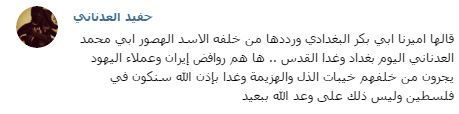
حفيد“Allah is great, my brothers, our jihadi fighters surprised the enemy infidels at the gates of Baghdad,” wrote Abu Jaafar Albagdadi, a high-profile IS operative. “We hurt them and the American officers who fled in panic from our fighters. Today in Baghdad, tomorrow in Jerusalem and Palestine with Allah’s help.”

جعفر 11“Our Caliph Abu Bakr al-Baghdadi made it clear, and repeated the words of our [military] commander Abu Mohammed al-Adnani: Today in Baghdad, tomorrow in Jerusalem,” wrote Eladnani the Grandson, an Iraqi IS member. “Look at Iran and the Jews’ cronies bearing a humiliating defeat. Tomorrow, with Allah’s help, we’ll be in Palestine. Allah promised it and it will happen.”

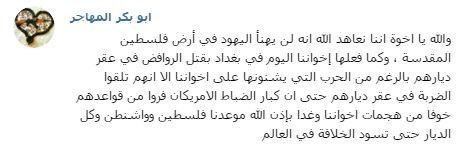
بكرIn the closed chat group, which utilizes the encrypted Telegram messaging service, top IS operative Abu Bakr Almuhager added: “My brothers, we’ve made a vow to Allah that the Jews will not take pleasure in occupying the holy land of Palestine. … Our brothers hit the infidels in the safety of their quarters in Baghdad, despite the ongoing war against us, and chased away the American officers. Our next meeting will be in Palestine, or Washington, or wherever, until the sacred caliphate rules the world.”

Iraqi MP Mish’an Al-Jabouri: I Took Millions of Dollars in Bribes, All Iraqi Politicians Do

February 8, 2016

Iraqi MP Mish’an Al-Jabouri: I Took Millions of Dollars in Bribes, All Iraqi Politicians Do, MEMRI-TV via You Tube, February 7, 2016


https://www.youtube.com/watch?v=hxoNSCuQGpM

According to the blurb beneath the video,

In a TV interview, Iraqi MP Mish’an Al-Jabouri admitted that he had taken millions of dollars in bribes. In a January 26 interview with Al-Etejah TV, MP Al-Jabouri claimed that all Iraqi politicians take bribery and that only a coward would not. He claimed that the entire political echelon is corrupt and responsible for the destruction of the country. Al-Jabouri is a member of the Iraqi Commission of Integrity, tasked with investigating governmental corruption. He refused to disclose names of fellow corrupt politicians for fear that “they will kill me right in the street.”


Turkish military launches large air campaign on PKK targets in northern Iraq

February 6, 2016

Turkish military launches large air campaign on PKK targets in northern Iraq Uğur Ergan

– ANKARA

February/06/2016

Source: Turkish military launches large air campaign on PKK targets in northern Iraq – CRIME

The Turkish military has launched a wide-scale air campaign on the outlawed Kurdistan Workers’ Party (PKK) targets in northern Iraq.

The operation which started on Feb. 3 continued on Feb. 4, military sources have told Hürriyet.

Unmanned areal vehicles, fuel feed planes and AWACS surveillance jets accompanied Turkish Air Force F-4E and F-16 jets during strikes on the PKK targets in the neighboring country, the sources said.

Some 40 jets that took of for bases in Diyarbakır, Malatya, Bandırma, Ankara-Akıncı and Merzifon his some 100 targets on the Kandil Mountain, known as ground for the PKK headquarters, on Feb. 3 before they bombed four other points else than Kandil the next day, they said.

Some 50 targets, including a group of PKK members who were in a meeting, were hit on the second day of the operation.

The same sources said PKK targets in Turkey’s Hakkari in the southeast were also hit on Feb. 4.


Iraqi Journalist Comes Out Against Claim That ISIS Has Nothing To Do With Islam

February 1, 2016

Iraqi Journalist Comes Out Against Claim That ISIS Has Nothing To Do With Islam, MEMRI, February 1, 2016

(Mr. Boula’s comments relate to Sunni Salafist Islam as practiced in Saudi Arabia and elsewhere. He does mention Shiite Islam as practiced in Iran. Perhaps that has something to do with the pro-Iranian bent of the newspaper for which he writes. — DM)

In an article titled “Does Terror Truly Have No Religion?” in the pro-Iranian Iraqi newspaper Al-Akhbar, Iraqi journalist Fadel Boula came out against the claim, which is frequently heard in the Arab world and outside it, that the terror of the Islamic State (ISIS) and its ilk is completely unrelated to Islam. He pointed out that these terror organizations are motivated by an extremist Salafi ideology and claim that their atrocities represent Allah’s will and directives.

The following are excerpts from his article:[1]  

26614Fadel Boula (image: Al-Akhbar, Iraq)

“[Does terror truly have no religion?] This slogan is uttered regarding terror, as though [terror] reflects a picture that is completely unrelated to its perpetrators’ religious affiliation, and as though there are no religious goals or values behind it, but only a state of insanity that causes those afflicted with it to run amok, unaware of what they are doing or what [they seek] to achieve by their actions – [actions] that disgust not only human beings but [even] the beasts of the jungle.

“The terror that is shaking the world today is not a natural disaster like a tornado, a thunderstorm or an earthquake, and it is not perpetrated by savage tribes. It is perpetrated by people who enlist [because they are] inspired by a religious ideology. [These people] advocate enforcing and spreading [this ideology as a set of] dogmatic principles that must be imposed by the force of the sword, and which [mandate] killing, expulsion and destruction wherever they go.

“Since its inception, this movement of terror has espoused a Salafi ideology that champions religious extremism, and brainwashed people of all ages have rallied around its flag, [people who were] trained to kill themselves and kill others in order to attain martyrdom.

“The terror organizations that act in the name of religion were born when [the mujahideen] declared Islamic jihad against the Soviet forces in Afghanistan. It was the Saudi sheikh Osama bin Laden who laid the cornerstone for the first [terror] cell, which he named Al-Qaeda. Later he called to launch a war in the name of religion, and young believers, influenced by fatwas of extremist [clerics], especially Saudi ones, flocked from the Muslim lands [to Afghanistan].

“[Then, Abu Mus’ab] Al-Zarqawi formed a branch of Al-Qaeda in Iraq, which, calling itself ‘the Islamic State in Iraq,’ recently settled in the city of Mosul and united with its counterpart in Syria. Thus, a scary organization [namely ISIS] suddenly appeared, which advertises itself as the bearer of Islam’s message and banner. [Emulating the early] Islamic conquests, [this organization] invaded Iraq and Syria and appointed a Caliph for the Muslims: Abu Bakr Al-Baghdadi, who settled in Mosul and showed its people what [it is like] to be ruled by a government [that is a throwback to] 1,400 years ago, in terms of the treatment [they received] and the plunder of their lands. The invaders attacked the populace of Mosul and eastern Syria, arrested them by the hundreds, and took a sword to their necks, and later singled out the Christians among them and offered them two options: either convert to Islam or pay the poll tax, as happened to their forefathers when the Arabs attacked their lands in the days of the Caliph ‘Umar Al-Khattab [583-644 AD]. When [the Christians] rejected this humiliation, [ISIS] seized their property, expelled them from their historic home, the province of Ninveh, and sent them to wander destitute under the skies, seeking rescue and safety.

“As for the Yazidis, their plight was and remains an historic disaster that was inflicted upon them by the God-fearing Caliph [Al-Baghdadi] when he applied to them the verse pertaining to infidels, namely offering them two options: to [either] embrace Islam, or die and have their money, women and children seized. We keep seeing images of innocent people being killed and beheaded by these terrorists, who butcher their victims while crying out “in the name of Allah the merciful” and “Allah akbar.” All these crimes are [ostensibly] carried out with Allah’s approval, and they are perpetrated by those who praise Allah day and night and who pray fervently and do everything according to His will.

“When the terrorists blew up the World Trade Center and several airplanes, killing thousands of victims, Osama bin Laden, surrounded by his people, said on television: ‘This is a victory from Allah.’ And now ISIS is bragging about killing innocent people in Paris, saying that it was ‘done with Allah’s approval,’ and threatening that the next attack will be in the U.S., Allah willing. And [Sheikh Yusouf] Al-Qaradhawi and others like him pray and hope that, in the wake of this terrorist momentum, a day will arrive when Muslims inundate Europe and subdue it to Islam. Is this not enough to convince [us] that terror [does] have a religion?”


Endnotes:


[1] Al-Akhbar (Iraq), November 18, 2015.

Israel and the Four Powers

January 9, 2016

Israel and the Four Powers, Algemeiner, Ben Cohen via JNS Org., January 8, 2016

download-4

JNS.org The rulers of the Arab Gulf states are, it seems, increasingly attentive to what Israel has to say about the balance of power in the region. As a rising Shi’a Iran faces off against a Sunni coalition led by Saudi Arabia, the core shared interest between Israel’s democracy and these conservative theocracies — countering Iran’s bid to become the dominant power and influence in the Islamic world — has rarely been as apparent.

Hence the interview given by a senior IDF officer to a Saudi weekly, Elaph, which laid out how Israel analyzes the present wretched state of the Middle East. In the Israeli view, there are, the officer said, four powers that have coalesced in the region. The first power centers on Iran and its allies and proxies, such as the Bashar al-Assad dictatorship in Syria, Shi’a rebels in Yemen and Iraq, and most pertinently for Israel, Hezbollah in Lebanon. The second power contains what the officer called “moderate” states with whom Israel has “a common language” — Egypt, Jordan and the Gulf countries. The third power, one that is obviously waning, is represented in the form of the Muslim Brotherhood, now vanquished in its Egyptian heartland but still reigning in Hamas-controlled Gaza. Finally, the fourth power is another non-state actor, the combined forces of jihadi barbarism like Al-Qaeda and Islamic State.

Israel’s goal in this situation is a modest one. As the IDF officer put it, “There is a danger that the strife will reach us as well if the instability in the region continues for a long time. Therefore, we need to take advantage of the opportunity and work together with the moderate states to renew quiet in the region.”

The key phrase here, it seems to me, is “renew quiet.” Foremost for the Israelis, that means counteracting Iran and especially its Lebanese proxy Hezbollah, and then minimizing the potential for jihadi terrorists to operate on or near Israeli-controlled territory. A broader strategic vision can also be detected here: Ultimately, both Israel and the conservative Arab states share the common interests of neutralizing Iran and eliminating the jihadi groups.

The partnership between Israel and these states is already in operation, at the levels of intelligence sharing and — not for the first time — cautious exploration of trade relations. That there is a strong military dimension as well to all this is entirely conceivable. And for the time being, it seems that neither side wants to expand or contract on their public ties with each other; Israel has long had embassies in Cairo and Amman, but that doesn’t mean there’ll be an Israeli ambassador in Riyadh anytime soon, much less a film festival or trade expo.

There’s another factor that has accelerated the formation of this undeclared, look-the-other-way alliance: the shift in American Middle East policy under President Barack Obama. Some readers will remember that back in 1991, the first Bush administration pointedly left Israel out of the coalition to expel Saddam Hussein from Kuwait, so as not to antagonize the Gulf states. Now, frustration with Obama has compelled these very same states to recognize that they have an existential interest in cooperating with Israel.

You might say that the president deserves credit for bringing about a situation, in the wake of the nuclear deal with Iran, which has compelled the Gulf states to grasp the reality and permanence of Israel as never before. Still, the visions and prophecies of a Middle Eastern equivalent of the European Union, much indulged during the Oslo Accords years in the late 1990s, are not now in evidence, and that’s welcome. For their own reasons, neither Israel nor the Arab states feel obliged to articulate a sense of what their region should look like in the event that the Iranian threat is overcome.

Indeed, there’s a case that doing so would be counterproductive — it would impose political pressures upon a discreet yet strategically vital relationship that above all requires, in the parlance of the IDF officer, the “moderate” states to remain as moderate states. With the reorientation of American policy towards a rapprochement with Tehran, along with Russia’s active involvement in the Tehran-Damascus axis, Israel is the nearest reliable, not to say formidable, power that these countries can turn to.

In the present Middle Eastern context, then, the realism and discretion which has always underwritten Israeli foreign policy continues to prevail. That realism presumably extends to recognizing that regimes like Saudi Arabia and Bahrain might eventually succumb to their internal instabilities, already exacerbated by the further collapse of the price of oil.

When you consider the alternatives, the region’s architecture could be much worse for Israel than it is currently. Long an anomaly as the only open society in the region, the target of Arab military and economic warfare throughout the latter half of the last century, Israel in this century is now a partner in a regional bloc. To be sure, this is a bloc based upon interests, not common values, and is therefore necessarily limited in scope. But in the present storm, and amidst the appalling human suffering generated by the clash of these rival interests in Syria, it’s the closest thing we have to progress.