H/t Vermont Loon Watch.
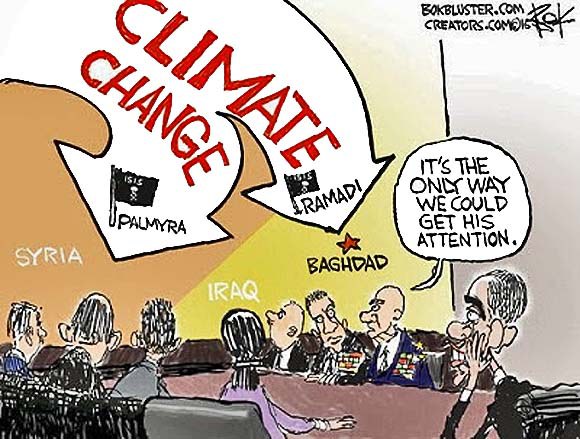
H/t Vermont Loon Watch.
Filling the Vacuum in Syria, The Gatestone Institute, Yaakov Lappin, May 28,2015
As the regime of Bashar Assad continues steadily to lose ground in Syria; and as Assad’s allies, Iran and Hezbollah, deploy in growing numbers to Syrian battlegrounds to try to stop the Assad regime’s collapse, the future of this war-torn, chaotic land looks set to be dominated by radical Sunni and Shi’ite forces.
The presence of fundamentalist Shi’ite and Sunni forces fighting a sectarian-religious war to the death is a sign of things to come for the region: when states break down, militant entities enter to seize control. The idea that, because Sunni and Shi’ite elements are locked in battle with one another today, they will not pose a threat to international security tomorrow, is little more than wishful thinking.
The increased presence of the radicals in Syria will have a direct impact on international security, even though the West seems more fixated on looking only at threats posed by the Islamic State (ISIS), and disregards the possibly greater threat posed by the Iranian-led axis. It is Iran that is at the center of the same axis, so prominent in entangling Syria.
The threat from ISIS in Syria and Iraq to the West is obvious: Its successful campaigns and expanding transnational territory is set to become an enormous base of jihadist international terrorist activity, a launching pad for overseas attacks, and the basis for a propaganda recruitment campaign.
It has already become a magnet for European Muslim volunteers. Their return to their homes as battle-hardened jihadists poses a clear danger to those states’ national security.
Yet the threat from the Iranian-led axis, highly active in Syria, is more severe. With Iran, a threshold nuclear regional power, as its sponsor, this axis plans to subvert and topple stable Sunni governments in the Middle East and attack Israel. Iran’s axis also has its sights set on eventually sabotaging the international order, to promote Iran’s “Islamic revolution.”
This is the axis upon which the Assad regime has become utterly dependent for its continued survival.
Today, the radical, caliphate-seeking Sunni organization, ISIS, controls half of Syria, while hardline Lebanese Shi’ite Hezbollah units can be found everywhere in Syria, together with their sponsors, Iran’s Islamic Revolutionary Guards Corps (IRGC) personnel, fighting together with the Assad regime’s beleaguered and worn-out military forces.
The increased Iranian-Hezbollah presence needs to be closely watched. According to international media reports, an IRGC-Hezbollah convoy in southern Syria, made up of senior operatives involved in the setting up of a base designed to launch attacks on the Golan Heights, was struck and destroyed by Israel earlier this year. The Hashemite Kingdom of Jordan too hasreason to be concerned.
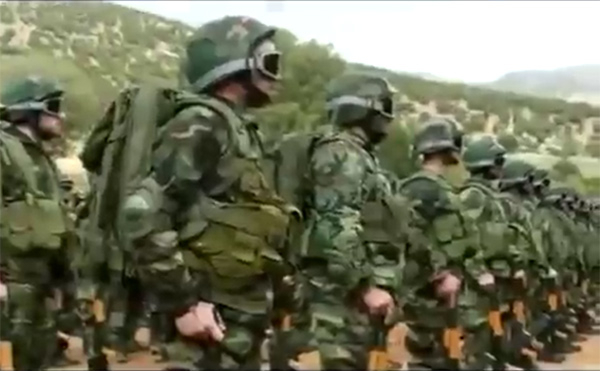 Lebanese Shi’ite Hezbollah fighters are deeply involved in Syria’s civil war. (Image source: Hezbollah propaganda video)
Syria has become a region into which weapons, some highly advanced, flow in ever greater numbers, allowing Hezbollah to acquire guided missiles, and allowing ISIS and the Al-Nusra Front to add to their growing stockpile of weaponry.
Other rebel organizations, some sponsored by Saudi Arabia, Turkey, and Qatar, are also wielding influence in Syria. These groups represent an effort by Sunni states to exert their own influence there.
Despite all the efforts to support it, the Assad regime suffered another recent setback when ISIS seized the ancient city Palmyra in recent days, making an ISIS advance on Damascus more feasible. To the west, near the Lebanese border, Al-Qaeda’s branch in Syria, the Al-Nursa Front, also made gains. It threatened to enter Lebanon, prompting Hezbollah to launch a counter-offensive to take back those areas.
These developments provide a blueprint for the future of Syria: A permanently divided territory, where conquests and counter-offensives continue to rage, and the scene of an ongoing humanitarian catastrophe, producing waves of millions of refugees that could destabilize Syria’s neighbors. Syria is set to remain a land controlled by warring sectarian factions, some of whom plan to spread their destructive influence far beyond Syria.
Events in Syria have shown that the notion that air power can somehow stop ISIS’s advance is a fantasy. More importantly, they have also illustrated that Washington’s policy of cooperation with Iran in a possible “grand bargain” to stabilize the region, while failing to take a firmer stance against the civilian-slaughtering Assad regime, is equally fruitless.
A policy of turning a blind eye to the Iran-led axis, including Syria’s Assad regime, appears to be doing more harm than good.
WH Admits Need To ‘Adapt Our Strategy’ Against IS, Contradicts Previous Admin Statements, Washington Free Beacon via You Tube, May 27, 2015
(“It’s more complicated than that.” Wash, rinse and repeat– DM)
Obama’s Islamic State strategy sparks doubt, resentment among Pentagon officials, Washington Times, Rowan Scarborough, May 26, 2015
Beneath the glowing battle reports about Iraq from U.S. military spokesmen in recent months, there remains a strong undercurrent of dissatisfaction among the Pentagon rank and file with the Obama administration’s Islamic State strategy.
“What strategy?” asked a Pentagon official involved in counterterrorism analysis. “We are now floating along, reacting to ISIS,” using a common acronym for the Islamic State.
This source said the military has a plan for introducing ground troops and defeating the Islamist group, but the belief is that President Obama will never activate it.
Whether this unhappiness has reached the inner sanctum of the Joint Chiefs of Staff is unclear. In public, the military leadership says it is squarely behind the strategy of limited U.S.-led airstrikes coinciding with the rebuilding of the Iraq army for all the ground fighting.
But a Washington Times spot check of department officials and people who interact with the Pentagon reveals deep-seated doubts.
 Photo by: © STRINGER Iraq / Reuters Iraq’s Shiite paramilitaries claimed to have taken charge of driving the Islamic State out from the western province of Anbar. However, Pentagon officials decry what they see as an unfocused White House plan to rout the terror group. (Reuters)
The Islamic State’s rout of Ramadi on May 18 exposed more than the Iraqi army’s lack of will to fight, as Defense Secretary Ashton Carter bluntly put it over the weekend.
After months of U.S. and coalition airstrikes on hundreds of Islamic State targets, after U.S. surveillance and intelligence collection, and with senior American officers advising Iraqis at a joint command center, the battlefield outcome still was no better than the rout of Mosul 11 months ago.
A former official who is frequently in the Pentagon said, “The building is very guarded about what they say, but clearly the White House is running the campaign, which has them furious.”
This source said combat pilots can loiter over a target for hours before approval comes to strike it. Sometimes approval never comes.
“The targeting requires immaculate rules of engagement, which means they cannot drop if there is a possibility of collateral damage [civilian deaths],” the former official said.
U.S. Central Command’s list of airstrikes around Ramadi showed a smattering of tactical strikes, not concentrated air power.
On May 18, the day Ramadi fell, Central Command listed three targets as being struck around Ramadi — two tactical units and an Islamic State staging area. Destroyed there were an armored vehicle, an excavator and a resupply vehicle.
On the previous day, as Islamic State fighters were taking control of Ramadi, eight airstrikes hit targets near the city. They were three tactical units, eight buildings, two armored vehicles, two mortars, an ammunition storage area and a command center.
“This is worse than pathetic,” the former official said.
Another annoying development, the source said, is the lack of American arms making their way from the Shiite-led national government in Baghdad to Iraqi Kurdish forces in the north. They have proven to be one of the few Iraqi units willing to take on the Islamic State.
The former official said a commitment of U.S. special operations forces and some infantry “could defeat the Islamic State in weeks.”
“But then what?” the source asked, noting that the Shiite-dominated government has badly mismanaged the post-U.S. environment.
“I have never seen such disgruntlement before,” the source said of the mood in the Pentagon.
Another official said a constant theme inside the Pentagon is that the White House does not seem committed to winning. The frequent public relations spin is that this will be a long process to take down the Islamic State when, in fact, officers say, it does not have to be.
“They question whether the U.S. has any interests at stake in Iraq,” this official said. “If we do, they expect Obama to make the case.”
The Iraqi government announced Monday that it has launched a new counteroffensive aimed at retaking Ramadi, the capital of the Sunni-dominated Anbar province. U.S. Marines in the mid-2000s, in an alliance with Sunni tribal leaders, fought a protracted counterinsurgency to rid the western region of al Qaeda terrorists.
So far, the Sunni role in trying to expel the Islamic State, a Sunni extremist army, does not seem as robust. That is why Prime Minister Haider al-Abadi is now relying on Iran-directed Shiite militias to fight in Anbar, as he did in the assault on the Sunni-majority city of Tikrit.
The former defense official said that if one wants to get a sense of the unhappiness inside the Pentagon, they should listen to the few retired senior generals who are speaking out.
One is retired Army Lt. Gen. Michael T. Flynn, the former director of the Defense Intelligence Agency under Mr. Obama. Mr. Flynn is urging a much more aggressive approach to the Islamic State and jihadis worldwide.
“Unless the United States takes dramatically more action than we have done so far in Iraq, the fractious, largely Shiite-composed units that make up the Iraqi army are not likely to be able, by themselves, to overwhelm a Sunni stronghold like Mosul, even though they outnumber the enemy by ten to one,” he wrote in Politico. “The United States must be prepared to provide far more combat capabilities and enablers such as command and control, intelligence, logistics and fire support, to name just a few things.”
Globally, he said, “We must engage the violent Islamists wherever they are, drive them from their safe havens and kill them. There can be no quarter and no accommodation.”
Another is retired Marine Corps Gen. James Mattis, who was Mr. Obama’s Central Command chief until May 2013, a time when the Islamic State had not yet established itself in Iraqi territory.
“The bottom line is we do not have a global strategy,” Mr. Mattis said May 13 at the Heritage Foundation. “Right now we have an America that is starting to reduce its role in the world. That’s not good.”
He noted that Mr. Obama last August said “we don’t have a strategy yet” for defeating the Islamic State. Mr. Mattis said that statement still holds true today. “We don’t really have a good strategy right now,” he said.
He added, “This is what would be called a poor grade at the National War College, to say the least. They would have flunked you.”
Robert Gates, Mr. Obama’s first defense secretary, told MSNBC, referring to the U.S. in Middle East, “We’re basically sort of playing this day to day.”
Mr. Carter took a big step over the weekend in beginning to bluntly blame the Iraqis for failing to hold Ramadi.
“What apparently happened was that the Iraqi forces just showed no will to fight,” the defense secretary told CNN. “They were not outnumbered. In fact, they vastly outnumbered the opposing force, and yet they failed to fight.”
The White House immediately launched damage control so as not to offend Mr. Abadi’s government.
“The recent universal statement by the [secretary of defense] that the Iraqis don’t have the will to fight is unhelpful,” said retired Army Lt. Gen. James Dubik, who led the training of Iraqi troops during the war. “‘Will to fight’ is a complex phenomenon. Why do they fight like hell in some circumstances and not others? That is the real issue.”
Mr. Dubik has been playing close attention to starts and stops of the campaign against the Islamic State as an analyst at the Institute for the Study of War in Washington.
“The fall of Ramadi is a blow to the Iraqi counteroffensive, and it complicates resupply and reinforcements to Al Asad [air base],” he said. “It shows how resilient ISIS is, and how difficult the counteroffensive to re-establish the Iraq-Syria border and re-establish Iraq’s political sovereignty will be. There is no guarantee that Iraq will be successful. And if they’re not, U.S. security interests in the region, and beyond, will suffer.”
U.S. Central Command remains upbeat. On Tuesday, Marine Brig. Gen. Thomas Weidley, the war command’s chief of staff, issued a statement referring to recent setbacks as temporary.
“Positive steps and effects are occurring throughout the battle space, which, in combination, are encouraging signs of the operational-level progress to date within the campaign,” he said.
Obama’s Iraq War, Front Page Magazine, Daniel Greenfield, May 26, 2015

We all know Bush’s Iraq War, but we don’t know much about Obama’s Iraq War. Republicans fight wars. Democrats engage in police actions, impose No-Fly Zones and provide security for humanitarian missions. They don’t do anything as vulgar as fight wars. That would be warmongering.
Even by the war-shy standards of Democrats, Obama’s word games with war have been something else.
Obama’s wars are complex shell games. When he goes to war, he claims that it was at the request of a third party, which was actually fulfilling his request to file a request that it later takes back, based on a pretext that turns out to be false, to carry out a mission that turns out to be a pretext for regime change.
At least that’s how it happened in Libya.
When he inherits a war, he changes its name and announces a withdrawal while leaving a heavy military presence in place, before then actually withdrawing. If the first withdrawal doesn’t result in a disaster, because it never really took place, he can’t be blamed for the disaster that begins after the real withdrawal. After all the original withdrawal worked, so withdrawing can’t be the problem.
That’s what he did in Iraq. It’s what he plans to do in Afghanistan.
Obama’s Iraq War doesn’t exist as a distinct entity because the administration has gone to great lengths to distance itself from any appearance of being involved in it. When his original promise of withdrawing within sixteen months proved unfeasible, he declared that “By Aug. 31, 2010, America’s combat mission in Iraq would end.”
The war was renamed from Operation Iraqi Freedom to Operation New Dawn. The 50,000 soldiers became members of “Advise and Assist Brigades”. When two soldiers were killed and nine wounded on that September, they did not die as part of a combat mission. When two members of the Puerto Rico Army National Guard were killed by an IED in January, they died as advisers and assistants for New Dawn.
Five years later, America’s combat mission in Iraq is still going on. We’re still advising, assisting and bombing. And there’s no new dawn anywhere in sight.
Operation Iraqi Freedom was a name that made liberal elites turn up their noses, but it succinctly expressed a purpose and a goal. New Dawn could have been anything from a brand of soap to a cult. It was a cheerfully meaningless name and that was its purpose. It created a sense of progress without any actual progress having been made. Like everything Obama did, it was a shiny box with nothing inside.
When it came to Iraq, Obama tried to fool everyone; selling the anti-war crowd an immediate withdrawal while promising everyone else a sensible withdrawal once the mission was finished.
And he managed to lie to everyone.
When the real withdrawal came, it was followed by an onslaught of Al Qaeda car bombs. More significantly it turned Al Qaeda in Iraq into the first franchise to be able to claim to have beaten America.
Obama had been so set on withdrawal that he had paid little attention to Al Qaeda in Iraq’s resurgence. Its continued activity in Iraq combined with the withdrawal allowed the terror group to create the myth that it had defeated the United States and driven it out of Iraq. And Obama allowed the myth to grow.
Al Qaeda around the world was looking for new tactics and inspirations. While Obama insisted that Al Qaeda had to be urgently fought in Afghanistan, its presence there was light. It was much more of a threat in Yemen, a locale that would become the source of a number of terrorist attacks directed at America and Europe, and a major player in the current civil war there, as well as back in Iraq.
Obama insisted that Bush had taken his eyes off the ball by ignoring Afghanistan, but he was the one who had taken his eyes off the ball by focusing on Afghanistan and ignoring Iraq. His eagerness to get away from Iraq created a situation in which the United States could target Al Qaeda in Yemen and Pakistan, but not in Iraq where it was strongest. This policy turned Iraq into an Al Qaeda haven.
His unwillingness to confront Al Qaeda in Iraq added to the myth that it had won and that the United States was too frightened of it to fight it. The myth had some elements of truth to it.
Obama was afraid, but he wasn’t afraid of Al Qaeda. He was afraid of Iraq.
September 11 had badly panicked Democrats who suddenly saw themselves losing the post-Cold War narrative of soft power and multilateral diplomacy. Their feigned patriotism only lasted long enough for them to spot a weakness by seizing on Al Qaeda’s campaign of terror in Iraq to turn the narrative around. The last thing Obama wanted to do was risk undermining the anti-war victory of the left in Iraq.
The left needed a defeat and so it created one in Iraq. The Islamists needed a victory so they derived it from Iraq. Osama bin Laden and the Democrats were both reading texts on Vietnam and drawing the same conclusions. But the Democrats did not understand the implications of those conclusions.
By positioning Iraq as a war that America had lost, they also made it a war that Al Qaeda had won.
Al Qaeda had thrived in Afghanistan because it could claim to have beaten the USSR. Now it was thriving in Iraq because it could claim to have beaten America. The transformation of Al Qaeda in Iraq into the Islamic State would become a self-fulfilling prophecy powered by propaganda and American apathy.
Obama had made Iraq into America’s blind spot. The blindness became policy. Even as ISIS was capturing entire cities, Obama clung to the narrative that the local franchises were Jayvee teams and that the entire War on Terror could be wrapped up by withdrawing from Afghanistan.
The administration’s insistence that the Iraq War couldn’t exist made it inevitable that it would. Each denial was read by ISIS, its supporters and opponents as proof that Obama was afraid of to fight it.
Televised genocide and mass rape forced Obama back into Iraq, but with the same lack of commitment. Just as before his final withdrawal, his priority is not to win the war but to avoid the appearance of blame. Once again he is trying to fight a war without fighting it by doing as little as he can get away with.
Obama does not fear an ISIS victory. He fears Bush’s Iraq War becoming his Iraq War. He worries about having his soft power foreign policy mired in the mud of Iraq. He is afraid of losing his Nobel Prize in Baghdad.
He ignored ISIS for as long as possible. Even now he does not envision defeating it, only “degrading” it until he can go back to safely ignoring it again. The rise of ISIS has not changed his Iraq policy. It is still the same disastrous and irresponsible policy that led to the rise of the world’s first Al Qaeda nation.
The plan is to reboot New Dawn, wait a while and then forget about Iraq all over again. But ISIS isn’t making it easy.
The roots of ISIS lie in the unwillingness of many Democrats to confront what Al Qaeda actually was and their expediency in seizing on its attacks in Iraq for political gain. Obama and his party have reaped the political benefits of Al Qaeda terror only to discover that the terror won’t go away just because Bush did.
Obama may refuse to call the war by its name, but the Iraq War has not ended and it’s his war now.
No army in Mid East is challenging ISIS. Iran regroups to defend S. Iraqi Shiites, Assad to save Damascus, DEBKAfile, May 25, 2015
 Iranian troops in fight to evict ISIS from Baiji refinery
Hassan Nasrallah Saturday, May 23, called his Lebanese Shiite Hizballah movement to the flag, because “we are faced with an existential crisis” from the rising belligerence of the Islamist State of Iraq and the Levant. His deputy, Sheik Naim Qssem, sounded even more desperate: “The Middle East is at the risk of partition” in a war with no end in sight, he said. “Solutions for Syria are suspended. We must now see what happens in Iraq.”
The price Iran’s Lebanese proxy has paid for fighting alongside Bashar Assad’s army for four years is cruel: some 1,000 dead and many times that number of wounded. Its leaders now understood that their sacrifice was in vain. ISIS has brought the Syrian civil war to a new dead end.
This week, a 15-year old boy was eulogized by Hizballah’s leaders for performing his “jihadist duty” in Syria.
Clearly, for their last throw in Syria, the group, having run out of adult combatants, is calling up young boys to reinforce the 7,000 fighting there.
The Syrian president Bashar Assad is in no better shape. He too has run dangerously short of fresh fighting manpower. Even his own Alawite community has let him down. Scarcely one-tenth of the 1.8 million Alawites have remained in Syria. Their birthrate is low, and those who stayed behind are hiding their young sons to keep them from being sent to the front lines.
Assad also failed to enlist the Syrian Druze minority to fight for his regime, just as Hizballah’s Nasrallah was rebuffed when he sought to mobilize the Lebanese army to their cause. This has left Hizballah and the Syrian ruler alone in the battlefield with dwindling strength against two rival foes: ISIS and the radical Syrian opposition coalition calling itself Jaish al-Fatah – the Army of Conquest – which is spearheaded by Al Qaeda’s Nusra Front and backed to topple Assad by Saudi Arabia, Qatar and Turkey.
Nasrallah tried to paint a brave picture of full mobilization to expand the war to all parts of Syria. However, Sunday, May 24, a key adviser to Assad admitted that his regime and its allies were being forced to regroup.
Their forces were withdrawing from the effort to shift the Islamists from the land they have conquered – about three-quarters of Syrian territory – and concentrating on defending the cities, Damascus, Homs and Latakia, home to the bulk of the population, as well as the strategic Damascus highway to the coast and Beirut. Hizballah needed to build up the Lebanese border againest hostile access.
But Syrian cities, the Lebanese border and the highway are still under threat – from Syrian rebel forces.
The Iraqi army, for its part, has been virtually wiped out, along with the many billions of dollars the US spent on training and weapons. There is no longer any military force in Iraq, whether Sunni or Shiite, able to take on ISIS and loosen its grip on the central and western regions.
The Kurdish peshmerga army, to whom President Barack refused to provide armaments for combating the Islamists, has run out of steam. An new offensive would expose the two main towns of the semi-autonomous Kurdish Republic – the capital Irbil and the oil city of Kirkuk – to the depredations of the Islamist belligerents.
A quick scan of Shiite resources reveals that in the space between the Jordan River and the Euphrates and Tigris, Iran commands the only force still intact in Iraq – namely, the Iraqi, Afghan and Pakistani Shiite militias, who are trained and armed by the Revolutionary Guards.
This last remaining fighting force faces its acid test in the battle ongoing to recover Baiji, Iraq’s main oil refinery town. For the first time, Iranian troops are fighting in Iraq, not just their surrogates, but in the Baiji campaign they have made little headway in three weeks of combat. All they have managed to do is break through to the 100 Iraqi troops stranded in the town, but ISIS fighting strength is still not dislodged from the refinery.
The Obama administration can no longer pretend that the pro-Iranian Shiite militias are the panacea for the ISIS peril. Like Assad, Tehran too is being forced to regroup. It is abandoning the effort to uproot the Islamists from central and western Iraq and mustering all its Shiite military assets, such as the Badr Brigade, to defend the Shiite south – the shrine towns of Najef and Karbala, Babil (ancient Babylon) and Qadisiya – as well as planting an obstacle in the path of the Islamists to Iraq’s biggest oil fields and only port of Basra.
The Shiite militias flown in by Tehran from Pakistan and Afghanistan have demonstrated in Syria and Iraq alike that they are neither capable nor willing to jump into any battlefields.
The upshot of this cursory scan is that not a single competent army capable of launching all-out war on ISIS is to be found in the Middle East heartland – in the space between the 1,000km long Jordan and the Euphrates and Tigris to the east, or between Ramadi and the Saudi capital of Riyadh to the south.
By Sunday, May 24, this perception had seeped through to the West. US Defense Secretary Ashton Carter, remarked: “What apparently happened was that the Iraqi forces just showed no will to fight.” The former British army chief Lord Dannatt was more down to earth. Since the coalition air force campaign had failed to stop ISIS’s advance, he said “it was time to think the previously unthinkable” and send 5,000 ground troops to fight the Islamists in Syria and Iraq.
The next day, Monday, Tehran pointed the finger of blame for the latest debacles in Iraq at Washington. Al Qods Brigades chief Gen. Qassem Soleimani was quoted by the English language Revolutionary Guards mouthpiece Javan as commenting: “The US didn’t do a damn thing to stop the extremists’ advance on Ramadi.”
Why Obama has come to regret underestimating the Islamic State, The Telegraph, Richard Spencer, May 23, 2015
Its strategy is essentially Maoist – the comparison has not been enough made, but now that Isil has declared itself an agent of Cultural Revolution, with its destruction of history, perhaps it will be more. Like Mao’s revolutionaries, it conquers the countryside before storming the towns.
Even now, the fact that much of its territory is rural or even desert is seen as a weakness. But it is beginning to “pick off” major towns and cities with impunity. In fact, where society is fractured, like Syria and Iraq, the “sea of revolution” panics the citizenry, making it feel “surrounded” by unseen and incomprehensible agents of doom.
********************
Have any words come back to haunt President Obama so much as his description of Islamic State of Iraq and the Levant last team as a “JV” – junior varsity – team of terrorists?
This wasn’t al-Qaeda in its 9/11 pomp, he said; just because a university second team wore Manchester United jerseys didn’t make them David Beckham.
How times change. As of this weekend, the JV team is doing a lot better than Manchester United. With its capture of Palmyra, it controls half of Syria.
Its defeat in Kobane – a town of which few non-Kurds had heard – was cheered by the world; its victory in Ramadi last Sunday gives it control of virtually all of Iraq’s largest province, one which reaches to the edge of Baghdad.
Calling itself a state, one analyst wrote, no longer looks like an exaggeration.
Senior US officials seem to agree. “Isil as an organization is better in every respect than its predecessor of Al-Qaeda in Iraq. It’s better manned, it’s better resourced, they have better fighters, they’re more experienced,” one said at a briefing to explain the loss of Ramadi. “We’ve never seen something like this.”
How did Isil manage to inflict such a humiliation on the world’s most powerful country? As with many great shock-and-awe military advances over the years, it is easier to explain in hindsight than it apparently was to prevent.
Ever since Isil emerged in its current form in 2013, military and and political analysts have been saying that its success is due to its grasp of both tactics and strategy.
Its strategy is essentially Maoist – the comparison has not been enough made, but now that Isil has declared itself an agent of Cultural Revolution, with its destruction of history, perhaps it will be more. Like Mao’s revolutionaries, it conquers the countryside before storming the towns.
Even now, the fact that much of its territory is rural or even desert is seen as a weakness. But it is beginning to “pick off” major towns and cities with impunity. In fact, where society is fractured, like Syria and Iraq, the “sea of revolution” panics the citizenry, making it feel “surrounded” by unseen and incomprehensible agents of doom.
Like Mao, Isil uses propaganda – its famed dominance of social media – to terrorise its targets mentally. Senior Iraqi policemen have recounted being sent images via their mobile phones of their decapitated fellow officers. This has a chastening effect on the fight-or-flight reflex.
It then uses actual terror to further instil chaos. Isil’s main targets have been ground down by years of car bombs and “random” attacks. It seems extraordinary, but one of the reasons given by Mosul residents for preferring Isil rule is that there are no longer so many terrorist attacks: not surprising, since the “terrorists” are in control.
Only once your enemy is weak, divided, and demoralised, do you strike.
You then do so with an awesome show of force – one which can mislead as to the actual numbers involved.
The final assault on central Ramadi, which had been fought over for almost 18 months, began with an estimated 30 car bombs. Ten were said to be individually of an equivalent size to the 1995 Oklahoma bombing, which killed 168 people.
There is nothing new in saying that both Syrian and Iraqi governments have contributed greatly to the rise of Isil by failing to offer the Sunni populations of their countries a reason to support them.
Some say that focusing on the failings and injustices of these regimes ignores the fact that militant Islamism, like Maoism, is a superficially attractive, even romantic idea to many, whether oppressed or not, and that its notions must be fought and defeated intellectually and emotionally.
That is true. But relying on Islamic extremism to burn itself out, or for its followers to be eventually persuaded of the errors of their ways, is no answer. Like financial markets, the world can stay irrational for longer than the rest of us can stay politically and militarily solvent.
Rather, the West and those it supports have to show they can exert force against force, and then create a better world, one which all Iraqis and Syrians, especially Sunnis, are prepared to fight for.
In March, an uneasy coalition of Shia militias, Iraqi soldiers, and US jets took back the town of Tikrit from Isil. It remains a wasteland, whose inhabitants have yet to return, ruled over by gunmen rather than by the rule of law.
That is not an attractive symbol, for Iraqi Sunnis, of what victory against Isil looks like. If the war against Isil is to be won, the first step is to make clear to Iraqis and Syrians alike what victory looks like, and why it will be better for them.
Analysis: Iran is no partner in the fight against the Islamic State, Long War Journal, Ali Alfoneh and Michael Pregemt, March 11, 2015
 Qassem Soleimani (center) with his bodyguards near the frontlines of Tikrit.
Iran benefits from the threat of an Islamic State, and if the US continues its courtship of Tehran, it may find the Islamic State replaced by an Islamic Republic.
****************
Testifying on Capitol Hill on March 3, Joint Chiefs Chairman General Martin Dempsey characterized the joint attempts of the Iraqi military, Iraqi Shia militias, and Iran’s Islamic Revolutionary Guards Corps (IRGC) at taking back control of Tikrit, Saddam Hussein’s hometown, from the Islamic State, as “a positive thing.” “Frankly,” General Dempsey said, “it will only be a problem if it results in sectarianism.”
General Dempsey’s caveat is an interesting one, since there is every reason to believe that Shia control of Tikrit will result in further sectarianism. While the US administration says in its most recent National Security Strategy that it desires to “degrade and ultimately defeat ISIL [Islamic State]” in an attempt to “support Iraq … free itself from sectarian conflict and the scourge of extremists,” Tehran is actively perpetuating the sectarian crisis in Iraq.
The threat of the Islamic State, coupled with American “strategic patience,” not only makes the Iraqi Shia more dependent on Tehran and legitimizes Iran’s military presence in Iraq, it also provides the regime in Tehran with another bargaining chip in nuclear negotiations with the P5+1 Group.
In the past, the Iraqi Shia have demonstrated little interest in reducing themselves to puppets of Tehran. During the war with Iraq from 1980-1988, Iraqi nationalism trumped sectarian identity: the Shia constituted the rank and file of the Iraqi military, and Shia leaders in Iraq kept their distance from the regime in Tehran. After the collapse of Saddam Hussein’s regime in 2003, Iraq became a sanctuary to Iranian clerics critical of the regime in Tehran, including Hossein Khomeini, grandson of the founder of the Islamic Republic.
But Iraq did not remain a refuge for long. The civil war in Iraq, followed by the rise of Islamic State, forced moderate Iraqi Shia, who otherwise would have pursued a line independent of Iran, to become dependencies of Tehran. After being rebuffed by the US following the Islamic State’s takeover of Mosul in 2014, General Qassem Atta, head of the Iraqi National Intelligence Service, asked Tehran for help and received assistance within 48 hours. Iraqi Prime Minister Haider al Abadi continues to press Washington for more support in his fight against the Islamic State and uses US hesitancy to justify reliance on Iran, which according to Vice President Iyad Allawi,only increases Iran’s influence in Iraq and could lead to dismantlement of the Iraqi state.
The Obama administration may desire to help secure the survival of the Iraqi state, but the small contingent of US advisers in Iraq is relying on a heavily Iranian-influenced Iraqi sectarian intelligence and security apparatus. The Iraqi security forces are predominantly Shia, and in addition, Shia militias and “advisers” from the IRGC Quds Force are now fighting as legitimate Iraqi forces.
This creates an environment in which targeting operations developed by Iranian forces and the militias have primacy over those developed by the US, leading to the possibility that Washington could be portrayed by Islamic State as complicit in the indiscriminate targeting of Sunnis. Such operations will be perceived the same way by the very Sunnis we need to fight Islamic State, thus undermining the US strategy to “support Iraq … free itself from sectarian conflict and the scourge of extremists.”
Any US reliance on Iranian support in the fight against the Islamic State is also likely to strengthen Tehran’s bargaining position in the nuclear negotiations.
Although both US and Iranian negotiators maintain that nothing but the nuclear issue is being discussed, this of course is fiction. On Sept. 22, Fars News, quoting an anonymous American source, reported that Secretary of State John Kerry and Mohammad Javad Zarif, Iran’s foreign minister, discussed the nuclear issue as well as the fight against the Islamic State. And Admiral Ali Shamkhani, Iran’s Supreme National Security Council Secretary, has also connected both issues. Clearly, Tehran’s cooperation with Washington in the fight against the Islamic State comes at a price, which Washington must pay at the negotiating table in Geneva.
Iran has Washington where it wants it. Iran wants a favorable deal, and the Obama administration is signaling that such a deal is forthcoming. US “strategic patience” is allowing Iran to increase its influence and presence in Iraq and Syria. Assad is waiting out the Americans and the international community, and Shia militias are now viewed as legitimate forces in Iraq, Syria, and Yemen. But most importantly, US “strategic patience” signals to Iran an unwillingness to jeopardize the talks by linking them to Iran’s role in Iraq, Syria, and Yemen.
Iran benefits from the threat of an Islamic State, and if the US continues its courtship of Tehran, it may find the Islamic State replaced by an Islamic Republic.
IS captures Jordanian pilot after warplane crashes in Syria
24 December 2014 Last updated at 12:36 GMT
via BBC News – IS captures Jordanian pilot after warplane crashes in Syria.

slamic State (IS) militants have captured the pilot of a Jordanian warplane that crashed in northern Syria, Jordan’s military has confirmed.
The jihadist group claimed it had shot down the jet with a heat-seeking missile near the city of Raqqa.
It published photographs showing the pilot, who has been named as Flight Lieutenant Moaz Youssef al-Kasasbeh.
This is the first US-led coalition aircraft to be lost on IS territory since air strikes began in September.
Jordan is one of four Arab states which have bombed targets in Syria.
Plea for mercyThe confirmation that a Jordanian pilot had been captured came in a statement carried by the state news agency, Petra.


“During a mission Wednesday morning conducted by several Royal Jordanian Air Force planes against hideouts of the IS terrorist organisation in the Raqqa region, one of the planes went down and the pilot was taken hostage,” a military source was quoted as saying.
“Jordan holds the group and its supporters responsible for the safety of the pilot and his life,” the source added.
The source did not name the pilot, but Petra published a photo of Flt Lt Kasasbeh above its report.

Analysis: Jonathan Marcus, BBC defence correspondent
We do not know yet if the Jordanian aircraft suffered an engine failure or other technical problem, or if it was actually downed by IS air defences.
IS has been assumed to have a limited air defence capability – based not least on the sorts of shoulder-fired missiles that are rife in the region.
IS fighters have downed Iraqi and Syrian government aircraft and helicopters in the past. We also know that IS has overrun a number of Syrian air defence bases.
It is not clear if IS has personnel capable of operating any of these more sophisticated Soviet or Russian-supplied systems.
The US-led coalition permanently monitors the nature of the air defence threat and if the Jordanian aircraft was shot down then any potential lessons will be fed into the ongoing air campaign.
Earlier, the UK-based Syrian Observatory for Human Rights, said it had received reports from its network of activists that IS members had taken “an Arab pilot prisoner after shooting his plane down with an anti-aircraft missile near the city of Raqqa”.
The pro-IS Raqqa Media Center also posted a photo on its Facebook page showing armed men taking the pilot out of what appeared to be a lake or river.
The man appeared able to stand but was bleeding from the mouth. He was wearing only a white T-shirt and was soaking wet.
A caption identified him as Lt Kasasbeh and later a photo appearing to show his military ID card was published.

Lt Kasasbeh’s father, Youssef al-Kasasbeh, confirmed his son had been captured in Syria in an interview with the Jordanian newspaper, Saraya.
Youssef al-Kasasbeh said he found out the news after the head of the RJAF informed another of his sons.
He appealed to IS leaders: “May Allah plant mercy in your hearts and may you release my son.”
The air forces of Jordan, the US, UAE, Saudi Arabia, and Bahrain have carried out hundreds of air strikes on IS in Syria in the past three months.
Many of the targets have been in and around Raqqa, which is the de facto capital of the “caliphate” whose creation IS proclaimed in June.
German author Juergen Todenhoefer recently met Islamic State fighters in Raqqa and filmed daily life
Syrian government warplanes also regularly bomb Raqqa and the surrounding province. On Tuesday, an air strike killed more than 20 people, according to the Syrian Observatory.
Australia, Belgium, Canada, Denmark, France, the Netherlands and UK have joined the US in conducting air strikes on IS in neighbouring Iraq.
The BBC’s Jim Muir in Beirut says the latest news will raise concern among the coalition nations about the level of armament available to the militants and the defensive measures deployed by coalition jets.
It may further diminish the appetite of Arab nations to take part in such operation, our correspondent adds.

Reports: ISIS Within a Mile of Baghdad
Tuesday, 30 Sep 2014 09:34 PM
By Todd Beamon
via Reports: ISIS Within a Mile of Baghdad.
Islamic State militants are reportedly within a mile of Baghdad despite battling Iraqi forces and U.S.-led airstrikes, and there is “immense fear among everybody,” the vicar of the only Anglican church in Iraq said Tuesday.
“We are at a crisis point,” Canon Andrew White, vicar of St George’s Church in Baghdad, told Sky News. “People know ISIS are coming nearer.”
The Islamic State is also known as ISIS.
White’s work is supported by the Foundation for Relief and Reconciliation in the Middle East, which said late Monday in a Facebook posting: “The Islamic State are now less than 2km away from entering Baghdad.”
“They said it could never happen, and now it almost has. Obama says he overestimated what the Iraqi army could do,” the posting said, referring to President Barack Obama.
“Well, you only need to be here a very short while to know they can do very very little,” the posting said.
He told Sky News that the U.S.-led airstrikes against ISIS are doing little more than killing civilians.
“People are being killed by the attacks of the coalition,” he said.
“This is horrendous,” he said about the Islamic State’s advance into Iraq’s capital city. “We have civilians being killed, yet [the Islamic State] are moving toward Baghdad.”
Renewed fighting has also occurred in such central Iraqi cities as Baquba and Ramadi, Sky News reports, as ISIS fighters appear to have advanced within 3 miles of Kobani, a critical border town in Syria, despite the airstrikes.
The reports come as the White House remains in damage-control mode after Obama told CBS’ “60 Minutes” on Sunday that U.S. intelligence officials had underestimated the ISIS threat.
The suggestion angered congressional Republicans, leading Mike Rogers, chairman of the House Intelligence Committee, to charge that “this was not an intelligence community failure, but a failure by policymakers to confront the threat.”
Obama had said:
“Our head of the intelligence community, Jim Clapper, has acknowledged that I think they underestimated what had been taking place in Syria.” He was referring to James Clapper, director of national intelligence.
White House spokesman Josh Earnest sought to clarify Obama’s remarks, noting that he was not blaming anyone as the U.S. sought global cooperation in the airstrikes that seek to weaken ISIS strongholds in Syria and Iraq.
“That is not what the president’s intent was,” Earnest said Tuesday. “What the president was trying to make clear” was “how difficult it is to predict the will of security forces that are based in another country to fight.”
In his Sky News interview, White said of Baghdad: “I’ve never known the city like it is at the moment.”
“Streets which are usually choc-a-bloc with traffic, cars and people are almost empty. People are too fearful to even leave their homes.”
He said that his church most likely would be “very high up” on the Islamic State’s target list and that “I must be at the top of the list.”
White told Sky News that one Iraqi soldier told him that if he was confronted by ISIS he would “take off his uniform and run,” and that he was in the army “because he needs the money.”
“This, sadly, is the kind of attitude of so many of these forces who should be coming to our aid and help,” he said.
According to The Daily Mail, airstrikes over the weekend appeared to have halted ISIS militants’ advance at Ameriyat al-Falluja, a small city about 18 miles south of Fallujah and 40 miles west of Baghdad.
But most of the fighters were undaunted — and many are making their way to the suburbs of Baghdad, the Daily Mail reports.
In a Facebook posting earlier Monday, White said: “Over 1,000 Iraqi troops were killed by ISIS yesterday, things are so bad.”
“All the military airstrikes are doing nothing,” he added. “If ever we needed your prayers, it is now.”




 anneinpt
 artaxes
 danmillerinpanama
 davidking1530
 Peter Hofman
 Joseph Wouk
 Peter
Peter Louisiana Steve
 WarSclerotic
Recent Comments