Posted tagged ‘Iranian proxies’

Addicted to self-deception

July 13, 2015

Addicted to self-deception, Israel Hayom, Dr. Reuven Berko, July 13, 2015

There is an Arab proverb that says, “What is written on the brow will inevitably be seen by the eye,” meaning that one will inevitably meet one’s destiny.

But the eyes of the West do not see the writing. The negotiators responsible for the talks between Iran and the world powers see the sights and hear the voices, but ignore reality and engage in the wishful thinking of those who sent them to Vienna.

Like failed psychologists, U.S. Secretary of State John Kerry and his team are managing the negotiations with the unquestionably stubborn Iranians as if they were therapy sessions. The Iranians, following the directives of a cynical ayatollah whispering to them from the wings, are deliberately displaying manic personality shifts, up and down, playing the West like a marionette between hope and despair.

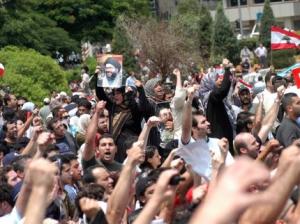
The West watches eagerly as Iran continues to develop its missiles and its nuclear program, as the centrifuges constantly whirl throughout this period of intentional procrastination. World leaders hear the threats of Ayatollah Ali Khamenei and his band of clerics, who shun the deal and preach the destruction of Israel, while declaring that the Iranian nation’s struggle against the “boastful” United States will continue and that there will be no access to the sites where the bomb is being developed. If that is what the leader thinks, then the masses will follow. And indeed, the Iranian media, defense establishment, and the crowds in the streets of Tehran parade their zealous hatred and their anti-Western incitement as they demand that sanctions be lifted while American and Israeli flags go up in flames.

It appears the leaders in the talks are using “denial” and “repression” as psychological tricks to delude themselves, and not, God forbid, as negotiation tactics to achieve the desired deal from the enemy. These masters of self-deception respond to threatening declarations from Iran’s supreme leader that his country will never giver up its nuclear achievements by saying that it is his way of preparing the masses in Iran for the concessions to come. This is like saying that the harsh and radical comments repeatedly made are simply a way to “vent” the feelings of rage in the Iranian public and are a sign “from above” of the concession of the nuclear project.

Those who have eyes in their heads understand that things are not going well. Lifting the sanctions will swell Iran’s purse, which funds global terrorism, particularly in Syria, Yemen, Jordan, Lebanon and Iraq, and seeks urgently to import Chinese and Russian weapons. Can the leaders of the negotiations admit that they were mistaken and were led astray by the masters of Iranian diplomacy? Will they be able to take a step back and admit that Prime Minister Benjamin Netanyahu was right to call the deal a disaster? Since we are dealing with deception, it appears that Kerry and his staff are trapped in cognitive dissonance of the same sort as a person who buys a beautiful car and then discovers that he has been deceived and the engine is burned out, yet still takes comfort in the fact that the horn works just fine.

From a psychological perspective, this is the line between the impulse for a collective Shiite suicide mission in the name of Allah and the megalomaniacal desire to control the world at the cost of the lives of everyone who opposes. However, in a Persian bazaar, what you see is what you buy. Iran is declaring, planning and working toward destroying every country in the Middle East — especially Israel — with its nuclear program, and no deal with Kerry will change that. Instead of the simple solution — the complete dismantling of the Iranian nuclear program — the West has become addicted to the process of self-deception and procrastination. At least therapy is discreet.

Israeli deterrence in the eye of the hurricane

July 12, 2015

Israeli deterrence in the eye of the hurricane, Jerusalem PostLouis Rene Beres, July 12, 2015

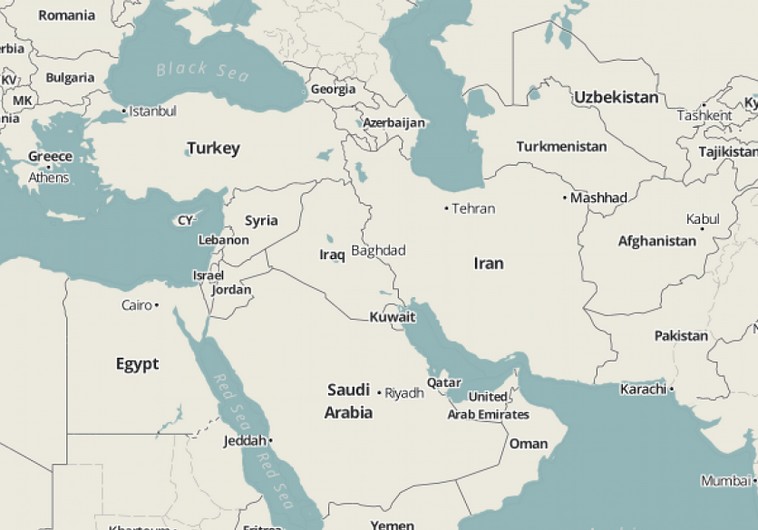
ShowImage (1)Map of Middle East. (photo credit:Courtesy)

Everything is very simple in war, but the simplest thing is difficult.”
– Carl von Clausewitz, On War

To prevent a nuclear war amid steadily growing regional chaos, especially as Iran will soon be fully nuclear (and the grateful beneficiary of US President Barack Obama’s pretend P5+1 diplomacy), Israel will need suitably complementary conventional and nuclear deterrents.

**********************

Left to themselves, especially as more “normal” hostilities dissolve into a full-blown regional chaos, Israel’s adversaries could drive the Jewish state toward an unconventional war. This fateful endangerment could be produced singly or collaboratively, by deliberate enemy intent or by the “collateral damage” of sectarian strife. Militarily, these Islamic adversaries of Israel, both Sunni and Shi’ite, could be either non-nuclear, or, in the future, nuclear.

They might also include certain wellarmed sub-state or terrorist forces. Already, Iranian-backed Hezbollah may have more usable missiles than all NATO countries combined.

To most effectively deal with such interpenetrating threats – including reasonably expected “synergies” and “force multipliers” – Israel’s leaders will first need to consider some largely-opaque factors. These include: 1) probable effects of regional chaos upon enemy rationality; 2) disruptive implications of impending Palestinian statehood; and 3) re-emergence of a corrosively Cold War-style polarity between Russia and the United States. Apropos of a “Cold War II,” there is already evidence of growing contact between Russia and Saudi Arabia, the world’s two largest oil producers.

In essence, Jerusalem must take all necessary steps to successfully manage an expectedly unprecedented level of adversarial complexity and weaponization. Israel’s leaders, in this connection, must take proper measures to ensure that any conceivable failures of its national deterrent would not spark biological or nuclear forms of regional conflict. To accomplish this indispensable goal, the IDF, inter alia, must continue to plan carefully around the core understanding that nuclear deterrence and conventional deterrence are inherently interrelated and meaningfully “seamless.”

Sometimes, in strategic matters, seeing requires distance. A nuclear war in the Middle East is not beyond possibility. This is a sensible assessment even if Israel were to remain the only nuclear weapons state in the region.

How is this possible? A bellum atomicum could come to Israel not only as a “bolt from the blue” enemy nuclear attack (either by a state or by a terrorist group), but also as the result, intended or otherwise, of certain uncontrolled military escalations.

Needed prudence in such narratives calls for additional specificity and precision. If particular Arab/Islamic enemy states were to launch conventional attacks upon Israel, Jerusalem could then respond, sooner or later, with calculated and more-or-less calibrated nuclear reprisals. Alternatively, if some of these enemy states were to launch large-scale conventional attacks, Jerusalem’s own still-conventional reprisals could then be met, perhaps even in the not-too-distant future, with enemy nuclear counterstrikes.

How should Israel prepare for such perilous contingencies? More than likely, Israel has already rejected any doctrinal plans for fielding a tactical/theater nuclear force, and for assuming any corollary nuclear war fighting postures. It would follow further from any such well-reasoned rejection that Israel should do whatever is needed to maintain a credible conventional deterrent.

By definition, such a measured threat option could then function reliably across the entire foreseeable spectrum of non-nuclear threats.

Still, any such strategy would need to include an appropriately complementary nuclear deterrent, a distinctly “last resort” option that could display a “counter-value” (counter-city) mission function. Si vis pacem, para bellum atomicum: “If you want peace, prepare for atomic war.”

A persuasive Israeli conventional deterrent, at least to the extent that it might prevent a wide range of enemy conventional attacks in the first place, could reduce Israel’s growing risk of escalatory exposure to nuclear war. In the always arcane lexicon of nuclear strategy, a complex language that more-or-less intentionally mirrors the tangled coordinates of atomic war, Israel will need to maintain firm control of “escalation dominance.” Otherwise, the Jewish state could find itself engaged in an elaborate but ultimately lethal pantomime of international bluster and bravado.

The reason for Israel’s obligation to control escalatory processes is conspicuous and unassailable. It is that Jerusalem’s main enemies possess something that Israel can plainly never have: Mass.

At some point, as nineteenth century Prussian military thinker Carl von Clausewitz asserts in On War: “Mass counts.”

Today, this is true even though Israel’s many enemies are in chaotic disarray. Now, amid what Clausewitz had famously called “friction” and the “fog of war,” it could become harder for Israel to determine real and pertinent differences between its allies, and its adversaries.

As an example, Jordan could soon become vulnerable to advancing IS forces.

Acknowledging this new vulnerability, an ironic question will come immediately to mind: Should Israel support the Jordanian monarchy in such a fight? And if so, in what specific and safe operational forms? Similarly ironic questions may need to be raised about Egypt, where the return to military dictatorship in the midst of surrounding Islamist chaos could eventually prove both fragile and transient.

Should President Abdel Fattah Sisi fail to hold things together, the ultimate victors could be not only the country’s own Muslim Brotherhood, but also, in nearby Gaza, Palestinian Hamas. Seemingly, however, Hamas is already being targeted by Islamic State, a potentially remorseless opposition suggesting, inter alia, that the principal impediment to Palestinian statehood is not really Israel, but another Sunni Arab terrorist organization. Of course, it is not entirely out of the question that IS’s Egyptian offshoot, the so-called “Sinai Province of Islamic State,” could sometime decide to cooperate with Hamas – the Islamic Resistance Movement – rather than plan to it.

To further underscore the area’s multiple and cross-cutting axes of conflict, it is now altogether possible that if an IS conquest of Sinai should spread to Gaza, President Sisi might then “invite” the IDF to strike on Egypt’s behalf. Among other concerns, Egypt plainly fears that any prolonged inter-terrorist campaign inside Gaza could lead to a literal breaking down of border fences, and an uncontrolled mass flight of Palestinians into neighboring Sinai.

Credo quia absurdum. “I believe because it is absurd.” With such peculiar facts in mind, why should Israel now sustain a conventional deterrent at all? Wouldn’t enemy states, at least those that were consistently rational, steadfastly resist launching any conventional attacks upon Israel, for fear of inciting a nuclear reprisal? Here is a plausible answer: suspecting that Israel would cross the nuclear threshold only in extraordinary circumstances, these national foes could be convinced, rightly or wrongly, that as long as their initial attacks were to remain conventional, Israel’s response would remain reciprocally non-nuclear. By simple extrapolation, this means that the only genuinely effective way for Israel to continually deter large-scale conventional war could be by maintaining visibly capable and secure conventional options.

As for Israel’s principal non-state adversaries, including Shi’ite Hezbollah and Sunni IS, their own belligerent calculations would be detached from any assessments of Israeli nuclear capacity and intent. After all, whatever attacks they might sometime decide to consider launching against the Jewish state, there could never be any decipherable nuclear response.

Nonetheless, these non-state jihadist foes are now arguably more threatening to Israel than most enemy national armies, including the regular armed forces of Israel’s most traditional enemies – Egypt, Jordan and Syria.

Some other noteworthy nuances now warrant mention. Any still-rational Arab/ Islamic enemy states considering firststrike attacks against Israel using chemical and/or biological weapons would likely take Israel’s nuclear deterrent more seriously. But a strong conventional capability would still be needed by Israel to deter or to preempt certain less destructive conventional attacks, strikes that could escalate quickly and unpredictably to assorted forms of unconventional war.

If Arab/Islamic enemy states did not perceive any Israeli sense of expanding conventional force weakness, these belligerent countries, now animated by credible expectations of an Israeli unwillingness to escalate to nonconventional weapons, could be more encouraged to attack. The net result here could be: 1) defeat of Israel in a conventional war; 2) defeat of Israel in an unconventional (chemical/biological/ nuclear) war; 3) defeat of Israel in a combined conventional/unconventional war; or 4) defeat of Arab/Islamic enemy states by Israel in an unconventional war.

For Israel, even the presumptively “successful” fourth possibility could prove too costly.

Perceptions are vitally important in all calculations of nuclear deterrence. By continuing to keep every element of its nuclear armaments and doctrine “opaque,” Israel could unwittingly contribute to the injurious impression among its regional enemies that Jerusalem’s nuclear weapons were unusable. Unconvinced of Israel’s willingness to actually employ its nuclear weapons, these enemies could then decide to accept the cost-effectiveness of striking first.

With any such acceptance, Israeli nuclear deterrence will have failed.

If enemy states should turn out to be correct in their calculations, Israel could find itself overrun, and thereby rendered subject to potentially existential harms.

If they had been incorrect, many states in the region, including even Israel, could eventually suffer the assorted consequences of multiple nuclear weapons detonations. Within the directly affected areas, thermal radiation, nuclear radiation and blast damage would then spawn uniquely high levels of death and devastation.

To prevent a nuclear war amid steadily growing regional chaos, especially as Iran will soon be fully nuclear (and the grateful beneficiary of US President Barack Obama’s pretend P5+1 diplomacy), Israel will need suitably complementary conventional and nuclear deterrents. Even now, at the eleventh hour, it will also require a set of residual but still-available preemption options. Under authoritative international law, actually exercising any such last-resort options would not necessarily represent lawlessness or “aggression.”

On the contrary, such strikes could readily meet the long-established and recognizable jurisprudential standards for “anticipatory self-defense.”

Going forward, Israeli nuclear deterrence – reinforced, of course, by ballistic missile defense – must become an increasingly central part of the Jewish state’s overall survival plan. Fulfilling this requirement should in no way suggest any corresponding violations of international law. After all, every state in world politics has an overriding obligation to survive.

International law is not a suicide pact.

The big unanswered question about pending Iran deal

July 11, 2015

The big unanswered question about pending Iran deal, Harretz, July 11, 2015

(Harretz includes the obligatory swipes at PM Netanyahu but then backs off, while raising an interesting question: Why does Obama continue to buckle to Iranian demands? Is it more than his need for a legacy, his affection for Islam, the likely that nobody will stop him, incompetence and/or a lack of interest? — DM)

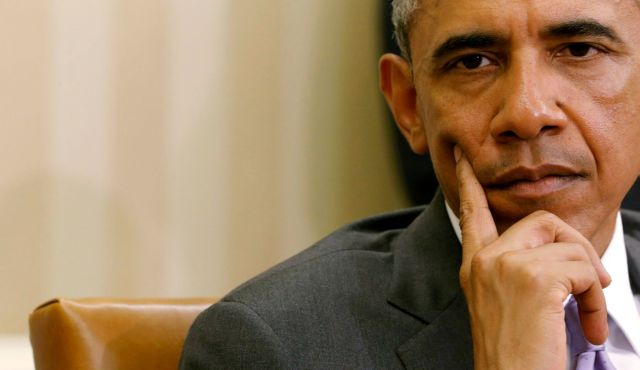
866182083President Barack Obama, July 7, 2015. What is he thinking with his Iranian strategy? Photo by Reuters

It’s hard to overstate the importance of cracking the code that has caused the administration to capitulate. It’s liable to put us, albeit not in the near-future, in a situation where all hope will be lost.

*********************

The inevitable revenge for Prime Minister Benjamin Netanyahu’s deluded flirtation with the Republicans and Congress has arrived. It’s crystal clear: Because of Netanyahu’s contrarian and irresponsible behavior, bridges with the U.S. administration were burned and Israel was ousted from the circle of influence on the pending nuclear deal with Iran. Netanyahu bears part of the responsibility for the bad deal that will be signed with Iran.

If any Israeli figures had a real impact on our inability to prevent a bad deal, however, it was Meir Dagan, Yuval Diskin and Gabi Ashkenazi – the principal opponents who leaked their objections to a military operation. They, along with the noisy chorus of America’s proxies in Israel, torpedoed the credibility of the brinkmanship strategy Netanyahu was leading. Iran, free of Israeli pressure, kept galloping toward the bomb.

True, Netanyahu’s mistakes – even in the area of Iran – are not few in number. However, anyone who assigns him responsibility, even indirect, for the heap of failings of the U.S. administration with regard to Iran discounts the American president and insults the memory and intelligence of the public.

The accusers, whatever their obligations to the United States, have exempted themselves from the need to think more deeply about the interests underlying America’s capitulation to Iranian chutzpah. For the sake of the future, it is dependent upon Israel to solve the big unknown: what motivates President Barack Obama to ease – in reality, cancel – sanctions before the Iranians prove, within a significant time frame, that they have left the path of nuclear arms, terror and fraud. Why is he providing the ayatollahs’ state with economic power – and therefore political and military power – to continue harming its allies in the region. And, finally, why doesn’t the agreement include an explicit demand for Iran to completely turn away from the path of terror?

Cracking America’s unclear, scarcely believable code of conduct is a major challenge. It is simply not logical that the American president, who bears responsibility for the fate of the world, should capitulate to the Iranians – unless he has a decisive reason – and cede effective supervision of nuclear sites.

The Iranians need American benevolence – not the other way around. So why are the Iranians able to bend the Americans, and not vice versa? In any event, the reason for their success does not lie, as many tend to think, in typical American naïveté – and certainly not in weakness or foolishness, as some say about Secretary of State John Kerry.

Israel’s point of departure needs to be – and this is the truth – that the U.S. president is acting in line with his nation’s interests, and that John Kerry is executing his policy. The latter’s behavior, as reflected in caricatures and articles criticizing him, is in accordance with the president’s directives, and not because he is a weak or shallow figure.

It’s hard to overstate the importance of cracking the code that has caused the administration to capitulate. It’s liable to put us, albeit not in the near-future, in a situation where all hope will be lost. Then, we will be forced to make it clear to the Americans: You, who pushed us into a corner, like in the words of the Book of Isaiah – “And I looked, and there was none to help; and I beheld in astonishment, and there was none to uphold” – bear responsibility. In a situation of no choice, we will act – and we will have to act – for as the verse continues, “And My fury, it upheld Me / And I trod down the peoples in Mine anger.”

Know Comment: Sham smiles all around

July 10, 2015

Know Comment: Sham smiles all around, Jerusalem PostDavid M. Weinberg, July 9, 2015

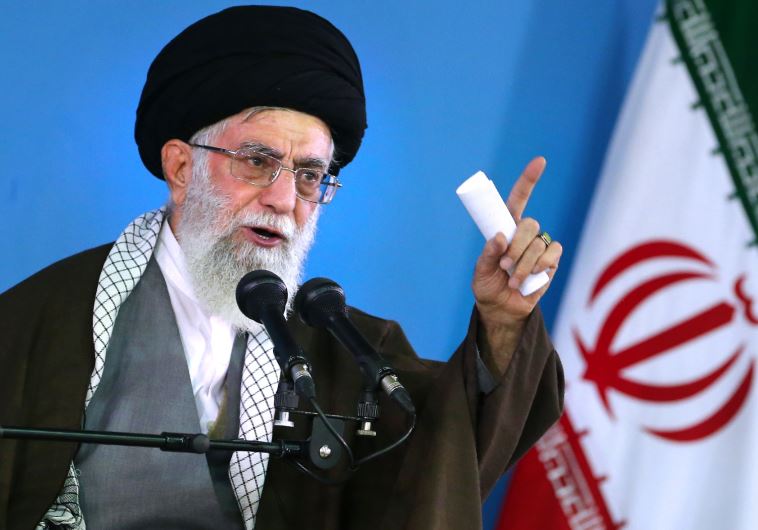
Supreme Leader 1Iran’s supreme leader, Ayatollah Ali Khamenei. (photo credit:AFP PHOTO)

Decoupling allows Obama to smile and sell sham narratives about Iran, even as Khamenei rebuffs and humiliates America. With a smile, of course.

*************************

With four deadlines come and gone, it’s probably safe to predict that there won’t be a grand package deal with Tehran this weekend, or at all. Instead, we’ll get a lot of smiles, and agreement to continue talking indefinitely, “for as long as the talks are useful,” without closure on Iran’s nuclear weapons drive.

Meanwhile, Ayatollah Khamenei’s centrifuges will continue to spin, Iran’s adventurism in the region will proceed unchecked, and President Obama won’t have to reveal to Congress the deep concessions he has already deposited in Iran’s pocket.

American analyst Michael Ledeen puts it bluntly: Khamenei doesn’t want to sign anything. He has two fixed principles: No “new relationship” with the Great Satan, and relentless pursuit of the atomic bomb. But since Obama won’t take an Iranian “no” for a definitive answer, the default American position will be a new form of “creative appeasement.”

Iran will promise to try really, really hard to be nice, and Obama will pay for this. Iran will continue to get its monthly sanctions relief payoff, while Obama will get Iranian smiles.

This will allow Obama to give another interview in which he blathers about meeting Iran’s “legitimate needs and concerns” and about his hopes that Iran will become “a very successful regional power.” After all, Obama will yet tell us, Iran “is one of the oldest and grandest civilizations in the world” – or something obsequious like that.

Who could have imagined, just a few years ago, that the president of the United States of America would wish the mullahs well in their quest for regional hegemony? What strategic thinker would have believed that the US would actively enter a de facto alliance with Shi’ite Iran (in Iraq, Syria and the Gulf) at the expense of America’s traditional Sunni allies and its ally in Israel? The metamorphosis of Iran, in pro-Obama elite opinion circles, from terrorist state into US partner is a long-brewing triumph for a certain set of pro-Iranian apologists and anti-Israel lobbyists in Washington.

Writing in The Wall Street Journal this week, Sohrab Ahmari showed how the National Iranian American Council advanced the argument that Iran deserves strategic respect, and placed its people in the Obama National Security Council.

Indeed, US think tanks played a prominent role in paving the way toward a climb-down from Obama’s declared policy of halting Iran’s nuclear drive.

Start with Thomas R. Pickering, the former under secretary of state for political affairs (and US ambassador to Russia, the UN and Israel), who showed up in Israel in 2012 as the head of “The Iran Project.” Peddling a “nuanced and sophisticated” view of Iran, he counseled an “engagement” strategy.

In a lecture at the Begin-Sadat Center for Strategic Studies, Pickering asserted that the US must end its confrontation with Iran over nuclear weapons. Sanctions, he said, were only “contributing to an increase in repression and corruption within Iran,” and were “sowing the seeds of longterm alienation between the Iranian people and the US.” What about the use of military force to crush the Iranian nuclear bomb program? Well, military force should be the very last resort taken by the US, Pickering told us, “and probably not at all.”

Next was the Center for a New American Security.

Its 2013 report, primarily authored by former Obama administration deputy assistant secretary of defense for the Middle East Colin H. Kahl, outlined “a comprehensive framework to manage and mitigate the consequences of a nuclear- armed Iran.” In other words, stopping the Iranian nuclear effort was already a passé discussion.

Then came the Atlantic Council, which called for Washington to “lessen the chances for war through reinvigorated diplomacy that offers Iran a realistic and face-saving way out of the nuclear standoff.” That’s diplomatic-speak for a containment strategy.

Then the Rand Corporation concluded that a nuclear-armed Iran would not pose a fundamental threat to the US and its regional allies. “An Iran with nuclear weapons will still be a declining power,” it said. “Iran does not have territorial ambitions and does not seek to invade, conquer, or occupy other nations.”

In his last article before dying in 2013, the leading realist theorist Ken Waltz of Columbia University even argued that Iran should get the bomb. It would create “a more durable balance of military power in the Middle East,” he wrote in the establishment journal Foreign Affairs.

The writing has been on the wall. Both Washington’s retreat from confrontation with Iran and its shift toward appeasement of Iran were there for those willing to see.

Obama has even invented a fancy term – “decoupling” – to obscure the magnitude of American collapse before Iran.

“Decoupling” means that the nuclear talks can take place in a virtual vacuum, without reference to Iranian behavior in any other field or arena – as if Iran were Iceland. There is just no coupling or link between Iran the nuclear power and Iran the aggressive adversary.

Decoupling means that Obama can be forgiven for failing to constrain Iranian terrorism. It means that Iran can get nuclear sanctions relief without having to scale back its hegemonic and subversive muckraking around the region.

The suave concept allows Obama to “decouple” the ayatollahs’ unpleasant anti-Semitic and genocidal rhetorical outbursts from Iran’s “responsible” (sic) understandings with the West on nuclear matters. It also allows Obama to ignore Iran’s human rights abuses.

Decoupling allows Obama to smile and sell sham narratives about Iran, even as Khamenei rebuffs and humiliates America. With a smile, of course.

The Iran Delusion: A Primer for the Perplexed

July 8, 2015

The Iran Delusion: A Primer for the Perplexed, World AffairsMichael J. Totten, Summer 2015

Totten_Iran

US foreign policy in the Middle East is focused on two things right now: containing ISIS and preventing Iran from acquiring nuclear weapons. These are both worthy goals, but if sanctions are lifted on Iran as part of a nuclear deal, whether or not it gets the bomb, Tehran will certainly have more money and resources to funnel to Hezbollah, the Assad regime, Iraq’s Shia militias, the Houthis in Yemen, and—perhaps—to Saudi Arabia’s disaffected Shia minority. The region will become even less stable than it already is. ISIS and al-Qaeda will likely grow stronger than they already are.

**************************

The chattering class has spent months bickering about whether or not the United States should sign on to a nuclear deal with Iran, and everyone from the French and the Israelis to the Saudis has weighed in with “no” votes. Hardly anyone aside from the Saudis, however, seems to recognize that the Iranian government’s ultimate goal is regional hegemony and that its nuclear weapons program is simply a means to that end.

What do these shatter zones have in common? The Iranian government backs militias and terrorist armies in all of them. As Kaplan writes, “The instability Iran will cause will not come from its implosion, but from a strong, internally coherent nation that explodes outward from a natural geographic platform to shatter the region around it.”

That’s why Iran is a problem for American foreign policy makers in the first place; and that’s why trading sanctions relief for an international weapons inspection regime will have no effect on any of it whatsoever.

Iran has been a regional power since the time of the Persian Empire, and its Islamic leaders have played an entirely pernicious role in the Middle East since they seized power from Mohammad Shah Reza Pahlavi in 1979, stormed the US Embassy in Tehran, and held 66 American diplomats hostage for 444 days.

In 1982, they went international. When the Israelis invaded Lebanon to dislodge Yasir Arafat’s Palestine Liberation Army, Iranian Revolutionary Guard Corps commanders forged a network of terrorist and guerrilla cells among their coreligionists in Lebanon’s Shia population.

Hezbollah, the poisoned fruit of these efforts, initially had no name. It was a hidden force that struck from the shadows. It left a hell of a mark, though, for an organization of anonymous nobodies when it blew up the American Embassy in Beirut and hit French and American peacekeeping troops—who were there at the invitation of the Lebanese government—with suicide truck bombers in 1983 that killed 368 people.

When Hezbollah’s leaders finally sent out a birth announcement in their 1985 Open Letter, they weren’t the least bit shy about telling the world who they worked for. “We are,” they wrote, “the Party of God (Hizb Allah), the vanguard of which was made victorious by God in Iran . . . We obey the orders of one leader, wise and just, that of our tutor and faqih [jurist] who fulfills all the necessary conditions: Ruhollah Musawi Khomeini. God save him!”

The Israelis fought a grinding counterinsurgency against Hezbollah for 18 years in southern Lebanon before withdrawing in 2000, and they fought a devastating war in 2006 along the border that killed thousands and produced more than a million refugees in both countries. Hezbollah was better armed and equipped than the Lebanese government even then, but today its missiles can reach Tel Aviv, Jerusalem, and even the Dimona nuclear power plant all the way down in the southern part of the country. 

Until September 11, 2001, no terrorist organization in the world had killed more Americans than Hezbollah. Hamas in Gaza isn’t even qualified as a batboy in the league Hezbollah plays in.

Hezbollah is more than just an anti-Western and anti-Jewish terrorist organization. It is also a ruthless sectarian Shia militia that imposes its will at gunpoint on Lebanon’s Sunnis, Christians, and Druze. It has toppled elected governments, invaded and occupied parts of Beirut, and, according to a United Nations indictment, assassinated former Lebanese Prime Minister Rafik Hariri.

Hezbollah is, for all intents and purposes, the foreign legion of Iran’s Revolutionary Guard Corps. The parts of the country it occupies—the northern Bekaa Valley, the Israeli border region, and the suburbs south of Beirut—constitute a de facto Iranian-controlled state-within-a-state inside Lebanon. 

After the United States demolished Saddam Hussein’s Sunni-dominated regime in 2003, Iran’s rulers duplicated their Lebanon strategy in Iraq by sponsoring a smorgasbord of sectarian Shia militias and death squads that waged war against the Iraqi government, the American military, Sunni civilians, and politically moderate Shias. 

Unlike Lebanon—which is more or less evenly divided between Christians, Sunnis, and Shias—Iraq has an outright Shia majority that feels a gravitational pull toward their fellow Shias in Iran and a revulsion for the Sunni minority that backed Hussein’s brutal totalitarianism and today tolerates the even more deranged occupation by the Islamic State, also known as ISIS. 

The central government, then, is firmly aligned with Tehran. Iran’s clients don’t run a Hezbollah-style state-within-a-state in Iraq. They don’t have to. Now that Hussein is out of the way, Iraq’s Shias can dominate Baghdad with the weight of sheer demographics alone. But Iran isn’t content with merely having strong diplomatic relations with its neighbor. It still sponsors sectarian Shia militias in the center and south of the country that outperform the American-trained national army. They may one day even supplant Iraq’s national army as the Iranian Revolutionary Guard Corps has more or less supplanted the Iranian national army. Iraq’s Shia militias are already the most powerful armed force outside the Kurdish autonomous region and ISIS-held territory.

When ISIS took complete control of the city of Ramadi, the capital of Anbar Province, in May of 2015, the Iraqi soldiers tasked with protecting it dropped their weapons and ran as they had earlier in Mosul, Tikrit, and Fallujah. So Iraq’s central government tasked its Iranian-backed Shia militias with taking it back. 

On the one hand, we can hardly fault Baghdad for sending in whatever competent fighting force is available when it needs to liberate a city from a psychopathic terrorist army, but the only reason ISIS gained a foothold among Iraq’s Sunnis in the first place is because the Baghdad government spent years acting like the sectarian dictatorship that it is, by treating the Sunni minority like second-class citizens, and by trumping up bogus charges against Sunni officials in the capital. When ISIS promised to protect Iraq’s Sunnis from the Iranian-backed Shia rulers in Baghdad, the narrative seemed almost plausible. So ISIS, after being vomited out of Anbar Province in 2007, was allowed to come back.

Most of Iraq’s Sunnis fear and loathe ISIS. They previously fought ISIS under its former name, al-Qaeda in Iraq. But they fear and loathe the central government and its Shiite militias even more. They’d rather be oppressed by “their own” than by “the other” if they had to choose. But they have to choose because Iran has made Iraq its second national project after Lebanon.

It doesn’t have to be this way. At least some of the tribal Sunni militias would gladly fight ISIS as they did in the past with American backing. If they did, residents of Ramadi, Fallujah, and Mosul would view them as liberators and protectors rather than potential oppressors, but Tehran and Baghdad will have none of it.

“All attempts to send arms and ammunition must be through the central government,” Adnan al-Assadi, a member of Parliament, told CNN back in May. “That is why we refused the American proposal to arm the tribes in Anbar. We want to make sure that the weapons would not end up in the wrong hands, especially ISIS.”

That may appear reasonable on the surface, but ISIS can seize weapons from Shia militias just as easily as it can seize weapons from Sunni militias. The real reason for the government’s reluctance ought to be obvious: Iraq’s Shias do not want to arm Iraq’s Sunnis. They’d rather have ISIS controlling huge swaths of the country than a genuinely popular Sunni movement with staying power that’s implacably hostile to the Iranian-backed project in Mesopotamia.

The catastrophe in Iraq is bad enough, but the Iranian handiwork in Syria is looking even more apocalyptic nowadays. ISIS wouldn’t even exist, of course, if it weren’t for the predatory regime of Bashar al-Assad, and the close alliance that has existed between Damascus and Tehran since the 1979 revolution that brought the ayatollahs to power.

Syria’s government is dominated by the Alawites, who make up just 15 percent of the population. Their religion is a heterodox blend of Christianity, Gnosticism, and Shia Islam. They aren’t Shias. They aren’t even Muslims. Their Arab Socialist Baath Party is and has always been as secular as the Communist Party was in the Soviet Union (and it was in fact a client of the Soviet Union). A marriage between an aggressively secular Alawite regime and Iran’s clerical Islamic Republic was hardly inevitable, but it’s certainly logical. The two nations had a common enemy wedged between them in Saddam Hussein’s Iraq, and both have been threatened by the region’s Sunni Arab majority since their inception. 

Hezbollah is their first child, and the three of them together make up the core of what analyst Lee Smith calls the Resistance Bloc in his book, The Strong Horse. The Party of God, as it calls itself, wouldn’t exist without Iranian money and weapons, nor would it exist without Damascus as the logistics hub that connects them. And it would have expired decades ago if Syria hadn’t conquered and effectively annexed Lebanon at the end of the Lebanese civil war in 1990.

Every armed faction in Lebanon, including Hezbollah, signed on to the Syrian-brokered Taif Agreement, which required the disarmament of every militia in the country. But the Assads governed Lebanon with the same crooked and cynical dishonesty they perfected at home, and as the occupying power they not only allowed Hezbollah to hold onto its arsenal, but also allowed Hezbollah to import rockets and even missiles from Iran.

“For Syria,” historian William Harris wrote in The New Face of Lebanon, “Hezbollah could persist as both a check on the Lebanese regime and as a means to bother Israel when convenient.”

The Party of God is now a powerful force unto itself, but it rightly views the potential downfall of the Assad regime as the beginning of its own end. The fact that Assad might be replaced by the anti-Shia genocidaires of ISIS compelled its fighters to invade Syria without an exit strategy—with the help of Iranian commanders, of course—to either prop up their co-patron or die.

Rather than going all-in, the Iranians could have cut their losses in Syria and pressured Assad into leaving the country. ISIS would be hiding under rocks right now had that happened. Hardly any Sunnis in Syria would tolerate such a deranged revolution if they had no one to revolt against. But the Resistance Bloc will only back down if it’s forced to back down. If ISIS devours Syria and Iraq as a result, then so be it.

And while the Resistance Bloc is fighting for its survival in the Levant, it’s expanding into the Arabian Peninsula.

The Shia-dominated Houthi movement took control of Yemen’s capital, Sanaa, earlier this year following the revolution that toppled former President Ali Abdullah Saleh, and its fighters are well on their way to taking the port city of Aden, in the Sunni part of the country.

The Houthis, of course, are backed by Iran.

They’re no more likely to conquer every inch of that country than Iran’s other regional proxies are to conquer every inch of anywhere else. Shias make up slightly less than half of Yemen’s population, and their natural “territory” is restricted to the northwestern region in and around the capital. Taking and holding it all is likely impossible. No government—Sunni, Shia, or otherwise—has managed to control all of Yemen for long. 

And the Saudis are doing their damnedest to make sure it stays that way. Their fighter jets have been pounding Houthi positions throughout the country since March.

Saudi Arabia is more alarmed at Iranian expansion in the region than anyone else, and for good reason. It’s the only Arab country with a substantial Shia minority that hasn’t yet been hit by Iranian-backed revolution, upheaval, or sectarian strife, although events in Yemen could quickly change that.

In the city and province of Najran, in the southwestern corner just over the Yemeni border, Shias are the largest religious group, and they’re linked by sect, tribe, and custom to the Houthis.

Not only is the border there porous and poorly defined, but that part of Saudi Arabia once belonged to Yemen. The Saudis conquered and annexed it in 1934. Najran is almost identical architecturally to the Yemeni capital, and you can walk from Najran to Yemen is a little over an hour. 

Will the Houthis be content to let Najran remain in Saudi hands now that they have Iranian guns, money, power, and wind at their back? Maybe. But the Saudis won’t bet their sovereignty on a maybe.

Roughly 15 percent of Saudi Arabia’s citizens are Shias. They’re not a large minority, but Syria’s Alawites are no larger and they’ve been ruling the entire country since 1971. And Shias make up the absolute majority in the Eastern Province, the country’s largest, where most of the oil is concentrated. 

Support among Yemen’s Sunnis for al-Qaeda in the Arabian Peninsula—the most dangerous branch of al-Qaeda on earth—is rising for purely sectarian reasons just as it has in Syria and Iraq. Iran can’t intervene anywhere in the region right now without provoking a psychotic backlash that’s as dangerous to Tehran and its interests as it is to America’s.

If Iranian adventurism spreads to Saudi Arabia, watch out. Everywhere in the entire Middle East where Sunnis and Shias live adjacent to one another will have turned into a shatter zone.

The entire world’s oil patch will have turned into a shatter zone.

US foreign policy in the Middle East is focused on two things right now: containing ISIS and preventing Iran from acquiring nuclear weapons. These are both worthy goals, but if sanctions are lifted on Iran as part of a nuclear deal, whether or not it gets the bomb, Tehran will certainly have more money and resources to funnel to Hezbollah, the Assad regime, Iraq’s Shia militias, the Houthis in Yemen, and—perhaps—to Saudi Arabia’s disaffected Shia minority. The region will become even less stable than it already is. ISIS and al-Qaeda will likely grow stronger than they already are.

We’re kidding ourselves if we think that won’t affect us. It’s not just about the oil, although until every car in the world is powered by green energy we can’t pretend the global economy won’t crash if gasoline becomes scarce. We also have security concerns in the region. What happens in the Middle East hasn’t stayed in the Middle East now for decades. 

The head-choppers of ISIS are problematic for obvious reasons. Their leader, Abu Bakr al-Baghdadi, said, “I’ll see you in New York,” to American military personnel when they (foolishly) released him from Iraq’s Camp Bucca prison in 2004. But the Iranian-led Resistance Bloc has behaved just as atrociously since 1979 and will continue to do so with or without nuclear weapons.

US involvement in Syria and Iraq is minimal now, but even the little we are doing makes little sense. We’re against ISIS in both countries, which is entirely fine and appropriate, but in Iraq we’re using air power to cover advances by Shia militias and therefore furthering Iranian interests, and in Syria we’re working against Iranian interests by undermining Assad and Hezbollah. Meanwhile, the nuclear deal Washington is negotiating with Tehran places a grand total of zero requirements on Iran’s rulers to roll back in their necklace of shatter zones.

We don’t have to choose between ISIS and Iran’s revolutionary regime. They’re both murderous Islamist powers with global ambitions, and they’re both implacably hostile to us and our interests. Resisting both simultaneously wouldn’t make our foreign policy even a whit more complicated. It would, however, make our foreign policy much more coherent.
The U.S. response to Iran’s cheating is a worrying omen

July 8, 2015

The U.S. response to Iran’s cheating is a worrying omen, The Washington Post, The Editorial Board, July 6, 2015

(The Washington Post, usually supportive of the Obama administration, speaks moderately in this Editorial Board offering. However, it manages to point out a few of the major problems with an Obama-led P5+1 “deal.” Please see also, White House Instructs Allies To Lean On ‘Jewish Community’ to Force Iran Deal. — DM)

Mr. Albright, a physicist with a long record of providing non-partisan expert analysis of nuclear proliferation issues, said on the Foreign Policy Web site that he had been unfairly labeled as an adversary of the Iran deal and that campaign-style “war room” tactics are being used by the White House to fend off legitimate questions.

*******************

IF IT is reached in the coming days, a nuclear deal with Iran will be, at best, an unsatisfying and risky compromise. Iran’s emergence as a threshold nuclear power, with the ability to produce a weapon quickly, will not be prevented; it will be postponed, by 10 to 15 years. In exchange, Tehran will reap hundreds of billions of dollars in sanctions relief it can use to revive its economy and fund the wars it is waging around the Middle East.

Whether this flawed deal is sustainable will depend on a complex set of verification arrangements and provisions for restoring sanctions in the event of cheating. The schemes may or may not work; the history of the comparable nuclear accord with North Korea in the 1990s is not encouraging. The United States and its allies will have to be aggressive in countering the inevitable Iranian attempts to test the accord and willing to insist on consequences even if it means straining relations with friendly governments or imposing costs on Western companies.

That’s why a recent controversy over Iran’s compliance with the interim accord now governing its nuclear work is troubling. The deal allowed Iran to continue enriching uranium, but required that amounts over a specified ceiling be converted into an oxide powder that cannot easily be further enriched. According to the International Atomic Energy Agency, Iran met the requirement for the total size of its stockpile on June 30, but it did so by converting some of its enriched uranium into a different oxide form, apparently because of problems with a plant set up to carry out the powder conversion.

Rather than publicly report this departure from the accord, the Obama administration chose to quietly accept it. When a respected independent think tank, the Institute for Science and International Security, began pointing out the problem, the administration’s response was to rush to Iran’s defense — and heatedly attack the institute as well as a report in the New York Times.

This points to two dangers in the implementation of any longterm deal. One is “a U.S. willingness to legally reinterpret the deal when Iran cannot do what it said it would do, in order to justify that non-performance,” institute President David Albright and his colleague Andrea Stricker wrote. In other words, overlooking Iranian cheating is easier than confronting it.

This weakness is matched by a White House proclivity to respond to questions about Iran’s performance by attacking those who raise them. Mr. Albright, a physicist with a long record of providing non-partisan expert analysis of nuclear proliferation issues, said on the Foreign Policy Web site that he had been unfairly labeled as an adversary of the Iran deal and that campaign-style “war room” tactics are being used by the White House to fend off legitimate questions.

In the case of the oxide conversion, the discrepancy may be less important than the administration’s warped reaction. A final accord will require Iran to ship most of its uranium stockpile out of the country, or reverse its enrichment. But there surely will be other instances of Iranian non-compliance. If the deal is to serve U.S. interests, the Obama administration and its successors will have to respond to them more firmly and less defensively.

Here’s the most critical part of Iran’s nuclear program that nobody is talking about

July 7, 2015

Here’s the most critical part of Iran’s nuclear program that nobody is talking about, Business Insider, Michael Eisenstadt, The Washington Institute For Near East Policy, July 7, 2015

(Please see also, Iran’s Rafsanjani Reiterates ‘Israel Will Be Wiped Off The Map.’  — DM)

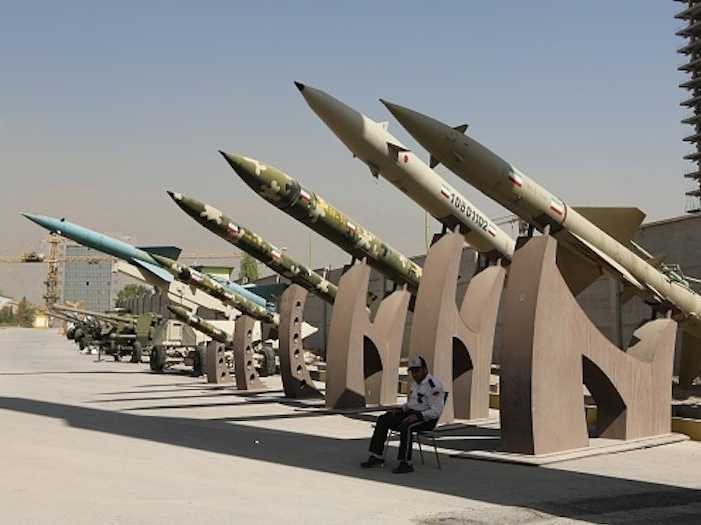
iran-missiles-exhibition-commemorationAtta Kenare/AFP/Getty Images. Missiles are displayed during ‘Sacred Defense Week,’ to commemorate the 1980-88 Iran-Iraq war. Photo taken on Sept. 28, 2014 at a park in northern Tehran.

Early in the P5+1 negotiations, US officials stated that “every issue,” including the missile program, would be on the table. In February 2014, however, Undersecretary of State for Political Affairs Wendy Sherman stated, “If we are successful in assuring ourselves and the world community that Iran cannot obtain a nuclear weapon,” then that “makes delivery systems … almost irrelevant.”

****************

According to the latest reports stemming from the P5+1 talks, Iran is now insisting that UN sanctions on its ballistic missile program be lifted as part of a long-term nuclear accord.

In addition to further complicating already fraught negotiations, this development highlights the importance Tehran attaches to its missile arsenal, as well as the need to answer unresolved questions about possible links between its missile and nuclear programs.

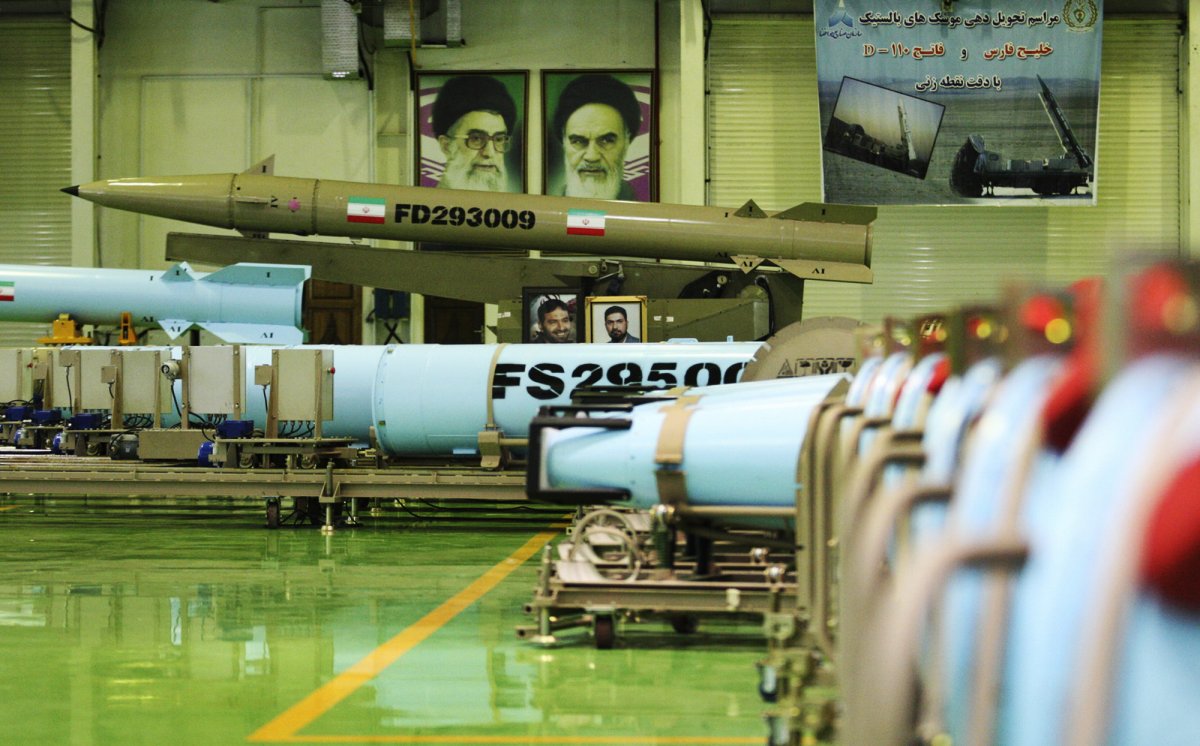
Iran is believed to have the largest strategic missile force in the Middle East, producing short- and medium-range ballistic missiles, a long-range cruise missile, and long-range rockets. Although all of its missiles are conventionally armed at present, its medium-range ballistic missiles could deliver a nuclear weapon if Iran were to build such a device.

Early in the P5+1 negotiations, US officials stated that “every issue,” including the missile program, would be on the table. In February 2014, however, Undersecretary of State for Political Affairs Wendy Sherman stated, “If we are successful in assuring ourselves and the world community that Iran cannot obtain a nuclear weapon,” then that “makes delivery systems … almost irrelevant.”

Yet many observers remain concerned that personnel and facilities tied to Iran’s missile program were, and may still be, engaged in work related to possible military dimensions (PMD) of the nuclear program. These concerns underscore the need to effectively address the missile issue as part of the UN Security Council resolution that will backstop the long-term nuclear accord now being negotiated, if it will not be dealt with in the accord itself.

screen shot 2015-06-11 at 8.47.42 am copyEstimated Range of Iranian Long-Range Missile Forces

Deterrence, warfighting, and propaganda

The Iran-Iraq War convinced Tehran that a strong missile force is critical to the country’s security, and it has given the highest priority to procuring and developing various types of missiles and rockets. Missiles played an important role throughout that war and a decisive role in its denouement.

During the February-April 1988 “War of the Cities,” Iraq was able to hit Tehran with extended-range missiles for the first time. Iranian morale was devastated: more than a quarter of Tehran’s population fled the city, contributing to the leadership’s decision to end the war.

Since then, missiles have been central to Iran’s “way of war,” which emphasizes the need to avoid or deter conventional conflict while advancing its anti-status quo agenda via proxy operations and propaganda activities.

Iran’s deterrence triad rests on its ability to (1) threaten navigation through the Strait of Hormuz, (2) undertake terrorist attacks on multiple continents, and (3) conduct long-range strikes, primarily by missiles (or with rockets owned by proxies such as Hezbollah).

rtr2vqx9REUTERS/Fars News/Hamed Jafarnejad. Iranian military personnel participate in the Velayat-90 war game in unknown location near the Strait of Hormuz in southern Iran December 30, 2011.

Yet the first two options carry limitations.

Closing the strait would be a last resort because nearly all of Iran’s oil exports go through it and Tehran’s ability to wage terror has atrophied in recent years (as demonstrated by a series of bungled attacks on Israeli targets in February 2012). Therefore, Iran’s missile force is the backbone of its strategic deterrent.

Missiles enable Iran to mass fires against civilian population centers and undermine enemy morale. If their accuracy increases in the future, they could further stress enemy defenses (as every incoming missile would have to be intercepted) and enable Iran to target military facilities and critical infrastructure.

Although terrorist attacks afford a degree of standoff and deniability, missiles permit a quicker, more flexible response in a rapidly moving crisis — for example, after an initial series of preplanned terrorist attacks, Tehran or its proxies might need weeks to organize follow-on operations. Missile salvos can also generate greater cumulative effects in a shorter period than terrorist attacks.

Indeed, missiles are ideally suited to Iran’s “resistance doctrine,” which states that achieving victory entails demoralizing one’s enemies by bleeding their civilian population and denying them success on the battlefield. In this context, rockets are as important as missiles, since they yield the same psychological effect on the targeted population.

The manner in which Hezbollah and Hamas used rockets in their recent wars with Israel provides a useful template for understanding the role of conventionally armed missiles in Iran’s warfighting doctrine.

flickr_-_israel_defense_forces_-_damage_caused_by_rockets_fired_from_gaza_(10)Israel Defense Forces via Wikimedia Commons. An apartment building in the town of Kiryat Malachi, damaged as a result of rockets fired from Hamas.

Missiles are also Iran’s most potent psychological weapon. They are a central fixture of just about every regime military parade, frequently dressed with banners calling for “death to America” and declaring that “Israel should be wiped off the map.”

They are used as symbols of Iran’s growing military power and reach. And as the delivery system of choice for nuclear weapons states, they are a key element of Iran’s nascent doctrine of nuclear ambiguity and its attempts at “nuclear intimidation without the bomb.”

Finally, while most nuclear weapons states created their missile forces years after joining the “nuclear club” (due to the significant R&D challenges involved), Iran will already have a sophisticated missile force and infrastructure in place if or when it opts to go that route.

This ensures that a nuclear breakout would produce a dramatic and rapid transformation in Iran’s military stature and capabilities.

Iran’s missle force

Iran has a large, capable missile force, with a likely inventory of more than 800 short- and medium-range ballistic missiles.

These include single-stage liquid-fuel missiles such as the Shahab-1 (300 km range), Shahab-2 (500 km), Qiam (500-750 km), Shahab-3 (1,000-1,300 km), and Qadr (1,500-2,000 km).

Nearly all of them can reach US military targets in the Persian Gulf, and the latter two can reach Israel. These missiles, which include several subvariants, are believed to be conventionally armed with unitary high-explosive or submunition (cluster) warheads.

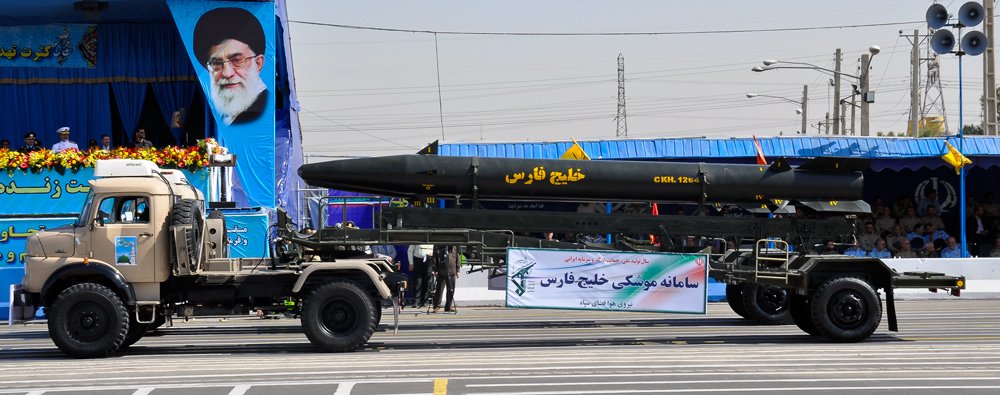
persian-gulf-missileKhalij Fars missile on a transporter.

Additionally, Iran has tested a two-stage solid-fuel missile, the Sejjil-2, whose range of over 2,000 km would allow it to target southeastern Europe — though it is apparently still not operational. In a June 28, 2011, press statement, Tehran claimed that it was capping the range of its missiles at 2,000 km (sufficient to reach Israel but not Western Europe), implicitly eschewing the development of intercontinental ballistic missiles in a presumed bid to deflect US and European concerns.

Yet its Safir launch vehicle, which has put four satellites into orbit since 2009, could provide the experience and knowhow needed to build an ICBM. (According to a May 2010 report by the International Institute for Strategic Studies, the Safir struggled to put a very small satellite into low-earth orbit and has probably reached the outer limits of its performance envelope, so it could not serve as an ICBM itself.) In 2010, Iran displayed a mockup of a larger two-stage satellite launch vehicle, the Simorgh, which it has not yet flown.

Tehran has also claimed an antiship ballistic missile capability that it probably intends for potential use against U.S. aircraft carriers: the Khalij-e Fars and its derivatives, the Hormuz-1/2, each with a claimed range of 300 km. Yet it is not clear that these systems are sufficiently accurate or effective to pose a credible threat to U.S. surface elements in the Gulf.

In addition, Iran recently unveiled the Soumar land-attack cruise missile, which is reportedly a reverse-engineered version of the Russian Raduga Kh-55. It has a claimed range of 2,500-3,000 km, though it may not be operational yet.

The Kh-55 was the Soviet air force’s primary nuclear delivery system.

Iran also fields a very large number of rockets, including the Noor 122 mm (with a range of 20 km), the Fajr-3 and -5 (45 and 75 km), and the Zelzal-1, -2, and -3 (with claimed ranges of 125 to 400 km). During the Iran-Iraq War, rockets played a major role in bombarding Iraqi cities along the border, and they are central to the “way of war” of Iranian proxies and allies such as Hezbollah and Hamas.

Tehran has built this massive inventory so that it can saturate and thereby overwhelm enemy missile defenses in any conflict. It would likely use such tactics whether its missile force remains conventional or becomes nuclear-armed, since conventional missiles could serve as decoys that enable nuclear missiles to penetrate defenses. Numbers would also enable Iran to achieve cumulative strategic effects on enemy morale and staying power by conventional means.

missilesiranAP Photo/Iranian Defense Ministry. To outwork missile defense systems, Iran would use a high volume of missiles.

Finally, many of Iran’s missiles are mounted on mobile launchers, and a growing number are based in silo fields located mainly in the northwest and toward the frontier with Iraq.

This mix of launch options is likely intended to impede preemptive enemy targeting of its missile force. The resources invested in this effort are unprecedented for a conventionally armed force, which indicates that at least some of these missiles would likely be nuclear armed if Iran eventually goes that route.

Nuclear connections

In the annex of a November 8, 2011, report regarding the nuclear program’s possible military dimensions, the International Atomic Energy Agency said it possessed credible information and documents connecting Iran’s missile and nuclear programs. These indicated that, prior to the end of 2003, Iran had:

  • conducted engineering studies on integrating a spherical payload (possibly a nuclear implosion device) into a Shahab-3 reentry vehicle (RV);
  • tested a multipoint initiation system to set off a hemisphere-shaped high-explosive charge whose dimensions were consistent with the Shahab-3’s payload chamber; and
  • worked on a prototype firing system that would enable detonation upon impact or in an airburst 600 meters above a target (a suitable height for a nuclear device).

Moreover, in 2004, Iran began deploying triconic (or “stepped”) RVs — a design almost exclusively associated with nuclear missiles — on its Shahab variants.

Some experts (including Uzi Rubin and Michael Elleman) believe that Iran may have deployed the triconic RV to enhance the stability and thus the accuracy of its conventional warheads, and perhaps to achieve higher terminal velocities that could reduce reaction time for missile defenses.

But if Iran were able to build a miniaturized nuclear device, its experience in designing, testing, and operating missiles with triconic RVs could expedite deployment of this weapon. Indeed, David Albright claimed in his 2010 book Peddling Peril that members of the A. Q. Khan nuclear smuggling network possessed plans for smaller, more advanced nuclear weapon designs that might have found their way to Iran, though most experts doubt the regime’s ability to build such a compact device at this time.

russianukeDesmond Boylan/Reuter

Could Iran have smuggled in a nuclear bomb?

These reports underscore why Washington and its partners must insist that Tehran respond to the IAEA’s questions about past engineering studies, design work, tests, and other elements of the PMD file prior to the lifting of sanctions.

They also highlight the need for a UN Security Council resolution (as called for in the Lausanne parameters) that would impose limitations on Iran’s missile R&D work and threaten real consequences for those who assist Iran’s missile program.

Failure to do so would signal tacit acceptance of activities that could enable Iran to deploy its first nuclear weapon atop a medium-range missile — an achievement that took most nuclear weapons states, including the United States and Soviet Union, about a decade to accomplish.

This development would in turn magnify the destabilizing impact of an Iranian breakout, while incentivizing other regional states to either take preventive action or move toward nuclear capabilities of their own before Iran crosses that threshold.

ISIS’ Sinai Attacks Show Real Threat to Hamas

July 3, 2015

ISIS’ Sinai Attacks Show Real Threat to Hamas, The Clarion ProjectRyan Mauro, July 3, 2015

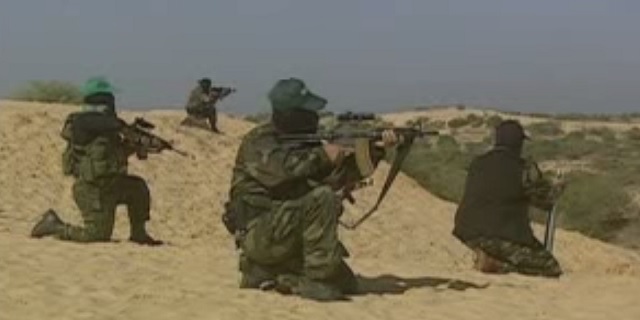
Hamas-640Hamas fighters (Photo: Video screenshot)

Should a full-blown war between Hamas and ISIS break out that makes Gaza look like Syria, the West mustn’t embrace Hamas as the better alternative. The minute differences between them should not be exaggerated out of a desire for a side to pick. They are the two manifestations of the same enemy.

*********************

The attacks on Egypt in the Sinai Peninsula by the Islamic State (ISIS) this week shows why its new vow to topple Hamas in the Gaza Strip should be taken seriously. Polls show that Palestinians have the highest level of sympathy for ISIS in the Arab world with the possible exception of Syria.

ISIS has killed at least 17 Egyptian security personnel (13 soldiers and 4 police officers) and injured 30 in coordinated attacks that reflect increasing sophistication.  The Egyptian military said 70 Islamist terrorists participated and five checkpoints were assaulted. ISIS claims it struck 15 sites all at once.

The Egyptian government immediately accused the Muslim Brotherhood of involvement as it has in the past. Egypt also claims Hamas, the Brotherhood’s Palestinian wing, is secretly supporting ISIS operations in the Sinai Peninsula. It has even threatened to attack Hamas in Gaza in response.

The Egyptian claims are questionable because of the open animosity between the two groups and ISIS’ new video pledging to conquer the Gaza Strip, but the Israeli military confirmed the links after Wednesday’s attacks. It identified two senior Hamas officials who advise ISIS and covertly arrange for hospital visits in Gaza for its injured operatives.

The Brotherhood denies involvement and its website has a statement urging Egyptians to reject violence, but the group’s double-talk is well-documented. It is simply false that the Brotherhood is completely non-violent and Brotherhood media outlets explicitly call for violence like that perpetrated by ISIS this week.

However, there does appear to be a division within the Brotherhood. Youth leaders and elements outside the country are advocating violent jihad, while the older generation repeatedly reaffirms the group’s non-violent stance in Egypt. It’s possible this is all a calculated deception. It’s also possible the rift is real and a faction would be willing to support ISIS against a common enemy.

One Brotherhood official, Mohamed Gaber, said it “seeks to use all expertise inside and outside the Brotherhood to achieve its goals at this stage,” referring to toppling the Egyptian government.

The Egyptian government’s crackdown on the Brotherhood makes it tempting for Hamas to support ISIS operations in the Sinai. Hamas may prefer a situation where its southern border is a battlefield between ISIS and Egyptian forces instead of a base for either. Plus, the Brotherhood uses every death as proof that Egypt’s crackdown is counter-productive and should end.

There are three possibilities: Claims of Hamas/Brotherhood links to ISIS in Sinai are simply wrong; the two groups simultaneously collaborate and fight with each other depending on circumstances; or there are elements within Hamas/Brotherhood that work independently with ISIS against the wishes of the leadership.

Whatever the truth is, the attacks in the Sinai show the threat to Hamas should be taken seriously.

A November 2014 poll found that the Palestinians are the most sympathetic population to ISIS in the Arab world. Only 4% view ISIS positively but if you include those who view it somewhat positively, it grows to nearly one-quarter of the population. However, another poll found that only 3% of Palestinians view ISIS’ gains positively and 88% view it negatively.

ISIS could capitalize on widespread dissatisfaction with Hamas and the situation in Gaza. ISIS’ message that Gaza is in bad shape because Hamas is not sufficiently implementing Sharia could resonate with Islamists who are struggling to understand why Hamas’ rule has not been blessed by Allah. The video also slams Hamas for being too soft on Israel.

A poll released last month shows that 50% of the population in Gaza—and an astounding 80% of the youth—want to leave. About 63% favor continuing rocket attacks on Israel. Another poll found that almost 25% would not vote if elections were held today.

Should a full-blown war between Hamas and ISIS break out that makes Gaza look like Syria, the West mustn’t embrace Hamas as the better alternative. The minute differences between them should not be exaggerated out of a desire for a side to pick. They are the two manifestations of the same enemy.

Israeli policymakers’ alarming over-reliance on Egypt to grapple with Hamas and ISIS

July 3, 2015

Israeli policymakers’ alarming over-reliance on Egypt to grapple with Hamas and ISIS, DEBKAfile, July 3, 2015

Sinai_fight_1.7.15Egyptian troops battle ISIS in Sinai

The statements coming from different Israeli spokesmen this week were not just at dangerous variance with the actual events but with one another, when it came to Egypt’s massive confrontation this week with ISIS close to Israel’s border, a fresh round of Palestinian West Bank anti-Israel terror and the ambivalent role played by Hamas extremists in all these events.

Coordinator of Government Activities in the Territories, Maj. Gen. Yoav Mordechai said in an Al Jazeera interview Thursday, July 2, that Israel had “clear evidence” of Hamas aiding the offensive the Islamic State’s Sinai affiliate launched against Egyptian positions in northern Sinai Wednesday.

The Israeli commander accused Hamas of giving “weapons and logistical support to the ISIS affiliate.”  He added “we have examples of Hamas commanders who actively participated in this assistance,” and named “Wael Faraj, a brigade commander of the military wing of Hamas…who smuggled wounded [ISIS fighters] from Sinai into Gaza,” and “Abdullah Kitshi …who trained operatives belonging to Wilayat Sinai.”

Asked about Israeli-Egyptian cooperation, Mordechai commented: “Egypt is a strong and independent country.”

The Defense Ministry’s strategic adviser Amos Gilead was more specific: He said Egypt was “a strong country of 90 million people with an army of half a million.” Gilead was sure that the Egyptians would do everything necessary for a determined war on ISIS.

Thursday, July 2, the day after the ISIS raid, the Egyptian military said it had killed 123 Islamic State gunmen in two days, 100 of which were killed on Wednesday. Egyptian bombers were then described as wiping out ISIS concentrations around the northern Sinai town of Sheikh Zuwaid. “The situation in northern Sinai is now under complete control,” said the Egyptian spokesman

All three officials were doing their best to put a good face on the Egyptian army’s reverses in its largest battle yet with ISIS, say DEBKAfile’s military sources. No one was ready to admit that the Islamic State’s Sinai branch had won this confrontation on points.

For two years, the Egyptian army has only chipped away at the edges of the threatening Islamist presence growing larger in the Sinai Peninsula, even through Israel suspended the restrictions of the 1979 peace accord and allowed Egypt to bring large military forces, tanks, artillery and helicopters into Sinai for a major campaign to expunge that presence. This has not happened although both the Egyptians and the IDF know the exact whereabouts of the Islamist terrorists’ bases.

Even while playing down the unwelcome outcome of the Wednesday battle, the IDF took the precaution of closing to traffic the main Israeli highway running parallel to the Egyptian border from Nitzana to the southern port of Eilat. The army in the south was also placed on high alert in case ISIS raiders crossed the border from Egyptian Sinai.

Then, on Friday afternoon, parts of southern Israel heard a red alert for rockets which the IDF estimated had come from Sinai, i.e. ISIS, rather than the Gaza Strip.

Israeli officials are at their most mixed up when they discuss Hamas – even after crediting that extremist Palestinian group with conducting a fresh surge of terrorist attacks on the West Bank and Jerusalem. In the past week, they murdered three Israelis – David Capra, Danny Gonen and Malachi Moshe Rosenfeld.

Yet, according to the mantra the IDF has taught accredited military correspondents, all Hamas wants is a long-term ceasefire so as to live in peace. They also trot out the official claims that the deadly attacks were the work of “lone wolves,” just as the persistent trickle of rocket fire from the Gaza Strip comes from “rogue” elements.

Israeli officials appear to have lost their way amid vain attempts to let Hamas off the terrorist hook.

Hamas’ own willingness to jump into bed with Egypt, Hizballah, Iran and ISIS – all at once – undoubtedly creates a confused picture about its shifting motives. However, Israeli policymakers must beware of falling into the dangerous trap of ambivalence and loss of focus.

President El-Sisi must realize by now that his army has missed the boat for a resounding one-strike victory against ISIS, because that enemy is no longer alone. Its association with Hamas is further bolstered by a secret pact with the Egyptian Muslim Brotherhood, the deadly foe of the El-Sisi administration.

Hamas, as the Brotherhood’s ideological offspring, in fact hosted Mahmud Izzat Ibrahim, head of the Brotherhood;s clandestine operational networks, which run from Libya through to Sinai.

This tripartite ISIS-Muslim Brotherhood-Hamas axis is currently in full momentum. Egypt is therefore in for a drawn-out bloody war.

Israeli policymakers would be foolish to depend on Cairo pull this red-hot iron out of the terrorist fire any time soon. They must find ways – the sooner the better – to grapple with the reality of a rampant Islamic State next door. ISIS is already in the process of overrunning the Gaza Strip; it is on the way to seizing expanding sections of the Sinai Peninsula. That territory will serve as a convenient base for Islamist raids against Israel.

If ISIS leaps further to hijack the coastal areas of Sinai, it may be necessary to fight a major war to preserve  the freedom of navigation in the Suez Canal and Israel’s southern exit through the Gulf of Aqaba.

Deadlines, red lines

July 3, 2015

Deadlines, red lines, Israel Hayom, Ruthie Blum, July 3, 2015

(Please see also, Iran’s Nuclear Negotiators Emboldened by Islamic Ideology: Cleric at (Iranian) Tashim News Agency. — DM)

The regime in Tehran has made its position clear. So has the White House. It will take a miracle — or a military strike — to prevent Iran from building nuclear bombs.

**********************

The deadline for a nuclear deal between the P5+1 powers and Iran was extended on Tuesday, when too many bones of contention remained unresolved on June 30. The new date set by the parties to finalize the “framework for an agreement” reached in Lausanne three months ago is July 7.

This means that there are four days to go before the current talks in Vienna bear fruit in the form of an official document. If such a piece of paper is signed, two leaders will feel particularly vindicated: U.S. President Barack Obama and Iranian President Hassan Rouhani — the former for playing out his fantasy of peace through diplomacy and the latter for delivering the goods to his boss, Ayatollah Ali Khamenei.

The rest of the world, however, will be in mortal peril. And Israel will be forced to act fast.

The only sliver of a silver lining in this otherwise black cloud is that Islamists sometimes play their cards wrong. Buoyed by the weakness of the West in the face of their fanaticism, they often take their visions of grandeur to heights that even American and European appeasers cannot accept. So by next week, it is possible that the Iranian negotiators will overstep their counterparts’ bounds, and everyone will return to the country from whence they came with nothing but another date and venue to show for their efforts.

But because the stakes are nuclear weapons in the hands of a mullah-led regime bent on global hegemony — and working toward it through proxy terrorist organizations — one cannot count on the above scenario.

A number of recent statements are cause for concern.

On Thursday, Iranian Foreign Minister Mohammad Javad Zarif told reporters: “The negotiations are moving forward and we should be hopeful. Today is a good day.”

This was an abbreviated version of what his deputy, Abbas Araqchi, said the day before in a TV interview: “A positive atmosphere is ruling the negotiations, and the spirit for going forward exists in all delegations, but this doesn’t mean that all delegations, including us, are ready to reach an agreement at any price.”

Araqchi also defined a “good deal” as one that would honor Khamenei’s “red lines.”

These were spelled out in a June 23 speech by Khamenei (and included in a June 30 Middle East Media Research Institute report): “In contrast to what the Americans are insisting on, we do not accept long-term restrictions for 10 to 12 years.

“Research, development and construction will continue. … They say, ‘Don’t do anything for 12 years,’ but these are particularly violent words, and a gross mistake.

“The economic, financial and banking sanctions — whether related to the Security Council or the American Congress and administration — must be lifted immediately with the signing of the agreement. The remainder of the sanctions will also be lifted within a reasonable time frame. The Americans are presenting a complex, convoluted, bizarre, and stupefying formula for [removing the] sanctions, and it is unclear what will emerge from it, but we are clearly stating our demands.

“The lifting of the sanctions must not depend on Iran carrying out its obligations. Don’t say, ‘You carry out your obligations and then the IAEA will approve the lifting of the sanctions.’ We vehemently reject this. The lifting of the sanctions must take place simultaneously with Iran’s meeting of its obligations. We oppose the delay of the implementation of the opposite side’s obligations until the [release of] the IAEA report [verifying that Iran has met its obligations], because the IAEA has proven repeatedly that it is neither independent nor fair, and therefore we are pessimistic regarding it.

“They say, ‘The IAEA should receive guarantees.’ What an unreasonable statement. They will be secure only if they inspect every inch of Iran. We vehemently reject special inspections [that are not customary for any country except Iran], questioning of Iranian personnel, and inspection of military facilities.

“Everyone in Iran — including myself, the government, the Majlis [parliament], the judiciary, the security apparatuses, and the military, and all institutions — want a good nuclear agreement … that is in accordance with Iran’s interests.

“Although we wish the sanctions lifted, we see them as [having brought us] a particular kind of opportunity, because they made us pay more attention to domestic forces and domestic potential.”

A few days later, on June 29, Obama’s deputy national security adviser, Ben Rhodes, gave an interview to The Atlantic’s Jeffrey Goldberg at the Aspen Ideas Festival.

When asked whether Obama believes a deal will exact change in Iran’s behavior, Rhodes replied: “We believe that an agreement is necessary … even if Iran doesn’t change. … That said, we believe that a world in which there is a deal with Iran is much more likely to produce an evolution in Iranian behavior than a world in which there is no deal. In fact … if the notion is that Iran has been engaged in these destabilizing activities under the last several years when they’ve been under the pressure of sanctions, clearly sanctions are not acting as some deterrent against them doing destabilizing activities in the region. … [T]he point is … in a world of a deal, there is a greater possibility that you will see Iran evolve in a direction in which they are more engaged with the international community and less dependent upon the types of activities that they’ve been engaged in.”

The regime in Tehran has made its position clear. So has the White House. It will take a miracle — or a military strike — to prevent Iran from building nuclear bombs.