Posted tagged ‘Iranian proxies’

‘Terrible’ Iran deal makes Israeli strike inevitable

July 15, 2015

‘Terrible’ Iran deal makes Israeli strike inevitable, BreitbartJoel B. Pollak, July 14, 2015

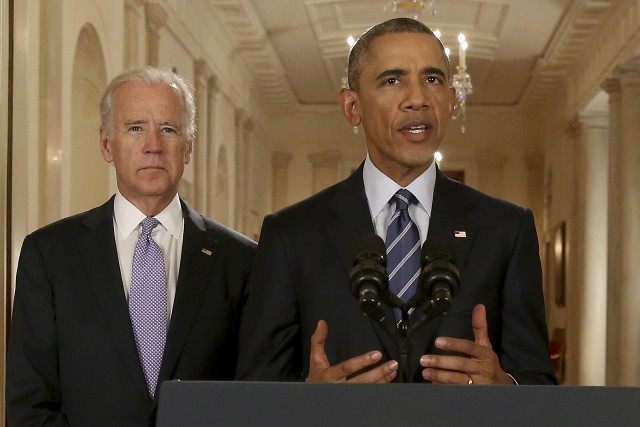
GettyImages-451830874-640x480

The nuclear deal reached with Iran on Tuesday is clouded by uncertainty about whether the Iranian regime will live up to its relatively weak commitments. One outcome is almost certain, however: Israel will launch a pre-emptive strike against Iran, hoping to weaken the regime and stop, or slow, its nuclear program.

Israel will attack–possibly by year’s end–because there is no other way to disrupt Iran’s advance to regional hegemony, which will become unstoppable once the deal’s provisions–especially the non-nuclear provisions–begin to take effect.

Despite what the Obama administration and its media supporters are saying, there is almost no doubt that the Iran deal, should it survive Congress, will enable Iran to become a nuclear power.

President Barack Obama himself admitted as much in April, when he defended the provisional deal signed in Lausanne by admitting it allowed Iran to reach “breakout” shortly after the ten-year (now eight-year) expiration date. The only question is whether Iran will move that date forward and risk the meager diplomatic consequences of breaking the deal.

There are Israeli analysts–a minority–who believe that Israel can live in the shadow of a nuclear-armed Iran, at least for a while. After all, Israel has developed a lethal “second-strike” capacity, in the form of nuclear missiles aboard Dolphin-class submarines programmed to target Iran. That leaves the Iranian regime to weigh the odds of surviving an Israeli counterattack versus the chances of causing the end of the world as they know it. From a fanatical religious perspective, it is a win-win scenario–but cooler, or less pious, heads may prevail.

The problem is that the Iran deal goes so much further than the nuclear issue alone. The Iranians shrewdly bargained for a host of late concessions: an end to the international arms embargo, the lifting of a ban on ballistic missile technology, and an accelerated schedule of sanctions relief that will pour over $100 billion into depleted Iranian coffers. The regime knew that Obama would not walk away–that he had committed his political career to a deal, and he was already dismissing all other alternatives, severely undermining his own leverage.

Israel just might find a way to live with a nuclear Iran, but it cannot live with a nuclear Iran and an array of turbo-charged Iranian proxies on its borders.

Iran has already renewed its support for Palestinian terror groups in Gaza, and the U.S. has quietly allowed Iranian-backed Hezbollah to regroup in Lebanon, even as it has been weakened by losses in the Syrian civil war. Flush with cash, armed with advanced new weapons, and perhaps equipped with nuclear contaminants, these groups will pose an ever-greater threat to Israel’s security–and soon.

That is why the alternative that Israeli Prime Minister Benjamin Netanyahu presented to Congress–and he did present an alternative to the present deal, though Obama pretended not to notice–included three provisions: “first, stop its aggression against its neighbors in the Middle East; second, stop supporting terrorism around the world; and third, stop threatening to annihilate my country, Israel–the one and only Jewish state.” None of those referred directly to the Iranian nuclear program. Obama ignored Netanyahu’s suggestions and forged ahead.

An Israeli strike might not stop the Iranian nuclear program. But it could stall that program, and create a renewed sense of vulnerability around the regime, which was near collapse as recently as 2009. Israel could also make Iran pay a direct cost for arming Hezbollah, Hamas, and other terror groups–a cost historically borne by the civilians of southern Lebanon or Gaza. It could project a conventional deterrent that would affect Iran here and now, as opposed to a nuclear deterrent whose effect might only be felt after an atomic exchange (i.e. not at all).

For Israel, the costs of such an attack on Iran–even a successful one–could be severe. It would be condemned and isolated internationally. It might suffer thousands of rocket attacks from Lebanon and Gaza. It may lose thousands of soldiers and civilians in a ground war.

Obviously the consequences will be less damaging–or more bearable–if the pre-emptive strike is successful. The reason Israelis are willing to take the risk at all is twofold. First, they have done it before (Iraq 1981; Syria 2007). Second, the alternative–thanks to the Iran deal–looks far worse.

The Obama administration has done all it can to prevent an Israeli pre-emptive strike, from leaking Israeli attack scenarios to denying Israel air space over Iraq. As a result, the only realistic bombing plans–whether Israel targets Iran’s nuclear and political installations directly, or detonates an electromagnetic pulse (EMP) over the country–involve a Doolittle Raid-style attack from which Israel’s pilots will not expect to return, or a landing in Saudi Arabia. The latter was once a non-starter, but–ironically–Obama’s overtures to Iran have made it possible.

The Saudis are expected to respond to the Iran deal by seeking nuclear weapons of their own. But the monarchy could also strike an alliance with Israel–perhaps even a grand bargain.

The Saudis could give Israel landing rights, logistical support, and intelligence. In return, Israel could accept Saudi Arabia’s proposal for a Palestinian state roughly along the “1967 lines”–plus Saudi control of Jerusalem’s Muslim holy sites, which would cement the royal family’s legitimacy. (Ironically, Obama, by provoking war, would enable Arab-Israeli peace.)

The clock is ticking, however. Before the Iran deal, it was thought that Israel could only carry out a pre-emptive strike in the time period before Iran actually became a nuclear power. Now, the deadlines are even shorter, and more complex.

Israel would need to attack before Russian S-300 surface-to-air missiles, already sold to Iran, can be delivered and activated. It would also need to attack while Hezbollah and Hamas are still weak, war-weary and cash-strapped–i.e. before sanctions relief delivers billions to Iran’s regional war and terror efforts.

Israel must also be wary of attacking too soon. It will not attack in the next ten days, for example, because they coincide with a religious period of mourning for historic defeats. It would also make little sense for Israel to attack while Congress is debating the Iran deal.

But Israel will attack before it loses the option. It will do so because the purpose of Israeli statehood is to enable Jews to defend themselves, and not rely on the help or mercy of others.

Obama wants to build a new legacy, but Netanyahu has inherited an old legacy–one he cannot ignore.

Nuclear deal pushes Israel aside in Washington, raises Iran to leading US partner and ally

July 15, 2015

Nuclear deal pushes Israel aside in Washington, raises Iran to leading US partner and ally, DEBKAfile, July 15, 2015

Benjamin_Netanyahu-Iran_14.7.15Binyamin Netanyahu: Powers gambled on our future

Israeli Prime Minister Binyamin Netanyahu bitterly accused the “leading international powers of gambling our collective future on a deal with the foremost sponsor of international terrorism” – roundly condemning all six world powers who signed the nuclear deal with Iran in Vienna Tuesday, July 14.

President Barack Obama topped the list. Netanyahu pointed out that the president had determined on a deal with Iran at any price before he took office, which is true. Therefore, it had nothing to do with the poor relations between himself and the US President, he said in answer to critics. It was now time for Israeli leaders to set aside differences and pull together, he said. Opposition leader, the Zionist Union’s Yitzhak Herzog, agreed and said he was enlisting for the necessary effort on behalf of Israeli security. Tuesday night he received an update on the situation from the prime minister.

The special security cabinet meeting, called to discuss the ramifications of the nuclear deal, hours after it was signed, unanimously rejected it and declared “this deal does not commit Israel.”

Unfortunately, Israel was never asked for its commitment, any more than the other Middle East powers directly affected by it. The cabinet statement was therefore no more than a meaningless expression of futility, a sensation shared equally by Saudi King Salman and Egyptian President Abdel-Fatteh El-Sisi, in the face of the iron wall Obama and Secretary of State John Kerry have built for Iran in the region.

Both unceremoniously ditched Israel and its Arab neighbors in order to join hands with Iran. By this reshuffle of allies, Washington has created a new geopolitical reality in the region at the expense of its equilibrium.

The US Congress has 60 days to review the nuclear accord and reach a decision. But if Netanyahu had had any hopes of swinging the Senate around to voting down the veto President Obama promised to impose to mullify its rejection, that hope swiftly vanished in thin air. Leading presidential contender Hillary Clinton announced that if she wins the 2016 election she would abide in full by the nuclear accord Obama signed with Iran. This announcement assured Obama of a Senate majority.

The dead end reached by Netanyahu on this issue also symbolizes the end of Israeli’s special standing in Washington as “America’s leading Middle East ally.”

Iran has stepped into this position. There is little point in Israel knocking on the White House door to renew the old understanding and sympathy, as advised by former prime minister Ehud Barak and others. It does not matter who sits in the prime minister’s office in Jerusalem, as matters stand now, he/she will find themselves on the wrong side of that door.

Defense Secretary Ashton Carter will visit Israel next week. But that is only an attempt to soften the blow.

This does not mean that the Obama administration will totally abandon Israel, only that it will no longer enjoy favored status compared with other Middle East nations. By ditching the Arab world, Obama equally dumped the Palestinian issue. This has some advantages for the Netanyahu government, but is not the end of the world for the Palestinians. They, like Arab governments, have the option of seeking an understanding with Tehran, whereas that door is shut tight against Israel.

In this situation, Israel’s quiet understandings with a number of Arab leaders directed at forming a bloc to counter the US-Iran alliance, have no immediate future. When the earth shakes in a major upheaval, each individual is out to save himself and has no time to look around for allies.

In some ways, the Netanyahu government may find relief in being released from the political and strategic constraints bound up in the relationship with the Obama administration, and find the freedom to be more pragmatic and independent in its policy-making.

After all, Israel still has the strongest army and the most vibrant economy in the Middle East. Its leaders must learn to use those huge assets wisely and independently of the Obama administration.

We Should Go to War With Iran, Not Give Them a Peace Deal | PJTV

July 15, 2015

We Should Go to War With Iran, Not Give Them a Peace Deal | PJTV, July 14, 2015


How Iran describes the nuclear deal

July 15, 2015

How Iran describes the nuclear deal, Power LineJohn Hinderaker, July 14, 2015

Throughout the negotiation process, Iran’s government has been more forthright and more reliable in characterizing the parties’ interim agreements than the Obama administration. So it is worth noting what the Iranians say the deal entails. This is from FARS, Iran’s news agency:

Iran’s President Hassan Rouhani said his country has achieved all its four goals in the agreement that his foreign minister Zarif signed with the six world powers in Vienna on Tuesday.

President Rouhani said his nation started talks with the world powers in a bid to remove all sanctions while maintaining its nuclear program and nuclear progress as two main goals.

All sanctions, including the financial, banking, energy, insurance, transportation, precious metals and even arms and proliferation sanctions will be, not suspended, but terminated according to the Tuesday agreement as soon as the deal comes into force, he said, adding that Iran will only be placed under certain limited arms deal restrictions for five years.

Meantime, Iran will inject gas into its highly advanced IR8 centrifuge machines, continue its nuclear research and development, and keep its Arak Heavy Water Facility and Fordo and Natanz enrichment plants under the agreement, he said, elaborating on Iran’s gains.

Another goal, Rouhani said, was taking Iran off Chapter Seven of the UN Charter, “and we did it”.

More details on the deal:

The agreement, the Joint Comprehensive Plan of Action (JCPOA), will be presented to the United Nations Security Council (UNSC), which will adopt a resolution in seven to 10 days making the JCPOA an official document.

Based on the agreement, which has been concluded with due regard for Iran’s red lines, the world powers recognize Iran’s civilian nuclear program, including the country’s right to the complete nuclear cycle.

The UNSC sanctions against the Islamic Republic, including all economic and financial bans, will be lifted at once under a mutually agreed framework and through a new UN resolution.

None of the Iranian nuclear facilities will be dismantled or decomissioned.

Furthermore, nuclear research and development activities on all types of centrifuges, including advanced IR-6 and IR-8 machines, will continue.

The nuclear-related economic and financial restrictions imposed by the United States and the European Union (EU) targeting the Iranian banking, financial, oil, gas, petrochemical, trade, insurance and transport sectors will at once be annulled with the beginning of the implementation of the agreement.

The arms embargo imposed against the Islamic Republic will be annulled and replaced with certain restrictions, which themselves will be entirely removed after a period of five years.

Additionally, tens of billions of dollars in Iranian revenue frozen in foreign banks will be unblocked.

I have now read the agreement in its entirety–you, too, can read it here–and I think the Iranians’ description is accurate. I also agree with what Paul wrote earlier today.

Some aspects of the agreement are technical and can’t be well understood without knowledge of nuclear engineering or the history of various sanctions that have been imposed. But those details are immaterial. Loopholes could make the agreement slightly worse, but no technical interpretation can save it.

The mullahs may cheat on the agreement, or they may not. They may decide to walk away from the agreement at some point and openly develop nuclear weapons, or they may not. It makes very little difference. There are no undertakings in the agreement that go beyond 10 years (in most instances) or 15 years (in a few). The Ayatollah takes the long view: ten or fifteen years are nothing. In the meantime, what does Iran get?

First, and most important, it gets in excess of $100 billion in currently-frozen assets. This will happen in the near future, on or about the agreement’s Implementation Date. I think this prospect is what is making Iran’s leaders so jubilant. With that money, they can step up their support for allies in Syria, Yemen and Iraq, and their support for terrorism everywhere. (By way of perspective, the entire United States military budget for the current fiscal year is only $560 billion.) To the extent that they spend some of it at home, it will help cement their position domestically.

Second, the agreement grants Iran international legitimacy. Since the revolution of 1979 and the seizure of America’s embassy in Tehran, Iran has been treated as a rogue state. Under the agreement, that status comes to an end. Investment in Iran will be permitted and likely will flourish. Sanctions will be removed and Iran’s nuclear program will not only be tolerated, it will be explicitly recognized and to some degree supported by the international community. The agreement contemplates that upon implementation, “the Iranian nuclear programme will be treated in the same manner as that of any other non-nuclear-weapon state party to the NPT [non-proliferation treaty].” It is hard to overstate how important this legitimacy is to the regime.

The third benefit to Iran’s rulers is perhaps the most important, and is closely linked to the first two. The agreement guarantees that, at least for the foreseeable future, the mullahs will remain in power. Realistically, the only way Iran could be denied a nuclear arsenal in the long term is through regime change. Early in the Obama administration, that seemed like a plausible scenario, but the administration declined to aid, or even encourage, anti-regime forces when such support might have made a difference. Now, with the mullahs both flush with cash and blessed with international legitimacy, their grip on power is probably stronger than ever. Nuclear weapons will follow, sooner or later, at a time of the regime’s choosing. And in the meantime, Iran’s ability to make mischief in the Middle East and around the world (e.g., through its newfound alliance with Venezuela) has been greatly enhanced.

Everything you need to know about Obama’s Iran deal

July 15, 2015

Everything you need to know about Obama’s Iran deal, BreitbartBen Shapiro, July 14, 2015

ap_barack-obama_ap-photo13-640x427AP Photo/Andrew Harnik, Pool

The deal the Obama administration cut today with the Iranian terrorist regime signals once and for all that the Obama administration considers both the United States and Israel to be the key threats to peace in the world.

Why else would the American president have lifted sanctions and granted the Iranian mullahs decades of American cover in the face of overwhelming evidence they support anti-Western, anti-Semitic, and anti-Sunni terror across the region and the globe?

President Obama’s statements today about the strength of this deal carry no weight, given that he has coordinated with the Iranian regime – which is responsible for the deaths of hundreds of Americans over the past few years – in Iraq, has allowed them to prop up Bashar Assad in Syria, has allowed them to continue their subjugation of Lebanon, watched in silence as they flexed their muscle in Yemen, and attempted to cut off weapons shipments to Israel in the midst of its war with Iranian proxy terror group Hamas.

Obama wants Iran to be a regional power, because Obama fears Israel more than he fears Iran. The same day that Obama announced his deal, “moderate” Iranian President Hassan Rouhani tweeted, “To our neighbours: Do not be deceived by the propaganda of the warmongering Zionist regime. #Iran & its power will translate into your power.”

Obama’s counting on it.

Obama had one motivation in this deal: he believes that any Western attempt to stop Iran’s nuclear development with force is more dangerous and less moral than Iran’s elevated terror support and even its eventual nuclear development.

America and the West, in Obama’s global worldview, are so dangerous that he wouldn’t even make minor requests of Iran, such as releasing American prisoners, if that meant the minute possibility of actual Western action on the horizon. Obama doesn’t care if Iran is lying. To him, that risk is acceptable when compared with the certainty of Western action, no matter how constrained, against Iran.

Obama consistently posed the choice about his nuclear deal as one between diplomacy and war, as though a military strike against Iran would have precipitated World War III. But this deal is far more calibrated to provoke World War III than any targeted strike by Israel, the United States, or anyone else.

The deal pats itself on the back with wording about ensuring that “Iran’s nuclear programme will be exclusively peaceful,” and how the deal will be a “fundamental shift” in the international community’s relationship with Iran. Then it gets to details. And the devil isn’t just in the details; the devils in Iran wrote them.

The deal “will produce the comprehensive lifting of all UN Security Council sanctions as well as multilateral and national sanctions related to Iran’s nuclear programme, including steps on access in areas of trade, technology, finance and energy.” Those sanctions end on the first day of the deal: “The UN Security Council resolution will also provide for the termination on Implementation Day of provisions imposed under previous resolutions.” The EU “will terminate all provisions of the EU Regulation.”

Money will now move between “EU persons and entities, including financial institutions, and Iranian persons and entities, including financial institutions.” Banking activities will resume abroad. Full trade will essentially resume. After five years, the arms embargo against Iran will end. After eight years, the missile embargo against Iran will end.

The deal explicitly acknowledges that Iran is gaining benefits no other state would gain under the Non-Proliferation Treaty. In terms of its nuclear development, instead of dismantling Iran’s nuclear program, that program is now protected:

Iran will continue to conduct enrichment R&D in a manner that does not accumulate enriched uranium. Iran’s enrichment R&D with uranium for 10 years will only include IR-4, IR-5, IR-6 and IR-8 centrifuges as laid out in Annex I, and Iran will not engage in other isotope separation technologies for enrichment of uranium as specified in Annex I. Iran will continue testing IR-6 and IR-8 centrifuges, and will commence testing of up to 30 IR-6 and IR-8 centrifuges after eight and a half years, as detailed in Annex I.

We have no way of knowing what Iran has done additionally, however, since the deal has no provisions forcing them to turn over information about what they’ve already done. There is no baseline.

So who will implement this deal? A “Joint Commission” comprised of the UK, France, Germany, Russia, China, the United States and Iran is charged with monitoring all developments under the agreement – meaning that all the signatories, all of whom have an interest in preserving a deal they signed, will be the “objective” monitoring agents.

The International Atomic Energy Agency will monitor and verify Iran’s nuclear program. But not everywhere. Only at key nuclear facilities will the IAEA have access – military sites were not included in the deal in any real way – and even then, the process for access is extraordinarily regulated:

74. Requests for access pursuant to provisions of this JCPOA will be made in good faith, with due observance of the sovereign rights of Iran, and kept to the minimum necessary to effectively implement the verification responsibilities under this JCPOA. In line with normal international safeguards practice, such requests will not be aimed at interfering with Iranian military or other national security activities, but will be exclusively for resolving concerns regarding fulfillment of the JCPOA commitments and Iran’s other non-proliferation and safeguards obligations. The following procedures are for the purpose of JCPOA implementation between the E3/EU+3 and Iran and are without prejudice to the safeguards agreement and the Additional Protocol thereto. In implementing this procedure as well as other transparency measures, the IAEA will be requested to take every precaution to protect commercial, technological and industrial secrets as well as other confidential information coming to its knowledge.

75. In furtherance of implementation of the JCPOA, if the IAEA has concerns regarding undeclared nuclear materials or activities, or activities inconsistent with the JCPOA, at locations that have not been declared under the comprehensive safeguards agreement or Additional Protocol, the IAEA will provide Iran the basis for such concerns and request clarification.

76. If Iran’s explanations do not resolve the IAEA’s concerns, the Agency may request access to such locations for the sole reason to verify the absence of undeclared nuclear materials and activities or activities inconsistent with the JCPOA at such locations. The IAEA will provide Iran the reasons for access in writing and will make available relevant
information.

77. Iran may propose to the IAEA alternative means of resolving the IAEA’s concerns that enable the IAEA to verify the absence of undeclared nuclear materials and activities or activities inconsistent with the JCPOA at the location in question, which should be given due and prompt consideration.

78. If the absence of undeclared nuclear materials and activities or activities inconsistent with the JCPOA cannot be verified after the implementation of the alternative arrangements agreed by Iran and the IAEA, or if the two sides are unable to reach satisfactory arrangements to verify the absence of undeclared nuclear materials and activities or activities inconsistent with the JCPOA at the specified locations within 14 days of the IAEA’s original request for access, Iran, in consultation with the members of the Joint Commission, would resolve the IAEA’s concerns through necessary means
agreed between Iran and the IAEA. In the absence of an agreement, the members of the Joint Commission, by consensus or by a vote of 5 or more of its 8 members, would advise on the necessary means to resolve the IAEA’s concerns. The process of consultation with, and any action by, the members of the Joint Commission would not exceed 7 days, and Iran would implement the necessary means within 3 additional days.

Obama and Secretary of State John Kerry wrote into the deal provisions designed to hamstring Congress and local authorities:

If a law at the state or local level in the United States is preventing the implementation of the sanctions lifting as specified in this JCPOA, the United States will take appropriate steps, taking into account all available authorities, with a view to achieving such implementation. The United States will actively encourage officials at the state or local level to take into account the changes in the U.S. policy reflected in the lifting of sanctions under this JCPOA and to refrain from actions inconsistent with this change in policy.

And if Iran cheats, the United States and EU will have to take the matter to dispute resolution rather than re-implementing sanctions, as Obama has lied:

The U.S. Administration, acting consistent with the respective roles of the President and the Congress, will refrain from re-introducing or re-imposing the sanctions specified in Annex II that it has ceased applying under this JCPOA, without prejudice to the dispute resolution process provided for under this JCPOA. The U.S. Administration, acting consistent with the respective roles of the President and the Congress, will refrain from imposing new nuclear-related sanctions. Iran has stated that it will treat such a re-introduction or re-imposition of the sanctions…

Obama is already moving on this front. While calling for an open conversation on the Iran deal, President Obama has already said he will veto any attempts to curb the deal by Congress. So feel free to chat, gang, so long as you don’t attempt to do anything.

In brief, the agreement trades enormous amounts of cash for Iran’s pinkie swear that they will not develop nuclear weapons now, and the blind hope that Iran’s regime will magically moderate over the next five to ten years – a hope made even more distant by the fact that this deal reinforces the power and strength of the current Iranian regime. The West has no interest in holding Iran to an agreement since, to do so, they would have to repudiate the deal they cut in the first place. Anything short of actual nuclear aggression will draw no response from the West. No wonder Prime Minister of Israel Benjamin Netanyahu called the deal a “historic mistake for the world,” explaining:

Far-reaching concessions have been made in all areas that were supposed to prevent Iran from obtaining nuclear weapons capability. In addition, Iran will receive hundreds of billions of dollars with which it can fuel its terror machine and its expansion and aggression throughout the Middle East and across the globe… One cannot prevent an agreement when the negotiators are willing to make more and more concessions to those who, even during the talks, keep chanting: ‘Death to America.’ We knew very well that the desire to sign an agreement was stronger than anything, and therefore we did not commit to preventing an agreement.

So here’s what happens next in the region.

Israel Waits. The chances of an Israeli strike on Iran are now somewhere between slim and none. Obama’s deal prevents Israel from taking action without risking sanctions from the European Union and the United States for endangering this sham deal.

Nothing would make Obama happier than to levy sanctions against the Jewish State – and should Israel act in its own interests, undercutting Obama’s Epitaph Achievement, Obama will react harshly. Israel will be busy enough handling all the Iranian proxies on its borders who will now see cash and resources flow to them, all sponsored by the West.

Hezbollah and Hamas Are Strengthened. Terrorist groups across the Middle East rejoice today, knowing that the money Iran just gained through lifting of sanctions will end up restocking their rocket supply. Hezbollah has already destroyed Lebanon as Iran’s arm; Hamas has already taken over Gaza. Both routinely threaten war on Israel, firing ordinance into Israeli territory.

Now they will not only be emboldened – after all, what happens if Israel retaliates against them, Iran threatens to get involved, and the world, seeking to preserve its newfound magical relationship with Iran, puts pressure on Israel? – they will be empowered. Obama just made the next war between Israel and its terrorist neighbors a certainty.

Saudi Arabia and Egypt Go Nuclear. President Obama came into office touting “America’s commitment to seek the peace and security of a world without nuclear weapons.” Given that Iran is months from a bomb, and that there are no real verification techniques and no real consequences for violation, Iran’s enemies will quickly seek to go nuclear in order to establish a deterrent, not just to Iran’s nuclear capabilities, but to their expanded conventional capabilities.

Iran has the largest active military in the Middle East, along with its massive paramilitary terror groups. They’ve built that in the midst of heavy sanctions. With Iran getting active on the borders of Egypt and Saudi Arabia, those regimes would be foolhardy not to attempt to develop a nuclear capacity – especially given that Obama has shown there are no detriments to doing so. What’s he going to do, threaten Egypt’s General Al-Sisi? He’s been doing that for years already.

Bashar Assad Stays In Power. Remember the time Obama said Syrian dictator Bashar Assad needed to go? That’s not happening anytime soon, given that Assad is Iran’s tool in Syria. When Obama drew a red line against Syria based on Assad’s use of chemical weapons, he apparently meant that Assad should stay forever, and that his sponsor state should be rewarded with billions of dollars in relieved sanctions. No wonder Assad called the deal a “major turning point” in world history, adding, “We are confident that the Islamic Republic of Iran will support, with greater drive, just causes of nations and work for peace and stability in the region and the world.”

Iraq Splits Permanently Between Iran and ISIS. Supposedly, the United States opposed Shia exclusionary policy against Sunnis in Iraq, and blamed such policy for the breakdown of security there. The Iranian Revolutionary Guard has now taken over the southern half of the country; the new Iraqi Prime Minister is an Iranian proxy. Meanwhile, Sunnis, seeking some sort of security against the Iranians and having no secular American-backed regime to rely upon, have been turning in increasing numbers to the barbarians of ISIS. President Obama has made ISIS a permanent feature of the world landscape, and has turned Iraq into an Iranian proxy state, just like Syria and Lebanon.

Iran Will Foray Into Iran [?? — DM], Afghanistan. Iran’s expansionist ambitions have been increased exponentially by this deal. The deal does nothing to demand Iran stop its military activities abroad, of course, which means that their sponsorship of the Houthis in Yemen and terrorist groups in Afghanistan will continue apace. Al Jazeera has even speculated at sectarian unrest in Pakistan.

Obama’s defenders today ask his detractors, “If the deal works, isn’t it a good deal?”

Sure. If the Munich Agreement had worked, it would have been a masterpiece of diplomacy.

But promising a unicorn in a diplomatic negotiation isn’t quite the same thing as delivering one. And delivering billions of dollars, international legitimacy, and a protective shield around a terrorist regime in exchange for that unicorn makes you either a fool or an active perpetuator of that terrorist regime.

CNN: Original Obama administration standards for nuclear deal not met

July 14, 2015

CNN: Original Obama administration standards for nuclear deal not met, Washington Free Beacon via You Tube, July 15, 2015


Ridge tells Obama to put his ‘Commander-in-Chief hat on’ to fight Islamic State

July 13, 2015

Ridge tells Obama to put his ‘Commander-in-Chief hat on’ to fight Islamic State, Washington Free Beacon via You Tube, July 13, 2014

(Does Obama even know where or what a “Commander in Chief” hat is? — DM)


Goodnight Vienna (12)

July 13, 2015

Goodnight Vienna (12)Scott Johnson, July 13, 2015

The new Iranian demand to lift the United Nations arms embargo is getting a lot of talk, and probably a bit more than it deserves. It’s not that the concession wouldn’t be devastating – it would light up the region in so many different ways that they’re difficult to catalogue – but it just doesn’t seem possible that the Americans can give ground on this.

*********************

As we remain on the final countdown to the full catastrophe taking place in Vienna, Omri Ceren helps us keep track of the details. In his second email update this morning, Omri draws attention to Andrew Bowen’s Daily Beast column Give the mullahs ballistic missiles?” (quoted below). Omri writes:

The last few hours have been a flurry of bilateral and trilateral meetings – Kerry/Zarif, Kerry/Zarif/Mogherini, Hammond/Lavrov, Lavrov/Zarif, etc – and a full P5+1/Iran meeting will probably take place this evening. That plenary is presumably supposed to serve as something of a final meeting: the negotiators will send the deal text back to the capitals, they’ll get pro forma approval, and in the morning there will be a formal announcement.

In the meantime, the new Iranian demand to lift the United Nations arms embargo is getting a lot of talk, and probably a bit more than it deserves. It’s not that the concession wouldn’t be devastating – it would light up the region in so many different ways that they’re difficult to catalogue – but it just doesn’t seem possible that the Americans can give ground on this. What’s the sales pitch to Congress going to be? “Not only are we giving Iran $150 billion to bolster its military, but we’re also lifting arms restrictions to make it easier for them to buy next-generation cruise missiles they’ll use against the U.S. military and our allies.”

But just for the sake of argument, because some pro-Iran voices have taken to publicly suggesting otherwise, yes of course lifting the arms embargo would detonate American national security:

Rather, the real threat from increased Iranian military might lies elsewhere. The Islamic Revolutionary Guard Corps (IRGC)… does not hesitate to remind the world through its harassment of commercial shipping, military exercises, and frequent rhetoric that it can control or shut the Strait of Hormuz, through which 30 percent of the world’s petroleum supplies passes. Keeping the Strait open depends on the U.S. Navy being able to keep up with effective counter measures against improved Iranian cruise missiles… and so Tehran has invested in weapons such as cruise missiles, mines, submarines, and even swarming armed speedboats to specifically target U.S. naval vulnerabilities… Lifting the conventional arms embargo would allow Russia or China to sell Iran the latest generation cruise missiles and drones, which only increase Tehran’s ability to frustrate or harass America’s protectorate of this vital waterway… Moreover, Iranian ballistic missiles outfitted with Russian or Chinese quality precision-guidance munitions could be devastating for U.S. and GCC naval and air bases if there are further relaxations on Iran’s acquisition of missile technology.

The article is by Andrew Bowen, the Director of Middle East Studies at the Center for the National Interest. He goes on to list several other ways Iran would exploit lifting the arms embargo, including by providing advanced missiles to terror proxies to use against U.S. allies such as Israel and Jordan.

The demand is so delusional that some people are speculating the Iranians just brought it up to gain leverage. Whether that’s true or not, the stunt will make it more difficult for the Obama administration to justify the deal to Congress. If Kerry agrees to drop the arms embargo, it’s difficult to see Congress accepting the agreement. If Kerry gets the Iranians to give up on the the demand, Congress will want to know what he had to trade away to do it.

Goodnight Vienna (11)

July 13, 2015

Goodnight Vienna (11), Power LineScott Johnson, July 13, 2015

Omri Ceren continues his series of reports by email from Vienna:

Good Monday from Vienna, where we’re now into day 17 of the current round of negotiations and yet summer continues to surprise us.

The JPOA is again set to expire at midnight after having been extended a few days ago. Just about everyone is saying that another short-term extension is not being considered. Of course the parties always say that, until they don’t, but this time the comments feel a little bit different. The Europeans could not be more frustrated – they don’t understand why the Americans and the Iranians can’t get their nonsense together – and the Russians and Chinese actually have things they need to take care of. Rouhani was even scheduled to speak on TV today, though the Iranians are now saying he’ll wait until there’s a formal announcement.

The conventional wisdom is that negotiations will wrap up today and a ceremony will be held tomorrow.

As for what the parties are still talking about: Reuters has been saying all week that sanctions remain unresolved, and today the wire piled on with “among the biggest sticking points in the past week has been Iran’s insistence that a United Nations Security Council arms embargo and ban on its ballistic missile program dating from 2006 be lifted immediately… Other problematic issues are access for inspectors to military sites in Iran” [1]. The Associated Press report from this morning also identified those two areas as key disagreements, and added that there are complications due to a new Iranian demand “that any U.N. Security Council resolution approving the nuclear deal be written in a way that stops describing Iran’s nuclear activities as illegal” [2].

As far as the UNSCR gambit goes, it seems like a not-very-sophisticated attempt to craft language that would later be used to undermine the IAEA’s authority to inspect Iranian facilities. The Iranians have successfully pulled off similar tricks throughout the talks: they inserted vague language into Geneva that they interpreted as a right to enrich, and they did the same thing at Lausanne so they could later claim that the arms embargo has to be lifted. U.S. negotiators have proven less than adept in detecting how and when the Iranians are laying traps for them.

As far as the arms embargo goes, there are multiple Iranian motives. The most obvious is that the Iranians are engaged in four hot wars across the region against traditional American allies, and they’re eager to purchase Russian weapons to fight in those wars. David Ignatius to MSNBC this morning: “Israel will see that as a direct threat, as it will arm the people Israel is fighting. The Sunni Arabs, as you said, will see this as a major capitulation by the U.S.” The more subtle reason has to do with how the Iranians conduct their illicit nuclear trade. The Iranians have an interest in weakening international restrictions against arms transfers in in general, because they then use newly-legitimized procurement channels to violate whatever restrictions remain. I’m [linking] below an article published yesterday by Benjamin Weinthal – a Berlin-based fellow for Foundation for Defense of Democracies (FDD) – on how Iran has been violating UNSC nuclear sanctions over the last few months:

While U.S.-led world powers hold talks with Iran in Vienna to curb Tehran’s illicit nuclear weapons program, the Islamic Republic’s spies have been seeking atomic and missile technology in neighboring Germany as recently as last month, according to German intelligence sources… Iran has a long history of illegally obtaining nuclear technology from within Germany and transporting it in ways that circumvent international sanctions. German companies have shown an eagerness to legally tap the Iranian market, though none are accused of abetting illegality in the latest efforts by Iran.

Of course there’s also what ought to be the major diplomatic scandal of the Iranians cheating on nuclear sanctions even as nuclear negotiations continue [reported by Benjamin Weinthal in the linked story]. But the Iranians have been caught cheating throughout the talks: they’ve violated UNSC resolutions in exactly this way and they’ve violated the JPOA by busting through oil caps, testing advanced centrifuges, and failing to convert excess enriched gas into dioxide. In literally every case the Obama administration has found a reason to publicly play Iran’s lawyer by spinning away those violations.

_________________

[1] http://www.reuters.com/article/2015/07/13/us-iran-nuclear-idUSKCN0PM0CE20150713
[2] http://bigstory.ap.org/article/1bfd89dfd94b47b19706949ae2255c02/iran-talks-hit-final-stage-announcement-expected

The Islamist state of Iran scoring victories

July 13, 2015

The Islamist state of Iran scoring victories, Front Page MagazineDr. Majid Rafizadeh, July 13, 2015

iran-photo

Why negotiations are shaping up to be a win-win for the Mullahs

The mainstream media have ignored and overlooked the Islamic Republic’s recent moves, which threatened regional security. The Islamic Republic’s search for regional hegemony has also been overshadowed by President Obama’s prioritization of signing a nuclear deal.

Iranian leaders and media outlets have given an estimate of how much they have so far gained from the nuclear talks. The Iranian leaders and state-owned media have recently boasted about receiving approximately $12 billion in assets over the period of the nuclear talks by July 7th.

The ruling clerics in the Islamic Republic and Iran’s Revolutionary Guard Corps have also unveiled and are celebrating the deployment of a new and second long-range Ghadir radar. According to an Iranian state-owned outlet, Brigadier General Farzad Esmaili, commander of the Islamic Revolutionary Guards Corps’ (IRGC) air defense force, who unveiled the Ghadir phased-array radar, pointed out that “Discovering and tracking micro aerial vehicles (MAV)… is one of the special qualities of the Ghadir radar system.”

This is part of long-range and air defense system. The Islamic Republic is attempting to completely shield its nuclear facilities when it is close to obtaining nuclear weapons. Russia has also made a deal with the Islamic Republic to ship the S-300 advanced missile system to Iran.

The Islamic Republic also continues to receive billions of dollars due to the nuclear talks. One recent example includes a side deal that the Islamic Republic worked out at the nuclear talks with the Obama administration, which would give Tehran 13 tons of gold worth about $700 million.

The winners of these nuclear talks are primarily President Obama, the Iranian government, Shiite proxies in the region, Iran’s Revolutionary Guard Corps, President Rouhani, the Syrian government and Bashar Al Assad, and Western corporations and companies.

President Obama desires to seal and achieve his final legacy. President Obama and his administration are creating the narrative that the deal is a historic and good one.

On the other hand, the easing of sanctions creates a whole array of other winners in the Islamic Republic including the IRGC, office of the Supreme Leader, and the Quds force (elite branch of IRGC which operates in extraterritorial landscapes).

As the economic power of the IRGC and the Quds force increases, Iran’s Shiite proxies in the region will benefit from the trickling down of these funds. Al Assad can also be more assured and confident that the Islamic Republic will continue supporting his government financially, economically, militarily, and through intelligence and advisory roles.

Entities or governments which will not benefit from these nuclear talks or latest developments are countries which are threatened by extremist militia groups in the region and are concerned with Iran’s hegemonic ambitions, it’s search for regional preeminence and supremacy, Iran’s attempts to tip the balance of power in its favor.

The Islamic Republic fuels extremism in the region, gives birth to militias and is the major root of atrocities, terrorism, human rights abuses and the vicious cycle we are witnessing in the Middle East and beyond. In fact, there is a powerful correlation between the Islamic Republic’s rising military buildup and the rising power of extremism and terrorism in the region.

As Israeli Prime minister Benjamin Netanyahu stated, the Islamic State (IS) threat is nothing in comparison to the Islamic Republic’s threat.

The Iranian government is also scoring further victories with regard to the nuclear talks. When we comprehensively and meticulously look at the deal, the agreement will not only maintain Iran’s nuclear ambitions, but it will create whole new security and geopolitical concerns in the region. The agreement is not final but temporary, broadly speaking. After 10 years, economic sanctions will have lifted, Iran’s breakout capacity will be nearly complete, and Iran can reinitiate its program with full speed.

As a result, Iranian leaders will have it both ways.

President Obama is treating the Islamic Republic completely differently from groups such as the Islamic State. He calls Iran a successful regional player.

Obama fails to recognize the fact that any victory or military capability that the Islamic Republic gains is a step towards more militarization, terrorism, violence and regional insecurity. As Israeli PM Benjamin Netanyahu stated, “Obviously no one thinking with a clear mind would consider giving Islamic State nuclear weapons,” and he adds, “But in the negotiations taking place now with Iran, this extreme state that spreads terrorism around the world is being given the ability to develop a nuclear weapons arsenal with many nuclear bombs, together with the means to deliver them… We should not strengthen one at the expense of the other…We need to weaken both and prevent the aggression and military buildup of both of them.”

It is the time to pay closer attention to the Islamic Republic’s covert military buildup and treat it the same way the international community treats the Islamic State, not as a successful regional player.