The new twist in the controversy surrounding the nuclear agreement is an argument over the veracity of a report on a side deal giving Iran the right to inspect its own nuclear facilities for potential violations. The idea is so preposterous that it must be true, judging by the rest of the top-secret document on which the U.S. Congress is going to vote in September.
But as the debate heats up over whether the deal furthers or hinders Iran’s nuclear weapon capabilities, an equally serious issue keeps being marginalized. This is the more immediate and tangible danger posed by Iran’s terrorist proxies, and the sudden financial and ideological boost the deal is providing them.
The reason it is crucial to keep an eye on their activities is that they constitute Iran’s global army — the boots on the ground, so to speak — who perform the legwork necessary for the ultimate aim of regional and global jihadist hegemony. Their role is to set the stage for that time in the not-so-distant future when Iran’s power and reach are so extensive that its leaders won’t need to waste their nuclear warheads by firing them.
This is where Israel comes in. As the only democracy in the Middle East, an ally of the West and a Jewish state, it has key strategic value. It is like the central card in a house of cards, whose removal topples the whole structure.
It is also tiny and surrounded by rogue states with an endless supply of Muslim would-be “martyrs” willing to die in the “holy” endeavor to take it down.
On Thursday, Israel received its latest message to this effect, when four rockets, launched from Syria, landed in the Upper Galilee and the Golan Heights. The Iran-backed Islamic Jihad terrorist organization was behind the attack, which spurred Israel to retaliate.
Also on Thursday, Israel deployed anti-missile Iron Dome batteries in the south of the country, in the areas between Ashkelon and Ashdod, as well as in Beersheba. This was in response to threats of rocket fire by Iran-baked terrorists in Gaza — whose excuse was the worsening condition of hunger-striking Palestinian terror suspect Mohammed Allan.
A review of recent Iranian rhetoric and activity, released by the Investigative Project on Terrorism, puts all of the above in context.<
Last month, the General Assembly of Islamic Resistance Ulema (scholars) held a weekend conference titled “Unity for Palestine.”
At the gathering, Hezbollah chief Hassan Nasrallah said, “We believe with certainty that Israel, this cancerous tumor, is headed for extinction, and that Palestine and Jerusalem will be returned to their people. It is only a matter of time and is linked to the will, action, jihad, and sacrifices of the Ummah [Islamic nation], according to the principle: If you achieve victory for Allah, Allah will lead you to achieve victory.”
From Iran, Ayatollah Mohsen Araki, secretary general of the World Forum for Proximity of Islamic Schools of Thought, agreed.
“Annihilation of the Zionist regime is a sure thing and Quranic pledge,” he said, adding that it is important to unify “Muslims in countering the regime of Zionism and the arrogant world.”
Muhammad Hasan Zamani, a former Iranian cultural attache in Egypt who heads the Department of International Islamic Madrasas (educational institutions) for the General Assembly of Islamic Resistance Ulema, reiterated this position.
“Israel must be erased from the map of the world,” he said. “These are the golden words Imam Khomeini, may God have mercy on him, uttered.”
Sheikh Abdel Halim Qadhi, a professor at Zahedan University in Iran, said, “The holy Quran makes it known that Jews are the enemies of Islam and the Muslims and their holy places and rites. … Jihad is the most powerful and only way to liberate Palestine and defend Jerusalem. … God loves those who fight in his way.”
Earlier this month, Iranian Supreme Leader Ali Khamenei published “Palestine,” a 416-page tome devoted to the issue of Israel’s inevitable demise, with a blurb on its back cover calling the author the “flagbearer of jihad to liberate Jerusalem.”
This week, Khamenei gave an abbreviated version of this on Twitter: “We spare no opportunity to support anyone #FightingTheZionists,” he wrote.
At the same time, a clip produced by the Islamic Revolution Design House, a media outlet associated with the Iranian Revolutionary Guard Corps, began to circulate on YouTube. The minute-and-a-half animated video depicts an Islamist invasion of Jerusalem.
The brief silent film shows soldiers from the Revolutionary Guards, Shia Badr, Hezbollah, Hamas and Qassam Brigades, clad in military gear and keffiyehs, marching to and standing on a hill overlooking the Temple Mount, as thousands upon thousands of additional terrorists amass.
An inscription in Farsi on a black screen at the end says: “Israel must be erased from the annals of history, and the youth will definitely see that day when it comes.”
Lest anyone imagine the mullahs pulling the strings in Iran don’t mean business, all one has to do is observe how they are executing their grand plan, part of which is the nuclear deal with the “Great Satan” and the other P5+1 countries. Among these is Russia, which confirmed on Wednesday that it will supply Iran with four upgraded batteries of S-300 surface-to-air missiles as soon as the deal is finalized.
Such missiles give Iran the extra benefit of being able to stave off attack. At that point, will it really matter if Iran is in charge of its own inspections?
The attack ordered by Iran comes after a report in April, when Iranian officials reportedly told the Syrian regime to strike Israel and open a war front on the Golan Heights.
**************************
PM warns ‘we’ll harm those who try to harm us,’ slams world powers for nuclear deal after ‘Iranian commander ordered rocket strike.’
Prime Minister Binyamin Netanyahu released a statement on Friday, shortly after the IDF airstrike that took out the Islamic Jihad terror cell backed by Iran that launched four rockets into Israel from Syria the day before.
“I said this week that those who try to harm us – we will harm them. And that’s what we did,” said the prime minister.
“The IDF struck the cell that conducted the (rocket) fire, and the Syrian forces that enabled it. We don’t intend to escalate the incidents, but our policy remains as it was,” he said. At least 14 targets were hit by the IDF overnight, including a strike on an army post which Syria said killed one soldier.
Turning his attention to the IDF reports that Iranian military sources funded and directed the Islamic Jihad cell, Netanyahu condemned the world powers that sealed a nuclear deal with Iran just last month and are now advancing economic trade and diplomatic ties.
“The countries that rush to embrace Iran need to know that an Iranian commander is the one who gave the cover and direction to the cell that fired on Israel,” he said.
As noted by Netanyahu, the one who gave the order for the rocket strike was said to be the head of the Palestinian department in Iran’s Al-Quds force, the covert foreign operations unit of the Iranian Revolutionary Guards.
Netanyahu on Friday ordered the Foreign Ministry to send an official letter to Western governments, saying Israel has “reliable information that this attack was carried out by the Palestinian Islamic Jihad, ordered directly by the Iranian terrorist Said Izadhi of the Iranian Revolutionary Guards.”
“This is further clear indication of Iran’s increasing involvement in attacks against Israel in particular and against regional targets in general. The ink on the nuclear agreement has not yet dried, and this attack shows clearly how Iran plans to act the moment after the international sanctions are removed.”
The attack ordered by Iran comes after a report in April, when Iranian officials reportedly told the Syrian regime to strike Israel and open a war front on the Golan Heights.
According to our military sources, it is this Iranian-backed network which Thursday, Aug. 20, fired a salvo of four rockets from the Golan into upper Galilee and the Golan. The impact set off brush fires but caused no casualties. A red alert had sent most people running to shelters.
****************
Israel’s top government and military went on a high level of preparedness Tuesday, Aug. 18 in expectation of the first terrorist attack to be orchestrated by Iran from Syrian or Lebanese borders. That is what brought Prime Minister Binyamin Netanyahu, Defense Minister Moshe Ya’alon and Chief of Staff Lt. Gen. Gady Eisenkott on a tour of inspection to the Golan and Northern Command headquarters. Netanyahu said then that Israel is ready for any scenario and would “harm anyone trying to harm us.”
DEBKAfile’s military sources report that these events were sparked by the knowledge reaching Israeli intelligence that Iranian Al Qods and Hizballah officers were building a new terrorist network for mounting large-scale terrorist attacks on Israel from the Syrian border opposite the Golan.
The officers had handed out anti-tank and anti-air rockets to the terrorists, raising Israeli suspicions that one of their plans was to seize an Israeli location or part of one and try and hold out against an Israeli counter-offensive of tanks and assault helicopters.
Our counter-terrorism sources disclose that three radical terrorist movements staff the new network:
One is the hard-line rejectionist Popular Front for Liberation of Palestine – General Command (PFLP-GC).
Another is the Golan-based Syrian Druze group known as Liberators of the Golan. It is headed by the notorious Samir Kuntar, a Lebanese Druze who has set up a Golan terror ring based in the Druze village of Al-Khadar opposite the Israeli border fence.
Also harnessed to Iran’s new Golan terror organization is the Syrian Social Nationalist Party (SSNP) which is made up of radical Christian terrorists. This old timer violent group, which is run by Syrian intelligence, took part in the 1982-3 Hizballah bombing massacres at the US Embassy and Marine headquarters in Beirut.
The first SSNP activists have arrived in the Quneitra district of the Golan.
According to our military sources, it is this Iranian-backed network which Thursday, Aug. 20, fired a salvo of four rockets from the Golan into upper Galilee and the Golan. The impact set off brush fires but caused no casualties. A red alert had sent most people running to shelters.
This was an unusually long-range attack: Previous launches from within Syria, whether deliberate or stray fire from the civil war there, hit the Israeli-held Golan without reaching the Israeli interior. It is now up to Israel to decide how and when to respond to an act of war orchestrated by Tehran, after the prime minister’s warning Tuesday had no deterrent effect.
(The views expressed in this post — which for the most part consists of links to and quotations from recent articles posted at Warsclerotic — are mine and do not necessarily reflect those of Warsclerotic or its other editors. — DM)
Over the past few days, Iranian officials have confirmed that international inspections of its nuke sites will be severely limited if permitted at all. This post provides excerpts from recent articles quoting them.
Iran’s nuke sites
The restrictions noted in this post are in addition to previously disclosed prohibitions on access by International Atomic Energy Agency (IAEA) inspectors to military sites, which Iran itself will inspect instead. Even The Daily Beast has mentioned this problem in reliance on an Associated Press article which states,
All IAEA member countries must give the agency some insight into their nuclear programs. Some are required to do no more than give a yearly accounting of the nuclear material they possess. But nations— like Iran — suspected of possible proliferation are under greater scrutiny that can include stringent inspections. [Emphasis added.]
The agreement in question diverges from normal procedures by allowing Tehran to employ its own experts and equipment in the search for evidence of activities it has consistently denied — trying to develop nuclear weapons. [Emphasis added.]
Olli Heinonen, who was in charge of the Iran probe as deputy IAEA director general from 2005 to 2010, said he could think of no similar concession with any other country.
A senior Iranian official declared on Monday that international nuclear inspectors would only be permitted into the country once they receive approval from the Islamic Republic’s Intelligence Ministry, putting another roadblock between the International Atomic Energy Agency (IAEA) and Iran’s contested nuclear sites.
Sayyed Abbas Araqchi, Iran’s deputy foreign minister and one of the top negotiators in talks that led to the recently inked nuclear deal, told the country’s state-controlled press that Iran’s intelligence apparatus must approve of any inspector who is issued a visa to enter Iran. [Emphasis added.]
International nuclear inspectors will only be permitted into the country after offering proofs of suspicious activity at the sites to be inspected, Iran’s Defense Minister Brig. Gen Hossein Dehqan said Tuesday. DEBKAfile: This condition is not contained either in the nuclear deal Iran signed with the six world powers last month or in its contract with the IAEA. How will the international watchdog obtain proofs if it is denied visits for inspections? [Emphasis added.]
Iranian leaders prevented a top International Atomic Energy Agency (IAEA) official from disclosing to U.S. officials the nature of secret side deals with the Islamic Republic by threatening harm to him, according to regional reports. [Emphasis added.]
Yukiya Amano, IAEA director general, purportedly remained silent about the nature of certain side deals during briefings with top U.S. officials because he feared such disclosures would lead to retaliation by Iran, according to the spokesman for Iran’s Atomic Energy Organization (AEOI).
Amano was in Washington recently to brief members of Congress and others about the recently inked nuclear accord. However, he did not discuss the nature of side deals with Iran that the United States is not permitted to know about.
Iran apparently threatened Amano in a letter meant to ensure he did not reveal specific information about the nature of nuclear inspections going forward, according to Iranian AEOI spokesman Behrouz Kamalvandi.
“In a letter to Yukiya Amano, we underlined that if the secrets of the agreement (roadmap between Iran and the IAEA) are revealed, we will lose our trust in the Agency; and despite the US Congress’s pressures, he didn’t give any information to them,” Kamalvandi was quoted as saying Monday during a meeting with Iranian lawmakers, according to Tehran’s state-controlled Fars News Agency.
“Had he done so, he himself would have been harmed,” the official added. [Emphasis added.]
If these analyses are correct, and they appear to be, there will be no meaningful “anytime anywhere” international inspections of Iranian military sites. Although Obama has repeatedly said that the current nuke “deal” is not based on trust, that appears to its only basis, an absurd one.
Shortly before US Secretary of State John Kerry was due in Qatar Monday, Aug. 3, Iran’s highest authorities led by supreme leader Ayatollah Ali Khamenei Sunday launched a public campaign to support Tehran’s noncompliance with the Vienna nuclear accord and UN Security Council Resolution 2231 of July 20, on its ballistic missile program. The campaign was designed by a team from Khamenei’s office, high-ranking ayatollahs and the top echelons of the Revolutionary Guards, including its chief, Gen. Ali Jafari. [Emphasis added.]
. . . .
The Security Council Resolution, which unanimously endorsed the Joint Comprehensive Plan of Action (Vienna nuclear accord) signed by Iran’s Foreign Minister Mohammed Javad Zarif, called on Iran “not to undertake any activity related to ballistic missiles designed to be capable of delivering nuclear weapons, including launches using such ballistic technology until the date eight years after the JCPOA Adoption Day.” [Emphasis added.]
Tehran retorted that none of its ballistic missiles were designed to deliver nuclear weapons, and so this provision was void. Shortly after its passage, the foreign ministry in Tehran issued an assurance that “…the country’s ballistic missile program and capability is untouched and unrestricted by Resolution 2231.”
On July 30, Ali Akbar Velayati, Khamenei’s senior adviser on international affairs and member of the Expediency Council, told reporters, “The recent UNSC Resolution on Iran’s defensive capabilities, specially (sic) its missiles, is unacceptable to Iran.”
TEHRAN (Tasnim) – Chief of Staff of the Iranian Armed Forces Major General Hassan Firouzabadi underlined that there are not any obstacles to the country’s missile program. [Emphasis added.]
“The Islamic Republic of Iran’s missile activities, as planned inside the country, will not face any obstacles,” the senior officer stressed on Sunday.
The general also reiterated that Iran’s missile tests are going to be carried out in a timely manner according to the plans endorsed by Supreme Leader of the Islamic Revolution Ayatollah Seyed Ali Khamenei.
Iran – North Korea nuke nexis
Nuke cooperation between Iran and North Korea was not considered during the P5+1 “negotiations.” The text of the current “deal” is silent on the subject. Kerry’s State Department has limited media contact with Douglas Frantz, his Assistant Secretary in charge of the Bureau of Public Affairs, to avoid releasing information on the Iran – North Korea nuke nexus. Mr. Frantz, formerly a highly respected journalist, had written extensively on North Korea’s nuclear program.
An honest accounting would quite likely reveal something that many press reports have alleged, but U.S. administration officials have never publicly confirmed: A history of nuclear weapons collaboration between Iran and nuclear-proliferating North Korea.
. . . .
Drawing on “previously secret reports, international officials, independent experts, Iranian exiles and intelligence sources in Europe and the Middle East,” Frantz wrote that “North Korean military scientists recently were monitored entering Iranian nuclear facilities. They are assisting in the design of a nuclear warhead, according to people inside Iran and foreign intelligence officials.”
. . . .
Perhaps Frantz should recycle that article to Secretary of State John Kerry, who while testifying to a congressional panel last month was asked about its allegations by Rep. Christopher Smith, and ducked the question.
. . . .
[I]t appears that as a State Department advocate of a free and well-informed press, Frantz himself is not free to answer questions from the press about his own reporting on North Korea’s help to Iran in designing a nuclear warhead. The State Department has refused my repeated requests to interview Frantz on this subject. Last year, an official at State’s Bureau of Public Affairs responded to my request with an email saying, “Unfortunately Assistant Secretary Frantz is not available to discuss issues related to Iran’s nuclear program.” [Emphasis added.]
. . . .
Of course, the real problem for the Obama administration is that an officially confirmed story of Iran-North Korea collaboration on nuclear warheads could spell further trouble for winning congressional approval of this nuclear deal.
Conclusions
Assuming (a highly dubious assumption) that Kerry and Obama’s other P5+1 “negotiators” wanted to limit Iran’s Uranium enrichment to peaceful purposes, to terminate its nuke weaponization and to restrict its missile development and use they failed. It might have been entertaining to have watched Obama instruct Kerry on how to negotiate for magic carpets in a Persian market. The Persians saw Obama’s P5+1 “negotiators” as suckers and took all of their cash. They then took whatever honor they may once have had.
With international inspections permitted, if at all, only at Iran’s whim, and international sanctions “snap back” a fantasy, Iran has been given a bright green light to do whatever it pleases. What pleases Iran should not please even Obama, who envisions a new era of Middle East stability as a major fruit of His victory in getting the July 2015 “deal.”
Iran plans to “stabilize” Israel first. Israel is the only free and democratic nation in the Middle East; America was once her most reliable ally. No longer, but perhaps one fine day she will be again.
A conference of religious scholars features speaker after speaker calling Israel’s annihilation inevitable and promising that a “new phase” in that effort is about to begin. [Emphasis added]
While some in the United States and among its Western allies may hope that a nuclear weapons deal with Iran might steer the Islamic Republic in a new, more responsible direction, hardliners draw new lines and issue new threats.
On Monday, Iranian Supreme Leader Ali Khamenei took to social media to attack the United States and Israel. “We spare no opportunity to support anyone #FightingTheZionists,” wrote the ayatollah, whose regime supplies Hizballah and Hamas with rockets and other weapons of terror.
Here’s a recent video from Iranian television showing how Iran plans to eliminate Israel.
The July 2015 “deal” remains a mystery shrouded in secrecy and deception. Obama has tried to mislead the the American public and the Congress. He has threatened members who have voiced opposition and characterized them as disloyal. Congress should kill the “deal.” Those members whose ultimate loyalty is to America rather than to Obama will vote to do so and then to override his veto.
(Three additional videos are available at the linked site. — DM)
A video shows the Revolutionary Guard Corps massing on a hill overlooking Jerusalem.
A conference of religious scholars features speaker after speaker calling Israel’s annihilation inevitable and promising that a “new phase” in that effort is about to begin.
While some in the United States and among its Western allies may hope that a nuclear weapons deal with Iran might steer the Islamic Republic in a new, more responsible direction, hardliners draw new lines and issue new threats.
On Monday, Iranian Supreme Leader Ali Khamenei took to social media to attack the United States and Israel. “We spare no opportunity to support anyone #FightingTheZionists,” wrote the ayatollah, whose regime supplies Hizballah and Hamas with rockets and other weapons of terror.
Perhaps more chilling is an animated video from the Islamic Revolution Design House, a media outfit associated with Iranian hardliners. It shows a soldier preparing for battle. He puts on a Revolutionary Guard patch, and then a Qassam Brigades headband, followed by a ski mask and a Palestinian scarf around his neck, while arming himself with a machine gun and a pistol. As he puts on a helmet, we see him looking over Jerusalem’s Temple Mount, home of the Dome of the Rock and Al Aqsa mosque. The image pulls back, showing the soldier amid a sea of conquering troops.
A concluding message invokes Ayatollah Khomeini’s threat that Israel must be wiped off the map and promises that day is coming soon.
A conference held in Beirut late last month reinforced that message over and over again. The General Assembly of Islamic Resistance Ulema (Scholars) held its first gathering under the banner “Unity for Palestine.” The weekend meeting included fiery rhetoric from an Iranian ayatollah and Hizballah’s leader Hassan Nasrallah.
“Annihilation of the Zionist regime is a sure thing and Quranic pledge,” Ayatollah Mohsen Araki told the assembly. Araki is secretary general of the World Forum for Proximity of Islamic Schools of Thought, emphasizing the importance of unifying “Muslims in countering the regime of Zionism and the arrogant World.”
Many of the speeches were uploaded to YouTube and translated by the Investigative Project on Terrorism.
Nasrallah called Israel a “cancerous tumor” and said “It is only a matter of time” before it is defeated.
“We believe with certainty that Israel, this cancerous tumor, is headed for extinction, and that Palestine and Jerusalem will be returned to their people. It is only a matter of time and [this outcome] is linked to the will, action, jihad, and sacrifices of the Ummah, according to the principle: If you achieve victory for Allah, Allah will lead you to achieve victory.” Nasrallah said it was Allah’s will for Muslims to achieve “final victory over the Zionist scheme” and urged the assembly not to waste the opportunity.
“The day in which we will all pray in Jerusalem, Inshallah (God willing) is inevitably coming Inshallah. All of these calamities, conspiracies, and crises are merely trials to strengthen and make fit all those who believe in this project and in this path to enable them to be worthy of the coming victory. Some people may gain victory but then waste it.
Allah Almighty wants our Ummah (nation) in its final victory over the Zionist project and in restoring Palestine and Jerusalem to be worthy of this huge historic victory and to be worthy of preserving this victory and not to lose it as many victories have been lost.”
Muhammad Hasan Zamani, a former Iranian cultural counselor in Egypt who runs the Department of International Islamic Madrasas for the General Assembly of Islamic Resistance Ulema, maintained the theme, insisting there is no peaceful resolution that would end in Iran’s acceptance of a Jewish state.
“Israel must be erased from the map of the world. These are the golden words Imam Khomeini (may God have mercy on him) uttered. Why do we assert the obligation of erasing Israel from the world, and not speak of erasing America and other unjust countries from the world? We in Iran say slogans in marches, Death to Israel, Death to America, Death to the English, and so forth and so on.”
Iran considers America the “greater Satan,” Zamani went on to say, but the Islamic Republic respects other governments which were chosen by their people. By contrast, he claimed Israel is not legitimate: “I say that the example of the rule of the Zionists is the example of thieves who attack a house and occupy the house and the people of the house defend their house.”
Sheikh Abdel Halim Qadhi, a professor at Zahidan University, explained that the conflict is inherently about religion. “[T]he Holy Quran makes it know that Jews are the enemies of Islam and the Muslims, and their holy places and rites,” he said.
“Jihad is the most powerful and only way to liberate Palestine and defend Jerusalem,” he added, saying “God loves those who fight in his way.”
In a final statement from conference attendees, the group emphasized “the first and most important obligation is to unite the Umma to liberate the holy Al-Aqsa Mosque” in Jerusalem, reported Al-Manar, a Lebanese news outlet considered close to Iran’s proxy Hizballah. The group also said “resistance” was the way “to achieve victory in Lebanon and Palestine, despite the unlimited support received by the Zionist enemy and continuing inaction of the countries in the region.”
Meanwhile, Iran’s supreme leader, Ayatollah Khamenei, published a 416-page book earlier this month outlining the destruction of Israel, referring to the Jewish state as an ally of “The American Great Satan.”
The book features a long-term strategy that entails terrorizing Israel in a war of attrition that would lead to Jews leaving Israel for other countries.
Supporters of the nuclear deal say it’s a fantasy to expect a better outcome should Congress override President Obama’s expected veto of a vote to defeat the agreement. The combined statements of Iran and its supporting clerics makes clear, however, that the true fantasy is any expectation Iran will turn away from terror as a result of its engagement with world powers.
Thanks to President Obama, radical Islam is the winner of the nuclear deal and the US emerges as the biggest loser when it comes to its national, economic, geopolitical and strategic interests. In addition, except for Israel and the United States, almost every country in the world (as well as Shiite militia groups) appear to be benefiting from the nuclear deal – economically, strategically, and geopolitically — as a result of rekindling relationships with the Islamic Republic. Not only does this deal damage the US and Israel’s national and economic interests, but it also strengthens the same forces and axis which have repeatedly sworn war and violence against Americans.
A strong argument can be made that one of the major birthplaces of fundamentalist Islamism, which at its core aims at opposing and fighting the United States, is the Islamic Republic of Iran.
The mission of anti-Americanism and anti-Semitism began heavily when the ruling mullahs of Iran, with the leadership of Ayatollah Rooh Allah Khamenei, came to power. This mission remains and will continue to remain the major pillar of the Islamic Republic as well as the keystone of the mullah’s political and ideological establishments.
Since then, the Islamic Republic, with IRGC and its proxies, has been attacking and slaughtering Americans. They also attempt to scuttle US foreign policy. The United States is not their sole target. They also interfere with the national and economic interest of several countries in the Middle East and beyond including Iraq, Lebanon, Syria, Yemen, etc.
Without a doubt, this is a regime that breeds anti-Americanism and hatred towards Jewish and Christian people. So, what is President Obama’s solution to offset such a threat? Surrender — while continuing to give bonuses and gifts to the Iranian regime.
After Russia and China, Switzerland was the first European country to officially lift economic and political sanctions against the Islamic Republic citing the nuclear deal which was reached between the Islamic Republic and six world powers. The sanctions included restrictions on trade in precious metals, petrochemical products, petroleum products as well as the transport of Iranian crude oil. Switzerland issued a statement pointing out that the “Federal Council (government) wishes today’s steps to be seen as a sign of its support for the implementation of the nuclear agreement and its interest in deepening bilateral relations with Iran.” It also added that it will seek to “promote a broad political and economic exchange with Iran.”
Other European countries are going to follow as well. What is going to happen next? Billions off dollars are going to flow into a government whose primary objective is to fight with the United States.
Russia, China, and other rivals will benefit economically, politically, strategically, and ideologically from the nuclear deal. It is the United States which not only is not gaining anything (economically, geopolitically, security-wise, or strategically) from this deal, but also is significantly empowering its rivals.
In the next phase, the nuclear deal will significantly tip the balance of power in favor of US rivals and the anti-American axis. China, Russia and the Iran-Assad-Hezbollah-Haman’s alliance will be considerably strengthened.
What does President Obama think that a political regime — that has been fighting the United States tooth and nail and that is responsible for the killing of many Americans in the Middle East — is going to use the billions of dollars it earns to promote? It certainly will not be pro-American or pro-Israel ideology, democratization, social justice, rule of law, human rights, or freedom of speech, press, and assembly.
Mr. Obama recently delivered a speech at American University pointing out that “just because Iranian hardliners chant ‘Death to America’ does not mean that that’s what all Iranians believe.” He added, “In fact, it’s those hardliners … chanting ‘Death to America’ who’ve been most opposed to the deal. They’re finding common cause with the Republican Caucus.”
There are several fallacies in his statements. First of all, he is implying the Republicans are similar to those Iranian politicians who are anti-American. Republicans are attempting to preserve the national and economic interest of their country when it comes to the Islamic Republic, but Iranian politicians are sworn to fight American interests and wipe out Israel.
Secondly, President Obama argues that Iranian hardliners are against the nuclear deal. This is absolutely inaccurate. It was because of the approval of Iran’s Supreme autocrat, Ayatollah Ali Khamenei, that the deal was signed. The hardliners are the ones who will gain the most from this deal.
Third, it is true that not all Iranian people believe in “Death to America,” but Mr. Obama is dodging the major point. When it comes to international politics and the mission of fighting America, it honestly does not matter what Iranian people believe or do not believe. What matters is the political establishment of the Islamic Republic and the government which has the hard power (weapons, military, financial means, oil, etc) to fight with the US.
Finally, it is not only the hardliners that chant “Death to America,” but the entire group of ruling clerics and leaders of the Islamic Republic that believe this with a passion. We should not forget that a major slogan of President Rouhani (the so-called “moderate”) is: “Saying ‘Death to America’ is easy. We need to express ‘Death to America’ with action.” Or, as the other supposed “moderate” and “pragmatist,” Rafsanjani pointed out, “If a day comes when the world of Islam is duly equipped with the arms Israel has in possession, the strategy of colonialism would face a stalemate because application of an atomic bomb would not leave anything in Israel[.]”
United Nations and European Union sanctions on some of Iranian war criminals will also be lifted as part of the nuclear pact. One of these figures is General Qassem Suleimani, the head of Iran’s Islamic Revolutionary Guard Corps—Qods Force, who is the mastermind behind creating Shiite militia groups and terrorists across the region. He oversaw the training, financing, and arming of these militia groups. These groups are directly or indirectly fighting the United States and American soldiers as well.
As Lt. Gen. (ret.) Michael Barbero stated Sunday in The Weekly Standard, the lifting of international sanctions against Gen. Soleimani is a “shameful betrayal” of the “the American families of Suleimani’s casualties, and …those of us who lost friends and comrades.”
What if the Iranian leaders circumvent the guidelines put into place by the deal down the road? Then, too bad. If the Iranian leaders, as predicted, are caught deceiving their way towards obtaining a nuclear bomb, it will be too late to do anything. The economic and political sanctions will have been lifted, leaving the Iranian government with a surplus of funds. The US, which was in a stronger position when sanctions were imposed on the Islamic Republic, will become the weaker player. Russia and China will block any re-imposition of sanctions on the Islamic Republic. At that point, unfortunately, it will be the US in the desperate position, not the Islamic Republic. Radical Islam will exponentially spread against the US, as well as democratic and Western values around the globe.
JP: Who do you perceive to be a greater security threat, ISIS or the Islamic Republic of Iran?
HL: An Iran with nuclear weapons or a pathway to obtain them is a far more dangerous threat than ISIS.
HL: Iran should not have nuclear weapons, period. Any deal that allows for Iran to enrich uranium is a violation of the NPT (Non-Proliferation Treaty). That the U.S. and global powers have agreed to an arrangement that offers Iran a bridge to nuclear weapons is wrong and dangerous. It will set a notion nuclear proliferation in the region, thereby making the Middle East a tinderbox for explosion.
JP: Should Israel consider a preemptive strike on Iran’s nuclear facilities?
HL: A preemptive strike against Iran by Israel is fraught with complications, but an Iran with nuclear weapons, a delivery capacity and a motivation to destroy Israel leaves the Israeli government with very few alternatives. The choice is indeed existential. An attack will have consequences; blow back with many lives put in jeopardy. Hoping for the best, however, is not a policy since the very survival of Israel is at stake. Hence, I believe Israeli leaders must act to defend the state and its people which means it must make the difficult decision of attack. As Norman Podhoretz so eloquently put it, “fight a conventional war now or a nuclear war later.”
******************
Of the many speakers at the “Stop Iran Rally” on July 22, 2015 in New York’s Times Square, the comments of Dr. Herbert London aroused the most enthusiastic response. His large frame encompasses a magnetic personality, and an incredible gift as a speaker. However, on a personal encounter, he reveals his gentle demeanor.
The 6’5” London played basketball for the Columbia University team, and was drafted by the Syracuse Nationals. He recorded several pop songs, achieving a hit record in 1959 with “Sorry, We’re Not Going Steady.” Herb has been primarily an intellectual steeped in academic life. He was listed among the “outstanding intellectuals of the 21st Century.” Yet, he became a force to be reckoned with far beyond the Ivory Towers of academia.
Dr. Herbert London is currently the president of the London Center for Policy Research, and senior fellow at the Manhattan Institute. He is the former president of the Hudson Institute. Herb is also professor emeritus and the former John M. Olin Professor of Humanities at New York University. He is responsible for creating the Gallatin School of Individualized Study in 1972, and was its dean until 1992. The school promotes the study of “great books and classic texts.”
Herb London graduated from Columbia University in 1960, and received his Ph.D. from New York University in 1966. London is also chairman of the National Association of Scholars and a member of the Council on Foreign Relations.
London believes in a better world for ordinary Americans. That is why he became a nominee of the Conservative party for Mayor of New York City and Governor of New York State. He is an author of a number of books, the latest being The BDS War against Israel.
Given Herb London’s global connections, and his involvement in framing foreign policy, this reporter addressed the following questions to him.
Joseph Puder (JP): Please tell us about the mission of the London Center for Policy Research. What are its goals, and how does it operate?
Herb London (HL): The London Center was organized to promote an independent, non-partisan analysis of “hot spots” on the globe and how to think strategically about them. In the areas where possible mitigation exits, the LCPR offers a variety of recommendations. Because of contacts cultivated in Washington, DC, the LCPR has established a regular seminar series on the Hill for staffers and elected officials, all designed to influence policy and future legislation.
JP: Millions of people from the Third World (mostly Muslims) will be flooding the West, especially Europe. What impact do you think this will have on the current Western democracies?
HL: Europe does not have a tradition of assimilation like the United States. As a consequence, minorities are generally not integrated into these societies. Separate communities, with separate conditions, and even separate laws within a host society is a recipe for tension and violence. Evidence for this can be found in every European nation. Malmo in Sweden, for example, the country’s third largest city, is organized as a Middle East Muslim community with imams determining who enters. Demographically, it is obvious a European population with a replacement level, on average of 1.5 and a Muslim replacement rate of 2.7 will result in significant political and attitudinal shifts in the next two decades rendering the continent an extension of Islamic positions to be.
JP: Who do you perceive to be a greater security threat, ISIS or the Islamic Republic of Iran?
HL: An Iran with nuclear weapons or a pathway to obtain them is a far more dangerous threat than ISIS. Moreover, Iran has created an empire of sorts with capitals in Damascus, Sanna, Bagdad, and Beirut. Should Iran obtain $150 billion with the lifting of sanctions, that money could be used to bolster its interests with Hezbollah, Hamas, and the Houthis. Using surrogates, the Iranians will likely extend their interests throughout the region with the prize being Saudi oil fields in the eastern part of the country which has a regional majority of Shia residents. Should Iran control Saudi and Iraqi oil along with its own deposits, it will control two-thirds of the world’s oil supply and be in a position to dictate oil prices.
ISIS is a relatively minor threat that has morphed into a formidable threat due to inaction and a hopelessly incompetent Iraqi military force. Using barbarism as a tactic, it has carved out a swath of territory in Iraq and Syria. If the U.S. were serious about launching a genuine attack against ISIS, it could be eliminated in a relatively short period.
JP: What alternatives to the nuclear deal with Iran would you propose?
HL: Iran should not have nuclear weapons, period. Any deal that allows for Iran to enrich uranium is a violation of the NPT (Non-Proliferation Treaty). That the U.S. and global powers have agreed to an arrangement that offers Iran a bridge to nuclear weapons is wrong and dangerous. It will set a notion nuclear proliferation in the region, thereby making the Middle East a tinderbox for explosion.
JP: Should Israel consider a preemptive strike on Iran’s nuclear facilities?
HL: A preemptive strike against Iran by Israel is fraught with complications, but an Iran with nuclear weapons, a delivery capacity and a motivation to destroy Israel leaves the Israeli government with very few alternatives. The choice is indeed existential. An attack will have consequences; blow back with many lives put in jeopardy. Hoping for the best, however, is not a policy since the very survival of Israel is at stake. Hence, I believe Israeli leaders must act to defend the state and its people which means it must make the difficult decision of attack. As Norman Podhoretz so eloquently put it, “fight a conventional war now or a nuclear war later.”
JP: How do you assess the performance of the Obama administration in the realm of foreign policy?
HL: From the outset of his presidency, Barak Obama made it clear that U.S. involvement in foreign activity leads inexorably to chaos. With that as the overarching assumption, the president engaged in a precipitous withdrawal from Iraq and a hasty departure from Afghanistan. He claims he ended both wars, but the fact is he extricated the U.S. from the wars, but the wars continue.
Since U.S. foreign policy is regarded as “undesirable,” he wants less of it. That explains his belief that American international positions should be channeled through the United Nations. It also explains why he submitted the P5+1 proposal with Iran to the Security Council before it was given to the Congress.
Although it is often foolhardy to attempt to read minds, the president has seemingly developed his own skewed version of the Iraq war and the role of President Bush and his advisers. As a consequence, all his foreign policy initiatives are based on the experience of the recent past, most specifically his understanding of it. Therefore, the military has been hollowed out and troop deployments abroad have been shrinking. Presumably, this will lead to a more peaceful world. However, empirical evidence suggests the opposite. The U.S. may not want to be the world’s policeman, but a world without a policeman is fraught with tension and potential war.
Articulate and deep thinking, Herb London is a voice worth hearing, and unlike other intellectuals who hide behind the ivory towers of academia to express nefarious ideas, Herb London never sought shelter from the real world.
The U.S. has provided approximately $5 billion to the Palestinians in bilateral aid since the mid-1990s and about $540 million this year. The EU added more than €500 million ($558 million), making it the largest single-year donor. Why should Palestinian Authority (PA) not have to pay the bill for its own savage behavior? And why is the U.S. so determined to protect it?
According to the deputy head of UNRWA, the organization needs $101 million in order to open schools on time. Why does the Hamas government not pay for its own children to go to school? And why does the Hamas government not pay for the repair of its own people’s houses? UNRWA and the U.S. government seem to believe that the PA and Hamas cannot be expected to spend their own funds — or donated funds — on the needs of their own people. Hamas can therefore use all its funds to make war.
As long as Hamas and the PA are permitted both to spend sponsors’ money on terrorism and warfare while escaping responsibility for the needs of their people, and as long as Iran is a key donor — with all the temptations, means and opportunity to “wipe Israel,” as it repeatedly threatens to do — the idea of a U.S.-led “peace process” is fantasy.
The Obama Administration has made it clear that it will not pursue Israeli-Palestinian “peace talks” while the Iran deal remains fluid. But as the President heads into his last year in office, the “two state solution” apparently remains an important political aspiration. The Iran deal and the “peace process” are linked by concerns over Iranian behavior on the non-nuclear front, and concerns about American willingness to remain the sort of ally Israel has found it to be in the past.
The following stories — all involving money and how it is spent — should be understood together:
U.S. requests lower bond for Palestinian appeal of terror case
Infant mortality in Gaza
Schools in Gaza may not open
Iranian assistance to Hamas
First, the U.S. Department of Justice this week asked a judge to “carefully consider” the size of the bond he requires from the Palestinian Authority (PA) as it appeals the award of damages to the victims of six terrorist attacks that killed and injured Americans in Israel. Concerned about the possible bankruptcy of the PA, Deputy Secretary of State Antony J. Blinken added a statement to the Justice Department filing, saying, “A P.A. insolvency and collapse would harm current and future U.S.-led efforts to achieve a two-state solution to the Israeli-Palestinian conflict.”
The Palestinian Authority was proven in a U.S. court to have organized and paid for terrorist attacks that killed Americans and Israelis. The U.S. has provided approximately $5 billion to the Palestinians in bilateral aid since the mid-1990s and about $540 million this year. The EU added more than €500 million ($558 million), making it the largest single-year donor. Why should PA not have to pay the bill for its own savage behavior?
And why is the U.S. so determined to protect it?
Second, UNRWA (United Nations Relief and Works Agency for Palestine Refugees in the Near East), which maintains camps for Palestinians in Gaza, Lebanon, Syria and parts of the West Bank, released a broadside last week entitled, “Infant Mortality Rises in Gaza for the First Time in 50 Years.” Subhead: “UNRWA’s Health Director says the [Israeli and Egyptian] blockade may be contributing to the trend.”
Such a rise would be a terrible thing, and Israeli culpability would be terrible also. But is it true? It takes only a few clicks of the computer keys to find out.
Palestinian infant mortality in the West Bank and Gaza has been on a straight downward slope since 1968. Using CIA Factbook figures, infant mortality was 158 per 1000 from 1950-55; 87 per 1000 in 1968 (using an Israeli government publication); 25 per 1000 in 1985-90; and is at 14 per 1000 today in Gaza. Where is the rising trend? The UNRWA release came from an article entitled “Increasing Neonatal Mortality among Palestine Refugees in the Gaza Strip,” published by PLOS ONE, an “open access” online journal.
The study itself notes, “These estimates are based on small numbers of deaths, and the confidence intervals are wide, so the infant mortality rate could in fact be stable or continuing to decline” (emphasis added). Yet its conclusion reads, “In conclusion, we have estimated that, for the first time in five decades, the mortality rate has increased among Palestine refugee newborns in Gaza, and this may reflect inadequate neo-natal care in hospitals.”
An Israeli website that evaluated the entire study caught the inherent contradiction. “They didn’t have enough data to reach the conclusion they did… Those two statements have no place in a serious scientific paper and would merit its immediate rejection.”
Third, having dispensed with scare mongering about infant mortality, let us turn to the other UNRWA broadside of the week: “Without New Cash, UNRWA Schools Won’t Open.” According to the deputy head of the organization, UNRWA needs $101 million in order to open schools on time.
Why does the Hamas government not pay for its own children to go to school?
This is similar to a story last January, in which UNRWA suspended the repair of Palestinian houses in Gaza because of a shortage of international donor money, and it raises the question: Why does the Hamas government not pay for the repair of its own peoples’ houses?
It is UNRWA’s belief — like that of the U.S. government, apparently — that Palestinian governments, including the one on the U.S. list of sponsors of terrorism, have to be protected from the consequences of their own war-making, support for terrorism, and thievery. UNRWA and the U.S. government seem to believe that the Palestinian Authority and Hamas cannot be expected to spend their own funds — or donated funds — on the needs of their own people.
Which brings us to Iran; the only country working assiduously to ensure that its client, Hamas in Gaza, gets the assistance it needs to meet its goals, and then meets those goals.
According to Israeli government sources, Iran’s most recent assistance includes “cash, military training for Hamas fighters, weaponry, and electronics equipment including for use against Israeli drones… Hamas has also been training fighters in the use of anti-tank and anti-aircraft missiles, and is training recruits to fly paragliders across the border.”
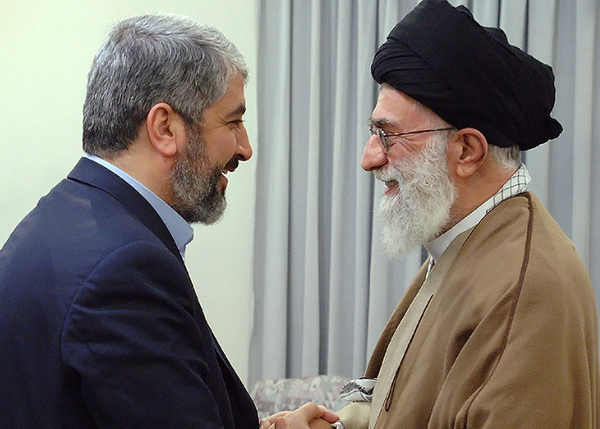
Bridging the Sunni-Shia divide, for the goal of genocide: Hamas leader Khaled Mashaal (left) confers with Iranian Supreme Leader Ali Khamenei, in 2010. (Image source: Office of the Supreme Leader)
UNRWA and Iran, with a supporting role played by the United States, have long made it possible for Hamas and the PA to spend other people’s money building more tunnels, arming multiplemilitias, paying “salaries” to convicted terrorists in Israeli jails, and improving the quality of their rockets and missiles. They know — and Israel knows — that between the Israeli government and the international aid agencies including, but not limited to, UNRWA, no Palestinians will starve, no one will go without medical care, no one will go homeless (except those homeless because Hamas confiscated about 20% of the cement and steel meant to restore Gaza houses damaged in last year’s war). Hamas can therefore use all its funds to make war.
As long as Hamas and the PA are permitted both to spend sponsors’ money on terrorism and warfare while escaping responsibility for the needs of their people, and as long as Iran is a key donor — with all the temptations, means and opportunity to “wipe Israel,” as it repeatedly threatens to do — the idea of a U.S.-led “peace process” is fantasy.
(The views expressed in this article are mine and do not necessarily reflect those of Warsclerotic or its other editors. — DM)
Courtesy of Obama, Iran’s mushroom clouds will be produced by detonating atomic bombs. Obama’s mushroom clouds, with help from His friends, have already been and continue to be detonated. They thrive in the absence of light and contain copious quantities of bovine fecal matter.
This limerick, if applied to Obama, makes sense:
Last night I saw upon the stair A little man who wasn’t there. He wasn’t there again today. Oh how I wish he’d go away!
I. Obama gave Iran its mushroom cloud
Several conservative media recently focused on Obama’s claim, made in His August 5, 2015 address praising His “deal,” that Iran had agreed to negotiate only after President Rouhani replaced Mahmoud Ahmadinejad on August 3, 2013:
it was diplomacy, hard, painstaking diplomacy, not saber rattling, not tough talk, that ratcheted up the pressure on Iran. With the world now unified beside us, Iran’s economy contracted severely, and remains about 20 percent smaller today than it would have otherwise been. No doubt this hardship played a role in Iran’s 2013 elections, when the Iranian people elected a new government, that promised to improve the economy through engagement to the world. [Emphasis added.]
A window had cracked open. Iran came back to the nuclear talks.
Obama did not mention that Rouhani could neither have run for office nor been elected without the backing of Iran’s Supreme Leader Khamenei. As far as I have been able to determine, neither Obama nor Kerry has said anything denying, acknowledging or explaining Senator Kerry’s “negotiations” with Iran which, as I noted here on August 13th, had begun in 2011, long before Ahmadinejad left office in 2013.
During those early “negotiations,” Kerry had already conceded Iran’s right to enrich Uranium, that the nuclear dossier would be closed and that the Possible Military Dimensions (“PMDs”) of Iran’s nuclear program would be ignored resolved.
Although Obama has claimed otherwise, the timing of P5+1 negotiations vis a vis Rouhani’s arrival in office makes little sense. Rouhani sought and got — courtesy of Kerry’s earlier concessions — at least as many concessions from the Obama-led P5+1 farce as Ahmadinejad could have got. Perhaps he got more, due to erroneous perceptions that Rouhani was a moderate and that Iran had changed course for the better. Such perceived changes also led to hopes that Iran would become a helpful U.S. Middle East ally.
In 2013, Hassan Rouhani was, for lack of a better word, “elected” president of Iran replacing the noxious Mahmoud Ahmadinejad. Rouhani, a grandfatherly-like figure with an affable smile, appeared to be, at least outwardly, more moderate than his predecessor, but in reality expressed the same rancid, xenophobic views. He was quoted as saying that “the beautiful cry of ‘Death to America’ unites our nation,” and referred to Israel as a “wound,” “a festering tumor” and the “great Zionist Satan,” among numerous other reprehensible pejoratives.
Israel’s Prime Minister Benjamin Netanyahu, in an address to the United Nations, dryly noted that while Ahmadinejad was a wolf in wolf’s clothing, Rouhani was a wolf in sheep’s clothing, but both were wolves nonetheless. What’s more, real power in Iran vests not with the nation’s president, but with its Supreme Leader, Ali Hosseini Khamenei, a pernicious man who seems incapable of addressing crowds without inserting at least one “death to America” reference somewhere in the speech. Indeed, just four days after signing the Joint Comprehensive Plan of Action (JCPOA) he addressed a large crowd and repeated the tired banalities of “death to America” and “death to Israel.” Khamenei is also solely responsible for vetting and approving presidential candidates which means that he found Rouhani to be an acceptable contender and that speaks volumes about what kind of character Rouhani is. [Emphasis added.]
. . . .
Despite the given realities about the Islamic Republic and its malevolent nature, Obama attempted to sell the American public on the nonsensical notion that the election of Rouhani ushered in a new period of Iranian enlightenment and moderation and afforded the U.S. an opportunity for meaningful engagement with the mullahs on their nuclear program. On that premise, he led the American public to believe that it was only after the election of the “moderate” Rouhani that the U.S. chose to engage Iran. [Emphasis added.]
Kerry had representatives of The Sultanate of Oman deliver a letter he had written to Iranian officials recognizing Iran’s Uranium enrichment rights and suggesting secret negotiations. Omani officials discussed the letter with Iranian officials and, when the Iranians appeared skeptical, the Omani official suggested,
Go tell them that these are our demands. Deliver [the note] during your next visit to Oman.’ On a piece of paper I wrote down four clearly-stated points, one of which was [the demand for] official recognition of the right to enrich uranium. I thought that, if the Americans were sincere in their proposal, they had to accept these four demands of ours. Mr. Souri delivered this short letter to the mediator, stressing that this was the list of Iran’s demands, [and that], if the Americans wanted to resolve the issue, they were welcome to do so [on our terms], otherwise addressing the White House proposals to Iran would be pointless and unjustified. [Emphasis added.]
“All the demands presented in this letter were related to the nuclear challenge. [They were] issues we had always come up against, like the closing of the nuclear dossier, official recognition of [the right to] enrichment, and resolving the issue of Iran’s past activities under the PMD [possible military dimensions] heading. After receiving the letter, the Americans said, ‘We are definitely and sincerely willing, and we can resolve the issues that Iran mentioned.’” [Emphasis added.]
a full accounting of Iran’s possible past atomic weapons research is not necessarily critical to reaching a nuclear deal with Tehran. His comments came amid concerns the Obama administration is backing down on demands that Iran resolve concerns about previous work as part of an agreement that would curb its nuclear program in exchange for sanctions relief. [Emphasis added.]
. . . .
“We know what they did,” Kerry said. “We have no doubt. We have absolute knowledge with respect to certain military activities they were engaged in. What we’re concerned about is going forward. It’s critical to us to know that going forward, those activities have been stopped and that we can account for that in a legitimate way.” [Emphasis added.]
Without knowing what Iran had been doing where, there is no viable way to know what it continues to do. Reliable information of that nature will not be available. Under the apparent terms of its secret deals with Iran, Iranians, not members of the IAEA, will inspect and take samples at military sites used by Iran for nuke weaponization. “Details” of the inspections will not be disclosed.
Kerry also claims to know “exactly” what the secret IAEA – Iran deals say, even though he has neither read nor seen them. In the video provided below, Kerry acknowledges just that beginning at about 10:00.
What aspect(s) of Iran’s nuke weaponization does Kerry have “absolute knowledge” about and how did he get it? The IAEA appears to have accumulated far less information than Kerry claimed to have on June 16th concerning Iran’s nuke militarization. Continuing to quote from the New York Times article linked above,
Much of Iran’s alleged work on warheads, delivery systems and detonators predates 2003, when Iran’s nuclear activity first came to light. But Western intelligence agencies say they don’t know the extent of Iran’s activities or if Iran persisted in covert efforts. An International Atomic Energy Agency investigation has been foiled for more than a decade by Iranian refusals to allow monitors to visit suspicious sites or interview individuals allegedly involved in secret weapons development. [Emphasis added.]
The November 14, 2013 Joint Plan of Action recognized Iran’s right to enrich Uranium for “peaceful purposes” — the reason asserted by Iran for enrichment. Iran’s need to enrich Uranium was mainly premised on its need to generate electricity. However earlier this month, Iran’s Deputy Foreign Minister and senior nuclear negotiator called Iran’s nukes for electricity program “a big loss” economically but necessary to defend the country’s honor.
In a leaked off-the-record meeting with journalists Saturday, Abbas Araqchi stressed that “if we want to calculate the expenses of the production materials, we cannot even think about it.” But, he said, “we paid this price so we protect our honor, independence and progress, and do not surrender to others’ bullying.”
Yet, he explained, “If we value our nuclear program based only on the economic calculations, it is a big loss.” [Emphasis added.]
. . . .
Due to the pressure from above, . . . the original report was removed by the national broadcasting service, which stated that the publication of Araqchi’s statements was a “misunderstanding.”
The November 13, 2013 Joint Plan of Action left open only where, how and how much Uranium Iran could enrich. It substantially ignored the nuclear dossier (i.e., nuke weaponization), Iran’s principal but denied reason for enrichment. It should, therefore, have come as no surprise that the 2015 “deal,” in conjunction with the secret deals between Iran and the International Atomic Energy Agency (IAEA), did the same, eliminating any chance that the IAEA might learn what Iran had been doing and whether it continues to do it.
Even before he became president, Barack Obama was imagining the possibilities of a diplomatic breakthrough with Iran. His willingness to reverse decades of official U.S. hostility was one of the things that set Obama apart on the campaign trail.
. . . .
Limited though it may be, the administration’s negotiation with Iran has shaken traditional allies such as Israel and Saudi Arabia. Meanwhile, through its action and inaction elsewhere in the Middle East, the U.S. has left both friends and enemies uncertain about what it will do next.
. . . .
The White House insists a nuclear deal with Iran would defuse the biggest threat to the region.
The Wilson Center’s Miller agreed a negotiated deal that stops or even stalls Iran’s nuclear program is preferable to the likely alternative of military action. But he dismisses as wishful thinking any expectation that Iran’s diplomatic rehabilitation will produce a new, more stable Middle East.
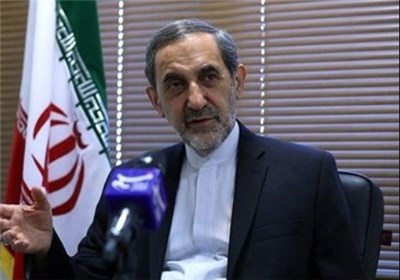
Iran’s Secretary-General of World Assembly of Islamic Awakening Ali Akbar Velayati praised the recent conclusion of nuclear talks between Iran and six world powers, saying that with the deal, Tehran has more strength to support its friends in the Middle East region. [Emphasis added.]
. . . .
Velayati, who is also the head of the Strategic Research Center of Iran’s Expediency Council, stressed the need for the consolidation of the anti-Israeli Resistance Front in the region. [Emphasis added.]
This is the Iranian mushroom cloud provided by Obama and Kerry:
III. Obama’s own mushroom cloud
Here is a photo of Obama’s mushroom cloud with one of His supporters standing contentedly in front of it:
Obama’s mushroom cloud, made of bovine fecal matter which Obama et al have asked us to swallow, has grown like Topsy. It’s full of many more lies than merely that He waited until Rouhani became Iran’s president to being nuke negotiations. His other lies, and those of His friends, are even less digestible. Here are just a few from Washington Free Beacon Supercuts to serve as aperitifs.
IV. Conclusions
The mushroom cloud detonated by Obama and Friends (“OAFs”) likely means that the “deal” with Iran will soon go into full effect. It will enable Iran to present us with its own nuclear mushroom cloud. It will also be of substantial assistance in furthering Iran’s hegemonic efforts to destabilize the Middle East.
Some mushrooms are good to eat. Obama’s cloud is full of toxic mushrooms. Perhaps they have made Obama, Iran and His other friends drunk with power; they are deadly for the rest of us.
(Great! More jobs for jihadists. Obama should like that. — DM)
TEHRAN (Tasnim) – Secretary-General of World Assembly of Islamic Awakening Ali Akbar Velayati praised the recent conclusion of nuclear talks between Iran and six world powers, saying that with the deal, Tehran has more strength to support its friends in the Middle East region.
Speaking at the opening ceremony of the 6th gathering of General Assembly of Ahl-ul-Bayt World Assembly here in Tehran on Saturday morning, Velayati, who is also the head of the Strategic Research Center of Iran’s Expediency Council, stressed the need for the consolidation of the anti-Israeli Resistance Front in the region.
“The Islamic Republic of Iran will always support the current (Resistance Front) and of course, with the nuclear agreement, it will have more power to side with its friends in the region,” he noted.
Iran and the Group 5+1 (Russia, China, the US, Britain, France and Germany) on July 14 reached a conclusion on a lasting nuclear agreement that would terminate all sanctions imposed on Tehran over its nuclear energy program after coming into force.
The Iranian official further pointed to the most important reasons behind regional crises, saying that despite the claims made by certain countries, the crises do not have religious or sectarian nature.
Velayati added that the regional problems has its roots in the plots hatched by Islam’s enemies, who are seeking to misuse some religious differences and portray a violent image of Muslims.
The 6th General Assembly of Ahl-ul-Bayt World Assembly was inaugurated with a speech by Iranian President Hassan Rouhani.
About1.800 foreign guests from 130 countries along with senior Iranian political and cultural figures have participated in the four-day event.








 anneinpt
 artaxes
 danmillerinpanama
 davidking1530
 Peter Hofman
 Joseph Wouk
 Peter
Peter Louisiana Steve
 WarSclerotic
Recent Comments