Posted tagged ‘Iranian proxies’

Oh by the way, Turkey is trying to get into a war w/Iraq

December 6, 2015

Oh by the way, Turkey is trying to get into a war w/Iraq, Front Page Magazine, Daniel Greenfield, December 6, 2015

hqdefault_1

Open question: What does Turkey’s deranged Islamist leader have to do to be disavowed by NATO, Europe and the US?

Erdogan armed terrorists in Syria, but pretty much everyone is doing that. He nearly began a war with Russia. Now Iraq keeps ordering Turkish troops off its soil. But they’re there at the supposed request of Sunnis militias around Mosul. Possibly to fight ISIS. But considering Turkey’s track record and Baghdad’s protests, probably not.

It’s a given that Baghdad, which has become a puppet regime for Iran, would oppose arming Sunni militias. Its preferred means of operation is through Iranian trained Shiite militias.

Since Turkey is really in Syria to overthrow Assad, it looks like its version of the Sunni-Shiite conflict is spreading to Iraq. Essentially Turkey is advancing into a war with the Shiite axis of Iran-Syria and its Russian patron, not to mention all the various Shiite terror militias.

I won’t object if Sunni and Shiite terrorists and their state sponsors shoot and bomb each other. Especially if it’s Turkey and Iran, but as long as Turkey is in NATO, its lunatic tyrant trying to revive the Ottoman Empire has the ability to drag us into his wars.

And that’s an obvious problem.

Turkey should not be in NATO. And only a madman would consider it for EU membership.

But Erdogan’s migrant games have forced Germany to come crawling to him offering cash and EU membership acceleration.

Obama, who was once closest to Erdogan, is obviously not about to cut him off no matter what he does. But the United States is now in the strange position of having a ridiculously confused presence in a Muslim civil war.

Obama is backing Sunni Jihadists in Syria and Shiite Jihadists in Iraq. He refuses to arm Sunni militias in Iraq, but stands by while Turkey carries out what is effectively an illegal invasion of Iraq. (Remember that one the next time Kerry squeals about Jews living in Jerusalem.) He backs Kurdish militias that Turkey is bombing. He’s trying to appease Iran and Turkey at the same time and it can’t work.

The only thing Obama has managed to do is shove the United States in the middle of a Muslim civil war while making occasional noises about un-Islamic ISIS.

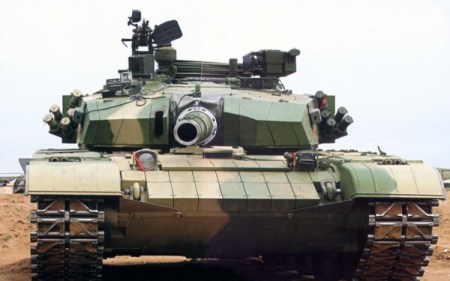
Russia brings over heavy T-90 tanks to boost three Syrian warfronts

December 6, 2015

Russia brings over heavy T-90 tanks to boost three Syrian warfronts, DEBKAfile, December 6, 2015

russian-tank-army-t-90-Syria_12.15

On Wednesday, Dec. 2, Russia started transferring dozens of advanced T-90 tanks to Syria, DEBKAfile’s military and intelligence sources report. They were moved immediately to two Syrian army fronts fighting rebel forces at the two most important cities, Aleppo and Damascus, and are expected to be sent to beef up the combined Syria, Iranian, Hizballah army poised to recover Palmyra from the Islamic State.

The shipment to the capital was delivered into the hands of the 4th armored division, Syria’s republican guard commanded by Gen. Ali Maher Assad, the younger brother of President Bashar Assad.

The attack on Palmyra in country infested by ISIS forces was scheduled to have begun two weeks ago but was delayed for the arrival of the heavy Russian tanks, among other reasons.

The T-90 weighs 46.5 tons and has a range of 375 kilometers, with an average speed of 45 km per hour under battle conditions or 65 km per hour on roads. It has three layers of defensive systems: composite armor plates on the turret; Kontact-5 third-generation explosive reactive armor on its front, sides, and turret that reduces penetration by kinetic energy bombs; and the “Shtora,” or curtain, an electro-optical active protection system that enables the tank to jam the systems of antitank missiles.

The T-90 also has 12 smoke mortars, a 125 mm cannon and AT-11 Sniper guided antitank missiles. The tank has proven itself in battle in recent years in Russia’s wars in Georgia and Chechnya against forces not unlike the Syrian rebels.

Until last week, Russia kept only a few T-90 tanks in Syria, mainly to protect its military bases around Latakia.

The new shipment, say Western military sources which are monitoring Russian movements, will eventually replace a large part of the Syrian army’s fleet of around 500 operational tanks, mostly T-72s – at least half of which are positioned to defend the capital.

But the pace of delivery will be dictated above all by the time needed for Russian instructors to retrain Syrian tank crews from scratch in the use of T-90s in battle conditions.

It should be noted meanwhile that, while the Syrian rebels have antitank missiles able to take out the T-72, they do not have advanced missiles capable of stopping the much heavier, reactively armed T-90. But  the Islamic State does, having captured US-made antitank missiles from the Iraqi armored divisions put to flight in June 2014. Some of those advanced missiles may be presumed to have been passed to ISIS forces in Syria.

For now, the Russian general staff shows no sign of preparing for a wide-scale operation against ISIS in Syria, so the newly-delivered T-90s are not immediately threatened from that quarter.

As far as Israel is concerned, the main worry is that Russian instructors will also be assigned to train Iranian and Hizballah tank crews in the use of the advanced T-90. Once they get hold of these tanks, they will be able to attain their objective of beefing up the Iranian-Hizballah front against Israeli defenses from southern Syria and the Syrian Golan.

Israeli finds cause for concern in the constant expansion of the Russian military presence and involvement in Syria. Preparations for a very long stay are signified by new developments every few days. A permanent Russian military presence in Syria would give Iran and Hizballah cover for a standing military buildup in Syria. This would confront Israel’s vital strategic interests with a major challenge.

Israel extremely nervous over Russian operations on its Golan border

December 2, 2015

Israel extremely nervous over Russian operations on its Golan border, DEBKAfile, December 2, 2015

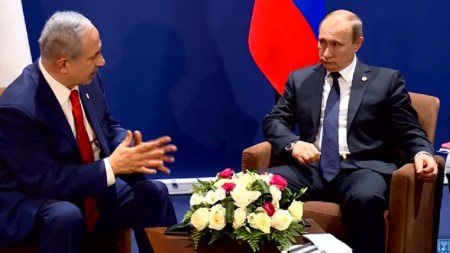
Netanyahu_speaks_with_Putin_Paris_30.11.15

Moscow may be giving Hizballah and Iran an umbrella for achieving their longstanding design to displace the Syrian rebels with Revolutionary Guards and Hizballah forces and deploy them along Israel’s Golan border.

**********************

On the outside, Israel is all smiles and full of praise for way the coordination with Moscow is working for averting clashes between its air force and Russian warplanes over Syria. This goodwill was conspicuous in the compliments Prime Minister Binyamin Netanyahu and President Vladimir Putin traded when they met on the sidelines of the Paris climate summit Monday, Nov. 30.

But the first disquieting sign appeared Tuesday, Dec. 1. Senior Russian and Israeli officers were due to meet in Tel Avid to discuss strengthening the cooperation between the two army commands. But no word from Moscow or Jerusalem indicated whether the meeting had taken place.

DEBKAfile’s military sources report that this week, the show of optimism is giving way to an uneasy sensation in the offices of the prime minister, Defense Minister Moshe Ya’alon and the IDF Chief of Staff Lt. Gen. Gady. They suspect an ulterior motive behind Russia’s military movements in southern Syria, especially its air strikes against Syrian rebels, just across from Israel’s Golan border.

In particular, Moscow may be giving Hizballah and Iran an umbrella for achieving their longstanding design to displace the Syrian rebels with Revolutionary Guards and Hizballah forces and deploy them along Israel’s Golan border.

This suspicion gained ground when Tuesday, Dec. 1, the day after the Putin-Netanyahu encounter, the combined Iranian-Syrian-Hizballah units expanded their thrust from the southern Syrian town of Deraa to the Golan town of Quneitra, within sight of Israel’s defense positions.

All that day, heavy battles raged over the rebel-held line of hills running from a point just south of Quneitra to the Israeli-Syrian-Jordanian border junction. The combined force was supported by Russian air strikes and heavy tanks and artillery, seen for the first time in this war arena.

When the fighting resumed Wednesday, the IDF placed its Golan units on high alert and an extra-vigilant eye was trained on this battle.

The Iranian-Syrian-Hizballah side is gaining a distinct advantage from the deep feud dividing rebel ranks. The Islamic State and the al-Qaeda-affiliated Syrian Nusra Front forces are tearing into each other with suicide bombers and explosive cars. Tuesday, an ISIS-rigged bomb car blew up at Nusra headquarters near Quneitra (see photo).

ISIS_car_bomb_in_Quneitra_nusra_1.12.15

But this also means that an Islamic State force has come dangerously close to the Israeli border.

However, even more perils are in store if Bashar Assad’s army backed by Iran, Hizballah and Russia manages to capture the hills opposite the Golan:

1. Two years of unrelenting Israeli military and intelligence efforts to keep Hizballah and Iranian forces away from its Golan border will have gone to naught.

2.  Hizballah will open the door for Iranian Revolutionary Guards officers to set up a command center right up to the Israeli border.

3.  Israel’s steadfast policy and military action to prevent advanced Iranian weapons reaching Hizballah in Lebanon via Syria will be superseded. On the Golan, Hizballah will have gained direct access to any weapons it wants directly from Syria and be able to deploy them at far shorter distances from Israeli targets than from their firing positions in Lebanon.

4.  Vladimir Putin attaches extreme importance to recovering southern Syria from the rebel forces backed by the US and Israel, because he regards the threat to the Assad regime as great from the south as it is from the north or the center.

5.  Israel faces a grave dilemma between keeping up its “honeymoon” with Moscow by giving way on its essential security interests, or taking the bull by the horns and keeping the enemy at bay, whatever the cost to the understanding reached with Putin.

Officials in Jerusalem point out that the threat to Golan peaked just hours after the Russian leader met the prime minister in Paris. Putin is conducting a hands-on policy on Syria and keeps close track of the slightest occurrence on the battlefield. He must have been perfectly aware of the state of play on the Golan when he met Netanyahu, but nonetheless kept it out of their conversation.

The French connection

November 17, 2015

The French connection, Israel Hayom, Ruthie Blum, November 17, 2015

When Islamist leaders condemned Friday night’s Paris attacks, which left more than 132 people dead and hundreds of others critically wounded, you just had to laugh through your tears.

Terror masters in Iran, Turkey, Syria and the Palestinian Authority actually had the gall to talk as if they themselves are not responsible for the ongoing murder of innocent people.

But hypocrisy, mendacity and lying as a matter of course are not the only reasons for their public expressions of solidarity with France during this frightful hour. In fact, what really bothers them is the fear that a rival group may be beating them at their own game. And hell hath no fury like a scorned, power-hungry radical Muslim with hegemonic aims and weapons with which to achieve them.

Such monsters, some in suits and ties to throw you off, are able to get away with playing the West for fools — particularly when the so-called leader of the free world keeps kowtowing to them, while espousing denial as a policy. Indeed, in the immediate aftermath of the bloodbath in Paris, U.S. President Barack Obama made a statement that put a smug smile on the faces of jihadists everywhere.

In the first place, he called the carnage “an attack on all of humanity and the universal values that we share.” This is an amazing assertion, since I don’t even share Obama’s values, let alone those of a great portion of “humanity” inside and out of Washington, D.C. You know, like the multimillions of anti-Semites, Christian-killers, women-subjugators and child-abusers who are trying to win the war over the world’s character and soul.

Secondly, the president said he didn’t “want to speculate at this point in terms of who was responsible for this.”

Right, responded radical Muslims in the privacy of their bunkers and bomb factories, for all Obama knew, the shootings and explosions in a theater, restaurants and at a soccer stadium could have been carried out by disgruntled Buddhists.

By the time he arrived in Antalya to attend the G-20 economic summit less than 48 hours later, even the U.S. president could no longer plead ignorance. So he had to address the issue of Islamic State tentacles spreading every which way, in spite of his having announced a few days earlier that its threat had been “contained.”

Even members of the left-leaning media were challenging his claim that the way he’s been fighting the al-Qaida spin-off is still the right one. And this, while sidling up to Turkish President Recep Tayyip Erdogan, whose recent landslide re-election was a dark day for people with those ostensibly “universal” values Obama had mentioned.

The good news here is also the bad.

Effectively combating Islamic State is actually irrelevant in the wider context, as counterterrorism expert Sebastian Gorka has been trying to explain for years.

That Friday night’s multiple attacks in Paris were carried out by terrorists affiliated with ISIS is “wholly irrelevant,” Gorka — national security editor at Breitbart and military affairs fellow at the Foundation for the Defense of Democracies — told me this weekend. “All members of the global jihadist movement, be they Sunni or Shia, Arab, Persian or converts, are driven by the same desire: the need to kill the kuffar [infidels] for the glory of Allah. All attacks, be they 9/11, 7/7, Mumbai, Amman, Paris or the recent stabbings in Israel, are tied together by the connective tissue of jihadist ideology.”

He stressed, “It is time for us to realize — and demand of our leaders that they act accordingly — that we face an existential threat, which, over the long term, could be as dangerous as Hitler’s Third Reich. This is a war between good and evil. And only one side will prevail in the end.”

I still harbor hope that the former will emerge victorious. But this cannot happen unless certain conditions are met. These include: getting the nuclear-deal-obsessive Democrats out of the White House; making Europe understand that it should be labeling undesirable Islamists, not Israeli products; and raising children in the West to grasp that the blessed ability to live in a free society means being prepared to die defending it against its detractors and destroyers.

ISIS launches its winter terror offensive with first 274 deaths

November 13, 2015

ISIS launches its winter terror offensive with first 274 deaths, DEBKAfile, November 13, 2015

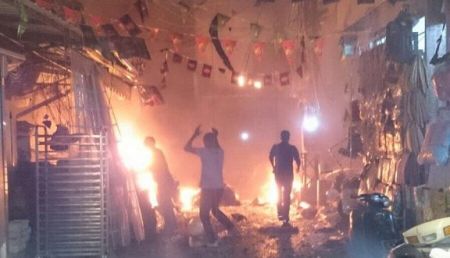
Borj_al-Barajneh12.11.15Suicide bombers strike Hizballah in Beirut
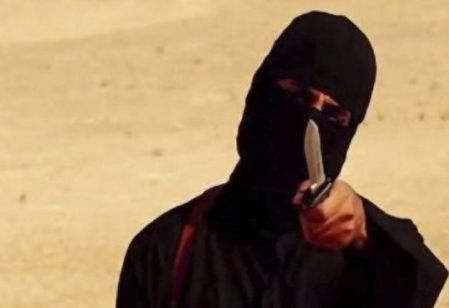
Execution of Steven Sotloff (1983 – 2014) by Jihadi John of ISIS. In August 2013, Sotloff was kidnapped in Aleppo, Syria, and held captive by militants from the Islamic State of Iraq and the Levant. Jihadi John (Mohammed Emwazi, born August 1988) a British man who is thought to be the person seen in several videos produced by the Islamic extremist group ISIL showing the beheadings of a number of captives in 2014 and 2015. (Photo by Universal History Archive/UIG via Getty Images)

Execution of Steven Sotloff (1983 – 2014) by Jihadi John of ISIS. In August 2013, Sotloff was kidnapped in Aleppo, Syria, and held captive by militants from the Islamic State of Iraq and the Levant. Jihadi John (Mohammed Emwazi, born August 1988) a British man who is thought to be the person seen in several videos produced by the Islamic extremist group ISIL showing the beheadings of a number of captives in 2014 and 2015. (Photo by Universal History Archive/UIG via Getty Images)

The US drone strike Thursday night, Nov. 11, targeting the Islamic State’s infamous executioner known as “Jihad John” in the northern Syrian town of Raqqa may or may not have hit the mark – the Pentagon says it is too soon to say. The hooded, masked terrorist with the British accent has been identified as a British Muslim born in Kuwait called Mohamed Emwazi. He appeared on videos worldwide showing the cold-blooded murders of US, British, Japanese and other hostages.

The drone attack occurred shortly after the latest ISIS atrocity: Thursday night, two or three suicide bombers blew themselves up, killing 43 people and injuring at least 240 in the Hizballah stronghold of southern Beirut opposite Burj Barajneh.

Ten days earlier, the Islamic State brought down the Russian Metrojet airliner over Sinai killing all 224 people aboard. This spectacular act of terror was apparently the first strike of the jihadist group’s winter offensive. It achieved its objectives of multiple murder; mortal damage to Egypt’s tourism industry and a blow to the prestige of its president Abdel-Fatteh El-Sisi.

The attack also punished President Vladimir Putin for bringing the Russian military into the center of the Syrian conflict.

The next Islamic State assault was aimed to undermine the credibility of Jordan’s King Abdullah and his security services: On Nov. 8,  a Jordanian police captain opened fire at a high-security US training facility outside Amman, killing two American trainers, a South African and two Jordanians. The number of US personnel injured in the attack was not released. This attack was timed to coincide with the 10thanniversary of the massive al Qaeda assault on Amman’s leading hotels, all American owned, which left 61 dead.

In northern Sinai, the murder of a family of 9 Egyptians at El Arish Thursday morning raised the total of ISIS murders in less than a month to 274.

DEBKAfile’s counterterrorism sources discern three objectives in the attack Thursday night in Beirut

1. A lesson for Tehran and Hizballah’s leader Hassan Nasrallah to show them that the Islamic State is able to reach them on their home ground, no matter how many troops they deploy to fight the jihadis in Syria (Iran and Hizballah together field an estimated 13,000 soldiers in Syria). ISIS was capable of inflicting terrible casualties both on the battlefield and in their homeland, first in Beirut and eventually in Tehran.

2.  The day before, Wednesday, Nov. 11, in a speech marking the “Day of the Shahid,” Nasrallah gloated over Hizballah’s triumph in a battle outside Aleppo. He also boasted that his domestic security shield in Lebanon presented an impenetrable barrier against ISIS or Nusra Front terrorist intrusions.

The Islamic State’s tacticians determined to blow up both claims in Nasrallah’s face. He and Iran were to be shown that they could not stop ISIS or prevent the Syrian war’s spillover into Lebanon.

3.  By blowing up the Russian airliner over Sinai, the Islamists sought to underscore this point for Moscow too. Russia might send a powerful military force to Syria, but the Islamists would hit Putin from the rear at a location of its choosing anywhere in the Middle East. Moscow may have opted to defend Bashar Assad, but what can it do to protect Hizballah and its other allies?.

DEBKAfile’s counterterrorism sources note that US and Russia have taken lead roles in the broad military effort to defeat ISIS – often by means of pinpointed operations. At the same time, under their noses, the Islamist terrorists have launched their winter campaign, striking with extreme ferocity and agility in unexpected places that are outside the regular battle fronts in which the big powers are engaged.

The Regional Storm Hits Israel

November 5, 2015

The Regional Storm Hits Israel, Israel DefenseAmir Rapaport, November 5, 2015

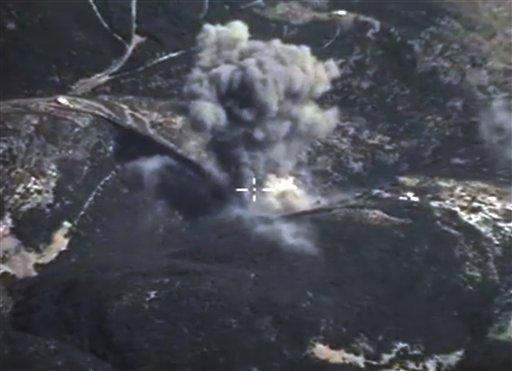
bomb in SyriaAn aerial view of a bomb explosion in Syria (Photo: AP/Russian Defense Ministry Press Service)

1. High Tide/Low Tide. When the “Second Intifada” broke out in October 2000, IDF used to refer to the riots and terrorist attacks in the Judea and Samaria area, as well is inside the territory of the State of Israel as “High Tide/Low Tide”, as each wave of riots was followed by a period of relative quiet, and then a new trigger emerged, leading to a wave of renewed violence, and so on.

Eventually, the “High Tide/Low Tide” incidents assumed a pattern of a murderous terrorist offensive, which took the lives of more than a thousand Israelis through suicide attacks, until the Intifada finally subsided in 2004.

The wave of riots and terrorist attacks that erupted about 15 years later, in the fall of 2015, appears to be connected, in some way or another, to the state of instability that characterizes many areas throughout the Middle East. For the last few years, the lion’s share of the fighting takes place in Syria, where hundreds of thousands of people were killed and millions more became refugees.

The major question that arose within the Israeli defense establishment in the fall of 2015 was whether this latest wave of terrorist attacks marks the outset of a “Third Intifada”. Although outwardly the Israeli interest is to announce “This is not a new Intifada,” in effect, there is talk about a “new situation” and no one knows how it will evolve.

Analyses performed within the defense establishment point to a number of reasons that suggest that this is a significant wave of terrorism which could turn out to be prolonged, as well as to reasons that justify the claim “This is not a new Intifada”.

One of the reasons that this wave of attacks is serious and could be prolonged is the religious motive: the Israeli media does not speak about it too often, but the Arab world is raging around rumors or reports that Israel actually intends to change the status quo on Temple Mount.

Even when one attempts to fish only “comfortable” data out of the statistics of the latest terrorist attacks, it is impossible to ignore the increase, by tens of percent, in the number of violent incidents throughout the Judea and Samaria area as well as within the “Green Line” during the last few weeks.

On the other hand, one significant difference between October 2015 and “Black October” (following the outbreak of the Second Intifada 15 years ago), is that the Israeli security forces are currently operating freely throughout the Judea and Samaria area. Consequently, entering the hospital in Nablus did not call for tactical support by tanks and aircraft. During the Second Intifada, on the other hand, it took the IDF and ISA quite a long time before they succeeded in regaining control over the centers of the Palestinian cities, pursuant to Operation Defensive Shield, and even then, the control achieved was only partial.

The recent events erupted despite the fact that IDF and ISA operate continuously against terrorist detachments. In each of the last few years, 2,000-3,000 Palestinian inhabitants were arrested. 80% of them were sentenced by the courts to prison terms of several months minimum.

It is still difficult to predict how the events will evolve over the next few months, but in any case, it seems that we have “a new security situation” on our hands.

2. Vladimir Putin. Many people regard the regional instability as the direct result of the American strategy of minimizing US involvement in the region, due to separatism processes and shifting the focus of world attention to Eastern Asia and the Pacific region (among other things, owing to the reduced dependence on Arab oil).

The party that stepped very effectively into the vacuum left by the USA was Russian President Vladimir Putin, who currently positions himself as the regional “Sheriff”.

No one can overestimate the importance of the moves made by Russian President Vladimir Putin, who deployed military forces to Syria this fall and continues to position himself as the strong man of the Middle East who never abandons his allies, while the USA has “transmitted” that her allies cannot rely on US support (as the USA had abandoned Egyptian President Hosni Mubarak in 2011).

This fall, the Russians deployed to Syria fighter aircraft that attack targets of the rebels opposing the military of President Bashar al-Assad. These moves were carefully coordinated with Iran, which, for her part, deployed hundreds of troopers (who are currently helping Hezbollah withdraw some of its forces back to Lebanon).

The Russian-Iranian move may have been intended to exert pressure on Saudi Arabia that supports the rebels, as well as to raise the price of oil, which is important to the economies of both countries.

Complicated? Even if there is no connection between the moves in Syria and the energy market, there is a definite connection between the fighting in Syria and the war raging in the southern part of the Arabian Peninsula. A solution in Syria may project on the war over there, as in both regions Iran and Saudi Arabia support opposing sides, with the conflict between the Shi’ite and Sunni factions of Islam as the backdrop.

Behind the scenes of the latest developments in Syria there has always been a Russian plan to bring about the end of the civil war in Syria by dividing it into areas of influence, with about 30% of the territory, in the Tartus and Lattakia area, remaining under control of the Alawite community of the current President, Bashar al-Assad.

Russia is interested in the sea ports in this area, and much less in maintaining Assad in control over a part of the disintegrated country. The Russians will not yield to the American demand to remove Assad from power until they have guaranteed their important interests. The party expected to pay the price is Israel, which may find itself, within a few months, facing a de-facto Iranian and Hezbollah domination on the other side of the border with Syria on the Golan Heights.

This situation could evolve despite the fact that Israel and Russia coordinate some of their respective moves, as indicated by the trip made by Prime Minister Netanyahu’s to Moscow last September, accompanied by the IDF Chief of Staff, Lt. Gen. Gadi Eizenkot, and Head of the IDF Intelligence Directorate, Maj. Gen. Hertzi Halevi, during which they met with “Sheriff” Putin.

3. Meanwhile, in the South. The good news come from the south, where Egypt under Abdel Fattah el-Sisi is determined to defeat the forces of al-Qaeda and the Islamic State that operate throughout the Sinai Peninsula. Egypt, Israel and the USA cooperate closely in the context of this effort, owing to their shared interests.

El-Sisi regards Hamas in the Gaza Strip as an enemy, owing to the cooperation between Hamas and the Egyptian Muslim Brotherhood movement, which is engaged in an on-going conflict with his regime.

Hamas itself is under tremendous pressure from different directions: from Egypt, which cuts off the underground tunnels connecting the Gaza Strip with the Egyptian territory, as well as from al-Qaeda and elements identifying with the Islamic State, who urge the leaders of Hamas to renew the fighting against Israel and occasionally even launch a rocket into Israeli territory in order to motivate Israel (which regards Hamas as the party responsible for such launches) to attack Hamas.

The reality that emerged in the Gaza Strip is yet another example of the complexity in our region. Iran, encouraged by the signing of the nuclear agreement with the superpowers, has renewed its support for Hamas, both financially and militarily (despite the fact that Hamas identifies with the rebels fighting against Bashar al-Assad in Syria and in Iran itself).

The positive bottom line is that Hamas, owing to its own considerations, does its best to maintain the ceasefire agreement reached with Israel following Operation Protective Edge in the summer of 2014. That state of affairs remained in effect until the fall of 2015 but reality, as everyone knows only too well, is highly dynamic.

4. A Small Military. One of the most significant moves expected within IDF in November is the endorsement of the long-term plan for the coming five-year period, and the conversion thereof into an effective order for execution.

“Gideon” is the name of the new multi-year plan led by IDF Chief of Staff, Lt. Gen. Gadi Eizenkot. The plan is intended to rely on the long-term budget allocated to the IDF according to the recommendations of the Locker Committee, and will come into effect in 2016, after five years during which IDF have operated without a long-term plan, as the previous plan had ended as far back as during the tenure of Lt. Gen. Gabi Ashkenazi as Chief of Staff. The Gideon plan is intended to convert the IDF into a technological, cyber-based military organization, possessing fast maneuvering elements equipped with accurate, lethal weapons and enhanced sea and air branches. Above everything else, the most substantial investment will be made in intelligence.

The greatest concern among quite a few elements within the defense establishment pertains to the size of the military, as the new plan calls for the demobilization of quite a few units. One of the principles of Israel’s national security concept since the days of David Ben-Gurion is the need to maintain a strong, substantial military force, based on hundreds of thousands of reservists. The principle is still valid, but in effect, the emphasis is placed on intelligence, air power and commando operations. The substantial ground army, along with its massive tank OrBat, is reduced dramatically – which is inconsistent with the aforesaid principle.

5. Defense Exports. Nearing the end of 2015, the Israel Ministry of Defense and the Israeli defense industries embarked upon a massive sales effort. Between October and December, they will take part in not less than five major defense exhibitions in the USA, South Korea, Japan, Colombia and Thailand.

Even if that effort proves successful, the statistics for 2015 will indicate that Israeli defense exports still follow the downward trend that began in 2014. At best, the defense exports for 2015 will amount to US$ 5 billion, as opposed to US$ 7 billion in 2013.

The main reason for this decrease is the end of the global campaigns in Iraq and Afghanistan. Several major deals that are still on the agenda, mainly in India, can still change the picture before the end of 2015 and lead to a positive trend in terms of the scope of exports. In any case, the contribution made by the defense exports, which amounts to billions of dollars, to the Israeli economy and to the Israeli security resilience is immense. The massive proceeds enable the Israeli defense industries to continue to invest funds in research in order to develop products at the cutting edge of technology.

What coordination? Russia and Israeli warplanes play cat and mouse over Syria

November 2, 2015

What coordination? Russia and Israeli warplanes play cat and mouse over Syria, DEBKAfile, November 2, 2015

AttackinSyria480

Syrian media reported an Israeli air force attack Sunday, Nov. 1, after two sorties Friday night against Syrian army and Hizballah bases in the Qalamoun Mountains on the Lebanese border. The IDF declined to confirm or deny these reports. Syrian sources described a large number of Israeli airplanes as bombing a Hizballah unit based in the village of El Ain in northern Lebanon and the arms depot of the 155thBrigade of the Syrian army at Al-Katifa to the east.

The two targets are 70 km apart. So these air strikes must have targeted two key points along the Iranian arms supply route to Hizballah.

They also raise three important questions:

1. Did Israel’s Tel Aviv command center use the hotline to Russian headquarters to give Moscow prior warning of air strikes against Syrian and Hizballah targets, explaining that no harm was intended to the Russian military in Syria?

Hardly likely; the Russians would not be expected to tolerate Israeli bombardments so close to their own military enclave in Latakia province.

2.  Did Russian surveillance planes and stations detect the approach of Israel’s bombers and decide not to interfere?

After all, Israel has turned a blind eye to repeated Russian air strikes in the last few days against rebel positions in the southern Syrian town of Deraa and Quneitra opposite IDF Golan positions. The two cases suggest a gentlemen’s agreement between Russia and Israel to abstain from interfering with each other’s air operations over Syria, so long as there are no direct clashes between the two air forces. This could easily have happened when Russian planes bombed Quneitra.

So is Moscow giving Israel enough aerial leeway to strike Iranian, Syria and Hizballah targets so long as there is no interference in Russian operations?

That too is unlikely because it would amount to permission for the Israeli air force to operate inside the anti-access/area denial bubble which the Russian air force has imposed over Syria.

3.  Did the Israeli air force use electronic warfare measures to jam the tracking systems installed in Russian spy planes and air defense missile systems in Syria?

DEBKAfile’s military sources have this answer: Israel and Russia have been conducting a clandestine electronic contest for 33 years, since the memorable episode in 1982, when the Israeli air force destroyed in a single strike the entire Russian air defense missile system installed in Syria.

Since then, the Russians have worked hard to develop electronic warfare measures for gaining on the Israeli edge, without much success.

This was strikingly demonstrated in September 2007, when the Russian-made electronic tracking and warfare systems, which were the backbone of Syria air defense missile batteries, missed the Israeli warplanes as they came in to bomb the North Korean-built Iranian-Syrian plutonium reactor going up in northern Syria.

This lapse may have recurred in the case of the Israeli air sorties Saturday.

Russia warns that Syria war could become a ‘proxy war’

November 1, 2015

Russia warns that Syria war could become a ‘proxy war’ BreitbartJohn J. Xenakis, November 1, 2015

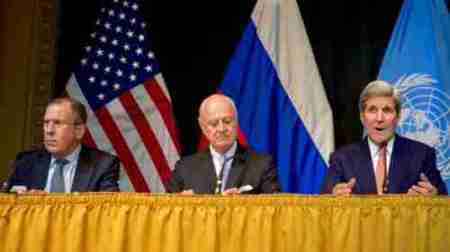
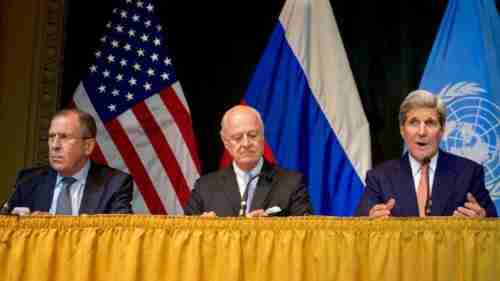
g151031bL-R: Sergei Lavrov, United Nations Special Envoy for Syria Staffan de Mistura, and John Kerry in Vienna on Friday (state.gov)

Russia has poured millions of dollars of heavy weapons into Syria, and is now sending in Russian troops to establish bases there. Recently, Russia launched 27 cruise missiles from the Caspian Sea to targets in Syria. Iran is pouring new troops into Syria. Iran has also given Lebanon’s Hezbollah terrorist group a great deal of money, and Hezbollah has sent thousands of troops into Syria to support Syria’s president Bashar al-Assad.

Al-Assad’s genocidal attacks on innocent Syrian Sunnis, killing hundreds of thousands and forcing millions from their homes, has caused Sunni jihadists from all of the world to fight against al-Assad, Russia, Hezbollah, and Iran in Syria. Along the way, these jihadists formed the so-called Islamic State (IS or ISIS or ISIL or Daesh).

And now, on Friday, Russia’s Foreign Minister Sergei Lavrov made a pronouncement that Barack Obama was going to trigger a “proxy war” in Syria by sending in 50 special operations forces, as we reported yesterday.

You can’t make this stuff up.

Thanks to Iran, Russia, al-Assad and Hezbollah, there are now tens of thousands of foreign troops fighting each other in Syria, with al-Assad in particular supported by massive amounts of foreign weapons.

But somehow, those tens of thousands of foreign fighters don’t make it a “proxy war,” but America’s 50 special forces troops do.

You can’t trust any garbage that comes out of Lavrov’s mouth, or out of al-Assad’s mouth, or out of Vladimir Putin’s mouth, but I listen to BBC, al-Jazeera, FOX, CNN, and other media sources all the time, and I see these news anchors report this crap with a straight face all the time. I don’t know whether it is more sickening to watch those fatuous news anchors, or to watch the fawning Secretary of State John Kerry suck up to Lavrov and Putin, which has happened in issues involving Ukraine, Iran’s nuclear development, and Syria.

All this verbiage is coming out of a meeting in Vienna whose purpose is to find a “political solution” to the Syria problem. With hundreds of thousands of Syrian migrants pouring into Europe, and with hundreds of ISIS militants returning to Russia to fight Putin, there is a lot of pressure to find a “political solution.” But this week’s announcement that Iran will fully enter the war in Syria on the side of the Syrian regime makes any “political solution” farther away than ever. On the contrary, Saudi Arabia and other Gulf countries will never agree to anything like the emerging situation. Actions by Russia and Iran, intervening militarily in Syria, is an emerging disaster, likely triggering a sectarian Sunni versus Shia war throughout the region. BBC and International Business Times and Reuters

Syria’s civil war and Generational Dynamics

In the 12 years that I’ve been doing this, I’ve posted about 4,000 articles with hundreds of Generational Dynamics predictions.

In 2011, when the Syrian civil war began, I said that the war should fizzle within a year or two. Of all the hundreds of Generational Dynamics predictions, this is the one where I’ve clearly been (depending on how you look at it) either wrong or poorly described.

Syria’s last generational crisis war was civil war that climaxed in 1982 with the massacre at Hama. There was a massive uprising of the 400,000 mostly Sunni citizens of Hama against Syria’s president Hafez Assad, the current president’s father. In February, 1982, Assad turned the town to rubble, 40,000 deaths and 100,000 expelled. Hama stands as a defining moment in the Middle East. It is regarded as perhaps the single deadliest act by any Arab government against its own people in the modern Middle East, a shadow that haunts the Assad regime to this day.

(As a related matter, the civil war in Lebanon also climaxed that year, with the bloody massacre at Sabra and Shatila occurring in September 1982. And it occurred as the Iran/Iraq war was ongoing, three years after Iran’s bloody Great Islamic Revolution in 1979. At that time, much of the Mideast was re-fighting World War I and the collapse of the Ottoman Empire, 60 years earlier.)

So, in 2011, I said that the civil war in Syria would fizzle, and could not turn into a crisis civil war. And that’s both wrong and true. There are too many survivors who remember the 1982 slaughter, and do not want to see it repeated. And so there’s been no massive anti-government uprising, as there was in 1982, and Bashar al-Assad’s Shia/Alawite troops have been fighting half-heartedly, with many soldiers defecting or deserting.

But the war did not fizzle.

It should have fizzled in 2011 or 2012, but Hezbollah and Iran starting pouring troops in to support al-Assad. And foreign fighters from around the world arrived to fight al-Assad and to form ISIS. That’s not something that Generational Dynamics could have predicted.

Earlier this year, it looked like al-Assad’s army was near collapse. In July, a desperate al-Assad gave a national speech in which he admitted he was losing. The war should have fizzled this year. But now, Russia and Iran are pouring tens of thousands more troops into Iran to bolster al-Assad. And that also is not something that Generational Dynamics could have predicted.

So the problem for me is: How should I have characterized the situation in 2011? The prediction that it wouldn’t turn into a crisis civil war was correct, but the war did not fizzle, because it turned into a proxy war.

Well, I don’t think there’ll be a next time, but if there is, I’ll try to characterize the situation differently, without simply using the word “fizzle.” NPR (1-Feb-2012)

Generational Dynamics and crisis civil wars

I write about a number of civil wars going on in the world today, so this is a good time to discuss civil wars from the point of view of Generational Dynamics.

Among generational crisis wars, an external war is fundamentally different than a civil war between two ethnic groups. If two ethnic groups have lived together in peace for decades, have intermarried and worked together, and then there is a civil war where one of these ethnic groups tortures, massacres and slaughters their next-door neighbors in the other ethnic group, then the outcome will be fundamentally different than if the same torture and slaughter is rendered by an external group. In either case, the country will spend the Recovery Era setting up rules and institutions designed to prevent any such war from occurring again. But in one case, the country will enter the Awakening era unified, except for generational political differences, and in the other case, the country will be increasingly torn along the same ethnic fault line.

The period following the climax of a crisis war is called the “Recovery Era.” One path that the Recovery Era can take is that the leader of one ethnic group decides that the only way to prevent a new civil war is for him to stay in power, and to respond to peaceful anti-government demonstrations by conducting massive bloody genocide, torture and slaughter of the other ethnic group, in order to maintain the peace. (Dear Reader, I assume you’ve grasped the irony of the last sentence.)

For example, in a July article about Burundi, I described how Burundi’s Hutu president Pierre Nkurunziza was using such violence to quell Tutsi protests, supposedly to avoid a repeat of the 1994 Rwandi-Burundi genocidal war between Hutus and Tutsis.

As another example, in a June article about Zimbabwe, I described how Zimbabwe’s president Robert Mugabe was even worse. His 1984 pacification campaign was known as “Operation Gukurahundi” (The rain that washes away the chaff before the spring rain). During that campaign, accomplished with the help of Mugabe’s 5th Brigade, trained by North Korea, tens of thousands of people, mostly from the Ndebele tribe, were tortured and slaughtered. Later, Mugabe single-handedly destroyed the country’s economy by driving all the white farmers off the farms, resulting in one of the biggest hyperinflation episodes in world history.

That is what Bashar al-Assad is doing in Syria. Fearing a Sunni uprising, like the one in 1982, al-Assad is conducting a massive “peace campaign” by slaughtering and displacing millions of innocent Sunnis. As I wrote above, this should have fizzled in 2011 or 2012, but it’s turned into a proxy war, and it’s a disaster for the Mideast and the world.

But none of the above three examples is a crisis civil war. A crisis war has to come from the people, not from the politicians. So, for example, there’s a massive crisis civil war going on today in Central African Republic (CAR), between the Muslim ex-Seleka militias fighting Christian anti-Balaka militias.

Unlike the previous examples, CAR is in a generational Crisis era. CAR’s last generational crisis war was the 1928-1931 Kongo-Wara Rebellion (“War of the Hoe Handle”), which was a very long time ago, putting CAR today deep into a generational Crisis era, where a new crisis war is increasingly likely. That’s why the CAR is a genuine crisis civil war, and won’t fizzle out. In fact, it won’t end until it has reached some kind of explosive conclusion — of the kind we described in Hama or Sabra and Shatila. ( “2-Oct-15 World View — Violence resurges in Central African Republic crisis war”)

Generational Dynamics and war between Palestinians and Israelis

I’ll discuss one more example — not a civil war, but very similar to a civil war, with the same kinds of issues.

In the last few years, there have been three non-crisis wars between Israelis and Palestinians in Gaza. In each case, the Israelis destroyed Hamas’s infrastructure, ending the war. The war began again each time when Hamas’s infrastructure was rebuilt.

But the point I want to make is that these three non-crisis wars were all directed by politicians. Palestinians attacked when the leadership told them to, and stopped attacking when the leadership told them to stop.

What I have been describing in numerous articles recently is that there is emerging a major, fundamental, historic change.

In the emerging situation, young people today are no longer willing to listen to these leaders. According to the CIA World Fact Book, 20% of Gaza’s population are in the 15-24 age range, and so are 21% of the West Bank — about 200,000 males in each territory, or 400,000 young males total.

On the Israeli side, there are over 600,000 young males in the same age range. There have been unconfirmed reports of young Israelis also disgusted with the leadership. It is possible that, like the young Palestinians, they are willing to take matters into their own hands.

So in this environment, what could happen next? The last three Gaza wars were non-crisis wars, but the next one could be a crisis war between Israelis and Palestinians.

How can a crisis war begin? How about if those 200,000 young male Gazans blow holes in the walls, pour across into Israel and start killing Israeli citizens en masse in their homes and villages? And how about if they are joined by those 200,000 young male Palestinians on the West Bank, who start with the Jewish settlers and continue with the Jews in Jerusalem. And how about if the young Israeli males strike back and start killing Palestinians in their homes and villages?

Israel’s tanks and bombers would not be of much use. You can’t bomb Jerusalem, and you can’t bomb Israeli villages and settlements to kill Palestinians.

That is the difference. That is what a generational crisis war is like. It is not two tanks shooting at each other. It is hand to hand combat in homes, neighborhoods and streets by people armed with sticks and knives. It is what happened in Central African Republic last year, it is what happened in Rwanda in 1994, in Bosnia in 1994, and in Palestine in 1947.

And by the way, that assumes that the bloody mess stays confined to Israel and the Palestinian territories. The Palestinians are likely to be joined by tens or hundreds of thousands from Jordan, Lebanon and Egypt.

The recent widely reported changes in the attitudes and behaviors of young Palestinians is a sign that this kind generational crisis war is coming.

Putin has no long term strategy, says administration w/no long term strategy

October 31, 2015

Putin has no long term strategy, says administration w/no long term strategy, Front Page Magazine, Daniel Greenfield, October 31, 2015

hqdefault

This is an administration that believes you win wars with word games

Obama claimed that Putin is acting in Syria out of weakness and is being all reactive. Then he reacted by shipping weapons to Sunni rebels, a move he had originally rejected, and sending American soldiers into combat as boots on the ground.

Now DNI James Clapper is claiming that Putin is being impulsive and has no long term strategy. This comes from an administration that changed its mind several times about intervening in the Syrian Civil War and keeps saying it still doesn’t have a plan for defeating ISIS.

Clapper said Putin was “very impulsive and opportunistic” as he increased Russian support for close ally President Bashar al-Assad in Syria’s roiling civil war.

“I personally question whether he has some long-term strategy or whether he is being very opportunistic on a day-to-day basis,” Clapper told CNN’s Jim Sciutto. “And I think his intervention into Syria is another manifestation of that.”

Being “opportunistic” is actually how real life battles are fought. You have a strategy, but you seize advantages based on the evolving situation on the ground.

So far Putin’s long term strategy has been to expand Russian influence in the region. It’s working really well. Russia is back to being the regional alternative to the US. It’s securing strategic territories and its allies are expanding their sphere of influence.

On top of that, Putin managed to avert US air strikes on Assad with his fake WMD deal. Then he helped Iran secure its nuclear weapons program with the Iran deal. (I’ll grant that he had a lot of help from Obama and Kerry there.) Now he’s angling to get Obama on board a peace deal that keeps Assad in power and ends US support for the rebellion. Considering this administration’s foreign policy track record, he’ll probably get his way. While the administration clown car taunts him as weak and opportunistic and reactive and impulsive.

In the Cold War, the Soviets trash talked while the US got things done. Under Obama, the US talks trash and Russia gets things done. But this is an administration that believes you win wars with word games.

How is that working out for them?

World powers agree to more talks on Syria crisis

October 31, 2015

World powers agree to more talks on Syria crisis, Al Jazeera, October 31, 2015

(But please see, Iran-US Talks Limited to Nuclear Issue: MPs — DM)

Friday’s talks included an Iranian delegation for the first time.

***********************

Major powers meeting in Vienna for talks on Syria have found enough “common ground” to meet for a new round of talks in two weeks, even as the conflict enters a new phase with the deployment of US special forces in the country.

President Barack Obama has ordered the deployment of fewer than 50 commandos to help coalition forces coordinate with local troops, Josh Earnest, the White House spokesperson, said on Friday.

The troop announcement came as diplomats in the Austrian capital representing 17 countries and the EU agreed to launch a broad new peace attempt to gradually end Syria’s long civil war – a declaration that avoided any decision on when President Bashar al-Assad might leave.

A Syrian member of parliament said the decision is an aggression because it does not involve the government’s agreement.

Sharif Shehadeh told AP news agency on Saturday that the troops will have no effect on the ground, but Washington wants to say that it is present in Syria.

It is not clear how many rebel groups would agree to a plan that does not result in Assad’s immediate departure.

Sergey Lavrov, Russia’s foreign minister, said on Friday a US decision to deploy special forces in Syria would make cooperation between the armed forces of the two countries more important.

“I am sure that neither the United States nor Russia want [the conflict] to become a so-called proxy war,” Lavrov said after the talks in Vienna.

“But it is obvious for me that the situation makes the task of cooperation between the militaries more relevant.”

Friday’s talks included an Iranian delegation for the first time.

Representatives from Britain, Egypt, France, Germany, Italy, Lebanon, the EU and other Arab states also attended.

The participation by Russia and Iran in the attempt could mark a new and promising phase in the diplomacy since those countries have staunchly backed Assad.

‘Tough conversations’

Any ceasefire agreement that may come as a result of the peace effort would not include the Islamic State of Iraq and the Levant (ISIL) group, which controls large parts of northern Syria and has its capital there.

“There were tough conversations today,” John Kerry, US secretary of state, said on Friday. “This is the beginning of a new diplomatic process.”

Kerry acknowledged that those present have major differences regarding the Assad government.

“But we cannot allow the differences to get in the way of diplomacy to end the killing.”

Federica Mogherini, the European Union foreign policy chief, said there is “hope” for a political process to advance, saying that those involved in the talks “found common ground” for further discussion.

“It was a very long and very substantial meeting. This was not an easy one, but for sure a historical one,” she said while praising “those who took difficult decisions” in joining the talks.

Lavrov said those present in the meeting spent a “long time” pushing for an inclusive Syrian-led peace process.

Among the points agreed upon during the talks was that ISIL cannot be allowed to reign in Syria, he said.

In a rare hint of diplomatic progress, Iran indicated it would back a six-month political transition period in Syria followed by elections to decide Assad’s fate, although his opponents rejected the proposal as a trick to keep him in power.

In addition to Assad’s fate, on which delegates said no breakthrough had been expected, sticking points have long included the question of which rebel groups should be considered “terrorists” and who should be involved in the political process.

Al Jazeera’s Mohammed Jamjoom, reporting from Vienna on Friday, said that there was a “mood of optimism” following the talks.

“There is a sense of hopefulness, which has been absent in these talks for quite a long time now,” he said.

The talks came as Syrian government air strikes continued in rebel-held territories, killing at least 61 people and wounding over 100 others in the Damascus suburb of Douma on Friday.

A further 80 people were killed in government and Russian air strikes in Aleppo province.