Posted tagged ‘Iranian proxies’

IDF Racing to Restructure Itself for New Middle East Warfare

February 24, 2016

IDF Racing to Restructure Itself for New Middle East Warfare, Investigative Project on Terrorism, Yaakov Lappin, February 23, 2016
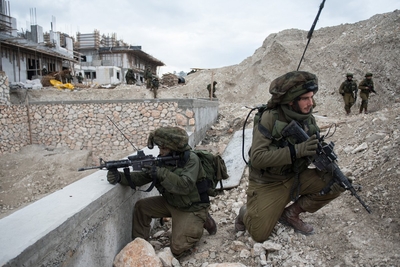
1362Photo Credit: IDF Spokesperson

The Israel Defense Forces (IDF) is in a race against time, and it is a race that is relevant to how other Western powers will also deal with the rise of radical, armed, Islamic groups proliferating across the Middle East.

As the IDF’s commanders look around the region, they see heavily armed, hybrid, Islamic sub-state foes that are replacing states. The traditional threat of hierarchical armies is fading quickly away, into obscurity.

The Sunni and Shi’ite jihadist entities on Israel’s borders – Hamas, Hizballah, ISIS-affiliated groups in Syria, Jabhat Al-Nusra, as well as elements of Iran’s IRGC forces – are all building their power and preparing for a future unknown point in time when they will clash with Israel.

The IDF is preparing, too, but it is not only counting how many soldiers, tanks, fighter planes, and artillery cannons it can call up in the next round. The IDF is in a race to adapt to 21st century Middle Eastern warfare, which bears no resemblance to how wars were fought in the 20th century.

In this new type of conflict, enemies appear and vanish quickly, use their own civilians as cover, bombard Israeli cities with projectiles, seek out the weakest link in Israel’s chain, and send killing squads through tunnels to attack Israeli border villages.

In this type of clash, the enemy looks for a ‘winning picture’ at the start of any escalation. This means landing a surprise blow that will knock Israeli society off balance, at least for a short while.

To be clear, all of the hostile sub-state actors currently are deterred by Israel’s considerable firepower and are unlikely to initiate a direct, all-out attack right now.

The price they would pay for such action is deemed too high, for now.

Yet, opportunities and circumstances can suddenly arise that would alter these calculations, and put these terrorist organizations on a direct collision course with the IDF.

Israel has fought four conflicts against Hamas and Hizballah in the past 10 years, and emerged with the conclusion that the era of state military versus state military warfare is over.

Acknowledging this development is one thing; the organizational transformation that must follow is quite another. Israel did not want to enter any of the past four conflicts that were forced upon it, but since they occurred, they have aided in the IDF’s adaptation process, which has been as complex as it has been painful, and is far from over.

“What you have to do against an enemy like this, and it is a great difficulty for militaries, including the IDF, is to operate in a combined, cross-branch [air force, ground forces, navy] manner, and to keep it [operations] focused. Focus the ground maneuver and firepower, on the basis of the intelligence you get,” a senior IDF source said earlier this month in Tel Aviv, while addressing the challenges of adaptation.

Taking southern Lebanon, the home base of Hizballah, as an example, the area has well over 100 Shi’ite villages that have been converted into mass rocket launching zones.

With one out of every 10 Lebanese homes doubling up as a Hizballah rocket launching site (complete with roofs that open and close to allow the rocket to launch), Hizballah has amassed over 120,000 projectiles – some of them GPS guided – with Iran’s help. This arsenal, pointed at Israel, forms one of the largest surface to surface rocket arsenals on Earth.

Would sending several military divisions into such an area be sufficient for Israel in stopping the rocket attacks? Without focused intelligence, the military source argued, the answer is a resounding no. Israel’s reliance on intelligence has never been more paramount in the age of sub-state, radical enemies.

“The urban areas swallow up our forces. If we can’t focus the maneuver, no amount of forces will be sufficient in dealing with this issue. It must be focused, and the information that must direct this focus is real-time intelligence,” the source said.

The IDF’s Military Intelligence Directorate has the mammoth task of building up a battle picture and a database of targets ahead of any conflict. After a conflict erupts, it must start the process all over again within a few days, when the entire map of threats changes in the modern dynamic battlefield.

This is a far cry from the old intelligence work that looked at enemy tank divisions and infantry formation.

IDF planners believe that any future conflict with a hybrid, terror-guerrilla military force will consist of five stages. An “opening picture” – that surprise blow intended to shock Israelis – will mark the start of hostilities, in which Israel must deny the adversary its “winning picture.” This will be followed by an exchange of firepower. After a few days, Israel would need to call up reserves, and then launch a ground offensive. Throughout this period, the Israeli home front would absorb heavy rocket fire, while the Israel Air Force would pound enemy targets. The IAF could fire thousands of precision-guided munitions every 24 hours, if it deploys its firepower to the maximum, as it would in an all-out clash with Hizballah.

Israeli air defense systems like Iron Dome could soften the blow to the home front significantly, but this is truer with respect to Gazan rockets than against the downpour of Hizballah rockets and missiles, which would overwhelm air defenses.

The ground offensive must destroy “70 to 75 percent of [enemy] capabilities,” the source said. “If there are 100 missiles and two operatives on the other side, and you kill the operatives, than the missiles become irrelevant.”

The last phase is the end stage, and it is unlikely that an entity like Hamas or Hizballah would wave a white flag when hostilities conclude, even if most of their capabilities have been destroyed.

The era of clear-cut military victories, like Israel experienced in the 1967 Six Day War, is gone, the source said.

With this reality in view, the IDF’s steps to adapt itself to modern threats include the ability to gather huge quantities of intelligence and deliver them, in real-time, to the forces that need them most in the battlefield, right down to the level of a battalion commander.

This requirement includes establishing an “operational Internet,” an internal IDF network that allows battalion commanders to access Military Intelligence target data in their area, and direct their units accordingly.

It would also allow field commanders to communicate directly with a fighter jet pilot or drone operator, or even a missile ship commander, for the type of cross-forces cooperation the IDF thinks will be most effective in shutting down threats.

As a result, the IDF’s C4i Branch has spent recent years overcoming many hurdles and objections and integrating the command and control networks of the air force, navy, and ground forces. It then directly linked them up to Military Intelligence.

By the end of this year, the first IDF division will have a “military Internet” network, complete with applications and browsers, up and running.

“I don’t want a squad commander walking around with a screen in his hand. He has to be aware of his soldiers. [But] the battalion commander should certainly have this,” the source said.

In 2014, the IDF did not do a good enough job in detecting, in real-time, the location of Hamas rocket launches in Gaza. It got away with this failure because of the effectiveness of the Iron Dome anti-rocket batteries. But against Hizballah’s much larger arsenal, no amount of air defenses will be sufficient, and the IDF therefore is working on improving its rocket detection and accurate return fire abilities.

“In the next stage [of our development], if you detect the rocket launch areas and the centers of activity of the enemy, and transmit them [to your own forces], you can learn the enemy’s patterns better,” the officer said.

Knowing the enemy has never been more important for Israel’s ability to defend itself against the jihadist entities that are replacing states in the Middle East. As these radical Islamist organizations prepare for the day of battle, Israel does the same, through updating its old 20th century battle doctrines and bringing them up to speed with its rapidly changing and chaotic environment.

The Moral Cost of Appeasing Iran

February 24, 2016

The Moral Cost of Appeasing Iran, Gatestone InstituteMohshin Habib, February 24, 2016

♦ The leaders of both France and Italy set aside their values to appease the president of Iran.

♦ In France, protesters demanded that President François Hollande challenge the Iranian president about his country’s human rights abuses. France’s leadership, however, raised no questions of that sort. Instead, Mr. Rouhani was welcomed as a superstar.

♦ According to a 659-page report by Human Rights Watch, Iran’s human rights violations under Mr. Rouhani’s governance have been increasing. Social media users, artists and journalists face harsh sentences on dubious security charges.

♦ In November, the Iranian Supreme Court upheld a criminal court ruling sentencing Soheil Arabi to death for Facebook posts “insulting the Prophet” and “corruption on earth.”

Right after signing the Iran nuclear deal with itself — Iran still has not signed it, and even if it did, the deal would not be legally binding — members of the P5+1 (the five permanent members of the UN Security Council plus Germany) have been showing their eagerness to establish improved relations with their imaginary partner.

Last month, after the lifting of international sanctions, Iran’s president, Hassan Rouhani, went on a five-day trip to Italy and France.

Officials from the host countries were so enthusiastic to welcome the Iranian president, it was as if they were unaware of Iran’s multiple violations of The Treaty on the Non-Proliferation of Nuclear Weapons (NPT) — which Iran did sign in 1968. They also seemed unaware of Iran’s expansion into Syria, Lebanon and Yemen, as well as Iran’s continuing role in sponsoring global terrorism.

Although both the leaders of France and Italy seemed eager to appease the president of Iran, in Paris, thousands of demonstrators gathered on the streets to protest Mr. Rouhani’s visit, and staged mock executions to highlight Iran’s dire human rights violations. In 2014, for instance, at least nine people were executed on the charge of moharebeh (“enmity against God”).

Even today, dozens of child offenders remain on death row in Iran. According to Iranian law, girls who reach the age of 9 and boys who reach the age of 15 can be sentenced to capital punishment. A recent report by Amnesty International called Iran one of the world’s leading offenders in executing juveniles. Despite the country’s ratification of the Convention on the Rights of the Child — which abolishes the use of the death penalty against offenders under the age of 18 — the UN estimates that 160 minors remain on death row.

The Iranian delegation, according to The New York Times, had asked Italian officials to hide all statues leading to the grand hall of the Capitoline Museums — where a news conference between Prime Minister Matteo Renzi and the Iranian president took place — to avoid any “embarrassment” for Rouhani, who casts himself as a moderate and reform-seeker. So on the first stop of Mr. Rouhani’s European visit, statues were encased in tall white boxes. In addition, “The lectern, was placed to the side — not the front — of an equestrian statue of the emperor Marcus Aurelius, apparently to avoid having images of the horse’s genitals appear in news photographs.”

As any kind of image is haram (forbidden) in Islam, any form of statue is considered idolatry.

Many Italians expressed their outrage over the decision to censor the statues. They accused the government of betraying Italian history and culture for the sake of economic interests.

An Iranian women’s rights organization, My Stealthy Freedom, condemned the Italian government’s decision. In a post on their Facebook page, the group wrote:

“Italian female politicians, you are not statues, speak out. Rome covers nude statues out of respect for Iran’s president in Italy and Islamic Republic of Iran covers Italian female politicians in Iran. Dear Italy. Apparently, you respect the values of the Islamic Republic, but the problem is the Islamic Republic of Iran does not respect our values or our freedom of choice. They even force non-Muslim women to cover up in Iran…”

In France, protesters demanded that President François Hollande challenge the Iranian president about his country’s human rights abuses. France’s leadership, however, raised no questions of that sort. Instead, Mr. Rouhani was welcomed as a superstar.

Big business deals were signed. France’s car-maker Peugeot and Iran’s leading vehicle manufacturer, Khodro, are engaged in a €400 million partnership. France’s energy giant, Total, signed a Memorandum of Understanding to buy crude oil from Iran. Total will reportedly begin importing 160,000 barrels of oil per day starting on February 16. Twelve days after the West lifted economic sanctions, Airbus announced that Iran Air had agreed to purchase 118 new planes. The deal is estimated at $25 billion.

Prime Minister of France Manual Valls hailed his country’s trade agreements with Iran. “France is available for Iran,” he said.

During a recent visit to Tehran, Germany’s Foreign Minister, Frank Walter Steinmeier, asked the Iranian president to keep Germany in mind as a future stop on his next trip to Europe.

Meanwhile, according to a US State Department report, Iran has pledged to continue its assistance to Shiite militias in Iraq. Many of these militias have poured into Syria and are now fighting alongside the Assad regime. Rouhani’s government also continues to support its Lebanese proxy Hezbollah, and Palestinian militants in Gaza.

For many years, the Iranian president has kept up close ties with leaders of Hezbollah, including Abbas Moussavi (the former leader of Hezbollah who was killed in 1992) and Hassan Nasrallah. In March 2014, Mr. Rouhani publicly pledged support for Hezbollah.

Rouhani’s Defense Minister is a former Islamic Revolutionary Guards Corps (IRGC) officer, Brig. Gen. Hossein Dehghan. He commanded IRGC forces in Lebanon is Syria during Hezbollah’s founding years from 1982-1984.

Last September, Dehghan said that Tehran will continue arming Hezbollah, Hamas and any group that is part of the “resistance” against the U.S. and Israel. Iran, he explained, considers America to be the Great Satan.

“Hizbullah,” Dehghan stated, “does not need us to supply them with rockets and arms. Israel and the U.S. need to know this. Today, Hamas, the Islamic Jihad, and Hizbullah have the capability of producing their own resources and weapons themselves. Nevertheless, we shall not refrain from supporting them.”

As well as Dehghan, almost all of Rouhani’s appointments are either former members of the IRGC or other revolutionary institutions, such as Iran’s Judiciary and Intelligence Ministries.

Iran’s human rights violations under Rouhani’s governance have been increasing. A 659-page report published by Human Rights Watch concludes that Iranian authorities have repeatedly clamped down on free speech and dissent. “In a sharp increase from previous years, Iran also executed more than 830 prisoners.”

806Since Hassan Rouhani (right) became the president of Iran, the surge in executions has given Iran the world’s highest death penalty rate per capita.

Social media users, artists and journalists face harsh sentences on dubious “security” charges. In May 2014, four young men and three unveiled women were arrested after a video showing them dancing to the popular song “Happy” went viral on YouTube. They were sentenced to up to a year in prison and 91 lashes on several charges, including “illicit relations.”

In November, the Iranian Supreme Court upheld a criminal court ruling sentencing Soheil Arabi to death for Facebook posts “insulting the Prophet” and “corruption on earth.”

Netanyahu phones Putin for clarifications on the South Syrian ceasefire

February 24, 2016

Netanyahu phones Putin for clarifications on the South Syrian ceasefire, DEBKAfile, February 24, 2016

PutinBibi2-480

Prime Minister Binyamin Netanyahu phoned President Vladimir Putin Wednesday Feb. 24, to find out how the partial Syrian ceasefire due to go into effect Saturday Feb. 27 will affect Israel’s northern border security. According to the Kremlin statement, “The two leaders discussed the Middle East and reached agreement to hold a number of high-level contact meetings.”

Agreement was also reached on “a range of contact [meetings] on the high and highest level, taking into consideration the 25tyh anniversary of the establishment of diplomatic relations between the two countries,” the communiqué went on to say.

The language and content of this communiqué struck DEBKAfile’s diplomatic sources as oddly off the point compared with statements that came after past conversations.

It is hard to believe that the Russian President, while deeply immersed in tense exchanges with President Barack Obama and Iran’s Hassan Rouhani for tying up the ends of the approaching Syrian ceasefire, would give his attention to the celebration of a historic event.

The words did however convey the impression that the Russian leader was making an effort to calm Israel’s apprehensions about the coming stage of the Syrian crisis.

According to our sources, Netanyahu put in the call to Putin when he learned that the Russian and American presidents had agreed to get the partial ceasefire started in southern Syria, namely on the front closest to the borders of Israel and Jordan.

Israeli and Jordanian military officials have been trying to get a picture of how these arrangements would work and affect their national security, but Washington and Moscow are similarly tightlipped on information. This is also the reaction the Israeli Foreign Ministry’s Director General Dore Gold found when he called on Russian Foreign Minister Sergei Lavrov in Moscow on Feb. 18. The minister was polite but avoided direct answers to questions.

Israel is most deeply troubled by the possibility that Syrian army, Iranian and Hizballah forces currently in offensive momentum in South Syria will exploit the cessation of hostilities to advance towards its Golan border with hostile intent.

With only three days to go before the truce goes into effect, Israel has still not received any clear answers about whether the Russian air force will continue to strike Syrian rebel elements deemed “terrorists” unabated in close proximity to its northern borders.

US officials have tried in the last 24 hours to assuage Israel’s concerns, but they are no more forthcoming with clear information than the Russians.

Netanyahu therefore picked up the phone to the Russian president, with whom he maintains a friendly dialogue, to find out what was ahead in the wake of the truce and to ask for guarantees that Syrian, Iranian and Hizballah forces would not permitted to take advantage of the lull to gain ground.

The prime minister also asked Putin about the huge $14bn arms deal in negotiation with Tehran.

He is most unlikely to have been appeased by the bone the Russian president threw him about a joint celebration of an anniversary. The record is not assuring. In early January, Putin promised Netanyahu that he would make sure that Hizballah forces would not be part of the Russian-backed Syrian army offensive in the South. But then, on Jan. 27, a large Hizballah force entered the southern town of Daraa and Russian air strikes drew ever closer to the Israeli border, until explosions could be heard in Israel from a distance of no more than a few hundred meters.

What to Expect in Iran

February 22, 2016

What to Expect in Iran, Gatestone InstituteJagdish N. Singh, February 22, 2016

♦ “The destruction of Israel is non-negotiable.” — Mohammad Neza Naghdi, Commander of Iran’s Basij paramilitary force.

♦ Sanctions relief will mainly benefit Ayatollah Khamenei and members of the Revolutionary Guards: they control up to one-third of Iran’s economy.

♦ Part of the Iranian regime’s grand strategy is to inflict “death to America” and replace it with its own radical version of Islamic governance. Ayatollah Khamenei himself called for America’s destruction amid nuclear negotiations.

♦ Officials also believe Iran is indirectly funding the Islamic State (IS) in the Sinai. “Suitcases of cash” are sent directly to Hamas officials in the Gaza Strip; part of the money is then transferred to IS.

♦ Iran now poses an even greater threat. If democracies today continue their present policies towards Iran, it will only embolden Iran’s regime to continue its quest to obtain nuclear weapons as well as its terrorism and human rights violations.

Humanity seldom seems to learn its lessons. The governments of the world’s leading democracies appear to be suffering from this predicament in their nuclear dealings with the Islamic Republic of Iran. To avoid catastrophe, democracies need quickly to correct their course.

One of the fatal blunders of Western democracies is their repeated commitment to appeasing and delaying action against aggressive regimes. Between the two World Wars, despite plenty of evidence of the widely-declared global racist agenda of Germany’s Adolf Hitler, democratic powers waited to take action until it was too late. Hitler was able to carry out a genocide that continues to haunt many nations.

Today, Western democratic governments, with their Eastern counterparts such as India, seem on a similar course in dealing with the Islamic Republic of Iran.

The domestic and international agenda of the Khomeinist government is publicly documented. Since the Iranian Revolution of 1979, part of the regime’s open grand strategy is to inflict “death to America,” the leader of the free world, and replace it with its own radical version of Islamic governance. Under the current Supreme Leader Ayatollah Ali Khamenei and his Islamic Revolutionary Guards Corps (IRGC), Iran has been gaining influence across the Middle East, Latin America, the Caribbean and South Asia. Despite nuclear talks with the West, Iran’s goal of “death to America” remains. The Ayatollah himself even called for America’s destruction amid nuclear negotiations.

Currently, Iran is a major player in aiding the autocratic regime of Basher al-Assad in Syria, the Houthis in Yemen, Hezbollah in Lebanon, Palestinian Islamic Jihad and Hamas in the West Bank and Gaza and the Islamic State (IS) in Egypt’s Sinai Peninsula.

To advance its imperial agenda, Iran has proceeded to develop its conventional and nuclear ballistic missile program. According to Director of National Intelligence James Clapper, Iran has “one of the largest inventories of ballistic missiles in the Middle East.”

In line with Iran’s missile development program, Iran’s Revolutionary Guard Navy Rear Commander, Ali Fadavi, announced: “Based on the fifth five-year plan, we should materialize our objective of mass-producing military speedboats with the speed of 80 knots per hour… and are equipped with missiles with a range of 100km; the vessels no one can catch.”

Aside from its military aspirations, since the fall of the Shah in 1979, successive Iranian governments have voiced their plans to annihilate the State of Israel, the only pluralist democracy in the Middle East, and an effective military deterrent to Iran’s designs in the region.

Hostile messages have been pouring forth from Iran. Mohammad Neza Naghdi, Commander of the Basij paramilitary force, stated in clear terms in April 2015, that, “The destruction of Israel is non-negotiable.”

Major General Yahya Rahim Safavi, a former IRGC commander and a top military aide to Khamenei, warned in May 2015, that “More than 80,000 missiles are ready to rain down on Tel Aviv and Haifa.”

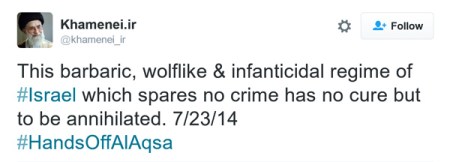
As late as November, Iran’s Supreme Leader Khamenei himself tweeted, “This barbaric, wolflike & infanticidal regime of #Israel which spares no crime has no cure but to be annihilated.”

1477

Bewilderingly, Western democracies have chosen to overlook Iran’s speeches and actions. They chose instead to appease the regime. Last July, despite genuinely serious reservations expressed by international strategic and military experts (including retired American military officers), the United States, United Kingdom, France and Germany – the four democracies in the P5+1 — concluded a nuclear deal with themselves that they proposed to Iran. Iran so far has not signed the deal, and apparently even if it did, according to the U.S. Department of State, the deal would not be legally binding.

Tehran will greatly benefit financially from the terms of the nuclear agreement in the months to come. Under the administration of President Barack Obama, nuclear sanctions against Iran have been lifted. To advance the deal and make it more appealing to Iran, the president has also agreed to pay Iran a $1.7 billion settlement for $400 million in “frozen” assets held in the United States since 1981.

The Society for Worldwide Interbank Financial Telecommunication (SWIFT), “the electronic bloodstream of the global financial system,” had disconnected 15 Iranian banks from its system in 2012. after coming under pressure from both the United States and the European Union at the height of efforts to curb Iran’s nuclear ambitions. Today, SWIFT is ready to let those banned banks, including the Central Bank of Iran, use its system once again. Iran now has an even greater ability to fund its terrorist proxies around the world.

European political and business leaders have been rushing to Tehran to sign new agreements. On January 28, in Paris, Iran’s President Hassan Rouhani and France’s President Francois Hollande signed major business deals, including a joint venture between car-makers PSA Peugeot Citroen and Iran’s Khodro. Iran is in the process of buying 118 Airbus passenger planes to update its aging fleet. The construction group Bouygues and the French airport operator ADP are now set to build an extension for Tehran’s airport, while Vinci, another construction firm, has been commissioned to design, build and operate new terminals for the Mashhad and Isfahan airports. The French oil company Total has agreed to buy Iranian crude oil, and agreements in shipping, health, agriculture and water provision have also been signed.

Democratic India is also cultivating relations with Iran. In a meeting in May, India’s Minister of Road Transport and Highways, Nitin Gadkari, and Iranian Transport and Urban Development Minister, Abbas Ahmad Akhoundi signed a Memorandum of Understanding on India’s participation in the development of the Chabahar Port in Iran.

The Chabahar project will impart strategic leverage to India and its access to Afghanistan and energy-rich Central Asia by bypassing Pakistan. The distance between the Chabahar Port and Gujarat – India’s westernmost state, located near the Persian Gulf, is less than the distance between Delhi and Mumbai. Transit times are estimated to be reduced by a third. Indian firms have already agreed to lease two existing berths at the port and operate them as container and multi-purpose cargo terminals.

The Chabahar project, New Delhi calculates, will be highly beneficial. As India has invested over $2 billion in Afghanistan, the Indian government plans to link the Chabahar port with the Zaranj-Delaram road it built in Afghanistan, thereby opening alternative routes to Afghanistan and enhancing access to regional and global markets.

Russia and China, permanent members of the UN Security Council, are also strengthening their cooperation with Iran. Both Russia and China adopted a policy of ambivalence towards Iran and saw to it that sanctions imposed by the West were not too tough. They also repeatedly blocked attempts at sanctioning Iran’s ally, the current Syrian regime, out of concern over financial ties in the region.

China is also capitalizing on the lifting of sanctions against Iran. Chinese President Xi Jinping rushed to Iran after the so-called nuclear agreement to discuss a 25-year strategic cooperation plan. In a landmark deal worth up to $600 billion, Xi committed to increase trade between the two nations during the next decade. Beijing and Tehran also agreed to enhance security cooperation through intelligence-sharing, counter-terror measures, military exchanges and coordination. Incidentally, despite international sanctions, China-Iran trade increased from $3 billion in 2001 to more than $50 billion in 2014.

Given its fanatical and sectarian ideological agenda, Iran is likely to use the new funds to boost its armament program and ongoing clandestine terror acts. Sanctions relief will mainly benefit Khamenei and members of the IRGC: they control up to one-third of Iran’s economy.

Iran now poses an even greater threat to the entire civilized world. The pattern of Tehran’s behavior shows the government can never be trusted on any promises it makes not to advance its nuclear weapons program. Khamenei has made an open declaration that Tehran will not allow effective inspections of its military sites or interviews with its nuclear scientists.

The links of the IRGC’s Qods Force with Hezbollah, Hamas, Palestinian Islamic Jihad, the Houthis and other terror militias pose a major threat to peace and stability in the Middle East.

Hezbollah’s networks have expanded over the years, infiltrating Latin America and the Caribbean through Shiite cultural centers in the region. According to an official Argentine report, Tehran has established its terrorist, intelligence and operational networks throughout Latin America as far back as the 1980s. Iran’s intelligence activities in the region are being conducted directly by Iranian officials or through its proxy, Hezbollah. Criminal activity may already be underway in Brazil, Colombia, Chile, Paraguay, Uruguay, Suriname and Trinidad and Tobago. Iran’s involvement in the cocaine trade has bolstered the regimes regional access and strengthened ties with its allies in Venezuela, Ecuador, Bolivia and elsewhere.

According to senior Western intelligence officials, the IRGC has transferred tens of millions of dollars to Hamas to be used for weapons, military equipment and training, and that Iran also delivers arms and funds to Hamas through the Red Sea and the Sinai. Officials also believe Iran is indirectly funding the Islamic State (IS) in the Sinai. “Suitcases of cash” are sent directly to Hamas officials in the Gaza Strip; part of the money is then transferred to IS.

Tehran’s links with Hamas and IS are part of a grander strategy of using proxy forces to gain hegemony over the Middle East and undermining American allies such as Egypt and Israel. In Lebanon, Iraq and Syria, Iran seeks to preserve its influence. By fighting IS, Iran strengthens existing pro-Iran regimes and maintains its relevance in the region.

While Iran does support IS indirectly in the Sinai, the government’s goal is to weaken the current Egyptian regime and the Sunni Arab alliance between Egypt, Saudi Arabia and Jordan. It has no problem with IS gaining strength in the Sinai right now. If IS does gain more power in the Sinai, Iran can use it to impose its own agenda in the future. Tehran evidently wants to use IS victories against Sunni states as an opportunity to take over.

Iran also supports the Gaza-based terror group al-Sabireen [“The Patient Ones”], established in the wake of previous tensions between Iran, Hamas and Islamic Jihad. The group has about 400 followers and its emblem is identical to that of Hezbollah. Each member receives a monthly salary of $250-$300, while senior members receive at least $700. Annually, the terror group receives a budget of $10 million from Iran, smuggled in suitcases through tunnels along the border with Egypt. Potential members are wooed by al-Sabireen through familiar channels of philanthropy and education. The group’s publications refer to the United States as “the source of superpower terrorism,” and its slogan is, “The road to the liberation of Palestinian goes through Karbala” — a Shiite holy city in Iraq.

Al-Sabireen has extended its operations from the Gaza Strip to the West Bank and Jerusalem with Iran’s backing. Hisham Salim, the founder of al-Sabireen, admitted that his group is directly financed by Iran. “We have an armed branch whose goal is to wage war on the Israeli occupation everywhere,” Salim said. “Within this framework we have members in the West Bank and Jerusalem.”

The Obama administration has forged ahead with its Iran policies despite knowing the regime’s support of global terrorism. U.S. President Barack Obama himself spoke about Iran’s terror activities in a press conference last year. “Now, we’ll still have problems with Iran’s sponsorship of terrorism; its funding of proxies like Hezbollah that threaten Israel and threaten the region; the destabilizing activities that they’re engaging in, including place like Yemen,” he said, adding that the nuclear “deal is not contingent on Iran changing its behavior. Its not contingent on Iran suddenly operating like a liberal democracy.”

History urges those living in democracies today to rein in their governments and correct their fatal Iran policies. The world cannot afford to overlook the damage of these governments. If democracies today continue their present policies towards Iran, it will only embolden Iran’s regime to continue its quest to obtain nuclear weapons as well as its terrorism and human rights violations.

Russian Magazine: Russia’s Air Force In Syria Is Winning The Battle For Assad

February 17, 2016

Russian Magazine: Russia’s Air Force In Syria Is Winning The Battle For Assad, MEMRI, February 17, 2016

(Please see also, Moscow on the Tigris: Russia Joins the Terror Nexus:

While an exhausted and burned out United States wishes international migraines like the Syrian civil war would just go away, Russia is energized by the prospect of filling the vacuum and thus once again playing a major role on the world stage. Aggressively intervening on behalf of his ally in Damascus, President Bashar al-Assad, and projecting force well beyond even the frontier states in his“near abroad,” Vladimir Putin audaciously aims to change political outcomes in a region that has been out of his country’s sphere of influence for a generation.

— DM)

Recently, the Russian campaign in Syria reached its 100th day. An article in Expert Online, the website of the influential Russian analytical magazine Expert, reviews the state of the Syria war, analyzing the activities on various fronts as well as the Russian involvement. The article, by journalist Pyetr Skorobogatyj, states that, with Russia’s help, the Syrian army is advancing slowly but surely. It stresses that the operation in Syria is not a substantial financial burden for Russia, and that it benefits Russia in many ways – including by allowing it to train pilots, test the performance of various weapons, and target Russian-speaking militants who are fighting in Syria. Most significantly, it allows Russia to establish a permanent presence in the Middle East that has an impact on all the region’s countries.

The article then reviews the military situation in Syria region by region. Focusing first on the north, it stresses that the Kurdish forces there are making headway against ISIS and are laying down the foundations for what may eventually become a Kurdish autonomy or even an independent Kurdish state. The main loser, says the article, is Turkey, who is powerless to stop these developments from unfolding.

The article states further that Russia, using its S-400 missiles, has effectively set up a no-fly-zone in the north of Syria, thus enabling the regime forces to make substantial achievements against the rebels, especially in the Latakia area. It adds that the U.S., too, is planning to establish a military base in northeast Syria, in the Malikia area.

Moving to the southern region, the article states that the stalemate between the sides there – namely the regime forces and rebel groups backed by Jordan – has ended, since Jordan has ordered these forces to stop attacking Assad’s troops. In Damascus, too, the regime is slowly flushing out the rebels, street by street and building by building. As for eastern Syria, the article concedes that ISIS still maintains a strong presence there and will be difficult to defeat.

The following are excerpts from the article.[1]

 “The Air Campaign Is Not Expensive For Moscow, And It Allows Russia To Train Pilots And Test Different Types Of Weapons”

“As the Russian campaign recently reached its 100th day,[2] [Russia’s] main goal appears to be the use of military power to force peace on the ‘rational’ [i.e., non-jihadist] rebel groups. There are a number of small [rebel] groups which have either joined Assad’s military or have stayed independent but coordinate their activities with the Syrian army. [Russia’s] largest partner [apart from the Syrian army] is the Syrian Democratic Army [SDA], a Sunni popular militia which is fighting in the north [of the country] alongside the Kurds and government troops. The Russian Ministry of Defense has confirmed that Russia supports the SDA with weapons, ammunition and airstrikes. ‘For its part, the patriotic opposition [i.e. the SDA] coordinates its military objectives with the Russian aviation group,’ noted Lt. General Sergei Rudskoy, Chief of Main Operations Management in the Russian Army General Staff…

“The joint military campaign of the Russian Air Force and Syrian troops seems to be [progressing] slowly but surely. [The slow pace] is due to the broad spectrum of military goals which must be met, including pressure on all ‘factions’ in order to separate [potential] ‘partners’ from ‘enemies,’ as well as the necessity to return as much territory as possible to the Syrian government’s control, in order to enable it to negotiate from a position of strength about the country’s future. In addition, all the battle fronts seem chaotic, with many parallel ‘seething cauldrons’… and with weather conditions are getting worse… All of these factors together make Russian air operations difficult, especially during the winter period. This week the ‘bad guys’ [i.e. ISIS] used the cover of a sandstorm [which hampered Russian air activity] to mount a major offensive on Deir Al-Zor, a Syrian enclave in the desert. This action resulted in a major defeat for the Syrian side. As prevailing weather conditions worsen, the… intensity of the military campaign will decrease…

“Notwithstanding, during the first 100 days of Russian Air Force and Navy operations, 217 villages and towns were retaken, and 1000 sq. km. of territory. The Russian-Syrian coalition has no need to hurry. The air campaign is not expensive for Moscow, and it allows Russia to train pilots and to test the battle performance of different types of weapons. These benefits are in addition to the political gains and to the main goal, which is to eliminate Russian-speaking fighters in theaters far away from Russia’s borders.

“In addition, thanks to the new Russian air force base in the [the Syrian city of] Latakia, Moscow has established a permanent presence in the region, controlling a very important logistic hub. This modern military base (equipped with Iskander[3] and S-400[4] missiles)… changes the military and political situation in Iraq, Iran, Israel, the U.S… and, of course, Turkey”…”

“Russia Has Set Up A No-Fly Zone Using Its S-400 Surface-To-Air Missile System”

“[Meanwhile] the goals of the main participants in the Syrian battle have become clear. In the north of Syria… the Kurds are winning. They are finally receiving extensive military support from the U.S. and covert support from Russia. They are carrying out offensive operations against ISIS and expanding their territory, which might become a future Kurdish state or an autonomous region within Syria, depending on the final agreement… The main loser is Turkey, who is unpredictable, irresponsible and unable to keep agreements. Currently, [Turkish President Recep Tayyip] Erdogan can only look on as the Kurdish enclave continually grows stronger. [The Turkish President] can initiate military operations only on his own territory…

“The geopolitical value of northern Syria is understood by all parties. Russia has set up a no-fly zone [there] using its S-400 surface-to-air missile system… [while] Syria is strengthening its Al-Bab air base with Russian military advisors and the S-300[5] missile system. The Americans are not napping either, and plan to set up a military base in Malikia in north-east Syria… This will allow the U.S to carry out an independent policy without having to depend on the Kurdish state which is being established…

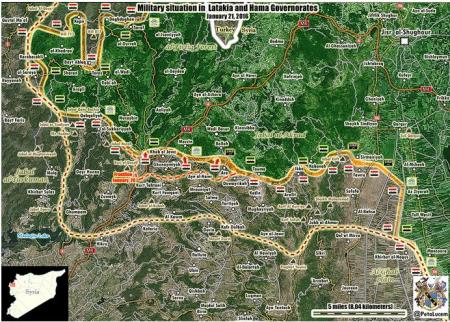
“The Syrian army, aided by Hizbullah’s brigades, is doing very well in the Latakia governorate. The map [below] clearly shows the movement of the fighting forces over the last few months. The dotted red line represents the front on October 7, 2015. In the first half of January 2016, government troops finally showed fighting ability against the Islamist stronghold of Salma… It was the first time that Russian military experts actively took part in the campaign, probably coordinating the attack on Salma. Support from Russian planes in the northern Latakia province allows the Syrian army to continue its advance at full speed…”

26798Military situation in Latakia and Hama areas, January 21, 2016

In The South, Jordan-Backed Rebels Have Been Ordered To Stop Attacking; In Damascus, The Government Is Flushing Out Islamists; In The East, ISIS Still Holds A Significant Area

“In the Dera province in the south, the opposing sides had [previously] agreed to maintain the status quo. Damascus was avoiding a conflict with Israel as well as with Jordan, which openly sponsored tribal forces and Islamist brigades… [Today, however,] the tactic of constant pressure [by Syrian regime troops on these forces and brigades] is producing results. The Military Operations Command [MOC] in Amman… which is coordinating rebel activities in southern Syria, has ordered [the forces it sponsors] to stop attacking [Syrian] government forces… Jordan’s logic is very simple… Syrian refugees in Jordan now total about 30% of the population, the same number as the Palestinians living in Jordan… so Jordan prefers to try to stabilize the situation in Syria rather than dream about cutting off Syria’s southern territories from the rest of the country. On the other hand, Damascus has begun to raise the issue of Israeli[-sponsored] rebels occupying the [Syrian] Golan Heights.

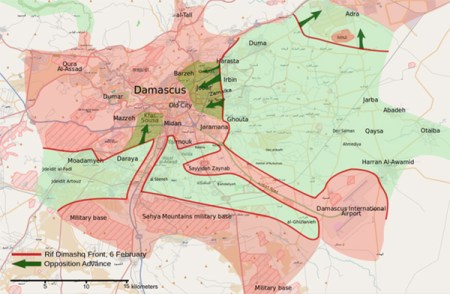
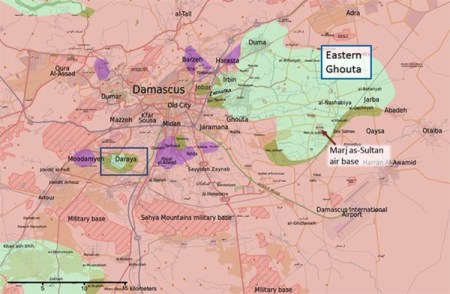
“In the Syrian capital, government troops are continuing to flush out Islamists and ‘bad guys’ from the city. The score is being kept not by counting streets retaken, but by counting buildings… The progress in the Damascus area is noticeable only when viewed over a long period of time. Below is a map showing the balance of forces in 2013, and beneath it a map showing the balance of forces in 2015.

26799Damascus area in 2013
26800Damascus’ area in 2015

“In addition, peace talks between the government and some rebel groups are now underway. Just recently, an agreement was made with a rebel brigade in the Al-Qadam suburb [in Damascus]. Some militants who were disarmed were moved to Raqqa and Idlib, while almost 1,500 others agreed to switch to Assad’s side…

“In spite of the relative success of government troops, ISIS still holds a significant area in the eastern part of Syria… The [ISIS] Caliphate is well-entrenched in the area it controls, with a strong force and command structure, and is not going to withdraw easily.”


Endnotes:

[1] Expert.ru, January, 22, 2016.

[2] The Russian campaign in Syria started on September 30, 2015.

[3] A Russia-manufactured portable short-range ballistic missile system; NATO designation name: SS-26 Stone.

[4] A Russia-manufactured anti-aircraft weapons system; NATO designation name: SA-21 Growler.

[5] A Russia-manufactured long range surface-to-air missile system;  NATO designation name: SA-10 Grumble.

‘Senior Official’ of Iran-Russia-Syria Alliance Brags About Subverting U.S. Diplomacy

February 17, 2016

‘Senior Official’ of Iran-Russia-Syria Alliance Brags About Subverting U.S. Diplomacy, Washington Free Beacon, Morgan Chalfant, February 17, 2016

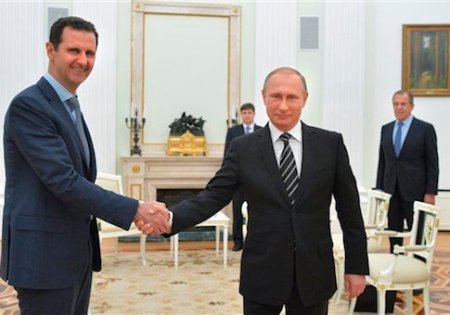
FILE - In this file photo taken on Tuesday, Oct. 20, 2015, Russian President Vladimir Putin, center, shakes hand with Syrian President Bashar Assad as Russian Foreign Minister Sergey Lavrov, right, looks on in the Kremlin in Moscow, Russia. When Russian Foreign Minister Sergey Lavrov said his country is ready to aid Syrian rebels fighting Islamic State militants on the ground, rebel commanders scoffed at the notion, pointing out that Russian aircraft were pounding rebel bases in central and northern Syria on daily basis. (Alexei Druzhinin, RIA-Novosti, Kremlin Pool Photo via AP, File)

FILE – In this file photo taken on Tuesday, Oct. 20, 2015, Russian President Vladimir Putin, center, shakes hand with Syrian President Bashar Assad as Russian Foreign Minister Sergey Lavrov, right, looks on in the Kremlin in Moscow, Russia. (Alexei Druzhinin, RIA-Novosti, Kremlin Pool Photo via AP, File)

A “senior official” of the military alliance between Iran, Russia, and Syria that is currently waging a ground offensive in Aleppo boasted about subverting U.S. diplomacy in a recent interview with an U.S. newspaper.

The official told the Wall Street Journal that military forces from Iran, Russia, and Syria would use a recent ceasefire deal brokered by world powers—including the United States—not to take steps towards a peaceful resolution of the Syrian war, but to consolidate their military gains.

The Journal reported:

“These allies are together in the same command center, working, planning and coordinating their operations in the battlefield,” said a senior official in the Iran-Russia-Syrian regime military alliance. “Retaking Aleppo will restore the regime’s strength and control over Syria; toppling the regime is now a thing of the past.” A cease-fire as proposed by world powers in Munich last week, he said, would simply be a pause for the Iran-led ground forces to consolidate recent territorial gains.

Thousands of fighters organized by Iran—including Hezbollah, the Islamic Revolutionary Guard Corps, and Shia fighters from Afghanistan, Iraq, and other countries—have launched the assault on Aleppo alongside Syrian army forces. Emboldened by Russian airstrikes, the fighters have been able to advance on Syria’s largest city.

There is some doubt regarding whether the ceasefire will be implemented at all. The deal was established by global powers on Friday, though neither Assad nor the Syrian opposition formally signed off on it. The deal was supposed to allow humanitarian aid to be sent to Syria and commence peace negotiations. The United States hoped that the ceasefire would be implemented in a week’s time.

Hours before the ceasefire was announced, Assad vowed to retake Syria in its entirety in an interview published by AFP.

Iran has put billions of dollars toward backing Assad, and Russia has launched a military intervention in Syria to back the Assad regime under the guise of fighting terrorist groups.

While the Obama administration has long said that Assad must be removed from power, the United States has softened that stance since 2011, when the Syrian civil war began. Secretary of State John Kerry said in December that the administration was not seeking a “regime change” in Syria following a meeting with Russian President Vladimir Putin.

“The United States and our partners are not seeking so-called regime change,” Kerry said then, indicating that world powers were focused on achieving a peace process in which “Syrians will be making decisions for the future of Syria.”

Both Russia and Iran have resisted any effort to oust Assad.

Special Israeli emissary to Moscow over Russian Syria air strikes near border

February 17, 2016

Special Israeli emissary to Moscow over Russian Syria air strikes near border, DEBKAfile, February 17, 2016

Israel_near_border_16.2.16

In view of the crisis building up on the southern Syrian-Israeli border, Prime Minister Binyamin Netanyahu decided immediately on his return home from Berlin early Wednesday, Feb. 17, to send a special  emissary to Moscow to ask for clarifications. Tuesday, Intensified Russian air strikes came to within 6 km of the Israeli border, sparking a growing exodus of Syrian refugees heading towards the Qoneitra border crossing to Israel.

DEBKAfile’s sources reveal that the envoy is Dr. Dore Gold, director-general of the Foreign Ministry and one of the prime minister’s few trusted confidantes.

It was still not clear whom Gold will meet in the Russian capital, but it is assumed that it will be one of Moscow’s senior decision-makers in the loop on its military operation in Syria.

The fact that Netanyahu decided to dispatch a top diplomat rather than a senior military or intelligence officer is a sign that the prime minister is not of one mind with the IDF’s intelligence assessments of the situation on the ground.

Netanyahu’s concerns grew after after the Russian air force on Tuesday widened its massive bombing of southern Syria from the city of Daraa to the Golan town of Quneitra, in order to help the Syria army’s 7th armored division push the rebels east, so they will not attempt to cross the border and seek shelter in Israel.

DEBKAfile’s military sources report that that 12 of the 15 targets bombed by the Russian air force across from the Israeli border were new rebel positions that had not been attacked before, even by the Syrian army. Military sources monitoring the war said Tuesday night that there is no doubt that the Russians are in the process of wiping out the rebel positions along the Israeli border by means of an offensive comparable to their operations in the northern Aleppo sector.

Our sources report that Israel’s concerns grew when, as the Russians bombing raids neared the Israeli border, Syrian officials threatened Jordan with serious consequences if Amman gave the Saudi air force a base for attacking eastern or southern Syria.

The threats began Tuesday, after Jordanian forces took over the Syrian-Jordanian border crossings formerly held by Syrian rebels, as a measure to stem the volume of Syrian refugees in search of sanctuary in the Hashemite Kingdom. But this step was interpreted by the Syrians and their Russian ally as clearing the way for Saudi intervention in the Syrian conflict using Jordan as a jumping-off base.

Meanwhile, Western military sources reported a sub substantial presence Tuesday of both Russian and Israeli warplanes in the skies over and around southern Syria.

Report: Hizballah Has Russian Technology Capable of Downing Israeli Jets

February 16, 2016

Report: Hizballah Has Russian Technology Capable of Downing Israeli Jets, Investigative Project on Terrorism, February 16, 2016

Hizballah is using advanced radar technology to “lock on” to Israeli aircraft flying reconnaissance missions over Lebanon, according to Israel’s Walla news service and reported by i24 News.

The new technology enables Hizballah to identify Israeli jets and fire missiles at them, Israeli security sources said.

“The connection between Hizballah, Russia and Syria have greatly changed the rules of the game in the region…Hizballah is indicating to Israel that it is ready for the next stage,” said an Israeli security official, quoted in Walla.

Israeli fighter jets are capable of detecting radar that threatens them, allowing pilots to alter their course. Nevertheless, the reports signal a troubling development that could hinder Israel’s freedom of movement in airspace across the northern border and its ability to effectively monitor Hizballah.

Following the 2006 war between Israel and Hizballah, the terrorist organization began acquiring sophisticated anti-aircraft systems and other advanced weapons from Syria and Iran. A recent report suggests that Hizballah is using Iranian anti-tank missiles in Syria that could be used against Israel in a future confrontation.

In light of these developments, Israel has allegedly targeted Hizballah weapons convoys on several occasions coming into Lebanon from Syria over the past few years. Nevertheless, the terrorist organization continues to build up its weapons arsenal and consolidate a base of operations on the Syrian Golan in order to attack the Jewish state.

Last month, Hizballah field commanders with operatives fighting in Syria told the Daily Beast that Russia is providing the terrorist organization with advanced weaponry amid enhanced coordination among both actors. The report outlines that Hizballah is acquiring long-range tactical missiles, anti-tank systems, and laser guided rockets from the Russians.

Saudi Arabia, Yemen and the Politicized UN

February 16, 2016

Saudi Arabia, Yemen and the Politicized UN, Gatestone InstituteRichard Kemp and Jasper Reid, February 16, 2016

♦ The UN’s assertion that the Saudi-led coalition has committed war crimes in Yemen is unlikely to be true. UN experts have not been to Yemen, depending instead on hearsay evidence and analysis of photographs.

♦ The UN has a pattern of unsubstantiated allegations of war crimes against the armed forces of sovereign states. Without any military expertise, and never having visited Gaza, a UN commission convicted the Israel Defense Force of deliberately targeting Palestinian civilians in the 2014 conflict. It was an assessment roundly rejected by America’s most senior military officer, General Martin Dempsey, and an independent commission.

♦ The Houthis have learned many lessons from Hamas and Islamic Jihad in Gaza, groups also supported by Iran. Those lessons include the falsification of civilian casualty figures and their causes. The UN swallowed the fake Gaza figures hook, line and sinker, and are now making the same error in Yemen.

♦ The Houthis exploit gullible or compliant reporters and human rights groups to facilitate their propaganda, including false testimony and fabrication of imagery.

♦ Forensic analysis shows that rather than deliberately targeting civilians, the Saudis and their allies have taken remarkable steps to minimize civilian casualties.

The United Nations, Amnesty International and other groups have accused the Saudi-led coalition of war crimes in Yemen. A leaked UN report claims the bombing campaign against Iranian-supported Houthi insurgents seeking violently to topple the legitimate government of Yemen has conducted deliberate, widespread and systematic attacks on civilian targets.

If the UN’s assertion is true, and the coalition is deliberately and disproportionately killing thousands of innocent civilians, it is a war crime. But it is unlikely to be true. The UN has produced no actual evidence of war crimes. None of their allegations is based on investigation on the ground. Their experts have not been to Yemen, depending instead on hearsay evidence and analysis of photographs.

The UN has a pattern of unsubstantiated allegations of war crimes against the armed forces of sovereign states. Only last year, without any military expertise, and never having visited Gaza, a UN commission convicted the Israel Defense Force of deliberately targeting innocent Palestinian civilians in the 2014 conflict. It was an assessment roundly rejected by America’s most senior military officer, General Martin Dempsey, the Chairman of the Joint Chiefs of Staff.

Dempsey’s own findings were confirmed by an independent commission of experienced senior military officers and officials from nine countries. The High Level Military Group found that Israel had not committed war crimes, but had in fact set a bar for avoiding civilian casualties so high that other armed forces would struggle to reach it.

Moreover, last September the UN said that a US airstrike against a hospital in Kunduz, Afghanistan, was “inexcusable” and “possibly a war crime.” Few military forces in the world take greater precautions to prevent civilian casualties on the battlefield than the US. Anyone who has actually experienced combat knows that while such incidents are tragic, when carried out by Western forces, they are far more likely to be the result of human error or the chaos of battle than deliberate war crimes.

There is every reason to believe that the UN is again crying wolf. There is no doubt that thousands are dying in Yemen in horrific circumstances. But we cannot just accept the UN’s figures and its attribution of the proportion of deaths being inflicted by the Saudi coalition. Most of the data comes from the Houthi insurgents, either directly or via non-governmental organizations (NGOs), and is simply accepted as fact. The Houthis have learned many lessons from Hamas and Palestinian Islamic Jihad in Gaza, groups also supported by Iran. Those lessons include the falsification and distortion of civilian casualty figures and their causes. The UN swallowed the fake Gaza figures hook, line and sinker, and are now making the same error in Yemen.

As with Israel’s defensive campaign in Gaza in 2014, and the continued U.S. military support to the Afghan regime, the Saudis’ war to defend the government of Yemen and curb Iranian aggression in the region is lawful and legitimate. Therefore, the illegality of civilian deaths must be assessed according to the laws of armed conflict, in particular whether adequate precautions were taken to avoid them, whether they were proportionate to the military objectives and whether they were necessary to achieve legitimate military goals. The UN cannot possibly make such judgements without a more far-reaching and thorough investigation, and especially not on the basis of information provided by Saudi Arabia’s enemies and by interpreting photographs.

Most of us do not like the way that the Saudi regime runs their country according to the strict application of Islamic Sharia law, and we abhor their record on human rights. But the Saudi military ethos is well known and understood by Western military leaders, including from the U.S. and UK, who have worked closely with them for many years. The reality is, as our officers currently serving alongside them will attest, that the Saudis and their allies are not deliberately trying to kill innocent civilians. Indeed, they are doing their best to minimize civilian casualties. The question is whether their best is good enough.

Saudi Arabia and its coalition allies have the most sophisticated Western combat equipment, including planes, attack helicopters, drones and precision-guided munitions. But they lack battle experience. The exception to this is the Emirati forces within the coalition. They have had many years of combat experience alongside Western militaries, including in Somalia, Kosovo, Libya and Afghanistan. Because of that, they have acquitted themselves in Yemen with great professionalism and effectiveness at sea, on the ground and in the air.

But the lack of experience of the other coalition members puts them many years behind our own forces in wielding the highly complex 21st century capabilities of intelligence, surveillance, reconnaissance, communication and targeting.

Yet the coalition faces the same tough challenges that we face on battlefields everywhere. Their Houthi adversaries fight according to the well-developed doctrine of their backers, the Iranian Quds Force. Like Hizballah, Hamas, the Taliban, Al Qaeda and the Islamic State, their techniques include deliberately killing civilians, fighting from within the population and forcing innocents to become human shields.

1474

Completely ignoring the laws of war, they exploit their enemies’ adherence to them. They lure their opponents to attack and kill civilians. They exploit gullible or compliant reporters, international organizations and human rights groups to facilitate their propaganda, including false testimony and systematic fabrication of imagery. The aim is to instigate international condemnation in order to constrain their militarily superior enemies.

We have seen credible forensic analysis of strikes in Yemen that directly contradict the findings of the UN. Forensic analysis shows that rather than deliberately targeting civilians, the Saudis and their allies have taken remarkable steps to minimize civilian deaths. Of note, they have learned much from Israel’s conduct of operations in Gaza. This has included the use of guided munitions to conduct precision attacks against insurgents while seeking to reduce collateral damage.

Why would coalition forces spend vast amounts of money in a cripplingly expensive conflict firing precision strike munitions, and put their valuable pilots at risk, if they wanted to massacre civilians? Why not use much cheaper unguided munitions or Assad’s indiscriminate barrel-bombs?

The overwhelming majority of civilian deaths caused by the Saudi-led coalition have been due not to deliberate targeting, but to inexperienced pilots and unsophisticated intelligence and targeting capabilities in the face of an enemy that fights from within the civilian population. And to that the friction, confusion, stress and fog of war that leads even the most sophisticated, experienced and restrained military forces, such as American, British and Israeli, to sometimes kill civilians unintentionally. Contrary to the UN’s claim, this is unlikely to amount to war crimes.

Like every conflict in the Middle East, the war in Yemen is almost intractable, takes a heavy toll on innocent civilians, and is unlikely to end in anything approaching a perfect solution. But Saudi Arabia and its allies are making considerable efforts to restore stability to the country and its legitimate government.

Instability in Yemen undermines Western interests, including oil supplies. Instability also allows Al Qaeda and the Islamic State — proven and lethal threats to the US and the West — to flourish there.

By confronting the Houthis in Yemen, Saudi Arabia is also confronting Iran, which represents an even greater threat to the region and to the world. Emboldened by U.S. President Barack Obama’s nuclear deal, enriched by the release of billions of dollars of previously frozen funds, encouraged by the imminent boost in oil revenues, Iranian imperial aggression is today rampant in Iraq, Syria, Lebanon and Yemen.

However unpalatable to many, Saudi Arabia is and will remain a vital ally of the West. We must continue to support them in the fight in Yemen. We must not allow the false, ill-informed and increasingly shrill condemnations by the UN, human rights groups and the media to undermine Saudi’s fighting effectiveness as they have sought to do against other legitimate government forces fighting lawless insurgents in so many other places.

Russian-Turkish clash building up over Syria

February 14, 2016

Russian-Turkish clash building up over Syria, DEBKAfile, February 14, 2016

Turkish-self-propelled_howitzers_13.2.16

Turkish President Tayyip Erdogan clearly took a calculated risk when he ordered a two-our cross-border artillery bombardment Saturday, Feb. 13 of Syrian army forces positioned around the northern Syrian town of Azaz and the Kurdish YPG militia units which two days earlier took control of the former Syrian military air base of Minagh some six kilometers from the Turkish border.

Kurdish troops backed by the Russian air force seized that base last week from rebel militias as part of the operation for cutting the rebel groups under siege in Aleppo from their supply routes. The Turkish bombardment was therefore an indirect attack on the Russian forces backing pro-Assad forces against the rebels in the Syria war.

Erdogan knows that Moscow hasn’t finished settling accounts with Turkey for the shooting down of a Russian Su-24 on Nov. 24 and is spoiling for more punishment. After that incident, the Russians deployed top-of-line S-400 ground-to-air missile batteries and advanced Sukhoi Su-35 warplanes to their base in Latakia near the Turkish border. Ankara therefore limited its strike to a two-hour artillery bombardment from Turkish soil, reasoning that a Turkish warplane anywhere near the Syrian border would be shot down instantly.

Emboldened by the delay in the Russian response, the Turks took another step: Prime Minister Ahmet Davutoglu threatened the Kurdish YPG militia with more attacks if they failed to withdraw from the Menagh air base.

Although the Turkish prime minister had called on “allies and supporters” to back the operation against the Russian-backed  Syrian Kurds, Washington took the opposite line by urging Turkey, a fellow member of NATO, to desist from any further attacks.

Washington’s concern is obvious. An outright clash between Turkey and Russia would entitle Ankara to invoke the NATO charter and demand allied protection for a member state under attack.

The Obama administration would have had to spurn this appeal for three reasons:

1. To avoid getting mixed up in a military clash between two countries, just as the US kept its powder dry in the Russian-Ukraine confrontation after Moscow’s annexation of the Crimean Peninsula in February 2014.

2. To avoid upsetting the secret Obama-Putin deal on the allocation of spheres of influence in Syria: the Americans have taken the regions east of the Euphrates River, and the Russians, the west.

The Kurdish YPG militia forces near Aleppo and the city itself come under the Russian area of influence.

3. Regional tensions were tightened another notch Saturday by Russian comments: Russian Prime Minister Dmitry Medvedev said that his country and the West have “slid into a new Cold War period,” and Foreign Minister Sergei Lavrov said a third World War is actually underway -“I call this struggle a third World War by other means.,” he said.

Washington will avoid any action that risks further stoking this high state of international tension, but will act instead to de-escalate the cross-border Turkish-Russian confrontation over Syria.

All eyes are now on Moscow, Much depends on Russia’s response to the artillery bombardment of its Syrian and Kurdish allies. It is up to Putin to decide when and how to strike back – if at all.