Posted tagged ‘Iranian nukes’

Iran Promises to ‘Set Fire’ to U.S. Interests

September 3, 2015

Iran Promises to ‘Set Fire’ to U.S. Interests, Washington Free Beacon, September 3, 2015

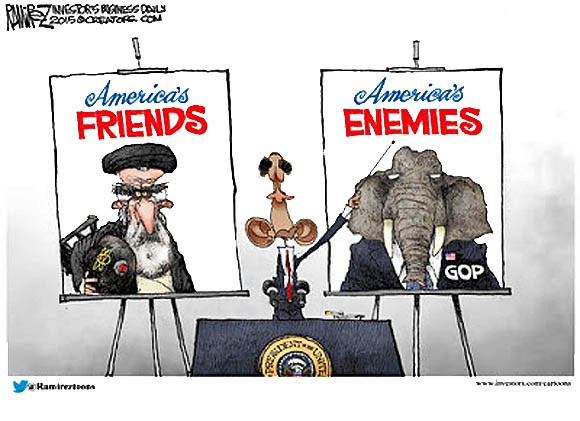
(Despite a the “deal” that favors Iran on every point, Obama’s Iranian friends keep saying “death to America.” He does not seem to mind. Who are his real friends and enemies?

Obama's enemies

— DM)

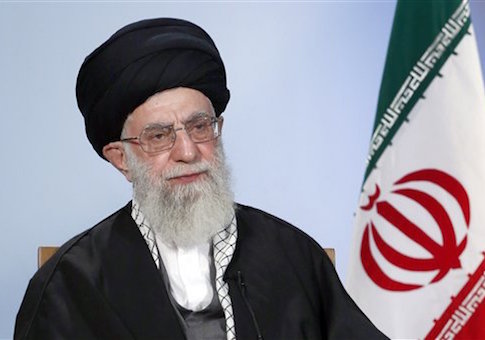
(AP Photo/Office of the Supreme Leader)

A senior Iranian military official has vowed to “set fire” to all U.S. interests in the region and maintained that the Islamic Republic welcomes war with America, according to regional reports demonstrating that Tehran is still committed to fighting the United States in the wake of a recently inked nuclear accord.

“In threatening remarks,” a top Iranian commander of the Revolutionary Guard Corps (IRGC) stated that Iran is prepared to “annihilate” U.S. and Israeli war forces should they “take the slightest military move against Iran,” according to Iran’s state-controlled Fars News Agency.

“We monitor their acts day and night and will take every opportunity to set fire to all their economic and political interests if they do a wrong deed,” Brigadier General Hossein Salami, the IRGC’s lieutenant commander, was quoted as saying in Tehran on Thursday.

In a direct threat to both the United States and Israel, Salami promised to “cut off enemies’ hands and fingers will then send its dust to the air,” according to the report.

These Iranian military officials were responding to multiple claims by U.S. officials that a military option against Tehran still remains on the table, despite the recently inked accord, which aims to constrain the Islamic Republic’s contested nuclear program.

In May, Salami said that Iran desires a war with the United States.

“We have prepared ourselves for the most dangerous scenarios and this is no big deal and is simple to digest for U.S.; we welcome war with the U.S. as we do believe that it will be the scene for our success to display the real potentials of our power,” he said at the time.

The comments came on the say day that the Iranian military unveiled a new missile defense system to track enemy threats.

“The system can detect and trace targets, take decisions for the operation of the missile systems, decide about the type of weapon systems needed, assess and foresee hostile targets, and field commanders can easily take a final decision with the data provided by the command and control system,” according to Fars.

Meanwhile, Iranian Supreme Leader Ali Khamenei on Thursday said that Iran is not open to negotiate with the United States on any other issue outside of the nuclear portfolio.

Khamenei “reiterated the complete ban on any negotiation between the Iranian officials and the Americans on other issues, and said there won’t be any other talks with the White House, except for the nuclear issue,” according to Fars.

“The U.S. positions are fully against the stances of the Islamic Republic,” Khamenei was quoted as saying in a wide-ranging speech.

Khamenei also called on the country’s leaders to attack U.S. critics of the deal.

“In the nuclear talks with are negotiating with the 5+1, but the U.S. administration is, in fact, the main party; but the U.S. officials speak very badly and a decision needs to be taken about the manner they speak,” Khamenei told the country’s powerful Assembly of Experts.

“Don’t say that the Americans are uttering these words to convince their internal rivals; of course, I believe that the internal disputes in the U.S. are real and they have differences and the reason for such a difference is clear to us, but what is officially said needs a response and if no response is given to them, the other side’s remarks will be entrenched,” Khamenei said.

Should Israel and its Arab neighbors form an alliance against Iran?

September 3, 2015

Should Israel and its Arab neighbors form an alliance against Iran? The Hill, Eli Verschleiser, September 3, 2015

Could a nuclear deal with Iran accomplish more than decades of diplomacy in the Middle East and, rather ironically, create new alliances between Israel and Arab neighbors?

That’s a key question as we gear up for the battle on Capitol Hill over President Barack Obama’s controversial pact with Tehran to limit uranium enrichment in return for lifting of sanctions. Critics say the agreement paves the way for a double reward of Tehran— a huge influx of cash and an eventual, unfettered path toward nuclear arms.

Neither the Saudis, the Kuwaitis, nor the United Arab Emirates or for that matter any of the other Persian Gulf states are too excited about the prospect of a nuclear-armed Iran. The role of Iran in the conflicts in Iraq and Syria, and the rise of Islamic State terror and the Muslim Brotherhood, have become a much bigger problem for Arab leaders than the tired conflict with Israel. Those countries have a Sunni majority, while Persian Iran is led by rival Shia Muslims.

Iran, of course, is also a major oil rival for the Gulf States and became more powerful following the fall of Saddam Hussein’s Iraq.

The Saudis have been publicly moderate on the deal but said to be privately angry over it. Epitomizing the old Middle East adage that the enemy of my enemy is my friend, the Saudis were reported to have offered Israel the ability to use their airspace to strike at Iran. This is a crucial step in keeping a military option on the table as it would save time and fuel if such a strike were necessary. “The Saudi authorities are completely coordinated with Israel on all matters related to Iran,” a European official was quoted as saying in an Israeli TV report.

Clearly momentum for alignment with Israel in some form is building.

“To all those who think the Persian state, and the regime of the Rule of the Imprudent… the dictatorial fascist Persian regime which controls it, is a friendly country, whereas Israel is an enemy country, I say that a prudent enemy is better than an imprudent one.”

Those words were written by Abdallah Al-Hadlaq in the official newspaper of Kuwait, Al-Watan.

It is not the first time the author has expressed support for ties with Israel. As far back as 2009 he called on his government and other Gulf states to put aside their differences with Jerusalem and forge an alliance against Iran.

But the fact that his column was published in a government daily in a country without full press freedom speaks volumes.

“The state of Israel and its various governments have waged more than five wars with the Arabs, yet never in the course of these wars did Israel think to use its nuclear weapons against its Arab enemies,” Al-Hadlaq wrote. “Conversely, if the Persian state, with its stupid, rash and fascist regime that hides behind a religious guise, ever develops nuclear weapons, it will not hesitate to use nuclear bombs against the Arab Gulf states in the first conflict that arises.”

Were the Saudis to show leadership in rallying other Sunni-led states against Iran it could have a significant impact on a new order in the Middle East.

Furthermore the new coalition could collectively work wonders to get rid of ISIS, as Jordan’s King Abdullah recently declared in a CNN interview that the war against ISIS ‘is our war’. The Iranian nuclear threat and the ISIS threat can top the agenda in this new coalition.

“Iran does have enough politico-military and economic potential to counter-balance Saudi led “Sunni” states in the Middle East and beyond,” wrote Salman Rafi Sheikh in an essay for the magazine Eastern Outlook last March. “It is precisely for this very reason that Saudi Arabia’s anxiety about an agreement has fueled a flurry of intense diplomacy in recent days to bolster unity among “Sunni” states in the Middle East in the face of “shared threats”, especially those emanating from Iran.”

Rafi Sheikh, a research-analyst of International Relations and Pakistan’s foreign and domestic affairs, noted that “this deal is most likely to send political jolts across the entire Middle Eastern political landscape, with Saudi Arabia and Israel standing as the most sensitive areas to bear its shocks; and as such, are most likely to clutch their hands into an alliance against Iran, and by default, against the US ambitions as well.”

There is great potential for Saudi Arabia’s King Salman to rally Gulf states as well as Turkey, Egypt and Jordan to stand up to an Iran that will only become more emboldened with the huge influx of post-sanctions billions and new political bona fides that will make Tehran bolder.

Increased security cooperation as Iran bides its time for an eventual bomb –after the agreement period, or in the worst-case scenario, in violation of the agreement — may eventually lead to more nuclear proliferation in the region.

Will that mean a nuclear pact between Israel and its former enemies? That will be a fascinating development that could never have been imagined even a decade ago.

And it will truly be a sad irony if, after nearly 70 years of a solid relationship between the United States and Israel, the Jewish state had to turn to despotic regimes with little or no human rights to solidify its security position, feeling far less than confident that Washington has its back than it has in the past.

However this may simply be the beginning of an Arabic Israeli accord where both groups can begin to understand and accept each other.

NATO Allies Making It Easier for Iran to Attack Israel?

September 3, 2015

NATO Allies Making It Easier for Iran to Attack Israel? The Gatestone InstituteBurak Bekdil, September 3, 2015

  • Iran did not go mad and threaten to hit all NATO installations in Turkey because it wanted 3.5 million Turkish citizens to die from the chemical warhead of a Syrian missile. It went mad and threatened because it viewed the defensive NATO assets in Turkey as a threat to its offensive missile capabilities.
  • Iran’s reaction to the NATO assets in Turkey revealed its intentions to attack. It could be a coincidence that the U.S. and Germany (most likely to be followed by Spain) have decided to withdraw their Patriot missile batteries and troops from Turkey shortly after agreeing to a nuclear deal with Iran. But if it is a coincidence, it is a very suspicious one. Why were Assad’s missiles a threat to Turkey two and a half years ago, but are not today?
  • Apparently, NATO allies believe, although the idea defies logic, that the nuclear deal with Iran will discourage the mullahs in Tehran from attacking Israel.

In early 2013, NATO supposedly came to its ally’s help: As Turkey was under threat from Syrian missiles — potentially with biological/chemical warheads — the alliance would build a mini anti-missile defense architecture on Turkish soil. Six U.S.-made Patriot missile batteries would be deployed in three Turkish cities and protect a vast area where about 3.5 million Turks lived.

The Patriot batteries that would protect Turkey from Syrian missiles belonged to the United States, Germany and the Netherlands. In early 2015, the Dutch mission ended and was replaced by Spanish Patriots. Recently, the German government said that it would withdraw its Patriot batteries and 250 troops at the beginning of 2016. Almost simultaneously, the U.S. government informed Turkey that its Patriot mission, expiring in October, would not be renewed. Washington cited “critical modernization upgrades” for the withdrawal.

Since the air defense system was stationed on Turkish soil, it unnerved Iran more than it did Syria. There is a story behind this. First, Patriot missiles cannot protect large swaths of land, but only designated friendly sites or installations in their vicinity. That the six batteries would protect Turkey’s entire south and 3.5 million people living there was a tall tale. They would instead protect a U.S.-owned, NATO-assigned radar deployed earlier in Kurecik, a Turkish town; and they would protect it not from Syrian missiles with chemical warheads, but from Iranian ballistic missiles.

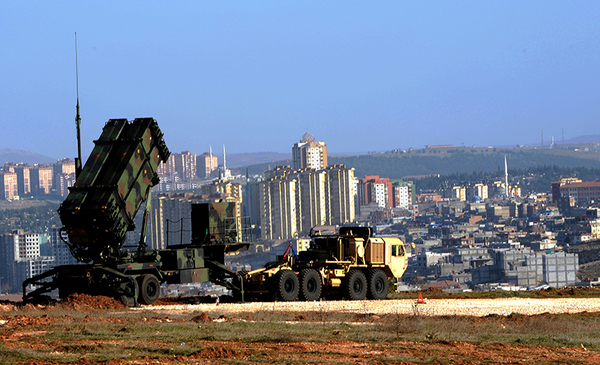
1234 (1)U.S. Patriot missiles, deployed outside Gaziantep, Turkey in 2013. (Image source: U.S. Army Europe/Daniel Phelps)

Kurecik seemed to matter a lot to Iran. In November 2011, Iran threatened that it would target NATO’s missile defense shield in Turkey (“and then hit the next targets,” read Israel) if it were threatened. Shortly before the arrival of Patriots in Turkey, Iran’s army chief of staff warned NATO that stationing Patriot anti-missile batteries in Turkey was “setting the stage for world war.”

What was stationed in Kurecik was an early-warning missile detection and tracking radar system. Its mission is to provide U.S. naval assets in the Mediterranean with early warning and tracking information in case of an Iranian missile launch that might target an ally or a friendly country, including Israel. So, a six-battery Patriot shield to protect the NATO radar in Kurecik against possible Iranian aggression was necessary. And that explains why the Iranians went mad about Kurecik and openly threatened to hit it.

NATO and Turkish officials have always denied any link between the Patriot missiles and the NATO radar in Turkey. They have often pointed out that the Patriot batteries were stationed in the provinces of Adana, Kahramanmaras and Gaziantep, while Kurecik was in nearby Malatya province. But the Patriot is a road-mobile system: It can be dismantled easily and re-deployed in another area in a matter of hours (the road distance between Kurecik and Kahramanmaras is a mere 200 kilometers, or 124 miles).

Clearly, Iran did not go mad and threaten to hit all NATO installations in Turkey because it wanted 3.5 million Turkish citizens to die from the chemical warhead of a Syrian missile. It went mad and threatened because it viewed the defensive NATO assets in Turkey as a threat to its offensive missile capabilities, which the Patriots could potentially neutralize.

Why, otherwise, would a country feel “threatened” and threaten others with starting a “world war” just because a bunch of defensive systems are deployed in a neighboring country? Iran did so because it views the NATO radar in Turkey as an asset that could counter any missile attack on Israel; and the Patriots as hostile elements because they would protect that radar. In a way, Iran’s reaction to the NATO assets in Turkey revealed its intentions to attack.

It could be a total coincidence that the U.S. and Germany (most likely to be followed by Spain) have decided to pull their Patriot batteries and troops from Turkey shortly after agreeing to a nuclear deal with Iran. But if it is a coincidence, it is a very suspicious one. In theory, the Patriot systems were deployed in Turkey in order to protect the NATO ally from missile threats from Syrian President Bashar al-Assad’s regime. Right? Right.

Assad’s regime is still alive in Damascus and it has the same missile arsenal it had in 2013. Moreover, Turkey’s cold war with Assad’s Syria is worse than it was in 2013, with Ankara systematically supporting every opposition group and openly declaring that it is pushing for Assad’s downfall. Why were Assad’s missiles a threat to Turkey two and a half years ago, but are not today?

The Patriot missiles are leaving Turkey. They no longer will “protect Turkish soil.”

Apparently, NATO allies believe, although the idea defies logic, that the nuclear deal with Iran will discourage the mullahs in Tehran from attacking Israel.

It looks as if the potential target of NATO heavyweights’ decision is more a gesture to Iran than to Turkey.

Obama secures rubber stamp for Iran deal catastrophe

September 3, 2015

Obama secures rubber stamp for Iran deal catastrophe, Front Page MagazineJoseph Klein, September 3, 2015

(Please see also, Use Our Senatorial Nuclear Option to Stop Iran’s Radioactive Nuclear Option. Make Senators vote yes or no on the “deal.”— DM)

obama-wc2

Democratic Senator Barbara Mikulski of Maryland has pushed President Obama’s nuclear appeasement deal with Iran over the top. With her decision to vote in favor of the deal, Obama now has the support of the 34 senators he needs to uphold his expected veto of a congressional resolution of disapproval. If enough craven Democrats back a planned filibuster to prevent a vote on the floor of the Senate, Obama will not even have to use his veto pen.

The nightmare of a financially secure nuclear armed Iran, legitimized by the Obama administration and its international partners, is about to envelop us.

Ironically, Obama warned in a speech he delivered on September 1st in Alaska that a potentially bleak future could lie ahead, in which “there’s not going to be a nation on this Earth that’s not impacted negatively.”

“People will suffer,” Obama said. “Economies will suffer. Entire nations will find themselves under severe, severe problems…more conflict.”

President Obama is right to be concerned about the future, but his stated reason for his concern is entirely misplaced. Obama was talking about climate change, which he considers to be a man-made disaster. In truth, Obama himself has created a far more imminent disaster with his nuclear deal.

In his climate change speech, Obama spoke about our “grandkids” who “deserve to live lives free from fear, and want, and peril.” He added that we need to prove “we care about them and their long-term futures, not just short-term political expediency.”

Obama, and the partisan loyalists who support him no matter what, are the ones letting down our grandkids. They are the ones who have sacrificed our grandkids’ long-term futures at the altar of short-term political expediency. The only long-term future that Obama is interested in is his own legacy.

By President Obama’s own admission, no later than 15 years from now – when my granddaughter will be just 18 years old – Iran will be in a position to develop enough enriched materials to produce nuclear bombs with virtually no “break-out” time. The deal’s major nuclear restrictions, such as they are, will have gone away, even assuming that Iran had not cheated in the meantime.

The deal’s inspection mechanism is a farce, including most notably, Iran’s self-inspection of its military site where it is suspected that nuclear weaponization research and development work was carried out. The military facility at Parchin is off-limits to onsite inspection by the International Atomic Energy Agency (IAEA). Yet the Obama administration continues to lie to the American people about how comprehensive the IAEA inspections will be. Secretary of State John Kerry tweeted this falsehood on September 2nd:  “With this #IranDeal, the IAEA can go wherever the evidence leads. No facility…will be off limits.”

The Iranian leaders also will get their hands soon on hundreds of billions of dollars. No doubt they will use some of their treasure trove from sanctions relief to fund their terrorist proxies all over the world. Obama admitted in his speech defending his deal last month at American University that monies from sanctions relief “will flow to activities we object to.” He acknowledged that “Iran supports terrorist organizations like Hezbollah. It supports proxy groups that threaten our interests and the interests of our allies – including proxy groups who killed our troops in Iraq. They try to destabilize our Gulf partners.”

Yet Obama tells the American people not to worry about such real-life risks. Instead, he diverts attention to his Chicken Little climate change hype that the sky will fall if we do not take urgent action now.

Much of the rest of the Iranians’ windfall from sanctions relief will go towards developing and acquiring, from North Korea, Russia and other sources, advanced military technology and long-range missiles.

Iran’s leaders have made it abundantly clear that they do not consider themselves bound by either the 5-year UN Security Council arms embargo or the 8-year missile embargo.  For example, Iran’s President Hassan Rouhani declared: “We will buy, sell and develop any weapons we need and we will not ask for permission or abide by any [U.N.] resolution for that.”

Iranian Defense Minister Hossein Dehghan said last month that “We are considering the design, research, and production of [missiles] that are highly destructive, highly accurate, radar evasive, and tactical.”

Brigadier General Amirali Hajizadeh, commander of the aerospace division of the Islamic Revolutionary Guard Corps (IRGC), said: “Some wrongly think Iran has suspended its ballistic missile programs in the last two years and has made a deal on its missile program.” To emphasize his point, the commander announced that Iran “will have a new ballistic missile test in the near future that will be a thorn in the eyes of our enemies.”

The head of Iran’s Islamic Revolutionary Guard Corps, Maj. Gen. Mohammad Ali Jafari, announced plans to expand the reach of Iran’s missiles.

The Iranian thugs are not limiting themselves to purely defensive weapons. “They (the US and the Zionists) should know that the Islamic Revolution will continue enhancing its preparedness until it overthrows Israel and liberates Palestine,” said Brigadier General Mohsen Kazzemeini, the IRGC’s top commander in the Tehran Province (as quoted by Iran’s Fars News Agency). “We will continue defending not just our own country, but also all the oppressed people of the world, especially those countries that are standing on the forefront of confrontation with the Zionists,” he added.

The Obama administration, which conceded as part of the nuclear deal to agree to unconditional term limits on the arms and missile embargoes, barely raised an eyebrow at Iran’s refusal to be bound by even these limited embargoes. In fact, Kerry went so far as to say that “they are not in material breach of the nuclear agreement for violating the arms piece of it.”

A sobering report was just released by the Iran Strategy Council, led by retired generals Chuck Wald (Commandant of Marine Corps) and James Conway (Deputy Commander of European Command). It warns of the deal’s likely dangers to America’s own national security and of the “cascading instability” it will produce in the Middle East region and beyond:

“The final agreement on Iran’s nuclear program, the Joint Comprehensive Plan of Action (JCPOA), has potentially grave strategic implications that directly threaten to undermine the national security of the United States and our closest regional allies. By allowing Iran to become a nuclear threshold state and enabling it to become more powerful and expand its influence and destabilizing activities – across the Middle East and possibly directly threatening the U.S. homeland – the JCPOA will place the United States in far worse position to prevent a nuclear Iran.”

The report’s authors predict that the “nightmare scenarios of WMD and terrorism on the soil of the United States and its allies will become more probable.”

Nevertheless, the Obama administration is spiking the ball, exulting over its evident victory in keeping enough Democratic senators on board to protect Obama’s deal.

The White House tweeted: “If your house is on fire, would you refuse to put it out because there could be another fire in 15 years?”

The question should be: “If your house is flammable, would you hand your enemy a match?”

Kerry, who turned on his own fellow soldiers during the Vietnam War, tweeted: “I have had the privilege of serving our country in times of peace and in times of war—and peace is better.”

When Neville Chamberlain returned from Germany with his infamous Munich Pact in hand, he declared: “I believe it is peace for our time…Go home and get a nice quiet sleep.”

The long nightmare of World War II ensued shortly thereafter. Thanks to Barack Obama and John Kerry, we are entering the nightmare leading inevitably to an emboldened, well-funded Iran equipped with nuclear arms and the missiles to deliver them.

Nuclear Fiascoes: From Diplomatic Failure With North Korea To Debacle With Iran

September 1, 2015

Nuclear Fiascoes: From Diplomatic Failure With North Korea To Debacle With Iran, Forbes, Claudia Rosett, August 31, 2015

(An excellent comparison of the machinations that led to the nuke “deal” with North Korea and those now leading to the “deal” with the Islamic Republic of Iran. — DM)

[B]oth Clinton and Bush purchased the transient gains of North Korean nuclear deals at the cost of bolstering a North Korean regime that has become vastly more dangerous. . . . Kim Jong Un bestrides a growing arsenal of weapons of mass murder, including chemical and biological, as well as nuclear, plus a growing cyber warfare capability. This is the legacy not least of North Korea’s skill at exploiting the feckless nuclear deals offered by U.S. presidents whose real achievements on this front were to hand off a monstrous and rising threat to the next administration.

Now comes the Iran nuclear deal, which President Obama has described as a perhaps once-in-a-lifetime “historic chance to pursue a safer and more secure world.” And from Israel’s Prime Minister Netanyahu, leader of America’s closest ally and Iran’s prime target in the Middle East, comes the warning that this deal is a “stunning historic mistake,” configured not to block Iran’s path to the bomb, but to pave the way.

Like the North Korea Agreed Framework, the Iran nuclear deal pivots narrowly on nuclear issues, as if ballistic missiles, terrorism, arms smuggling, gross violations of human rights, blatant declarations of destructive intent and the malign character of the regime itself were irrelevant to the promised “exclusively peaceful” nuclear program.

[I]f this Iran deal goes through, is that we are about to see the mistakes made with North Korea amplified on a scale that augurs not security in the 21st century, but a soaring risk of nuclear war.
************************

With Congress due to vote by Sept. 17 on the Iran nuclear deal, there’s a warning worth revisiting. It goes like this: The president is pushing a historic nuclear agreement, saying it will stop a terror-sponsoring tyranny from getting nuclear weapons. And up pipes the democratically elected leader of one of America’s closest allies, to say this nuclear deal is mortal folly. He warns that it is filled with concessions more likely to sustain and embolden the nuclear-weapons-seeking despotism than to disarm it.

This critic has more incentive than most to weigh the full implications of the deal, because his country is most immediately in harm’s way — though it has not been included in the nuclear talks. He notes that the nuclear negotiators have sidelined such glaring issues as human rights, and warns that Washington is naive, and the U.S. is allowing itself to be manipulated by a ruthless dictatorship.

No, the critic I’m referring to is not Israel’s Prime Minister Benjamin Netanyahu, though he has warned of precisely such dangers in the Iran nuclear deal. I am citing the warnings voiced 21 years ago by the then-President of South Korea, Kim Young Sam, as the Clinton administration bargained its way toward the 1994 nuclear deal with North Korea known as the Agreed Framework.

As it turned out, Kim Young Sam’s misgivings were right on target. The 1994 Agreed Framework did not stop North Korea’s pursuit of the bomb. Instead, it became a pit stop on North Korea’s road to the nuclear arsenal it is amassing today.

For all the differences between North Korea and Iran, there are parallels enough to suggest that the failed 1994 nuclear bargain with North Korea is an excellent guide to the future trajectory with Iran, if the U.S. goes ahead with the nuclear deal — the Joint Comprehensive Plan of Action — announced by the U.S., France, Britain, Germany, Russia, China and Iran on July 14 in Vienna.

Recall that in 1994, faced with the threat of North Korea producing plutonium for nuclear weapons, the U.S. sought a diplomatic solution. Taking a cue from an exploratory trip to Pyongyang by former President Jimmy Carter, the Clinton administration wooed North Korea with an offer of lightwater nuclear reactors to be used exclusively for the peaceful production of electricity. All Pyongyang had to do was give up its nuclear bomb program.

As this agreement was taking shape, South Korea’s Kim Young Sam laid out his concerns in an hourlong interview with the New York Times. In the resulting article, dated Oct. 8, 1994, the Times reported: “After weeks of watching in silent frustration as the United States tries to negotiate a halt to North Korea’s nuclear program, President Kim Young Sam of South Korea lashed out at the Clinton administration today in an interview for what he characterized as a lack of knowledge and an overeagerness to compromise.”

The Times article described Kim’s concerns that “compromises might prolong the life of the North Korean government and would send the wrong signal to its leaders.” Kim was quoted as denouncing the deal then in the making as a “half-baked compromise” which would lead to “more danger and peril.”

President Clinton rolled right past that warning. On Oct. 21, 1994, less than two weeks after Kim’s concerns hit the headlines, the U.S. signed the Agreed Framework with North Korea. Clinton praised the deal as “good for the United States, good for our allies, and good for the safety of the entire world.” Promising that the Agreed Framework would reduce the threat of nuclear proliferation, Clinton further lauded the deal as “a crucial step for drawing North Korea into the global community.”

South Koreans and their leaders, in the main, disagreed. But with South Korea dependent on the U.S. superpower for defense against North Korea, Kim Young Sam had little choice but to follow Clinton’s lead. Seoul damned the deal with faint praise. The Associated Press reported: “South Korean Foreign Minister Han Sung-joo said that even though the deal fell short of expectations, it met South Korea’s minimum policy goals.”

History now shows that the chief policy goals served by the Agreed Framework were those of Pyongyang, which racked up a highly successful exercise in nuclear extortion, and carried on, first secretly, then overtly, with its nuclear weapons program. As South Korea’s president had predicted, the Agreed Framework helped fortify Pyongyang’s totalitarian regime, rather than transforming it.

Some of the negotiators involved in that 1994 deal have since argued that while the North Korean agreement eventually collapsed, it did at least delay Pyongyang’s progress toward nuclear weapons. What they tend to omit from that select slice of history is that the Agreed Framework helped rescue a North Korean regime which in 1994 was on the ropes. Just three years earlier, North Korea’s chief patron of decades past, the Soviet Union, had collapsed. The longtime Soviet subsidies to Pyongyang had vanished. China did not yet have the wealth to easily step in. And just three months before the nuclear deal was struck, North Korea’s founding tyrant, Kim Il Sung, died. His son and heir, Kim Jong Il, faced the challenge of consolidating power during a period of famine at home and American superpower ascendancy abroad.

But in the game of nuclear chicken, it was America that blinked. In exchange for North Korea’s promise to freeze and eventually dismantle its nuclear weapons program, the U.S. agreed to lead a $4.6 billion consortium to build two lightwater reactors for North Korea, and provide shipments of free heavy fuel oil for heating and electricity production while the new reactors were being built. This was augmented by U.S. security guarantees, easing of sanctions and promises to move toward normalizing diplomatic relations, with generous food aid thrown in.

By the late 1990s, just a few years into the deal, North Korea had become the largest recipient of U.S. aid in East Asia. That did not curb Kim Jong Il’s hostile ways. The Pyongyang regime put the interests of its military and its weapons programs before the needs of its starving population. In 1998, North Korea launched a long-range missile over Japan, a test for which it was hard to discern any purpose other than developing a vehicle to carry nuclear weapons. By that time, as a number of former Clinton administration officials have since confirmed, the U.S. was seeing signs that North Korea was cheating on the nuclear deal by pursuing a secret program for uranium enrichment.

Instead of confronting North Korea, Clinton during his last two years in office tried to double down on his crumbling nuclear deal by pursuing a missile deal with Pyongyang. In 2000, that led to an exchange of high-ranking officials, in which the Clinton administration dignified North Korea with the unprecedented move of welcoming one of its top-ranking military officials, Vice Marshal Jo Myong Rok, to a 45-minute sitdown with Clinton at the White House. Clinton then dispatched Secretary of State Madeleine Albright, together with the administration’s special advisor for North Korea policy, Wendy Sherman, to Pyongyang (yes, the same Wendy Sherman recently employed by Obama as chief negotiator of the Iran nuclear deal). Sherman and Albright brought North Korea’s Kim Jong Il a basketball signed by star player Michael Jordan; Kim entertained them with a stadium flip-card depiction of a long-range missile launch. There was no missile deal.

North Korea continued raking in U.S. largesse until late 2002, when the Bush administration finally confronted Pyongyang over its nuclear cheating. North Korea then walked away from the 1994 deal (on which it had by then been cheating for years), withdrew from the Non-Proliferation Treaty (on which it had also been cheating) and began reprocessing plutonium from the spent fuel rods which despite the 1994 deal had never been removed from its Yongbyon nuclear complex. President Bush then made his own stab at nuclear diplomacy, via the Six-Party Talks. North Korea punctuated that process in Oct. 2006 with its first nuclear test. In 2007, the Bush administration led the way to a Six-Party denuclearization deal with North Korea, bull-dozing ahead even after it became clear that North Korea had been helping Syria build a secret copy of North Korea’s plutonium-producing Yongbyon reactor (destroyed in Sept. 2007 by an Israeli air strike). Once again, North Korea took the concessions, cheated on the deal and in late 2008 walked away.

Since Obama took office, North Korea has carried out its second and third nuclear tests, in 2009 and 2013; restarted its plutonium-producing reactor at Yongbyon; and in 2010 unveiled a uranium enrichment plant, which appears to have since at least doubled in size. Having equipped itself with both uranium and plutonium pathways to the bomb, North Korea is now making nuclear weapons, and developing increasingly sophisticated missiles — including long-range — to deliver them.

In sum, both Clinton and Bush purchased the transient gains of North Korean nuclear deals at the cost of bolstering a North Korean regime that has become vastly more dangerous. When Kim Jong Il died in late 2011, North Korea’s regime managed a second transition of power, to third-generation Kim family tyrant Kim Jong Un — who was described last year by the commander of U.S. Forces in Korea, General Curtis Scaparrotti, as “overconfident and unpredictable.” Kim Jong Un bestrides a growing arsenal of weapons of mass murder, including chemical and biological, as well as nuclear, plus a growing cyber warfare capability. This is the legacy not least of North Korea’s skill at exploiting the feckless nuclear deals offered by U.S. presidents whose real achievements on this front were to hand off a monstrous and rising threat to the next administration.

Now comes the Iran nuclear deal, which President Obama has described as a perhaps once-in-a-lifetime “historic chance to pursue a safer and more secure world.” And from Israel’s Prime Minister Netanyahu, leader of America’s closest ally and Iran’s prime target in the Middle East, comes the warning that this deal is a “stunning historic mistake,” configured not to block Iran’s path to the bomb, but to pave the way.

There are surely dissertations to be written on the intricate differences between the North Korea Agreed Framework and the Iran nuclear deal now before Congress. But important and alarming similarities abound.

Like the North Korea deal, the Iran deal dignifies a despotic, murderous regime, and provides its worst elements with relief from economic distress, via a flood of rejuvenating resources. In North Korea’s case, the main help arrived in the form of aid. In oil-rich Iran’s case, it comes in the far more lucrative form of sanctions relief, including access to an estimated $55 billion or more (by some estimates, two or three times that amount) in currently frozen funds held abroad.

Like the North Korea Agreed Framework, the Iran nuclear deal pivots narrowly on nuclear issues, as if ballistic missiles, terrorism, arms smuggling, gross violations of human rights, blatant declarations of destructive intent and the malign character of the regime itself were irrelevant to the promised “exclusively peaceful” nuclear program.

Like the North Korea deal, the Iran deal comes loaded with incentives for the U.S. administration to protect its own diplomatic claims of success by ignoring signs of cheating. Monitoring of nuclear facilities is shunted to the secretive International Atomic Energy Agency, which has no power of enforcement, and will have to haggle with Iran for access to suspect sites.

Like Clinton with North Korea, Obama chose to frame the Iran deal not as a treaty, but as an executive agreement, performing an end-run around vigorous dissent within Congress by submitting the deal pronto for approval by the United Nations Security Council. In the North Korean case, the Security Council gave its unanimous blessing in the form of a presidential statement. In the Iran case, the Obama administration drafted a resolution which the Security Council unanimously approved. Having hustled the deal directly to the U.N., despite legislation meant to ensure Congress a voice, Obama administration officials are now pressuring Congress to defer to the U.N.

To be sure, there are two highly significant differences between the 1994 North Korea deal and the 2015 Iran deal. Iran, with its oil wealth, location in the heart of the Middle East, messianic Islamic theocracy and global terror networks, is even more dangerous to the world than North Korea. And, bad as the North Korea deal was, the Iran deal is much worse. Along with its secret side agreements and its promises to lift the arms embargo on Iran in five years and the missile embargo in eight, this deal lets Iran preserve its large illicitly built nuclear infrastructure and carry on enriching uranium, subject to constraints that will be problematic to enforce, and are themselves limited by sunset clauses that even North Korea never managed to obtain at the bargaining table.

When Israel’s Netanyahu spoke this past March to a joint meeting of Congress, warning that the Iran nuclear deal would lead to “a much more dangerous Iran, a Middle East littered with nuclear bombs and a countdown to a potential nuclear nightmare,” Obama dismissed that speech as “nothing new.” That’s true, in the sense that we have heard similar warnings before. What’s new, if this Iran deal goes through, is that we are about to see the mistakes made with North Korea amplified on a scale that augurs not security in the 21st century, but a soaring risk of nuclear war.

Saudi king wants Obama to tackle Iranian ‘mischief’

August 31, 2015

Saudi king wants Obama to tackle Iranian ‘mischief,’ Al-Monitor, August 31, 2015

U.S. US Secretary of Defense Ashton Carter meets with Saudi Arabia's King Salman bin Abdul-Aziz Al Saud (R) at Al-Salam Palace in Jeddah, Saudi Arabia, July 22, 2015. (photo by REUTERS/Carolyn Kaster) Read more: http://www.al-monitor.com/pulse/originals/2015/08/saudi-king-washington-visit-iran-deal.html#ixzz3kPeQtHQK width= U.S. Defense Secretary Ash Carter meets with Saudi Arabia’s King Salman bin Abdul Aziz (R) at Al-Salam Palace in Jeddah, Saudi Arabia, Wednesday, July 22, 2015.

King Salman bin Abdul-Aziz Al Saud’s three-day visit, strategically scheduled just days before Congress votes on the agreement, offers the Saudi leader a powerful platform to insist that the United States help combat Iranian “mischief.” The king is seeking assurances in the fight against Iran’s proxies across the region, as well as with elements of the nuclear deal itself.

The visit “underscores the importance of the strategic partnership between the United States and Saudi Arabia,” White House spokesman Josh Earnest said Aug. 27.

“The president and the king will discuss a range of issues and focus on ways to further strengthen the bilateral relationship, including our joint security and counterterrorism efforts,” Earnest said. “They will also discuss regional topics, including the conflicts in Yemen and Syria, and steps to counter Iran’s destabilizing activities in the region.”

Despite deep reservations about the deal, sources close to the Saudi government say that unlike Israel, the kingdom quickly concluded that it could not be defeated in Congress and that no better alternatives were likely to emerge.

Riyadh, however, has repeatedly made clear that its support is conditioned on a tough inspection regime and snapback sanctions. Salman may seek further assurances on those aspects of the deal in light of recent reports that allege that Iran will be allowed an unusual amount of autonomy with regard to inspections of its military installation at Parchin.

“The agreement must include a specific, strict and sustainable inspection regime of all Iranian sites, including military sites, as well as a mechanism to swiftly re-impose effective sanctions in the event that Iran violates the agreement,” the Saudi Embassy in Washington said after the deal was announced.

Most of the discussion is expected to center on non-nuclear issues, however.

Salman and President Barack Obama, who will meet Sept. 4 at the White House, are expected to further flesh out Washington’s promise of increased military support for the Gulf Cooperation Council countries — including a potential missile defense shield — as discussed during the US-GCC Camp David summit in May. That meeting, which was skipped by four of the top six regional leaders — including Salman — aimed to reassure the Gulf nations of America’s commitment to their security amid the perceived rapprochement with Iran.

“This is an opportunity to reset this relationship when there are some pretty considerable concerns on both sides,” said David Weinberg, a Gulf analyst with the Foundation for Defense of Democracies. “It comes in the context of the United States trying to reassure the Gulf states about the Iran deal, as well as to focus on this Camp David agenda in terms of concrete US security assistance. It’s reasonable to assume that that’s going to be a big focus of the trip as well.”

Much of the conversation is expected to focus on military hardware: The Saudis are seeking upgrades to their F-15s along with other advanced weaponry, but Israel is said to have raised concerns during Defense Secretary Ashton Carter’s recent visit to the region. Congress may object to such sales if lawmakers deem that they would undermine Israel’s so-called qualitative military edge.

The Saudis will be interested “in how much the White House will invest itself so that it can get the technology that it wants,” former Obama National Security Council Middle East adviser Prem Kumar told Al-Monitor. They will want to see if the White House “will spend some political capital on the Hill.”

Another topic of interest is the proposed creation of a GCC-wide “rapid reaction force” to take on external threats. The White House paid lip service to the idea in its joint statement from the Camp David summit, but the idea has failed to gain traction among concerns by Qatar and Oman that it would be dominated by the Saudis.

“In terms of GCC-wide reassurance, the Saudis are interested to hear what the US is prepared to do to support the GCC rapid reaction force, the joint Arab defense force, if that is going to materialize,” Kumar said.

Beyond military requests, Salman is likely to seek US backing for his more muscular approach to foreign policy compared with his predecessor. That includes beefed-up US support for his campaign against the Houthis in Yemen and a renewed focus on getting rid of President Bashar al-Assad in Syria.

For Riyadh, said former Saudi Embassy political analyst Fahad Nazer, a nuclear Iran “is more of a long-term issue. They’re concerned about the here-and-now.”

“The Saudis at this point have kind of parted ways with their traditional behind-the-scenes diplomacy and trying to mediate between warring factions,” Nazer said. “[They’ve realized] it’s time for them to take the helm of ensuring their own interests.”

In Yemen, “The Saudis want the US to get more involved, beyond intelligence and logistical support to the Saudi-led coalition,” said Kumar, now vice president with the Albright Stonebridge Group. Already, the Pentagon in recent weeks has more than doubled its advisers on the ground providing targeting intelligence for airstrikes and helping the Saudis roll back the Houthis, according to the Los Angeles Times.

Those battlefield successes have led some Saudi cheerleaders to argue that the intervention in Yemen offers a “template” for similarly emboldened leadership in Syria. While Nazer and others doubt Riyadh will go that far, the Saudis have recently announced their own proposal to withdraw support for Sunni rebels if Iran removes its forces and Hezbollah fighters with a view to parliamentary and presidential elections under UN supervision.

“I think there are a couple concrete things” on the Saudi wish list, Kumar said. “First is to increase support for the Syrian opposition, in some form or other. Safe zones, maybe direct pressure on the [Assad] regime, that would not necessarily undercut diplomatic initiatives.”

The king’s visit isn’t just about politics, however. He will be accompanied by a large entourage of ministers and business executives, and some of them are expected to stay on after the royal visit.

The US-Saudi Arabian Business Council has announced a daylong investment forum with the ministers of finance as well as commerce and industry.


The Senate Must Sue Obama to Block the Iran Treaty

August 31, 2015

The Senate Must Sue Obama to Block the Iran Treaty, American ThinkerRobert B. Sklaroff and Lee S. Bender, August 31, 2015

(I assume that suit would be filed in a Federal District Court, most likely the one sitting in Washington, D.C., followed by appeals to the D.C. Circuit and thence to the Supreme Court. The process would likely take years, with the outcome currently difficult to assess. An assessment would have to take into account that the Supreme Court has become increasingly “pragmatic” in recent years and tends to favor the Executive Branch.

Such a suit is not a bad idea, but the Congress should also note Obama’s failure to disclose key information necessary to evaluate the “deal” and disapprove it. Obama will veto its disapproval and the Congress is unlikely to override his veto. That will leave the “deal” a mere executive agreement and, therefore, subject to being overturned by the next president. That would likely happen well before rendition of a final adjudication on the suggested suit.

Interestingly, Iranian President Rouhani has asked the Iranian Parliament not to approve the “deal” because it would then become legally binding on Iran. — DM)

When Congress returns from recess after Labor Day, one of the most pressing issues on the agenda is the Joint Comprehensive Plan of Action (JCPOA), known commonly as “the Iran deal.” Much has been discovered since the Corker-Cardin-Menendez bill was enacted, including the White House’s and State Department’s deceit which influenced the Senate to abandon its constitutionally-provided role regarding treaties.

Now it might take a lawsuit spearheaded by Senate Majority Leader Mitch McConnell (R-KY) to reverse not only the damage to the Constitution but also potential damage to America and our allies as a result of the provisions of the Iran nuclear-deal.

Senate Majority Leader Mitch McConnell has overwhelming justification to sue President Obama over the JCPOA which constitutes a treaty and thereby must be ratified by a 2/3-vote of those present prior to implementation.

Such a suit could ultimately prompt the Supreme Court to disclaim Obama’s portrayal of this document as an Executive Agreement. It could also sustain the overwhelming will of the American people–according to polling data—to trash this “legacy” effort, for reasons that have been exhaustively detailed.

Blocking implementation of the Iran nuclear-deal would thereby necessitate the legislative branch triggering a confrontation between the judicial and the executive branches.

Two essays {authored by RBS} published in The Hill explored the legalities of this initiative, focused on its “treaty” [July 29] and “rule-of-law” [August 25] components.

In the interim [USA Today, August 5], Professor Alan Dershowitz recognized that a Supreme Court opinion challenged the president’s power to enter into long-term deals with foreign powers without the consent of Congress. He is cannot avoid congressional oversight by simply declaring an important deal with foreign powers to be an executive agreement rather than a treaty [Gibbons v. Ogden]:  “[G]eneral and permanent commercial regulations with foreign powers must be made by treaty, but…the particular and temporary regulations of commerce may be made by an agreement of a state with another, or with a foreign power, by the consent of Congress.”

Two other authors, legal-authority Andrew C. McCarthy [National Review Online, July 17] and accomplished-author Caroline B. Glick [Jerusalem Post, July 21] also claimed the deal is a treaty, but none of these columnists proposed a remedy that would force a clash with this out-of-control Obama Administration. Jerry Gordon has detailed, comprehensively, “How Best to Overturn the Iran Nuclear Pact” [New English Review, August].

The drip-drip-drip of news about details of the deal as well as “secret” side arrangements that has emerged this summer congeals into two major rationales for such litigation, addressing both specifics and lack of transparency. Specifically, multiple side-deals between Iran and the IAEA satirize the concept of “anytime, anywhere surveillance” but, perhaps more important, Obama and his cabinet-members “inexplicably” failed to reveal this information to Congress as secrets.  Moreover, the Administration also misled Congress and the American public about the nature of the deal and the resulting preservation of Iran’s nuclear infrastructure and right to continue advanced research that will provide it with a bomb when the pact expires in a mere decade to 15 years.

The “legislative intent” of the Corker-Cardin Bill (Iran Nuclear Agreement Review Act of 2015) was focused exclusively on Iran’s nuclear program, contrasting with the final pact the Administration concluded that was expanded to allow lifting of conventional-weapon sanctions. Iran sought—and was granted—this specific concession at the very end of the negotiations.  This was outside what the Administration had originally advised Congress about the parameters of this deal, focused on nuclear-weapons capability and not conventional weapons (or ICBMs). Thus, the final version of the Iran nuclear-deal encompassed issues, such as weaponization, that the Administration did not disclose to Congress before it debated and passed the Corker-Cardin Bill.

(Other facets of the negotiation were also misrepresented by the Obama Administration prior to when Kerry inked the deal. For example, although release of American prisoners was not ultimately achieved, Deputy Secretary of State Antony Blinken testified before the Senate Foreign Relations Committee on  January 21, 2015 that the Administration’s negotiators “continue to insist” that Americans held in detention be released.)

This pattern of deception started before the Corker-Cardin Bill was passed in May. It was even maintained by Iran when the Tasnim News agency reported [June 15] “Secretary of Iran’s Supreme National Security Council (SNSC) Ali Shamkhani reiterated that negotiations between Tehran and six major world powers solely focus on nuclear topics, dismissing any talk of military subjects in the talks.” And, reflecting the persistence of the deception,  it was manifest one week prior to when the deal was signed [July 14] during a Senate Armed Services Committee hearing via testimony from Defense Secretary Carter and Chairman of the Joint Chiefs of Staff Dempsey that the arms embargo, pursuant to Security Council Resolution 1929, was not to be lifted [July 7].

Thus, overall, absent the ability to review all relevant data, the Senate (1)—cannot render an informed judgment, consistent with its “advise/consent” role, and (2)—cannot be viewed to be facing a 60-day deadline, for the Corker-Cardin Bill mandates that this “clock” start “ticking” only after the database has been completed.

Refusal to provide copies of side-agreements to Congress continues unabated, as per testimony on August 5 by chief-negotiator Wendy Sherman and IAEA Director General Yukiya Amano. We now know why normally-sedate Senator Corker exploded (“We cannot get him to even confirm that we will have physical access inside of Parchin”) because such inspections have been serially outsourced by Obama to the IAEA and then, we learned more recently, by the IAEA to Iran.

The “toughest inspections-regime in history” forces America (and the world) to allow Iran to provide proof that Iran is not making nukes in Iran.

Perhaps more ominous is the dismissive posture adopted by Secretary of State Kerry [July 28] when confronted by Rep. Brad Sherman (D-CA) during a House Foreign Affairs Committee hearing. The innocent hypothetical was unambiguous:  Would he “follow the law” governing existing congressional sanctions if Congress voted to override a veto? The elitist reply challenged rule-of-law:  “I can’t begin to answer that at this point without consulting with the President and determining what the circumstances are.”

Could BHO go rogue?

The ability of the Supreme Court to exercise “judicial review” is rooted in the Supremacy Clause, was affirmed in 1803 [Marbury v. Madison], and has never been tested again to this day.

But, because the Supreme Court does not command any enforcement-military, the remedy for potential lawlessness is unclear. Indeed, this concern would extend to any nullification effort by the President related to the prospect that the Supreme Court would declare the Iran-Nuclear Deal to be a “treaty” rather than the “executive agreement” the President has potentially improperly considered it to be, to skirt congressional oversight and approval.

These concerns were predicted [May 7] and corroborated [July 23] in essays that presage the current crisis [by RBS, both published in The American Thinker]. They were confirmed in an e-mail exchange by noted constitutional scholar, Dr. John C. Eastman [the Henry Salvatori Professor of Law & Community Service at the Dale E. Fowler School of Law at Chapman University and Founding Director of The Claremont Institute’s Center for Constitutional Jurisprudence]:First, because only a ‘treaty’ is the Supreme law of the land, a mere executive agreement could not overturn statutorily-imposed sanctions.” Eastman continued in an e-mail, “And neither, in my view, could a change in the constitutionally-mandated default rule for adopting a treaty.  Second, if that is true, then members of the Senate who, collectively, had the votes to prevent ratification of a treaty would have standing to challenge the process that negated their vote.  That’s the Coleman v. Miller case on all fours.” This 1939 landmark decision ensured that Congress was empowered to specify a deadline by which an external entity was to affirm proposed legislation, such as a Constitutional amendment.

The Ottoman-Islamic defeat at the “Gates of Vienna” in 1683 is on the verge of being reversed by Obama/Kerry and their P5+1 partners, again in Vienna; the irony is that the West is validating Iranian-Islamic supremacism. It seems only the U.S. Senate can rescue (Judeo-Christian) Western Civilization from the Administration’s collaboration and perfidy.

The Senate must definitively impose a limit to the President’s executive lawlessness before a constitutional crisis erupts. Resolution by the courts may be the most effective way to check and to balance the scales that Obama has usurped.


CNN: DNC Not Backing Iran Deal ‘Big Embarrassment’ for Obama

August 30, 2015

CNN: DNC Not Backing Iran Deal ‘Big Embarrassment’ for Obama, Washington Free Beacon, August 30, 2015

https://www.youtube.com/watch?v=9_95RpMSZBQ

President Obama suffered an “embarrassment” with the Democratic National Committee not passing a resolution over the weekend in support of his Iran nuclear deal, CNN panelists said Sunday.

According to the Washington Post, party chair Debbie Wasserman Schultz (D., Fla.) blocked the resolution at the summer meeting in Minnesota.

“The Obama-controlled DNC could not pass a resolution this weekend expressing support for President Obama’s Iran deal,” New York Times reporter Jonathan Martin said. “It’s a bit of an embarrassment for the administration seeing as it’s how his party, he appointed Debbie Wasserman Schultz, and it’s revived the sort-of latest round of eye-rolling among Democratic operatives about the state of the party.”

CNN host John King said Martin was being diplomatic, saying it was a “big embarrassment for the president.”

Iran Unveils Advanced Radars

August 30, 2015

Iran Unveils Advanced Radars, Israel DefenseAmi Rojkes Dombe, August 30, 2015

(Have the new systems been deployed? How long can Israel wait to attack Iran’s nuke sites? — DM)

New Iranian radar

Among of the unveiled products were the upgraded model of the Keyhan (Cosmos) radar, ground-based radar jamming systems and a domestically-made IFF (Identification, Friend or Foe) system.

***********************

A number of Iran’s homegrown air defense systems, including upgraded radars and electronic warfare equipment, were unveiled on Saturday.

One of the unveiled products was the upgraded model of the Keyhan (Cosmos) radar, a long-range radar that uses mixed frequencies to identify small flying objects, and is suitable for detecting large number of aerial targets in the electronic warfare.

In addition, a variety of ground-based radar jamming systems were unveiled. The jamming systems, which have been connected to the country’s integrated air defense network, are employed for electronic countermeasures in the fight against aerial threats.

A domestically-made IFF (Identification, Friend or Foe) system was also unveiled. Commander of Khatam al-Anbia Air Defense Base Brigadier General Farzad Esmaili said the system can distinguish friendly forces from the enemy by detecting 100 targets simultaneously.

A number of other Iranian radars, including Bina, Nazir and Talash were also put on display in the exhibition.

Admiral James ‘Ace’ Lyons (Ret). on the Iran Nuke Deal

August 29, 2015

Admiral James ‘Ace’ Lyons (Ret). on the Iran Nuke Deal, The Daily Ledger via You Tube, August 27, 2015


https://www.youtube.com/watch?v=jOkzeplCpkE