Posted tagged ‘Iranian nukes’

The Perils of Not Listening to Iran

April 7, 2016

The Perils of Not Listening to Iran, Gatestone InstituteShoshana Bryen, April 7, 2016

♦ The Iranian firing of a missile within 1500 yards of U.S. aircraft carrier Harry S. Truman in December, and the kidnapping and photographing of a U.S. Navy ship and crew (the photographs were a violation of the Geneva Convention) were test cases. Other than an apparent temper tantrum by Secretary Kerry, there was no American response. Oh, actually, there was. Mr. Kerry absolved his friend Iranian Foreign Minister Javad Zarif of responsibility.

♦ The Iranians were confident that the Americans could be counted on not to collapse the whole discussion over violations along the edges. Their model was American behavior in the Israeli-Palestinian “peace process.” The Palestinians violate agreements and understandings with impunity because they know the Administration is more firmly wedded to the process than the specific issues on the table.

Supporters of President Obama’s Iran deal (JCPOA) are starting to worry — but that is because they believed him when his lips moved. They heard “snapback sanctions” and pretended those were an actual “thing.” They are not, and never were. They heard Treasury Secretary Jack Lew say the U.S. would never allow Iran access to dollar trading because of the corruption of the Iranian banking system and Iranian support for terrorism — and they wanted to believe him. And sanctions? The administration said that sanctions related to non-nuclear Iranian behavior — support for terrorism, ballistic missile development, and more — would be retained.

Supporters believed Secretary Kerry when he said sanctions on Iran would be lifted only by a “tiny portion,” which would be “very limited, temporary and reversible… So believe me, when I say this relief is limited and reversible, I mean it.” They all but heard him stamp his loafer.

The mistake was not just listening to the administration say whatever it was Democrats in Congress wanted to hear, while knowing full well that once the train left the station it would never, ever come back. The bigger mistake was not listening to Iran. The Iranians have been clear and consistent about their understanding of the JCPOA.

Days before Congress failed to block the JCPOA, Maj. Gen. Hassan Firouzabadi, Chief of Staff of the Iranian Armed Forces, outlined Iran’s red lines.

  • To block “infiltration” of “Iran’s defense and security affairs under the pretext of nuclear supervision and inspection… Iranian military officials are not allowed to let the foreigners go through the country’s security-defense shield and fence.”
  • “Iran’s military officials are not at all allowed to stop the country’s defense development and progress on the pretext of supervision and inspection and the country’s defense development and capabilities should not be harmed in the talks.”
  • “Our support for our brothers in the resistance [Hezbollah, Assad, Yemeni Houthis, Hamas, Shiites in Iraq] in different places should not be undermined.”
  • A final deal should be a “comprehensive one envisaging the right for Iran to rapidly reverse its measures in case the opposite side refrains from holding up its end of the bargain.”
  • “Iran’s national security necessitates guaranteed irreversibility of the sanctions removal and this is no issue for bargaining, trade, or compromise.”
  • “Implementation… should totally depend on the approval of the country’s legal and official authorities and the start time for the implementation of undertakings should first be approved by the relevant bodies.”
  • Iran would not be limited in transferring its nuclear know-how to other countries of its choosing.

The Iranians deliberately and openly conflated what the Administration claimed would be limited sanctions relief related to specific Iranian actions on the nuclear program with the larger issues of sanctions for other Iranian behavior. The Iranians were confident that the Americans could be counted on not to collapse the whole discussion over violations along the edges. Their model was American behavior in the Israeli-Palestinian “peace process.” The Palestinians violate agreements and understandings with impunity because they know the Administration is more firmly wedded to the process than the specific issues on the table.

The Iranian firing of a missile within 1500 yards of U.S. aircraft carrier Harry S. Truman in December, and the kidnapping and photographing of a U.S. Navy ship and crew (the photographs were a violation of the Geneva Convention) were test cases. Other than an apparent temper tantrum by Secretary Kerry, there was no American response. Oh, actually, there was. Mr. Kerry absolved his friend, Iranian Foreign Minister Javad Zarif, of responsibility, noting, “it was clear” that the footage did not come from the Iranian Ministry of Foreign Affairs. He blamed the Iranian military, as if they do not work together.

Iran’s announcement that it would pay $7,000 to each family of Palestinian terrorists killed by Israel “to enable the Palestinian people to stay in their land and confront the occupier,” elicited the disclosure that Mr. Kerry was “extremely disturbed.”

Iran’s ballistic missile test in November, in violation of UN Security Council Resolutions, prompted U.S. Ambassador to the UN Samantha Power to say, “The U.S. is conducting a serious review of the reported incident,” and if the reports were confirmed, the Obama administration would bring the issue to the UN and “seek appropriate action.”

By February, however — after yet another ballistic missile test, in which the missiles carried explicit threats to Israel, Mr. Kerry said he was prepared to let the matter drop. “We’ve already let them know how disappointed we are.”
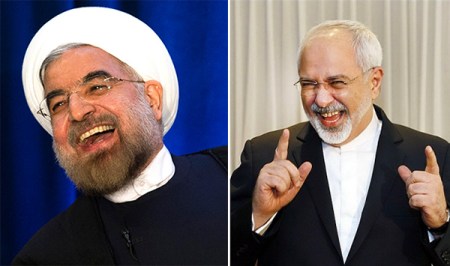
1323 (1)Iran’s firing of a missile within 1500 yards of a U.S. aircraft carrier in December, and its kidnapping and photographing of a U.S. Navy crew were test cases. Other than an apparent temper tantrum by Secretary of State John Kerry, there was no American response, except that Kerry absolved his friend Iranian Foreign Minister Javad Zarif of responsibility. Pictured above: Iranian President Hassan Rouhani (left) and Foreign Minister Javad Zarif (right).

Responding to Senator Lindsay Graham’s suggestion that Congress might increase sanctions against Iran, Mr. Kerry replied, “I wouldn’t welcome [that] at this time given the fact that we’ve given them a warning and if they decide to do another launch then I think there’s a rationale.”

Kerry may not have to wait long.

Just this week, Iranian Deputy Chief of Staff Brig-Gen Maassoud Jazzayeri was quoted by the FARS News Agency reiterating, “The White House should know that defense capacities and missile power, specially at the present juncture where plots and threats are galore, is among the Iranian nation’s red lines and a backup for the country’s national security and we don’t allow anyone to violate it.”

Now, he is believable.

Congress is beginning to breathe fire, but it is not yet clear what it can or will do in the face of the Obama Administration’s executive actions. Last week, angry congressmen were reduced to threatening to “name and shame” American companies that do business with Iran because they cannot figure out how to stem the tide of the Obama Administration’s indulgence of Iranian provocations. That reaction is not even close to good enough.
Primary distractions from Iran

April 5, 2016

Primary distractions from Iran, Israel Hayom, Ruthie Blum, April 5, 2016

Ahead of Tuesday’s Wisconsin presidential primaries, U.S. Speaker of the House Paul Ryan was in Israel, the destination he chose for his first foreign trip since assuming his post at the end of October.

In meetings with Israeli leaders — and in an interview with Times of Israel editor David Horovitz — Ryan reaffirmed his commitment to the Jewish state and his opposition to the nuclear deal with Iran. He also stated, in no uncertain terms, that — contrary to increasing rumor and pressure — he is not going to end up becoming the Republican nominee at what threatens to be a contested GOP convention. Nobody really believes he means it, however, because he had been equally adamant about not wanting the position he is currently occupying.

But, while distraught Americans from both parties are obsessing over whether Donald Trump can win the nomination — and if he does, whether he can beat likely Democratic rival Hillary Clinton — the Obama administration is being given a free pass to get away with murder, figuratively. More literally, it is enjoying the benefit of the doubt caused by the distraction of the public away from the havoc the White House and State Department are continuing to wreak, which is enabling the actual death of a lot of people in the present, and a whole lot more in the future.

The terrorism of the Islamic State group is only a tiny part of this, though it seems to be the only jihadist organization that gets a rise out of Westerners, whom it makes no bones about targeting for mass murder. Indeed, as the suicide bombings in Brussels on March 22 indicated, Europeans and Americans only wake up when a lot of people with whom they can identify get slaughtered senselessly. That this kind of thing is going on routinely everywhere else in the world barely elicits a yawn.

But as evil as ISIS is, it is still small fry compared to the Islamic Republic of Iran, the world’s greatest state sponsor of terrorism, with tentacles reaching far and wide. And now, thanks to the Obama administration, it also has multibillions of dollars at its disposal with which to build its nuclear arsenal. Nor does it hide its ambitions to wipe Israel off the map and its loathing for America, the “great Satan.”

Iran’s supreme leader, Ayatollah Ali Khamenei, has made this clear to the point of warning his own underlings to follow suit.

“Those who say the future is in negotiations, not in missiles, are either ignorant or traitors,” he said last week.

How has the Obama administration responded to this and previous Iranian muscle-flexing, abduction of American sailors, celebration of U.S. abdication and assertion that nothing Tehran does violates the nuclear agreement?

It has conceded to Iran on every point. Or worse.

As was revealed in a piece by Adam Kredo in The Washington Free Beacon on Monday, “Congress is investigating whether the Obama administration misled lawmakers last summer about the extent of concessions granted to Iran under the nuclear deal, as well as if administration officials have been quietly rewriting the deal’s terms in the aftermath of the agreement.”

Rep. Mike Pompeo (R-Kansas) told Kredo that “the gap between [the administration’s] promises … and today’s scary reality continues to widen. We are now trying to determine whether this was intentional deception on the part of the administration or new levels of disturbing acquiescence to the Iranians.”

He was referring to issues such as Iran’s ballistic missile testing, which the administration initially said constituted a violation of nuclear-deal codifier U.N. Resolution 2231, and then backtracked. Perhaps even more disturbing were statements from the Treasury Department indicating that international business transactions with Iran could be done in dollars — releasing the ban in place on Iran’s access to the U.S. financial system.

In other words, not only was the deal America made with the devil a dangerous one to begin with, but apparently, we don’t know the half of it.

This sentiment was expressed in an op-ed in The Wall Street Journal on Sunday by United Arab Emirates Ambassador to the U.S. Yousef Al Otaiba, who wrote that, in spite of President Barack Obama’s claim about the world being safer place as a result of the nuclear deal, “The Iran we have long known — hostile, expansionist, violent — is alive and well, and as dangerous as ever.”

It is this sorry situation, and the Democrats who brought us here, that Americans must keep in mind come November, no matter who the Republican candidate is.

Rouhani threatened unless he keeps Iran’s “provocative”

April 2, 2016

Rouhani threatened unless he keeps Iran’s “provocative” DEBKAfile, April 2, 2016

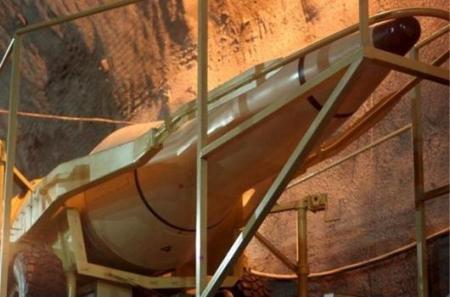
A missile is seen inside an underground missile base for Iran's Islamic Revolutionary Guards Corps (IRGC) Aerospace Force at an undisclosed location in this undated handout photo courtesy of Fars News. REUTERS/farsnews.com/Handout via Reuters

A missile is seen inside an underground missile base for Iran’s Islamic Revolutionary Guards Corps (IRGC) Aerospace Force at an undisclosed location in this undated handout photo courtesy of Fars News. REUTERS/farsnews.com/Handout via Reuters

President Barack Obama said Friday April 1, that “Iran has so far followed the letter of the [nuclear] agreement [with the six powers], but, he added, “the spirit of the agreement involves Iran also sending signals to the world community and business that it is not going to be engaging in a range of provocative actions that may scare business off,” such as fire-testing nuclear-capable ballistic missiles, calling for Israel’s destruction and providing Hizballah with missiles.

At a news conference ending the two-day nuclear summit in Washington, Obama went on to say: “Some of the concerns that Iran has expressed, we are going to work with them to address.” But meanwhile, he said, the US and its allies are taking steps to help Iraq benefit from the agreement by facilitating trade and banking transactions with the Islamic Republic; and the US Treasury Department is seeking to set clearer investment guidelines for Iran.

Two days earlier, on Wednesday, March 30, the Obama administration was reported acting to give Iran limited access to US dollars, since the almost complete lifting of sanctions in January, which netted Tehran an injection of approximately $150 billion “hasn’t provided the country with sufficient economic benefits.”

DEBKAfile’s analysts note the inherent contradiction in the US president’s approach to Tehran: He wants Iran to be compensated with a never-ending shower of dollars for agreeing to limit its nuclear program, but “the US and its allies” cannot question how the money is spent.

So while the West, under orders from Washington, must scramble to boost the Iranian economy, Tehran may continue to test ballistic missiles until they are nuclear capable, and top up the Hizballah terrorists’ arsenal with ever deadlier tools of death.

This glaring inconsistency arises from a fact largely hidden from the world public: last year’s landmark nuclear accord was concluded by Iran’s President Hassan Rouhani and Foreign Minister Mohammed Javad Zarif – not by the real powers in Tehran, supreme leader Ayatollah Ali Khamenei, the Revolutionary Guards chiefs and the ayatollahs at the head of the fundamentalist Shiite movement.

Indeed, even Rouhani was never allowed to formally sign the deal, much less gain Khamenei’s ratification.

But now, Rouhani’s fate depends on keeping those ruling elites happy.  He has found himself in the position of their hostage, a cash machine for keeping the funds for the Islamic Republic’s projects termed by President Obama “provocative” constantly on tap.

Those projects which are currently in full spate clearly leave every little over from the $150bn to even start lifting the Iranian economy out of its mess, while the Rouhani’s government carries the can for that too. Indeed, DEBKAfile’s Iranians sources disclose, the president is forced to earmark 50 percent of the funds released by sanctions relief for items listed under “defense”, namely,  the nuclear and missile development programs, Iran’s overseas military operations, including the Syrian war, subsidizing the Lebanese Hizballah, and establishing new terrorist organizations for attacks on Israel, such as the Al-Sabirin, on the Golan.

These enterprises eat up billions of dollars. Just Iran’s operations in Syria and support for Hizballah cost Tehran $2 billion every month.

Syrian president Bashar Assad didn’t surprise anyone when he revealed that the five-year civil war in his country had cost $200 billion so far. With this kind of spending on “defense,”  the Iranian economy will continue to decay, while Rouhani’s government, which promised the people a better life after the nuclear accord, must bow to the will of the hard-liners or face the consequences.

Our Iranian sources report that Obama’s inconsistent approach to Iran has sharpened the discord between the two major political camps in Tehran and put the “reformists” in extreme peril should they dare to defy the hard-liners who hold the levers of power. Khamenei has publicly threatened to liquidate such opposition leaders as Rouhani and his ally, former president Ayatollah Akbar Hashemi Rafsanjani.

President Rouhani has been put by Obama’s policy in the position of having to keep Tehran’s hungry war- and terror-mongers flush with cash, if he is to save himself and fellow “reformists” from “liquidation.”

The supreme leader was pretty blunt when he said on Friday, March 29, “Those who say the future is in negotiations, not in missiles, are either ignorant or traitors.” This comment underlined Iran’s overriding commitment to developing nuclear missiles and a warning to “traitors” of their fate: execution or a life sentence in a grim Iranian jail.

Op-Ed: Obama’s public face – a political theater of distraction and deception

March 20, 2016

Op-Ed: Obama’s public face – a political theater of distraction and deception, Israel National News, Jeffrey Ludwig, March 20, 2016

In his article “Iran’s Diplomacy for Dummies,” Jonathan Tobin, a totally reasonable individual, again misses the perfidy of Obama’s policies, towards Iran.  We brought to the UN our concerns about Iran testing ballistic missiles being a violation of the Iran deal.  Russia stated flatly that they “would not permit sanctions to be [re-] imposed because Iran’s actions did not violate UN Security Council resolutions.”  Samantha Powers expressed frustration and dismay at the Russian reaction to our concerns.

However, Amb. Powers’ comments against the Russians in the UN were nothing more than a charade. Her comments were a pretense of being offended by Russia.  The Obama administration was just playing politics with the issue, and using Samantha as the actress to give voice to our “concern” in this one-act political theater. We pretend to be standing up for real-time enforcement of the Iran deal, and then blame the Russians when enforcement is prevented. Whereas the truth is there was no real expectation or desire for enforcement by Obama and his lady advisors from day one of the negotiations or our sign-off.  Powers and Obama are merely trying to appear earnest in their implementation of the treaty (which they falsely called an agreement).

The charade (i.e., playacting) can be seen at work over a variety of political scenarios.  These bits of play acting are the modus operandi of the Obama administration.  They seek to reverse the idea found in Shakespeare’s drama “Hamlet.”  There we find the line, “The play’s the thing. Wherein [to] catch the conscience of the king.”   For the Obama inner clique, the principle is “the play’s the thing” to deflect our understanding of the king’s dereliction of duty for God and country.

We see this playacting during a recent interview.  During the course of the interview, Obama tried to appear measured and sincere in his thinking.  For example, he says to the interviewer, “Real power means you can get what you want without having to exert violence.”  He presented himself as a wise Solon who prefers negotiation to force. Here he may not be completely duplicitous but simply be in denial.

Many so-called peaceniks on the left fail to see the cowardly and traitorous underpinnings (motives) of their pseudo-pacifism. Thus, seen in a more honest light, we need to understand that preference for negotiation over force is, in reality, a preference for capitulation and a policy of fear. Capitulation is then interpreted as being wise and detached, whereas it is actually a flight from reality and the unpleasant experiences that accompany any of life’s confrontations.

He also pretended to be detached in the Shiite-Sunni conflict. According to Obama, the two sides “need to find an effective way to share the neighborhood.”  Bret Stephens of the Wall Street Journal tags this remark as sounding more “like Mr. Rogers.” However, this writer finds it to be more duplicitous and sinister than Mr. Stephens thinks.   In reality Obama has taken the side of the Shiites and of the Muslim Brotherhood wing of the Sunnis.  He has decided to reject Sunni leadership that is not rooted in Muslim Brotherhood ideology — in Libya (overthrew Qaddafi), Egypt (overthrew Hosni Mubarak and is not working cooperatively with General Abdel el-Sisi, but did send F-16s to el-Sisi’s predecessor Muslim Brotherhood President Mohamed Morsi), and Yemen (allowed a pro-Iranian Shiite faction to overthrow the pro-Saudi government).

Further, the U.S. has not lifted a finger to prevent Iranian-backed Hezbollah from taking over Lebanon.

Lastly, and most important from a Jewish perspective, he has justified U.S. funding of Hamas via their alliance with the PLO in 2014.   And we know that Hamas is a Shiite (Iranian-backed) organization with Muslim Brotherhood backing as well. Thus by saying to Goldberg that Shiites and Sunnis will just have to learn to get along, Obama was feigning a neutrality that in practice he totally rejects.  His remarks are pure political theater, totally divorced from the policies and practices of his administration.

Although Bret Stephens characterizes Obama’s thinking as shallow, it seems to this writer that Obama’s playacting is not rooted in shallowness, but simply in his being wrong. His underlying principles are ultimately harmful.  He is identified with left-wing pseudo pacifism (“pseudo” because violence is justified, but only for leftist ideals), a Marxist-derived anti-American bias that would portray the U.S. as an exploitative society, a bitter anti-Israel bias derived from his Muslim roots, and a false universalism (“false” because it is not God-centered).

His playacting is thus an attempt to distract from his deep ideological commitments. In Hamlet, the play was intended to reveal the hidden murderous action of the King of Denmark.  With the present U.S. executive branch, the intent of the playacting is to hide the murderous intent.

Dangerous illusions about Iran

March 10, 2016

Dangerous illusions about Iran, Israel Hayom, Elliott Abrams, March 10, 2016

Last year’s Iran nuclear agreement was sold with several powerful arguments, and among the most important were these: that the agreement would strengthen Iranian “moderates” and thus Iran’s external conduct, and that it would allow us unparalleled insight into Iran’s nuclear program.

Both are now proving to be untrue, but the handling of the two differs. The “moderation” argument is being proved wrong but the evidence is simply being denied. The “knowledge” argument is being proved wrong but the fact is being met with silence. Let’s review the bidding.

The idea that the nuclear agreement was a reward for Iran’s “moderates” and would strengthen them is a key tenet of the defense of the agreement. If Iran remains the bellicose and repressive theocracy of today when the agreement ends and Iran is free to build nukes without limits, we have entered a dangerous bargain. It is critical that Iran change, so defenders of the agreement adduce evidence that it has. And the new evidence is Iran’s recent elections. Those elections were a great victory for “moderates” and hard-liners, it is said, and they help to prove that the nuclear deal was wise.

The problem here is that those elections were anything but a victory for Iran’s reformers. As Mehdi Khalaji wrote about the Assembly of Experts election, “If one understands ‘reformist’ as a political figure who emerged during the reform movement of the late 1990s and is associated with the parties and groups created at that time, then neither the candidates on the ‘reformist’ list nor the winners of Tehran’s sixteen assembly seats can credibly be called by that name.” To take one of the examples Khalaji cites, Mahmoud Alavi ran on what has been called a reformist ticket but he “is the current intelligence minister, and Supreme Leader Ali Khamenei appointed him as head of the military’s Ideological-Political Organization from 2000 to 2009.” Khalaji concludes that “no new prominent reformists won seats, and the proportion of hardliners remained the same.”

Ray Takeyh and Reuel Gerecht draw a stark conclusion: This year’s elections “spelled the end of Iran’s once-vivacious reform movement” which has simply been crushed by the regime. “The electoral cycle began with the usual mass disqualification of reformers and independent-minded politicians,” they remind us. I’d cite another fact: that reformers of past election years, presidential candidates Mir-Hossein Mousavi and Mehdi Karoubi, have remained under house arrest for five years now, during the entire Rouhani presidency, demonstrating the true fate of reformers of even a mild variety.

What’s the point of the “reformist” charade? As Takeyh and Gerecht note, “Foreigners don’t have to confess that they are investing in an increasingly conservative and increasingly strong theocracy; rather, they are aiding ‘moderates’ at the expense of hardliners.” But this charade has in fact worked well, producing headline after headline in the Western media about “reformist” victories. You can fool most of the people some of the time, or at least most of the people who have a strong desire to be fooled — because they wish to protect the nuclear deal and its authors.

Iran’s conduct certainly suggests radicalization rather than moderation, and the past weeks have seen repeated ballistic missile tests. Ballistic missiles are not built and perfected in order to carry 500 pound “dumb” bombs; they are used to carry nuclear weapons. So Iran’s continued work on them suggests that it has never given up its nuclear ambitions, not even briefly for the sake of appearances.

The American response has been anemic, even pathetic; we threaten to raise the issue at the United Nations. Two missiles were test-fired today, with the phrase “Israel must be wiped out” written on them. These tests violate U.N. Security Council resolutions, but the American reaction is cautious: a speech, a debate in New York, perhaps some sanctions, but nothing that could possibly lead Iran to undo the nuclear deal. Because Iran knows that this will be the Obama administration’s reaction, expect more and more ballistic missile tests. Expect more conduct like the interception, capture, and humiliation of American sailors in the Gulf. Expect more Iranian military action throughout the region.

Some moderation.

The head of CENTCOM, Gen. Lloyd Austin, put it this way: “We see malign activity, not only throughout the region, but around the globe as well. … We’ve not yet seen any indication that they intend to pursue a different path. The fact remains that Iran today is a significant destabilizing force in the region. … Some of the behavior that we’ve seen from Iran of late is certainly not the behavior that you would expect to see from a nation that wants to be taken seriously as a respected member of the international community.”

Are we now, to turn to the second matter, gaining unparalleled insight into the Iranian nuclear program? Is this one of the achievements of the agreement? On the contrary, it seems. As the Associated Press put it, “The four Western countries that negotiated with Iran — the U.S., Britain, France and Germany — prefer more details than were evident in last month’s first post-deal [International Atomic Energy Agency] report. In contrast, the other two countries — Russia and China — consider the new report balanced, while Iran complains the report is too in-depth. IAEA chief Yukiya Amano feels he has struck the right balance, considering Iran is no longer in violation of U.N. and agency demands to curb its nuclear program. His report was much less detailed than pre-nuclear deal summaries.”

Much less detailed? Sure, because the U.N. Security Council resolutions under which the IAEA provided the detail, are gone, wiped out by the nuclear deal. The IAEA’s February 26 report was its first since the nuclear deal went into effect, and lacked details on matters such as uranium stockpiles, production of certain centrifuge parts, and progress by Iran toward meeting safeguard obligations. The Obama administration has wavered, sometimes saying there was enough detail, but then demanding more. The deal was sold, in part, as a way of providing transparency, but that does not appear to be accurate: it may in fact legitimize opacity. Earlier this week came a remarkable exchange between a reporter and State Department spokesman John Kirby, who defended the degree of knowledge we have.

Kirby said, “So we now know more than we’ve ever known, thanks to this deal, about Iran’s program.” The reporter, Matt Lee of AP, asked “How much near-20% highly enriched uranium does Iran now have?” Kirby replied, “I don’t know.” To which Lee noted, “You don’t know because it’s not in the IAEA report.”

So, the bases on which the nuclear agreement with Iran was sold appear to be crumbling. Moderates are not gaining power, Iran is not moderating its behavior, and we know less rather than more about what it is actually doing in its nuclear program. Some of those conclusions are denied by the administration and by credulous portions of the press, and others are ignored. But all those verbal games will not make us any safer.

From “Pressure Points” by Elliott Abrams. Reprinted with permission from the Council on Foreign Relations.

Iranian official: “Iran’s missile program will not stop under any circumstances”

March 10, 2016

Iranian official says Iran never accepted UN Security Council resolutions regarding missile program The Iranian Revolutionary Guards Corps (IRGC) claim that in light of the missile trials and the wave of international criticism of them, the Islamic Republic of Iran does not recognize the UN Security Council’s decisions regarding the country’s missile program.

Mar 10, 2016, 2:00PM Becca Noy

Source: Iranian official: “Iran’s missile program will not stop under any circumstances” | JerusalemOnline.com

For a few days, Iran has been testing ballistic missiles and today (Thursday), a senior level IRGC official said that “we never accepted the UN Security Council resolutions on Iran’s missile work.”

Yesterday (Wednesday), Israeli officials strongly condemned the trials that were conducted in Iran recently, in which long range missiles that can reach any destination in Israel were tested. In addition, threats against Israel were inscribed on some of the missiles.

Biden urged Israel: “accept the US aid package proposal”

March 9, 2016

Obama’s administration is determined to send billions of dollars to Israel A key goal of the US Vice President was exerting pressure on the Israeli government following the impasse of negotiations on a package of security assistance. The Vice President urged Israel to receive less money than it demands.

Mar 9, 2016, 8:45PM Idan Cohen

Source: Biden urged Israel: “accept the US aid package proposal” | JerusalemOnline.com

Photo Credit: Channel 2 News

Biden gave a speech today (Wednesday) in which he claimed that “We helped bolster Israel’s security more than any other administration in History. We have raised our security cooperation in military intelligence fields to unprecedented levels. We have insured Israel has the most advanced weapons including one of the most effective missile defense system in the world. At the same time, we are struggling to increase our missile defense capabilities because of the threat from North Korea.”

“It does not mean we do not disagree, but you never need to doubt that the US has Israel’s back. We are committed to making sure that Israel can defend itself against all serious threats and maintain its qualitative edge with a quantity sufficient to maintain that. It’s critical because Israel lives in a very tough and changing neighborhood,” Biden Added.

Biden has also referred to Iran: “if they will break the deal, we will act.” Regarding the Islamic State terrorist organization, Biden said that “they are losing ground every day.”

U.S. Demands Greater Oversight on Iran Nuke Program

March 9, 2016

U.S. Reverses Position, Demands Greater Oversight on Iran Nuke Program Obama administration repeats concern that Iran already violating nuke deal

BY:
March 9, 2016 1:45 pm

Source: U.S. Demands Greater Oversight on Iran Nuke Program

Read also :

Obama Administration: A UN Resolution That Would Divide Israel And Jerusalem Is Back In Play

The Obama administration shifted its stance on Iran’s contested nuclear program Wednesday, writing in a letter to the United Nations that it is concerned the international community’s nuclear watchdog organization is not fully reporting on potential Iranian violations of the nuclear deal.

The administration also renewed concerns about Iran having violated its international commitments by stockpiling too much nuclear-related material. The renewed concerns come after Iran repeatedly test fired ballistic missiles in violation of current U.N. resolutions.

Yukiya Amano, chief of the International Atomic Energy Agency, or IAEA, said earlier this week that the agency is prohibited by the nuclear agreement from publicly reporting on potential violations by Iran.

The revelation prompted criticism from outside nuclear experts, including a former IAEA deputy director general. The limited reporting could prevent the international community from detecting potential nuclear violations by Tehran, according to these observers.

However, the Obama administration initially dismissed these concerns, with officials telling the Washington Free Beacon and other news outlets that “there isn’t less stringent monitoring or reporting on Iran’s nuclear program.”

One State Department official who spoke to the Free Beacon  Tuesday said it is “a distortion to say that if there is less detail” in the reports, then there is “less stringent monitoring or less insight into Iran’s nuclear program.”

By Wednesday morning, this rhetoric had shifted. The administration now says that the reports on Iran should be more “robust and detailed,” according to a letter submitted by U.S. Ambassador Henry S. Ensher to the IAEA’s board of governors.

“It is vital that the [IAEA] director general continues to provide robust and detailed reporting on Iran’s implementation of its commitments,” Ensher wrote, according to a copy of the letter. “Sufficiently comprehensive information in reports avoids misunderstandings.”

The level of reporting “is essential to ensuring that Iran’s nuclear program is and will remain exclusively peaceful,” Ensher wrote. “Full implementation will assure the international community that Iran’s potential pathways to obtaining a nuclear weapon have been firmly closed off.”

Ensher said the nuclear agreement still permits the IAEA to fully investigate potential Iranian infractions, though it remains unclear how much of this information will be made public going forward.

“It is important to note that the IAEA retains its full authorities to investigate any new concerns that may arise in Iran, including any new concern regarding weaponization-related activities,” he wrote.

Ensher also disclosed U.S. concerns that Iran is currently violating the deal by stockpiling too much heavy water, which is used in a nuclear reactor.

“We note with serious concern Iran’s temporary accumulation of heavy water in excess of its agreed stockpile limit, and welcome the quick actions taken to remedy this inconsistency with Iran’s commitments,” Ensher wrote.

Foreign policy insiders say that the Obama administration’s shift on the issue is emblematic of its dealings with Iran.

“This reversal is the latest in a seemingly unending stream of Iranian illegality and sanctions violations that the administration initially tried to ignore, then tries to justify, and then, finally, promises to deal with,” said one senior foreign policy consultant who has worked closely with Congress on the Iran issue.

Meanwhile, Iran for a second day in a row test-fired ballistic missiles, which is a violation of U.N. Security Council resolutions.

The Obama administration implemented new sanctions on Iran in January for similar behavior.

Wednesday’s launch included missiles that were marked with rhetoric advocating the destruction of Israel and the United States.

Sen. Mark Kirk (R., Ill.) called the second missile test “a direct threat to Israel on the same day Vice President Joe Biden is actually visiting Jerusalem.”

“Since the enactment of the flawed nuclear deal, the U.S. has under-enforced current sanctions on Iran’s ballistic missile program,” Kirk said. “Today is another example of this administration’s policy of they are ‘not supposed to be doing that.’ Instead, we should send the president bills to stop Iran’s Islamic Revolutionary Guard Corps, as well as the Ministry of Defense, Aerospace Industries Organization and other related entities driving the Iranian ballistic missile program.”

Iranian State Television Flaunts Anti-Israel Ballistic Missile Launches

March 9, 2016

Iranian State Television Flaunts Anti-Israel Ballistic Missile Launches

BY:
March 9, 2016 1:45 pm

Source: Iran | Missile | Israel

For the second day in a row, Iranian state television has broadcast propaganda videos that show the launch of several ballistic missiles with anti-Israel intent.

A video released Tuesday shows the inside of an underground tunnel used for launching the missiles. It features an Israeli flag painted on the ground which Islamic Revolutionary Guard Corps, or IRGC, members are meant to walk over on their way to launch.

Wednesday’s video shows another two missiles labeled with “Israel must be wiped off the Earth” in Hebrew. Persian-language media headlines included the Hebrew message in order to emphasize the IRGC’s anti-Israel intentions. The missiles were reportedly precision-guided Qadr missiles that put Israel within striking range.

Amir Ali Hajizadeh, commander of the IRGC aerospace division, said that the tests were meant to intimidate Israel.

“The reason we designed our missiles with a range of 2,000 km (1,200 miles) is to be able to hit our enemy the Zionist regime from a safe distance,” Hajizadeh said. “Israel is surrounded by Islamic countries and it will not last long in a war. It will collapse even before being hit by these missiles.”

Iranian officials have brushed off the launches as part of their national defense capabilities, arguing that they are not in violation of the nuclear agreement implemented in January. The nuclear deal will free Iran from ballistic missile restrictions in eight years.

However, the tests do stand in violation of United Nations Security Council Resolution 2231, which states that Iran should not partake in “any activity related to ballistic missiles designed to be capable of delivering nuclear weapons.”

Speaking in Jerusalem Wednesday, Vice President Joe Biden said that the U.S. would “act” if Iran violated the nuclear deal and would keep an eye on threatening conventional military activity.

“There is no need to doubt that the United States has Israel’s back,” Biden said.


Iran Breaks With Arab States in Backing Hezbollah

March 9, 2016

Iran Breaks With Arab States, Continues Backing Hezbollah Iran blames Jews for forcing Arab states to designate Hezbollah as terrorist group

BY:
March 9, 2016 11:40 am

Source: Iran Breaks With Arab States in Backing Hezbollah

Read also :

Obama Administration: A UN Resolution That Would Divide Israel And Jerusalem Is Back In Play

Iranian leaders publicly broke ranks this week with major Arab Gulf nations in a series of statements criticizing these regional powers for formally designating Hezbollah as a terrorist organization.

The Gulf Cooperation Council, or GCC, a regional governing coalition comprised of Saudi Arabia, the United Arab Emirates, Qatar, Oman, Kuwait, and Bahrain, announced last week that it is formally designating the Lebanese militant group Hezbollah a terrorist organization.

The GCC joins the United States, Israel, Canada, and a host of other nations in labeling Hezbollah a terrorist organization. These nations, including Saudi Arabia, have already taken steps to blacklist organizations and individuals associated with Hezbollah.

The decision by the coalition of Arab states to go after Hezbollah has sparked outrage in Iranian government, which is now claiming that “Zionists” secretly orchestrated the GCC’s effort.

Regional experts view Iran’s pushback as a sign that Tehran’s ongoing support for extremist groups has made it a pariah among other Arab nations, which have expressed concern Iran will spend the billions of dollars it received as part of the recent nuclear agreement to fund Hezbollah’s terror activities.

“No doubt the move was made upon an order by the Zionists and the sworn enemies of Islam and Great Prophet Mohammad,” said Major Gen. Hassan Firouzabadi, the Iranian Armed Forces chief of staff, according to Iran’s state-controlled press.

Iranian leaders vowed to continue its support for Hezbollah, which is responsible for killing Israelis and Americans in terror attacks.

“Despite efforts by the House of Saud [Saudi Arabia] and its regional and trans-regional allies, Hezbollah’s deep-seated position will remain intact,” Firouzabadi said. “It will not shift the balance of power in the region. It will not help the Zionists extend their grip on the occupied Palestinian territories.”

Sadeq Larijani, the head of Iran’s judiciary system, also blamed Jewish interests for the GCC’s latest move.

“The resistance movement of Hezbollah in Lebanon protects the integrity of Arabs and Muslims against the Zionist regime,” Larijani said Monday.

Iran’s foreign ministry also took aim at the GCC, specifically Saudi Arabia, which has had poor relations with Iran since its embassy in Tehran was burned down in January. Jaberi Ansari, the spokesman for Iran’s foreign ministry, accused the Arab states of aligning with “the occupiers of Palestine.”

“Certain Arab countries are against the Hezbollah resistance movement,” Ansari said. “The movement represents the efforts and ideals of Muslim nations for independence, freedom, justice, and integrity. Hezbollah stands against the Israeli oppression, occupation, racism, and terrorism.”

“Those who are behind the move are knowingly or unknowingly undermining the interests of the Muslim nations,” Ansari claimed.

Regional experts described the verbal conflict between Iran and the GCC as a sign that Hezbollah is becoming increasingly toxic on the international stage.

“It’s getting harder for Iran to defend Hezbollah on the world stage,” Jonathan Schanzer, a former terrorism finance analyst at the U.S. Treasury Department, told the Washington Free Beacon. “The United States, Israel, Canada, France, Saudi Arabia, Bahrain, UAE, Qatar, Kuwait, the Netherlands, New Zealand, the UK, the EU and Australia have all designated the group, in some form, as a terrorist organization—and it’s increasingly clear that their concerns have increasingly less to do with Hezbollah’s terrorist activities against Israel, and more to do with the group’s global footprint.”

The nuclear deal helped to fuel the GCC’s designation of Hezbollah, according to Schanzer, who serves as vice president of research at the Foundation for Defense of Democracies.

“Ironically, had Iran not signed the nuclear deal, it’s unclear whether the recent terrorist designations would have taken place,” Schanzer said. “But with Iran set to receive $100 billion in sanctions relief, one major concern is that Hezbollah will receive a significant portion of those funds for the purpose of terrorist attacks and other activities that would further destabilize the Middle East.”

“With Iran no longer under sanctions, the world is more alarmed about the activities of this Iranian proxy than ever before,” he said.

Hezbollah leader Hassan Nasrallah also slammed the GCC over the weekend, saying in a video message that Saudi Arabia and its allies in the coalition are losing credibility.


