♦ It appears that several major Palestinian terror groups have begun to prepare for mega-terror attacks on Israel.
♦ The authoritative rules of war do not equate “proportionality” with how many people die in each side of a conflict. In war, no side is ever required to respond to aggression with only the equivalent measure of force. Rather, the obligations of proportionality require that no side employ any level of force that is greater than what is needed to achieve a legitimate political and operational objective.
♦ Under pertinent international law, the use of one’s own people as “human shields” — because such firing from populated areas is intended to deter Israeli reprisals, or to elicit injuries to Palestinian civilians — represents a codified war crime. More specifically, this crime is known as “perfidy.” This is plainly an attempt to make the IDF appear murderous when it is compelled to retaliate, but it is simply a Palestinian manipulation of legal responsibility. Under law, those Arab residents who suffer from Israeli retaliations are incurring the consequences of their own government’s war crimes.
♦ International law is not a suicide pact. Instead, it offers a universally binding body of rules and procedures that allows all states to act on behalf of their “inherent right of self-defense.”
Already, calls from various directions have begun to condemn Israel for its recent retaliatory strikes in self-defense at Gaza.[1] The carefully-rehearsed refrain is all-too familiar. Gazan terrorists fire rockets and mortars at Israel; then, the world calls upon the Israel Air Force (IAF) not to respond.
Although Israel is plainly the victim in these ritualistic cycles of Arab terror and required Israeli retaliations, the “civilized world” usually comes to the defense of the victimizers. Inexplicably, in the European Union, and even sometimes with the current U.S. president, the Israeli response is reflexively, without thought, described as “excessive” or “disproportionate.”
Leaving aside the irony of President Obama’s evident sympathies here — nothing that Israel has done in its own defense even comes close to the indiscriminacy of recent U.S. operations in Afghanistan[2] — the condemnations are always unfounded. Plainly, Hamas and allied Arab terror groups deliberately fire their rockets from populated areas in Gaza at Israeli civilians. Under pertinent international law, this use of one’s own people as “human shields” — because such firing from populated areas is intended to deter Israeli reprisals, or to elicit injuries to Palestinian civilians — represents a codified war crime. More specifically, this crime is known as “perfidy.”
“Perfidy” is plainly an attempt to make the IDF appear murderous when it is compelled to retaliate, but it is always simply a Palestinian manipulation of true legal responsibility. Hamas’s intent might be to incriminate the Israelis as murderers of Gaza’s civilians. Legally, however, the net effect of Arab perfidy in Gaza is to free Israel of all responsibility for Arab harm, even if it is Israeli retaliatory fire that actually injures or kills the Gazan victims. Under law, those Arab residents who suffer from Israeli retaliations are incurring the consequences of their own government’s war crimes. Palestinian suffering, which we are surely about to see again in stepped-up, choreographed Arab propaganda videos, remains the direct result of a relentlessly cruel, insensitive, and criminal Hamas leadership.
Significant, too, although never really mentioned, is that this Hamas leadership, similar to the PA and Fatah leadership, often sits safely away from Gaza, tucked away inconspicuously in Qatar. For these markedly unheroic figures, “martyrdom” is allegedly always welcomed and revered, but only as long as this singular honor is actually conferred upon someone else.
Moreover, the authoritative rules of war do not equate “proportionality” with how many people die in each side of a conflict. In war, no side is ever required to respond to aggression with only the equivalent measure of force. Rather, the obligations of proportionality require that no side employ any level of force that is greater than what is needed to achieve a legitimate political and operational objective.
If the rule of proportionality were genuinely about an equivalent number of dead, America’s use of atomic weapons against Japanese civilians in August 1945 would represent the greatest single expression of “disproportionality” in human history.
It appears that several major Palestinian terror groups have begun to prepare for mega-terror attacks on Israel. Such attacks, possibly in cooperation with certain allied jihadist factions, could include chemical and biological weapons of mass destruction. Over time, especially if Iran, undeterred by the July 2015 Vienna Pact, should agree to transfer portions of its residual nuclear materials to terror groups, Israel could then have to face Palestinian-directed nuclear terrorism.
One message is clear. If Israel, pressured by outside forces, allows Palestinian terror from Gaza to continue unopposed, the state could become increasingly vulnerable to even greater forms of Arab aggression.
Also important to keep in mind is that nuclear terror assaults against Israel could be launched from trucks or ships, not only from rockets and missiles.
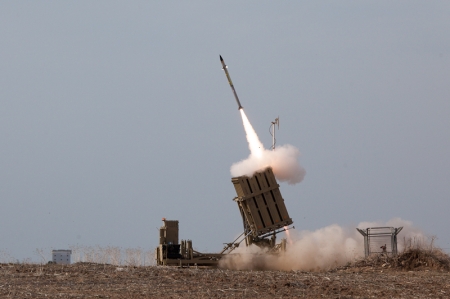
What about Israel’s active defenses? In its most recent defensive operations, Protective Edge and Pillar of Defense, Israel accomplished an impressively high rate of “Iron Dome” interceptions against incoming rockets from Gaza. Still, it would be a mistake to extrapolate from any such relatively limited successes to the vastly more complex hazards of strategic danger from Iran. Should Iran “go nuclear” in ten years or sooner, that still recalcitrant Islamic regime could launch at Israel missiles armed with nuclear warheads.
In its most recent defensive operations, Israel accomplished an impressively high rate of “Iron Dome” interceptions against incoming rockets from Gaza. Still, it would be a mistake to extrapolate from any such relatively limited successes to the vastly more complex hazards of strategic danger from Iran. (Image source: IDF)
Sun Tzu, the ancient Chinese military thinker, already understood — long before the nuclear age — that too great a reliance on defense is always misconceived. Today, Arrow, Israel’s core ballistic missile defense (BMD) interception system, would require a 100% rate success against offensive nuclear missiles. At the same time, such a rate is impossible to achieve, even if enhanced by Rafael’s new laser-based defenses. Israel must therefore continue to rely primarily on deterrence for existential nuclear threats.
Although unacknowledged, Israel has always been willing to keep its essential counterterrorism operations in Gaza consistent with the established rules of humanitarian international law. Palestinian violence, however, has remained in persistent violation of all accepted rules of engagement — even after Israel painfully “disengaged” from Gaza in 2005.
Both Hamas and the Palestinian Authority still speak indignantly of “the Occupation?” But where, precisely, is this “occupation?” After all their agitated umbrage about Israeli “disproportionality,” shouldn’t the Palestinians and their allies finally be able to answer that core question? There are no Israelis in Gaza.
International law is not a suicide pact. Instead, it offers a universally binding body of rules and procedures that allows all states to act on behalf of their “inherent right of self-defense.”[3] When terrorists groups such as Hamas openly celebrate the “martyrdom” of Palestinian children, and when Hamas leaders unhesitatingly seek their own religious redemption through the mass-murder of Jewish children, unfortunately these terrorists retain no legal right to demand sanctuary.
In response to endless terror attacks from Gaza, Israel, with countless leaflets, phone calls, “knocks on the roof,” and other warnings to its attackers, has been acting with an operational restraint unequaled by any other nation and according to binding rules of war. In these obligatory acts of self-defense there has not yet been the slightest evidence of disproportionality.
____________________________________
[1] Speaking in Beirut on Channel 10 News, on May 7, 2016, Hezbollah leader Hassan Nasrallah accused Israel of “attacking Gaza,” continuing: “Unfortunately, the Arab world is silent about the situation in Gaza. … these actions must be condemned.” Cited in Israel National News, “Nasrallah calls for condemnation of Israeli ‘Attacks’ on Gaza,” May 7, 2016. Interesting, too, is that Nasrallah, a Shiite leader, is speaking here in strong support of Sunni Hamas.
[2] See Alissa J. Rubin, “Airstrike Hits Doctors Without Borders Hospital in Afghanistan,” The New York Times, October 3, 2015. This is an account of the October 2015, U.S. destruction of a crowded hospital in the embattled city of Kunduz. The Pentagon confirmed the strike, which it called “collateral damage,” and President Obama offered condolences to the victims in what he termed a “tragic incident.” Doctors Without Borders was awarded the Nobel Peace Prize in 1999.
[3] See, especially, Article 51 of the United Nations Charter.
A rational voice in a world of madness. Obama emboldened, enriched and legitimized the world’s largest state sponsor of terror. He has unleashed a terrible evil on the world.
Not all will go quietly. Thank you, Governor Abbott, for giving voice and action to the voiceless and powerless.
Governor Greg Abbott today informed the Obama administration that Texas will maintain and strengthen its sanctions against Iran. Governor Abbott responded to a letter from the administration requesting that Texas “review” its economic sanctions against Iran. Governor Abbott reiterated his strong opposition to the Iran deal and informed the administration that he will continue to seek new legislation to strengthen existing economic sanctions against the world’s leading state sponsor of terrorism.
“Entering into an agreement with a country that consistently calls for ‘death to America’ and repeatedly articulates anti-Semitic policies is short-sighted and ignores geopolitical realities,” Governor Abbott writes in the letter. “As a strong supporter of Israel, I am committed to doing everything in my power to oppose this misguided deal with Iran. Accordingly, not only will we not withdraw our sanctions, but we will strengthen them to ensure Texas taxpayer dollars are not used to aid and abet Iran.”
During his visit to Israel in January 2016, Governor Abbott met with Israeli Prime Minister Benjamin Netanyahu and announced he would seek legislation to:
Prohibit local government entities in the State of Texas from investing in Iran or entities conducting business with Iran
Require all Texas state entities – not just state pensions – to follow Texas’ divestiture policy
Close additional loopholes in Texas’ current divestiture statute.
Texas Rejects Obama’s Request to Lift Iran Sanctions, Affirms ‘Strong Support’ for Israel,” By Max Gelber, United with Israel, May 16, 2016:
Texas Governor Gregg Abbott announced he would not lift the state’s sanctions on Iran, rejecting a request to do so by President Obama and affirming ‘strong support’ for Israel.
Abbott told the Obama administration in a letter that Texas will maintain and even strengthen its sanctions against Iran.
Abbott was responding to a letter from the administration sent in April requesting that Texas “review” its economic sanctions against Iran.
The governor reiterated his strong opposition to the Iran deal, which was sealed with the Islamic Republic last summer, and informed the administration that he will continue to seek new legislation to strengthen existing economic sanctions against Iran, which he termed as the “world’s leading state sponsor of terrorism.”
“Entering into an agreement with a country that consistently calls for ‘death to America’ and repeatedly articulates anti-Semitic policies is short-sighted and ignores geopolitical realities,” Abbott wrote in the letter.
Obama
US President Barack Obama (Susan Walsh/AP)
“As a strong supporter of Israel, I am committed to doing everything in my power to oppose this misguided deal with Iran. Accordingly, not only will we not withdraw our sanctions, but we will strengthen them to ensure Texas taxpayer dollars are not used to aid and abet Iran,” he stated.
During his visit to Israel in January, Abbott met with Prime Minister Benjamin Netanyahu and announced he would seek legislation to prohibit local government entities in the State of Texas from investing in Iran or entities conducting business with Iran, a law that requires all Texas state entities, and not just state pensions, to follow Texas’ divestiture policy, and further legislation to close additional loopholes in Texas’ current divestiture statute.
“Given all the flaws that are inherent in the Iran deal, Texas is absolutely committed to maintaining its sanctions against Iran,” the letter reads.
Meeting with the Jewish media in New York over the weekend, Abbot said he is “deeply disturbed” by the nuclear deal and views it as “a potential existential threat to Israel and frankly to nations across the globe.”
“It makes no sense to me why the United States would be an accomplice to arming and aiding economically a nation that to this day seems to be devoted to terrorism,” he said at the meeting, according to the Jerusalem Post.
“Israel has no stronger ally in the United States than the State of Texas,” he added. “Texas is going to take the lead in sending the message to the international community that we stand with Israel.”
The Obama administration’s efforts to create a so-called “echo chamber” meant to mislead reporters and lawmakers about the substance of last summer’s comprehensive nuclear deal with Iran may have violated U.S. laws against the establishment of domestic propaganda outfits, according to testimony to Congress by a former Pentagon adviser.
Top U.S. officials, including Secretary of State John Kerry, may have fallen victim to a massive spin operation helmed by White House national security adviser Ben Rhodes, who has come under intense scrutiny following a magazine profile detailing his efforts to mislead the American public and prominent D.C. insiders about the Iran deal, according to testimony offered Tuesday before the House Oversight Committee.
The administration late Monday declined to make Rhodes available to testify to Congress about his press operation, which was run out of the White House by Rhodes and other top members of the National Security Council.
In lieu of Rhodes, the Oversight Committee invited three former U.S. officials to discuss the ways in which the pro-Iran effort intentionally misinformed Congress and negatively impacted American national security.
Michael Rubin, a former Pentagon adviser who testified, told the Washington Free Beacon following the hearing that Congress has grounds to launch an investigation into whether these efforts may have violated U.S. laws against the establishment of domestic propaganda campaigns targeting Americans.
“Rhodes essentially bragged about creating a propaganda operation,” Rubin told the Free Beacon. “It wasn’t simply about spin, rather, it was about denying facts he knew to be true, feeding outright lies into the mainstream press through sympathetic enablers and supposed independent experts on the Ploughshares trough whom he knew were anything but independent.”
“In effect,” Rubin explained, “he was running a propaganda operation against the American public and other officials. There are laws against that. Unfortunately, it seems that Kerry himself—a person whom even staffers have described as too credulous—got caught in that web.”
Questions remain about whether Kerry ever received impartial information from experts functioning outside of Rhodes’ so-called echo-chamber, Rubin said.
“In essence, did Rhodes—working from the National Security Council, a body that was always supposed to coordinate policy across agencies and not run a spin war room—craft propaganda that was fed to State Department leaders through unofficial channels by a network of experts who had financial incentive to amplify what he said?” Rubin asked.
Rubin further explained during his testimony how Rhodes may have deceived Kerry as part of the operation, a situation that raises questions about whether the secretary of state was negotiating with Iran from a sound position.
“Rhodes has placed the security of the U.S. and its allies at risk,” Rubin testified. “Certainly any dissemination of falsehoods to Congress and the American people warrants a broader investigation. National security and Congress’ credibility are at risk.”
Rubin expressed concern that “by creating an echo chamber and only talking to people in it, in effect, what Rhodes did was create a propaganda operation in which he entrapped none other than Secretary of State John Kerry. Did Secretary of State Kerry talk to people outside the echo chamber? If not, then he’s a victim of Ben Rhodes as well.”
Rep. Jason Chaffetz (R., Utah), the committee’s chairman, expressed frustration at the White House’s decision to bar Rhodes from testifying. Chaffetz has suggested that Rhodes could be subpoenaed to testify in the future.
“The White House on Thursday claimed that this wasn’t about exec privilege, then, less than 24 hours, before this hearing they reversed course,” Chaffetz said. “Now who’s being inconsistent?”
“You had plenty of times, Mr. Rhodes, to go out and talk to your media friend in the echo chamber” before showing up to testify, he said.
Michael Doran, a former senior director of the White House National Security Council under George W. Bush, said that the White House still has not publicly revealed the complete contents of the nuclear deal.
“In my view, the creation of the echo chamber and war room [by Rhodes] constitutes a deception of the American people,” Doran said at the hearing. “We do not actually know what is in the Iran deal. We still to this day do not know.”
The White House’s spin operation effectively created a false narrative about Iranian moderates rising to power in the Islamic Republic, according to Doran, who explained that this false narrative set the stage for negotiations to take place.
The deepening scandal surrounding the White House campaign prompted a call from leading senators on Monday for President Barack Obama to fire Rhodes, according to a letter sent to the White House and first reported by the Free Beacon.
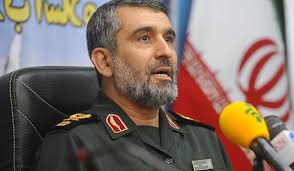
Amir Ali Hajizadeh, commander of the Aerospace and Missile Force of Iran’s Islamic Revolutionary Guard Corps (IRGC), said at a conference of religious students in Qom on May 14, 2016:
Hajidazeh. Source: Farsnews.com.
“The arrogance [i.e. the U.S.] is trying to create [among us] the belief that Iran is at a crossroads, and that it has no choice but to compromise with America or be eternally subjected to American pressure and the problems that stem from that… At the same time, within Iran the belief has taken root that it is not possible to solve [Iran’s] problems without America…
“If we stand fast against this move by the Americans, who have stolen the funds of the [Iranian] nation, they will abandon this habit [of thievery]. But if we compromise with them, the[ir] thievery will end up [taking] $40-$50 billion of Iran’s assets and its blocked funds. The Americans understand only the language of force; they do not understand the language of reason. They cannot be trusted. We must face them down firmly, and we must act. If we do not, we will witness daily their exaggerated and evil demands.
“At this time, the Americans are telling [us]: ‘Don’t talk about missile affairs, and if you conduct a test or maneuver, don’t mention it.’ If we agree to this, they will advance another step, and say: ‘Don’t conduct [a missile test] at this time, and also don’t do it in the Persian Gulf region.’ After that, they will tell us: ‘Why do you need your missiles to have a range of 2,000km [anyway?]?’
“After that, they will tell [us]: ‘Next, we will check whether your missiles can really carry nuclear weapons. Bring us the details [of the missiles].’ After that, they will say: ‘We need to set up cameras.’ And, finally, they will say: ‘Either saw [the missiles up into pieces] or, like [Libyan dictator Mu’ammar] Gadhafi, load them onto a ship and hand [them] over to us.’
“They are clearly deluding themselves. Nothing like this will ever happen.”[1]
Iran ‘preparing another Holocaust,’ Netanyahu charges After meeting French FM, prime minister calls on world to condemn Islamic Republic for ‘denying and mocking’ the Shoah
Prime Minister Benjamin Netanyahu railed at Iran Sunday for holding its annual Holocaust denial cartoon contest, charging that the Islamic Republic was “preparing another Holocaust” against the Jewish people.
Iran “denies the Holocaust, mocks the Holocaust, and is preparing another Holocaust,” he told ministers at the start of the weekly cabinet meeting in his Jerusalem office, “and I think all the countries of the world need to stand up and condemn this unequivocally.”
Israel’s problem with Iran, he said, “isn’t just its subversive, aggressive policy in the region. It’s the values on which it’s based.”
Iran’s annual international cartoon contest lampooning the Holocaust features around 150 works from 50 countries. It began Saturday and is running for the next two weeks.
The contest secretary said Saturday it was not denying the Nazi genocide and wasn’t “ridiculing its victims,” but then went on to equate Nazi crimes with Israel’s treatment of the Palestinians.
Netanyahu also said that France’s support for a UNESCO resolution that neglected to mention the Temple Mount’s Jewish history casts a pall over Paris’s impartiality in attempts to resuscitate peace talks.
He was speaking shortly after meeting with visiting French Foreign Minister Jean-Marc Ayrault. Ayrault traveled to Ramallah to convene with Palestinian Authority President Mahmoud Abbas after his tete-a-tete with the Israeli prime minister.
Prime Minister Benjamin Netanyahu (R) shakes hands with French Foreign Minister Jean-Marc Ayrault on May 15, 2016 during a meeting at the Prime Minister’s Office in Jerusalem (AFP PHOTO AND POOL / MENAHEM KAHANA)
The prime minister said that he told Ayrault that France’s “scandalous decision” to vote in favor of a UNESCO resolution “which doesn’t recognize the millennia-old connection between the Jewish people and the Temple Mount casts a shadow on France’s evenhandedness in any forum it’s trying to convene.” Netanyahu wrote a furious letter to President Francois Hollande last week protesting the French support for the decision.
Ayrault reassured Netanyahu that France maintains complete transparency regarding its relations with Israel, and reiterated Hollande’s assertion that the UNESCO vote was a “misunderstanding.”
“The only way to advance real peace between us and the Palestinians is through direct negotiations… with no preconditions,” Netanyahu restated.
Ayrault is promoting a bid to persuade Netanyahu to accept France’s efforts to engineer a peace deal between Israel and the Palestinians, based on a two-state solution.
Editor’s Note: The National Interest and the Heritage Foundation have partnered for a multi-part occasional series examining various aspects of the Iran nuclear agreement. The below is part four of the series. You can read previous parts here: one, two and three.
Last summer’s Iran nuclear deal has been roundly criticized for a number of solid reasons, ranging from Tehran’s ability under the deal to continue advanced centrifuge research to lingering questions about the possible military dimensions of its nuclear program.
That’s all well established.
One issue that has been largely ignored—wittingly or unwittingly—is this: What if Iran were able to find a suitable partner to collude with on an ‘‘underground” nuclear weapons program, all while seemingly staying within the restrictions of the July 2015 nuclear deal?
In other words, Tehran could by all public accounts adhere to the P5+1’s (China, France, Germany/European Union, Russia, the United Kingdom and the United States) Joint Comprehensive Plan of Action (JCPOA). But concurrently, Iran could work clandestinely with another country to advance its nuclear weapons program, essentially circumventing the International Atomic Energy Agency’s inspections and monitoring of the nuclear program inside Iran.
What better candidate for covert cooperation than cagey North Korea?
First, there’s no doubt that North Korea has a nuclear weapons capability. It has conducted four—maybe soon five—tests (2006, 2009, 2013 and 2016), possibly using both plutonium and uranium as fissile material.
Next, some analysts believe Pyongyang may have already “miniaturized” or “weaponized” the underground testing device into a nuclear warhead, capable of being mated to a ballistic missile. Even if North Korea hasn’t achieved it yet, it’s working on it.
Pyongyang has also expanded its missile testing beyond land-based launches. It now has conducted at least two subsurface ballistic missile tests that may also be related eventually to its nuclear weapons program. Clearly, these North Korean capabilities—though not all proven—would benefit an Iranian nuclear weapons program.
Also important is that Pyongyang seems willing to share its nuclear know-how with others, as evidenced by its building of a nuclear facility for Damascus that was destroyed in an Israeli air strike in 2007. Though public evidence is scarce and, if available, gauzy, it’s quite reasonable to conclude with some confidence that Pyongyang and Tehran already have some sort of established security or defense relationship. For instance, in 2012, Iran and North Korea reportedly signed a science and technology (S&T) agreement. It’s fair to assume that any cooperation is defense-related.
Indeed, considering the sorry state of their respective economies, research and industrial bases, it’s hard to conceive of what sort of civilian S&T Pyongyang might offer Tehran—and vice versa, of course.
Lending credence to this idea is the report that, at the time of the S&T agreement’s signing, Iran’s Supreme Leader, Ayatollah Ali Khamenei, spoke of how Tehran and Pyongyang had “common enemies.” The United States quickly—and clearly—comes to mind.
The idea of collaboration should come as no real surprise, as it’s seemingly well-known that the Iran and North Korea are reported to have been cooperating at some level on ballistic missiles going back to at least the late 1990s. For instance, it’s long been asserted that some Iranian ballistic missiles (e.g., the Shahab) are based on North Korean ballistic-missile technology (e.g., the Nodong) or transfers (e.g., the Scud).
Equally alarming is the New York Times report suggesting that the 2013 North Korean nuclear test may have been conducted “for two countries.” That notion was raised by unattributed U.S. government sources and gives support to concerns that Pyongyang and Tehran may be cooperating on more than ballistic missiles. This wouldn’t be the first time such an allegation has been leveled at Tehran and Pyongyang informally, but perhaps the first time it’s been acknowledged by Washington, taking into account a source not willing to be identified.
Of course, the situation has changed dramatically with the JCPOA now in force. Iran now has more than a passing interest in moving forward with its nuclear weapons program—especially considering the evolving regional security situation—without losing the benefits that the agreement provides, such as the removing of crippling economic sanctions. From Iran’s perspective, the need for “nuclear networking” with North Korea is greater than ever.
Of course, it’s not just Tehran that is in need. Pyongyang is also needy for its own reasons, such as its self-imposed, collectivist economic woes and the increasing international economic sanctions it faces over nuclear and missile tests.
In addition, North Korea could use some technical assistance with its space launch program, where Iran is arguably more advanced, but which is integral—and critical—to Pyongyang’s intercontinental ballistic missile (ICBM) program.
Lastly, both countries despise the United States and some of its allies (e.g., South Korea and Israel). Accordingly, Iran and North Korea would benefit from the existence of another state that threatens America with nuclear-tipped ICBMs.
In other words, there’s plenty of political and military motivation for these two rogue states to get together on nuclear and/or missile matters, arguably even more so today than last summer, before the JCPOA came into effect.
♦ The Iran nuclear deal, marking its first anniversary, does not appear to have had a calming effect on the Middle East.
♦ Iran funnels money to Hamas and Islamic Jihad because they share its desire to eliminate Israel and replace it with an Islamic empire. The Iranian leaders want to see Hamas killing Jews every day, with no break. Ironically, Hamas has become too “moderate” for the Iranian leadership because it is not doing enough to drive Jews out of the region.
♦ More Palestinian terror group leaders may soon perform the “pilgrimage” to their masters in Tehran. If this keeps up, the Iranians themselves will puppeteer any Palestinian state that is created in the region.
The Iran nuclear deal, marking its first anniversary, does not appear to have had a calming effect on the Middle East. The Iranians seem to be deepening their intervention in the Israeli-Palestinian conflict in general and in internal Palestinian affairs in particular.
This intervention is an extension of Iran’s ongoing efforts to expand its influence in Arab and Islamic countries, including Iraq, Yemen, Syria and Lebanon and some Gulf states. The nuclear deal between Tehran and the world powers has not stopped the Iranians from proceeding with their global plan to export their “Islamic Revolution.” On the contrary, the general sense among Arabs and Muslims is that in the wake of the nuclear deal, Iran has accelerated its efforts to spread its influence.
Iran’s direct and indirect presence in Iraq, Syria, Yemen and Lebanon has garnered some international attention, yet its actions in the Palestinian arena are still ignored by the world.
That Iran provides financial and military aid to Palestinian groups such as Hamas and Islamic Jihad has never been a secret. In fact, both the Iranians and the Palestinian radical groups have been boasting about their relations.
Iran funnels money to these groups because they share its desire to eliminate Israel and replace it with an Islamic empire. Like Hezbollah in Lebanon and the Houthis in Yemen, Hamas and Islamic Jihad agreed to play the role of Tehran’s proxies and enablers in the Israeli-Palestinian conflict.
Iran used to funnel money to Hamas and Islamic Jihad because they share its desire to eliminate Israel and replace it with an Islamic empire. Relations between Iran and Hamas foundered a few years back, when Hamas leaders refused to support the Iranian-backed Syrian dictator, Bashar Assad. Pictured above: Hamas leader Khaled Mashaal (left) confers with Iranian “Supreme Leader” Ali Khamenei, in 2010. (Image source: Office of the Supreme Leader)
But puppets must remain puppets. Iran gets nasty when its dummies do not play according to its rules. This is precisely what happened with Hamas and Islamic Jihad.
Relations between Iran and Hamas foundered a few years back over the crisis in Syria. Defying their masters in Tehran, Hamas leaders refused to declare support for the Iranian-backed Syrian dictator, Bashar Assad. Things between Iran and Hamas have been pretty bad ever since.
First, the Assad government closed down Hamas offices in Damascus. Second, Assad expelled the Hamas leadership from Syria. Third, Iran suspended financial and military aid to Hamas, further aggravating the financial crisis that the Gaza-based Islamist movement had already been facing.
Islamic Jihad got it next. Iranian mullahs woke up one morning to realize that Islamic Jihad leaders have been a bit unfaithful. Some of the Islamic Jihad leaders were caught flirting with Iran’s Sunni rivals in Saudi Arabia and other Gulf countries. Even worse, the Iranians discovered that Islamic Jihad was still working closely with their erstwhile allies in the Gaza Strip, Hamas.
Iran had had high hopes for Islamic Jihad replacing Hamas as Tehran’s darling, and major proxy in the Palestinian arena. But here were Islamic Jihad leaders and activists working with their cohorts in Hamas, in apparent disregard of Papa Iran.
The mullahs did not lose much time. Outraged by Islamic Jihad’s apparent disloyalty, Iran launched its own terror group inside the Gaza Strip: Al-Sabireen (The Patient Ones). This group, which currently consists of several hundred disgruntled ex-Hamas and ex-Islamic Jihad members, was meant to replace Islamic Jihad the same way Islamic Jihad was supposed to replace Hamas in the Gaza Strip — in accordance with Iran’s scheme.
Lo and behold: it is hard to get things right with Iran. Al-Sabireen has also failed to please its masters in Tehran and is not “delivering.” Palestinian sources in the Gaza Strip say that Iran has realized that the investment in Al-Sabireen has not been worthwhile because the group has not been able to do anything “dramatic” in the past two years. By “dramatic,” the sources mean that Al-Sabireen has neither emerged as a serious challenger to Islamic Jihad or Hamas, and has not succeeded in killing enough Israelis.
So Iran has gone running back to its former bedfellow, Islamic Jihad.
For now, Iran is not prepared fully to bring Hamas back under its wings. Hamas, for the Iranians, is a “treacherous” movement, thanks to its periodic temporary ceasefires with Israel. The Iranian leaders want to see Hamas killing Jews every day, with no break. Ironically, Hamas has become too “moderate” for the Iranian leadership because it is not doing enough to drive Jews out of the region.
That leaves Iran with the Islamic Jihad.
In a surprise move, the Iranians this week hosted Islamic Jihad leader Ramadan Shalah and senior officials from his organization, in a renewed bid to revive Islamic Jihad’s role as the major puppet of Tehran in the Gaza Strip. Islamic Jihad officials said that the visit has resulted in the resumption of Iranian financial aid to their cash-strapped organization. As a result of the rift between Islamic Jihad and Iran, the Iranians are said to have cut off nearly 90% of their financial aid to the Palestinian terror organization.
Some Palestinians, such as political analyst Hamadeh Fara’neh, see the rapprochement between Iran and Islamic Jihad as a response to the warming of relations between Hamas and Turkey. The Iranians, he argues, are unhappy with recent reports that suggested that Turkey was acting as a mediator between Hamas and Israel.
Other Palestinians believe that Iran’s real goal is to unite Islamic Jihad and Al-Sabireen so that they would become a real and realistic alternative to Hamas in the Gaza Strip.
Whatever Iran’s intentions may be, one thing is clear: The Iranians are taking advantage of the nuclear deal to move forward with their efforts to increase their influence over some Arab and Islamic countries. Iran is also showing that it remains very keen on playing a role in the Israeli-Palestinian conflict — one that emboldens radical groups that are bent on the destruction of Israel and that share the same values as the Islamic State terror group.
Iran’s latest courtship of Islamic Jihad is yet another attempt by the mullahs to deepen their infiltration of the Palestinian arena by supporting and arming any terror group that strives to smash Israel. For now, it seems that Hamas’s scheme is working, largely thanks to the apathy of the international community, where many believe that Iran has been declawed by the nuclear deal.
But more Palestinian terror group leaders may soon perform the “pilgrimage” to their masters in Tehran. If this keeps up, the Iranians themselves will puppeteer any Palestinian state that is created in the region. Their ultimate task, after all, is to use this state as a launching pad to destroy Israel. And the Iranians are prepared to fund and arm any Palestinian group that is willing to help achieve this goal.
Lt. Col. Ralph Peters blasted White House aide Ben Rhodes Monday, insisting that dictator Joseph Stalin could have used a “chief propagandist” like him when he was in power.
Peters was responding to a New York Times profile where, among other revelations, Rhodes boasted about using reporters and creating an “echo chamber” of Obama-friendly experts to sell the Iran nuclear deal.
Fox Business host Stuart Varney read out Rhodes’ Medium column posted Sunday where the Obama flack reversed course and said there was “no shortage of good reporting and analysis.” However, Varney pointed out, Rhodes “still misled” these people.
He asked Peters, a fierce critic of the Obama administration’s foreign policy, for his take.
“Well, let’s start with Ben Rhodes’ title,” Peters said. “It’s Deputy National Security Adviser for Strategic Communications. In other words, Chief Propagandist. And as a propagandist, he’s been very, very good. I mean, Joseph Stalin could have used this guy. But, really, if you look at what he said, he not only insulted journalists, just trashed them, he insulted the foreign policy community, the military, virtually everyone.
“Ben Rhodes was gleeful, gleeful in this brilliantly done article about how they put one over on the American people through manipulating journalists through this myth that they were only negotiating now with the Iranians because suddenly there were moderates in place when they’d been negotiating with the hard-liners for years before that. Then Ben Rhodes throws out the trope that, ‘Well, you know, if you don’t like this nuke deal, the only alternative is war.’ And that was nonsense.”
Peters later referred to Rhodes as being “just a wordsmith.”
(The views expressed in this article are mine and do not necessarily reflect those of Warsclerotic or any of its other editors. — DM)
A recent article by David Samuels at the New York Times Magazine, based on an interview with Obama’s foreign policy guru Ben Rhodes, purported to explain how, and about what, the Obama administration lied to get public support for the Iran Scam. According to the article, the principal Obama lie involved who was the Iranian president when the negotiations with Iran began. It’s much deeper and worse than that. As Paul Harvey would say, “Here’s “the rest of the story.”
Iranian President Rouhani was elected on June 15, 2013 and assumed office on August 3d. According to Rhodes,
negotiations started when the ostensibly moderate Hassan Rouhani was elected president, providing an opening for the administration to reach out in friendship. In reality, as Samuels gets administration officials to admit, negotiations began when “hardliner” Mahmoud Ahmadinejad was still president. [Emphasis added.]
There is no necessary inconsistency — about a month and a half elapsed between Rouhani’s election and becoming the Iranian president. However, that is of little if any consequences.
Mr. Rosen, interviewed in the above video, touches, very briefly, on other problems with the Iran scam. Back in the world of reality, “we” had been negotiating with Iran during Ahmadinejad’s presidency for a couple of years, during which “we” gave Iran everything it requested. This article is intended to provide substantially more information and analysis of what happened and why during “our” secret bilateral negotiations with Iran.
The Negotiations
According to interviews with Iranian vice president and Atomic Energy Organization head Ali Akbar Salehi, translated and published by the Middle East Media Research Institute (MEMRI) on August 17, 2015, secret bilateral negotiations between the Obama and Iranian regimes had begun much earlier and included Obama’s Assistant Secretary of State, William Burns. During those negotiations, the U.S. conceded that Iran’s right to Uranium enrichment would be respected, that Iran’s missile programs would be left out of any deal and that its efforts to develop nuclear warheads and other devices would be ignored. Obama had essentially caved in to Iran’s demands even before the existence of negotiations was acknowledged.
In an interview published in the daily Iran on August 4, 2015 under the title “The Black Box of the Secret Negotiations between Iran and America,” Iranian vice president and Atomic Energy Organization head Ali Akbar Salehi, who is a senior member of Iran’s negotiation team and was foreign minister under president Ahmadinejad, revealed new details on the secret bilateral talks between Iran and the U.S. that started during Ahmadinejad’s second presidential term. According to Salehi, U.S. Secretary of Energy Dr. Ernest Moniz, whom Salehi knew from his period as a doctoral student at MIT, was appointed to the American negotiation team at Salehi’s request, a request which the Americans met within hours. [Emphasis added.]
Salehi added that Khamenei agreed to open a direct channel of negotiations between Iran and the U.S. on the condition that the talks would yield results from the start and would not deal with any other issue, especially not with U.S.-Iran relations. Following this, Salehi demanded, via the Omani mediator Sultan Qaboos, that the U.S. recognize Iran’s right to enrich uranium, and received a letter from Qaboos expressing such American recognition, which he relayed to Ahmadinejad. [Emphasis added.]
The secret bilateral Iran-US negotiations had begun with a letter for Iran delivered to an Omani official. Salehi told an Omani intermediary.
‘I am not sure how serious the Americans are, but I will give you a note. Tell them that these are our demands. Deliver it on your next visit to Oman.’ I wrote down four clear issues, one of which was official recognition of rights to [uranium] enrichment. I figured that if the Americans were sincere in their offer, then they must agree to these four demands. Mr. Suri gave this short letter to the mediator, and stressed that these were Iran’s demands. [He added that]if the Americans wished to solve this issue, they were welcome to, otherwise dealing with White House proposals would be useless and unwarranted…
“All the demands in the letter were related to the nuclear challenge. These were issues we have always come against, such as closing the nuclear dossier [in the Security Council], official recognition of [Iran’s] right to enrich [uranium], and resolving the issue of Iran’s actions under the PMD [Possible Military Dimensions]. After receiving the letter, the Americans said: ‘We are certainly willing and able to easily solve the issues Iran has brought up.’ [Emphasis added.]
The first meeting between the Iranian and American negotiating teams began following eight months of coordination. Iran
sent a team to Oman that included the deputy foreign minister for European and American affairs, Mr. [Ali Asghar] Khaji, as well as several CEOs. The Americans were surprised in the first meeting and said, ‘We cannot believe this is happening. We thought Oman was joking. We aren’t even prepared for these talks with you.’
“Q: What was the level of the team that the Americans dispatched?
“A: It included Assistant Secretary of State William Burns. They said: ‘We only came to see if Iran was truly willing to negotiate.’ Our representative gave them the required response and eventually there were talks on this issue. The initial result was achieved and the ground was prepared for further coordination. [Emphasis added.]
“Q: How were the Americans convinced that the Iranian diplomats who were dispatched had the necessary authority?
“A: [Until] that phase, Iran and America had not been allowed to sit opposite each other at the negotiating table. The fact that Iran had sent a deputy foreign minister to the talks indicated its seriousness. The Americans also noticed how seriously [Iran was taking] the issue. At that meeting, Khaji pressed the Americans to set up a roadmap for the negotiations, and eventually the talks of a roadmap were postponed to the second meeting. At the second meeting, Khaji warned the Americans: ‘We did not come here for lengthy negotiations. If you are serious, you must officially recognize enrichment, otherwise we cannot enter into bilateral talks. But if you officially recognize enrichment, then we too are serious and willing to meet your concerns on the nuclear matter as part of international regulations.‘
International regulations were later agreed upon by the P5+1 negotiators, in the form of the Iran – IAEA secret deals concerning nuke inspections and a UN resolution dealing with Iranian missiles. Neither was included in the Joint Cooperative Plan of Action.
“Of course, at that time we were [still] exchanging various information with the Americans via the [Omani] mediation, and this is documented at the Foreign Ministry. We did not do it in the form of official letters, but rather unofficially and not on paper. The Omani mediator later came to Iran, held talks with us, and then later spoke to the Americans and told them our positions, so that the ties were not severed. But there was no possibility for direct talks.
“Thus, a real opportunity was squandered because, at the time, the Americans were genuinely prepared to make real concessions to Iran. Perhaps it was God’s will that the process progressed like that and the results were [eventually] in our favor. In any case, several months passed and Obama was reelected in America [in November 2012]. I thought that, unlike the first time, we must not waste time in coordinating [within regime bodies], so with the leader’s backing and according to my personal decision, I dispatched our representatives to negotiate with the Americans in Oman. [Emphasis added.]
“Q: Didn’t you have another meeting with the leader about the process and content of the talks?
“A: No. Obviously during the process I wrote a letter to the leader detailing the problems. He said ‘try to solve them.’ He was always supportive but told me to ‘act in a manner that includes necessary coordination [within the regime]. In this situation, I dispatched Khaji to the second meeting in Oman (around March 2013) and it was a positive meeting. Both sides stayed in Oman for two or three days and the result was that the Omani ruler sent a letter to Ahmadinejad saying that the American representative had announced official recognition of Iran’s enrichment rights. Sultan Qaboos sent the same letter to the American president. When Ahmadinejad received the letter, several friends said that this move would be fruitless and that the Americans do not keep [their] commitments. [But] we had advanced to this stage. [Emphasis added.]
. . . . We [then ] prepared ourselves for the third meeting with the Americans in order to set up the roadmap and detail the mutual commitments. All this happened while Iran was nearing the presidential elections [in June 2013]. At that time, the leader’s office told me that I had to cease negotiations and let the next government handle the talks after the results of the elections were known.
. . . .
“Q: What was the Americans’ position in the first meetings between Iran and the P5+1 held during the Rohani government [era]?
“A:After the Rohani government began to operate – along with the second term of President Obama – the new negotiations between Iran and the P5+1 were started. By then, Kerry was no longer an American senator but had been appointed secretary of state. As a senator, Kerry had been appointed by Obama to be in charge of handling the nuclear dossier, and then [in December 2012] he was appointed secretary of state. [Emphasis added.]
“Before that, the Omani mediator, who had close relations with Kerry, told us that Kerry would soon be appointed [U.S.] secretary of state. During the period when the secret negotiations with the Americans were underway in Oman, there was a situation in which it was easier to obtain concessions from the Americans. After the Rohani government and the American administration [of Obama’s second term] took power, and Kerry become secretary of state, the Americans spoke from a more assertive position. They no longer showed the same degree of eagerness to advance the negotiations. Their position became harder, and the threshold of their demands rose. At the same time, on the Iranian side, the situation [also] changed, and a most professional negotiating team took responsibility for negotiating with the P5+1. [Emphasis added.]
As to the reluctance of the American side to make concessions after Kerry had replaced Clinton as the Secretary of State, it must be remembered that “we” had already made all or most of the concessions Iran sought.
Another positive point was that [President] Rohani oversaw the dossier, knew its limits, and as a result succeeded in producing a good strategy to advance the nuclear dossier. At the same time, Rohani took responsibility for everything. Many may have reservations and ask why we were putting ourselves in danger, but Rohani’s willingness to take responsibility was very high. There are those who say, from a political standpoint, that he was willing to take a very great risk, because, had the negotiations not achieved certain results, and had the best results not been achieved, he would have faced waves of criticism. But he took upon himself the risk of [such] criticism. In any event, he agreed to take this responsibility, and, God be praised, even God helped him, and he emerged [from the negotiations] with his head held high.” [Emphasis added.]
At some point, the negotiations broke down over “technical issues.” Salehi, a technical expert as well as a diplomat, found a way to resolve those issues.
A . . . condition was that American experts would come to Iran and talk to me. I said that as vice president I would not enter into a discussion with their experts, because as far as the protocol was concerned, this would create a bad situation and they would say that Iran would capitulate in any situation. This was not good for Iran, but I was willing to quit and to come to the talks not as vice president but as the foreign minister’s scientific advisor. Larijani said ‘he’s right.’ The next day, Fereydoun asked me to come to his office and asked me who my [American] counterpart was. I said, the [U.S.] Department of Energy. Fereydoun called Araghchi and said, ‘Tell [U.S. Under Secretary of State for Political Affairs] Ms. [Wendy] Sherman that Salehi is joining the negotiations provided that the American secretary of energy also joins the negotiators.‘ Araghchi and Sherman were the liaison between Iran and America. Araghchi said in this conversation with Fereydoun that on such short notice it was unlikely that they [i.e. the Americans] would send their secretary of energy. I heard [Fereydoun’s conversation with Araghchi]. In short, Fereydoun asked and Araghchi contacted Sherman and a few hours later a report that they welcomed Iran’s proposal arrived. [Emphasis added.]
“Q: How many hours did it take before they [the Americans] said yes?
“A: It didn’t take long. I went to see Fereydoun in the evening and the next day they responded. This was because of the time difference [between Tehran and Washington].
“Q: The general perception was that because Moniz was brought into the negotiating team, you were brought into the Iranian team?
“A: [On the contrary,] Moniz came because of me. In any case, in February [2015] I joined [the negotiations], and praise God, matters moved forward with Moniz.
“Q: Did you and Moniz study together?
“A: Moniz knew me more than I knew him. I saw him at the annual IAEA meeting. When I was a doctoral student at MIT, he had just been accepted as a staff member. He is five years older than me.
“Q: Did you take one of his classes?
“A: No. He knew me because my doctoral studies advisor was his close friend and right hand man in scientific fields. Even now he is an advisor on many of Moniz’s scientific programs. Many of my fellow students are now experts for Moniz. One of them was Mujid Kazimi, who is of Palestinian origin. He recently died. He was two years older than me but we were friends in college. After graduating, he became the head of the MIT Department of Nuclear Science and was a prominent figure who carried out many programs with Moniz.
“Q: How did Moniz treat you initially?
“A: In light of our prior acquaintance, he was excited. We’ve known each other for years and he treated [me] very well. Our first meeting was in public.
“Q: How did you feel when you heard Moniz was coming [to the talks]?
“A: I was very happy. I was assured. I said that the prestige of the Islamic Republic remained intact [because] an Iranian official would not speak to an American expert but rather would negotiate with a high-ranking American official. This was very important. Second, as I said before, he could make a decision [while] an expert could not. We had a very interesting group meeting. The American experts were same ones who had dealt with disarmament vis-à-vis the Soviet Union.
“I said [to Moniz]: ‘I cannot accept your offer for various reasons.’ One American expert said, ‘We do not accept the basic assumption of your calculations.’ I said, ‘Tell us what is the basic assumption of [your] calculations so we can work from there.’ He said ‘we can’t do that.’ I said to them, ‘If you don’t accept our estimation, then tell us [yours]. You say that you cannot because this [exposes] your process. If we show [our] calculation, you will know our working secrets.’ So then I said ‘ok, what do we do now?’ The meeting stagnated.
“Later I thought about it… and said ‘Mr. Moniz, I am here with full authority from my country. Anything I sign will be acceptable to my country. Do you have full authority as well, or does any result achieved here need to be asked and clarified with officials from other countries?’ He said ‘no, I have full authority.’
“Q: Did you have full authority?
“A: Yes. In the scientific discussions, I knew the level of [Iran’s] demands. I said, ‘Mr. Moniz, you made an offer to Iran, and Iran rejects it. I want to ask you a question. If you can answer it [then] I will have no problem with your offer.’ I continued and said: ‘Show me one place on earth where enrichment is taking place using the method you are demanding of us. If you can give me even a single example then I will sign on the spot and we will become the second country to enrich in this method.’ He looked [at me] and then announced that the meeting was over, and we spoke. We had the first private meeting that lasted two or three hours. He said: ‘Mr. Salehi, when I was called [out of the negotiating room, it was because] Obama wanted to speak to me. Now I am free [to continue]. What you said is acceptable [but] there are practical problems with your offer.’ I said, ‘Do you agree? Then I relinquish that proposal.’ Eventually. we reached mutual understandings on this issue. I said ‘let’s start from the top.’ This diplomatic challenge should be published in a memoir so that everyone can understand how we reached 6,000 centrifuges. It is a very nice story… [Emphasis added.]
The Aftermath
Ultimately, Iran’s right to enrich Uranium was fully recognized in the Joint Plan of Action (JPOA) and in the subsequent Joint Cooperative Plan of Action (JCPOA). As to the missile aspects of the “possible military dimensions” of Iran’s nuclear program, neither document dealt with Iranian missiles. That was left up to the United Nations Security Council to deal with in its resolution approving the nuke “deal.” In light of Russia’s warm relations with Iran, Russia would most likely veto any proposed Security Council resolution finding Iran in violation of its missile provisions.
The “verification” mechanism was included only in separate and secret “side deal(s)” solely between Iran and the IAEAwhich members of the U.S. Congress were not permitted to see during the pseudo-approval process. According to Kerry, he was not permitted to see them either, but the details were “fully explained” to him.
Here’s a video of Secretary Kerry under questioning about the side deals:
Questions might have been better directed to this Kerry clone; more candid answers might have been provided.
Any pretense that the IAEA will have “any time, anywhere” access to Iran’s military sites was mere rhetoric, as acknowledged by US Under Secretary of State Wendy Sherman on July 16th
“I think this is one of those circumstances where we have all been rhetorical from time to time,” Sherman said in a conference call with Israeli diplomatic reporters. “That phrase, anytime, anywhere, is something that became popular rhetoric, but I think people understood that if the IAEA felt it had to have access, and had a justification for that access, that it would be guaranteed, and that is what happened.” [Emphasis added.]
Ms. Sherman was right about the rhetorical nature of administration assertions, but wrong about IAEA access, of which there will apparently be little or none pursuant to the secret deals between Iran and the IAEA.
In an interview on Al Jazeera TV last week Ali Akbar Velayati, Security Adviser to Iran’s Supreme Leader, stated that
United Nations nuclear inspectors from the International Atomic Energy Agency would not be given access to Tehran’s sensitive military nuclear sites.
. . . .
“First, allow me to emphasize that the issue of the missiles and of Iran’s defensive capabilities were not part of the negotiations to begin with,” Velayati said. [Emphasis added.]
“No matter what pressure is exerted, Iran never has negotiated and never will negotiate with others – America, Europe, or any other country – about the nature and quality of missiles it should manufacture or possess, or about the defensive military equipment that it needs. This is out of the question.” [Emphasis added.]
. . . .
Reza Najafi, Iran’s ambassador and permanent envoy to the IAEA, stated over the weekend that “no country is permitted to know the details of future inspections conducted by the IAEA.” [Emphasis added.]
Najafi’s statement could mean (a) that no details about inspection methodology will be disclosed, (b) that no details about inspection results will be disclosed or (c) both. If inspection methodologies — who did the inspections as well as when, where and how, are not disclosed, what useful purpose will they serve, other than for Iran? If details of the results of inspections are not disclosed, that will also be the case. How, in either or both cases, will the members of the P5+1 negotiating teams have sufficient information to decide whether to “snap back” sanctions — if doing so is now even possible — or anything else? [Emphasis added.]
Conclusions
One can only hope that our next president will dispose of the Iranian “deal” as a treaty which Obama refused to submit to the Congress as the Constitution requires or at least ostentatiously ignore it and grant no more concessions.
Otherwise, be not afraid; Obama the Great One — the smartest person in any room and the best President ever — has made us safe. How can one possibly be safer alive than dead?
 In its most recent defensive operations, Israel accomplished an impressively high rate of “Iron Dome” interceptions against incoming rockets from Gaza. Still, it would be a mistake to extrapolate from any such relatively limited successes to the vastly more complex hazards of strategic danger from Iran. (Image source: IDF)








 anneinpt
 artaxes
 danmillerinpanama
 davidking1530
 Peter Hofman
 Joseph Wouk
 Peter
Peter Louisiana Steve
 WarSclerotic
Recent Comments