Contrary to Tehran’s assurance to Washington in August that Iranian arms supplies to Yemeni Houthi rebels had been suspended, the rebels took delivery last week of the largest consignment of Iranian weapons to date.
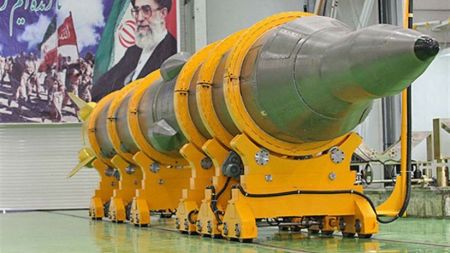
According to DEBKAfile’s military sources, the shipment included highly sophisticated Scud D surface-to-surface missiles with a range of 800km; and C-802 anti-ship missiles (an upgraded version of the Chinese YJ-8 NATO-named CSS-N-8 and renamed by Iran Saccade).
They came with Iranian Revolutionary Guards officers and radar systems to fine-tune the targeting of these missiles by Iran’s Yemeni proxies.
The Scuds were given to the Houthi forces fighting in northern Yemen on the Saudi border, while the C-802s were delivered to the Houthis’ Ansar Allah faction, which is under direct Iranian Rev Guards command.
The missiles were posted at special launch bases constructed by Iran outside Yemen’s two principal Red Sea ports of Mokha and Hudaydah.
Since no more than 62km of Red Sea water divides the Saudi and African coasts, the Iranian missiles are well able to block shipping and tanker traffic plying to and from the Gulf of Suez and the Persian Gulf. Therefore, the threat of blockade hangs imminently over one-third of Saudi and Gulf Emirate oil exports.
The same threat hangs over Israeli civilian and naval shipping from its southern port of Eilat through the Gulf of Aden and out to the Indian Ocean.
One of the most troubling aspects of this pivotal new menace to an international waterway was that US, Saudi, Egyptian and Israeli intelligence agencies missed the huge consignment of Iranian missiles as it headed towards Yemen. Neither did they pick up on the construction by Iranian military engineers of three ballistic missile bases – one facing Saudi Arabia and two Red Sea traffic.
Tehran’s Yemeni proxies moreover landed large-scale military strength on Perim island in the mouth of the Bab al-Mandeb strait, the chokepoint for ingress and egress from the Red Sea.
Since the strait is just 20km wide, control of this island empowers this force to regulate shipping movements through this strategic strait.
Tehran wasted no time after all its assets were in place to begin using them:
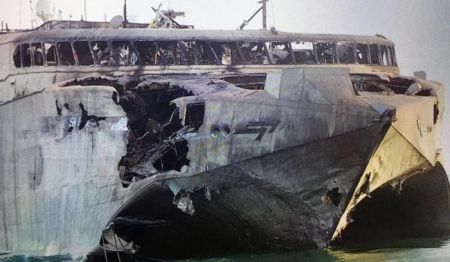
1. On Oct. 1, Iran’s Houthi surrogates launched C-8-1 missiles against a United Arab Emirates transport HSV-2 Swift logistics catamaran as it was about to pass through the strait. The ship, on lease from the US Navy, was badly damaged. No information was released about casualties.
DEBKAfile’s military and intelligence sources discerned that the aim of this attack was to choke off the movements of UAE warships from the southern Yemeni port of Aden, where large Emirate and Saudi forces are concentrated, to the Eritrean port of Assab, where the UAE has established a large naval base.
This attack did finally evoke a US response. The guided missile destroyers, USS Mason and USS Nitze, were dispatched to the Red Sea, along with the USS Ponce afloat forward staging base, to patrol the strait opposite the Yemeni coast
2. This did not deter Tehran or its Yemeni pawns: On Oct. 9, they fired an additional barrage of C-802 at the American flotilla, which according to a US spokesman, missed aim.
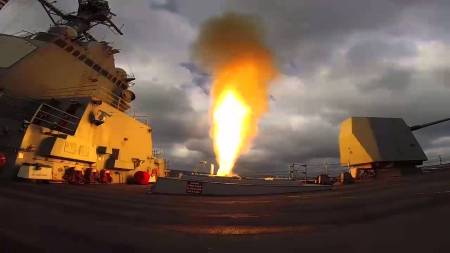
The Mason hit back with two Standard Missile-2s and a single Enhanced Sea Sparrow Missile.
There has been no official word about whether these weapons destroyed a Yemeni launching site. But the event itself was a landmark as the first direct Iranian-Houthi attack of its kind on an American naval vessel.
3. That same day, the Houthis fired Scud-D missiles at the Saudi town of Ta’if, 700 km from the Yemeni border and only 70km from the Muslim shrine city Mecca. This was meant as a direct assault on the Saudi royal house and its claim to legitimacy, by virtue of its role as Guardian of the Holy Places of Islam.
In America’s heated presidential campaign, the Democratic contender Hillary Clinton boasts repeatedly that as Secretary of State she helped “put the lid on Iran’s nuclear program without firing a single shot.”
That is factually true. America did not fire a single shot. Iran did the shooting and still does, constantly upgrading its arsenal with sophisticated ballistic missiles.
Key documents relating to the Obama administration’s secret negotiations with Iran, including a $1.7 billion cash payment, are being stored at a highly secure site on Capitol Hill, preventing the public and many in Congress from accessing them, according to multiple sources who described the situation to the Washington Free Beacon.
The documents are not technically classified but are being kept in a “secure reading space” where the majority of congressional officials cannot access them. Those cleared are forced to relinquish their cellular devices and are barred from taking notes, undermining the ability of staffers to brief their lawmakers on the contents, according to the sources.
Sources further disclosed that joint U.S.-Iranian signatures across the three documents add up to a package deal between Washington and Iran’s Intelligence Ministry, the country’s internal spy agency. Sources familiar with a closed-door January briefing by senior Obama administration officials told the Free Beacon they were informed the United States negotiated with “the Iranian intelligence apparatus.”
The terms of the arrangement—which was signed by Special Presidential Envoy Brett McGurk—had Iran releasing several U.S. hostages and obligated Washington to pay Tehran $1.7 billion in cash, removed international sanctions on a key financial node of Iran’s ballistic missile program, and dropped charges against 21 Iranian operatives linked to terrorism.
“There are three of them [agreements], and one specifically relates to the $1.7 billion [payment] and is a commitment of the U.S. to make arrangements to transfer the money,” said one congressional official familiar with the agreements.
A second document “lays out the commitments regarding Iranians that the U.S. was going to pardon, as well as the release of [imprisoned] Americans,” the source explained.
A third document “relates to assurances” the United States would allow international sanctions to be dropped on Iran’s Bank Sepah, a bank the Treasury Department described in 2007 as the “linchpin of Iran’s missile procurement.”
Multiple sources told the Free Beacon all three documents are part of one package deal. Each document was initially dated Jan. 16, but that was subsequently “crossed out and the 17th was scribbled in,” according one congressional source who spoke to the Free Beacon.
“They were all signed at the same time and ties it to the hostage release,” the source said. It further debunks claims made for months by the Obama administration that the negotiations over each concession were kept separate.
A second senior congressional source familiar with the contents of these secret documents told the Free Beacon that they provide proof that each of these three concessions to Iran was bound up in the hostage release.
“If it looks like ransom and sounds like ransom, it’s probably ransom,” the source said. “Why else would Brett McGurk deal with his Iranian counterparts and sign agreements on all these seemingly unrelated issues on the same day and in the same place if they weren’t connected?”
A third senior congressional official told the Free Beacon that officials were never notified by the Obama administration that these documents were partially being made available. The source speculated the administration did this to avoid rigorous oversight of its diplomacy with Iran.
“The State Department knows that its Iran policy is embarrassing and often semi-illegal, so it hides documents related to Iran,” the official said. “State delays publication, refuses to answer questions, and puts extra restrictions preventing the Hill from even accessing the materials.”
The handling of these documents is similar to the Iran deal itself, which the Free Beaconfirst disclosed could only be viewed by congressional officials in a highly classified manner.
The Free Beacondisclosed on Tuesday that the administration misled journalists and lawmakers for more than nine months about a secret agreement lifting international sanctions on Bank Sepah.
A State Department official declined to provide the Free Beacon with the name and affiliation of the Iranian official or officials who took part in negotiations with McGurk. The State Department also would not provide information about the process by which Congress can view these documents.
“As part of the JCPOA [Joint Comprehensive Plan of Action] negotiations, the United States made the determination that it would remove Bank Sepah from our Specially Designated Nationals and Blocked Persons List (SDN List) on Implementation Day,” the State Department official told the Free Beacon.
“In general, we are committed to ensuring that Congress has documents and information it may need to conduct effective oversight, and have transmitted these in a fashion that both protects sensitive information while giving all Members the ability to review them,” the official said.
A new report from the Foundation for the Defense of Democracies showcases the ways in which Iran’s Revolutionary Guards Corps (IRGC) has benefited from the so-called nuclear deal. This deal, which Congress never voted to approve nor reject, and which the Iranian government fundamentally altered rather than accepting, has nevertheless led to a vast transfer of wealth to Iran. Much of that wealth has fallen right in the hands of the IRGC, which oversees Iran’s terrorist and military nuclear programs.
Here at CounterJihad, we have covered the problems withIran’s nuclear deal somewhat extensively. The Foundation for Defense of Democracies report’s conclusions will thus be of little surprise to our regular readers. However, it does include additional detail on the degree to which Iran’s corporate and business ventures are secretly dominated by IRGC elites. As the report says:
[IRGC abuses] did not stop France’s mobile phone giant, Orange, from beginning talks with Iran’s largest mobile phone operator, Mobile Telecommunication Company of Iran (MCI), over acquiring a stake in the Iranian company. The IRGC controls MCI through a 50-percent-plus-one stake in its parent company, the Telecommunication Company of Iran (TCI). In short, whether its internal security, foreign adventures, or large corporate ventures, the IRGC plays an outsized role in Iran’s internal power structure. Established in 1979 to consolidate the Islamic revolution and fight its enemies, the IRGC has evolved over the years into a full-fledged conventional army, conducting and directing terrorist activity abroad. The Guard has also become a political power broker, an economic conglomerate, and an agency in charge of nuclear and ballistic-missile proliferation…. IRGC revenues from economic activities yield the necessary resources and political leverage to place its members in positions of power. Conversely, the Guard’s political power serves the economic enterprises it owns, and both its political and economic weight in turn advance its military projects.
The IRGC’s corporate activity offers revenue to the organization in the same way that its control of narcotics within Iran does. However, whereas the narcotics are often passed on to Hezbollah to be turned into heroin, corporate profits can be rolled over into apparently legitimate enterprises that have useful military applications. That allows Iran a backdoor to internationally-developed advanced weaponry and so-called “dual use” technologies. These are technologies that have both a legitimate purpose, but also an application to Iran’s nuclear program.
Their space program is an excellent example of the way in which a legitimate purpose can mask development of nuclear weapons: the same technologies involved in building space rockets that can deploy satellites in particular orbits can also be used to develop ballistic missiles that will deliver nuclear warheads to particular cities. The New York Times reported in September that the biggest engine in North Korea’s nuclear missile program seems to have been developed in partnership with Iran. Iran’s version is “nuclear-capable,” but the North Korean version makes no pretense about its intentions.
The potential links to Iran complicate the issue. Iran has ignored a United Nations Security Council resolution, passed in conjunction with last year’s agreement freezing its nuclear program, to refrain from tests of nuclear-capable missiles for eight years. The Obama administration has not sought sanctions, knowing they would be vetoed by Russia and China, nor has it said much in public about the details of the cooperation on the new rocket engine.
Nor are they likely to do so, given how much of the administration’s prestige is tied up with the so-called nuclear deal. It is worth noting, however, that the effect of the deal has been to embolden Iran — and North Korea, and Russia, and America’s enemies in general.
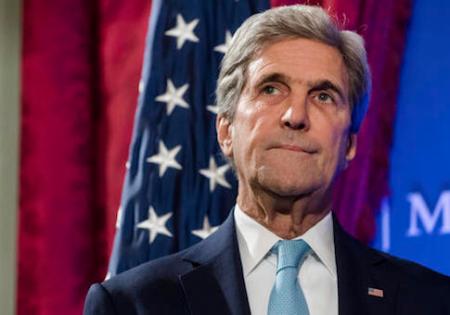
U.S. Secretary of State John Kerry smiles during a speech on the future of “Transatlantic Relations” during an event hosted by The German Marshall Fund (GMF) and the U.S. Mission to the EU at Concert Noble in Brussels, Tuesday, Oct. 4, 2016. AP Photo/Geert Vanden Wijngaert
The Obama administration misled journalists and lawmakers for more than nine months about a secret agreement to lift international sanctions on a critical funding node of Iran’s ballistic missile program, as part of a broader “ransom” package earlier this year that involved Iran freeing several U.S. hostages, according to U.S. officials and congressional sources apprised of the situation.
The administration agreed to immediately lift global restrictions on Iran’s Bank Sepah—a bank the Treasury Department described in 2007 as the “linchpin of Iran’s missile procurement”–eight years before they were to be lifted under last summer’s comprehensive nuclear agreement. U.S. officials initially described the move as a “goodwill gesture” to Iran.
The United States also agreed to provide Iran $1.7 billion in cash to release or drop charges against 21 Iranians indicted for illegally assisting Tehran. Full details of this secret agreement were kept hidden from Congress and journalists for more than nine months, multiple sources told theWashington Free Beacon.
State Department officials who spoke to the Free Beacon now say the United States “already made” the decision to drop U.S. sanctions, but declined to address multiple questions aimed at clarifying the discrepancy between past and current explanations for dropping international sanctions.
The Free Beacon first reported on these terms in January, including the dropping of international sanctions on Bank Sepah.
State Department officials told the Free Beacon at the time that the settlement with Iran, including the $1.7 billion cash award, was “not related” to “the release of the U.S. citizens from Iran.”
U.S. officials last week confirmed to the Wall Street Journal that in fact the dropping of sanctions on Bank Sepah “was part of a package of tightly scripted agreements” surrounding the release of the U.S. citizens from Iran.
When asked about the discrepancies between these statements, a State Department official would not elaborate, instead telling the Free Beacon, “The U.S. government had already made the determination that it would remove Bank Sepah from our domestic Specially Designated Nationals and Blocked Persons List on Implementation Day, which was outlined clearly in the JCPOA [nuclear deal] itself in July 2015.”
“We made this determination after a careful review of the activity of all individuals and entities—including Bank Sepah—that would be removed from the SDN list,” the official explained. “Although we removed Bank Sepah from the U.S. SDN list, Bank Sepah will continue to be cut off from the U.S. financial system and its funds under U.S. jurisdiction will remain blocked. Furthermore, we have the ability to quickly reimpose additional U.S. sanctions if Bank Sepah or any other entity engages in activities that remain sanctionable.”
The Free Beacon was not the only publication that was provided with misleading information by the Obama administration.
U.S. officials told Al Monitor in late January that the move to cancel international sanctions on Bank Sepah at the United Nations was undertaken by Venezuela without U.S. action.
“We already made the decision to delist this bank as part of U.S. secondary sanctions as part of the nuclear deal,” the official added, claiming the United States only agreed “not to oppose the delisting at the U.N., which Iran very much wanted.”
Senior Iranian officials said in January that the $1.7 billion payment and delisting of Bank Sepah were part of the agreement to free U.S. hostages, a charge the Obama administration denied at the time.
“The annulment of sanctions against Iran’s Bank Sepah and reclaiming of $1.7mln of Iran’s frozen assets after 36 years showed that the U.S. doesn’t understand anything but the language of force,” Mohammad Reza Naqdi, commander of Iran’s Basij Volunteer Force, told Iran’s state-controlled press in early February.
Senior congressional sources apprised of the matter told the Free Beacon that these latest revelations provide further proof of the administration’s intentional bid to deceive the public about its dealings with Iran.
“Facts are facts, no matter how much the administration tries to hide them,” said one senior congressional aide involved in investigating the matter. “Journalists and Members of Congress are on the trail and have already uncovered so much, including the cash payment of almost $2 billion to the world’s largest state sponsor of terrorism as a ransom for four American hostages. The truth, no matter how disturbing it is, will continue to come out.”
“This should eliminate any remaining doubt that the administration paid a ransom to Iran,” said another source familiar with the issue. “Why else would they keep Congress and the American people in the dark about this unprecedented concession? President Obama’s continued capitulation to the Iranian regime is a hazard to our national security.”
Another source who serves as a senior adviser to Congress and is familiar with the administration’s thinking told the Free Beacon that the Obama administration misled the public to avoid sparking outrage over its decision to drop sanctions on the top funder of Iran’s ballistic missile program.
“The Obama administration couldn’t tell the American public that it had just unleashed Iran’s ballistic missile program as one part of an enormous ransom extracted by Iran,” the source said. “So instead they ran to friendly reporters to misleadingly boast about how successful their diplomacy was, while they were bribing Iran with billions of dollars and military concessions to stay at the table.”
The Foundation for Defense of Democracies, a Washington, D.C.-based think tank, described the administration’s move as putting Iran’s ballistic missile program “back in business.”
“It represents a unilateral dismantling of the international ballistic missile embargo against the Islamic Republic,” FDD wrote in a recent policy analysis. “Iran’s preferred missile-financing bank is back in business.”
Iran has test fired multiple ballistic missiles since the nuclear deal was implemented, despite international restrictions on this type of activity.
German Economy Minister Sigmar Gabriel has promised to press Washington loosen its economic restrictions on Iran, as it promised to do as part of last year’s nuclear deal.
During a public speech during a landmark two-day economic cooperation visit to Tehran, Gabriel said Germany intends to “remind the United States of the commitment to get to an effective dismantling of sanctions.”
The SPD politician, who also serves as Germany’s Vice Chancellor, said that Washington “should act on its responsibilities concerning Iran so the outcome of the nuclear deal becomes visible in Iran.”
For its part, Germany said it planned to sign 10 key deals, and boost economic turnover with Iran by €2.5 billion, as a result of the visit, during which 120 senior business leaders joined Gabriel.
Iran’s banks, oil producers and government had been under severe economic restrictions from the US following the Islamic Revolution, which had been subsequently tightened several times, as a reaction to the country’s nuclear program, and ostensible support for organizations Washington classifies as terrorists, such as Hamas and Hezbollah.
Many of those, and others imposed by the EU and the UN, were officially lifted in January this year, after Iran was adjudged to have been following the terms of the Joint Comprehensive Plan of Action (JPA) – an agreement between Iran and China, France, Russia, United Kingdom, United States, Germany and the EU – that promised more favorable economic conditions in exchange for greater restrictions and tighter supervision of the country’s nuclear program.
But according to Iranian President Hassan Rouhani, the implementation of the sanctions reprieve has been “flawed.” Most problematically, many European banks are still reluctant to do business inside Iran, as they fear this may endanger their dealings with US financial institutions that are still banned from having dealings with the Islamic Republic.
But the US said that it is fulfilling its state obligations, and it is now down to individual companies if they want to invest in Iran. Last week, US Energy Secretary Ernest Moniz said that Iran’s oil exports were “essentially back to pre-sanctions levels” – Washington and Brussels imposed an embargo on Iranian petrochemicals in 2012 – and said that the Islamic Republic was now the beneficiary of “a considerable additional cash flow.”
In a September 25, 2016 speech to a Tehran political circle, Mohsen Rafighdoost, who was minister of the Iran’s Islamic Revolutionary Guard Corps (IRGC) during the 1980-88 Iran-Iraq War and who heads the Noor Foundation,[1] said that the secret of the victory of Iran’s Islamic Revolution was Iranians’ total obedience to the leader. He said that today the IRGC ground forces are “five times better” than the U.S. Army, and that the Iranian regime is capable of deploying nine million troops against it in less than 10 days.
Rafighdoost added that Iran’s missiles in Tehran and the northwest of the country can reach Tel Aviv, and expressed his yearning for Israel to launch a missile at Iran so that Iran could “flatten Tel Aviv.” He also said that Islamic Revolution founder Ayatollah Khomeini established Hizbullah in Lebanon to promote the Islamization of other countries,[2] and that today, in the era of Supreme Leader Ali Khamenei, the organization has become “a supreme force in the region.”
Mohsen Rafighdoost. Source: Wilayah.info, January 27, 2014.
Following are his September 25 statements:
“The IRGC’s Ground Forces Are Perhaps Five Times Better Than The American Army”
“The factor that led to our victory in the [Iran-Iraq] War is [the same] factor that led to our victory in the [Islamic] Revolution. The Imam [Khomeini], in France, would order a parade [to be held in Iran], and the people would hold a parade, even in remote villages.
“During the eight years of the imposed war, not only was not one inch of Iranian land surrendered to the enemy, but we also acquired deterrent capability. I believe that as long as the Islamic Revolution stands against the Western and Eastern camps, we will be under military sanctions. We must never think that the world will provide us with military aid. Thanks to the war and its martyrs, Iran currently has deterrent capability. After a while, the Imam [Khomeini] replaced the call of ‘war, war to victory’ with ‘war, war until the fitna is removed.’ At the time, we understood this call as meaning that ‘we must be so strong that the enemy will not even think of a military strike against Iran.’
“Today, Iran has deterrent capability. In recent years, the enemies have spoken of the option [of a military strike against Iran] as being on the table, but that was a lie. [Our] air force and navy are good, but it is [our] ground forces that finish the war. The IRGC’s ground forces are perhaps five times better than the American army.
“Despite all the enemy media and cultural propaganda against us, if America wants to try its luck against us, [it should know that] we are completely capable of mobilizing nine million fighters [against it]… on the [battle]front in under 10 days.”
“If Only A Single [Israeli] Shell Would Strike Anywhere In This Country – So That We Can Flatten Tel Aviv”
“We have warehouses full [of missiles] in Tehran, Zanjan [in northwest Iran] and Oshnavieh [in Western Azerbaijan Province in northwest Iran] that can strike Tel Aviv. If only a single [Israeli] shell would strike anywhere in this country, so that we can flatten Tel Aviv.”
In Khamenei’s Era, Hizbullah “Has Become A Supreme Force In The Region”
“In accordance with his secondary plan, the Imam [Khomeini] created Hizbullah in Lebanon. This plan was [aimed at] Islamizing other countries. Today, in the era of the Leader [Khamenei, Hizbullah] has become a supreme force in the region.
“Despite all the criminal [plots], Iranian security forces grow stronger every day. Some of the statements being put out there are made out of lack of awareness, and anyone who makes them is ignorant.[3]
“The secret to victory lies in wise and complete obedience to the leader [Khamenei]. During the time of the Imam [Khomeini], we obeyed him, and today we obey the leader [Khamenei].”[4]
Endnotes:
[1] Since 1999, Mohsen Rafighdoost has been director of the Noor Foundation, which reportedly owns significant real estate and has revenues of over $200 million from importing pharmaceuticals, sugar and construction materials.
[2] During the 1980s, Rafighdhoost was involved in the creation of Hizbullah in Lebanon and likely had knowledge of its terror activities in Beirut.
[3] A reference to Hashemi Rafsanjani’s August 20, 2016 call for investing in Iran’s economy instead of in its the military, as Japan and Germany did post-World War II. MEMRI is soon publishing a report on Rafsanjani’s statements and reactions to them.
(Rouhani and Hillary would make a good team for Iran. DM)
The portrait that emerges from Rouhani’s interview is of a man who lies and distorts to defend Iran’s illicit behavior— with its domestic nuclear program and in Syria. Simply put, Rouhani is not a “moderate,” as he is so often described, but an apologist for Iran’s revolutionary regime that operates in defiance of international law and norms.
****************************
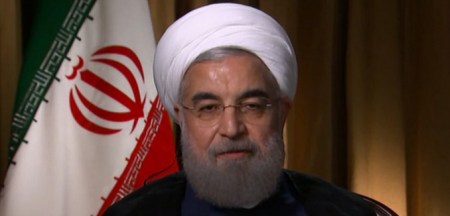
In an interview two weeks ago, Iranian President Hassan Rouhani consistently lied and evaded questions put to him by NBC News’s Chuck Todd.
Todd first asked why Iran was claiming that the United States was not living up to the nuclear deal, known as the Joint Comprehensive Plan of Action (JCPOA). Rouhani responded that the deal states “that all nations involved in this agreement must free the path, pave the way for resumption of normal activities with the Islamic Republic of Iran, such as banking transactions, insurance transactions, and the likes.” Not only is that not correct, it fits a pattern described earlier this week by analysts from the Foundation for Defense of Democracies, in which Iran hopes to gain additional concessions by threatening to walk away from the deal unless the West provides every economic concession that it believes it is owed.
The United States was only required to suspend its nuclear-related sanctions, not sanctions placed on Iran due to its history of terror financing and money laundering. (The United States has seen to it that the global watchdog against money laundering, the Financial Action Task Force, relaxed some restriction on Iran despite Iran’s continued presence at the top of the list of money launderers.)
When asked by Todd whether that was a misinterpretation of the deal’s sanctions-related clauses, Rouhani evaded the question, instead accusing the United States of blocking access to large financial institutions. Then he added that “the other breach of the agreement on the side of the United States, it has been brought into the JCPOA that airplanes intended for civil aviation only must be freely sold to Iran.”
But the airplanes that Iran wants are likely not “intended for civil aviation only.” As Emanuele Ottolenghi of the Foundation for Defense of Democracies has shown, Iran Air, Iran’s national airline, which is seeking to purchase planes from Boeing and Airbus, is using planes to transport arms and troops to Syria to support the regime of Syrian dictator Bashar al-Assad. Transporting soldiers and materiel is not “civil aviation.”
Todd later asked Rouhani if the world should be concerned about Iran’s intentions once most nuclear restrictions on Iran are lifted. Rouhani responded that Iran has adopted additional anti-weaponization safeguards as per the JCPOA, and even if these measures weren’t in place, “within the doctrine or within the laws of the Islamic Republic of Iran to include the fatwa issued by the Supreme Leader of the Islamic Republic of Iran…the building or pursuing or obtaining and using any type of weapons of mass destruction are strictly and unequivocally forbidden by Islamic law.”
The Middle East Media Research Institute has searched for a record of Khamenei’s nuclear fatwa and found no such fatwa. Mehdi Khalaji, an Iran expert at the Washington Institute for Near East Policy (WINEP), wrote in a 2011 study (.pdf) “no written texts exist for the Supreme Leader’s fatwas.” But as WINEP research director Patrick Clawson observed in the preface to Khalaji’s analysis, even if Khamanei had issued such a fatwa, “past proclamations about the matter, like all fatwas issued by Shiite clerics, can be revised under new circumstances.”
Furthermore, Rouhani himself said in a 2005 speech (.pdf) that “having [nuclear] fuel cycle capability almost means that the country that possesses this capability is able to produce nuclear weapons, should that country have the political will to do so,” suggesting that he believes the decision to develop nuclear weapons to be a political, not religious, decision.
Todd followed up by asking Rouhani why Iran has deployed a missile defense system at the Fordow nuclear site if its purpose is strictly civilian. Rouhani cited the need for Iranians to “defend ourselves,” but didn’t fully address the question. When Todd persisted, Rouhani stated that “Iran has always maintained her commitment to any agreement it has become a signatory of. You will not find any instances during the past 38 years of the history of the Islamic Republic of Iran in which a bilateral agreement or an international agreement has been signed and Iran has broken its commitment.”
This is blatantly false. Iran, a signatory to the Nuclear Nonproliferation Treaty refused to end its uranium enrichment program despite the threat of being sanctioned by the United Nations Security Council. The JCPOA allowed Iran to maintain a portion of its enrichment capacity, which it had maintained despite being repeatedly sanctioned. Being forgiven for the breach of an agreement is not the same thing as having abided by it.
Then Rouhani added, “What we were accused of for years, called ‘possible military dimensions,’ the International Atomic Energy Agency eventually reached the conclusion that that file must be closed for good and announced that the activities of Iran were solely for peaceful purposes.”
This is also false. The IAEA report (.pdf) last December did not find that Iran’s nuclear activities “were solely for peaceful purposes.” Rather, it found that Iran had a military nuclear program until at least 2009, though it found “no credible indications” that its military nuclear program continued after this point. It’s true that the IAEA closed down its investigation of Iran’s past nuclear work, but as the Institute for Science and International Security assessed, “the IAEA’s report can be viewed, at best, as a document that closes the process set forth by terms of the Roadmap” to the nuclear deal, but not as a clean bill of health.
Rouhani’s protestations of abiding by the deal also must be viewed with a certain amount of skepticism based on his own record as Iran’s lead nuclear negotiator more than a decade ago. In 2006, after he left the position, Rouhani boasted in a meeting with Islamic clergy and scholars that he had duped the West. Rouhani claimed that Iran had continued installing equipment for converting yellowcake, one of the ingredients necessary for creating nuclear fuel, even as he told his European counterparts that there was no nuclear work being performed at that time.
“When we were negotiating with the Europeans in Tehran we were still installing some of the equipment at the Isfahan site,” Rouhani told his audience. “There was plenty of work to be done to complete the site and finish the work there. In reality, by creating a tame situation, we could finish Isfahan.”
Similarly, when he was running for president in 2013, Rouhani said in an interview that he used the earlier negotiations to advance Iran’s clandestine, illicit nuclear work, boasting, “We halted the nuclear program? We were the ones to complete it! We completed the technology.”
Todd then asked Rouhani about Iran’s involvement in the Syrian Civil War, starting with a question about the recent Russian bombing of a humanitarian convoy, which killed 20 aid workers and which one United Nations official called a war crime. Instead of condemning the attack, Rouhani pointed to a mistaken American airstrike on a Syrian army position—as if an accidental bombing somehow excuses a deliberate one. Rouhani also claimed that since the Syrian soldiers were fighting ISIS (also known as Daesh), the United States was involved in “a direct defense of the Daesh terrorist group.” The charge is outrageous. Even though Syrian troops have been targeting civilians, the United States said that it was an accident and apologized.
Rouhani went on to state that Israel had also attacked some Syrian positions, though he neglected to mention that it was in response to shells being fired into Israel. He allowed that a ceasefire would be beneficial because “food stuff and medicines can get to those who are in need and have been waiting for those supplies for months.” But he didn’t mention that the party engaging in the sieges is Assad, with Iran’s backing.
In response to Secretary of State John Kerry’s recent call for a halt to all flying above Syria, Rouhani stated that “any proposal can be coordinated in order to avoid the targeting of humanitarian convoys.” But a general from his own country’s Islamic Revolutionary Guard Corps (IRGC) boasted last month that Iran provides intelligence on the ground to guide Russia’s bombing campaigns. Given this, and the ensuing possibility that Iranian troops were complicit in the bombing in question, Rouhani’s assurances that convoys can be protected are glib and meaningless.
The portrait that emerges from Rouhani’s interview is of a man who lies and distorts to defend Iran’s illicit behavior— with its domestic nuclear program and in Syria. Simply put, Rouhani is not a “moderate,” as he is so often described, but an apologist for Iran’s revolutionary regime that operates in defiance of international law and norms.
According to a September 30 Wall Street Journal article, the Obama administration signed a secret agreement with Iran to lift U.N. sanctions from two Iranian banks — Bank Sepah and Bank Sepah International — that helped finance Iran’s ballistic-missile program. U.S. and Iranian officials signed this deal on January 17, 2016, the same day Iran released four U.S. prisoners.
U.S officials in January said the prisoners were swapped for the release of seven Iranian prisoners by the U.S. and the removal of 21 persons — mostly Iranian nationals — from an INTERPOL wanted list for violating U.S. laws barring transfers of WMD technology and weapons to Iran.
The American people and Congress did not learn until August that the U.S. prisoners were not allowed to leave Iran until a planeload of $400 million in cash sent by the United States had landed in Iran. This payment — and two more over the next month — has been strongly condemned by Republican congressmen as U.S. ransom payments to a state sponsor of terror.
Commenting on the $400 million cash payment to Iran, the prisoner swap and the lifting of sanctions from the Iranian banks, a senior U.S. official told the Journal, “The timing of all this isn’t coincidental. Everything was linked to some degree.”
The Journal also quoted unnamed Obama officials who justified lifting sanctions against the two Iranian banks to “harmonize the U.N. sanctions list with the U.S.’s” and because “Washington believed Iran had earned more sanctions relief because Tehran had been implementing the terms of the nuclear agreement.” The Obama administration lifted U.S. sanctions against Bank Sepah and Bank Sepah International in July 2015. The U.N. Security Council voted to lift these sanctions on January 17, 2016.
This suggests the removal of sanctions against the Iranian banks was part of a broad ransom agreement to free U.S. prisoners held by Iran.
The secret agreement to lift sanctions against the Iranian banks also violated U.N. Security Council Resolution 2231, passed in July 2015 which endorsed the JCPOA. This resolution stipulated that U.N. missile-related sanctions against Iran would remain in place for eight years. In addition, lifting sanctions against the two banks broke promises to Congress by Obama officials that the nuclear deal would only lift nuclear-related sanctions against Iran and that U.N. missile sanctions would remain in place for eight years.
I argue in my new book on the Obama administration’s nuclear diplomacy with Iran is national-security fraud. This latest secret side deal is more compelling evidence of this.
By criticizing and blaming the U.S. for not honoring the terms, Rouhani plans to exploit President Obama’s weak point, as the negotiating team has been doing all along, by invoking Obama’s fear that Tehran might pull out of the nuclear deal — a move that would highlight the failure of the accord. This tactic will, as usual, successfully pressure the administration to give Tehran even more geopolitical and economic “carrots,” and pursue a policy with Iran of agreeing to even more concessions.
Rouhani’s tactical shift is intended to reinforce Iran’s entrenched revolutionary ideal of anti-Americanism, appease Khamenei and the Revolutionary Guards, and ensure his second term presidency.
Iran’s President Hassan Rouhani and Foreign Minister Mohammad Javad Zarif will be attending the 71st session of the UN General Assembly in New York this week.
Based on the latest developments, all signs point to a tactical shift by Rouhani, in which his messages and tone will be quite different this year.
In the previous sessions of the UN General Assembly, Rouhani and his team adopted a diplomatic tone in order to have the UN Security Council lift sanctions against Iran. He praised the success of the nuclear agreement, its contribution to peace and its prevention of more tension and potential conflagration in the region. Iran’s objective was achieved: a few months later, when all four rounds of the Security Council sanctions were removed, billions of dollars and billions of cover-up stories arrived, all cost-free gifts from the U.S.
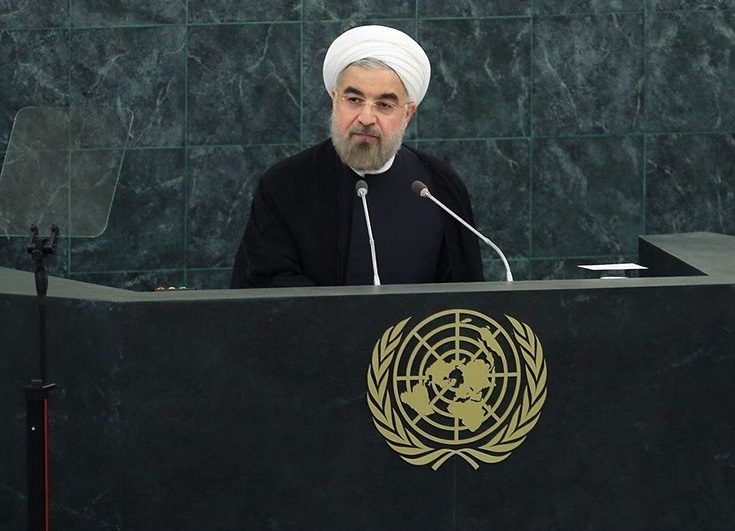
Iranian President Hassan Rouhani speaks at the UN General Assembly, September 26, 2013. (Image source: president.ir)
After achieving these goals for Iran’s ruling politicians, Rouhani’s message this year will switch to blaming the U.S. for all sorts of injurious shortcomings in the nuclear agreement, which Iran, incidentally, still has not signed.
U.S. President Barack Obama’s administration has sent hundreds of billions of dollars to Iran, and has hidden Iran’s supposed non-compliance with the nuclear deal to which it never officially agreed in the first place. The deal, in fact, seems only to have existed in the overheated imaginations of the US and other gullible members of the Joint Comprehensive Plan of Action (JCPOA). Nevertheless, the U.S. has ignored what Iran’s violations could be, and has assisted Tehran in evading any terms of the nuclear agreement it wished.
In addition, now that Iran has seen that the U.S. had lost all political leverage to pressure Tehran through the Security Council sanctions, and that, as critics of the deal had repeatedly and urgently warned, sanctions could not be “snapped back,” partly due to the veto power of Russia and China, Rouhani will be openly delivering the hardline messages of Iran’s Supreme Leader, Ayatollah Ali Khamenei, and the generals of Iran’s Islamic Revolutionary Guard Corps (IRGC), who enjoy power over Iran’s economic and political systems.
Khamenei and the senior cadre of the IRGC draw their legitimacy and power from the revolutionary principle of opposing the U.S., the “Great Satan.”
After the billions of dollars from the nuclear deal were delivered, the regime’s anti-American remarks and behavior only increased. For Rouhani, any expectation of rapprochement with the U.S. must be prevented, and also any domestic political liberalization prevented from occurring.
Reasons for Rouhani’s tactical shift in more publicly adhering to Iran’s revolutionary principle of anti-Americanism also include Iran’s leaders’ awareness that President Obama is tightly and desperately clutching the nuclear agreement until he leaves office: he considers the deal his crowning foreign policy accomplishment and legacy. By criticizing and blaming the U.S. for not honoring the terms, Rouhani plans to exploit President Obama’s weak point, as the negotiating team has been doing all along, by invoking Obama’s fear that Tehran might pull out of the nuclear deal — a move that would highlight the failure of the accord. This tactic will, as usual, successfully pressure the administration to give Tehran even more geopolitical and economic “carrots,” and pursue a policy with Iran of agreeing to even more concessions. Rouhani and Zarif will, as usual, conduct bilateral talks with American diplomats behind the closed doors to make sure they are achieved.
Rouhani’s public shift to Iran’s hard-line political spectrum is also partially pitched to Iran’s upcoming presidential elections. He needs the firm support of the hard-line leaders — fundamentally that of Supreme Leader Khamenei, who enjoys the final say in Iran’s domestic and foreign policy, and that of the IRGC leaders — in order to assure his election to a second term.
By more publicly delivering Khamenei’s message — that the US is not adhering to the terms of the nuclear deal and that it is supposedly the U.S. that has been “breaking oaths and not acting on their commitments and creating obstacles” —
Rouhani is most likely hoping further to endear himself to Khamenei and the IRGC and prove his loyalty.
A recent poll by the Center for International and Security Studies at the University of Maryland revealed that the moderate camp’s popularity has not only decreased, but that Iran’s former president, Mahmoud Ahmadinejad,
“now represents the single largest threat to Rouhani’s re-election, and trails the once-popular incumbent by only eight points. Suddenly, the ex-president [Ahmadinejad] seems once again to be a real political contender.”
Rouhani had also promised the Iranian people that the nuclear deal would improve their economic life. Since the implementation of the nuclear deal, however, the Iranian people have (unsurprisingly) not seen the fruits of the deal and the billions of dollars that the government has received. Rouhani will undoubtedly be trying to distract people’s attention from blaming the Iranian government by pointing to the U.S. as the culprit.
In one of his latest speeches, Khamenei pointed out that the U.S. is attempting to “destroy Iran’s economic relationships with other countries.” He added:
“Was it not supposed to be so that the unjust sanctions would be removed and it would have an effect on people’s lives? After six months, is there any tangible effect on the lives of the people? If not for America violating its oaths, would the administration not be able to do many things during this time? … Of course it has been some years that I have been repeating this about the lack of trust with America, but for some it was hard to accept this reality.”
Another issue on Rouhani’s agenda will be to promote, at the governmental level, business deals and trade, which will further financially benefit the IRGC and Khamenei, not Iran’s private sector.
Rouhani will more likely attempt to justify Iran’s military adventurism in the region by playing the anti-terrorism card, even though Iran is still the leading sponsor of terrorism.
Rouhani’s government will most likely focus on spreading the narrative of Khamenei and the IRGC, that Iran is an indispensable force in fighting the Islamic State and other extremist groups; that regional and global powers need to join Iran in this battle, and that Iran is the victim of terrorism in the region. In addition, Rouhani will presumably attempt to buttress the argument that the international community needs to support the Syrian President Bashar al-Assad in order to defeat terrorism.
Rouhani’s tactical shift is intended to reinforce Iran’s entrenched revolutionary ideal of anti-Americanism, appease Khamenei and the IRGC, and ensure his second term presidency.
Dr. Majid Rafizadeh, political scientists and Harvard University scholar is president of the International American Council on the Middle East. He can be reached atDr.rafizadeh@post.harvard.edu.
(The views expressed in this article are mine and do not necessarily reflect those of Warsclerotic or its other editors. — DM)
On September 9th, North Korea conducted its fifth nuke test, of its most powerful nuke thus far. Can Obama get China to help make North Korea stop developing and testing nukes? Nope. China sees Obama, not as the representative of the world’s greatest power, but as a joke. He has no clout internationally and is a national embarrassment.
China and North Korea – a very short history
Here’s a link to an article I posted on June 25, 2013 about the Korean conflict. To summarize, China and the Democratic People’s Republic of Korea (North Korea) have a long history of acting together. China views the Republic of Korea (South Korea), which borders North Korea to the south and is an American ally, as a threat. She does not want reunification of the Korean peninsula under a government favorable to America.
When, on June 25, 1950, North Korea invaded South Korea with Russian aircraft, weaponry, training and other substantial support, China did not assist North Korea. North Korean forces pushed the South Korean government, as well as the few American military advisers (then under the command of the Department of State), south to the Pusan perimeter. Following General MacArthur’s unexpected and successful Inchon invasion which began on September 15th, American and other United Nations forces pushed the North Korean forces back north: MacArthur sent his by then greatly augmented forces east to Wonson and eventually managed to push North Korean forces to the northern side of the Yalu River. However, Chinese forces struck back en masse and MacArthur’s forces were driven back to Seoul.
Ever since bringing to an end MacArthur’s successes in the Korean Conflict, China has supported North Korea. She has opposed, and has then declined to enforce, significant sanctions responsive to North Korean nuclear and missile development and testing. While China may acquiesce in weak UN resolutions condemning North Korean provocations, she rarely goes beyond that.
China, Japan and the two Koreas
China has a long memory and still resents, bitterly, the lengthy period prior to and during World War II when Japan occupied significant parts of China. Ditto South Korea, all of which was under Japanese occupation for a lengthy period prior to and during World War II. Although China has substantial trade with both South Korea and Japan, she is more hostile to Japan than is South Korea; the latter two have substantial mutual interests transcending trade.
Perhaps the most important current dispute between China on the one hand, and Japan-South Korea-America on the other, involves the plans of Japan and South Korea to defend against North Korean missiles by the installation of THAAD anti-missile weapons provided by America. China’s stated reason for opposition to the THAAD system is that it could be used against Chinese, as well as North Korean, missiles. Why does China assert this objection unless she hopes to fire missiles at one or both of them? If China fires missiles at Japan and/or South Korea, they have every right to destroy her missiles and to respond in kind with U.S. assistance if requested.
condemned Pyongyang’s fifth nuclear test today in the “strongest possible terms as a grave threat to regional security and to international peace and stability” as outraged lawmakers from both parties called for tougher action to stop North Korea’s nuclear program. [Emphasis added.]
That may well be all that Obama does — despite the warnings of Rep. Adam Smith (D-Wash.), the top Democrat on the House Armed Services Committee, that
we have to make it absolutely clear that if they engage in any military activity, they will be destroyed. We have to have a credible deterrent. That seems to be the only thing that will stop North Korea from engaging in military action… We have sanctioned them, and we should keep sanctioning them, but it’s not going to stop them from developing the nuclear weapons.” [Emphasis added.]
Obama won’t do that:
In a statement Friday, President Obama vowed to “take additional significant steps, including new sanctions, to demonstrate to North Korea that there are consequences to its unlawful and dangerous actions.”
Obama did not suggest what He might have in mind, beyond historically ineffective sanctions and condemnations “in the strongest possible terms,” to let North Korea know that there will be “consequences.”
A September 9th article at the New York Times provides an unpleasant analysis of the options Obama now has, and which His successor will have, in dealing with North Korea.
A hard embargo, in which Washington and its allies block all shipping into and out of North Korea and seek to paralyze its finances, risks confrontations that allies in Asia fear could quickly escalate into war. But restarting talks on the North’s terms would reward the defiance of its young leader, Kim Jong-un, with no guarantee that he will dismantle the nuclear program irrevocably.
For more than seven years, President Obama has sought to find a middle ground, adopting a policy of gradually escalating sanctions that the White House once called “strategic patience.” But the test on Friday — the North’s fifth and most powerful blast yet, perhaps with nearly twice the strength of its last one — eliminates any doubt that that approach has failed and that the North has mastered the basics of detonating a nuclear weapon.
Despite sanctions and technological backwardness, North Korea appears to have enjoyed a burst of progress in its missile program over the last decade, with experts warning that it is speeding toward a day when it will be able to threaten the West Coast of the United States and perhaps the entire country. [Emphasis added.]
. . . .
Mr. Obama has refused to negotiate with the North unless it agrees first that the ultimate objective of any talks would be a Korean Peninsula without nuclear arms. But Mr. Kim has demonstrated, at least for now, that time is on his side. And as he gets closer to an ability to threaten the United States with a nuclear attack, and stakes the credibility of his government on it, it may be even more difficult to persuade him to give up the program.
In a statement Friday, Mr. Obama condemned the North’s test and said it “follows an unprecedented campaign of ballistic missile launches, which North Korea claims are intended to serve as delivery vehicles intended to target the United States and our allies.”
“To be clear, the United States does not, and never will, accept North Korea as a nuclear state,” he said.
Many experts who have dealt with North Korea say the United States may have no choice but to do so. [Emphasis added.]
“It’s too late on the nuclear weapons program — that is not going to be reversed,” William Perry, the defense secretary under President Bill Clinton during the 1994 nuclear crisis with North Korea, said in August at a presentation in Kent, Conn. The only choice now, he argued, is to focus on limiting the missile program. [Emphasis added.]
Obama has taken no significant steps to limit Iran’s continuing missile development and testing program. How can He limit that of North Korea without Chinese cooperation?
Yet the latest effort to do that, an agreement between the United States and South Korea to deploy an advanced missile defense system in the South, has inflamed China, which argues the system is also aimed at its weapons. While American officials deny that, the issue has divided Washington and Beijing so sharply that it will be even more difficult now for them to come up with a joint strategy for dealing with the North. [Emphasis added.]
China has been so vocal with its displeasure over the deployment of the American system that Mr. Kim may have concluded he could afford to upset Beijing by conducting Friday’s test. [Emphasis added.]
Fueling that perception were reports that a North Korean envoy visited Beijing earlier this week.
“North Korea almost certainly sees this as an opportunity to take steps to enhance its nuclear and missile capabilities with little risk that China will do anything in response,” Evans J.R. Revere, a former State Department official and North Korea specialist, said in a speech in Seoul on Friday. [Emphasis added.]
The breach between China and the United States was evident during Mr. Obama’s meeting with President Xi Jinping last week. “I indicated to him that if the Thaad bothered him, particularly since it has no purpose other than defensive and does not change the strategic balance between the United States and China, that they need to work with us more effectively to change Pyongyang’s behavior,” Mr. Obama said, referring to the Terminal High Altitude Area Defense system, as the advanced missile defense project is known. [Emphasis added.]
North Korea and Iran
Iran and North Korea have a long history of cooperation in developing nukes and missiles with which to deliver them. In the past, Iranian scientists have been present at North Korean nuke tests, and vice versa. They have also assisted each other in the development of nukes and missiles.
Iran and North Korea have substantial reasons to cooperate: by virtue of the Iran scam, Iran now has lots of money but is at least minimally restricted in its nuke development. North Korea has little usable currency, needs whatever it can get, and no attempts to halt or even to limit its nuke development have worked.
Photos released by North Korea of its launch of long-range ballistic missiles are the latest proof of the close military cooperation between Pyongyang and Tehran, an Israeli expert in the field told the news site IsraelDefense on Tuesday.
According to Tal Inbar — head of Space and UAV Research Centre at the Fisher Institute for Air & Space Strategic Studies — what was new in the photos was the shape of the warheads attached to the Nodong missiles, known in Iran as the Shahab-3.
Until now, such warheads — first detected by Inbar in Iran in 2010 — have not been seen in North Korea. At the time, Inbar dubbed them NRVs (or, “new entry vehicles”), which became their nickname among missile experts around the world. [Emphasis added.]
Inbar told IsraelDefense: “The configuration that we saw [on Tuesday] is identical to what we saw in Iran six years ago. In principle, its penetrating body (warhead) is identical to that of Scud missiles, but is mounted on the Shahab-3, and creates a more stable entity than other Shahab/Nodong warheads.”
Inbar said this was the third time that something of this nature had appeared in Iran before it did in North Korea. “But we must remember that the two countries engage in close cooperation where military and space-directed missiles are concerned,” he said. “It is thus possible that both plans and technology are being transferred regularly from one to the other.” [Emphasis added.]
Are North Korea and Iran rational? According to this New York Times analysis, North Korea is.
North Korea’s actions abroad and at home, while abhorrent, appear well within its rational self-interest, according to a 2003 study by David C. Kang, a political scientist now at the University of Southern California. At home and abroad, he found, North Korean leaders shrewdly determined their interests and acted on them. (In an email, he said his conclusions still applied.) [Emphasis added.]
“All the evidence points to their ability to make sophisticated decisions and to manage palace, domestic and international politics with extreme precision,” Mr. Kang wrote. “It is not possible to argue these were irrational leaders, unable to make means-ends calculations.” [Emphasis added.]
Victor Cha, a Georgetown University professor who served as the Asian affairs director on George W. Bush’s National Security Council, has repeatedlyargued that North Korea’s leadership is rational.
I submit that the same analysis, applied to Iran, produces the same result. Iran’s leaders know what they want, and are sufficiently rational to achieve it; they did. Obama, not the leader of a dictatorial theocracy, is sufficiently irrational to believe that what he wants for the Islamic Republic of Iran is what America needs it to have. It is not.
Obama and Iran
Obama’s Iran scam would be farcical were it not potentially deadly. He did not do what would have been best for America and the free world in general — increase sanctions until Iran complied fully with UN resolutions on missile testing, ceased Uranium enrichment and disposed of the means to do it, ceased all nuke research as well as all nuke cooperation with North Korea and ceased supporting all terrorist groups, including Hezbollah and Hamas. Instead, perhaps considering Himself above such trivia, Obama sought little more than what He considered His greatest achievement — His legacy:
Conclusions
If Obama were viewed internationally as the powerful leader of the world’s most powerful nation, He might be able to get China to clamp down, severely and successfully, on North Korea’s nuke and missile development. Were China to reject His overtures, He could arrange for it to wish that it had acceded. That’s not who Obama is, as demonstrated by, among His other actions, entering into the Iran Scam deal with Iran.
Perhaps Kim Jong-un needs to dress like an Iranian mullah to convince Obama to give him a “deal” similar to the one He gave to Iran. He had better hurry: that won’t work with President Trump.




 Iranian President Hassan Rouhani speaks at the UN General Assembly, September 26, 2013. (Image source: president.ir)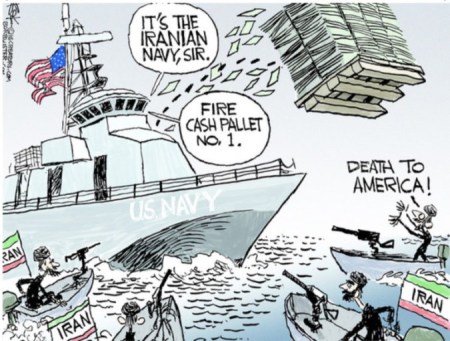




 anneinpt
 artaxes
 danmillerinpanama
 davidking1530
 Peter Hofman
 Joseph Wouk
 Peter
Peter Louisiana Steve
 WarSclerotic
Recent Comments