Posted tagged ‘Iranian missiles’

Iran Renews Commitment to Jihad Against Israel

May 4, 2016

Iran Renews Commitment to Jihad Against Israel

BY:
May 3, 2016 1:44 pm

Source: Iran Renews Commitment to Jihad Against Israel

Senior Iranian leaders on Tuesday renewed their commitment to violent resistance against Israel during meetings with top leaders of the Islamic Jihad terror group, according to recent remarks.

Ali Larijani, the speaker of Iran’s parliament, held a Tuesday meeting in Tehran with Ramadan Abdullah, secretary general of the Islamic Jihad group. Following the powwow, Larijani affirmed Iran’s commitment to the terrorist fight against Israel.

“Intifada is an important opportunity for Palestine and you should endeavor to keep this stream alive and God will help you on the path of Intifada until victory,” Larijani was quoted as saying in the country’s state-controlled press.

The Islamic Jihad leader reportedly thanked the Iranian official and claimed that “Intifada is the only way for Palestinians to gain freedom and get rid of their cumbersome situation,” according to the report.

Ali Shamkhani, the secretary Iran’s Supreme National Security Council, offered similar comments on Monday supporting resistance against Israel.

“All advocates of the Palestinian cause worldwide now share the view that the only way to victory and restoration of the Palestinians’ rights is to rely on people’s determination to continue Islamic resistance,” Shamkhani was quoted as saying after his own meeting with Abdullah.

No S-300s or cash windfall for Iran

April 20, 2016

No S-300s or cash windfall for Iran, DEBKAfile, April 19, 2016

(How credible is Kerry? — DM)

S-300_command_vehicles_command_vehicles_17.4.16

Iran held its annual military parade on April 17 to mark National Army Day.DEBKAfile’s military and Iranian sources said it was the most unimpressive in recent years. Iran usually displays its most advanced missiles and other weapons systems, but this year it only showed components of the S-300 antiaircraft system acquired from Russia, demonstrating that Moscow had held back on the entire missiles and will apparently continue to do so in the near future.

On show only were parts of the S-300 radar system, an empty command structure without the launching systems, and a crane used to lift the missiles onto the launchers.

Western military experts who monitored the parade said no other country would display such a miserably inadequate collection of missile system parts, and it emphasizes that Iran did not receive the missiles but only useless components, of the supporting technical system.

The military experts said the other weapons systems displayed at the parade showed that the country’s two main fighting forces are tired and worn out. This follows three years of fighting in Syria by the Revolutionary Guard Corps, and only four months of fighting by units from Iran’s standing army that have had no significant achievements on the battlefield despite massive air support by Russia. It also seems like a very large percentage of those killed and wounded has come from the Revolutionary Guard.

DEBKAfile’s military sources report that during the Teharn parade, Iranian Gen.Mohamed Reda Zada was seriously wounded on the front near Aleppo in northern Syria. Zada was the latest of a long list of high-ranking Iranian casualties of the war. The Revolutionary Guard arranged for a special plane to fly him back to Tehran the same day, and he is now in a military hospital where doctors are fighting for his life.

Meanwhile, despite the lifting of sanctions following Iran’s nuclear deal with the world powers, Tehran has not only been unable to acquire advanced weapons, but has also failed to recover its frozen assets from US and European banks.

US Secretary of State John Kerry notice on April 19 shortly before his meeting in New York with Iranian Foreign Minister Mohammad Javad Zarif, that Tehran had only recovered about $3 billion of its frozen assets since the agreement was reached last year.

Kerry ridiculed the American politicians, particularly Republicans, as well as others, such as Israeli Energy Minister Yuval Steinitz, who estimated that Iran would enjoy a windfall of between $100 billion and $150 billion worth of assets.

DEBKAfile’s sources say that there are two reasons why Tehran has only recovered such a comparatively small amount of funds:

1. Although EU member states and the UN have lifted their sanctions, the US has not done so. The Obama administration is having difficulty passing bills in Congress for cancellation of the sanctions, while the Congress is preparing to impose new sanctions over Iran’s continuing tests of nuclear-capable ballistic missiles.

2. The majority of the Iranian funds are in banks outside the US. Since Washington has yet to lift its sanctions, these banks, which conduct the majority of their transactions in the US, are afraid to release the frozen funds and do business with the Iranians because the US could eventually take action against them.

In other words, the losses incurred by international banks for doing business with Iran would be grater than their profits.

Report: US army building secret missile-proof base in Israel

April 7, 2016

Report: US army building secret missile-proof base in Israel, Israel National News, David Rosenberg, April 7, 2016

img682871US officers at missile battery near Tel Aviv Ziv Koren flash90

Iran’s recent ballistic missiles tests, which have led to concern and consternation in Israel, apparently have the United States military worried as well.

In late February the US military took part in a five day joint military exercise with Israel code named “Juniper Cobra”.

The central focus of the exercise was coordinating responses to a potential ballistic missile attack.

Since then, however, security officials have revealed that the US military has serious concerns about the possibility of missile attacks by Iran, Hezbollah, or Hamas, and is taking additional precautions to protect American assets in Israel.

Speaking to Walla News, these officials said the US is constructing a secret army base in central Israel.

The new base, which is being built in response to the Iranian missile threat, is reportedly designed to withstand ballistic missile attacks.

According to the report the base, which is already in advanced stages of construction, will be fully manned at all times and prepared for emergency situations.

The base is linked to the US army’s radar facility in Dimona.

In March Iran conducted a series of ballistic missile tests, the first since October 2015.

Iran’s ballistic missiles, which are capable of reaching Israel and can be fitting with nuclear warheads, have prompted partial American sanctions, with some American lawmakers calling for harsher measures to punish the Iranian regime.

The Perils of Not Listening to Iran

April 7, 2016

The Perils of Not Listening to Iran, Gatestone InstituteShoshana Bryen, April 7, 2016

♦ The Iranian firing of a missile within 1500 yards of U.S. aircraft carrier Harry S. Truman in December, and the kidnapping and photographing of a U.S. Navy ship and crew (the photographs were a violation of the Geneva Convention) were test cases. Other than an apparent temper tantrum by Secretary Kerry, there was no American response. Oh, actually, there was. Mr. Kerry absolved his friend Iranian Foreign Minister Javad Zarif of responsibility.

♦ The Iranians were confident that the Americans could be counted on not to collapse the whole discussion over violations along the edges. Their model was American behavior in the Israeli-Palestinian “peace process.” The Palestinians violate agreements and understandings with impunity because they know the Administration is more firmly wedded to the process than the specific issues on the table.

Supporters of President Obama’s Iran deal (JCPOA) are starting to worry — but that is because they believed him when his lips moved. They heard “snapback sanctions” and pretended those were an actual “thing.” They are not, and never were. They heard Treasury Secretary Jack Lew say the U.S. would never allow Iran access to dollar trading because of the corruption of the Iranian banking system and Iranian support for terrorism — and they wanted to believe him. And sanctions? The administration said that sanctions related to non-nuclear Iranian behavior — support for terrorism, ballistic missile development, and more — would be retained.

Supporters believed Secretary Kerry when he said sanctions on Iran would be lifted only by a “tiny portion,” which would be “very limited, temporary and reversible… So believe me, when I say this relief is limited and reversible, I mean it.” They all but heard him stamp his loafer.

The mistake was not just listening to the administration say whatever it was Democrats in Congress wanted to hear, while knowing full well that once the train left the station it would never, ever come back. The bigger mistake was not listening to Iran. The Iranians have been clear and consistent about their understanding of the JCPOA.

Days before Congress failed to block the JCPOA, Maj. Gen. Hassan Firouzabadi, Chief of Staff of the Iranian Armed Forces, outlined Iran’s red lines.

  • To block “infiltration” of “Iran’s defense and security affairs under the pretext of nuclear supervision and inspection… Iranian military officials are not allowed to let the foreigners go through the country’s security-defense shield and fence.”
  • “Iran’s military officials are not at all allowed to stop the country’s defense development and progress on the pretext of supervision and inspection and the country’s defense development and capabilities should not be harmed in the talks.”
  • “Our support for our brothers in the resistance [Hezbollah, Assad, Yemeni Houthis, Hamas, Shiites in Iraq] in different places should not be undermined.”
  • A final deal should be a “comprehensive one envisaging the right for Iran to rapidly reverse its measures in case the opposite side refrains from holding up its end of the bargain.”
  • “Iran’s national security necessitates guaranteed irreversibility of the sanctions removal and this is no issue for bargaining, trade, or compromise.”
  • “Implementation… should totally depend on the approval of the country’s legal and official authorities and the start time for the implementation of undertakings should first be approved by the relevant bodies.”
  • Iran would not be limited in transferring its nuclear know-how to other countries of its choosing.

The Iranians deliberately and openly conflated what the Administration claimed would be limited sanctions relief related to specific Iranian actions on the nuclear program with the larger issues of sanctions for other Iranian behavior. The Iranians were confident that the Americans could be counted on not to collapse the whole discussion over violations along the edges. Their model was American behavior in the Israeli-Palestinian “peace process.” The Palestinians violate agreements and understandings with impunity because they know the Administration is more firmly wedded to the process than the specific issues on the table.

The Iranian firing of a missile within 1500 yards of U.S. aircraft carrier Harry S. Truman in December, and the kidnapping and photographing of a U.S. Navy ship and crew (the photographs were a violation of the Geneva Convention) were test cases. Other than an apparent temper tantrum by Secretary Kerry, there was no American response. Oh, actually, there was. Mr. Kerry absolved his friend, Iranian Foreign Minister Javad Zarif, of responsibility, noting, “it was clear” that the footage did not come from the Iranian Ministry of Foreign Affairs. He blamed the Iranian military, as if they do not work together.

Iran’s announcement that it would pay $7,000 to each family of Palestinian terrorists killed by Israel “to enable the Palestinian people to stay in their land and confront the occupier,” elicited the disclosure that Mr. Kerry was “extremely disturbed.”

Iran’s ballistic missile test in November, in violation of UN Security Council Resolutions, prompted U.S. Ambassador to the UN Samantha Power to say, “The U.S. is conducting a serious review of the reported incident,” and if the reports were confirmed, the Obama administration would bring the issue to the UN and “seek appropriate action.”

By February, however — after yet another ballistic missile test, in which the missiles carried explicit threats to Israel, Mr. Kerry said he was prepared to let the matter drop. “We’ve already let them know how disappointed we are.”

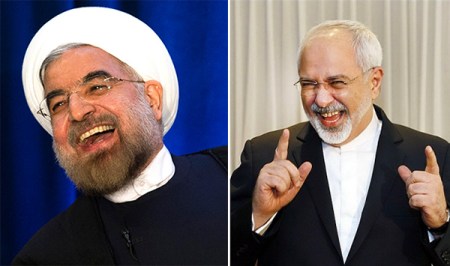
1323 (1)Iran’s firing of a missile within 1500 yards of a U.S. aircraft carrier in December, and its kidnapping and photographing of a U.S. Navy crew were test cases. Other than an apparent temper tantrum by Secretary of State John Kerry, there was no American response, except that Kerry absolved his friend Iranian Foreign Minister Javad Zarif of responsibility. Pictured above: Iranian President Hassan Rouhani (left) and Foreign Minister Javad Zarif (right).

Responding to Senator Lindsay Graham’s suggestion that Congress might increase sanctions against Iran, Mr. Kerry replied, “I wouldn’t welcome [that] at this time given the fact that we’ve given them a warning and if they decide to do another launch then I think there’s a rationale.”

Kerry may not have to wait long.

Just this week, Iranian Deputy Chief of Staff Brig-Gen Maassoud Jazzayeri was quoted by the FARS News Agency reiterating, “The White House should know that defense capacities and missile power, specially at the present juncture where plots and threats are galore, is among the Iranian nation’s red lines and a backup for the country’s national security and we don’t allow anyone to violate it.”

Now, he is believable.

Congress is beginning to breathe fire, but it is not yet clear what it can or will do in the face of the Obama Administration’s executive actions. Last week, angry congressmen were reduced to threatening to “name and shame” American companies that do business with Iran because they cannot figure out how to stem the tide of the Obama Administration’s indulgence of Iranian provocations. That reaction is not even close to good enough.

The Mullahs’ Plan to Hit Israel

April 7, 2016

The Mullahs’ Plan to Hit Israel, Front Page MagazineDr. Majid Rafizadeh, April 7, 2016

ws (2)

The Islamist state of Iran’s blatant aggression and provocative attitudes have reached an unprecedented level.

After the nuclear deal, and Obama’s appeasement policies towards Iran, the ruling Islamists of the country have become very public and vocal about their ideological objectives.

Most recently, the Fars News Agency, the Islamic Republic’s state-controlled news outlet, quoted Iranian Deputy Chief of Staff, Brigadier General Maassoud Jazzayeri, warning the United States to stay away from Iran’s redlines―one of which is Iran’s ballistic missiles.

In addition, Brigadier General Amir Ali Hajizadeh was also quoted by the ISNA agency as stating, “The reason we designed our missiles with a range of 2000 km is to be able to hit our enemy the Zionist regime from a safe distance.” Iran has increased its short–and medium–range ballistic missiles, and currently boasts the largest ballistic missile stockpile in the Middle East.

But what will Obama’s response to these threats be? Most likely there would be more bowing to the ruling clerics of Iran and giving them more carrots. Iranian theocrats have learned that intransigence works with Obama.

There is a simple rule that if you reward a student or your kid for bullying and breaking the rules, you will be encouraging his/her bad behavior, which can ultimately become dangerous for everyone around that person. In addition, if you show students your weakness–such as being willing to give them extra points so that they give you good reviews at the end of the year–they will take advantage of that, or as the Persian proverbs goes: “they will milk you to the end.”

And this is exactly what Iran is doing and how President Obama is encouraging the Islamic Republic’s aggression. Iranian leaders have become cognizant of the fact that intransigence absolutely works with the White House, and threatening Obama with pulling out of the nuclear deal will lead to Obama offering more concessions to the mullahs.

There is a basic rule in Iran’s politics and in Iran’s Supreme Leader’s philosophy: concessions means weakness.  Once someone shows you his/her weakness, you have to speed up getting more concessions from him or her until there is nothing left to get from them.

Here is a chain of events that can easily help us understand how we got here with Iran. It also helps predict how President Obama and the White House will respond to Iran’s recent aggression and threats to the US and Israel.

When the nuclear negotiations were initiated, Obama announced his terms. Iran’s Supreme Leader, Khamenei, gave an inflammatory speech, lashing out at the US. Obama’s response was to increase the number of centrifuges that Iran can hold and give Tehran more leverage in uranium enrichment. Obama also agreed not to include issues such as Iran’s ballistic missiles, human rights or the fate of those Americans imprisoned in Iran during the negotiations.

Now Khamenei knew the game. He used another shrewd tactic by giving another speech threatening the US that he will pull out of the negotiations if certain conditions were not met. Obama’s response was to immediately allow the Islamic Republic to receive all sanctions relief (including the removal of United Nations Security Council’s sanctions), even before Iran finishes its 10-year obligations. Obama also gave Iran a green light to become a nuclear state by enriching uranium at a level that they desire, spinning as many centrifuges as they like, and buying arms with no limits, after the 10-year period.

Khamenei and the IRGC leaders wanted to more forcefully milk the cow, as the Persian proverb goes. Iran launched its ballistic missiles in violation of the JCPOA (UNSCR 2231 Annex II, paragraph three), which states that Iran should not undertake any ballistic missiles activity “until the date eight years after the JCPOA Adoption Day or until the date on which the IAEA submits a report confirming the Broader Conclusion, whichever is earlier.”

President Obama ignored it. Iran launched ballistic missiles several times more. President Obama issued a superficial statement criticizing Iran. Khamenei immediately gave his Nowruz speech heavily lashing out at the United States, the “Great Satan,” and implying that he will pull out of the nuclear deal.

To appease the ruling clerics of Iran, Obama immediately backed off his statements by breaking the promises that he made to the Congress when he was trying to get his nuclear deal through. In other words, he is now preparing to give Iran access to the US’s banking and financial system, and he has already lifted sanctions against Iran that are not related to the nuclear program, but to Iran’s ballistic missiles, terrorism and human rights violations. Iran was also removed from the list of countries for which there is a travel ban, although it is prominent sponsor of terrorism.

Thanks to Obama’s weak leadership and appeasement policies towards the mullahs, Iran is already publicly attacking several countries in the region directly or through its proxies Hamas, Hezbollah, Badr, Kataeb Imam Al Ali, Harakat Al Islam, etc. Iran would have never dared to be so intransigent and aggressive when the UNSC sanctions were previously imposed on Iran. However, sanctions are being completely lifted, thanks to Obama.

Iran has a history spanning over 2,500 years and it goes without saying that that the mullahs are among the shrewdest politicians. They can smell weakness from thousands of miles away and they know how to exploit it. Obama’s weakness–that he fears his so-called crowning foreign policy achievement (the nuclear deal) might fall apart–has led to Iran’s bullying, and has driven his carrots-but-no-stick policy towards Tehran. It appears that Obama is indeed focused on scoring superficial records in his name, such as the nuclear deal or visiting Cuba. But there is no doubt that his so-called “accomplishments” will be forgotten soon. The things that are important are the lives that have been lost, the human rights violations, and the escalation of regional conflicts on the part of Iranian leaders thanks to Obama’s decisions.

Primary distractions from Iran

April 5, 2016

Primary distractions from Iran, Israel Hayom, Ruthie Blum, April 5, 2016

Ahead of Tuesday’s Wisconsin presidential primaries, U.S. Speaker of the House Paul Ryan was in Israel, the destination he chose for his first foreign trip since assuming his post at the end of October.

In meetings with Israeli leaders — and in an interview with Times of Israel editor David Horovitz — Ryan reaffirmed his commitment to the Jewish state and his opposition to the nuclear deal with Iran. He also stated, in no uncertain terms, that — contrary to increasing rumor and pressure — he is not going to end up becoming the Republican nominee at what threatens to be a contested GOP convention. Nobody really believes he means it, however, because he had been equally adamant about not wanting the position he is currently occupying.

But, while distraught Americans from both parties are obsessing over whether Donald Trump can win the nomination — and if he does, whether he can beat likely Democratic rival Hillary Clinton — the Obama administration is being given a free pass to get away with murder, figuratively. More literally, it is enjoying the benefit of the doubt caused by the distraction of the public away from the havoc the White House and State Department are continuing to wreak, which is enabling the actual death of a lot of people in the present, and a whole lot more in the future.

The terrorism of the Islamic State group is only a tiny part of this, though it seems to be the only jihadist organization that gets a rise out of Westerners, whom it makes no bones about targeting for mass murder. Indeed, as the suicide bombings in Brussels on March 22 indicated, Europeans and Americans only wake up when a lot of people with whom they can identify get slaughtered senselessly. That this kind of thing is going on routinely everywhere else in the world barely elicits a yawn.

But as evil as ISIS is, it is still small fry compared to the Islamic Republic of Iran, the world’s greatest state sponsor of terrorism, with tentacles reaching far and wide. And now, thanks to the Obama administration, it also has multibillions of dollars at its disposal with which to build its nuclear arsenal. Nor does it hide its ambitions to wipe Israel off the map and its loathing for America, the “great Satan.”

Iran’s supreme leader, Ayatollah Ali Khamenei, has made this clear to the point of warning his own underlings to follow suit.

“Those who say the future is in negotiations, not in missiles, are either ignorant or traitors,” he said last week.

How has the Obama administration responded to this and previous Iranian muscle-flexing, abduction of American sailors, celebration of U.S. abdication and assertion that nothing Tehran does violates the nuclear agreement?

It has conceded to Iran on every point. Or worse.

As was revealed in a piece by Adam Kredo in The Washington Free Beacon on Monday, “Congress is investigating whether the Obama administration misled lawmakers last summer about the extent of concessions granted to Iran under the nuclear deal, as well as if administration officials have been quietly rewriting the deal’s terms in the aftermath of the agreement.”

Rep. Mike Pompeo (R-Kansas) told Kredo that “the gap between [the administration’s] promises … and today’s scary reality continues to widen. We are now trying to determine whether this was intentional deception on the part of the administration or new levels of disturbing acquiescence to the Iranians.”

He was referring to issues such as Iran’s ballistic missile testing, which the administration initially said constituted a violation of nuclear-deal codifier U.N. Resolution 2231, and then backtracked. Perhaps even more disturbing were statements from the Treasury Department indicating that international business transactions with Iran could be done in dollars — releasing the ban in place on Iran’s access to the U.S. financial system.

In other words, not only was the deal America made with the devil a dangerous one to begin with, but apparently, we don’t know the half of it.

This sentiment was expressed in an op-ed in The Wall Street Journal on Sunday by United Arab Emirates Ambassador to the U.S. Yousef Al Otaiba, who wrote that, in spite of President Barack Obama’s claim about the world being safer place as a result of the nuclear deal, “The Iran we have long known — hostile, expansionist, violent — is alive and well, and as dangerous as ever.”

It is this sorry situation, and the Democrats who brought us here, that Americans must keep in mind come November, no matter who the Republican candidate is.

U.S. Offers Feckless Response to Iranian Belligerence

April 5, 2016

U.S. Offers Feckless Response to Iranian Belligerence, Clarion Project, Meira Svirsky, April 5, 2016

Iran-Basij-March-IP_4A member of the Iranian Basij voluntary militia (Photo: © Reuters)

Iran has stepped up its belligerency in the Middle East since signing the nuclear agreement, increasing its involvement in conflicts from Syria and Iraq to Yemen and flaunting its forbidden ballistic missile program.

The United States, for its part, has reacted fecklessly, fudging its redlines regarding the Islamic Republic and making empty threats.

Last week, U.S. President Barack Obama commented that Iran was obeying the “letter” of the nuclear agreement with the West, but not the “spirit” of it.

The president’s remark came after the second testing of ballistic missiles (designed to carry nuclear warheads) by the Islamic Republic. While Congress was originally told a moratorium on the Iranian ballistic missile program was part of the agreement, the administration decided it really wasn’t – and that the test constituted “merely” a violation of U.N. resolutions.

No matter that in the latest test, conducted while Joe Biden was visiting Tel Aviv, the missiles had Hebrew writing on them saying “Israel should be wiped out.”

The harshest criticism Obama could muster against the test was that such provocations would be bad for international trade as they would make countries “nervous” to do business with Iran.

Similarly, Congress was told the International Atomic Energy Agency (IAEA) would be conducting inspections of all Iranian nuclear facilities and would have full, independent access. We then heard that two key passages of the Iran deal were kept secret – not only from Congress, but from the president himself.

The secret deal involved the Parchin military installation, which was under suspicion for years for conducting research on nuclear weapons and long-range ballistic missiles. The second centered on negotiations between the IAEA and Iran to resolve the issue of possible military dimensions (PMD) of Iran’s nuclear program.

After allowing Iran to take its own samples from Parchin, the IAEA declared the issue of possible military dimensions of the Iranian nuclear program was now over, freeing billions of dollars in sanctions relief for the Islamists.

Again, there was no reaction from the U.S. administration. Now, that inaction is (finally) prompting outrage in Congress. As Jennifer Rubin writes in  The Washington Post, “Congressional leaders from both parties are firing back over what they see is evidence that Congress was blatantly misled about the terms of the deal and the administration’s willingness to confront Iran’s non-nuclear behavior.”

As Rep. Mike Pompeo (R-Kan.) said, “When multiple officials—including Secretary Kerry, Secretary Lew, and Ambassador Mull—testify in front of Members of Congress, we are inclined to believe them. However, the gap between their promises on the Iran nuclear deal and today’s scary reality continues to widen. We are now trying to determine whether this was intentional deception on the part of the administration or new levels of disturbing acquiescence to the Iranians.”

In the last weeks, it was reported that:

  • Iran warned the United States that it would be crossing a “redline” if it tried to stop Iran’s ballistic missile program. In the words of Iranian Deputy Chief of Staff Brig.-Gen. Maassoud  Jazzayeri, “The White House should know that defense capacities and missile power, especially at the present juncture where plots and threats are galore, is among the Iranian nation’s red lines and a backup for the country’s national security and we don’t allow anyone to violate it.”
  • Iran is beefing up its military presence in Syria by sending an elite unit of commandos as “advisors” to be stationed near Aleppo.  The elite force joins thousands of Iranian troops from its Revolutionary Guards Corps as well as Iranian-backed fighters from the Lebanese terror organization Hezbollah.
  • A U.S. Navy ship seized thousands of rifles and rocket-propelled grenades after stopping an Iranian arms shipment on its way to Yemen. It was the third such seizure in the last few weeks in the Arabian Sea.

Congress must use its power to impose new sanctions on Iran. In addition, lawmakers can extend a number of sanctions that are due to expire this year.

With or without the support of the current administration, Iran represents a threat to the world and must be stopped.

Khamenei Criticizes Top Political Rivals: Favoring Talks over Missiles Constitutes Treason

April 4, 2016

Khamenei Criticizes Top Political Rivals: Favoring Talks over Missiles Constitutes Treason, MEMRITV via You Tube, April 4, 2016

According to the blurb posted beneath the video,

In two recent public speeches, Iranian Supreme Leader Ali Khamenei, in a pointed reference to a Tweet made by Expediency Council Chairman Rafsanjani, said that those who say that today is an era of talks, not of missiles, are committing treason. Khamenei rejected President Rouhani’s call to instate an economic and cultural model – which he termed JCPOA 2, 3, and 4 – for the benefit of society, and said that this would constitute an abandonment of the principles of Islam and of the Islamic Revolution. He further criticized the U.S., saying: “the Americans have not upheld their commitments” in the JCPOA.

Rouhani threatened unless he keeps Iran’s “provocative”

April 2, 2016

Rouhani threatened unless he keeps Iran’s “provocative” DEBKAfile, April 2, 2016
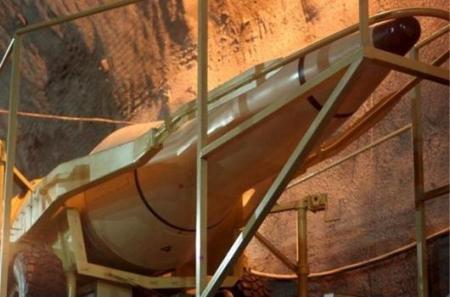
A missile is seen inside an underground missile base for Iran's Islamic Revolutionary Guards Corps (IRGC) Aerospace Force at an undisclosed location in this undated handout photo courtesy of Fars News. REUTERS/farsnews.com/Handout via Reuters

A missile is seen inside an underground missile base for Iran’s Islamic Revolutionary Guards Corps (IRGC) Aerospace Force at an undisclosed location in this undated handout photo courtesy of Fars News. REUTERS/farsnews.com/Handout via Reuters

President Barack Obama said Friday April 1, that “Iran has so far followed the letter of the [nuclear] agreement [with the six powers], but, he added, “the spirit of the agreement involves Iran also sending signals to the world community and business that it is not going to be engaging in a range of provocative actions that may scare business off,” such as fire-testing nuclear-capable ballistic missiles, calling for Israel’s destruction and providing Hizballah with missiles.

At a news conference ending the two-day nuclear summit in Washington, Obama went on to say: “Some of the concerns that Iran has expressed, we are going to work with them to address.” But meanwhile, he said, the US and its allies are taking steps to help Iraq benefit from the agreement by facilitating trade and banking transactions with the Islamic Republic; and the US Treasury Department is seeking to set clearer investment guidelines for Iran.

Two days earlier, on Wednesday, March 30, the Obama administration was reported acting to give Iran limited access to US dollars, since the almost complete lifting of sanctions in January, which netted Tehran an injection of approximately $150 billion “hasn’t provided the country with sufficient economic benefits.”

DEBKAfile’s analysts note the inherent contradiction in the US president’s approach to Tehran: He wants Iran to be compensated with a never-ending shower of dollars for agreeing to limit its nuclear program, but “the US and its allies” cannot question how the money is spent.

So while the West, under orders from Washington, must scramble to boost the Iranian economy, Tehran may continue to test ballistic missiles until they are nuclear capable, and top up the Hizballah terrorists’ arsenal with ever deadlier tools of death.

This glaring inconsistency arises from a fact largely hidden from the world public: last year’s landmark nuclear accord was concluded by Iran’s President Hassan Rouhani and Foreign Minister Mohammed Javad Zarif – not by the real powers in Tehran, supreme leader Ayatollah Ali Khamenei, the Revolutionary Guards chiefs and the ayatollahs at the head of the fundamentalist Shiite movement.

Indeed, even Rouhani was never allowed to formally sign the deal, much less gain Khamenei’s ratification.

But now, Rouhani’s fate depends on keeping those ruling elites happy.  He has found himself in the position of their hostage, a cash machine for keeping the funds for the Islamic Republic’s projects termed by President Obama “provocative” constantly on tap.

Those projects which are currently in full spate clearly leave every little over from the $150bn to even start lifting the Iranian economy out of its mess, while the Rouhani’s government carries the can for that too. Indeed, DEBKAfile’s Iranians sources disclose, the president is forced to earmark 50 percent of the funds released by sanctions relief for items listed under “defense”, namely,  the nuclear and missile development programs, Iran’s overseas military operations, including the Syrian war, subsidizing the Lebanese Hizballah, and establishing new terrorist organizations for attacks on Israel, such as the Al-Sabirin, on the Golan.

These enterprises eat up billions of dollars. Just Iran’s operations in Syria and support for Hizballah cost Tehran $2 billion every month.

Syrian president Bashar Assad didn’t surprise anyone when he revealed that the five-year civil war in his country had cost $200 billion so far. With this kind of spending on “defense,”  the Iranian economy will continue to decay, while Rouhani’s government, which promised the people a better life after the nuclear accord, must bow to the will of the hard-liners or face the consequences.

Our Iranian sources report that Obama’s inconsistent approach to Iran has sharpened the discord between the two major political camps in Tehran and put the “reformists” in extreme peril should they dare to defy the hard-liners who hold the levers of power. Khamenei has publicly threatened to liquidate such opposition leaders as Rouhani and his ally, former president Ayatollah Akbar Hashemi Rafsanjani.

President Rouhani has been put by Obama’s policy in the position of having to keep Tehran’s hungry war- and terror-mongers flush with cash, if he is to save himself and fellow “reformists” from “liquidation.”

The supreme leader was pretty blunt when he said on Friday, March 29, “Those who say the future is in negotiations, not in missiles, are either ignorant or traitors.” This comment underlined Iran’s overriding commitment to developing nuclear missiles and a warning to “traitors” of their fate: execution or a life sentence in a grim Iranian jail.

Op-Ed: Obama’s public face – a political theater of distraction and deception

March 20, 2016

Op-Ed: Obama’s public face – a political theater of distraction and deception, Israel National News, Jeffrey Ludwig, March 20, 2016

In his article “Iran’s Diplomacy for Dummies,” Jonathan Tobin, a totally reasonable individual, again misses the perfidy of Obama’s policies, towards Iran.  We brought to the UN our concerns about Iran testing ballistic missiles being a violation of the Iran deal.  Russia stated flatly that they “would not permit sanctions to be [re-] imposed because Iran’s actions did not violate UN Security Council resolutions.”  Samantha Powers expressed frustration and dismay at the Russian reaction to our concerns.

However, Amb. Powers’ comments against the Russians in the UN were nothing more than a charade. Her comments were a pretense of being offended by Russia.  The Obama administration was just playing politics with the issue, and using Samantha as the actress to give voice to our “concern” in this one-act political theater. We pretend to be standing up for real-time enforcement of the Iran deal, and then blame the Russians when enforcement is prevented. Whereas the truth is there was no real expectation or desire for enforcement by Obama and his lady advisors from day one of the negotiations or our sign-off.  Powers and Obama are merely trying to appear earnest in their implementation of the treaty (which they falsely called an agreement).

The charade (i.e., playacting) can be seen at work over a variety of political scenarios.  These bits of play acting are the modus operandi of the Obama administration.  They seek to reverse the idea found in Shakespeare’s drama “Hamlet.”  There we find the line, “The play’s the thing. Wherein [to] catch the conscience of the king.”   For the Obama inner clique, the principle is “the play’s the thing” to deflect our understanding of the king’s dereliction of duty for God and country.

We see this playacting during a recent interview.  During the course of the interview, Obama tried to appear measured and sincere in his thinking.  For example, he says to the interviewer, “Real power means you can get what you want without having to exert violence.”  He presented himself as a wise Solon who prefers negotiation to force. Here he may not be completely duplicitous but simply be in denial.

Many so-called peaceniks on the left fail to see the cowardly and traitorous underpinnings (motives) of their pseudo-pacifism. Thus, seen in a more honest light, we need to understand that preference for negotiation over force is, in reality, a preference for capitulation and a policy of fear. Capitulation is then interpreted as being wise and detached, whereas it is actually a flight from reality and the unpleasant experiences that accompany any of life’s confrontations.

He also pretended to be detached in the Shiite-Sunni conflict. According to Obama, the two sides “need to find an effective way to share the neighborhood.”  Bret Stephens of the Wall Street Journal tags this remark as sounding more “like Mr. Rogers.” However, this writer finds it to be more duplicitous and sinister than Mr. Stephens thinks.   In reality Obama has taken the side of the Shiites and of the Muslim Brotherhood wing of the Sunnis.  He has decided to reject Sunni leadership that is not rooted in Muslim Brotherhood ideology — in Libya (overthrew Qaddafi), Egypt (overthrew Hosni Mubarak and is not working cooperatively with General Abdel el-Sisi, but did send F-16s to el-Sisi’s predecessor Muslim Brotherhood President Mohamed Morsi), and Yemen (allowed a pro-Iranian Shiite faction to overthrow the pro-Saudi government).

Further, the U.S. has not lifted a finger to prevent Iranian-backed Hezbollah from taking over Lebanon.

Lastly, and most important from a Jewish perspective, he has justified U.S. funding of Hamas via their alliance with the PLO in 2014.   And we know that Hamas is a Shiite (Iranian-backed) organization with Muslim Brotherhood backing as well. Thus by saying to Goldberg that Shiites and Sunnis will just have to learn to get along, Obama was feigning a neutrality that in practice he totally rejects.  His remarks are pure political theater, totally divorced from the policies and practices of his administration.

Although Bret Stephens characterizes Obama’s thinking as shallow, it seems to this writer that Obama’s playacting is not rooted in shallowness, but simply in his being wrong. His underlying principles are ultimately harmful.  He is identified with left-wing pseudo pacifism (“pseudo” because violence is justified, but only for leftist ideals), a Marxist-derived anti-American bias that would portray the U.S. as an exploitative society, a bitter anti-Israel bias derived from his Muslim roots, and a false universalism (“false” because it is not God-centered).

His playacting is thus an attempt to distract from his deep ideological commitments. In Hamlet, the play was intended to reveal the hidden murderous action of the King of Denmark.  With the present U.S. executive branch, the intent of the playacting is to hide the murderous intent.