Posted tagged ‘Iran’

The ‘Iran Deal’ Was Not Signed by Iran or Anyone Else

September 19, 2015

Neither Iran nor any other party has signed the ‘Iran Deal.’ That means there is no formal agreement. That means nothing bars Iran’s race to nuclear weapons. By: Lori Lowenthal Marcus Published: September 19th, 2015

Source: The Jewish Press » » The ‘Iran Deal’ Was Not Signed by Iran or Anyone Else

Rep. Mike Pompeo (R-KS-04)

Rep. Mike Pompeo (R-KS-04)
Photo Credit: Wikimedia


The Nuclear Iran Deal that is at the epicenter of a Congressional battle and the focus of so much attention for months is not actually any deal at all, as not one of the parties, including any representative of the Islamic Republic of Iran, has signed the Agreement.

This morning, Sept. 18, Cong. Mike Pompeo (R-KS-04) sent a letter to Secretary of State John Kerry. In that letter Pompeo informed the Secretary that while reviewing the Joint Comprehensive Plan of Action (Nuclear Iran Deal), he noted that there are no signatures on the so-called final Agreement.

Without signatures, there can be no legally binding contract.

There apparently is no “Iran Deal.”

Pompeo asked Kerry to provide a copy of the JCPOA with signatures and signing authority, so that members of Congress and the rest of the American people know that the parties to the agreement have “confirm[ed] each country’s commitment to the agreement” and that “makes clear precisely who the parties to the agreement are and the authority under which that nation entered into the agreement.”

International affairs scholar and Iran expert Michael Ledeen pointed out more than two months ago that Iran’s Ayatollah Khameini would not allow his country to sign the JCPOA. Ledeen’s point then, and today, is that the desperation exhibited by the Obama administration made clear to the Iranian leader that “there is no reason for him to approve a hated deal with the devil. It’s much better to keep talking until all the sanctions are gone, and Iran’s ‘right’ to pursue its nuclear projects is fully recognized.”

It appears that Ledeen’s prediction was dead-on. If there is no signed agreement, even the feeble conditions placed on Iran by Team Kerry’s negotiators are unenforceable.

When asked what then, is the current status of the JCPOA, assuming the administration did not just, oh, forget to distribute to Congress the signed version, Ledeen told the JewishPress.com: “It’s a verbal agreement. It means the diplomats meeting in Vienna thought it was a good agreement, but that is all. It is not enforceable.”

Ledeen said he could not think of any other major international agreement, certainly not any of the portentous nature of the Iran Deal, where lawmakers moved forward to begin implementation without having a signed agreement in place.

“Anyone who has read in the media that the ‘Iran Deal’ was signed has to now know they were lied to, it has not happened.”

So what next?

Congress could, conceivably, pass a law forbidding the lifting of sanctions. That’s been tried, you say? True, but will the same members of Congress who support the deal, the same ones who never read significant portions of the deal, and who had those portions explained to them by people who themselves never read the deal are willing to once again vote against or even bar a vote on a stay on the lifting of sanctions when they know there is nothing preventing Tehran from violating any of the purportedly agreed-to conditions? Will they really?

Cong. Pompeo’s letter to Secretary Kerry follows:

Dear Secretary Kerry:


I have reviewed the Joint Comprehensive Plan of Action (JCPOA) between the P5+1 and Islamic Republic of Iran – or at least the parts of the agreement that were provided to Congress by the administration.  As you know, pursuant to H. Res. 411, the House of Representatives considers the documents transmitted on July 19, 2015 incomplete in light of the fact that the secret side deals between the International Atomic Energy Agency (IAEA) and the Islamic Republic of Iran were not provided to Congress.  I look forward to seeing the entire agreement – including the two secret side deals that are part of the JCPOA – so that Congress may continue to evaluate the JCPOA and, depending on the outcome of the vote under the relevant provisions of the Iran Nuclear Agreement Review Act, potentially end the current and continuing prohibition of the lifting of sanctions on Iran.

During that review, I found that the copies provided to Congress of the JCPOA are not signed by any of the P5+1 members nor by Iran.  Having never seen an international agreement of this magnitude not signed by the parties or an agent of the parties, I assume this is simply an oversight or an administrative error.  That is, Congress must not have the final version of the agreement that would necessarily be signed.  I request that you provide us with copies of a final, executed copy of the JCPOA.  In the event that the JCPOA has not yet been signed by the parties, please inform us (a) when signatures will be placed on the agreement, (b) what parties will be signing, and (c) which person you anticipate will sign on behalf of each of those parties, including on behalf of the United States.

I am confident that you intended for the JCPOA to be signed by each of the P5+1 participants.  I can find no international agreement of this “historic” nature that was not signed by the parties.  Each of the past five major nuclear agreements to which the U.S. is a party – SALT I, SALT II, START I, START II and the 1994 Agreed Framework between the United States and the Democratic People’s Republic of Korea – were signed by representatives of each nation that was party to the agreement.  This is not a mere formality.  Those signatures represent the commitment of the signatory and the country on whose behalf he or she is signing.

A signature also serves to make clear precisely who the parties to the agreement are and the authority under which that nation entered into the agreement.  In short, just as with any legal instrument, signing matters.

This is particularly important with respect to JCPOA.  Iranian President Hassan Rouhani has made clear that he does not believe that JCPOA is legally binding on his nation, saying, “If the Joint Comprehensive Plan of Action is sent to (and passed by) parliament, it will create an obligation for the government.  It will mean the president, who has not signed it so far, will have to sign it.  Why should we place an unnecessary legal restriction on the Iranian people?”

Given the many benefits that will accrue to the ayatollahs, the Iranian Revolutionary Guard Corps, and other unsavory elements of the Iranian regime, I believe that Iran should, at the very least, bind itself to the few requirements placed on it under the JCPOA by signing the agreement.  I also believe that the United States and its P5+1 partners on the JCPOA should execute the agreement on behalf of their countries.  I look forward to your response.

We all do.
Obama’s victory was won by a politician, not a statesman

September 13, 2015

Obama’s victory was won by a politician, not a statesman, Israel Hayom, Boaz Bismuth, September 13, 2015

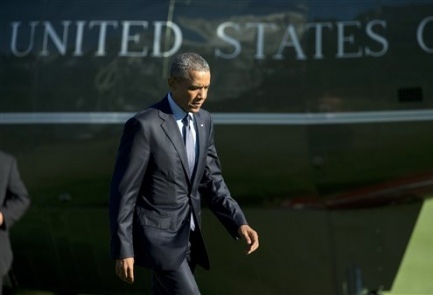
144213644746070861a_bU.S. President Barack Obama | Photo credit: AP

For once, however, Obama is right: Global warming is a burning issue that must be addressed, preferably starting in the Middle East, where the flames are unusually high.

*****************************

The U.S. House of Representatives voted Friday against the nuclear agreement with Iran, with a majority of 269 against, including 25 Democrats, and 162 in favor. This vote followed the expressed objections of 58 Senators, including four Democrats, who could not vote against the deal over a procedural win in the Senate on Thursday. It also followed a recent Pew Research Center survey showing that 49% of Americans oppose the deal, and only 21% support it.

Friday’s vote, albeit symbolic, proves that it is not the American people or their elected officials who want this deal — it is U.S. President Barack Obama who wants it, and what Obama wants, Obama gets.

The truth is, the U.S. does not believe Iran will adhere to the deal, but Obama, who since taking office has undermined the very foundations of the Middle East (and beyond), remains a savvy politician who knows exactly what needs to be done to push the nuclear deal through, despite the opposition it garners — opposition Obama is well aware of — so as to secure his legacy. Nevertheless, the nuclear deal is a victory won by a politician, not a statesman.

While Obama may have won the battle over the Iran nuclear deal, it was a procedural victory. History has taught us that the Senate rarely rejects a presidential foreign policy initiative.

The Iran nuclear deal would have been voted down if not for Obama’s considerable efforts. He understood the crucial need to present the Iran deal as an agreement, not as a treaty, which would have required he secure a two-thirds majority in the Senate, which he would not have been able to do. He also applied pressure on Democrats up for re-election, the majority of whom admitted the deal was far less than perfect.

According to American media, now that Obama has secured support for the Iran deal, he is turning his attention to global warming. For once, he is right — temperatures in the Middle East are scorching hot, and Obama had a hand in turning them up.

The recent sandstorm to cloud Israel was something of an ominous sign. The world has suddenly woken up to overt Russian presence in the Middle East. The Americans seem to have fallen asleep at the wheel, allowing Russian President Vladimir Putin to dictate a new reality on the ground, as he did in Ukraine. Could it be that Washington needed Moscow’s support for the Iran deal so badly it willingly dropped the ball?

The buildup of Russian forces in Syria has vast regional and international ramifications, which cannot be ignored. The West and Israel can no longer operate in Syria under the auspices of alleged “open skies,” and just in case that point was lost on anyone, Russia warned the U.S. against any “unintended incidents” on Syrian soil.

Russia has introduced its presence in the Middle East in a time when it could be seen as favorable. The international community wants to see the Islamic State group defeated, as do the Russians. Unlike in Ukraine, this time the Russians are on the same side as the good guys.

The Russians, however, are not alone: They have returned with the Iranians on their side, which is actually a gift from the U.S. — something that has irked the Saudis to no end, as they now have to find alternative avenues of dealing with both Moscow and Tehran.

For once, however, Obama is right: Global warming is a burning issue that must be addressed, preferably starting in the Middle East, where the flames are unusually high.

PM Netanyahu’s Greetings for Rosh Hashana

September 13, 2015

PM Netanyahu’s Greetings for Rosh Hashana, via You Tube, September 13, 2015


Khamenei: Israel won’t survive next 25 years

September 9, 2015

Khamenei: Israel won’t survive next 25 years Taking to Twitter, Iranian leader says Zionists won’t find serenity until destruction, calls US ‘Great Satan’ and rejects any talks with Washington beyond nuke deal By Times of Israel staff September 9, 2015, 12:20 pm

Source: Khamenei: Israel won’t survive next 25 years | The Times of Israel

In this picture released by official website of Ayatollah Ali Khamenei's office on Thursday, Sept. 3, 2015, he is seen speaking in a meeting with members of Iran's Experts Assembly in Tehran, Iran. (Office of the Iranian Supreme Leader via AP)

In this picture released by official website of Ayatollah Ali Khamenei’s office on Thursday, Sept. 3, 2015, he is seen speaking in a meeting with members of Iran’s Experts Assembly in Tehran, Iran. (Office of the Iranian Supreme Leader via AP)

Israel will not survive the next 25 years, Iran’s Supreme Leader Ayatollah Ali Khamenei said Wednesday, making a series of threatening remarks published online.

In a quote posted to Twitter by Khamenei’s official account, Khamenei addresses Israel, saying, “You will not see next 25 years,” and adds that the Jewish state will be hounded until it is destroyed.

The quote comes against a backdrop of a photograph showing the Iranian leader walking on an Israeli flag painted on a sidewalk.

“After negotiations, in Zionist regime they said they had no more concern about Iran for next 25 years; I’d say: Firstly, you will not see next 25 years; God willing, there will be nothing as Zionist regime by next 25 years. Secondly, until then, struggling, heroic and jihadi morale will leave no moment of serenity for Zionists,” the quote from Iran’s top leader reads in broken English.

The quote was apparently taken from a speech given earlier in the day.

The remarks came as US lawmakers began to debate supporting a recent nuclear agreement between Tehran and six world powers. Critics of the deal have pointed to fiery anti-US and anti-Zionist rhetoric as proof that the regime should not be trusted.

The White House and other deal boosters argue that the pact, meant to keep Iran from acquiring a nuclear weapon, is based on verification, not trust.

Khamenei’s statements also reaffirmed his view that the US is a “Great Satan” and that there would be no detente with Washington beyond the nuclear talks.

“We approved talks with the United States about [the] nuclear issue specifically. We have not allowed talks with the US in other fields and we [do] not negotiate with them,” Khamenei said in statements published on his website.

Khamenei is quoted as saying any other talks would be “a tool for penetration and imposing their demands.”

On Twitter, Khamenei said talks with the US were a “means of infiltration and imposition of their wills.”

Quoting the founder of the Islamic Republic and his predecessor as Supreme Leader Ayatollah Ruhollah Khomeini, Khamenei tweeted: “@IRKhomeini stated “US is the Great Satan,” some insist on depicting this Great Satan as an angel.”

The Twitter handle @IRKhomeini is an Iranian government account dedicated to Khomeini’s statements.

Some have pointed to the nuclear deal as an opening for Iran to repair long-frayed ties with the West.

Several senior European officials have traveled to Iran since the nuclear deal was reached to boost economic and diplomatic ties, including Austrian President Heinz Fischer, who on Monday became the first European leader to visit Tehran in over a decade.

On Tuesday, Iranian President Hassan Rouhani signaled that Iran is ready to hold talks with world powers on ways to resolve Syria’s civil war — provided such negotiations could secure peace and democracy in the conflict-torn country, he said.

Iran, together with Russia, backs the embattled regime of Bashar Assad, who is opposed by much of the West.

Khamenei Publishes Book About The Annihilation Of Israel

September 5, 2015

Khamenei Publishes Book About The Annihilation Of Israel

By Missing Peace

Source: Khamenei Publishes Book About The Annihilation Of Israel | Missing Peace | missingpeace.eu | EN

Khamenei during meeting with IRGC veterans

Iran’s Supreme Leader, Ayatollah Ali Khamenei, just published a book in which he outlines a ‘slow and painful’ strategy to annihilate Israel.

The 416-page book, titled Palestine, was edited by Saeed Solh-Mirzai–but received full approval from Khamenei’s office and is thus Khamenei’s most authoritative document regarding his views on the issue, the Goldstone Institute think tank reported.

The book was published only weeks after six world powers, including the United States, reached a controversial agreement about Iran’s nuclear weapons program.

Khamenei’s plan for Israel will promote “the hegemony of Iran” while it will remove “the West’s hegemony” from the Middle East, the Ayatollah claims in the book. How this goal will be reached is described in detail by Khamenei.

“Israel has no right to exist” is the central theme of the book. Khamenei uses three words to describe the destruction of Israel. “One is “nabudi,” which means “annihilation.” The other is “imha,” which means “fading out.” And finally, there is “zaval,” meaning “effacement,” the Gatestone Institute reported.

The annihilation of Israel will not be achieved via conventional warfare, Khamenei argues, but via a never ending string of terror attacks and low-intensity conflict that will make life unbearable for the Israeli Jews.

In the end, they would pack their bags and leave the country for another country in the West–or return to their country of origin–because many Israelis have dual citizenship, the Iranian Supreme Leader thinks. This same way of thinking caused Yasser Arafat to launch the Second Intifada, but Israelis never even contemplated leaving the country during the five years of continuing terror.

Khamenei writes that his strategy for the annihilation of the Jewish State has nothing to do with anti-Semitism but with “well-established Islamic principles.”

The overriding principle is that Israel was established on territory that belongs to the Ummah (Islamic nation) and, therefore, is part of the Dar al-Islam (house of Islam). Such land can never be ceded to non-Muslims and must be brought under Muslim control again.

There are, however, three other reasons Khamenei gave for the mandatory destruction of Israel.

The first is that Israel, which he labels “adou” (enemy) and “doshman” (foe), is the ally of the “Great Satan” (United States) and is conspiring with the U.S. in an “evil scheme” to dominate the heartland of the Ummah.

The second reason is that Israel has become “Kaffir al-Harbi,” a hostile infidel because of the numerous wars it fought against Muslim armies.

The third reason Israel must be destroyed is that it “occupies” Jerusalem, the third holy city in Islam, according to Khamenei, who is honored with the title “The flagbearer of Jihad to liberate Jerusalem” on the cover of the book. He writes that one of his “most cherished wishes” is to pray in Jerusalem one day.

Khamenei is counting on increasing “Israel fatigue” in the international community that makes it more likely that the world will force his version of the one-state solution upon Israel, he thinks.

What is this solution?

The Supreme Leader wants to organize a referendum among at least 8 million Palestinian Arabs and their descendants and only 2.2 million Israeli Jews, those who did not immigrate to Israel.

The United Nations would run the affairs in the new country until the referendum takes place; and after that, Khamenei would be willing to let the Jews continue to live in the new “Palestine” as second-class citizens (Dhimmi’s).

Khamenei also boasts that Iran was behind the Second Lebanon War between Israel and Hezbollah in 2006 and the 22-day long war with Hamas in Gaza last year.

In his book, Khamenei denies the Holocaust and writes that he regards it as “a propaganda ploy” or a disputed claim. “If there was such a thing we don’t know why it happened and how,” he claimed.

Amir Taheri, the Iranian journalist who wrote the Gatestone article, added the following:

Khamenei has been in contact with professional Holocaust deniers since the 1990s. In 2000, he invited Swiss Holocaust-denier Jürgen Graf to Tehran and received him in private audiences. French Holocaust-denier Roger Garaudy, a Stalinist who converted to Islam, was also feted in Tehran as “Europe’s’ greatest living philosopher.”

It was with Khamenei’s support that former President Mahmoud Ahmadinejad set up a “Holocaust-research center” led by Muhammad-Ali Ramin, an Iranian functionary with links to German neo-Nazis who also organized annual “End of Israel” seminars.

Despite efforts to disguise his hatred of Israel in Islamic terms, the book makes it clear that Khamenei is more influenced by Western-style anti-Semitism than by classical Islam’s checkered relations with Jews.

His argument about territories becoming “irrevocably Islamic” does not wash, if only because of its inconsistency. He has nothing to say about vast chunks of former Islamic territory, including some that belonged to Iran for millennia, now under Russian rule.

Nor is he ready to embark on Jihad to drive the Chinese out of Xinjiang, a Muslim khanate until the late 1940s.

Israel, which in terms of territory accounts for one per cent of Saudi Arabia, is a very small fry.

Khamenei’s book has been published in Farsi, the language of Iran. An Arab translation is expected soon.


Iranian Regime Celebrates Its Victory In The Nuclear Agreement

September 4, 2015

Iranian Regime Celebrates Its Victory In The Nuclear Agreement, MEMRI, September 4, 2015

After Iran and the P5+1 announced the JCPOA on July 14, 2015, top Iranian officials, headed by Supreme Leader Ali Khamenei, said that the country was a superpower with standing equal to that of the U.S., and that this status would become even stronger because of the agreement. They boasted of Iran’s might and said that it had forced the superpowers to surrender to it and its demands.

Following are highlights from these statements:

Iranian Defense Minister: The Superpowers Surrendered To Iran And “Obeyed The Iranian Rights”

At an armed forces general command ceremony on August 30, 2015, Iranian Defense Minister Hossein Dehghan said: “Today, Iran has attained such status that the superpowers have surrendered to it, because of its majesty, its steadfastness, its resistance, and its unity. Despite their great pride, the regime of the arrogance [the West, led by the U.S.] sat humbly behind the negotiating table and obeyed the rights of the Iranian nation.”[1]

Leader Khamenei: “Those Who Levelled Sanctions Against Us Yesterday Are Dying Today – Because Iran Has Become The Region’s Foremost Military Power”

On August 24, 2015, the website of Iranian Supreme Leader Ali Khamenei published a poster titled “The Iron Fist,” symbolizing Iran’s might following the agreement. The text on the poster states: “Those who levelled sanctions against us yesterday are dying today, because Iran has become the region’s foremost military power. The Islamic Republic of Iran has proven that it works diligently to defend itself. The entire nation unites as a solid fist, standing fast against the aggressors who lack all reason.” The poster features a fist adorned with Iranian flags breaking through clouds; the fist is made up of military equipment, including missiles, jets, ships, tanks, and so on.[2]

24758

IRGC Website Javan: “Iran Is Becoming A Power… Equal To America In The World”

On July 15, 2015 the Javan website, which is affiliated with Iran’s Islamic Revolutionary Guard Corps (IRGC), claimed that Iran has become a superpower with standing equal to that of the U.S., and that this is why the U.S. agreed to conduct a dialogue with Iran in nuclear talks: “In his speech following the agreement between Iran and the P5+1, Obama stated: ‘This deal is also in line with a tradition of American leadership. It’s now more than 50 years since President Kennedy stood before the American people and said, “Let us never negotiate out of fear, but let us never fear to negotiate.” He was speaking then about the need for discussions between the United States and the Soviet Union.’[3]

“This speech clearly shows the sunset of American power and that [the U.S.] has been downgraded from a superpower to an ordinary power. First, Obama considers diplomacy and negotiations to be America’s leadership tradition, while its record indicates that since it emerged in the international arena during World War I, it has chosen no path but military force. The wars in Korea, Vietnam, Iraq, and Afghanistan, the bombing of Hiroshima and Nagasaki, and the dozens of other crimes in Latin America show that America’s leadership tradition has never been diplomacy. Superpowers see themselves as too big to waste their time in negotiations and diplomacy with third-world or smaller countries. They are used to determining how others should behave by waving their finger, and fulfilling their interests by way of military assault. America’s diplomatic record includes several rounds of talks with the former Soviet Union. Therefore, we can say that from World War II to 1990, America’s leadership tradition championed diplomacy or negotiations only vis-à-vis powers of equal standing…

“Obama’s statements defending negotiating with Iran can lead to one of two conclusions: Either America views Iran and its deterrence as equal to those of the former Soviet Union… or America does not have the status it once did…

“What has happened now is that the U.S. Secretary of State [John Kerry] has abandoned all his duties and his life to negotiate with Iran – to haggle, to capitulate, to call on the Europeans to help in the talks, and he does not consider Iran to be like Vietnam, Korea, Afghanistan, and Iraq. So what really happened here?

“In his televised speech on April 5, 2015, following the Lausanne agreement, Obama said that of the three options – attack, sanctions, and negotiations – he saw no other option but negotiations, and even before that he said, ‘If I could have, I would have dismantled Iran’s entire nuclear [project].’ The other side of the ‘if I could have’ coin is ‘I can’t.’ How can we understand this ‘I can’t?’ After all, America has a military presence in 50 places around the globe, including in the Persian Gulf…

“America’s conduct in the absence of the Soviet Union shows that Iran is becoming a power that is second to, or even equal to America in the world. [Therefore,] America does not have the courage to attack it militarily or even to conduct bilateral talks [with it], so it is being helped by three European countries [France, Britain, and Germany].

“It is not unreasonable that America believes that our military capabilities do not surpass its own, but it fears [Iran’s] soft power, which is stronger than military bombardment… This soft power has two main avenues: an covenant between the nation and the Imam [Ayatollah Ruhollah Khomeini]… and an alliance with the countries of the region [that is based on] emotion and faith. The Iraqi nation is an example of this alliance; there, America sacrificed 4,400 troops and ousted Saddam [Hussein], but the friends of the Islamic Revolution [of Iran] sat on Saddam’s throne and did not in any way allow [the Americans] to seize power there. This soft power cannot carry out a military assault, which is why the Islamic Revolution’s increasing might has caused America to transform itself, due to fear, from a stupid enemy into a relatively clever one.”[4]

Senior Khamenei Advisor In IRGC: Nuclear Agreement Will Improve Iran’s Status And Might

Yadollah Javani, senior advisor to Khamenei in the IRGC, wrote in the July 27, 2015 editorial of the IRGC weeklySobh-e Sadeq: “Will war break out between Iran and America? This cannot be decisively answered with a yes or no. But we can prove that in past years, the U.S. was incapable of carrying out, and could not work up the courage to carry out, a military assault on Iran. In the past decade, the Americans and Zionists have repeatedly threatened to attack Iran, but due to their deep concerns regarding the implications of a possible war against [Iran], they have not followed through with their threats… Therefore, American officials announced that Iran’s nuclear dossier would only be resolved by diplomatic means.

“After the [April 2, 2015] Lausanne statement, U.S. President Obama announced that war or increased sanctions would not subdue Iran or destroy its nuclear industry. Throughout all these years the Americans threatened to attack Iran militarily, but both they and others, including the Iranian nation, knew full well that this threat was mainly psychological warfare, and that America could not start another war in West Asia.

“With its record of empty military threats, the Americans once again began to boast about the issue of a military assault on Iran, after the conclusion of the Vienna talks and the signs of an emerging nuclear agreement between Iran and the P5+1. The military threat has come from Obama, U.S. Secretary of State John Kerry, Defense Secretary Ashton Carter, and other American officials in recent days; they have all stressed the option of military force against Iran in the future…

“So far the Americans have not attacked, because of Iran’s deterrence, which is steadily increasing. A decade ago, the Americans were stronger than they are today, and the Islamic Republic of Iran was weaker. In the past decade, the power of America and its allies in the region has eroded, while the power of the Islamic Republic and its allies has only increased. Therefore, the regional upheavals during the past decade have worked in Iran’s favor, and to the detriment of the U.S.. Thanks to the nuclear agreement, this process will not take a turn for the worse for Iran, but could only add special might to it.

“This is precisely the cause of the concern regarding the nuclear agreement that has been expressed by officials of the Zionist regime and of America’s other allies in the region, such as the Al-Saud regime. Therefore, the boasting by America, following the acknowledgement of a nuclear Iran by the agreement between Iran and the P5+1, comes from necessity, and reflects America’s attempt to maintain the façade of its status as a world superpower.

“However, the truth is that the time of this superpower has passed, and America must accept the facts of the new world. The world’s balance of power is shifting, and a new international political order is being shaped. [This new world order] includes the acknowledgement of a nuclear-fuel-cycle-Iran with decisive deterrent capabilities in the region by the world’s six main powers…”[5]

__________________

Endnotes:

[1] Tasnimnews.com (Iran), August 30, 2015.

[2] Farsi.khamenei.ir, August 24, 2015.

[3] Whitehouse.gov, July 14, 2015.

[4] Javan (Iran), July 15, 2015.

[5] Sobh-e Sadeq (Iran), July 27, 2015.

What the axis of evil owes Obama

September 4, 2015

What the axis of evil owes Obama, Israel Hayom, Ruthie Blum, September 4, 2015

His presidency has been paved not with failures, but with a string of the most successfully orchestrated disasters in history. For this, the “axis of evil” Obama so stringently denies owes him a great debt of gratitude.

********************

On Wednesday, U.S. President Barack Obama fulfilled a lifelong dream he has spent nearly seven years in office trying to realize.

It is a very different dream from that of Martin Luther King Jr., whom Obama invokes whenever it feeds his own visions of a particular form of grandeur.

This is not to say that rising from modest means to becoming the head of the United States and, by extension, the leader of the free world, is not already about as grand as one can get. But it is America’s greatness — not Obama’s — that enabled him to make it to the White House in the first place.

His ability to pull it off a second time, in spite of a bad economy and the sweeping radicalization of the Middle East, is a measure of how well he had already implemented the methods of his mentor, “Rules for Radicals” author Saul Alinsky, of infiltrating the country’s institutions and destroying them from within.

Indeed, the previously imperfect, but still functional, systems he tackled to chip away at the fabric of society were health, education, welfare and, of course, the family unit. He even set back the very societal strides that allowed for the election of a black president, creating an environment in which race relations took a sharp turn for the worse.

All of this made America ripe for the picking of its enemies.

This is where Obama’s foreign policy comes into play. Like the chisel he took to domestic affairs, Obama strived to strip the United States of its global superpower status. The crowning moment of this endeavor took place in July in Vienna, when the tireless efforts of the U.S.-led P5+1 to persuade the Islamic Republic of Iran to sign an agreement Obama desperately wanted finally paid off.

According to the agreement, Iran will be able to continue to develop and hone its nuclear weapons program, unfettered by the financial constraints of economic sanctions, and increase the flow of funds to its strategically placed terrorist proxies the world over. In exchange, Russia and China, two laughable members of the P5+1, get to do dubious deals with the mullahs in Tehran; Europe, inundated with refugees from Muslim countries, gets phony guarantees about its short-term safety; and Obama gets to tell himself he has finally earned the Nobel Peace Prize he was awarded about five minutes into his presidency.

This week, he scored his ultimate coup — over Congress. Faced with a majority of the House and Senate opposing the deal, Obama announced that if it did not pass when put to a vote in September, he would exercise his presidential veto power and force it down the throats of the American people.

The only thing that could have prevented this from happening was a veto-override majority. Alas, one was not to be had. By Wednesday, the fate of the deal was sealed by the Obama camp.

Obama deserves full credit for this and the other disasters he has wreaked.<

Where Iran is concerned, one need only look back in time to the early months of Obama’s first term to grasp what he was up to then, and how it led to where we are today.

On June 12, 2009, a rigged election in Iran reinstated then-President Mahmoud Ahmadinejad. Though opposition candidate Mir-Hossein Mousavi clearly had come out ahead of the incumbent, the latter declared victory and hailed his reign as the “will of the people.”

Millions of Iranians took to the streets to protest the false claims on the part of the regime they had intended to replace with what they believed would be a more democratic one.

During these demonstrations, in the course of which Iranians begged the U.S. to help them, a young woman named Neda was gunned down, and the photo of her bullet-ridden body and haunted eyes became the key symbol of the Iranian people’s wish to be free of the repression the Islamic Revolution of 1979 had imposed on them.

Viewing these events from behind his desk in the Oval Office, Obama was “impartial.” He had entered the White House only five months earlier, pledging to overturn his predecessor’s policies. Among these was George W. Bush’s position on radical Muslim regimes and groups in general, and on Iran specifically.

Claiming that the only way to rid Iran of its nuclear and hegemonic ambitions would be by extending goodwill gestures to its leaders, Obama abandoned the term “axis of evil,” which Bush had coined to define state sponsors of terrorism, Iran being a prime example.

Convinced, as well, that the U.S. had become a pariah among nations for being a capitalist, imperialist bully, Obama set about to show the world that America was in no way superior to other countries and cultures.

His wife, Michelle, shared this dim view of her country. Her response to her husband’s electoral victories in a series of Democratic primaries was to say it was the first time in her adult life that she was proud to be an American.

It was neither ignorance nor oversight, then, which caused Obama to abandon the genuine freedom-seekers in Iran, and try to engage the vicious ayatollahs. It was part of his plan, born of a twisted ideology that America was to blame for the hatred it inspired among despots — so ridiculous a notion that it allows for ignoring the plight of truly terrorized populations, prey to the tyrannical oppression of their leaders.

It is also at the core of his appalling attitude towards Israel. As a traditional ally of the U.S., with shared values, it, too — in Obama’s eyes — is to blame for the enmity it arouses.

It is impossible to get into Obama’s head to determine whether he actually believes the nuclear pact he is signing with the devil is the lesser of all evils.

One thing is clear, however: His presidency has been paved not with failures, but with a string of the most successfully orchestrated disasters in history. For this, the “axis of evil” Obama so stringently denies owes him a great debt of gratitude.

Khamenei: U.S.Is The Enemy’; ‘We Must Combat The Plans Of The Arrogance With Jihad For The Sake Of Allah

September 1, 2015

Khamenei: U.S.Is The Enemy’; ‘We Must Combat The Plans Of The Arrogance With Jihad , MEMRI, September 1, 2015

(Does Iran’s Supreme Leader refer to Obama’s America or to the United States? There’s a difference. — DM)

On August 17, 2015, just over a month after the announcement of the JCPOA in Vienna, Iranian Supreme Leader Ali Khamenei said in a speech at a conference held by the Iranian Shi’ite Ahl Al-Bayt organization that the U.S. is the embodiment of the enemy of the Islamic peoples and of Iran. It must be fought with military, cultural, economic, and political jihad, he said, adding that Islamic Iran is not interested in reconciling with it. He further claimed that the U.S. is attempting to divide the Islamic world into Shi’ite and Sunni camps that will wage a religious war against each other, and in this way gain it will be able to gain control over the peoples of the region.[1]

Iran, he stressed, stands behind the resistance axis, opposes the division of Syria and Iraq, and will continue to support anyone who fights Israel.

Following are excerpts from a report on the speech that was posted on Khamenei’s website (Leader.ir):

“[Khamenei said:] ‘We must combat the plans of the arrogance [i.e. the West, led by the U.S.] with jihad for the sake of Allah.’ The Leader pointed to ‘America’s efforts to exploit the results of the nuclear talks and exert economic, political, and cultural influence in Iran’ and to the plots of the power-hungry order aimed at sowing conflict and gaining influence in the region. The Leader called for ‘adopting the correct plans in order to wisely and consistently fight this plot, in an offense against it and a defense against it.’

“[Khamenei said:] ‘Jihad for the sake of God does not only mean military conflict, but also means cultural, economic, and political struggle. The clearest essence of jihad for the sake of God today is to identify the plots of the arrogance in the Islamic region, especially the sensitive and strategic West Asian region. The planning for the struggle against them should include both defense and offense.

“[He continued:] ‘The plots of the arrogance in the region have continued for a century, but [its] pressure and plotting increased after Iran’s Islamic Revolution [1979], in order to prevent [this Revolution] from spreading to other countries. For 35 years, the regime in Iran has been subjected to threats, sanctions, security pressure, and various political plots. The Iranian nation has grown accustomed to this pressure. After the Islamic awakening movement blossomed in recent years in North Africa [i.e. the Arab Spring], the enemy greatly stepped up its plots in the West Asian region because of its panic.

“‘The enemies thought that they could suppress the Islamic awakening movement, but it cannot be suppressed. It continues, and sooner or later it will prove itself as reality.

“‘The power-hungry order led by the United States of America is the perfectly clear embodiment of “the concept of the enemy.” America has no human morality. It carries out evil crimes under the guise of flowery statements and smiles. The enemy’s plot is two pronged: creating conflict and [exerting] influence. [The enemy sows conflict] among governments, and, worse, among the nations. At this stage, they are using the Shi’a and the Sunna to create conflict among the nations. Britain is an expert in sowing conflict; the Americans are its apprentices.

“‘Establishing violent despicable criminal takfiri circles, which the Americans have acknowledged establishing, is the main means of sowing conflict, ostensibly religious conflict, among [the Muslim] nations. Sadly, some innocent and ignorant Muslims have been fooled by this plot, and have been tricked by the enemy and fallen into its trap. Syria is an obvious example of this. When Tunisia and Egypt, with Islamic slogans, ousted their infidel governments, the Americans and Zionists decided to use this formula to eliminate the countries of the resistance, turning their attention to Syria. After the events in Syria began, some ignorant Muslims were tricked by the enemy and dragged Syria to its current situation. What is happening today in Iraq, Syria, Yemen, and other countries, which some people insist on calling “a religious war,” is in no way a war of religion [i.e. Sunni vs. Shi’ite], but a political war. The most important duty today is to remove these conflicts.

“‘I have explicitly stated that Iran reaches out in friendship to all the Islamic governments in the region, and that we have no problem with Muslim governments. Iran has friendly relations with most of its neighbors. Some still have conflicts with us; they are stubborn, and carry out nefarious acts, but Iran aspires to good relations with its neighbors and with the Islamic governments, especially with the governments in the region. The basis for Iran’s conduct comprises the principles laid out by Imam Khomeini, which he used to bring about victory for the Islamic Revolution, and he led it to a phase of stability.

“‘One of the principles of the [Islamic] regime [in Iran] is to be “forceful against the disbelievers, merciful amongst themselves [Koran 48:29].” On the basis of Imam Khomeini’s lesson, we do not wish to reconcile with the arrogance, but we aspire to friendship with our Muslim brothers. When we support [any of] the oppressed, we ignore the religious element; we provide the same aid to our Shi’ite brothers in Lebanon and to our Sunni brothers in Gaza. We see the Palestinian issue as the chief issue of the Islamic world.

“‘There must be no exacerbation of the conflict in the Islamic world. I oppose any conduct, even by Shi’ite circles, that creates conflict. I condemn the insults against the sanctities of the Sunna.

“‘The U.S. has aspired for decades to infiltrate the region and regain its lost reputation. The Americans wish to infiltrate Iran with the [JCPOA] agreement, whose fate in Iran and in the U.S. is still unknown. But we have decisively blocked this path, and we will do anything to keep them from infiltrating Iran economically, politically, and culturally.

“‘Iran’s regional policy is the opposite of America’s. While [America] seeks to divide the countries of the region and to create statelets that obey it, this will not happen. Some were amazed by statements I made in the past about America’s attempt to divide Iraq, but today the Americans themselves honestly acknowledge this. The Americans’ clear goal is to divide Iraq, and, if they can, Syria as well. But the territorial integrity of the countries of the region – Iraq and Syria – is very important to Iran.

“‘Iran supports the resistance in the region, including the Palestinian resistance, and we will support anyone who struggles against Israel and strikes at the Zionist regime. Iran’s chief policy is a struggle against America’s policy of division and its sowing of conflict. We do not recognize the Shi’a that is based in London and works in the service of the arrogance.

“‘In contrast to unfounded claims, Iran is not interfering in Bahrain and Yemen, but will continue to support the oppressed. The massacre of oppressed Yemenis and the destruction of that country must be strictly condemned. Promoting some [Saudi] political goals via foolish methods results in ongoing crimes against the Yemeni people.

“‘There are also painful events in Pakistan and Afghanistan. Muslims must be wise and vigilant, and thus they will solve these problems.

“‘The Islamic Radio and Television Union [organization in Iran] is an important center in the struggle against the dangerous empire of the sophisticated American-Zionist media mafia. We must strengthen and grow this movement…

“‘The future of the region belongs to the Muslim nations. Islam’s might is clear and will be maintained because of the presence of the fighting men and women.'”[2]

_________________

Endnotes:

[1] It should be noted that in the main Friday sermon in Tehran on August 28, 2015, prayer leader Ayatollah Kazem Seddiqi advised the officials in the government of Iranian President Hassan Rohani not to be misled by the West and the U.S. following the JCPOA, because they are “cannibals, liver-eaters, and anti-religion.” Fars, Iran, August 29, 2015.

[2] Leader.ir, August 18, 2015.

Iran Unveils Advanced Radars

August 30, 2015

Iran Unveils Advanced Radars, Israel DefenseAmi Rojkes Dombe, August 30, 2015

(Have the new systems been deployed? How long can Israel wait to attack Iran’s nuke sites? — DM)

New Iranian radar

Among of the unveiled products were the upgraded model of the Keyhan (Cosmos) radar, ground-based radar jamming systems and a domestically-made IFF (Identification, Friend or Foe) system.

***********************

A number of Iran’s homegrown air defense systems, including upgraded radars and electronic warfare equipment, were unveiled on Saturday.

One of the unveiled products was the upgraded model of the Keyhan (Cosmos) radar, a long-range radar that uses mixed frequencies to identify small flying objects, and is suitable for detecting large number of aerial targets in the electronic warfare.

In addition, a variety of ground-based radar jamming systems were unveiled. The jamming systems, which have been connected to the country’s integrated air defense network, are employed for electronic countermeasures in the fight against aerial threats.

A domestically-made IFF (Identification, Friend or Foe) system was also unveiled. Commander of Khatam al-Anbia Air Defense Base Brigadier General Farzad Esmaili said the system can distinguish friendly forces from the enemy by detecting 100 targets simultaneously.

A number of other Iranian radars, including Bina, Nazir and Talash were also put on display in the exhibition.

Resolving the Syrian war is not the silver bullet for stopping ISIS

August 29, 2015

Resolving the Syrian war is not the silver bullet for stopping ISIS, DEBKAfile, August 29, 2015

(Please see also, Pentagon Not Targeting Islamic State Training Camps. — DM)

jISIS_mobile_defense_of_SVBIED_8.15ISIS “mobile defense SVBIED” in action in Iraq

President Obama may likewise offer King Salman all sorts of assistance for standing up to ISIS, but he will find no buyers in Riyadh for his failed policy of reliance on Saudi Arabia’s rival, Iran, for liquidating the Islamist threat looming against the oil kingdom from neighboring Iraq.  Neither is US aid much use for stemming the tide of pro-ISIS radicalism spreading among young Saudi men.

As matters stand today, therefore, the Islamic State faces no tangible threat – even if Iran does go ahead and achieve a nuclear bomb.

**************************

The war to stop the Islamic State in Iraq and the Levant (ISIS) has entered a dark tunnel. And with it the bottomless conflicts in Syria, Yemen, Libya and Iraq. The search for a ray of light moves next week from Moscow to Washington, when Saudi King Salman Bin Abdulaziz makes his first visit as monarch for talks with President Barack Obama.

The three worried Arab rulers received in the Kremlin Tuesday, Aug. 25, by President Vladimir Putin could only talk in circles: Egyptian President Abdel-Fatteh El-Sisi,is  embattled on three fronts, Sinai, his border with Libya and Cairo; Jordan’s King Abdullah II – is wedged between two wars; and UAE Crown Prince Sheikh Mohamed bin Zayed Al Nahyan, has sent his army to fight the Yemen insurgency alongside Saudi Arabia.

For them, resolving the Syrian conflict looked like the silver bullet, the key to ending all their troubles. But whichever Russian or Iranian plans and ideas they considered for a way forward, they were all forced to come back to the same impasse. Even Putin and Obama can’t get around or ignore two solid facts:

1. In the year since the US built an international coalition for fighting ISIS, the brutal Islamists have not been cut down; they have instead been empowered to seize more turf outside their Iraqi and Syrian conquests, such big oil fields in Libya, an ascending threat to Egypt and big plans for Lebanon.

2. A major letdown has followed on the high hopes reposed in Iran. The nuclear deal negotiated with the six world powers – and the elevated regional status conferred on Iran – hinged closely on US expectations that Tehran would put up effective military resources for tackling ISIS.

But the Revolutionary Guards, the popular Syrian and Iraqi forces the Guards established,and  the Afghan and Pakistani Shiite militias they imported – none have proved a match for ISIS and jihadi tactics.

In Syria, ISIS stands fast, unthreatened in the terrain, towns and oil fields they have captured, in the past year – excepting only on fringe fronts, where they have been forced back by local Kurdish rebel fighters.

Hizballah is a big part of the disappointment. It was supposed to serve as a bulwark against ISIS invading eastern Lebanon from Syria. Instead, these Lebanese Shiite fighters, allies of Assad’s army, are bogged down in a bitter battle for the strategic Syrian town of Zabadani, after failing to breach Syrian rebel defenses in forays from the south, the north or the center.

The door is therefore open for the Islamist State to march into Hizballah’s strongholds in the Lebanese Beqaa valley and head north to the port of Tripoli for a foothold on the Mediterranean.

Whether Bashar Assad stays or goes, which might have made a difference at an early stage of the Syrian insurgency, is irrelevant now that his army and allied forces are in dire straits.

In Iraq, the forces fighting ISIS are equally stumped. The jihadis are in control of a deadly string of  strategic towns, Ramadi, Faluja, the refinery city of Baiji, Mosul, and most of the western province of Anbar, including Haditha which commands a key stretch of the Euphrates River.

Here, too, the Islamist terrorist army’s lines remain intact, unbroken either by the undercover Jordanian Special Forces campaign 200 km inside Anbar, albeit backed by US and Israeli military and intelligence assistance; by the “popular mobilization committees” set up by the Iranian general Abu Mahdi al-Muhandis, deputy of the Al Qods chief Qassem Soleimani, or less still by US-trained Iraqi army units.

This week, the impasse spurred two combatants into chilling escalations:

— Iran began shipping its solid propellant missile, Zelzal-3B (meaning “earthquake”), across the border into Iraq, in the hope that this powerful projectile, with a range of 250km , would give the Revolutionary Guards their doomsday weapon for tipping the scales against ISIS.

— The Islamists, for their part, embraced a new tactic, known in the west as “SVBIED mobile defense.” Scores of armed vehicles are packed tight with hundreds of tons of explosives and loosed against military convoys on the move and static enemy positions and bases.

This tactic quickly proved itself by killing the 10th Iraqi Division’s chief, deputy and its command staff, as well as the deputy chief of Iraqi forces in Anbar.

In Moscow last week, Putin offered his three Middle East guests Russian nuclear reactors, arms, joint pacts for fighting terror and assorted ideas for the future of Bashar Assad. But he too had no practical proposals for bringing the Islamic State down.

President Obama may likewise offer King Salman all sorts of assistance for standing up to ISIS, but he will find no buyers in Riyadh for his failed policy of reliance on Saudi Arabia’s rival, Iran, for liquidating the Islamist threat looming against the oil kingdom from neighboring Iraq.  Neither is US aid much use for stemming the tide of pro-ISIS radicalism spreading among young Saudi men.

As matters stand today, therefore, the Islamic State faces no tangible threat – even if Iran does go ahead and achieve a nuclear bomb.