Posted tagged ‘Iran Scam’

Obama Admin Signed Secret Doc to Lift UN Sanctions on Iran Banks

September 30, 2016

Report: Obama Admin Signed Secret Document to Lift U.N. Sanctions on Iranian Banks

BY:
September 30, 2016 1:23 pm

Source: Obama Admin Signed Secret Doc to Lift UN Sanctions on Iran Banks

The Obama administration signed a secret document to lift United Nations sanctions on two Iranian state banks that were previously blacklisted for their involvement in financing Iran’s ballistic-missile program the same day Tehran released four American prisoners, the Wall Street Journal reported Friday.

Based on the nuclear agreement between Iran and six world powers, the two banks were initially under sanctions until 2023, but the administration agreed to delist the entities on Jan. 17. Senior U.S. officials told the Journal that State Department official Brett McGurk and an Iranian government representative met in Geneva and signed three documents that day.

One document committed the U.S. to dropping criminal charges against 21 Iranian nationals, and Tehran to releasing the Americans imprisoned in Iran.

Another committed the U.S. to immediately transfer $400 million in cash to the Iranian regime and arrange the delivery within weeks of two subsequent cash payments totaling $1.3 billion to settle a decades-old legal dispute over a failed arms deal.

The U.S. agreed in a third document to support the immediate delisting of the two Iranian banks, according to senior U.S. officials. In the hours after the documents were signed at a Swiss hotel, the different elements of the agreement went forward: The Americans were released, Iran took possession of the $400 million in cash, and the U.N. Security Council removed sanctions on Bank Sepah and Bank Sepah International, these officials said.

In February, a documentary by Iranian media outlet Tasnim News Agency, which is affiliated with the Islamic Revolutionary Guard Corps, claimed that Iranian government officials demanded that Bank Sepah  be delisted from U.N. sanctions as part of the deal to release four Americans. Despite previous sanctions on the bank by the Treasury Department, the Obama administration agreed to lift the sanctions under the nuclear deal reached in July 2015.

After the nuclear accord was inked, senior officials said they continued to have dialogue with Iran about the two banks before the three documents were officially signed in January. Tehran argued that Bank Sepah and Bank Sepah International were critical to international trade and their economy, the Journal reported.

Bank Sepah is Iran’s oldest bank and one of its three largest in terms of assets. Bank Sepah International, based in London, was key to financing Iran’s international trade before sanctions were imposed.

The U.S. Treasury was vehemently opposed to the banks back in 2007 for their alleged role in financially backing Iran’s missile program.

At the time, the Treasury said that Bank Sepah and Bank Sepah International had provided financial support to Iranian-state owned companies and organizations developing Iran’s missile program. These included Iran’s Aerospace Industries Organization and the Shahid Hemmat Industries Group.

“Bank Sepah is the financial linchpin of Iran’s missile procurement network and has actively assisted Iran’s pursuit of missiles capable of carrying weapons of mass destruction,” the Treasury said in a January 2007 statement.

Since the nuclear agreement was reached in July 2015, Iran has conducted up to 10 ballistic missile tests. The U.N. has been critical of these launches but has not imposed any new sanctions.

Senior Pentagon officials are upset about the prisoner deal, the Journal noted, despite U.S. officials saying the Obama administration closely vetted all entities and people associated with Bank Sepah before they agreed to the lifting of sanctions.

The dispute in Washington has only deepened in recent weeks, as senior Pentagon officials, including Secretary of Defense Ash Carter, told Congress in a hearing that they weren’t notified by the White House about the cash transfer. The chairman of the Joints Chief of Staff, Marine Gen. Joe Dunford, said at a hearing last week that he found it “troubling” that the U.S. provided Tehran with so much cash, which he argued could be used for “spreading malign influence.”

The Obama administration has repeatedly denied accusations that it sent $1.7 billion to Tehran to secure the release of four American prisoners. Many lawmakers have called the money transfer a ransom payment. A majority of lawmakers supported legislation last week that would legally ban the Obama administration from sending more cash payments to Tehran.

The Washington Free Beacon previously reported on House Majority Leader Kevin McCarthy (R., Calif.) praising the legislation.

While the Obama administration has threatened to veto the bill, McCarthy said the majority of Congress disagrees with the administration’s decision to pay Iran $1.7 billion prior to the release earlier this year of several U.S. hostages.

“The Obama administration paid a cash ransom to Iran for American hostages,” McCarthy told the Free Beacon. “No matter how the Obama administration chooses to redefine this payment, the message to Iran is crystal clear: You will be rewarded for taking hostages—not punished.”

Another Day, Another Secret Obama Side Deal with Iran

September 30, 2016

Another Day, Another Secret Obama Side Deal with Iran, Center for Security Policy, September 30, 2016

409742601

Source: National Review

According to a September 30 Wall Street Journal article, the Obama administration signed a secret agreement with Iran to lift U.N. sanctions from two Iranian banks — Bank Sepah and Bank Sepah International — that helped finance Iran’s ballistic-missile program. U.S. and Iranian officials signed this deal on January 17, 2016, the same day Iran released four U.S. prisoners.

U.S officials in January said the prisoners were swapped for the release of seven Iranian prisoners by the U.S. and the removal of 21 persons — mostly Iranian nationals — from an INTERPOL wanted list for violating U.S. laws barring transfers of WMD technology and weapons to Iran.

The American people and Congress did not learn until August that the U.S. prisoners were not allowed to leave Iran until a planeload of $400 million in cash sent by the United States had landed in Iran. This payment — and two more over the next month — has been strongly condemned by Republican congressmen as U.S. ransom payments to a state sponsor of terror.

Commenting on the $400 million cash payment to Iran, the prisoner swap and the lifting of sanctions from the Iranian banks, a senior U.S. official told the Journal, “The timing of all this isn’t coincidental. Everything was linked to some degree.”

The Journal also quoted unnamed Obama officials who justified lifting sanctions against the two Iranian banks to “harmonize the U.N. sanctions list with the U.S.’s” and because “Washington believed Iran had earned more sanctions relief because Tehran had been implementing the terms of the nuclear agreement.” The Obama administration lifted U.S. sanctions against Bank Sepah and Bank Sepah International in July 2015. The U.N. Security Council voted to lift these sanctions on January 17, 2016.

This suggests the removal of sanctions against the Iranian banks was part of a broad ransom agreement to free U.S. prisoners held by Iran.

The secret agreement to lift sanctions against the Iranian banks also violated U.N. Security Council Resolution 2231, passed in July 2015 which endorsed the JCPOA. This resolution stipulated that U.N. missile-related sanctions against Iran would remain in place for eight years. In addition, lifting sanctions against the two banks broke promises to Congress by Obama officials that the nuclear deal would only lift nuclear-related sanctions against Iran and that U.N. missile sanctions would remain in place for eight years.

The secret deal to lift missile sanctions against the Iranian banks joins a long list of secret JCPOA side deals that the Obama administration illegally withheld from the U.S. Congress and the American people. These include allowing Iran to inspect itself for nuclear weapons work; the dumbing down of IAEA Iran reports; exemptions granted to Iran on its JCPOA obligations so it would receive $150 billion in sanctions relief; sending Iran planeloads of $1.7 billion in cash to free four imprisoned Americans; and an agreement allowing Iran to construct advanced centrifuges in 2027. One has to wonder how many more secret side deals have yet to be disclosed.

I argue in my new book on the Obama administration’s nuclear diplomacy with Iran is national-security fraud. This latest secret side deal is more compelling evidence of this.

Khamenei on WWII: Iran Must Not Go the Way of Germany and Japan Khamenei on WWII: Iran Must Not Go the Way of Germany and Japan

September 29, 2016

Khamenei on WWII: Iran Must Not Go the Way of Germany and Japan  Khamenei on WWII: Iran Must Not Go the Way of Germany and Japan, Israel National News, Col (res.) Dr. Eran Lerman, September 29, 2016

Speaking on September 18, 2016 before commanders of Iran’s Revolutionary Guards Corps (IRGC), the Supreme Leader of Iran launched into a bitter polemic against Rafsanjani’s call to invest more in the economy and less in military build-up. (Ref. MEMRI translation and analytical observations.) The IRGC, Khameini declared, is the key to the success of the revolutionary project. Deterrence can only be achieved if fear of Iran’s raw power is instilled in the hearts of her enemies. Neither the JCPOA (the nuclear deal between Iran and the P5+1 powers) in itself, nor a shift in strategy to more civilian pursuits, can protect Iran. The revolution must be translated into military might.

At this point in the speech, Khameini offered a fascinating point of reference. Look, he suggested, at Germany and Japan at the end of World War II: forced into submission, humiliated, and required to disarm. He made no effort to hide his sympathy. As far as Khameini is concerned, the bad guys won and the good guys lost in 1945, and the time has come to overthrow the entire post-war dispensation.

Speaking on September 18, 2016 before commanders of Iran’s Revolutionary Guards Corps (IRGC), the Supreme Leader of Iran launched into a bitter polemic against Rafsanjani’s call to invest more in the economy and less in military build-up. (Ref. MEMRI translation and analytical observations.) The IRGC, Khameini declared, is the key to the success of the revolutionary project. Deterrence can only be achieved if fear of Iran’s raw power is instilled in the hearts of her enemies. Neither the JCPOA (the nuclear deal between Iran and the P5+1 powers) in itself, nor a shift in strategy to more civilian pursuits, can protect Iran. The revolution must be translated into military might.

At this point in the speech, Khameini offered a fascinating point of reference. Look, he suggested, at Germany and Japan at the end of World War II: forced into submission, humiliated, and required to disarm. He made no effort to hide his sympathy. As far as Khameini is concerned, the bad guys won and the good guys lost in 1945, and the time has come to overthrow the entire post-war dispensation.

This position is, after all, in line with Iran’s denial of the Holocaust (recall the caricature competition designed to denigrate and diminish it) and exterminatory stand towards Israel. It is not the personal quirk of Ahmadinejad, who was, in fact, just told by the Leader that he will not be allowed to run for president again this time. It is the position of Khamenei himself and of Khomeini before him: “Khatt al-Imam,” the line of the Imam, the ultimate imperative of the revolutionary regime.

According to this line, Iran has a religious (or, rather, ideological) imperative to reject all Western mores. For this to be possible, the Revolution, even more than the State as such, must position itself as a strong military power in regional and global affairs. The alternative is unthinkable. The “values” the West and the US seek to impose include utterly base and noxious notions like homosexuality (with which Iran’s present leaders are apparently obsessed). Military weakness would lead to moral weakness, a “cultural invasion,” and the loss of all that Khameini and Khomeini have sought to establish.

Khameini told his audience that there are misguided souls in Iran who seek to negotiate with the US even as the Americans themselves seek a dialog with Iran on regional affairs (e.g., on Syria, Lebanon, Iraq and Yemen). He rejects this quest not only as poisonous for Iran, but as evidence that America is now a spent force.

With that American weakness in mind, the Iranian leadership is now openly calling for the total destruction of Wahhabism (read: the Saudi state). It makes this call while complaining, as did Foreign Minister Zarif in an op-ed at The New York Times, that “big money is being used to whitewash terrorism.” This claim is, of course, extremely rich to anyone with even a smattering of knowledge about Iran’s behavior in recent years.

Iranian arrogance is thus on the rise in the post-deal era, and with it Iran’s hope of steadily undoing Israel and undermining regional and global stability until the true Imam or Mehdi appears on earth. Meanwhile, as Saudi Foreign Minister Adel Jubayr wrote in response to Zarif, it is Iran that remains at the top of the terror lists. It is Iran’s ally in Syria, with the help of Iran’s proxies in Lebanon, who is now engaging in unprecedented acts of carnage in Aleppo.

The Leader’s extolling of military might is thus frightening to all in the region, even as Tehran tries to present itself as the voice of reason in the struggle against the Islamic State (Iran was quick to denounce the assassination in Amman this week of a Christian journalist who “insulted” the IS radicals).

There could be an opportunity here. Neither candidate for the US presidency seems to have bought into the strange notion, implicit (and at times explicit) in the positions taken by Obama and his inner circle, that Iran can serve as a useful counterweight to other forces in the region. Nor have they bought (yet) into the delusion that Iran’s revolutionary impulse can be assumed to be benign. The US is thus still able to think of Iran as an enemy, which it is.

If so, the domestic tension and turmoil over the unfulfilled promise of economic relief, and over Khamenei’s demand for more and more sacrifices by the people (a “resistance economy,” as he calls it) can provide fertile ground for destabilization of the Iranian regime. Such an opportunity was lost in 2009. It need not be lost again.

In Debate, Hillary Dodges Blame for Libya, What Obama Called His “Greatest Mistake”

September 27, 2016

In Debate, Hillary Dodges Blame for Libya, What Obama Called His “Greatest Mistake”, Counter Jihad, September 27, 2016

16live1

The first Presidential debate revealed a Democratic candidate who believes she has all the answers even though her failed performance as Secretary of State led directly to the formation of the Islamic State (ISIS), aided the rise of Iran, and furthered much of the chaos in the Middle East.  She cannot learn anything while she believes she already knows everything.  Electing her promises more of the same, and ‘the same’ has been a disaster.

The Republican challenger, meanwhile, has much still to learn about the security structure he would command as President.  Clinton’s strongest moment against him on foreign policy came as she chided him for appearing to suggest that America would not honor its mutual defense treaties with Japan or South Korea.  Nothing is more important to the world than the reliability of America’s word.  Clinton should know that:  it was her former boss, President Obama, who personally kicked off the refugee crisis bedeviling Europe by failing to enforce his red line against Syria’s use of chemical weapons against its own people. His failure to keep his word on a security agreement gave the Syrian regime free rein to wage war on its own population, putting millions on the road to Europe.

Trump’s strongest moment against Clinton came when he accused her of bad judgment in the formation of ISIS.  She attempted to respond by saying that George W. Bush had negotiated the withdrawal from Iraq, and that “the only way that American troops could have stayed in Iraq is to get an agreement from the then-Iraqi government that would have protected our troops, and the Iraqi government would not give that.”

That’s all true, but whose job was it to obtain such an agreement?  That was her job.  She was the one who was supposed to obtain that agreement, and she failed utterly.  As our earlier coverage states:

It was her job to negotiate an arrangement with the Iraqi government that would do two things:  allow a stabilizing US military presence to remain in Iraq, and allow the US Department of State the freedom of movement it would need to step up as guarantors of the peace.  The peace, you see, had been purchased not only by the US military’s victory on the battlefields, but also by its patient negotiation with militants formerly aligned with al Qaeda in Iraq.  These tribes, mostly but not exclusively Sunni, had rejected the terrorism of al Qaeda in Iraq in return for promises of fair treatment from the Iraqi central government.  This included jobs, assistance for communities recovering from the war, and many other things that the government promised to provide in return for the support of these former enemies.  The United States helped to negotiate all these agreements, and promised to see that they would be kept faithfully.

Instead, the Secretary of State failed to produce either a new Status of Forces agreement that would permit US troops to remain in Iraq, or an agreement that would allow State Department personnel to move about the country safely to observe whether agreements were being kept.  In the wake of the precipitous withdrawal of US forces, Prime Minister Maliki moved to arrest Sunni leaders in government, and broke all his promises to the tribes.

The result was that the western part of Iraq once again became fertile ground for an Islamist insurgency.

Clinton was similarly unreflective when she argued that Trump had supported “the actions we took in Libya,” without pausing for a moment to acknowledge what a destabilizing mistake it was.  Effecting regime change with no capacity to control the outcome is what allowed radical groups, including ISIS, to expand into the vacuum.  That one is also her fault personally, as she pushed President Obama to take this action.  Her own President says that he considers ataking her advice on Libya to be his “worst mistake.”  Yet again, she has learned nothing, and does not seem to be aware that there is even anything to learn.

A similar failure to understand the lessons of the recent past occurred in their exchange on NATO.  Trump is right to be critical of the institution’s continuing relevance, but he is criticizing it on the wrong grounds.  That the other nations do not pay their way is true, but it is not the problem with NATO.  That it does not focus on terrorism is partly true, but it does not render the organization obsolete because a resurgent Russia remains a security challenge for western Europe.

Nevertheless, Clinton’s smug response is un-reflective and wrong.

You know, NATO as a military alliance has something called Article 5, and basically it says this: An attack on one is an attack on all. And you know the only time it’s ever been invoked? After 9/11, when the 28 nations of NATO said that they would go to Afghanistan with us to fight terrorism, something that they still are doing by our side.

What Clinton fails to mention here is that, like all of NATO’s decisions, invoking Article 5 must be done unanimously.  The reason to question NATO’s continued relevance is that the Turkish drift into Islamist politics makes it unlikely that a unanimous vote could still be reached.  Turkey has also shown signs recently of falling into Russia’s orbit.  If Turkey becomes a Russian ally in the way that China is, NATO may be rendered obsolete simply because it can never take a decision.  If Turkey becomes a Russian satellite, NATO will indeed have been rendered obsolete.  In either case, NATO’s continued relevance turns on figuring out how to swing Turkey away from Islamist thought and Russian influence, eliminating the unanimity requirement on NATO actions, or else developing a mechanism to expel the Turks from the alliance.   None of that exists, and since Turkey would have to agree to any of those changes, none of it is likely to come to exist.

Finally, on Iran, Clinton is wedded to a policy that Trump rightly describes as a disaster.

You look at the Middle East, it’s a total mess. Under your direction, to a large extent.

But you look at the Middle East, you started the Iran deal, that’s another beauty where you have a country that was ready to fall, I mean, they were doing so badly. They were choking on the sanctions. And now they’re going to be actually probably a major power at some point pretty soon, the way they’re going.

The horror show in Syria is linked to the Iran deal, as Obama decided to let Syria fester in order to pursue Iran’s approval of his deal.  Clinton’s role in this deal is something she herself has celebrated, so she cannot walk away from it.  Since then, Iran has developed new ballistic missiles that make sense only as a delivery mechanism for nuclear payloads.  It has bought advanced anti-aircraft missiles, and installed them around one of the nuclear sites allegedly to be made harmless by this wonderful “deal.”  Why is it hardening this site against air strikes if it intends to live by the deal?  Why develop a delivery mechanism for weapons you don’t intend to build?

Clinton cannot even ask these questions, because she is wedded to her failures.

Obama Turns Blind Eye to Iranian Offenses in UN Speech

September 27, 2016

Obama Turns Blind Eye to Iranian Offenses in UN Speech, Clarion Project, Jennifer Breedon, September 27, 2016

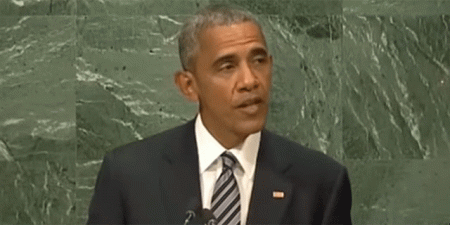
obama-un-address-2016-hpU.S. President Barack Obama addresses the UN General Assembly on Sept. 20, 2016. (Photo: video screenshot)

The Iranian leader rightfully fears a future administration that may not be willing to tolerate a total disregard for international law or human rights, given that even President Obama’s positive nod to Iran at the UN was met with the label of “continued animosity.” 

****************************

In 2015, President Obama stated that Iran’s “support for terrorism” and “its use of proxies to destabilize parts of the Middle East” was problematic, despite the Joint Comprehensive Plan of Action (the nuclear deal) that had been reached by that time that allowed Iran access to millions of previously frozen funds.

Yet, bafflingly, just five minutes after mentioning terror proxies in his 2016 UN address last week, President Obama seemed to turn a blind eye to Iran’s ongoing offenses by saying, “When Iran agrees to accept constraints on its nuclear program, that enhances global security and enhances Iran’s ability to work with other nations.”

Today, Iran is poised to move funds to its global terror proxies more easily due to the infusion of cash created by the unfreezing of their assets.  Even John Kerry admitted in 2015 that some of the money going back to Iran through sanctions relief would undoubtedly go to fund terrorism.

So, we all know it is happening and yet nothing is being done to stop them or to even state this obvious fact aloud before the very body that is designed to protect against such international violations.

The UN Convention that prohibits terrorism financing explicitly outlines the illegality of any government that commits such an offense when it

“directly or indirectly, unlawfully and willfully, provides or collects funds with the intention that they should be used or in the knowledge that they are to be used, in full or in part, in order to carry out . . . act(s) intended to cause death or serious bodily injury to a civilian, or to any other person not taking an active part in the hostilities in a situation of armed conflict, when the purpose of such act, by its nature or context, is to intimidate a population, or to compel a government or an international organization to do or to abstain from doing any act” (Article 2(1)).  

Iran is guilty in spades of all of this.

Additionally, the Iranian government remains the U.S. State Department’s top proxy war and terror sponsor. Previous reports from the U.S. State Department note that Iran remains “unwilling to bring to justice senior al-Qaeda (AQ) members [and has] previously allowed AQ facilitators to operate a core facilitation pipeline through Iran.”

The State Department has also highlighted Iran’s provision of “hundreds of millions of dollars in support of H[e]zballah in Lebanon and has trained thousands of its fighters . . . in direct support of the Assad regime in Syria” as well as terrorist groups in Palestine (Hamas), Yemen (Houthis) and “throughout the Middle East.”

President Obama’s appeals to the oppressive government of Iran have clearly fallen on deaf ears.  In a one-on-one with MSNBC’s Chuck Todd merely 24 hours after Obama’s UN speech, Iranian President Rouhani stated, “If the future administration of the United States wishes to continue animosity, it will receive the appropriate response.”

The Iranian leader rightfully fears a future administration that may not be willing to tolerate a total disregard for international law or human rights, given that even President Obama’s positive nod to Iran at the UN was met with the label of “continued animosity.”

No amount of vocal, material or financial appeasement can ease relations with the State Department’s leading state sponsor of terrorism.  Despite repeated efforts by President Obama, it will not get better until the Iranian regime abandons its practice of funding terrorism, inciting proxy wars throughout the Middle East, and oppressing their own people by using their resources to build and test weapons before providing the infrastructure needed to create a stable economy and free society for their people.

While Iranian civilians and citizens were in dire economic straits with very little government reprieve or resource allocation to ease their conditions prior to the Nuclear Deal sanctions relief, the Iranian regime was spending over $6 billion per year to support the Assad regime in Syria in its efforts to ensure a Shiite majority in the region.

The Iranian regime must be held accountable for its non-adherence to international law and its desire to finance terror globally in places like Yemen, Iraq, Lebanon, and Syria.

It must be held responsible for using funds to bankroll violence and oppression instead of providing basic necessities and freedoms for its own people.  As Obama said at the UN this year, Iran must “listen to voices of young people everywhere who call out for freedom, and dignity, and the opportunity to control their own lives.”

Rouhani made it clear that, despite all of the steps we’ve taken, including acknowledging them positively at the UN General Assembly, nothing the U.S. has done has thawed our relationship with Iran or helped to improve the security of people living in the areas ruled by Iran or its terror proxies.

Our leaders must continue to speak out against Iran’s human rights violations and the financing of terror if we ever hope to see change and remain a positive beacon of democracy and freedom.


Obama’s Syria Policy Explained

September 26, 2016

Obama’s Syria Policy Explained, Power Line, Paul Mirengoff, September 26, 2016

It seems likely that Obama welcomed Russia’s direct intervention since (1) it served Iran’s interests and (2) made it much easier for Obama to defend not taking military action. Indeed, Obama sees Russia as a partner in Syria.

*********************************

In writing about the pathetic efforts of John Kerry to arrange a cease fire in Syria, I’ve referred to the Secretary of State as the village idiot. But what about President Obama?

Though his intellect may be overrated, he’s anything but an idiot. Obama is, instead, a clever operator who often thinks several moves ahead of his domestic, though not his foreign, adversaries.

Why, then, has U.S. policy paved the way for Assad’s revival, Iranian and Russian success in Syria, and the massacre of up to half a million Syrians?

I’ve come to believe that the answer lies in the Iran nuclear deal. I base this view in part on the great reporting of Jay Solomon for the Wall Street Journal.

For example, Solomon revealed that in 2013, Iran told Obama that if he were to strike the regime of Bashar Assad following the latter’s chemical-weapons attack, the Iranians would end the talks over their nuclear program. Obama duly canceled the strike and later reassured Iran that the United States would not touch Assad.

In my view, Obama’s priority from Day One has been to negotiate a nuclear deal with the mullahs and use the deal as a springboard to a kind of alliance with the their regime under which Iran would “stabilize” the region and the U.S. would basically exit. This desire best explains why Obama’s Syria policy serves Iran’s interests.

My view finds powerful support in a piece in Tablet by Tony Badran of the Federation for Defense of Democracies. Having read Badrad’s piece, it seems to me that the pro-Iran tilt manifested in Obama’s Syria policy is even more pronounced than I had suspected.

Badran states his thesis this way:

America’s settled policy of standing by while half a million Syrians have been killed, millions have become refugees, and large swaths of their country have been reduced to rubble is not a simple “mistake,” as critics like Nicholas D. Kristof and Roger Cohen have lately claimed. Nor is it the product of any deeper-seated American impotence or of Vladimir Putin’s more recent aggressions.

Rather, it is a byproduct of America’s overriding desire to clinch a nuclear deal with Iran, which was meant to allow America to permanently remove itself from a war footing with that country and to shed its old allies and entanglements in the Middle East, which might also draw us into war. By allowing Iran and its allies to kill Syrians with impunity, America could demonstrate the corresponding firmness of its resolve to let Iran protect what President Barack Obama called its “equities” in Syria, which are every bit as important to Iran as pallets of cash.

Obama’s intentions should have been evident from the beginning. After all, as Badran points out, “if Obama purposefully took the Iranian regime’s side during the 2009 protests so as not to upset the prospect of rapprochement, he similarly wasn’t about to commit the United States against Iran’s longest-standing strategic ally, Assad.”

But Obama did a great job of masking his pro-Assad tilt and confusing none-too-bright media. Badran writes:

[B]y 2012, criticism of the administration’s policy had grown more vocal, and calls rose to give military support to the Syrian opposition, a proposition the president was always opposed to. As this was a fixed position for Obama, the task before the White House was, therefore, one of public relations—to quiet the calls for supporting the opposition, outside and also within the administration, without doing anything that would actually upset Assad and his patrons in Iran.

Messaging, as always, was of paramount importance to the White House. As the Wall Street Journal reported in early 2013, “White House national security meetings on Syria [in 2012] focused on what participants called ‘strategic messaging,’ how administration policy should be presented to the public.” To that end, the administration started putting out targeted talking points. The administration laid down its now-infamous mantra: There is no military solution in Syria.

Unfortunately, Assad, Iran, and Russia did not share this view — as Obama knew. Thanks to U.S. policy, Assad, Iran, and Russia appear to be right.

Not content with the “no military solution” mantra, Obama added argument that he wanted to avoid “further militarization” of the situation in Syria. Thus Jay Carney stated:

We do not believe that militarization, further militarization of the situation in Syria at this point is the right course of action. We believe that it would lead to greater chaos, greater carnage.

In light of subsequent developments, this statement is obscene, but it was always ridiculous. A no-fly zone would have prevented much of the carnage — and presumably virtually all of carnage rained down from the air — that has occurred since Carney spoke this rubbish several years ago.

But a no-fly zone would have thwarted Iran’s ambitions. Thus, argues Bedran, it was always a non-starter for Obama.

Russia’s presence in the air over Syria provided Obama with an excuse for rejecting a no-fly zone. But, as Bedran says, the administration had firmly rejected such action for years before the Russians were anywhere near Syria.

It seems likely that Obama welcomed Russia’s direct intervention since (1) it served Iran’s interests and (2) made it much easier for Obama to defend not taking military action. Indeed, Obama sees Russia as a partner in Syria. According to Bedran, “partnership with Russia is what the White House has sought after since late 2015 and throughout 2016 —with [Robert] Malley as the point man, negotiating directly with the Kremlin’s special envoy. Malley, by the way, is virulently anti-Israel.

The cynicism of Obama’s pronouncements on Syria — his “strip tease” as Bedran calls it — is encapsulated by what he and his team have said about Russian intervention in Syria. Initially, the administration’s line was that Russia had made a tragic mistake by becoming involved in a quagmire (never mind that, as we pointed out at the time, its military involvement was limited almost entirely to air strikes). Now, Team Obama argues that Russia holds all the cards in Syria and that our only option is to work with the Kremlim.

Russia and Iran hold all the cards because Obama allowed them to. Bedran makes a strong case that Obama allowed them to because because he wants Iran to prevail.

One might admire the elegance of Obama’s “strip tease,” if not for the demise of hundreds of thousands of Syrians and the triumph of our arch-enemy in Tehran.

In Contrast To Rohani Allegations In UNGA, Senior Iranian Officials Confirm U.S. Has Met Its Obligations Under JCPOA

September 24, 2016

In Contrast To Rohani Allegations In UNGA, Senior Iranian Officials Confirm U.S. Has Met Its Obligations Under JCPOA, MEMRI,  Y. Carmon and A. Savyon* September 23, 2016

Introduction

In his September 22, 2016 speech at the UN General Assembly, Iranian President Hassan Rohani accused that the U.S. is not meeting its obligations towards Iran under the JCPOA. He said: “The lack of compliance with the deal on the part of the United States in the past several months represents a flawed approach that should be rectified forthwith… Any failure on the part of the United States in implementing it (the deal) would constitute an international wrongful act and would be objected to by the international community.”[1] 

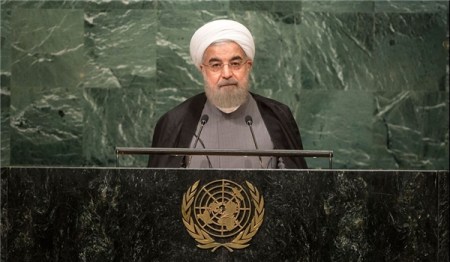
30061Rohani at the UNGA (Image: Farsnews.com, September 22, 2016)

Rohani’s statements, which are part of an Iranian attempt in recent weeks to create a false impression that the U.S. has not met its obligations towards Iran, are in stark contradiction to statements made by senior members of the Iranian negotiation team who explicitly admitted that the U.S. has in fact met its obligations under the JCPOA (see below).

This Iranian measure is a response to the refusal of Western banks to conduct transactions with Iran in dollars, despite the lifting of the nuclear sanctions in January 2016, because the initial sanctions imposed on Iran by Congress for human rights violations and for terrorism are still in force. As will be recalled, Iran refuses to negotiate with the West on issues of terrorism, on the grounds that these issues are internal sovereign matters.

Below is a MEMRI report on this issue published on August 15, 2016.

As the first year of the JCPOA is marked, and in light of Western banks’ rejection of Iranian transactions in dollars, Iranian Supreme Leader Ali Khamenei and his supporters in the West have launched a campaign to pressure the U.S. to lift the initial sanctions imposed on Iran by Congress for human rights violations and for terrorism. Their aim is to have these sanctions lifted without negotiations and without giving anything in return.

As will be recalled, Iran from the outset restricted the framework of the negotiations to the nuclear issue, and refused to allow them to include other issues such as human rights, terrorism, or missiles, which it considers internal sovereign matters. Therefore, the initial American sanctions concerning these areas remain in force.

A demand for lifting of all the sanctions, including the initial ones, was made by Supreme Leader Ali Khamenei in the months after the JCPOA was achieved in July 2015.[2] Perhaps Tehran thought that with the lifting of the nuclear sanctions, the entire sanctions regime would collapse, including those concerning human rights, terrorism, and missiles. But this did not happen. The U.S. Treasury Department is following the letter and the spirit of U.S. law, and is warning banks worldwide that the initial sanctions remain in force.[3]

In light of this situation, Iran and the supporters of its regime in the West are now working to create a false impression that the U.S. has not met its obligations towards Iran. They claim that, in order to fulfill its commitments towards Iran in the JCPOA, the U.S. is obligated to revoke or circumvent the initial sanctions imposed on Iran by Congress, which currently prevent banks from dealing freely with Iran.  For example, Tyler Cullis, member of the Iranian lobby in the U.S., the National Iranian American Council (NIAC), stated in a recent policy paper that “the United States is committed to ensuring that neither U.S. law nor policy is standing in the way of non-U.S. banks resuming correspondent banking relations with their Iranian counterparts… If U.S. laws or policies are interfering with Iran realizing the full benefit of the lifting of sanctions on Iran’s financial institutions, then the U.S. is required to take steps to ensure that those laws or policies no longer are running such interference. To do so could require additional changes to U.S. laws or policies governing the issue.”[4]

Iranian Deputy Foreign Minister and negotiating team member Majid Takhtravanchi also demanded that the U.S. take explicit steps to remove any obstacles currently preventing banks from dealing with Iran. He said on June 27, 2016,: “Two [contradictory] messages are coming out of Washington: The State Department says that there is no problem carrying out banking and financial transactions with Iran, while the OFAC says the opposite… We want the OFAC… to guarantee that there is no problem for the banks that are cooperating with Iran…”[5]

It should be mentioned that the Iranian implication that the U.S. has not met its obligations towards Iran stands in contradiction to explicit statements made recently by Iranian officials, mainly negotiation team members from Iran’s pragmatic camp, who confirmed that the U.S. had upheld its part of the JCPOA. Deputy Foreign Minister and senior negotiating team member ‘Abbas Araghchi said on a television special marking the first anniversary of the JCPOA: “Both sides have met their obligations under the JCPOA… In order to benefit from the JCPOA… we must carry out several steps because there are restrictions that are not connected to the JCPOA… The other side has implemented its obligations, and if it had not, that would have been a violation of the JCPOA, and we would have handled it in the Joint Committee…

“The JCPOA was meant to remove the obstacles of the sanctions from Iran’s economic path. [Indeed], these obstacles have been removed, but there are other obstacles, such as the initial sanctions by America, FATF [Financial Action Task Force on Money Laundering], and laws connected to money-laundering, which require time [to take care of].

“From the outset, [the other side] was not meant to lift the sanctions that are not connected to the nuclear issue; that is written even in the [2013] Geneva Joint Plan of Action [about the lifting of] ‘sanctions related to the nuclear [issue], because we were negotiating about the nuclear issue [alone]…

“The sanctions on the dollar and the use of the financial apparatus of America belong to the initial sanctions imposed long ago because of issues that are not nuclear-related… We raised the matter in the negotiations, but the Americans did not agree to lift these sanctions… and demanded additional concessions [from us] in matters that were part of our red lines…

“The Americans are serious about maintaining their initial sanctions; this is the essence of America. Iran is Iran and America is America, and as long as we do not negotiate on bilateral relations [with the U.S.], these sanctions will remain in force. The American Treasury Department tells [the banks worldwide] that these sanctions are in force, and has warned them not to get in trouble because of them. These sanctions are not related to the JCPOA.”[6]

Deputy Foreign Minister and negotiating team member Hamid Ba’idinejad said at a press conference marking the first anniversary of the JCPOA: “Up to this very moment, the members of the [Iranian] negotiating team believe that the JCPOA has not been violated [by the U.S.], and still believe that it is possible to solve the problems [concerning transactions in dollars] with discussions, recommendations, and talks… From the outset, the task set out [for the Iranian negotiating team] was to resolve the nuclear issue [alone]. So far, the Islamic Republic has made no decision to negotiate with America on [the other] issues in dispute…

“Our regime never expected us to achieve the lifting of the sanctions for human rights [in the framework] of the nuclear talks.”[7]

Expediency Council head Ali Akbar Hashemi Rafsanjani said: “America is telling [the banks worldwide] that it has not lifted the [initial] sanctions because this problem is related to human rights, terrorism, Palestine, and Lebanon. These [issues] too we could have solved.”[8]

However, after Khamenei warned, on August 1, 2016, that the U.S. had violated its commitments, the negotiating team heads fell into line with him, and began to state that the U.S. had indeed violated its obligations and to demand further changes in U.S. policies and laws.

A U.S. capitulation to these Iranian demands would be a blow to the authority of Congress, which imposed the initial sanctions, and to the separation of powers in the U.S. Moreover, it would constitute U.S. support for Iran’s ideological camp – Khamenei, Iran’s Islamic Revolutionary Guard Corps (IRGC), the Basij, and the ayatollahs connected to them – and not to the pragmatic camp, and would also stand in contradiction to President Obama’s commitment that the JCPOA deals only with the nuclear issue.


* Y. Carmon is President of MEMRI; A. Savyon is the director of MEMRI’s Iran Media Project


Endnotes:


[1] Farsnews.com, September 22, 2016.

[2] See MEMRI Special Dispatch No. 6151, Khamenei Declares That He Will Not Honor The Agreement If Sanctions Are Merely Suspended And Not Lifted, September 4, 2015.

[3] See MEMRI Inquiry and Analysis No. 1249, Post-JCPOA, The IRGC Is The Factor Stopping Iran From Integration Into The Western Economy, May 20, 2016.

[4] Niacouncil.org, August 2016.

[5] Tabnak (Iran), July 27, 2016.

[6] Fars (Iran), July 11, 2016.

[7] Fars (Iran), July 13, 2016.

[8] Fars (Iran), August 10, 2016.

Iran Sanctions Have Ended – and the Mass Executions Have Restarted

September 22, 2016

Iran Sanctions Have Ended – and the Mass Executions Have Restarted, American ThinkerMansour Kashfi, September 22, 2016

The crippling global sanctions on Iran cost the country hundreds of billions of dollars and decimated the economy. Inflation rose to over 40 percent and unemployment levels reached 33 percent. Consequently, the majority of citizens experienced an astronomical cost of living and lack of government services. Therefore, news of negotiations and lifting of sanctions was very well received by Iranians and generated optimism for a life of less hardship after sanctions.

However, since the agreement ending sanctions was signed between the Islamic Republic (IR) and the international powers last January, nothing has improved regarding the everyday life of the Iranian people. Not even one of the critical civil issues that was promised by the so-called “moderate”, “pragmatic” president, Hassan Rouhani, to be addressed after sanctions ended, has been opened for discussion by the IR officials.

Regardless of the rather rapid increase in Iranian crude oil and petrochemical sales and the release of billions of dollars of frozen money by a number of international oil companies and foreign governments, the nation-wide tax in all categories remarkably increased, and a limited welfare to needy senior citizens has been discontinued.

Despite the rosy promises of the IR’s authorities, especially Hassan Rouhani, to bring justice for all and raise the standards of living of the people, amazingly nothing has been done to improve Iranians’ living conditions, and no social freedom and justice is on the horizon. On the contrary, tougher repression and mass executions are the only gift by the IR to the Iranian people after sanctions ended.

Release of Assets

US officials claimed that IR had more than $100 billion of frozen assets abroad during the sanctions era, the equivalent of 28 percent of the country’s gross domestic product, which has been returning to the IR after sanctions ended. A good portion of this money was balance payments of crude oil sold by IR to its customers during the sanction years, including Royal Dutch Shell, Italy’s Saras, Greece’s Hellenic, Emirates National Oil Company, the Indian Reliance and Essar oil refiner, the Netherlands and Japan. All unfrozen money has been transferring to IR’s Central Bank by way of the SWIFT global transactions network. President Hassan Rouhani announced last March that the government of IR has access to all unfrozen assets.

Further, according to the International Energy Agency, IR is currently exporting about 2.14 million barrels of crude and over 200,000 barrels of gas condensates daily. The IR’s oil ministry reported the oil revenues from 2016 until mid-July were about $20 billion.

During negotiations with the IR last year the Obama administration agreed to pay $400 million plus interest of $1.3 billion to settle a failed arms sale to Iran that was initiated during the monarchical government before 1979. The first payment equivalent of $400 million in cash in the form of Swiss francs and euros was airlifted from Geneva, Switzerland to Tehran on January 17, and in return four Iranian-American hostages in IR’s jail were released. Further, officials of the State and Treasury departments confirmed on September 6 that two remaining installments of the $1.3 billion were sent to Tehran in the same manner through Geneva on January 22 and February 5.

With all this windfall money nothing tangible in terms of infrastructure renovations, civil reform and the rise of standard of living has taken place in the country. On the contrary, poverty has increased, over one-third of Iranians presently live under the poverty line, and thousands of citizens escape the country everyday to find a safer place to live. Worst of all, in testimonies of various human rights advocates and organizations, the ignoring of human rights by the IR is always an ever-growing issue in Iran, particularly after the ending of sanctions.

Human Rights Issues

The level of repression inside Iran has increased since Hassan Rouhani took office as president in 2013. Since then, the number of executions has grown rapidly. In 2014, the number of death sentences in Iran reached the largest number of executions in the world except for China. In 2015, according to Ahmed Shaheed, the U.N. Special Rapporteur on human rights in Iran, the number exceeded 1,000.

The U.N. General Assembly’s human rights committee passed a resolution last November that expressed its deepest concern about human rights violations by the Islamic regime. Amnesty International has also called on regime authorities to stop the hanging, particularly of juvenile offenders who are convicted on dubious evidence.  Amnesty International time and again has published reports on physical and psychological torture in Iran, saying that the number of torture and ill-treatment cases is increasing in Iran, making it clear that these violations of human rights not only continue in this time of a moderate President, but are noticeably becoming widespread and in most places systematic.

In January of 2016, finally the expected moment of change arrived, and sanctions were lifted. But immediately, political pressure and religious discrimination began increasing daily. The penalty for apostasy is still death. Any female regardless of age that does not wear veils is arrested and faces harsh punishments. Cultural dissidents, artists, and homosexuals on most occasions would receive capital punishment. Mass executions for political prisoners which were common practice for over a decade after the so-called revolution have now restarted primarily for non-Shi’a citizens.

There was a hanging of 20 innocent Sunni-Kurdish citizens in Karaj, a suburb of Tehran on August 3, 2016, the execution of an Iranian nuclear scientist on August 7, the hanging of 5 minority citizens in the western province of Azerbaijan on August 14, and another hanging of 3 minority citizens accused of exploding the oil pipeline in the southwest province of Khuzestan on August 16. Although U.N. Representative Ahmed Shaheed firmly requested the IR stop the systematic executions, 12 more allegedly accused of possession of illegal drugs were hanged in Karaj prison on August 27. There were a total of 41 executions officially of innocent citizens just in one month. In addition many young male and female citizens disappear every day, and their decomposed bodies are occasionally found in the remote parts of their hometowns. These systematic executions reveal that the nature of the Islamic regime has not changed at all, sanctions or no sanctions. IR claims they were executed for “purported terrorism and related activities” as reported by Zeid Ra’ad Al Hussein, the U.N. High Commissioner for Human Rights.

Ed Royce, the Chairman of the House Foreign Affairs Committee, introduced on September 6 a bill to censure President Obama for his rewarding a terrorist government for its hostage taking as IR presently still has three Iranian-Americans in prison.

It is inhuman for these executions to take place after an unfair trial, absent of any attorneys on behalf of defendants, and obviously based entirely on coerced confessions. In most cases such executions take place without any trial at all, and the Islamic regime has never allowed Ahmed Shaheed to visit Iran to make a precise assessment on human rights violations.

Iran as a member of the United Nations and other international human rights communities has systematically violated nearly every provision of these institutions and the Universal Declaration of Human Rights. IR’s officials have openly opted to ridicule the concept of universal human rights, and they brand the principle of human rights as a tool of the “Great Satan” and Western imperialism.

Where does the money go?

Evidently, the released money after sanctions ended was not intended for citizens’ welfare and the improvement of the living conditions in Iran. The IR officials have been apathetic since the welfare and health of the Iranian people is of the lowest priority in their eyes, considering the huge expense of their active terrorist groups in the Middle East. The money has already reached the IR’s Revolutionary Guard Corps (IRGC) for their efforts to export the Islamic revolution to neighboring countries and carry on the IR’s hostile engagements in Syria, Iraq, and Yemen, arming and financially supporting terrorist groups around the world including Hamas in Gaza, Hezb’llah in Lebanon, Shi’a groups in Bahrain, Houthis in Yemen, and the drug traffickers in South America. The IRGC is the most powerful extralegal organization and richest entity in Iran. The associated IRGC units own over one-third of the listed companies of the Tehran Stock Exchange. Further, according to Bloomberg, the IR Supreme Leader Mullah Khamenei is the owner of an economic empire of about $95 billion.

Now we know where the money goes.

Obama Admin Seeks Pathway for Future ‘Ransom Payments’ to Iran

September 22, 2016

Obama Admin Seeks Pathway for Future ‘Ransom Payments’ to Iran, Washington Free Beacon, September 21, 2016

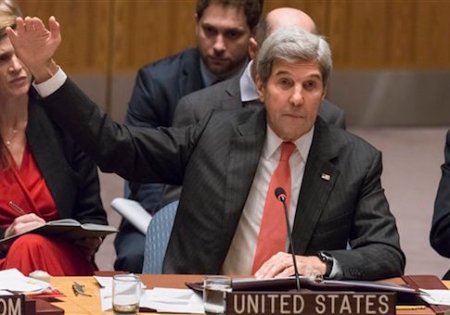
US Secretary of State John Kerry addresses the United Nations Security Council during an open, high-level debate regarding the ongoing Syrian crisis, at UN Headquarters in New York, NY, USA on September 21, 2016. The meeting, presided over by New Zealand's Prime Minister John Key, comes amid growing hostility between the United States and Russia over allegations of military operations conducted in the region. (Photo by Albin Lohr-Jones) *** Please Use Credit from Credit Field ***

US Secretary of State John Kerry addresses the United Nations Security Council during an open, high-level debate regarding the ongoing Syrian crisis, at UN Headquarters in New York, NY, USA on September 21, 2016. (Credit Field)

The Obama administration is pushing a pathway to ensure it can continue sending Iran cash payments amid mounting accusations it laundered some $1.7 billion to the Islamic Republic as part of a “ransom payment” to free U.S. hostages earlier this year, according to statements by the White House and sources familiar with the matter.

The White House late Wednesday promised to veto new legislation—first disclosed by theWashington Free Beacon—that would bar the administration from making “future ransom payments to Iran,” prompting outrage from key members of Congress who have been investigating how U.S. officials delivered nearly $2 billion in cash to Iranian officials.

The administration’s veto threat comes as top lawmakers on a range of investigatory committees launch efforts to uncover details about the cash exchange still being hidden by the Obama administration.

Congressional sources who spoke to the Free Beacon raised questions as to why the Obama administration would threaten to veto the bill, given its insistence that the cash payments to Iran were not part of a ransom.

“President Obama’s veto threat on our ransom legislation puts the lives of U.S. citizens around the world at risk,” Rep. Mike Pompeo (R., Kan.), a member of the House Intelligence Committee who helped spearhead the ransom legislation, told the Free Beacon.

“Instead of admitting wrongdoing, this administration is sticking to talking points. But selective noun use cannot explain away criminality, nor does it excuse eight months of lying to the American people,” Pompeo said. “It is unprecedented and reckless for the U.S. to be doling out billions to the Islamic Republic of Iran—under wraps and in cash—which is why our bill is necessary.”

Sen. Marco Rubio (R., Fla.), a lead sponsor of the legislation to ban future payments to Iran, told theFree Beacon that he would continue to push the legislation, despite threats by the administration.

“This effort by the President to defend his ransom payments to Iran at all costs amounts to doubling down on ‎a policy that has made Americans less safe,” Rubio told the Free Beacon. “Democrats may be swayed by this threat, but I will continue to fight to prevent the U.S. government from sending taxpayer dollars to the world’s foremost state sponsor of terrorism.”

Sen. Mark Kirk (R., Ill.) told the Free Beacon Wednesday evening that the Obama administration is betraying U.S. victims of Iranian terrorism, who are owed billions under federal court rulings.

“Under U.S. court judgments, Iran owes $55.6 billion to American victims of Iranian terrorism,” Kirk told the Free Beacon. “The Administration should stop finding ways to send more cash to Iran, and start working to bring a measure of justice to American families whose loved ones were killed or injured due to Iran-backed terrorists.”

One source familiar with the matter said Iran prefers cash because it can more easily be used to fund terrorism.

“There is no credible reason for the administration to oppose this bill. We already know, contrary to what the president initially said, that the administration can in fact wire money to Iran,” the source said. “So why do we need the option to pay in cash? Simple. This money can fund terrorism, and there’s nothing we can do to know of stop it.”

The Obama administration maintains the legislation is “ill-advised” and would “undermine U.S. obligations” to Iran.

The bill is “an ill-advised attempt to respond to a problem—so-called ‘ransom’ payments to Iran—that does not exist, in a way that would undermine U.S. obligations and ultimately benefit Iran at the expense of the United States,” the White House said in a statement.

The administration said it plans to award Iran further payments, which would not be possible under the ransom legislation.

“This bill, while styled as prohibiting future purported ‘ransom payments,’ instead bars virtually any payment from the U.S. government to Iran, including those permitted or even required by law,” the administration said.

The $1.7 billion cash payment was given to Iran as part of an effort to resolve decades-old legal disputes, many of which are still outstanding. The administration said further payments could be made to Iran in order to settle these disputes.

“Specifically, this bill would effectively prevent the United States from paying out awards rendered by the Tribunal and, thus, risk putting the United States in violation of our obligations under the Algiers Accords—an agreement concluded by President Carter, endorsed by President Reagan and honored by every President since that time,” according to the White House.

Questions remain about why the administration chose to pay Iran in cash installments routed through the New York Federal Reserve and several European banks.

Lawmakers such as Pompeo and Sen. Ted Cruz (R., Texas) have described the administration’s process as tantamount to a money laundering scheme.

UPDATE 8:40 P.M.: This piece was updated to include comments from Sens. Marco Rubio (R., Fla.) and Mark Kirk (R., Ill.).

 Iran Threatens to Turn Tel Aviv, Haifa to ‘Dust’

September 22, 2016

Iran is again threatening Israel, saying it will “turn Tel Aviv and Haifa to dust” pending mistakes by the “Zionist regime.”

By: Hana Levi Julian

Published: September 21st, 2016

Source: The Jewish Press » » Iran Threatens to Turn Tel Aviv, Haifa to ‘Dust’

Missile Strike’ — a new anti-Israel game launched by Iran.
Photo Credit: FNA

Tehran is back to threatening Israel, this time during a parade marking the anniversary of the 1980 Iraqi invasion of Iran, a war that lasted eight years.

A wide variety of military hardware was on display Wednesday during the parade, which made its way down the main drag in the nation’s capital. Included was the Qadr H missile, which allegedly has a range of 2,000 kilometers.

Long-range ballistic missiles, tanks and the Russian-produced S-300 surface-to-air missile defense system were all in full view as the gala parade was broadcast on state television.

One military truck displayed a banner shown prominently on the broadcast that read:

“If the leaders of the Zionist regime make a mistake, then the Islamic Republic will turn Tel Aviv and Haifa to dust.”

The Iranian Navy showed off 500 vessels, along with submarines and helicopters, at the port of Bandar Abbas on the Persian Gulf.

Iran has tested American mettle more than 30 times so far this year with close encounters in the Gulf between its vessels and those of the United States Navy, according to U.S. officials quoted by Reuters.