Posted tagged ‘Iran nuke inspections’

Iran’s and Obama’s co-dependent mushroom clouds

August 15, 2015

Iran’s and Obama’s co-dependent mushroom clouds, Dan Miller’s Blog, August 15, 2015

(The views expressed in this article are mine and do not necessarily reflect those of Warsclerotic or its other editors. — DM)

Courtesy of Obama, Iran’s mushroom clouds will be produced by detonating atomic bombs. Obama’s mushroom clouds, with help from His friends, have already been and continue to be detonated. They thrive in the absence of light and contain copious quantities of bovine fecal matter.

This limerick, if applied to Obama, makes sense:

Last night I saw upon the stair
A little man who wasn’t there.
He wasn’t there again today.
Oh how I wish he’d go away!

I. Obama gave Iran its mushroom cloud

Several conservative media recently focused on Obama’s claim, made in His August 5, 2015 address praising His “deal,” that Iran had agreed to negotiate only after President Rouhani replaced Mahmoud Ahmadinejad on August 3, 2013:

it was diplomacy, hard, painstaking diplomacy, not saber rattling, not tough talk, that ratcheted up the pressure on Iran. With the world now unified beside us, Iran’s economy contracted severely, and remains about 20 percent smaller today than it would have otherwise been. No doubt this hardship played a role in Iran’s 2013 elections, when the Iranian people elected a new government, that promised to improve the economy through engagement to the world. [Emphasis added.]

A window had cracked open. Iran came back to the nuclear talks.

Obama did not mention that Rouhani could neither have run for office nor been elected without the backing of Iran’s Supreme Leader Khamenei. As far as I have been able to determine, neither Obama nor Kerry has said anything denying, acknowledging or explaining Senator Kerry’s “negotiations” with Iran which, as I noted here on August 13th, had begun in 2011, long before Ahmadinejad left office in 2013.

During those early “negotiations,” Kerry had already conceded Iran’s right to enrich Uranium, that the nuclear dossier would be closed and that the Possible Military Dimensions (“PMDs”) of Iran’s nuclear program would be ignored resolved.

Although Obama has claimed otherwise, the timing of P5+1 negotiations vis a vis  Rouhani’s arrival in office makes little sense. Rouhani sought and got — courtesy of Kerry’s earlier concessions — at least as many concessions from the Obama-led P5+1 farce as Ahmadinejad could have got. Perhaps he got more, due to erroneous perceptions that Rouhani was a moderate and that Iran had changed course for the better. Such perceived changes also led to hopes that Iran would become a helpful U.S. Middle East ally.

Here’s an excerpt from a Front Page Magazine about Obama’s claim:

In 2013, Hassan Rouhani was, for lack of a better word, “elected” president of Iran replacing the noxious Mahmoud Ahmadinejad. Rouhani, a grandfatherly-like figure with an affable smile, appeared to be, at least outwardly, more moderate than his predecessor, but in reality expressed the same rancid, xenophobic views. He was quoted as saying that “the beautiful cry of ‘Death to America’ unites our nation,” and referred to Israel as a “wound,” “a festering tumor” and the “great Zionist Satan,” among numerous other reprehensible pejoratives.

Israel’s Prime Minister Benjamin Netanyahu, in an address to the United Nations, dryly noted that while Ahmadinejad was a wolf in wolf’s clothing, Rouhani was a wolf in sheep’s clothing, but both were wolves nonetheless. What’s more, real power in Iran vests not with the nation’s president, but with its Supreme Leader, Ali Hosseini Khamenei, a pernicious man who seems incapable of addressing crowds without inserting at least one “death to America” reference somewhere in the speech. Indeed, just four days after signing the Joint Comprehensive Plan of Action (JCPOA) he addressed a large crowd and repeated the tired banalities of “death to America” and “death to Israel.” Khamenei is also solely responsible for vetting and approving presidential candidates which means that he found Rouhani to be an acceptable contender and that speaks volumes about what kind of character Rouhani is. [Emphasis added.]

. . . .

Despite the given realities about the Islamic Republic and its malevolent nature, Obama attempted to sell the American public on the nonsensical notion that the election of Rouhani ushered in a new period of Iranian enlightenment and moderation and afforded the U.S. an opportunity for meaningful engagement with the mullahs on their nuclear program. On that premise, he led the American public to believe that it was only after the election of the “moderate” Rouhani that the U.S. chose to engage Iran. [Emphasis added.]

What really rankles, as noted in my August 13th article, is that in 2011 Kerry, representing Obama, led the way for Iran to get what it wanted.

Kerry had representatives of The Sultanate of Oman deliver a letter he had written to Iranian officials recognizing Iran’s Uranium enrichment rights and suggesting secret negotiations. Omani officials discussed the letter with Iranian officials and, when the Iranians appeared skeptical, the Omani official suggested,

Go tell them that these are our demands. Deliver [the note] during your next visit to Oman.’ On a piece of paper I wrote down four clearly-stated points, one of which was [the demand for] official recognition of the right to enrich uranium. I thought that, if the Americans were sincere in their proposal, they had to accept these four demands of ours. Mr. Souri delivered this short letter to the mediator, stressing that this was the list of Iran’s demands, [and that], if the Americans wanted to resolve the issue, they were welcome to do so [on our terms], otherwise addressing the White House proposals to Iran would be pointless and unjustified. [Emphasis added.]

“All the demands presented in this letter were related to the nuclear challenge. [They were] issues we had always come up against, like the closing of the nuclear dossier, official recognition of [the right to] enrichment, and resolving the issue of Iran’s past activities under the PMD [possible military dimensions] heading. After receiving the letter, the Americans said, ‘We are definitely and sincerely willing, and we can resolve the issues that Iran mentioned.’” [Emphasis added.]

The Possible Military Dimensions of Iran’s nuke program are no longer of interest to the Obama administration, if they ever were. On June 16, 2015, the New York Times reported that Kerry said

a full accounting of Iran’s possible past atomic weapons research is not necessarily critical to reaching a nuclear deal with Tehran. His comments came amid concerns the Obama administration is backing down on demands that Iran resolve concerns about previous work as part of an agreement that would curb its nuclear program in exchange for sanctions relief. [Emphasis added.]

. . . .

We know what they did,” Kerry said. “We have no doubt. We have absolute knowledge with respect to certain military activities they were engaged in. What we’re concerned about is going forward. It’s critical to us to know that going forward, those activities have been stopped and that we can account for that in a legitimate way.” [Emphasis added.]

Without knowing what Iran had been doing where, there is no viable way to know what it continues to do. Reliable information of that nature will not be available. Under the apparent terms of its secret deals with Iran, Iranians, not members of the IAEA, will inspect and take samples at military sites used by Iran for nuke weaponization. “Details” of the inspections will not be disclosed.

Kerry also claims to know “exactly” what the secret IAEA – Iran deals say, even though he has neither read nor seen them. In the video provided below, Kerry acknowledges just that beginning at about 10:00.

What aspect(s) of Iran’s nuke weaponization does Kerry have “absolute knowledge” about and how did he get it? The IAEA appears to have accumulated far less information than Kerry claimed to have on June 16th concerning Iran’s nuke militarization. Continuing to quote from the New York Times article linked above,

Much of Iran’s alleged work on warheads, delivery systems and detonators predates 2003, when Iran’s nuclear activity first came to light. But Western intelligence agencies say they don’t know the extent of Iran’s activities or if Iran persisted in covert efforts. An International Atomic Energy Agency investigation has been foiled for more than a decade by Iranian refusals to allow monitors to visit suspicious sites or interview individuals allegedly involved in secret weapons development. [Emphasis added.]

The November 14, 2013 Joint Plan of Action recognized Iran’s right to enrich Uranium for “peaceful purposes” — the reason asserted by Iran for enrichment. Iran’s need to enrich Uranium was mainly premised on its need to generate electricity. However earlier this month, Iran’s Deputy Foreign Minister and senior nuclear negotiator called Iran’s nukes for electricity program “a big loss” economically but necessary to defend the country’s honor.

In a leaked off-the-record meeting with journalists Saturday, Abbas Araqchi stressed that “if we want to calculate the expenses of the production materials, we cannot even think about it.” But, he said, “we paid this price so we protect our honor, independence and progress, and do not surrender to others’ bullying.”

Yet, he explained, “If we value our nuclear program based only on the economic calculations, it is a big loss.” [Emphasis added.]

. . . .

Due to the pressure from above, . . .  the original report was removed by the national broadcasting service, which stated that the publication of Araqchi’s statements was a “misunderstanding.”

Please see also, The Iranian Nuke Deal Depends on This One Myth.

The November 13, 2013 Joint Plan of Action left open only where, how and how much Uranium Iran could enrich. It substantially ignored the nuclear dossier (i.e., nuke weaponization), Iran’s principal but denied reason for enrichment. It should, therefore, have come as no surprise that the 2015 “deal,” in conjunction with the secret deals between Iran and the International Atomic Energy Agency (IAEA), did the same, eliminating any chance that the IAEA might learn what Iran had been doing and whether it continues to do it.

II. Related matters

According to March 31, 2015 article at National Public Radio,

Even before he became president, Barack Obama was imagining the possibilities of a diplomatic breakthrough with Iran. His willingness to reverse decades of official U.S. hostility was one of the things that set Obama apart on the campaign trail.

. . . .

Limited though it may be, the administration’s negotiation with Iran has shaken traditional allies such as Israel and Saudi Arabia. Meanwhile, through its action and inaction elsewhere in the Middle East, the U.S. has left both friends and enemies uncertain about what it will do next.

. . . .

The White House insists a nuclear deal with Iran would defuse the biggest threat to the region.

The Wilson Center’s Miller agreed a negotiated deal that stops or even stalls Iran’s nuclear program is preferable to the likely alternative of military action. But he dismisses as wishful thinking any expectation that Iran’s diplomatic rehabilitation will produce a new, more stable Middle East.

On August 15th, Iran’s Tasnim News Agency published an article stating that

Iran’s Secretary-General of World Assembly of Islamic Awakening Ali Akbar Velayati praised the recent conclusion of nuclear talks between Iran and six world powers, saying that with the deal, Tehran has more strength to support its friends in the Middle East region. [Emphasis added.]

. . . .

Velayati, who is also the head of the Strategic Research Center of Iran’s Expediency Council, stressed the need for the consolidation of the anti-Israeli Resistance Front in the region. [Emphasis added.]

This is the Iranian mushroom cloud provided by Obama and Kerry:

Mushroom cloud

III. Obama’s own mushroom cloud

Here is a photo of Obama’s mushroom cloud with one of His supporters standing contentedly in front of it:

cow manure

Obama’s mushroom cloud, made of bovine fecal matter which Obama et al have asked us to swallow, has grown like Topsy. It’s full of many more lies than merely that He waited until Rouhani became Iran’s president to being nuke negotiations. His other lies, and those of His friends, are even less digestible. Here are just a few from Washington Free Beacon Supercuts to serve as aperitifs.


IV. Conclusions

games

The mushroom cloud detonated by Obama and Friends (“OAFs”) likely means that the “deal” with Iran will soon go into full effect. It will enable Iran to present us with its own nuclear mushroom cloud. It will also be of substantial assistance in furthering Iran’s hegemonic efforts to destabilize the Middle East.

Some mushrooms are good to eat. Obama’s cloud is full of toxic mushrooms. Perhaps they have made Obama, Iran and His other friends drunk with power; they are deadly for the rest of us.

Recent Iranian disclosures highlight the perversity of the Iran “deal”

August 13, 2015

Recent Iranian disclosures highlight the perversity of the Iran “deal,” Dan Miller’s Blog, August 13, 2015

(The views expressed in this article are mine and do not necessarily reflect those of Warsclerotic or its other editors. — DM)

In 2011, well before the multilateral P5+1 “negotiations” with Iran began in February of 2013, Obama put Senator John Kerry in charge of  “secret bilateral negotiations on the [Iranian] nuclear dossier.” Kerry then advised Iranian officials that “we are definitely and sincerely willing, and we can resolve the issues” — including Uranium enrichment and the Possible Military Dimensions (PMDs) of Iran’s nuclear program. Iran’s nuclear weaponization and missile development programs have been substantially ignored ever since.

Ernest Moniz, who was to become Kerry’s technical adviser, was brought into the P5+1 negotiations at the specific request of the Iranian official — Moniz’ former MIT classmate — who was to be his counterpart. 

The Iran – North Korea nuclear axis, through which the rogue nations cooperate on nuke and missile development, continues to be ignored.

In earlier articles, beginning shortly after the Joint Plan of Action was published in November of 2013, I attempted to show that the focus was on pretending to curtail Iran’s Uranium enrichment programs as they expanded and then granting sanctions relief, while substantially ignoring the program’s “possible military dimensions” (PMDs). Followup articles are here, here and elsewhere. The PMDs have yet to be explored seriously and evidently will not be under the current “comprehensive” joint plan and the secret side deals between the International Atomic Energy Agency (IAEA) and Iran.

Any pretense that the IAEA will have “any time, anywhere” access to Iran’s military sites was mere rhetoric, as acknowledged by US Under Secretary of State Wendy Sherman on July 16th

“I think this is one of those circumstances where we have all been rhetorical from time to time,” Sherman said in a conference call with Israeli diplomatic reporters. “That phrase, anytime, anywhere, is something that became popular rhetoric, but I think people understood that if the IAEA felt it had to have access, and had a justification for that access, that it would be guaranteed, and that is what happened.” [Emphasis added.]

Ms. Sherman was right about the rhetorical nature of administration assertions, but wrong about IAEA access, of which there will apparently be little or none pursuant to the secret deals between Iran and the IAEA.

I. Here’s some background on Kerry

Reporting for duty

Reporting for duty with Iran

During his 2004 campaign for president, Kerry said if he were the president he would

have “offered the opportunity to provide the nuclear fuel” to Iran, to “test them, see whether or not they were actually looking for it for peaceful purposes.” Mr. Kerry’s words brought comfort to Tehran’s top mullahs, who have been seeking to buy time from the international community for the past two years while they continue perfecting their nuclear weapons capabilities. [Emphasis added.]

. . . .

Top among the pro-regime fund-raisers who have contributed to the Kerry campaign is a recent Iranian immigrant in California named Susan Akbarpour.

. . . .

The Kerry campaign credits Miss Akbarpour and her new husband, Faraj Aalaie, with each raising $50,000 to $100,000 for the presidential campaign. Mr. Aalaie is president of Centillium Communications, a Nasdaq-listed software firm.

These contributions continue . . . even though Miss Akbarpour was not a permanent U.S. resident when she made her initial contribution to Mr. Kerry on June 17, 2002, as this reporter first revealed in March. (To be legal, campaign cash must come from U.S. citizens or permanent residents).

On August 10th of this year, the Middle East Media Research Institute (MEMRI) published a lengthy article quoting Iranian officials on their dealings with Senator Kerry. Obama had put Senator John Kerry in charge of “secret bilateral negotiations on the [Iranian] nuclear dossier” well before the multilateral P5+1 “negotiations” with Iran began in February of 2013.

The MEMRI article states that Kerry had representatives of The Sultanate of Oman deliver a letter he had written to Iranian officials recognizing Iran’s Uranium enrichment rights and suggesting secret negotiations. Omani officials discussed the letter with Iranian officials and, when the Iranians appeared skeptical, the Omani official suggested,

Go tell them that these are our demands. Deliver [the note] during your next visit to Oman.’ On a piece of paper I wrote down four clearly-stated points, one of which was [the demand for] official recognition of the right to enrich uranium. I thought that, if the Americans were sincere in their proposal, they had to accept these four demands of ours. Mr. Souri delivered this short letter to the mediator, stressing that this was the list of Iran’s demands, [and that], if the Americans wanted to resolve the issue, they were welcome to do so [on our terms], otherwise addressing the White House proposals to Iran would be pointless and unjustified. [Emphasis added.]

“All the demands presented in this letter were related to the nuclear challenge. [They were] issues we had always come up against, like the closing of the nuclear dossier, official recognition of [the right to] enrichment, and resolving the issue of Iran’s past activities under the PMD [possible military dimensions] heading. After receiving the letter, the Americans said, ‘We are definitely and sincerely willing, and we can resolve the issues that Iran mentioned.’” [Emphasis added.]

The texts of the November, 2013 Joint Plan of Action, as well as the July 14, 2015 “deal,” could easily have been predicted based on Kerry’s 2011 response to the Iranians.

“After Rohani’s government began working [in August 2013] – this was during Obama’s second term in office – a new [round of] negotiations between Iran and the P5+1 was launched. By this time, Kerry was no longer a senator but had been appointed secretary of state. [But even] before this, when he was still senator, he had already been appointed by Obama to handle the nuclear dossier [vis-à-vis Iran] and later [in December 2012] he was appointed secretary of state. Before this, the Omani mediator, who was in close touch with Kerry, told us that Kerry would soon be appointed secretary of state. In the period of the secret negotiations with the Americans in Oman, there was a more convenient atmosphere for obtaining concessions from the Americans.  After the advent of the Rohani government and the American administration [i.e., after the start of Obama’s second term in office], and with Kerry as secretary of state, the Americans expressed a more forceful position. They no longer displayed the same eagerness to advance the negotiations. Their position became more rigid and the threshold of their demands higher. But the situation on the Iranian side changed too, since a very professional team was placed in charge of the negotiations with the P5+1…”

Perhaps Kerry had found it more congenial, and certainly more consistent with his and Obama’s own intentions, to be eager to help Iran during secret negotiations and to appear modestly resistant during the P5+1 sessions; they were at least slightly more in public view. Even so, according to Amir Hossein Motagh, a former aide to President Rouhani,

The US negotiating team are mainly [in Lausanne] to speak on Iran’s behalf with other members of the 5+1 countries and convince them of a deal. [Emphasis added.]

. . . .

French Foreign Minister Laurent Fabius, for example, has long been insisting that Iran come clean on its previous military activities, something we are now told that the American delegation, led by Secretary Kerry, wants to leave out of the negotiation. Why? Because the Iranians have said they will not come clean. [Emphasis added.]

That was too much even for the normally pro-Democrat Washington Post, which wrote in a column attributed to its Editorial Board last Friday that the deal was “a reward for Iran’s noncompliance.”

According to the article linked above,

Some Iranian-Americans believe that Secretary Kerry should have recused himself from the negotiations at the very outset because of his long-standing relationship to his Iranian counter-part, Mohammad Javad Zarif.

The two first met over a decade ago at a dinner party hosted by George Soros at his Manhattan penthouse, according to a 2012 book by Hooman Majd, who frequently translates for Iranian officials.

Iranian-American sources in Los Angeles tell me that Javad Zarif’s son was the best man at the 2009 wedding between Kerry’s daughter Vanessa and Behrouz Vala Nahed, an Iranian-American medical doctor.

The newlyweds went to Iran shortly after their wedding to met Nahed’s family. Kerry ultimately revealed his daughter’s marriage to an Iranian-American once he had taken over as Secretary of State. But the subject never came up in his Senate confirmation hearing, either because Kerry never disclosed it, or because his former colleagues were too polite to bring it up.

Why did Obama designate Kerry to deal with Iran in 2011? Andrew C. McCarthy, writing at The Center for Security Policy, offers this:

Clearly, there are two reasons: Obama needed someone outside the administration, and Kerry’s status and track record made him a natural.

Remember, Obama was running for reelection in 2011–12. Public opposition to Iran’s acquisition of nuclear weapons and, therefore, to Iran’s enrichment of uranium was very strong — and, indeed, remains so. Consequently, Obama pretended on the campaign trail that he would vigorously oppose Iran’s uranium-enrichment efforts . . . even as he was covertly signaling to the jihadist regime that he was open to recognizing Iran as a nuclear power. [Emphasis added.]

As my friend Fred Fleitz of the Center for Security Policy has noted, Obama asserted in the lead-up to the 2008 election that “the world must work to stop Iran’s uranium-enrichment program.” So too, in the run-up to the 2012 election, did Obama continue assuring voters that Iran “needs to give up its nuclear program and abide by the U.N. resolutions that have been in place.” Those U.N. resolutions prohibit Iran’s enrichment activities. Thus did the president proclaim, in seeking reelection, that the only deal he would accept would be one in which the Iranians “end their nuclear program. It’s very straightforward.” [Emphasis added.]

With Obama out feigning opposition to Iran’s enrichment activities, it would not do to have a conflicting message communicated to Iran by his own administration. What if Iran, to embarrass Obama, were to go public about an administration entreaty that directly addressed enrichment? It would have been hugely problematic for the president’s campaign. Obama thus needed an alternative: someone outside the administration whom Obama could trust but disavow if anything went wrong; someone the Iranian regime would regard as authoritative. [Emphasis added.]

John Kerry was the perfect choice.

I agree, but Mr. McCarthy does not address this exchange, quoted above but worth repeating here:

“All the demands presented in this letter were related to the nuclear challenge. [They were] issues we had always come up against, like the closing of the nuclear dossier, official recognition of [the right to] enrichment, and resolving the issue of Iran’s past activities under the PMD [possible military dimensions] heading. After receiving the letter, the Americans said, ‘We are definitely and sincerely willing, and we can resolve the issues that Iran mentioned.’” [Emphasis added.]

II. Ernest Moniz

Moniz, the U.S. Energy Secretary, was asked to join the P5+1 technical discussions at the request of Ali Akbar Salehi, head of Iran’s Atomic Energy Organization.

Salehi said that he was asked to join the nuclear talks when the discussions on the Natanz enrichment facility reached a dead end. Salehi said he would only join the talks if Moniz, his American counterpart, did as well. According to Salehi, this was approved by Undersecretary Wendy Sherman and Deputy Foreign Minister Abbas Araghchi, which he described as “the communications link between America and Iran.” [Emphasis added.]

Salehi said he and Moniz did not know each other well when they were at MIT, but when they first met during the talks, “there was a feeling that he has known me for years.” Salehi added, “A number of my classmates are now Mr. Moniz’s experts.”  [Emphasis added.]

According to Salehi, Moniz entering the talks was important because Salehi expressed that he had been sent with “full authority” to sign off on all technical issues in the nuclear negotiations and Moniz had told him that he had the same authority. He added, “If the negotiations did not take place with the Americans, the reality is that it would not have reached a conclusion. No [other] country was ready to sit with us and negotiate for 16 days with their foreign minister and all of its experts.”

Salehi said that one of the more difficult times negotiating with Moniz was after they reached an agreement on a particular issue. Moniz would take it to the other members of P5+1, who would then make their own requests.

Moniz was likely as forthcoming with the non-US members of P5+1 as he was with members of the U.S. Congress; not at all.

North Korea and Iran, partners in crime

This is a drum I have been beating for years. Recent articles are available here and here. The Obama Administration persists in covering up what it knows on the subject and the current “deal” with Iran is silent on the matter. So, of course, was the November 2013 Joint Plan of Action.

Forbes published an article by Claudia Rosett today (August 13th) on the subject and, beyond noting that Douglas Frantz is Kerry’s Assistant Secretary in charge of the Bureau of Public Affairs, she observes that in his former capacity as a journalist for the Washington Post and New York Times, he wrote about the nature and perils of the axis.

Frantz’ duties under Kerry include

engaging “domestic and international media to communicate timely and accurate information with the goal of furthering U.S. foreign policy and national security interests as well as broadening understanding of American values.”

But it appears that as a State Department advocate of a free and well-informed press, Frantz himself is not free to answer questions from the press about his own reporting on North Korea’s help to Iran in designing a nuclear warhead. The State Department has refused my repeated requests to interview Frantz on this subject. Last year, an official at State’s Bureau of Public Affairs responded to my request with an email saying, “Unfortunately Assistant Secretary Frantz is not available to discuss issues related to Iran’s nuclear program.” This June I asked again, and received the emailed reply: “This is indeed an important topic for Doug, but he feels that speaking about his past work would no longer be appropriate, since he is no longer a journalist.”

The real issue, of course, is not the career timeline of Douglas Frantz, but the likelihood, past and future, of nuclear collaboration between Iran and North Korea. Frantz may no longer be a journalist, but it’s hard to see why that should constrain him, or his boss, Secretary Kerry, from speaking publicly about important details of Iran’s illicit nuclear endeavors — information which Frantz in his incarnation as a star journalist judged credible enough to publish in a major newspaper.

. . . .

President Obama has been telling Congress and the American public that the Iran nuclear deal — the Joint Comprehensive Plan of Action — “cuts off all Iran’s pathways to the bomb.” That’s not true. One of the most dangerous aspects of this deal is that it does not sever the longtime alliance between Tehran and Pyongyang. If there has indeed been cooperation between these two regimes on nuclear weapons, it’s time not only for Iran to come clean, but for the Obama administration to stop covering up. [Emphasis added.]

Although that’s not the only dangerous aspect which the Obama Administration has covered up and lied about cutting off “all [of] Iran’s pathways to the bomb” it is an important one. Meanwhile, it has been reported that

Fresh satellite images suggest North Korea is expanding its uranium extraction capacity, possibly with a view to increasing its stockpile of nuclear weapons.

The images taken in Pyongyang show Kim Jong-un has begun to refurbish a major mill that turns uranium ore into yellowcake – a first step towards producing enriched uranium.

A recent report by U.S. researchers warned that Kim was poised to expand his nuclear programme over the next five years and, in a worst-case scenario, could possess 100 atomic weapons by 2020. 

Conclusions

“Negotiations” involving hostile foreign nations such as Iran are easier when led by friendly “negotiators” with compatible interests. At least since his failed 2004 campaign for the presidency, Kerry has been on Iran’s side and has favored it over the United States. While pretending for political purposes to be against Iran’s nuclear program, Obama was and remains in favor of it, pretenses to the contrary notwithstanding.

Obama, Kerry and Moniz got the deal they wanted. They, along with their P5+1 partners, richly deserve their resultant legacy of empowering Iran as an anti-American, anti-Israel, anti-Western civilization, Islamist hegemonic nuclear power with a disgraceful human rights record comparable to that of its partner, North Korea.

The Iran – North Korea nuclear axis has helped both rogue nations to develop and create nuclear bombs and the means to deliver them, with very little in the way of “adult supervision.” The failure to deal with even tangentially, or even to mention, the axis will likely become a significant part of Obama’s legacy. Ours as well.

Bringing Obama’s vision of stability to the Middle East, Allah willing.

This video is from August 2010. Now it may well be too late to stop Iran.

Some deal: Iran will soon be able to kill 90 percent of our population

August 13, 2015

Some deal: Iran will soon be able to kill 90 percent of our population, Newsday, Lawrence J. Hass, August 13, 2015

Iran has tested how to conduct an EMP attack, such as by attaching a nuclear weapon to an orbiting satellite or launching a nuclear-armed missile into the atmosphere from a ship.

Iranian military leaders have endorsed an EMP attack against America, according to secret Iranian military documents that Pentagon officials have translated, and the Pentagon’s North American Aerospace Defense Command is moving back into Cheyenne Mountain in Colorado because it can resist an EMP attack.

Those who, in light of this deal and Iran’s missile and EMP work, nevertheless dismiss the “Death to America” threats from Iran as just political rhetoric might heed the words of former Israeli Foreign Minister Abba Eban: “It is our experience that political leaders do not always mean the opposite of what they say.”

********************

Just four days after U.S.-led global powers and Iran completed their nuclear deal, Ayatollah Ali Khamenei, Iran’s supreme leader, reaffirmed the “Death to America” mantra that has pervaded his regime since its establishment in 1979, stating, “The entire country is under the umbrella of this great movement.” Iran has killed hundreds of Americans in the Middle East, both directly and through its terrorist proxies. It has threatened U.S. regional interests by funding anti-Israeli terrorists, propping up Syria’s terror-backing Bashar al-Assad and de-stabilizing U.S.-backed governments.

Moving forward, this deal will enable Tehran to threaten U.S. security more directly in at least two ways: First, Iran could deploy a nuclear warhead on one of its ballistic missiles and fire it at the United States. Iran is building increasingly sophisticated ballistic missiles, with its Shahab-3 able to reach Israel, and the Sejjil that it’s developing capable of reaching Italy and Poland.

Tehran also announced plans to build missile silos in what experts consider a precursor to deploying longer range missiles.

Second, Iran could detonate a nuclear device over the United States in an electromagnetic pulse attack that destroys our electric grid, putting the nation in the dark for months and eventually leaving 90 percent of Americans dead from disease or starvation.

Iran has tested how to conduct an EMP attack, such as by attaching a nuclear weapon to an orbiting satellite or launching a nuclear-armed missile into the atmosphere from a ship.

Iranian military leaders have endorsed an EMP attack against America, according to secret Iranian military documents that Pentagon officials have translated, and the Pentagon’s North American Aerospace Defense Command is moving back into Cheyenne Mountain in Colorado because it can resist an EMP attack.

That Iran can develop nuclear weapons under the deal, making these two scenarios plausible, is clear; the only question is when.

For starters, the deal is time-limited and, as restrictions end in 10-15 years, Iran can pursue two paths to a bomb – enriching uranium to weapons-grade levels or building plutonium-producing reactors, or both.
But Tehran need not wait that long because international inspectors will be hard-pressed to confirm that Iran is abiding by the deal’s restrictions on how much uranium it’s enriching, how many centrifuges it’s operating, and what it may be doing at secret sites that the world has not yet discovered.

That’s because rather than “anywhere, anytime” inspections, Iran will have 24 days to comply with requests from the International Atomic Energy Agency to visit a suspected undeclared site, during which Iran can move, hide, or destroy evidence of its nuclear progress.

If Iran refuses to allow a site visit after 24 days, global leaders likely would begin further negotiations with Iran that would give the latter weeks more to clean up a site.

But Tehran need not wait that long because international inspectors will be hard-pressed to confirm that Iran is abiding by the deal’s restrictions on how much uranium it’s enriching, how many centrifuges it’s operating, and what it may be doing at secret sites that the world has not yet discovered.

That’s because rather than “anywhere, anytime” inspections, Iran will have 24 days to comply with requests from the International Atomic Energy Agency to visit a suspected undeclared site, during which Iran can move, hide, or destroy evidence of its nuclear progress.

If Iran refuses to allow a site visit after 24 days, global leaders likely would begin further negotiations with Iran that would give the latter weeks more to clean up a site.

Nor, under this deal, must Tehran reveal the military-related dimensions of its nuclear work to date, leaving the world dangerously ignorant of how close it already is to developing and deploying a nuclear weapon and also leaving inspectors without a baseline against which to judge Iranian compliance in the future.

Moreover, the $100 billion to $150 billion in sanctions relief will give Iran a huge windfall to develop a more robust infrastructure for nuclear weapons production – either quickly by evading the weak inspections regime or more patiently by waiting about a decade until the world frees Iran of all restrictions.

Those who, in light of this deal and Iran’s missile and EMP work, nevertheless dismiss the “Death to America” threats from Iran as just political rhetoric might heed the words of former Israeli Foreign Minister Abba Eban: “It is our experience that political leaders do not always mean the opposite of what they say.”

What Iran’s hostile reaction to the Parchin issue means for the nuclear deal

August 11, 2015

What Iran’s hostile reaction to the Parchin issue means for the nuclear deal, Washington Post, David Albright, August 10, 2015

The United States and Congress should clearly and publicly confirm, and Congress should support with legislation, that if Iran does not address the IAEA’s concerns about the past military dimensions of its nuclear programs, U.S. sanctions will not be lifted. To do otherwise is to make a mockery of the nuclear deal.

********************

Chico Marx said: “Who you gonna believe? Me or your own eyes?” Iran’s Foreign Minister Mohammad Javad Zarif said over the weekend that my organization, the Institute for Science and International Security, was spreading lies when we published satellite imagery that showed renewed, concerning activity at the Parchin military site near Tehran. This site is linked by Western intelligence and the International Atomic Energy Agency (IAEA) to past work on nuclear weapons. But like Chico, instead of acknowledging the concern, the Iranians chose to deny the visible evidence in commercial satellite imagery. Iran’s comments would be mirthful if the topic were not so serious.

Zarif is also calling U.S. intelligence officials and members of Congress liars. They are the original source of the information both about renewed activity at Parchin and concerns about that activity. All we did was publish satellite imagery showing this activity and restate the obvious concern.

Moreover, this information about renewed activity at Parchin does not come from opponents of the Joint Comprehensive Plan of Action negotiated between the United States, five other world powers and Iran, as Zarif suggested. We are neutral on whether the agreement should be implemented and have made that position clear for weeks. The U.S. intelligence community is hardly opposed to the deal. Iran’s attempts to dismiss this concern as the work of the deal’s foes also is just wrong.

Concern about Parchin has become more urgent now that there is a debate raging over whether the IAEA will have adequate access to this site under the terms of its deal with Iran. It would be irresponsible not to worry about reports that suggest that Iran could be again sanitizing the site to thwart environmental sampling that could reveal past nuclear weapons activities there. This concern is further heightened because Iran has demanded to do this sampling itself instead of letting the IAEA do it. Such an arrangement is unprecedented and risky, and will be even more so if Iran continues to sanitize the site. In the cases of the Iranian Kalaye Electric site and the North Korean plutonium separation plant at Yongbyon, the success of sampling that showed undeclared activities depended on samples being taken at non-obvious locations identified during previous IAEA visits inside buildings. The IAEA will not be able to visit Parchin until after the samples are taken, and it remains doubtful that the inspectors will be able to take additional samples.

Some of this can be written off to Zarif’s volatility. At one point during the negotiations, he yelled so loudly at Secretary of State John F. Kerry that those outside the room could hear him. He obviously angers easily. But he is also one of the more reasonable Iranian government officials. I can remember in the late 1990s discussions with Iranian government and nuclear officials in New York where the Iranians vehemently stated, despite the overwhelming evidence to the contrary, that they did not have any gas centrifuge programs. I was presenting the evidence that they did, in fact, have a centrifuge program, one in fact aided by Pakistan, and at one of these meetings, Zarif quietly said to me that he had always told me that Iran had the entire fuel cycle — technical language admitting to an enrichment program. His willingness to admit the obvious gave me hope that the crisis over Iran’s program could be solved diplomatically. But on Parchin, his words appear to reflect Iranian government intransigence on its past nuclear weapons program. Its action is an assault on the integrity and prospects of the nuclear deal.

Iran’s reaction shows that it may be drawing a line at Parchin. Resolving the Parchin issue is central to the IAEA’s effort to resolve concerns about Iran’s past work on nuclear weapons by the end of the year, but Parchin is not the only site and activity involved in this crucial issue. The IAEA needs to visit other sites and interview a range of scientists and officials. Instead of allowing this needed access, Iran appears to be continuing its policy of total denial, stating that the concerns are merely Western falsifications and fantasies. The United States recently reasserted that it believes Iran had a nuclear weapons program and stated that it knows a considerable amount about it. So, if Iran sticks to its strategy, one can expect an impasse that includes Iran refusing to allow the IAEA the access it needs to sites and scientists within the coming months.

U.S. officials have stated that the Joint Comprehensive Plan of Action requires Iran to address concerns about its past work on nuclear weapons prior to the lifting of sanctions. However, Iran may argue otherwise, and one could easily conclude that its recent actions are the start of such a reinterpretation of the agreement. The United States and Congress should clearly and publicly confirm, and Congress should support with legislation, that if Iran does not address the IAEA’s concerns about the past military dimensions of its nuclear programs, U.S. sanctions will not be lifted. To do otherwise is to make a mockery of the nuclear deal.

No Trust, No Verification, No Sanctions: Obama’s Humiliating Capitulation to the Mullahs

August 8, 2015

No Trust, No Verification, No Sanctions: Obama’s Humiliating Capitulation to the Mullahs, National Review, Andrew C. McCarthy, August 8, 2015

(I have been beating this drum for quite a while. So have others. The Obama administration’s position still makes no sense whatever, unless unfortunate motives are attributed to the Commander in Chief. — DM)

The sanctions regime President Obama and Secretary of State Kerry vowed to step up has already collapsed. The mullahs are already scooping up billions in unfrozen assets and new commerce, and they haven’t even gotten the big payday yet. Obama’s promises of “anytime, anywhere” inspections have melted away as Tehran denies access and the president accepts their comical offer to provide their own nuclear-site samples for examination. Senator John Barasso (R., Wyo.), a medical doctor, drew the apt analogy: It’s like letting a suspect NFL player what he says is his own urine sample and then pronouncing him PED-free.#

And now even the Potemkin verification system has become an embarrassing sham, with Iran first refusing to allow physical investigations, then declining perusal of documentation describing past nuclear work, and now rejecting interviews of relevant witnesses.

Recall that administration officials indignantly assured skeptics that there would be no agreement in the absence of Iran’s Iran’s coming clean on the “past military dimensions” of its nuclear work. As Kerry put it, “They have to do it. It will be done. If there’s going to be a deal; it will be done.”

The reason it had to be done is obvious. According to Obama, his Iran deal is built on verification, not trust — at least when the president is not trusting Ayatollah Khamenei’s phantom anti-nuke fatwa. Plainly, it would be impossible to verify whether Iran was advancing toward the weaponization of nuclear energy — whether it had shortened the “breakout time” the elongation of which, Obama claims, is the principal objective of his deal — unless one knew how far the mullahs had advanced in the first place

But now, in open mockery of an American president they know is so desperate to close this deal he will never call their bluff, the mullahs have told the International Atomic Energy Agency to pound sand — although not sand in Iran, where the IAEA is not permitted to snoop around. Tehran is steadfastly refusing to open its books, and the IAEA sheepishly admits that it cannot answer basic questions about Iran’s programs and progress.

So what does Team Obama do? Do they, as they promised, walk away from an unverifiable and thus utterly indefensible deal that lends aid and comfort to our enemies? Of course not. Now they’re out there telling Americans, “We don’t need this IAEA program to discover whether or not Iran was pursuing a nuclear weapon — they were,” as Senator Chris Murphy, a Connecticut Obamabot, told the Wall Street Journal.

Well good for you, Sherlock; Obama, Kerry, and Hillary Clinton may still be hanging on that fatwa, but you hit the bull’s-eye.

Here’s the thing, though, Senator Murphy: Yes, all of us know the Iranians, as you cheerily put it, “were” pursuing a nuclear weapon — especially all of us who oppose Obama’s Iran deal and who recognize that the jihadist regime has waged war against us since 1979, killing thousands of Americans. But you “let’s make a deal” guys told us your objective was to uncover how far along they “were” and to roll back their progress. (Actually, you used to tell us your objective was to prevent them from getting nuclear weapons, period — as in “if you like your health-care plan, you can keep your health-care plan, period.”)

If you don’t have a baseline from which to begin verification, you can’t verify the time of day, much less the progress of nuclear research, development, procurement, and experimentation. Iran is saying we don’t get the baseline without which the Obama administration guaranteed there would be no agreement.

So in the grand deal our president describes as subjecting the mullahs to historically rigorous inspection, disclosure, and verification requirements, there is no inspection, no disclosure, and no verification.

And did I mention no sanctions?

On July 29, Kerry assured lawmakers that Iranian Quds Force commander “Qassem Soleimani will never be relieved of any sanctions.” Soleimani orchestrates the regime’s terrorist operations and, according to the Pentagon, is responsible for killing at least 500 American soldiers in Iraq.

Yet, only five days before Kerry gave that testimony, Soleimani traveled to Russia for meetings with Putin’s government — notwithstanding the vaunted sanctions that, Kerry would have us believe, confine him to Iran.

Russia, of course, is a member of the U.N. Security Council, from which Obama sought and obtained endorsement of his Iran deal before seeking congressional review. Not only has Russia rendered the current sanctions a joke; it has made Obama’s implausible promise of future “snapback” sanctions against Iran even more laughable. Russia, by the way, has also agreed to build yet another nuclear reactor for the mullahs in Busheir — which Obama’s deal obligates the United States to protect against sabotage. And Putin has also just agreed to supply the terrorist regime in Tehran with $800 million worth of S-300 anti-aircraft missiles that can be used against the U.S. Air Force and have enough range to strike planes in northern Israel.

What a deal, Mr. President!

Actually, we really don’t know quite what a deal it is because key provisions remain secret. After its bold verification promises, the Obama administration was too embarrassed to reveal exactly how pathetic the agreement’s inspections provisions are. So, as I outlined in a recent column, Obama and Kerry tucked them into a secret side deal between Iran and the IAEA. It then twaddled that the details — i.e., the heart of the deal from the American perspective — are, conveniently, between Iran and the IAEA. None of our business, you see.

This message was reiterated on Capitol Hill this week by the IAEA. Understand: The IAEA could not function (to the limited extend it does function) without the United States Congress’s underwriting of 25 percent of its budget — the American taxpayer contribution dwarfs that of every other country, including Iran’s, which is tiny. Yet, the IAEA chief told lawmakers that he could not reveal the agreement between his agency and Tehran because that is “confidential” information, disclosure of which would compromise the IAEA’s “independence.” The only things the IAEA would confirm are that (a) there are verification provisions and (b) Iran is not cooperating with them.

Feel better?

Well, to further improve your mood, let’s talk the Corker bill. Remember, that’s the legislation by which the GOP-controlled Congress reversed the constitutional presumption against international agreements and virtually assured that Obama’s Iran deal — no matter how appalling it may be, no matter how much aid and comfort if provides to the enemy — will become law.

Why on earth would Beltway Republicans agree to anything so catastrophic for the national security that the Constitution’s Treaty Clause is designed to protect? Because, they proclaimed, by making this devil’s bargain, they would ensure that Congress and the American people got full disclosure of the Iran deal that Obama would otherwise shroud in secrecy.

But as I asked at the time, what possessed them to think Obama would not shroud the agreement in secrecy just because there would now be a law forbidding that?

Supporters are telling themselves that the Corker bill’s benefits [include that] the president will have to produce the agreement. . . . But this is a mirage. . . . The president is notoriously lawless, and thus Republicans can have no confidence that the agreement he produces to Congress will, in fact, be the final deal he signs off on with Iran and, significantly, submits to the U.N. Security Council for an endorsing resolution.

And so it has come to pass: Republicans forfeited their constitutional power for an unenforceable promise of transparency from an infamously duplicitous backroom dealer. Now they have no power and no idea what they’ve enabled.

The president had it backwards Wednesday when, in his repulsively demagogic speech on the Iran deal, he said that Republicans are aligned with the Iranian chanting ‘Death to America.’” It is Obama who is aiding and abetting the hardliners. Republicans have merely aided and abetted Obama.

IAEA chief stonewalls Congress

August 7, 2015

IAEA chief stonewalls Congress, Power LinePaul Mirengoff, August 6, 2015

Yukiya Amano, director general of the International Atomic Energy Agency Alliance (IAEA) came to Capitol Hill yesterday to try to reassure members of the Senate Foreign Relations Committee about the Iran nuclear deal. Amano wanted to convince Senators that the private side deals between Iran and the IAEA aren’t problematic and shouldn’t lead Congress to reject the deal.

There was just one problem: Amano couldn’t provide any details about his agency’s confidential arrangement to examine Iran’s nuclear research to see if the mullahs are trying to develop a nuclear weapon. “There were many questions on this issue,” Amano reported. “I repeated that I am not authorized to share or discuss confidential information.”

Amano might therefore just as well have stayed home. According to Committee chairman Bob Corker, “most members left here with greater concerns about the inspection regime than they came in with.”

Corker’s Democratic counterpart, ranking Democrat Benjamin Cardin of Maryland, also expressed disappointment. “I think there are provisions in the document that relate to the integrity of the review,” he said, stating the obvious.

Amano’s justification for not disclosing this vital information doesn’t seem to wash. He protests that the credibility of his agency depends on confidentiality. Yet, Wendy Sherman, the lead U.S. negotiator of the Iran deal, says she has seen documents relating to the side agreements between Iran and the IAEA. As Senator Corker asked, “if Wendy has been able to read it, why can’t we read it?”

But it doesn’t really matter whether Amano has good reasons for not telling Congress what’s in the side agreements. As Sen. Cardin says, these agreements go to the integrity of inspections, and the integrity of inspections goes to viability of the deal (though even under the best inspections possible, the deal doesn’t prevent Iran from becoming a nuclear state in the “out years”).

It’s reasonable to suspect, moreover, that provisions pertaining to the integrity of inspections we farmed out to the IAEA because the U.S. couldn’t get Iran to accept language that (a) it considered necessary or, more likely, (b) it knew Congress would see as vital.

If Congress isn’t permitted to find out what’s in the side agreements, it should reject the deal for that reason alone.

Speaking of the Iran deal (13)

August 6, 2015

Speaking of the Iran deal (13), Power LineScott Johnson, August 6, 2015

(Did anyone tell Obama about Iran’s sanitation efforts before his August 5th address on the Iran “deal?” The linked Bloomberg View article is available here at Warsclerotic. — DM)

The U.S. intelligence community has informed Congress of evidence that Iran was sanitizing its suspected nuclear military site at Parchin, in broad daylight, days after agreeing to a nuclear deal with world powers…

******************

Omri Ceren writes to comment on the Bloomberg View story reporting that President Obama’s friends in Iran are destroying evidence at the Parchin site in broad daylight. Omni comments by email:

The Obama administration has spent the last two years assuring lawmakers and reporters that any deal with Iran would have to include the Iranians allowing IAEA inspectors robust access to the Parchin military base. The Iranians used the facility to conduct hydrodynamic experiments relevant to the detonation of nuclear warheads, and the IAEA needs to resolve the nature of the work and figure out how far they got in order to set up a reliable verification regime.

The requirement was never, ever up for debate: Sherman in 2013: the JPOA requires Iran to “address past and present practices… including Parchin” [a]; Sherman in 2014: “as part of any comprehensive agreement… we expect, indeed, Parchin to be resolved” [b]; Harf in 2015: “we would find it… very difficult to imagine a JCPA that did not require such [inspector] access at Parchin” [c]; etc.

Then two weeks ago Sen. Risch revealed in an open Foreign Relations Committee hearing that U.S. negotiators had collapsed on the demand, and that the Iranians would be allowed to collect their own samples instead of the IAEA collecting the evidence. Sen. Menendez followed up with “chain of custody means nothing if at the very beginning what you’re given is chosen and derived by the perpetrator” [d]. Kerry responded by declaring that the information was classified, but the AP ran down and confirmed the story out of Vienna [e].

Now the punchline: Bloomberg View revealed this afternoon that the Iranians have spent the last few weeks busily trying to sanitize Parchin. So the administration blessed a deal in which they trusted the Iranians to provide evidence from Parchin, and the Iranians turned around and started destroying evidence at Parchin.

The U.S. intelligence community has informed Congress of evidence that Iran was sanitizing its suspected nuclear military site at Parchin, in broad daylight, days after agreeing to a nuclear deal with world powers… Intelligence officials and lawmakers who have seen the new evidence, which is still classified, told us that satellite imagery picked up by U.S. government assets in mid- and late July showed that Iran had moved bulldozers and other heavy machinery to the Parchin site and that the U.S. intelligence community concluded with high confidence that the Iranian government was working to clean up the site ahead of planned inspections by the IAEA…

Several senior lawmakers, including Democrats, are concerned that Iran will be able to collect its own soil samples at Parchin with only limited supervision, a practice several lawmakers have compared to giving suspected drug users the benefit of the doubt to submit specimens unsupervised. Iran’s sanitization of the site further complicates that verification.

A few hours after the Bloomberg View article The Institute for Science and International Security (ISIS) published one of its Imagery Briefs with photos showing the new destruction. ISIS assessed “the renewed activity occurring after the signing of the JCPOA raises obvious concerns that Iran is conducting further sanitization efforts to defeat IAEA verification… this renewed activity may be a last ditch effort to try to ensure that no incriminating evidence will be found” [f].

In the last few weeks, some skeptics of the deal have suggested that the JCPOA’s flaws are becoming borderline-comical (or at least they would be if the deal wasn’t such a catastrophe). Revelations like this are the reason why: the White House is telling Congress that Iran can be trusted to turn over evidence from Parchin while the intelligence community is telling Congress that Iran is destroying evidence at Parchin.

[a] http://www.gpo.gov/fdsys/pkg/CHRG-113shrg87828/html/CHRG-113shrg87828.htm
[b] http://www.shearman.com/~/media/Files/Services/Iran-Sanctions/US-Resources/Joint-Plan-of-Action/4-Feb-2014–Transcript-of-Senate-Foreign-Relations-Committee-Hearing-on-the-Iran-Nuclear-Negotiations-Panel-1.pdf
[c] http://www.state.gov/r/pa/prs/dpb/2015/04/240324.htm
[d] https://youtu.be/N4TK8hOLrNA?t=9m44s
[e] http://bigstory.ap.org/article/e1ccf648e18a4788ac94861a3bc1b966/officials-iran-may-take-own-samples-alleged-nuclear-site
[f] http://isis-online.org/uploads/isis-reports/documents/Renewed_Activity_at_Parchin_August_4_2015_FINAL.pdf

Obama Puts Fear Before Facts on Iran

August 6, 2015

Obama Puts Fear Before Facts on Iran, Bloomberg View, The Editors, August 5, 2015

(Please see also, Iran Already Sanitizing Nuclear Site, Intel Warns. — DM)

The pact is not a treaty: A future president and Congress might overturn it, arguing that it was sealed without proper consideration. And history often looks with disgust at causes built on fear, especially if they go awry. Obama wouldn’t want to face the kind of scorn he heaped on George W. Bush today.

***********************

President Barack Obama took to the airwaves today, aiming to sell Congress and the American people on the wisdom of his nuclear deal with Iran. He had a case to make but chose not to make it. He decided instead to cast legitimate criticism of his pact as ignorant warmongering. 

A few examples:

“We have achieved a detailed arrangement that permanently prohibits Iran from obtaining a nuclear weapon.” Actually, the deal’s restrictions end abruptly after 15 years, with some of the constraints on uranium enrichment fading away after just 10. Late in the speech, Obama made the case that much can change in a decade and that the West could be in a stronger position then to continue to block Iran’s nuclear desires. But the temporary nature of the deal remained disguised.

“Many of the same people who argued for the war in Iraq are now making the case against the Iran nuclear deal.” Certainly the Iraq war was sold on spurious grounds and had tragic results. Certainly Republicans and Democrats alike were far too credulous in accepting the Bush administration’s rationale. But these facts have absolutely nothing to do with this agreement.

“Before the ink was even dry on this deal, before Congress even read it, a majority of Republicans declared their virulent opposition.” That’s true, but ignores that opponents had plenty of time to study the draft agreement reached last spring. The real problem is that Congress still hasn’t read the entire accord, its side agreements and the inspections plan negotiated by the International Atomic Energy Agency. Even Secretary of State John Kerry says there are aspects of the deal he has never seen.

“If there is a reason for inspecting a suspicious undeclared site anywhere in Iran, inspectors will get that access even if Iran objects. This access can be with as little as 24 hours’ notice.” The key words here are “as little as.” Iran can draw that process out for as long as 24 days if it so chooses. Foreign Minister Javad Zarif says some military sites will remain off-limits to IAEA personnel.

“If, as has also been suggested, we tried to maintain unilateral sanctions, beefen them up … we’d have to cut off countries like China from the American financial system. And since they happen to be major purchasers of our debt, such actions could trigger severe disruptions in our own economy, and, by way, raise questions internationally about the dollar’s role as the world’s reserve currency.” Rejection by Congress could cause the sanctions regime to fray. Lawmakers should weigh this. The idea that it might cripple the U.S. economy is absurd.

“I’ve had to make a lot of tough calls as president, but whether or not this deal is good for American security is not one of those calls, it’s not even close.” Maybe this deal is the best chance to delay the mullahs’ race to the bomb and keep the Middle East out of a nuclear arms race. But the case is anything but open-and-shut. It’s hard to see what the president gains from denying this.

Well, perhaps one thing: Obama may hope that denigrating those who disagree with him will rally Democrats in Congress to support a veto of any measure of disapproval. Tactics aside, it would be far better to win this fight fairly. The pact is not a treaty: A future president and Congress might overturn it, arguing that it was sealed without proper consideration. And history often looks with disgust at causes built on fear, especially if they go awry. Obama wouldn’t want to face the kind of scorn he heaped on George W. Bush today.

Iranian negotiator discusses talks with Moniz

August 6, 2015

Iranian negotiator discusses talks with Moniz, Al Monitor, Arash Karami, August 5, 2015

(A sweet deal between good friends. — DM)

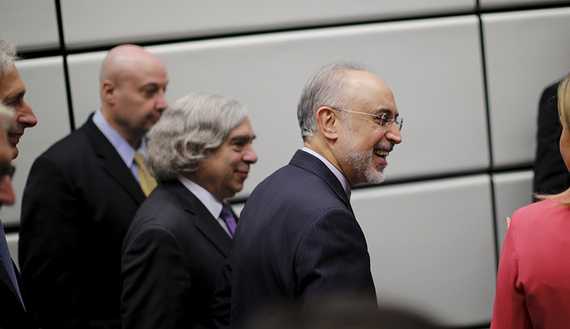
REUTERS/Carlos Barria

Salehi said that he was asked to join the nuclear talks when the discussions on the Natanz enrichment facility reached a dead end. Salehi said he would only join the talks if Moniz, his American counterpart, did as well. According to Salehi, this was approved by Undersecretary Wendy Sherman and Deputy Foreign Minister Abbas Araghchi, which he described as “the communications link between America and Iran.”

*****************

One of the most popular American negotiators in Iranian social media was US Energy Secretary Ernest Moniz. The Massachusetts Institute of Technology (MIT) professor emeritus and former director of the MIT Laboratory for Energy and the Environment joined the nuclear talks between Iran and five permanent members of the UN Security Council plus Germany (P5+1) to discuss the technical aspects of the nuclear deal with the head of Iran’s Atomic Energy Organization, Ali Akbar Salehi.

In an interview with an Iranian newspaper, Salehi spoke about the negotiations and his relationship with Moniz. Just as Moniz was picked to lead the technical negotiations due to his nuclear expertise, Salehi, an MIT graduate, is one of the few individuals to have held important positions for three consecutive administrations — a sign that he has the trust of Supreme Leader Ayatollah Ali Khamenei.

Salehi first denied accusations that former hard-line nuclear negotiator Saeed Jalili was not a serious negotiator. Salehi was Iran’s foreign minister at the time and said that when he was at the meetings with the Supreme National Security Council, Jalili’s negotiating positions were in line with the country’s positions and that “he did not go rogue.”

According to Salehi, the reason for the deadlock during that time was the differences among the P5+1. Specifically, the EU3 (France, United Kingdom and Germany) saw their positions and interests separate from the E3 (US, Russia and China). He said that even when European Union Chief Catherine Ashton reached a point of agreement with Iran on one issue, one country would oppose it and throw everything off. This is why Iran agreed to bilateral talks with the United States in Oman.

Salehi said that he was asked to join the nuclear talks when the discussions on the Natanz enrichment facility reached a dead end. Salehi said he would only join the talks if Moniz, his American counterpart, did as well. According to Salehi, this was approved by Undersecretary Wendy Sherman and Deputy Foreign Minister Abbas Araghchi, which he described as “the communications link between America and Iran.”

Salehi said he and Moniz did not know each other well when they were at MIT, but when they first met during the talks, “there was a feeling that he has known me for years.” Salehi added, “A number of my classmates are now Mr. Moniz’s experts.”

According to Salehi, Moniz entering the talks was important because Salehi expressed that he had been sent with “full authority” to sign off on all technical issues in the nuclear negotiations and Moniz had told him that he had the same authority. He added, “If the negotiations did not take place with the Americans, the reality is that it would not have reached a conclusion. No [other] country was ready to sit with us and negotiate for 16 days with their foreign minister and all of its experts.”

Salehi said that one of the more difficult times negotiating with Moniz was after they reached an agreement on a particular issue. Moniz would take it to the other members of P5+1, who would then make their own requests.

It was also reported that Moniz had given Salehi a gift for the birth of his granddaughter — clothes and a toy embossed with MIT logos. Salehi said that he had also brought gifts for Moniz — Iranian honey and trail mix of Iranian nuts.


Iran Already Sanitizing Nuclear Site, Intel Warns

August 5, 2015

Iran Already Sanitizing Nuclear Site, Intel Warns, Bloomberg View&  August 5, 2015

The U.S. intelligence community has informed Congress of evidence that Iran was sanitizing its suspected nuclear military site at Parchin, in broad daylight, days after agreeing to a nuclear deal with world powers.

For senior lawmakers in both parties, the evidence calls into question Iran’s intention to fully account for the possible military dimensions of its current and past nuclear development. The International Atomic Energy Agency and Iran have a side agreement meant to resolve past suspicions about the Parchin site, and lawmakers’ concerns about it has already become a flashpoint because they do not have access to its text.

Intelligence officials and lawmakers who have seen the new evidence, which is still classified, told us that satellite imagery picked up by U.S. government assets in mid- and late July showed that Iran had moved bulldozers and other heavy machinery to the Parchin site and that the U.S. intelligence community concluded with high confidence that the Iranian government was working to clean up the site ahead of planned inspections by the IAEA.

The intelligence community shared its findings with lawmakers and some Congressional staff late last week, four people who have seen the evidence told us. The Office of the Director of National Intelligence briefed lawmakers about the evidence Monday, three U.S. senators said.

“I am familiar with it,” Senate Intelligence Committee Chairman Richard Burr told us Tuesday. “I think it’s up to the administration to draw their conclusions. Hopefully this is something they will speak on, since it is in many ways verified by commercial imagery. And their actions seem to be against the grain of the agreement.”

Burr said Iran’s activities at Parchin complicate the work of the IAEA inspectors who are set to examine the site in the coming months. IAEA’s director general, Yukiya Amano, was in Washington on Wednesday to brief lawmakers behind closed doors about the side agreements.

“They are certainly not going to see the site that existed. Whether that’s a site that can be determined what it did, only the technical experts can do that,” Burr said. “I think it’s a huge concern.”

A senior intelligence official, when asked about the satellite imagery, told us the IAEA was also familiar with what he called “sanitization efforts” since the deal was reached in Vienna, but that the U.S. government and its allies had confidence that the IAEA had the technical means to detect past nuclear work anyway.

Another administration official explained that this was in part because any trace amounts of enriched uranium could not be fully removed between now and Oct. 15, the deadline for Iran to grant access and answer remaining questions from the IAEA about Parchin.

Senate Foreign Relations Committee Chairman Bob Corker told us Tuesday that while Iran’s activity at Parchin last month isn’t technically a violation of the agreement it signed with the U.S. and other powers, it does call into question Iran’s intention to be forthright about the possible military dimensions of its nuclear program.

“The intel briefing was troubling to me … some of the things that are happening, especially happening in such a blatant way,” he said. “Iran is going to know that we know.” He added the new information gave him “a lot of concerns” about Iran coming clean on military dimensions of its nuclear work.

According to the overall nuclear agreement, sanctions relief for Iran can come only after the IAEA and Iran resolve their outstanding concerns about possible military dimensions of past and current work. But the agreement does not specify how the issue must be resolved, only that it be resolved to the IAEA’s satisfaction.

Several senior lawmakers, including Democrats, are concerned that Iran will be able to collect its own soil samples at Parchin with only limited supervision, a practice several lawmakers have compared to giving suspected drug users the benefit of the doubt to submit specimens unsupervised. Iran’s sanitization of the site further complicates that verification.

Democratic Senator Chris Coons, a member of the Foreign Relations Committee, told us Tuesday that this area is part of why he is undecided on supporting the Iran deal.

“I have concerns about the vigorous efforts by Iran to sanitize Parchin,” he said. “I’ve gotten some reassurance about how difficult it is for them to effectively conceal what we know to have been their illicit nuclear weapons developments there.”

Coons said he was most concerned about the integrity of the IAEA inspection process going forward and not as concerned about figuring out what happened in the site in the past: “We know what the Iranians did at Parchin.”

David Albright, the president of the Institute for Science and International Security, obtained a commercially available image of the Parchin site taken by satellites on July 26 that shows renewed activity at the Parchin site. He told us there are two new large vehicles, alterations ongoing to roofs of two of the buildings and new structures near two of the buildings.

“You have to worry that this could be an attempt by Iran to defeat the sampling, that it’s Iran’s last-ditch effort to eradicate evidence there,” he said. “The day is coming when they are going to have to let the IAEA into Parchin, so they may be desperate to finish sanitizing the site.”

The facility, outside of Tehran, first came to the attention of the international community in 2004 when news reports surfaced that it was being used to test explosives for a nuclear warhead.

A 2007 U.S. National Intelligence Assessment concluded that Iran halted this kind of work in 2003. Between 2005 and today, Iran has allowed IAEA inspectors access to Parchin — a vast complex with dozens of buildings — on only five occasions. In 2012, Abright’s group reported on satellite imagery that it said showed efforts to clean up evidence of an explosives testing chamber there.

Representative Ed Royce, the Republican chairman of the House Foreign Affairs Committee, said that Amano had told him in recent conversations that the IAEA had “thousands of pages of documentations on tests to weaponize a nuclear device.” Royce added, “For a long time, they have been altering sites.”

The IAEA has documented this as well. The agency’s report from May 29 this year said there was  satellite imagery of vehicles, equipment and “probable construction materials” at Parchin. The report said, “The activities that have taken place at this location since February 2012 are likely to have undermined the Agency’s ability to conduct effective verification.”

Secretary of State John Kerry has said that the U.S. government has “absolute knowledge” about what Iran has done in the past. Ahead of the vote on the agreement next month, many lawmakers don’t share Kerry’s confidence. Iran would seem to have its doubts as well, since it’s still trying to cover its tracks.