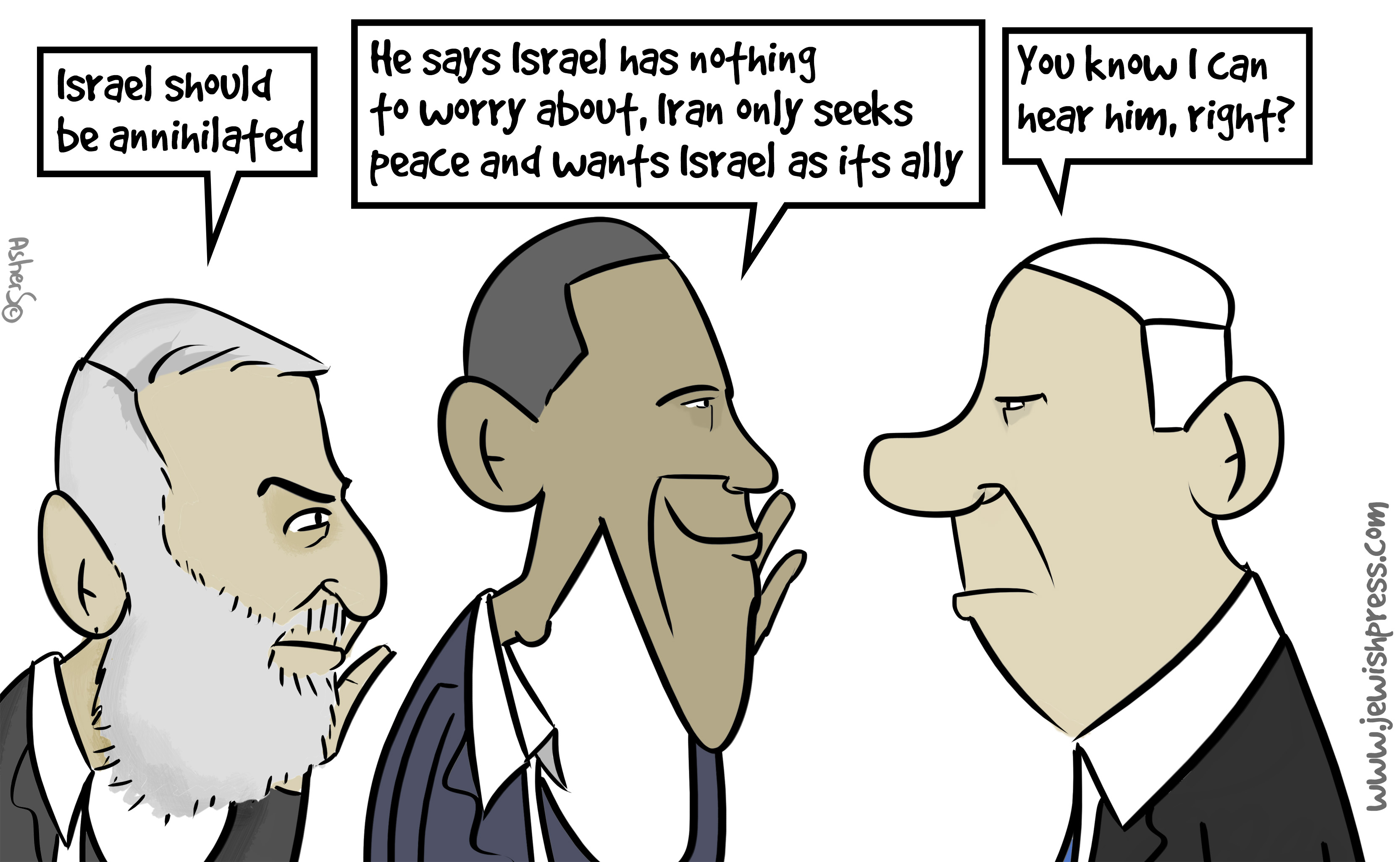
H/t The Jewish Press
U.N. Nuclear Watchdog: Iran May Have Built Extension at Disputed Military Site, Washington Free Beacon, Reuters, August 27, 2015

International Atomic Energy Agency (IAEA) Director General Yukiya Amano addresses a news conference after a board of governors meeting at the IAEA headquarters in Vienna, Austria, June 8, 2015. REUTERS/Leonhard Foeger/Files
VIENNA (Reuters) – Iran appears to have built an extension to part of its Parchin military site since May, the U.N. nuclear watchdog said in a report on Thursday delving into a major part of its inquiry into possible military dimensions to Tehran’s past atomic activity.
A resolution of the International Atomic Energy Agency’s Parchin file, which includes a demand for IAEA access to the site, is a symbolically important issue that could help make or break Tehran’s July 14 nuclear deal with six world powers.
The confidential IAEA report, obtained by Reuters, said:
“Since (our) previous report (in May), at a particular location at the Parchin site, the agency has continued to observe, through satellite imagery, the presence of vehicles, equipment, and probable construction materials. In addition, a small extension to an existing building appears to have constructed.”
Diplomats say any activities Iran has undertaken at Parchin since 2012 are likely to have undermined the agency’s ability to verify intelligence suggesting Tehran previously conducted tests there relevant to nuclear bomb detonations.
Under a “roadmap” accord Iran reached with the IAEA parallel to its groundbreaking deal with the global powers, the Islamic Republic is required to give the Vienna-based watchdog enough information about its past nuclear activity to allow to write a report on the long vexed issue by year-end.
“Full and timely implementation of the relevant parts of the road-map is essential to clarify issues relating to this location at Parchin,” the new IAEA report said.
Iran has for years been stonewalling the PMD investigation but delivered on a promise under the roadmap to provide more information by Aug. 15.
IAEA Director-General Yukiya Amano said on Tuesday that the agency had received substantive amounts of information from Iran although it was too early to say whether any of it is new.
Iran Could Fund Own Nuclear Inspections, Washington Free Beacon,
 International Atomic Energy Agency (IAEA) Director General Yukiya Amano arrives for a board of governors meeting at the IAEA headquarters in Vienna November 20, 2014. REUTERS/Heinz-Peter Bader
The Department of State on Tuesday left open the possibility that Iran could partially fund international inspections of its own contested nuclear sites, raising concerns that the Islamic Republic is being given too much control over the implementation of the recent deal reached with world powers.
John Kirby, a spokesman for the Department of State, declined to answer multiple questions about how international inspections of Iran’s nuclear sites would be paid for by the International Atomic Energy Agency (IAEA), which is requesting at least $10 million to carry out the work.
The United States will likely fund some portion of the cost, and Kirby left open the possibility that Iran could also foot some of the bill.
The matter has been the subject of much speculation in recent days after it came to light that Iran would be permitted to inspect its own nuclear sites, raising the possibility that Iran could continue to hide nuclear weapons work.
“I don’t have any specific funding contributions to speak to today in terms of amount,” Kirby told reporters. “We’re still working our way through that. I do want to add that we have every intention to continue to contribute to the IAEA for the purpose of this—doing this very important work of the verification of Iran’s nuclear-related commitments.”
“I won’t speak for Iran,” Kirby added. “I don’t know what, if any, commitments Iran has or will engender under this, but we’ve—as we noted in the statement, we’re committed to working with all the member states to ensure that the IAEA has the resources that it needs.”
When pressed to explain whether the United States would pay for Iran to inspect its own nuclear sites or press the Iranian government to foot the bill, Kirby demurred.
“Honestly don’t have a specific answer for you in that regard,” Kirby told reporters. “I mean, again, we’re going to contribute—continue to contribute to the IAEA and their funding needs specifically as it relates to this deal. And it’s not just us; we want other member states to do it as well.”
“I’ll let Iran speak for itself in terms of what, if any, contributions it plans to make,” he added. “But I don’t know that I would characterize the funding resources applied to IAEA and their need to do this work as sort of then paying for any efforts done by Iranian officials to meet compliance.”
Matthew Lee, a reporter for the Associated Press, continued to question Kirby on the issue.
“Well, I mean, someone’s got to pay for it,” Lee said. “They’re not going to work for free, whoever they are, whether they’re Iranians or they’re from Djibouti.”
“Well, I’m assuming many of them are government—work for the government of Iran,” Kirby responded.
Yukiya Amano, the IAEA’s director general, warned on Tuesday that the agency is in dire financial straits and will run out of money later this year.
“The Agency has immediate funding needs related to the continuing costs of implementing monitoring and verification under the existing Joint Plan of Action,” Amano was quoted as saying. “The extra-budgetary contributions which we have previously received for this purpose will be exhausted by the end of September.”
The State Department would not address a request for comment seeking further information about future funding for the IAEA, directing a reporter to call the IAEA directly.
One senior official with a pro-Israel organization criticized the administration for failing to take the funding issue into consideration before inking the deal.
“In the last few weeks we’ve learned that the Iranians will be inspecting themselves at some sites,” said the source, who is involved in the fight over the deal. “Now the administration has opened the door to the Iranians literally paying the salaries of the people who will be inspecting them at other sites.”
“That may or may not happen, but it’s revelatory that the White House cares so little about the nitty-gritty of the inspection regime that they didn’t even bother thinking through these questions,” the source said. “They just want this out of the way.”
The funding issue comes amid new revelations that Iran could be permitted to conduct its own inspections of the Parchin military complex, one of the country’s most disputed nuclear sites.
“Thanks to the Associated Press story, the public now knows that Iran, one of the worst nuclear proliferators in history, will be allowed to inspect itself at the Parchin military facility,” said a senior Republican congressional source. “While the Obama administration had initially refused to publicly confirm or deny Iran’s self-inspection at Parchin, now it’s doubling down and embracing this charade of nuclear verification, and holding open the possibility that the American taxpayer will help pay for the charade,” the source said.
Iran also has revealed in recent weeks that the United States is banned from knowing the details of its nuclear inspections agreement with the IAEA, a disclosure that prompted anger among many U.S. lawmakers.
Iran has gained additional leverage over the IAEA by refusing to sign a document known as the Additional Protocol, which is meant to force Iran to disclose certain details of its nuclear program to the IAEA in order to confirm that Tehran is not operating a clandestine weapons program.
The Iran deal and the Israeli veto, Power Line,
(How long can Israel wait? Please see also, Thinking About the Unthinkable: An Israel-Iran Nuclear War and WHY IRAN IS NUCLEAR NOW. — DM)
CNN’s report thus raises this obvious question: Will Israel attack Iran now that the U.S. and its European allies are about to enter a deal that effectively grants Iran the right to become a nuclear power?
***********************
This weekend, CNN reported that in recent years, Israeli leaders planned three attacks on military targets in Iran. CNN bases this story on an audio recording with former Defense Minister (and one-time Prime Minister) Ehud Barak. The recording was leaked to an Israeli television station.
Why didn’t Israel carry through with the planned attacks? In the first case (2010), Israeli military leaders reportedly nixed the idea. The head of the Israeli Defense Force (IDF) simply didn’t believe the planned attack was “operational.”
In the second case (2011), the IDF signed off on an attack. However, two key ministers had doubts that could not be overcome.
In the third case (2012), the attack didn’t come off because of scheduling issues. Supposedly, the planned strike conflicted with a joint military exercise with the United States. The Israeli didn’t want to embarrass Washington by attacking Iran just as it was set to engage in the joint military exercise because this would give the appearance that the Americans were involved. (The explanation in CNN’s report for why the attack wasn’t rescheduled is garbled).
In all three instances, Prime Minister Netanyahu wanted to attack. In all three instances, Barak, who is not a member of Netanyahu’s party, concurred.
In none of these instances does it appear that President Obama’s obvious opposition to an Israeli attack on Iran was the dealbreaker, if CNN’s report is to be believed (though Obama’s views may have contributed to the two ministers getting cold feet in 2011).
CNN’s report thus raises this obvious question: Will Israel attack Iran now that the U.S. and its European allies are about to enter a deal that effectively grants Iran the right to become a nuclear power?
One might think not. The deal has the support of European governments eager to allow their businessmen to take advantage of Iranian markets. Here in the U.S., the deal is unpopular, but Obama considers it the main element of his foreign policy legacy.
There will be hell to pay if Israel upsets these expectations by attacking Iran.
But the more we learn about the farcical nature of this deal, the more Israel’s calculus may tilt in favor of an Israeli attack — if not in 2015 or 2016, then in 2017 when Obama is no longer president. After all, the hell Israel would pay if it attacks Iran must be weighed against the threat of a nuclear Iran. CNN’s report, if accurate, adds plausibility to the view that Israel sees the latter as more hellacious.
In a very real sense, then, the key people evaluating Obama’s deal aren’t U.S. Senators and Representatives, but rather Israeli generals, intelligence chiefs, and ministers. They are the ones who, effectively, can nullify the deal.
It seems to be that with every revelation of a major Obama/IAEA concession to the mullahs, the prospect that Israel will exercise its veto increases.
Inspector Clouseau was unavailable (4), Power Line,
Amano’s defense of the Parchin side deal comes amid speculation that the IAEA is being subject to overwhelming pressure by the Americans and the Iranians. On the American side, the leverage is straightforward: Amano is up for reelection next year, and he perennially relies on Western nations to provide him with slim majorities [r].
************************
Omri Ceren emails an update on the IAEA side deal with Iran on Parchin. I think that readers who have followed this important story so far will find this of interest as well. Omri writes:
As was more or less inevitable, today was all about the AP scoop describing the secret IAEA-Iran side deal on Parchin, the military base where Iran conducted hydrodynamic experiments relevant to the detonation of nuclear warheads. The IAEA has been trying to get access to the facility for years to figure out how far the Iranians got, as a prerequisite to setting up a verification regime preventing them from going further. The Obama administration told lawmakers throughout the Iran talks there could be no deal without the Iranians providing that access, but the AP yesterday published the text of a side deal between the IAEA and Iran indicating that the West had caved on that demand.
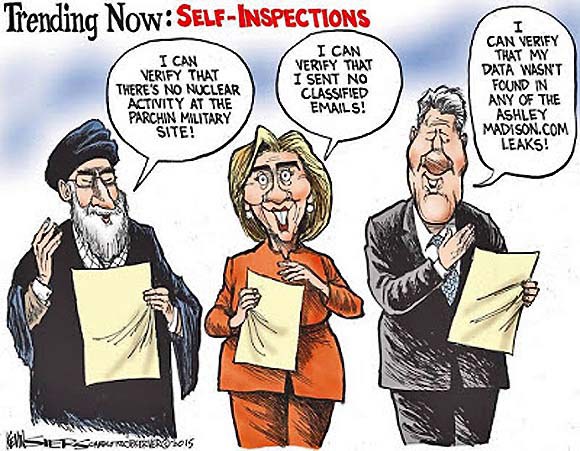
The document, titled “Separate arrangement II” – which was referenced in a Wednesday AP story and published Thursday – indicates that Iranians will be allowed to inspect themselves for evidence of the nuclear work they conducted at Parchin [a][b]. Instead of allowing IAEA inspectors to collect evidence from the facility, samples will be collected by the Iranians using Iranian equipment. Instead of allowing the IAEA to collect everything it wants, only seven samples will be handed over from mutually agreed upon areas. Instead of giving inspectors access to facilities, photos and videos will be taken by the Iranians themselves, again only from mutually agreed upon areas.
Iran deal supporters haven’t settled on just one response. As of last night administration liaisons were playing for time by telling lawmakers that the earlier AP story about the side deal was just a rumor. Then the AP published the actual draft. So this morning White House allies – including groups that have worked with the administration in lobbying Congress – tweeted around the theory that maybe the AP document was forged, at one point even referencing Israeli Prime Minister Benjamin Netanyahu [c][d][e]. Other validators have been trying to argue that the IAEA can still do its work even without access [f]. The White House will end up taking that latter claim – the IAEA stuff, not the Parchin Truther insanity – and insulating it with the argument that past work doesn’t matter anyway because what matters is the verification regime for future inspections. State Department spokesman Kirby was already floating that claim at yesterday’s press briefing [g].
That talking point might work on a political level. Administration officials can simply assert that the side deal is adequate and then – when pressed for details – declare that they can’t reveal their reasoning because it’s classified. They’ll heavily leverage yesterday’s statement from IAEA chief Amano saying that, for all sorts of classified reasons, the IAEA can live with the arrangement [h]. The opacity might well get the White House through the next month and a half of Congressional review.
But on a policy level, the side deal guts the JCPOA’s verification regime for future violations, which the administration has put at the center of the Iran deal. Administration officials really had no choice: once they gave up on any demands that would physically preclude the Iranians from going nuclear – dismantling centrifuges, mothballing facilities, etc – verification was all they had left. But it’s difficult to see how the pretense of verification can be sustained now that the Parchin side deal has been detailed:
(1) The side deal will become the precedent for future inspections of military sites — The Parchin arrangement – no physical access, restricted sampling, restricted video surveillance, etc. – will likely be used at least in part as a precedent for inspections of future sites. There is at least one other secret side deal out there: the AP’s Parchin document describes itself as “Separate arrangement II,” so presumably there’s a ‘Separate arrangement I’ that isn’t public and that may describe the verification arrangements. The Iranians were already saying that the future verification regime will not include inspector access to military sites, which would track with the Parchin precedent [j][k][l]. David Albright, president of the Institute for Science and International Security, told CNN about the Parchin arrangement “you have to worry that this would set a bad precedent in the Iran context and in the context of other countries” [m]. Rep. Royce sent Kerry a letter a few weeks ago that was even more explicit: the “side deals of today will become central to the agreement’s verification provisions tomorrow” [n] [quote omitted].
(2) IAEA sign-off suggests the agency has bent to political pressure — The Parchin arrangement is a humiliation for the IAEA. Heinonen told CNN that “It is very unusual… I find it really hard to understand why you would let someone else take the samples and only see through the camera” while Albright said “It’s really not normal… I don’t know why they accepted it. I think the IAEA is probably getting a little desperate to settle this” [o]. Until very recently Amano was explicit that the agency required further access to Parchin to resolve PMD issues: last March he “what we don’t know [is] whether they have undeclared activities or something else. We don’t know what they did in the past… we cannot tell we know all their activities” and last June he reiterated “the Agency is not in a position to provide credible assurance about the absence of undeclared nuclear material and activities in Iran” [p][q].
Amano’s defense of the Parchin side deal comes amid speculation that the IAEA is being subject to overwhelming pressure by the Americans and the Iranians. On the American side, the leverage is straightforward: Amano is up for reelection next year, and he perennially relies on Western nations to provide him with slim majorities [r]. On the Iranian side, there are several mechanisms that are getting attention. Some are overt: this week Iran’s Fars News Agency published a boast that Amano knew he “would have been harmed” had he disobeyed Iranian wishes and revealed details of the side deal to Congress (the threat was scrubbed after it garnered international attention; some Iran defenders have suggested that Fars published the threat due to a mistranslation of a speech, though it’s unclear why having a state-controlled vehicle go out of its way to mistranslate and publish a threat is supposed to be reassuring [s][t]). Other Iranian pressure mechanisms are more subtle: for the first eight years of the JCPOA Iran is only bound to provisionally apply, rather than to ratify, the Additional. Even JCPOA supporters describe the concession as being “all about Iran keeping some leverage over the IAEA… it wants to be able to keep the option of revoking its provisional implementation, and not ratifying the AP, as leverage” [u].
[a] http://bigstory.ap.org/article/d8bfeff00c8341caab084841f44d9cde/what-secret-agreement-between-iran-and-un-says
[b] http://bigstory.ap.org/article/bedd428e26924eed95c5ceaeec72d3a4/text-draft-agreement-between-iaea-iran
[c] https://twitter.com/jstreetdotorg/status/634743999597801472
[d] https://twitter.com/tparsi/status/634743163467526144
[e] https://twitter.com/Max_Fisher/status/634726697263349761
[f] http://www.nbcnews.com/id/57764838/ns/msnbc-all_in_with_chris_hayes/#.VdeLL_mrT4Y
[g] http://www.state.gov/r/pa/prs/dpb/2015/08/246211.htm
[h] https://www.iaea.org/newscenter/pressreleases/statement-iaea-director-general-yukiya-amano-1
[i] http://www.powerlineblog.com/archives/2015/07/speaking-of-iran-6.php
[j] http://english.farsnews.com/newstext.aspx?nn=13940429001105
[k] http://en.mehrnews.com/news/108760/No-military-sites-inspections-Velayati
[l] http://www.latimes.com/world/middleeast/la-fg-iran-deal-zarif-20150722-story.html
[m] http://edition.cnn.com/2015/08/20/politics/iran-inspections-report-nuclear-deal-experts/index.html
[n] http://foreignaffairs.house.gov/sites/republicans.foreignaffairs.house.gov/files/Parchin%20side%20deal_0.pdf
[o] http://www.cnn.com/2015/08/20/politics/iran-inspections-report-nuclear-deal-experts/index.html
[p] http://www.pbs.org/newshour/bb/iaea-monitoring-irans-nuclear-program/
[q] https://www.iaea.org/newscenter/statements/introductory-statement-board-governors-63
[r] http://carnegieendowment.org/2012/11/20/plan-for-iaea-safeguards
[s] http://freebeacon.com/national-security/iran-threatened-harm-to-top-nuke-inspector-to-prevent-disclosure-of-secret-deal/
[t] http://english.farsnews.com/newstext.aspx?nn=13940526000960
[u] http://armscontrollaw.com/2015/07/15/much-much-more-on-the-jcpoa/
Inspector Clouseau was unavailable (3), Power Line,
I think it is very likely the side-deal documents were drafted by the United States and given to the IAEA, which agreed to make them into secret agreements with Iran to finalize the main agreement.
***********************
The pushback against George Jahn’s AP scoop on the IAEA side deal with Iran now includes the allegation that the draft of the side deal posted by the AP is a forgery — perhaps an Israeli forgery. Fred Fleitz has reported the relevant details with links and evidence here at NR’s Corner. Fleitz’s knowledgeable assessment seems reasonable to me:
First, the errors and non-IAEA prose in the AP’s transcribed document appear to indicate a first draft written by a party other than Iran or the IAEA to resolve the Parchin issue. This is consistent with my assessment that the side deal documents were drafted by the United States and handed to the IAEA to finalize after U.S. diplomats were unable to resolve the issues of the Parchin military base and possible military dimensions of Iran’s nuclear program during the talks. The AP says it was told by two anonymous officials that this document is a draft and “does not differ from the final, confidential agreement between the IAEA and Iran.” I believe it probably is a first draft written by a political appointee at the State Department or an NSC staffer.
Second, to believe this is a forgery one has to believe George Jahn and the Associated Press were deceived by two anonymous diplomats or U.S. officials. I doubt this could happen to a reporter as experienced as Jahn. (MSNBC believes otherwise and attacked Jahn as “not a real reporter” for his article.) The AP is standing by this story and I doubt it would put its reputation on the line if it did not believe Jahn’s article was rock solid.
Third, claims by backers of the Iran deal that this is an Israeli forgery are nonsense. If the Israelis wanted to do a forgery like this it would be perfect. An Israeli foreign ministry or intelligence officer would never use the wrong terminology for Iran.
My bottom line is that the side-deal document transcribed by the AP is not a forgery but a first draft written by a third party that is essentially the same as the final version agreed to by the IAEA and Iran. The outstanding question is who wrote this initial draft. Given Secretary Kerry’s efforts in May and June to drop the issues of the Parchin base and possible military dimensions, I think it is very likely the side-deal documents were drafted by the United States and given to the IAEA, which agreed to make them into secret agreements with Iran to finalize the main agreement.
Fleitz adds in the final paragraph of his post that “what [Jahn] reported apparently is consistent with classified briefings provided to Congress on the secret side deals[.]”
I trust that all will become clear in time. The relevant self-inspection provisions of the side deal are so absurd that they should be fraudulent. Consistent with Fleitz’s conclusion, however, I believe they will prove to be an integral part of the finalized side deal. Neither the administration nor the IAEA disputes the accuracy of Jahn’s reportage. I conclude that the terms of the side deal reported by Jahn are a joke, but not a forgery.
White House Allies Suggest Israel Forged Iran-IAEA Agreement Document, Washington Free Beacon, Alana Goodman, August 21, 2015
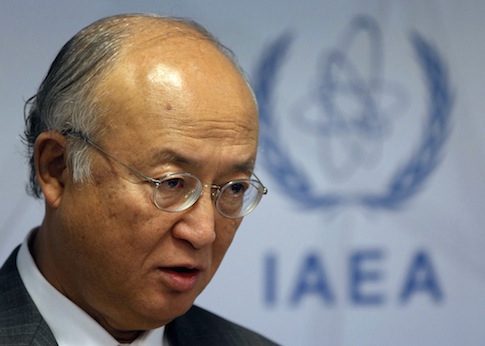
Trita Parsi, the head the National Iranian American Council (NIAC), another White House-allied group, hinted that Israeli President Benjamin Netanyahu might have forged the document himself. (Huh? — DM)
*********************
Top White House allies are mounting a campaign to discredit recent reports Iran will be responsible for investigating its own military facility for evidence of nuclear activities under an agreement between international inspectors and Tehran.
The International Atomic Energy Agency will rely on Iran to collect its own environmental samples and turn over photos and videos from its suspected nuclear military site Parchin, according to a draft of a secret side-deal between the agency and the Iranian government published by the Associated Press on Thursday.
White House allies rushed to denounce the report, accusing the AP of publishing a phony document and suggesting that the Israeli government forged it to undermine the Obama administration’s Iran deal.
J Street, one of a number of groups that has been meeting with White House officials as part of a lobbying push to support the nuclear deal, questioned the accuracy of the document obtained by the AP on Friday and suggested that it was forged by Israel.
“The AP report should be thoroughly investigated and verified,” J Street tweeted. “Very worrying if there is any doubt of authenticity.”
Obama administration officials and the IAEA have not disputed the authenticity of the document. The existence of the Parchin side deal was first mentioned publicly by Sen. James Risch (R., Idaho) at a Senate Foreign Relations Committee hearing last month.
Trita Parsi, the head the National Iranian American Council (NIAC), another White House-allied group, hinted that Israeli President Benjamin Netanyahu might have forged the document himself.
Parsi noted that the draft document published by AP referred to the “Islamic State of Iran” in one instance, instead of the “Islamic Republic of Iran.”
“The only one who refers to Iran as ‘Islamic State of Iran’ is Netanyahu. And strangely, @AP‘s dubious ‘draft’ of the IAEA-Iran agreement…” wrote Parsi on Twitter.
Others also floated the idea that Israel fabricated the document and leaked it to the AP.
“Could it be that #Israel stands behind leaking this document to #AP?” tweeted Said Arikat, the Washington bureau chief for Al Quds daily newspaper.
Jeffrey Lewis, a professor at the Middlebury Institute of International Studies at Monterey (MIIS) who tweets under the name ArmsControlWonk, also questioned the accuracy of the report on Twitter.
MIIS, J Street, and NIAC have all received funding from the Ploughshares Fund, one of the top financers of the lobbying campaign to support the Iran deal.
The pushback against the AP story, and insinuations about Israeli sabotage, follow a months-long campaign to discredit Jewish lawmakers and others who have announced their opposition to the deal.
These attacks include charges of “dual loyalty” against Jewish politicians, which pro-Israel groups said crossed the line into anti-Semitism.
Vox blogger Max Fisher also argued that the AP story was “badly flawed,” noting that an ex-IAEA official questioned its authenticity and that some details were removed from the story after it was posted. The AP later added those details back into the article and said it had been shorted for brevity and not due to accuracy issues.
“As with many AP stories, indeed with wire stories generally, some details are later trimmed to make room for fresh info so that multiple so-called ‘writethrus’ of a story will move on the AP wire as the hours pass,” AP spokesperson Paul Colford told Fisher. “It was unfortunate that some assumed (incorrectly) that AP was backing off.”
AP reporters noted that the Obama administration and the IAEA have not disputed the document’s authenticity.
“If you don’t want to believe the report, so be it. But I would look for someone to actually deny what’s in it,” said AP diplomatic reporter Matt Lee in a tweet to Fisher.
“I am curious if you have managed to find a current official anywhere to back up the fraud claim,” Lee later added. As of Friday afternoon, Fisher had not.
The original AP article was written by Vienna bureau chief George Jahn.
According to the report, a draft of a side deal between the IAEA and Iran would allow the Iranian government to police its own military site for nuclear activities.
Iran has been accused of conducting nuclear detonations testing at the Parchin military facility, and supporters of the nuclear agreement said the site would be opened to international inspectors under the deal.
But according to the AP, the IAEA side agreement would not allow independent inspections of Parchin. Instead the Iranian government would turn over photographs and videos of the military site to the IAEA.
Under the deal, Iran would collect its own environmental samples from the Parchin military facility, which international inspectors would then test for nuclear residue.
Iran has been accused of conducting nuclear detonations testing at Parchin, and supporters of the nuclear deal said the facility would be opened to international inspectors under the recently signed agreement.
Contentions: Text of Iran-IAEA Agreement Proves Inspection is a Farce, Commentary Magazine, Jonathan S. Tobin, August 21, 2015
(The text of the draft is available here. According to an Associated Press preface to the agreement provided at the link,
Two officials, speaking on condition of anonymity, confirmed to The Associated Press that this draft does not differ from the final, confidential agreement between the IAEA and Iran.
What other side deals are there and what facilities, if any, in addition to Parchin are thought to have worked on nuke weaponization? What facilities are thought to be doing so now?– DM)
If letting Iran inspect Parchin by itself is not enough to move undecided Democrats into the columns of those opposing the deal, then obviously nothing will. If we have learned nothing else from this debate, it’s that all of the lip service members of the president’s party have given to the danger from Iran and the need for tough inspections is just a lot of eyewash. The text that the AP has published shows that a vote for the deal now is clearly a vote not for postponing nuclear peril, as some Democrats say, but for indifference to it.
**********************
On Wednesday when the Associated Press published a report claiming that the International Atomic Energy Agency had agreed to let Iran inspect the Parchin military site itself, critics of the nuclear deal were outraged. But the administration and its supporters weren’t rattled. They claimed there was nothing amiss and soon the IAEA itself issued a statement saying the story was “misleading,” though it wouldn’t say exactly what was misleading about it. The IAEA further asserted that it was obligated not to reveal the text of its agreement with Iran. That was enough to set media cheerleaders for President Obama, like those at the Vox website, into full spin mode, claiming that the AP’s reporting was flawed. They argued both that the claim about the Iranians being allowed to inspect their own site was unproven and that even if it were true it was no big deal. We’ll leave the latter claim aside for the moment, but the headline this morning is that doubts about the veracity of the original story are now gone. The AP has released the text of the draft agreement between the IAEA and Iran that is, according to all accounts, not different from the final version. One doesn’t need to be a nuclear expert to understand that the headline on the original story was entirely accurate, “UN to let Iran inspect nuke work site.” This is not only more damning evidence that the nuclear deal is a farce but that Democrats who are prepared to let it go through out of loyalty to President Obama are enabling a shocking betrayal of the nation’s security.
The text of the agreement makes clear that international inspectors won’t get anywhere near Parchin. The Iranians will do all the inspecting and at the end of the process a UN official will be allowed to pay a courtesy visit followed by a “roundtable” discussion of the entire affair. In other words, Parchin and all that happened there will be swept under the rug along with U.S. and IAEA promises about exploring exactly how much progress Iran had made there.
The point of concern is that Parchin is where Iran did its work on the possible military dimensions (PMD) of its nuclear project. The work done there was not theoretical physics but on triggers for nuclear bombs. Supposedly, they stopped their work there a long time ago and the site has already been scrubbed. But that doesn’t mean its unimportant. As even Secretary of State John Kerry admitted, without knowing what was done there, we can’t understand how close Iran is to building a bomb. Any discussion about nuclear “breakout” times, which is crucial to the administration’s scenario for monitoring and preventing Iran from getting a bomb during the ten-year period when the deal is in effect, becomes pure speculation without this knowledge. And if Iran is doing the inspections, the IAEA and the U.S., and American allies won’t get it.
Let’s be clear about who the real culprits are here. The IAEA is a UN agency with a lot of responsibility but its power stems from the cooperation it gets from the nations it inspects. With the U.S. more interested in détente with Iran than in pressing the Iranians on difficult issues, the IAEA is in no position to push Tehran for more access to Parchin or any other military site. It should also be remembered, as we noted earlier this week, the Iranians have already threatened Yukio Amano, the director of the IAEA, and made clear to him that they will not tolerate his making public the details of the arrangements for inspections.
While the administration is telling us all to move along as there’s nothing to see here and their cheerleaders are assuring the country that this is a minor detail of no consequence, the story of the IAEA agreement on Parchin is deeply significant. By itself, it shows that the UN nuclear watchdog agency is being given the runaround by Iran and is forced to take it so long as the U.S. doesn’t pressure Iran to be more transparent.
But context is also everything here. The Parchin agreement provides the setting for the entire inspections process of Iran’s active nuclear facilities. Administration promises of “anytime, anywhere” inspections were as trustworthy as the president’s famous ObamaCare pledges about keeping your insurance and doctors if you liked them. As with the assurances about Parchin, we’re also told that the 24-day waiting period for inspections of active plants is not a big deal. But the message being sent to Iran is clear. It isn’t so much that the inspections regime is a farce as it is that the administration is demonstrating that it doesn’t consider these details to be a major concern. If you believe, as President Obama has repeatedly told us, that Iran is changing and that it is about to “get right with the world,” you don’t worry about inspections. You also don’t worry about Iran’s support for terrorism or its production of ballistic missiles (whose only purpose can be to attack the U.S. and Europe, not those recalcitrant and paranoid Israelis that the president falsely claims are the world’s only opponents of the deal).
That brings us back to the question of what members of the House and Senate are supposed to think about any of this. Democrats have been under a great deal of pressure to back the president on the Iran deal. He has made it clear that he regards this vote as a litmus test of their loyalty to both their party and to him personally. That seems to be enough for most of them, including those who have long professed to care deeply about stopping Iran’s nuclear ambitions. But this sidebar to the general discussion about the merits of the pact with Iran is telling. It shows that when it is demonstrated that the terms of the deal are utterly inadequate even by the administration’s own standards, the bulk of the president’s party is unable or unwilling to draw the proper conclusions.
If letting Iran inspect Parchin by itself is not enough to move undecided Democrats into the columns of those opposing the deal, then obviously nothing will. If we have learned nothing else from this debate, it’s that all of the lip service members of the president’s party have given to the danger from Iran and the need for tough inspections is just a lot of eyewash. The text that the AP has published shows that a vote for the deal now is clearly a vote not for postponing nuclear peril, as some Democrats say, but for indifference to it.




 anneinpt
 artaxes
 danmillerinpanama
 davidking1530
 Peter Hofman
 Joseph Wouk
 Peter
Peter Louisiana Steve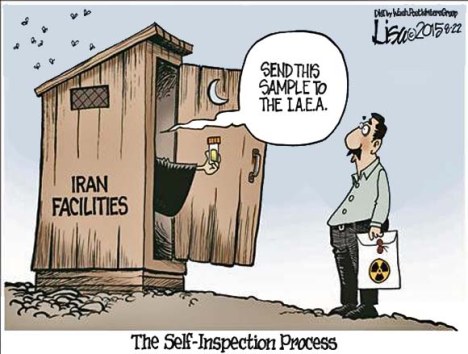

 WarSclerotic
Recent Comments