Posted tagged ‘Iran nuke inspections’

Goodnight Vienna (11)

July 13, 2015

Goodnight Vienna (11), Power LineScott Johnson, July 13, 2015

Omri Ceren continues his series of reports by email from Vienna:

Good Monday from Vienna, where we’re now into day 17 of the current round of negotiations and yet summer continues to surprise us.

The JPOA is again set to expire at midnight after having been extended a few days ago. Just about everyone is saying that another short-term extension is not being considered. Of course the parties always say that, until they don’t, but this time the comments feel a little bit different. The Europeans could not be more frustrated – they don’t understand why the Americans and the Iranians can’t get their nonsense together – and the Russians and Chinese actually have things they need to take care of. Rouhani was even scheduled to speak on TV today, though the Iranians are now saying he’ll wait until there’s a formal announcement.

The conventional wisdom is that negotiations will wrap up today and a ceremony will be held tomorrow.

As for what the parties are still talking about: Reuters has been saying all week that sanctions remain unresolved, and today the wire piled on with “among the biggest sticking points in the past week has been Iran’s insistence that a United Nations Security Council arms embargo and ban on its ballistic missile program dating from 2006 be lifted immediately… Other problematic issues are access for inspectors to military sites in Iran” [1]. The Associated Press report from this morning also identified those two areas as key disagreements, and added that there are complications due to a new Iranian demand “that any U.N. Security Council resolution approving the nuclear deal be written in a way that stops describing Iran’s nuclear activities as illegal” [2].

As far as the UNSCR gambit goes, it seems like a not-very-sophisticated attempt to craft language that would later be used to undermine the IAEA’s authority to inspect Iranian facilities. The Iranians have successfully pulled off similar tricks throughout the talks: they inserted vague language into Geneva that they interpreted as a right to enrich, and they did the same thing at Lausanne so they could later claim that the arms embargo has to be lifted. U.S. negotiators have proven less than adept in detecting how and when the Iranians are laying traps for them.

As far as the arms embargo goes, there are multiple Iranian motives. The most obvious is that the Iranians are engaged in four hot wars across the region against traditional American allies, and they’re eager to purchase Russian weapons to fight in those wars. David Ignatius to MSNBC this morning: “Israel will see that as a direct threat, as it will arm the people Israel is fighting. The Sunni Arabs, as you said, will see this as a major capitulation by the U.S.” The more subtle reason has to do with how the Iranians conduct their illicit nuclear trade. The Iranians have an interest in weakening international restrictions against arms transfers in in general, because they then use newly-legitimized procurement channels to violate whatever restrictions remain. I’m [linking] below an article published yesterday by Benjamin Weinthal – a Berlin-based fellow for Foundation for Defense of Democracies (FDD) – on how Iran has been violating UNSC nuclear sanctions over the last few months:

While U.S.-led world powers hold talks with Iran in Vienna to curb Tehran’s illicit nuclear weapons program, the Islamic Republic’s spies have been seeking atomic and missile technology in neighboring Germany as recently as last month, according to German intelligence sources… Iran has a long history of illegally obtaining nuclear technology from within Germany and transporting it in ways that circumvent international sanctions. German companies have shown an eagerness to legally tap the Iranian market, though none are accused of abetting illegality in the latest efforts by Iran.

Of course there’s also what ought to be the major diplomatic scandal of the Iranians cheating on nuclear sanctions even as nuclear negotiations continue [reported by Benjamin Weinthal in the linked story]. But the Iranians have been caught cheating throughout the talks: they’ve violated UNSC resolutions in exactly this way and they’ve violated the JPOA by busting through oil caps, testing advanced centrifuges, and failing to convert excess enriched gas into dioxide. In literally every case the Obama administration has found a reason to publicly play Iran’s lawyer by spinning away those violations.

_________________

[1] http://www.reuters.com/article/2015/07/13/us-iran-nuclear-idUSKCN0PM0CE20150713
[2] http://bigstory.ap.org/article/1bfd89dfd94b47b19706949ae2255c02/iran-talks-hit-final-stage-announcement-expected

Addicted to self-deception

July 13, 2015

Addicted to self-deception, Israel Hayom, Dr. Reuven Berko, July 13, 2015

There is an Arab proverb that says, “What is written on the brow will inevitably be seen by the eye,” meaning that one will inevitably meet one’s destiny.

But the eyes of the West do not see the writing. The negotiators responsible for the talks between Iran and the world powers see the sights and hear the voices, but ignore reality and engage in the wishful thinking of those who sent them to Vienna.

Like failed psychologists, U.S. Secretary of State John Kerry and his team are managing the negotiations with the unquestionably stubborn Iranians as if they were therapy sessions. The Iranians, following the directives of a cynical ayatollah whispering to them from the wings, are deliberately displaying manic personality shifts, up and down, playing the West like a marionette between hope and despair.

The West watches eagerly as Iran continues to develop its missiles and its nuclear program, as the centrifuges constantly whirl throughout this period of intentional procrastination. World leaders hear the threats of Ayatollah Ali Khamenei and his band of clerics, who shun the deal and preach the destruction of Israel, while declaring that the Iranian nation’s struggle against the “boastful” United States will continue and that there will be no access to the sites where the bomb is being developed. If that is what the leader thinks, then the masses will follow. And indeed, the Iranian media, defense establishment, and the crowds in the streets of Tehran parade their zealous hatred and their anti-Western incitement as they demand that sanctions be lifted while American and Israeli flags go up in flames.

It appears the leaders in the talks are using “denial” and “repression” as psychological tricks to delude themselves, and not, God forbid, as negotiation tactics to achieve the desired deal from the enemy. These masters of self-deception respond to threatening declarations from Iran’s supreme leader that his country will never giver up its nuclear achievements by saying that it is his way of preparing the masses in Iran for the concessions to come. This is like saying that the harsh and radical comments repeatedly made are simply a way to “vent” the feelings of rage in the Iranian public and are a sign “from above” of the concession of the nuclear project.

Those who have eyes in their heads understand that things are not going well. Lifting the sanctions will swell Iran’s purse, which funds global terrorism, particularly in Syria, Yemen, Jordan, Lebanon and Iraq, and seeks urgently to import Chinese and Russian weapons. Can the leaders of the negotiations admit that they were mistaken and were led astray by the masters of Iranian diplomacy? Will they be able to take a step back and admit that Prime Minister Benjamin Netanyahu was right to call the deal a disaster? Since we are dealing with deception, it appears that Kerry and his staff are trapped in cognitive dissonance of the same sort as a person who buys a beautiful car and then discovers that he has been deceived and the engine is burned out, yet still takes comfort in the fact that the horn works just fine.

From a psychological perspective, this is the line between the impulse for a collective Shiite suicide mission in the name of Allah and the megalomaniacal desire to control the world at the cost of the lives of everyone who opposes. However, in a Persian bazaar, what you see is what you buy. Iran is declaring, planning and working toward destroying every country in the Middle East — especially Israel — with its nuclear program, and no deal with Kerry will change that. Instead of the simple solution — the complete dismantling of the Iranian nuclear program — the West has become addicted to the process of self-deception and procrastination. At least therapy is discreet.

Back in Tehran… Khamenei adds red lines, Rouhani tries to resign, Jaafari hints at “fait accompli” soon

July 12, 2015

Back in Tehran… Khamenei adds red lines, Rouhani tries to resign, Jaafari hints at “fait accompli” soon, DEBKAfile, July 12, 2015

(To the extent accurate, this is a fascinating account of what happened on June 29th, when Rouhani returned to Tehran for “consultation.” — DM)

ROUHANI-JAFARIPresident Rouhani vs Ali Jaafari

Iran’s top leaders remain ambivalent about whether or not to sign the comprehensive nuclear accord with the six world powers in Vienna as 22 agonizing months of negotiation falter on the brink. The all-powerful supreme leader Ayatollah Ali Khamenei’s latest comment was far from helpful. Saturday, July 11, he said publicly: “The US is the true embodiment of global arrogance,” the fight against which “could not be interrupted” even after the completion of the nuclear talks. He also boasted that the Islamic Republic had “managed to charm the world” by sticking with those negotiations.

DEBKAfile’s Iranian sources report that Khamenei’s remarks reflect the struggle between the pro- and anti-nuclear deal factions at the highest level of the Iranian leadership. For now, President Barack Obama’s odds of less than 50 percent on a final accord may well describe the balance in Tehran.

On June 29, President Hassan Rouhani was planning to resign when he asked the supreme leader to receive him first. He was upset by Foreign Minister Mohamed Zavad Zarif’s recall from Vienna to Tehran for a tough briefing. Zarif had warned the president that the talks were doomed unless Iran gave some slack. The foreign minister said that the six foreign ministers were preparing to leave Vienna in protest against Iran’s intransigence.

Rouhani when he met Khamenei warned him that Iran was about to miss the main diplomatic train to its main destination: the lifting of sanctions to save the economy from certain ruin.

The supreme ruler was unconvinced: He referred the president to the conditions for a deal he had laid down on June 23 and refused to budge: Sanctions must be removed upon the signing of the final accord; international atomic agency inspectors were banned at military facilities, along with interviews with nuclear scientists; and the powers must endorse Iran’s right to continue nuclear research and build advanced centrifuges for uranium enrichment.

Rouhani hotly stressed that those conditions had become a hindrance to the deal going through and insisted that sanctions relief was imperative for hauling the economy out of crisis.

Khamenei disputed him on that point too. He retorted that the revolutionary republic had survived the eight-year Iranian-Iraqi war (1979-187) with far fewer resources and assets than it commanded at present.

For back-up, the supreme ruler asked two hardliners to join his ding-dong with the president: Defense Minister Hosseim Dehqan and Revolutionary Guards chief Mohammad Ali Jaafari.

Both told Rouhani in the stiffest terms that Tehran must not on any account bow to international pressure for giving up its nuclear program or the development of ballistic missiles.

In a broad hint to President Rouhani to pipe down, Khamenei reminisced about his long-gone predecessor Hassan Bani-Sadr (president in 1980-1981) who was not only forced out of office but had to flee Iran, and the former prime minister and presidential candidate Mir Hossein Moussavi, who has lived under house arrest for six years since leading an opposition campaign.

The supreme leader then set out his thesis that the danger of Iran coming under attack had declined to zero, since Europe was in deep economic crisis (mainly because of Greece) and because the US president had never been less inclined to go to war than he is today.

Jaaafri added his two cents by commenting that after a succession of fiascos, Obama would go to any lengths to reach a nuclear deal with Iran as the crowning achievement of his presidency.  The Revolutionary Guards chief then added obliquely: “Before long we will present the West with a fait accompli.”

He refused to elaborate on this when questioned by the president, but it was taken as a reference to some nuclear event.

Rouhani left the meeting empty-handed, but his letter of resignation stayed in his pocket.

The next day, when Zarif landed in Vienna to take his seat once more at the negotiating table, he learned about a new directive Khamenei had sent the president, ordering him to expand ballistic missile development and add another five percent to its budget – another burden on Iran’s empty coffers.

Khamenei’s office made sure this directive reached the public domain. Zarif too was armed with another impediment to a deal. Khamenei instructed him to add a fresh condition: The annulment of the sanctions imposed against Iran’s missile development and arms purchases.

Voices were raised at the Vienna nuclear talks Wednesday night against obdurate Iran

July 9, 2015

Voices were raised at the Vienna nuclear talks Wednesday night against obdurate Iran, DEBKAfile, July 9, 2915

Zarif_Mogherini__8.7.15Iranian foreign minister and EU executive in heated exchange

DEBKAfile’s sources agree that the rhetoric on both the American and Iranian sides is probably part and parcel of the bargaining tactics around the table in Vienna. It is therefore hard to judge whether their words are to be taken literally or maneuvers for stepping up pressure on the opposite side.

****************

European Union Foreign Executive Federica Mogherini is quoted by DEBKAfile’s intelligence sources as shouting Wednesday night, July 8, at Iran’s Foreign Minister Mohamed Javad Zarif: “If that’s where you stand it’s a pity to waste any more time!” Jarif is quoted as snapping back: “Don’t threaten us!” The US delegation led by Secretary of State John Kerry sat without moving a muscle. But Russian Foreign Minister Sergey Lavrov stepped in to cool tempers and urged everyone to go back to the matters at issue.

The shouting started amid the discussion of sanctions relief, after the second deadline for a final deal had slipped by. The Iranians stood by their demand for the immediate lifting of all sanctions – not just the penalties for its nuclear activities, but on the score of involvement in terrorism, which Iran has consistently denied.

Other sticking points between the six powers and Iran are still the UN embargo on Iranian arms sales, restrictions on ballistic missiles and the nature and powers of the mechanism for monitoring Iran’s nuclear activities.

Even before this angry exchange, President Barack Obama remarked at a closed meeting on Capital Hill Tuesday night, “The chances of a deal at this point are below 50:50.” He was quoted by the top Democrat Sen. Dick Durbin of Illinois, the Assistant Democratic Leader and a close ally of Obama’s. “I think it’s an indication that this is crunch time and that he said he’s not going to accept a weak or bad deal. He knows what’s at stake here,” said Durbin.

But Obama did not seem to be ruling out letting the negotiations run on for another few days.

At another meeting with US lawmakers Tuesday, Chairman of the Joint Chiefs of Staff Gen. Martin Dempsey spoke in particularly categorical terms against easing restrictions for Iran. “Under no circumstances should we relieve pressure on Iran relative to ballistic missile capabilities and arms trafficking,” he said.

In contrast to Obama, Iranian President Hassan Rouhani sounded upbeat Wednesday night, before setting out on a trip to Moscow. He said: “Negotiations with the P5+1 group are at a sensitive stage and the Islamic republic of Iran is preparing for [the period] post-negotiations and post-sanctions.”

DEBKAfile’s sources agree that the rhetoric on both the American and Iranian sides is probably part and parcel of the bargaining tactics around the table in Vienna. It is therefore hard to judge whether their words are to be taken literally or maneuvers for stepping up pressure on the opposite side.

Our sources deny Israeli media reports claiming that Undersecretary of State Wendy Sherman, who leads the US negotiating team, tried to call Israel’s National Security Adviser Yossie Cohen for an update on the state of the negotiations, but that he avoided taking her calls. If Sherman had really phoned Cohen, our sources say, her call would have certainly been put through to him.

Goodnight Vienna (6)

July 8, 2015

Goodnight Vienna (6), Power LineScott Johnson, July 7, 2015

There are no surprises in Omri Ceren’s latest email update from Vienna, but if you have been following his reports, you will find this of interest (footnoted URLs at the bottom). Omri writes:

The parties missed another deadline this morning, and talks are now expected to go through the end of the week. Mogherini told reporters this morning: “I am not talking about extension. I am talking about taking the hours we need to try to complete our work”(?). The overwhelming consensus from press and analysts here in Vienna nonetheless hasn’t changed: the parties will indeed announce some kind of agreement before they leave, though it will almost certainly have details that will need to be sorted out in future negotiations. How that aligns with the administration’s legal obligation to provide Congress with all final details the deal is anyone’s guess at this point.

Meanwhile the Obama administration and its allies are laying the groundwork for another U.S. collapse, this time on inspections. Couple of indicators:

(1) They’re giving up on promising the most robust inspection/verification regime in history– Here’s President Obama during his April 2 speech about the Lausanne announcement: “Iran has also agreed to the most robust and intrusive inspections and transparency regime ever negotiated for any nuclear program in history” [a]. Here’s White House spokesman Josh Earnest at the beginning of May echoing the boast: “what President Obama has indicated must be part of any nuclear agreement… is the most intrusive set of inspections that have ever been imposed on a country’s nuclear program” [b].

But now here’s White House validator Daryl Kimball talking to Politico a couple days ago: “this particular agreement will establish the most extensive, multilayered system of nuclear monitoring and verification for any country not defeated in a war” [c]. Catch the caveat about wartime defeat? The talking point had already been floated at the beginning of the Vienna talks by RAND’s Alireza Nader talking the JTA: “If the goal is ‘anytime, anywhere’ access and unlimited inspections, it’s not realistic asking a sovereign country not defeated in war.” [d]. Yesterday Jofi Joseph, a former nonproliferation official in the Obama White House, told the LAT that the Iranians can’t be expected to submit to anytime/anywhere inspections for the same reason: “What is forgotten is that Iraq was militarily defeated in a humiliating rout and had little choice but to accept [anytime/anywhere inspections]” [e].

For 20 months the administration promised Congress that Iran had been sufficiently coerced by sanctions that Tehran would accept anytime/anywhere inspections. Many in Congress disagreed and urged the administration to boost American leverage by working with the Hill to pass time-triggered sanctions. The administration responded with two different media wars that included accusations – including some by the President – describing lawmakers as warmongers beholden to “donor” money. Congress was right and the administration was wrong. Why would lawmakers now accept a weaker inspection regime than what the administration said it could secure, and what administration officials smeared lawmakers for doubting?

(2) A new talking point is that the IAEA’s technology makes up for the P5+1 collapsing on inspections – This appeared in two articles yesterday (the NYT [f] and the Daily Beast [g]). The two stories are fantastically geeky reads about the IAEA’s toys, but that’s not what the administration officials and validators wanted to focus on. Instead you had Energy Secretary Moniz telling the NYT that the technology “lowers the requirement for human inspectors going in” and Kimball telling the Daily Beast that the technology meant that the IAEA would be able to “detect [nuclear activities] without going directly into certain areas.”

This argument is terrible and scientists should be embarrassed they’re making it. In its story the NYT quoted Olli Heinonen – a 27-year veteran of the IAEA who sat atop the agency’s verification shop – all but rolling his eyes:

Mr. Heinonen, the onetime inspection chief, sounded a note of caution, saying it would be naïve to expect that the wave of technology could ensure Iran’s compliance with the nuclear deal. In the past, he said, Tehran has often promised much but delivered little. “Iran is not going to accept it easily,” he said, referring to the advanced surveillance. “We tried it for 10 years.” Even if Tehran agrees to high-tech sleuthing, Mr. Heinonen added, that step will be “important but minor” compared with the intense monitoring that Western intelligence agencies must mount to see if Iran is racing ahead in covert facilities to build an atomic bomb.

The most fundamental problem is that IAEA procedures require physical environmental samples to confirm violations. They can use futuristic lasers and satellites to *detect* that Iran is cheating. But to *confirm* the cheating they need environmental samples, and usually multiple rounds of samples. Without that level of proof – which requires access – the agency simply wouldn’t tell the international community that it was certain Iran is violation. If you need a paragraph on the procedure click on this link and ctrl-f to “Yet if Iran tries to conceal what it is doing…” [h]. If inspectors can’t get into a facility, it’s highly unlikely they’d ever be comfortable declaring that Iran was violating its obligations.

That’s before even beginning the discussion about why technology can’t make up for access to people, facilities, and documents – without which the IAEA won’t even know where to point its lasers and satellites.

But is what the administration has left: the Iranians can’t be expected to grant anytime/anywhere access but that’s OK because the IAEA has cool toys.

________________

[a] https://www.whitehouse.gov/the-press-office/2015/04/02/statement-president-framework-prevent-iran-obtaining-nuclear-weapon
[b] https://www.whitehouse.gov/the-press-office/2015/05/02/press-briefing-press-secretary-josh-earnest-512015
[c] http://www.politico.com/story/2015/07/the-iran-watchers-119665.html
[d] http://www.jta.org/2015/06/29/news-opinion/politics/as-iran-deadline-approaches-skeptics-draw-dueling-red-lines
[e] http://www.latimes.com/world/europe/la-fg-iran-bargain-20150706-story.html
[f] http://www.nytimes.com/2015/07/07/world/middleeast/nuclear-inspectors-await-chance-to-use-modern-tools-in-iran.html
[g] http://www.thedailybeast.com/articles/2015/07/06/the-spy-tech-that-will-keep-iran-in-line.html
[h] http://www.washingtoninstitute.org/policy-analysis/view/irans-nuclear-breakout-time-a-fact-sheet

12 Times the Obama Administration Caved to Iran on Nuclear Deal | SUPERcuts! #211

July 7, 2015

12 Times the Obama Administration Caved to Iran on Nuclear Deal | SUPERcuts! Washington Free Beacon via You Tube, July 6, 2015

With their own words, Barack Obama, John Kerry and their team trying to make a nuclear deal with Iran have caved time and time again.


Here’s the most critical part of Iran’s nuclear program that nobody is talking about

July 7, 2015

Here’s the most critical part of Iran’s nuclear program that nobody is talking about, Business Insider, Michael Eisenstadt, The Washington Institute For Near East Policy, July 7, 2015

(Please see also, Iran’s Rafsanjani Reiterates ‘Israel Will Be Wiped Off The Map.’  — DM)

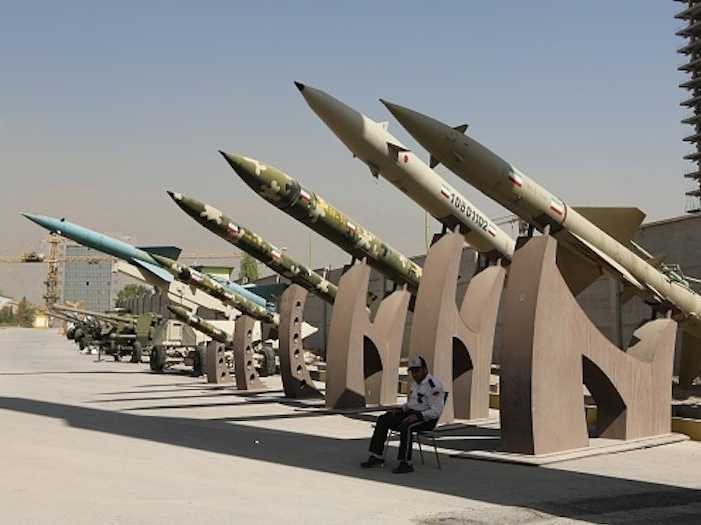
iran-missiles-exhibition-commemorationAtta Kenare/AFP/Getty Images. Missiles are displayed during ‘Sacred Defense Week,’ to commemorate the 1980-88 Iran-Iraq war. Photo taken on Sept. 28, 2014 at a park in northern Tehran.

Early in the P5+1 negotiations, US officials stated that “every issue,” including the missile program, would be on the table. In February 2014, however, Undersecretary of State for Political Affairs Wendy Sherman stated, “If we are successful in assuring ourselves and the world community that Iran cannot obtain a nuclear weapon,” then that “makes delivery systems … almost irrelevant.”

****************

According to the latest reports stemming from the P5+1 talks, Iran is now insisting that UN sanctions on its ballistic missile program be lifted as part of a long-term nuclear accord.

In addition to further complicating already fraught negotiations, this development highlights the importance Tehran attaches to its missile arsenal, as well as the need to answer unresolved questions about possible links between its missile and nuclear programs.

Iran is believed to have the largest strategic missile force in the Middle East, producing short- and medium-range ballistic missiles, a long-range cruise missile, and long-range rockets. Although all of its missiles are conventionally armed at present, its medium-range ballistic missiles could deliver a nuclear weapon if Iran were to build such a device.

Early in the P5+1 negotiations, US officials stated that “every issue,” including the missile program, would be on the table. In February 2014, however, Undersecretary of State for Political Affairs Wendy Sherman stated, “If we are successful in assuring ourselves and the world community that Iran cannot obtain a nuclear weapon,” then that “makes delivery systems … almost irrelevant.”

Yet many observers remain concerned that personnel and facilities tied to Iran’s missile program were, and may still be, engaged in work related to possible military dimensions (PMD) of the nuclear program. These concerns underscore the need to effectively address the missile issue as part of the UN Security Council resolution that will backstop the long-term nuclear accord now being negotiated, if it will not be dealt with in the accord itself.

screen shot 2015-06-11 at 8.47.42 am copyEstimated Range of Iranian Long-Range Missile Forces

Deterrence, warfighting, and propaganda

The Iran-Iraq War convinced Tehran that a strong missile force is critical to the country’s security, and it has given the highest priority to procuring and developing various types of missiles and rockets. Missiles played an important role throughout that war and a decisive role in its denouement.

During the February-April 1988 “War of the Cities,” Iraq was able to hit Tehran with extended-range missiles for the first time. Iranian morale was devastated: more than a quarter of Tehran’s population fled the city, contributing to the leadership’s decision to end the war.

Since then, missiles have been central to Iran’s “way of war,” which emphasizes the need to avoid or deter conventional conflict while advancing its anti-status quo agenda via proxy operations and propaganda activities.

Iran’s deterrence triad rests on its ability to (1) threaten navigation through the Strait of Hormuz, (2) undertake terrorist attacks on multiple continents, and (3) conduct long-range strikes, primarily by missiles (or with rockets owned by proxies such as Hezbollah).

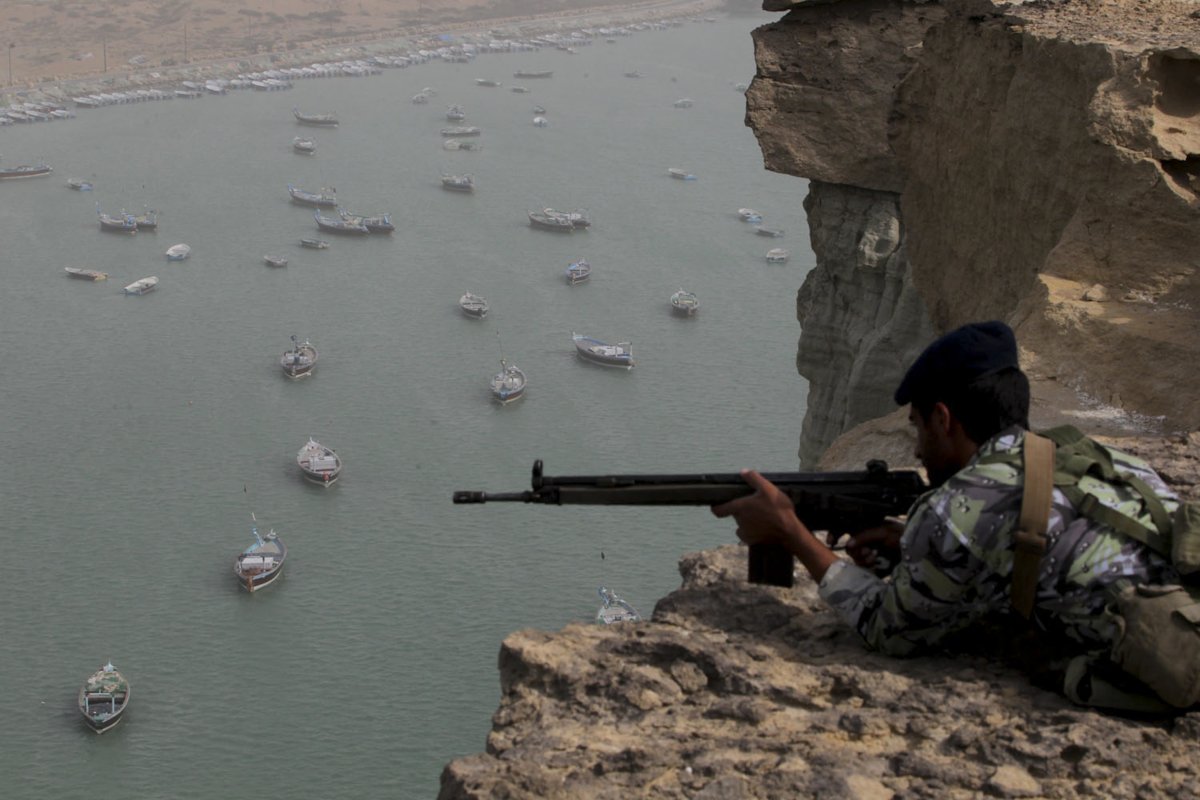
rtr2vqx9REUTERS/Fars News/Hamed Jafarnejad. Iranian military personnel participate in the Velayat-90 war game in unknown location near the Strait of Hormuz in southern Iran December 30, 2011.

Yet the first two options carry limitations.

Closing the strait would be a last resort because nearly all of Iran’s oil exports go through it and Tehran’s ability to wage terror has atrophied in recent years (as demonstrated by a series of bungled attacks on Israeli targets in February 2012). Therefore, Iran’s missile force is the backbone of its strategic deterrent.

Missiles enable Iran to mass fires against civilian population centers and undermine enemy morale. If their accuracy increases in the future, they could further stress enemy defenses (as every incoming missile would have to be intercepted) and enable Iran to target military facilities and critical infrastructure.

Although terrorist attacks afford a degree of standoff and deniability, missiles permit a quicker, more flexible response in a rapidly moving crisis — for example, after an initial series of preplanned terrorist attacks, Tehran or its proxies might need weeks to organize follow-on operations. Missile salvos can also generate greater cumulative effects in a shorter period than terrorist attacks.

Indeed, missiles are ideally suited to Iran’s “resistance doctrine,” which states that achieving victory entails demoralizing one’s enemies by bleeding their civilian population and denying them success on the battlefield. In this context, rockets are as important as missiles, since they yield the same psychological effect on the targeted population.

The manner in which Hezbollah and Hamas used rockets in their recent wars with Israel provides a useful template for understanding the role of conventionally armed missiles in Iran’s warfighting doctrine.

flickr_-_israel_defense_forces_-_damage_caused_by_rockets_fired_from_gaza_(10)Israel Defense Forces via Wikimedia Commons. An apartment building in the town of Kiryat Malachi, damaged as a result of rockets fired from Hamas.

Missiles are also Iran’s most potent psychological weapon. They are a central fixture of just about every regime military parade, frequently dressed with banners calling for “death to America” and declaring that “Israel should be wiped off the map.”

They are used as symbols of Iran’s growing military power and reach. And as the delivery system of choice for nuclear weapons states, they are a key element of Iran’s nascent doctrine of nuclear ambiguity and its attempts at “nuclear intimidation without the bomb.”

Finally, while most nuclear weapons states created their missile forces years after joining the “nuclear club” (due to the significant R&D challenges involved), Iran will already have a sophisticated missile force and infrastructure in place if or when it opts to go that route.

This ensures that a nuclear breakout would produce a dramatic and rapid transformation in Iran’s military stature and capabilities.

Iran’s missle force

Iran has a large, capable missile force, with a likely inventory of more than 800 short- and medium-range ballistic missiles.

These include single-stage liquid-fuel missiles such as the Shahab-1 (300 km range), Shahab-2 (500 km), Qiam (500-750 km), Shahab-3 (1,000-1,300 km), and Qadr (1,500-2,000 km).

Nearly all of them can reach US military targets in the Persian Gulf, and the latter two can reach Israel. These missiles, which include several subvariants, are believed to be conventionally armed with unitary high-explosive or submunition (cluster) warheads.

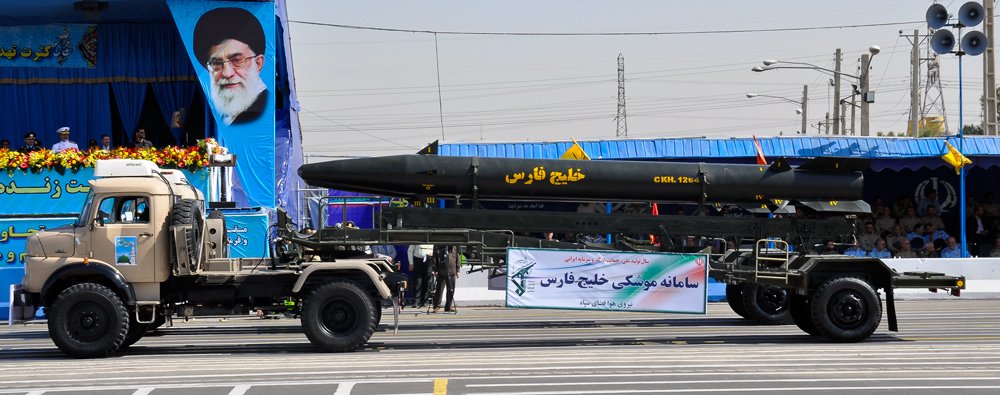
persian-gulf-missileKhalij Fars missile on a transporter.

Additionally, Iran has tested a two-stage solid-fuel missile, the Sejjil-2, whose range of over 2,000 km would allow it to target southeastern Europe — though it is apparently still not operational. In a June 28, 2011, press statement, Tehran claimed that it was capping the range of its missiles at 2,000 km (sufficient to reach Israel but not Western Europe), implicitly eschewing the development of intercontinental ballistic missiles in a presumed bid to deflect US and European concerns.

Yet its Safir launch vehicle, which has put four satellites into orbit since 2009, could provide the experience and knowhow needed to build an ICBM. (According to a May 2010 report by the International Institute for Strategic Studies, the Safir struggled to put a very small satellite into low-earth orbit and has probably reached the outer limits of its performance envelope, so it could not serve as an ICBM itself.) In 2010, Iran displayed a mockup of a larger two-stage satellite launch vehicle, the Simorgh, which it has not yet flown.

Tehran has also claimed an antiship ballistic missile capability that it probably intends for potential use against U.S. aircraft carriers: the Khalij-e Fars and its derivatives, the Hormuz-1/2, each with a claimed range of 300 km. Yet it is not clear that these systems are sufficiently accurate or effective to pose a credible threat to U.S. surface elements in the Gulf.

In addition, Iran recently unveiled the Soumar land-attack cruise missile, which is reportedly a reverse-engineered version of the Russian Raduga Kh-55. It has a claimed range of 2,500-3,000 km, though it may not be operational yet.

The Kh-55 was the Soviet air force’s primary nuclear delivery system.

Iran also fields a very large number of rockets, including the Noor 122 mm (with a range of 20 km), the Fajr-3 and -5 (45 and 75 km), and the Zelzal-1, -2, and -3 (with claimed ranges of 125 to 400 km). During the Iran-Iraq War, rockets played a major role in bombarding Iraqi cities along the border, and they are central to the “way of war” of Iranian proxies and allies such as Hezbollah and Hamas.

Tehran has built this massive inventory so that it can saturate and thereby overwhelm enemy missile defenses in any conflict. It would likely use such tactics whether its missile force remains conventional or becomes nuclear-armed, since conventional missiles could serve as decoys that enable nuclear missiles to penetrate defenses. Numbers would also enable Iran to achieve cumulative strategic effects on enemy morale and staying power by conventional means.

missilesiranAP Photo/Iranian Defense Ministry. To outwork missile defense systems, Iran would use a high volume of missiles.

Finally, many of Iran’s missiles are mounted on mobile launchers, and a growing number are based in silo fields located mainly in the northwest and toward the frontier with Iraq.

This mix of launch options is likely intended to impede preemptive enemy targeting of its missile force. The resources invested in this effort are unprecedented for a conventionally armed force, which indicates that at least some of these missiles would likely be nuclear armed if Iran eventually goes that route.

Nuclear connections

In the annex of a November 8, 2011, report regarding the nuclear program’s possible military dimensions, the International Atomic Energy Agency said it possessed credible information and documents connecting Iran’s missile and nuclear programs. These indicated that, prior to the end of 2003, Iran had:

  • conducted engineering studies on integrating a spherical payload (possibly a nuclear implosion device) into a Shahab-3 reentry vehicle (RV);
  • tested a multipoint initiation system to set off a hemisphere-shaped high-explosive charge whose dimensions were consistent with the Shahab-3’s payload chamber; and
  • worked on a prototype firing system that would enable detonation upon impact or in an airburst 600 meters above a target (a suitable height for a nuclear device).

Moreover, in 2004, Iran began deploying triconic (or “stepped”) RVs — a design almost exclusively associated with nuclear missiles — on its Shahab variants.

Some experts (including Uzi Rubin and Michael Elleman) believe that Iran may have deployed the triconic RV to enhance the stability and thus the accuracy of its conventional warheads, and perhaps to achieve higher terminal velocities that could reduce reaction time for missile defenses.

But if Iran were able to build a miniaturized nuclear device, its experience in designing, testing, and operating missiles with triconic RVs could expedite deployment of this weapon. Indeed, David Albright claimed in his 2010 book Peddling Peril that members of the A. Q. Khan nuclear smuggling network possessed plans for smaller, more advanced nuclear weapon designs that might have found their way to Iran, though most experts doubt the regime’s ability to build such a compact device at this time.

russianukeDesmond Boylan/Reuter

Could Iran have smuggled in a nuclear bomb?

These reports underscore why Washington and its partners must insist that Tehran respond to the IAEA’s questions about past engineering studies, design work, tests, and other elements of the PMD file prior to the lifting of sanctions.

They also highlight the need for a UN Security Council resolution (as called for in the Lausanne parameters) that would impose limitations on Iran’s missile R&D work and threaten real consequences for those who assist Iran’s missile program.

Failure to do so would signal tacit acceptance of activities that could enable Iran to deploy its first nuclear weapon atop a medium-range missile — an achievement that took most nuclear weapons states, including the United States and Soviet Union, about a decade to accomplish.

This development would in turn magnify the destabilizing impact of an Iranian breakout, while incentivizing other regional states to either take preventive action or move toward nuclear capabilities of their own before Iran crosses that threshold.

Contentions — Cementing the Bad Deal

July 6, 2015

Contentions — Cementing the Bad Deal, Commentary Magazine, July 6, 2015

The following is a dispatch from The Israel Project’s Omri Ceren regarding the state of nuclear negotiations with Iran:

Happy Monday from Vienna. The EU’s foreign affairs chief Federica Mogherini arrived yesterday and told reporters: “As you know I have decided to reconvene the ministers. They will be arriving tonight and tomorrow. It is the third time in exactly one week. That’s the end, the last part of this long marathon.” Secretary of State John Kerry and Iranian Foreign Minister Javad Zarif already held an impromptu meeting this morning. The overarching consensus – which is almost certainly correct – is that whatever gets announced will be announced no later than tomorrow afternoon. It might very well happen tonight.

As to what that announcement might be, there are a few options. In order of increasing probability:

0% chance: Kerry might make good on the comments that he made yesterday to reporters, and walks away from a bad deal.

Very low probability: the parties might come to a full-blown agreement ready to be implemented immediately. This scenario was never likely by June 30, and became functionally impossible after Supreme Leader Ayatollah Ali Khamenei set out a range of new red lines a few weeks ago. Also, the Iranians gave a background briefing earlier today in Vienna where they provided their interpretation of an emerging final deal. Among other things they have some interesting views on what military-related restrictions will be lifted, which are in tension with how the Americans have been describing the deal. Those differences will have to be overcome, and they won’t be in the next few days.

Low-probability: the gaps might still be too significant to even colorfully announce a deal, and the parties would extend the interim agreement all the way through the summer. The option would be more attractive to the Obama administration than taking another 2 or 3 weeks. If the administration sends Congress a deal after July 9 then the Corker clock – how long a deal sits in front of Congress – goes from 30 days to 60 days. But if they get all the way through the summer, it goes back down to 30 days. The administration has obvious reasons to prefer that.

Most likely: there will be a non-agreement agreement. The parties will announce they’ve resolved all outstanding issues but they still have to fill in some details. Then the P5+1 and Iran would move in parallel to implement various commitments, and the Iranians would in particular have to work with the IAEA on its unresolved concerns regarding Iran’s weapons program (PMDs). In the winter the IAEA would provide a face-saving way for the parties to declare Iran is cooperating – IAEA head Amano said earlier this week that the agency could wrap up by the end of the year if Iran cooperates – and then a deal would officially begin. The option is attractive to the administration because it puts off granting Iran all of its anticipated sanctions relief until the IAEA makes some noises about the Iranians cooperating. The alternative would be poison on the Hill. This way the administration can tell Congress that of course PMDs will be resolved before any sanctions relief is granted; and after Congress votes, if the Iranians jam up the IAEA but demand relief anyway, lawmakers will have no leverage to stop the administration from caving.

The focus will then shift to Congress, where the debate on approving or disapproving of the deal will take place over the next month. Some of the questions will get technical and tangled – the breakout time debate is going to be mind-numbing – but lawmakers will also use a very simple metric: Is the deal the same one the President promised he’d bring home twenty months ago? Back then the administration was very clear about what constituted a good deal and emphatic that U.S. negotiators had sufficient leverage to secure those terms. The U.S. subsequently collapsed on almost all of those conditions, and lawmakers will want to know how the deal can still count as a good one.

In line with those questions, here is a roundup from the Foreign Policy Initiative on where the administration started and how dramatically it has moved backwards. From the overview of the analysis:

Over the past three years, the Obama administration has delineated the criteria that any final nuclear agreement between the P5+1 and Iran must meet. In speeches, congressional testimony, press conferences, and media interviews, administration officials have also articulated their expectations from Tehran with repeated declarations: “No deal is better than a bad deal.” This FPI Analysis… compiles many of the administration’s own statements on nuclear negotiations with Iran over the past three years, and compares them with current U.S. positions. It also examines U.S. statements on a range of other issues related to U.S. policy toward Tehran, and assesses whether subsequent events have validated them.

The web version has embedded links for each of the statements, so if you need them just click through on the url at the top. You might just want to do that anyway, because the web version is more readable.

Zarif on getting to yes

July 4, 2015

Zarif on getting to yes, Power LineScott Johnson, July 3, 2015

(Javad Zarif — “Mr. Moderation.” — DM)

In the annals of murderous deceit and provocative audacity, the video of Iranian foreign minister Javad Zarif takes the cake. The video aims at zarif’s American counterparts and a wider American audience. The video is posted here with full text of Zarif’s message on YouTube. [Here’s the video, with text in a box beneath it. — DM)

Mr. Zarif advises: “Getting to yes requires the courage to compromise, the self-confidence to be flexible, the maturity to be reasonable, the wisdom to set aside illusions, and the audacity to break old habits.” Do check out the whole sickening production. It virtually defies belief. Mr. Zarif, where can I get the soundtrack?

Mr. Zarif, of course, speaks with a forked tongue about the qualities conducive to this particular agreement. He must be in some doubt on this point, but I’m confident that our own Supreme Leader has all the qualities necessary to enter into the deal in process with Iran.

Deadlines, red lines

July 3, 2015

Deadlines, red lines, Israel Hayom, Ruthie Blum, July 3, 2015

(Please see also, Iran’s Nuclear Negotiators Emboldened by Islamic Ideology: Cleric at (Iranian) Tashim News Agency. — DM)

The regime in Tehran has made its position clear. So has the White House. It will take a miracle — or a military strike — to prevent Iran from building nuclear bombs.

**********************

The deadline for a nuclear deal between the P5+1 powers and Iran was extended on Tuesday, when too many bones of contention remained unresolved on June 30. The new date set by the parties to finalize the “framework for an agreement” reached in Lausanne three months ago is July 7.

This means that there are four days to go before the current talks in Vienna bear fruit in the form of an official document. If such a piece of paper is signed, two leaders will feel particularly vindicated: U.S. President Barack Obama and Iranian President Hassan Rouhani — the former for playing out his fantasy of peace through diplomacy and the latter for delivering the goods to his boss, Ayatollah Ali Khamenei.

The rest of the world, however, will be in mortal peril. And Israel will be forced to act fast.

The only sliver of a silver lining in this otherwise black cloud is that Islamists sometimes play their cards wrong. Buoyed by the weakness of the West in the face of their fanaticism, they often take their visions of grandeur to heights that even American and European appeasers cannot accept. So by next week, it is possible that the Iranian negotiators will overstep their counterparts’ bounds, and everyone will return to the country from whence they came with nothing but another date and venue to show for their efforts.

But because the stakes are nuclear weapons in the hands of a mullah-led regime bent on global hegemony — and working toward it through proxy terrorist organizations — one cannot count on the above scenario.

A number of recent statements are cause for concern.

On Thursday, Iranian Foreign Minister Mohammad Javad Zarif told reporters: “The negotiations are moving forward and we should be hopeful. Today is a good day.”

This was an abbreviated version of what his deputy, Abbas Araqchi, said the day before in a TV interview: “A positive atmosphere is ruling the negotiations, and the spirit for going forward exists in all delegations, but this doesn’t mean that all delegations, including us, are ready to reach an agreement at any price.”

Araqchi also defined a “good deal” as one that would honor Khamenei’s “red lines.”

These were spelled out in a June 23 speech by Khamenei (and included in a June 30 Middle East Media Research Institute report): “In contrast to what the Americans are insisting on, we do not accept long-term restrictions for 10 to 12 years.

“Research, development and construction will continue. … They say, ‘Don’t do anything for 12 years,’ but these are particularly violent words, and a gross mistake.

“The economic, financial and banking sanctions — whether related to the Security Council or the American Congress and administration — must be lifted immediately with the signing of the agreement. The remainder of the sanctions will also be lifted within a reasonable time frame. The Americans are presenting a complex, convoluted, bizarre, and stupefying formula for [removing the] sanctions, and it is unclear what will emerge from it, but we are clearly stating our demands.

“The lifting of the sanctions must not depend on Iran carrying out its obligations. Don’t say, ‘You carry out your obligations and then the IAEA will approve the lifting of the sanctions.’ We vehemently reject this. The lifting of the sanctions must take place simultaneously with Iran’s meeting of its obligations. We oppose the delay of the implementation of the opposite side’s obligations until the [release of] the IAEA report [verifying that Iran has met its obligations], because the IAEA has proven repeatedly that it is neither independent nor fair, and therefore we are pessimistic regarding it.

“They say, ‘The IAEA should receive guarantees.’ What an unreasonable statement. They will be secure only if they inspect every inch of Iran. We vehemently reject special inspections [that are not customary for any country except Iran], questioning of Iranian personnel, and inspection of military facilities.

“Everyone in Iran — including myself, the government, the Majlis [parliament], the judiciary, the security apparatuses, and the military, and all institutions — want a good nuclear agreement … that is in accordance with Iran’s interests.

“Although we wish the sanctions lifted, we see them as [having brought us] a particular kind of opportunity, because they made us pay more attention to domestic forces and domestic potential.”

A few days later, on June 29, Obama’s deputy national security adviser, Ben Rhodes, gave an interview to The Atlantic’s Jeffrey Goldberg at the Aspen Ideas Festival.

When asked whether Obama believes a deal will exact change in Iran’s behavior, Rhodes replied: “We believe that an agreement is necessary … even if Iran doesn’t change. … That said, we believe that a world in which there is a deal with Iran is much more likely to produce an evolution in Iranian behavior than a world in which there is no deal. In fact … if the notion is that Iran has been engaged in these destabilizing activities under the last several years when they’ve been under the pressure of sanctions, clearly sanctions are not acting as some deterrent against them doing destabilizing activities in the region. … [T]he point is … in a world of a deal, there is a greater possibility that you will see Iran evolve in a direction in which they are more engaged with the international community and less dependent upon the types of activities that they’ve been engaged in.”

The regime in Tehran has made its position clear. So has the White House. It will take a miracle — or a military strike — to prevent Iran from building nuclear bombs.