Posted tagged ‘Iran – Middle East’

Iran’s Chess Board

June 3, 2016

Iran’s Chess Board, Front Page MagazineCaroline Glick, June 3, 2016

official_photo_of_hassan_rouhani_7th_president_of_iran_august_2013

Even if Obama’s successor disavows his actions, by the time Obama leaves office, America’s options will be more limited than ever before. Without war, his successor will likely be unable to stem Iran’s rise on the ruins of the Arab state system.

********************

Reprinted from jpost.com.

Strategic thinking has always been Israel’s Achilles’ heel. As a small state bereft of regional ambitions, so long as regional realities remained more or less static, Israel had little reason to be concerned about the great game of the Middle East.

But the ground is shifting in the lands around us. The Arab state system, which ensured the strategic status quo for decades, has collapsed.

So for the first time in four generations, strategy is again the dominant force shaping events that will impact Israel for generations to come.

To understand why, consider two events of the past week.

Early this week it was reported that after a two-year hiatus, Iran is restoring its financial support for Islamic Jihad. Iran will give the group, which is largely a creation of the Iranian Revolutionary Guard Corps, $70 million.

On Wednesday Iranian media were the first to report on the arrest of a “reporter” for Iran’s Al-Alam news service. Bassam Safadi was arrested by Israel police in his home in Majdal Shams, the Druse village closest to the border with Syria on the Golan Heights. Safadi is suspected of inciting terrorism.

That is, he is suspected of being an Iranian agent.

There is nothing new about Iranian efforts to raise and run fronts against Israel within its territory and along its borders. Iran poses a strategic threat to Israel through its Hezbollah surrogate in Lebanon, which now reportedly controls the Lebanese Armed Forces.

In Gaza, Iran controls a vast assortment of terrorist groups, including Hamas.

In Judea and Samaria, seemingly on a weekly basis we hear about another Iranian cell whose members were arrested by the Shin Bet or the IDF.

But while we are well aware of the efforts Iran is making along our borders and even within them to threaten Israel, we have not connected these efforts to Iran’s actions in Iraq and Syria. Only when we connect Iran’s actions here with its actions in those theaters do we understand what is now happening, and how it will influence Israel’s long-term strategic environment.

The big question today is what will replace the Arab state system.

Syria, Iraq, Lebanon, Yemen and Libya no longer exist. On their detritus we see the fight whose results will likely determine the fates of the surviving Arab states, as well as of much of Europe and the rest of the world.

Israel’s strategic environment will be determined in great part by the results of Iran’s actions in Iraq and Syria. While Israel can do little to affect the shape of events in these areas, it must understand what they mean for us. Only by doing so, will we be able to develop the tools to secure our future in this new strategic arena.

Until 2003, Saddam Hussein was the chief obstacle to Iran’s rise as the regional hegemon.

US forces in Iraq replaced Hussein until they left the country in 2011. In the meantime, by installing a Shi’ite government in Baghdad, the US set the conditions for the rise of Islamic State in the Sunni heartland of Anbar province on the one hand, and for Iran’s control over Iraq’s Shi’ite-controlled government and armed forces on the other.

Today, ISIS is the only thing checking Iran’s westward advance. Ironically, the monstrous group also facilitates it. ISIS is so demonic that for Americans and other Westerners, empowering Iranian-controlled forces that fight ISIS seems a small price to pay to rid the world of the fanatical scourge.

As former US naval intelligence analyst J.E. Dyer explained this week in an alarming analysis of Iran’s recent moves in Iraq published on the Liberty Unyielding website, once Iranian- controlled forces defeat ISIS in Anbar province, they will be well placed to threaten Jordan and Israel from the east. This is particularly the case given that ISIS is serving inadvertently as an advance guard for Iran.

In Syria, Iran already controls wide swaths of the country directly and through its surrogates, the Syrian army, Hezbollah and Shi’ite militias it has fielded in the country.

Since the start of the war in Syria, Israel has repeatedly taken action to block those forces from gaining and holding control over the border zone on the Golan Heights.

Prime Minister Benjamin Netanyahu’s surprising recent announcement that Israel will never relinquish control over the Golan came in response to his concern that in exchange for a cease-fire in Syria, the US would place that control on the international diplomatic chopping block.

A week and a half ago, Iran began its move on Anbar province.

On May 22, Iraqi forces trained by the US military led Iraq’s offensive to wrest control over Fallujah and Mosul from ISIS, which has controlled the Sunni cities since 2014. Despite the fact that the lead forces are US-trained, the main forces involved in the offensive are trained, equipped and directed by Iran.

As Iraqi forces surrounded Fallujah in the weeks before the offensive began, Qassem Soleimani, the commander of the Revolutionary Guards’ Quds forces, paid a public visit to the troops to demonstrate Iran’s dominant role.

The battle for Fallujah is a clear indication that Iran, rather than the US, is calling the shots in Iraq. According to media reports, the Pentagon wanted and expected for the forces to be concentrated in Mosul. But at the last minute, due to Soleimani’s intervention, the Iraqi government decided to make Fallujah the offensive’s center of gravity.

The Americans had no choice but to go along with the Iranian plan because, as Dyer noted, Iran is increasingly outflanking the US in Iraq. If things follow their current course, in the near future, Iran is liable to be in a position to force the US to choose between going to war or ceasing all air operations in Iraq.

On May 7, Asharq al-Awsat reported that the Revolutionary Guards is building a missile base in Suleimaniyah province, in Iraqi Kurdistan.

A senior IRGC general has made repeated visits to the area in recent weeks, signaling that the regime views this as an important project. The report further stated that Iran is renewing tunnel networks in the region, built during the 1980-88 Iran-Iraq War.

Dyer warned that depending on the type of missiles Iran deploys – or has deployed – to the base, it may threaten all US air operations in Iraq. And the US has no easy means to block Iran’s actions.

To date, commentators have more or less agreed that US operations in Iraq and Syria make no sense. They are significant enough to endanger US forces, but they aren’t significant enough to determine the outcome of the war in either territory.

But there may be logic to this seemingly irrational deployment that is concealed from view. A close reading of David Samuels’s profile of President Barack Obama’s Deputy National Security Adviser Ben Rhodes published last month in The New York Times, points to such a conclusion.

Samuels described Rhodes as second only to Obama in his influence over US foreign and defense policy. Rhodes boasted to Samuels that Obama’s moves toward Iran were determined by a strategic course he embraced before he entered office.

A fiction writer by training, Rhodes’s first “national security” job was as the chief note taker for the Iraq Study Group.

Then-president George W. Bush appointed the group, jointly chaired by former secretary of state James Baker and former congressman Lee Hamilton, in 2006, to advise him on how to extricate the US from the war in Iraq.

In late 2006, the ISG published its recommendations.

Among other things, the ISG recommended withdrawing US forces from Iraq as quickly as possible. The retreat was to be enacted in cooperation with Iran and Syria – the principle sponsors of the insurgency.

The ISG argued that if given the proper incentives, Syria and Iran would fight al-Qaida in Iraq in place of the US. For such action, the ISG recommended that the US end its attempts to curb Iran’s nuclear program.

Responsibility for handling the threat, the ISG recommended, should be transferred to the US Security Council.

So, too, the ISG recommended that Bush pressure Israel to withdraw from the Golan Heights, Jerusalem and Judea and Samaria in the framework of a “peace process.”

Such action too would serve to convince Iran and Syria that they could trust the US and agree to serve as its heirs in Iraq.

Bush of course, rejected the ISG’s recommendations.

He decided instead to sue for victory in Iraq. Bush announced the surge in US forces shortly after the ISG published its report.

But now we see, that through Rhodes the Iraq Study Group’s recommendation became the blueprint for a new US strategy of retreat and Iranian ascendance in Iraq and throughout the Middle East.

The chief components of that strategy have already been implemented. The US withdrawal from Iraq in 2011 left Iran as the new power broker in the country. The nuclear pact with Iran facilitated Iran’s transformation into the regional hegemon.

Against this strategic shift, the US’s minimalist campaigns in Iraq and Syria against ISIS make sense.

The US forces aren’t there to defeat ISIS, but to conceal Iran’s rise.

When ISIS is defeated in Anbar and in Raqqa in Syria, its forces are liable to turn west, to Jordan.

The US is currently helping Jordan to complete a border fence along its border with Iraq. But then ISIS is already active in Jordan.

And if events in Iraq and Syria are any guide, where ISIS leads, Iran will follow.

Iran’s strategic game, as well as America’s, requires Israel to become a strategic player.

We must recognize that what is happening in Iraq is connected to what is happening here.

We need to understand the implications of the working alliance Obama has built with Iran.

Even if Obama’s successor disavows his actions, by the time Obama leaves office, America’s options will be more limited than ever before. Without war, his successor will likely be unable to stem Iran’s rise on the ruins of the Arab state system.

In this new strategic environment, Israel must stop viewing Gaza, Judea and Samaria, the Golan Heights and Lebanon as standalone battlefields. We must not be taken in by “regional peace plans” that would curtail our maneuver room. And we must bear in mind these new conditions as we negotiate a new US military assistance package.

The name of the game today is chess. The entire Middle East is one great board. When a pawn moves in Gaza, it affects the queen in Tehran.

And when a knight moves in Fallujah, it threatens the queen in Jerusalem.

What Washington Doesn’t Get about Iran

June 1, 2016

What Washington Doesn’t Get about Iran, The National Interest, Lincoln P. Bloomfield Jr.Ramesh Sepehrrad, May 31, 2016

(It’s a very long article. That’s necessary when trying to analyze the mess Washington has made through its dealings with Iran. — DM)
ayatollah (1)

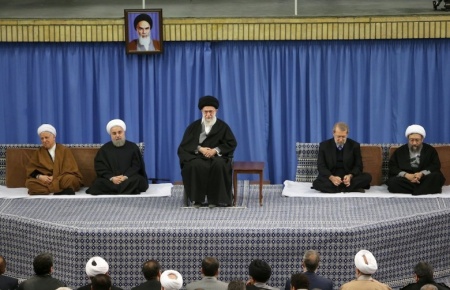
Obscured by the drama of America’s presidential campaign, one major foreign policy issue—the future direction of the U.S. approach to Iran—is at a crossroads. President Obama stood before world leaders at the UN General Assembly in September 2013 and stated, “If we can resolve the issue of Iran’s nuclear program, that can serve as a major step down a long road towards a different relationship, one based on mutual interests and mutual respect.” Yet in the aftermath of the July 2015 nuclear accord, statements by Iran’s Supreme Leader Ali Khamenei and Iranian actions have provided little indication that U.S.-Iran relations are moving in a direction more respectful of American interests.

“It is now clear,” writes UAE Ambassador to the United States Yousef al-Otaiba, “that one year since the framework for the deal was agreed upon, Iran sees it as an opportunity to increase hostilities in the region.” Internally, executions of prisoners is at a twenty-year high. Still, the occasion of national elections in February for Iran’s parliament and Assembly of Experts—like the June 2013 election of President Hassan Rouhani—generated widespread commentary by policy experts in the United States that a process of meaningful change was at hand, as “reform” candidates outpolled their hard-line opponents in Tehran.

Testifying before the Senate on April 5, Under Secretary of State for Political Affairs Thomas Shannon asserted that “the extent to which reformers. . . swept the board” in polling for parliamentary seats in Tehran “highlights the fact that President Rouhani, and his intent on opening Iran to the world and addressing the fundamental stumbling blocks, has resonated in a positive way.” Under Secretary Shannon cited the difficulty in determining the impact of these electoral results on “how Iran behaves strategically” because, as he explained, Iran is “a mix of conflictive entities and groups, with hard-liners aligning themselves both with religious. . . and security leadership to prevent reformists from moving too fast, too far.” Part of the supreme leader’s work, said Mr. Shannon, “is to balance forces inside of Iran.”

Factionalism and jockeying for influence and position occur quite naturally in leadership ranks of democracies and dictatorships alike, including Iran. The key question Under Secretary Shannon could not answer definitively is whether regime politics would ever allow for real change in Iran’s “strategic” behavior. His remarks, however, reflected a long-standing belief by policymakers and advisors that the clerical circle in power since the 1979 revolution is capable of empowering political stewards who are inclined to reform Iran and fulfill President Obama’s hopeful vision, reciprocating his administration’s solicitude and forbearance toward Tehran.

Decades of Chasing the Elusive Promise of Reform

U.S. policymakers have experienced cycles of hope and disappointment with Tehran. After being singed by scandal in the mid-1980s, when President Reagan’s arms-for-hostages dealings were exposed, U.S. officials anticipated positive change in Iran when Akbar Hashemi Rafsanjani gained the presidency in 1990 with the promise of rebuilding an economy weakened after eight years of war with Iraq. However, terror attacks in Germany and Argentina ensued, along with assassinations of exiled regime opponents, tied directly to Rafsanjani and Khamenei. The June 25, 1996, bombing of Khobar Towers in Saudi Arabia killed nineteen U.S. airmen, as the Clinton administration maintained a “dual containment” approach toward both Iran and Iraq, backed by mounting sanctions.

When Mohammad Khatami took office as president in 1997 and proposed a “Dialogue of Civilizations,” again Washington judged that he was a reasonable interlocutor signaling a departure from Iran’s pattern of repression at home and terrorism abroad. The wave of domestic oppression that followed, including what came to be known as the “chain murders” of dissidents by Iran’s intelligence ministry, appeared to many as a hard-line reaction to Khatami’s agenda; nevertheless, for the Iranian people, hopes for reform under Khatami gave way to “fears of darker times ahead.”

Not even the fact that Iran’s nuclear program advanced dramatically in secret under President Khatami would shake Washington’s durable conviction that progressive elements within the Tehran ruling elite might one day ascend to power, as keen to see Iran adhere to international norms and uphold universal rights as are Western governments and citizens.

Listening to most Iran analysts at policy gatherings in Washington, two themes will be apparent. First, any mention of Iran’s status as the leading state sponsor of terrorism, its domestic human rights abuses or the destructive activities of the Islamic Revolutionary Guard Corps (IRGC), including its elite Quds Force, will be at once acknowledged and dismissed with a figurative hand-wave. This is old news; Iran has for years been sanctioned over it. Since there is no new story here, only unenlightened warmongers would harp on these aspects of Iranian affairs which, while condemnable, only stifle consideration of the possibilities for U.S. policy with Iran looking forward.

Second, the topic that animates the policy cognoscenti, and comports with the aspirations of the Obama White House, is the dynamic ebb-and-flow of political factions competing within Iranian leadership circles: “principlists” versus “reformers,” “conservatives” versus “moderates,” the hard-line Khamenei group versus the Rafsanjani group that seeks to integrate Iran more with the outside world. At a time when America’s own presidential election process has featured candidates channeling popular discontent toward the country’s political and economic elites, media coverage of Iran’s most recent elections—encouraged by the administration’s own rhetoric—has amplified the theme of grassroots rebellion at the polls. Given the lack of details reported about Iran’s managed electoral process, the average American would be forgiven for assuming that 79 million Iranian citizens were freely exercising popular sovereignty.

Iran’s wrongful behavior, other than actions seen as possible violations of the Joint Comprehensive Plan of Action (JCPOA), is reported, but not debated, as the policy community seems devoid of confidence that it could constructively influence the regime organs overseeing terrorism, paramilitary operations, judicial abuse, monopoly control of economic and financial assets, restraints on journalism, communications monitoring and censorship, arms trafficking to violent nonstate actors, propaganda and intelligence deception operations. This drumbeat of undesirable Iranian actions, now well into its fourth decade, has continued unabated despite the nuclear deal. Yet much more attention is paid to President Rouhani and Foreign Minister Mohammad Javad Zarif, the lead figures in Tehran’s diplomatic overture to the West, because they are perceived as agents of hoped-for change that might, at long last, end the negative drumbeat.

Is the administration’s hope justified or misplaced? Granted that factions rise and fall inside Iran’s clerical elite, the implications of these dynamics, like so much of Iran’s post-1979 history, offer reasonable grounds for debate. Debate is needed, as President Obama presented his diplomatic project with Iran last year as a fait accompli, accusing any detractors of courting war. Is it impolitic to suggest that neither Supreme Leader Ali Khamenei nor former president Rafsanjani would press their rival tendencies within the governing structure to the point of empowering other political forces and destabilizing the regime’s collective hold on power in Iran? Where has the case been made that clerical “reformers” will effect strategically significant change?

The central policy issue—how meaningful change in Iran can occur—has not been seriously explored. The administration’s and its supporters’ energies have largely been directed toward defending the JCPOA against political critics whose knowledge of Iranian affairs they regard as inferior. A top advisor to President Obama has recently admitted that the administration’s narrative “of a new political reality in Iran, which came about because of elections that brought moderates to power in that country. . .  was largely manufactured for the purpose for [sic] selling the deal.”

Nevertheless, by underscoring reformist challenges to the conservative order and touting electoral “upsets,” policy experts are acknowledging differences within the regime, and tensions between government and governed in Iran. What direction and scenario should the United States wish to see unfold from here? With the U.S. presidency transitioning in 2017, a proper understanding of the Tehran regime’s challenges, priorities and choices is needed now as the predicate to a realistic, principled and forward-looking “post-JCPOA” Iran policy.

Overlooked Clues from the Regime’s History

Americans of a certain age are familiar with scenes reported from Iran since 1979, where crowds gathered to chant “Death to America”; news in recent years has signaled the existence of dissent against the status quo, manifested in the rise and suppression of the Green uprising during the June 2009 elections, and the popular demonstrations against election fraud that followed, during which twenty-six-year-old philosophy student Neda Agha-Soltan was shot to death in the streets of Tehran by regime enforcers. But the reality behind these and other political events merits closer examination.

In a system where political authority is permanent and nonnegotiable, the narrative of both current and past events is vigilantly managed by the rulers, as an essential tool of regime survival. What with Foreign Minister Zarif’s artful appeals to Western opinion in which he proclaims Iran’s peaceful intent and devotion to international law, and laments its unfair victimization by “threats, sanctions and demonization” by the United States in particular, one can only imagine what effect thirty-seven years of managed media have had on the population, the penetration of internet and satellite television notwithstanding.

In Iran today, where the loyalty of aspirants to political office is closely monitored and overt dissent is severely punished, there is no credible measurement of the population’s true level of attachment to, or desire to be rid of, the constitutional caliphate fashioned in 1979 by Ayatollah Khomeini. Khomeini’s fusing of politics and religion via a new constitution codifying a “guardianship of the Islamic jurist” (velayat-e faqih) drew upon the religious devotion of Iran’s Muslims as the basis for his exercise of temporal power. For many Iranians at the time, Muslims included, religious dictatorship was a far cry from the participatory democracy they had anticipated after enduring the excesses of the shah.

Confronted with growing resistance in the spring of 1981 to the restrictive new order that culminated in massive pro-democracy demonstrations across the country invoked by MEK leader Massoud Rajavi on June 20—twenty-eight years to the day before Neda famously met her death under similar circumstances—Khomeini’s reign was secured at gunpoint with brute force, driving Iran’s first and only freely elected president, Abolhassan Bani-Sadr, underground and into permanent exile. This fateful episode was described by historian Ervand Abrahamian as a “reign of terror”; Professor Marvin Zonis called it “a campaign of mass slaughter.”

President Obama, reflecting a view common among analysts and journalists in America, has made imprecise reference to “the theocrats who overthrew the Shah.” The reality is that in the late 1970s the shah lost his mandate with many segments of the Iranian population, and his departure sparked a dramatic outburst of electoral competition, even while Khomeini was requiring office seekers to accept his constitutional formula, elevating religious authority over all politics. As the incompatibility of democratic principles with velayat-e faqih became increasingly evident, the regime was, as Professor Abrahamian described it, “clearly. . . losing control in the streets.” What Iranians today know all too well, and Americans would profit by better understanding, is that the “theocrats” secured control of Iran not by bringing down the shah, but by bringing down the revolution.

It is not the only historical misperception that has stood uncorrected. Speculation has surrounded the Obama administration’s Iran diplomacy that some kind of gesture by the United States—if not an outright apology, then an acknowledgement of past mistakes—would be extended as atonement for the CIA coup that deposed nationalist Prime Minister Mohammad Mossadegh in 1953. Indeed, Tehran has repeatedly demanded it. Yet, for historical justice to be served, a representative of the supreme leader would need to affix his signature to any such mea culpa alongside that of the president’s representative, reflecting the fact that the leading clerics at the time, including Khomeini’s mentor Ayatollah Abol-Ghasem Kashani, openly colluded with the Pahlavi dynasty and backed the ouster of Mossadegh.

Kashani later pronounced Mossadegh guilty of betraying the jihad, and said he deserved the death penalty. Khomeini himself expressed satisfaction with Mossadegh’s downfall. Here again, the clerics have airbrushed their place in Iran’s turbulent political evolution for the West’s edification.

June 1981—a cataclysmic event in Iran’s modern political history, second only perhaps to the shah’s demise—is relevant to understanding why the clerics responded with deadly force to the challenge of the Green uprising and the return of citizens to the streets en masse in 2009, demanding democratic accountability. Nor was the closed (and rigged) electoral process the only longstanding source of disaffection: Khomeini’s fundamentalist forces early on had targeted Iran’s universities with their “cultural revolution” to suppress mainly leftist critics, whose appeal among students and intellectuals further highlighted their lack of political legitimacy.

Despite their comprehensive efforts to silence intellectual dissent, the torch of antiauthoritarian resistance carried through the 1980s to the next generation, resurfacing in public protests during July of 1999. People took to the streets after regime forces closed a student paper and violently attacked a dormitory at Tehran University, reportedly throwing students from windows.

Fear of the “street,” consequently, was almost certainly a central consideration behind Iran’s costly (and continuing) intervention in Syria after pro-democracy Arab Spring demonstrations first arose there in 2011. More than any other partisan in the Syria conflict, Iran is credited with keeping a minority secular dictatorship in power, in defiance of President Obama’s vow that Bashar al-Assad must go, a determined if ill-equipped Syrian resistance, and UN-backed efforts to foster a national reconciliation process entailing a transition to new leadership.

Similarly in Iraq, the Quds Force’s active direction of client Shia parties and militias, reported to be “carrying out kidnappings and murders and restricting the movement of Sunni Arab civilians,” has impeded that country’s efforts toward a functioning multiethnic constitutional system, and further imperiled Iraq’s fragile national unity.

Islamic State may be a concern to Iran, but successful, multiethnic constitutional republics replacing the Baathist dictatorships in Syria and Iraq would be a much greater concern. For Tehran, the potential that an eastward-spreading Arab Spring could ignite a new Persian Spring was, and remains, a constant danger to the Islamic Republic’s grip on the reins of power, to be prevented at all costs.

The deficit of legitimacy underlying the mullahs’ claim to power remains a blind spot in Washington’s collective understanding of the Iranian revolution, overlooked in the wake of the hostage crisis. It may account for the absence of critical thinking to challenge, for example, the regime’s narrative of its eight-year war with Saddam Hussein’s Iraq, never questioning why Khomeini, after regaining by mid-1982 all the Iranian territory seized by Iraq in 1980, prosecuted the war for six more years, during which Iran suffered 90 percent of its casualties and depleted its economy.

Just as the seizure of the U.S. embassy in 1979 had empowered the clerics against contending political forces, the war with Iraq provided the supreme leader with an emergency mandate to crush growing internal dissent, impose religious and cultural requirements, and appropriate all necessary resources to assure the regime’s primacy and control. While every Iranian schoolchild and adult throughout the 1980s was fed the jingoistic line justifying these extreme sacrifices, Khomeini’s role in perpetuating the war is by no means universally recalled by Iranians in a favorable light.

A similar lack of skepticism has left U.S. policymakers with no insight as to why a hojatoleslam—a cleric with religious status well below others at the time—belatedly became Khomeini’s chosen successor as supreme leader rather than the broadly respected Grand Ayatollah Hossein Ali Montazeri; no benign explanation as to why Iran would choose to pursue major nuclear infrastructure investments instead of far more accessible and cost-effective energy options, given its meager national uranium supplies; and no reflection on whether considerations other than sanctions-induced financial duress may have led Iran to the P5+1 negotiating table.

Similarly, one saw no speculation in Washington that factors other than personal legal transgressions could have lain behind the arrest and imprisonment of the Washington Post’s correspondent Jason Rezaian—or curiosity about what the regime hoped to hide by deterring Western correspondents from seeking visas to report from Iran at that time. A clue may be found in the emerging story of another U.S. hostage, former CIA contractor Robert Levinson (still held by Iran), whom the Iranians reportedly offered via the French government in 2011 to release in exchange for conclusions, in a pending IAEA report, that Iran’s nuclear program was “peaceful” in nature.

This credulous U.S. approach to Iranian affairs has not been helped by what might delicately be termed self-censorship on the part of Western correspondents and media companies, who know they would be shut out of Iran if their reporting sufficiently displeased the regime. For too long, U.S. policy has reacted to Iranian government actions and words without a credible functional understanding of the nature of this important international actor.

The Regime’s “Job One”: Maintain Control

During the regime’s formative years, the man who would in 1989 succeed Khomeini as supreme leader, Ali Khamenei, worked in partnership with Rafsanjani to implement Khomeini’s doctrine of bast (expansion) and hefz (preservation), the two facets assuring continuity of the Islamic revolution. Their work was at the center of Khomeini’s velayat-e faqih project. While both figures are today identified with conflicting political tendencies and loyalists, the larger reality is that bast and hefz remain core tenets of the Islamic Republic of Iran.

What Washington describes in straight factual terms—destabilization of neighboring countries, propping up a dictator in Damascus guilty of grave crimes against his country, arming extremist nonstate actors, fomenting sectarian warfare that undermines Iraq’s fragile hopes for rights-based governance—the clerics in Tehran call bast. The revolution, said Khomeini, requires energetic efforts to advance Tehran’s agenda well beyond the country’s borders.

Similarly, the surreptitious and aggressive buildup at home of Iran’s uranium enrichment capacity, and associated “possible military dimensions” of its nuclear program, combined with widely condemned and worsening human rights abuses, restrictions on journalists, monitoring and propaganda imposed within the information space, and seizure of control over much of the functioning economy—all these and other domestic measures fulfill the doctrine of hefz. To stay in power, the regime must monopolize the levers of power within the country.

As two of the original officers of the velayat-e faqih operation from the outset of Ayatollah Khomeini’s tenure, Ali Khamenei and Hashemi Rafsanjani understood, as few others did, the dynamic nature of the revolutionary enterprise. Both recognized that the Islamic Republic would not long survive without continually demanding respect and pursuing influence externally while requiring sacrifice and enforcing subservience internally. In 1989, after Ali Khamenei succeeded Khomeini, Rafsanjani worked in partnership with the new supreme leader to enhance the authority of the office as compensation for his lack of religious and political stature and charisma.

The velayat-e faqih has always operated on two fronts. Domestically, it maintains a focus on image-building propaganda for the leader of the revolution, ever promoting the stature of its “heroic” godfather, Ayatollah Khomeini. Propaganda is used to rally and unify the Revolutionary Guards, mobilize paramilitary forces such as the Basij for public crackdowns, and organize the religious sector across the nation for Friday prayers in accordance with prescribed policy themes.

Internationally, the office sustains the narrative of leadership over Shia Muslims around the region, and the Islamic world generally. Khomeini’s mantra that the new Islamic republic would conquer “Quds via Karbala” makes clear that he set out to create a dominion of influence unbounded by Iran’s borders. As the embodiment of the Twelfth Imam succeeding the Prophet Muhammad, Iran’s Supreme Leader poses a challenge to the Sunni world, asserting its own claim to Islam’s most holy sites in defiance of the Saudi king (“Guardian of the Two Holy Mosques” at Mecca and Medina) and the Hashemites of Jordan, who trace their lineage to the Prophet and are considered the overseers of the Al Aqsa mosque in Quds (Jerusalem), Islam’s third holiest site.

In both its internal and external dimensions, the revolutionary project spawned by Khomeini has confounded Western efforts to understand it, and thus to engage diplomatically with confidence in a predictable outcome. Why did the clerical regime from its earliest years, consumed with extinguishing democratic impulses at home and repelling Iraq’s incursions on their shared border, repeatedly target U.S. and European forces, embassies, hostages and airline passengers, starting in Lebanon? What was the purpose of arming and supporting proxy nonstate militias abroad and staging spectacular acts of terror as far afield as Argentina?

While Iran’s abuse of sovereign privilege—running terror operations under the cover of diplomatic secrecy and immunity in such capitals as Ankara, Damascus, Bonn and Buenos Aires—has long branded it a serial violator of international law and norms, these hostile acts abroad are better understood for their intended effect on regime cohesion and the loyalty of its footsoldiers, as manifestations of Khomeini’s bast doctrine, his unique theory of empowerment through religious extremism, pursued at the direct expense of the Westphalian system.

The one goal the international community has sought in all its dealings with Tehran—a readiness to adhere to accepted norms of state conduct, including respect for universally recognized rights at home—is the very condition that the Islamic Republic of Iran could least tolerate. The acceleration of both bast and hefz since 2013 under President Rouhani, at the same time that Iran was garnering international goodwill, relief from economic sanctions and legal recognition of its nuclear rights at the negotiating table, may have been a response to popular discontent inside Iran. It was not, however, a move toward any version of reform that would comport with American principles or ideals.

Signs of Failure and Desperation

A compelling case can be made, and should be the subject of policy debate today, that Iran’s exertions around the Middle East are falling well short of Khomeini’s doctrinal requirements calling for export of its revolution and leadership of the Muslim world against the West, particularly the United States. In 2016, much of the Muslim world rejects Iran’s brand of revolution. Even the fifty-seven-member Organization of Islamic Cooperation has formally “deplored Iran’s interference in the internal affairs of the States of the region and other member states. . . and its continued support for terrorism.”

With the exceptions of Syria’s secular dictatorship and some Shia factions in Iraq, states surrounding Iran continue to defy and resist Tehran’s pretensions of religious hegemony. Tehran’s overt attempts to influence Shia populations within Arab Gulf states have only served to poison relations with those governments, which to date have refrained from reciprocal meddling on behalf of 18 million Sunni Iranians, to whom the mullahs have denied a single mosque. Influential Shia figures, including Ayatollah Sistani in Iraq, refuse to accept the system of velayat-e faqih or endorse Khamenei’s leadership among Muslims. Iran’s funding, training and sponsoring of warring factions in Iraq, Syria, Yemen and Afghanistan could as rightfully be assessed a losing as a winning effort by the regime’s own metrics.

The costs of these campaigns, particularly casualties suffered by the IRGC and the Quds Force, which have struggled to replenish their ranks and their leadership cadres from today’s young generation, would likely prove unsustainable over time. Recent losses reportedly suffered by the IRGC along the Iran-Iraq border, and claims by the Democratic Party of Iranian Kurdistan and the Kurdistan Freedom Party that they have recently resumed “armed resistance” against the revolutionary republic, reinforce perceptions that the momentum of the ambitious crusade launched thirty-seven years ago by Khomeini is now in retreat.

The supreme leader’s office has therefore viewed the nuclear weapons program as a game-changing substitute for Tehran’s unproductive paramilitary efforts—hence Khamenei’s denial (without further explanation) that the JCPOA leaves Iran stripped of nuclear deterrence. In recent years his office has lauded the “jihad spirit” of Iran’s nuclear scientists in their drive to stand up to foreign powers “like a lion.” He earlier declared the program an essential aspect of Iran’s “national identity” and “dignity,” all part of a narrative intended to compensate for, and obscure, Khamenei’s diminishing power at home and in the region.

Recall that the nuclear program began during Rafsanjani’s presidency; it was institutionalized during Khatami’s time, and expanded to a multitrack program during Ahmadinejad’s presidency. Whatever Washington analysts may believe about the June 2013 elections, the clerics made clear months beforehand that they would “engineer” the electoral process to succeed Ahmadinejad. Khamenei’s expectation of his one-time nuclear negotiator, Hassan Rouhani, was that he would deliver the program despite all the external and internal pressures.

Rouhani’s pursuit of a nuclear deal entailing sanctions relief, far from representing a policy split from Khamenei’s embrace of the nuclear program, was done with the supreme leader’s full support. While the P5+1 secured arrangements to inhibit and detect any near-term nuclear weapons breakout efforts by Iran, the many statements by Khamenei are consistent with the conclusion that Rouhani’s diplomatic approach was deemed more likely to enable the Islamic Republic to maintain the posture of nuclear deterrence than a policy of escalating confrontation and defiance of the West.

Two years of high diplomacy—extended repeatedly without complaint from any side, despite the absence of agreement—by the regime, sharing the global spotlight with the world’s leading powers, rehabilitated Iran’s image after a period of growing isolation, threats of military confrontation and, yes, economic pain from targeted sanctions, falling oil prices and a weakening currency in 2012. Such considerations lay behind Iran’s success in shaping the JCPOA as a nonbinding agreement in which the language and process to enable the “snap-back” of sanctions is convoluted—the term never appears—and thus hard to portray within Iran as a concession.

At the same time he was calling publicly for “heroic flexibility” in Iran’s foreign policy, Khamenei clearly intended that Rouhani and Iran’s negotiators secure the maximum flexibility to continue the militarization of the nuclear program, including ballistic missile development, as was seen with the March 2016 missile tests. While the United States responded by sanctioning the IRGC Aerospace and Missile Force, and Secretary Kerry suggested a new arrangement with Iran to address concerns about the missile tests, Foreign Minister Zarif called his complaints “baseless”; Defense Minister Hossein Dehghan called them “nonsense.” The commander of the missile force claimed that the U.S. government had quietly urged Iran not to publicize its missile tests, presumably to avoid complicating the larger relationship.

Regime Preservation or Change from Within?

If Iran’s strategic behavior, in Under Secretary Shannon’s parlance, is not fundamentally different under either hard-line or “reformist” management, what to make of the factional differences within the regime? Khamenei’s focus has been on hefz and the sustainment of Iran’s nuclear and conventional military modernization programs. For self-proclaimed reformers, including Rouhani and Rafsanjani, the priority order is the reverse. Their view is that by easing international sanctions they can better defuse the public’s push for meaningful political reform and thereby preserve the system of velayat-e faqih.

Rouhani, like Khatami before him, has pledged domestic reform yet presided over repression. Even his explicit 2013 pledge, to release from house arrest the leaders of the Green uprising and all who were imprisoned following the 2009 protests within one year, has gone unfulfilled years later. While the regime’s internal fissures may inspire hope in the West for positive change, the evidence for that is lacking.

The perennial perception in the U.S. policy community that “reformist” equates to true moderation is belied by, for example, “reformist” Mohammad Khatami’s role as minister of Islamic Culture and Guidance early in the Iran-Iraq War, when he generated propaganda to recruit children to sacrifice themselves by crossing minefields ahead of military forces. An estimated forty thousand died. Despite worldwide condemnation of this practice, Khatami as recently as 2007 lauded the wartime role of youth in “the proud years of the Sacred Defense.” The use of child soldiers by Tehran has now apparently been revived by his “reformist” successor Hassan Rouhani.

For all the talk about reform and betterment of the people’s lot, in Iran today one finds no equivalent to glasnost or perestroika, no clerical Deng Xiaoping ready to strike a grand bargain freeing the people economically and socially in return for continued political subservience to the supreme leader.

The relevant fault line within Iran’s leadership, for many years now, has been a difference over how best to carry forward Khomeini’s Islamic republic, not how to end it. Differences in regime priorities manifested themselves in the recent parliamentary elections, and more factionalism and clashing rhetoric is predictable in the political arena. Still, as competition over priorities and tactics to preserve velayat-e faqih has become personal—and public—for both sides over the years, and some individuals have shifted alliances and rebranded themselves, the roster of leading players has remained strikingly consistent.

While many have moved seamlessly between so-called reformist and conservative patronage, the driving motive seems less to be ideology than competition for resources and leverage. Even such proven supporters of velayat-e faqih as the five Larijani brothers, who rose to positions of influence within the parliament, Guardian Council, judiciary, broadcasting (IRIB) and foreign ministry, are viewed with suspicion by Khamenei for this very reason.

Khamenei has survived by surrounding himself with a small and shrinking circle of trusted advisors, including his own son Mojtaba, who leads the Basij and oversees all his financial affairs operating beyond the reach of sanctions. Some have speculated that Mojtaba is being groomed to become his father’s successor, suggesting Khamenei’s misgivings about Khomeini’s own mechanism for leadership transition.

Ali Akbar Velayati, serving as his foreign-affairs advisor, once served under Prime Minister Mir Hossein Mousavi (the now-detained leader of the Green uprising) and Hashemi Rafsanjani. Yahya Safavi, head of the IRGC, serves as his special advisor in regional affairs and has recently touted the “alliance” of Iran, Russia, Iraq, Syria and Hezbollah. Mojtaba Zolnour also serves as his representative in the IRGC, and has recently claimed that even if Iran were to give up its nuclear program, it would not weaken “this country’s determination to destroy Israel.” Mohammad Salimi, formerly defense minister in the cabinet of Mir Hossein Mousavi, now serves as his commander of the Iranian Army.

As much as regime figures may jostle for primacy and influence over Iranian policy, all are charter members of an enterprise whose overriding mission is their collective survival in power. What recent trends reveal is that the supreme leader’s diminishing power is accompanied by, and likely further eroded by, the more open rivalries at play in Tehran.

How to Reform the Islamic Republic?

It may seem exhausting for the U.S. foreign-policy establishment, having devoted so much effort to closing off Iran’s “pathways to the bomb,” to be expected now to address an array of additional concerns about Iran, from political disenfranchisement to human-rights abuses, suppression of women and minorities, destabilization of neighboring countries, and support for terrorism. The list is long, and Washington’s record of tempering Tehran’s malignant behavior offers little grounds for optimism.

What makes these concerns more pertinent today is not the closing off of Iran’s illicit pathways to the bomb under the JCPOA, but the opening up of a new pathway to the bomb courtesy of the JCPOA itself: the right granted to Iran to become an internationally recognized nuclear power when the agreement’s restraints expire. Secretary Kerry emphasizes how far into the future that time will be. Can the United States be certain that the regime in Tehran will have “reformed” by then? And—crucially—what changes from today’s Iran would constitute “reform”?

If one were to poll experts on how the United States should measure reform in Iran, a consensus would likely be elusive. Ending the loyalty screening and disqualification by the Guardian Council of candidates for office would be an obvious metric; yet it has been more than two decades since the percentage of registered candidates ultimately permitted to run for president has exceeded 2 percent. Even with Rafsanjani’s two electoral victories, in 1989 and 1993, more than 96 percent of registered candidates were disqualified in advance.

Certainly a sharp reduction, and preferably the end, of executions in Iran would herald reform; yet here again, one has to question the likelihood of meaningful change. The State Department’s 2015 annual human rights report, released in April 2016, cites a long list of human rights abuses in Iran, noting that “Impunity remained pervasive throughout all levels of the government and security forces.” President Rouhani, upon being elected in 2013, nominated as his justice minister Mostafa Pour Mohammadi, a man personally implicated in the 1988 extrajudicial executions of as many as thirty thousand jailed dissidents. This was a crime “of greater infamy,” according to British-Australian human rights lawyer Geoffrey Robertson, whose 2009 inquiry brought the full story to light, than the World War II Japanese death marches or the 1995 Srebrenica genocide.

While a serious debate is needed on U.S. policy toward this troublesome, and troubled, regime, there is one act that more than any other would signal to the West, Iran’s neighbors and above all its 79 million citizens that reform is at hand. Iran’s rulers need to face the inescapable truth that in their quest to be at once a religious caliphate and a sovereign country, they have failed in both roles.

By removing from the constitution the writ of divine power—velayat-e faqih—that has corrupted both politics and religion in Iran with immeasurable human costs, the clerics can focus on repairing their religious reputation and return the revolution to its rightful owners, the Iranian people. The world will reward Iran for a national effort to pursue reconciliation without recrimination, a social contract enabling freely elected leaders to reflect the goodness of a great people. In time, an Iran so reformed will recover, and assume a position of honor and responsibility among nations.

Ambassador Lincoln Bloomfield Jr., a former U.S. defense and foreign policy official now serving as Chairman of the Stimson Center in Washington, has written and testified about the inaccuracies of narratives emanating from the regime in Iran. Dr. Ramesh Sepehrrad is a ranking executive for a major American technology company and a Scholar Practitioner at the George Mason University School of Conflict Analysis and Resolution. Her parents and sister were arrested by the fundamentalist regime in Iran during the 1980s for helping to publish pro-democracy literature; detained at the age of fourteen, her sister was kept in prison for two years.

What to Expect in Iran

February 22, 2016

What to Expect in Iran, Gatestone InstituteJagdish N. Singh, February 22, 2016

♦ “The destruction of Israel is non-negotiable.” — Mohammad Neza Naghdi, Commander of Iran’s Basij paramilitary force.

♦ Sanctions relief will mainly benefit Ayatollah Khamenei and members of the Revolutionary Guards: they control up to one-third of Iran’s economy.

♦ Part of the Iranian regime’s grand strategy is to inflict “death to America” and replace it with its own radical version of Islamic governance. Ayatollah Khamenei himself called for America’s destruction amid nuclear negotiations.

♦ Officials also believe Iran is indirectly funding the Islamic State (IS) in the Sinai. “Suitcases of cash” are sent directly to Hamas officials in the Gaza Strip; part of the money is then transferred to IS.

♦ Iran now poses an even greater threat. If democracies today continue their present policies towards Iran, it will only embolden Iran’s regime to continue its quest to obtain nuclear weapons as well as its terrorism and human rights violations.

Humanity seldom seems to learn its lessons. The governments of the world’s leading democracies appear to be suffering from this predicament in their nuclear dealings with the Islamic Republic of Iran. To avoid catastrophe, democracies need quickly to correct their course.

One of the fatal blunders of Western democracies is their repeated commitment to appeasing and delaying action against aggressive regimes. Between the two World Wars, despite plenty of evidence of the widely-declared global racist agenda of Germany’s Adolf Hitler, democratic powers waited to take action until it was too late. Hitler was able to carry out a genocide that continues to haunt many nations.

Today, Western democratic governments, with their Eastern counterparts such as India, seem on a similar course in dealing with the Islamic Republic of Iran.

The domestic and international agenda of the Khomeinist government is publicly documented. Since the Iranian Revolution of 1979, part of the regime’s open grand strategy is to inflict “death to America,” the leader of the free world, and replace it with its own radical version of Islamic governance. Under the current Supreme Leader Ayatollah Ali Khamenei and his Islamic Revolutionary Guards Corps (IRGC), Iran has been gaining influence across the Middle East, Latin America, the Caribbean and South Asia. Despite nuclear talks with the West, Iran’s goal of “death to America” remains. The Ayatollah himself even called for America’s destruction amid nuclear negotiations.

Currently, Iran is a major player in aiding the autocratic regime of Basher al-Assad in Syria, the Houthis in Yemen, Hezbollah in Lebanon, Palestinian Islamic Jihad and Hamas in the West Bank and Gaza and the Islamic State (IS) in Egypt’s Sinai Peninsula.

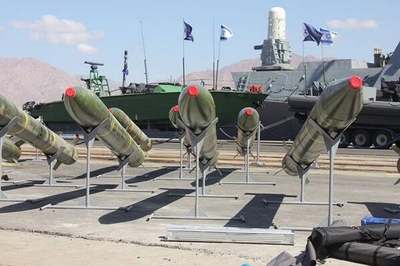
To advance its imperial agenda, Iran has proceeded to develop its conventional and nuclear ballistic missile program. According to Director of National Intelligence James Clapper, Iran has “one of the largest inventories of ballistic missiles in the Middle East.”

In line with Iran’s missile development program, Iran’s Revolutionary Guard Navy Rear Commander, Ali Fadavi, announced: “Based on the fifth five-year plan, we should materialize our objective of mass-producing military speedboats with the speed of 80 knots per hour… and are equipped with missiles with a range of 100km; the vessels no one can catch.”

Aside from its military aspirations, since the fall of the Shah in 1979, successive Iranian governments have voiced their plans to annihilate the State of Israel, the only pluralist democracy in the Middle East, and an effective military deterrent to Iran’s designs in the region.

Hostile messages have been pouring forth from Iran. Mohammad Neza Naghdi, Commander of the Basij paramilitary force, stated in clear terms in April 2015, that, “The destruction of Israel is non-negotiable.”

Major General Yahya Rahim Safavi, a former IRGC commander and a top military aide to Khamenei, warned in May 2015, that “More than 80,000 missiles are ready to rain down on Tel Aviv and Haifa.”

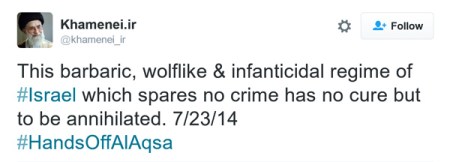
As late as November, Iran’s Supreme Leader Khamenei himself tweeted, “This barbaric, wolflike & infanticidal regime of #Israel which spares no crime has no cure but to be annihilated.”

1477

Bewilderingly, Western democracies have chosen to overlook Iran’s speeches and actions. They chose instead to appease the regime. Last July, despite genuinely serious reservations expressed by international strategic and military experts (including retired American military officers), the United States, United Kingdom, France and Germany – the four democracies in the P5+1 — concluded a nuclear deal with themselves that they proposed to Iran. Iran so far has not signed the deal, and apparently even if it did, according to the U.S. Department of State, the deal would not be legally binding.

Tehran will greatly benefit financially from the terms of the nuclear agreement in the months to come. Under the administration of President Barack Obama, nuclear sanctions against Iran have been lifted. To advance the deal and make it more appealing to Iran, the president has also agreed to pay Iran a $1.7 billion settlement for $400 million in “frozen” assets held in the United States since 1981.

The Society for Worldwide Interbank Financial Telecommunication (SWIFT), “the electronic bloodstream of the global financial system,” had disconnected 15 Iranian banks from its system in 2012. after coming under pressure from both the United States and the European Union at the height of efforts to curb Iran’s nuclear ambitions. Today, SWIFT is ready to let those banned banks, including the Central Bank of Iran, use its system once again. Iran now has an even greater ability to fund its terrorist proxies around the world.

European political and business leaders have been rushing to Tehran to sign new agreements. On January 28, in Paris, Iran’s President Hassan Rouhani and France’s President Francois Hollande signed major business deals, including a joint venture between car-makers PSA Peugeot Citroen and Iran’s Khodro. Iran is in the process of buying 118 Airbus passenger planes to update its aging fleet. The construction group Bouygues and the French airport operator ADP are now set to build an extension for Tehran’s airport, while Vinci, another construction firm, has been commissioned to design, build and operate new terminals for the Mashhad and Isfahan airports. The French oil company Total has agreed to buy Iranian crude oil, and agreements in shipping, health, agriculture and water provision have also been signed.

Democratic India is also cultivating relations with Iran. In a meeting in May, India’s Minister of Road Transport and Highways, Nitin Gadkari, and Iranian Transport and Urban Development Minister, Abbas Ahmad Akhoundi signed a Memorandum of Understanding on India’s participation in the development of the Chabahar Port in Iran.

The Chabahar project will impart strategic leverage to India and its access to Afghanistan and energy-rich Central Asia by bypassing Pakistan. The distance between the Chabahar Port and Gujarat – India’s westernmost state, located near the Persian Gulf, is less than the distance between Delhi and Mumbai. Transit times are estimated to be reduced by a third. Indian firms have already agreed to lease two existing berths at the port and operate them as container and multi-purpose cargo terminals.

The Chabahar project, New Delhi calculates, will be highly beneficial. As India has invested over $2 billion in Afghanistan, the Indian government plans to link the Chabahar port with the Zaranj-Delaram road it built in Afghanistan, thereby opening alternative routes to Afghanistan and enhancing access to regional and global markets.

Russia and China, permanent members of the UN Security Council, are also strengthening their cooperation with Iran. Both Russia and China adopted a policy of ambivalence towards Iran and saw to it that sanctions imposed by the West were not too tough. They also repeatedly blocked attempts at sanctioning Iran’s ally, the current Syrian regime, out of concern over financial ties in the region.

China is also capitalizing on the lifting of sanctions against Iran. Chinese President Xi Jinping rushed to Iran after the so-called nuclear agreement to discuss a 25-year strategic cooperation plan. In a landmark deal worth up to $600 billion, Xi committed to increase trade between the two nations during the next decade. Beijing and Tehran also agreed to enhance security cooperation through intelligence-sharing, counter-terror measures, military exchanges and coordination. Incidentally, despite international sanctions, China-Iran trade increased from $3 billion in 2001 to more than $50 billion in 2014.

Given its fanatical and sectarian ideological agenda, Iran is likely to use the new funds to boost its armament program and ongoing clandestine terror acts. Sanctions relief will mainly benefit Khamenei and members of the IRGC: they control up to one-third of Iran’s economy.

Iran now poses an even greater threat to the entire civilized world. The pattern of Tehran’s behavior shows the government can never be trusted on any promises it makes not to advance its nuclear weapons program. Khamenei has made an open declaration that Tehran will not allow effective inspections of its military sites or interviews with its nuclear scientists.

The links of the IRGC’s Qods Force with Hezbollah, Hamas, Palestinian Islamic Jihad, the Houthis and other terror militias pose a major threat to peace and stability in the Middle East.

Hezbollah’s networks have expanded over the years, infiltrating Latin America and the Caribbean through Shiite cultural centers in the region. According to an official Argentine report, Tehran has established its terrorist, intelligence and operational networks throughout Latin America as far back as the 1980s. Iran’s intelligence activities in the region are being conducted directly by Iranian officials or through its proxy, Hezbollah. Criminal activity may already be underway in Brazil, Colombia, Chile, Paraguay, Uruguay, Suriname and Trinidad and Tobago. Iran’s involvement in the cocaine trade has bolstered the regimes regional access and strengthened ties with its allies in Venezuela, Ecuador, Bolivia and elsewhere.

According to senior Western intelligence officials, the IRGC has transferred tens of millions of dollars to Hamas to be used for weapons, military equipment and training, and that Iran also delivers arms and funds to Hamas through the Red Sea and the Sinai. Officials also believe Iran is indirectly funding the Islamic State (IS) in the Sinai. “Suitcases of cash” are sent directly to Hamas officials in the Gaza Strip; part of the money is then transferred to IS.

Tehran’s links with Hamas and IS are part of a grander strategy of using proxy forces to gain hegemony over the Middle East and undermining American allies such as Egypt and Israel. In Lebanon, Iraq and Syria, Iran seeks to preserve its influence. By fighting IS, Iran strengthens existing pro-Iran regimes and maintains its relevance in the region.

While Iran does support IS indirectly in the Sinai, the government’s goal is to weaken the current Egyptian regime and the Sunni Arab alliance between Egypt, Saudi Arabia and Jordan. It has no problem with IS gaining strength in the Sinai right now. If IS does gain more power in the Sinai, Iran can use it to impose its own agenda in the future. Tehran evidently wants to use IS victories against Sunni states as an opportunity to take over.

Iran also supports the Gaza-based terror group al-Sabireen [“The Patient Ones”], established in the wake of previous tensions between Iran, Hamas and Islamic Jihad. The group has about 400 followers and its emblem is identical to that of Hezbollah. Each member receives a monthly salary of $250-$300, while senior members receive at least $700. Annually, the terror group receives a budget of $10 million from Iran, smuggled in suitcases through tunnels along the border with Egypt. Potential members are wooed by al-Sabireen through familiar channels of philanthropy and education. The group’s publications refer to the United States as “the source of superpower terrorism,” and its slogan is, “The road to the liberation of Palestinian goes through Karbala” — a Shiite holy city in Iraq.

Al-Sabireen has extended its operations from the Gaza Strip to the West Bank and Jerusalem with Iran’s backing. Hisham Salim, the founder of al-Sabireen, admitted that his group is directly financed by Iran. “We have an armed branch whose goal is to wage war on the Israeli occupation everywhere,” Salim said. “Within this framework we have members in the West Bank and Jerusalem.”

The Obama administration has forged ahead with its Iran policies despite knowing the regime’s support of global terrorism. U.S. President Barack Obama himself spoke about Iran’s terror activities in a press conference last year. “Now, we’ll still have problems with Iran’s sponsorship of terrorism; its funding of proxies like Hezbollah that threaten Israel and threaten the region; the destabilizing activities that they’re engaging in, including place like Yemen,” he said, adding that the nuclear “deal is not contingent on Iran changing its behavior. Its not contingent on Iran suddenly operating like a liberal democracy.”

History urges those living in democracies today to rein in their governments and correct their fatal Iran policies. The world cannot afford to overlook the damage of these governments. If democracies today continue their present policies towards Iran, it will only embolden Iran’s regime to continue its quest to obtain nuclear weapons as well as its terrorism and human rights violations.

Op-Ed: Contemplating a US/Russia Alliance

February 16, 2016

Op-Ed: Contemplating a US/Russia Alliance, Israel National News, Ted Belman and Alexander Maistrovoy, February 16, 2016

Before Donald Trump’s blowout win in New Hampshire he shocked the world by saying he would allow the Russians to do the “dirty work” and would “let them beat the s*** out of ISIS also.”. Trump went further, “I have always felt that Russia and the United States should be able to work well with each other towards defeating terrorism and restoring world peace, not to mention trade and all of the other benefits derived from mutual respect,”

Putin, responded by saying: “He (Trump) says that he wants to move to another level of relations, to a deeper level of relations with Russia. How can we not welcome that? Of course we welcome it.”

The condemnation of Trump for his remarks was immediate but certainly not universal. Many American’s are beginning to see Russia in a new light.

Until the fall of the USSR, the 20th Century was dominated by an ideological struggle between American capitalism and Russian communism. But now that Russia has abandoned communism and the US is embracing socialism, as seen by the Sander’s victory in the New Hampshire primary, the two powers are more alike than ever before.

Now we have a different ideological struggle to contend with, namely a civilizational war between the Christian/Secular West and the Islamic Caliphate. They are inimical to each other. North America, Europe and Russia are natural allies in this struggle as they are different daughters of one civilization.

In the past, both Russia and the US have backed different Arab states or Muslim groups, including radical Islamists. The end result of this US/Russia enmity was to destabilize the ME and Europe and to allow an Islamic fifth column into America and Europe.

The reality is that Russia, Europe and the US desperately need each other. Together they can withstand the hydra of pan-Islamism with its countless heads (ISIS, al-Qaeda, Jabhat al-Nusra, Salafis, Muslim brothers, etc.), can stabilize the Middle East, the cradle of Islamic fanaticism and can stabilize Europe.

For Russia, the triumph of the Caliphate in any form will be a deadly threat to its “soft underbelly”: the Caucasus and Volga region with Tatarstan.

Penetration of Islamic militancy from Afghanistan into Central Asia means the appearance of the Islamists on the longest and vulnerable southeastern border of Russia.

From Europe’s point of view, a destabilized North Africa and Middle East is resulting in a mass migration of Muslims including radical Islamists which threaten to tear it apart and irreparably change it. This in turn will have dire consequences for both Russia and America.

Both US and Russia are not able to cope with the global “jihad” separately” especially when they are supporting different sides. Russia has no resources for a war against radical Islam made more difficult by western sanctions and pressure. The West, in spite of its material power, lacks the will needed to defeat such a savage and ruthless enemy.

Thus an alliance is imperative.

“New Middle East”

A new Middle East is in the making. It will not look like the “New Middle East” as envisioned by Shimon Peres.  Syria, Iraq and Libya are no more. Lebanon looks like it will also fracture due to the influx of 1.5 million Sunnis, either Palestinian or Syrian. Hezbollah Shia have been reduced from 40% to 25% of the population by this influx so expect a power struggle to ensue there.

Alawite Syria, a strong Kurdish state in the north of former Iraq and Syria, tribal unions in Libya, Druze enclaves in Syria, a Christian enclave in Lebanon and perhaps in Iraq, all will appear on the map of the new Middle East. They will all need the support, both militarily and diplomatically, of either the US or Russia. In this way, the west will be empowered to keep the radical Islamists out.

Russia already has supported the Kurdish PYD (Democratic Union Party) in northern Syria diplomatically (Kremlin insists on PYD’s participation in negotiations about the future of Syria) and by providing them with weapons. The US is also supportive of the Kurds but bas been restrained by Turkey’s insistence that the Kurds be denied independence.  If the US forms an alliance with Russia it no longer needs an alliance with Turkey.

The American embrace of the Muslim Brotherhood and Turkey must be seen as the aberration it is. Rather than support the Islamization of the Middle East and North Africa, America should fight it. Rather than embrace the Muslim Brotherhood and other Islamists, as Obama did, the US should embrace Russia.

Pressure could then be brought to bear on Turkey to change its Islamist allegiances and to allow greater autonomy to its 10 million Kurdish citizens who otherwise will want to join the newly formed Kurdistan.

The US, by destroying Qaddafi and Mubarak, greatly destabilized North Africa. By waging war against Assad, the US has destabilized the Middle East and Europe. What is needed now is that the US and Russia come together to strengthen President al Sisi of Egypt to enable him to defeat ISIS in Sinai and Libya. Russia should be invited back into Libya to assist in its stabilization.  Europe and Tunisia will also benefit from this stabilization as will African states to the south.

In addition, US and Russia should cut a deal for a political solution for Syria in which Syria is divided into three states based on ethnic lines; Alawite Syria in which Russia holds sway, Kurdish Syria which will join with Kurdistan in Iraq and a Sunni state amalgamating the Sunni areas of both Syria and Iraq.

Such a deal will involve cooperation between Russia, US, Turkey and Saudi Arabia. ISIS must be defeated and non-Islamist Sunnis must be put in charge. Saudi Arabia would have a major role in the creation and maintenance of such a state. It is not inconceivable that Jordan would in the end, amalgamate with this state given the number of Sunni refugees it is now host to. This state would serve as a bulwark to an expansionist Iran.

It is in the interest of Russia to placate Saudi Arabia so that Saudi Arabia will cut down on her oil production and allow the price of oil to rise. Saudi Arabia would be agreeable to doing so and to such a division of Syria if Russia would restrain Iran.

Iran

Today, Russia is the de facto ally of Iran and the US is a wannabe.  The Iranian star reached its zenith with the total capitulation of the US in the Iran Deal. Since then it’s been downhill all the way. Without the help of Russia they would have lost Syria as an ally and their connection to Hezbollah. But with that help, Russia is now calling the shots.

It wasn’t so long ago that Russia supported the sanctions on Iran and didn’t want to remove them because it meant the addition of Iranian oil to the world market and the weakening the already weak ruble. Kremlin couldn’t betray its ally but in fact (aside from rhetoric) will not object to a renewal of sanctions. This will save Russia from a powerful competitor in the energy market.

Moscow needs Iran primarily as a means to put pressure on the West but it can quite easily sacrifice it for the sake of strategic considerations. Iran is not a natural ally of Russian for it doesn’t have any historical or cultural connection similar to the connection both Serbia and Armenia have for example.

The View from the Kremlin

Since the 16th century, the main threat to Russia came from the West. Moscow was occupied by Poles in the 17th century and by Napoleon in the 19th century.  In 1941, the troops of the Wehrmacht came within a few kilometers of Moscow.  St. Petersburg was built by Peter Great to resist the invasion of the Swedes.

The collapse of the Soviet Union was a painful blow to Russia and the West took advantage of this collapse. The bombing of Serbia and recognition of Kosovo, the “color revolutions” in the former Soviet Union, NATO’s extension to the Baltic countries, and the constant hectoring of Russia on human rights served to undermine Russia and make her feel threatened. This formed the impetus for the revival of nationalism under the leadership of Vladimir Putin.

The US, Britain and France intervened in Libya in order to both destroy the Gadaffi regime and oust Russia.  Accordingly, they refused Russia’s mediation efforts.  Similarly they tried to oust Assad. But this time, Russia, who had lost its Mediterranean port in Libya was determined to keep its Mediterranean port in Syria.  After many years of death and destruction in Syria brought about by the desire of the US and Saudi Arabia to oust Assad, Assad was on his “death bed”. Russia and Iran doubled down on their efforts to support him. Russia supplied their air force and air defense radar systems and Iran provided more troops. As a result Assad has gained much ground and is in a much better negotiating position today.

During this period, Russia acquired Crimea from the Ukraine and supported an insurgency in eastern Ukraine. A majority of the population of both areas are Russian. The Russians didn’t understand why the West came to the defense of Ukraine. It’s impossible to believe that EU wanted to bring Ukraine into the EU given its large population and systemic corruption.  Moscow believes the West didn’t do so in order to protect the sovereignty of Ukraine but to weaken Russia.  Ukraine, after all, is the backyard of Russia, as Mexica is backyard of US and Corsica is backyard of France.

Last week Russia’s Prime Minister, Medvedev, urged a “more constructive and more cooperative relationship with Russia… I strongly believe that the answer lies with both more defense and more dialogue.”

Last week Henry Kissinger delivered a speech in Moscow in which he began:

“I am here to argue for the possibility of a dialogue that seeks to merge our futures rather than elaborate our conflicts. This requires respect by both sides of the vital values and interest of the other,”

And concluded,

“It will only come with a willingness in both Washington and Moscow, in the White House and the Kremlin, to move beyond the grievances and sense of victimization to confront the larger challenges that face both of our countries in the years ahead.”

Should the West want to pursue such an alliance, it must recognize Russia’s “Near Abroad” – its traditional zone of influence since the 18th century: Ukraine and Belarus, Crimea, whose history is inseparable from Russia, the Caucasus and Central Asia. Russia also seeks influence in Europe and in the Eastern Mediterranean. This is imperial policy but Russia is no longer obsessed with ideological madness.  Thus, it is possible to negotiate a rapprochement and to respect each other’s sphere of influence.

Israel is not an ally of Russia nor its enemy.  Israel and Russia agreed to respect each other’s spheres of interest in Syria. In addition, Moscow mediated in delicate situations between Israel and Hezbollah.  This model can be used on a global scale by the US.

It is of historical note that the Byzantium, otherwise known as the Eastern Roman Empire, fought a sustained battle against the Ottoman Turks, who had invaded, only to finally succumb in 1453.  The Turks changed the name of their capital city, Constantinople, to Istanbul.  The Ottoman Empire succeeded over the years in conquering more of Europe and finally laid an unsuccessful siege to Vienna in 1529. There followed 150 years of bitter military tension and attacks, culminating in the Battle of Vienna of 1683. This battle was won by the Holy Roman Empire of the German Nations in league with the Polish-Lithuanian Commonwealth thereby saving Europe from Islamic conquest.

What is needed today is a similar resolute stand by both east and west against the Islamic Jihad’s attempt to conquer Europe.

Will the old prejudices and enmity focused on Russia prevail over rational considerations and the instinct for self-preservation?

According to the Munich Accords just signed, perhaps not.

It now appears that Russia and the US have come to an agreement for the implementation of a ceasefire and a division of spheres of influence. The document was signed by 17 nations, including Saudi Foreign Minister Adel al-Jubayr for the Syrian opposition and Iran’s top diplomat Muhammed Javad Zarif in the name of the Assad regime.

DEBKA reports:

“The nub of the Munich accord was therefore the parties authorized to name the terrorists. This was spelled out as follows: “The determination of eligible targets and geographic areas is to be left up to a task force of nations headed by Russia and the United States.”

“This puts the entire agreement in the joint hands of the US and Russia. Lavrov emphasized, “The key thing is to build direct contacts, not only on procedures to avoid incidents, but also cooperation between our militaries.”

“The Munich accord therefore provided the framework for expanding the existing US-Russian coordination on air force flights over Syria to cover their direct collaboration in broader aspects of military operations in the war-torn country.

“Lavrov mentioned a “qualitative” change in US military policy to cooperate with Russia in continuing the fight against the Islamic State, but it clearly goes beyond that.”

“This pact as sets out a division of military responsibility between the two powers: The Americans took charge of areas east of the Euphrates, leaving the Russians responsible for the territory east of the river. “

Hopefully, this accord is just the beginning of a new alliance.

Between Putin and Obama

February 7, 2016

Between Putin and Obama, Israel Hayom, Boaz Bismuth, February 7, 2016

The tide has turned in Syria: Aleppo, the rebel stronghold, is on the verge of falling to President Bashar Assad’s army. Hezbollah’s Shiite militias, the Iranian army and the massive Russian air strikes have been the difference.

In contrast to the rebels, Assad can count on his partners. On the Syrian dictator’s side, backed by Russia, action is being taken. On the rebel side, backed by the Americans, there has been a lot of talking. This perhaps explains why in January 2017 U.S. President Barack Obama will exit the White House, and Assad will still be in power. We can add this legacy to the American president’s splendid list of achievements.

And we haven’t even mentioned the millions of Syrian refuges, the terrible migrant crisis in Europe (leading to the rise of far-right parties across the continent), and the escalation of hostilities between Shiites and Sunnis. It’s not a short list.

Since last Monday, Aleppo has been under heavy attack from Assad’s forces. The gains on the ground have been considerable. Russia’s intervention has tipped the balance of power. No one can say this was unexpected. Washington, meanwhile, continues to grumble. U.S. Secretary of State John Kerry lambasted Moscow on Friday for the large number of dead Syrian women and children. Moscow isn’t exactly heeding his criticism. Washington still fails to understand that instead of talking, maybe it would be better to take action already. In August of 2013, however, after Assad had attacked his own people with chemical weapons for the 14th time, the Americans did nothing (red lines, remember?). Why should things be any different today?

Washington, you will say, has worked hard to find a diplomatic solution. This is a good time to remind everyone that the peace talks in Vienna have again hit a dead end. The talks aren’t likely to succeed for a number of reasons, namely that the two main players — Saudi Arabia and Iran — have reached a point of open hostilities, thanks to American foreign policy. Instead of cooperating to resolve the Syrian crisis, these two regional powers are closer than ever to a full-fledged military conflict. Riyadh is threatening to send ground forces into Syria to support the rebels. The commander of Iran’s Revolutionary Guard has already vowed that any such intervention would result in immense casualties for the Saudis. This is where things stand.

Over the weekend Turkey’s foreign minister discussed opening his country’s borders to the steady stream of refugees, but the crossings remain as shut as they were in September, 2014, when thousands of Kurds tried to flee the border town of Kobani. The European Union is trying to remind the Turks that they were given $3 billion for the expressed purpose of absorbing these 2 million refugees. But who expects agreements to be kept in today’s Middle East?

Who does have faith in agreements?

The refugee issue is becoming the hot button topic of the Syrian civil war. “The markets solved the economic crisis, the voters will solve the refugee crisis,” a French lawmaker said a few days ago. In the meantime, as Assad solidifies his power the far-right parties in Germany, Sweden, Denmark and Holland, and of course in France, are all growing in strength. It appears that everyone outside the Obama camp is thriving. And here is yet one more legacy to tell the grandchildren about.

Iran and Russia in first major falling-out over Syrian war and Assad

February 5, 2016

Iran and Russia in first major falling-out over Syrian war and Assad, DEBKAfile, February 5, 2016

P.V

While diplomats from 70 countries talked in London about how to raise $9 bn for projects to rehabilitate Syria’s refugees and rebuild their war-ravaged country, its future was further clouded this week by an argument that flared between the main arbiters, Russia and Iran.

Ali Akbar Velayati, Iranian supreme leader Ayatollah Ali Khamenei’s foreign affairs advisor, spent three days in Moscow Feb. 1-4 haranguing Russian leaders, including President Vladimir Putin, whom he saw twice, on the differences that had cropped up in their long political and military cooperation for propping up the Assad regime.

The Iranian official went home without resolving those differences, DEBKAfile’s sources report exclusively. Left pending were not just the next stage of the war but also the fate of President Bashar Assad.

Velayati told Iranian reporters on his plane: “We are against stopping the war,” and “The war must be continued until all (Syrian) terror cells are eradicated.”

He did not elaborate, but DEBKAfile’s Iranian and Moscow sources point out that he was underlining Tehran’s concerns about Moscow’s reported plans for the Assad regime, in which Iran is heavily invested, and the slowdown of Russia’s air campaign against every last rebel group.

Most of all, Iran’s leaders were troubled to find that Russia, by dint of its proactive military intervention, had maneuvered itself into position for calling the shots for Syria.

They are particularly distrustful, according to our sources, over Moscow’s complicated deals with Washington on the Syrian question and the dialogue Russia is holding with the Persian Gulf states, led by Saudi Arabia. The Iranians fear that Putin is calibrating his offensive against rebel groups according to the pace of these interchanges and may therefore scale back strikes on pro-American or “moderate” rebels, or even refrain from subduing them.

Tehran also looks askance at the improved relations Moscow is fostering with its rivals in the region, Riyadh and Abu Dhabi. Last week, Russian Foreign Minister Sergei Lavrov visited the two Arab capitals to allay their concerns for the Syrian rebel groups they support. He promised the Saudis not to harm them, so long as they did not get in the way of the joint Russian-Syrian steps in their country.

Given the Russian moves, the Syrian war looks increasingly to Tehran as unlikely to end in President Assad’s favor.

Lavrov seemed to confirm this Iranian concern on Feb. 2 when, during his visit to Oman he said, “Russian air strikes will not cease until we truly defeat the terrorist organizations ISIL and Jabhat al-Nusra, And I don’t see why these air strikes should stop.”

The Iranians immediately jumped on his omission of all other rebel groups but the two Islamists as the enemy, confirming their suspicions that Moscow was now acting in Syria on its own account. This was the cause of raised tempers in Velayati’s second meeting with the Russian president in Moscow.

The Iranian official demanded the expansion of Russian military operations to cover more inclusive rebel targets. Putin shot back that if Iran wants to ramp up war operations, it should send its own troops into the fray – and not just generals.

He touched on a sore point:  Iran’s Revolutionary Guards Corps don’t have troops available for fighting in Syria. And so, Velayati’s mission to Moscow ended on an acrimonious note.

A European-Iranian honeymoon

January 31, 2016

A European-Iranian honeymoon, Israel Hayom, Prof. Eyal Zisser, January 31, 2016

Last week, the European dam burst. While the continent was turning a cold shoulder to Israel and European entities continued with their threats of boycott, its gates were thrown open to Iran. European leaders put their obsession with Israel aside for an hour or two, and after paying the necessary lip service to International Holocaust Memorial Day, gave Iranian President Hassan Rouhani a royal welcome.

The Iranian president, the smiling face of the Islamic republic, arrived for visits to Italy and France. It was the first visit of its kind since the nuclear deal was signed, a visit that signaled the start of a European-Iranian honeymoon, a visit that will be followed by others like it all over the continent. Rouhani’s visit came days after the economic sanctions on Iran were lifted. It’s no wonder that during the visit, announcements were made about contact between the Iranians and a number of Italian and French companies on deals including a return to European cars being manufactured in Iranian plants and, of course, contracts to purchase Iranian oil. The Iranians are hungry for Europe’s products and technology, while European companies are hungry for Iranian money.

As Rouhani was being received in Europe as an honored guest, Iran’s spiritual leader Ayatollah Ali Khamenei was busy with his longtime hobby of denying the Holocaust. He posted a clip on his website in which he called to investigate whether or not the Holocaust had actually happened, as the Zionists claim it did. But no one in Europe bothered Rouhani with any minor matter like that. After all, it was U.S. Secretary of State John Kerry who urged people not to take Tehran’s calls to annihilate Israel and the U.S. seriously, saying it was only talk. The Europeans also didn’t bother to raise the question of Iranian involvement in regional destabilization, such as in Yemen and Syria, or about Tehran’s support of terrorism. Even questions about respecting human rights and freedom of expression and promoting democracy in Iran itself were removed out of respect for the agenda of the day. Europe, as we know, only asks those questions of Israel.

Indeed, despite Rouhani’s smiles, no change has taken place yet in Iran itself. The conservative camp continues to rule with a fist of iron and supreme leader Khamenei remains firmly at the wheel, or in the hands of the Revolutionary Guard and not Rouhani and his people. So while Rouhani was trying to spread the slogan of a “new Iran” throughout Europe and asking his hosts to turn over a new leaf in the relations between Iran and Europe, the conservatives at home were preparing an unpleasant surprise. Most of the reform camp’s candidates for the parliamentary election scheduled to take place on February 26 were rejected. Even the grandson of late Ayatollah Ruhollah Khomeini, Ahmed Khomeini, who wanted to be elected to the Council of Experts — the Iranian body that oversees the supreme spiritual leader and is responsible for choosing his successor — was rejected on the grounds of “not proving appropriate religious capabilities.”

Iran should be judged not by its words, but by its actions, but the Iranian record speaks for itself. A mere two months after it signed the nuclear agreement with the major world powers in July 2015, Tehran sent thousands of soldiers to Syria to fight on the side of Syrian President Bashar Assad. Painful pictures are coming out of Syria of children dying of hunger in cities under siege by Assad’s forces, Hezbollah fighters, and members of the Iranian Revolutionary Guard. But Iran has been rewarded for its doings in Syria and invited by the U.N. and western countries to take part in a discussion on Syria’s future. The Iranian record also includes ballistic missile tests, to show us what Iranian’s military ambitions are; the arrest of U.S. sailors in the Persian Gulf; and — just like in the good old days — an angry mob setting fire to the Saudi Arabian embassy in Tehran.

The Europeans are choosing to ignore all that as they announce a new chapter in Iranian-European relations. The bill for the honeymoon will be footed by others — in Syria, the Persian Gulf, and Israel.

Iran’s Commitment to Shia in the Region

January 17, 2016

Iran’s Commitment to Shia in the Region, Gatestone InstituteLawrence A. Franklin, January 17, 2016

♦ Iran’s commitment to Shi’ite interests seems firmly linked to its idea of its mission, as well as to the survival of its revolutionary regime. Iran’s theocracy is likely willing to pay a high price to safeguard this legacy. The West should not expect Iran to reduce its presence in Syria or Iraq, even under severe military pressure.

♦ As the Obama Administration continues to reward Iran for violating its agreement not to build nuclear weapons under the nuclear Non-Proliferation Treaty (NPT), and violating its agreement not to build nuclear-capable missiles, and its refusal to sign the worthless “Iran Deal,” its presence is set to become even more unpleasant as it becomes more prominent.

The West does not seem to appreciate the intensity of Iran’s commitment to its Shi’ite cousins in Syria. The West also seems not to comprehend the depth of Iran’s spiritual ties to its centuries-old role as the champion of Shi’a Islam.

Much Western journalistic commentary addresses Iran’s commitment to the Assad regime in Damascus. Left underreported is the profound sense of shared religious identity between the Shia of Iran and the Shi’a Alawi minority of Syria. Iran’s determination to maintain Alawi supremacy in Syria transcends any personal attachment to the Assad administration.

In light of this month’s execution of a leading Shi’ite preacher Nimr al-Nimr by Saudi Arabia and the consequent heightened tension between Tehran and Riyadh, it might help policymakers to understand that the religious divide between Shi’ite and Sunni Muslims as an inveterate and unbridgeable chasm as that between ISIS and the United States.

1427Parts of the Saudi embassy in Tehran were burned on January 2, when a mob of Iranians attacked and ransacked the diplomatic mission. The attack came in response to Saudi Arabia’s execution of Shi’ite preacher Nimr al-Nimr the same day.

Iran’s Shi’ite Ayatollahs are on record declaring that Syria’s Alawites are genuine Shi’ites[1], a question finalized after a centuries-long dispute. The Iranian Shi’ite establishment had questioned the Syrian Alawi inclination to venerate Jesus, Mohammad and Ali as a pale reflection of the Christian theological concept of the Holy Trinity. Moreover, some Iranian Mullahs were not comfortable with the Alawi practice of celebrating Christmas. Iran evidently felt obligated to extend a protective cover to its Shi’ite co-religionists.

Another dimension of Iran’s support for regional Shi’ism is its close operational relationship with the Lebanon-based terrorist group, Hezbollah — the political arm of Lebanon’s Shi’ites. The links are so close that Tehran has been able to mobilize thousands of Lebanese Shi’ite volunteers to fight in support of the Assad regime in Syria. Iran’s theological ties to Lebanon’s Shi’ite Muslims also are deep and longstanding.

Iran’s sense of responsibility for Shi’ism beyond its borders seems linked to the historical Islamic world-power contest for hegemony between Sunni and Shi’ite Muslims. The Sunni, for centuries, have dominated and persecuted the Shi’ites, even in states where the Shiites have been in the majority. This century is first time the Shi’ites have started successfully to challenge Sunni supremacy in the region of the Persian Gulf. The George W. Bush Administration replaced Iraq’s ousted Sunni President, Saddam Hussein, with a basically Shi’ite leadership. And the Obama Administration, thorough the promised infusions of up to $150 billion (much of which Iran will presumably use to increase its terrorist activities worldwide), has paved the way for Iran to have the capability to assemble nuclear weapons and missile delivery systems.

But perhaps even the Americans could not, in an electoral system, have prevented Shi’ite predominance in a country where the Shi’ites constituted about two-thirds of Iraq’s population.[2]Next-door Iran is at least 75% Shi’ite.[3] The theological cadre from both countries receives its religious training in many of the same seminaries in Qom, Iran and Najaf, Iraq. Much of Iraq is now controlled by militia groups loyal to Tehran, not to Baghdad.[4]

Iran is also extending assistance to Bahrain’s Shi’ites, the vast majority of the island’s population.[5] Iran, which had controlled Bahrain before the island was colonized by Great Britain in the 19th century, had agreed to London’s grant of independence to the Gulf state in 1971. The agreement had served British imperial interests in the region. Yet Iran has evidently never been comfortable with the arrangement. The final secession of Bahrain from Iranian patrimony remains an open wound to Iran’s national pride. The Bahrain issue is particularly sensitive, as the United States Navy’s 5th Fleet is now headquartered there. The fleet’s naval assets enable the U.S. to guard the Persian Gulf below Iran’s southern border.

A religious reason, however, also motivates Tehran’s role in Bahrain. For more than two centuries, Bahrain has been governed by the al-Khalifas, a Sunni family originally from Qatar,[6]and sustained in power by Iran’s regional and religious arch-rival: Saudi Arabia. The Sunni ruling family in Riyadh even financed the construction of a 14-mile bridge linking Saudi Arabia and Bahrain, enabling a quick response to any possible move by Tehran to re-establish its dominance in the island. In 2011, Riyadh dispatched military units to Bahrain to suppress protests by the country’s Shi’ites, who were demanding more representation in keeping with their majority status on the island.

Iran also maintains extensive ties to the Shi’ite minority in Saudi Arabia’s Eastern Province, where most of the country’s oil fields are. The Saudi National Guard does not permit demonstrations against Riyadh’s policies. Imams who preach any opposition sentiment to the House of Saud are immediately imprisoned. One imam, Nimr, al-Nimr, was executed by the Saudis this month, presumably as a warning to Shi’ites in Saudi Arabia not even to think any dissenting thoughts.

Iran’s sense of duty to Shi’ite communities outside the Arab Middle East has also earned it influence, particularly in South Asia[7] and West Africa[8].

Iran’s commitment to Shi’ite interests seems firmly linked to its idea of its mission, as well as to the survival of its revolutionary regime. Iran’s theocracy is likely willing to pay a high price to safeguard this legacy. The West should not expect Iran to reduce its presence in Syria or Iraq, even under severe military pressure.

As the Obama Administration continues to reward Iran for violating its agreement not to build nuclear weapons under the nuclear Non-Proliferation Treaty (NPT), and violating its agreement not to build nuclear-capable missiles, and its refusal to sign the worthless “Iran Deal,” its presence is set to become even more unpleasant as it becomes more prominent.

Dr. Lawrence A. Franklin was the Iran Desk Officer for Secretary of Defense Rumsfeld. He also served on active duty with the U.S. Army and as a Colonel in the Air Force Reserve, where he was a Military Attaché at the U.S. Embassy in Israel.


[1] In 1972 Shi’ite cleric Ayatollah Hasan Mahdi al-Shirazi issued a Fatwa ruling that Shia and Alawis are “two synonymous words.” Ayatollah Musa al-Sadr, who disappeared on a visit to Libya reconfirmed al-Shirazi’s Fatwa. See also The Vanished Imam by Fouad Ajami, 1986. p 174.

[2] Encyclopedia Britannica (1997) and various other compilation sources support the statistics cited. However, B.E. claims the percentage of Shia among Iran’s Muslims is about 93%.

[3] Encyclopedia Britannica. Kuwait 30%, Syria/15%, Pakistan 15-20%, Bahrain/65%.

[4] The Council on Foreign Relations Initial Background Paper on Militia Groups in Iraq by Lionel Beehnor and follow-on versions, 9 June 2005.

[5] Encyclopedia Britannica.

[6] Al-Khalifa has governed Bahrain directly or indirectly since 1783.

[7] The key pro-Iranian militia/terrorist group in Pakistan’s mega-city of Karachi is the Tehrik-e-Jafaria.

[8] Iran has just lodged diplomatic protest against the alleged Nigerian Army’s recent massacre of Shi’a Muslims.

A Strategy to Defeat Islamic Theo-fascism

January 7, 2016

A Strategy to Defeat Islamic Theo-fascism, American ThinkerG. Murphy Donovan, January 7, 2016

Surely, whatever passed for American foreign or military policy in the past three decades is not working. Just as clearly, in case anyone keeps score these days, the dark side of Islam is ascendant at home and abroad. What follows here is a catalogue of policy initiatives that might halt the spread of Islamic fascism and encourage religious reform in the Ummah.

Some observers believe that the Muslim problem is a matter of life and death. Be assured that the need for Islamic reform is much more important than either. The choices for Islam are the same as they are for Palestine Arabs; behave or be humbled. Europe may still have a Quisling North and a Vichy South; but Russia, China, and even America, at heart, are still grounded by national survival instincts – and Samuel Colt.

Call a spade a spade

The threat is Islam, both kinetic and passive aggressive factions. If “moderate” Islam is real, then that community needs to step up and assume responsibility for barbaric terror lunatics and immigrants/refugees alike. Neither America nor Europe has solutions to the Islamic dystopia; civic incompetence, strategic illiteracy, migrants, poverty, religious schisms, or galloping irredentism. The UN and NATO have no remedies either. Islamism is an Ummah, Arab League, OIC problem to solve. Absent moral or civic conscience, unreformed Islam deserves no better consideration than any other criminal cult.

Western Intelligence agencies must stop cooking the books too. The West is at war and the enemy is clearly the adherents of a pernicious ideology. A global war against imperial Islam might be declared, just as angry Islam has declared war on civilization.  A modus vivendi might be negotiated only after the Ummah erects a universal barrier between church and state globally. Islam, as we know it, is incompatible with democracy, civility, peace, stability, and adult beverages.

Oxymoronic “Islamic” states need to be relegated to the dustbin of history. If the Muslim world cannot or will not mend itself, Islamism, like the secular fascism of the 20th Century, must be defeated, humbled in detail. Sooner is better.

Answer the Ayatollahs

Recent allied concessions to Tehran may prove to be a bridge too far. If the Persian priests do not abide by their nuclear commitments, two red lines might be drawn around Israel. Firstly, the ayatollahs should be put on notice, publicly, that any attack against Israel would be considered an attack against America — and met with massive Yankee retaliation. Secondly, any future cooperation with NATO or America should be predicated on an immediate cessation of clerical hate speech and so-called fatwas, those arbitrary death sentences.

Clerical threats to “wipe Israel off the face of the earth” and “death to America” injunctions are designed to stimulate jihad and terror globally. The only difference between a Shia ayatollah and a Sunni imam in this regard these days seems to be the torque in their head threads.

Ostracize the Puppeteers

Strategic peril does not emanate from Sunni tacticians like Osama bin Laden, Mullah Omar, or Abu Bakr al-Baghadadi. Nor does the real threat begin with or end with al Qaeda, the Taliban, Hezb’allah, Hamas, or the Islamic State. Lethal threat comes, instead, on four winds: toxic culture, religious politics, fanatic fighters, and furtive finance, all of which originate with Muslim state sponsors. The most prominent of these are Saudi Arabia, the Emirates, Turkey, Iran, and Pakistan.

Put aside for a moment the Saudi team that brought down the Twin Towers in New York. Consider instead, the House of Saud as the most egregious exporter of Salifism (aka Wahabbism) doctrine, clerics, imams, and mosques from which ultra-irredentist ideologies are spread. The Saudis are at once the custodians of Islam’s sacredshrines and at the same time the world’s most decadent, corrupt, and duplicitous hypocrites. Imam Baghdadi is correct about two things: the venality of elites in Washington and Riyadh. The House of Saud, an absolutist tribal monarchy, does not have the moral standing to administer “holy” sites of any description — Mecca, Medina, or Disneyland.

The cozy relationship between Europe, the European Union, and Arabia can be summarized with a few words; oil, money, arms sales, and base rights. This near-sighted blend of Mideast obscenities has reached its sell-by date. The “white man’s burden” should have expired when Edward Said vacated New York for paradise.

Jettison Turkey and Pakistan

What Saudi Arabia is to toxic ideology in North Africa, Turkey and Pakistan are to perfidy in the Levant and South Asia. Turkey and Pakistan are Islam’s most obvious and persistent grifters. Turkey supports the Islamic State and other Sunni terror groups with a black market oil racket. Pakistan supports the Taliban, al Qaeda, and ISIS with sanctuary and tolerance of the world’s largest opium garden. Oil and drug monies from Arabia, Turkey, and South Asia are financing the global jihad. Turkey also facilitates the migration of Muslims west to Europe while sending Islamist fighters and weapons south to Syria and Iraq.

With the advent of Erdogan and his Islamist AKP, Turkey has morphed into NATO’s Achilles Heel, potentially a fatal flaw.  Turkey needs to be drummed out of NATO until secular comity returns to Ankara. Pakistan needs to be restrained, too, with sanctions until it ceases to provide refuge for terrorists. Pakistani troops harassing India could be more prudently redeployed to exterminate jihadists.

Sanctions against Russia and Israel are a study in moral and political fatuity whilst Arabs and Muslims are appeased midst a cultural sewer of geo-political crime and human rights abuses. If NATO’s eastern flank needs to be anchored in trust and dependability, Russia, Kurdistan, or both, would make better allies than Turkey. Ignoring Turkish perfidy to protect ephemeral base rights confuses tactical necessity with strategic sufficiency.

Recognize Kurdistan

Aside from Israel, Kurdistan might be the most enlightened culture in the Mideast. The Kurds are also the largest ethnic group in the world not recognized as a state. While largely Muslim, the Kurds, unlike most of the Ummah, appreciate the virtues of religious diversity and women’s rights. Indeed, Kurdish women fight alongside their men against Turkish chauvinism and Sunni misogyny with equal aplomb. For too long, the Kurds have been patronized by Brussels and Washington.

While Kurdish fighters engage ISIS and attempt to control the Turkish oil black market, Ankara uses American manufactured NATO F-16s to bomb Kurds in Turkey and Syria. Turkish ground forces now occupy parts of Iraq too. In eastern Turkey, Ergdogan’s NATO legions use ISIS as an excuse for bookend genocide, a cleansing of Kurds that might rival the Armenian Christian genocide (1915-1917).

195876_5_Kurdish angel of death

All the while, American strategic amateurs argue for a “no-fly” zone in contested areas south of Turkey. Creating a no-fly zone is the kind of operational vacuity we have come to expect from American politicians and generals. Such a stratagem would foil Kurdish efforts to flank ISIS and allow the Erdogan jihad, arms, and oil rackets to flourish. A no-fly zone is a dangerous ploy designed to provoke Russia, not protect Muslim “moderates.”

Putin, Lavrov, and the Russians have it right this time; Turkish and Erdogan family subterfuges are lethal liabilities, not assets.

Washington and European allies have been redrawing the map in Eastern Europe, North Africa, South Asia, and the Mideast since the end of WWII. The time has come to put Kurdistan on the map too. Kurdistan is a unique and exemplary case of reformed or enlightened Islam; indeed, a nation that could serve as a model for the Muslim world.  If base rights are a consideration, Kurdistan would be an infinitely more dependable ally than Turkey or any corrupt tribal autocracy in Arabia. America has a little in common with desert dictators — and fewer genuine friends there either. Indeed, at the moment America is allied with the worst of Islam.

Create New Alliances

NATO, like the European Union, has become a parody of itself. Absent a threat like the Soviet Union or the Warsaw Pact, Brussels has taken to justifying itself by meddling in East Europe and resuscitating a Cold War with the Kremlin. Indeed, having divided Yugoslavia, NATO now expands to the new Russian border with reckless abandon; in fact, fanning anti-Russian flames now with neo-Nazi cohorts in former Yugoslavia, Georgia, and Ukraine.

NATO support for the Muslims of one-time Yugoslavia is of a piece with support for Islamic troublemakers in Chechnya and China too. Throughout, we are led to believe that jihad Uighurs and caliphate Chechens are freedom fighters. Beslan, Boston, Paris, and now San Bernardino put the lie to any notion that Islamists are “victims” (or heroes). Indeed, the Boston Marathon bombing might have been prevented had Washington a better relationship with Moscow.

Truth is, America has more in common with Russia and China these days than we do with any number of traditional European Quislings. Indeed, it seems that Europe and America can’t take yes for an answer.

The Cold War ideological or philosophical argument has been won. Moscow and Beijing have succumbed to market capitalism. Islamism, in stark contrast, is now a menace to Russian, Chinese, and American secular polities alike. The logic of a cooperative or unified approach to a common enemy seems self-evident. America, China, and Russia, at least on issues like toxic Islam, is a match made in Mecca.

The late great contest with Marxist Russia and China was indeed a revolution without guns. Now the parties to that epic Cold War struggle may have to join forces to suppress a theo-fascist movement that, like its Nazi predecessor, will not be defeated without guns. The West is at war again, albeit in slow motion. Withal, questions of war are not rhetorical. Saying that you are not at war does not make it so. Once declared, by one party or the other, the only relevant question about war is who wins and who loses. Losers do not make the future.

If America and Europe were as committed to Judeo/Christian secular values as Islamists are committed to a sick religious culture, then the war against pernicious Islam would have been won decades ago. Or as Jack Kennedy once put it: “Domestic policy can only defeat us; foreign policy can kill us.

Trump Footnote

Donald Trump made several policy suggestions on the Islamism issue, one on immigration, the other on Mideast oil. On the former, he suggests a hiatus on Muslim immigration until America develops a plan or reliable programs to vet migrants. On Arab oil, he suggests, given the lives and treasure spent liberating Kuwait and Iraqi oil fields, America should have held those resources in trust and use oil revenues to finance the war against jihad, however long that takes. The problem with both Trump ideas is that they come perilously close to common sense, an American instinct in short supply these days.


To Strike or Not to Strike, That is the Question

December 17, 2015

To Strike or Not to Strike, That is the Question, The Investigative Project on Terrorism, Paul Alster, December 16, 2015

1310 (1)

[C]ould there still be a window of opportunity, unpalatable as much of the international community might find it, of Israel launching a pre-emptive strike against what is widely perceived as a massive and increasing threat to its security?

**********************

Israeli estimates of the number of missiles terrorist powerhouse Hizballah has in Lebanon increased last summer from 100,000 to 150,000. The Shi’ite army continues to gain strength, unhindered by the token presence of United Nations troops in what was supposed to be a de-militarized zone following the 2006 Second Lebanon War.

Hizballah’s promises of capturing the Galilee – that have inspired a feature-length Lebanese movie on the subject – are oft-repeated. The imminent release (as a result of the P5+1 nuclear deal) of billions of dollars to its guardian angel and guiding hand, the Islamic Republic of Iran, promise more money and materiel will be placed at the disposal of an organization that has already fought two vicious wars against the Jewish state, a state whose existence it refuses to recognize.

Hizballah’s growing strength, and its acquisition of advanced weapons, (undoubtedly aided of late by Russian air strikes in support of the Syrian army), has Israeli leaders thinking hard about how long they can allow such a build-up to go unchecked, and whether there is a growing case for something more than sporadic cross-border interventions to temporarily stem Hizballah’s growing firepower.

“We operate in Syria from time to time to prevent it turning into another front against us,” Israeli Prime Minister Benjamin Netanyahu acknowledged Dec. 1 at the Galilee Conference in Acre. “We act, of course, to prevent the transfer of deadly weaponry from Syria to Lebanon.”

His surprise comments came on the back of two reported airstrikes on Syrian weapons convoys – attributed to the IAF – apparently destined for Hizballah.

Two days later, Defense Minister Moshe Ya’alon again highlighted the increasing danger posed by Iran’s overt support of the Hizballah, telling members of the U.S. Congress, “We are very worried about Iran’s presence in Syria… This regime generates terrorism and undermines many of the regimes in the Middle East, and this is not good news for the region, not only Israel.”

Reports last week of Iran completing a second medium-range ballistic missile test in contravention of U.N. Security Council resolutions did little to ease Israeli fears. On Dec. 10, in another indication of the urgency with which it views the Iran-Hizballah threat, Israel successfully tested its Arrow 3 missile defense system, an extra layer of defense on top of the Iron Dome, David’s Sling, and the Arrow 2 system that may well prove critical in defending against the Iranian-made Shihab 3 longer ranger missiles.

In an exclusive interview with the Investigative Project on Terrorism, a senior IDF official – who for security reason must remain anonymous – spelled out the likely scenario should Hizballah live up to its promises and attack Israel from the north. He did not discuss the likelihood of an Israeli pre-emptive strike against Hizballah, but painted a sometimes grim assessment of what the Israeli public can expect.

“The next war will be different. As an Israeli citizen, father to two boys in the army, I really hope we will find a solution to peace in the area… but we have to deal with this,” the IDF official explained. “I believe that in the next war we will see that Hizballah and Hamas will both launch missiles. They have the same interest here.”

Earlier this month, subsequent to this interview taking place, Israel’s Channel 2 news reported that Shadi el-Meni, the Islamic State leader in the Sinai Peninsula, met with Hamas leaders to discuss increased weapons supplies to the Gaza-based terrorists. The ideological differences between the two sides seemingly set aside in the pursuit of preparing an enhanced assault on Israel.

The IDF officer suggested that during the 2014 Gaza War more than 70 percent of the Israeli population was covered by the Iron Dome as it intercepted missiles coming from the Hamas-controlled enclave. But with rockets raining down from Israel’s north and south, Iron Dome’s use would be limited. There will be occasions when civilians will not be protected when defending strategic installations take priority.

“We understand that Iron Dome next time will not do the same work,” he said, “because you will not always put it on populations; you will put it in strategic locations that we need to defend like chemical factories, and gas [installations], of course.”

Israel’s third largest metropolitan area, Haifa, is home to a huge Mediterranean port and a major Israeli naval base. Defending such a massive target will be “very hard” he said. “We have Iron Dome, the Arrow and the Patriot as well, but when you have 150,000 missiles from Lebanon, you cannot assume that every missile they will launch will [be intercepted]. This is what we need to explain to the Israeli population. A lot of [apartment blocks], a lot of industrial zones, a lot of factories will be targeted, and at the same time Hamas will launch from Gaza. This is our understanding.”

He suggested there will be sustained bouts of simultaneous rocket attacks in the north, although there is no doubt that Hizballah’s arsenal offers the capability to reach as far as Tel Aviv and Jerusalem.

“I think the enemy has [learned] very well. Today we see Hizballah fighting in Syria. Hizballah a few years ago said they are just defensive, now we see they are an offensive force. After the [2014] operations near Israel’s Gaza border, we understand that kibbutzim near the [Lebanese] border may be ‘evacuated and moved back.’ We think it is possible [Haifa] will be without electricity for 72 hours,” he continued. “No phones. No talking to your family. We have practiced evacuations to shelters and built civilians rescue teams in the towns and villages.”

Civilian teams have trained to help get people into shelters and in emergency response in Jewish towns and Arab villages alike. Haifa, for example, is home to a wide variety of communities, including around 30,000 Israeli Arabs, (both Muslim and Christian), Druze, and followers of the Baha’i faith.

“We assume everything Hizballah sees in Syria they can try to bring into Lebanon, so I assume that they will try to bring missiles such as Scuds and try and launch them all over Israel. In [the Haifa] district what we will see is the 122mm – they have thousands of these Katyushas that have a range of up to 45 kms – and that would take them from the [Lebanese] border to Tirat HaCarmel [on the south side of Haifa]. This is the main problem for the first days of the war.”

“Hizballah has advanced weapons. You don’t need to be in uniform to know that if they take the C-802 that they launched at Eilat in 2006 they will try launching it [again]. They have very good, advanced weapons, anti-tank missiles – a huge stockpile.”

And, under the cover of missile fire, the senior IDF officer said he has little doubt Hizballah will attempt some degree of land invasion.

“I think that there are maps of this,” he said. “We understand this when [Hizballah leader Hassan] Nasrallah says he will be in the Galilee and will take it from Israel. I don’t think that he will [achieve] it. So, they will take Metula, or Shlomi, or Hanita for a few hours and they’ll raise a flag. Okay, so they will launch thousands of rockets. It will be hard, but Israel will continue to exist. With Hizballah fighting in Syria in offensive attacks with tanks, infantry, UAV’s, you understand they are building a very powerful military with much practical experience.”

During the long and bloody fight against ISIS, Al Nusra and others in Syria, Hizballah has picked up large amounts of weaponry from the battlefield, weapons manufactured around the globe, some likely from the U.S. who have armed the Free Syrian Army. Whatever they captured could be fired on Israel when the war everyone expects finally breaks out.

With the exception of its border with Jordan, Israel faces non-state actors at all points of the compass. Hizballah in south Lebanon, Hizballah, ISIS and the Al Nusra Front in Syria, Hamas and Islamic Jihad in Gaza, and ISIS and al-Qaida in Sinai. There are also signs that the Fatah-run Palestinian Authority is increasingly vulnerable to radical Islamists from Hamas or ISIS as the stabbing terror spree against Israelis continues into a third month.

Could the awful Paris attacks in November have finally brought Europeans around to understanding the Israeli predicament in facing terror organizations on virtually all sides?

“I think that all over the world we have problems with radical Muslims. What we see… is a common enemy. These radical terror organizations have similar tactics and I hope the world will understand what Israel has [faced] in the last decades. I think maybe we don’t know how to explain our story [very well]. I hope that maybe now they will understand what a threat the world has, facing non-state actors and terrorist organizations – and we know it is Iran that gives money to Hizballah and tries to give them missiles to hit every place in Israel.”

The best opportunity for Israel to intervene might have presented itself last summer, when Hizballah appeared to be on the ropes.

“One can conclude that Israel may see an auspicious opportunity to make a preemptive attack to destroy Hezbollah’s massive ordnance in southern Lebanon, stockpiled since the 33-day Israel-Hezbollah war in 2006,” Iranian-Canadian political analyst Shair Shahidsaless wrote at the Huffington Post in June.

That was before the game-changing Russian entry into the conflict that has seen the balance of power sway back towards Assad and Hizballah. But could there still be a window of opportunity, unpalatable as much of the international community might find it, of Israel launching a pre-emptive strike against what is widely perceived as a massive and increasing threat to its security?