Posted tagged ‘IDF’

Israeli teen seriously hurt in day’s second Hebron shooting

November 6, 2015

Israeli teen seriously hurt in day’s second Hebron shooting 19-year-old suffers wounds to upper body in Friday’s fourth terror attack; large number of troops searching area

By Times of Israel staff

November 6, 2015, 6:47 pm

Source: Israeli teen seriously hurt in day’s second Hebron shooting | The Times of Israel

A wounded Jewish teen arrives at Shaare Zedek Medical Center in Jerusalem on November 6, 2015, after unknown assailants shot and wounded him and another teen in the West Bank city of Hebron. (AFP PHOTO/AHMAD GHARABLI)

A wounded Jewish teen arrives at Shaare Zedek Medical Center in Jerusalem on November 6, 2015, after unknown assailants shot and wounded him and another teen in the West Bank city of Hebron. (AFP PHOTO/AHMAD GHARABLI)

An Israeli youth was seriously wounded Friday evening in a shooting attack at the Beit Anun junction north of the West Bank city of Hebron.

The victim was a 19-year-old Israeli who had been shot in the upper body

Medics and emergency personnel rushed to the scene of the attack, where they administered first aid treatment before evacuating the victim to Hadassah Hospital Ein Kerem in Jerusalem.

This was the fourth terror attack on Israelis in the West Bank in one day. A short time earlier, two Israeli teenagers were wounded, one seriously, in a separate shooting attack in the Hebron area.

The security forces were looking into the possibility that one cell had carried out both the Beit Anun attack and the shooting at the Tomb of the Patriarchs a short time earlier, Channel 10 said.

Large numbers of forces from the IDF and Shin Bet security service were conducting searches in the Beit Anun area, Maariv reported.

The shootings come hours after a Palestinian woman in her 70s tried to drive her car into a group of soldiers in the Hebron area. She was shot and wounded by troops.

Also Friday, an Israeli man was badly hurt when he was stabbed outside a West Bank supermarket north of Jerusalem. A Palestinian from the Jerusalem area later posted a video clip on Facebook claiming responsibility for the stabbing.

16-year-old seriously hurt in Hebron shooting attack

November 6, 2015

16-year-old seriously hurt in Hebron shooting attack 18-year-old also lightly hurt in attack near the Cave of the Patriarchs

November 6, 2015, 5:05 pm

Source: 16-year-old seriously hurt in Hebron shooting attack | The Times of Israel

Israeli security forces fire tear gas canisters to disperse Palestinian protesters during a demonstration in the West Bank city of Hebron, on October 27, 2015. (AFP Photo/Hazem Bader)

Israeli security forces fire tear gas canisters to disperse Palestinian protesters during a demonstration in the West Bank city of Hebron, on October 27, 2015. (AFP Photo/Hazem Bader)

Two Israeli teens were hurt Friday evening in a shooting attack at the Cave of the Patriarchs in the West Bank city of Hebron.

One of the two, a 16-year-old, was seriously hurt and the other, aged 18, sustained light injuries.

The two were hit by sniper fire, Maariv reported. Both of the victims were said to be conscious at the scene of the attack.

Obama rules out Israeli-Palestinian peace deal before leaving office

November 6, 2015

Obama rules out Israeli-Palestinian peace deal before leaving office US officials say president has made ‘realistic assessment’; will discuss steps to prevent further violence with Netanyahu on Monday

By AP, Times of Israel staff and AFP

November 6, 2015, 2:17 am

Source: Obama rules out Israeli-Palestinian peace deal before leaving office | The Times of Israel


From left: Prime Minister Benjamin Netanyahu, US President Barack Obama and PA President Mahmoud Abbas during a trilateral meeting in New York, Sept. 22, 2009 (photo credit: Avi Ohayon/GPO/Flash90)

From left: Prime Minister Benjamin Netanyahu, US President Barack Obama and PA President Mahmoud Abbas during a trilateral meeting in New York, Sept. 22, 2009 (photo credit: Avi Ohayon/GPO/Flash90)

US officials said Thursday that President Barack Obama has made a “realistic assessment” that a peace deal between Israelis and Palestinians is not possible during his final months in office.

The stark assessment comes ahead of Israeli Prime Minister Benjamin Netanyahu’s visit to the White House on Monday — the first meeting between the two leaders in more than a year. Preparation for that meeting has been overshadowed by Netanyahu’s appointment of a new media chief, Ran Baratz, who has previously branded Obama an anti-Semite and mocked Secretary of State John Kerry. Netanyahu was Thursday night said to have told Kerry that he was reviewing the appointment.

Officials said the two leaders will discuss steps to prevent a confrontation between the parties in the absence of a two-state solution. They said that while Obama remains committed to a two-state solution between Israelis and Palestinians, he does not believe it’s possible before he leaves office in January 2017, barring a major shift.

White House deputy national security adviser Ben Rhodes told Israeli reporters that the president would want to hear from Netanyahu on Monday ways in which the prime minister will seek to keep a two-state solution viable even in the absence of direct negotiations. Rhodes said Obama regards a two-state solution as urgent, and reiterated the US stance that settlement building undermines faith in the diplomatic process and delays such a solution.

“The main thing the president would want to hear from Netanyahu is that, without peace talks, how does he want to move forward to prevent a one-state solution, stabilize the situation on the ground and to signal he is committed to the two-state solution,” said Rob Malley, the president’s senior adviser on the Middle East, according to Haaretz.

The president expects that Netanyahu will take trust-building steps that “leave the door open for a two-state solution,” Malley said, without elaborating. “We said for some time that we expect from both parties to show that they are committed to a two-state solution. We would expect they take steps that are consistent with that,” Malley said.

A wave of Israeli-Palestinian violence, marked by dozens of Palestinian stabbing attacks on Israelis, broke out two months ago; clashes at Jerusalem’s contested Temple Mount have been followed by Palestinian terror attacks across Israel and into the West Bank, and Palestinian-Israeli clashes in the West Bank and at the border with the Gaza Strip.

At a press conference last month, Obama reiterated his long-held conviction that the only way Israel would be secure, and the Palestinians would meet their aspirations, was via a two-state solution. He indicated then, but did not spell out, that the US was not about to start a new peace effort, saying “it’s going to be up to the parties” to do that, “and we stand ready to assist.”

Kerry sought to be broker an accord in 2013-2014, but the effort collapsed amid a stream of bitter accusations and recriminations between the sides.

With no realistic prospect of substantial negotiated progress, the Obama administration is said to remain determined to keep the idea of a two-state solution viable, and it is understood the president and the prime minister will discuss possible steps in that direction.

The two leaders will likely discuss means to prevent a further deterioration on the ground, including how to thwart further terrorism; tackle incitement more effectively; deal with the strained Palestinian Authority; and safeguard Israeli-Jordanian relations.

No meeting is known to be scheduled for the near future between Obama and PA President Mahmoud Abbas.

The two leaders are also expected to announce that their allied countries are at work on a new long-term agreement for US defense assistance to Israel. The current 10-year framework, which provided for over $30 billion in US military aid, expires in 2018, and there has been talk of a new 10-year framework valued at $40-50 billion in total.

Obama and Netanyahu are expected to discuss commitments that could see Israel get more than the 33 hi-tech F-35 jets already ordered, precision munitions and a chance to buy V-22 Ospreys and other weapons systems designed to ensure Israel’s military edge over its neighbors.

The weapons said to be under discussion reflect the prominence of Iran in US and Israeli military thinking.

The F-35 is the only aircraft able to counter the S-300 surface-to-air missile system that Russia has suggested it may sell to Tehran.

Officials said Israel may also seek to ensure that other US allies in the region do not get the F-35.

The White House has so far rebuffed Arab Gulf states’ requests to buy the planes.

But while Israel has been offered some bunker-busting bombs, divisions over how to handle Tehran may put the sale of 30,000 pound “Massive Ordnance Penetrators” that could be used to target Iranian nuclear sites off the table.

“This is not something that has been raised in the context of the MoU discussions,” said senior Obama national security aide Ben Rhodes referring to the deal, known formally as a memorandum of understanding.

Military experts say Israel’s lack of bunker busting capability has limited Netanyahu’s ability to launch a unilateral strike against Iran, effectively giving Washington a veto over military action.

The visit, Rhodes said, “would be an opportunity to discuss and hear from Israel its assessment of its security challenges and the related security needs it has… whether it is something like the F-35 or a variety of others.”

Obama and Netanyahu will be meeting face-to-face for the first time since the US and its partners reached a nuclear accord with Iran. Netanyahu has been a chief critic of the deal.

On that vexed issue, the meeting could mark the day when Netanyahu finally engages with the administration on the practical implications of the deal, enabling the two sides to get down to work coordinating their positions on countering the threats posed by an emboldened and soon-to-be wealthier Iran, and on the appropriate responses to possible Iranian violations of the deal.

Cartoon added by JK

Two-Office Solution

Photo Credit: Asher Schwartz

The Regional Storm Hits Israel

November 5, 2015

The Regional Storm Hits Israel, Israel DefenseAmir Rapaport, November 5, 2015

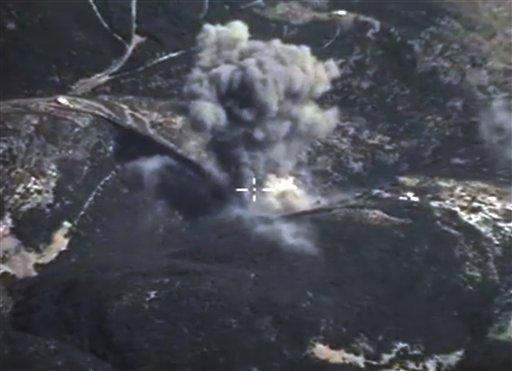
bomb in SyriaAn aerial view of a bomb explosion in Syria (Photo: AP/Russian Defense Ministry Press Service)

1. High Tide/Low Tide. When the “Second Intifada” broke out in October 2000, IDF used to refer to the riots and terrorist attacks in the Judea and Samaria area, as well is inside the territory of the State of Israel as “High Tide/Low Tide”, as each wave of riots was followed by a period of relative quiet, and then a new trigger emerged, leading to a wave of renewed violence, and so on.

Eventually, the “High Tide/Low Tide” incidents assumed a pattern of a murderous terrorist offensive, which took the lives of more than a thousand Israelis through suicide attacks, until the Intifada finally subsided in 2004.

The wave of riots and terrorist attacks that erupted about 15 years later, in the fall of 2015, appears to be connected, in some way or another, to the state of instability that characterizes many areas throughout the Middle East. For the last few years, the lion’s share of the fighting takes place in Syria, where hundreds of thousands of people were killed and millions more became refugees.

The major question that arose within the Israeli defense establishment in the fall of 2015 was whether this latest wave of terrorist attacks marks the outset of a “Third Intifada”. Although outwardly the Israeli interest is to announce “This is not a new Intifada,” in effect, there is talk about a “new situation” and no one knows how it will evolve.

Analyses performed within the defense establishment point to a number of reasons that suggest that this is a significant wave of terrorism which could turn out to be prolonged, as well as to reasons that justify the claim “This is not a new Intifada”.

One of the reasons that this wave of attacks is serious and could be prolonged is the religious motive: the Israeli media does not speak about it too often, but the Arab world is raging around rumors or reports that Israel actually intends to change the status quo on Temple Mount.

Even when one attempts to fish only “comfortable” data out of the statistics of the latest terrorist attacks, it is impossible to ignore the increase, by tens of percent, in the number of violent incidents throughout the Judea and Samaria area as well as within the “Green Line” during the last few weeks.

On the other hand, one significant difference between October 2015 and “Black October” (following the outbreak of the Second Intifada 15 years ago), is that the Israeli security forces are currently operating freely throughout the Judea and Samaria area. Consequently, entering the hospital in Nablus did not call for tactical support by tanks and aircraft. During the Second Intifada, on the other hand, it took the IDF and ISA quite a long time before they succeeded in regaining control over the centers of the Palestinian cities, pursuant to Operation Defensive Shield, and even then, the control achieved was only partial.

The recent events erupted despite the fact that IDF and ISA operate continuously against terrorist detachments. In each of the last few years, 2,000-3,000 Palestinian inhabitants were arrested. 80% of them were sentenced by the courts to prison terms of several months minimum.

It is still difficult to predict how the events will evolve over the next few months, but in any case, it seems that we have “a new security situation” on our hands.

2. Vladimir Putin. Many people regard the regional instability as the direct result of the American strategy of minimizing US involvement in the region, due to separatism processes and shifting the focus of world attention to Eastern Asia and the Pacific region (among other things, owing to the reduced dependence on Arab oil).

The party that stepped very effectively into the vacuum left by the USA was Russian President Vladimir Putin, who currently positions himself as the regional “Sheriff”.

No one can overestimate the importance of the moves made by Russian President Vladimir Putin, who deployed military forces to Syria this fall and continues to position himself as the strong man of the Middle East who never abandons his allies, while the USA has “transmitted” that her allies cannot rely on US support (as the USA had abandoned Egyptian President Hosni Mubarak in 2011).

This fall, the Russians deployed to Syria fighter aircraft that attack targets of the rebels opposing the military of President Bashar al-Assad. These moves were carefully coordinated with Iran, which, for her part, deployed hundreds of troopers (who are currently helping Hezbollah withdraw some of its forces back to Lebanon).

The Russian-Iranian move may have been intended to exert pressure on Saudi Arabia that supports the rebels, as well as to raise the price of oil, which is important to the economies of both countries.

Complicated? Even if there is no connection between the moves in Syria and the energy market, there is a definite connection between the fighting in Syria and the war raging in the southern part of the Arabian Peninsula. A solution in Syria may project on the war over there, as in both regions Iran and Saudi Arabia support opposing sides, with the conflict between the Shi’ite and Sunni factions of Islam as the backdrop.

Behind the scenes of the latest developments in Syria there has always been a Russian plan to bring about the end of the civil war in Syria by dividing it into areas of influence, with about 30% of the territory, in the Tartus and Lattakia area, remaining under control of the Alawite community of the current President, Bashar al-Assad.

Russia is interested in the sea ports in this area, and much less in maintaining Assad in control over a part of the disintegrated country. The Russians will not yield to the American demand to remove Assad from power until they have guaranteed their important interests. The party expected to pay the price is Israel, which may find itself, within a few months, facing a de-facto Iranian and Hezbollah domination on the other side of the border with Syria on the Golan Heights.

This situation could evolve despite the fact that Israel and Russia coordinate some of their respective moves, as indicated by the trip made by Prime Minister Netanyahu’s to Moscow last September, accompanied by the IDF Chief of Staff, Lt. Gen. Gadi Eizenkot, and Head of the IDF Intelligence Directorate, Maj. Gen. Hertzi Halevi, during which they met with “Sheriff” Putin.

3. Meanwhile, in the South. The good news come from the south, where Egypt under Abdel Fattah el-Sisi is determined to defeat the forces of al-Qaeda and the Islamic State that operate throughout the Sinai Peninsula. Egypt, Israel and the USA cooperate closely in the context of this effort, owing to their shared interests.

El-Sisi regards Hamas in the Gaza Strip as an enemy, owing to the cooperation between Hamas and the Egyptian Muslim Brotherhood movement, which is engaged in an on-going conflict with his regime.

Hamas itself is under tremendous pressure from different directions: from Egypt, which cuts off the underground tunnels connecting the Gaza Strip with the Egyptian territory, as well as from al-Qaeda and elements identifying with the Islamic State, who urge the leaders of Hamas to renew the fighting against Israel and occasionally even launch a rocket into Israeli territory in order to motivate Israel (which regards Hamas as the party responsible for such launches) to attack Hamas.

The reality that emerged in the Gaza Strip is yet another example of the complexity in our region. Iran, encouraged by the signing of the nuclear agreement with the superpowers, has renewed its support for Hamas, both financially and militarily (despite the fact that Hamas identifies with the rebels fighting against Bashar al-Assad in Syria and in Iran itself).

The positive bottom line is that Hamas, owing to its own considerations, does its best to maintain the ceasefire agreement reached with Israel following Operation Protective Edge in the summer of 2014. That state of affairs remained in effect until the fall of 2015 but reality, as everyone knows only too well, is highly dynamic.

4. A Small Military. One of the most significant moves expected within IDF in November is the endorsement of the long-term plan for the coming five-year period, and the conversion thereof into an effective order for execution.

“Gideon” is the name of the new multi-year plan led by IDF Chief of Staff, Lt. Gen. Gadi Eizenkot. The plan is intended to rely on the long-term budget allocated to the IDF according to the recommendations of the Locker Committee, and will come into effect in 2016, after five years during which IDF have operated without a long-term plan, as the previous plan had ended as far back as during the tenure of Lt. Gen. Gabi Ashkenazi as Chief of Staff. The Gideon plan is intended to convert the IDF into a technological, cyber-based military organization, possessing fast maneuvering elements equipped with accurate, lethal weapons and enhanced sea and air branches. Above everything else, the most substantial investment will be made in intelligence.

The greatest concern among quite a few elements within the defense establishment pertains to the size of the military, as the new plan calls for the demobilization of quite a few units. One of the principles of Israel’s national security concept since the days of David Ben-Gurion is the need to maintain a strong, substantial military force, based on hundreds of thousands of reservists. The principle is still valid, but in effect, the emphasis is placed on intelligence, air power and commando operations. The substantial ground army, along with its massive tank OrBat, is reduced dramatically – which is inconsistent with the aforesaid principle.

5. Defense Exports. Nearing the end of 2015, the Israel Ministry of Defense and the Israeli defense industries embarked upon a massive sales effort. Between October and December, they will take part in not less than five major defense exhibitions in the USA, South Korea, Japan, Colombia and Thailand.

Even if that effort proves successful, the statistics for 2015 will indicate that Israeli defense exports still follow the downward trend that began in 2014. At best, the defense exports for 2015 will amount to US$ 5 billion, as opposed to US$ 7 billion in 2013.

The main reason for this decrease is the end of the global campaigns in Iraq and Afghanistan. Several major deals that are still on the agenda, mainly in India, can still change the picture before the end of 2015 and lead to a positive trend in terms of the scope of exports. In any case, the contribution made by the defense exports, which amounts to billions of dollars, to the Israeli economy and to the Israeli security resilience is immense. The massive proceeds enable the Israeli defense industries to continue to invest funds in research in order to develop products at the cutting edge of technology.

Our World: Showdown at the OK Corral

November 3, 2015

Our World: Showdown at the OK Corral, Jerusalem Post, Caroline Glick, November 2, 2015

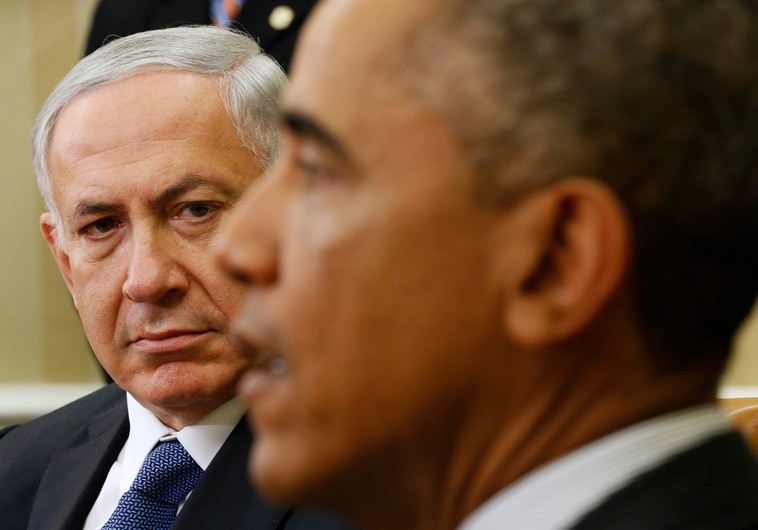
ShowImage (16)US President Barack Obama meets with Prime Minister Benjamin Netanyahu at the White House, October 1, 2014. (photo credit:REUTERS)

Whatever he says before the cameras next week when he meets with Netanyahu, Obama has no intention of letting bygones be bygones.

Prime Minister Benjamin Netanyahu’s meeting with US President Barack Obama next week is likely to look less like a rapprochement than a showdown at the OK Corral.

The flurry of spy stories spinning around in recent weeks makes clear that US-Israel relations remain in crisis.

Two weeks ago, The Wall Street Journal published a fairly detailed account of the US’s massive spying operations against Israel between 2010 and 2012.

Their purpose was to prevent Israel from attacking Iran’s nuclear installations. The Journal report, which was based on US sources, also detailed the evasion tactics the Obama administration employed to try to hide its covert nuclear talks with Iran from Israel. According to the report, the administration was infuriated that through its spy operations against Iran, Israel discovered the talks and the government asked the White House to tell it what was going on.

Over the past several days, the Israeli media have reported the Israeli side of the US spying story.

Friday Makor Rishon’s military commentator Amir Rapaport detailed how the US assiduously wooed IDF senior brass on the one hand and harassed more junior Israeli security officials on the other hand.

Former IDF chiefs of General Staff Lt.-Gens. Gabi Ashkenazi and Benny Gantz were given the red carpet treatment in a bid to convince them to oppose Israeli strikes on Iran’s nuclear installations. More junior officials, including officers posted officially to the US were denied visas and subjected to lengthy interrogations at US embassies and airports in a bid to convince them to divulge information about potential Israeli strikes against Iran.

Sunday, Channel 2 reported that the IDF’s Intelligence Directorate’s information security department just issued guidance to all IDF soldiers and officers warning them about efforts by the CIA to recruit them as US agents.

These stories have been interpreted in various ways. Regardless of how they are interpreted, what they show is that on the one hand, the Obama administration has used US intelligence agencies to weaken Israel’s capacity to harm Iran and to actively protect Iran from Israel. And on the other hand, Israel is wary of the administration’s efforts to weaken it while strengthening its greatest foe.

These stories form the backdrop of next week’s meeting between Netanyahu and Obama – the first they will have held in more than a year. They indicate that Obama remains committed to his policy of weakening Israel and downgrading America’s alliance with the Jewish state while advancing US ties with Iran. Israel, for its part, remains deeply distrustful of the American leader.

This Israeli distrust of Obama’s intentions extends far past Iran. Recent statements by Obama and Secretary of State John Kerry have convinced Israel that during his last 15 months in office, Obama intends to abandon US support for Israel at the UN Security Council, and to ratchet up pressure and coercive measures to force Israel to make irreversible concessions to the Palestinians.

From Netanyahu’s perspective, then, the main strategic question is how to prevent Obama from succeeding in his goal of weakening the country.

The implementation of Obama’s deal with Iran deal will form a central plank of whatever strategy the government adopts.

As far as Obama and his allies see things, the nuclear accord with Iran is a done deal. On October 21, House Minority Leader Nancy Pelosi hosted a reception for Democratic congressmen attended by White House Chief of Staff Denis McDonough to celebrate its official adoption.

Unfortunately for Pelosi and her colleagues, Iran is a far more formidable obstacle to implementing the deal than congressional Republicans. As Yigal Carmon, president of the Middle East Media Research Institute (MEMRI), explained in a report published on his organization’s website last week, at no point has any Iranian governing body approved the nuclear deal. Iran’s parliament, the Majlis, and its Guardians’ Council have used their discussions of the agreement to highlight their refusal to implement it. More importantly, as Carmon explains, contrary to US media reports, in his October 21 letter to Iranian President Hassan Rouhani, Iran’s Supreme leader Ayatollah Ali Khamenei did not give his conditional approval to the deal. He rejected it.

Carmon explained that the nine conditions Khamenei placed on his acceptance of the nuclear deal render it null and void. Among other things, Khamenei insisted that all sanctions against Iran must be permanently canceled. Obama couldn’t abide by this condition even if he wanted to because he cannot cancel sanctions laws passed by Congress.

He can only suspend them.

Khamenei also placed new conditions on Iran’s agreement to disable its centrifuges and remove large quantities of enriched uranium from its stockpiles.

He rejected inspections of Iran’s military nuclear installations. He insisted that Iran’s Arak heavy water reactor must remain capable of producing heavy water in contravention of the deal. And he insisted that at the end of the 15-year lifetime of the deal Iran must have sufficient uranium enrichment capability to enable it to develop bombs at will.

As Carmon noted, the US and EU have announced that they will suspend their nuclear sanctions against Iran on December 15 provided that by that date, the UN’s International Atomic Energy Commission certifies that Iran has upheld its part of the bargain.

By that date, in conformance with their interpretation of the nuclear deal, the US and the EU expect for Iran to have reduced the number of centrifuges operating at the Natanz facility from 16,000 to 5,060 and lower enrichment levels to 3.67%; reduce the number of centrifuges at Fordow to a thousand; remove nearly all its advanced centrifuges from use; permit the IAEA to store and seal its dismantled centrifuges; reduce its stockpile of enriched uranium to 300kg.; remove the core from the Arak reactor and disable it; and submit to agreed monitoring mechanisms of its nuclear sites.

Carmon noted that Iran has taken no steps to fulfill any of these conditions.

With Khamenei’s rejection of the nuclear deal and Iran’s refusal to implement it, there are two possible ways the US and the EU can proceed.

First, as Carmon suggests, Obama and the EU may renew nuclear talks with Iran based on Khamenei’s new position. These talks can drag out past Obama’s departure from office. When they inevitably fail, Obama’s successor can be blamed.

The other possibility is that Iran will implement some component of the deal and so allow Obama and the EU to pretend that it is implementing the entire deal. Given the US media’s failure to report that Khamenei rejected the nuclear pact, it is a fair bet that Obama will be able to maintain the fiction that Iran is implementing the deal in good faith until the day he leaves office.

So what is Israel to do? And how can Netanyahu use his meeting with Obama next week to Israel’s advantage? Israel has two policy options going forward. First, it can highlight the fact that Iran is not implementing the deal, just as Israel took the lead in highlighting the dangers of the nuclear accord with Iran over the past year. This policy can potentially force Obama onto the defensive and so make it harder for him to go on the offensive against Israel at the UN and other venues in relation to the Palestinians.

But then, it is far from clear that Obama will be deterred from adopting anti-Israel positions at the UN even if Israel succeeds making an issue of Iranian noncompliance with the nuclear deal.

Moreover, if Netanyahu leads the discussion of the Iran’s bad faith, as he drove the discussion of the nuclear deal itself, he will reinforce the already prevalent false assessment in the US that a nuclear Iran threatens Israel but is not dangerous for the US.

This incorrect assessment has made a lot of Americans believe that by seeking to prevent Iran from acquiring nuclear weapons, Israel is advancing is own interests at America’s expense.

The other policy option is the one that Defense Minister Moshe Ya’alon indicated Israel is pursuing in his meeting last week with his counterpart Defense Secretary Ashton Carter. At the Pentagon Ya’alon declared, “The Iran deal is a given. Our disputes are over.”

The downside of this position is that it indicates that Israel accepts the legitimacy of a deal that Iran is not implementing and that would imperil Israel’s national security even if Iran were implementing it.

Its upside is that it takes Israel out of the US debate regarding the nuclear deal. To the extent that opponents of Obama’s Iran policy are willing to lead the fight against the deal themselves, Israel could do worse than to take a step back and plot its own course on Iran, independent of the US policy discussion.

It is hard to know which line of action makes more sense. But as the spy stories demonstrated, one thing is clear enough. Whatever he says before the cameras next week when he meets with Netanyahu, Obama has no intention of letting bygones be bygones.

Ya’alon Warns Israel’s Enemies Divided on Ideology But United in Hatred

November 3, 2015

Defense Minister Moshe Ya’alon warns that Israel’s enemies are divided in ideology but united in their hatred of the Jewish State. By: Hana Levi Julian Published: November 3rd, 2015

Source: The Jewish Press » » Ya’alon Warns Israel’s Enemies Divided on Ideology But United in Hatred

An F-16 fighter jet takes off from Ramat David air force base.
Photo Credit: Ofer Zidon / Flash 90

Israel’s Defense Minister Moshe Ya’alon warned Tuesday that Israel’s enemies are split along ideological lines, but united in their hatred of the Jewish State.

The defense minister noted there appear are several axes among those aligned against Israel: on one side are forces united with the Muslim Brotherhood, which include Turkey and Qatar. On another, there are those united with the Global Jihad movement, which include Salafi Islamists such as Al Qaeda-linked groups such as the Army of Islam, and Da’esh (ISIS).

Both are united in their hatred of Jews and Israel, and the “unwillingness… to recognize our right to exist as the nation state of the Jewish people,” Ya’alon said – as is the Palestinian Authority.

[PLO Chairman Yasser] “Arafat and [Palestinian Authority leader Mahmoud] Abbas also did not want to end the conflict on the 1967 borders,” he said.

In remarks broadcast last week on official Palestinian Authority television, Abbas said in Arabic to the United Nations Human Rights Commission in Geneva: “Mr. President, ladies and gentlemen, haven’t you wondered: For how long will this protracted Israeli occupation of our land last? After 67 years (i.e., the re-creation of the State of Israel), how long? Do you think it can last, and that it benefits the Palestinian people?”

The remarks were translated and reported by the media watchdog organization Palestinian Media Watch (PMW). Www.palwatch.org

Israel has “zero tolerance” for arms sales to terrorists, the defense minister said in remarks following alleged Israeli air strikes against Hezbollah near the Syrian-Lebanese border.

Speaking at a Kibbutz Leadership conference in Judea-based Kibbutz Ma’ale Hamisha, near Jerusalem, Ya’alon warned in a cryptic remark, “Those who cross red lines will be hit.” It is believed that Ya’alon was referring not only to standard ordnance but also to the transfer of chemical weapons by Syria to the Hezbollah terrorists who have fought to defend President Bashar al-Asssad.

Ya’alon commented that the Hamas terror organization has only withheld hostilities out of dire necessity: “not because they have turned Zionist, but due to the price they paid [last year] in Operation Protective Edge.”

New Rules of Engagement Result in Safer Security Forces, High Arab Casualties

November 2, 2015

IDF soldiers are finally allowed to defend themselves and fight the terrorists…

By: JNi.Media

Published: November 2nd, 2015

Source: The Jewish Press » » New Rules of Engagement Result in Safer Security Forces, High Arab Casualties

Palestinian Arabs clash in riots with IDF troops in Bethlehem. (Oct. 2015)

Palestinian Arabs clash in riots with IDF troops in Bethlehem. (Oct. 2015)
Photo Credit: Flash 90


(JNi.media) In late September, 2015, following a critical increase in Arab terrorism, Israel changed the rules of engagement for its security forces. The perceived result has been a decline in injuries and casualties among Israeli police and the military– in part, due to the use of preemptive measures, and a sharp rise in injuries and casualties among Arab rioters and terrorists.

A Red Crescent report published this week suggests as many as 2,617 Arabs were shot with live and rubber-coated steel bullets in the recent clashes. A Crescent spokesperson told Ma’an that when considering Arab rioters who were repelled with tear gas, the total figure for October comes to 8,262.

The report claims 26 Arabs were shot dead during clashes, and another 40 were shot dead after carrying out (attempted or successful) stabbing or shooting attacks against Israeli civilians or security forces. Ten Israelis were killed during the same period, every one of them from an attack by Arab terrorists.

On September 24, the Israeli government opened a new chapter in its relationship with security forces in the field. The rules of engagement for Israeli police and border guards were changed. It was a process, it involved a steady rise in Arab stone throwing and stabbing attempts, as well as sporadic shots at Israeli drivers passing through Judea and Samaria, but after a little less than a month, the rules of engagement were finally changed.

On a Thursday night, the Netanyahu Security Cabinet approved unanimously a series of decisions to assist in the fight against stone, Molotov cocktail and fireworks throwers in eastern Jerusalem and elsewhere. The Cabinet decided, among other things, that police officers would be “allowed to open fire when faced with a threat to the life of any individual.” In addition, Public Security Minister Gilad Erdan accepted the police argument that it is impossible to tell if the stone throwers are minors or adults, and insisted on removing the clause stating that the rules of engagement apply only to adults. It meant that police were given a green light to shoot minors who throw stones or Molotov cocktails.

The change was major not only because of the obvious understanding the cabinet was showing, of the difficulties being faced by its security men and women on the ground. It also, shortly thereafter, delivered the message to the same officer on the ground that the Netanyahu government is finally ready to protect them against the Attorney General apparatus which in the past was inclined to limit their range of responses when carrying out their assignments against violent Arab mobs.

The AG put up a fierce fight against both ideas: that police be allowed to shoot at rioters even if they don’t pose a direct threat to the policeman but are endangering the lives of others; and the allowance for cops to shoot at anyone posing such a threat, without having to verify his or her age. There were intense debates between the AG staff and police over these new rules, and, eventually, Netanyahu came down on the side of police and, with that, changed everything. His decision also carried a message to the AG and his office, that while they are appointed civil servants, and must support him, the elected executive who ultimately makes those decisions.

The new atmosphere that followed matched the changes in the IDF command’s approach to its own set of rules of engagement. Back in mid-August, OC Central Command Chief Col. Roni Numa revised the rules of engagement in Judea and Samaria during riots and terrorist attacks, to require that if the attacking terrorist does not endanger the security forces, and, having carried out his attack is now running away from them, firing should be in the air and not at the terrorist’s body. The purpose of the change was to “avoid escalating the tense situation in Judea and Samaria and to avoid raising the number of Palestinians being killed.”

The revision came in response to criticism of the IDF and security forces for indiscriminate shooting of innocent people, or unarmed terrorists, heard time and again from the Palestinians and from human rights groups. A report released by the Breaking the Silence NGO, allegedly based on soldiers’ testimonies from Operation Protective Edge, argued, for example, that there were “indiscriminate firing policies, and an extensive moral lapse in the IDF operation policy, reaching from the top command down.”

The IDF’s approach to the rules of engagement was also changed shortly thereafter, when it was discovered that the softer methods did nothing to quell Arab violence, quite the opposite, it encouraged a steep rise in Arab acts of terrorism.

This new Israeli approach to protecting the lives of the security forces has not gone without outside condemnation. The UN High Commissioner for Human Rights, Zeid Raad al-Hussein, said: “The high number of casualties, in particular those resulting from the use of live ammunition by Israeli security forces, raise concerns of excessive use of force, and violations of the right to life and security of the person.”

Amnesty International said only last week that Israeli forces “ripped up the rulebook and resorted to extreme and unlawful measures.”

Palestinian, Israeli and international rights groups have been claiming that in the majority of cases, Israeli forces needlessly killed their attackers, who posed no imminent threat. Israeli NGO B’Tselem called it “extrajudicial executions.”

As was the case during the 2014 Gaza war, the extreme left is angriest when Israel turns its disproportionate might against its enemies. It should be noted that even if human rights advocates were correct, and every single Arab who rushed an Israeli policeman or soldier with a knife didn’t pose a real threat (which is debatable) — in most Western democracies such an attack would result in the killing of the perpetrator. Likewise with a civilian who would light up a Molotov cocktail and throw it at a patrol car —that individual would likely be signing his or her death warrant, regardless of whether or not the firebomb managed to blow up its target.

The wave of terror continues as November rolls in, with fresh riots leaving more Arab youths injured this past Sunday. Interestingly, a report by the Gaza Health Ministry of a shooting of two Arabs by Israeli forces in the central Gaza Strip acknowledges that both Palestinians were hit in their lower extremities, following which they were taken in moderate condition to Shuhada al-Aqsa Hospital. A simple analysis of the news report belies the extreme left’s claims of “extrajudicial executions.” If an enemy soldier wants to execute you, he probably won’t aim at your legs.

Fatah on the verge of eruption

October 24, 2015

Fatah on the verge of eruption, Ynet News, Alex Fishman, October 23, 2015

As long as Tanzim militants did not walk around brandishing their weapons in public, Israel and the PA turned a blind eye. Now, they are emerging as a significant and central player, fervently courted by the Fatah leadership. Those seeking to inherit Abbas’ seat need the Tanzim divisions on their side. The mounting tensions, the political situation and the anarchy on the street are pushing both Tanzim militants and those courting them to take more extreme positions, and call for an armed conflict against Israel.

***************************************

IDF troops that entered Shuafat refugee camp this week had to withdraw after encountering dozens of armed militants; this is only an example of what might happen when Fatah’s armed wing, Tanzim, joins the fight against Israel. And they won’t do with just knives: There are thousands of weapons all over East Jerusalem.

When senior Palestinian security officials want to mock their Israeli colleagues, they remind them that just in Qalandiya – an area controlled by Israel – there are at least 400 M-16 rifles. That figure does not incluide other weapons – guns, explosives and grenades – that are in the hands of militant groups there.  Some of these groups are affiliated with Fatah’s Tanzim, some are affiliated with other organizations, and others belong to criminal organizations – all operating in this no man’s land, where no law applies.

These militants have no problem with appearing on camera, on Channel 2 for example, just as they had no quams about opening fire at an IDF force that went into Qalandiya last Saturday to arrest a wanted man who already spent a year and a half in prison.

“So are YOU going to go in there and get the weapons out, or are you going to leave it to us?” the Israeli security officials respond in anger whenever anyone accuses them of sitting on their hands and doing nothing – implying that the Israeli security forces are afraid to enter a refugee camp under their control in order to demilitarize the Tanzim.

1_oA Tanzim militant (Photo: AP)

Even Israel admits that there is an arsenal of some 3,000 weapons inside the Shaufat refugee camp. The figure includes M-16 and kalashnikov assault rifles, grenades, and IEDs (improvised explosive devices).

Last Saturday night, an army force entered the camp to take measurements of a home set to be demolished. Several dozen militants surrounded the building and made it abundantly clear that they were willing to die in order to stop the structure from being demolished. This is the mood in Palestinian neighborhoods of Jerusalem. The army will have to come back there, with more forces, in order to complete preparations. And now it’s clear that demolishing terrorists’ homes – a countermeasure promised by the Israeli government – will entail fighting dozens of militants who have been left unchecked for years.

Tanzim power structure

Israeli security officials tend to dismiss the knife-wielding terrorists, presenting them as proof of the weakned status of the more established Palestinian terrorist organizations. Except that for a Muslim, the knife is the symbol of the fight for the holy places, in the spirit of the “sword of Islam.” Muslims don’t view the use of a knife as an act of desperation and wretchedness, but an act of bravery. So the less friction on the Temple Mount – which would lead to the lowering of religious tensions – the less stabbing attacks we’ll have.

In the current wave of violence, the stabbing attacks are just ripples in the ocean. The statistics surrounding these “lone-wolf attacks” don’t accurately reflect the level of violence accumulating on the Palestinian street. Israeli security officials are more concerned with these massive tidal waves that have a far bigger potential of dangerously erupting.

Indeed, when the IDF prepares to face a long-term wave of violence, it takes into consideration the eventuality that at any given moment- and without prior warning – thousands of militants in the West Bank, mostly affiliated with Fatah’s Tanzim, could join the fight.

In its early days, Tanzim was a secret organization compiled of local political activists, students, and released prisoners, which executed Fatah’s policies: Be it social activities, organizing support rallies for the regime, or rioting against Israel. Later, during the second intifada, Tanzim’s militants committed terror attacks against Israeli security forces and civilians, including the terror attack in Kibbutz Metzer, where five people were murdered – including a mother and her two children.

The basic structure of the organization remains, and nowadays it serves as Fatah’s “shadow army” operating on the Palestinian street, alongside the PA’s security forces.

However, the ties between the heads of Tanzim and the Mukataa in Ramallah are growing weaker by the day. Abbas’ security forces can’t enter some of the refugee camps because the Tanzim militants kick them out.
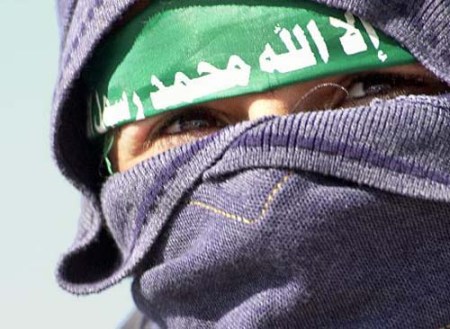
ap_oA Tanzim militant (Photo: AP)

Two months ago, when there was talk of the day after Abbas, Tanzim threatened the heads of Fatah that if it didn’t get its share of the leadership pie, they would launch attacks against Palestinian security facilities and take them by force.

Tanzim’s militants are spread over ten districts of the West Bank. East Jerusalem is one of these districts. Each district is divided into sub-districts, and then further divided into neighborhoods, villages, ect. The smallest unit is the “Jannah,” and it that might also be a bunch of huts outside a village. Every such unit – from the district to the Jannah – has commanders. Today, when these groups sense Abbas’ weakness and the crumbling of his regime, they go out on the street armed, in broad daylight. This is an act of defiance not just against the Palestinian Authority, but also against Israel.

After the second intifada, Israel and the Palestinian Authority, under the auspices of the Americans, signed a pardon agreement for wanted militants. The agreement dictated that the Fatah militants who fought as part of the Al-Aqsa Martyrs’ Brigades during the second intifada would cease their involvement in terrorism and disarm. Israel, in return, would stop pursuing them. It turns out that some of the armed Tanzim militants of today are the same wanted militants from the distant past – the same ones who committed not to carry arms. So even that agreement has fallen apart.

The arson at Joseph’s Tomb last weekend might have been an anti-Jewish provocation, but it also demonstrated how little regard the Palestinian militant groups have for the Palestinian security forces. Joseph’s Tomb is only 400 meters away, in a straight line, from a central Palestinian security forces base. The perpetrators acted against the PA’s interests, and right under its nose. They just don’t give the Palestinian security forces the time of day.

pa (1)Tanzim militants (Photo: AP)

As long as Tanzim militants did not walk around brandishing their weapons in public, Israel and the PA turned a blind eye. Now, they are emerging as a significant and central player, fervently courted by the Fatah leadership. Those seeking to inherit Abbas’ seat need the Tanzim divisions on their side. The mounting tensions, the political situation and the anarchy on the street are pushing both Tanzim militants and those courting them to take more extreme positions, and call for an armed conflict against Israel.

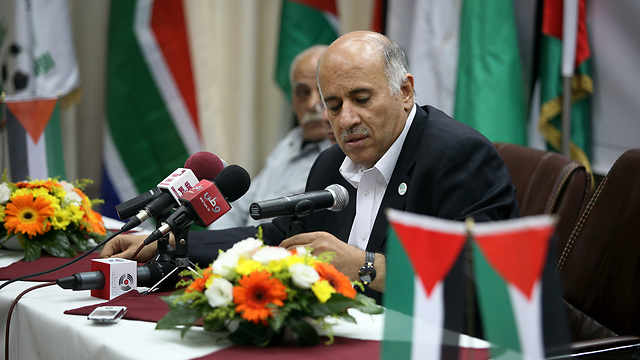
Jibril Rajoub, for example, is one of the ten candidates to succeed Abbas. When this wave of violence just started, Rajoub was still urging the Palestinian security forces to hold a dialogue with Israel and now, this week, he changed his tune to a far more extreme position, encouraging the knife-wielding terrorists, as if he was competing with Hamas over who has the most inflammatory rhetoric. Rajoub wants to win back the hearts and minds of the Palestinian people, Israeli officials explain, and the Palestinian people want blood. Rajoub views himself as one of the leaders of Tanzim, and this kind of rhetoric only serves to increase his popularity on the Palestinian street.

62114480100589640360noJibril Rajoub, rising in popularity on the Palestinian street (Photo: Amit Shabi)

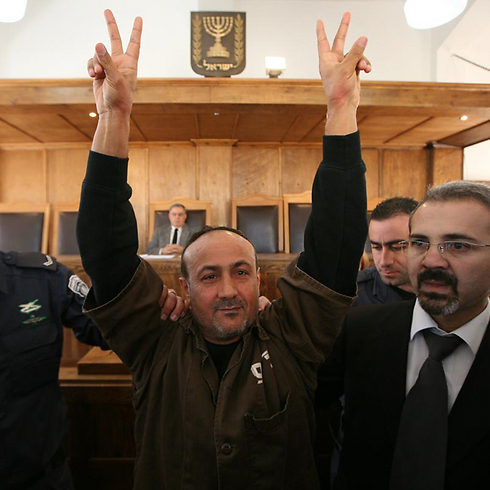
Several of Abbas’ potential successors even formed coalitions to bring Tanzim to their side. For example, the coalition of Abbas’ rivals, headed by Mohammed Dahlan, which also includes Yasser Abed Rabbo (the former secretary-general of Fatah’s executive committee, who was removed from office) and Salam Fayyad (the former Palestinian prime minister who was also removed from office). This coalition seeks to bring in Marwan Barghouti, who is imprisoned in Israel, as a symbol. It also has money, and a lot of it, that Dahlan brought with him from the Gulf monarchies, in order to buy Tanzim’s loyalty.

370098820870100490490noMarwan Barghouti, a symbol (Photo: Gil Yohanan)

Then there’s also the group of Abbas allies, like Majid Faraj, the head of the Palestinian security forces, and Saeb Erekat, the chief negotiator with Israel.

They face other potential candidates to succeed Abbas, like Muhammad al-‘Alul – the former governor of Nablus and one of the more senior members of the Tanzim leadership, who’s been there since the first intifada.

All of these candidates have their sights on the militant organization, trying to appropriate it. The fight for Tanzim creates a kind of conduct and comments that are becoming more and more extreme.

Eisenkot’s West Bank forum

This week, Abbas finally realized the kind of trap he walked into. In a desperate attempt to stop the escalation, he tried to reframe the fight with a new slogan: “Smart Resistance.” Wednesday’s editorial in the PA’s mouthpiece Al-Hayat al-Jadida warns against the situation getting out of control, which could hurt the Palestinian people’s quality of life. The term “third intifada” is not mentioned.

Abbas’ former slogan, “Peaceful Resistance,” is no longer relevant. As long as the resistance only included stone-throwing, rioting, and Molotov cocktails, Abbas would congratulate the “shahids” who committed these actions. He was against terrorism in principle, but not to this kind of activity. But the moment the PA started encouraging violence of any kind – it was inviting that escalation. And when the knives started appearing and Abbas was unwilling to condemn the stabbers, it came back to him like a boomerang. The Palestinian street no longer accepts the PA’s authority. Young rioters don’t heed the calls of the Palestinian security forces, Hamas, or anyone else for that matter. That is why the PA leadership is now talking about a “Smart Resistance”: To bring the knives back into the kitchen, because the Palestinians will pay dearly for this escalation. But it appears Abbas has already missed the train.
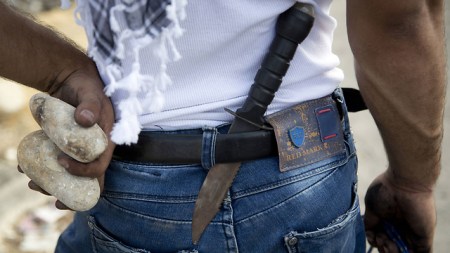
stone throwersStone throwers: ‘Peaceful resistance’; Knife-wielding attackers:’Smart resistance’ (Photo: AP)

In war games held by the IDF’s Central Command on the eve of Abbas’ speech at the UN General Assembly meeting last month – with Israeli officials worried about an inflammatory speech that would set the Palestinian street on fire – the army drilled several scenarios of a loss of control over the West Bank.

The first scenario: A wave of lone-wolf attackers dragging the entire Palestinian street into all-out violence. This scenario is defined as low-level violence, and it is unfolding right now.

The second scenario was of a violent outburst inside the refugee camps that would enlist Tanzim to an armed struggle that would set the West Bank on fire. This is the scenario currently worrying Israel’s defense establishment. That is why Defense Minister Moshe Ya’alon instructed the army to prepare for long-term deployment of increased forces in the West Bank, including the possibility of switching out the conscript soldiers in the West Bank with reservists, to allow the army to resume its regular training schedule.

Assignments for the reservists have already been determined, and starting December they too will be deployed in the West Bank. There will be a price to pay for the reservists – there’ll make more mistakes out in the field – but the army has been on high alert in the West Bank for a month now, and it is unclear when that would end. So calling up the reserves at this point appears like a necessary step.

Stone throwers for AbbasAbbas welcomed stone-throwing rioters (Photo: EPA)

Facing constantly increasing levels of terrorism, the IDF’s General Staff is also focusing on preparing long-term plans. Chief of Staff Gadi Eisenkot holds at least three weekly meetings with a team of senior officers who rose up the ranks while fighting terrorism in the West Bank. Among them is Deputy Chief of Staff, Maj.-Gen. Yair Golan, who was the commander of the Judea and Samaria Division; the head of Army Intelligence, Maj.-Gen. Herzl Levy, who was the commander of the Jenin Brigade; the head of the Operations Branch, Maj.-Gen. Nitzn Alon, who was the commander of the Judea and Samaria Division and the GOC Central Command; the current GOC Central Commander, Maj.-Gen. Roni Numa; COGAT Maj.-Gen.

Yoav Mordechai; the head of the Operations Division, Brig.-Gen. Aharon Haliva, who commanded over the Tulkarm-Qalqilya sector; and of course the current Judea and Samaria Division commander, Brig.-Gen. Lior Carmeli, who served in the past as the head of the Jenin Brigade. Not to mention Shin Bet chief Yoram Cohen and the commander of the Shin Bet’s Jerusalem District, in charge of the West Bank, who served in Hebron for 17 years.

The army wants to send a message that it put its best people on the job – senior officers with the most experience fighting against the Palestinians in the West Bank that the army has. There’s more than a subtle hint here to the attempts of politicians to challenge the defense establishment’s judgment with bizarre ideas, meant solely to bring the situation to a boiling point in order to create a new reality on the ground vis-à-vis the Palestinians.

For example, Bayit Yehudi Minister Uri Ariel’s call to stop the transfer of funds to the Palestinian Authority. On paper, this is an innocuous and logical proposal. They owe over NIS 1.5 billion to the Israel Electric Corporation, so why do we need to pay their bills? After all, those funds are also paying the stipends given to families of terrorists.

Except that army officials who are in communication with the Palestinian security forces have received a very clear message from them: Don’t you dare touch our tax money. If the funds don’t come in, there will be no money to pay policemen’s salaries. No salaries? Those policemen won’t be out in the field or worse – they’ll join the ranks of Tanzim or Hamas.

And this is what Minister Ariel and his ilk want: Anarchy.

AnarchyAnarchy (Photo: AFP)

The defense establishment is fighting tooth and nail to stop the approval of a proposal from right-wing ministers to impose a blockade on the West Bank. The government has accepted the defense establishment’s position. The ball is now in the prime minister’s court. The moment Netanyahu caves in and surrenders to the pressure coming from the extreme right – the IDF will no longer be able to stop an all-out armed conflict.

It was no coincidence that the defense minister – in a speech he made this week – chose to speak against the inciters, the “price tag” people, and the like. The defense establishment is aware of the potential threat of Jewish violence. The most effective weapon the defense minister has against Jewish extremists in the West Bank is Israeli public opinion, which won’t accept such conduct from hawkish ministers and settler leaders on the ground.

The heads of the Palestinian security forces are having a hard time keeping their men in line. There were already several “rebellions” by Palestinian security personnel who tried to commit attacks – and were thwarted. The heads of the Palestinian security forces are pleading with Israel to minimize the amount of casualties in clashes with Palestinians, to keep out of Area A, and not deny them the funds to pay salaries.

Snipers instead of aerial fire

On October 16, Palestinian security forces arrested two terror cells: One belonging to Hamas and the other to the Popular Front for the Liberation of Palestine. According to intelligence obtained by the PA, the Hamas cell planned to commit a big terror attack meant to rile up the Palestinian street and weaken the Palestinian Authority.

Israel has no reason to doubt the credibility of this report. A similar incident occurred, on a much larger scale, on the eve of Operation Protective Edge. At the time, the Shin Bet exposed a Hamas plot including dozens of operatives planning to commit several major terror attacks against Israel and the Palestinian Authority in an effort to bring down Abbas.

Hamas is currently fighting on three separate fronts, leading a different policy in each of them. In Jerusalem, Hamas is working to take over the Temple Mount. In the West Bank, it’s making every effort to execute a large-scale terror attack that would serve as the final nail in the coffin for the Palestinian Authority as it is today. The large sums of money feeding the propaganda Hamas is spreading through social media as well as traditional media is coming from Istanbul, from the Hamas headquarters in Turkey.

Gaza border (2)Clashes on the Gaza border (Photo: Reuters)

Saleh Al-Aruri, who was exiled to Qatar by the Turkish government several months ago, has returned to Istanbul with the Turks’ consent, and is leading Hamas’ a campaign of propaganda and incitement under the slogan “Stab, stab!” This message is falling on attentive ears not just in East Jerusalem and among Palestinians illegally staying in Israel, but also in the West Bank, mostly in the Hebron area, where quite a few stabbing attacks occurred over the past week.

In recent days, the incitement coming out of Turkey has been working to change the focus from stabbing attacks to vehicular attacks. Hamas believes the stabbing attacks have exhausted themselves, even though there were quite a few of them taking place in the West Bank this week, mostly in the Hebron area. The vehicular attacks are far more effective. And, indeed, there has been a rise in vehicular attacks in recent days.

In the Gaza Strip, on the other hand, Hamas lets the Palestinians to blow off steam, but keeps it under control, and stops, by all means possible, any rocket fire at Israel. Twelve Gazans have been killed in clashes with IDF forces on the border fence and in airstrikes, without any response from Hamas.

The field is flooded with IDF snipers, and over the past few days protesters have failed to cross the border fence. The IDF is also trying not to give Hamas a reason to change its policy in the Gaza Strip. When snipers fired from inside the Strip, hitting an Israeli vehicle, the army considered a targeted strike from the air. But out of operative considerations, the IDF decided instead to hit back with sniper fire. By the way, these Gazan snipers were part of an organization that broke away from Hamas.

Hamas is playing these three different games with a lot of caution and without any confusion. The organization’s basic assumption is that Israel won’t launch another conflict in the Gaza Strip over a terror attack initiated by Hamas in the West Bank.

The Palestinian security forces were not the only ones arresting Hamas operatives in the West Bank. The IDF conducted its own raids, arresting both military and political figures. One such political figure was Hassan Yousef, who is considered the head of Hamas in the West Bank, and who Israel accuses of incitement. But what these arrests are actually meant to do is signal Hamas that Israel will trample the organization’s presence in the West Bank, just as it did during Operation Brother’s Keeper, after the kidnapping and murder of the three yeshiva students in the summer of 2014.

During a situation assessment meeting held in Israel after the arrests, one of the officers compared dealing with Hamas to going to the family health center. Every once in a while, people like Hassan Yousef need to be brought in to see how much weight he gained, how high he got and check his mental state. A sort of litmus paper for the way the wind blows in the West Bank. The problem is that at this family health center, there are no innocent babies or kind nurses. The players in the triangle of Israel-West Bank-Gaza have already realized that the era of knife-wielding attackers could very well be one day remembered as normal compared to what the Palestinian street knows, could and might do.

Kerry urges Benjamin Netanyahu to ‘move beyond rhetoric’

October 22, 2015

Kerry urges Netanyahu to ‘move beyond rhetoric’ and take steps to end wave of violence

October 22, 2015, 9:50 am

Source: Kerry urges Benjamin Netanyahu to ‘move beyond rhetoric’ and take steps to end wave of violence – Israel News – Jerusalem Post

US Secretary of State John Kerry met with Prime Minister Benjamin Netanyahu in Berlin on Thursday, saying that the time had come for Israel and the Palestinians to agree on the steps that must be taken to “move beyond condemnations and rhetoric” and stop the current round of terror attacks plaguing Israeli cities.

Kerry was beginning a four-day trip to Europe and the Middle East aimed at deescalating the violence which has seen ten Israelis killed in terror attacks and dozens of Palestinian attackers and rioters killed by Israeli forces.

Netanyahu reiterated his assertion that the current wave of terror is “driven directly” by incitement from Hamas, the Islamic Movement of Israel, and the Palestinian Authority and its leader, Mahmoud Abbas.

Added by JK

Attacks on Israelis will go on, Hamas chief says in South Africa
At Cape Town rally organized by ruling African National Congress party, Khaled Mashaal urges continued terror attacks
http://www.timesofisrael.com/attacks-on-israelis-will-go-on-hamas-chief-says-in-south-africa/

I want to thank you and the US for condemning the terrorist attacks against Israel, for standing up for our right of self defense,” the prime minister told Kerry.

“We remain committed to the status quo. We’re the ones that protect all the holy sites,” Netanyahu said, refuting Palestinian claims that Israel is seeking to change the status quo at the Temple Mount.

“Israel is acting to protect its citizens as any democracy would in the face of such wanton and relentless attacks,” he said in response to charges that Israel has used excessive force in stopping the attacks.

“To generate hope, we have to stop terrorism. To stop terrorism, we have to stop the incitement,” he stated.

“It’s time that the international community told President Abbas to stop the incitement and hold him accountable for his words and his deeds,” he added.

Kerry said that “it is absolutely critical to end all incitement, to end all violence and to find a road forward to build the possibility which is not there today for a larger process.”

“So we have to go steps, but today you and I can really rekindle that process,” he added.

Kerry said that he had spoken to Jordan’s King Abdullah and Abbas, and had received the impression that “everyone wants this to deescalate.”

Israel’s “Knock on the Keyboard” campaign spies on and subverts terrorist social networks

October 21, 2015

Israel’s “Knock on the Keyboard” campaign spies on and subverts terrorist social networks DEBKAfile, October 21, 2015

Keyboard_Brigades

With this fuel constantly on tap to keep the flames high, diplomatic efforts underway to calm the conflict, such as visits by UN Secretary General Ban Ki-moon or US Secretary of State John Kerry, are no more effective than a small glass of water. The best hope of curbing the violence rests with the new modes of operation which Israeli intelligence has switched into high gear.

*******************

The newest type of Israeli intelligence officer does not require expertise in hand-to-hand combat, shooting or the ability to survive in enemy territory, but rather a keyboard, screen, internet connection and a complete command of Arabic, including idioms, jargon and expressions. The officer goes online under a false name and uses social networks to connect with those about to stab, run down or shoot Israelis. Along with the undercover agents in the field, there is a new generation of Israeli “digital HUMINT” officers who are updated on the latest trends among the Arab youth and spread out in the same digital space as the users in the back alleys of Palestinian refugee camps. Posing as terrorists, they use their fluent Arabic on Facebook or Twitter to request instructions, assistance, information and direction to “carry out attacks.”  

Israeli policymakers and security chiefs have different views on the existence of a central figure or group at the head of the current wave of terror that began with the murder of Na’ama and Itam Henkin on October 1. and for which no end is in sight. But they all agree on the means used to disseminate and scale up the knife attacks, stone throwing, gunfire and hit-and-run attacks, which have killed 11 Israelis and wounded dozens until now.

Those means consist largely of Facebook and Twitter and instant messaging services such as Skype and Whatsapp, which communicate instructions to the terror operatives.

They also serve as mass media for publicizing and glorifying acts of terror, relaying training methods, spreading propaganda, marking targets and post mortems on operations performed.

The social media and instant messaging provide the masters of terror with endless services, such as the transfer of private data, video and images and even chitchat between “friends.” Encrypted information carried thereby can’t be decoded.

The causes of Palestinian terror have not changed fundamentally over the years from one outbreak to the next. The “soldiers of terror” have the same motivations today as yesterday. The only difference is the mode of communication between the rank-and-file terrorists and their handlers.

Land-line and cellular communication, which until a few years ago served security organizations as their primary tools for forestalling terror, are now old hat. Almost extinct too are the costly technological engineering and SIGINT (signal intelligence) equipment and information systems, once used for disrupting and thwarting terror.

The contemporary emphasis on OSINT (open source intelligence), which monitors the mass media, such as television and radio stations, internet sites and newspapers, has given birth to a new branch of intelligence, which harvests critical operational and tactical data from the social networks.   ,

The present-day Israeli intelligence officer is not trained in hand-to-hand combat, marksmanship or methods of surviving in enemy territory. He is armed with a keyboard, screen, internet connection and a complete command of Arabic, including idioms, jargon and expressions. This officer goes online using a false name and accesses the right social networks to connect with those about to stab, run down or shoot Israelis.

HUMINT (human intelligence), classic field intelligence, is taking on a new form. Besides the field commanders and the undercover agents, there is a new generation of Israeli “digital HUMINT” officers, who are updated on the latest trends among young Arabs by invading their digital space. Posing as terrorists, they use their fluent Arabic on Facebook or Twitter to request instructions, assistance, information and direction to “carry out attacks”,

It is an established fact that social networks are a key operational medium in the service fo terrorists for transferring orders and instructions. Israeli intelligence is well prepared to move in on this chink in the terrorists’ defenses, better than their Western counterparts.

Hundreds of male and female soldiers with fluent Arabic, using false names to mingle among Arab web surfers, were first used to good purpose at the outset of the Arab Spring. The project picked up steam as the trend of terror in the Arab and Muslim world grew.

For terrorists, the social networks have both advantages and disadvantages. A young man in Beit Hanina or Issawiyeh, who uploads to Facebook a video praising a Palestinian driver who ran down Jewish pedestrians, or offering guidance on where to thrust a knife to kill a Jew, also gives away his IP address, his e-mail address, and the visitors who post comments and likes.

The vast amount of data garnered from social networks is a gold mine for analysts to draw conclusions, delineate the web of ties among terrorists and home in on orders and instructions passed out to fuel the current wave of terror.

With this fuel constantly on tap to keep the flames high, diplomatic efforts underway to calm the conflict, such as visits by UN Secretary General Ban Ki-moon or US Secretary of State John Kerry, are no more effective than a small glass of water. The best hope of curbing the violence rests with the new modes of operation which Israeli intelligence has switched into high gear.

Even in the midst of serial terror, these cyber warriors are busily sifting through an ocean of information from open sources and making headway towards identifying the chains of command orchestrating the wave of violence, as well as individuals, pairs or groups responsible for carrying out the attacks.

Equally important, they are using the social networks to sow panic and confusion among the terrorists, thus rendering them almost useless as means of furthering terror.

Even as you are reading this article, the Israeli security and law enforcement agencies have been able to pinpoint and make personal calls to the parents or acquaintances of identified rioters and potential terrorists, to warn them in Arabic that they are in for serious consequences – a variety on the “knock on roof” warnings the IDF gave to Gaza households during the last Gaza campaign against terror.