Posted tagged ‘human rights’

Op-Ed: Obama’s Faith in anti-Semites and the Cost

June 20, 2015

Op-Ed: Obama’s Faith in anti-Semites and the Cost, Israel National News, Steve Apfel, June 18, 2015

(Please see also, State Department Report Minimizes Palestinian Incitement to Violence.– DM)

Perhaps it’s more self-deception than ignorance. But it’s atrocious for a leader with the balance of human survival on his shoulders to deal a joker like this: “…The fact that (Iran’s leaders) are anti-Semitic doesn’t mean that this overrides all their other considerations.”

***************************

It is one thing to hate Greeks or Turks, for want of example, and quite a different thing to hate Jews. Likewise, to hate this country or that one is not akin to hating Israel. The faultless logic of a felon explains all. Asked why he robbed banks Willie Sutton explained, “That’s where the money is.” Well, Israel is where six million Jews are, and Iran is not the only power that, day and night, aches to wipe them off the face of the earth.

Clearly there’s more to hating Israel than meets the eye. By ”more” I mean a human condition – the raising of blind hatred to such a power that incendiary rhetoric is not enough to contain an imperative for violence. And right at this point the leader of the free world commits a cardinal error. By papering over this special hatred, American President Obama tilts the globe towards an ultimate catastrophe.

Calculated or innocent, the error is mighty convenient for that do or die Iran deal. To get the piece of paper signed it helps Obama to make light of the risk posed by Jew-mad fanatics. It’s not enough to decouple Tehran’s world-wide web of terrorism from the nuclear talks. To placate mullahs and ayatollahs he must downplay the rabid anti-Semitism from that quarter, already guilty of two heinous attacks on Jewish targets, in Borges and Buenos Aries. Now there’s talk of US complicity. Diplomatic sources told World Tribune that the US pressed Argentina to end, or at least fudge the investigation of Iran’s involvement.

Pacts with the devil come at a price. That  was Tehran’s price, and at the wink of an eye Washington paid it. Lately Obama declared himself an honorary member of the ‘tribe.’ And he has always had “Israel’s back” should Iran’s bite prove to be worse than its bark. A President for whom Democrat Jews voted for twice is duty-bound to give assurances of the kind. Certainly he can’t afford to be seen making a Chamberlain look-alike pact with a bunch of Fuhrers.

To drive his message home, Obama gave The Atlantic’s Jeffrey Goldberg a morale booster to pass onto American Jewry: they needn’t be overly concerned. “There are deep strains of anti-Semitism in the core regime,” Goldberg’s ‘Pres’ conceded, “but they also are interested in maintaining power.”

Even Goldberg was left wide-eyed. “It’s my belief,” he told the President, “that it is difficult to negotiate with parties that are captive to a conspiratorial anti-Semitic worldview; not because they hold offensive views, but because they hold ridiculous views… I don’t believe that the regime can be counted on to be entirely rational.”

The truth is somewhat more profound. True, there’s nothing calculated in verbal attacks of the kind that Iran makes. Like a volcano they seem to emanate from a deep-down superheated disturbance. But when anti-Semites spew vitriol at Israel they do more than distort facts or recite a miscellany of canards. Seldom do anti-Semites react to provocation, to something that Jews did. When a core figure warns that Iran needs only 24 hours and an excuse to wipe Israel off the map, he’s not mad at Israel’s deeds. No, he is passionately in love with hating Jews.

Anti-Semites are not, as the phrase goes, in their right minds. In a real sense they are out of their minds. A passion can do that. And the passion that collects around Israel is like no other. It consumes whole countries. It sweeps up domestic and international affairs in a maelstrom. It distorts trade. Quite sane leaders when it comes to Israel lose their minds. According to Walter Russell Mead, “nations and political establishments warped by this hatred tend to make one dumb decision after another — starting at shadows, warding off imaginary dangers, misunderstanding the nature of problems they face.”

It’s what Goldberg was getting at, and also what left him nonplussed that his revered leader did not get it. Debriefing Foreign Policy Journalafterwards he bemoaned the great man’s obtuseness. “Obama doesn’t seem to fully understand that anti-Semites actually believe the dangerous and idiotic things they say.” Had he not been a died-in-the-wool Democrat, perhaps Goldberg would have paid closer attention to the President’s own ‘take’ on the subject. Had he done so Obama would not have slipped that cardinal error past him. Here it comes.

“The fact that you are anti-Semitic, or racist, doesn’t preclude you from being interested in survival. It doesn’t preclude you from being rational about the need to keep your economy afloat; it doesn’t preclude you from making strategic decisions about how you stay in power; and so the fact that (Iran’s) supreme leader is anti-Semitic doesn’t mean that this overrides all of his other considerations.”

The dead give-away lurks where? We hit on it here, there and everywhere in that snatch from an Obama lecture.  It makes us want to interject with, ‘How about the Third Reich!’ For how can the President be that ignorant about the last word in Jew-mad regimes? No one taught Obama that the extermination of Jews was not a means to an end but an end in itself? He doesn’t know that the Final Solution was not a part of the war effort, it was fully equal to the whole war effort? He’s not aware that resources needed for winning the war were diverted to the higher priority of putting Jews to death? He never read about the failure of Operation Barbarossa, a turning point in the fortunes of the Third Reich, in no small measure caused by the diversion of trains for Hitler’s genocide project? Hitler condemned his own troops to the pitiless Russian winter so that trains to death camps would continue to run and oven chimneys would continue to smoke.

Perhaps it’s more self-deception than ignorance. But it’s atrocious for a leader with the balance of human survival on his shoulders to deal a joker like this: “…The fact that (Iran’s leaders) are anti-Semitic doesn’t mean that this overrides all their other considerations.”

For the good of the world so fatuous a notion ought not to pass muster. Yet Obama-voting Jews passed it. Tehran warns that it will not abide the “Zionist tumor.” The White House says, don’t worry, the mullahs and ayatollahs will keep cool heads. Tehran declares that destruction of Israel is non-negotiable. Obama says ignore it. Maybe Tehran will play ball. Maybe it will behave so as not to ruin the American leader’s pet project.

Iran of course is not Obama’s only pet project. If it’s learning he’s in want of, there’s a textbook case of Jew-hatred and its cost near the top of Washington’s foreign agenda. Everyone knows how desperately Obama wants to secure a state for Palestinians. Hark to the appeal from the President’s very Jewish heart. If your age-old values still mean anything to you, Oh Israel, set the oppressed Palestinians free.

Now here’s the thing. If Jordan was still occupying the “West Bank” and Egypt was still occupying Gaza, the Palestinians would not be pleading to be set free. They’d be as happy as the day was long under the occupying powers. We know, because for nineteen long years, ending in 1967, Palestinians told the world they were happy not to have a state to call their own. They were more than happy; Arafat and his cronies inscribed it in the founding PLO Charter. We like what we have. Life under Egypt is fine; we accept the King of Jordan as our sovereign ruler. As for the Arab world, it would be wrong to say it was happy.

The wants and wishes of subjugated people in Gaza and “West Bank” never entered the mind of the Arab world. No Arab leader offered hisbrothers living on Israel’s doorsteps a home to call their own. Only Jewish leaders did that – a couple of times after 1967. Even then Arafat said ‘Nein! and with his Intifadas bit the Jewish hand that proffered the prize. Abbas said ‘Nein! after Arafat – a few times.

And here are the Palestinians, half a century on, wallowing in self-pity even as they insist they’ll not live with a Jewish state for a neighbour. If that is not a self-inflicted wound from hating the Jew then pigs can fly.

Shaking Hands with Iran

June 19, 2015

Shaking Hands with Iran, The Gatestone InstituteDaniel Mael, June 19, 2015

  • According to the organization Iran Human Rights, the Iranian regime has executed a prisoner every two hours this month.
  • “So far in 2015, more than 560 have been executed, and we are just in the first half of the year… What we are witnessing today is not so much different from what ISIS is doing. The difference is that the Iranian authorities do it in a more controlled manner, and represent a country which is a full member of the international community with good diplomatic relations with the West.” — Mahmood Amiry-Moghaddam, spokesman for Iran Human Rights.
  • Now the West, with the possibility of a nuclear deal, stands to increase Iran’s diplomatic standing.

As negotiations between the P5+1 countries and Iran continue, human rights concerns under the Iranian regime remain on the periphery.

The Obama Administration, over the objections of countless human rights organizations, has made clear that the United States is not seeking to alter the nature of the Iranian regime. Rather, the aim of the direct negotiations is solely to reach an agreeable compromise over the Iran’s continued nuclear enrichment. The current nominal deadline for negotiations is June 30.

The Islamic Republic of Iran is notoriously the world’s largest state sponsor of terrorism. Proxy organizations include Hezbollah in Lebanon, Hamas in the Gaza Strip and Houthi rebels in Yemen. The regime’s support of barbarism is reflected within Iran as well, as Iranian leaders support unspeakable human rights abuses on a daily basis.

With the deadline for negotiations only days away, June 2015 has been no exception.

According to a June 17 press release from the organization Iran Human Rights, which “supports the Iranian people’s struggle for human rights and amplifies their voices on the international stage,” the Iranian regime has executed a prisoner every two hours this month:

“According to reports collected by IHR so far in June at least 206 people have been executed in different Iranian cities. 60 of the executions have been announced by the official sources while IHR has managed to confirm 146 other executions which have not been announced by the authorities.”

“So far in 2015 more than 560 people have been executed in the country and we are just in the first half of the year,” Mahmood Amiry-Moghaddam, the spokesman of IHR, said in an interview. “This is unprecedented in the last 25 years! Unfortunately, people in Iran feel that the international community has closed its eyes on what they are going through.”

The executions are just the tip of the crane. As IHR reported Wednesday morning, Mohammed Moghimi, a defense lawyer for civil activist Atena Faraghadani, was scheduled to be released from prison on June 16, after three days in prison. What, exactly, was his crime?

“Mohammad Moghimi was charged with ‘non-adultery illegitimate relations’ for shaking hands with his female client,” writes IHR. “He had gone to Evin Prison to meet Ms. Faraghadani and to prepare an appeal request for her 12-year prison sentence.” According to IHR sources, the forbidden handshake “happened in the presence of two agents in the room. Atena apologized for this right there… but the agents didn’t let it go and took her back to her prison ward and arrested Mr. Moghimi right there.”

Moghimi release was released on condition that he meet a bail of roughly $60,000.

And why is Faraghadani in prison? For Facebook posts. A Revolutionary Court in Tehran sentenced her to 12 years and 9 months in prison for posts against the government, which constituted “assembly and collusion against national security,” “propaganda against the state,” and “insulting the Supreme Leader, the President, Members of the Parliament, and the IRGC [Revolutionary Guards] Ward 2-A agents, ” according to IHR.

“What we are witnessing in Iran today is not much different from what ISIS is doing,” argues Amiry-Moghaddam. “The difference is that the Iranian authorities do it in a more controlled manner, and represent a country which is a full member of the international community with good diplomatic relations with the West.”

Now the West, with the possibility of a nuclear deal, stands to increase Iran’s diplomatic standing — and with not even a minimal regard for human rights.

While U.S. negotiators shake hands with Iranian diplomats during the next round of talks in Geneva, Iranian citizens cannot shake hands among themselves without fear of years of imprisonment. While officials, both from the West and from Iran, share updates on social media, Iranians at home face jail time for staking out the wrong position in Facebook posts.

1118Does Iran’s foreign minister risk going to jail? Iranian FM Javad Zarif (right) is apparently touching the arm of EU Foreign Affairs representative Federica Mogherini (second from right). Back in Tehran, the lawyer Mohammad Moghimi (inset top) was arrested and charged with “non-adultery illegitimate relations,” for shaking hands with his female client, Atena Faraghadani (inset bottom). Faraghadani was sentenced to 12 years and 9 months in prison, for Facebook posts critical of the regime

If the Iranian regime cannot trust its own citizens’ handshakes, how can the West trust the Iranian regime with uranium centrifuges?

The Postcolonial Rot Spreads Beyond Middle East Studies

June 15, 2015

The Postcolonial Rot Spreads Beyond Middle East Studies, Front Page Magazine, June 15, 2015

middle-east-scholarships

Middle East Studies programs, Kramer writes, “came under a take-no-prisoners assault, which rejected the idea of objective standards, disguised the vice of politicization as the virtue of commitment, and replaced proficiency with ideology.” The ideology, of course, comprised the old Marxist narrative of Western colonial and imperial crimes, a Third Worldism that idealizes the dark-skinned, innocent “other” victimized by Western depredations, and the juvenile romance of revolutionary violence.

*****************

In theory, Middle East Studies programs are a good idea. One of the biggest impediments to countering modern jihadism has been the lack of historical knowledge about the region and Islam. But even the attention and urgency that followed the terrorist attacks on 9/11 have not led to such knowledge. The result has been policies pursued both by Republicans and Democrats that are doomed to fail, as the current chaos in the region attests.

Rather than enlightening citizens and policy-makers, Middle Eastern Studies programs have darkened our understanding. As Martin Kramer documented in his important 2002 study Ivory Towers on Sand, most programs have become purveyors not of knowledge but of ideology. Under the influence of literary critic Edward Said’s historically challenged book Orientalism––“a work,” historian Robert Irwin has written, “of malignant charlatanry, in which it is hard to distinguish honest mistakes from willful misrepresentations”­­––Middle East Studies programs, Kramer writes, “came under a take-no-prisoners assault, which rejected the idea of objective standards, disguised the vice of politicization as the virtue of commitment, and replaced proficiency with ideology.” The ideology, of course, comprised the old Marxist narrative of Western colonial and imperial crimes, a Third Worldism that idealizes the dark-skinned, innocent “other” victimized by Western depredations, and the juvenile romance of revolutionary violence.

Yet Said’s baleful influence has not been limited to Middle East Studies programs, one of which has been created at my campus of the California State University, replete with the problems Kramer catalogues. It has insidiously corrupted much of the humanities and social sciences, operating under the innocuous rubric of “postcolonial” studies, which to the unwary suggests a historical rather than an ideological category. Through General Education courses that serve students across the university, and in departments like English that train primary and secondary school teachers, Saidian postcolonial ideology has been shaping the attitudes and presumed knowledge of Islam and the Middle East far beyond the reach of Middle East Studies programs.

Said’s dubious argument in Orientalism is that the work of Western scholars on the Middle East embodied “a Western style for dominating, restructuring, and having authority over the Orient,” thus creating the intellectual infrastructure for justifying colonialism and imperialism. As such, every European scholar perforce was “a racist, an imperialist, and totally ethnocentric.” For social science and humanities departments committed totally to the multiculturalist melodrama of white racism and oppression of the dark-skinned “other,” Said’s work seemingly provides scholarly bona fides to ideas that are in fact expressive of illiberal grievance politics.

English departments have been particularly vulnerable to Said’s work, for he overlaid his bad history with watered down Foucauldian ideas about the relationship of power to discourse. Thus English professors seduced by the poststructuralist theory ascendant in 1978 when Orientalism was published found in that book a seemingly sophisticated theoretical paradigm that shared both poststructuralism’s disdain for objectivity and truth, and its “hermeneutics of suspicion,” the notion that the apparent meaning of a discourse is a mask for the sinister machinations of power at the expense of the excluded “other.”

More important, postcolonialism is a politically activist theory, bound up as it is in the politics of the Middle East, especially the Arab-Israeli conflict. Now English professors could avoid the legitimate charge that poststructuralism, despite its patina of leftist ideology, was in fact an evasion of politics, a “symbolic politics,” as historian Russell Jacoby put it, “a replacement for, and a diversion from, the gritty politics of the community and the street.” On the contrary, the purveyors of postcolonialism were on the barricades, struggling to liberate Palestinians and other Muslims oppressed by a neo-imperialist America and its puppet Israel. Rather than pampered elitists guaranteed jobs for life, now the professors could fancy themselves freedom fighters and champions of the ex-colonial brown peoples still exploited and oppressed by the capitalist, racist West.

Finally, the dogma of multicultural “diversity” now firmly enshrined in American universities likewise has found Saidian postcolonialism a useful tool for interpreting and teaching literature, one that exposes the Western literary canon’s hidden racism and oppression. Moreover, in a university like Fresno State, half of whose students are minorities, a postcolonial perspective can establish a rapport with minority students who are encouraged to interpret their own experiences through the same lens of unjust exclusion and hurtful distortions of their culture and identity. At the same time white students are schooled in their privilege and guilt, minorities can be comforted by a narrative that privileges them as victims of historical oppression, one masked by the unearned prestige of the classics written by “dead white males.” Now minority students learn that Shakespeare’s Caliban is the true hero the Tempest with whom they should identify, the displaced victim of rapacious colonialists and slavers like Prospero who unjustly define the indigenous peoples as savages and cannibals in order to justify the brutal appropriation of their lands and labor.

Over the thirty years I have taught in the California State University, I have seen this transformation of the English department. Reading lists dominated by contemporary ethnic writers are increasingly displacing the classics of English literature, and even when traditional works are on the list, the books are often taught from the postcolonial perspective. New hires more and more comprise those Ph.D.’s whose specialties lie in ethnic or “world” literature, replacing the Shakespeare scholars and others trained to teach the traditional English and American literary canon. The traditional content of a liberal education––“the best which has been thought and said in the world,” as Matthew Arnold wrote––is disappearing, replaced by multicultural melodramas of Western crime and guilt.

More important for the culture at large, many of these students will go on to earn teaching credentials and staff public schools. They will carry the postcolonial ideology into their own classrooms, influencing yet another generation and reinforcing a received wisdom that will shape their students’ understanding of the important threats to our national security and interests emanating from the Middle East, especially jihadism. And it will encourage ordinary citizens to assent to the demonization of our most valuable regional ally, Israel, currently battling the Boycott, Divest, and Sanction movement that can more easily gain traction among those who from grade school to university have been exposed to the postcolonial ideology.

The damage done to our foreign policy by Middle East Studies is obvious. The influence of the godfather of such programs, Edward Said, on the social sciences and humanities departments like English is more insidious and subtle. But it is no less dangerous.

Islam’s ‘Baby Jihad’

June 12, 2015

Islam’s ‘Baby Jihad,’ Front Page Magazine, June 12, 2015

Islamic aspirations to dominate the world are set to happen—if not through might of arms, then apparently through sheer numbers.

In 1900, the Muslim population of the world was less than 200 million.  Conversely, the Christian population of the world was almost 560 million—almost three times the number of Muslims.

Times have changed.  According to the findings of a Pew Research Center in America:

The number of Muslims will increase at more than double the rate of the world’s population, which is expected to rise by 35 per cent in the next four decades.

There will be more Muslims than Christians in the world in less than sixty years, new research revealed.

The [Islamic] religion’s share of the world’s population will equal the Christian share – at roughly 32 per cent each – in 2070, analysis by the Pew Research Center showed.

[…]

By 2050 Muslims will make up around ten per cent of Europe’s population.

For a better idea of what is in store for Europe, simply look to the UK’s “Londonistan”—the apt name for London and other regions with a notable Muslim presence: Already with a 10 percent Muslim population, Londonistan is a reflection of Europe 35 years from now when it too is projected to be ten percent Muslim (and by which time the UK will likely have an even much larger Muslim population).

The same sorts of anti-infidel violence and sexual abuse that is a daily fixture in Muslim majority nations is already a normal feature of Londonistan with its mere 10 percent Muslim minority.

Put differently, if “ISIS” and other Islamic groups regularly behead “infidel” men and sexually enslave “infidel” women in the Middle East—so are “average” Muslims doing so in the UK:

Recall how in 2013, two Muslim men shouting “Allahu Akbar” beheaded a British soldier with a cleaver—in a busy intersection and in broad daylight no less.  They even boasted in front of passersby and asked to be videotaped.

Or recall how Muslims were recently busted for running a sex ring in Rotherham, England: 1,400 British children as young as 11 were plied with drugs before being passed around and sexually abused in cabs and kabob shops.

It was at least the fifth sex abuse ring led by Muslims to be uncovered in England—Muslims who only make 10 percent.

During the trial of an earlier Muslim-run sex ring “Several of the men on trial in Liverpool apparently told their victims that it was all right for them to be passed around for sex with dozens of men ‘because it’s what we do in our country.’”

In fact, that is exactly what some Muslim men do to infidel girls in their country.  Seemingly not a day goes by without Christian girls in Egypt, Pakistan, Nigeria, Iraq, Syria, and any number of other Muslim majority nations being abducted, enslaved, raped, and/forced to convert (See Crucified Again, pgs. 186-199 for a sampling, plus the doctrinal justification.)

When a Muslim man savagely raped a nine-year-old Christian girl in Pakistan, he told her “not to worry because he had done the same service to other young Christian girls.”  Commenting on this case, local human rights activists said,  “It is shameful. Such incidents occur frequently. Christian girls are considered goods to be damaged at leisure. Abusing them is a right. According to the community’s mentality it is not even a crime. Muslims regard them as spoils of war.”

Indeed, there is no end of patterns of abuse against Christian minorities in the Muslim world that are now occurring in the West.  While many are now aware that “ISIS” destroys churches and Christian cemeteries, few realize that Muslims—not “ISIS”—just average Muslims—are doing the same thing in the West.

Days ago in Canada, which has a miniscule Muslim population, a Muslim man vandalized and desecrated a church on several different occasions.  Among other things, he covered the Christ statue in front of the church with black paint and broke its fingers and tore up Christian books inside the church.

Weeks earlier in France, 215 Christian gravestones and crosses in the cemetery of Saint-Roch de Castres (Tarn) were damaged and desecrated by a Muslim man later described as follows:  “The man repeats Muslim prayers over and over, he drools and cannot be communicated with: his condition has been declared incompatible with preliminary detention.”

And last March in Germany, a potential jihadi attack on the cathedral and synagogue in Bremen was averted following action by police.

In short, along with all the other forms of jihad to be wary of—the sword jihad, the tongue jihad (deceit/propaganda), the money jihad (financial support to jihadis)—the West should also be aware of the baby jihad.

If the same sorts of crimes being committed against Christian minorities in Muslim majority nations are already being committed in Europe and North America—despite the fact that Muslims are currently minorities—how then when, as projected, Islam becomes the most adhered to religion in the world?

Time wars

June 12, 2015

Time wars, Israel Hayom, Judith Bergman, June 12, 2015

Perhaps one of the greatest, yet least spoken of, misconceptions of the West concerning the ‎Middle East is its failure to understand the radically different concept of time on which it ‎operates. While Israel predominantly ticks on a Western — if Mediterranean — linear clock, ‎which puts a premium on speed and efficiency, this is overwhelmingly not the case in Arab ‎culture. For Muslims in particular, time is the domain of Allah and from this belief follows a ‎fatalism and an immense patience, which could almost be mistaken for resignation, that in ‎time Allah will see to all things.

There could be no greater contrast to the West, which is impatient to the point of ‎hyperventilation, wishing to solve problems that are not always solvable as fast as possible ‎– and preferably yesterday

***********************

In his speech at the 15th annual Herzliya Conference on Tuesday, Prime Minister Benjamin ‎Netanyahu reaffirmed his commitment to a demilitarized Palestinian state that recognizes the ‎Jewish state. Much more important than this reaffirmation, however, was the prime minister’s ‎subsequent realistic estimation of the actual possibility of establishing such a demilitarized ‎state.

Netanyahu described how he had attempted in vain to talk to Palestinian ‎Authority President Mahmoud Abbas over the course of six and a half years. When he finally met him, in Sharm el-Sheikh, they spoke ‎for six hours and the only thing that Abbas had to say during this session was a demand that ‎Israel extend the freeze on settlement construction.‎

‎”So I again call on Abbas to return to the negotiating table without preconditions,” said the ‎prime minister, “but I also know he has very little reason to talk. Why should he talk? He can ‎get by without talking. He can get by with an international community that blames Israel for failing to hold talks. In other words, the Palestinians run from the table. … But the Palestinians have a ‎nifty trick up their sleeve: They refuse to negotiate and then get international pressure, ‎sanctions, boycotts on Israel for there not being negotiations. It’s a perfect catch-22. And there ‎are those who attempt to impose terms on Israel in the U.N. Security Council, because there are ‎no talks, and some of them pretend that the dangers we face are not real dangers at all.”

In fact, the ability of the international community — particularly that of its European members — to ‎willfully close its eyes to the dangers and to the complicated geopolitical circumstances that ‎Israel continues to finds itself in, particularly now, is boundless. The catalogue of malicious ‎actions on the part of the international community, most particularly its European members, to ‎force Israel into acquiescing to concessions is expanding. At the same time, its inability to understand the geopolitical realities of the Middle East grows.‎

Perhaps one of the greatest, yet least spoken of, misconceptions of the West concerning the ‎Middle East is its failure to understand the radically different concept of time on which it ‎operates. While Israel predominantly ticks on a Western — if Mediterranean — linear clock, ‎which puts a premium on speed and efficiency, this is overwhelmingly not the case in Arab ‎culture. For Muslims in particular, time is the domain of Allah and from this belief follows a ‎fatalism and an immense patience, which could almost be mistaken for resignation, that in ‎time Allah will see to all things.

There could be no greater contrast to the West, which is impatient to the point of ‎hyperventilation, wishing to solve problems that are not always solvable as fast as possible ‎– and preferably yesterday. ‎

It is this impatience, bordering on panic, that characterizes the current efforts of the U.S. and ‎the EU to reach a deal with Iran, rushed even more, of course, by U.S. President Barack Obama’s ego-driven ‎desire to have a deal with Iran as part of his legacy.‎

The Western impulse to solve problems that may turn out to be unsolvable, especially ‎according to a Western time schedule, and the impatience that accompanies repeated failures ‎to solve said problems, is nowhere more prevalent than concerning the question of Israel and ‎the Palestinians. In fact, the very actions of the international community create a false sense of ‎urgency that would not necessarily exist among the parties if the West did not insist on ‎constantly meddling in the process.

Yet, the conflicts of the Middle East — and the Israeli-Arab conflict is no different in this respect ‎‎– will not be solved with Western quick fixes, express shuttle diplomacy and emergency ‎meetings in the Security Council, only because the West wishes it to be so. While Israel’s clock ‎may tick on a Western time continuum, its security does not, because its security is tightly ‎connected to its Arab and Persian neighbors, who operate on a ‎different time continuum. During a lecture about the Islamic State group, Dr. Eitan Azani, ‎deputy executive director of the Institute for Counter-Terrorism at the IDC Herzliya, mentioned ‎that this organization — which contrary to popular belief is highly organized, with former Iraqi ‎colonels and intelligence officers at the top — operates under a 100-year plan.

One example of a centuries old conflict in the Middle East, which continues unresolved without ‎enjoying a fraction of the sense of urgency that the West bestows on the Israeli-Palestinian ‎conflict, is the persecution of Christians in the Muslim world, including the PA-controlled ‎territories, where their numbers have dwindled dramatically since the Oslo Accords. Most ‎urgent in this respect is the ethnic cleansing of Christians going on in Iraq, which until now has ‎barely caused Western powers to bat an eye.

Similarly, the Yazidis, an ancient people who live in northern Iraq, have suffered persecution ‎throughout their history, but the current ethnic cleansing of the group by Islamic State has not created any sense of ‎urgency in the West, to put it mildly.

Another example is the persecution of the Kurds, an ancient nation comprising roughly 30 million people, and the blatant denial of national self-‎determination for them. Western ‎powers brutally let them down in their quest for national self-determination after World War I ‎and subsequently conveniently ignored them, as if they had disappeared from history ‎altogether. Instead, Arab, Turkish and Persian rulers have persecuted them, most infamously ‎perhaps Saddam Hussein, who used chemical weapons against them. In the Kurds’ ‎current battle against Islamic State, the West has not exactly been rushing to aid them. ‎

Finally, the internal Muslim conflict between Shiites and Sunnis is also one that has existed for ‎centuries and will probably continue for centuries to come. The West has never felt any urge to ‎resolve this bitter conflict, not when the Sunni Saddam was murdering Shias in the south of Iraq ‎and not now, when Sunni Islamic State murders Shias — and also any Sunnis who do not adhere to its ‎particular teachings of Islam.‎

Only one conflict out of the many currently burning in the Middle East has been specifically selected for ‎intense scrutiny and resolution by the West — the Israeli-Palestinian conflict. Further, as the ‎prime minister said, it is Israel, not the Palestinians, that is blamed for not resolving this ‎conflict, despite the fact that the Palestinians have run away from every negotiation table that ‎they have ever seen. This should have caused great concern and outrage among ‎decent people a long time ago and a public debate about the rationale for such skewed and ‎slanted Western policies, but the world remains silent and unquestioning on this and instead ‎rages with fury at Israel.

Israel does not have the luxury of dealing with the rose-tinted, imaginary Middle East of the ‎West, where everybody would get along just fine, swaying to the tune of John Lennon’s ‎‎”Imagine,” if only Israel would give in to every single demand. Israel must stick to the harsh ‎realities on the ground and deal with the region, as tough, difficult and dangerous as it actually ‎is. This is the important message that the prime minister communicated in his speech, and it ‎would be most helpful if the West would listen — for once.

Death by Lashing: Saudi Arabia

June 11, 2015

Death by Lashing: Saudi Arabia, The Gatestone InstituteSalim Mansur, June 11, 2015

  • Nothing could uplift the universal image of Saudi Arabia and King Salman more than if today he issued a pardon. World leaders, including U.S. President Barack Obama, who has so far been silent on the issue, should immediately speak out — as should the media and human rights groups.
  • There was no insult of Islam, of the prophet, or of the Quran, in what Badawi wrote; and, truth be told, God, Islam and the prophet are all beyond insults, and beyond the reach of profanity that occasionally spills forth from the bigoted or tortured minds of individuals.
  • The treatment of Raif Badawi stands out, not merely for its cruelty, but how it has come to symbolize the grotesquely repulsive nature of the Saudi kingdom and what it represents behind the mask of religious austerity.

Tomorrow, Friday, the virtual death sentence by 1000 lashes, delivered “very harshly” according to the flogging order, fifty at a time, might continue for Raif Badawi, a 31-year-old Saudi blogger and father of three, for allegedly “insulting Islam.”

The flogging sentence, plus ten years in prison, was upheld last week by Saudi Arabia’s supreme court, and can now only be overturned by a pardon from King Salman.

Although Badawi, who is ill and frail, would most certainly perish, in Saudi justice there is little concern for sentences to be proportionate to the crimes for which the accused are found guilty, or for adequate legal representation. Badawi’s lawyer, Walid Abu al-Khair, was also jailed, effectively for the crime of representing him.

Badawi was accused of insulting Islam in his blog posts. In a country where thinking is forbidden, Badawi had expressed forbidden thoughts by questioning the nature of his society and going public with them.

Badawi, for instance, had written, “Muslims in Saudi Arabia not only disrespect the beliefs of others, but also charge them with infidelity — to the extent that they consider anyone who is not Muslim an infidel. They also, within their own narrow definitions, consider non-Hanbali [the Saudi school of Islam] Muslims as apostates. How can we be such people and build… normal relations with six billion humans, four and a half billion of whom do not believe in Islam?”

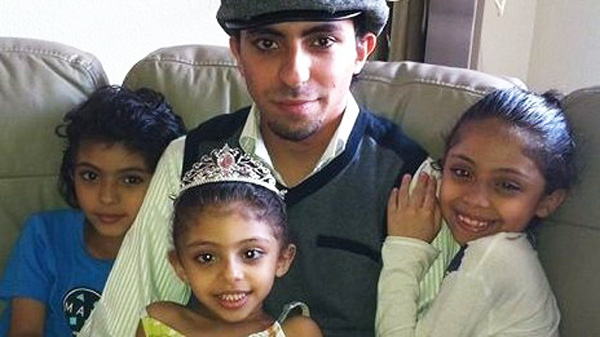
1106Raif Badawi and his children, before his 2012 arrest.

There was naivety in putting such thoughts in writing, as Badawi did, and drawing the attention of Saudi thought police. In another post, Badawi suggested, “Secularism respects everyone and does not offend anyone… Secularism is the practical solution to lift countries (including ours) out of the third world and into the first world.”

It appears Badawi wrote in the first blush of what seemed to have been a breath of fresh air, characterized as the “Arab Spring,” that wafted across the politically bleak landscape of the Arab world in early 2011. There had come news of a Tunisian vendor who had put lit himself on fire protesting police brutality, and had died as a result; his death sparked a movement against Arab despots.

The anguish of the Tunisian vendor, Mohammed Bouazizi, was genuine. His tragic death brought people into the streets, and the Tunisian strongman, Zine el-Abidine Ben Ali, eventually fled into exile in January 2011. The Tunisian protest stirred Egyptians to rise against their strongman, President Hosni Mubarak, and succeed in toppling him in February 2011.

The “Arab Spring,” for those brief few weeks in early 2011, held forth the promise of change for better across the Arab world. And young men like Raif Badawi could be forgiven for imagining that they, too, in Saudi Arabia, could no longer be denied freedom, democracy, and secularism — the accepted norms in the West.

But the hard realities of the Arab world turned the promise of the “Arab Spring” into the nightmare of religious terror and counter-terror. Saudi Arabia is the incubator and citadel of Islamic fascism, otherwise known as Wahhabism. And here in the land of the two holy cities of Islam — Mecca and Medina — religion and politics are inseparable, and anyone who trespasses either does so at the risk of losing his head — literally — in the public beheadings that are the hallmark of the Saudi kingdom.

Raif Badawi was arrested, and has been held in prison in Jeddah since June 2012. The arrest of Badawi and Souad al-Shammari came after they together set up the web site called Saudi Liberal Network. It was promptly closed by the authorities when Badawi posted criticism of the Saudi religious police.

The initial sentence for Badawi by the Criminal Court in Jeddah for mischief and subverting public order was for 600 lashes and seven years in prison. He appealed, and the court returned the verdict by raising the sentence to 1000 lashes and 10 years in prison. The Saudi supreme court has upheld this sentence.

In the interim Badawi was given 50 lashes in a Jeddah public square in January of this year, while further lashings were suspended on medical grounds. Badawi’s wife, Ensaf Haidar, fears the lashings will resume — according to court order the 1000 lashes are to be completed in 20 sessions in front of a mosque — and could be fatal for her husband.

* * *

There is very little the outside world can do to change the nature of the Saudi regime, or for that matter the regime in Iran, which is indistinguishable from the Saudi regime in terms of tyranny and the cruelty to which, in both countries, dissidents are subjected.

After Raif Badawi was arrested, Ensaf Haidar and her children found refuge in Quebec, Canada. Across Quebec there has been heartfelt popular support expressed for Raif Badawi, and condemnation of his punishment. Quebec has officially protested Badawi’s sentence, while demanding his release from Saudi Arabia so that he might join his family where they have settled.

In response to a Quebec National Assembly resolution, passed unanimously in February, condemning Badawi’s lashings in Jeddah in January 2015, the Saudi ambassador to Canada wrote a letter to the Quebec politicians. The same letter was also sent to the Canadian government in Ottawa.

The letter, signed by the Saudi ambassador, Naif Bin Bandir Alsudairy, was obtained by the Canadian Broadcasting Corporation (CBC). It states, “The Kingdom does not accept at all any attack on it in the name of human rights especially when its constitution is based on Islamic law, which guarantees the rights of humans and preserves his blood, money, honour and dignity.”

The stand taken by the Quebec government apparently rattled the Saudi kingdom sufficiently to have its ambassador write a letter addressed to members of a provincial legislature.

* * *

It is one of the anomalies of our age that when, by a fluke of nature, large deposits of fossil fuels are discovered in a country, as in Saudi Arabia, it is accorded attention and respect by other countries in excess of anything it has done, or achieved, or by the record of its conduct in human affairs.

Apart from the oil reserves of the kingdom, the House of Saud is indistinguishable from the House of Kim ruling North Korea, and it is as deserving of the same contempt.

Oil has not only made the difference for Saudi Arabia, it has also made the West complicit in the evil that Saudi Arabia does at home and perpetrates abroad: spreading its pre-modern and perverted culture as Islam or, more appropriately, Wahhabism; and funding terror as jihadism.

The treatment of Raif Badawi stands out, not merely for its cruelty, but how it has come to symbolize the grotesquely repulsive nature of the Saudi kingdom and what it represents behind the mask of religious austerity.

Saudi Arabia is possessed with the opposite of the “Midas touch”: wherever its money buys influence, there, the natural goodness in society is stained and corroded by its touch.

The tragedy surrounding Raif Badawi is both the savage treatment meted out to a young man by the Saudi regime for simply expressing his thoughts, and of how innocence, when it goes against the culture of Saudi intolerance, is mocked, abused, and strangled.

Raif Badawi is also the face of why “official” Islam — the one portrayed by Saudi Arabia and the other OIC member states, and to which the West routinely defers – is so terribly retarded. Freedom of thought is anathema to “official” Islam and its defenders, as it once was in the former Soviet Union; it is the defining characteristic of a closed, totalitarian society.

Raif Badawi is a young man, and the thoughts he expressed were the unsullied thoughts of the young that are at once universal in expectations and desires, as they are innocent and unburdened by the hardness of life’s experiences.

There was no insult of Islam, of the prophet, or of the Quran, in what Badawi wrote; and truth be told, God, Islam, and the prophet are all beyond insults, and beyond the reach of profanity that occasionally spills forth from the bigoted or tortured minds of individuals.

“Official” Islam is an insult to Muslims and non-Muslims alike — for “official” Islam is politics devoid of any redeeming quality found in faith, which nourishes the spiritual yearning of people and uplifts them in a broken world. Through betrayal and hypocrisy, “official” Islam insults God, Islam, and the prophet, every minute of each day, and has become a torment to Muslims.

It is “official” Islam, and Wahhabism in its most perverted expression among Sunni Muslims, that has turned God — Allah in Arabic — repeatedly invoked in the Quran as the “Most Beneficent, the Most Merciful,” into a vengeful and capricious deity.

The Quran states that on the Day of Reckoning the prophet will speak forth, “O my Lord! Lo! mine own folk make this Qur’an of no account” (25:30). In another verse, the Quran instructs the prophet to tell the wandering Arabs of the desert that they have merely submitted, but they have no belief “for the faith hath not yet entered into your hearts” (49:14). And then there is the verse stating categorically, “There is no compulsion in religion” (2:256).[1]

When religion is reduced to politics then it is the logic of politics, hence power and coercion, that takes precedence. In Albert Camus’s striking formulation, “Politics is not religion, or if it is, then it is nothing but the Inquisition.”[2] In Saudi Arabia, religion is a daily dose of inquisition, and the executioner with his sword is both the reality and the symbol of the vengeful deity that bears little resemblance to the merciful and compassionate God of the Quran.

Raif Badawi’s innocence betrayed him. Age and experience would have taught him the hard reality of his culture, veiled by the mask of “official” Islam. This hard reality of Arab culture has been best understood by Arab poets through the years of Arab and Muslim history. Here is one example of a poet’s disgust with the hard reality of his country’s culture and politics. These are lines from a poem of Nizar Qabbani (1923-98), a much-loved Syrian-Arab poet:

When a helmet becomes God in heaven
and can do what it wishes
with a citizen – crush, mash
kill and resurrect
whatever it wills,
then the state is a whorehouse,
history is a rag,
and thought is lower than boots.

When a breath of air
comes by decree
of the sultan,
when every grain of wheat we eat,
every drop of water we drink
comes only by decree
of the sultan,
when an entire nation turns into
a herd of cattle fed in the sultan’s
shed, embryos will suffocate
in the womb, women will miscarry
and the sun will drop
a black noose over our square.[3]

The Sultan’s power is vainglorious, whimsical, easily insulted, and secured by perpetrating fear, and the realm he rules by decree is by necessity a slaughterhouse.

If Raif Badawi survives the thousand lashes in the slaughterhouse that is the Kingdom of Saudi Arabia, it will be a testimony of how an individual’s courage, born of innocence, might well defy the Sultan’s decree.

Nothing could uplift the universal image of Saudi Arabia or King Salman more than if today he issued a pardon.

World leaders, including U.S. President Barack Obama, who has so far been silent on the issue, should immediately speak out — as should the media and human rights groups.

________________________

[1] Verses quoted from the Quran are from The Meaning of the Glorious Koran, translated by Mohammed Marmaduke Pickthall (New York: Alfred A. Knopf and Everyman’s Library, 1930, 1992).

[2] A. Camus, The Rebel (New York: Vintage Books, Random House, 1956), p. 302.

[3] Nizar Qabbani, “From The Actors” in Salma Khadra Jayyusi (editor), Modern Arabic Poetry: An Anthology (New York: Columbia University Press, 1987), pp. 378-379.

The UN’s Anti-Israel Children and Armed Conflict Report

June 10, 2015

The UN’s Anti-Israel Children and Armed Conflict Report, Front Page Magazine, June 10, 2015

(Please see also, Legal Experts Slam IDF for Over-Warning Gazans. — DM)

UN_Secretary-General_Ban_Ki-moon_-_Flickr_-_The_Official_CTBTO_Photostream_13-431x350

According to the New York Times, citing unnamed diplomats, United Nations Secretary General Ban Ki-moon bowed to “unusual pressure from Israel and the United States” in deciding not to include either Israel or Hamas on a list of “armies and guerilla groups that kill and maim children in conflicts worldwide.” The list is included in an annex to an annual report by the Secretary General entitled “Children and armed conflict,” which he just released for 2015. The list, as its title states, is intended to identify specifically the entities that “recruit or use children, kill or maim children, commit rape and other forms of sexual violence against children, or engage in attacks on schools and/or hospitals in situations of armed conflict.”

Ban Ki-moon considered the recommendation of his special representative for children and armed conflict, Leila Zerrougui, to include both Israel and Hamas on this list as a reflection of their actions and the deadly consequences to children arising from the Gaza conflict last summer. The list already includes such Islamic jihad terrorist groups as the Islamic State, the al-Nusra Front, Boko Haram, the Taliban, Al Shabaaba, Al-Qaida in the Arab Peninsula and the Houthis, as well as government forces of the Syrian regime, Yemen, Sudan and Afghanistan.

While the Secretary General rejected his special representative’s recommendation, leaving both the terrorist jihadist group Hamas and Israel off the list in a display of moral equivalence, the body of the report is far more condemnatory of Israel than of Hamas or other Palestinian militants. There were more than three times as many paragraphs devoted to alleged Israeli violations of children’s rights relating to the Gaza war than devoted to the actions of Hamas or other Palestinian terrorists. When there was any criticism of Palestinian actions, it was stated in the mildest of terms. Israel, on the other hand, received the full brunt of the Secretary General’s censure:

“I am deeply alarmed at the extent of grave violations suffered by children as a result of Israeli military operations in 2014. The unprecedented and unacceptable scale of the impact on children in 2014 raises grave concerns about Israel’s compliance with international humanitarian law, notably the principles of distinction, proportionality and precaution in attack, and respect for international human rights law, particularly in relation to excessive use of force.” (Paragraph 110)

Nevertheless, Riyad Mansour, Permanent Observer of the State of Palestine to the United Nations, was not satisfied. He issued a blistering statement declaring that “It is without doubt that Israel, the occupying Power, flagrantly, systematically and grossly commits human rights violations against Palestinian children constituting grave violations that qualify it for such a listing in the annex to the Annual Report on Children and Armed Conflict. The UN’s inaction, submitting to the inordinate pressures exerted, sends a most regrettable signal that the same criteria do not apply in all situations for all children, undermining the credibility of the UN system as a whole…”

As usual, Mr. Mansour stands the truth on its head. Indeed, Ban Ki-moon should have accepted his special representative’s recommendation to include Hamas on the annex list. Hamas and its other jihadist allies, not Israel, belong on the list alongside their Islamic State and al Qaeda brethren. They use children as human shields, deliberately store weapons in schools, homes hospitals and mosques where they know children are likely to be, and recruit children for jihad including the establishment of youth military training camps. They prepare children for the glory of martyrdom, extolling the virtues of suicide bombings that kill Jews.

Ban Ki-moon properly rejected his special representative’s recommendation to include Israel on the annex list. Israel does not belong on the same list as non-state and state entities that deliberately kill children with abandon, recruit children as soldiers, abduct and rape little girls, and kill their parents before their very eyes. To the contrary, the Israeli armed forces took great pains to minimize civilian casualties. It took the unprecedented step of warning civilians in advance of impending attacks on facilities that Hamas was using as launching pads from which to fire rockets at Israeli population centers and from which they were building their terrorist tunnels to sneak their fighters into Israel for the purpose of killing Israeli civilians, including women and children.

However, putting the annex list aside, Mr. Mansour should have been happy that the Secretary General reflected the institutional bias of the United Nations against Israel in the body of his report. In a crucial paragraph urging corrective actions to remedy the report’s catalogue of alleged violation of children’s rights – mostly said to be committed by Israel – the report focused solely on what Israel should do:

“I urge Israel to take concrete and immediate steps, including by reviewing existing policies and practices, to protect children, to prevent the killing and maiming of children, and to respect the special protections afforded to schools and hospitals. An essential measure in this regard is ensuring accountability for perpetrators of alleged violations. I further urge Israel to engage in a dialogue with my Special Representative and the United Nations to ensure that there is no recurrence in grave violations against children.” (Paragraph 111)

As usual, nothing is asked of the Palestinians. They are not urged to stop storing weapons in schools and hospitals. They are not asked “to protect children, to prevent the killing and maiming of children,” which they could begin to do by not using children as human shields, and not deliberately conducting rocket attacks against Israeli civilians including children and conducting other military activities from areas where they know Palestinian children are likely to be. They are not asked to close the youth military training camps or stop the online propaganda that indoctrinates Palestinian children into believing that martyrdom through jihad against Jews is the way to paradise.

We should not be surprised. Such anti-Israel bias is par for the course at the United Nations. Its Human Rights Council passes more resolutions condemning Israel than all of the other 192 member states combined. The Human Rights Council’s agenda item 7 requires that Israel’s – and only Israel’s – record of human rights be debated at every session. Investigations launched by the Human Rights Council and the UN Secretary General of alleged human rights and other international law violations in Gaza during the repeated wars there initiated by Hamas’s terrorist attacks against Israeli civilians are blatantly one-sided against Israel.

Israel was the only country in the world to be named as a violator of “health rights” during the UN World Health Organization’s annual assembly in May 2015. Never mind about Syria, Iran, Iraq, Libya, or North Korea where basic medical care and health services are scarce, if existent at all. Israel facilitates the delivery of humanitarian aid and takes care of the sick and injured, whether they be Palestinians or not. The Syrian regime prevents humanitarian aid including medical supplies from reaching besieged civilians, including Palestinian children trapped in Yarmouk. Yet the World Health Organization chose to ignore all this and adopt a resolution focusing solely on health conditions in the occupied Palestinian territory, including East Jerusalem, and in the Golan Heights, for which Israel is held responsible.

The UN Commission on the Status of Women, whose latest annual meeting concluded on March 20, 2015, marched to the same anti-Israel tune. The only country it condemned for its women’s rights record was Israel, presumably because of its alleged treatment of Palestinian women.

“If anyone had any doubt that there was demonization of Israel at the United Nations, here is the entire truth before our eyes,” said Israel’s Ambassador to the UN, Ron Prosor. “There are 193 member states in the UN, and they include countries that butcher men and women, jail both male and female journalists, execute female oppositionists and legislate laws against women. All of these countries receive immunity in the UN. The UN Commission on the Status of Women is itself comprised of some of the worst violators of women’s rights, including Iran and Sudan, two of the more moderate members by comparison.”

Every day it seems that there is new proof of the demonization and attempts to delegitimize the Jewish state of Israel at the United Nations. Secretary General Ban Ki-moon’s report on “children and armed conflict” is but the latest example. There will certainly be more to come.

US finds peeling back the Iran sanctions onion no easy task

June 10, 2015

US finds peeling back the Iran sanctions onion no easy task, Israel Hayom, June 10, 2915

(For Obama, principles are as flexible as words.

Humpty words

— DM)

143393177342310791a_bU.S. Treasury Secretary Jacob Lew | Photo credit: Reuters

Under the sanctions developed over decades, hundreds of companies and individuals have been penalized not only for their roles in the country’s nuclear program but also for ballistic missile research, terrorism, human rights violations and money laundering.

Officials say the administration can meet its obligations because of how it interprets nuclear sanctions.

For example, they say measures designed to stop Iran from acquiring ballistic missiles are nuclear-related because they were imposed to push Iran into the negotiations. Also, they say sanctions that may appear non-nuclear are often undergirded by previous actions conceived as efforts to stop Iran’s nuclear program.

***********************

The Obama administration may have to backtrack on its promise that it will suspend only nuclear-related economic sanctions on Iran as part of an emerging nuclear agreement, officials and others involved in the process told The Associated Press Tuesday.

The problem derives from what was once a strong point of the broad U.S. sanctions effort that many credit with bringing Iran to the negotiating table in the first place.

Administration officials vehemently reject that any backtracking is taking place, but they are lumping sanctions together, differently from the way members of Congress and critics of the negotiations separate them.

Under the sanctions developed over decades, hundreds of companies and individuals have been penalized not only for their roles in the country’s nuclear program but also for ballistic missile research, terrorism, human rights violations and money laundering.

Now the administration is wending its way through that briar patch of interwoven economic sanctions.

The penalties are significant. Sanctioned foreign governments, companies or individuals are generally barred from doing business with U.S. citizens and businesses, or with foreign entities operating in the American financial system. The restrictions are usually accompanied by asset and property freezes as well as visa bans.

Negotiators hope to conclude a final nuclear deal by June 30. According to a framework reached in April, the U.S. will be required to lift sanctions that are related to Iran’s nuclear program but could leave others in place. President Barack Obama can suspend almost all U.S. measures against Iran, though only Congress can revoke them permanently.

“Iran knows that our array of sanctions focused on its efforts to support terrorism and destabilize the region will continue after any nuclear agreement,” Treasury Secretary Jack Lew told a gathering of American Jews in a weekend speech. U.S. officials will “aggressively target the finances of Iranian-backed terrorist groups and the Iranian entities that support them,” he said, including the Lebanese militant group Hezbollah and Iran’s Quds Force.

The Treasury Department’s sanctions point man, Adam Szubin, has been tasked with sorting out the mess, according to U.S. officials, though no clear plan has yet been finalized.

Officials say the administration can meet its obligations because of how it interprets nuclear sanctions.

For example, they say measures designed to stop Iran from acquiring ballistic missiles are nuclear-related because they were imposed to push Iran into the negotiations. Also, they say sanctions that may appear non-nuclear are often undergirded by previous actions conceived as efforts to stop Iran’s nuclear program.

The officials who provided information for this story spoke only on condition of anonymity because they were not authorized to speak publicly on the private discussions.

After years of negotiations, U.S. officials believe a deal is within reach that for a decade would keep Iran at least a year from being able to build a nuclear weapon.

In return, the U.S. would grant billions of dollars in relief from sanctions that have crippled Iran’s economy. But the whole package risks unraveling if the U.S. cannot provide the relief without scrapping sanctions unrelated to Iran’s nuclear program.

Administration officials say they are examining a range of options that include suspending both nuclear and some non-nuclear sanctions, a step that would face substantial opposition in Congress and elsewhere. Under one scenario, the U.S. could end non-nuclear restrictions on some entities, then slap them back on for another reason. But Iran could then plausibly accuse the U.S. of cheating on its commitments.

U.S. President Barack Obama has spoken about Iran potentially recouping up to $150 billion in assets trapped overseas. The process for how that would take place is still being worked through, said officials.

The Iranian Central Bank may prove the most glaring example of the administration’s dilemma, and officials acknowledge there is no way to give Iran the sanctions relief justified by its compliance without significantly easing restrictions on the institution.

The bank underpins Iran’s entire economy, and for years the U.S. avoided hitting it with sanctions, fearing such action would spread financial instability and raise oil prices. By late 2011, with Iran’s nuclear program advancing rapidly, Obama and Congress did order penalties, declaring the bank a “primary money laundering concern” and linking its activity to ballistic missile research, terror financing and support for Syrian President Bashar Assad.

The effects were far-reaching: Petroleum exports fell by 60%, Iran suffered runaway inflation, cash reserves dried up and industrial output in several sectors plummeted. And Iran agreed to talk about its nuclear program with the United States and five other world powers.

Now that the nuclear agreement is so close, Iran wants these sanctions lifted. The administration officials say all sanctions on the bank are nuclear-related.

Lew told the Jewish conference in New York that a nuclear accord would include the suspension of all “secondary” oil, trade and banking restrictions — those that apply to U.S. and non-U.S. banks, as well as foreign governments.

Many of these measures overlap with American sanctions tied to Iran’s nuclear program, and that has officials considering new sanctions to keep certain Iranian institutions under pressure.

Eliminating the secondary sanctions across the board could have wide-ranging implications, making it easier for Iran’s Revolutionary Guard Corps and its police, intelligence services and paramilitary groups to do business.

That possibility has Iran’s rivals in the region, including Israel and the Sunni monarchies of the Middle East, gravely worried.

“I share their concern,” Gen. Martin Dempsey, the Joint Chiefs of Staff chairman, said Tuesday in Jerusalem.

“If the deal is reached and results in sanctions relief, which results in more economic power and more purchasing power for the Iranian regime, it’s my expectation that it’s not all going to flow into the economy to improve the lot of the average Iranian citizen,” he said.

“I think they will invest in their surrogates. I think they will invest in additional military capability.”

Iran’s Revolutionary Guard is under U.S. sanctions because of its proliferation of weapons of mass destruction. But because the U.S. views the corps as so pernicious, the administration is considering new measures to help block it from meddling in the internal conflicts of Iraq, Lebanon, Syria and Yemen.

Of the 24 Iranian banks currently under U.S. sanctions, only one — Bank Saderat, cited for terrorism links — is subject to clear non-nuclear sanctions. The rest are designated because of nuclear and ballistic missile-related financing, while several are believed to be controlled by the Revolutionary Guard.

Will they be cleared for business with the world? U.S. officials still cannot say one way or another. Congress, too, has not received a list of banks and institutions that would be released from sanctions under the deal.

If the United States cannot deliver on its promises, it could take the blame for a collapse of the years-long negotiations toward a nuclear deal, putting the world — in the words of Obama and other U.S. officials — on a path toward military confrontation. At the same time, an Iran unburdened by sanctions could redouble efforts toward nuclear weapons capacity, while international unity and the global sanctions architecture on Tehran fray.

Turkey’s View of Israel

June 9, 2015

Turkey’s View of Israel, The Gatestone InstituteUzay Bulut, June 9, 2015

  • The media’s unethical coverage of the Israel/Palestine conflict seems to be the number one reason why people in Turkey have remained so misinformed and brainwashed about the issue. It is not just anti-Semitism, but also anti-Zionism, that is racist and hateful.
  • The houses and apartments Israelis built in their historic homeland are called “illegal settlements.” But there were no “settlements” before 1967. What, then were the Israelis supposedly “occupying” between 1948 and 1967? Why was the Palestine Liberation Organization (PLO) even then trying to destroy Israel? What did it think it was “liberating”?
  • This “occupation” myth seems, instead, to have a lot to do with the “Islamization” of history and geography. Since the creation of the world, it goes, there has been only one religion: Islam. All our religious teachers have taught us that earlier historical figures were prophets — Isa [Jesus], Musa [Moses], Davut [David] and so on — were Muslims and that the original religions they brought were Islamic. These prophets, we are told, preached the teachings of Allah, but their followers, who came later, distorted their messages, changed the writings in their holy books, and fabricated these fake, untrue religions called Judaism and Christianity. Then Islam came as the last, the perfect and the only true and unchanged eternal word of Allah, which led to Muhammad to this world as a “liberator.”
  • If someone says, “there is a place related to King David and it is a Jewish place,” then a Muslim would say, “Yes, but David was also a Muslim. So this place actually belongs to Muslims.” There is never Islamic invasion; there is only Islamic liberation. If these people truly cared about Palestinian Arabs, they would do their best to stop the incitement and help to achieve a sustainable peace where both Arabs and Jews would be safe.

A large number of the citizens of Turkey, a NATO member, see Israel and the United States as enemies.

A survey conducted recently in Turkey found that nearly half the country’s citizens (42.6%) see Israel as the biggest security threat, followed by the United States (35.5%), and only then Syria (22.1%).

How do they visualize Israel, a country with which they have made several military and trade agreements, as being a security threat? Do they think Israel would ever invade Turkey? Bomb Turkey? Nuke Turkey? This view seems to be based on either religion-induced paranoia caused by Islamic anti-Semitism, or else their understanding of reality has been distorted Nazi-style by Turkish leaders and the media.

The problem is that the false myth of Israel’s being an “occupier” and “troublemaker” has been indoctrinated into the minds of most Turkish children from their early years. Almost all of us — including myself — grew up with an extreme prejudice against Israel. The media’s unethical coverage of the Israel/Palestine conflict — including both the Islamist and Kemalist (secular nationalist) media — seems to be the number one reason why people in Turkey have remained so misinformed and brainwashed about the issue.

Only the intensity of the prejudice changes according to what newspaper or TV channel you follow or what family raises you. Islamic anti-Semitism, even if we might not be aware of it, has a lot to do with this kind of upbringing.

A short scanning of Turkish newspapers and TV channels would also clearly show their continual hateful propaganda against Israel.

No other state or organization has been demonized and delegitimized by the Turkish media to this extent.

Unfortunately, even the media that calls itself “progressive” has bought and reproduced the propaganda that Israel is the “invader” and the “oppressor.” One of their most popular slogans is, “We are not anti-Semitic, but just anti-Zionist.”

Zionism defends the concept that Jews — like any other people — have human rights, and are entitled to live their original Biblical homeland. Although forced out of their land many times, as by the Babylonians or the Romans, they never entirely left it.

If the demand of Jews for equality and independence disturbs anyone, it is due to his own racism — in whatever name he is trying to dress it up — and not to anything the Jews might have allegedly done. It is not just anti-Semitism, but also anti-Zionism, that is racist and hateful.

Every person who comes up with the genius idea of “not being anti-Semitic but just being anti-Zionist” should also offer their idea of what kind of a Jewish state they would like to see or whether they would like to see a Jewish state at all. If it is the political system of Israel they oppose, then they should clarify how their own alternative system would be better than the current one, and what they would do to convince Hamas and the Palestinian Authority to achieve peaceful coexistence with Israel.

They should also clarify why they are so obsessed with Israel, which has the most democratic political system in the Middle East, while autocratic, theocratic, despotic regimes abound in the region.

They might also please explain what makes the non-existent, imaginary “democratic Palestine” preferable to already existing, thriving and democratic Israel.

Mahmoud Abbas’s Fatah is essentially no better than Hamas; just sometimes less violent. The Palestinian Authority (PA), as stated in its charter and “phased plans,” says it prefers to displace Israel diplomatically, through the dictator-controlled United Nations and European governments, and economically through boycotts and sanctions, rather than with missiles.

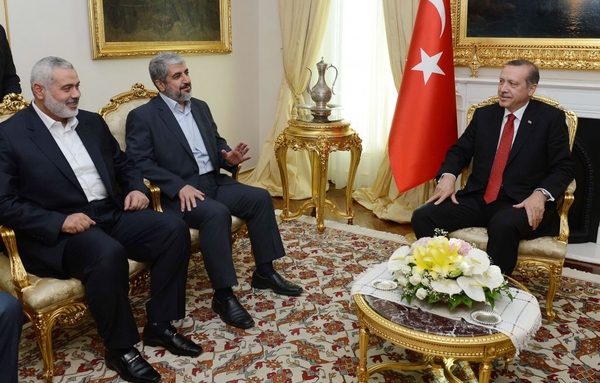
826Turkish President (then Prime Minister) Recep Tayyip Erdogan, right, meeting with Hamas leaders Khaled Mashaal (center) and Ismail Haniyeh on June 18, 2013, in Ankara, Turkey. (Image source: Turkey Prime Minister’s Press Office)

Now that so many Jews are all in one place, the progressives can pretend to themselves that it is “just Israel,” and not “the Jews,” who are the target of their hate. As the former Iranian president Akbar Hashemi Rafsanjani said, Israel, only slightly bigger than the city of Beijing, is a “one-bomb country.”

The progressive media’s representation of Israel as an “occupier” only caters to the genocidal desires of these anti-humanitarian regimes or groups. They never point to Turkey’s occupation of northern Cyprus, China’s occupation of Tibet, or Pakistan’s occupation of Kashmir — not to mention Russia’s recent flamboyant occupations.

For the past 2000 years, Jews have been exposed to unending persecution accompanied by expulsions, forced conversions, mob attacks, pogroms, property confiscations, massacres, and the 1938-45 Holocaust. Attacks against Jews in Europe continue today.

After Jews were forced from their Biblical home into the Diaspora, their lives were painful for centuries. When they were in exile in Europe, they were disposable. Now that they are back home in Israel, they are “occupiers;” again not wanted.

Under Nazi rule, Jews were “illegal,” slaughtered wholesale, tortured with fake “medical experiments” and not even considered fully human.

To end their history of 2000 years of suffering and to finally be free, Jews have returned to their home, Israel.

They have brought their light back to the land and presented gifts to the Middle Eastern peoples that no other nation there has experienced: democracy, tolerance, freedom of speech, human rights — as well as countless medical and technological innovations. This tiny country has produced some of the most brilliant minds in history, and has become the second most educated nation on earth.

What they have done is to build a truly open and productive society on sand dunes and deserts, where even the Muslim citizens, who make up 20% of Israel’s population, have the freedom to say the most horrendous things about anyone they wish, including the prime minister — and they do. In short, even the Muslims in Israel enjoy privileges that in any other country in the region would get them incarcerated.

Israel’s neighbors, however, have not shown much appreciation for these admirable traits — only more jealousy and hatred.

As thanks for the endless good the Israelis bring the region and the world, they are vilified by the anti-Semitic, anti-Zionist, Jew-hating, politically-driven blocs in the Arab countries, Turkey, Europe and the UN, which clearly want to destroy them, on one pretext or another.

The houses and apartments Israelis build in their historic homeland are called “illegal settlements.” But there were no “settlements” before 1967. What, then, were the Israelis supposedly “occupying” between 1948 and 1967? Why was the Palestine Liberation Organization (PLO) even then trying to destroy Israel? What did it think it was “liberating”?

This “occupation” myth seems, instead, to have a lot to do with the “Islamization” of history and geography.

According to Islamic ideology, all history is actually Islamic history and most of the major historical figures were actually Muslims. Islam does not recognize other religions as either genuine or original.

Since the creation of the world, it goes, there has been only one religion: Islam. Others are irrelevant, fabricated by those who came later but went astray. All our religion teachers have taught us that the earlier prophets — Issa [Jesus], Musa [Moses], Davut [David] and so on — were Muslims, and that the original religions they brought were Islamic. These prophets, we are told, preached the teachings of Allah, but their followers, who came later, distorted their messages, changed the writings in their holy books, and fabricated those fake, untrue religions called Judaism and Christianity. Then Islam came as the last, the perfect and the only true and unchanged eternal word of Allah, which led to the coming of Muhammad to this world as a “liberator.”

If someone says “there is a place related to King David and it is a Jewish place,” then a Muslim would say “Yes, but David was also a Muslim. So this place actually belongs to Muslims.”

The Islamization of history leads to the Islamization of geography. All those religious figures were Muslims, so the places in which they resided were also Muslim places. So Muslims never call their invasions “invasions.” They consider them all liberations of former Muslim places. There is never Islamic invasion; there is only Islamic liberation.

This view is the view behind the recent call of Turkey’s President, Recep Tayyip Erdogan, for “Liberating Jerusalem” from the Jews. “Conquest is Mecca,” said Erdogan in a speech in Istanbul on June 1, before millions who were celebrating the 562nd anniversary of the fall of Constantinople. “Conquest is Saladin,” he said, “It is to hoist the Islamic flag over Jerusalem again; conquest is the heritage of Mehmed II and conquest means forcing Turkey back on its feet.”

Erdogan is calling for an invasion of Jerusalem, which basically means a call for death and destruction. He was doing that just prior to the elections, because he knew that such anti-Semitic outbursts will most likely increase the votes of the AKP party.

The biggest problem is that this statement was made by the head of a NATO member.

Why would a Turk or a Muslim want to “liberate” Jerusalem? To turn it into another Muslim land where discrimination and persecution against minorities and all kinds of human rights violations run wild? Turkey does not even treat its own minorities with respect and discriminates against them daily, for instance by not giving the Kurds even the right to be educated in their native language. For what purpose, or based on what right, should Turkish authorities want to rule over Jerusalem?

Do they want to slaughter the Jews just as they slaughtered Christians in 1915, and still deny it even today? Do they want to ban the Hebrew language just as they ban the Kurdish language in Turkey? Do they want to rape Jewish women as they raped Kurdish and Greek Cypriot women during ethnic cleansing campaigns? Do they want to convert Israel’s synagogues and churches into stables as they did those in Turkey? Or do they want to turn Israel’s prisons into centers of torture just as they did in Turkey’s Kurdistan? What on earth could Turkish authorities give to Jerusalem if they could capture it?

These people need to understand and accept the fact that the Ottoman Empire is dead and that none of its former colonies wants it back.

This is not the first time that anti-Semitism is promoted by a Turkish state authority. Anti-Semitism has a very long history in Turkey. Some of the most horrible crimes committed against Turkey’s Jews happened during the 1934 pogrom, when about 15,000 Jews in Thrace were forcibly driven out of their homes. During the pogrom, Jews were boycotted and attacked, their property was looted and burned down, and Jewish women were raped.

Just prior to the outbreak of the 1934 pogrom, Ibrahim Tali Ongoren, the inspector general of Thrace (the highest state official in the region) made a four-week inspection tour of the province. According to Tali Ongoren’s report, “The Jew of Thrace is so morally corrupt and devoid of character that it strikes one immediately.” The Jew, he wrote, possessed a “fawning, deceitful character that hides its secret intentions, always applauds the powerful, worships gold and knows no love of the homeland.”

“The Jews represent a secret danger and possibly want to establish communist nuclei in our country through the workers’ club and it is therefore an indispensable necessity for Turkish life, the Turkish economy, Turkish security, the Turkish regime and the revolution in Thrace and for Turkish Thrace to be able to recover, to finally solve [the Jewish] problem in the most radical way.” [1]

According to the historian Corry Guttstadt, although the 90-page report Ongoren prepared for the government and for the ruling Republican People’s Party (CHP) contained a wide range of topics, he seemed to be, “outright obsessed with the ‘Jewish problem,’ which comes up in nearly every chapter.”

“Tali’s report” Guttstadt wrote, “is laced with the crudest of anti-Semitic stereotypes. This contradicts not only the government’s assertion that anti-Semitism in Turkey was only a fringe phenomenon [Tali was the highest ranking official of the Republic in this region] but must also be considered proof that the expulsion of the Jews from Thrace and from the Dardanelles was in keeping with the state’s objectives, just as foreign diplomats had reported.

“The rights of the non-Muslim minorities were protected by the international Treaty of Lausanne, at least on paper. To circumvent these legal obstacles, The Turkish authorities had apparently opted for the strategy of putting the Jews under such pressure with boycott activities and anonymous threats ‘from the population’ that they would leave the area ‘voluntarily’.

“The period that followed was characterized by further boycott attempts and intimidation in Edirne and even in Istanbul.”[2]

While these crimes against Jews were committed, there was no Jewish state in Israel. But Jew-hatred was clearly rampant.

The main offenders to be held responsible for anti-Semitism in Turkey are the Turkish state authorities. A state that is an EU candidate, as well as a NATO member, is supposed to be a true ally of the West. It is supposed to fight anti-Semitism and promote a peaceful, diverse and pro-Western culture. It is supposed to provide its schoolchildren with a kind of education in which the children will rid themselves off the traditional Jew-hatred and other racism, and embrace at least some humanitarian values that will help them recognize all peoples as equal and worthy of respect.

Sadly, Turkey has done none of that. It has made a record number of military and commercial deals with the state of Israel, but domestically it has systematically propagated anti-Semitism and racism, as well as Turkish-Islamic supremacy, through its institutions and media. As a result of this propaganda, a great number of Turkish people see Israel and the USA as the biggest security threats today.

In Turkey, being Westernized has been restricted to benefiting from the technical and material innovations of the West, but rejecting the social values of the West on grounds that those values would not fit into the Turkish culture. More perplexingly, being politically and socially pro-Western is almost associated with being a “traitor.”

“Israel wants peace. Period,” wrote the journalist Israel Kasnett. “The Jewish people have never held a desire to rule over others and this remains true today. Not only are we ohev shalom [‘lovers of peace’], but we are also rodef shalom [‘active pursuers of peace’].”

Is anyone listening? Are Turks listening? Many, apparently, are not.

Throughout much of the world are bloodbaths and persecution of human beings, but it is only Israel, the sole democracy in the Middle East, that is targeted and singled out for defending itself, and is accused of “occupation.”

To many of the people here in Turkey, the problem does not seem to be whether Israel wants peace, or whether Israel is a democracy, or whether Palestinian Arabs are really suffering, or why. If these people truly cared about Palestinian Arabs, they would do their best to stop the killings and incitement and to help achieve a sustainable peace where both Arabs and Jews would be safe.

But they do not really care about the Palestinians. They do not want peace. They do not want a “two-state solution.” They want to see Jews dead. And they could not care less about how many Arabs will lose their lives in the meantime.

But there is one thing they do not seem to be aware of: Their genocidal Jew-hatred can never strip Israel off its right to self-defense. It can only empower and further legitimize this right.

_______________
[1] Guttstadt, Corry (2013). Turkey, the Jews, and the Holocaust. Cambridge University Press. More slurs include: “Although (the Jews) underwent natural selection as a result of constant mixing with different blood in the last century and have almost entirely lost the physical characteristics specific to Jewry, they have completely retained the typically Jewish fawning, deceitful character that hides its secret intentions, always applauds the powerful, worships gold, and knows no love of the homeland, and have even developed these harmful traits so much further that they could inflict torment on humanity.

“In the Jewish value system, honor and dignity have no place. The Jews of Thrace owe their rise to the destructive effects of the wars on the Turkish population, that is how [the Jews] have become rich and enchanted their influence.

“The Jews of Thrace are intent on making Thrace the equivalent of Palestine. For the development of Thrace, it is of the utmost necessity that this element [the Jews], whose hands are grabbing for all the treasures of Thrace, not be allowed to continue to suck out the Turks’ blood. In the establishment of new military facilities… we must keep our administrative and military activities entirely secret from this element [the Jews].

“Above all, it is essential that this element [the Jews] be neutralized so completely that they cannot engage in spying…”

[2] Guttstadt, Corry (2013). Turkey, the Jews, and the Holocaust. Cambridge University Press.

“In the light of this, it hardly seems coincidental that Tali himself had travelled the entire region until a week before the events erupted and then remained in Ankara during the boycott activities and the threats. It seems that the operations then ‘got out of hand’ locally, with the nationalist mob putting itself in charge in some places and committing looting and acts of violence.

“After the reports of the riots reached the international public, the government was forced to condemn both the events and anti-Semitism in general. In the end, however, the episode achieved, for the most part, the intended goal and largely ‘solved’ the ‘Jewish problem’ in Thrace in the way favored by Tali.”

As ISIS Brutalizes Women, a Pathetic Feminist Silence

June 9, 2015

As ISIS Brutalizes Women, a Pathetic Feminist SilenceThe New York Post via Middle East Forum, Phyllis Chester, June 7, 2015

1354

While the most recent Women’s Studies annual conference did focus on foreign policy, they were only interested in Palestine, a country which has never existed, and support for which is often synonymous with an anti-Israel position. Privately, feminists favor non-intervention, non-violence and the need for multilateral action, and they blame America for practically everything wrong in the world.

Feminists strongly criticize Christianity and Judaism, but they’re strangely reluctant to oppose Islam — as if doing so would be “racist.” They fail to understand that a religion is a belief or an ideology, not a skin color.

**************************

Oh, how the feminist movement has lost its way. And the deafening silence over ISIS’s latest brutal crimes makes that all too clear.

Fifty years ago, American women launched a liberation campaign for freedom and equality. We achieved a revolution in the Western world and created a vision for girls and women everywhere.

Second-wave feminism was an ideologically diverse movement that pioneered society’s understanding of how women were disadvantaged economically, reproductively, politically, physically, psychologically and sexually.

Feminists had one standard of universal human rights — we were not cultural relativists — and we called misogyny by its rightful name no matter where we found it.

As late as 1997, the feminist majority at least took a stand against the Afghan Taliban and the burqa. In 2001, 18,000 people, led by feminist celebrities, cheered ecstatically when Oprah Winfrey removed a woman’s burqa at a feminist event — but she did so safely in Madison Square Garden, not in Kabul or Kandahar.

Six weeks ago, Human Rights Watch documented a “system of organized rape and sexual assault, sexual slavery, and forced marriage by ISIS forces.” Their victims were mainly Yazidi women and girls as young as 12, whom they bought, sold, gang-raped, beat, tortured and murdered when they tried to escape.

In May, Kurdish media reported, Yazidi girls who escaped or were released said they were kept half-naked together with other girls as young as 9, one of whom was pregnant when she was released. The girls were “smelled,” chosen and examined to make sure they were virgins. ISIS fighters whipped or burned the girls’ thighs if they refused to perform “extreme” pornography-influenced sex acts. In one instance, they cut off the legs of a girl who tried to escape.

These atrocities are war crimes and crimes against humanity — and yet American feminists did not demand President Obama rescue the remaining female hostages nor did they demand military intervention or support on behalf of the millions of terrified Iraqi and Syrian civilian refugees.

An astounding public silence has prevailed.

1355The National Organization for Women (NOW) apparently doesn’t think ISIS is a problem.

The upcoming annual conference of the National Organization for Women (NOW) does not list ISIS or Boko Haram on its agenda. While the most recent Women’s Studies annual conference did focus on foreign policy, they were only interested in Palestine, a country which has never existed, and support for which is often synonymous with an anti-Israel position. Privately, feminists favor non-intervention, non-violence and the need for multilateral action, and they blame America for practically everything wrong in the world.

What is going on?

Feminists are, typically, leftists who view “Amerika” and white Christian men as their most dangerous enemies, while remaining silent about Islamist barbarians such as ISIS.

Feminists strongly criticize Christianity and Judaism, but they’re strangely reluctant to oppose Islam — as if doing so would be “racist.” They fail to understand that a religion is a belief or an ideology, not a skin color.

The new pseudo-feminists are more concerned with racism than with sexism, and disproportionately focused on Western imperialism, colonialism and capitalism than on Islam’s long and ongoing history of imperialism, colonialism, anti-black racism, slavery, forced conversion and gender and religious apartheid.

And why? They are terrified of being seen as “politically incorrect” and then demonized and shunned for it.

The Middle East and Western Africa are burning; Iran is raping female civilians and torturing political prisoners; the Pakistani Taliban are shooting young girls in the head for trying to get an education and disfiguring them with acid if their veils are askew — and yet, NOW passed no resolution opposing this.

Twenty-first century feminists need to oppose misogynistic, totalitarian movements. They need to reassess the global threats to liberty, and rekindle our original passion for universal justice and freedom.