Posted tagged ‘Hezbollah’

Hezbollah convoy hit in possible Israeli airstrike

May 10, 2016

Lebanon: Hezbollah convoy hit in apparent Israeli airstrike Unconfirmed reports say Israeli jets hit a convoy belonging to Shia terrorist group in along the Syrian-Lebanese border.

By Ari Soffer First Publish: 5/10/2016, 9:04 PM / Last Update: 5/10/2016, 9:11 PM

Source: Hezbollah convoy hit in possible Israeli airstrike – Defense/Security – News – Arutz Sheva

IAF F-16  Flash 90

A convoy of Hezbollah terrorists and weapons was hit in an apparent Israeli airstrike in Lebanon, according to Channel 2 reports.

The convoy was reportedly traveling through the village of Anjar, close to Lebanon’s border with Syria, when it was hit.

Anjar is located in the Bekaa Valley region, a Hezbollah stronghold in Lebanon.

Israeli airstrikes have targeted Hezbollah positions in Syria over the past several years, as part of efforts to avoid the Shia terrorist group obtaining advanced weaponry from Iran in exchange for its support of the Assad regime.

However Israeli strikes in Lebanon – Hezbollah’s heartland – have been far rarer over the past several years, and only in direct response to attacks by Hezbollah and other terrorist groups.

Updates to follow.

Iran reconciles with Islamic Jihad: DEBKAfile sources

May 6, 2016

Iran reconciles with Islamic Jihad: DEBKAfile sources, DEBKAfile, May 6, 2016

The full renewal of aid came after Iran, under Hizballah pressure,  partially renewed the support in March. Hizballah is interested in maintaining its close ties with Islamic Jihad in order to ensure influence on Palestinian affairs and a foothold in Gaza.

**************************

After a two-year rift between Islamic Jihad and Iran that resulted in the halting of Tehran’s military and financial aid to the terrorist organization, a reconciliation agreement was reached this week between the two sides in the Iranian capital, DEBKAfile‘s sources report. The dispute began when Islamic Jihad refused to back Iran’s policy of support for Syrian President Bashar Assad, and rejected Iran’s request to send members of the organization in Syria and Lebanon to fight alongside pro-Iranian militias in Syria.

The reconciliation was reached when Islamic Jihad leader Ramadan Shalah arrived in Tehran with a large delegation from the organization’s leadership and met Iran’s supreme leader Ayatollah Ali Khamenei.

The renewal of Iran’s financial aid to Islamic Jihad was announced during the meeting.

DEBKAfile: The main mediator between the two sides was the leadership of Hizballah in Lebanon. The full renewal of aid came after Iran, under Hizballah pressure,  partially renewed the support in March. Hizballah is interested in maintaining its close ties with Islamic Jihad in order to ensure influence on Palestinian affairs and a foothold in Gaza.

During a public appearance in Tehran, Islamic Jihad leader Shalah said “defending Palestine is defending Islam.” In other words, Iran, not ISIS, is the defender of Islam.

Saudi Columnist Following Pulverizing Of Aleppo: Assad Is The No. 1 Terrorist; Is Putin Any Different From Al-Baghdadi? Is Khamenei More Humane Than Al-Zawahiri?

May 5, 2016

Saudi Columnist Following Pulverizing Of Aleppo: Assad Is The No. 1 Terrorist; Is Putin Any Different From Al-Baghdadi? Is Khamenei More Humane Than Al-Zawahiri? MEMRI, May 5, 2016

Following the massive attack on the city of Aleppo by the Syrian regime and its Russian ally, which included the destruction of a hospital, Saudi columnist Khalaf Al-Harbi penned an article in which he harshly attacked the Syrian regime as well as the leaders of Russia, Iran and Hizbullah. Writing in the government Saudi daily ‘Okaz, he accused these leaders of committing a “genocide” of the Syrian people, and the international community of silent complicity in this crime. He added that this crime was comparable to, if not worse than, the crimes of terrorist organizations such as ISIS and Al-Qaeda.

The following are excerpts from the article:[1]

27877Khalaf Al-Harbi (image: All4syria.info)

“In disaster-ridden Aleppo, a [Syrian air force] jet dropped barrel bombs on a hospital that was treating victims of previous airstrikes. The wounded [victims], the doctors and [other] patients were killed, and at the same time another jet bombed the rescue teams and civil defense [forces]. All this, of course, under the pretext of combatting terrorists!

“What action can terrorists carry out that is worse than the destruction of a hospital[?]

“Look at all the terrifying ISIS videos and the barbaric Al-Qaeda statements, and you will see the same [acts], possibly even less severe ones. If ISIS sends a suicide [bomber] to blow up a vegetable market, Bashar [Al-Assad] and Putin’s jets, together with Iran and Hizbullah, have already erased an entire city, and strove with all their might to exterminate its peaceful residents.

“What’s the difference between Putin and [ISIS leader] Abu Bakr Al-Baghdadi? Is it possible that [Iranian Supreme Leader] Khamenei any more humane than [Al-Qaeda Leader] Al-Zawahiri? Did [Al-Qaeda in Iraq leader] Al-Zarqawi commit any crimes that [Hizbullah leader] Hassan Nasrallah has refused to commit? And as for Bashar Al-Assad – he cannot even be compared to the most satanic among people and demons, since he is the number one terrorist butcher, who receives the blessings of the international community, and in most cases has even conspired with it.

“Moreover, one could say that the case of Al-Baghdadi, Al-Zawahiri, and other terrorist leaders is simpler than that of Putin, Khamenei, Nasrallah, and Bashar, since these terrorist leaders are wanted all over the world, whereas the leaders of the barrel bombs are presidents of UN member-states. The silence regarding the crimes [of these leaders] provides certain legitimacy to the methodical extermination [they carry out in Syria], while we thought that such matters have long ago disappeared from the world.

“If the horrible crimes taking place in Aleppo today are classified as ‘combatting terrorism,’ then we say to the supporters of the barrel bombs – you will surely lose [this] campaign. This, because the child whose good family was destroyed in front of him will not become a peace activist or a human rights activist, but will seek an organization even more barbaric than ISIS to [join, in order to] avenge his family that was wiped off the face of the earth. Shame will continue to hound all those who, for political or sectarian reasons, supported [the dropping of] barrel bombs…”


Endnotes:

[1] ‘Okaz (Saudi Arabia), May 2, 2016.

Suddenly Russia consents to consider Assad’s ouster

May 4, 2016

Suddenly Russia consents to consider Assad’s ouster, DEBKAfile, May 4, 2016

Washington and Moscow have made dramatic progress over the last few days in marathon telephone talks between Secretary of State John Kerry and Foreign Minister Sergei Lavrov on ending the war in Syria. Russia agreed for the first time to discuss the possibility that Syrian President Bashar Assad will step down, and the conditions under which such a process will take place, according to DEBKAfile’s intelligence sources.

The sources add that the Russians also agreed to begin to negotiate the future of senior Syrian military commanders who are carrying out the war against the rebels. The contacts that include the Saudis and the Jordanians have reached such an advanced stage that participants have started to prepare lists of Syrian commanders who will be removed or remain in their posts.

One of the clearest signs of the progress was the arrival of nearly all of the heads and commanders of the Syrian rebel organizations on Monday and Tuesday (May 2-3) for intensive talks at the US Central Command Forward-Jordan, a war room outside Amman staffed by officers from the US, Jordan, Saudi Arabia and the UAE. The gathering was arranged via a series of meetings held in Geneva over the last few days between the top diplomats of the US, Saudi Arabia and Jordan.

Our sources report that US officials and senior officers in charge of the Obama administration’s strategy for the war in Syria presented the rebel leaders and commanders with a series of agreements already reached by Washington and Moscow on ways of ending the war. The main part of the agreement focused on the resignation of Assad and the departure of him and his family from the country-the Syrian opposition’s key demand for continuing the talks.

The rebel leaders were asked by the US officials and officers, who were accompanied by Saudi and Jordanian officials, to help facilitate implementation of the agreed measures and not to try to interfere with them, or in other words, to stop the fighting.

According to the information from our sources, the discussions in Jordan are continuing.

Washington’s current goal is achieve a ceasefire in all of Syria that will prevent an imminent attack by Russian, Iranian, Syrian and Hizballah forces on Aleppo, the country’s second-largest city.

Our military sources report that on Monday and Tuesday, by order of President Vladimir Putin, the Russian air force suddenly halted its airstrikes in the Aleppo area.

Thus, the Iranian, Syrian and Hizballah armies are preparing to launch their assault without the air support needed to capture the city. Even though the Syrian air force can operate in an uninhibited manner in the Aleppo area, it is not up to a large-scale and decisive attack.

No specific information is forthcoming for the Russian U-turn on Assad ousters in mid offensive for the recovery of Aleppo.

However Putin is prone to sudden zigzag in policies.

Iranian Hezbollah Organization Issues Threats Of Physical Harm Against Former Iranian Presidents Rafsanjani And Khatami, Calls On President Rohani To Cancel JCPOA

May 3, 2016

Iranian Hezbollah Organization Issues Threats Of Physical Harm Against Former Iranian Presidents Rafsanjani And Khatami, Calls On President Rohani To Cancel JCPOA, MEMRI, May 3, 2016

“Mr. President, you bear responsibility for every martyr whose blood has been spilled. If you look at all the breaches of promise and disruptions by ‘the Great Satan,’ America, and declare firmly that you are cancelling the JCPOA because of America’s violations [of it], history will never forget your heroic and revolutionary move; the heart of the Imam Mahdi will also rejoice because of you.

**************************

In an April 12, 2016 interview, Mahdi Abdi, the director of affairs for the northwestern provinces and towns for the coordination council of the fundamentalist organization Hezbollah Iran, which is affiliated with Iran’s ideological circles, warned leaders of Iran’s pragmatic camp, including Expediency Council chairman and former president Hashemi Rafsanjani and former president Mohammad Khatami, not to undermine the status of Iranian Supreme Leader Ali Khamenei. The interview was published by the organization’s Hezbollah Press website.

Echoing Khamenei’s accusations of treason against Rafsanjani,[1] Abdi accused both Rafsanjani and Khatami of treason, and threatened them with physical harm. He also demanded that they stop calling for the release of the 2009 Green Protest leaders – former Majlis speaker Mehdi Karroubi and former prime minister Mir-Hossein Mousavi, as well as Mousavi’s wife – who have been under house arrest since 2011.

Reminding Iranian President Hassan Rohani of what happened to Iranian officials who criticized Iran’s Islamic Revolution and the path of its founder Ayatollah Ruhollah Khomeini, Abdi warned him to neither trust the U.S. nor follow it, or to face the consequences. He also called on him to cancel the JCPOA.

The following are the main points of the interview. It should be noted that following its publication, the piece was removed from the website.

“This Is Hezbollah’s Final Warning To Hashemi [Rafsanjani] And The Grey Fox, [Former President] Mohammad Khatami, And To Anyone Who Even Thinks About Marginalizing The Imam Khamenei”

“The heart of [Iranian] Hezbollah is bleeding because of the tremendous disloyalty and the great treason of the unwise and two-faced [pragmatic camp leaders Rafsanjani and Rohani]. Imam Khamenei need not feel alone today because certain individuals who are betraying Islam and the Revolution are daring to boast and to express opinions in society, while others dare to speak about an end to the arrest of the hated leaders of the ‘2009 fitna’ [Mousavi and Karroubi]. [These traitors are] publishing [such statements] freely online and talking about it, and [expecting] the security apparatuses to remain silent.

“The hated leaders of the ‘fitna’ should thank God that they are under arrest. Otherwise, Hezbollah would not have given them a chance to breathe. This is Hezbollah’s final warning to Hashemi [Rafsanjani] and the grey fox, [former president] Mohammad Khatami, and to anyone who even thinks about marginalizing the Imam Khamenei, trampling the principles and foundations of the Islamic Revolution, and seeking to present the plan for a leadership council [as Rafsanjani recently proposed as a replacement for the position of Supreme Leader] in order to weaken the Rule of the Jurisprudent.

“If they are thinking of sparking more ‘fitna’ in Iran, Hezbollah will activate its popular punishment units, the ones called The Martyrs For the Revolution and Islam, and, once and for all, blind the eyes of the ‘fitna.'”

To President Rohani: “Hezbollah Obeys The Orders Of The Imam Khamenei And Will Never Allow These Things, Which Contradict Islam, To Be Carried Out In Iran”

“Mr. President [Rohani], many times the Koran called on Muslims to learn from history. We look at history today and see what became of those who trusted foreigners, especially those who trusted the bloodthirsty ‘Great Satan’ America. They all suffered harm, and ultimately ended up regretting having trusted America.

“If Islamic Iran wishes today to receive aid from the ‘arrogant nations,’ chiefly America, it must turn its back on the civilization of Islam and on the descendants of [Imam] Ali [that is, the Shi’ites] and must melt into their false civilization, must deny jihad, must abandon the oneness of God, and must enable them [i.e. the ‘arrogant nations’] to boycott Iran, using the human rights [issue] as an excuse. Or, much like the backwards Arab countries, [Iran] must hand over its interests and its oil in favor of the interests of the arrogance and of America, must back down from the explicit Koranic commandment about supporting the oppressed, and must form a friendly alliance with the occupying Israel.

“All the above contradict the original, noble civilization of Mohammad’s Islam. Hezbollah obeys the orders of the Imam Khamenei, and will never allow these things, which contradict Islam, to be carried out in Iran – because all the days are [the days of] Ashura [the Shi’ite days of mourning for the Imam Hossein who died in the Battle of Karbala in 680] and all the lands are [the lands of] Karbala – unless we lose our minds. Hezbollah will never forget all of this.

“Mr. President, tomorrow history will judge, and coming generations will ask: ‘Has the nation achieved anything from pouring concrete into the heart of Iran’s science [i.e. into the heavy water reactor in Arak, as required under the JCPOA]? Why do the officials still trust foreigners, although they repeatedly break their promises?’

“Mr. President, you bear responsibility for every martyr whose blood has been spilled. If you look at all the breaches of promise and disruptions by ‘the Great Satan,’ America, and declare firmly that you are cancelling the JCPOA because of America’s violations [of it], history will never forget your heroic and revolutionary move; the heart of the Imam Mahdi will also rejoice because of you.

“In the Islamic Republic [of Iran], the president, in his various terms of office, is legitimate so long as he truly believes, in thought and in action, in the rule of the jurisprudent. We must learn from history – from the fate of people such as [president Abolhassan] Bani Sadr [deposed in 1981] and [Ayatollah Hossein Ali] Montazeri [designated heir of Ayatollah Khomeini, who spent the latter years of his life under house arrest until his death in 2009], who trampled the line of [the rule of the jurisprudent], and were shamed and humiliated.”

Abdi concluded the interview by referring to a tweet by Rafsanjani about the current era as “an age of talks and not missiles”[2] and said: “It is enough to respond to Rafsanjani with a single word, and to say that had the Islamic State [ISIS] entered Iran and captured your daughter, you would have known the value of Iran’s missile and defense industry, and of the heroic deeds of the brave men of the IRGC.”


Endnotes:


[1] See MEMRI Special Dispatch No. 6373, Power Struggle Between Iranian Supreme Leader Khamenei’s Ideological Camp And Rafsanjani’s Pragmatic Camp Intensifies – Part III: Iranian Supreme Leader Ali Khamenei Speaks Out Against Pragmatic Camp Leaders Rafsanjani, Rohani, April 5, 2016.

[2] MEMRI Special Dispatch No. 6373, Power Struggle Between Iranian Supreme Leader Khamenei’s Ideological Camp And Rafsanjani’s Pragmatic Camp Intensifies – Part III: Iranian Supreme Leader Ali Khamenei Speaks Out Against Pragmatic Camp Leaders Rafsanjani, Rohani, April 5, 2016.


Shi’ite Lebanese Journalist: I Renounce The Shi’ite Sect; Hizbullah Is ‘Immoral, Murderous’

May 2, 2016

Shi’ite Lebanese Journalist: I Renounce The Shi’ite Sect; Hizbullah Is ‘Immoral, Murderous’ MEMRI, May 2, 2016

(Please see also, Iran’s army chief takes command in Syria. — DM)

In response to the massive attack of the Syrian regime and its allies on the city of Aleppo in the last few days, in which over 200 people have already been killed, Shi’ite Lebanese journalist Hannan Al-Sabbar penned a scathing article in which she renounced Hizbullah as well as the Shi’ite sect that follows it blindly. Al-Sabbar, who is known for her criticism of Hizbullah, especially since it joined the war in Syria, wrote on the news website newlebanon.info that Hizbullah was an “immoral and murderous” organization that was deviating from God’s path and from the path of the fathers of the Shi’a. She compared the events in Aleppo to the battle of Karbala in 680 CE, between the supporters of the Prophet’s grandson, Hussein bin ‘Ali, and the supporters of the first Umayyad caliph, Yazid I, which is a seminal event in the history of Shi’ite Islam.

The following are excerpts from her article: 

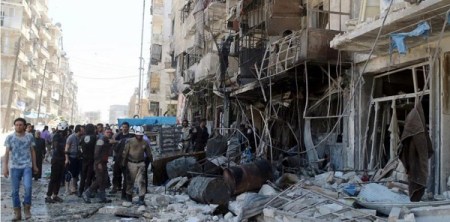
27840Aftermath of airstrike in Aleppo (image: al-Arabiya.net, April 26, 2016)

“I am a Shi’ite from South [Lebanon, the stronghold] of the resistance [i.e., Hizbullah], and I used to be proud of this. [In the past] I never thought that the resistance was wrong or would ever be wrong, and I staunchly defended the beliefs of my society and my surroundings. I did not know that a day [would come] when I would renounce [my] society, my blind sect and the party [Hizbullah,] which I have condemned since it became involved in the Syrian crisis.

“Today I asked myself: where is the conscience of the ‘resistance’ when it comes to the children [of Aleppo]? How can we be the party of God [Hizbullah] when we do not obey God’s directives? Every morning, I went over the reports [from Aleppo], trying to find even one piece of proof that Assad has the right to do what he is doing – but I found only words filled with sadness and grief over loved ones killed in the airstrikes. I found only the tears of an old man calling on Muhammad’s nation to help him, and a young man who insists on his honor and declares, ‘we stay here. This is our land, not the Russians’ or the Americans.’

“This loyalty to the land, despite the crisis these residents of Aleppo are experiencing, filled me with embarrassment and caused me to wonder what was the source of this loyalty to a city that is nearly in ruins… [At that point] I finally decided to revolt and take off the false mantle of Shi’ism, for my Zainab[1] would not allow the women of Aleppo to become the Zainabs of this age, and my Imams, ‘Ali and Hussein,[2] would not want the children of Aleppo to become the ‘Abdallah al-Radhi’ of this age.[3]

“If [the battle of] Karbala is being waged all over again by those who hide behind a mantle of piety, then [Hizbullah] is immoral and murderous and I cannot but say: Aleppo, I feel shame towards you and I hereby renounce the Shi’a and the party [Hizbullah] that supports the one who is destroying you.'”

Endnotes:

[1] The granddaughter of the Prophet Muhammad and daughter of ‘Ali, who was taken hostage in the battle of Karbala.

[2] ‘Ali bin abi Talib, the fourth caliph, and his son Hussein, who was killed in the battle of Karbala.

[3] ‘Abdallah, the son of Hussein and the grandson of ‘Ali, was killed in the battle of Karbala when he was only six months old.

Iran’s army chief takes command in Syria

May 2, 2016

Iran’s army chief takes command in Syria, DEBKAfile, May 2, 2016

Iranian ground forces commander

Israel must be prepared for the possibility that the Iranian chief of staff will personally take charge of the deployment of Iranian, Syrian and Hizballah forces along Syria’s border with the Golan Heights.

*********************

The chief of staff of the Iranian military, Maj. Gen. Hassan Firouzabadi, arrived in Damascus on April 30 to assume direct command of the Iranian, Syrian and Hizballah forces fighting in Syria, DEBKAfile’s military and intelligence sources report. His arrival showed Iran has significantly stepped up its military involvement in Syria.

Sources close to Iranian supreme leader Ayatollah Ali Khamenei said May 1 in Tehran that the general arrived in Damascus “to personally supervise the battles and the borders that were determined.” The sources did not specify which battles he would command or who had set the borders. They also did not say whether the borders referred to those of the war raging in Syria, or the country’s sovereign borders.

According to DEBKAfile’s sources in Moscow and Tehran, just as Russian President Vladimir Putin and his country’s military command see the current offensive by Russian, Iranian, Syrian and Hizballah forces around Aleppo as the climax of the Russian military intervention, the Iranians see the battle  for Aleppo as pivotal for the future of Syrian President Bashar Assad’s regime, as well as Tehran’s standing in Damascus.

Tehran also believes that the battle around Syria’s largest city will play a major role in determining all of the country’s borders, not just its northern one.

Our sources report that there are sharp differences between Moscow and Tehran on this point. It seems that the main role of Maj. Gen. Firouzabadi will be to ensure that immediately after the capture of Aleppo, his country’s forces will focus their operations on other areas of Syria where Iran, not Russia, has strategic interests.

One example of such an area is southern Syria, which borders both Israel and Jordan.

In other words, Israel must be prepared for the possibility that the Iranian chief of staff will personally take charge of the deployment of Iranian, Syrian and Hizballah forces along Syria’s border with the Golan Heights.

Until now, Israel’s government and military command had believed that it was possible to secure the northern border though understandings with Putin. But now, that assessment has been proven to be mistaken with the arrival of the Iranian general in Damascus, and Tehran’s announcement that Firouzabadi will deal with the issue of borders, among others.

DEBKAfile’s military sources point out that another main reason for the dispatch of the chief of staff is the fact that Iran has sent large forces from elite units of its standing army to Syria during the last month. It is the first time in Iran’s modern history that its standing army forces have been sent to fight beyond the country’s borders.

Over the past few weeks, the arrival of Iran’s 65th Airborne Brigade of the Special Forces-NOHED brigade drew particular attention.

Our sources report that this brigade will serve as the spearhead of the Iranian, Syrian and Hizballah assault on rebel positions in Aleppo.

According to the understandings reached by the Russian and Iranian general staffs, there is a clear division of responsibility between the forces of the two sides in the campaign. The Russian air force and heavy artillery will strike the rebel bases and positions in and around the city, while the Iranians, Syrians and Hizballah advance on the ground. After those forces surround the rebels in Aleppo, they will launch an all-out attack.

UK: The Left’s Little Antisemitism Problem

May 1, 2016

UK: The Left’s Little Antisemitism Problem, Gatestone InstituteDouglas Murray, May 1, 2016

♦ Within a week, Britain’s Labour party leadership was forced to suspend one of its newest MPs and one of its oldest grandees — and both for the same reason.

♦ Labour party leader Jeremy Corbyn and Ken Livingstone both say that they condemn anti-Semitism. They always tend to add that they also condemn “Islamophobia and all other forms of racism,” a disclaimer that always seems a deliberate attempt to hide a hatred of Jews under the skirts of any and all criticism of Islam. What is most fascinating is that all the while they are saying this, they stoke the very thing they claim to condemn.

♦ They pretend that the Jewish state does such things for no reason. There is no mention of the thousands of rockets that Hamas and other Islamist groups rain down on Israel from the Gaza Strip. The comment turns a highly-targeted set of retaliatory strikes by Israel against Hamas in the Gaza Strip into a “brutal” attack “on the Palestinians” as a whole. While mentioning those death-tolls, Livingstone has no interest in explaining that the State of Israel builds bunkers for its citizens to shelter in, while Hamas uses Palestinians as human shields and useful dead bodies for the television cameras, to help Hamas appear as an aggrieved “victim.”

♦ It is the narrative of the “left” on Israel that is causing the resurgence of anti-Semitism. It is not coming from nowhere. It is coming from them. If the left wants to deal with it, they first have to deal with themselves.

Every time anyone thinks Britain’s Labour party has reached a new low of anti-Semitism, entirely new depths seems to open. In September, I wrote here about how the election of Jeremy Corbyn to the leadership of the Labour party constituted a “mainstreaming” of racism in the UK. Although Mr. Corbyn claims he does not have any tolerance for any hatred of anyone, he is a man who has spent his political life cosying up to anti-Semites and terrorist groups that express genocidal intent against the Jewish people. He has worked closely with Holocaust deniers, praised anti-Semitic extremists and described Hamas and Hezbollah as his friends.

During his leadership so far, it is clear that the lead he is given is being followed farther down the party hierarchy. In March, I described how the party appeared to be rotting from the head down, with the discovery that the Labour Club at Oxford University had become an entity rife with anti-Semitic insults. Yet anyone who thought that the party could fall no farther had not imagined its turns of the past week.

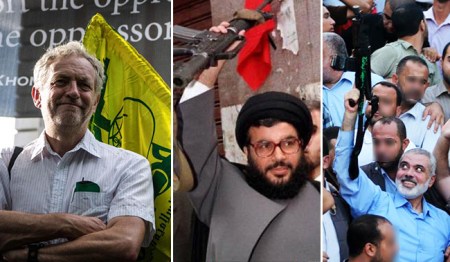
1267In 2009, Jeremy Corbyn (left, posing before a Hezbollah flag) said: “It will be my pleasure and my honour to host an event in Parliament where our friends from Hezbollah will be speaking. I also invited friends from Hamas to come and speak as well.” Pictured in the middle is Hezbollah leader Hassan Nasrallah. Pictured at right is Hamas leader Ismail Haniyeh.

At the start of the week, the MP for Bradford West, Naz Shah, was found to have posted on Facebook threads such ideas as the deportation of all the Jews from Israel over to America; the caption read, “problem solved.” Elsewhere she wrote on a discussion thread, “The Jews are rallying.” Ms. Shah happens to be a Muslim and represents a constituency which, until the last election, was represented by George Galloway. Other luminaries of the area include the former Liberal Democrat MP and David Ward.

So it is fair to say that among her peers, what Ms. Shah said was not unusual. The posts are from 2014, a year before she became an MP, and during the latest of Israel’s engagements in Gaza. In her apology, once she was found out, Ms. Shah talked of the fact that it was period in which “feelings were running high.” Of course, not everyone during a period of heightened feelings calls for the destruction of a UN member state, but Ms. Shah did, and within a day of the exposé of these messages, and an appropriate political outcry, she was suspended from the Labour party, pending a full investigation.

Labour’s week had barely begun. Within hours, another Labour MP, Rupa Huq, tried to come to Ms. Shah’s rescue. In a BBC interview, Ms. Huq tried to compare calls to eradicate the State of Israel with any other “amusing” thing one might find on Twitter. After a swift U-turn, Ms. Huq managed to restrain herself and remained in the party.

Next, from stage far-left, the former Mayor of London, Ken Livingstone, currently on Labour’s National Executive Committee, made his intervention. Mr. Livingstone has been in the Labour party for almost five decades and in the same trenches as the party’s current leader all of his political life. They have marched together for many a terrible cause and stood shoulder-to-shoulder on many a forsaken platform. But as Ken Livingstone went on several BBC programs, he probably did not expect that within hours, his own Labour party membership would be suspended, as was Ms. Shah’s. Livingstone had used his media opportunities to start talking about Hitler — specifically to claim, that Zionism was an early policy of Hitler’s. Perhaps sensing that he had got himself onto unfortunate ground, Livingstone then stressed that this was all before Hitler “went mad” and killed six million Jews.

So within a week, the Labour party leadership was forced to suspend one of its newest MPs and one of its oldest grandees — and both for the same reason. Presently, Jeremy Corbyn and his spinners are desperately trying to pretend that they have cut out the problem and are dealing with it appropriately. But there are reasons why they cannot do this with the problem that the Labour party — and the wider left in Europe and America — now has when it comes to Jews and the State of Israel.

Both Jeremy Corbyn and Ken Livingstone say that they condemn anti-Semitism. They always tend to add that they also condemn “Islamophobia and all other forms of racism,” a disclaimer that always seems a deliberate attempt to hide a hatred of Jews under the skirts of any and all criticism of Islam. But doubtless on one level they believe it. What is most fascinating is that all the while they are saying this, they stoke the very thing they claim to condemn.

There was much outcry to one answer Ken Livingstone gave this week when he tried to excuse Naz Shah’s original comments by saying that they were “over the top and rude.” But it was what he said earlier and has so far gone uncommented upon that was far more revealing and points to the left’s central problem here. In an earlier interview that morning with BBC London, Livingstone had said:

“The simple fact in all of this is that Naz made these comments at a time when there was another brutal Israeli attack on the Palestinians.

“And there’s one stark fact that virtually no one in the British media ever reports, in almost all these conflicts the death toll is usually between 60 and 100 Palestinians killed for every Israeli. Now, any other country doing that would be accused of war crimes but it’s like we have a double standard about the policies of the Israeli government.”

That right there is what is at the centre of Labour’s anti-Semitism problem. It pretends that the Jewish state does such things for no reason. There is no mention of the thousands of rockets that Hamas and other Islamist groups rain down on Israel from the Gaza Strip. The comment turns a highly-targeted set of retaliatory strikes by Israel against Hamas in the Gaza Strip into a “brutal” attack “on the Palestinians” as a whole. While mentioning those death-tolls, Livingstone has no interest in explaining that the State of Israel builds bunkers for its citizens to shelter in, while Hamas uses Palestinians as human shields and useful dead bodies for the television cameras, to help Hamas appear as an aggrieved “victim.”

In pretending that a state, Israel, in protecting itself from a rain of rockets, stabbings and car-rammings in the best way it possibly can, is, instead, committing war-crimes, not only is there a perpetuation of one lie; there is the subtle placing of a kernel of a thought. Why, a naïf might wonder, do these double-standards exist only in regard to Israel, and not to, say, Iran, China, Sudan, North Korea or Russia? Might it be because some people just hate Jews?

Such a comment is also the reason why even if the party pretends to “root it out,” it no longer can. What Livingstone said there passed without comment because it is the sort of thing which many MPs in the party and countless members of the party believe. Yet every time they say it, they are propagating a lie. Excusing Naz Shah’s comments by saying that they came “at a time when there was another brutal Israeli attack on the Palestinians” parcels a whole pack of lies into one.

That is the problem. It is the narrative of the “left” on Israel that is causing the resurgence of anti-Semitism. It is not coming from nowhere. It is coming from them. If the left wants to deal with it, they first have to deal with themselves.

Iranian Daily ‘Kayhan’: Iran Asked Russia To Intervene In Syria; Moscow Must Not Reach Any Agreement On Syria With Washington At Assad’s And Iran’s Expense; Tehran Is Providing Assad With Strategic Weapons

April 27, 2016

Iranian Daily ‘Kayhan’: Iran Asked Russia To Intervene In Syria; Moscow Must Not Reach Any Agreement On Syria With Washington At Assad’s And Iran’s Expense; Tehran Is Providing Assad With Strategic Weapons, MEMRI, April 27, 2016

In its April 11, 2016 editorial, the Iranian daily Kayhan, the mouthpiece of Iran’s ideological camp which is led by Iranian Supreme Leader Ali Khamenei, discussed Russia’s interests in Syria and the Middle East, and Iran-Russia relations. The editorial warned Moscow not to reach a secret agreement with Washington at the expense of Syrian President Bashar Al-Assad and Iran in exchange for Washington’s lifting its pressure on Russia over Ukraine and Crimea. It also underlined that such an agreement would in any case be doomed to failure, because it would not have Tehran’s knowledge or agreement, and stated that Tehran is opposed to Russia’s federal plan for Syria.

Noting that while it is important to Russia, Syria is not strategic to it as it is to Iran and Hizbullah. Russia’s might in the region stems solely from its protection of the Iran-Hizbullah-Syria resistance axis, it said, adding that if Moscow sells out Assad and Syria, it will become a minor player in the region, like France and the U.K.

The editorial revealed that the Russian military had entered Syria in October 2015 at Tehran’s request, and acknowledged that major parts of northern and southern Syria are directly controlled by Hizbullah and Iran. It added that Tehran has for some time been providing Assad with strategic weapons, and that Russia had withdrawn from Syria because its presence there was no longer needed.

The following are excerpts from the editorial:

“What Part Does Syria Play In Russian Foreign Policy?”

“…What part does Syria play in Russian foreign policy? Is it great or small? To what extent is Russia’s Syria policy based on cooperation with the West? Great or small? Is Russia’s security situation such that it would prefer to trade Syria for Ukraine – meaning that Russia will receive Ukraine and give Syria to the West? What weight does Russia have in Syria – meaning how much does Russia really influence the Syrian security issue? And on this matter, historically, in the past 50 years, was Syria, or was it not, part of the Eastern Bloc and [after the collapse of the Soviet Union] one of Russia’s satellite states?

“What is the extent of the military relations between Russia and Syria? How dependent is the Syrian army on Russian arms? What was Russia’s aim in becoming [physically] involved in Syria’s security situation this past October? What agreement was arrived at between the U.S. and Russia at the Geneva talks?

“Isn’t Russia’s becoming a main focal point at the Geneva talks, and isn’t its secret agreement with the U.S., aimed at weakening Iran’s role [in Syria] and placing the fate of Iran’s allies in the hands of Moscow-Washington agreements?

“According to this, and in light of the fact that it is clear what the outcome of the secret Kremlin-White House talks will be, what was the point of our five-year effort to protect the Syrian government, and our sacrifice of beloved martyrs? And, ultimately, in light of its past reputation, can Russia’s game be trusted?…”

“All Russia’s Might Lies In Its Preservation Of Iran, Hizbullah, And Syria; If It Does Not Do This, [Russia] Will Become A Minor Player, Like France And England”

“Syria plays a major part in Russia’s foreign policy… Syria and its Mediterranean coast is the only point in the Middle East and North Africa that has [physical] contact with the southern reaches of NATO territory. To some extent, these places are under Russian control, and any plan that impacts Russia’s ongoing presence in this sensitive region is certainly contrary to Russia’s interests and national security.”

“On the other hand, there is no way Russia can trust that any agreement with the West that rejects Assad will not also reject Russian influence. Therefore, we can say that in terms of geopolitics and strategic interests, there is no possibility that an agreement between Russia and the West about the current Syrian government would be achieved – unless the Russians make a mistake in the talks. But even if this happens, there is a possibility for rectification [of such a mistake by Russia], thanks to the good Iran-Russia relations. Additionally, in the past year or two, we have seen at least two such mistakes that were subsequently rectified.”

“Regarding Russian control over Eastern Ukraine and the Crimea, and Russian military control of the Black Sea: There is no reason for Russia to bring Syria in [to the equation] in order to obtain Ukraine. At this time, in the Ukrainian issue, the Westerners and the Western government in Kiev are apprehensive about Russia’s influence and about Russia’s military and security expansion in Eastern and Southern Ukraine. Therefore, the statement that is brought up in Iran – i.e. that Russia wants to trade Syria for Ukraine, is not compatible with reality.

“What weight does Russia carry in Syria? Undoubtedly, Russia is one of the countries that influence the Syrian issue. Russia’s military presence in the ports of Latakia and Tartus, as well as the Russia-Syria military agreements, give Russia prominent status. But in comparison with the status of Iran and Hizbullah, [Russia’s] status is not considered strategic.

“In principle, in some strategic matters, there are strategic points of contention between Russia and Syria – but there are no such disputes between Damascus and Tehran… Russia’s influence in Syria is not so great that [Russia] can make decisions on behalf of the Syrian government and its allies in the region… that is, Russia has no strategic relations either with the Syrian government or with the main rebels such as Jabhat Al-Nusra and ISIS, which would allow it to establish a particular situation in Syria. All Russia’s might lies in its preservation of Iran, Hizbullah, and Syria. If it does not do this, [Russia] will become a minor player, like France and England.”

“Major Parts Of The Line Of Defense And The Operations Of North And South Syria Are Now Directly In Hizbullah’s And Iran’s Hands”

“Over the past 50 years, Syria was never recognized as part of the Eastern Bloc, and never expressed solidarity with it, despite its good relations with the Soviet Union and Russia. Perhaps the main reason there was no such alliance is Russia’s active relations with the Zionist regime. In any event, Syria was not defined as part of Russia’s [interests], and has, since the beginning of the victory of [Iran’s Islamic] Revolution, been part of the resistance front and an ally of Iran – and now too it owes its existence to Iran’s special and influential aid.

“In contrast to Russia, that has nothing in Syria that belongs to it, major parts of the line of defense and the operations of north and south Syria are now directly in Hizbullah’s and Iran’s hands. If Russia reaches an agreement with a third country that is unacceptable to Iran, such an agreement will surely fail – because in the past 30 years, every decision made for the resistance states and movements in which Iran had no part failed.

“Syria has no absolute dependence on Russian arms, and Iran has been providing Syria with strategic weapons for a long time. Therefore, in the [second Lebanon] war, the Assad government gave its Russian weapons to Hizbullah in Lebanon, without fearing that this would violate either the military protocols [that were in place] with Russia or the Russians’ conditions. Russia also did not succeed in expressing serious opposition [to this move]. Therefore, if Moscow was Syria’s only source of weapons, Assad would not have been able to unilaterally violate the agreement.”

“On The First Of October 2015, Russia [Physically] Entered The Syrian Security Issue, After Iran Officially Asked It To Do So”

“On the first of October 2015, Russia [physically] entered the Syrian security issue, after Iran officially asked it to do so. Two days after a visit [to Moscow] by a high-ranking Iranian delegation, Moscow sent its air forces and missile defense systems into the war against terrorist elements in Syria, and five and a half months later, it withdrew part of its military forces from Syria. This was because the Islamic Revolutionary Guard Corps (IRGC)   agreement with Putin was in force for five months at most. After the end of the [Russia-Iran] agreement, Russia withdrew only some of its forces from Syria.

“[It was at] Iran’s invitation that Russia entered Syria, when such a [military intervention] was necessary and worthwhile, and [Russia] withdrew part of its forces when even withdrawing them all would not have harmed the [Assad] government and the Syrian security apparatuses one bit. In this case, Iran’s conclusion was that the Russian forces should return [to Russia].

“The truth is that last summer, because of the advance of the terror elements in Idlib, Shaykh Maskin, Sakhaneh, and Tadmor, terror elements were enthused, and Syria needed a psychological shock; additionally, prior to Russia’s entrance, the sensitive region of Zabadani was taken by Hizbullah.

“This shock [i.e. Russia’s entrance into Syria] was implemented in early October, and it gave the [Syrian] army, and the forces connected to it, their second wind, and they carried out the Nasser 2 operation in the western part of the city of Aleppo and also determined the fate of the war in Syria. Therefore, when the Russians withdrew their forces [from Syria], there was no longer any need for their presence. So it is not at all correct to say that Iran and Syria were surprised when this happened.

“For Syria, there is a need for diplomatic talks, and Iran always stresses [the need for] this alongside military operations. Iran has had a useful presence in most [of these talks] particularly in the two recent rounds of talks held in Munich and Geneva. Here, Russia’s role was two-pronged: First, in the developments in the [war] arena; in this matter [Russia] is fully coordinating with Iran. Second is Russia’s special plan, the main point of which is [Syria’s] federalization. Iran has neither rejected nor approved [this plan], but it recognizes it as premature, and as not serving the interests of the participants in the diplomatic talks in Geneva.”

New Palestinian pact-for-terror

April 25, 2016

New Palestinian pact-for-terror, DEBKAfile, April 25, 2016

TerrorTunnels480

Israel embarked on a P. R. campaign to play down the extent of the threat which surfaced in one day in the discovery of Hamas tunnel near Kibbutz Sufa, and the suicide bombing of Jerusalem bus No. 12 on April 18, with 20 people injured. The police initially claimed for example that the explosion was due to a technical problem with the engine. But the two developments actually represented a sharp and serious escalation of the Palestinian wave of terror against Israel.

Neither of the operations was carried out by “lone wolves” but rather by large terror networks. The secret tunnel discovered in the Gaza border area was built by the Hamas military wing, the Izaddin al-Qassam brigades, while the suicide bombing in Jerusalem was carried out by the Hamas infrastructure in Judea and Samaria, specifically its operatives in the Bethlehem area.

Each of these terror networks poses a different challenge to Israel.

In Gaza, the Hamas political leadership is no longer in contact with the heads of its military wing. Neither the top commanders nor the regional commanders of the brigades obey any Hamas political body. They only heed three sources:

1. The Hamas military command framework headed by Mohammad Deif and Marwan Issa.

2. Iranian or Hizballah intelligence services, which maintain contacts with them and often provide funds or weapons.

3. The ISIS affiliate in the Sinai, with which the Hamas military wing maintains operational ties.

There is an equally serious problem in Judea and Samaria. Over the past few weeks, the Hamas terror networks have started to make contact with sleeper cells from Fatah’s Tanzim paramilitary force that have the knowledge, ability, means and experience for major terrorist attacks against Israel, such as the Jerusalem bus bombing.

This dormant wing of Mohammad Abbas’s Fatah has began to show signs of life and willingness to return to the path of terror.

These contacts began immediately after publication of a letter from jailed Tanzim leader Marwan Barghouti to members of the force that called on them to start coordinating their operations against Israel with Hamas. Nobody has bothered to explain how a senior terrorist jailed in a high-security Israeli prison succeeded in smuggling such a letter out.

The link between part of the Tanzim and the Hamas terror networks is no less dangerous than the tunnel discovered near Kibbutz Sufa, and it presages an escalation of terror operations in the future.

The only way to prevent a major deterioration of the security situation is to strike targets of the Izzadin al-Qassam brigades. There is no need to launch a total war against Hamas or to occupy Gaza.

But instead of responding as needed, Israel’s government and security establishment have released pictures of digging equipment that has finally succeeded in locating a single Hamas infiltration tunnel out of the many that exist, and claimed that those responsible for the Jerusalem bombing have yet to be identified. At the same time, senior officials and IDF officers continue to assert that Hamas is not seeking escalation.

Unfortunately, this can only mean a resurgence of the wave of terror.