Posted tagged ‘Hezbollah’

Israeli-Saudi Ties Warming; Hizballah and Iran Livid

August 8, 2016

Israeli-Saudi Ties Warming; Hizballah and Iran Livid, PJ MediaP. David Hornik, August 7, 2016

netImage Courtesy of Shutterstock

As Khamenei tweeted on Monday: “Revelation of Saudi government’s relations with Zionist regime was stab in the back of Islamic Ummah.”

************************

The Israeli society that I encountered embraces a culture of peace, has accomplishments it wants to (protect), wants coexistence, and wants peace.

Those words weren’t spoken by an enthused congressman after a trip to Israel. They were spoken to BBC Arabic by Abd al-Mujid al-Hakim, director of the Middle East Center for Strategic and Legal Policy in Jedda, Saudi Arabia, and a member of a Saudi delegation that recently visited Israel.

The delegation, which included academics and businessmen, was led by Dr. Anwar Eshki, a retired Saudi general and former top adviser to the Saudi government. About a year earlier Eshki had shaken hands and shared a stage in Washington with Israeli Foreign Ministry director-general Dore Gold—seen as a major breakthrough at the time. But a public visit to Israel of this kind, which could only have been carried out with the approval of the highest level of the Saudi government, is a historical first and still has a taste of the surreal to it.

During the visit Eshki met again with Gold; with Maj.-Gen. Yoav Mordechai, responsible for Israeli administration of the territories; with Palestinian officials in Ramallah; and with opposition Members of Knesset.

One of those opposition MKs, Issawi Frej of the far-left, mostly Jewish Meretz Party, said:

The Saudis want to open up to Israel. It’s a strategic move for them. They want to continue what former Egyptian president Anwar Sadat started (with the 1979 Israeli-Egyptian peace treaty). They want to get closer with Israel, and we could feel it clearly.

What’s going on?

Israeli commentator Yossi Melman, while noting that the visit marks a new plateau in the increasingly overt Israeli-Saudi ties, points out:

[O]n a covert level, according to foreign reports, the ties being cultivated are even more fascinating. Intelligence Online reported that Israel is selling intelligence equipment, as well as control and command centers, to the Saudi security forces. Previously, it had been reported in the foreign media that the heads of the Mossad, the organization responsible for Israel’s covert ties, met with their Saudi counterparts. Media outlets affiliated with Hezbollah even reported that officers from the two countries’ armies had met.

What’s going on, in other words, is that Israel and Saudi Arabia have common enemies in the region, and with American power withdrawing, Israel’s power constantly growing, ISIS threatening, and the Obama administration having paved a path to nuclear weapons for Iran, the Saudis—like Egypt, Jordan, and other Sunni states—are casting their troubled gaze toward Jerusalem.

Or as Melman puts it:

Israel and the Saudis share a fear for Iran’s nuclear program and Tehran’s efforts to increase its influence in the region. They also both have an interest in weakening the standing of Hezbollah, “the forward headquarters” of Iran on Lebanon’s Mediterranean coast. Prime Minister Benjamin Netanyahu speaks often of Israel’s ties with the “Sunni Bloc,” and hints that the Saudis are included in this group.

It appears that he need hint no more.

Last week’s Saudi visit to Jerusalem—a dramatic, even stunning confirmation of Israel’s cooperation with that bloc—did not go unnoticed, of course, by the rival Shiite bloc. And they’re not happy about it.

Hizballah chief Hassan Nasrallah accused the Saudis of “normalizing for free, without receiving anything in return…. It seems the future of Palestine and the fate of its children have become a trivial matter for some Arab states recently.”

The Saudi visit, he said, “couldn’t have taken place without the agreement of the Saudi government. We know how things work there. In Saudi Arabia a person will be lashed for so much as tweeting.”

But if Nasrallah is not pleased with this development, his boss—Iranian supreme leader Ayatollah Khamenei—is even less thrilled.

As Khamenei tweeted on Monday: “Revelation of Saudi government’s relations with Zionist regime was stab in the back of Islamic Ummah.”

None of this means that the Sunni Arab part of the Ummah is ready to warmly embrace Israel. While in Israel last week, Dr. Eshki—like Egyptian and Jordanian officials before him—said that real “normalization” would have to await a resolution of the Palestinian issue. It’s code for: “We’re not really ready to accept a Jewish state in our midst.”

Still, considering that Israel and Sunni Arab states used to fight wars every few years, a reality of nonbelligerency and pragmatic ties is a major improvement for Israel. Whoever is the next U.S. president might want to cooperate with the Israeli-Sunni alliance against Iran instead of giving the mullahs a “sunset clause” leading to nuclear night.
Has the IDF hit the Basij forces commander General Naghdi?

July 30, 2016

Has the IDF hit the Basij forces commander General Naghdi? DEBKAfile, July 30, 2016

EinZivan2 (1)

Gen. Naghdi’s visit to Quneitra undoubtedly presaged some decisions in Tehran with regard to direct Hizballah-Syrian-Iranian action against Israel.

The Iranian, Syrian and Hizballah agencies accuse Israel of the attack because the say it was executed by two Nimrod anti-tank long-range missiles, manufactured by the Israeli Aerospace Industry, for use by the IDF against armored vehicles, ships, bunkers and troop concentrations.

*****************

Iranian, Syrian and Hizballah sources are intimating that the “Syrian officer” injured on July 26 in Quneitra by Israel’s double Nimrod’ missile shot was none other than Revolutionary Guards Gen. Muhammad Resa Naghdi, head of the paramilitary Organization for the Mobilization of the Oppressed, also known as the Basij, which falls under the Islamic Revolutionary Guard Corps (IRGC). The victim was earlier described officially as a Syrian officer.

If he was indeed hurt or killed by an Israeli rocket, Naghdi would become the highest-ranking IRGC general ever hit by the IDF.

On July 27, the semi-official Fars news agency reported that a top Iranian general recently visited the Israeli-Syrian border to tour Quneitra and the Golan demarcation lines between Syria and Israel – the first time the Tehran government had publicized a visit by a senior regime official to the area.

It may be presumed, DEBKAfile’s intelligence sources say, that someone at the IDF lookout posts spotted and reported on Gen. Naghdi’s arrival with an entourage in Quneitra on July 26 and saw him inspecting through binoculars the IDF defense positions. He was then quickly identified.

Any decision to go after a high-ranking Iranian would not have been left to local IDF commanders or even OC Northern Command Maj. Gen. Aviv Kohavi, but passed straight to Prime Minister Binyamin Netanyahu, Defense Minister Avigdor Lieberman and Chief of Staff Lt. Gen. Gady Eisenkot – especially in this case.

General Naghdi is not just another Iranian general. He heads the more than a million-strong Basij militia, which is a pillar of the ayatollahs regime in Tehran, and the backbone of the Iranian internal security forces which maintain the regime’s total control in every corner of the Islamic Republic.

Gen. Naghdi’s visit to Quneitra undoubtedly presaged some decisions in Tehran with regard to direct Hizballah-Syrian-Iranian action against Israel.

The IDF is holding its silence on reports of his injury, declining as usual to comment on reports by foreign publications.

The Iranian, Syrian and Hizballah agencies accuse Israel of the attack because the say it was executed by two Nimrod anti-tank long-range missiles, manufactured by the Israeli Aerospace Industry, for use by the IDF against armored vehicles, ships, bunkers and troop concentrations..

The missile has a semi-active laser guidance system, and is able to operate day and night. Its flight path can be below the clouds, while its operators far behind use a laser to guide it to target.

The launcher platform, with four missiles, can be installed on a Jeep, weapon-bearing vehicle, Abir, or armored vehicles. In addition, it is possible to send it from CH-53 ‘Yasur’ helicopter.

Israel has acted in the past against the establishment of an Iranian and/or Hizballah military presence on its Golan doorstep. On Jan. 19, 2015, an IDF air strike killed the Iranian Brig. Gen, Mohammad Ali Allahdadi and six Hizballah officers while they were on a tour of inspection near Quneitra.

Thursday, July 28, DEBKAfile ran an exclusive report on rising Israel-Russia tensions centering on southern Syria and the Golan.

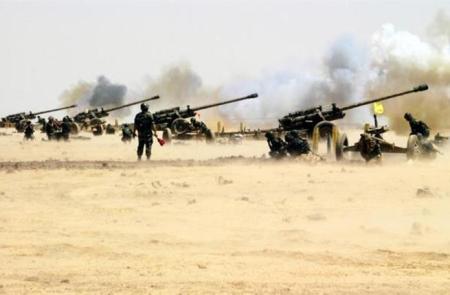
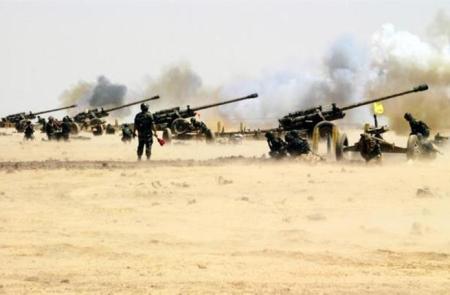
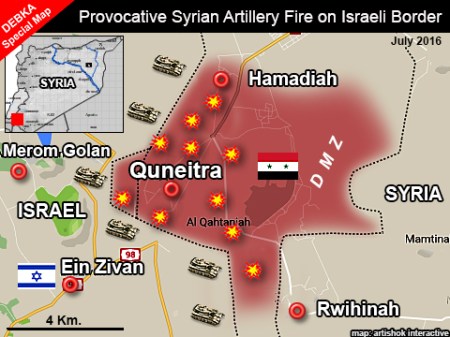
For four days since July 25, the Syrian army has been continuously firing artillery batteries – moved close to Israel’s defense lines on the Golan border – in a manner that comes dangerously close to provoking an Israeli response. This carefully orchestrated Syrian campaign goes on around the clock.

It is the first time in the six years of the Syrian war that Bashar Assad has ventured to come near to provoking Israel. But now he appears to be emboldened by his Russian ally.

The IDF is holding its fire for the moment. But Israeli military and government leaders know that the time is near for the IDF to be forced to hit back, especially since it is becoming evident that the Syrian army’s steps ae backed by Russia.

DEBKAfile’s military sources provide details of the Syrian steps:

  • The Syrian army’s 90th and 121nd battalions have been firing their artillery batteries non-stop across a 10km band along the Golan border from Hamadia, north of Quneitra, up to a point facing the Israeli village of Eyn Zivan. (See attacked map).
    This means that the Syrian army has seized the center of buffer zone between Israel and Syria and made it a firing zone.
  • This artillery fire fans out across a radius that comes a few meters short of the Israeli border and the IDF troops stationed there. It then recedes to a distance of 500 to 600 meters and sweeps across the outposts and bases of the Syrian rebel forces believed to be in touch with Israel or in receipt of Israeli medical aid.
  • The new Syrian attack appears to hold a message for Jerusalem: For six years, you supported the rebels against the Assad regime in southern Syria. That’s now over. If you continue, you will come face to face with Syrian fire.
  • Damascus is also cautioning those rebels:  For years, you fought us with Israel at your backs. But no longer. Watch us bring you under direct artillery fire, while the IDF sits on its hands.
  • On July 26, Russian media published an article revealing that Russia had delivered to the Syrian Air Force, advanced SU-24M2 front-line bombers, which is designed for attack on frontlines of battle. Israeli officials were unpleasantly taken aback by the news. Up until now, the Russians and Syrians refrained from deploying air strength in South Syria near the Israeli border. Now the Syrian air force has the means to do so.
  • DEBKAfile military sources report that the SU-24M2, following recent upgrades and modifications in Russian factories, is now capable of dropping smart bombs – ballistic bombs with a guidance system on their tails that enable them to hit targets with precision.This guidance system does not rely on US GPS satellites but rather the equivalent Russian GLONASS system which is linked to a network of 21 Russian satellites and partially encrypted for military usages.
    In addition, the SU-24M2 is equipped with a system that projects the information the pilot needs (flight details and battle details) on the plane’s windshield (head-up display) and on the pilot’s visor.
  • The Russians delivered to the Syrians two of these sophisticated airplanes this week, out of 10 that they will supply soon.

The IDF has concluded that it is only a matter of time before these planes appear in Southern Syria and so generate a new and highly combustible situation on Israel’s northern and northeastern borders.

The Russians are colluding with Damascus to inform Israel that it will no longer be allowed by either to continue backing the rebel forces in southern Syria or sustain the buffer zone which they man.

Israel may pay dear if Prime Minister Binyamin Netanyahu, Defense Minister Avigdor Lieberman, and Chief of Staff Lt. Gen. Gadi Eisenkot decide to continue to abstain from hitting back at the Syrian fire which is aimed every few hours at the vicinity of IDF posts or the impending arrival of Russian bombers. The price in store would be the weakening of the IDF’s hold on the Golan border.

London’s Muslim Mayor Refuses To Support Ban On Hezbollah Terror Group

July 21, 2016

London’s Muslim Mayor Refuses To Support Ban On Hezbollah Terror Group

by Raheem Kassam

20 Jul 2016

Source: London’s Muslim Mayor Refuses To Support Ban On Hezbollah Terror Group

London’s new and first Muslim mayor Sadiq Khan has refused to back a request for the terrorist outfit Hezbollah to be a proscribed organisation.

Following a question from UK Independence Party (UKIP) London Assembly member David Kurten, Mr. Khan said that he would not back a ban on the group which has recently had supporters and sympathisers protesting with its famous yellow jihadi flag at ‘Al Quds Day’ in London.

Mr. Kurten asked the question in the discussion following Assembly member Kemi Badenoch’s question: “What action is the Metropolitan Police Service taking against the use of flags representing designated terrorist organisations as seen during the recent al-Quds Day march in London on July 3rd?”

While Mr. Khan said he understood “the concerns of the Jewish community, and the distress these flags cause many Londoners”, he also said “It would not be appropriate… to comment on an ongoing police investigation” and that he would not commit to pushing for a ban on the “political wing” of Hezbollah.

A common misconception about the terror group which is deeply entrenched in both Europe and the Americas is that there is a tangible difference between a “military” or terrorist wing and the group’s political arm. In Lebanon, Hezbollah has 12 member of parliament and takes two seats in the cabinet of the government.

The group is designated as a terror group in its entirety by the Arab League, Bahrain, Canada, France, Israel, the Netherlands, and the United States.

But the European Union, as well as the United Kingdom maintain a difference between the group’s military and political wings, seeking only to proscribe the former.

The Hezbollah flags, which were flown at the Al Quds Day march, do not distinguish between two “wings” and the two “wings” both report to the same group leadership in terror chief Hassan Nasrallah.

Mr. Kurten made this point, and asked if this was the reason why the Metropolitan Police Service is not able to intervene when Hezbollah flags are flown. The Mayor admitted this was the case saying “…you’re right…”.

He then asked the Mayor if he would call for the political wing of Hezbollah to be proscribed to bring the UK into line with many other nations. The Mayor responded negatively saying: “That’s not what I’ve committed to…”  

UKIP’s other London Assembly member Peter Whittle joined Mr. Kurten in calling on new Prime Minister Theresa May for Hezbollah to be proscribed in its entirety.

Mr Kurten added after the event: “The number one duty of the Mayor is to ensure that Londoners are safe. It is astonishing that in the current climate the Mayor did not call for a blanket ban of Hezbollah, and did not oppose this loophole which is both frightening to many Londoners and also potentially encourages violent hate crime. I hope that on reflection that he will change his mind.” 

Syria post near Golan border bombed, unclear if Israel involved

July 20, 2016

Syria post near Golan border bombed, unclear if Israel involved IDF declines to comment on report of jets hitting Assad government-held building near Quneitra; Hezbollah points finger at Nusra Front

By Ilan Ben Zion

July 20, 2016, 1:33 pm

Source: Syria post near Golan border bombed, unclear if Israel involved | The Times of Israel

Smoke rises following an explosion in Syria’s Quneitra province as Syrian rebels clash with President Bashar Assad’s forces, seen from the Israeli-controlled Golan Heights in 2014. (AP/Ariel Schalit, File)

A Syrian government building near the Golan border was bombed Wednesday, with some reports initially attributing the attack to Israel.

However, Hezbollah and several Arab media outlets indicated the building in Medinat al-Ba’ath had been attacked by rebel groups.

 It wasn’t immediately clear what purpose the building served, or whether it was occupied at the time of the strike. There was no immediate word on casualties.

Unconfirmed reports indicated that the planes targeted Hezbollah operatives in the area.

The Lebanese Al-Mayadeen news agency denied the accuracy of reports attributing the bombing to Israeli airstrikes in Syria, quoting Hezbollah saying the al-Qaeda affiliated Nusra Front launched rockets at Quneitra, inflicting casualties.

The Local Coordination Committees in Syria, meanwhile, claimed Free Syrian Army forces fired rockets at Assad forces in Medinat al-Ba’ath.

The Syrian Qasioun news agency claimed that the building was an Assad government command post that may have been used for Hezbollah activities.

There was no immediate response to the reports in the Syrian official news agency and the IDF Spokesman’s Unit said it didn’t comment on reports regarding Israeli strikes in Syria.

Shortly after the reported strike, the Local Coordination Committees in Syria reported that Assad government helicopters bombed the nearby towns of Umm Batna and Ajraf.

Syrian Army artillery then were said to target and destroy Nusra Front positions in response to the reported rocket attacks on Medinat al-Ba’ath.

Earlier in the day, gunfire hit an army post near the Israeli town of Metulla on the Lebanon border. The IDF said it was investigating but believed the bullets to be stray fire from across the border.

On Tuesday, Prime Minister Benjamin Netanyahu marked 10 years since the Second Lebanon War with Hezbollah by warning that “if the need arises, we will respond to aggression — and the response will be powerful. Whoever thinks they will find ‘spiderwebs’ here will get… an iron fist.”

He was alluding to a 2000 speech by Hezbollah leader Hassan Nasrallah, in which he called the Jewish state “feebler than a spiderweb.”

Israel has maintained an official policy of nonintervention in the Syrian civil war, which has wracked the country for over five years and left over 250,000 dead and millions displaced but Israeli officials have made clear that Israel would act to prevent Hezbollah from obtaining sophisticated weaponry from Syria or Iran.

The IDF has also retaliated when fighting by the various rebel groups and government forces struck Israel.

Earlier this month the IDF struck two Syrian artillery pieces after errant fire struck just inside the border fence with Israel.

On Sunday, the army also attempted to shoot down a drone that infiltrated the Golan from Syria, but failed to hit it with two Patriot missiles and a missile shot from a jet.

The IDF has been bolstering defenses along the northern border, expanding the network of fences and surveillance capabilities, to prepare for a possible war with Hezbollah, the Shiite group that fought a war with Israel in 2006 and has vowed to destroy the Jewish state.

The border has been largely quiet in the ten years since the Second Lebanon War, with Hezbollah’s forces deployed to support Iranian and Assad regime forces in the Syrian civil war.

Not Just the Saudis: Iran’s Huge Role in 9/11 Also Covered Up

July 19, 2016

Not Just the Saudis: Iran’s Huge Role in 9/11 Also Covered Up, PJ MediaRobert Spencer, July 19, 2016

Iran and Saudi

“Satan in Flames” was the Iranian’s elaborate plot to hijack three passenger jets, each packed full of people, and crash them into American landmarks: the World Trade Center, which jihadis took to be the center of American commerce; the Pentagon, the center of America’s military apparatus; and the White House.

*************************

The 28-page section of the 9/11 report detailing Saudi involvement in the terror attack has finally been released (although with substantial portions still redacted). We now know why one president who held hands with the Saudi King and another president who bowed to him worked so hard all these years to keep these pages secret. The 28 pages confirm that the 9/11 jihad murderers received significant help from people at the highest levels of the Saudi government.

However, Saudi involvement in 9/11 was not the only subject of a cover-up: Iran’s little-noted role in 9/11 has been covered up as well.

As I detail in my new book The Complete Infidel’s Guide to Iran, on December 22, 2011, U.S. District Judge George B. Daniels ruled in Havlish, et al. v. bin Laden, et al., that Iran and Hizballah were liable for damages to be paid to relatives of the victims of the September 11, 2001 jihad attacks in New York and Washington.

Judge Daniels found that both the Islamic Republic and its Lebanese proxy had actively aided al-Qaeda in planning and executing those attacks. He found that Iran and Hizballah had cooperated and collaborated with al-Qaeda before 9/11, and continued to do so after the attacks.

Before 9/11, Iran and Hizballah were implicated in efforts to train al-Qaeda members to blow up large buildings. This training resulted in the bombing of the Khobar Towers in Saudi Arabia in 1996, the bombing of the U.S. embassies in Kenya and Tanzania in 1998, and the attack on the USS Cole in 2000.

Shortly after the Cole attack, the 9/11 jihad plot began to come together — and Iran was involved.

Former MOIS operative Abolghasem Mesbahi, a defector from Iran, testified that during the summer of 2001 he received messages from Iranian government officials regarding a plan for unconventional warfare against the United States. The plot was entitled Shaitan dar Atash (“Satan in Flames”).

“Satan in Flames” was the Iranian’s elaborate plot to hijack three passenger jets, each packed full of people, and crash them into American landmarks: the World Trade Center, which jihadis took to be the center of American commerce; the Pentagon, the center of America’s military apparatus; and the White House.

A classified National Security Agency analysis referred to in the 9/11 Commission report reveals that eight to 10 of the 9/11 hijackers traveled to Iran repeatedly in late 2000 and early 2001.

The 9/11 Commission called for a U.S. government investigation into Iran’s role in 9/11 — but none was ever undertaken.

So Kenneth R. Timmerman of the Foundation for Democracy in Iran was, in his words, “engaged by the Havlish attorneys in 2004 to carry out the investigation the 9/11 Commission report called on the U.S. government to handle.”

Timmerman noted that during the 9/11 hijackers’ trips to Iran, they were “accompanied by ‘senior Hezbollah operatives’ who were in fact agents of the Iranian regime.” Iranian border agents did not stamp their passports so that their having been inside the Islamic Republic would not arouse suspicion when they entered the United States. The CIA, embarrassed by its failure to recognize the import of these trips, tried to suppress this revelation.

However, Timmerman contends that even the available evidence is explosive enough. In his words, he reveals that the Islamic Republic of Iran:

  • Helped design the 9/11 plot
  • Provided intelligence support to identify and train the operatives who carried it out
  • Allowed the future hijackers to evade U.S. and Pakistani surveillance on key trips to Afghanistan — where they received the final order of mission from Osama bin Laden — by escorting them through Iranian borders without passport stamps
  • Evacuated hundreds of top al-Qaeda operatives from Afghanistan to Iran after 9/11 just as U.S. forces launched their offensive
  • Provided safe haven and continued financial support to al-Qaeda cadres for years after 9/11
  • Allowed al-Qaeda to use Iran as an operational base for additional terror attacks, in particular the May 2003 bombings in Riyadh, Saudi Arabia

The Ayatollah Khamenei knew about the plot. During the summer of 2001, he instructed Iranian agents to be careful to conceal their tracks. He told them to communicate only with al-Qaeda’s second-in-command — Ayman al-Zawahiri — and Imad Mughniyah of Hizballah.

Mughniyah was Iran’s key player in the 9/11 “Satan in Flames” plot. During the Havlish trial, former CIA agents Clare M. Lopez and Bruce D. Tefft submitted an affidavit stating:

Imad Mughniyah, the most notable and notorious world terrorist of his time, an agent of Iran and a senior operative of Hizballah, facilitated the international travel of certain 9/11 hijackers to and from Iran, Lebanon, Saudi Arabia, and Afghanistan, and perhaps various other locations for the purpose of executing the events of September 11, 2001.This support enabled two vital aspects of the September 11, 2001 plot to succeed: (1) the continued training of the hijackers in Afghanistan and Iran after securing their United States visas in Saudi Arabia, and (2) entry into the United States.

The Obama-era CIA went to great pains to try to ensure that information about Iran’s role in 9/11 did not come out in the Havlish case.

In August 2010, a CIA official pressured a Havlish witness to withdraw his testimony in exchange for a new identity, new passport, and new job.

In December of that year, another CIA operative approached a different Havlish witness, showed him documents stolen from the case, and took him to a U.S. embassy where he was subjected to five hours of interrogation. He was finally offered cash if he recanted his testimony. Says Timmerman:

After I reported those attempts at witness tampering to a Congressional oversight committee, they ceased.

Judge Daniels determined that Iran, Hizballah, the Islamic Revolutionary Guard Corps, the Iranian Ministry of Intelligence and Security, and other Iranian government departments — as well as the Ayatollah Khamenei himself and former Iranian president Ali Akbar Hashemi Rafsanjani — were all directly implicated in Iranian efforts to aid al-Qaeda in its 9/11 plot.

Daniels awarded the plaintiffs in the Havlish case $394,277,884 for economic damages, $94,000,000 for pain and suffering, $874,000,000 for mental anguish and grief, $4,686,235,921 in punitive damages, and $968,000,000 in pre-judgment interest for a total of $7,016,513,805.

The Havlish plaintiffs will not receive a check for that amount from the Islamic Republic of Iran neatly signed by the Ayatollah Khamenei. Still, the judgment provided a small bit of solace for the loss of life and years of trauma these families suffered as a result of the Islamic Republic’s war against the United States.

Most importantly, the judgment stands as an acknowledgment of Iran’s role in the 9/11 attacks.

Clearly, Iran is and has been at war with the United States, Over a period of many years, Iran has conducted that war on numerous unconventional fronts while threatening conventional attacks if its agenda is thwarted in any way.

For the Islamic Republic this war is very real, a principal focus of its energy and expenditures. But it appears that only one side is fighting.

This was underscored in March 2016, when it came to light that Iranian hackers who were accused of being tied to the Islamic Republic had attempted to hack into the operating system of the Bowman Avenue Dam north of New York City, as well as into financial conglomerates Bank of America, JP Morgan Chase, Citibank, and HSBC – and the New York Stock Exchange.

Said Attorney General Loretta Lynch:

These attacks were relentless, they were systematic, and they were widespread.

Such attacks, if they had been successful, could have caused catastrophic damage to New York City and the American economy. Yet true to form, the Obama administration only indicted the accused (none of whom it had in custody). He took no measures against the Iranian government.

After 9/11, the U.S. declared war on terror and entered Afghanistan and Iraq. But if Bush had really been serious about attacking jihad terror at its root, he would have invaded Saudi Arabia and Iran instead. Under Obama, the denial and willful ignorance have only gotten exponentially worse.

Hezbollah’s Massive Arms Build-up in Lebanese Civilian Areas

July 19, 2016

Hezbollah’s Massive Arms Build-up in Lebanese Civilian Areas, Front Page MagazineJoseph Klein, July 19, 2016

hn

Every calendar quarter the United Nations Security Council holds an extensive debate on the Israeli-Palestinian “situation.” The Israeli and Palestinian UN representatives make speeches following the Secretary General’s report on the current status, which are normally predictable restatements of their respective positions. This time, however, Israel’s ambassador Danny Danon, addressing the Security Council at its July 12th meeting, presented new graphic evidence of Hezbollah’s alarming arsenal of rockets and missiles located in civilian areas of southern Lebanon.

Ten years ago, when Security Council Resolution 1701 was adopted, ending the war that had broken out between Israel and Hezbollah, the terrorist group was estimated to have had about 7000 rockets. The resolution called for Hezbollah and other armed groups not officially a part of the Lebanese government’s armed forces to relinquish their weapons. Instead, precisely the opposite has happened. Hezbollah never stopped its arms build-up, which has been funded and supplied principally from the world’s leading state sponsor of terror, Iran.

Hezbollah now has approximately 120,000 rockets and missiles aimed at Israeli civilian population centers.  By way of comparison, Ambassador Danon said that “more missiles are hidden underground in 10,000 square kilometers [of Lebanon] than the above-ground 4 million square kilometers” of the European North Atlantic Treaty Organization countries.

Referring to aerial satellite imagery, based on the latest Israeli intelligence, Ambassador Danon demonstrated to the members of the Security Council the location of rocket launchers and arms depots that Hezbollah had placed in civilian areas. “The village of Shaqra has been turned into a Hezbollah stronghold with one out of three buildings used for terror activities, including rocket launchers and arms depots,” Ambassador Danon said.  “Hezbollah has placed these positions next to schools and other public institutions putting innocent civilians in great danger.”

Hezbollah, aided and abetted by Iran, was “committing double war crimes,” the Israeli ambassador charged. “They are attacking civilians, and using Lebanese civilians as human shields,” he said. “We demand the removal of Hezbollah terrorists from southern Lebanon.”

Not surprisingly, Ambassador Danon’s presentation of irrefutable evidence of Hezbollah’s clear and present danger to Israeli and Lebanese civilians, and his demand for Security Council action, fell on deaf ears. In her own statement that followed Ambassador Danon’s remarks, U.S. Ambassador to the UN Samantha Power said not a word about what was just presented regarding Hezbollah. Instead, she stuck to her canned talking points that continue to draw a moral equivalence between acts of Palestinian terrorism and Israeli self-defense. “In recent months, there’s been a steady stream of violence on both sides of the conflict,” she said. Then Ambassador Power proceeded to criticize the building of Israeli settlements, as if again to draw a moral equivalence between housing construction and terrorism. She assailed what she called Israel’s “systematic process of land seizures, settlement expansions, and legalizations of outposts that is fundamentally undermining the prospects for a two-state solution.” All that Ambassador Power said about Lebanon was to decry the political stalemate in electing a new president and to state that “the United States is helping the Lebanese armed forces build the capabilities necessary to counter violent extremism and protect the Lebanese people.”  If the Obama administration were truly interested in countering “violent extremism” in Lebanon and protecting the Lebanese people, it would start by doing everything possible to eliminate the violent extremist threat posed by Hezbollah’s massive rearmament. That, in turn, would require the Obama administration to reverse its appeasement course towards Iran and tighten, not loosen, the financial screws on the regime.

There is no doubt where the bulk of Hezbollah’s funding and arms is coming from. Even Secretary of State John Kerry acknowledged last January Iran’s leading role in arming Hezbollah.

The terrorist organization’s chief Hasan Nasrallah boasted last month about Iran’s bankrolling its operations:

“We are open about the fact that Hezbollah’s budget, its income, its expenses, everything it eats and drinks, its weapons and rockets, are from the Islamic Republic of Iran,” Nasrallah was quoted by Hezbollah’s official Al Ahed newspaper as saying.  “As long as Iran has money we will have money. Hezbollah gets its money and arms from Iran, as long as Iran has money, so does Hezbollah. We extend gratitude to the Leader Imam, [His Eminence] Sayyed Khamenei, and to the leadership of the Islamic Republic and its government, president, scholars and people for their generous support which has never stopped.”

To add insult to injury, Nasrallah made his remarks while honoring the “martyrdom” of a top Hezbollah terrorist killed in Syria whom has been linked to the 1983 attack on the U.S. Marines barracks in Lebanon. That attack took the lives of 241 Americans. Now, Hezbollah is stronger than ever, with Iran’s “generous support.”

Iran continues to fund global terrorism, with its treasury being replenished thanks to the Obama administration’s largesse.

Iranians and Walid suicide units on Golan border

July 8, 2016

Iranians & Walid suicide units on Golan border, DEBKAfile, July 8, 2016

GolanIsrael_military

A flurry of false Hizballah claims amid rising military tension this week was designed to cover up a direct Israeli hit of the Iranian Revolutionary Guards HQ in South Syria, DEBKAfile military and intelligence sources disclose.

Whereas Hizballah reported on July 5 that Israeli helicopters had attacked Syrian army positions near the Golan town of Quneitra, in fact, one of the two Israeli “Tamuz” IDF rockets fired on July 4, in response to stray cross-border Syrian army mortar shells, struck the Syrian Ministry of Finance building near Quneitra, which housed Iranian Guards and Hizballah regional headquarters. An unknown number of Iranian officers were killed as a result.

On July 6, Hizballah sources reported a high level of tension at its east Lebanese outposts in Hasbaya, al-Qarqoub and Mount Hermon, indicating possible preparations to retaliate for the Iranian casualties.

The mortar shells that occasionally stray into Israel are aimed by the Syrian forces in Quneitra at Syrian rebel engineering units, which are digging an anti-tank trench on the town’s southern edge to prevent Syrian tanks from mounting an all-out assault against them (See attached map).

These skirmishes are put in the shade by the dangerous gains by Islamist terrorists in southern Syria.

Both ISIS and al-Qaeda’s Nusra Front have overrun the entire Syrian strip bordering on Israel and Jordan – a distance of 106km from Daraa up to the Druze villages of Mount Hermon.

The Islamists have seized control of this strategic borderland by taking advantage of the fighting between Syrian army and Syrian rebel forces in southern Syria.

Israel and Jordan were also remiss. The IDF and the Jordanian Army were so busy trying to prevent the Syrian army, the Iranian Revolutionary Guards and Hizballah from encroaching on their northern defense lines in northern Jordan and the Golan that they failed to notice the Islamic terrorists creeping up on their borders.

The terrorist presence which Israel finds most alarming is that of the “Khaled Bin Al-Walid Army” – a militia linked to both ISIS and al-Qaeda, which now controls a 36km band bordering on central and southern Golan from south Quneitra to the Jordan-Israel-Syria tri-border area – opposite Hamat Gader and Shaar HaGolan (See map).

The Khaled Bin Al-Walid Army was spawned by a union between the Islamist Liwa Shouada Yarmouk and Mouthana Islamic Movement militias. Its commander is Abu Abdullah al-Madani,  a Palestinian from Damascus, who is one of al-Qaeda’s veteran fighters. Close to Osama Bin-Laden, he fought with hhimagainst the Americans when they invaded Afghanistan 15 years ago. Ten years ago, he moved to Iraq, still fighting Americans, now alongside the al-Qaeda commander Abu Musab al-Zarqawi.

When al-Qaeda was defeated in Iraq, al-Madani moved to Syria.

DEBKAfile counter terror sources report that this veteran of Islamist terrorism, who is believed to be in touch wit Bin Laden’s successor Ayman al Zawahri, is active in three areas:

1. He is purchasing and stockpiling chemical weapons – a high priced commodity frequently traded among various Syrian rebel organizations.

2. Abu Abdullah al-Madani is recruiting from his militia suicide units for which he is personally training for operations inside Israel. DEBKAfile sources say that his plan is being taken very seriously by Israel security chiefs.

3. He is maintaining operational ties with Al Nusra commanders in the border region, possibly seeking access to the Israeli border through their turf for his chemical weapons and suicide units.

Iranians demand ‘Death to Israel,’ burn flag, at al-Quds Day rallies

July 1, 2016

Iranians demand ‘Death to Israel,’ burn flag, at al-Quds Day rallies US also condemned as tens of thousands of protesters march in Tehran, other demonstrations held nationwide

By AP July 1, 2016, 10:58 am

Source: Iranians demand ‘Death to Israel,’ burn flag, at al-Quds Day rallies | The Times of Israel

Iranian protesters burn an Israeli flag during a demonstration to mark al-Quds (Jerusalem) Day in Tehran on July 10, 2015. (AFP/Atta Kenare)

TEHRAN — Iranians staged anti-Israel rallies across the country Friday for the annual al-Quds Day events established by the late ayatollah Ruhollah Khomeini, with protesters condemning the Israeli occupation of Palestinian territories and chanting “death to Israel.”

Tens of thousands of people marched in the capital Tehran for the rallies held each year on the last Friday of Ramadan. Some protesters trampled the Israeli flag, and also chanted “down with the USA.”

 Iranian state media reports that similar rallies were taking place throughout the country.

Iran, which does not recognize Israel and has called for its destruction, has marked al-Quds Day since the start of its 1979 Islamic revolution. Al-Quds is the historic Arabic name for Jerusalem, and Iran says the day is an occasion to express support for the Palestinians and emphasize the importance of Jerusalem for Muslims.

In this August 2, 2013 file photo, Hezbollah leader Sheikh Hassan Nasrallah speaks during a rally to mark Jerusalem day, or Al-Quds day, in the southern suburb of Beirut, Lebanon. (AP Photo/Hussein Malla)

Hezbollah leader Sheikh Hassan Nasrallah speaks during a rally to mark Jerusalem Day, or al-Quds Day, in Beirut, Lebanon, August 2, 2013. (AP/Hussein Malla, File)

The Lebanon-based Hezbollah terror group on Thursday cancelled its annual al-Quds Day event in Beirut’s southern suburbs, amid security concerns gripping the country in the wake of deadly suicide bombings earlier this week in a Christian village along the Syrian border.

In a statement, the Iran-backed Shiite group said it was scrapping the commemorations, citing the prevailing “security situation.”

It was the first time the group, which also participates as a political party in Lebanon’s government, cancelled the annual commemoration.

Lebanese security forces secure the site of multiple suicide bombings which took place early on June 27, 2016 in the predominantly Christian village of Al-Qaa, in eastern Lebanon near the border with Syria. (AFP/ STRINGER)

Lebanese security forces secure the site of multiple suicide bombings that took place early on June 27, 2016, in the predominantly Christian village of al-Qaa, in eastern Lebanon near the border with Syria. (AFP/Stringer)

Lebanon has been on high alert since nine bombs exploded in the eastern border village of Qaa on Monday, killing five residents. Eight were detonated by suicide bombers. No group has so far claimed responsibility for the attacks.

Violence from neighboring Syria’s devastating civil war has on occasion spilled into Lebanon’s border regions. The Islamic State and al-Qaeda militants briefly seized the Lebanese border town of Arsal in 2014, before security forces pushed them back across the frontier.

First Palestinians in Syria war – under Hizballah

June 19, 2016

First Palestinians in Syria war – under Hizballah, DEBKAfile, June 19, 2016

Hezbollah_Zabadani_12.8.15Hizballah artillery in action in Syria

On Sunday, June 19, helicopters of the Syrian Air Force started transporting Palestinian militia fighters from the Damascus area to the Deir-ez-Zor region of eastern Syria, DEBKAfile’s military sources said in an exclusive report. They are joining Hizballah troops in an all-out assault on Islamic State’s grip on the area, notably the Euphrates River valley.

The Hizballah buildup was first revealed by DEBKAfile Friday, June 17.

It is the first time since the Syrian war began in 2011 that Palestinians are fighting for the regime of President Bashar Assad under the direct command of Hizballah. It is also the first time Palestinian forces are engaged in direct combat with ISIS.

The Palestinian troops are from a militia set up by Syrian and Iranian military intelligence officers called the al-Jaleel Forces, or the “Young Men Return to Palestine Movement”. It was armed and trained for terrorist attacks deep inside Israeli territory.

However, after Russian President Vladimir Putin promised Israeli Prime Minister Binyamin Netanyahu, during their June 9 meeting in Moscow, that no terror forces of any kind, whether Iranian, Syrian or Hizballah, would be allowed to set foot in southern Syria, or gain access to Israel’s northern border, the Palestinian militia was reassigned to the eastern Syrian front to boost the Hizballah operation against ISIS.

In the last hours, the Palestinian fighters were transferred from Damascus to al-Qusour near Deir ez-Zor and some, according to DEBKAfile’s military and intelligence sources, were sent directly into battle against ISIS as soon as they arrived in the area, and immediately suffered losses. Syrian sources name three fatalities as Mohamed Abbas, Eid al-Mohamed and Essam al-Abbas, with no further details.

On Friday, June 17, our military sources first revealed the new Hizballah mission: 

Hizballah this week ordered a general military call-up for their biggest combat mission in the Syrian war since their forces began fighting in support of the Assad regime in 2013, DEBKAfile military forces report.

Iran’s Lebanese proxy has been assigned the task of expelling the Islamic State from broad areas it occupied in the Deir ez-Zor region of eastern Syria and, in particular, the Euphrates River valley which connects eastern Syria and western Iraq.

This Hizballah offensive is designed to open the way for the pro-Iranian Shiite Popular Mobilization Forces and the Badar Forces militias which entered the ISIS-held Iraqi town of Fallujah Friday June 17 to move west and up the Iraqi side of the valley. The two militias spearheaded the Fallujah operation under the command of Iran’s Maj. Gen. Qassem Soleimani of the Revolutionary Guards and Ground Corps Brig. Gen. Mohammad Pakpour.

The plan is for Hizballah forces to meet these pro-Iranian militia forces on the Syria-Iraq border and so gain control over the most important strategic land pass between Iraq and Syria.

Whereas the pro-Iranian militias in Iraq are fighting under US air cover, Hizballah is assured of Russian air support in Syria.  And so, for the first time in the Syria conflict and its own history, Hizballah will receive air cover from both the US and Russia, the two superpowers now coordinating their military moves in Syria and Iraq.

This strategy, which essentially connects the Syrian and Iraqi campaigns against ISIS, was charted on June 9, at a secret meeting in Tehran of the Russian, Iranian and Syrian defense chiefs.

DEBKAfile military sources in Washington say that the operation’s plan was put before President Barack Obama and he sanctioned it as part of the war on ISIS.

In the run-up to the Syrian segment of the plan, Hizballah is transferring substantial combat strength from Lebanon into Syria, and emptying its other Syrian fronts, especially around Aleppo, for the large-scale concentration around Palmyra.

The Hizballah force will start out by targeting the Syrian town of Al-Sukhna, 63km south of Palmyra and 136km north of Deir ez-Zor, thus gaining command of M20, the main highway link between northern to eastern Syria. DEBKAfile military sources say that this military offensive by Hizballah against ISIS, with combined US-Russian support, threatens to transform a terrorist organization dedicated to fighting Israel in the service of Iran into one of the most powerful armies in the Middle East. Israel cannot stop this happening. The former Israel defense ministers who harangued this week against the Netanyahu government’s alleged “scaremongering” willfully ignored this dangerous development. They must also be held at least partly accountable for the failure of Israel’s air raids over Syria to diminish Hizballah’s military capabilities.

Hizballah set to fight ISIS for Euphrates Valley

June 17, 2016

Hizballah set to fight ISIS for Euphrates Valley, DEBKAfile, June 17, 2016

Hezbollah_Zabadani_12.8.15Hizballah artillery in action in Syria

Hizballah this week ordered a general military call-up for their biggest combat mission in the Syrian war since their forces began fighting in support of the Assad regime in 2013, DEBKAfile military forces report.

Iran’s Lebanese proxy has been assigned the task of expelling the Islamic State from broad areas it occupied in the Deir ez-Zor region of eastern Syria and, in particular, the Euphrates River valley which connects eastern Syria and western Iraq.

This Hizballah offensive is designed to open the way for the pro-Iranian Shiite Popular Mobilization Forces and the Badar Forces militias which entered the ISIS-held Iraqi town of Fallujah Friday June 17 to move west and up the Iraqi side of the valley. The two militias spearheaded the Fallujah operation under the command of Iran’s Maj. Gen. Qassem Soleimani of the Revolutionary Guards and Ground Corps Brig. Gen. Mohammad Pakpour.

The plan is for Hizballah forces to meet these pro-Iranian militia forces on the Syria-Iraq border and so gain control over the most important strategic land pass between Iraq and Syria.

Whereas the pro-Iranian militias in Iraq are fighting under US air cover, Hizballah is assured of Russian air support in Syria. And so, for the first time in the Syria conflict and its own history, Hizballah will receive air cover from both the US and Russia, the two superpowers now coordinating their military moves in Syria and Iraq.

This strategy, which essentially connects the Syrian and Iraqi campaigns against ISIS, was charted on June 9, at a secret meeting in Tehran of the Russian, Iranian and Syrian defense chiefs.

DEBKAfile military sources in Washington say that the operation’s plan was put before President Barack Obama and he sanctioned it as part of the war on ISIS.

In the run-up to the Syrian segment of the plan, Hizballah is transferring substantial combat strength from Lebanon into Syria, and emptying its other Syrian fronts, especially around Aleppo, for the large-scale concentration around Palmyra.

The Hizballah force will start out by targeting the Syrian town of Al-Sukhna, 63km south of Palmyra and 136km north of Deir ez-Zor, thus gaining command of M20, the main highway link between northern to eastern Syria.

DEBKAfile military sources say that this military offensive by Hizballah against ISIS, with combined US-Russian support, threatens to transform a terrorist organization dedicated to fighting Israel in the service of Iran into one of the most powerful armies in the Middle East. Israel cannot stop this happening. The former Israel defense ministers who harangued this week against the Netanyahu government’s alleged “scaremongering” willfully ignored this dangerous development. They must also be held at least partly accountable for the failure of Israel’s air raids over Syria to diminish Hizballah’s military capabilities.