An IDF soldier wounded in a cross-border attack outside Gaza is carried into Soroka Hospital in the southern city of Beersheba on December 24, 2014 (photo credit: Flash90)
Palestinians opened fire on an Israeli patrol late Wednesday morning along the southern Gaza Strip. One soldier from the Bedouin Reconnaissance Battalion was shot in the chest and severely injured. He was evacuated to a hospital, the IDF said.
The patrol was operating on the Israeli side of the border near Kibbutz Kissufim when it came under sniper and machine gun fire.
Palestinian sources said that a heavy exchange of fire ensued, with IDF tank fire striking a target east of Khan Younis. The air force also fired on Gaza targets.
Palestinians said that the commander of Hamas’s surveillance unit in the area was killed in the IDF response, Israel Radio reported. Hamas fighters were abandoning positions across the Strip, the report said.
Medical sources said Tayseer al-Ismary, 33, died after being hit by a bullet fired by the IDF, while Hamas sources confirmed he was a member of the movement’s military wing, the Izz ad-Din al-Qassam Brigades.
“This attack, the second of this week, is a lethal violation of the relative quiet along the Gaza border and is a blatant breach of Israel’s sovereignty,” said IDF spokesman Peter Lerner. “The IDF will continue to use all necessary means in order to maintain the safety of the citizens of southern Israel and will not hesitate to respond to any attempt to harm IDF soldiers.”
Israeli farmers were told to cease all work near the border fence, the Ynet news site reported, and roads in the area were closed.
On Friday, after a Palestinian rocket attack prompted an Israeli airstrike, Hamas informed Israel that it was not interested in an escalation in the Gaza Strip, and would crack down on the Palestinians who fired the rocket.
Hamas conveyed its message to Israel through an Egyptian mediator, emphasizing that it did not stand behind the rocket attack — the third of its kind since a ceasefire agreement in August ended the most recent conflagration in the Strip.
The terror group pledged to locate those responsible for firing the projectile, which drew a retaliatory Israeli airstrikes over the weekend. The air raid targeted a Hamas factory that was producing cement to rebuild the attack tunnels destroyed and damaged in last summer’s war, Prime Minister Benjamin Netanyahu said.
The airstrikes Friday night were the first by Israel on the Palestinian enclave since the summer truce that ended the 50-day war between the sides.
[T]here is no clear path back to sanity, nor is there a clear path to the end of the obsession with Israel.
*****************
It has been a pretty typical week on the hate Israel front. A European Union Court has decided that Hamas is not a terrorist organization, and their previous designation as such had not been justified by real evidence that Europeans had developed, as opposed, say, to information supplied by the United States or Israel. An international court in Geneva is hearing evidence of Israeli human rights violations. The United Nations Security Council has been considering a resolution developed by the Palestinian Authority, as well as one by the French that would effectively lay out the terms for Israel’s capitulation over the next few years. Israel’s peace camp has been working with U.S. Secretary of State John Kerry, encouraging a delay in consideration of the Security Council resolutions, since any action before the upcoming Israeli parliamentary elections could benefit the right-wing parties in Israel. In other words, there is not even an attempt to hide anymore that the United States is putting its foot down for one particular side in the Israeli election. Various European countries are endorsing Palestinian statehood on the terms demanded by the Palestinian Authority. Academic groups, unions, and churches in Europe and the United States are endorsing the boycott, divestment, and sanctions (BDS) movement. Certain European communities are now “Israeli-frei” – free of Israeli goods (or at least those they can identify and care to avoid). The U.N. Human Rights Council and the General Assembly, as well as specific agencies whose only task is to bash Israel, are set to get back to work, creating more resolutions and condemnations of the Jewish state.
As Joshua Muravchik makes clear in his outstanding new book, Making David Into Goliath, this obsession with Israel by most nations of the world and the United Nations – or as they are collectively known, “the international community” – as well as by “the global left,” could not have been imagined a half-century back, prior to the Six-Day War. At that time, Israel was championed by Socialist political parties, and viewed sympathetically as a beleaguered democracy fighting for its existence against a collection of larger anti-Western Arab tyrannies. There was residual sympathy for Jewish survivors of the Holocaust, many of whom had moved to Israel. There was no movement for Palestinian nationhood, though certainly violent actions by Arabs aimed at Israel and Jews in the region had been going on for decades.
Muravchik’s book attempts to explain what has happened during this period and why. A lot changed after the 1967 war, when, instead of little Israel facing off with 21 Arab nations, the conflict was recast with Israel as the big dog, oppressing the Palestinians and occupying their land. Since the left tends to root for the underdog, Israel no longer fit the bill. The description of the conflict in the post-1967 telling is of course neither factual nor historical, since there had never been a unique nation of Palestinian Arabs, denied their nationhood – say, the way the Tibetans or the Kurds have been for sixty years, or forever. The Palestinians became refugees because their leaders refused to accept half a loaf – a state on half of the mandate territory in 1947 – and instead chose to go to war to deny the Zionists their state. The Arabs of Palestine, even with the support of armies from their Arab neighbor states, lost the war.
When you start a war and lose, there are consequences.
Since 1967, the Palestinians and their allies have been trying to reverse not just the war of 1967, but the 1948 war as well. Refugees from the 1948 war (and there are not many of them left) are still in refugee camps, unlike any other refugees from any other conflicts then or in the years since, and the descendants of the original refugee population, now from three generations, demands a “right of return” to homes in Israel where they never lived and in fact to a country where they have never been.
The 1948 war produced a population exchange – a larger number of Jews were driven out of Egypt, Tunisia, Morocco, Algeria, Yemen, Iraq, Libya, and other countries than Arabs who left their homes in what became Israel. Most of the Jewish refugees moved to Israel, where in relatively short order they were out of any temporary refugee camps and absorbed as regular citizens of the state. That the Arabs have sacrificed generations of their own people to maintain their inflexible hatred of Israel is all one needs to know about why there has been no resolution of the conflict despite serious efforts over the years to accomplish this.
Muravchik, who was once a leftist himself, spends a fair amount of time in the book documenting the impact of Edward Said , who with his disciples has mentored the current U.S. president, Barack Obama. Said, despite his faked personal history, has had enormous impact introducing moral relativism to studies of the regions, declaring that the West cannot understand “the Orient” and has no right to judge the regimes, the religions, the people. What the West calls a terrorist group is instead viewed as a resistance fighting for freedom. The combination of mosque and state is what those in the region know and prefer, not Western parliamentary systems. Israel is not a beacon with much to offer those in the region, but an imperialist creation and a predator. Muravchik outlines how in Israel itself, a part of the population is at war with Zionism and is in fact in league with Israel’s external enemies, assisting viperish non-governmental organizations (often funded by European nations) and bigoted journalists. An increasing number of left-wing Jews in the United States behave as if Israel is an embarrassment, claiming that Israel’s behavior is “not in its name” and calling for an end to the “racist, apartheid“ state.
At one time, the United Nations consisted primarily of democracies who had fought the Axis powers. With the decolonization of Africa and Asia after the war, dozens of new nations, since dubbed “the Third World,” became the dominant block at the U.N., particularly in the General Assembly and other international organizations. These new nations included many Arab and Islamic countries, and their power in numbers shifted these organizations into full-blown assault forces directed at Israel. Three quarters of all U.N. General Assembly resolutions that are directed at a single country are rebukes of Israel. It is fairly obvious that the international community considers Israel the worst country in the world (or at least the closest thing to a piñata for the purposes of diplomatic assault) and has ignored the human rights disasters at play in Sudan, Somalia, Nigeria, Iran, North Korea, Pakistan, Bangladesh, Libya, Saudi Arabia, and dozens of other easy targets, since there is no real interest in fairness, and Israel is always held to a different standard.
The Palestinians and their allies have also scored with the terror weapon and the oil weapon. One nation after another demonstrated that cowardice was the preferred policy for dealing with Palestinian terror groups, rather than risking confrontation with them, and many nations thought they could buy peace and security by becoming harsh critics of Israel and allies of the Palestinians. In countries with large populations of Arab or Muslim immigrants, taking on Israel politically, and ignoring violence directed against Israel or threats against Jews, was seen as a safety valve to prevent terrorism and violence directed against such countries’ own citizens. After the 1973 Yom Kippur War, OPEC, dominated by Arab oil producers, began a more systematic effort to use the threat of cutting off oil deliveries to force changes in policy by oil-importing nations, particularly in Europe.
Muravchik is an honest historian of the conflict, and he documents how Israel contributed to changing the narrative of the conflict. Some of Israel’s leaders were poor spokespersons for the country. The invasion of Lebanon in 1982, followed by the attacks carried out by Christian Phalangists in Sabra and Shatila to avenge the assassination of their leader by Palestinians, with Israeli forces seemingly looking the other way, were particularly damaging. Many Israelis, not all on the hard left, have opposed the settlement enterprise in Judea and Samaria. Muravchik makes clear, however, much as Caroline Glick has done in her book The Israel Solution, that to a large extent it is irrelevant what Israel has offered in any peace process to achieve a deal. In essence, the country has entered a bidding war against itself.
Muravchik has laid out why Israel is now in the dock, facing more critics on more fronts all the time. But what is most depressing is that there is no clear path back to sanity, nor is there a clear path to the end of the obsession with Israel. In fact, the momentum is all with those ganging up on the Jewish state. In the United States, Barack Obama is a president more comfortable with the thinking of the international community than any prior president since Israeli statehood in 1948, and he seems anxious to end America’s isolation on this issue (since it alone has stood in Israel’s corner for several decades) and move American policy so we are more in line with Sweden or Spain with regard to the conflict.
Muravchik calls for vigilance (Obama will be around only another two years and one month), but with America’s rapidly shifting demography, and the takeover of so many parts of the culture by the left – most of the media, the arts, the universities, Hollywood, many churches and synagogues – the struggle for those who stand with Israel will be uphill.
Although the EU court has said that its controversial decision was “technical” and was not a reassessment of Hamas’s classification as a terrorist group, leaders of the Islamist movement believe that the move will eventually earn them legitimacy in the international arena.
The EU court’s decision represents a “severe blow to the Palestinian Authority and Egypt,” according to Palestinian political analyst Raed Abu Dayer.
Any victory for Hamas, albeit a small and symbolic one, is a victory for the Islamic State, Al-Qaeda, Islamic Jihad, the Muslim Brotherhood and other fundamentalist groups, and causes tremendous damage to those Muslims who are opposed to radical Islam.
Hours before the EU court’s decision was made public, Hamas leader Mahmoud Zahar announced that his movement would never recognize Israel, and that Hamas seeks to overthrow the Palestinian Authority and seize control of the West Bank.
The EU court’s decision also coincided with a rapprochement between Hamas and Iran. Now, the Iranians and other countries, such as Turkey and Qatar, are likely to interpret the EU court’s decision as a green light to resume financial and military aid, including rockets and missiles, to Hamas — not only to Gaza but to the West Bank as well — to support those Palestinians whose aim it is to eliminate Israel.
Less than 48 hours after a top European Union court ruled that Hamas should be removed from the bloc’s list of terrorist groups, supporters of the Palestinian Islamist movement responded by firing a rocket at Israel. The attack, which did not cause any casualties or damage, did not come as a surprise.
Buoyed by the EU court’s ruling, Hamas leaders and spokesmen see it as a “political and legal achievement” and a “big victory” for the “armed struggle” against Israel.
Musa Abu Marzouk, a top Hamas leader, issued a statement thanking the EU court for its decision. He hailed the decision to remove his movement from the terrorist list as a “victory for all those who support the Palestinian right to resistance.”
When Hamas leaders talk about “resistance,” they are referring to terrorist attacks, such as the launching of rockets and suicide bombings against Israel. In other words, Hamas has interpreted the court’s decision as a green light to carry out fresh attacks as part of its ambition to destroy Israel.
The rocket that was fired from the Gaza Strip at Israel only days after the court decision is not likely to be the last.
Although the EU court has said that its controversial decision was “technical” and was not a reassessment of Hamas’s classification as a terrorist group, leaders of the Islamist movement believe that the move will eventually earn them legitimacy in the international arena.
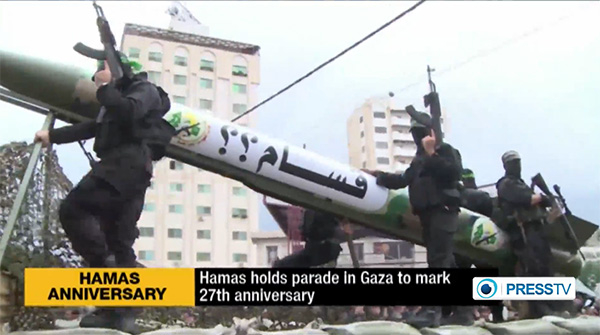
Ironically, the EU court’s decision coincided with Hamas celebrations marking the 27thanniversary of its founding. Once again, Hamas used the celebrations to remind everyone that its real goal is to destroy Israel. And, of course, Hamas used the event to display its arsenal of weapons that include various types of rockets and missiles, as well as drones.
Thousands of armed Hamas troops showed off their military hardware at a Dec. 14, 2014 parade in Gaza, marking the organization’s 27th anniversary. (Image source: PressTV video screenshot)
Hours before the EU court decision was made public, Hamas leader Mahmoud Zahar announced that his movement would never recognize Israel. Zahar also made it clear that Hamas seeks to overthrow the Palestinian Authority [PA] regime and seize control over the West Bank.
The EU court’s decision also coincided with increased efforts to achieve rapprochement between Hamas and Iran. Recently, a senior Hamas leadership delegation visited Tehran as part of efforts to mend fences between the two sides. The main purpose of the visit was to persuade the Iranians to resume military and financial aid to Hamas. The visit, according to senior Hamas officials, appears to have been “successful.”
“There are many signs that our relations are back on the right track,” explained Hamas’s Musa Abu Marzouk. “Hamas and Iran have repaired their relations, which were strong before the Syrian crisis.” Relations between Hamas and Iran deteriorated due to the Islamist movement’s refusal to support the regime of Syrian President Bashar Assad.
Now the Iranians are likely to interpret the EU court decision to remove Hamas from the list of terrorist groups as a green light to resume financial and military aid to the movement.
Iran’s leaders recently announced that they intend to dispatch weapons not only to the Gaza Strip, but to the West Bank as well, as part of Tehran’s effort to support those Palestinians who are fighting to eliminate Israel.
Moreover, the EU court’s move will also embolden other countries that provide Hamas with political and financial aid, first and foremost Qatar and Turkey. Oil-rich Gulf countries such as Kuwait, Bahrain, Oman and Saudi Arabia will now face pressure from many Arabs and Muslims to join Qatar, Turkey and Iran in extending their support to Hamas.
The biggest losers, meanwhile, are Palestinian Authority President Mahmoud Abbas and Egypt’s President Abdel Fattah el-Sisi. Over the past few months, the two men have been doing their utmost to undermine Hamas and end its rule over the Gaza Strip.
Abbas has been fighting Hamas by blocking financial and humanitarian aid and arresting its supporters in the West Bank, while Sisi continues to tighten the blockade on the Gaza Strip and destroy dozens of smuggling tunnels along the border with Egypt.
The EU court’s decision represents a “severe blow to the Palestinian Authority and Egypt,” noted Palestinian political analyst Raed Abu Dayer. “As far is Abbas is concerned, the decision grants Hamas political legitimacy and challenges his claim to be the sole legitimate leader [of the Palestinians]. With regards to Egypt, the European court decision calls into question rulings by Egyptian courts that Hamas is a terrorist organization.”
Even if the EU court decision is reversed in the future, there’s no doubt that it has already caused tremendous damage, especially to those Muslims who are opposed to radical Islam.
Any victory for Hamas, albeit a small and symbolic one, is a victory for the Islamic State, Al-Qaeda, Islamic Jihad, the Muslim Brotherhood and other fundamentalist groups around the world.
The decision has left many Arabs and Muslims with the impression that Hamas, after all, is not a terrorist organization, especially if non-Muslims in Europe say so through one of their top courts. Even worse, the decision poses a real and immediate threat to Israel, as evident from the latest rocket attack.
If the Europeans have reached the conclusion that Hamas is not a terrorist organization, then why don’t their governments openly invite tens of thousands of Hamas members and supporters to move to London, Paris and Rome? And they should not forget to ask the Hamas members to bring along with them their arsenal of weapons.
Obama condemns “wicked” U.S. imperialism for supporting American values such as freedom and democracy abroad. Simultaneously, he tries to precipitate “regime change” in Israel so that she will support His values and those of Palestinians rather than American and Israeli values of freedom and democracy.
The Palestinians have placed before the United Nations Security Council a “peace proposal” intended to force Israel to agree to creation of a Palestinian state and “an Israeli withdrawal to the pre-1967 lines” by the end of 2017. Secretary Kerry has argued that the matter should not be considered until after the Israeli Knesset elections in March. According to an article in Foreign Policy,
Speaking at an annual luncheon with the 28 European Union ambassadors, Kerry cautioned that any action by the U.N. Security Council would strengthen the hands of Israeli hardliners who oppose the peace process. . . . [Emphasis added.]
“Kerry has been very, very clear that for the United States it was not an option to discuss whatever text before the end of the Israeli election,” according to a European diplomat.
The diplomat, who spoke on condition of anonymity because the luncheon was confidential, said that Kerry explained that Israel’s liberal political leaders, Shimon Peres and Tipzi Livni, had expressed concern that a Security Council move to pressure Israel on the eve of election would only strengthen the hands of Israeli hardliners, including Prime Minister Benjamin Netanyahu, and Naftali Bennett, an implacable foe of a Palestinian state and leader of the right-wing Jewish Home party. Netanyahu is also fiercely opposed to the Palestinians effort to secure Security Council backing for its statehood drive. [Emphasis added.]
Kerry said Livni had “told him that such a text imposed by the international community would reinforce Benjamin Netanyahu and the hardliners in Israel,” as well as the hardliners in Palestine, according to the European diplomat.
The message, said another European diplomat, was that U.N. action would “give more impetus to more right-wing parties, that there was a risk this could further embolden the more right-wing forces along the Israeli political spectrum.” [Emphasis added.]
Kerry’s remarks highlight the Obama administration’s delicate balancing act when it comes to its tense relationship with the Israeli government. On the one hand, senior administration officials make little attempt to hide the personal dislike between Netanyahu and President Barack Obama or their sharp disagreements on issues ranging from the peace process to Iran. On the other hand, Kerry and other top policymakers have tried to avoid saying or doing anything that could be seen as meddling in the Israeli election in an effort to oust Netanyahu and replace him with a more centrist prime minister. [Emphasis added.]
told Dmitry Medvedev that he would have more flexibility after November’s election to deal with contentious issues such as missile defence. . . .
Obama’s candid remark was considered a gaffe because He made it assuming that the microphone had been turned off and that no one other than Medvedev would hear Him. Kerry, however, candidly but intentionally told twenty-eight European Union ambassadors that it is U.S. policy to encourage the Israeli left, to diminish the Israeli right and to make it more difficult for Prime Minister Netanyahu to remain in office. Aside from his incredible naivete, why did Kerry do that?
For Obama and European leaders, Israel is reducible to the peace process. And the Israeli left depends on the support of foreign governments for its network of foreign funded non-profit organizations. The Israeli left can’t let go of its exploding version of ObamaCare [Palestine] because the left is becoming a foreign organization with limited domestic support. Its electorate isn’t in Israel; it’s in Brussels. [Emphasis and bracketed insert added.]
. . . .
Escalating a crisis in relations has been the traditional way for US administrations to force Israeli governments out of office. Bill Clinton did it to Netanyahu and as Israeli elections appear on the horizon Obama would love to do it all over again.
There’s only one problem.
The United States is popular in Israel, but Obama isn’t. Obama’s spats with Netanyahu ended up making the Israeli leader more popular. The plan was for Obama to gaslight Israelis by maintaining a positive image in Israel while lashing out at the Jewish State so that the blame would fall on Netanyahu. [Emphasis added.]
Kerry’s remarks — covered by Israeli media — seem, contrary to his intentions, likely to enhance the chances of Israeli “hardliners” on the “right,” to hurt the chances of those on the left and hence to increase PM Netanyahu’s chances of remaining in office. Even leaving that aside, how will Kerry’s remarks favoring regime change be viewed by other increasingly reluctant U.S. allies in the Middle East?
Israeli “hardliners” have already yielded to the Palestinians as much as, if not more than, they can without greatly endangering the security of Israel because there is no Palestinian entity with which peace can be made other than through Israel’s suicide.
Interestingly, the speaker doesn’t mention the longing for Palestinian statehood or independence. Instead, he talks of the establishment of the “Islamic Caliphate.” “Oh Allah’” he states, “Hasten the establishment of the State of the Islamic Caliphate,” and further rants, “Oh Allah hasten the pledge of allegiance to the Muslim Caliph.” He spews forth the latter statement three times to chants of “Amen!” from the large, approving crowd congregating around him.
These comments, which would register horror and revulsion in the West (at least in some quarters) are almost banal among Palestinians. In fact, a similar video featuring a different speaker some days earlier at the same venue, conveyed identical sentiment, expressing admiration for the Islamic State and calling for murder of Jews and annihilation of America. [Emphasis added.]
Here’s the other video referenced in the article:
Guttural anti-Semitism is ingrained and interwoven in the fabric of Palestinian society. Despite their minuscule numbers, 78% of Palestinians believe that Jews are responsible for most of the world’s wars while a whopping 88% believe that Jews control the global media and still more believe that Jews wield too much power in the business world. [Emphasis added.]
Much of the blame for this can be placed squarely on the doorstep of Mahmoud Abbas’s Palestinian Authority, which subjects the Palestinian population to a steady diet of hate-filled, Judeophobic rhetoric through state-controlled media and educational institutions. It is so well entrenched that the process of deprogramming, if it were ever attempted, would take generations to reverse. [Emphasis added.]
As noted in the Wall Street Journal article linked in the quote immediately above,
To understand why peace in Palestine is years if not decades away, consider the Palestinian celebrations after Tuesday’s murder in a Jerusalem synagogue of five Israelis, including three with joint U.S. citizenship. Two Palestinian cousins armed with meat cleavers and a gun attacked worshipers during morning prayers, and the response was jubilation in the streets.
The Popular Front for the Liberation of Palestine claimed responsibility, while Hamas praised the murders as a “response to continued Israeli crimes.” The main obstacle to peace isn’t Jewish settlements in the multireligious city of Jerusalem. The barrier is the culture of hatred against Jews that is nurtured by Palestinian leaders. [Emphasis added.]
Palestinian Prime Minister Mahmoud Abbas condemned the killings, but not without calling for Israel to halt what he called “invasions” of the holy Al Aqsa Mosque in Jerusalem. Mr. Abbas has previously said the Temple Mount was being “contaminated” by Jews, despite assurances by Prime Minister Benjamin Netanyahu that the Dome of the Rock and Al Aqsa Mosque are for Muslim worship only. The Memri news service reports that the Oct. 29 issue of the Palestinian daily Al-Hayat Al-Jadida was full of false accusations that Israel is damaging Jerusalem’s holy sites. [Emphasis added.]
An overwhelming majority of Palestinian Arabs support the recent spate of terrorist attacks against Israelis, an opinion pollreleased Tuesday finds, according to The Associated Press (AP).[Emphasis added.]
The poll also found that more than half of Palestinian Arabs support a new “intifada” (uprising) against Israel, and that Hamas would win presidential elections if they were held today. [Emphasis added.]
Palestinian Arab pollster Khalil Shikaki said the results reflected anger over Israeli statements about Jerusalem, as well as a loss of hope following the collapse of U.S.-brokered peace talks and Israel’s recent war with Hamas in Gaza.
Shikaki heads the Palestinian Center for Policy and Survey Research, which interviewed 1,270 people in the Palestinian Authority-assigned areas of Judea and Samaria and Gaza last week. The poll had an error margin of 3 percentage points.
“There is an environment in which violence is becoming a dominant issue,” Shikaki told AP. “This seems to be one of the most important driving forces.”
Hamas is, if possible, even worse than Abbas’ Palestinian Authority.
Both Hamas and Abbas’ Palestinian Authority seek the death of Israeli Jews and the destruction of Israel, the only democratic and free nation in the Middle East. Kerry’s ill-conceived efforts to assist them at the expense of Israel, most recently by actively seeking to promote Israel’s left wing, to diminish its right wing and hence to empower Palestinians intent upon the death of Israel, may well fail. Succeed or fail, those efforts are consistent with Obama’s preference for Islamic dictators over democracy coupled with freedom.
The red alert for the incoming rocket from Gaza which exploded in the Eshkol District Friday morning, Dec. 19, may well be the harbinger of more to come. In parts of Beersheba too the dull thumps of explosions were heard on Thursday.
According to DEBKAfile’s military and intelligence sources, Hamas has once again fallen under Tehran’s sway after patching up their quarrel.
Iran lost no time in directing the Palestinian terrorist group to revoke the ceasefire it accepted in June for halting Israel’s summer operation in the Gaza Strip and revive low-key rocket fire. An apparently “anonymous” organization will take responsibility – in reality it will be Hamas’ military wing.
Israel’s security authorities are aware of this ominous turn of events, but prefer to keep it quiet for the time being.
Hamas is reverting to its old terrorist ways, DEBKA reports, after not only spurning, but omitting to send a reply, to a Saudi package which Riyadh believed would be too generous to resist. The Saudis offered to put up the funds for Hamas’ entire annual budget, including military spending, as well as covering the full cost of rebuilding the Gaza Strip after the ravages of the summer war.
There were two conditions:
1. The Palestinian extremists must throw their unreserved support behind Egyptian President Abdel-Fattah El-Sisi and henceforth synchronize its operations with Cairo – i.e. desert its traditional allegiance to the Muslim Brotherhood.
2. They must totally sever their military, political and financial ties with Iran. In token of this action, Hamas’ political chief Khaled Meshaal must call off his impending trip to Tehran, scheduled to mark the public announcement of the organization’s reconciliation with Iran and its leading ally, Syrian President Beshar Assad.
Instead of any sort of direct response to Riyadh’s offer, Hamas opted to use its 27th anniversary celebrations on Sunday Dec. 14, for a display of loyalty to Iran by 2,000 marching Izz e-din al-Qassam fighters. Every detail of the event was cleared in advanced by Tehran and broadcast live over all of Iran’s TV channels – an unprecedented honor.
As we first reported last week, a high-powered Hamas delegation visited Tehran on Dec. 9 to draft with Iranian officials the text of the Hamas reconciliation accord with Assad and map out future operations.
The most prominent members were Meshaal’s right hand, Muhammed Nasser; two members of the Hamas overseas military branch, Maher Abdullah and Jemal Ismail; and Lebanese agent, Osama Hamdan.
One item on this accord provided for the gradual resumption of rocket attacks on Israel from the Gaza Strip.
Hours after the first rocket was launched Friday, Hamas staged its first ever parade on Temple Mount, Jerusalem, marching around the golden Dome of the Rock, and shouting calls to revive the Palestinian rocket offensive against Israeli locations. They were clad uniformly in green with jihadi headbands and hoisted Hamas banners aloft.
Hamas’ riotous demonstration of defiance contrasted sharply with the calm observed in Friday worship at Al Aqsa in the last three weeks.
[T]he endless quarrels between Obama and Netanyahu over the peace process are so pointless. No matter how much Obama tilts the diplomatic playing field in the Palestinians’ direction or how often he and his supporters prattle on about time running out for Israel, Abbas has no intention of signing a peace agreement. The negotiations as well as their maneuverings at the UN and elsewhere are nothing but a charade for the PA and nothing Netanyahu could do, including offering dangerous concessions, would change that. The sooner Western leaders stop playing along with their game, the better it will be for the Palestinian people who continue to be exploited by their leaders.
*****************
In the end, there wasn’t much suspense about the Obama administration’s decision whether to support a United Nations Security Council resolution endorsing a Palestinian state. After weeks of pointless negotiations over proposed texts, including a compromise endorsed by the French and other European nations, the wording of the proposal that the Palestinians persuaded Arab nations to put forward was so outrageous that even President Obama couldn’t even think about letting it pass because it would undermine his own policies. And the rest of the international community is just as unenthusiastic about it. In a very real sense this episode is the history of the Arab-Israeli conflict in a nutshell: the world wants to do something for the Palestinians but their leaders are more interested in pointless shows than in actually negotiating peace or doing something to improve the lives of their people.
The resolution that was presented to the Security Council was so extreme that Jordan, the sole Arab nation that is currently a member, didn’t want anything to do with it. But, after intense lobbying by the Palestinian Authority representative, the rest of the Arab nations prevailed upon Jordan and they put it forward where it will almost certainly languish indefinitely without a vote since its fate is preordained.
The terms it put forward were of Israeli surrender and nothing more. The Jewish state would be given one year to withdraw from all of the territory it won in a defensive war of survival in 1967 where a Palestinian state would be created. That state would not be demilitarized nor would there be any guarantees of security for Israel which would not be granted mutual recognition as the nation state of the Jewish people, a clear sign that the Palestinians are not ready to give up their century-long war against Zionism even inside the pre-1967 lines.
This is a diktat, not a peace proposal, since there would be nothing for Israel to negotiate about during the 12-month period of preparation. Of course, even if the Palestinians had accepted the slightly more reasonable terms proposed by the French, that would have also been true. But that measure would have at least given the appearance of a mutual cessation of hostilities and an acceptance of the principle of coexistence. But even those concessions, let alone a renunciation of the “right of return,” was not possible for a PA that is rightly fearful of being supplanted by Hamas. So long as Palestinian nationalism remains wedded to rejection of a Jewish state, no matter where its borders might be drawn, no one should expect the PA to end the conflict or actually make peace.
Though many of us have been understandably focused on the question of how far President Obama might go to vent his spleen at Israeli Prime Minister Netanyahu and his government, that petty drama is, as it has always been, a sideshow distraction from the real problem at the core of the Middle East peace process: Palestinian rejectionism.
Though the administration has tirelessly praised PA leader Mahmoud Abbas as a champion of peace in order to encourage him to live up to that reputation, he had other priorities. Rather than negotiate in good faith with the Israelis, Abbas blew up the talks last year by signing a unity pact with Hamas that he never had any intention of keeping. The purpose of that stunt, like the current UN drama, isn’t to make a Palestinian state more likely or even to increase Abbas’s leverage in the talks. Rather, it is merely a delaying tactic, and a gimmick intended to waste time, avoid negotiations, and to deflect any pressure on the PA to either sign an agreement with Israel or to turn it down.
That’s not just because the Palestinians wrongly believe that time is on their side in the conflict, a dubious assumption that some on the Israeli left also believe. The reason for these tactics is that Abbas is as incapable of making peace as he is of making war.
This is not just another case of the Palestinians “never missing an opportunity to miss an opportunity,” in Abba Eban’s immortal and quite accurate summary of their actions over the years. It’s that they are so wedded to unrealistic expectations about Israel’s decline that it would be inconceivable for them to take advantage of any opening to peace. That is why they turned down Israeli offers of statehood, including control of Gaza, almost all of the West Bank, and a share of Jerusalem, three times and refused to deal seriously with a fourth such negotiation with Netanyahu last year.
And it’s why the endless quarrels between Obama and Netanyahu over the peace process are so pointless. No matter how much Obama tilts the diplomatic playing field in the Palestinians’ direction or how often he and his supporters prattle on about time running out for Israel, Abbas has no intention of signing a peace agreement. The negotiations as well as their maneuverings at the UN and elsewhere are nothing but a charade for the PA and nothing Netanyahu could do, including offering dangerous concessions, would change that. The sooner Western leaders stop playing along with their game, the better it will be for the Palestinian people who continue to be exploited by their leaders.
Who is responsible for most of the terrorist acts around the world today? Mother Theresa? What percentage of Muslims support militant Islamist organizations? These are not “lone-wolves” — this is a serious phenomenon with grave implications on the free world. It is something that needs to be confronted, rather than ganging up on anyone who points it out.
Isn’t it time to wake up?
********************
1. They haven’t woken up yet. Certainly not in Australia. Even after the deadly terrorist attack at a cafe in Sydney, parts of the institutionalized Australian media are still trying to delude their audience, maintaining that it was a “lone-wolf” who perpetrated the horrific assault. The Australian prime minister “took comfort” in the knowledge that the assailant had a history of mental illness.
A European court decided this week that Hamas is not a terrorist organization — it is a charity group with some “lone-wolf” members. The West’s basic instincts have become dull, after decades of suppressing its own survival mechanism by self-imposing a stern “politically correct” regime. Most of the leading figures in the West (and in Israel) are more concerned with how they are perceived by the community, and that they say the “correct” words that they are allowed to say, than they are with actually confronting the truth.
Who is responsible for most of the terrorist acts around the world today? Mother Theresa? What percentage of Muslims support militant Islamist organizations? These are not “lone-wolves” — this is a serious phenomenon with grave implications on the free world. It is something that needs to be confronted, rather than ganging up on anyone who points it out.
In February 2007, Professor Raphael Israeli — an international expert on Islam and professor at Hebrew University — was interviewed by an Australian newspaper. In the interview, Israeli warned that the Muslim minority living in the continent posed a real threat to the Australians. His studies suggest that life can become unbearable when the Muslim population of a Western country reaches critical mass (in one study he even attached a number to this idea of critical mass: 10 percent of the general population). It is a rule of thumb, he said, and if it applies everywhere, it certainly applies in Australia.
As an example, he cited the riots in Paris in 2006. Israeli suggested that the Australians ban the entry of Muslim radicals and adopt a preventative approach to avoid flooding the continent with immigrants from Indonesia. Muslim immigrants, he argued, have a reputation of taking advantage of Western tolerance and hospitality to advance their own ends. Trains in London and in Madrid were not blown up by Christians or Buddhists. They were blown up by Muslims. Precautions must be taken, he warned.
Not too far from Australia, in Bali, Islamist organizations perpetrated two horrifying terrorist attacks in 2002 and in 2005. Bali bomber Amrozi bin Nurhasin, who was charged with causing the deaths of more than 200 people, stood up in court in front of the global media and cried out “Jews! Remember Khaibar. The army of Muhammad is coming back to defeat you.” Not one of the 200 victims was Jewish. The Australians watched, read the warnings, and went back to what they were doing.
When Israeli was interviewed, the Bali attacks were still fresh, but the regime political correctness made sure to take the string out. Israeli became the target of a Bolshevik-style witch hunt. He was accused of racism, xenophobia, and was called a plethora of derogatory names. He received death threats. In response, the Middle East expert told the Australians to wait and see what happens. This week, one would hope that the Australians recalled Israeli’s cautionary words. Maybe some of them wondered why they didn’t heed his warning. Maybe.
2. On Monday, radio personality Tali Lipkin-Shahak interviewed Professor Israeli. It wasn’t the interview that was notable, but the style in which it was conducted — a style shared particularly by many Israeli journalists, and Western journalists in general. “You were ahead of your time,” she said to him. Israeli replied that he had been investigating the Muslim “diaspora” in Western countries for over a decade, and that in that time the Muslim population has grown to alarming proportions.
“But why do you attribute violent intentions to the immigration process?” the interviewer asked him. “Joseph also immigrated to Egypt,” she remarked, evoking the Book of Genesis.
True, the professor answered, remarking that he had written five books on the subject, “but Joseph’s family had not proclaimed that it planned to conquer Egypt or to convert Egypt to become Israelite.”
“The Muslims explicitly say that they did not come to Europe in order to become European, but to Islamize Europe.” They have vowed that a Muslim flag will wave over 10 Downing Street in England and over Versailles Palace in France within 25 years, he explained.
Lipkin-Shahak then said that “one can always [always!] talk about those people in terms of a negligible, extremist minority, including the terrorist attackers.” Even ISIS, she said, “has no more than several thousand members.”
Israeli insisted that these atrocities are nothing new. In the past, Muslims who immigrated to Australia, Scandinavia and Germany, as well as other places, have perpetrated very serious attacks.
The overly concerned interviewers rushed to protect the ears of her tender listeners, saying “I have to be the one to tone things down, or at least present the opposing view,” she said. “What you are saying, it is very serious. You are vilifying an entire population; you are contributing to the process of hatred and counter-hatred, which only causes harm and intensifies the violence.”
Israeli was not surprised. “That is exactly what they told me in Australia, until they became the victims of a catastrophe…This is my job. Anyone who wants to listen can listen. Anyone who doesn’t, they can wait for the next catastrophe.”
Lipkin-Shahak stuck to her guns: “We listened, but we voiced a skeptical opinion. We disagree.”
“What are you basing your opinion on?” Israeli wondered in desperation. “I am basing my opinion on thirty years of research, studying Islam, and you are basing yours on a trend, on the fact that it is not nice to say these things. We are talking on two completely different planes.”
Indeed, two completely different worlds. Facts vs. beliefs. Reality vs. fantasy. Make love not war; imagine there’s no countries, and no religion too. A very special kind of liberal fundamentalism. The moment the truth comes knocking, they retreat into their politically correct shells and refuse to recognize the facts. There is no such thing as Muslim terrorism. The terrorists come from outer space. Islam is a religion of peace and we mustn’t link it to all these terrible acts perpetrated in its name. Sadly, the people who think this way — the politically correct — have the microphone. The researcher with the facts is only a momentary guest.
3. The politically correct mechanism that launders the language that we use makes it very hard to express doubt in these John Lennon-esque fantasies, like the Oslo Accords for example. It may be hard to believe, but the principles of the Oslo Accords are still being marketed, under new names, to this day. Case in point: The recent empty declarations made by newfound partners Tzipi Livni and Isaac Herzog regarding their ability to resolve the Israeli-Palestinian conflict.
For our own good, we need to examine the remarks made by the late Arab-Palestinian minister Ziad Abu Ein, who, in 1979, murdered Boaz Lahav of Tiberias and David Lankri of Beit Shean and seriously wounded five others when he detonated an explosive device inside a trash can on a busy Tiberias street.
In July, 2006, Abu Ein told Al-Alam Iranian television that “the Oslo Accords are not the dream of the Palestinian people. However, there would never have been resistance in Palestine without Oslo. Oslo is the effective and potent greenhouse whish embraced the Palestinian resistance.”
“Without Oslo, there would never have been resistance. In all the occupied territories, we could not move a single pistol from place to place. Without Oslo, and being armed through Oslo, and without the Palestinian Authority’s A areas, without the training, the camps, the protection afforded by Oslo, and without the freeing of thousands of Palestinian prisoners through Oslo — this Palestinian resistance and we would not have been able to create this great Palestinian Intifada.”
Hamas could, with a fair amount of ease, cause Israel to end its security blockade by accepting the terms of the international Quartet. These include recognizing the state of Israel, renouncing violence and abiding by past agreements.
Of course, those would contravene Hamas’s ideology of Islamist jihad and move it away from its current trajectory of organized violence and religious hatred, the foundations upon which it was established in the 1980s by the Muslim Brotherhood.
For now, it seems, Hamas will try, as it has been doing for months, to orchestrate terrorism in the West Bank, on the opposite side of Israel, while upholding its truce in Gaza.
The Israel Defense Forces, too, has spent recent months preparing to respond if there is a fresh round of hostilities.
More than three months have passed since the end of the fifty-day conflict between Hamas in Gaza and Israel this past summer, yet all of the catalysts that helped spark that war remain in place and are pushing the sides into their next clash.
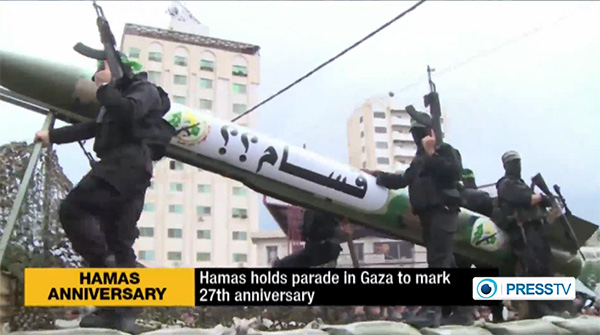
Thousands of armed Hamas troops showed off their military hardware at a Dec. 14, 2014 parade in Gaza, marking the organization’s 27th anniversary. (Image source: PressTV video screenshot)
One of the reasons Hamas launched a war in July this year was to try to end its strategic isolation, which became severe after the downfall of the Muslim Brotherhood in next-door Egypt. Hamas also sought to improve its crumbling economic situation as the ruler of the Gaza Strip; its dire situation was illustrated by Hamas’s inability to pay 40,000 of its Gazan employees their monthly salaries.
Hamas could, with a fair amount of ease, cause Israel to end its security blockade by accepting the terms of the international Quartet. These would include recognizing the state of Israel, renouncing violence and abiding by previous diplomatic agreements. Of course, those would contravene Hamas’s ideology of Islamist jihad and move it away from its current trajectory of organized violence and religious hatred, the foundations upon which it was established in the 1980s by Palestinian members of the Muslim Brotherhood.
Today, however, the same problems that plagued Hamas prior to the summer war have become worse. Gaza is hemmed in to the south by a hostile Egypt under the rule of President Abdel Fattah El-Sisi. Egypt is systematically cutting off the smuggling tunnels that linked Sinai to the Gaza Strip. This means that Hamas is no longer easily able to smuggle either weapons or goods it can tax before they enter Gaza’s market.
Israel’s naval security blockade, designed to prevent the smuggling of arms or materiel that can be used to build weapons, remains in place, as does Israel’s tight security control of its border crossings with the Gaza Strip. Israel has in recent months begun permitting the entry of construction materials to encourage Gaza’s reconstruction efforts, and assisted in the export of Gazan agricultural goods to places such as the West Bank.
Most critically, however, Hamas’s hopes for $5.4 billion of international aid money, pledged by donor states for Gaza’s post-war recovery, remain unrealized. The money has barely begun to trickle in, due to an ongoing crisis with the Fatah-run Palestinian Authority [PA] in Ramallah.
Under the terms set by the international community, the money must enter Gaza through a joint PA-Hamas mechanism. Due to ongoing Fatah-Hamas divisions, such a mechanism appears far from being built.
The latest illustration of these intra-Palestinian tensions can be found in the coordinated, multiple bomb attacks in November on the homes of Fatah officials in Gaza — attacks carried out by Hamas’s military wing.
Meanwhile, the approximately 100,000 Gazans whose homes were destroyed by the fighting in the summer remain without a fixed roof over their heads in the winter, creating another source of pressure on Hamas.
These factors have led Hamas’s military wing to warn publicly that a new explosion of violence against Israel is imminent. “We are saying to all sides — if the siege on Gaza and the obstacles for reconstruction remain, there will be a new explosion,” stated Abu Obeida, the spokesman of Hamas’s military wing, the Ezzedine al-Qassam Brigades.
The warning was answered this week by Israel’s Defense Minister, Moshe Ya’alon, who said, “We now base the quiet in the Gaza Strip on deterrence. At this stage they are deterred, but we must be ready at any given time for the possibility that we will have to again act with full force.”
While it would not be in Hamas’s interests to spark a new destructive conflict so soon after a bruising one, if faced with the possibility that its regime in Gaza might collapse, it may decide to do so.
Hamas has, since the moment that hostilities ended in August, resumed rocket production in Gazan plants, albeit at a slower rate than before the conflict. Hamas has also most likely restarted work to dig more tunnels from Gaza into Israel, which are designed to inject guerrilla squads into Israel to commit terrorist kidnappings and murders.
The Israel Defense Forces, too, has spent recent months preparing to respond if there is a fresh round of hostilities. It assesses that Israeli deterrence has been fully replenished; it is also reluctantly prepared should the volatile situation in Gaza push deterrence aside.
For now, it seems, Hamas in Gaza will try, as it has been doing in recent months, to orchestrate terrorism in the West Bank, on the opposite side of Israel, while upholding its truce in Gaza. If Hamas’s standoff with Fatah continues, however, and the host of factors that pushed Hamas into the last war do not change, the countdown to the next war may be shorter than many think.
(When reality is unpleasant, as it often is, those not personally experiencing reality make decisions based on pleasant fantasies. — DM)
[T]his is supposed to be a “peace process.” The operative word here is “peace.” How dare we dictate anything to the Israelis, who are forced to live with the deadly consequences of this obviously flawed foreign policy paradigm? How can we presume to know better than they what it is that the Israelis can actually live with?
**************
In September 1993, when Yasser Arafat was recast from the role of “granddaddy of terrorism” to that of “peacemaker,” the Oslo Accords were marketed to the Israeli public and to world Jewry wrapped in the package of “reversibility.” I remember clearly when a friend of mine, a leftist television personality, assured me: “Don’t worry, Sarah. We will be watching Arafat very closely. It all depends on his compliance with our strict guidelines. He has to stop all the incitement and all the terror. It’s only Gaza and Jericho first. If it doesn’t work, we can always go back and retrieve it.”
That was 21 years ago. Since then, not a day goes by without another fiery Palestinian Authority incident of incitement (painstakingly documented and broadcast to the world by the good work of Palestinian Media Watch). This hatred has metastasized like a cancer and an entire generation has grown up steeped in it. The horrific result is the vast number of Israelis murdered at the hands of Palestinian terrorists.
This past week Khalil Shikaki from the Palestinian Center for Policy and Survey Research conducted a poll which indicated that a full 80 percent of Palestinians support stepping up violent attacks against Israelis, including random stabbings and traffic attacks. Over 86 percent believe that Haram al-Sharif (or the Temple Mount, where Al-Aqsa mosque is located) is in danger.
That comes as no surprise because 93 percent of Palestinians consider themselves to be religious Muslims, and the leadership of the Palestinian Authority has been constantly stirring up hysteria that “the Jews are desecrating Haram al-Sharif.”
Although the Oslo Accords were presented as conditional, successive Israeli governments have upheld them, despite the steady stream of constant, daily incitement and increasing number of what the Left used to euphemistically call “korbanot shel shalom” (“victims of peace”).
We Jews seem to have gotten ourselves deeper and deeper into a hole. And many of our leaders do not seem to understand the basic philosophy that “when you are in a hole, you should stop digging.”
American presidents, politicians and diplomats have consistently argued that “Israeli-Palestinian negotiations should be left up to parties themselves.”
Which brings us to Habayit Hayehudi Chairman Naftali Bennett’s spirited debate with Martin Indyk at the Brookings Institute’s Saban Forum last week. Bennett courageously uttered the words: “We’re stuck in the conventional directions that we’ve been working on over the past three decades. There’s only one game [foreign policy paradigm] in town and that is a Palestinian state in the heart of Israel. Now, regardless of whether you support it or not, the reality is, it’s not working. It’s not working.”
The outcry from American journalists and officials, who have based their careers on the success of the peace process and the two-state paradigm, was so intense one would have thought Bennett had said something highly irresponsible, such as that Arabs are the descendants of apes and pigs (a remark that official Palestinian Authority media frequently uses to describe Jews).
After all, this is supposed to be a “peace process.” The operative word here is “peace.” How dare we dictate anything to the Israelis, who are forced to live with the deadly consequences of this obviously flawed foreign policy paradigm? How can we presume to know better than they what it is that the Israelis can actually live with?
The premise of “land for peace,” which has dominated American foreign policy and the its attitude toward Israel over the last two decades, might well work in the West when dealing with a land dispute between the United States and Mexicans or Canadians. But it is patently obvious, when listening to the inflammatory rhetoric that comes directly out of the mouths of Palestinian Authority officials, that they have never laid down the societal groundwork for peace, but rather for its very opposite.
This has been going on for over a generation. Words and ideas matter. These hateful words have seeped deep into the consciousness of an entire generation of Palestinians. They lead to tragedies like the recent attack at the Har Nof synagogue in which four Israelis were killed while reciting morning prayers (and a Druze policeman was killed coming to their aid); or earlier this week, when an Israeli family of five stopped to pick up a hitchhiker in Judea and Samaria and was subjected to an acid attack; or in October when a three-month-old, the first child for a couple who had endured years of infertility, was murdered when a Palestinian terrorist rammed his car into a group of Israelis waiting at a light rail station in Jerusalem.
For some, in America, this is merely a statistic. But for Israelis and Jews, this was somebody’s father, somebody’s mother, somebody’s brother, sister or child. Israel is a tiny country. By now there is hardly anyone in the country who does not personally know someone wounded or murdered at the hands of Palestinian terrorists.
If this were a scientific experiment, we would have reached the null hypothesis a long time ago, and realized it was time to go back to the drawing board.
Whether or not one agrees with Bennett, it is impossible not to admire his moral courage and intellectual honesty for publicly declaring something every Israeli and every Palestinian already knows. He is like the little boy in the story who, in front of everyone, points to the naked monarch and declares: The emperor wears no clothes!
As Bennett said, “Let’s stop looking at perfection, the ideal dream of two states living side by side in peace and democracy. Let’s stop talking perfection that has led us to disaster.”
Yet Indyk, who has made a career out of the peace process industry, had the audacity to tell him, “You are talking pure mythology. … You live in another reality. … You live in what Steve Jobs called ‘a distorted reality.'”
Bennett responded with, “This is quite a sentence. I have been through the First Intifada, the Second Intifada. You attend conferences. I have been on the ground there. How many missiles have to fall on Ashkelon until you wake up? How many people need to die before you wake up from this illusion? When will you say you were wrong?”
Bennett deserves high praise for injecting a bit of reality into the fantasy world that exists inside the beltway, where everyone continues to cling to the illusions of 1993. So many of our think tanks, diplomats and scholars look at the Taliban attack in a school in Pakistan or the hostage crisis in a cafe in Australia as a deplorable acts of terrorism, but when it comes to Palestinian terrorists taking the lives of Israeli citizens, our State Department officials say, “Both sides have to try harder,” as Secretary of State John Kerry said at a press conference in London this week.
This is a hypocritical double standard that no one but Israel would be expected to endure. When people impose a standard on Israel, the Jewish state, that they would never impose on themselves, we have one word for it and that word is anti-Semitism.
Sometimes this anti-Semitism comes directly out of the mouths of Jews. Two thousand years of living in the Diaspora has had an indelible effect on our collective psyche. Many Jews are self-conscious of their Judaism, and want the love of the world so desperately that they have to prove to the world how liberal and broad minded they are … at the expense of their own Israeli brothers and sisters.
I could never understand how anyone sitting in a comfortable living room on this side of the Atlantic, never knowing what it is like to constantly fear for their lives and never worrying about having 60 seconds or less to gather the entire family and hide from incoming missiles, can claim to know better than the Israelis about what is good for them.
This gives new meaning to the definition of the term “chutzpah.”







 anneinpt
 artaxes
 danmillerinpanama
 davidking1530
 Peter Hofman
 Joseph Wouk
 Peter
Peter Louisiana Steve
 WarSclerotic
Recent Comments