Posted tagged ‘Hamas’

Terrorist Organizations Attempt to Smuggle Drones into Gaza,

May 30, 2016

Terrorist Organizations Attempt to Smuggle Drones into Gaza, Israel DefenseAmi Rojkes Dombe, May 30, 2016

Drones for GazaPhoto: The Israeli Crossing Points Authority in the Minisrty of Defense

Dozens of smuggling attempts by mail were foiled in recent weeks at the Erez Crossing, on the Israel-Gaza barrier. The pressure exerted by a joint task force, comprised of the Israel Security Agency (ISA), the Coordinator of Government Activities in the Territories (COGAT), Customs, Israeli police and the Israeli Crossing Points Authority in the Minisrty of Defense, compels terrorist organizations to devise original smuggling methods. It seems that they are taking advantage of the postal services that Israel allows into the Gaza Strip.

In recent weeks, the Israeli Crossing Points Authority at the Erez Crossing, together with the Israel Security Agency, thwarted dozens of attempts to smuggle weapons and combat support equipment via mail. Some of the seized postal packages included drones, which were dismantled and sent to Gaza in parts.

Just this morning (Monday), 10 drone motors in postal packages were seized at the Erez crossing. The authorities also seized rifle sights, Gyro means of enhancing accuracy, magnifying ranges and increasing signal strength for the use of cell phones in areas without reception, transceiver to transmit a video signal at a frequency of 5.8GHz, which is not approved for use in the Palestinian Authority nor in Israel. The equipment was confiscated and an investigation was launched to locate those involved in stealing the weapons and combat support equipment and attempting to smuggle them into Gaza.


Obama Names Official Linked to MB as Gov’t Liaison to Muslims

May 30, 2016

Obama Names Official Linked to MB as Gov’t Liaison to Muslims, Clarion ProjectRyan Mauro, May 30, 2016

Zaki-Barzinji-IPZaki Barzinji (Photo: White House)

The Obama Administration has chosen the grandson of a Muslim Brotherhood terror suspect as its new liaison to the Muslim-American community. The new official also led the youth section of the Islamic Society of North America (ISNA), an identified Muslim Brotherhood entity that was labeled an unindicted co-conspirator in a Hamas-financing trial.

The official, Zaki Barzinji, previously served as the deputy director of intergovernmental affairs for Virginia Governor Terry McAuliffe (more on that further down in this article), who is now under investigation for possible political corruption. Before that, Barzinjiw as the president of the Muslim Youth of North America, whichdescribes itself as the youth wing of ISNA.

ISNA was labeled an unindicted co-conspirator in the largest terrorism-financing trial in U.S. history, with the Justice Department specifically listing it as an entity of the Muslim Brotherhood. The Brotherhood’s own documents list ISNA at the top of its list of “our organizations and the organizations of our friends.”

ISNA’s links to the Brotherhood and Hamas are laid out in bipartisan legislation titled the Muslim Brotherhood Terrorist Designation Act. The bill now has over 75 supporters in the House and Senate.

How did Zaki Barzinji rise through the ranks in ISNA and McAuliffe’s office to become the new associate director of public engagement for the White House?

He is the grandson of a prominent Islamist leader named Jamal Barzinji, who passed away last year.  Indeed, Jamal Barzinji was a founder and/or senior official in virtually every group identified as a Muslim Brotherhood front in America. He also frequently donated to political campaigns. He was nearly prosecuted, but the Obama Justice Department dropped the planned indictment.

Zaki accepted an award on his grandfather’s behalf in 2013 at the Hamas/Brotherhood-linked Dar al-Hijrah Islamic Center in Virginia, which the late Barzinji helped found. The mosque is most known for having Al-Qaeda operative Anwar al-Awlaki as its imam in 2001 before he officially joined the terrorist group.

Jamal Barzinji was most involved with the International Institute of Islamic Thought (IIIT). The group’s office, Jamal Barzinji’s home and the offices of other organizations that Jamal Barzinji was affiliated with were raided in 2002 as part of a terrorism investigation. The affidavit said has being investigated because of evidence leading the U.S. government to “believe that [Jamal] Barzinji is not only closely associated with Palestinian Islamic Jihad (as evidenced by ties to [Sami] Al-Arian…), but also with Hamas.”

Jamal Barzinji’s group was so close to Palestinian Islamic Jihad operative Sami Al-Arian that IIIT’s president considered his group and Al-Arian’s to be essentially one entity. The indictment of Al-Arian and his colleagues says that they “would and did seek to obtain support from influential individuals, in the United States under the guise of promoting and protecting Arab rights.”

Keep that quote and the investigation into McAuliffe’s political contributions in mind when you consider how Zaki Barzinji apparently rose to his new position with some help from his grandfather’s political connections.

In 2011, IIIT (again, the late Jamal Barzini’s organization) donated $10,000 to the New Dominion PAC, which has strong Democratic party ties in the state, particularly as a donor to current Senator (former Governor) Tim Kaine, who spoke at a New Dominion PAC event honoring Jamal Barzinji in 2011.

Barzinji’s grandson became the outreach coordinator for McAuliffe’s campaign for governor in April 2013, per his LinkedIn profile. The Barzini/IIIT-linked PAC raised $15,000 for McAuliffe’s campaign two years later on September 29, 2013.

Zaki Barzinji became McAuliffe’s special assistant for policy in January 2014 and was promoted to deputy director of intergovernmental affairs in July 2014. This month, he became the White House’s liaison to the Muslim-American community as its new associate director of public engagement. Quite a rapid rise for a 27-year old.

There are no Islamist-sounding quotes from Zaki Barzinji but important questions remain.

Is it really wise to have the grandson of a Muslim Brotherhood terror suspect, who served as the head of the youth wing of an identified Muslim Brotherhood identity with Hamas links, as the White House’s liaison to the Muslim-American community?

What role did the political ties and donations of his Islamist grandfather and IIIT play in his remarkably fast rise through state politics and to the White House?

And what about his own work as president of the youth wing of ISNA, an entity of the U.S. Muslim Brotherhood?

Israel and the Palestinians: What the media won’t report

May 29, 2016

Israel and the Palestinians: What the media won’t report, Gatestone Institute via YouTube, May 28, 2016

Deceiving Cairo and helping IS, Hamas sets Gaza on course for new troubles

May 28, 2016

Deceiving Cairo and helping IS, Hamas sets Gaza on course for new troubles Hamas officials promised Egypt two months ago they’d end cooperation with IS fighters in Sinai. But Gaza’s rulers have done nothing of the kind, and the repercussions could impact Israel

By Avi Issacharoff
May 28, 2016, 5:06 pm

Source: Deceiving Cairo and helping IS, Hamas sets Gaza on course for new troubles | The Times of Israel

Salafi demonstrators in Gaza waving Islamic State flags during a demonstration that took place on January 19, 2015. (Courtesy MEMRI)

A few days ago, Hamas’s security forces in Gaza arrested a group of Salafi activists — members of Salafiya Jihadiya, a movement made up of Islamist groups that identify mainly with Islamic State. The head of the group is the son of a well-known Salafi preacher from the Shahin family. Hamas officials claimed that the group was planning to cross Gaza’s border into Sinai to join members of Islamic State in their fight against Egypt.

News of the arrests created the sense that Hamas was working to stop attempts by these Gazan activists to help Islamic State in its war against the Egyptian army. The arrests were presented as part of an impressive operation by Hamas, fulfilling promises its representatives made to Egypt during a visit to Cairo two months ago. At that time, amid escalating tension between Egypt and Hamas and accusations of close collaboration between Hamas’s military wing and Walayat Sinai (Islamic State’s branch in Sinai), the high-ranking Hamas delegates assured Egyptian officials that Hamas would end its relationship with Islamic State there and then.

 Hamas has indeed since reinforced its troop deployment along the Gaza-Egypt border, and promised to stop all smuggling done via the tunnels there. The Salafi arrests thus provided further ostensible proof of the new Hamas commitment to Egypt’s well-being. (Those arrests, in turn, prompted rocket fire at Israel two days ago, for which the Sheikh Omar Hadid Brigade, a Salafi group, claimed responsibility — a case of Israel being targeted by a Gaza terror group angry with Hamas.)

Yet there seems to be a wide gap between what senior Hamas officials are telling the Egyptians and what the heads of its military wing are actually doing on the ground. Despite the promises by Gaza’s rulers to stop the smuggling to and from Sinai and the recent arrests, Hamas continues to maintain a delicate and complicated web of interests and alliances with Islamic State in Sinai.

According to an abundance of Arab, Israeli and Palestinian sources, wounded members of Islamic State are still being brought into Gaza for medical treatment at almost the same rate as before the Hamas delegation’s visit to Cairo two months ago. Likewise, arms smuggling from the Gaza Strip to Sinai and vice versa continues, albeit at a reduced rate, supervised by members of Hamas’s military wing. Overall, in short, it is largely business as usual.

Israel's Coordinator of Government Activities in the Territories Maj. Gen. Yoav Mordechai in 2015 (Gershon Elinson/Flash90)

Israel’s Coordinator of Government Activities in the Territories Maj. Gen. Yoav Mordechai (Gershon Elinson/Flash90)

When Maj. Gen. Yoav Mordechai, the Coordinator of Government Activities in the Territories (COGAT), mentioned some of these facts in interviews on the Saudi Arabian news site Elaph two weeks ago, Hamas issued vigorous denials, of course. But other sources — not Israeli ones, but sources actually living in Gaza — confirm that over the past 10 months, dozens of Islamic State fighters have received medical treatment in the hospital in Khan Yunis, for example. This is astonishing considering Hamas’s delicate relationship with Egypt.

Yahya Sinwar (screenshot)

Yahya Sinwar (screenshot)

The transfer of wounded Islamic State fighters is not the work of some low-ranking activist looking for a quick way to make money. It is a deliberate policy of Hamas that began in mid-2015. The Hamas official in charge of arranging medical treatment for Islamic State members is Mohammed Sutari, a well-known activist from the Khan Yunis refugee camp. This is the same place that produced the hard core of Hamas’s military wing, including notorious terror chief Mohammed Deif and Yahya and Muhammad Sinwar.

This week the Elaph website, quoting a Palestinian source, published the name of one Islamic State fighter who is receiving medical treatment in Gaza. Maj. Gen. Mordechai named two more: Ibrahim Matar, who helps Sutari coordinate medical treatment for Islamic State members, and Said Abdelal, a Gazan from Rafah who is responsible for coordinating Islamic State’s military activities (apparently training) in the Gaza Strip.

Hamas military wing commander Muhammad Deif

Hamas military wing commander Muhammad Deif

The most problematic factor for Cairo may be the smuggling of arms between Gaza and Sinai. There’s been a dramatic reduction in the scope, but Hamas still manages to bring quantities of arms into the Gaza Strip and to move arms and ammunition from Gaza to Sinai. Constrained by Egypt’s crackdown on the border tunnels, some of the smuggling has been done recently by sea.

In addition, despite those widely reported Salafi arrests, several former Hamas activists (whose ideology leans toward that of those same Salafist groups) have crossed the border in recent weeks to join the fighting in Sinai against the Egyptian army. The best-known case is that of Musa Abdallah el-Mor, a former member of Hamas’s military wing whose family set up a mourning tent in Rafah after he was killed in Sinai while fighting against the Egyptian army there.

All of this cross-border activity takes place under the noses of Egyptian officials, who heard the promises of the Hamas senior officials and then watched in dismay over the past two months as Hamas, and especially its military wing, did as they pleased and kept up their relationship of interests with Islamic State.

Egypt’s response to this, it must be said, shows a degree of confusion and perhaps a lack of clear strategy.

The Egyptians opened the Rafah border crossing briefly, for humanitarian reasons. At the same time, they allowed tons of concrete into the Gaza Strip when concrete and wood were in short supply there. They did this even though they knew that Hamas was using such materials to build tunnels, including tunnels that crossed into Sinai.

Palestinians inspect the damage after Egyptian forces flooded smuggling tunnels dug beneath the Gaza-Egypt border, in Rafah in the southern Gaza Strip, on September 18, 2015. (Abed Rahim Khatib/ Flash90)

Palestinians inspect the damage after Egyptian forces flooded smuggling tunnels dug beneath the Gaza-Egypt border, in Rafah in the southern Gaza Strip, on September 18, 2015. (Abed Rahim Khatib/ Flash90)

These might have been interpreted as goodwill gestures by Egypt, but Egyptian intelligence heads quickly realized that the likes of Deif and Yahya Sinwar were unmoved, and have no intention of ordering a complete halt to cooperation with Islamic State anytime soon. It is doubtful, then, that Cairo will again open the Rafah crossing for periods longer than just a day or two, even with Ramadan approaching.

In other words, almost two years after the 50-day Operation Protective Edge Israel-Hamas war, and despite several statements suggesting that relations between Cairo and Gaza might be about to improve, that’s not happening.

Instead, the Gaza Strip is spiraling back to the dangerous routine of tension with Egypt and a humanitarian situation that is slowly but consistently deteriorating. One can only hope that we are not in for a rerun of the summer of 2014.

Gaza rockets miss the mark

May 28, 2016

Gaza rockets miss the mark Terrorists from Gaza fire three rockets towards southern Israel, but they explode on the Gazan side of the border.

By Elad Benari, Canada

First Publish: 5/27/2016, 11:55 PM

Source: Gaza rockets miss the mark – Defense/Security – News – Arutz Sheva

Rocket fired from Gaza (archive)
Flash 90

Terrorists from Gaza on Friday night fired rockets towards southern Israel, but missed the mark as three rockets exploded on the Gazan side of the border.

There were no reports of injuries or damages on the Palestinian side.

Earlier this week, a rocket from Gaza was fired towards southern Israel, exploding in an open area of the Sha’ar Hanegev Regional Council and causing no physical injuries or damages.

The Israel Air Force retaliated by striking two terrorist infrastructures belonging to Hamas in Gaza.

Rocket and mortar fire from Gaza has continued to “trickle” into Israel on occasion. On May 6, two mortar shells fired from Gaza exploded near the security fence in the Eshkol Regional Council.

There were no physical injuries or damages. Israeli aircraft hit two Hamas targets in Gaza in retaliation for the attack.

The day after Abbas

May 27, 2016

The day after Abbas, Israel Hayom, David M. Weinberg, May 27, 2016

The day Mahmoud Abbas departs his post as president of the Palestinian Authority, or is deposed from his dictatorial perch, could be a watershed moment. It could and should force a reassessment of conventional thinking about the feasible contours of accommodating Palestinian independence.

That moment may be coming soon. Abbas is old, sick and tired. He has little to show for his persistent efforts to isolate Israel diplomatically and force Israel into hasty withdrawals. His regime is viewed as utterly corrupt by 95.5% of Palestinians (according to a recent Palestinian poll). The tens of billions of dollars in international aid he has swallowed have failed to build any real institutional basis for a good or democratic Palestinian government.

Abbas’ thuggish underlings are jockeying aggressively around him for pole position in the battle to succeed him as West Bank despot. Hamas, too, smells blood.

On the diplomatic front, Abbas’ departure will leave nothing behind but scorched earth. He has fled from real negotiation and compromise with Israel, espoused maximalist positions, stoked hatred toward Israelis and Jews, venerated terrorists and pushed the criminalization of Israel internationally. He basically convinced most Israelis that there is no reasonable peace deal to be had with the Palestinians.

And yet, the Obama administration and much of the global community nonsensically still considers Abbas and his gang to be viable partners for a two-state peace arrangement. What will it take for them to move beyond this rotten reliance on Fatah leadership and the creaky two-state construct?

Nevertheless, most Israelis, including Prime Minister Benjamin Netanyahu, still seek to move toward some clarity of borders, stability, and improved quality of life for Israelis and Palestinians alike.

They seek to do so without embarking on insane Israeli withdrawals that would likely lead to the establishment of a second “Hamastan” in the West Bank, or worse, an Islamic State-type regime.

So it’s time for Israel to re-articulate its thinking about the possibilities of an Israeli-Palestinian modus vivendi. Netanyahu should capitalize on his newly broadened government, and the coming transitions in Palestinian and American politics, to reset the diplomatic table. He can outline the acceptable contours of a conflict amelioration process in which Israel can pragmatically participate.

Doing so is especially urgent since the Obama administration is, in extremis, not-so-subtly readying to move the global goal posts farther away from Israel. This, of course, will only make the likelihood of Palestinian compromise with Israel even more remote.

Here are some guidelines and red lines that the Israeli government may want to adopt:

• Regional solutions: Unconventional alternatives to the struggling two-state paradigm must be on the table, including: a Palestinian-Jordanian federation; shared sovereignty with Israel in the West Bank; a three- or four-way land swap involving Egypt and Jordan; and, possibly, a combination of all these approaches.

The major Western powers must be willing to drive serious exploration of such alternatives. Arab states too can take responsibility for solving the Israeli-Palestinian conflict and consider investment of tangible resources in “regional” solutions.

• Baseline: Israel’s position at the outset of talks should be that 100% of the West Bank belongs to Israel, by historical right, and that this right is richly buttressed by political experience, legitimate settlement and security necessity. Only then can Israel hope to obtain a sensible compromise.

Talks should not begin from a 68-year-old armistice line forced upon Israel by Arab aggression; nor “from the point that talks last left off” eight years ago under a previous, defeatist Israeli government; nor from the defensive security fence line forced upon Israel by Palestinian terrorism; nor from any borders high-handedly dictated in advance by U.S. President Barack Obama or the international community.

• Security: The radical Islamic winter buffeting this region, and its inroads into the Palestinian national movement, means that the security envelope encompassing Israeli and Palestinian areas must be militarily controlled by the IDF, fully and indefinitely. This includes the Jordan Valley and the mountain ridges on both sides of Judea and Samaria.

• The Temple Mount: One way in which to wring Palestinian recognition of the Jewish people’s ancient ties to this holy land is to insist on Jewish prayer on the Temple Mount. This can be modestly facilitated either through a time-sharing arrangement (similar to that in place at the Tomb of the Patriarchs in Hebron), or through a small synagogue tucked away on the fringes of the vast Temple Mount plaza (which won’t overshadow the two large Muslim structures on the Mount).

Palestinian denial of Jewish religious, historical and national rights in Israel is the essence of the conflict. It is time to tackle this head-on, cautiously but candidly, at the core — in Jerusalem.

In conclusion, Netanyahu should leverage this turning point to reframe the parameters of how Israel can live astride the very problematic Palestinian national movement.

Lebanese ‘Al-Safir’ Daily Marks 16th Anniversary Of Israel’s Withdrawal From South Lebanon: Hizbullah Is Digging Tunnels On Israel Border

May 26, 2016

Lebanese ‘Al-Safir’ Daily Marks 16th Anniversary Of Israel’s Withdrawal From South Lebanon: Hizbullah Is Digging Tunnels On Israel Border, MEMRI, May 25, 2915

On May 25, 2016, the Lebanese daily Al-Safir, which is known for its support for Hizbullah, published a front- page article celebrating “Liberation Day,” i.e. the 16th anniversary of Israel’s withdrawal from South Lebanon. The article, which appears without a byline, analyzes the current situation of Hizbullah (which it calls “the resistance”) as well as its combative actions on the Syrian and Israeli fronts. It claims that this year’s Liberation Day celebrations are mixed with heartbreak for Hizbullah supporters, due to the large number of Hizbullah casualties in the Syria war. It adds that in its fight in Syria, Hizbullah currently faces the toughest challenge since its establishment, greater even than its conflict against Israel, because the price thus far paid by Hizbullah in this war – both in capabilities and casualties – is unprecedented, and no solution in Syria is on the horizon.

The article assesses that Hizbullah may expand its theater of operations even further in the future, in response to new challenges, and that this will turn it into a “regional power” that “formulates new equations in the region.”

Adding that alongside its fighting in Syria, Hizbullah is continuing its activity against Israel, the article also reports that resistance fighters work day and night along the Israeli border, “conducting observations, preparing, and digging tunnels that cause the settlers and enemy soldiers to lose sleep.” It also states that in fighting “tafkiri organizations,” Hizbullah has encountered an enemy that excavates tunnels, after becoming accustomed to being the only one digging them; in fact, it was Hizbullah that taught other resistance fighters, particularly Palestinians in the Gaza Strip, the tunnel doctrine.[1]

The following are excerpts from the article:[2]
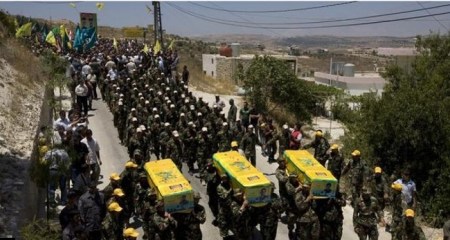
28169Funeral of Hizbullah fighters killed in Syria (image: Safa.ps)

“[Since its founding], the resistance [i.e. Hizbullah] never found itself deployed on several fronts and facing more than one challenge and more than one danger at once [as is happening today]. These four years since it became involved in the war in Syria represent the greatest trial it has [ever] faced… The movement has never paid in flesh, blood and abilities as it has paid [during the Syria war] and as it may continue to pay in the future, in the open confrontation with the takfiri [groups, i.e. the groups fighting against the Assad regime in Syria].[3] [So far] over 1,000 [fighters] have died and thousands have been wounded and disabled, and many others may meet [the same fate] in the ever-expanding confrontation that is becoming more difficult and more aggressive every day. This, especially since the horizon of a political solution seems to have been eliminated for the foreseeable future.

“Amid all this comes the 16th [anniversary] of the liberation [of South Lebanon], which underscores an element that Israel cannot ignore, namely the strengthening of the security and stability equation on both sides of the Palestine-Lebanon border. [This is] thanks to the deterrence system, or more accurately the balance of terror, which is an equation that has turned South Lebanon into the most secure region in the entire Middle East. Though we must not ignore other factors, no less important, [that contribute to this security], including [UN] Resolution 1701, UNIFIL and the Lebanese army.

“The celebrations of liberty are held amid heartbreak mixed with joy. Heartbreak [at the sight of] the processions of martyrs crossing the boundary south of the Litani every day [i.e. bodies of Hizbullah fighters killed in Syria being returned to Lebanon for burial], and joy [at the sight of] the processions [of people] rejoicing over [Hizbullah’s victory in some of] the local elections [that have been held in Lebanon in recent weeks]…

“The heartbreak over the martyrs is a necessary tax [that must be paid] in the struggle, [a struggle] which the Lebanese, of all sectors, regard as existential, even though they are divided on whether the preemptive war against the terrorists outside the borders of the homeland is justified. This heartbreak is present in every home in South [Lebanon]… When Hizbullah secretary-general Hassan Nasrallah speaks at Liberation Day ceremonies [today] in the town of Al-Nabi Shayth in the Bekaa [Valley], he will be speaking to a public that has contributed to the resistance [by supporting Hizbullah’s activity in Syria] just as residents of the South have contributed [in fighting against Israel], and perhaps even more, since [Bekaa Valley residents] face a danger today on their eastern border that is just as bad as the Israeli danger.

“It is right to say that the men of resistance on the eastern border complement the mission of the first men of resistance [who operate against Israel], who work day and night [along the border, from] the last border point in Al-Naquora to [the one in] Kfar Shouba, conducting observations, preparing, and digging tunnels that cause the settlers and enemy soldiers to lose sleep. [All this they do] without abandoning the [other] tasks of the resistance, which stands ready, openly and secretly, throughout Lebanon, and especially in the Southern Dahiya, in order to prevent any terrorist attack by the takfiris, in full coordination with the Lebanese army and Lebanon’s other security apparatuses. There might be further expansion of Hizbullah’s battle front, in accordance with future challenges, and this expansion turns this Lebanese group [Hizbullah], which was established 34 years ago in Sheikh ‘Abdallah’s base in Baalbek, into a regional force that formulates new equations in the region…

“In all of its rounds of fighting with the Israeli enemy, the resistance never faced what it has been facing for years in confronting the dark [elements] armed with the Prophet Muhammad’s Koran and Sunnah, who receive funding from tyrannical regimes and innumerable intelligence apparatuses, and are armed with military [equipment] that only armies possess.”

“The resistance also never experienced a four-year war in an area several times larger than Lebanon [itself]. It never experienced [war] against groups that imitate its methods and ways of warfare, but [who] instead of blowing themselves up against an Israeli convoy terrorize innocent people in the cities and villages, without batting an eyelash, as happened in the southern Dahiya or yesterday in Tartus and Jableh.

“The resistance never experienced war against groups fighting in caves and in the hills, mountains, wadis and even deserts, as happened at Tadmor and in the rural areas of Homs and Aleppo… Before [the war with Syria], the resistance did not storm cities and did not fight armies deep in the mountains.  Before this, no one lay in wait for it in tunnels like the ones that only it used to excavate, and [the doctrine of which] it spread to the rest of the men of the resistance, particularly to the Palestinians in the Gaza Strip.

“All these have been the unique characteristics of the resistance throughout the 16 years since May 25, 2000. All these [characteristics] and others will cause Hassan Nasrallah to declare that defending the achievement of liberation will end only with the defeat of the terrorists…”

Endnotes:

[1] Regarding the issue of the tunnels, it should be noted that Ibrahim Al-Amin, chairman of the board of the Lebanese dailyAl-Akhbar, wrote in a January 13, 2014 article that Hamas members fighting in Syria, in the Al-Quseir area and other regions, had dug tunnels there, similar to the ones excavated by Hamas in Gaza. He explained that Hizbullah had taught Hamas to dig these tunnels in the days when the two organizations were cooperating in smuggling arms into Gaza and preparing military plans against Israel.

[2] Al-Safir (Lebanon), May 25, 2016.

[3] Hizbullah, like the Syrian regime, does not draw a distinction between the rebels and the Salafi-jihadi groups.

Hamas is Fantastic!!

May 26, 2016
Published on May 22, 2016
Ami Horowitz

Would university students donate money to Hamas to blow up schools and hospitals? Watch and find out!!!

Smugglers Caught Red-Handed Exporting Mortar Parts From Hebron to Gaza

May 26, 2016

Hamas has a factory in Hebron to manufacture parts for its weapons which ships the goods the Gaza. This time the smugglers were caught.

By: Hana Levi Julian

Published: May 26th, 2016

Source: The Jewish Press » » Smugglers Caught Red-Handed Exporting Mortar Parts From Hebron to Gaza

A recent joint operation by Israeli military, police, customs and tax officials and Shin Bet intelligence agents has turned up a massive shipment of military parts headed for Gaza from Hebron. It is also now clear there is a Hamas manufacturing facility in the ancient Judean city.

Terrorists were caught red-handed with contraband – weaponry parts – at the Tarqumiya crossing near Hebron with a large shipment headed for the Kerem Shalom crossing into Gaza.

The shipment was listed as textiles and jewelry, and was huge, according to a statement by security officials.

But hidden among the goods were a lot of electric motors that are useful for building tunnels – attack tunnels – and special cuttings for mortars and rockets.

Gaza’s ruling Hamas terrorist organization has, in fact, a manufacturing and distribution center set up in Hebron, with a plant there to produce parts for its war machine.

Imagine what might have happened, if the Tarqumiya checkpoint no longer existed?

Or if the Kerem Shalom crossing were simply wide open, as Turkey continues to demand?

 Turkey’s President Erdogan ‘Waiting for Israel’ to Respond on Gaza

May 21, 2016

Pres. Erdogan says Turkey will mend ties with Israel if Jerusalem agrees to allow Ankara to repair water, energy and infrastructure in Gaza.

By: Hana Levi Julian Published: May 21st, 2016

Source: The Jewish Press » » Turkey’s President Erdogan ‘Waiting for Israel’ to Respond on Gaza

Turkey’s President Recep Tayyip Erdogan.
Photo Credit: Social media

President Recep Tayyip Erdogan says he is waiting for Israel to grant permission for Turkey to construct energy and water transfer infrastructure in Gaza, according to a report published Saturday (May 21) in the Hurriyet Daily News, quoting an earlier broadcast.

“I expect that something will happen this month. It’s my wish that we’ll reach a conclusion in a short time,” Erdogan told a news broadcast by A Haber on May 19.

“In regards to [lifting] the embargo, they say, ‘We are open to allowing goods into Gaza through Turkey, but we are not open to those coming from places other than Turkey.’ But the problem is not only this. We have some other demands,” Erdogan said.

The Turkish leader said Ankara has demanded that Israel allow provision of continuous energy to Gaza, “as the enclave has only three to four hours of electricity per day,” Erdogan said.

He added that Turkey’s proposal to provide electricity to Gaza through a naval vessel was rejected by Israel.

“But they proposed something else: We told them that we are ready to construct all the infrastructure [of energy]. They viewed the proposal positively,” Erdogan said.

The second demand, he said, was that Turkey be allowed to provide water to Gaza either by desalinating the sea water or by drilling wells. “There are positive developments with regard to this issue as well,” he said.

Turkey’s third demand from Israel, said Erdogan, was regarding construction projects in Gaza.

“Our third offer is about building schools and hospitals. The construction of a hospital has been completed and necessary equipment is being provided. ‘These must be done,’ we told them. ‘If these would be done, then we’ll immediately appoint ambassadors and improve our relations in the right direction.’”

According to the report, Israeli and Turkish diplomats are expected to meet in the near future to finalize an agreement between the two countries.

But it’s impossible to know what the final outcome will be: Erdogan’s ruling Justice and Development (AK) Party is set to meet at a nationwide Congress on May 22 to choose a new prime minister.

Incumbent Prime Minister Ahmet Davutoglu, hand-picked by Erdogan, resigned his position earlier this month.