Posted tagged ‘Gulf states’

Iran, North Korea, nukes and Obama

March 30, 2015

Iran, North Korea, nukes and Obama, Dan Miller’s Blog, March 30, 2015

(The views expressed in this article are mine and do not necessarily reflect those of Warsclerotic or its other editors. — DM)

North Korea has ample nukes and wants money. Iran wants (and may already have) nukes, has money and will have more as sanctions are ended. The two rogue nations have long had a symbiotic relationship and it has not diminished. Yet “our” P5+1 negotiators, under the leadership of Obama’s minions, ignore that inconvenient problem as well as Iran’s missile development, “possible” nuclear weaponization and increasing regional hegemony.

I wrote about the Iran – North Korea connection back in 2013 in articles titled China, Iran and North Korea — a radioactive stew,  Iran, North Korea and Nuke Negotiations and elsewhere. As I noted in the radioactive stew article,

The main thing that puzzles me is why we continue to focus on Iran’s uranium enrichment. Is Iran (again) playing us for suckers? North Korea is fully capable of enriching uranium for Iran (or for anyone else) and would doubtless be happy to enrich as much as may be desired in exchange for the hard currency freely available to Iran if it were only to cease its own enrichment. North Korea needs the money and is not likely very particular about its sources. Just as our sanctions have not impacted Iran’s enrichment capabilities significantly, neither have they impacted those of North Korea. Perhaps we may awaken before it’s too late and notice Iran playing its Korean hole card in our high-stakes poker game.

We have not awakened and the problem has worsened since 2013.

Soure: American in North Korea

Soure: American in North Korea

In 2014, I summarized several earlier articles in one titled The Iran scam continues. There, I pointed out that the English language version of the interim P5+1 deal and the White House summary generally ignore “undisclosed” — but known — Iranian sites for missile and warhead development and the work done there– despite warnings from the International Atomic Energy Agency. I also noted the Iran – North Korea nexus. Again, the situation has become worse since then. As the magic date of March  31, 2015 arrives, Iran is still demanding – and likely will get — more and more concessions.

“The Iranians are again outplaying the Americans,” said one source in Europe familiar with the negotiations. “They know they’ll have to give up certain things eventually. So they’re digging in their heels on issues that mean everything and preparing to give ground on relatively minor issues—but not yet, and not until they see how much more the Americans are willing to give.” [Emphasis added.]

. . . .

“Iran has successfully dragged the administration toward their positions to attain massive concessions, and, sensing that kind of weakness, they are seeking to press their advantage to gain further ground on critical points,” according to the source, who added that on the sanctions relief front, Iran is seeking a rollback “without dismantling anything.” [Emphasis added.]

a1  Obama and Kahameni -building a toaster

What might Iran be willing to give up in order to get additional important concessions? How about stuff that North Korea will be pleased to do in exchange for a share of the extra funds Iran will have as sanctions are eliminated?

Occasionally but not often, news media raise the Iran – North Korea connection. For example, a March 29th article at the Washington Post by Ali Alfoneh and Reuel Marc Gerecht is titled What else is Iran hiding? Another article at the Daily Beast by Gordon G. Chang is titled Does Iran Have Secret Nukes in North Korea?

As noted in the Washington Post article,

The unfinished North Korean-designed reactor that was destroyed by Israeli planes on Sept. 6, 2007, at Deir al-Zour in Syria was in all likelihood an Iranian project, perhaps one meant to serve as a backup site for Iran’s own nuclear plants. We draw this conclusion because of the timing and the close connection between the two regimes: Deir al-Zour was started around the time Iran’s nuclear facilities were disclosed by an Iranian opposition group in 2002, and the relationship between Shiite-ruled Syria and Shiite Iran has been exceptionally tight since Bashar al-Assad came to power in 2000. We also know — because Ali Akbar Hashemi Rafsanjani, the former Iranian president and majordomo of the political clergy, proudly tells us in his multivolume autobiography — that sensitive Iranian-North Korean military cooperation began in 1989. Rafsanjani’s commentary leaves little doubt that the Iranian-North Korean nexus revolved around two items: ballistic missiles and nuclear-weapons technology. [Emphasis added.]

. . . .

The Iranian-North Korean contacts intensify in 1992, the year that Rafsanjani, with Rouhani at his side, launches a policy of commercial engagement with the Europeans. On Jan. 30, Rafsanjani receives intelligence minister Ali Fallahian and Mostafa Pourmohammadi, the ministry’s director of foreign espionage, to discuss “procurement channels for sensitive commodities.” On Feb. 8, Rafsanjani writes, “The North Koreans want oil, but have nothing to give in return but the special commodity. We, too, are inclined to solve their problem.” Rafsanjani orders defense minister Akbar Torkan to organize a task force to analyze the risks and benefits of receiving the “special commodity.” This task force recommends that the president accept the “risk of procuring the commodities in question.” Rafsanjani adds that “I discussed [this] with the Leader [Ayatollah Ali Khamenei] in more general terms and it was decided to take action based on the [task force’s] review.” [Emphasis added.]

It’s most unlikely that the “special commodity” and the technical know-how surrounding it have anything to do with ballistic missiles; Rafsanjani expresses anxiety that the “special commodity” could be intercepted by the United States, but doesn’t share this worry about missile procurement. In a March 9, 1992, journal entry, the cleric gloats about the U.S. Navy having tracked a North Korean ship bound for Syria but not two ships destined for Iran. Two days later, when the “special commodity” is unloaded, he writes: “The Americans were really embarrassed.” [Emphasis added.]

. . . .

Odds are good that North Korea helped to jump-start Iran’s nuclear-weapons program. If so, how long did this nefarious partnership continue?

Rouhani was Rafsanjani’s alter ego. He’s undoubtedly the right man to answer all of the PMD questions that the IAEA keeps asking and the Obama administration keeps avoiding. [Emphasis added.]

As noted at the Daily Beast article,

In October 2012, Iran began stationing personnel at a military base in North Korea, in a mountainous area close to the Chinese border. The Iranians, from the Ministry of Defense and associated firms, reportedly are working on both missiles and nuclear weapons. Ahmed Vahidi, Tehran’s minister of defense at the time, denied sending people to the North, but the unconfirmed dispatches make sense in light of the two states announcing a technical cooperation pact the preceding month.

. . . .

[N]o inspections of Iranian sites will solve a fundamental issue: As can be seen from the North Korean base housing Tehran’s weapons specialists, Iran is only one part of a nuclear weapons effort spanning the Asian continent. North Korea, now the world’s proliferation superstar, is a participant. China, once the mastermind, may still be a co-conspirator. Inspections inside the borders of Iran, therefore, will not give the international community the assurance it needs.

The cross-border nuclear trade is substantial enough to be called a “program.” Larry Niksch of the Center for Strategic and International Studies in Washington, D.C., estimates that the North’s proceeds from this trade with Iran are “between $1.5 billion and $2.0 billion annually.” A portion of this amount is related to missiles and miscellaneous items, the rest derived from building Tehran’s nuclear capabilities. [Emphasis added.]

Iran has bought a lot with its money. Mohsen Fakhrizadeh, thought to be Tehran’s chief nuclear scientist, was almost certainly in North Korea at Punggye-ri in February 2013 to witness Pyongyang’s third atomic test. Reports put Iranian technicians on hand at the site for the first two detonations as well.

The North Koreans have also sold Iran material for bomb cores, perhaps even weapons-grade uranium. The Telegraph reported that in 2002 a barrel of North Korean uranium cracked open and contaminated the tarmac of the new Tehran airport.

. . . .

Even if Iran today were to agree to adhere to the Additional Protocol, it could still continue developing its bomb in North Korea, conducting research there or buying North Korean technology and plans. And as North Korean centrifuges spin in both known and hidden locations, the Kim regime will have a bigger stock of uranium to sell to the Iranians for their warheads. With the removal of sanctions, as the P5+1 is contemplating, Iran will have the cash to accelerate the building of its nuclear arsenal.

So while the international community inspects Iranian facilities pursuant to a framework deal, the Iranians could be busy assembling the components for a bomb elsewhere. In other words, they will be one day away from a bomb—the flight time from Pyongyang to Tehran—not one year as American and other policymakers hope. [Emphasis added.]

Why does the Obama administration persistently avoid raising the Iran – North Korea nexus? Perhaps doing so would scuttle the “negotiations” and thereby Obama’s dreams about His legacy. Perhaps Obama is keen for Iran to have, and be in a position to use, nukes to enhance its hegemony over the Middle East and to displace Israel as well as regional Arab allies in the Gulf states. Since Israel is unwilling to commit suicide in present circumstances by agreeing to a two state solution with Palestinians — intent upon and capable of causing her destruction — that may well be His only way to bring to fruition His desire for Middle east “peace” through submission and “social justice.”

to follow the Constitution.  It's to old and too slow.

to transform the Middle East with social justice

Conclusions

The Iran – North Korea nexus, regardless of its importance, was not considered (or was considered but deemed too intractable to approach) when the framework for the P5+1 negotiations was decided and it will not be considered now. That’s bad and dangerous. If a deal with Iran evolves from the current mess, Obama will gloat about His legacy and the Mad Mullahs will gloat about having put one over on the weak and declining free world. That’s frustrating but otherwise of little consequence.

Because of the Iran – North Korea nexus, Iran would need little time to repair any damage Israel and/or her Arab allies might do to Iran’s existing or future nuclear infrastructure. What can and should be done? I wish I knew. Perhaps Iran’s borders could be sealed adequately to keep North Korean stuff out, but that would require an expensive long term commitment. Perhaps others will think of something better. I hope so.

NBC’s Engel: Officials Say Allies: Simply Don’t Trust” U.S. Under Obama Admin – The Five

March 28, 2015

NBC’s Engel: Officials Say Allies: Simply Don’t Trust” U.S. Under Obama Admin – The Five, Fox News via You Tube, March 27, 2015

(In other breaking news, today is Saturday, unexpectedly. Please see also, Iranian general in Sanaa to organize Yemen rebel counter-offensive for Saudi-led attacks.  — DM)


Saudi Arabia puppet of US, Israel: Houthi leader

March 26, 2015

Saudi Arabia puppet of US, Israel: Houthi leader, Press TV (Iranian), March 26, 2015

(The positions of Obama’s friends in Iran. How soon will he bow, apologize and make more concessions to Iran to atone for his sins? — DM)

bbc72135-d3b0-4924-91b3-4c85d14cbc21Tribal gunmen loyal to the Houthis Ansarullah shout slogans against Saudi Arabia during a gathering in the capital Sana’a on March 26, 2015.

The leader of Yemen’s Houthi fighters has heaped scorn on Saudi Arabia for conducing unjust and heinous attacks on Yemeni people, saying the Arab kingdom is serving as a puppet for the United States and the Israeli regime.

Abdul-Malik al-Houthi made the remarks in a televised address on Thursday in reaction to Saudi Arabia’s “unjustified” deadly attacks targeting Yemeni people in the capital, Sana’a.

Saudi Arabia is a puppet at the disposal of superpowers, the Houthi leader said, adding that Riyadh is putting in action the US-Israeli conspiracy in Yemen.

He noted that the US-Israeli plot in Yemen aims to break up the chaotic country and deprive people of security and freedom.

Al-Houthi said the Saudi invasion of Yemen came after their agents, including al-Qaeda terrorists and the ISIL Takfiri terrorists, failed to execute their plots in Yemen.

He said the “criminal” attacks uncovered the “tyrannical” nature of the Saudi regime.

Al-Houthi warned that Saudi Arabia would face consequences should it push ahead with its aggression against Yemen, saying, “We will confront the criminal forces and their tools in the country.”

“You think you can kill Yemeni people, but this is because of your stupidity,” he said. “This unjustified aggression shows the hostility and arrogance of this regime. The attacks are reflecting the inhumanity of the aggressor.”

Al-Houthi said the “aggressors” should keep in mind that the Yemeni people are “committed to defending their country and revolution” by relying on God.

On Thursday, Saudi warplanes carried out fresh airstrikes against Yemen, hitting the northern cities of Sa’ada and Ta’izz in the south.

Airstrikes also targeted arms depots in the Malaheez region in Sa’ada near the border with Saudi Arabia.

Saudi warplanes started bombing the positions of the Ansarullah fighters and launched attacks against the Sana’a International Airport and the Dulaimi airbase early on Thursday.

Despite Riyadh’s claims that it is attacking Ansarullah positions, Saudi warplanes have flattened a number of homes near the Sana’a airport. Based on early reports, the Saudi airstrikes on Yemen have so far claimed the lives of 18 civilians with more deaths feared, Yemeni sources said.

The Saudi invasion of Yemen has drawn condemnation from many countries such as Iran, Russia, Iraq and Syria, as well as the Lebanese resistance movement, Hezbollah.

The blatant invasion of Yemen’s sovereignty by the Saudi government comes against a backdrop of total silence on the part of international bodies, especially the United Nations. The world body has so far failed to show any reaction whatsoever to the violation of the sovereignty of one of its members by Riyadh.

Saudi Arabia launches airstrikes in Yemen, ambassador says

March 26, 2015

Saudi Arabia launches airstrikes in Yemen, ambassador says, Fox News, March 26, 2015

(Meanwhile, as Iranian supported Houthis take over much of Yemen, the U.S. is providing airstrikes in Tikrit to assist Iran and helping Iran to establish itself as a nuclear power. Please see also, US air force bombs Tikrit to aid Iran-led operation against ISIS. Saudi, Egyptian bombers strike Iran-backed Houthi rebels in Yemen. — DM)

032515_shep_Yemen2_640Iran-backed rebels bring Yemen to brink of civil war

Saudi Arabia launched airstrikes against the Houthi rebels in Yemen early Thursday, one day after the U.S.-backed Yemeni president was driven out of the country.

President Obama has authorized the provision of logistical and intelligence support to the military operations, National Security Council spokesperson Bernadette Meehan said late Wednesday night. She added that while U.S. forces were not taking direct military action in Yemen, Washington was establishing a Joint Planning Cell with Saudi Arabia to coordinate U.S. military and intelligence support.

Saudi Ambassador Adel al-Jubeir said the operations began at 7 p.m. Eastern time.

He said the Houthis, widely believed to be backed by Iran, “have always chosen the path of violence.” He declined to say whether the Saudi campaign involved U.S. intelligence assistance.

Al-Jubeir made the announcement at a rare news conference by the Sunni kingdom.

He said the Saudis “will do anything necessary” to protect the people of Yemen and “the legitimate government of Yemen.”

A Yemeni official earlier Wednesday would not say where Yemeni President Abed Rabbo Mansour Hadi fled to, but did tell Fox News: “He is safe. That’s all I can say at this point.”

Hadi’s departure marks a dramatic turn in Yemen’s turmoil and means a decisive collapse of what was left of his rule, which the United States and Gulf allies had hoped could stabilize the chronically chaotic nation and fight Al Qaeda’s branch here after the 2011 ouster of longtime autocrat Ali Abdullah Saleh.

Over the past year, the Shiite rebels known as Houthis, who are believed to be supported by Iran, have battled their way out of their northern strongholds, overwhelmed the capital, Sanaa, seized province after province in the north and worked their way south. Their advance has been boosted by units of the military and security forces that remained loyal to Saleh, who allied with the rebels.

With Hadi gone, there remains resistance to the Houthis scattered around the country, whether from Sunni tribesmen, local militias, pro-Hadi military units or Al Qaeda fighters.

Hadi and his aides left Aden after 3:30 p.m. on two boats, security and port officials told The Associated Press. He is scheduled to attend an Arab summit in Egypt on the weekend, where Arab allies are scheduled to discuss formation of a joint Arab force that could pave the way for military intervention against Houthis.

His flight came after Houthis and Saleh loyalists advanced against Hadi’s allies on multiple fronts. Military officials said militias and military units loyal to Hadi had “fragmented,” speeding the rebel advance. The officials spoke on condition of anonymity because they were not authorized to speak to reporters

Earlier in the day, the rebels seized a key air base where U.S. troops and Europeans had advised the country in its fight against Al Qaeda militants. The base is only 60 kilometers (35 miles) away from Aden.

In the province of Lahj, adjoining Aden, the rebels captured Hadi’s defense minister, Maj. Gen. Mahmoud al-Subaihi, and his top aide on Wednesday and subsequently transferred them to the capital, Sanaa. Yemen’s state TV, controlled by the Houthis, announced a bounty of nearly $100,000 for Hadi’s capture.

Hadi then fled his presidential palace, and soon after warplanes targeted presidential forces guarding it. No casualties were reported. By midday, Aden’s airport fell into hands of Saleh’s forces after intense clashes with pro-Hadi militias.

Aden was tense Wednesday, with schools, government offices, shops and restaurants largely closed. Inside the few remaining opened cafes, men watched the news on television. With the fall of the city appearing imminent, looters went through two abandoned army camps, one in Aden and the other nearby, taking weapons and ammunition.

The takeover of Aden, the country’s economic hub, would mark the collapse of what is left of Hadi’s grip on power. After the Houthis overran Sanaa in September, he had remained in office, but then was put under house arrest. He fled the capital earlier in March with remnants of his government and declared Aden his temporarty capital.

Yemen’s Foreign Minister Riad Yassin told Dubai-based Al-Arabiya TV satellite news network that he officially made a request to the Arab League on Wednesday to send a military force to intervene against the Houthis. Depicting the Houthis as a proxy of Shiite Iran, a rival to Sunni Gulf countries, he warned of an Iranian “takeover” of Yemen. The Houthis deny they are backed by Iran.

Mohammed Abdel-Salam, a spokesman for the Houthis, said their forces were not aiming to “occupy” the south. “They will be in Aden in few hours,” Abdel-Salam told the rebels’ satellite Al-Masirah news channel.

Earlier, Al-Masirah reported that the Houthis and allied fighters had “secured” the al-Annad air base, the country’s largest. It claimed the base had been looted by both Al Qaeda fighters and troops loyal to Hadi.

The U.S. recently evacuated some 100 soldiers, including Special Forces commandos, from the base after Al Qaeda briefly seized a nearby city. Britain also evacuated soldiers.

The base was crucial in the U.S. drone campaign against Al Qaeda in the Arabian Peninsula, which Washington considers to be the most dangerous offshoot of the terror group. And American and European military advisers there also assisted Hadi’s government in its fight against Al Qaeda’s branch, which holds territory in eastern Yemen and has claimed the attack on the French satirical magazine Charlie Hebdo in Paris.

U.S. operations against the militants have been scaled back dramatically amid Yemen’s chaos. U.S. officials have said CIA drone strikes will continue in the country, though there will be fewer of them. The agency’s ability to collect intelligence on the ground in Yemen, while not completely gone, is also much diminished.

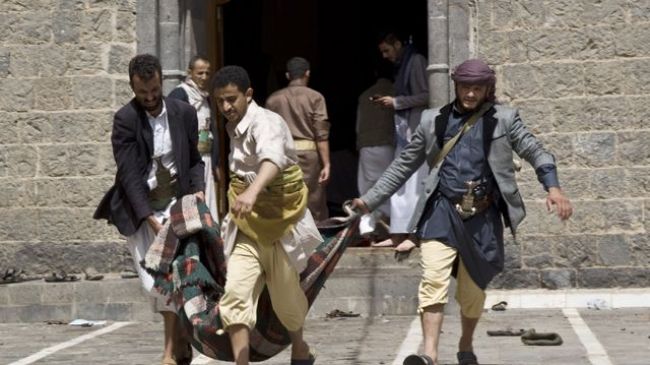
The Houthis, in the aftermath of massive suicide bombings in Sanaa last week that killed at least 137 people, ordered a general mobilization and their leader, Abdel-Malik al-Houthi, vowed to send his forces to the south to fight Al Qaeda and militant groups.

In Sanaa, dozens of coffins were lined up for a mass funeral of the victims Wednesday. Among the victims was a top Shiite cleric. Yemen’s Islamic State-linked militants have claimed responsibility for the attack.

The Houthis seized the capital, Sanaa, in September and have since been advancing south along with Saleh’s loyalists. On Tuesday, they fired bullets and tear gas to disperse thousands of protesters in the city of Taiz, known as the gateway to southern Yemen. Six demonstrators were killed and scores more were wounded, officials said.

The Houthis also battled militias loyal to Hadi in the city of al-Dhalea, adjacent to Taiz, Yemen’s third-largest city. Taiz is also the birthplace of its 2011 Arab Spring-inspired uprising that forced Saleh to hand over power to Hadi in a deal brokered by the U.N. and Gulf countries.

Hadi on Tuesday asked the U.N. Security Council to authorize a military intervention “to protect Yemen and to deter the Houthi aggression” in Aden and the rest of the south. In his letter, Hadi said he also has asked members of the six-nation Gulf Cooperation Council and the Arab League for immediate help.

Saudi Arabia warned that “if the Houthi coup does not end peacefully, we will take the necessary measures for this crisis to protect the region.”

France balks at the US-Iranian deal on five counts – not least with an eye on its Gulf ties

March 21, 2015

France balks at the US-Iranian deal on five counts – not least with an eye on its Gulf ties, DEBKAfile, March 21, 2015

hollande_obama-IranObama and Hollande fail to meet on nuclear Iran.

Why does Washington respect France’s right to balk at its nuclear policy but disallows prime minister Binyamin Netanyahu’s objections in the name of Israel’s security?

The answer is simple. It is easier to put the squeeze on the Israeli prime minister than the president of France or Gulf rulers. Obama has hit on the presentation of Netanyahu’s hawkish attitude as the main hurdle in the way of a nuclear deal as a useful tactic for dealing with the spreading opposition to the deal in Europe and the Persian Gulf.

******************

President Barack Obama failed to shift French President France Hollande from his objections to the nuclear accord taking shape between the US and Iran in the call he put through to the Elysée Friday night, March 30 [sic]. US Secretary of State John Kerry fared no better Saturday, when he met British, French and German Foreign ministers in London for a briefing on the talks’ progress intended to line the Europeans up with the American position. He then found, according to DEBKAfile’s sources, that France was not alone; Germany too balked at parts of the deal in the making.

The French are demanding changes in five main points agreed between Kerry and Iranian Foreign Minister Javad Zarif before the Iranians quit the talks Friday:

They insist that –

  • Iran can’t be allowed to retain all the 6,500 centrifuges (for enriching uranium) conceded by the Americans. This figure must be reduced.
  • Similarly, the stocks of enriched uranium accepted by the US to remain in Iranian hands are too large.
  • France insists on a longer period of restrictions on Iran’s nuclear work before sanctions are eased. It is pushing for a longer moratorium – 25 years rather than the 15 years offered by the Obama administration – and guarantees at every stage.
  • The main sticking point however is France’s insistence that UN sanctions stay in place until Iran fully explains the evidence that has raised suspicions of past development work on a nuclear warhead design. The Iranians counter that they could never satisfy the French condition, because they would never be able to prove a negative and disprove evidence of a weapons program that is forged.There is no chance of Tehran ever admitting to working on a nuclear warhead – or allow US inspectors access to suspected testing sites – because that would belie supreme leader Ayatollah Ali Khamenei’s solemn contention that Iran’s nuclear program is solely for peaceful purposes and always has been.

DEBKAfile’s Gulf sources disclose that the tough French bargaining position in the nuclear stems partly from its intense ties with Saudi Arabia and other Gulf nations, including the United Arab Emirates.

France maintains military bases in the Gulf, including air and unit units in Saudi Arabia and the UAE. The emirates moreover have become the most profitable market for the French munitions industry.

Riyadh and Abu Dhabi have been pushing Paris hard not to sign off on the text shaping up between the Obama administration in Tehran because they believe it would place their national security at grave risk.

This raises an interesting question: Why does Washington respect France’s right to balk at its nuclear policy but disallows prime minister Binyamin Netanyahu’s objections in the name of Israel’s security?

The answer is simple. It is easier to put the squeeze on the Israeli prime minister than the president of France or Gulf rulers. Obama has hit on the presentation of Netanyahu’s hawkish attitude as the main hurdle in the way of a nuclear deal as a useful tactic for dealing with the spreading opposition to the deal in Europe and the Persian Gulf.

Book review: The Islamic War

March 16, 2015

The Islamic War: Book review, Dan Miller’s Blog, March 16, 2015

(The views expressed in this article are mine and do not necessarily reflect those of Warsclerotic or its other editors. — DM)

The Islamic War, Martin Archer, 2014

The novel begins with a terror attack on a residential area in Israel, resulting in multiple causalities. It may, or may not, have involved members of the Iranian Revolutionary Guard. Menachem Begin is the Israeli Prime Minister and Ariel Sharon is the Defense Minister. The story begins immediately after the (postponed?) end of the Iran – Iraq war in 1988.

A massive armor, infantry, artillery and air attack on Israeli positions in the Golan follows the terrorist attack. The Israelis are outnumbered and suffer many thousands of casualties.

Israel had anticipated a simultaneous attack via Jordan, so most Israeli tank, infantry and air resources are deployed there, rather than in the Golan, to conceal themselves and await the arrival of Iranian, Iraqi and Syrian forces. They come and are defeated, most killed or fleeing. The Israeli forces then move into Syria and have similar successes there as well.

As the story evolves, it becomes evident that Israel must have known that the Iran – Iraq war had been allowed to fester to permit Iran, Iraq and Syria to develop a well coordinated plan to dispose of Israel, in hopes that a surprise attack could be made as soon as the Iran – Iraq war ended. Other events also suggest that Israel had prior notice:

Nuclear facilities of several hostile nations explode mysteriously.

The Israeli Navy had managed to infiltrate Iranian oil ports — apparently before the attack on the Golan — without being noticed. Then, at a propitious moment near the end of the fighting elsewhere, they destroyed all oil tankers in, entering or leaving port, along with all Iranian oil storage facilities.

The Israel Navy, which had suffered no losses, then moved to Saudi Arabia to protect her oil ports and ships coming to buy her oil and leaving.

As these events unfold, Israel, Egypt, Jordan, Saudi Arabia and Turkey* are negotiating a united front against Iran, Iraq and Syria, much to the displeasure of the U.S. Secretary of State, who wants a cease fire and return to the status quo ante. Fortunately, the U.S. President favors Israel and her coalition and generally ignores his SecState.

I won’t spoil the story by relating what happens at the end, but it’s very good for Israel, Egypt, Jordan, Saudi Arabia, Turkey and the Kurds, and very bad for Iran, Iraq and Syria. The novel is well worth reading, perhaps twice.

_____________

*Historical note: Turkey in 1988 was reasonably secular and also in other ways quite different from now. Egypt under President Al-Sisi is, in some but not all respects, similar to Egypt in 1988 under President Mubarak. Beyond a good relationship with Israel, Al-Sisi is working to modernize and reform Islam by turning it away from the violent jihad which drives both the Islamic State (Sunni) and the Islamic Republic of Iran (Shiite). Egypt remains under fire from the Obama administration due to the “coup” which ousted President Morsi, who had made Egypt essentially an arm of the Muslim Brotherhood. Egypt now helps to protect Israel with her military presence in the Sinai to oppose Hamas and Muslim Brotherhood activities there. Saudi Arabia and Jordan, like most countries in the Middle East, look out for the interests of their rulers first and are quite concerned about both the Islamic State and Iran.

Iran’s advances create alarm in Saudi Arabia and the Gulf

March 14, 2015

Iran’s advances create alarm in Saudi Arabia and the Gulf, the Guardian,  March 13, 2015

Arabs believe Baghdad, Damascus, Beirut and Sana’a are in effect under Iranian control – and power may shift further if US sanctions are eased.

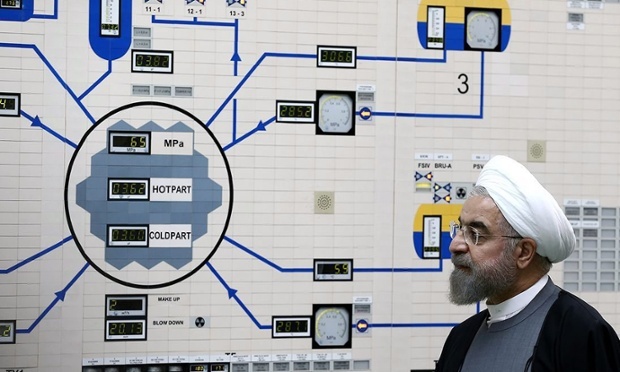
c0ac3569-93da-4ae8-8b51-29dc6991ee13-620x372 Hassan Rouhani, the Iranian president, visiting Bushehr nuclear power plant in southern Iran this year. Photograph: Presidential official handout/EPA

Iran’s great advantage, suggests Emile Hokayem, an analyst, is its commitment and competence, in Syria and beyond. “The expertise, experience and strategic patience it deployed in support of the Syrian regime to a great extent facilitated Assad’s recovery from serious setbacks in 2012. In contrast, the war in Syria has exposed not only the political and operational limitations of the Gulf states, but also the rivalries among them.”

*********************

The commanders of Iran’s Islamic Revolutionary Guard Corps (IRGC) have been working overtime recently, flaunting their achievements across the Middle East and flexing muscles as international negotiations over the country’s nuclear programme enter their critical and perhaps final phase.

On Wednesday it was the turn of Major-General Mohammad Ali Jafari, the IRGC’s most senior officer. “The Islamic revolution is advancing with good speed, its example being the ever-increasing export of the revolution,” he declared. “Not only Palestine and Lebanon acknowledge the influential role of the Islamic Republic but so do the people of Iraq and Syria. They appreciate the nation of Iran.”

Last month a similarly boastful message was delivered by General Qassem Suleimani, who leads the IRGC’s elite Quds force — and who is regularly photographed leading the fightback of Iraqi Shia miltias against the Sunni jihadis of the Islamic State (Isis) as well as against western and Arab-backed rebels fighting Bashar al-Assad in southern Syria. “Imperialists and Zionists have admitted defeat at the hands of the Islamic Republic and the resistance movement,” Suleimani said.

Iran’s advances are fuelling alarm in Saudi Arabia and the Gulf, where Tehran has been a strategic rival since the days of the Shah, and which now, it is said with dismay, in effect controls four Arab capitals – Baghdad, Damascus and Beirut and in the last month Sana’a in Yemen – which is uncomfortably close to home.

Iran’s regional position has certainly improved. Its high-profile role fighting Isis in Iraq, Assad’s retention of control in Syria with the help of its Lebanese ally Hezbollah, and the Houthi rebel takeover in Yemen have all been deeply discomfiting for the Saudis. Anti-government protests in Shia-majority Bahrain are also often blamed on Tehran — though that ignores the domestic roots of the unrest.

In Riyadh King Salman has dropped his preoccupation with the Muslim Brotherhood in favour of building a united Sunni Arab front to confront the Iranians, diplomats say, though translating that strategy into action is another matter. The message from Saudi Arabia and the United Arab Emirates is that whatever the outcome of the nuclear talks, Iran is bent on expanding its power and influence. “The Iranians have scored major victories but only where there are Shia minorities,” a senior Gulf official told the Guardian. “Our concern is that the nuclear issue will become a tool of their foreign policy.”

Arab alarm is shared by Israel. Binyamin Netanyahu used identical arguments in his recent speech to the US Congress, timed to influence next week’s nuclear endgame in Geneva. “The Saudis will be incredibly worried that we are getting close to a point where the Iranians will be players because of the nuclear issue and the way the Americans have effectively ended up on the same side as the Iranians in Iraq,” said one veteran Saudi-watcher. “But the noise they are making is in inverse proportion to their ability to do anything about it.”

Arab governments are not reassured by the promises of John Kerry, the US secretary of state, that Washington is not seeking a “grand bargain” with Tehran that will allow it to “destabilise” the Middle East, bolstered by the easing of economic sanctions. Saud Al Faisal, the Saudi foreign minister, warned of Tehran’s “hegemonic” ambitions as the IRGC supported the military operation to retake the Iraqi town of Tikrit from Isis. In Gulf capitals Hassan Rouhani, the emollient Iranian president, is seen as less important than the hardline supreme leader, Ayatollah Ali Khamenei.

It is hard to disentangle propaganda from reality. But independent analysts argue that Iran is inflating its gains for both foreign and domestic consumption. “If you listen to Suleimani there is a degree of exaggeration,” argues Ali Ansari of St Andrews University. “It’s rhetorical reassurance. He is saying to Iranians: ‘We are powerful and and everyone is worried about this’ – partly to make the point that they are not really under pressure. People outside can see what Iran’s strengths and weaknesses are. But there is this belief that you need to negotiate from a position of strength and that if you are weak you will be trampled on.”

Iran-watcher Hossein Rassam also detects a domestic calculation in the IRGC statements. “Critics of Rouhani’s policy of rapprochement with the international community inside Iran can turn to the supreme leader and say there wasn’t really much need for that softer tone because now we have more bargaining chips in our hands. Iran is the only power in the region which can actually fight Isis and the west needs us for that.”

Meir Litvak, an Israeli expert on Iran, sees both genuine belief and posturing in Tehran’s stance. “The Iranians believe they have been able to save the Assad regime from total collapse and there is at least stalemate in Syria,” he said. “That means they have been able to maintain the link with Hezbollah and maybe open a second front by proxy against Israel on the Golan Heights. The Houthi rebellion in Yemen was initially a genuinely domestic affair but the Iranian regime saw it as an opportunity. And it has become a bonus for it – even if they are not that active inYemen. But if the Saudis are scared that’s a plus for the Iranians.”

Arab diplomatic sources say they expect to see an IRGC and Hezbollah presence in Yemen, helped by a new agreement on regular flights between Tehran and Sana’a.

Iran’s role in Bahrain, where the Shia majority remains locked in confrontation with the Saudi-backed Sunni monarchy, is more about scoring propaganda points than material support – despite claims in Manama about Iran’s sinister role.

Still, in the heartlands of Iranian influence, Iraq and Syria, there have been significant costs as well as benefits, including the deaths of two senior IRGC commanders. Continuing sanctions and low oil prices – seen in Tehran as a deliberate strategy by the Saudis – have also made it harder to shell out billions of dollars to subsidise the Assad regime.

Iran’s great advantage, suggests Emile Hokayem, an analyst, is its commitment and competence, in Syria and beyond. “The expertise, experience and strategic patience it deployed in support of the Syrian regime to a great extent facilitated Assad’s recovery from serious setbacks in 2012. In contrast, the war in Syria has exposed not only the political and operational limitations of the Gulf states, but also the rivalries among them.”